

Adolescent and young adult romantic relationships have significant implications for mental health (Collins, Reference Collins2003). Yet, their importance has been evaluated on a continuum from the most common cause of strong positive and strong negative emotions, to transitory and irrelevant from a clinical perspective (Furman, Reference Furman2002; Furman & Shaffer, Reference Furman, Shaffer and Florsheim2003). This variety of opinions is unsurprising and may stem from the limited focus on adolescent and young adult romantic relationships, with most studies being focused on adult marital dissolution (Mastekaasa, Reference Mastekaasa1997; Tschann, Johnston, & Wallerstein, Reference Tschann, Johnston and Wallerstein1989; Williams & Siegel, Reference Williams and Siegel1989).
Romantic relationship quality (RRQ) is defined as ‘the degree to which the relationship provides generally beneficent experiences [. . .] in which partners manifest intimacy, affection, and nurturance’ (Collins, Reference Collins2003, pp. 10–11). RRQ has been referred to as a ‘relationship well-being barometer’ with regard to an individual's subjective experience of how satisfied they are in their relationship (Karney & Bradbury, Reference Karney and Bradbury1995). Studies examining the associations between RRQ and mental health outcomes among early- and late-adolescent groups have rendered mixed results. On the one side, as one would expect, certain stressful features or experiences that occur within a romantic relationship may be associated with depression and/or suicide ideation or behaviours (Furman & Shaffer, Reference Furman, Shaffer and Florsheim2003). For example, increased depression, especially among adolescent girls, was associated with: (a)
the perception of inequality of emotional investment in a romantic relationship and/or in the relationship decision making (Galliher, Rostosky, Welsh, & Kawaguchi, Reference Galliher, Rostosky, Welsh and Kawaguchi1999; La Greca & Harrison, Reference La Greca and Harrison2005), (b) lower levels of intimacy in their romantic relationships (Williams, Connolly, & Segal, Reference Williams, Connolly and Segal2001), and (c) lower emotional support and higher relationship-related stress (Daley & Hammen, Reference Daley and Hammen2002). Other romantic relationship quality indicators associated with depression include conflict behaviours (e.g., verbal attacks) among young adult couples (Marchand-Reilly, Reference Marchand-Reilly2009) and perceived maltreatment or hassles by partners (Gallaty & Zimmer-Gembeck, Reference Gallaty and Zimmer-Gembeck2008). Thus, the association between involvement in romantic relationships and depression seems to be attributable to the characteristics of the relationship and/or of the partner rather than to romantic involvement per se (Collins, Reference Collins2003). At the same time, other research studies proposed that romantic involvement in adolescence relates to increased risk for depression (Davila, Reference Davila2008; Davila, Steinberg, Kachadourian, Cobb, & Fincham, Reference Davila, Steinberg, Kachadourian, Cobb and Fincham2004; Gotlib, Lewinsohn, & Seeley, Reference Gotlib, Lewinsohn and Seeley1998; Welsh, Grello, & Harper, Reference Welsh, Grello, Harper and Florsheim2003) even after controlling for initial depression levels (Joyner & Udry, Reference Joyner and Udry2000).
Romantic relationships breakups (RRB) are commonplace among adolescents and young adults, with 23% of adolescents having experienced a breakup in the past 6 months (Connolly & McIsaac, Reference Connolly and McIsaac2009) and 98% of adolescents having experienced a breakup at any time in the past (Morris & Reiber, Reference Morris and Reiber2011). Despite the view that adolescents and young adults are just learning about romantic relationships and that RRBs would thus be expected to take less of an emotional toll given their age-related normalcy (Brown, Reference Brown, Crouter and Booth2006), RRBs might in fact be associated with significant emotional difficulties, such as increased likelihood of experiencing the onset of a first major depressive episode (even after controlling for other life stressors; Monroe, Rhode, Seeley, & Lewinsohn, Reference Monroe, Rohde, Seeley and Lewinsohn1999) and medically serious suicide attempts among young adults (Donald, Dower, Correa-Velez, & Jones, Reference Donald, Dower, Correa-Velez and Jones2005).
Age-related (i.e., developmentally influenced) differences regarding the ways relationships are defined might shape individuals’ experiences of romantic relationships and breakups. Some have argued that the emotional impact of a RRB might be even stronger at younger versus older ages (Chen et al., Reference Chen, Guo, Yang, Li, Duan, Zhang and Ge2009). However, the research evidence is scarce regarding the role of age as a moderator of the association between adolescent romance and depression or suicide ideation.
The existing literature also raises the question of gender differences regarding the association between romantic relationships and RRBs and depression. Females, as compared with males, might experience increased symptoms of depression following a RRB (Mearns, Reference Mearns1991; Monroe et al., Reference Monroe, Rohde, Seeley and Lewinsohn1999; Natsuaki et al., Reference Natsuaki, Klimes-Dougan, Ge, Shirtclif, Hastings and Zahn-Waxler2009). Yet, other findings indicate that young males’ depressive symptoms were related more to breakups, while young females’ depressive symptoms were related more to other elements of romantic relationships (Chen et al., Reference Chen, Guo, Yang, Li, Duan, Zhang and Ge2009, p. 1287). Still, no significant differences were found between male and female college students regarding their emotional and physiological reactions to a RRB (Morris & Reiber, Reference Morris and Reiber2011).
In sum, there seems to be an agreement that an association between RRQ and/or RRB with mental health outcomes exists among adolescents and young adults. However, the magnitude of this association is still uncertain; the relative weight of RRB compared to RRQ has not been established, and moderators of this relationship such as age and gender are not well understood. One of the most comprehensive up-to-date articles on this topic — a literature review by Davila (Reference Davila2008) — only provided a theoretical framework for explaining the association between romantic breakups and depression and/or suicide ideation. We were not able to locate any meta-analyses on the proposed topic.
The present meta-analysis was conducted to examine the overall strength of the association between RRQ and RRB on one side, and mental health outcomes on the other side. We use ‘mental health outcomes’ as an umbrella term that includes depression, suicide ideation, deliberate self-harm, and suicide attempts. While recognising these are discrete concepts, they are undeniably interrelated and often treated as relatively synonymous within the existing literature on this topic. In addition, we examined whether the strength of this association varied as a function of gender and age. This meta-analysis included only adolescents (13–17 years old) and young adults (18–29 years old) in an attempt to fill the existing literature gap regarding adolescent and young adult romantic relationships as associated with mental health outcomes.
The specific research questions addressed by the present meta-analysis were:
-
1. What is the overall strength of the association between measures of mental health outcomes (i.e., depression, suicide ideation, deliberate self-harm, and suicide attempts) and (a) the experience of romantic breakup(s); and (b) the quality of one's romantic relationship among adolescents and young adults?
-
2. Do gender, age, nationality, or the nature of the assessment measures employed moderate the strength of this association, and if yes, what is their weighted significance?
Method
Study Selection and Coding
An extensive literature search was conducted in order to identify studies that met the following inclusion criteria: (1) a sample of participants who were either adolescents (13–17 years old) or young adults (18–29 years old); (2) assessments of depression, suicide ideation, suicide attempts, or deliberate self-harm, as well as a measure of romantic breakups or romantic relationship quality; (3) written in English; and (4) examined normal, developmental romantic relationships (as opposed to specifically targeting negative or abusive relationships). Measures of relationship quality were broadly defined for the purpose of this study to encompass both cognitive (e.g., security of attachment, satisfaction) and behavioural (e.g., conflict resolution) dimensions. Studies were excluded if focused on clinical samples of adolescents or young adults with a diagnosed mental health disorder and a prior history of receiving psychiatric services.
As a first step, literature searches for articles published in peer-reviewed journals and for unpublished dissertations, starting at January 1990, were conducted. An initial search was conducted in PsycINFO, Academic Search Premier, Social Work Abstracts, Web of Science, and Sociological Abstracts. The initial search terms were: (teenag* or adolesc* or youth or young) and (suicid* or ‘suicide ideation’ or ‘self-harm’ or ‘self harm'or depress*) and (romantic or ‘break-up’ or breakup or reject*) not (bipolar or ‘mental illness’ or crisis or homeless or jail or ‘personality disorder’ or alcohol or substance or borderline or brain or medication or schizophrenia or bully*). In a second step, search terms were slightly modified to: ‘relationship termination’ or breakup or ‘relationship dissolution’ and depression or ‘major depression’ or suicide or ‘attempted suicide’ or ‘suicide ideation’ or ‘self-destructive behaviors’ or ‘affective disorders’ or ‘major depression’ or ‘self-mutilation’ or ‘self-destructive behaviors’ and the age groups selected were adolescence (13–17 years old) and young adulthood (18–29 years old). The search of sociological abstracts also excluded articles with ‘relationship violence’ in the title or abstract due to the large number of such articles obtained through an initial search. Results from all searches were combined, duplicates were removed, and titles/abstracts were scanned for irrelevant studies. The reference sections of eligible articles, as well as a recent qualitative review (Davila, Reference Davila2008), were also examined to identify additional studies.
Zero-order correlation coefficients were the effect size of primary interest and were extracted from all articles deemed eligible for inclusion. Effect sizes presented in other metrics (e.g., Cohen's d, odds ratios; Cohen, Reference Cohen1992) were converted using standard formulas. When only adjusted coefficients were available (e.g., standardised multiple regression coefficients, adjusted odds ratios), zero-order effects were imputed using the formula outlined in Peterson and Brown (Reference Peterson and Brown2005). If the information provided in the article or dissertation was insufficient, the authors were contacted via email to obtain the necessary information.
In addition to effect size, studies were coded for study location, mean age of participants, percentage of participants who were female, the type of relationship measure (quality or breakup), the type and name of clinical measure (depression or self-harm), and whether the relationship measure was designed to measure positive (e.g., satisfaction) or negative (e.g., maltreatment) aspects of the relationship. If multiple measures from a single study were relevant, all were retained and the mean relationship was used in analyses.
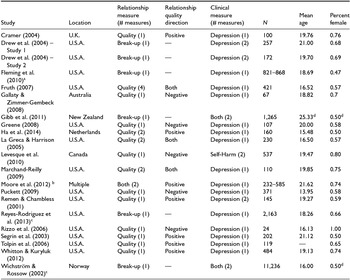
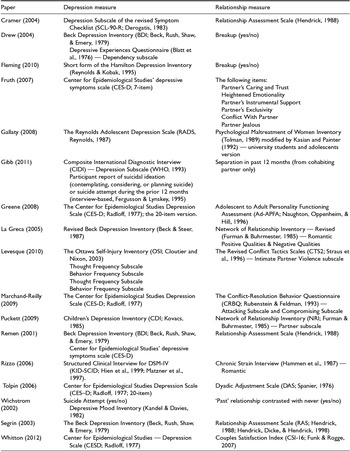
An overview of the assessments included in the articles used for the meta-analysis is presented in Tables 1 and 2.
Information about the Studies Included in the Meta-Analysis

Note: aStudy included three time points so the mean of these values was used for analyses. bResults included a contrast of those who experienced a recent breakup vs. those who had not (n = 585), as well as a measure of relationship quality among those currently in a relationship (n = 232). cEffect size was presented as standardised beta and required conversion. dValue was inferred/imputed from available information.
Assessments Included in the Meta-Analysis Papers

Data Analysis
Analyses were conducted using Comprehensive Meta-Analysis Version 2.0 (Biostat, Inc.; Englewood, NJ). The overall summary parameters were computed using a random effects model, allowing the true effect size to vary across studies and providing a more conservative test of hypotheses. Heterogeneity of effect sizes was examined using Cochran's Q statistic, which allows for formal significance testing of the presence of heterogeneity using a χ2 test. Both T 2 and I 2 statistics were also computed to provide more readily interpretable information about heterogeneity. T 2 reflects the between-studies variance (in the metric of the effect size) and I 2 is the ratio of between-study heterogeneity to total observed variance, providing a standard convention on which to interpret findings (25% low heterogeneity, 50% moderate heterogeneity, and 75% high heterogeneity). Examination of subgroups utilised a mixed effects approach, with random effects within subgroups and fixed effects across subgroups; τ2 estimates were computed separately for each subgroup. Meta-regression using a method of moments approach (DerSimonian & Laird, Reference DerSimonian and Laird1986) was used for continuous moderators (age, gender).
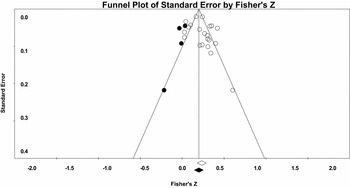
Multiple procedures were used to assess for publication bias. A fail-safe N (Rosenthal, Reference Rosenthal1979) was computed, which provides information about the number of studies with null effects needed to render the observed effect non-significant. A funnel plot, which examines the relationship between standard error and effect size, was also created. Asymmetry in this plot suggests the potential for publication bias. Egger's regression intercept (Egger, Davey Smith, Schneider, & Minder, Reference Egger, Davey Smith, Schneider and Minder1997) was used to test for the presence of asymmetry. We also used the trim-and-fill method of Duval and Tweedie (Reference Duval and Tweedie2000), which imputes additional studies to compensate for those identified as responsible for the asymmetry, creating an adjusted effect size.
Results
Study Characteristics
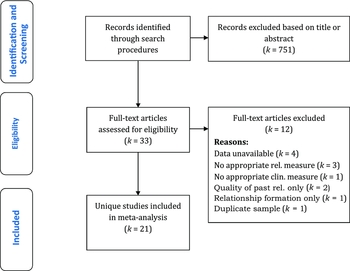
See Figure 1 for a flowchart detailing the study selection process. A total of 20 manuscripts reporting on 21 unique studies (N = 19,623) were identified in the search. The majority of studies (k = 14) took place in the United States (U.S.), with no other location appearing more than twice, so analyses examining location were limited to a contrast of U.S. and non-U.S. samples. A total of fourteen studies exclusively examined relationship quality, six exclusively reported on the effects of relationship dissolution and one study examined both. Only three studies included separate measures of suicidal ideation or deliberate self-harm. These were coded as distinct so they could be examined separately in analyses. The age of the samples varied substantially within the targeted range, as did the gender composition of the samples (47–100% female). One study did not report a mean age but did report a range of ages for participants, so the midpoint was used as the mean. One additional study included no information regarding the age of participants, so was excluded from analyses involving age. Two studies did not include information on the gender of participants. However, both were large-scale, population-based studies, so these values were imputed as 0.5 (50%).
Flow diagram of study selection.

Meta-Analysis Results
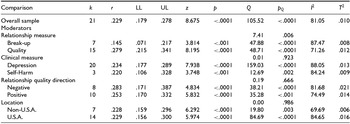
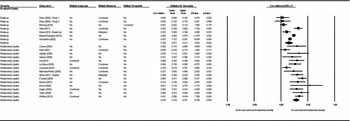
An overall model combining both relationship quality and breakup yielded a highly significant association between relationship measures and depression/self-harm (see Table 3 and Figure 2). The strength of this relationship was modest (r = .229), falling between the conventional standards for small and medium effect sizes [40]. However, there was substantial evidence of heterogeneity, suggesting the potential for this relationship to be affected by one or more moderators. Indeed, the strength of the association between depression/self-harm and relationship quality (r = .279) was statistically different (p = .006) from the strength of the association between depression/self-harm and relationship dissolution (r = .145). In contrast, clinical measure (depression vs. self-harm) did not affect the estimated strength of these associations, nor did the nature of the relationship measure (positively vs. negatively worded). Location of the study (U.S. vs. non-U.S.) also had no effect. Table 3 presents effect sizes and detailed reporting of the results of these analyses.
Summary of Overall and Subgroup Meta-Analysis Results

Note: When multiple measures of different types were available, these were treated independently in the analysis to provide a more conservative estimate of differences. Accordingly, k is reflective of the number of measures and thus may exceed the total number of studies for moderator analyses.
LL = lower limit of confidence interval; UL = upper limit of confidence interval.
Forest plot of included studies.

Meta-regression analyses did not provide any indication that age affected the strength of the association between relationship measures and depression/self-harm (B = -0.005, 95% CI [-0.026, 0.016], p = .647). This effect remained non-significant when examining only those studies reporting on relationship quality (p = .576). There was weak evidence that the gender composition of the sample moderated the relationship between relationship measures and depression/self-harm (B = .160, 95% CI [-0.021, 0.340], p = .083), with studies containing a larger proportion of women participants generally reporting a stronger association. This effect remained a trend when including only reports of relationship quality (p = .080).
Publication Bias
The fail-safe N indicated that an extremely large number of studies with null results (k = 1,916) would be needed to reduce the overall effect below the threshold of significance. A funnel plot of the data is presented in Figure 3. Eggert's regression intercept did not suggest the presence of bias, t(19) = 1.22, p = .236. However, the trim-and-fill method did suggest the imputation of four additional studies, though this resulted in only a minor reduction in the overall point estimate (r = .197).
Funnel plot.

Discussion
Based on the 21 studies included in our meta-analysis, the association between mental health outcomes and relationship variables is only modest in strength. Nonetheless, this association was statistically significant and should not be presumed inconsequential. This meta-analysis provides evidence that both negative RRQ and RRB are associated with mental health outcomes among adolescents and young adults. The relatively modest effect sizes might be due, in part, to the great heterogeneity of individual differences and contexts surrounding these relationships. Further research is needed to identify specific circumstances that moderate the strength of this association. For instance, the professional literature has long recognised that ability to cope with a stressful situation — and thus emotional responses to that situation — are associated with cognitive appraisals of the situation (Lazarus & Folkman, Reference Lazarus and Folkman1984), and to self-efficacy beliefs and perceived resources and abilities to cope (Bandura, Reference Bandura1977, Reference Bandura1982). All these psychological factors could be further examined as possible moderators of the associations between RRQ/RRB and mental health outcomes.
One particularly critical finding was that relationship quality was more strongly associated with mental health outcomes than was relationship dissolution. There are several possible explanations for this difference. First, RRB is a common occurrence in this population (Connolly & McIsaac, Reference Connolly and McIsaac2009), which could indeed dampen any impact on mental health outcomes. Similarly, mental health may be less likely to contribute to RRB in adolescents and young adults due to the somewhat more short-lived and transient nature of these relationships. Consequently, developing and staying in unsatisfying romantic relationships might represent a more accurate indicator of emotional difficulties, particularly at younger ages. In addition, a relationship dissolution may be a more sudden and drastic change in psychosocial environment and thus be more likely to motivate help-seeking behaviours that enhance mental health outcomes. In contrast, those maintaining low quality relationships may be in even greater need of clinical services but less likely to pursue them. Available evidence suggests that poor-quality relationships and relationship dissolutions are stressors that contribute to the onset of depressive symptoms and yet it is also plausible that low-quality relationships are a consequence of depression, rather than a cause — an issue that has been discussed at length in the adult relationship literature (Vujeva & Furman, Reference Vujeva and Furman2011). Regardless of the causal direction, the presence of a significant association indicates that relationships and relationship quality are clinically relevant and may reflect a critical measurable factor associated with depression or self-harm. Finally, while the majority of our sample included non-clinical populations, it might be the case that relationship dissolution would be found to have a greater impact among individuals who have already been experiencing documented mental health difficulties and who are expected to be less equipped for dealing with acute stress. In addition, much of the existing literature on this topic has not fully accounted for whether a RRB was self-initiated, partner-initiated, or mutual. This has the strong potential to moderate the association between RRB and mental health outcomes and thus is a key topic for exploration in future research.
There was weak evidence that the association between RRQ/RRB and depression/self-harm may be stronger for women. Gender roles, prioritisation of relationship status for women in society, and/or increased likelihood to acknowledge negative emotions represent factors that could affect this finding. The differential impact of relationship characteristics and relationship dissolution on women could contribute to the increased rate of depression observed among women, particularly among adolescent and young women (Nolen-Hoeksema, Reference Nolen-Hoeksema2001).
In contrast, the association between relationship variables and depression/self-harm was robust with respect to nationality and age. The important role that romantic relationships may play in mental health thus appears to be relatively universal, rather than culturally bound. Nonetheless, extreme caution should be used when generalising findings to nationalities or groups not explicitly captured by the included studies. There was no evidence to suggest that the strength of these associations differed as a function of age. However, these findings should be interpreted with caution given prior mixed findings regarding age and the limited power to detect such an effect in the current study. Future studies should examine these associations across discrete age groups to enhance our understanding of how these associations change across developmental windows. Regardless, our findings support the need for professional services tailored to the developmental and cognitive-emotional needs of adolescents and young adults. Clinicians should not discount the important role that romantic relationships may play in mental health status, even among younger individuals whose relationships may appear transient and less meaningful. In addition, future research is needed to address a number of other potential moderators of these associations that could not be examined in the present investigation due to limited prior research, including relationship history (e.g., number of age-related past breakups and positive/negative relationships) and attachment style. The latter is of particular interest, as it has the potential to serve in either a moderating role (i.e., relationships perceived as ‘high quality’ may only be associated with positive outcomes for those with secure attachments), or as a mediator of this association (i.e., low-quality relationships lead to insecure attachment, which is the principle cause of poorer outcomes). Most studies do not consider the role of attachment, but it may have a profound impact on both the nature of the relationship and the ability of the individual to deal with a RRB (Kirkpatrick & Davis, Reference Kirkpatrick and Davis1994; Simpson, Reference Simpson1990).
A few limitations should be mentioned, including the relatively small number of studies, which may have limited power to detect differences among studies in moderator analyses, and the significant variability in how relationship dissolution, relationship quality, and depression were measured across studies. Unfortunately, this variability precluded us from conducting a more refined assessment of measures as a moderator of the effect size. Future studies are needed on more homogenous populations, including a distinction between clinical and non-clinical populations. Longitudinal research on specific age groups would also shed additional light regarding the role of developmental factors, while mixed-model studies inclusive of qualitative data might offer valuable information regarding moderating variables.
Clearly, one size does not fit all when it comes to love in adolescence and young adulthood. However, despite the methodological difficulties inherent to exploring such complex interrelations, the present study adds to the literature and defines venues for further research regarding adolescent and young adult romantic relationships and their impact on mental health.