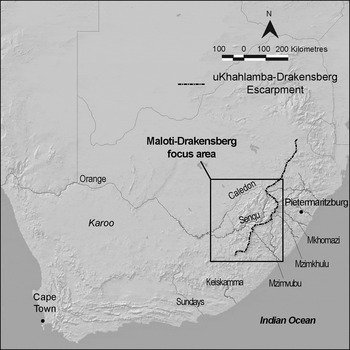
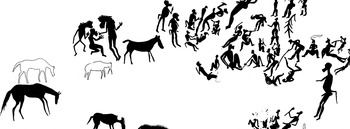
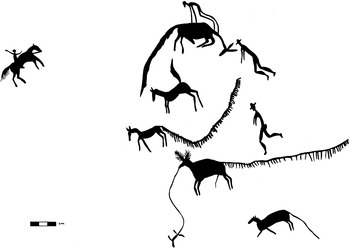
South Africa's Maloti-Drakensberg MountainsFootnote 1 (Fig. 1) have long been viewed as environmentally, politically, and historiographically marginal.Footnote 2 During the eighteenth and nineteenth centuries, they appear relatively isolated amidst rapidly changing theatres, accessed primarily by refugees, raiders, and the few intrepid colonists who launched expeditions to acquire information or retrieve stolen livestock.Footnote 3
Map showing Maloti-Drakensberg focus area.

Four decades ago, John Wright and Patricia Vinnicombe drew attention to these mountains as refugia for ‘Bushmen’ desiring independent lifeways once colonial frontiers placed a stranglehold on movement and subsistence.Footnote 4 Their seminal treatments of the ‘Bushman raider’ phenomenon presented these people as SanFootnote 5 making a last stand against colonial authority, with cattle raiding becoming a viable recourse in the face of changing socioeconomic circumstances.Footnote 6 Recent work has proposed that these ‘Bushman’ communities were actually culturally heterogeneous groups that found a common cause in raiding cattle. Rock art scholars such as Geoff Blundell and Lara Mallen have attributed certain painted motifs and stylistic types to these raiding bands, who deliberately evoked features of aboriginal San culture in their art.Footnote 7 Sam Challis has further described how the AmaTola, a group including Khoe- and Bantu-speakers as well as Bushmen, articulated a creolised cosmology and new identity through rock art.Footnote 8
These Bushman raiding groups have been seen as epiphenomenal to the expansion of colonial authority: historically and historiographically, they have appeared as reactions to or by-products of encroaching European and African authority, which provoked raiding as a means of survival. Over the past decade, Blundell, Challis, and Mallen have identified individual groups of raiders and their art within this trend. Running through these works is a sense that these raiders were cultural anomalies that emerged through the twinned imperatives of political resistance and cultural and economic survival, as the Maloti-Drakensberg became a last refuge for nomadic lifestyles.Footnote 9 However, we are left wondering if there isn't a different way of reading these many observations: have we perhaps achieved a critical mass of research on individual Bushman raiding groups sufficient to explore these as part of a broader regional phenomenon?
Here, we propose viewing the Maloti-Drakensberg Mountains as a political theatre in which polities engaged in heterodox activities were the norm rather than the exception. We follow Laura Mitchell's formulation of ‘heterodoxy’ as describing practices that deviated from the expectations and desires of colonial authority (dubbed ‘orthodoxy’), ranging from banditry to unconventional households and marriages.Footnote 10 In the present case, the heterodoxies in question were cattle raiding, mobility, and foraging. Our concern lies with examining how these came to be defining features of a mountainous region characterised by nineteenth-century observers as a ‘nest of thieves’ and a landscape ‘abandoned to Bushmen and outlaws’.Footnote 11
By the nineteenth century, ‘Bushman’ connoted people who eschewed sedentism and who foraged or thieved. For Africans capable of sustaining themselves through agriculture to revert to a ‘Bushman’ existence was evidence of moral corruption or social distress. As Cape Governor Sir Harry Smith observed, there was no precedent to explain ‘a nation exiling themselves … with their families, their herds, their flocks, … and planting themselves on a doubtful tenure in a Country possessed by Barbarians’.Footnote 12 Yet the Maloti-Drakensberg presented numerous instances of chiefdoms and hunter-gatherer communities engaging in highly mobile lifestyles and intensive cattle raiding, apparently deliberately and often working together. These mountains thus presented a challenging social and intellectual space: colonial officials and observers saw the Maloti-Drakensberg as a milieu of aberrant behaviours. For people living within that milieu, however, these practices were not aberrant but commonplace and meaningful. Further, these same people were often aware that their practices were considered antisocial by colonists and colonial agents.
This situation resonates with what North American historians have described as the Native ‘interior’ or ‘indigenous worlds’ that persisted after European colonies established themselves on the continent. These interior worlds were, effectively, autonomous nodes of power, trade, and kinship, which Anne Hyde described as mosaics that constituted Native spheres of influence.Footnote 13 Across the American West, interior worlds were loosely defined by geography, trade networks, and ecologies, and were characterised by particular sociocultural logics. These distinctive blends of cultures, practices, and economies may have existed prior to European arrival but took on new significance in colonial contexts.Footnote 14 Raiding for captives, livestock, and goods was one such practice that was crucial for allowing interior world communities to penetrate Euro-American borderland economies. At the same time, raiding played a fundamental role in the social and cosmological fabric of these communities.Footnote 15 Whether through deliberate acts of conquest (what Pekka Hämäläinen has called ‘reversed colonialism’) or more subtle ‘invisible influences’ like complex trade networks,Footnote 16 these interior worlds shaped the terms of colonial encounters rather than being produced by them.
We find the interior world framework particularly intriguing in the context of the Maloti-Drakensberg because it does not rely upon the existence of a single, cohesive political system or a deliberate programme of resistance. Rather, it highlights how people in contexts where large, cohesive chiefdoms were absent or weak could still engage and reinterpret the material apparatuses of colonialism – roads, police stations, magistracies, etc. Where these engagements took the form of heterodox practices like raiding and mobility, they direct our attention to how clashes with authority and expected behaviour could be powerful forces that inspired social cohesion, settlement strategies, and the formation of new cosmologies.
In what follows, we synthesise established literature and introduce insights from some new historical and archaeological studies to suggest a scenario in which heterodox activities were commonplace and sociopolitically significant. The result was a regional network characterised by creative relations between chiefdoms and culturally hybrid bands, and by cattle raiding that could (paradoxically) be both socially fractious and unifying.Footnote 17 We describe this network primarily through the lens of Bushman raiders and Mokuoane and Moorosi's BaPhuthi chiefdom; these vantage points are ideal for pulling together disparate observations of other polities in the Maloti-Drakensberg. The material on Mokuoane's and Moorosi's BaPhuthi discussed here has not been widely presented before and therefore merits more in-depth treatment.
As archaeologists, our approach attends to the interplay between historical sources and material practices, with particular focus on what Ann Stahl has called ‘embodied forms of practical knowledge’.Footnote 18 This entails being aware of how colonised people drew on their pre-existing experiences – what might be called commonsense ways of doing things – as they received, rejected, and recontextualised the objects and economies that accompanied colonial encounters. We are thus in an excellent position to separate out ethnicised stereotypes and labels connoting illegality, and instead follow the physical gestures and ‘stuff’ underpinning these designations: mobile horticulture, settlement patterns, and rock art, among others.
As such, we bring archaeological insight to bear on addressing historical questions. While we endeavour to keep specialised terminology out of our discussion as much as possible, readers will by now have noticed the use of phrases such as ‘lifeways’ and ‘polity’ uncommon in historical writing. We use these words not to obfuscate, but because archaeological and historical evidence operate on different social, spatial, and temporal scales and we need to be careful with how we speak of this evidence within a single framework. Within some of the situations we describe below, the line between a chiefdom and a band of raiders is clearer historically than it is archaeologically; hence, we sometimes use ‘polity’ as a more expansive term. Similarly, ‘lifeway’ comes into archaeological parlance to denote the combination of beliefs, customs, economies, and actions that together constitute ways of doing things and thinking about doing things in the past.
One final note about terminology: We are venturing into territory where naming conventions carry suites of meaning that may not reference political identity, but rather were constructed or bestowed by historical actors at different places and times. The use of ‘Bushman’ as a cipher for foraging and illicit activities is one example: when raiding bands are said to have included ‘Bushmen’, does this mean people who self-identified as such and spoke San languages, people who abandoned farming for mobile lifeways, or both?Footnote 19 Were ‘BaPhuthi’ raiding on the Kraai River in 1850 the same as those in Natal in 1862, as there were multiple BaPhuthi polities with flexible boundaries?Footnote 20 Without first-person testimony from these actors, we proceed from the position that although these identities were often fluid and subjective, they were nevertheless publicly enacted and thus had real political consequences; readers should be attuned to the behaviours and socioeconomic positions of the people to whom this nomenclature pertains.
CHIEFS, RAIDERS, AND ‘BUSHMEN’ OF THE MALOTI-DRAKENSBERG
The Maloti-Drakensberg have long been characterised by close relations between San and Bantu-speaking chiefdoms, a situation that likely predated the nineteenth century but became more pronounced (or at least historically more visible) following the rise of African nation-builders.Footnote 21
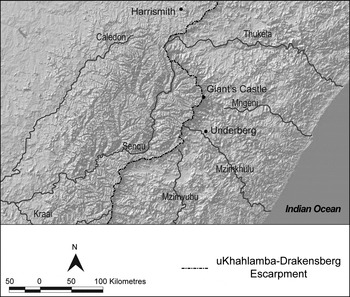
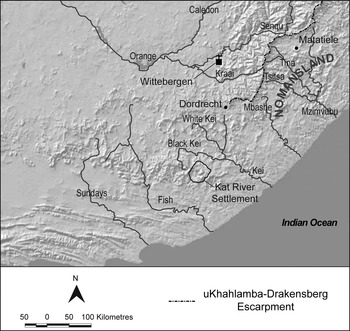
Historiographically, the northern Drakensberg Mountains (Fig. 2) remain the best-researched subregion. Its emergence as a nineteenth-century frontier hinged upon the dynamics of chiefly states. In the eighteenth century, burgeoning trade in cattle and ivory connected to Delagoa Bay provided the ‘initial dynamic’ for political change around the Thukela River, sustained and intensified by drought and conflict over land. In the early nineteenth century, cattle raids and armed conflicts between nascent states on the lower Thukela led to prominence and power for some and expulsion for others. The Thukela-Mzimkhulu and Mzimkhulu-Mzimvubu inter-riverine areas were regional fulcra around which pivoted confrontations among major players such as Thembu and Bhaca.Footnote 22 From around 1820 conflict had spilled over the Mzimvubu River and into the southern Maloti-Drakensberg (Fig. 3): manoeuvres by Matiwane's Ngwane and early Zulu leaders had displaced Bhaca, Thembu, and others, forcing them to move southwest towards Mpondo and Xhosa around the Mzimkhulu/Mzimvubu and Great Kei Rivers.Footnote 23
Map showing aspects of the northern Maloti-Drakensberg mentioned in the text.

Map showing aspects of the southern Maloti-Drakensberg and Nomansland mentioned in the text.

Wright and colleagues have provided an invaluable understanding of the political dynamics of the late eighteenth- and early nineteenth-century northern Drakensberg. However, locating the main drivers of political change in the control of trade goods, land, and followers sidelines the role of non-state peoples (especially those leading mobile, hunter-gatherer existences) in historical analyses. We integrate this earlier work with our own to better articulate the roles of historically less visible actors.
Along the Mzimvubu, traders’ and missionaries’ accounts from the late 1820s illustrate a thriving ivory trade linking chiefdoms with ‘Botwas’, ‘a people whose sole occupation is elephant hunting’ with ‘no fixed settlement’.Footnote 24 ‘Botwas’ suggests the Nguni ethnonym for ‘Bushmen’, abaTwa. Port Natal traders variously characterised Botwas as Bushmen or as displaced Nhlangwini forced to take up elephant hunting on the Mngeni River, discrepancies that are due in large part to the fact that traders did not meet every link in the ivory supply chain.Footnote 25 In 1835 Captain Allen Gardiner ascertained that Port Natal traders had been conflating Nguni-speaking Nhlangwini with bands of abaTwa serving as professional elephant huntersFootnote 26 for chiefs, who in turn acted as middlemen in a regional ivory trade network.Footnote 27 Many Botwa bands had leaders who traded only with specific chiefs (for example, the Mpondo chief Faku), maintaining a fairly rigid supply chain that frustrated European traders.Footnote 28 The ethnic composition of these Botwa groups was a source of confusion for traders and travellers alike. Botwa use of a mélange of material cultures associated with Bantu-speakers and Bushmen (for example, San poisons on iron spears) challenged preconceived cultural categories. Beliefs about racialised authoritarian structures were confused by observations of Botwas led by ‘Bushmen’ and ‘Nguni’.Footnote 29
Minimally, then, ‘Botwa’ described heterogeneous consortia primarily engaged in elephant hunting and leading a fairly mobile existence. Following observations by Norman Etherington and others, ‘Botwas’ likely included native Bantu-speakers who had rejected sedentism and cattle accumulation, attached themselves to Bushmen, and joined the ivory trade.Footnote 30 During the early nineteenth-century inter-chiefdom conflicts described above, people whose herds had been depleted may have found it advantageous not to rebuild them, instead adopting lifestyles that, to contemporary observers, might appear as those of ‘Bushman’ hunter-gatherers.Footnote 31 As elephants and hippopotami became scarce, Botwas focused on cattle raiding, reconfiguring their ivory-trading links with chiefs.Footnote 32 Mallen's recent research suggests that the frequent associations between cattle and elephants in rock paintings throughout the former Nomansland (see Fig. 3) reflected a widespread association between elephant hunting and cattle raiding among Bushmen who painted. These connections may have considerable time-depth, as cattle first arrived there around 1000–1300 years ago.Footnote 33
Within this milieu, Bhaca, Thembu, and others moving from the north found themselves in direct contention with Faku's Mpondo for land, cattle, and people. From settlements along the Mzimvubu (occupied c. 1828–38), Mpondo raided cattle and strengthened their position in the ivory trade, relying heavily on connections with Botwas and Bushmen.Footnote 34 From the late 1820s Ngcaphayi's Bhaca had similarly made a name for themselves as committed cattle raiders, leading expeditions through the southern Drakensberg against Xhosa, Thembu, and Mpondomise.Footnote 35 During the 1820s and 1830s Faku's and Ngcaphayi's people were such active raiders that observers labelled them primarily as raiding chiefdoms: they abandoned agriculture for varying durations, and Faku's raiding parties incorporated Bushmen and known outlaws.Footnote 36 Mpondo raids comprised contingents of men led by a headman, where Bhaca raids were movements of the entire chiefdom (including women and children) with foodstuffs harvested from small gardens of sorghum.Footnote 37
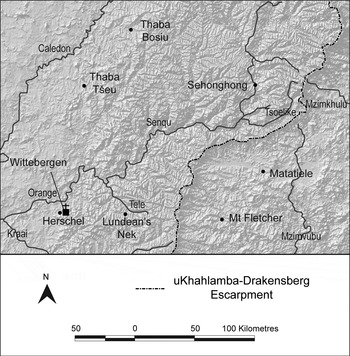
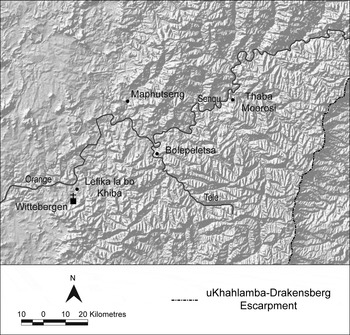
The southern Drakensberg did not develop in isolation from the other side of the Escarpment, although tying the two together has not been widely rectified in the region's historiography. This is partly a consequence of the longstanding belief that, as the Senqu River was the southernmost and easternmost extent of the Sotho leader Moshoeshoe I's territories until 1871, the mountains and Escarpment constituted a political vacuum between BaSotho and the Nomansland chieftaincies. Under the prevailing reading of mountains as refugia, this political no man's land was precisely what attracted communities wishing to live outside the bounds of colonial and African authority. However, this land south of the Senqu was not apolitical but fell within the ambit of BaPhuthi under the chieftaincies of Mokuoane and his son Moorosi; this rugged stretch of mountains was so closely identified with Moorosi that many came to refer to it simply as ‘Moorosi's Country’ (Fig. 4).
Map showing aspects of the Maloti Mountains mentioned in the text.

Detailing the history of Mokuoane and Moorosi's BaPhuthi in the southern Drakensberg has been attempted with varying degrees of success for the last century: such projects either focused primarily on Bushmen implicated in relationships with BaPhuthi,Footnote 38 or on Moorosi's 1879 rebellion.Footnote 39 Rachel King's historical archaeological treatment of Mokuoane's and Moorosi's BaPhuthi has produced perhaps the most detailed discussion of BaPhuthi lifeways from c. 1820–79.Footnote 40 Key to King's approach is the argument that, while first-person verbatim evidence related to these communities is scarce, it is possible to reconstruct (at least partially) logics of settlement, mobility, and economy from the material practices discernible through archival sources and archaeology.Footnote 41 Some internal workings of this chiefdom remain murky but a focus on actions, landscape use, and material culture evokes past patterns and social history without according undue authority to ethnicised and racialised colonial accounts.Footnote 42 We draw on King's work in our discussion, in particular her contention that these logics of Mokuoane's and Moorosi's BaPhuthi included an emphasis on mobility rather than long-term settlement, and on cattle raiding to acquire wealth, build social cohesion, and as a type of performance.
While genealogies and ancestral demographic movements of BaPhuthi recorded in the late nineteenth century should perhaps be taken as cultural idioms rather than literal fact,Footnote 43 by the early nineteenth century BaPhuthi claimed grazing lands around the Tele and Senqu Rivers and spoke a distinct language (SePhuthi).Footnote 44 Statements and oral histories taken from BaPhuthi stressed close socioeconomic and kin-based ties with peoples identified as Mpondomise and, especially, Bushmen: BaPhuthi claim to have adopted Bushman names (Moorosi was dubbed ‘Qhenga’), and raiding bands were said to have consisted of both BaPhuthi and Bushmen.Footnote 45
These same accounts assert BaPhuthi raiding prominence on either side of the Drakensberg Escarpment. Mokuoane claimed the right to settle and graze livestock on lands between the Tina and Tsitsa Rivers as part of his association with Mpondomise there in the early nineteenth century. However, the nature of Mokuoane's cattle raids and the reprisals they provoked meant that raiding parties – and occasionally the entire chiefdom – remained mobile. Agriculture was a minimal part of their economy, limited mainly to gardens as BaPhuthi occupied settlements for short durations before relocating elsewhere. Raiding bands concealed their movements and their spoils by living for varying durations in rockshelters in the mountains.Footnote 46 This combination of mobility and cattle raiding allowed Mokuoane and his BaPhuthi to move throughout the Maloti-Drakensberg acquiring cattle, and maintaining a network of marriage allies and raiding partners from ‘the broken men of various tribes’ throughout the eastern Cape and Nomansland (see below).Footnote 47
Around the early 1820s, Moshoeshoe took BaPhuthi hostages and forced Mokuoane and Moorosi to become his vassals and representatives south of the Senqu, which had hitherto been beyond Moshoeshoe's control.Footnote 48 Moorosi's missionary D. F. Ellenberger later suggested that winning (or coercing) Mokuoane and Moorosi as allies added to Moshoeshoe's territory the land bounded by the Senqu, the Escarpment, and the Wittebergen and Stormberg Ranges.Footnote 49
Although they nominally served as Moshoeshoe's representatives, Mokuoane and Moorosi continued to act with relative autonomy. During the 1820s and 1840s, by executing raids in collusion with a wide array of chiefs they established a sphere of influence that spilled over the Escarpment and into Nomansland and the eastern Cape.Footnote 50 Moorosi supplied Moshoeshoe with cattle and horses taken from across the Escarpment. Moorosi even provided the BaSotho leader with his first horse, which was relieved from a farm in Dordrecht. Raids to the southwest contributed to the instability of the ‘Tambookie frontier’: as the Thembu paramount Maphasa attempted to secure his precarious chieftaincy in the face of British and Rharhabe Xhosa efforts to undermine him, intensive raids by BaPhuthi and others exacerbated the disorder within his chiefdom.Footnote 51
Mokuoane's and Moorosi's BaPhuthi emerged as regional players while Botwas along the Mzimvubu were building reputations as elephant hunters, cattle raiders, and collaborators with Bhaca and Mpondo. These were not isolated phenomena: skirmishes between various combinations of Botwas, BaPhuthi, Bhaca, Mpondomise, Thembu, and Mpondo polities were opportunities to gain cattle and popular followings, and to employ their newly acquired wealth and capital to expand their activities. The late 1820s and early 1840s witnessed a cattle-and-arms race as these polities claimed portions of the southern Drakensberg for settlement, grazing, trade, horticulture, and field agriculture.
Peoples dispersed by the Thukela-Mzimkhulu conflicts swelled the ranks of chiefdoms there and of raiding bands operating within and around the Maloti-Drakensberg, along with ‘Mfengu’ or ‘Fingoes’ from the Cape.Footnote 52 Following attempts by the Cape government to tribalise these latter peoples by settling them in ‘Fingo’ locations’ from 1835, ‘Mfengu’ came to denote both those within the locations and politically dispossessed peoples with newly acquired equestrian and marksmanship skills. Many such people were designated vagrants upon leaving the locations and became associated (at least in Cape rumours) with culturally mixed bands of outlaws and cattle thieves.Footnote 53 Hans Lochenberg was a well-known cattle rustler at the head of a group of ‘Fingos’. The Mancazana Band was a ‘set of banditti composed of Bushmen, Hottentots, and runaway slaves’ headquartered in the Mancazana Valley until the expansion of the Cape boundary forced them to relocate beyond the frontier.Footnote 54
These and other heterodox persons or groups became part of the interior world of the Maloti-Drakensberg, and it is here that we see the Bushman raider phenomenon emerging within a larger social milieu. As ‘Bushman’ became a cipher among contemporary observers for antisocial and undesirable behaviour, the features underpinning this designation (mobility, stock theft, band-like social formations) appear with increasing frequency in the Maloti-Drakensberg. Although cattle raiding has often been portrayed as a destabilising factor for the Thukela-Mzimkhulu region, in the Maloti-Drakensberg raids by BaPhuthi, Botwas, and others were disruptive but not necessarily antisocial. We see numerous examples in the mid- to late nineteenth century of raids as commonplace, as sanctioned by chiefs and within chiefly prerogatives, and as opportunities for groups of diverse people to coalesce around a shared aim.
ANATOMY OF AN INTERIOR WORLD
The logics of the Maloti-Drakensberg interior world became most visible from the late 1830s and 1840s until the late 1870s. As we focus our discussion of Bushman raiders and BaPhuthi to articulate these logics, we draw attention to four main points.
First, new arrivals in the Maloti-Drakensberg (including people from the eastern Cape and technologies such as horses) were implicated in culturally creative processes, such as the emergence of new lifeways and the creation of heterogeneous communities. Following from this, raiding and other illicit activities (for instance, gun acquisition) can be seen as performances that, to varying degrees, enacted cohesion among raiding groups. Rock art provides compelling evidence of this. Third, certain chiefdoms were highly mobile and some Bushman communities would settle for a time with more sedentary chiefdoms; these trends upended contemporary ‘common sense’ that chiefs had fixed Great Places and Bushmen were nomadic. Finally, these heterodoxies were often practiced self-consciously.Footnote 55 Certain constituents of the interior world were well aware of how observers interpreted their (mis)behaviours. Moreover, they turned the complex physical and political terrain of the Maloti-Drakensberg to their advantage, thwarting the encroachment of African and colonial authority and evading reprisals for their actions. As colonial borders solidified, these strategies premised on the ambiguities of the Maloti-Drakensberg were curtailed.
The transformative impact of the horse on the Maloti-Drakensberg interior world cannot be overstated. Lowland chiefdoms such as Mpondo appear to have obtained horses by the early 1820s. BaPhuthi had acquired horses by this time if not earlier, as they were experienced horsemen by the mid- to late 1820s, when Mokuoane and Moorosi taught Moshoeshoe to ride.Footnote 56 Xhosa, Khoekhoen, Mfengu ‘vagrants’, and Bushmen are known to have brought horses into the region from at least 1835.Footnote 57 Horses became pivotal technology: while the rugged mountain landscape limited colonial construction projects such as roads, horses were a form of biological colonial infrastructure that interior world communities co-opted to facilitate travel, raiding, hunting, and livestock transhumance across great distances. With horses, raiders could more effectively turn the Maloti-Drakensberg's landscape to their advantage and escape observation, capture, retribution, and regulation. Rivers flowing south and east from the Escarpment functioned as conduits that allowed raiding parties to access the lowlands and then retreat – often mounted – into the mountains. Raiders were known to have kept horses and stolen livestock in the highlands beyond the reach of punitive expeditions.Footnote 58 Indeed, horses were so well suited to this landscape (with water from highland-fed rivers and pasture free from disease-carrying vectors) that by 1870 the Basotho pony had emerged as a breed tailored to montane ways of life.Footnote 59 Horses connected chiefs, raiders, and communities throughout this broken landscape with unprecedented ease, helping to shape a network in which knowledge, goods, and people could circulate widely and in new locations.Footnote 60
As Bushman raiding intensified through the first half of the nineteenth century, these themes were represented in rock art and archival corpuses. While testimonial evidence is available for only a few bands of Bushman raiders, these testimonies describe a suite of behaviours and technological innovations that rock arts distributed throughout the Maloti-Drakensberg elaborate upon. These rock arts are detailed thoroughly elsewhere; here we tie these discussions together within the context of the interior world.
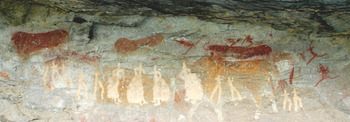
Indicated by Henry Francis Fynn and Walter Harding as responsible for some of the most devastating cattle raids in Nomansland and Natal, the ‘AmaTola’ were known as a ‘nation’ of ‘Bushmen, Hottentots, and runaway slaves’.Footnote 61 AmaTola almost certainly drew members from the array of Xhosa, Mfengu, and ‘outlaws’ entering the Maloti-Drakensberg in the wake of the eastern Cape frontier conflicts. From horseback, AmaTola raided throughout the southern Drakesnberg as far east as Estcourt, using rockshelters at higher altitudes to keep livestock safe from retaliatory or punitive expeditions.Footnote 62 Challis has argued that rock art found between Mount Fletcher and Giant's Castle provides insight into the logics at work among AmaTola and similar polities operating in the Maloti-Drakensberg. Paintings of baboons paired with horses articulated a worldview that drew on cultural ideas shared by the diverse members of these raiding groups. This worldview connected baboons with medicinal roots conferring protection during raids, emphasised the potency of horses, and foregrounded beings capable of controlling colonial material culture such as guns and brimmed hats (Figs. 5 and 6). This corpus of rock art thus illustrates the social and performative roles that raiding, mounted lifeways, and acquiring guns played for AmaTola.Footnote 63 While Challis has mainly focused his discussion of the AmaTola band, we should consider the presence of other ‘Tola-type’ peoples – that is, creolised raiding communities – on the landscape, even if these were not specifically named in the historical or oral historical record.Footnote 64
Section of a panel of paintings depicting horses, dancing figures, and figures with baboon features, especially noses and tails. Courtesy Sam Challis.

Panel of paintings depicting figures in wide-brimmed hats (colonial motifs) and non-real horses with figures connected (shamanistic motifs). Courtesy RARI.

Challis's work provides perhaps the most compelling ‘insider’ view of Bushman raiding communities available through rock art,Footnote 65 drawing out themes of cultural creativity tied to heterodox practices. Testimonies from Bushman raiders contemporary with AmaTola resonate with these themes. Accounts that raiders gave to Fynn, Harding, and later Sir Walter Stanford demonstrated that bands fluctuated in size from 117 to 13 or 15 members, and attested to marriages and raiding partnerships with Mpondomise, Bhaca, and Lochenburg's group, among others.Footnote 66 Raiders such as Mdwebo, Nqabayo, and Qinti described obtaining cattle, horses, and guns from other raiders and chiefdoms around the Maloti-Drakensberg, both in ad hoc raiding parties and within more enduring sorts of alliances.Footnote 67 Of course, positing Tola-type creolised cosmologies for all Bushman raiders may not be appropriate. To describe different sorts of social dynamics at work, Mallen and Blundell have drawn attention to finger-painted images of colonial material culture overpainted on fine-line images. They suggest that these types of paintings delineated processes whereby some raiding bands – culturally heterogeneous and cohering for common, illicit aims – expressed identities that referenced or contested notions about San culture (Fig. 7).Footnote 68
Contemporary with Bushman raiding throughout the Maloti-Drakensberg, from the late 1830s to the late 1870s, Mokuoane's and Moorosi's BaPhuthi were actively raiding and establishing settlements from the Kraai River up the Senqu and into the Escarpment. Much of their success there was due to their effective use of mounted raiding,Footnote 69 and their skill at turning the rugged terrain – which proved an almost insurmountable challenge for militia and retributive justice – to their advantage.
‘Type 3’ finger-painted figures in colonial dress overpainted on fine-line paintings. Courtesy SARADA.

Mokuoane and Moorosi developed a mobile, fairly peripatetic chieftaincy tailored to the harsh topography of the southern Maloti-Drakensberg. Rather than establishing a Great Place (as did chiefs such as Faku and Moshoeshoe), they built and circulated through smaller settlements on near-inaccessible hilltops (Figs. 8 and 9).Footnote 70 In this scheme, subsistence was based in short-term garden agriculture – free from the fixed locations and seasonal schedules of field agriculture – in a strategy of cyclical occupation and abandonment. These phases lasted for varying durations, and offered opportunities to move throughout the area south of the Senqu, (re)visiting settlements and evading reprisals for raids.Footnote 71 For instance, when the Wittebergen Native Reserve was founded in 1850 it brought British colonial representatives charged with stopping cattle raiding to Moorosi'sFootnote 72 doorstep, which is to say to his settlement at Lefika la bo Khiba (Figs. 8 and 9).Footnote 73 Moorosi responded by relocating his BaPhuthi to another settlement across the Tele River (Bolepeletsa) and leading raids into the Reserve.Footnote 74 BaPhuthi reoriented their raiding focus to the east and south, appearing more frequently in connection with raids in Natal and Nomansland – a distance that offered opportunities for escape and misdirection. Following one raid, a reprisal force traced the spoor of stolen horses into Moorosi's territory and demanded his help apprehending the raiders. Moorosi led the party into the Maloti highlands while he (allegedly) hid the horse thieves with allies in Nomansland.Footnote 75 This shift in BaPhuthi raiding activity following the establishment of Wittebergen – which constricted Moorosi's movements to the west – supports a hypothesis that Wright offered in 1971:Footnote 76 that the increase in raids in Natal from around 1856 was connected to an increase in BaPhuthi raids around but no longer through Wittebergen.
Map showing BaPhuthi settlements.

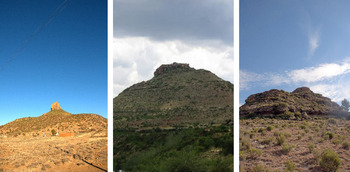
Three BaPhuthi settlements: Lefika la bo Khiba, Bolepeletsa, Thaba Moorosi.

This last account illustrates how strategies emphasising dispersed settlements and mobility made use of the Maloti-Drakensberg's harsh terrain to support extensive cattle raiding. Launching raids far afield from their settlements (for example, across the Escarpment into Natal and to the edges of Xhosa territory) and using temporary shelters immediately after raids often confounded those pursuing Moorosi's BaPhuthi. If people intent upon retrieving their stolen property did follow BaPhuthi back to their settlements, most of these territories were ultimately under Moshoeshoe's jurisdiction, a fact that discouraged incursions by Boers or British settlers.Footnote 77 From the 1850s Moorosi often used the Senqu valley as a fallback position from raids, where Natal forces could do little to pursue him. The tenuous negotiations between the Orange Free State, British, and BaSotho over land rights on the Highveld meant that Natal was forced to exercise caution in its intrusion into BaSotho territory.Footnote 78
These strategies continued to prove useful for Moorosi as the process of annexing Basutoland to the Cape got underway, and the western Maloti-Drakensberg experienced both an intensified British presence and confusion over the sociopolitical landscape there. By 1868, when BaSotho began to negotiate with the Cape over the boundaries of what would become Basutoland, Moorosi had proved adept at exploiting the ambiguities of colonial control. From about 1868–71, Moorosi carried out raids on European farmers in Natal, who demanded compensation. As a nominal vassal of Moshoeshoe, Moorosi fell under the jurisdiction of both the BaSotho royal house and (eventually) the Cape High Commissioner Sir Philip Wodehouse and the Basutoland Governor's Agent. Moshoeshoe did little to assist in disciplining his representative south of the Senqu; the latter two were thwarted in their efforts to gather evidence against Moorosi by the distances he travelled and uncertainties over who precisely was involved in the raids. Consequently, the matter was dropped.Footnote 79 Similarly, in 1869, Captain Albert Allison announced his intention to seek out one of Moorosi's raiding parties in Nomansland and requested assistance from then-Basutoland Governor's Agent James Bowker.Footnote 80 Bowker equivocated: he was unwilling to send a costly expedition into mountainous territory that he knew to be treacherous,Footnote 81 choosing instead to wait for Natal to drive the fugitives farther into Basutoland and apprehend them there.Footnote 82 Despite Moorosi's increasingly negative reputation among colonial officials, his status as a BaSotho-backed regional chief afforded him further protection: Bowker was unwilling to attack Moorosi and risk offending Moshoeshoe or rallying BaSotho to Moorosi's defence.Footnote 83
While the inner workings of Moorosi's BaPhuthi are difficult to access, cattle raiding and the mobility that it entailed appear as key sociopolitical components. This does not mean that we are speaking of a homogeneous, monolithic political body; on the contrary, Moorosi himself revealed that there were different ways of ‘being BaPhuthi’.Footnote 84 Men claiming shared ancestry with Moorosi were charged with defending and reprovisioning BaPhuthi settlements in Moorosi's absence.Footnote 85 Moorosi's marriage to Mpondomise and Bushmen women built on kinship idioms to assert their identification with the BaPhuthi chiefdom.Footnote 86 Not only did Moorosi's BaPhuthi raid, cohabit with, and produce rock art alongside Bushmen,Footnote 87 but by the 1860s at least Moorosi had achieved a measure of authority over peoples identified as Bushmen. During his 1869 expedition, a Sotho man told Allison of a group of Bushmen, ‘their chief would be angry if I interfered with them without reason. Their chief is Moorosi. There are many Bushmen living amongst Moorosi's people.’Footnote 88
BaPhuthi raiding cohorts did not necessarily share these kin-based connections: they may have comprised a ‘core’ of individuals linked by ancestors or marriage, and others who opted into raids as needed. Despite being subjected to BaPhuthi raids in the 1820s and 1830s, Xhosa and Thembu frequently joined Moorosi's raiding parties, to the point where Moshoeshoe had to correct a British misapprehension that Moorosi was himself Thembu.Footnote 89 Moorosi was said to have safeguarded the cattle of the Thembu chief Mtirara when they were threatened by commandos from the Cape.Footnote 90 Following Wittebergen's establishment, Moorosi attracted residents of the Reserve to his raiding parties: because of the Reserve's strict prohibitions against stock theft, some residents covertly joined Moorosi's raids and then disavowed connections to Moorosi when confronted by Reserve authorities.Footnote 91
Regarding the role of raiding in Moorosi's chieftainship, two points bear particular attention here. First, contemporary observers identified ‘BaPhuthi’ based upon varying criteria: sometimes through verbatim testimony by Moorosi and his sons, and sometimes simply because people were seen with Moorosi. These latter could have included people who primarily saw themselves as Xhosa, Thembu, BaSotho, or Bushman but subscribed to Moorosi's raids for a short time. But while ‘insider’ descriptions of who actually constituted Moorosi's chiefdom may not have been coterminous with archival identifications, common to all these constructions was that cattle raiding was a meaningful practice. Though often (mis)construed as bellicose and antisocial, the ease with which raiding targets could become raiding partners, coupled with the implication of raided cattle in belief systems and intricate obligatory relationships, illustrates that raids were about more than just acquiring property and social capital.Footnote 92 This is mirrored in AmaTola practices, as many AmaTola came from pastoralist backgrounds (for example, Khoe-speakers) that included institutionalised raiding.Footnote 93
Taking an archaeological view that emphasises the connections between settlement, landscape use, movement, and social cohesion brings us to our second point. Among Moorosi's BaPhuthi cattle raiding appears to have enacted solidarity and leadership, as among numerous chiefdoms throughout the Maloti-Drakensberg.Footnote 94 Raids were opportunities for Moorosi to demonstrate his skill, ingenuity, and authority; Moshoeshoe treated raiding in much the same way, as explained in his vast corpus of nineteenth-century praise poetry.Footnote 95
There is also a social or communal element to raids and circulating through settlements that should not be overlooked. Mobility of this sort could serve as a social diacritic: settlement occupation, maintenance, and abandonment by an entire community was a collective act that underscored the line between community and ‘other’.Footnote 96 Mobility can thus be seen as both a strategic means of avoiding surveillance and control, and also as a means of fostering some sense of solidarity. This is not a one-size-fits-all explanation for raiding in southern African chiefdoms, but describes an archaeological way of thinking about how authority and collaboration might have been expressed through material and physical gestures.Footnote 97 As Blundell has suggested for some Bushman raiding communities,Footnote 98 Moorosi's BaPhuthi illustrate how degrees of cohesiveness were fostered through skilful combinations of mobility, raiding, and ancestor-based ‘political vocabularies’Footnote 99 (evoking descent from BaPhuthi and Bushman progenitors). This cohesion was useful for maintaining a chiefdom with somewhat flexible demographic and geographic boundaries that coalesced for varying durations and purposes.
This idea about raiding as cohesive and performative could apply to many of Moorosi's contemporaries, including (as mentioned) Moshoeshoe. What makes Moorosi's case outstanding or at least useful to think with is his particular combination of heterodox traits – making him appear an ambiguous figure somewhere between a chief and a bandit – and how these were tailored to the Maloti-Drakensberg physical and political landscape.
Moorosi's peripatetic polity and leadership thrived because this landscape remained illegible or inaccessible to European settlers and colonial governments. Unlike Moshoeshoe or Faku, Moorosi rarely had to capitulate to the political or economic demands of encroaching colonial powers. One of the clearest illustrations of this occurred when the missionary Christian Schrumpf attempted to establish a mission station among Moorosi's BaPhuthi in 1844. After building his mission and spending about a year among BaPhuthi at Maphutšeng (Bethesda), Schrumpf was appalled when Moorosi announced the wholesale movement of his chiefdom to his settlement at Tulumaneng. Pleas and threats by both Schrumpf and Moshoeshoe were unsuccessful at dissuading Moorosi; the mission stood largely empty by 1847. On the one hand this could have been an effort to undermine Moshoeshoe's authority – Schrumpf certainly thought so. On the other, Moorosi's actions were in keeping with strategies that allowed him to evade attempts to ‘settle’ (literally and figuratively) his followers, at least until Basutoland's annexation in 1871 (see below).Footnote 100
The complex identities, economies, and behaviours of this interior world made identifying raiders a challenging exercise in ethnic classification: colonial observers struggled to name (and penalise) raiders on the basis of location and racial stereotypes, a fact that raiders and chiefs turned to their advantage. Faku proved particularly adept at exploiting the features of the Maloti-Drakensberg interior world and colonial perceptions of it. For instance, in 1840 trekboere from what was then Natalia blamed Ncgaphayi's Bhaca for the loss of around 700 cattle and 50 horses.Footnote 101 Faku supported the trekboere’s belief that the raids were executed by ‘rapacious and sanguinary Bushmen’ with whom Bhaca joined for the purpose of raiding Boers and Mpondo alike.Footnote 102 The (probably erroneous) determination of Bhaca guilt was due in part to perceptions of them as a ‘raiding chiefdom’,Footnote 103 and in part to Faku's political manoeuvring against his some-time allies.
In the mid-nineteenth century, the government of the colony of Natal endeavoured to harness Mpondo power against Bushman raiders, as an 1844 treaty established Mpondo boundaries that encompassed suspected Bushman raiding groups. When these authorities demanded that Faku control raiders in his territories and requested permission to pursue thieves onto Mpondo land, Faku demurred, suspecting these counter-raids were a pretext for inspection by officials covetous of his land.Footnote 104 As seen above, Faku raided with Botwas and Bushmen at least throughout the 1820s and 1830s. His decision to disavow connections with them was part of a larger diplomatic strategy: Faku requested government assistance against Bushmen and Bhaca, welcomed missionaries and appeared to accede to their demand that Mpondo stopped raiding, and reserved the prerogative to conduct raids for headmen and special armies.Footnote 105
This tactic of attributing raids to Bushmen (independently or in collaboration with neighbours) was used by virtually all chiefs. When Mokuoane and Moorosi were accused of theft, they cast blame (with varying degrees of plausibility) on one of the many other raiding bands active in the region.Footnote 106 In Nomansland and Natal, pressures from the Wesleyan mission circuit and the Natal government made it politically advantageous for chiefs to distance themselves from perceived criminals, and accusing Maloti-Drakensberg raiders was a useful device for concealing activities that would likely be seen as malfeasance.Footnote 107 From a historiographic perspective, these strategies ensured that raiding bands remained at the periphery of chiefdoms, despite the sociopolitical ties (casual or profound) linking them with Mpondo, Mpondomise, Bhaca, Thembu, and others.
LAST STANDS AND LAST REDOUBTS
By the late nineteenth century the effects of this interior world were being felt keenly in Natal, Nomansland, Basutoland, and the eastern Cape. Wright and Vinnicombe drew attention to the impact of Bushman raiders on settlement in Natal: colonists struggled to secure farmland and livestock, prompting the Natal government to establish Nguni farmsteads along the foot of the mountains as buffers against Bushman incursions. Nguni and European farmers alike were raided heavily, representing a substantial financial toll for the colony.Footnote 108 Challis has argued that raiders’ preference for livestock owned by colonists rather than Nguni farmers amounted to a ‘guerrilla-style war on the Europeans’.Footnote 109
Raids disrupted Natal into the 1870s but their character changed as shifting interior world politics entailed realignments of affiliation and authority, and refocusing settlement and raiding strategies. From the late 1850s onward, AmaTola reoriented their attentions to the upper Senqu and aligned with other raiding bands, including that of Moorosi's brother Lisawana. Among AmaTola and Tola-type communities gender relations appear to have undergone a major transformation. In rock art specific to these groups, depictions of women carrying spears often included knobkerries, spears, bandoliers, and other accoutrements characteristic of Nguni divination practices. These female figures in the art were therefore likely acting as ritual specialists.Footnote 110 Women were reported to have moved with raiding bands (for example, Nqabayo's) and chiefdoms (for example, Bhaca) alike: although they did not themselves participate in raids, associations between women and divination practices seem to have intensified.Footnote 111
Moorosi's BaPhuthi similarly underwent major changes as the nineteenth century progressed and political boundaries forced changes in the interior world. On the heels of the 1864–5 and 1868 Boer-BaSotho conflicts, increased pressure on BaSotho lands, and the creation of Basutoland's borders in 1871, magistracies were established to monitor Moorosi's activities. The Cornet Spruit magistrate John Austen saw Moorosi as ‘a standing menace’, noting that his territories south of the Senqu were ‘the key to Matatiele, Tambookieland, and Basutoland’.Footnote 112 In the 1870s BaPhuthi reoriented their raiding focus away from the Basutoland borders (and their magistracies and police outposts) farther up the Senqu and into the highlands: it was in this context that Joseph Millerd Orpen and James Murray Grant encountered Moorosi's part-Bushman son Qacha as headman of the area across the Escarpment from Matatiele.Footnote 113
It is within this context that we see accounts of ‘last stands’ of heterodox communities. Within Basutoland, expansionist elements of the BaSotho royal house looked to the highlands to extend their settlements beyond the already-tenuous control of Moshoeshoe's heir Letsie I.Footnote 114 As part of this enterprise, Moshoeshoe's grandson Joel Molapo led a party that killed Soai (c. 1870–2), the purported last Maloti-Drakensberg ‘Bushman chief’, in order to secure their claim. Soai and his followers were closely tied to Moorosi's BaPhuthi: Soai was said to have a Phuthi lover, and Moorosi made repeated visits to Soai at Sehonghong, as described in the late 1920s into the early 1930s by an elderly Sotho woman present for one of these meetings.Footnote 115
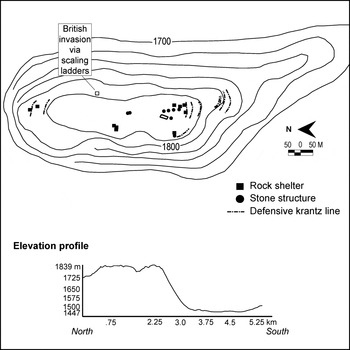
Moorosi's last stand also occurred during this period. In 1879, sparked by the legal prohibition against Africans owning firearms and rooted in long-simmering unrest over changes to BaPhuthi lifeways, Moorosi and his followers rebelled against British and BaSotho rule and retreated to the fortified mountain Thaba Moorosi (Fig. 10). The siege of Thaba Moorosi lasted for eight months, with BaPhuthi combatants drawing on strategies honed through years of raiding: Moorosi used rockshelters to hide supplies and as bases for stealth attacks, keeping his cattle with Bushmen and Tola-type collaborators in the highlands. When the siege ended, Moorosi was killed and his followers dispersed, imprisoned, or pressed into service in the Cape.Footnote 116 The rebellion had numerous consequences. Cape Parliament convened a Select Committee to investigate the rebellion. The Committee interrogated Basutoland officials and revised administrative policies, including reducing the power of district magistrates and proposing more infrastructure (roads, outposts, etc.) deeper into the highlands. Parliament commissioned enquiries into the nature of Moorosi's BaPhuthi and their interactions with other peoples, attempting to ascertain whether BaPhuthi were isolated outlaws or well-connected insurrectionists.Footnote 117
Survey plan and elevation profile of Mt Moorosi.

MAKING HISTORY FROM THE MOUNTAINS
The Maloti-Drakensberg interior world emerged quickly and lasted for a relatively brief time, although its roots undoubtedly predate the period covered here. The heterodoxies that shaped this theatre – raiding, pronounced mobility, hunter-gatherer ways of life – were modifications or reinterpretations of longstanding practices rather than reactions to the stress of the advancing colonial frontier. In this view, raiding activities were not indicators of crisis brought on by colonial pressures; they played a specific role in the social and political logics of the bands and chiefdoms operating within this region. This is the crux of the Maloti-Drakensberg interior world: these mountains do not provoke or create heterodoxies, but rather set a scene in which heterodox practices move to centre stage.
This perspective views the emergence of ‘Bushman raiding’ phenomena as fundamentally intertwined with chiefdoms whose political economies are premised in part on cattle raiding; depictions of ‘Bushman raiding’ as a wholly-distinct socioeconomy probably have more basis in longstanding epistemic divisions in social sciences than in material reality.Footnote 118 Our discussion of Bushman raiders and Moorosi's BaPhuthi working in tandem demonstrates as much, and encourages exploring how larger, more sedentary chiefdoms – Faku's Mpondo, Ncgaphayi's Bhaca – might be considered within this schema.
Our approach lends itself to borderland and frontier contexts throughout southern Africa and beyond, most immediately the middle Orange River and northern Cape frontiers. Perhaps the greatest utility of the interior world framework as articulated in North America and applied here is that it accepts a plurality of interior worlds. Its strength lies in its exhortation to explore how ‘Native mosaics’ operated in the precolonial and colonial periods, and how they influenced the socioeconomic transformations that accompanied the advance of colonial frontiers.