INTRODUCTION
Due to technological developments in medicine and the numerous treatments that are now possible, patients, relatives, and physicians often have high expectations and hopes when a patient becomes seriously ill. However, these high expectations may result in curative overtreatment, which many participants in one questionnaire study labeled as “inappropriate end-of-life care” (KNMG, 2015). Receiving overly aggressive treatments toward the end of life can cause patients to suffer from serious side effects and decreased physical function, and can hamper advance care planning (ACP) conversations and prevent a peaceful death (Buiting et al., Reference Buiting, Rurup and Wijsbek2011; Mattes & Sloane, Reference Mattes and Sloane2015).
The wish to remain optimistic and hopeful has been found to play an important role in curative overtreatment (Mattes & Sloane, Reference Mattes and Sloane2015). Research shows that the majority of patients with an incurable illness or terminal cancer still hope for a cure or life prolongation, even against all odds (Clayton et al., Reference Clayton, Butow and Arnold2005; Benzein et al., Reference Benzein, Norberg and Saveman2001; Weeks et al., Reference Weeks, Catalano and Cronin2012; Chen et al., Reference Chen, Cronin and Weeks2013). They sometimes present themselves more physically and mentally fit than they actually feel, hoping to receive another treatment (Buiting et al., Reference Buiting, Rurup and Wijsbek2011). In turn, physicians may not want to disappoint patients who explicitly wish for treatment by taking away their last hopes. As such, a so-called coalition of hope (de Haes & Koedoot, Reference de Haes and Koedoot2003) can come into existence, in which patients and physicians mutually reinforce each other's attitudes of not giving up (Buiting et al., Reference Buiting, Rurup and Wijsbek2011).
That many patients hope for a cure even when they are in the last phase of life suggests that physicians must choose between providing hopeful or realistic information (Back et al., Reference Back, Arnold and Quill2003; van Vliet, Reference van Vliet, Francke and Tomson2013). Additionally, the ethics of hope have often been understood as a conflict between duties: do not lie versus do not destroy hope (Olver, Reference Olver and Elliott2005). Such a way of framing the ethics of hope may easily place physicians on the side of realism and patients on the side of (false) hope (Olsman et al., Reference Olsman, Willems and Leget2015). However, hoping for a cure and preparing for potential death need not be mutually exclusive (Back et al., Reference Back, Arnold and Quill2003), as, for example, shown in an interview study among advanced lung cancer patients and their family members in which ACP did not interfere with hope for a cure, and vice versa (Robinson, Reference Robinson2012). However, in practice, a substantial proportion of physicians seem to feel differently. Another study showed that oncological specialists considered discussing death or dying while simultaneously administering chemotherapy a contradiction, which could negatively affect a patient's well-being by taking away their hope (Buiting et al., Reference Buiting, Rurup and Wijsbek2011). Indeed, hope has been described as an essential element of human life, one that is integral to a person's quality of life and well-being (Rustoen, Reference Rustoen1995; Lin & Bauer-Wu, Reference Lin and Bauer-Wu2004; Clayton et al., Reference Clayton, Butow and Arnold2005; McClement & Chochinov, Reference McClement and Chochinov2008).
As shown above, the relationship between hopeful and realistic information is rather complex. For some patients, realistic information can nurture hope, while others argue that realistic information destroys hope (Hagerty et al., Reference Hagerty, Butow and Ellis2005). However, the work of van Vliet and colleagues (Reference van Vliet2013) showed that a need for hope and realism might not be as conflicting as often thought and that the crux of the matter seems to lie in providing “realistic hope.” Other studies suggest that physicians must possess the skill of balancing hope with honesty (Clayton et al., Reference Clayton, Hancock and Parker2008). However, how to combine realistic and hopeful information in communicating with patients is barely explored. Moreover, the few studies conducted relate almost exclusively to cancer patients (Clayton et al., Reference Clayton, Hancock and Parker2008), for whom “maintaining hope” has been found to be more important than for patients with other life-threatening illnesses like COPD and AIDS (Curtis et al. Reference Curtis, Wenrich and Carline2002). In addition, earlier studies failed to include people with a Muslim background. Because their number is increasing in Western countries, and because studies have shown that their preferences when it comes to end-of-life communication differs from that of non-Muslims (e.g., relatives are often quite influential in end-of-life communication and sometimes choose to not confront the patient with a poor prognosis), it is important to include this often-unexplored group (Hagerty et al., Reference Hagerty, Butow and Ellis2005; Clayton et al., Reference Clayton, Hancock and Parker2008; de Graaff et al., Reference de Graaff, Francke and van den Muijsenbergh2010).
Therefore, the aim of our study was to explore how Dutch patients, older people, relatives, and healthcare professionals with and without a Muslim background think that realistic and hopeful information should be combined in physician–patient communication at the end of life. The study was part of a larger research project focusing on the causes and potential solutions for curative overtreatment, requested by the Koninklijke Nederlandsche Maatschappij tot bevordering der Geneeskunst (the Royal Dutch Medical Association) (KNMG, 2015).
METHODS
Design
Five online focus groups (OFGs) were organized in the autumn of 2014. During a period of 15 days, participants could log on to a closed discussion site and react at any time of the day, not necessarily when anyone else was participating. Organizing focus groups online has the advantage that participants can easily join the discussion from their homes at a convenient time. Moreover, previous research has indicated that the anonymity of OFGs allows participants to express themselves more freely, particularly regarding sensitive topics (Tates et al., Reference Tates, Zwaanswijk and Otten2009; Zwaanswijk & van Dulmen, Reference Zwaanswijk and van Dulmen2014).
Participants and Sampling
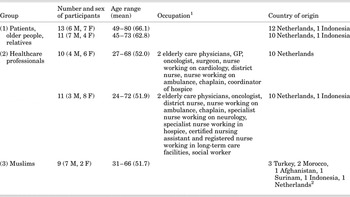
Three different groups of people participated separately from each other, so that they could freely express their views and experiences: (1) patients, older people, and relatives without a Muslim background (24 participants divided over two OFGs); (2) healthcare professionals without a Muslim background (21 participants divided over two OFGs); and (3) patients and relatives with a Muslim background (9 participants in one OFG) (see Table 1 for their characteristics). Muslims living in The Netherlands are often first- or second-generation migrants from former Dutch colonies like Surinam and Indonesia, or (children of) laborers from Morocco or Turkey. Because previous research has indicated that Muslims might have distinct views on what constitutes good care and communication at the end of life, related to their cultural and religious background, we chose to have a specific group for Muslim participants.
Characteristics of participants

1 Only available for healthcare professionals.
2 Converted to Islam at a later age.
The majority of the participants in groups 1 and 2 were recruited by means of a 2013 online questionnaire study among patients, older people, relatives, and healthcare professionals regarding (in)appropriate care in the last phase of life (KNMG, 2015). In that study, respondents could write down their email address if they were interested in participating in a follow-up study. In selecting participants for the OFGs, we aimed to create a sample of people with a wide range of characteristics (sex, age, religion, region, organization through which they received the questionnaire in 2013, and healthcare professionals' occupation), so as to potentially maximize the views on hope and realism expressed in the focus groups. Because older people and Muslims were underrepresented in the questionnaire study, we recruited some extra participants with help from the Association of Catholic Organizations of Senior Citizens in the Netherlands (Unie KBO) and the Network of Organizations for Older Migrants (NOOM). Subsequently, the selected people received an email with information on the aim, content, and procedure of the study and were invited to participate.
Procedure and Topics
Those who agreed to participate received a link to the closed discussion site and a personal login code and password. To ensure anonymity, participants were asked not to mention their names or addresses or the names of their healthcare providers. Every two days (except for weekends), a new topic was introduced with a new first question, and participants were informed about this via email and encouraged to respond. The days in between were used to introduce a follow-up question. The first author (MOV) functioned as the moderator in group discussions and tried to facilitate discussions by summarizing reactions, asking additional questions to clarify participants' views if necessary, and encouraging participants to react to others' comments. After a week, a reminder email was sent to participants who had not yet reacted.
Topics were based on literature research, an expert meeting, and the findings from the earlier-mentioned questionnaire study on “(in)appropriate care in the last phase of life” conducted in 2013 (KNMG, 2015), and were deemed to require more-detailed exploration. Apart from “hope and realism,” the other topics were “timely discussion of care needs and possibilities,” “communication among physician, patient, and relatives,” “societal views on death,” and “consultation and coordination between healthcare professionals.” Healthcare professionals were presented an extra topic: “organization of the Dutch healthcare system.” For the present article, reactions within the topic “hope and realism” were most relevant, although we did not solely use the reactions to this topic, as reactions to other themes offered interesting insights.
Hope and Realism
The topic “hope and realism” was introduced as follows:
Healthcare professionals, patients, and relatives may unintentionally stimulate each other to continue with medical treatments. Physicians often prefer not to start discussing withholding or withdrawing a treatment, because they do not want to take away patients' hope for a cure or life prolongation. In turn, patients sometimes present themselves more optimistically (about their physical and mental state) than they actually feel, hoping to receive another treatment.
Questions
-
1. Do you recognize this? Do you think that providing “hopeful information” should be replaced by providing “realistic information”? If no, why not? If yes, how should realistic information preferably be delivered?
-
2. Are there other ways for physicians to provide hope while simultaneously being realistic?
Analysis
The first available data (from the first two OFGs) were discussed by MOV and AF, who decided that no rephrasing of questions or topics was needed for the remaining three OFGs. Transcripts were analyzed following the principles of thematic analysis (Boyatzis, Reference Boyatzis1998). Transcripts were read and reread to allow the researchers to become thoroughly familiar with the data. Codes were then ascribed to meaningful text units (e.g., communicating with empathy, shift of hopes, involvement of other professionals). Codes were grouped together, and we searched for themes and their interrelatedness. After coding several interviews in this inductive manner, the findings were discussed with different members of the research group, all experienced in qualitative research, and we worked toward a consensus about interpretation of the key themes. MOV checked these interpretations with the existing data. A professional translated the quotes that we eventually chose to illustrate our results (shown in Tables 2–4).
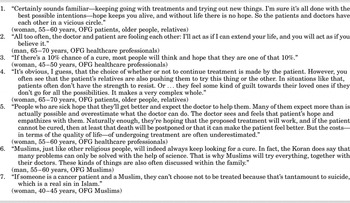
Quotes from participants regarding a circle of hope

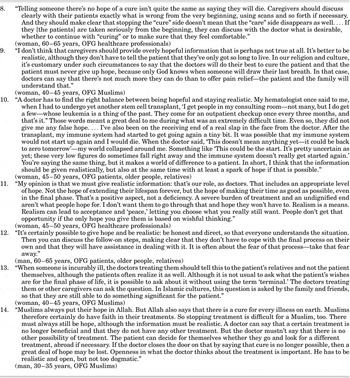
Quotes from participants regarding the balance between hopeful and realistic information

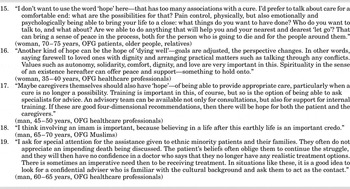
Quotes from participants regarding the shifting of hopes

Ethics
The anonymity of participants was strictly safeguarded throughout the process of data collection and analysis. Ethical approval for this study was not needed under the applicable Dutch legislation, since all participants were competent individuals and the study did not involve any interventions or treatments.
RESULTS
Circle of Hope
Participants from all OFGs recognized that physicians and patients often encourage each other to continue with medical treatments and as such reinforce each other's hopes (quotes 1 and 2). Although a few participants indicated that the maintenance of hope could foster optimism, the majority regarded such a “circle of hope” as undesirable. Applying treatment after treatment when the chances for a cure are very small was evaluated as nurturing false hope. Aside from being a waste of resources, participants mentioned that it often heavily burdens patients and deprives them of a dignified last phase of life, where they could say goodbye to their loved ones and complete unfinished business.
Several factors explaining this circle of hope were raised related to either patients, relatives, or physicians. For example, participants described how some patients wish to start any treatment no matter how small the chances for cure or life prolongation are. Their urge to survive and their faith in medicine can cause them to listen selectively to a physician's message (quote 3). Participants also reported that some patients feel morally obliged toward society to fight against their disease and not allow themselves to be defeated by it. In addition, relatives were thought to play a role here: they can sometimes not accept that the patient is incurably ill and push him/her to undergo just one more treatment (quote 4). Another factor mentioned by participants was that physicians are not always clear in their communications. For example, they present some new treatment alternatives right after talking about the patient being incurably ill. In fact, according to some participants, unfamiliarity with palliative treatment possibilities as well as the hope physicians have themselves make them reluctant to withhold or withdraw treatments with a curative aim. Because physicians are taught to cure the sick, it may feel like a failure when they cannot meet the high expectations that patients have, especially when the physician and patient know each other for a longer period of time (quote 5).
In addition, participants with a Muslim background tended to recognize the existence of a circle of hope. And, in line with other participants, they regarded it as unacceptable when physicians consciously gave false hope by providing unrealistic information or withholding realistic information. However, hope was found to play a different role for Muslims than for non-Muslims. They pointed out that they always keep their hopes up and rely on their faith in Allah, who is the decider when it comes to life and death. Moreover, Muslims reported that they are obliged to seek all possibilities for cure (quotes 6 and 7). The terms “curative overtreatment” and “life prolongation” were therefore not appropriate for people with a Muslim background.
Combining Hopeful and Realistic Information
The majority of participants from all OFGs—those with and without a Muslim background—reported that they prefer physicians to give realistic information rather than unrealistic but hopeful information (quotes 8 and 9).
Several participants detailed some conditions under which this realistic information could best be provided. First, realistic information should be provided at the right moment, that is, when the patient and family are open to receiving this information and are in the “right” state of mind. Second, realistic information must not be provided too bluntly, but rather with empathy. Delivering bad news in a five-minute conversation or by providing a pamphlet was seen as inconsiderate. Instead, participants indicated that physicians must possess good communication skills, so that they can communicate with the patient and his/her family in a clear, honest, and empathic manner (quote 10). Quote 10 reflects what many more participants from all groups reported: that it is not a matter of providing either realistic information or hopeful information, but that they should go together (quotes 11 and 12).
Most participants with a Muslim background preferred that physicians provide realistic information to relatives first. Thereafter, open and explicit communication with the patient does not always occur. Muslims reported that family members, especially of first-generation immigrant patients, sometimes choose to not confront the patient with his/her poor prognosis and the fact that they are nearing death (quote 13). In addition, Muslim participants detailed how a physician could best communicate that a patient is nearing death: they should inform the patient and/or relatives that they have no curative treatments available, but they should never state that a patient has an “incurable illness,” because physicians are not the ones who decide the question of life and death (quote 14).
Shifting of Hope
When the end of life approaches and there is, from a medical perspective, no longer a chance for a cure, participants described how hope for a cure gradually shifted to other goals—like hope for a good death and a good rounding-off of life. In this phase, participants emphasized the importance of physicians telling their patients that they would never leave him/her on his own and that having no curative treatment available was not equal to withholding care. Participants also wanted physicians to explicitly ask how they might support the patient during the time remaining (quote 15). As such, physicians could support the transition patients need to make from “hope for a cure” to “hope for a good death” (quote 16).
According to several participants, physicians could more often involve and consult specialized palliative care teams, psychologists, or social workers in order to help them regard palliative care as a “hopeful” form of care as well (quote 17).
Some participants also reported that physicians could more often refer patients to people who could provide “hope,” that is, spiritual counselors, pastors, or imams (quote 18). Muslim participants especially expressed a preference to involve an imam when the patient was aware of his/her terminal illness. Both participants with a Muslim background and healthcare professionals treating Muslim patients recommended involving a Muslim spiritual counselor to facilitate clarity in end-of-life communications (quote 19).
DISCUSSION
By conducting five OFGs, this study investigated, from different perspectives, how realistic and hopeful information should best be combined in physician–patient communications at the end of life. Our results show that participants from all groups preferred that physicians provide realistic information on diagnosis and prognosis in an empathic way, by assuring that the patient would be accompanied throughout the last stage of their life by the physicians themselves and by other professionals. Our finding that participants preferred realistic information over unrealistic but hopeful information is in line with other studies (Clayton et al., Reference Clayton, Butow and Arnold2005; Hagerty et al., Reference Hagerty, Butow and Ellis2005; Clayton et al., Reference Clayton, Hancock and Parker2008; van Vliet et al., Reference van Vliet, Francke and Tomson2013). In a survey study among cancer patients, no less than 98% of patients wanted their doctor to be realistic, to provide an opportunity to ask questions, and to acknowledge them as individuals when discussing prognosis (Hagerty et al., Reference Hagerty, Butow and Ellis2005). They perceived that provision of realistic information in a supportive and collaborative environment was more nurturing of hope than avoidant behavior (Hagerty et al., Reference Hagerty, Butow and Ellis2005). In addition, the systematic review of Clayton et al. (Reference Clayton, Hancock and Parker2008) highlighted the need for health professionals to balance honesty with hope without encouraging unrealistic expectations of longevity in the context of a far-advanced life-limiting illness. However, whereas previous studies focused almost exclusively on cancer patients, our findings apply to a wide variety of participants, who have experiences with all kinds of life-limiting diseases, with and without a professional view, and with and without a Muslim background. The strategies for fostering hope when discussing prognosis that are recommended based on the review conducted by Clayton et al. (Reference Clayton, Hancock and Parker2008) are very similar to what the participants in our study suggested: be honest and open without being blunt; offer reassurance that the patient will be supported throughout the illness trajectory; and reassure them that many treatments are available for controlling pain and other symptoms. Nevertheless, some patients might need a more direct or indirect approach, as was concluded from a study that found high variability in the way patients personally process the interaction of hope and prognostic information (Curtis et al., Reference Curtis, Engelberg and Young2008).
Our participants indicated that the transition patients and family (and sometimes also physicians) need to make from “hope for a cure” to “hope for a good death” is best supported when realistic information, realistic hope, and empathy are combined well for the individual patient. Additionally, previous studies have described and illustrated such a transition and a reframing of hope when death comes nearer (Benzein et al., Reference Benzein, Norberg and Saveman2001; Clayton et al., Reference Clayton, Butow and Arnold2005; Pattison & Lee, Reference Pattison and Lee2011; van Vliet, Reference van Vliet, Francke and Tomson2013). It thus seems that the way information is delivered to patients and families is often as important as the content. Displaying empathy and acquiring understanding are important skills for healthcare professionals (Clayton et al., Reference Clayton, Hancock and Parker2008), but not yet common practice, as only 38% of cancer patients reported that their diagnosis was conveyed in an empathic manner (Spiegel et al., Reference Spiegel, Zidek and Maier2009). Compared to previous studies, it is remarkable how often participants in our focus-group study emphasized the involvement of other professionals (e.g., palliative care consultant teams and spiritual counselors) to help patients and physicians with this transition and with the reframing of hope. Such professionals have important functions: whereas palliative care consultant teams can advise physicians in such a way that they gain more hope and faith in the possibilities of palliative care, spiritual counselors can help patients and their families to cope with and give (spiritual) meaning to the end of life. As hope has many facets on which healthcare professionals cannot all be expert, referral to other professionals has also been recommended elsewhere (Olsman et al., Reference Olsman, Leget and Onwuteaka-Philipsen2014).
Especially the Muslim participants in our focus-group study emphasized the involvement of an imam in end-of-life communications. Aside from providing spiritual care, an imam or other professional with a Muslim background might facilitate clear communications among the patient, his/her family, and physicians at the end of life. Such an intermediary function may be even more important, as we found, in line with other studies (Ozdogan et al., Reference Ozdogan, Samur and Bozcuk2004; Reference Ozdogan, Samur and Artac2006; Oksüzoğlu et al., Reference Oksüzoğlu, Abali and Bakar2006; de Graaff et al., Reference de Graaff, Francke and van den Muijsenbergh2010; Reference de Graaff, Mistiaen and Devillé2012a ; Reference de Graaff, Francke and van den Muijsenbergh2012b ), that relatives of people with a Muslim background are often quite influential in end-of-life communications and decisions and sometimes choose to not confront the patient with his/her poor prognosis. This does not mean that physicians do not have to be open and honest with Muslim patients. Whereas previous studies found that one of the main concerns about good care expressed by Turkish and Moroccan families was “never having hope taken away” (de Graaff et al., Reference de Graaff, Francke and van den Muijsenbergh2010; Reference de Graaff, Mistiaen and Devillé2012a), our findings present a more nuanced picture. When realistic information from a medical perspective is introduced in a culturally sensitive way (e.g., not by stating that a patient is incurably ill, but by informing the patient that the physician himself no longer has any available treatment options), hope can be maintained. This approach seemed acceptable to Muslims and was actually preferred by the participants in our focus-group study.
LIMITATIONS AND METHODOLOGICAL CONSIDERATIONS
In our study, all participants had a close experience of receiving or providing care at the end of life, but they were not necessarily an incurably ill patient or healthcare professional themselves. Their responses should therefore be regarded as a combination of views on preferences for end-of-life communication and experiences, which might have contributed to our finding that healthcare professionals and Dutch patients (without a Muslim background) had remarkably similar ideas about what would be best practice. Furthermore, although we tried to recruit a study sample with diverse characteristics, one should bear in mind that only people with access to the internet and with sufficient computer skills could participate, meaning that frail older people and people with a low level of literacy were most probably not included. In addition, we recruited people based on their cultural background (Muslim or not), but we did not take level of religiosity or education into account, which might also influence experiences with and preferences for realistic and hopeful information.
A clear advantage of conducting focus groups online is that participants can react anonymously from any place at any time, thus enhancing the richness of their reactions. However, this method also has its limitations. For example, participants reacted to each other's comments, but to a lesser extent than would have been expected in face-to-face focus groups. In addition, we noticed a decrease in the number of responses in all OFGs as the study period progressed and new themes and questions were posed. The number of responses in the OFG with Muslims stayed below that in other groups, even after motivating emails were sent by the organization through which participants were recruited. Moreover, only 9 Muslim participants reacted at the discussion site, while 15 people agreed to participate in the focus group. It could be that conducting focus groups online was not suitable for some of these participants. Nevertheless, we were able to garner interesting responses from people with a Muslim background, who are known to be difficult to include in all types of studies (whether online or not). Further research is recommended, with a larger sample of Muslims, that would take account of the other factors that may influence preferences in terms of hope and realism.
CONCLUSIONS
Realistic and hopeful information are not necessarily mutually exclusive and can even be combined when discussing diagnosis and prognosis at the end of life. To support the transition of patients and relatives from “hope for a cure” to “hope for a good death,” realistic information can best be provided delicately and in a culturally sensitive way. This means that, when communicating with patients who are in the last phase of life, physicians and other healthcare professionals should be aware of individual, cultural, and religious diversity with respect to views on hope, and they should realize that some patients will never cease to hope for a cure. In their communications with Muslim patients, physicians would do best by being open and providing realistic information while at the same time paying close attention to the wording of their messages. Communication skills training as well as inculcating knowledge about cultural and religious diversity into medical educational programs could improve physician–patient communications at the end of life. The focus of future research should be whether or not patients who receive information in a way that combines realism with hope and empathy have more favorable outcomes (e.g., increased awareness and understanding of their prognosis and satisfaction with consultations).
ACKNOWLEDGMENTS
This study was supported by the Royal Dutch Medical Association (KNMG). We would like to thank all the participants in the focus-group discussions, as well as Yvonne Heijgele from NOOM and Agnes van Balkom from Unie KBO for their help in recruiting participants.