


Both exceptional and definitive, Wuthering Heights (1847) stands out among nineteenth-century novels for its polymorphous afterlives even as it continues to shape what “Victorian” now signifies.Footnote 1 Generically, Emily Brontë's work calls out its innovations while repurposing such older forms as the ballad, fairy tale, and gothic romance.Footnote 2 Q. D. Leavis argued that Wuthering Heights would be a noteworthy realist account of female maturation were one willing to dismiss the invention of Heathcliff as a rookie's blunder.Footnote 3 But if Emily's novel diverges from nineteenth-century realism as typically conceived, it nonetheless portrays characters who, as Arnold Kettle put it, “live in the world and strive to change it.”Footnote 4 Too fantastic to stand as provincial novel or historical romance, too underpopulated for industrial fiction, and too weird for a courtship plot, Wuthering Heights, at the same time, is all of these things. If it is also a species of crime fiction that adumbrates Yorkshire noir, that is not primarily because it can be shown to confirm the “strange eccentricity” and “unnatural power of crime” that Elizabeth Gaskell attributed to a life in the West Riding.Footnote 5 It is, I will show, because Wuthering Heights prefigures the “hardboiled” pull from epistemological certainty to ontological complication—and does so by virtue of its occulted landscape.
This essay makes that case by showing how the dialectic of genre and place performs the ontological work of narrative fiction. It is no doubt obvious that a narrative's depiction of place bears on what we can know about that place and its condition—obvious partly because the poststructuralist turn to language encouraged us to think about epistemology, or what Mary Poovey (channeling Lorraine Daston) has defined as “the assumptions and conventions that constitute . . . what counts as knowledge at any given moment.”Footnote 6 Until recently, however, we have thought less in terms of what place tells us about ontology: that is, what counts as real at any given moment. Conventionally defined as a branch of metaphysics concerning the nature of being, ontology as I invoke it asks how narrated worlds take on the shape of imaginary realities that are intelligible to a reader's awareness and cognition. By way of highlighting such ontological work, this essay focuses on the interplay between generic conventions and figurations of place—a sense-making dialectic that enables readers to discern the terms of existence which shape any given fictional world.
For example, while place is important both to Dracula (1897) and Pride and Prejudice (1813), most readers readily recognize that the events of Bram Stoker's novel would not be possible in Jane Austen's. Alert to the ontological portents of generic signals—the strange howling of a dog versus a maxim about marriage—readers discern what each storyworld makes conceivable, probable, or subject to change. That discernment, moreover, occurs despite the fact—in some ways because of the fact—that neither the ominous canine yowl nor the ironic narrative proclamation constitutes absolute knowledge of any kind. That is why, in narrative fiction (as in philosophy more generally), what counts as knowledge (epistemology) and what counts as real (ontology) are necessarily interdependent. Thus, while my essay brings overdue attention to the latter, its purpose is neither displacement of epistemology nor the elevation of reality over knowledge.
To make matters even more complicated, we cannot forget that one of narrative fiction's most important rewards is the insight it offers into worlds outside fiction. What Fredric Jameson calls “cognitive mapping” involves the invention of “radically new forms” to endow readers “with some new heightened sense” of “place in the global system.”Footnote 7 This way of thinking about the ontological work of narrative widens literary meaning: as generic conventions shape spatial perceptions that exceed mere geography, the emerging sense of globalized place enlists familiar literary forms in telling ways while bodying forth new ones.
Thinking together with Helena and Lauren has underlined for me the ways in which empire is not a single concept-metaphor but a complexly variegated field of forces, sometimes . . . mutually illegible to one another. Widening thus is not necessarily about inclusion, or about inclusion in any positive sense. Widening can also be about incorporation of others as constitutive outsides.—Parama Roy
In speaking of genre, I invoke a category of literary analysis that Tzvetan Todorov, building on reception theory, has defined as “horizons of expectation.” Genres so defined are not fixed essences, or rigid categories in a taxonomic scheme, but, rather, precirculated (though still contingent) sets of conventions against which readers discern the features particular to new works of art.Footnote 8 As such, genres do not exist in a vacuum: there can be no “horizons” without the circulation of cultural forms; no “expectation” without subjects alive to narrative conventions and the cognitive maps they help evoke. Moreover, since genres come “from other genres,”Footnote 9 it follows that the best grasp of any single work entails conventions drawn from multiple genres. Playful mash-ups such as Pride and Prejudice and Zombies (2009) delight in confuting the bedrock distinction between natural and supernatural worlds. Yet, to some degree, all genres begin as mash-ups: a “new genre,” says Todorov, “is always the transformation of an earlier one, or of several.”Footnote 10 What genre, after all, is the multiplot blend of domestic, gothic, “condition-of-England,” and emerging detective fiction in Charles Dickens's Bleak House (1852–53)? Why, for that matter, does Shirley (1849), the successor to Jane Eyre (1847), begin with the narrator's warning readers to “calm” their “expectations” of “melodrama” and prepare instead for “something as unromantic as Monday morning” (chap. 1)?
Precisely because genres resist inflexible classification, they should help us think transtemporally and comparatively. That said, the frequent alignment of stylistic categories such as “realism,” “modernism,” and “postmodernism” with discrete historical periods constrains this effect. Critics convinced that Victorian “realism” is a coherent genre—as opposed to a mode that informs multiple genres (prior to and since the nineteenth century)—risk overlooking diversity within periods as well as complementarities between them. By contrast, transtemporal comparisons invite us to study how genres evoke worlds—both inside narrative fiction and beyond it. Thus, the “everyday being” that Georg Lukács (in my epigraph below) tied to a “configuration of complexes within a historical process” operates through perceivable rules of reality that in some ways resemble a set of genre conventions—like the Monday morning that Shirley upholds to its readers.Footnote 11 To elaborate, this essay (which derives from a larger project on the ontological work of nineteenth-century fiction) positions the study of genre and place as the basis for a comparative literary practice that crosses periods and media—a case I make with special reference to the occulted landscapes of Yorkshire noir.
What this conjuncture of papers encourages me to reflect on is other means of widening periodization.—Ross Forman
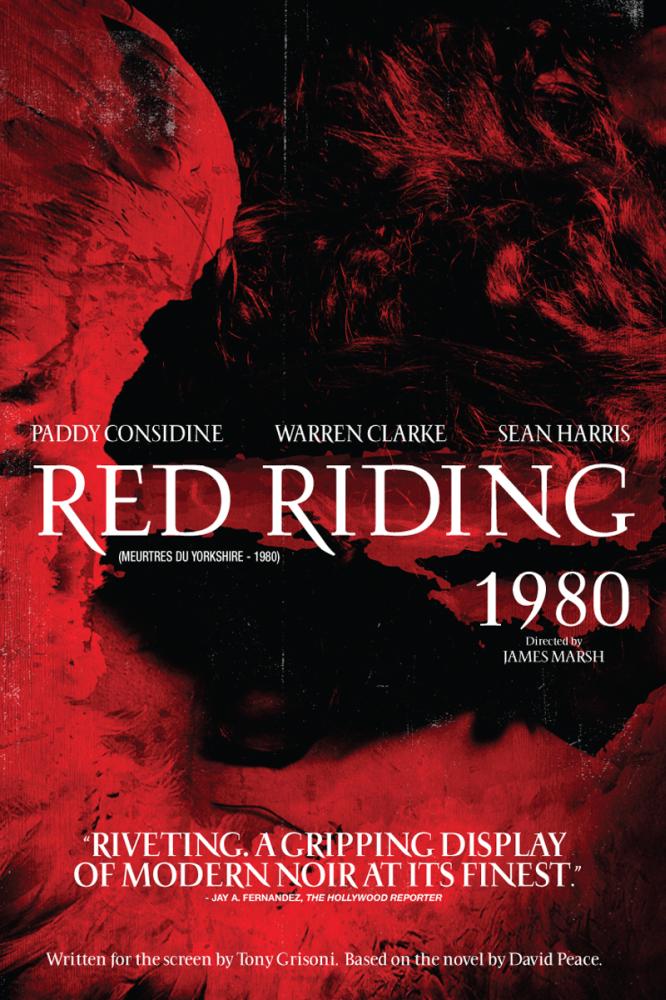
My discussion of Wuthering Heights begins with a concise look at David Peace's Red Riding Quartet (1999–2002), a sequence of hardboiled crime novels set in the late 1970s and early ’80s, which was adapted for film as The Red Riding Trilogy (2008).Footnote 12 As I hope to show, both works draw on the ontological resonances of a real-world geography: Yorkshire's West Riding. Nonetheless, whereas Peace's Red Riding series is a palimpsest in which the localized layers of history speak to and through one another, Wuthering Heights builds out its story through a photomontage-like spatial composite that airbrushes its seams. As we will see, both works engender narratives of regional becoming through occulted landscapes that trouble the ontological borders between human and animal, life and death, past and present, nature and supernature. In doing so, both works—so far from provincial—remind us that world-systems thinkers, beginning with Karl Marx, have offered the ontological premise that the material world as we know it has been shaped through an ongoing process of combined and uneven development.Footnote 13 To clarify this wide mode of reading, I begin by inviting the Victorianist readers of this journal to reflect on their long-standing ontological presumptions.
Ontology Now
We are using the fine word “ontology.”. . . There is certainly no Being in the [metaphysical] sense, and even that which we call everyday being is a specific and extremely relative configuration of complexes within a historical process.
—Georg LukácsIn the last two decades, interpretive disciplines such as literary criticism have seen a growing interest in ontology. In their much-discussed Empire (2000), Michael Hardt and Antonio Negri sought to radicalize political action through focus on the possibilities of self-organizing collectivities. Since “we all exist entirely within the realm of the social and political,” they wrote, an ontology that dwells too rigidly on material forces of determination will fail to provide an adequate account of “what is and what exists.”Footnote 14 More recently, scholars have explored the very different implications of object-oriented ontologies that set out to decenter long-lasting anthropocentric biases—from classical humanism to poststructuralist theory. In anchoring reality to its construction in language, poststructuralist thought, for all its rigorous anti-essentialism, implicitly privileges human actants and, thus, epistemology (knowing) over ontology (being). By setting aside linguistic perspectives as well as “deep” humanist emphases such as experience, consciousness, and historicity, object-oriented standpoints privilege what Bruno Latour calls “objective facts.” If the appeal of these flat ontologies is the check on anthropocentrism, the potential cost is a reductionist positivism modeled on the sciences.Footnote 15
Of course, in stressing the ontological limitations of a turn to “facts,” my point is hardly to defend anthropocentric biases. We cannot ignore the ravages of anthropogenic destruction. But neither can we curb it by ontologically bracketing the strong human investment in consciousness, experience, and historicity. The key point for readers of the present essay is that all scholarly engagements of the world, inside as well as outside the study of literature, entail presuppositions about what counts as real, whether explicit or implicit. The new interest in “objective” models drawn from the sciences thus emphasizes “ontology” without addressing either the downsides of ontological positivism or the rewards of critical alternatives.
To speak of a critical ontology is to wed the positivist's focus on observable phenomena to the historical materialist's conviction that modern lifeworlds are subject to complex structures that cannot be captured through observation alone. Critical ontologies thus turn to theory in the effort to describe real phenomena that (like racism, commodification, or the uneven development of capitalist globalization) are difficult to visualize, pinpoint, and measure.Footnote 16 In upholding Lukács's “configuration of complexes” as a guide, I aspire to that “heightened sense” of “place in the global system” that Jameson (though not himself an explicitly ontological thinker) associates with artistic forms that have yet fully to emerge.Footnote 17 Moreover, in highlighting the ontological work of genre and place, I draw out the figurative powers of landscape that Marx illustrated when he wrote (in an essay on India) that “industry and commerce” were creating the “material conditions of a new world” in the same way that “geological revolutions have created the surface of the earth.”Footnote 18 Historically, landscapes are culturally active sites that work at the intersection of economics, aesthetics, ecology, and social life, both within and across regional borders. When industrialization concentrated productive resources that were hitherto geographically dispersed, it created deep spatial asymmetries that are functionally combined but constitutively uneven—a condition that fuses “a specificity of historical experience and place” to an evolving structure of “worldwide macro-interdependency.”Footnote 19 The results are occulted landscapes: geographic formations that bespeak the ontological gap between what individuals positively know and what they feel to be real but cannot directly perceive.
Here is the opening for narrative art forms whose ontological work is to heighten the awareness of place in a global system—engaging and “figuring out” the realities converging at multiple scales within variously temporalized frames of space and spatialized frames of time. Never simply imitating, reproducing, or mediating these worlds beyond fiction, the ontological work of “figuring out” aspires to cognitive mapping at its most utopian.Footnote 20 It entails both figura in its root sense (that which provides imaginative shape) and the more prospective work of figuring out (that which invites speculation and discovery). With their singular capacity to elaborate the form and duration of imagined locations, fictional narratives are well suited to “figuring out” combined and uneven world-systems at work. In this essay, I use occulted landscapes to designate the ontologically replete manifestations of place that, for more than a century, have undertaken this ontological work through hardboiled genre conventions centered on Yorkshire.
Lauren's “wide” is also long and deep. These coordinates act as powerful (gravitational?) pulls.—Helena Michie
In offering this case for occulted landscapes, I am mindful of the pitfalls of a “symptomatic” emphasis on what is “hidden” or “hiding.”Footnote 21 A resolute attention to the visible usefully reins in such theoretical abstraction; but taken too far, it produces a positivistic reification of the seen that is itself an abstraction. The critical focus on ontology I enact is, thus, not so much deep (in privileging hiddenness over visibility) as it is wide (in emphasizing the multiscaled interdependence that situates everyday being, both observable and not).Footnote 22 My argument rests on hardboiled particularly because the strongly occulted landscapes that recur in such works amplify this “configuration of complexes.” The term “hardboiled” typically enunciates the split between classic detective fiction's emphasis on “who done it and how?” and a very different focus on existential conditions—a shift, that is, from epistemological certainty to ontological complexity.Footnote 23 That said, my point is not that Wuthering Heights is best categorized either as hardboiled or as historical crime fiction; it is, rather, to demonstrate how this landmark 1847 work, which has long exceeded its characterization as a “gothic” or “Victorian” novel, typifies the work of landscape on which the generic signals of hardboiled fiction depend.
Both Wuthering Heights and the Red Riding series evoke moorland terrains inseparable from the long (and still ongoing) history of woolens manufacture: developments that required access to capital and to a major port (Liverpool) that had been energized by the Atlantic slave trade. Beginning with the later work—an unusual tactic in an essay for Victorian Literature and Culture—thus enables me to highlight ontological features of Wuthering Heights that conventional periodizations have obscured. As we will see, “Yorkshire noir” takes shape through a focalization of landscape that is as incandescent in Peace's series as in Brontë's formally groundbreaking novel.
“What have those lonely mountains worth revealing?”Footnote 24
I grew up with the Yorkshire moors around the corner. . . . And the thing about the Yorkshire moors [in the 1960s] . . . was that you associated them with the Moors murders, with Ian Brady and Myra Hindley. . . . And another childhood in the North of England that was very much traumatised by the moors was Heathcliff's. So I began in the more contemporary story; then I just kept thinking about that landscape and what it has meant historically.
—Caryl Phillips on the writing of his multitemporal novel The Lost Child (2015)As a novel quartet adapted into a film trilogy that was broadcast on Britain's Channel 4, released in U.S. cinemas, and streamed internationally, the Red Riding series considerably differs from television serials such as HBO's The Wire (2000–2008). In the publicity for the trilogy, a tripartite image that obscurely figures a businessman's fetish for swans calls attention to series form in becoming intelligible only when viewed as a whole.Footnote 25 Yet, as though to complicate that full apprehension, each film focalizes different characters in a different year and enlists different directors working with distinct technologies. Red Riding 1974, which focuses on Eddie Dunford, a young crime reporter drawn to a series of child murders, was shot on grainy 16 mm film; Red Riding 1980, which features Peter Hunter, a Manchester detective enlisted to investigate the search for the Yorkshire Ripper, was filmed on the more conventional 36 mm stock; and Red Riding 1983, which throws digital light on the subterranean web of crime that links the police to local elites, was processed with anamorphic widescreen technology. The latter film centers on three characters: BJ, the genderqueer rent boy who helps Dunford in 1974; Maurice Jobson, a policeman with a guilty conscience; and John Piggott, the son of another bent copper, who, as a solicitor, helps Michael Myshkin, the mentally challenged man who has been framed for several schoolgirl murders. The very names of these isolated protagonists—Dunford, BJ, Jobson, Piggott, Hunter (ironic because he is hunted)—invite audiences to predict that their efforts will be quixotic at best. Nonetheless, what connects these stories is their inextricable relation to place: Yorkshire's “Red Riding” is “red” in the symbolic sense of a violent space that transcends the historic “ridings” of East, North, and (especially) West Yorkshire as well as the proximate Lancashire city of Manchester.Footnote 26
As readers of this journal know well, the West Riding's manufacture of woolens was the primal scene of that world-historical conjuncture that Marx seized upon when he likened industrialization to a geological revolution. Nonetheless, scholars of the Red Riding series are likely to categorize Peace's novels in postmodern terms—their blend of real-life and fictional Thatcher-era crimes as examples of the self-reflexive form that Linda Hutcheon calls “historiographic metafiction.”Footnote 27 Of course, the mixing of real and imaginary scenes is hardly unknown to Victorian literature. But it has become conventional to regard metafictionality as the trademark feature of postmodernist aesthetics while upholding nineteenth-century novels for their (supposed) antimetafictional fidelity to the purest mimesis.Footnote 28
Red Riding's “noir” evocation of the Yorkshire past illustrates how gothic tropes inject historical time into claustrophobic space. The gothic castle, for example, makes visible “traces” of history through architecture, furniture, and family objects. In Wuthering Heights, the same obsession with anachronistic “vestiges” that finds castles saturated with history infuses the “jutting stones” and “primitive chairs” of an antique farmhouse built to withstand “atmospheric tumult.”Footnote 29 But it is above all landscape that conditions the hauntings of Yorkshire noir. Penistone Crags, their “bare masses of stone, with hardly enough earth . . . to nourish a stunted tree,” stand both for a pervasive hostility to living things and a nonarable geography that encouraged industrial development.Footnote 30 As the Red Riding series transmutes this legacy, its Yorkshire terrain is comparably scarred by endemic brutality. When the narrator of 1974 investigates a disturbing crime against swans, the “purples and browns” of the surrounding moors bring a bruised human face to mind (1974, 140), reminding us of the “scratched and bruised” face of Isabella as she flees the Heights or the “frowning” rocks in which Linton Heathcliff discerns his father's presence (WH chap. 17, chap. 26). Yorkshire noir thus operates as the stylistic seepage from occulted crimes that have been centuries in the making.
In interviews, Peace has described his writing as “occult history”—an attempt to recover those aspects of the past that have been “occulted” or hidden from view.Footnote 31 As Jill Galvan observes, the “term occult is at once a barrier and an invitation, demarcating the hidden . . . while challenging us to make it known.”Footnote 32 Occulted landscapes accentuate the temporalized spaces they “figure out,” enlisting generic tropes to irradiate the signs of hard-to-see histories. Both a hardboiled space that spotlights the pathologies of neoliberal deindustrialization and a gothic history that longs for regional becoming, “Red Riding,” like Marx's landscape, stands for “the material conditions of a new world.” In doing so, it evokes the paradoxical wideness of place.
Is “wide” a spatial term, or can it also/instead be epistemological? How can we think of wide beyond space without making it signify something too wide—like “new”?—Helena Michie
As the above epigraph from the Kittitian-British novelist Caryl Phillips suggests, for a generation of contemporary authors, growing up in the shadow of “the Yorkshire moors” implied the haunting remembrance of Ian Brady and Myra Hindley's infamous child abductions in the 1960s. Red Riding's long and wide metafictional historical embrace cites the so-called Moors Murders (designated as such because the victims were buried on Saddleworth Moor). The repetition of the phrase “over the moors” echoes “Suffer Little Children,” a song about the murders recorded in 1983 by the Smiths, a postpunk rock band. Front man Morrissey wrote the lyrics after reading a true crime account of the Moors Murders that opens with lines from Emily Brontë's poetry (“I dream of moor, and misty hill”).Footnote 33 The song's plangent refrain epitomizes the Smiths’ dour poetics of northern life: “Oh Manchester, so much to answer for.”Footnote 34 As a crying child calls out from a shallow moorland grave, the lyrics conjure the same conjoining of claustrophobic space and anachronistic time that prompted Phillips to make The Lost Child (2015) a meditation on Wuthering Heights’ longue durée. Born in St. Kitts but raised in Leeds, Phillips believes that if Brontë's characters were incarnated as living beings “in that landscape” today, they would continue to “recognise it.”Footnote 35 The same dynamic landscape provides the ontological enzyme for Peace's “occult history.”
Like “Suffer Little Children,” The Red Riding Quartet makes the journey “over the moors” a recurrent set piece. In 1980 Hunter's harrowing drives on the M62 between Manchester and Leeds mark him as a doomed outsider. His narration depicts the trans-Pennine landscape as a fusion of postindustrial blight and forgotten violence, conflating inorganic matter, atmospheric conditions, and human remains—as when describing “the articulated lorries, stark and empty, snow across their cold lost bones” (1980, 19). Hunter's investigation involves disentangling the Yorkshire Ripper's violence from murders the police have perpetrated to cover their own criminal conspiracy. The more immersed in this collusion he becomes, the more Hunter's “riding” encompasses his own “red” recollections (including a guilty affair with a female colleague). This mixture of regional and personal wrongs connects him to the arrogant Dunford, gluttonous Piggott, and complicit Jobson, all of whom are implicated in systemic misogyny and exploitation that they deplore but do not forgo. As Jobson crosses the Pennines, dwelling on a long history of police perfidy, the moorland he conjures is an occulted space: “the wraiths and the sheep, the pylons and the pile-ups.” His tormented parataxis renders a disordered ontology in which the signs of human violence (“more lost children”) blend indistinguishably with atmospheric disturbance (“shotgun blasts” of rain, thunder, and lightning), preternatural states (“More voices”), and psychological precarity (“I drifted”) (1983, 249).Footnote 36
The rather different situation of BJ, the series’ only focalized victim, glimpses the moors through the windows of a coach:
BJ look across aisle and out other window at rain and moors, bleak weather and land it makes, no suitcase over BJ's head—
Just a pocket full of blood ‘n’ cum money (1983, 52).
Though his narration bears the signs of local dialect, queer subjectivity, and a childhood too harried for correct grammar, BJ's link to the detective narrators is the shared experience of occulted landscape. The same ruptured ontology that fuses corpses and machines, ghosts and animals, and industrial infrastructure and industrial calamity, merges bodily fluids and liquifiable cash (“blood ‘n’ cum money”).
Contiguous with the occulted moors is Red Riding's variation on the hardboiled city: Leeds, the West Riding conurbation described by Hunter as a “collision of the worst of times, the worst of hells” (1980, 26). As his mission becomes ever more suicidal, Hunter's place-fixated narration becomes manic and incantatory:
Leeds, fucking Leeds:
Medieval Leeds, Victorian Leeds, Concrete Leeds –
Concrete decay, concrete murder, concrete hell – A concrete city –
Dead city:
Just the crows, the rains, and the Ripper— (1980, 364)
By extending “the worst of times” outside the series’ chronology, Red Riding's ontological collisions spill into time itself, collapsing medieval, Victorian, and neoliberal temporalities. Leeds, the geographic epicenter of this living palimpsest, is at once an antique market town for woolens; a center for the West Riding's nineteenth-century industrial economy; a site of the late-capitalist deindustrialization that followed; and—as such—a transhistorical cluster of (real-life) gothic locations. These include both Millgarth Police Station (a 1970s edifice, rebuilt on the site of a Victorian original, in whose “Belly” confessions are coerced and crimes concealed) and the Griffin Hotel (built in the 1870s, in which prisonlike space Hunter, tasked to police the West Yorkshire force, realizes that they are policing him). To the south, in Wakefield (administrative center of the old West Riding), is the Strafford Arms, the haunted public house in which BJ witnesses a traumatic shooting; as well as Stanley Royd, a hospital for the insane (opened in 1818 as part of the West Riding Pauper Asylum), in which an earlier crime reporter is institutionalized. As yet another ill-fated journalist warns Dunford, “All great buildings resemble crimes” (1974, 82).
A few miles out on the M62 lies Fitzwilliam, a real-life pit village named after the aristocratic owners of a colliery that became the site of century-long industrial struggles (see fig. 1). This old company town, now a hotspot of postindustrial dysfunction, is, in Peace's quartet, home to a disgraced policeman whose suicide devastated the young Piggott (his son) as well as the Myshkins (an immigrant family forced to pay the price for heinous crimes their son did not commit).Footnote 37 It is also the haunt of the shadowy Reverend Laws. A latter-day exorcist, whose name tellingly invokes the “Law of the Father,” Laws is a closet pedophile whose decades of child abuse began with BJ.Footnote 38 In this way, the old mine shafts in which earlier generations of Yorkshire children labored now bury a new generation's suffering at the hands of sexual predators.
Dunford driving to Fitzwilliam in Yorkshire, in view of nuclear cooling towers that ironically pronounce the long history of this place as a coal-mining town (Red Riding: 1974).

The recurrent sign of this subterranean chamber of horrors are the swan feathers that, like the fog in Dickens's Bleak House, connect systemic crimes that are otherwise hard to connect. Their literal referent is the obsession of a real-estate developer whose swan-shaped house and plans for a swan-themed shopping center make clear that the motif of the winged child in the marketing image figures the swan's wings that are sewn into the bodies of abducted schoolgirls—presumably for his pleasure. This quintessentially evil act is also a crime against ontology: a monstrous merger of girl and bird. That we never learn who performs the grotesque ritual—the developer? a police collaborator? Laws?—illustrates how the series is less about particular deeds and doers than about the pathologies that attach to place.
As such, Red Riding's traumatized terrain is both unique and suggestive of place in a global system: a crystalline formation in a wider structure of combined and uneven development. It is a part that Yorkshire is well qualified to play. A kind of longue durée primal scene, the region's history peaked with the industrial development that Neil Smith has called “the gift of dead labor fossilized in [a] geographical structure.”Footnote 39 Plateauing around the time Brontë wrote Wuthering Heights, the same historical process that turned England's North into the world's first workshop eventually led capital outside Britain entirely. The “long-term depression” that began under Thatcher's government has disproportionately affected the North.Footnote 40
It is all the more striking, then, that the series’ climax occurs when BJ, traveling southward, dubs himself a “son of Yorkshire” who “got away” (fig. 2).Footnote 41 In a stream of parataxis recalling Allen Ginsberg's poetry, BJ begins jubilantly—“Hello from back seat hard on last bus home, one that got away and lived to tell the tale” (1983, 399)—hailing multiple characters until the cast he assembles includes “every missing child in this whole fucking world.” “Hello,” he continues, “from Strafford Public House and Griffin Hotel, Millgarth and Wood Street nicks”; from
. . . motorways and car parks, from parks and toilets, idle rich and unemployed, from Maggie Thatcher and Michael Foot, from SWP and National Front, IRA and UDA, from M&S and C&A, Tesco and Co-op and every shopping centre in this wounded, wounded land, from shit they sell and shit we buy . . . [from] black bodies in Calder and ones in Aire, from all dead meat and my dead friends, pubs and clubs . . . silent pits and page three tits, from Nazis and Witches, West Yorkshire coppers and their bent mates, from all little shits and things we get to see, dead bodies piled up . . . sirens that howl for ten long years bloodstained with fear, from one that got away, un-lucky one, from Dachau to Belsen, Auschwitz to Preston, from Wakefield to Leeds, Stanley Royd and fucking North, from West Bloody Riding and Red Riding Hood, final solution and wrath of God . . .
This is for all things you made me do, for all things you had me see . . . , for boy I was and them boys that saw, . . . for that knife in my heart and this one in you. (1983, 399–400)
It is not the least of this passage's rhetorical power that the figurative knife BJ thrusts in the Howl-like collision of crimes is also a literal deathblow struck against a specific tormenter. That unholy father, Reverend Laws, is on the verge of assassinating his victim when the latter begins this defiant tirade. As an epicenter of modern capitalism, the Yorkshire that BJ triumphally calls to account is plumbed into a wider, longer history that includes imperialism, the slave trade, industrialization, deindustrialization, consumerization, racism, and fascism.
BJ (Robert Sheehan) figured as a “son of Yorkshire” who “got away” (Red Riding 1983).

As “one that got away,” BJ's escape is the utopian kernel in an otherwise devastating narrative of the Thatcherite defeat, in Dean Lockwood's words, “of socialism, modernism and ideas of progress.” Rejecting the “discredited” postmodernist fiction that abetted neoliberalism's “post-political” malaise, Peace, according to Lockwood's analysis, imports the social realism of the 1960s into a rejuvenated “pulp modernism.”Footnote 42 Though I agree, I offer a simpler observation. Whether one judges it as largely realist, modernist, or postmodernist, Peace's series contains little that stands out as stylistically “dead.”Footnote 43 Indeed, this “occult history” of ascendant Thatcherism, whose climax is BJ's defiant summoning of place in a world-scale configuration of complexes, is more resonant than ever in the hour of Brexit and Boris Johnson. Red Riding thus challenges a periodizing logic that proffers preconceived ontological claims about literary form. In doing so, Peace's series amplifies the ontological work of Victorian literature's best-known occulted landscape.
“bleak weather and land it makes . . .”
The land [in the West Riding's “hill villages”] has often been held by one family since the days of the Tudors. . . . [T]hose remaining . . . in the lonely houses . . . sufficiently indicate what strange eccentricity—what wild strength of will—nay, even what unnatural power of crime was fostered by a mode of living in which a man seldom met his fellows. . . . [T]he tales of positive violence and crime . . . in these isolated dwellings [were] . . . doubtless familiar to the [author] of “Wuthering Heights.”
—Elizabeth Gaskell, The Life of Charlotte Brontë, 1857Whereas the ontological work of place in Peace's Red Riding is palimpsestic, the landscape of Brontë's single (and singular) Wuthering Heights is, I will show, synoptic. But before turning to this photomontage-like formation, we must address the character whose very name is a landscape. It is through Heathcliff that Wuthering Heights makes ontological uncertainty the condition of its story of regional becoming. As Isabella knows, the question is not who but what she has married: is Heathcliff a man, a madman, or a devil (chap. 13)? What is his race, nationality, or ethnicity? Is he a gypsy (chap. 1), a Lascar, a Spanish castaway (chap. 6), a Chinese emperor's son, an Indian prince (chap. 7), or an “out-and-outer” destined to be hanged (chap. 6)? Is he a cuckoo (chap. 4), a wolf (chap. 10), a “savage beast” (chap. 16); an “it” (chap. 4) or a “dark thing” (chap. 34); a ghoul, a vampire, or a demon (chap. 34); or an “arid wilderness of furze and whinstone” (chap. 10)? Like hardboiled crime fiction, Wuthering Heights plays with these indeterminacies even as it organizes them through a generational plot and frame narrative borrowed from earlier genres. Ultimately, I suggest, the novel articulates two distinct fictional ontologies and, thus, two ways of evoking a collective experience of place in a global system.
In what may be the best ontological reading to date, Dorothy Van Ghent describes Brontë's “two kinds of reality: the raw, inhuman reality of anonymous natural energies, and the restrictive reality of civilized habits.”Footnote 44 Her observation mirrors Catherine's famous contrast between her love for Linton (“Time will change it . . . as the winter changes the trees”) and for Heathcliff (as “necessary” as “the eternal rocks beneath” [chap. 9]). Heathcliff riffs on this claim, declaring that Edgar “might as well” expect an oak to thrive “in a flower-pot” as “imagine” that “the soil of his shallow cares” can “restore” the ailing Catherine (chap. 14). Notably, both analogies summon landscape to articulate distinctions of scale: for Catherine, the durational difference between eternality and transience; for Heathcliff, the spatial opposition of amplitude and constraint.
Scholarship on the landscape of Wuthering Heights has tended to focus on real-life inspirations.Footnote 45 While this decades-long quest for an original has been inconclusive on its own terms, it successfully demonstrates how this most meticulous author drew on deep regional knowledge to invent a fictional map. Architecturally, Wuthering Heights combines elements of Tudor manor and “Halifax house” (a style of “moderate size” Yorkshire dwelling favored by upwardly mobile yeomen with a yen for “swagger”).Footnote 46 Geographically, it has been associated with Top Withins, just a few miles from the Brontë parsonage, ever since Ellen Nussey, a family friend, pointed out the resemblances between the fictional Heights and this real-life enclosure of moorland dating back to the sixteenth century. That such upland “hill farms” could prosper despite lack of arable land was owing to the woolens industry that arose when family-based “farmer/clothiers” (with “clothiers” signifying makers of woolen cloth) replaced the dispersed guilds of the middle ages. In Top Withins, as in the Heights, agricultural labor focused on dairy (primarily for family use) and sheep (for production of wool).Footnote 47
By contrast, Thrushcross Grange, a more “aristocratic” estate than all but a handful of northern country houses, is harder to place. The “whole character of the establishment,” according to Everard Flintoff, “belongs to the English lowlands,” not least since its “arable landscape” could not exist in the Pennines. Hence, photomontage-like, the valley separating the Heights from the Grange seams together “very different sorts of terrain with startlingly different land-use,”Footnote 48 an occulting of landscape that imbues a single location with spatiotemporal width and depth. As Raymond Williams has shown, country houses like Thrushcross Grange, with their miles of uncultivated parkland, represented an aestheticizing of enclosure and, thus, of agrarian capitalism.Footnote 49 Hence, when Hutcheon defines historiographic metafiction as an effort to square empirical history with fictional autonomy, she might be describing the landscape of Wuthering Heights.
As we have seen, periodization militates against such observations by projecting homogenized horizons of expectation over dynamic and hybrid forms (forgetting, in effect, that genres come “from other genres” and a “new genre is always the transformation of an earlier one, or of several”). At least two kinds of interpretations of Wuthering Heights illustrate this effect by contrasting Emily's romance to Charlotte's realism. On the first view, Wuthering Heights is an old-fashioned outlier—too beholden to forms like Scott's regional romances to render industrial-age Yorkshire with the documentarian fidelity of Charlotte's Shirley.Footnote 50 A more prevalent misreading reverses these poles, contrasting Charlotte's compromised verisimilitude to Emily's metaphysical flights. Terry Eagleton, for example, lauds Emily's confrontation between “authenticity” (Catherine's “ontological commitment to Heathcliff”) and “social convention” (her “phenomenal relation to Linton”).Footnote 51 Like much other criticism that equates ontology with metaphysics, this construal exempts “authenticity” from social practice while depriving “phenomenal relationship” of any theory of existence.
In an earlier Marxist reading, Kettle emphasizes the novel's deeply “local quality.”Footnote 52 Wuthering Heights, he writes, depicts material structures such as class, property ownership, and marriage while upholding collective striving over atomized romantic desire. Kettle's evidence for locality, however, stumbles. He tells us that Heathcliff was born in a “Liverpool slum” when, in fact, he was found in that port city: the nonwhite signifiers clustering around this “gibberish”-speaking orphan of color and possible “castaway” suggest the real possibility of a birthplace in Africa, Asia, the Caribbean or elsewhere in the Atlantic world-system (WH chaps. 4 and 6).Footnote 53 Kettle also tells us that Haworth was a site of significant industrial “unrest” without clarifying that Wuthering Heights does not name Haworth (or any other real-life location more specific than Yorkshire).Footnote 54 The result is a case for the novel's expression of modern conflict that never explains how this “moral fable” and “symbolic novel” convey the concretely collective experience Kettle admires—or, to put it differently, how Wuthering Heights, like the “hardboiled” fiction it eventually helped to inspire, heightens consciousness of place in a global system.Footnote 55 The answer, I contend, is occulted landscape.
When Kettle alludes to the “industrial revolution,” he uses a term that obscures the century-long transition from “purely domestic manufacture to complete factory production.”Footnote 56 As Gaskell's Life of Charlotte Brontë noted, Yorkshire's woolens manufactures date back to the reign of Edward III.Footnote 57 The growing trade that could enable a yeoman farmer to build a showy “Halifax house” in 1500 entailed a multistage production process that included sheep-rearing and shearing; sorting, carding, and stapling; as well as spinning and weaving; followed by the purchase of cloths by merchants who traveled to markets and resold the finished products at home and abroad. Thus, the decades between Heathcliff's introduction to the Heights in 1771, and the close of Brontë's novel thirty years later, coincided with Yorkshire's nearly doubling its share of this unprecedented commercial expansion. In this way, a mountainous region in England's North became, for a time, the epicenter of a global trade—a dimension of Emily's contemporary world that she can hardly have missed.Footnote 58
But if wool's historic growth was decidedly local, it was also the product of an Atlantic world-system. Locally, we might emphasize how agricultural enclosure, the flying shuttle, and the spinning jenny boosted worker productivity; globally, how the slave trade and lucrative markets for slave-grown sugar and cotton generated a crucial stimulus.Footnote 59 The history of industrialization thus included Liverpool merchants like John Sparling who, in addition to importing Virginia tar and tobacco and exporting woolens and salt, invested in slaving.Footnote 60 The same history included local families like the Sidgwicks and Caruses, whose “links to the plantation economy” likely influenced Wuthering Heights as well as Jane Eyre. Footnote 61
Another problem is how the term “industrial revolution” tends to connote Lancashire cotton rather than Yorkshire wool (or conflate the two). For deeply social as well as technological reasons, the mechanized weaving of wool was slower to take root than that of cotton (a fiber relatively new to British manufacture that derived from a distinct imperial relation to the Indian subcontinent and, eventually, slave plantations in the U.S. South). The most piqued resistance to machinery in wool—an example of which is the “Luddism” that Shirley depicts—concerned stages in the production process prior to weaving.Footnote 62 Moreover, “mills” as such were not necessarily objects of worker resistance. As a West Riding merchant explained to Parliament in 1844,
The woollen manufacture of this district may still be termed domestic. Many of the small clothiers have shares in the mills and those who [do not, still] enjoy the advantages of them. Wool is generally bought sorted of the stapler and sent to the mill for scribbling and slubbing for which a small sum is paid per lb. weight. It is then returned to the clothier who spins and weaves . . . at his own home. It is again sent to the mill to be fulled. The clothier then prepares it for market and it is sold in bulk in the cloth halls to the merchant who dyes and finishes it.Footnote 63
Brontë almost certainly knew this process—and not only because the merchant in question was Ellen Nussey's father, John. In 1841 there were still 116 handloom weavers in the Haworth region alone (about 12 percent of the population); and though the number had been dwindling and would decline precipitously after 1860, the Sunderlands of Top Withins were among the last farmer/clothiers.Footnote 64
According to Nancy Armstrong, the “effects of industrialization are notoriously absent” from Wuthering Heights, Footnote 65 a claim that overlooks the uneven course of those effects and the potential of landscape to evoke them. In fact, the novel hardly lacks evidence for a wool-centered economy beginning with the “shaggy sheep-dogs” of chapter 1, which, as Heathcliff avers, are not “kept for pet[s].” In the next chapter, Heathcliff is said to be in the “fowl'd” (sheepfold), and he later instructs Hareton to “drive those dozen sheep into the barn porch”—establishing his vigilant attention to the income-generating parts of his farm. Gimmerton, the novel's fictional town, takes its name from gimmer, a female yearling. When Lockwood returns near the close of the novel, the sight of “moor-sheep” alerts him of his proximity (chap. 32); and in the final chapter, the crying boy who tells Nelly that he has seen “Heathcliff and a woman, yonder” is a shepherd (chap. 34). Wuthering Heights is thus bookended by reminders that wool is as central to the local economy as is corn in the arable South (to which, by virtue of Emily's “photomontage,” Thrushcross Grange belongs).
The pervasiveness of wool also speaks through the characters’ names. The name Earnshaw, unlike Linton, is uniquely northern.Footnote 66 This thirteenth-century surname connects the power to “earn” (from the Old High German word for harvesting) to “shaw” (Old English for copse or thicket).Footnote 67 To be an Earnshaw is, thus, to harvest a place, which in a moorland terrain is to raise sheep. Several historical Earnshaws were mechanics, and one was a reputed machine breaker; but the Earnshaw that Emily likely knew of was the partner in Clay & Earnshaw, a large woolens manufacturer in Brighouse (where Emily walked when she was a teacher at Law Hill, working in a schoolroom converted from a warehouse where “originally a wool business flourished”).Footnote 68 To name a character Earnshaw is, thus, to tag him as a harvester of wool who may one day become a manufacturer of woolens, like the characters in fiction by Branwell and Charlotte.Footnote 69 Hindley is also an old northern name. Though a “hind” may refer to a deer, it also denotes an agricultural laborer, like those “unlettered moorland hinds” that Charlotte laments in her preface to Wuthering Heights. Footnote 70 To name a character Hindley Earnshaw is, thus, to evoke a prosperous farmer of wool while raising the possibility that a hind is always a hind. In this way, Hindley's naming clarifies certain features of Wuthering Heights: an old yeoman's property pitched between working farm and gentleman's residence. Although the novel does not depict farmer/clothiers like the Sunderlands, we know they are there; not only because the shepherd boy must belong to them, but also because the rents collected by the Earnshaws, supplementing their income from the sale of wool, imply the existence of clothier tenants (who, like the real-life Sunderlands, could not survive on dairy farming alone).
Moreover, wool itself appears in the surreal narration of Catherine's delirium. As Susan Stewart observes, this famous chapter is shot through with archaisms drawn from ballads and local lore. Feverish and unable to distinguish past from present, yet aware on some level that she is hallucinating, Catherine believes that her bed has become “the fairy cave under Penistone Crag” and that Nelly is “an aged woman,” “fifty years hence,” gathering “elf-bolts to hurt our heifers,” while “pretending . . . that they are only locks of wool.” Explaining what she perceives as actual reality, Catherine says, “I'm conscious” that “there are two candles . . . making the black press shine like jet.” When Nelly protests that she is talking in her sleep since there is not (and never was) any “press” in the room, Catherine insists: the “black press . . . against the wall, as it always is” in which “I see a face” (chap. 12). What she is actually seeing, Nelly explains, is her own reflection in a mirror.
According to Stewart, “elf bolts” are flint fragments reputed to be “remnants of fairy arrows” and endowed with curative powers. Stewart reads the “locks of wool” as “elf locks”—another icon of local lore.Footnote 71 But Catherine quite clearly contrasts the elf bolts that might hurt the dairy cows (representing the chief domestic product of an upland farm) to innocuous “locks of wool” (representing its chief commodity-form). Such “real-life matter” had provided concrete inspiration for Brontë fiction ever since childhood.Footnote 72 The room with the “press”—a closet or chest but also a kind of loomFootnote 73—may be the workroom in a farmhouse like that at Top Withins, or a room like that in the wool-warehouse-turned-schoolroom-and-dormitory adjacent to Law Hill. This surreal layering of spatial realities, anticipatory of the Red Riding's palimpsest, makes the temporal reference to “fifty years hence” remarkable in lying outside the chronology of Wuthering Heights (which concludes in 1803)—glimpsing an extradiegetic future to which I will return.
According to I. E. Gorak, Emily's “independent Yorkshiremen” are regional types populating a work looking back to Scott's ballads. Rightly pointing out that the naïve outsider, verbose servant, “dark romantic hero and heroine,” sublime landscape, and inheritance plot are common conventions of Scottish romance, Gorak criticizes Emily's nonmimetic treatment of “observed regional life.”Footnote 74 But if the test of a historically engaged realism is “figuring out,” then one might judge this repurposing of the ballad as a metafictionality like that which postmodernism valorizes—or, at any rate, a different realist engagement than Charlotte's.
As Williams suggests, Wuthering Heights contends with the problem of inheritance holistically—not as a question of individual property.Footnote 75 In fact, the struggle of household clothiers to preserve their independent status marks a distinct opposition to capitalist logic, which is not reducible to a mere struggle for economic survival. As with resistance to enclosure, the stakes were common rights: for the agricultural laborer, a right to the land, and for the clothier, a right to Tudor-era laws that regulated the manufacture of wool in the interest of the public good. The signatories of a 1794 petition thus urged Parliament to enforce laws that had maintained the customary distinction between makers and sellers of cloth (who had begun to invest capital in the mechanization of weaving). The problem, the petitioners knew, was not only that laissez-faire would reduce independent clothiers to wage laborers; it was also that the unchecked liberty of capital militates toward monopoly (as we find today with Amazon and its ilk). The positive freedom they strove to uphold in the interest of collective right—what political philosophers call a holist social ontology—is the basis of social democracy to this day.Footnote 76 Thus, Parliament's decision to suspend those laws in 1803 (the year in which Wuthering Heights closes) legitimized the possessive individualism to which Thatcherite neoliberalism appeals in Peace's storyworld almost two centuries later. This is the crime that such histories of “progress” occult.
I have suggested that Wuthering Heights articulates two critical ontologies: two ways, that is, of engaging history and enlivening a collective experience of place. This is not Van Ghent's distinction between an inhuman nature and a restrictive civilization. The basis for that distinction begins and ends with Heathcliff, who is the incarnation of inhuman nature—a character named for a landscape who, at various points becomes a landscape (as when the “frowning nab” personifies him; when Catherine likens him to “furze or whinstone”; or when he joyfully welcomes the prospect of dissolving into dust with her corpse). A kind of walking, talking avatar of an object-oriented ontology, Heathcliff, like Mary Shelley's monster, is a posthuman archetype. Geopolitically and racially, he is the virtual exile who anticipates a host of indeterminate others (from Anthony Trollope's Ferdinand Lopez and modernism's many exiles to the hybrid subjects, including Peace's BJ, of postmodern and postcolonial fiction)—figures for whom the irreducible uncertainties of otherness represent a way of resisting, even while expressing, the ubiquitous alienation of the capitalist and imperial condition.Footnote 77 When this incarnate Heathcliff divides into ghost and landscape, he compels us to ask: does he end as a gothic revenant who will haunt the moors in perpetuity, or as a force of nature whose existence is not so much mythic (as in Eagleton's reading), or metaphysical (as in some Romantic readings), as it is utopian, futural, and even immanent (in the sense of Hardt and Negri)—a reading that enables us to see Catherine and Heathcliff as, in some sense, children of Yorkshire who “got away”?
Whatever the answer, the ontology that enables Heathcliff to love, hurt, count his money, and seek revenge dies with his corporal form, making way for the tamer existence of Hareton and Cathy. In the end, that second-generation reality—tempered by Heathcliff but never of him in any strong ontological sense—is not entirely different from the world projected in Shirley (a novel that, if hardly as “unromantic” as the narrator insists, nonetheless brings different formal conventions to bear on the social problem of a dying way of life that is, in many respects, superior to the one destroying it). We might even postulate that Heathcliff dies—his traces hardened into rock or sublimated into lore—so that industrialization cannot kill him. The somewhat insular synthesis of Earnshaw and Linton that Heathcliff leaves behind at the Grange is not precisely Eagleton's “fully-fledged capitalist class” (though it is predominantly English, Anglo-Saxon, and southern). Building on the analogy to Shirley, we might find it leavened by that “creative process,” common to both sisters’ works, which summons “the imaginative act by which” human beings grant ethical stature to nonhuman others such as animals.Footnote 78 Where that leaves the possibilities Wuthering Heights raises for some stronger iteration of those who “live in the world and strive to change it” depends less on the “period” of this work than on the ontological perceptions its readers are inspired to embrace: whether mythic and metaphysical or, as I am urging, critically real and widely utopian.