INTRODUCTION
Of the 186 national parks in Latin America, over 80% are home to indigenous communities or other local human populations (Amend & Amend Reference Amend and Amend1992; Brandon et al. Reference Brandon, Redford and Sanderson1998). While some authors view indigenous peoples, with their low population densities and low-impact subsistence economies as allies in protecting Amazonian biodiversity, others see them as a growing threat to protected areas (PAs) and conservation, due to population growth and increasing integration into the market economy (for example Alcorn Reference Alcorn1993; Redford & Stearman Reference Redford and Stearman1993; Schwartzman et al. Reference Schwartzman, Moreira and Nepstad2000; Terborgh & Peres Reference Terborgh, Peres and Terborgh2002). Conservation policy has often conflicted with the interests of indigenous peoples, sometimes forcing them out of newly-established PAs (see Colchester Reference Colchester2004). However, more recent international advocacy has created a policy consensus that indigenous people should participate in and benefit from biodiversity conservation and PA management (Declaration of Belém Reference Posey and Overall1988; IUCN [World Conservation Union] 1994; MacKay Reference MacKay1999; Colchester Reference Colchester2004).
Indigenous participation in ecotourism has been a common prescription for providing economic benefits from biodiversity conservation: for example the US Agency for International Development (USAID) funded 105 projects with ecotourism components between 1988 and 2003 (Kiss Reference Kiss2004). In theory, ecotourism provides direct incentives for conservation by tying economic benefits to well-preserved natural ecosystems (Budowski Reference Budowski1976; Boo Reference Boo1990; Brandon Reference Brandon1996; Yu et al. Reference Yu, Hendrickson and Castillo1997; Hearne & Santos Reference Hearne and Santos2005; Krüger Reference Krüger2005). Community-based ecotourism (CBET), a popular issue at both the World Tourism Congress in Quebec (2002) and the National Parks Congress in Durban (2003), is also seen as a way of compensating indigenous and other local peoples for their hitherto undervalued roles as guardians of PAs within or adjacent to their own traditional territories.
However, empirical studies suggest that ecotourism projects generate few economic benefits for local people (Place Reference Place1991; Weaver & Elliot Reference Weaver and Elliot1996; Bookbinder et al. Reference Bookbinder, Dinerstein, Rijal, Cauley and Rajouria1998; Peters Reference Peters1998; Stone & Wall Reference Stone and Wall2004), are weakly linked to conservation actions (Yu et al. Reference Yu, Hendrickson and Castillo1997; Kiss Reference Kiss2004; Stone & Wall Reference Stone and Wall2004), do not always generate economic benefits for protected areas (Wells Reference Wells1993; Lindberg et al. Reference Lindberg, Enriquez and Sproule1996; Simpson Reference Simpson1999) and rarely alter existing land-use or economic tendencies on a large scale (Rodriguez Reference Rodriguez1999; Salafsky et al. Reference Salafsky, Cauley, Balachander, Cordes, Parks, Margoluis, Bhatt, Encarnacion, Russell and Margoluis2001). A principal criticism is that profitability has rarely been prioritized, so that projects become dependent on external support over many years, undermining their long-term viability (Kiss Reference Kiss2004). Even when ecotourism does produce substantial earnings, it does not necessarily lead to conservation action (Yu et al. Reference Yu, Hendrickson and Castillo1997; Ferraro & Simpson Reference Ferraro and Simpson2002; Kiss Reference Kiss2004). Many so-called integrated conservation and development projects (ICDPs) may represent little more than ‘conservation by distraction’, consuming donor money while failing to contribute to either biodiversity conservation or economic development in the long run (Ferraro & Simpson (2002, p. 389). Direct payments for specific conservation actions may be a more efficient way of achieving conservation goals (Ferraro & Kiss Reference Ferraro and Kiss2002), yet tests of the efficacy of payments for conservation in developing countries are few (Wunder Reference Wunder2007; Lindberg & Enriquez Reference Lindberg and Enrıquez1994; Aylward et al. Reference Aylward, Allen, Echeverra and Tosi1996; Wunder Reference Wunder2000; Robertson & Wunder Reference Robertson and Wunder2005).
Our aim is to answer three questions that underlie all attempts to use ecotourism as a means of funding conservation activities. (1) Can an indigenous ecotourism business be financially viable? (2) Can an indigenous ecotourism business provide sufficient and well-distributed income for the indigenous population involved? (3) Are there any non-monetary benefits of the ecotourism business that accrue to the local communities? Our study concentrates on the ‘Casa Matsiguenka’ ecotourism lodge, owned and built by members of two indigenous communities in Manu National Park through financing provided by the German foreign aid agency, Gesellschaft für Technische Zusammenarbeit (GTZ) via the Protected Areas Support Fund (FANPE) within Peru's Instituto Nacional de Recursos Naturales (INRENA), the government agency charged with protected areas.
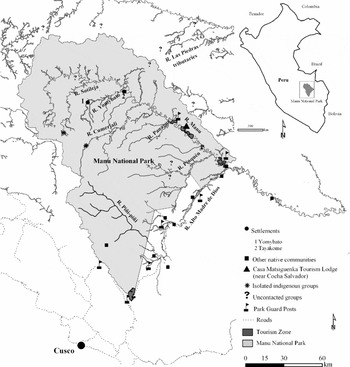
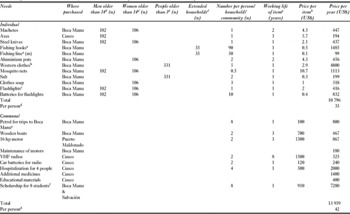
The 1.7 million ha Manu National Park (Fig. 1) is located in the lowland rainforests of south-eastern Peru, a biodiversity hotspot (Myers et al. Reference Myers, Mittermeier, Mittermeier, Fonseca and Kent2000), and has been designated an IUCN World Heritage site and a UNESCO Biosphere Reserve. The Matsigenka are the main indigenous population in the Park today, consisting of two settled communities, Tayakome and Yomybato (total population 421 in January 2005). The Matsigenka have a traditional subsistence economy of swidden manioc horticulture, fishing, hunting and gathering of forest resources (Johnson Reference Johnson2002; Wezel & Ohl Reference Wezel and Ohl2005; Ohl et al. Reference Ohl, Wezel, Shepard and Yu2007). However, they have long relied on manufactured goods such as axes, machetes, knives and fishing gear for basic subsistence (Table 1).
Diagrammatic map of Manu National Park and its location.

Annual income requirements for the 2005 Matsigenka population (Tayakome & Yomybato): individual and communal needs. aUnpublished monitoring data of fishing effort from 2004–2005 (J. Ohl, unpublished data 2005). bWestern clothes are additional to traditional woven robes and skirts, which are not suitable for working or hunting. cFor night hunting, and also avoiding snake bites while walking at night. dCalculated for all inhabitants of Tayakome and Yomybato ≥3 years old (not including the Maizal settlement). eTrips to Boca Manu for election, meetings and emergency cases. fTen months a year in Boca Manu or Salvación studying, with monthly living costs of US$ 14 for lodging and US$ 77 for food (Student in Salvacion, personal communication, 2003). gEstimated from several years of direct observation. hMean prices in 2001 from Boca Manu when available, otherwise from Cusco.

Nature and adventure tourism to the Park began in the 1980s, with visitation restricted to the lower part of the Manu river (the tourism zone; Fig. 1), reaching an annual plateau of around 3000 visitors by 2002 (see Supplementary material at http://www.ncl.ac.uk/icef/EC_Supplement.htm, Fig. S1). In 1988, one tour operator built an ecotourism lodge on the lower Manu via a concession arrangement with the Park. All other operators used temporary campsites concentrated around Cocha Salvador, a large oxbow lake that is Manu's prime tourist destination. In 1991, ten Manu tour operators in Cusco (all but one, Peruvian nationals) formed Ecotur Manu, a trade association with the stated purpose of improving professional quality. In 2000, this group successfully lobbied the Park administration for exclusive access, effectively creating an ecotourism cartel in Manu. In return, Ecotur Manu operators agreed to pay annual concession fees (c. US$ 6000 each) in addition to the entrance fee (US$ 50 per person in 2004) paid by each tourist.
Today, Manu is one of Peru's most prestigious destinations. Excursions usually take 5–10 days, of which only 2–3 are spent in the Park. Manu is remote, and transportation costs are high, proceeding from Cusco to different ports along the Madre de Dios River, either by plane or along a rugged highway descending the Andes (Fig. 1). All further transportation is by river in small boats. Excursions cost between US$ 90–200 per person per day.
Ecotourism had long been suggested as a potential economic opportunity for the Park's Matsigenka inhabitants. In the early 1990s, a biologist and ecotourism entrepreneur, encouraged the Matsigenka to actively pursue lodge construction in collaboration with an indigenous rights organization. The Matsigenka, who had long complained about the lack of economic opportunities (Shepard et al. Reference Shepard, Rummenhoeller, Ohl-Schacherer and Yu2007), were enthusiastic and in 1993 built a rustic structure near Cocha Salvador (Fig. 1), 2–4 days travel downriver from their communities in the heart of Manu's tourism zone. Park authorities halted construction, as permits and long-term planning are required in this part of the Park. Years of rancorous debate followed, pitting the Park against the indigenous rights organization, which framed the issue in terms of indigenous territorial and human rights. Fearing backlash by the indigenous communities (some had threatened to clear cattle pasture in the Park if the lodge project were not approved), INRENA ultimately co-opted the indigenous ecotourism concept and the Matsigenkas’ enthusiasm for it, by creating its own lodge proposal using funds from the UN Global Environment Facility (GEF) and GTZ.
Construction began again in 1997 at Cocha Salvador. The lodge design incorporated native architectural elements, and construction was carried out by crews of Matsigenka workers with oversight by a non-governmental organization (NGO) and professional builders. The project suffered from numerous problems, internal conflicts and delays (for details see Shepard Reference Shepard1998; Shepard et al. Reference Shepard, Rummenhoeller, Ohl-Schacherer and Yu2007). Nonetheless, major construction was completed in autumn 1998, with a total of 24 beds. The first tourist groups began arriving in 1999.
The ‘Casa Matsiguenka’ lodge is owned by the legal entity ‘Empresa Multicomunal Matsiguenka’ (Matsigenka Multi-Community Enterprise). Logistics and marketing are undertaken by a Cusco-based administrator, the only non-indigenous employee. Indigenous employees coordinate with the Cusco office mostly by radio. Each community designates a manager, and they alternate stints at the lodge, such that one manager is always present. Each community also designates one or two workers to live at the lodge, rotating every 3–6 months in order to maintain their swidden agricultural plots and social life in the communities. Some workers and most managers are accompanied by their wives and infant children during their working stint.
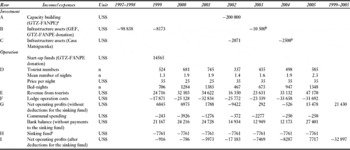
Casa Matsiguenka is not part of Ecotur Manu, and only in late 2006 was it finally granted full operator status, meaning that for its first eight years it was not permitted to market, sell or run its own tour groups except for sporadic ‘experimental groups’ (see below). Thus, until recently, Casa Matsiguenka has only been permitted to sell accommodation (bedrooms, showers, toilets, dining room and kitchen) to competing Ecotur Manu operators, who provide their own guides, cooks, food and transport. Initially, Ecotur Manu operators at Cocha Salvador maintained temporary campsites that closed for the peak rainy season (December–April), while the Casa Matsiguenka lodge remained open year-round. Thus the lodge's business plan was founded on the promise of a monopoly on rainy-season lodging at Cocha Salvador. In the busy dry season (June–September), the lodge received visitors when Ecotur Manu campsites exceeded capacity. The flaw in this business plan is that Casa Matsiguenka depends on its competitors for most or all of its business. From the beginning, Ecotur Manu operators saw the indigenous lodge project as unwelcome and unfair competition, firstly because the Matsigenka had received their lodge for ‘free’, and secondly, because their special status exempts them from the annual concession fee. Furthermore, some operators feared that indigenous people would harm the area by hunting or farming. In 2002, Ecotur Manu successfully lobbied for permission to build larger year-round campsites at Cocha Salvador, cutting Casa Matsiguenka's sales by more than 50% (Table 2; see Supplementary material at http://www.ncl.ac.uk/icef/EC_Supplement.htm, Fig. S1).
Income and expenses of the Casa Matsiguenka lodge. Note that the first year of business started in May 1999. aEstimated from expenditures in the GTZ-FANPE office in Lima. bEstimates by the Casa Matsiguenka Lodge administrator in Cusco. cReplacement costs calculated on a 10-year lodge replacement cycle (see Table 3).

In 2003, Casa Matsiguenka's Cusco-based administrator began to exploit more regularly a loophole that allowed direct sales via non-Ecotur Manu operators to ‘experimental groups’, permitted on a case-by-case basis as a way of preparing the Lodge for full operator status. Paradoxically, these experimental groups became the backbone of the Casa Matsiguenka's business, since visitation by official Ecotur Manu groups was insufficient to meet costs (see Supplementary material at http://www.ncl.ac.uk/icef/EC_Supplement.htm, Fig. S1). Though Casa Matsiguenka was granted full tour-operator status in April 2006, it does not yet have the capital or marketing skills needed to run a fully independent business. Meanwhile, Ecotur Manu operators have filed numerous lawsuits to exclude competitors and question the legality of concession fees and other Park policies.
In summary, while Casa Matsiguenka lodge is located in a favourable area for ecotourism, short-sighted business planning has left the enterprise at the mercy of better-established competitors, organized in a cartel-like fashion, who have used their power to limit its success.
METHODS
All financial data, as well as information from the Park administration, the tour companies, and other stakeholders were collected by J. Ohl-Schacherer (Ohl Reference Ohl2004). Additionally, we draw upon observations and conversations from ongoing fieldwork undertaken since 1987 by G. Shepard, since 1996 by D. Yu, and since 2000 by J. Ohl-Schacherer. G. Shepard is fluent in the Matsigenka language.
Revenues and costs
Lodge financial data were based on a detailed analysis of accounting books and receipts for 1997–2003; 2004 and 2005 data were supplied by the Cusco lodge administrator. Data on handicraft sales at the lodge, recorded from March 2000 to July 2002, were used to extrapolate handicraft sales per visitor for other years. US$ exchange rates were rounded to 3.5 Soles for 1997–2002 and 3.35 Soles for 2003–2005.
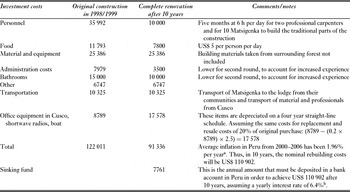
Additionally, we calculated the real cost of a complete renovation of the lodge buildings, office equipment in Cusco, shortwave radios, and boat and outboard motors. We then calculated the amount that, if deposited annually into a savings account over ten years, would have yielded the full renovation cost. We call the annual deposit the ‘sinking fund,’ because infrastructure is a sunk cost.
Calculation of individual and communal needs
Current Matsigenka welfare, individual and communal, is dependent on an array of manufactured goods that must be initially purchased with cash, though many items arrive in and are distributed through the communities by donation, barter and gifting in family networks. We identified trade goods present in all households in 2002 (Ohl Reference Ohl2004) and classified them into subsistence necessities (i.e. necessary to maintain physical well-being; Doyal & Gough Reference Doyal, Gough and Merchant1994) as against luxury items (Table 1). For the former, interviews and field observation were used to estimate consumption rates per household per year. Prices were obtained at the nearest small town, Boca Manu, at the Park entrance. An inventory was made of annual community consumption necessities, including communication radios, boats, motors and petrol for transportation (for example for elections or medical emergencies), and supplementary medical and educational costs beyond what was provided by the government.
Calculating the income required to meet needs
We emphasize that our estimates of individual and communal needs are not definitive, based as they are on reported need, direct observation, and our judgement. Moreover, the cash value of material needs is only one way to judge human welfare. However, these particular measures at least allow us to make a reasonable and semi-quantitative assessment of the lodge's contribution to Matsigenka standards of living.
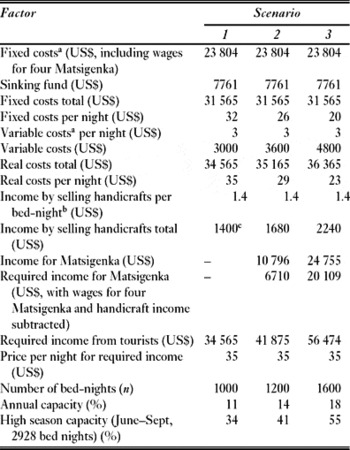
We divided lodge operation costs into fixed (salaries, office expenses, upkeep) and variable costs (i.e. tax, material consumption that depends upon the number of tourists). The current lodging fee of US$ 35 per night was used to calculate the number of bed-nights necessary to achieve financial break-even (Scenario 1), to cover individual material necessities for both communities (Scenario 2), and to cover both individual and communal needs (Scenario 3).
RESULTS
Revenues and costs
Total initial construction costs (1997–1998) were US$ 107 011, with an additional US$ 15 000 spent on flush toilets and showers (2002–2004; Table 2 row B, Table 3). An additional US$ 200 000 was spent on travel expenses associated with capacity-building workshops and monitoring activities (Table 2, row A). During the first year of operation, US$ 14 565 was provided to cover administrative costs (Table 2, row C). None of this investment of US$ 322 082 was required to be repaid.
Calculation of the sinking fund. Costs for the initial construction and post-ten-year reconstruction of the Casa Matsiguenka lodge. All values in US$, converted using exchange rates in text. aSource: Instituto Nacional de Estadística e Informática (INEI; URL http://www.inei.gob.pe/perucifrasHTM/inf-eco/gra001.htm). bCurrent rate at Superintendencia de Banca, Seguros, y AFP (SBS; URL http://www.sbs.gob.pe/portalsbs/tipotasa/tasadiaria_6.asp).

Annual tourist visits ranged from a high of 745 in 2001 to a low of 337 the following year (Table 2, row D; see Supplementary material at http://www.ncl.ac.uk/icef/EC_Supplement.htm, Fig. S1). Mean tourist stay over six years of operation was 1.7 nights, with prices fluctuating between US$ 25 and US$ 35 per night. Gross annual income ranged from US$ 16 350 to US$ 47 170 (Table 2, row E), and operating costs, including wages, ranged from US$ 17 871 to US$ 33 658 (Table 2, row F). Operational profits were achieved for the first three years of operation, but tourist numbers and income at Casa Matsiguenka fell by over half in 2002, mostly due to competition by Ecotur-Manu campsites which were opened year-round for the first time (however, overall tourist numbers to Manu did drop by a few per cent in 2002; see Supplementary material at http://www.ncl.ac.uk/icef/EC_Supplement.htm, Fig. S1). Tourist numbers at Casa Matsiguenka recovered in subsequent years, notably through sales to non-Ecotur Manu ‘experimental groups’, which provided 22% of revenues in 2004 and 2005. After registering a loss for 2002, Casa Matsiguenka roughly broke even in 2003 and 2004. In 2005, it again generated a profit, owing in part to increased visitation by a few Ecotur Manu operators whose campsites had been destroyed by flooding that year. At the time of writing, comprehensive financial data for 2006 were unavailable, but 722 bed-nights were sold, many at discounted rates.
Thus far, the lodge has operated mostly in credit, but this did not account for the cost of replacing infrastructure (Table 2, row G). When the cost of this sinking fund is added (Table 2, row H, Table 3), Casa Matsiguenka has generated a loss over its operating lifetime through 2005 (Table 2, row I).
Individual and community cash needs
We estimated annual individual cash needs of US$ 10 796 (US$ 33 per person per year) plus community needs of US$ 13 959 (US$ 42 per person per year; Table 1). These values fall far below the World Bank's definition of poverty in developing countries, at US$ 365 per person per year. However, Matsigenka cash needs do not include food, shelter, water and other necessities gleaned by traditional subsistence activities from the Park's abundant natural resources. For example, the two communities consume approximately 16 tonnes of wild game per year (Ohl-Schacherer et al. Reference Ohl-Schacherer, Shepard, Kaplan, Peres, Levi and Yu2007), with an estimated local cash replacement cost of US$ 18 285, or US$ 55 per person per year. Matsigenka agriculture annually generates c. 400–500 tonnes of manioc alone (Ohl Reference Ohl2004) and fishing probably accounts for another 5–10 tonnes per year of essentially free food (J. Ohl-Schacherer, unpublished data 2007).
Income and distribution
The Casa Matsiguenka generated three income streams for indigenous communities, namely operating profits returned in equal parts to the two participating communities, salaries to individual workers and handicraft sales.
Operating profits distributed to the two communities for communal spending ranged from US$ 243 to US$ 3926 (mean US$ 1289) per year. Communal spending was mostly on petrol, boats and school supplies.
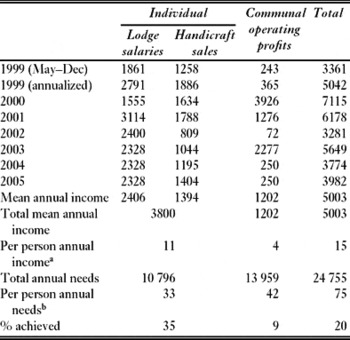
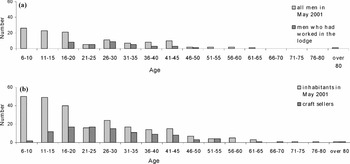
Matsigenka workers at the lodge earned total mean salaries of US$ 2387 per year (range US$ 1555–3114), distributed almost equally between the two communities (Table 4). Monthly wages in local currency were 190–200 Soles (about US$ 58) for managers and 110–150 Soles (US$ 32–44) for workers (salaries were raised in 2001 by communal agreement). From 1999 to 2002, the system of work rotation designed by the communities resulted in salary income to at least one member of 80% of residence groups in Tayakome and 62% of residence groups in Yomybato. Most lodge workers were young men in their twenties (Fig. 2). Older men have larger families and greater social and subsistence responsibilities, while women are not directly employed due to their cultural role in child-rearing and agriculture.
Mean annual income generated by Casa Matsiguenka, 1999 to 2005, compared to income requirements in 2005. All numerical values in US$, converted using exchange rates listed in text. aBased on the January 2005 population of 331, which omits children ≤3 years and the Maizal settlement. bData from Table 1.

Age structure of (a) men who worked in the lodge (1999–2002) and (b) craft sellers in Tayakome and Yomybato (March 2000 to July 2002).

Sales of handicrafts (extrapolated from 2001 data) generated a mean annual income of US$ 1394 (Table 4) with per person earnings of US$ 1–100, widely distributed between sexes and among age classes (Fig. 2). These monies were paid directly to the craft maker, and the lodge did not take commission.
Summing the three income sources, Casa Matsiguenka provided an estimated total average income of US$ 5003 per year (Table 4). Dividing by the January 2005 consumer population (age ≥3) of 331, this amounted to US$ 11 (range US$ 9–15) per person annual income from individual sources plus US$ 4 (US$ 0–21) per person annual income from community disbursements.
Non-monetary benefits
The lodge project also generated a number of important, less easily quantified benefits for indigenous workers and communities. Most of the lodge workers have improved their spoken Spanish ability and their ease of interacting with tourists and tour operators, skills that could contribute to future monetary returns in tourism and other employment opportunities. For instance, two former lodge employees now work outside their communities (one in tourism, the other as a Park guard), earning approximately US$ 200 per month, an excellent salary considering the local economy and their educational background. Participation in the project has forced the Matsigenka, a notoriously autonomous and acephelous society (Johnson Reference Johnson2002), to organize themselves politically, socially and logistically, in order to coordinate group construction efforts, negotiate the business structure with INRENA and GTZ, distribute wages equably, and support the lodge workers with food and transport. The lodge project has catalysed the creation of new cultural skills and institutions in these indigenous communities, especially managerial capacity and improved ability (both individually and collectively) to interact and negotiate with outsiders.
DISCUSSION
Many factors have constrained the Casa Matsiguenka project since its outset (see Shepard et al. Reference Shepard, Rummenhoeller, Ohl-Schacherer and Yu2007).
(1) The initial lodge concept was imposed by outside interests, generating severe conflicts among stakeholders and forcing the rushed adoption of a compromise project.
(2) The Matsigenka had been culturally isolated since the Park's inception in 1973, and thus had very limited educational opportunities and no business experience.
(3) The GTZ personnel who developed and funded the project and the Peruvian NGO that oversaw construction and capacity-building had insufficient experience in ecotourism ventures for cost-effective implementation.
(4) Untimely replacements of the GTZ Director, occurring twice in the short history of the lodge, disrupted project continuity and ultimately resulted in the withdrawal of funding in late 2003.
(5) Ongoing capacity-building and monitoring activities, foreseen as crucial since the early phases of the project (Shepard Reference Shepard1998) were cut off prematurely.
(6) The plan for socio-environmental monitoring developed at considerable expense (APECO 2000) was never implemented.
(7) A flawed business plan left Casa Matsiguenka largely dependent on its own competitors for business.
The persistence of Casa Matsiguenka despite numerous impediments is attributable mostly to the perseverance and commitment of the lodge managers and community members, themselves motivated largely by a lack of other economic alternatives within a strictly protected national park. The dedication of the Cusco-based administrator has also been a significant factor.
To answer the questions posed at the outset, eight years after its launch the lodge has not made an overall financial profit (i.e., when infrastructure replacement is included), even though its considerable start-up costs were donated. The lodge is located in a favourable tourist destination, thus poor business performance is attributed mostly to a flawed business plan and competition by established ecotourism operators. With regards to the distribution of benefits, however, the lodge has generated significant and widely distributed income to individual Matsigenka community members through wages and handicraft sales, covering about 35% of estimated total individual per person cash needs and reaching over two-thirds of the households (Tables 1 and 4, Fig. 2). Considering that cash-earning opportunities in these communities prior to Casa Matsiguenka were restricted to a handful of individuals on a sporadic basis and often in exploitative and socially disruptive conditions (see Shepard et al. Reference Shepard, Rummenhoeller, Ohl-Schacherer and Yu2007), this has been a significant achievement. By contrast, community disbursements taken from operating profits have covered only 9% of estimated communal cash needs (Table 4).
Clearly, changes to the balance sheet are necessary for the lodge to begin generating reliable profits, cover the sinking fund and improve communal benefits. Cutting expenses seems a difficult prospect. The largest expense category (US$ 13 500 per year, more than 50% of current expenses; see Supplementary material at http://www.ncl.ac.uk/icef/EC_Supplement.htm, Fig. S2) covers the salary and office space of the Cusco administrator, a crucial link to the tourist market. Infrastructure renovations could be postponed or done on the cheap, but ultimately, deteriorating facilities will reduce tourist visitation in a highly competitive market. The only alternative for reducing expenses would be to seek a joint venture with an established tour operator, increasing business, but also giving away control, oversight and perhaps profits (see Supplementary material at http://www.ncl.ac.uk/icef/EC_Supplement.htm, Table S1 for advantages and disadvantages of this and other alternative business models). The current Cusco administrator has taken on not only the lodge business, but also the Matsigenka cause more generally as a personal crusade. Should this person leave, a poorly-chosen replacement could be disastrous, given the considerable sums of money that change hands while the legal owners of the lodge are hundreds of miles away in the jungle.
Fee increases are infeasible, since the current price (US$ 35 per night) is already higher than at competing campsites. Thus, to achieve financial sustainability the lodge must increase its sales. Including the sinking fund, the lodge must sell 1000 bed-nights at US$ 35 per night to break even (Table 5, scenario 1). This amounts to 11% of total annual capacity, a level achieved only in 2005 when flood damage to competing campsites boosted sales. Sales (including projected handicraft sales) would have to reach an unprecedented 1200 bed-nights to cover 100% of individual cash needs as calculated (Table 5, scenario 2). Further growth to 1600 bed-nights, representing more than double the occupancy in 2006, would be required to cover total individual and communal cash needs (Table 5, scenario 3). This means capturing 31% of the mean annual visitor traffic into Manu National Park (see Supplementary material at http://www.ncl.ac.uk/icef/EC_Supplement.htm, Fig. S1), achievable only if the Park were to restore monopoly visitation rights during the rainy season and facilitate the growth of Casa Matsiguenka as an independent tour operator.
Scenarios for required bed-nights to reach (1) financial stability, (2) to cover individual needs, and (3) to cover individual and communal needs. aVariable costs include tax and utilities, fixed costs include all other costs not dependent on number of tourists. bMean tourist stay between 1999 and 2005 was 1.7 nights, and mean handicraft income per bed-night was 1.4. cIncome from handicraft sales accrues to individuals and can not be used in calculations.

Hosting of educational or research programmes (i.e. field schools and resident naturalists) during the off-season represents another option for boosting lodge income. This business model has a number of advantages: it offers prolonged occupancy, could include capacity building and participatory research opportunities for the Matsigenka, and would represent a business niche in Manu that is without competitors (see Supplementary material at http://www.ncl.ac.uk/icef/EC_Supplement.htm, Table S1). A single month-long, annual ‘field school’ programme at Casa Matsiguenka for 20 university students has the potential to increase current annual income by some US$ 16 000 to US$ 18 000, representing a 50–60% increase over average annual income to date (Table 2). In November 2007, we implemented a pilot Ethnobotany Field School programme for American university students in collaboration with the Peruvian non-profit organization, Centro de Recursos y Educación en la Selva (CREES, see URL http://www.crees-manu.org).
Ultimately, individual cash needs increase with population growth, which has averaged 4.5% per year over the last 15 years (Ohl-Schacherer et al. Reference Ohl-Schacherer, Shepard, Kaplan, Peres, Levi and Yu2007). Even if lodge sales could grow to cover current needs, they are unlikely to keep up with population growth. Moreover, four Matsigenka workers are sufficient to manage a fully booked lodge, meaning that more bed-nights will not necessarily increase employment. Thus, assuming that the lodge achieves real profits, new mechanisms will be needed in the future to distribute those profits. One such mechanism has been employed at the Chalalan CBET lodge in Bolivia. Each lodge shareholder (70% of all community member households) receives an annual sum that depends on profit levels, amounting to US$ 700 per shareholder in 2001 (S. Valdez, personal communication 2002); a portion of profits is reinvested in the company and the rest goes to a community fund managed by the village authority for health, education and other public benefits (Robertson & Wunder Reference Robertson and Wunder2005).
It is instructive to compare the lodge's current financial results with an alternative scenario in which the same GTZ/GEF investment of US$ 322 082 were instead converted to Peruvian soles and deposited in a bank account yielding 6.4% annually, the current average yield of the major Peruvian banks for deposits over one year (Table 3). After subtracting the average inflation rate of 1.96% per year (Table 3), the real annual yield would have been 4.44%, or US$ 14 300 per year, exceeding current individual cash needs and representing 58% of current individual plus communal cash needs (Table 4). Even when sinking fund costs are ignored, the actual mean annual income to community members of US$ 5003 (Table 4) represented only a 1.55% annual return on the initial investment, less than inflation. It should be noted that the Matsigenka themselves have indicated that they see the slow pace of the project and the modest income in a positive light: they acknowledge their educational limitations, appreciate having time to learn the business gradually and understand clearly that too much money too soon might upset the sociocultural and economic balance of their communities.
Such considerations support the argument that direct payments for conservation are financially more efficient (Ferraro & Kiss Reference Ferraro and Kiss2002). Still, considerable managerial challenges would arise regarding the long-term custodianship of a large cash sum for the benefit of a distant and financially unsophisticated indigenous population. Also, the lodge project has generated important, less easily quantified individual benefits and social changes that direct payments could not have achieved. Most significantly from the perspective of biodiversity conservation, this ecotourism project has promoted rapprochement between the Matsigenka communities and the Manu Park administration after almost thirty years of mutual distrust and miscommunication, during which the Matsigenka came to view the Park as a negligent if not oppressive force on their well-being (Shepard et al. Reference Shepard, Rummenhoeller, Ohl-Schacherer and Yu2007; see also Archabald & Naughton-Treves Reference Archabald and Naughton-Treves2001 for a similar example in Uganda). It is not clear that a direct payment scheme could have achieved these corollary benefits.
Overall, these cultural and societal changes could eventually have a large, positive impact on the Matsigenka and on the nature of their relationship with the Park. As we have argued elsewhere (Ohl-Schacherer et al. Reference Ohl-Schacherer, Shepard, Kaplan, Peres, Levi and Yu2007; Shepard et al. Reference Shepard, Rummenhoeller, Ohl-Schacherer and Yu2007), the long-term future of Manu Park requires a co-management agreement with the Matsigenka communities. If the long-term business viability of the Casa Matsiguenka can be secured, we see the training and interaction opportunities afforded by the lodge as one of the most effective ways by which the culturally isolated Matsigenka can evolve to become partners in the protection of Manu Park. Such an outcome would fulfil the Casa Matsiguenka's original goal of promoting biodiversity conservation while providing development.
ACKNOWLEDGEMENTS
Research funding was provided by GTZ and the Leverhulme Trust. We thank Carlos Abanti, Timoteo Coshante, Rafael Metaqui, Miguel Vicente, and other Matsigenka colleagues for hospitality and cooperation. Margot Valer (the lodge's Cusco-based administrator) kindly made the lodge's financial records available. We thank INRENA and the Manu National Park directorship for research permissions and logistical support. We also thank Quinn Meyer and the CREES staff for much valuable assistance. Professor Manuel Lizarralde and Connecticut College's Study Away/Teach Away programme supported the first Ethnobotany Field School programme at Casa Matsiguenka in November 2007. Important contributions to this manuscript were made by an anonymous reviewer.