INTRODUCTION: THE VARIETY OF ΙΕΡΟΙ IN THE GREEK AND ROMAN EAST
The adjective ἱερός is a central term in Greek religion and is used in various contexts. Generally translated ‘sacred’, it indicates that an object has been conceded to the gods and is now in relation with them (relation of belonging, protection, etc.).Footnote 1 It appears frequently in Greek inscriptions in the expression τὰ ἱερά, to designate sacred objects or, in a more abstract meaning, sacred matters.
The last decades have seen several works on the question of ‘the sacred’ and consecration.Footnote 2 Without claiming comprehensiveness on such a wide topic, this article aims at discussing the question of human consecration in order to refine our knowledge of the general process of consecration in ancient Greek religion. The epigraphic evidence on the topic is so scattered, geographically and chronologically, that it should not be taken for granted that all the consecrated humans are identical and form a single category. However, this article proposes an attempt to compensate for the lack of any recent comprehensive approach.Footnote 3
In our attempt better to understand the specific relation between human beings and deities through human dedications as well as changes of social status in these processes,Footnote 4 it quickly appears necessary to investigate the term ἱερός and some composite terms in which it appears.Footnote 5 More precisely, three categories of persons are to be taken into account: the so-called ἱεροί, ἱερόδουλοι and ἱεροὶ παῖδες. Does the common root ἱερός justify an identity, or a relation, between these categories? And what is the connection of each of these persons with gods and human society in general? Etymologically, the terms ἱερόδουλοι and ἱεροὶ παῖδες hint at ‘sacred slavery’, which is not suggested by ἱεροί. But if we go deeper into the contexts and practices into which these individuals are involved, it becomes obvious that the problem is much more complex than this analysis suggests at first sight.
The adjective ἱερός is applied to a multitude of persons in various contexts throughout the Greek world and it is hard to perceive any unity between all of them. The issue of the ἱεροί involved in the mysteries of Andania is well known, though not entirely unproblematic: as evident as their role in the mysteries of Andania may appear, their potential connection with other ἱεροί attested in the Peloponnese and the date of their appearance in these mysteries are not clear.Footnote 6 Other activities, cultic or not, are attested elsewhere in the Greek world.Footnote 7 For instance, some ἱεροί might have been involved in oracular activities in Lydia,Footnote 8 whereas a group of ἱεροί apparently had some financial responsibilities in a sanctuary in Pereudos, Phrygia, at an uncertain date.Footnote 9 Alongside the matter of the activity of ἱεροί, the question of the status of some ἱεροί within a population is also a frustrating one: are they ἱεροί only through their activity, as a ἱερεύς is not only a ἱερεύς but primarily a citizen,Footnote 10 or does the label ἱερός designate them as a distinct group within a community?Footnote 11 Moreover, are ἱερόδουλοι merely ‘sacred slaves’, that is slaves involved into cultic activities, or is the term δοῦλος misleading? And to what extent should they be contrasted to ἱεροὶ παῖδες?
It clearly appears from different epigraphic corpora that one could become ἱερός through ‘dedications’ to a god: a person was dedicated, offered, consecrated – a wide lexical variety is found here – and was thereby declared ἱερός. Several case studies will be adduced here in chronological order. ‘Sacral manumissions’ from different places of the Greek world in the Hellenistic period, collected mainly from Laurence Darmezin's corpus, are an appropriate starting point.Footnote 12 After addressing general issues about the status of these freedmen, we will analyse more deeply the case of the city of Buthrotum, in Epirus. Two dossiers from the Imperial period will then be compared: registrations (καταγραφαί) into a god's service from the sanctuary of Apollo Lairbenos in Phrygia and dedications from Leucopetra (Macedonia) – a particularly complex case study as this corpus combines consecrations with slave manumissions, financial loans and votive dedications. The status of the freeborn Paramonos in Leucopetra will provide a case study. Ἱερόδουλοι and ἱεροὶ παῖδες will also be discussed, before turning to the appropriateness of the notion of ‘rites of passage’ in the case of these dossiers.
Contextualization is the most important desideratum of a study encompassing different geographical and chronological settings. We will therefore try to make sense of the discontinuities between the corpora and of their internal inconsistencies by reading them against a well-delimited social and cultural background, in which the practice of consecrating human beings is attested. This not only prevents us from assuming an overly clear-cut picture of the practices related to human consecration, but it also allows us to appreciate the historical changes that progressively adapted consecration and its lexicon to new social needs and personal motivations.
1. SACRAL MANUMISSIONS IN THE HELLENISTIC PERIOD
1.1 General remarks
General remarks about the so-called ‘sacral manumission’ in the Hellenistic period are needed. Sacral manumission was one of the processes through which a slave or servant could be granted freedom from his masters.Footnote 13 In many cases, the expressions used by the master freeing his slave are typically appropriate for dedication, as shown by the verb ἀνατίθημι, and relied heavily on the personal preferences of the master or on local norms.Footnote 14 In her corpus, in which most inscriptions are from Boeotia, Darmezin contrasts the expression ἀνατίθημι ἱερόν with ἀφίημι ἐλεύθερον to stress that, in the second case, it was ‘un affranchissement “mixte”, où la divinité n'apparaît guère que comme protectrice dans la clause de sauvegarde’; she therefore distinguishes cases where terminology only refers to consecration and cases where the focus is on freedom.Footnote 15 It must be noted, however, that, although terminological variations may emphasize different aspects, they should not be contrasted too strictly.Footnote 16
The freedom of slaves manumitted through ‘sacral manumission’ has also been repeatedly debated.Footnote 17 An argument supporting the view that a slave was merely transferred from a human to a divine master could rely on the fact that, in some cases, the quality of ἱερός came into force once the παραμονή, that is the obligation to stay by one's master after being manumitted, reached an end.Footnote 18 However, this question is partly a non-issue, because it is raised through our own perplexity and our need to establish well-defined categories. In this perspective, our analysis of sacred human beings also suffers from the comparison with sacred objects: one should not consider that, because sacred objects are the gods' property, human beings who are ἱεροί share the same fate.
The fact that ἱεροί enjoyed freedom – though not as citizens did – is suggested by several elements. Firstly, the process through which they could, in turn, consecrate their own children is remarkable.Footnote 19 To do so, they required the assistance of a ἱεράρχης, ‘magistrat qui dirigeait l'ensemble de l'administration sacrée et gérait les biens appartenant aux dieux’.Footnote 20 It is understandable that freedmen did not enjoy the same political rights as citizens, which explains this assistance: after all, freedom does not suffice to grant access to the assembly either. But this specific status did not prevent ἱεροί from being occasionally more flexible in terms of dedicating their own children than some citizens were. For instance, some masters needed the agreement of members of their family – and more precisely of their heirs – to free and consecrate a slave, because heirs thereby lost a part of their legacy. Verbs used for this agreement are stronger than (συμ)πάρειμι and denote more than a mere assistance: σύμφημι, συνεπαινέω, συνεπινεύω, συνευαρεστέω, συναρεστέω, εὐαρεστέω, συνευδοκέω, εὐδοκέω.Footnote 21 In the case of ἱεροί, however, assistance does not mean agreement: this becomes fairly obvious by looking at the terms in use. The typical verb used to denote this assistance is παρεῖναι or συμπαρεῖναι, ‘to be by someone's side’. Moreover, the ἱεράρχης is never said to be κύριος, although Darmezin considers that the quality of a κύριος is inherent in the participle παρόντος.Footnote 22 On this point, the freedom of the ἱεροί seems to be larger than, say, that of the ἱεροὶ παῖδες from Pergamum.Footnote 23
Secondly, although after the παραμονή (or, less often, during the παραμονή) some of these freedmen had to take part in rituals related to the deity to which they had been dedicated, this should not be interpreted as a sign of submission of the freedmen to the sanctuary or its deity. This indication is actually not so widespread.Footnote 24 Besides, such ritual acts are likely to have been performed by ‘non-consecrated’ persons as well, and nothing indicates that ἱεροί were the members of the cultic personnel specifically in charge of these acts. The necessity to accomplish sacrifices to specific deities does not mean that ἱεροί had to take part in all the sacrifices. Rather, they would be involved in the rituals performed by their masters.
Finally, nothing permits us to think that ἱεροί actually belonged to a sanctuary. It is more correct to speak of them as individuals with a specific relation to a specific sanctuary.Footnote 25 The reference to a sanctuary was part of a dissuasive strategy aimed at preventing other people from using as slaves these newly manumitted persons with a precarious status, which was a potential risk. The fact that any contraveners would be guilty of ἱεροσυλία or ἱεροφορία does not allow us to think, as Darmezin does, that ‘ces affranchis sont donc devenus des biens sacrés, ils appartiennent au dieu’. It should be seen as a sanction against someone who would disrespect their new status rather than as a proof that such persons are devoid of freedom.Footnote 26 The priestess of Charops Heracles, a deity to which freedmen could be consecrated in Coroneia, is said to be κουρία in case someone would reduce the manumitted persons to slavery, and so is any Boeotian. The adjective κύριος does not mean ‘owner’ or ‘master’ here, but only implies that the priestess or any Boeotian is empowered to intervene to protect the freedmen.Footnote 27
Besides, the complexity of the relation between consecrated persons and a sanctuary is nicely illustrated by this clause, in one of the inscriptions: [ὡ]ς τῶ ἱα[ρῶ ἰόντων ἐ]|λευθέρων Διω[νουσίω κὴ Ὀ]|[ν]ασίμω κὴ ὧν κὰ [οὗτοι] | κτείσωνθη ‘as Dionysios and Onasimos and their possessions will be free in relation to the sanctuary’.Footnote 28 The ambiguity is relevant to the interpretation of the genitive τῶ ἱαρῶ and the verb κτείσωνθη. These men do have the right to acquire – and henceforth to own – things, to use the straightforward sense of κτῆσθαι. Moreover they are said to be free (ἐλευθέρων). The genitive does not denote stricto sensu the possession of the freedmen by the sanctuary – why would they then be called ἐλευθέρων? – but rather a relation to the sanctuary. Similarly, the objects possessed by the freedmen do not belong to the sanctuary but are put in relation to it, be this relation as it is. On the same level, lists of freedmen kept by priests in their archives are not a list of goods per se, but rather come from the need to know who has been consecrated.Footnote 29 To quote a last example, another inscription envisages the possibility that the manumitted slave would leave (lines 14–15: ἐπὶ κ᾿ἀποτρέκε, ἐλεύθερος ἀποτρεχέτω): there would be no reason to raise this eventuality if the freedman was a property of the sanctuary.Footnote 30
1.2 The case of Buthrotum
Let us now examine a specific case study. The corpus of Buthrotum in Epirus provides a large set of human consecrations dating to the period 163–144 b.c., when the city was a member of the Epirotan koinon of the Prasaiboi.Footnote 31 Dedications can be divided into three groups according to the authors and the type of slave manumission performed: individual acts of secular manumission; memorial lists of freedmen published on their own initiative and accompanied by the formula οἱ ἀφεωθέντες ἐλεύθεροι (cf. no. 20); individual acts of temple manumission accompanied by a consecration to Asclepius or Zeus Soter. It is the last type which is relevant to our study.
The texts express the combination of manumission and consecration with a formalized vocabulary. The most extended formula follows a pattern exemplified by no. 67, ἀφίεντι ἐλευθέραν καὶ ἀνατίθεντι ἱερὰν τῶι Ἀσκλαπιῶι | ἀνέφαπτον Φιλουμέναν. Repetitiveness allows us to assume that even when abbreviated and rare formulae appear, they have no influence on the act of manumission itself or on the status implied by it.Footnote 32 Vocabulary and syntax also provide a consistent depiction of the relationship between the act of manumission and the god. The formula ἱερόν + dative is by far the most common, implying that the freed person is consecrated to the god, in whose temple the manumission took place. However, as Pierre Cabanes observed, even among those acts where no consecration is reported, reference to the manumission being performed in front of the god is often made explicit by mentioning the priest (at least for the date) and/or through the formula παρὰ Ἀσκλαπιόν (no. 20, 40, 46) or παρὰ τὸν θεόν (no. 23). Just as in the Boeotian corpus examined by Darmezin, the formulae of the inscriptions from Buthrotum hint at the complementary aspects of the manumission act and the role of the god as witness. Like the expression ἐναντία | τῶ Ἀσκλαπιῶ attested in Hellenistic Thespiae, the formula παρὰ Ἀσκλαπιόν makes it explicit that the manumission (even without implying formal consecration) has been performed in the sanctuary and has involved the local god as witness of the act. Similarly, those acts where manumission is combined with consecration suggest that religious authority was meant to strengthen the new status by submitting it to the care of the god, who became the protector of its inviolability.
2. IMPERIAL PERIOD: PHRYGIAN ΚΑΤΑΓΡΑΦΑΙ AND LEUCOPETRA
We shall now examine pieces of evidence from the Imperial period. It should be stressed that, although we are dealing with a period in which the studied areas were under Roman control, it is not the right place here to discuss at length connections with Roman forms of manumission. Specific problems arise from the study of Roman slavery and manumission itself.Footnote 33
2.1 Phrygian καταγραφαί
Καταγραφαί from the Phrygian sanctuary of Apollo Lairbenos, in the Imperial period, require special discussion.Footnote 34 Although they display similar elements to the manumission inscriptions discussed so far (masters setting up inscriptions for their slaves, use of the adjective ἱερός), fundamental differences are to be noted. These texts are not manumission inscriptions per se and many persons who go through such καταγραφαί are actually not slaves, but free persons' children. Even in the case of people of servile status, καταγραφαί cannot be assimilated to manumission texts stricto sensu, as the act of καταγραφή in itself perhaps did not confer freedom to the slave.Footnote 35 Moreover, the verb καταγράφω has a different meaning from ἀνατίθημι: although it can have several meanings, it surely does not mean ‘to dedicate’ or ‘to consecrate’. The translation retained here is ‘to register’.Footnote 36 The reason for this choice is that καταγράφω is used in several inscriptions of the corpus to designate the assignment of tools to someone for the job that he will have to do.Footnote 37 Interestingly, there is a clear distinction in this sanctuary between objects, for which the verb ἀνατίθημι is used, and human beings, for which the verb καταγράφω is used. Τhese texts have to be considered here precisely because they also occasionally use the adjective ἱερός – though at a lower rate than the manumission inscriptions discussed above.Footnote 38 How can ἀνατίθημι (ἱερόν) + an object and καταγράφω (ἱερόν) + a person be contrasted? We have to postulate that the motivations and implications of both processes largely differed.
Indeed, many inscriptions from the surrounding regions deal with acts of personal devotion to a god. Free – and sometimes wealthy – persons chose to ‘consecrate’ themselves or their children to a god. As is the case for slaves, the notion of ‘devotion to a god’ covers a wide range of Greek lexical expressions: the process of inscribing oneself at the god's service is often referred to as a καταγραφή, whereas different terms attest the submission to a god, such as ὑποτακτικὸς θεῶνFootnote 39 or the expression καταγράψαι ἐμαυτὴν ἰς ὑπηρεσίαν τοῖς θεοῖς (‘register myself to the god's service’) in a confession inscription.Footnote 40 It is reasonable, however, to assume that this language is rather symbolic and attests a personal will to show one's piety. Even a woman writing that she is the concubine (παλλακή) of a god must be understood in this way and not as ‘submitted’ slavishly to a god.Footnote 41 Similarly, owing to mentions such as κατὰ τὴν ἐπιταγὴν τοῦ θεοῦ or ὡς ἐδήλωσε ὁ θεός in our καταγραφαί, we are inclined to think of these καταγραφαί as displaying the piety of families.Footnote 42 Furthermore, there is no financial dimension in these texts whatsoever. The quality of ἱερός – or of καταγεγραμμένος Ἀπόλλωνι, to use a term of our own – would be part of someone's identity, even for well-off people or individuals with an important role on the scene.Footnote 43 Such a status could imply regular acts of piety towards the god.
On the other hand, as was the case with the manumission inscriptions, καταγραφαί usually have clauses of protection. The most usual risk is that some people might be tempted to dispute (ἐπεγκαλεῖν) the new status of a registered person. In this eventuality, the protester may have to pay fines to the god, to the city of Motella or to the Roman fiscus.Footnote 44 Protections against being brought back to slavery are also attested: in some cases, challenging the new status implies bringing back the individual to slavery.Footnote 45 It is important to highlight this point for our purpose: in the sanctuary of Apollo Lairbenos as well as in the manumission inscriptions of the Hellenistic period, an external authority has a role to play to validate and protect a new status.
2.2 Leucopetra
Hellenistic Macedonia has not transmitted any large corpora of temple manumissions comparable to the ones from Boeotia and Buthrotum. However, some inscriptions show that similar manumissions performed through temple dedication were in use since the second century b.c.Footnote 46 Conversely, relevant documents are much more numerous in Imperial Macedonia, where, however, both the social framework and the practices of human consecrations are different from those shown by Hellenistic corpora.
The richest and more complex dossier comes from the sanctuary of the Mother of the Gods Autochthon of Leucopetra, situated about 13 km south from Beroea and active from the mid second to the early fourth century a.d.Footnote 47 Most inscriptions from Leucopetra differ from the stylized concision of other corpora, thus allowing a more detailed insight into the motivations – be they economic, religious, or both – that led people to dedicate slaves to a god. The most interesting aspect of the dossier is that the traditional vocabulary concerning human consecrations to a god, which here shows no differences from other corpora except the absence of the term ἱερός, discloses a much larger variety of motivations and social conditions related to the consecration.Footnote 48
A few documents from Leucopetra strikingly challenge the assumed connection between the dedication of human beings to a god and slave manumission. The sanctuary of the Mother of the Gods Autochthon operated in the surroundings of Roman Beroea like a pawnshop lending money in exchange for the temporary handing-over of slave property.Footnote 49 This procedure is clearly recognizable where things have gone wrong and the insolvent debtor lost his property over the slave.Footnote 50 We may assume that other cases of temple-loans have left no traces precisely because the borrower could honour his debt. Here the patent economic nature of the texts suggests that we are dealing with the reports of contracts, for which the dedication pattern provides suitable formal warranty. The absence of the verb ἀνατίθημι in these cases is perhaps of further support to this interpretation. I.Leucopetra 69 (a.d. 219) suggests that the operation of borrowing money from the sanctuary could be repeated more than once: the borrower, Klaudia Euboule, keeps up with the habits of her presumably deceased husband by handing over to the sanctuary the property rights of her slaves, who had already been pawned (and returned) more than once before.Footnote 51 The traditional procedure of consecrating slaves to a god could therefore be reused to enact a (temporary or definitive) change of property of the dedicated good, namely the slave: this exchange can hardly be seen as an act of emancipation. However, ad hoc clauses could better define the status of the consecrated persons and actually improve their life conditions by reducing their duties in terms of time (usually the former owner's lifetime when the παραμονή clause is expressed) and occasions (service requested only on sacred days).Footnote 52 Both the actor and the recipient of the consecration got advantages from this practice: consecrations provided the sanctuary with new labour force whereas the παραμονή would allow the former master to enjoy the service of the consecrated person who had been under his property.
The ambiguous place of these transactions, between religious procedures and economic motivations, is paralleled by I.Beroea 49 (a.d. 181), where the record of the donation (line 4, δῶρον ἔδωκεν) of a slave to Artemis Agrotera by a woman, Ariagne, is followed by a letter from her brothers: they grant Ariagne their consent to dispose of her slaves for the present purpose of freeing them (lines 15–17: νῦν βουλο|μένης σού τινας τῶν ἰδίων θρε|πταρίων ἐλευθερῶσαι) and for possible future decisions to pawn them (at the sanctuary) as collateral to borrow money, so that she will be able to ensure herself a more comfortable life in her old age (lines 21–4: ἐὰν | καὶ ὡς πρεσβυτέρα γυνὴ βούλει δα|νίσασθαι καὶ ὑποθέσθαι τι τῶν σῶ̣ν ἰς | τὴν διεξαγωγὴν τοῦ γήρως). It is tempting to generalize from the data of this text and to infer that when the dedication of a slave is presented as a δῶρον to the divinity we are dealing with true manumissions (cf. line 17, ἐλευθερῶσαι), perhaps granting the slave the status of (ἀπ)ελεύθερος of the goddess, whereas cases of economic transactions with the sanctuary would involve the status of ἱερόδουλος and the compulsory task to serve the sanctuary on the festival days.
If some texts clearly imply an economic background for the consecration, others shed light on religious motivations. These vary from accomplished vows to confessions, from acts of thanksgiving to requests for the goddess' intervention. Consecrating a human being belongs here in the larger domain of offerings meant to establish a communication with the divine. As we will see below, a properly religious motivation can be detected in the cases of ἱερόδουλοι consecrating children to the goddess of Leucopetra and even purchasing newborns for this purpose. In other texts, the donor asks for or responds to divine help. In I.Leucopetra 41 a praetorian soldier consecrates gilded greaves to the goddess (lines 7–8: ἀνέθηκα δῶ|ρον) and offers her (line 11, ἐχαρισάμην) a slave together with her two children. The dedicated objects seem to point at a thanksgiving offering, perhaps in return for safety during the military office. In any case, as already highlighted in Phrygia, the verb ἀνατίθημι is only used for votive objects whereas it is avoided, one could say on purpose, for human beings.Footnote 53
Other texts request the goddess' intervention by dedicating to her something that belongs to the donor but has been lost or is in danger. A man dedicates a lost slave to the Mother of the Gods, so that the goddess will look for her.Footnote 54 As Angelos Chaniotis pointed out, this text belongs to the widely spread type concerning ‘the cession of lost or stolen property to a god or goddess making the deity a victim of the theft and forcing it to punish the culprit’.Footnote 55 Sometimes the dedication is meant to satisfy a god's request, which, if not fulfilled, may result in divine anger and punishment.Footnote 56 This case is exemplified by I.Leucopetra 35 and 65, where the donors affirm that the consecration has occurred at the end of a period of persecution by the Mother of the Gods. Again, a fitting parallel is provided by propitiatory dedications known from contemporary Lydia and Phrygia.Footnote 57 Most remarkable is the verb ἀποδίδομεν used in no. 65, which represents the slave as something already belonging to the goddess. In consideration of this and of a similar expression in the fragmentary I.Leucopetra 9 (ἀποκατέστησα τῇ θεῷ), one can suggest that the property attributed to the goddess combined once more a religious and an economic aspect: the goddess' persecution could have originated from an illegitimate claim over the possession of the slave, an act which, as seen above, would result in an infraction of the clause recognizing the goddess as the only master of the dedicated slave.
2.3 An unusual case: the consecration of Paramonos in Leucopetra
One document from Leucopetra (a.d. 203/4) can be considered as a limit case regarding the interaction between the religious motivations of consecrations and the social status that they bestow: it is the sole inscription from Beroea concerning the dedication of a freeborn and the unique extant document where a person consecrated on the initiative of another must express his consent for the achievement of the consecration. A certain Ladoma, daughter of Amyntas, promised to consecrate her son Paramonos when her child had fallen seriously ill in his childhood.Footnote 58 The verb χαρίζομαι used to indicate Ladoma's action fits the votive reason for her dedication. The exceptional character of this consecration emerges from the active role that Paramonos is called to play in the accomplishment of the dedication: he is said to have been present and to have agreed with the promise of his mother (παρῆν καὶ συνεπέδωκεν αὑτόν). Apart from the original status of Paramonos, however, nothing exceptional can be detected in the expression defining his new condition as a consecrated person: ὑ|π<α>ιρετοῦντα μηδενὶ ἑτέρῳ | ἢ μόνῃ τῇ θεῷ is a common clause of exclusivity in the corpus of Leucopetra. The adopted formula seems therefore to suggest that by being consecrated to the Mother of the Gods, Paramonos acquires an ambiguous status similar to the slaves dedicated to the goddess.Footnote 59
Faced with this unusual case, an approach exclusively internal to the text would fall short of a satisfactory explanation. The editors of the Leucopetra corpus aptly observe that we need to reconsider the existing gap between slaves, free and freed persons in the provincial environment of Beroea.Footnote 60 Moreover, in this article we have argued that a short practical distance existed between different statuses, in relation to property and to other rights. If we assume that a case like Paramonos' implied a status-change, the only possible problem would concern the eligibility of the consecrated person for Roman citizenship. At least at the moment of the consecration, however, such issue was out of question for Paramonos, whose mother could not display a nomen stating her citizenship. In any case, reasons of a religious order like the accomplishment of a vow could be strong enough to submit the future of a person to a possibly life-long service to a sanctuary. This presumably happened in as much as the dedication would not have condemned the involved person to a worsening of his life conditions: Paramonos would probably not be requested to do much more than helping the temple staff on the occasion of the local festivals. Also, we are not told whether Paramonos would dwell in a facility of the sanctuary or remain in her mother's house: no certainty is possible, yet on the grounds of the cases discussed above we would argue that the second possibility was more likely. Similarly, the need for Paramonos' explicit consent for the accomplishment of the dedication may well have responded to a formal change of status; however, one can suggest that the consent was rather required because, as a freeborn, Paramonos was fully responsible for his own body and life and, as a consequence, he was expected to dedicate himself in order to accomplish his mother's promise. Finally, one cannot rule out the possibility that, in the provincial setting of Beroea, having been saved by a miracle of the Mother of the Gods could even give Paramonos some social prestige compensating for his service to the goddess.
All in all, Paramonos' case proves that the procedure of consecrating human beings to a god responded to a variety of purposes. Even if a diachronic investigation of the Hellenistic and Roman evidence shows that consecration commonly accompanied slave manumissions, the same practice would equally fit other forms of communication between the human community and the gods: prayers, requests for divine help and vows notably fall within this domain.
3. ΙΕΡΟΔΟϒΛΟΙ
3.1. Hellenistic period
A few references to ἱερόδουλοι in Strabo provide a helpful starting point to warn against any generalization concerning the status and occupations of these figures.Footnote 61 Strabo uses the term ἱερόδουλοι to define women that he assumes to have been destined in the past to temple prostitution in Eryx (6.2.6; cf. Diod. Sic. 4.83) and Corinth (8.6.20). Modern scholarship has rightly criticized Strabo's assumption, based on a misunderstanding of the actual situation in Corinth.Footnote 62 For our present purpose, however, it is interesting to note that in the passage on Corinth, Strabo refers to ἱερόδουλοι as possession of the sanctuary and interprets their status as the consequence of dedication by attenders of the sanctuary.Footnote 63 Strabo also identifies as ἱερόδουλοι some figures associated with ecstatic prophecy and human sacrifice near Iberia, in Caucasian Albania (11.4.7). Finally, the historian mentions temple-slaves as being part of the large estate owned by sanctuaries of the Anatolian moon god Men (12.3.31; 12.8.14).Footnote 64 It is clear that in both cases the term ἱερόδουλοι does not correspond to any Greek practice and simply provides lexical approximation to eastern costumes.
An interesting combination of Anatolian temple tradition and Hellenistic formulae of slave consecrations can be detected in the dossier of King Antiochos I Theos of Commagene (mid first century b.c.). In the relevant texts, whose number has considerably augmented after the archaeological rescue campaign of 2000,Footnote 65 the act of causing a person to become a ἱερόδουλος stems from a consecration by the king to the gods and to his own cult, an act represented as responding to divine will (cf. SEG 53.1776, line 18: ἀφιέρωσα; IGLS 1.1, lines 174–7: ἐγὼ θε|οῖς τε καὶ τιμαῖς ἐμαῖς κατὰ δαιμό|νιον βούλη|σιν ἀνέθηκα). Whereas the verbs of consecration depict this act in a manner similar to the Hellenistic corpora of temple manumission, the condition of the consecrated persons appears quite different: as ἱερόδουλοι, they will contribute to services in the sanctuary under the supervision of priests. Their status as property of the gods is made clear by clauses against the cancellation of the newly acquired status. These show, once again, only superficial similarities with Hellenistic temple manumissions: the formula μήτε αὑτῶι καταδουλώσασθαι (cf. IGLS 1.1, line 182) cannot be appealed to as a sign that the consecrated persons are free, but simply that nobody will be allowed to take them and their descendants as his own slaves, thus alienating them from the sanctuary. A similar formula is attested in Roman Pisidia by SEG 19.827 (second century a.d.), a private dedication whose vocabulary (lines 8–11: ἐποίησαν ἱεροδούλην, ὥσ|τε ὑπηρετεῖν αὐτὴν τοῖς | θεοῖς) bears again no trace of manumission.Footnote 66
The dossier from Hellenistic and Roman Egypt further warns one against regarding the relationship between the consecration of a person to a deity and the change of status implied thereby as a homogeneous phenomenon.Footnote 67 Greek papyri from the mid-late third century b.c. to the Roman period show Egyptian ἱερόδουλοι – most probably of free status because they are mentioned with their patronymic – serving local gods through a variety of temple activities, among which breeding and burying sacred animals is attested.Footnote 68 Although no Greek document explains how one could become ἱερόδουλος in Egyptian sanctuaries, it is probable, though not proved, that this Greek term corresponds to the Egyptian denomination b3k, ‘servant’ of a god, by which a rich corpus of Demotic self-dedications describe a person consecrating himself, occasionally together with his offspring, to a god.Footnote 69 While the young age of most consecrated persons, the extendibility of the contract to their descendants, and the protection asked to the god in exchange for sacred service, echo Greek human consecrations of the Hellenistic and Imperial periods, other details, such as the presence of a fixed sum to pay to the sanctuary for protection, warn against generalizations which are too clear-cut – all the more so in the light of contemporary Greek and Demotic evidence on temple κατοχή, which implied a period of seclusion within the precinct of a sanctuary, and whose existence suggests that in Greco-Roman Egypt several possible ways co-existed for people to be associated with sanctuaries and to provide their voluntary or forced service in exchange for protection.Footnote 70
3.2 Imperial period
The survey of Hellenistic documents concerning ἱεροδουλία has shown how fluid the use of this term and the status implied thereby can be. We turn now to Imperial documentation from Macedonia and Phrygia to discuss what the status of ἱερόδουλοι there was and what kind of religious and juridical proceeding would imply the acquisition of this condition. We first approach the dossier from Leucopetra, where six documents show ἱερόδουλοι of the Mother of the Gods as the authors of dedications of slaves.Footnote 71 This proves first of all that, in the Beroean society of the Imperial period, ἱερόδουλοι could acquire properties and dispose of them in a manner not different from free persons. Dedications where ἱερόδουλοι act as donors show a strong religious intention since they often concern the purchase of newborns or small children, most probably with the purpose of dedicating them to the goddess. In addition, when they perform a human dedication, ἱερόδουλοι often stress a personal tie with both the goddess and the consecrated person, often a θρεπτός, that is a child brought up by the future donor.Footnote 72 With the exception of no. 117, none of the extant texts involves the παραμονή clause keeping the dedicated slave attached to the donor during the latter's lifetime. If I.Leucopetra 117 did not exist, one could infer from the absence of the παραμονή that ἱερόδουλοι lived in temple facilities and consequently did not have a private place where their former slaves could be requested to dwell after the consecration. On the contrary, this text further equates the condition of ἱερόδουλοι to that of free donors: they could enjoy a high degree of independency and a status close, in many respects, to that of free people.Footnote 73 On the other hand, I.Leucopetra 113 makes it explicit that the person offered to the goddess shall dwell at the sanctuary on the occasion of the customary festival days: while – here as almost always in Macedonian texts – the new status of the offered person is not expressed through a distinctive word, it is likely that this request fits the status of the ἱερόδουλοι in general, who consequently would not be forced to stay at the sanctuary except on the days when they had to serve the goddess.Footnote 74
Besides the Leucopetra corpus, other contemporary documents from Macedonia show ἱερόδουλοι dedicating human beings to a god.Footnote 75 An inscription from Heraklea Lynkestis (Suvodol, Republic of Macedonia), dated a.d. 286, has a ἱερόδουλος of the goddess Pasikrata consecrate (ἀνέ|θηκα) to the goddess his child, a slave himself, purchased/ransomed by his father with the help of the goddess.Footnote 76 It is tempting to follow M. Ricl in proposing that the father ransomed his son from a private owner with the economic help of the sanctuary and that, as a consequence, his son became a ἱερόδουλος too, a condition that could imply a better quality of life and social status. The final clause εἰς τὴν χρῆσιν αὐτοῦ is particularly difficult to interpret. The possibility that it refers to a παραμονή clause, where αὐτοῦ is the dedicating father, seems syntactically awkward and perhaps in contradiction with the father's attempt to ransom his son. We would rather opt for an interpretation of αὐτοῦ as an objective genitive: the goddess will take advantage of the consecrated person's service, that is the ransomed son will repay his freedom by being a servant of the goddess.
A puzzling text from the village of Episkopi (near Scydra in Bottiea) refers to the status acquired by the dedicated person in the accusative, within the unusual formula ἀφίημιFootnote 77 … ἱερόδουλον.Footnote 78 The dedication combines the typical verb of manumissions with a term formally implying slave-status. This could give the impression that, at least in Bottiea during the Imperial period, a formal act of manumission in a sanctuary did not grant the status of freedman. However, it seems more likely that becoming ἱερόδουλος was something different from becoming (or remaining) a slave. If our interpretation of the inscription from Lynkestis is correct, both that text and this one could indicate a similar procedure implying a change of status, which would probably involve an improvement in the consecrated person's lifestyle.
It is interesting to compare this inscription with another one from the same area (Arseni; a.d. 232?), concerning the consecration of the eighteen-year-old slave Onesima to Artemis Gazoria. The girl will become δούλη τῆς θεᾶς, yet the text makes it explicit that Onesima will be free as regards matters outside the sanctuary.Footnote 79 The inscription seems therefore to foster the assumption that in Imperial Macedonia the special relationship with a sanctuary, which was bestowed upon slaves trough dedication, implied an improvement of the slaves' life conditions and was in fact an intermediate position between slavery and freedom: for this reason, formal acts of manumissions could at the same time grant secular freedom and destine a person to a possibly life-long service in a sanctuary.Footnote 80
Another contemporary text warrants attention. If becoming (ἀπ)ελεύθερος marks the passage from slavery to freedom, an inscription from Kozani (north-west Macedonia) possibly adds further nuances to the status achieved through temple manumission (EAM 59). The source, which is badly preserved, collects fragments of three different acts, the last of which dates to a.d. 108. Apparently the person mentioned in the second text is attached to the sanctuary of a local hero; as a consequence she is ἐλευθέρα ναοῦ, a free(d?) person of the temple.Footnote 81 A possible parallel case is I.Leucopetra 43, where the author of the offering, Crispina, is an ἀπελευθέρα of the goddess.Footnote 82 The clauses accompanying the consecration do not differ from the common formulae of the corpus: the dedicated person is required to dwell in the sanctuary for the customary days whereas she remains in the master's house for the rest of the time, until Crispina's death.
It is hard to understand what difference existed between being the sacred δοῦλος of a god – yet considered free outside the sanctuary – and being attached to a sanctuary as a free(d) person. Ricl has collected the scanty parallel cases of people mentioned as freedmen of a god or of a sanctuary in Greek and Latin sources.Footnote 83 They are only eight and this exiguity proves that such a definition was quite infrequent. Similarly, the kind of social path to which it refers is for the largest part obscure. By reacting against the opinion of the editors of the Leucopetra corpus, who considered ἱερόδουλος and (ἀπ)ελεύθερος θεοῦ as interchangeable variants respectively stressing the viewpoint of the sanctuary and of the former owner,Footnote 84 Chaniotis first stressed that ‘one should also consider the possibility that the donated slaves could at some later point be released from service in the sanctuary, that is, become ἀπελεύθεροι of the goddess’.Footnote 85 M. Ricl developed this hypothesis by proposing a sequence of status changes that can be summarized in the following scheme:
A: (1) δοῦλος → consecration implying duties towards the god → (2) ἱερόδουλος → following exemption from these duties → (3) (ἀπ)ελεύθερος θεοῦ
B: (1) δοῦλος → consecration without duties towards the god → (2) ἀπελεύθερος
In Marijana Ricl's words, then, ‘Ἀπελεύθεροι Θεᾶς can be viewed as (ἱερό)δουλοι who owed this status to their consecration by the original masters … and who were subsequently released by the Goddess from the obligations imposed on them at the moment of the consecration. Even if we take the obligation of staying in the sanctuary on all the “customary days” and serving the Goddess to be a life-long bond uniting the slave to the deity, it is at least conceivable that some (ἱερό)δουλοι were granted exemption from this customary service (perhaps after the former master's death and in return for a payment to the sanctuary?), thus joining the ranks of ἀπελεύθεροι Θεᾶς and let free to worship their patroness without having the obligation to present themselves in the sanctuary on all the “customary days”.’Footnote 86 This explanation is ingenious but cannot rely on any documentary evidence proving that stage A(3) was necessarily preceded by A(2). Moreover, we lack any knowledge of how this change could occur.Footnote 87 Finally, the rarity of the relevant formulae in ancient sources warns against inferring a high level of coherence for the procedures concerning temple manumission within such a large historical framework. As a consequence, Ricl's interpretation remains a likely hypothesis but one cannot rule out other explanations: it is also possible that, in Imperial Macedonia, definitions such as ἱερόδουλος and (ἀπ)ελεύθερος τοῦ θεοῦ constituted, together with practical clauses like the παραμονή and the service on sacred days, a flexible system open to fluctuations from case to case. Be that as it may, sources allow us to conclude that, despite the formal distinction implied by the language used, little or hardly any practical difference with regard to status existed between a ἱερόδουλος whose service was restricted to a sanctuary and a freedman who had to serve therein.
Tullia Ritti suggests a parallel in terms of freedom between the ἱερόδουλοι from Macedonia and ἱεροί of the sanctuary of Apollo Lairbenos in Phrygia.Footnote 88 As far as the ἱερόδουλοι from Asia Minor are concerned, it seems that it was also possible for them to take some initiatives and be responsible for cultic acts. For instance, two altars are dedicated by ἱερόδουλοι respectively to Artemis Epekoos and Thea Hera Epekoos.Footnote 89 In another inscription, a priest honours a friend qualified as συνιερόδουλος with a golden crown: this suggests that someone could become a priest after being a ἱερόδουλος, but nothing precludes him from being a ἱερόδουλος at the same time as being a priest.Footnote 90 Besides, in a confession inscription from Lydia, ἱερόδουλοι are mentioned as being the targets of an attack in a procession alongside images of gods.Footnote 91 Both images of gods and ἱερόδουλοι must have been the core of the procession, which suggests that, in some cultic contexts at least, these ‘sacred slaves’ were not negligible and had an active role to play.
4. BACK TO THE ΙΕΡΟΙ: A COMPARISON OF ΙΕΡΟΔΟϒΛΟΙ, ΙΕΡΟΙ AND ΙΕΡΟΙ ΠΑΙΔΕΣ
After adducing the relevant evidence and highlighting the features of each category of persons, it is necessary to make a brief comparison. A cautious postulate must be adopted: ἱερόδουλοι and ἱεροί should not be assimilated too hastily, since differences are evident on several levels. Ricl has written that some ἱεροί from Lydia and Phrygia ‘were slaves and freeborn persons consecrated by their masters and blood relatives and transferred to gods by dedication. By virtue of this they legally became slaves of divinities.’Footnote 92 We did not find any ἱερός who had become slave of divinities, at least not at a legal level. If the vocabulary suggests devotion or servile service, it is at a symbolic level, as emphasized above. On the other hand, slaves could be consecrated to a deity and keep their servile status, which, as suggested by a passage from Strabo,Footnote 93 was a common practice: ἱερόδουλοι seem to be placed at this level, with all the different possibilities that were implied in each case. It is probably no coincidence that, although the corpus of Darmezin displays plenty of cases in which people become ἱερός, only one instance shows a man leaving his two female servants as ἱερόδουλαι to Meter Oreia, in Lycia.Footnote 94 These two categories are therefore intrinsically different.
A last category that will be discussed briefly here are the ἱεροὶ παῖδες. These are attested in inscriptions from different parts of the Greek world in the Hellenistic period.Footnote 95 The term suggests at first sight a connection with ἱερόδουλοι, as it is tempting to interpret παῖς as ‘slave’. Indeed, ἱεροὶ παῖδες seem to have benefited from a restricted freedom. In an inscription from the sanctuary of Asclepius in Pergamum (second century b.c.) the priest is to care for the good order of the sanctuary and be the master (κυριεύειν) of the ἱεροὶ παῖδες.Footnote 96 As indicated by the verb κυριεύειν, it seems likely that the priest was the legal κύριος of the ἱεροὶ παῖδες. In any case it clearly indicates a hierarchy between these different persons. An inscription from Samos (245/244 b.c.) forbids the ἱεροὶ παῖδες from taking part in commercial transactions in the surroundings of the sanctuary.Footnote 97 Interestingly, slaves are also mentioned in this same inscription (line 16: παρὰ δούλου), which shows that the ἱεροὶ παῖδες should not be assimilated to them. It is likely that the mentioned δοῦλος is a generic term for any slave external to the sanctuary, whereas the ἱεροὶ παῖδες are part of the internal personnel.
The action of the ἱεροὶ παῖδες apparently only fell within the organizational matters of a sanctuary. In Didyma, for instance (probably in the second century b.c.), the role of ἱεροὶ παῖδες is mentioned alongside mules in the description of building works, which is instructive of the low status that must have been shared by these παῖδες.Footnote 98 In a list of offerings from Delos (middle of the second century b.c.), a ἱερὸς παῖς called Stephanos is said to have brought back a lost amount of gold.Footnote 99 The verb for this action, ἀναφέρω, does not designate a cultic act, such as ἀνατίθημι, but merely an action related to the internal organization of the sanctuary. The absence of patronymic in the name may lead us to think that this Stephanos was of servile status, or a freedman. The mere fact that his name is mentioned, however, should also be taken into account, as he was worthy enough to be mentioned in spite of his low status.Footnote 100 To sum up, there seems to be less variety in the status of ἱεροὶ παῖδες than ἱερόδουλοι, but there is also much less evidence.
5. DISTINGUISHING SLAVE CONSECRATIONS FROM RITES OF PASSAGE
Tracing the possible evidence for archaic rites of passage in northern Greek societies (especially in Thessaly and Macedonia), Miltiades Hatzopoulos has proposed that the process enacting the acquisition of freedom by a slave through consecration in a sanctuary originated from ‘rites of segregation → integration’, as described by the famous model proposed by Arnold Van Gennep.Footnote 101 The weakness of this explanation emerges from the fact that the assumed equation between the status of slaves and young citizens going through initiatory rites is ultimately founded only on the fact that both enjoy, for different reasons and to a different extent, incomplete rights in comparison with adult citizens.Footnote 102 Their rights are increased, remarkably again to a different extent, by passing through a ritualized change of status: respectively manumission and access to adult society. Allegedly, an equation between the status of free under-age people and slaves is somehow implied by a passage of the Hellenistic gymnasiarchal law of Beroea (I.Beroea 1B, lines 21–3), which allows the gymnasiarch to whip both disorderly boys and paidotribai who are not free, whereas the free ones will be punished with a fine.Footnote 103 Nevertheless, this kind of association is in fact hardly of any significance with regard to a religious domain: free-born children can receive corporal punishment simply because they have not yet become citizens, yet becoming adults changes their status in a way that has no analogy with manumission whatsoever. Another passage of the gymnasiarchal law (1B, lines 27–8) is more interesting for the present purpose as it informs us about the social classes that were prohibited from stripping off to exercise in the gymnasium: slaves, freedmen and their children are mentioned among members of other social categories.Footnote 104 The fact that two generations were required before the social stigma of slavery disappeared in relation to the gymnasium must arise from the importance of this place for civic identity. This reminds us of the insufficiency of conceiving ancient Greek societies in terms of a mere dichotomy between citizens' freedom and slavery. A variety of social statuses and life conditions existed in between these extremes, varying through space and time.Footnote 105 It is exactly within this setting that religious authority operated in slave manumissions: rather than the succession ‘segregation (through consecration in a sanctuary) → integration’ suggested by Hatzopoulos, the process at stake here was intimately related to the freedmen's risk of losing the freedom that they had newly acquired. Putting freed persons under the god's supervision was therefore a suitable religious instrument for safeguarding them against any future claims over their property. Because freed people were sacred to a god, their new status was expected to become stronger and possibly untouchable.
Because the inheritance of rites of passage must be rejected, one should look for other explanations for the young age of most consecrated persons. A motivation of religious order is patent in the dedication from Leucopetra mentioned above where a person decides to purchase a newborn to offer her to the god (I.Leucopetra 39).Footnote 106 Moreover, as the grant of divine protection seems to be a common expectation related to temple consecration, we may assume that the early age of the people given to a deity corresponded to the purpose of placing them under divine care as soon as possible. However, other explanations may be also possible, and given that consecrations must have had, at least in some social contexts, economic ramifications as well, we should not underestimate the possibility that the age of slaves given to sanctuaries also bears a more practical meaning in relation to social conventions and to their economic value for the household.
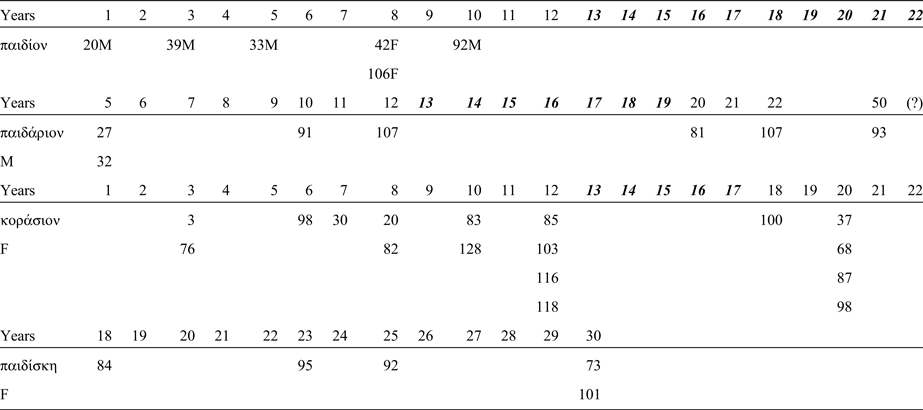
The corpus of Leucopetra offers once again a helpful case study as many of the extant inscriptions provide detailed information about the age of the consecrated persons (Table 1).Footnote 107 Male slaves are usually consecrated from their birth up to ten years old, while only three cases of consecration being performed at the end of the adolescence or in adulthood are known.Footnote 108 As for female slaves, a conspicuous gap between thirteen and seventeen years corresponds to a particularly sensitive moment in the life of women, that is puberty, marriage and motherhood.Footnote 109 The absence of consecrated women of this age most probably had a religious connotation too in the light of impurity being associated with pregnancy and giving birth.Footnote 110 For men too, the beginning of puberty seems to be a critical moment for consecrations, perhaps again for religious reasons. Nevertheless, the Leucopetra corpus also shows that slaves could be consecrated throughout their childhood, thus disproving a specific ritual connection with the approximation of puberty. A link with the upcoming beginning of adolescence can explain why the rate of consecrated girls reaches its peak at twelve years, at a limit age before the menarche. Rather than drawing on the heritage of hypothetical rites of temple seclusion and passage, the link between adolescence and the temporary interruption of consecrations should therefore be understood as the consequence of the exclusion from sanctuaries of persons in risk of polluting them. As a transition period, the entrance in fertile age was very critical in both a social and religious way and it seems that for this reason slaves were not consecrated during puberty – exactly the opposite of the ‘rites of passage theory’. Finally, the rarity of dedications of young adult men in comparison with women of the same age is plausible to interpret in an economic sense, that is, in relation to the high value of adult male slaves in terms of labour force, a resource which owners would predictably not want to lose.
Age and consecration in Leucopetra.

Notes: Numbers under the line correspond to the references in Hatzopoulos et al. (2000).
M and F refer to the gender of the consecrated slave.
Bold numbers refer to the age gap discussed in the text.
CONCLUSION
The ambiguous category of ‘sacred’ persons comprises multiple groups – ἱεροί, ἱερόδουλοι, ἱεροὶ παῖδες – whose place in relation to the gods and to human society cannot be framed within a single coherent interpretative paradigm, beyond the mere fact that they all shared in a special relationship with a sanctuary. Other groups like (ἀπ)ελεύθεροι and δοῦλοι of a god contribute to the difficulty of disentangling the issue of the social and religious status of these people. This may partly depend on the fact that evidence is often too scanty and scattered, but even when sources are sufficiently informative, the impression is that being sacred to a god was just one element of a much richer set of variables, which would define the condition of a person within a certain social context. In practice, this warns against assuming that people labelled as ἱεροί necessarily passed through a consecration comparable to the one customary for manumitting slaves. In addition, the relationship between ἱερόδουλοι, (ἀπ)ελεύθεροι charged with temple service, δοῦλοι of a god and ἱεροὶ παῖδες leaves an ambiguous zone where case-by-case negotiations and local traditions could play a role in defining the condition of the consecrated person.
This draws attention to a third point: the inefficacy of an interpretative approach based on the dichotomy freedom vs slavery, whereas it is clear that a varied in-between class of people having reduced civil rights existed throughout antiquity in the Greek world. It is in relation to these social groups, whose condition was somehow fluid and weak enough to be exposed to the abuses of stronger people within society, that the appeal to the protection of a god played a helpful role by strengthening the inviolability granted by law. Consecrating a person to a god is therefore a device deeply rooted in the religious instruments that support social stability. This aspect ultimately makes any interpretation drawing on rites of passage through segregation unnecessary.
A final point that warrants attention concerns the vocabulary used in the inscriptions, particularly from the Imperial period. We have highlighted that some word-families, such as those related to the concept of giving (δῶρον, δωροῦμαι, δίδωμι), can shed more light on the type of consecration involved when different possible motivations can co-exist in the same corpus. However, we would like to finish with a warning against any univocal interpretation of the vocabulary, in particular as regards the concepts of servitude (ὑπηρεσία, δοῦλος): these words hint in some cases at the legal condition of the consecrated persons, but in other texts they may convey a more symbolic meaning indicating actual religious devotion. Failing to take prudent consideration of the nuances of these difficult texts can at the same time expose us to the risks of forcing the interpretation of the social status granted to consecrated persons and of neglecting the religious significance of their being in a sacred relationship with the god.