Introduction
Background
The 1970s are regarded as the decade terrorist activities emerged onto Australian soil. This was heavily influenced at the time by global events, including the long-running ethnic tensions in Yugoslavia, which culminated in a bombing of the Yugoslav trade and tourist agency in Sydney in 1972. 1 However, it was the bombing of a Commonwealth Heads of Government Regional Meeting at Sydney’s Hilton Hotel in 1978 that brought terrorism to the collective attention of the Australian people and significantly altered the landscape of Australia’s counter-terrorism efforts. 2
Today, Australia is ranked 71st on the Global Terrorism Index (GTI; 2019), a scoring system of terrorist activities. This ranking is similar to countries such as Japan (78th) and Italy (63rd), falling into the “low” terrorism impact zone. However, Australia ranks above Argentina (83rd), Denmark (101st), and New Zealand (122nd) in the “very low” zone, and its South East Asian neighbor Singapore (138th) in the “no impact” zone. 3
Historically, Australia has had a relatively low terrorist risk and has suffered no large-scale terrorist attacks this century. 4 However, in September 2014, following the emergence of the Islamic State of Iraq and Syria (ISIS) and subsequent foreign fighter concerns, Australia raised its terror threat level to “high” for the first time since the warning system was introduced in 2002. 5 A new National Terrorism Threat Advisory System (NTTAS) was implemented in November 2015, with “high” replaced by “probable” where the threat level has remained ever since. 5 This follows an assessment that “credible intelligence indicates that individuals or groups have both the intent and capability to conduct an attack.” 6
The complexities of transnational terrorism remain at the forefront of national security discussions with on-going threats from the likes of the Islamic State, Al Qaeda, and its affiliated organizations. 7 In addition, the proliferation of violent white supremacy extremist organizations and other right wing extremist groups pose an additional opportunistic and re-emerging threat in Europe, America, and Australia, with the high likelihood that terrorism methodologies will include traditional methods such as firearms, incendiaries, and nonconventional like chemical, biological, radiation, vehicle attacks, as well as experimentation with emerging technologies such as drones and 3D printed weapons. This assortment of threats adds to the complexities of asymmetric terrorist attacks and requires that unique mitigation, preparedness, and response steps be taken by health care responders. Reference Clarke8
Terrorist events have significant and wide-ranging repercussions, but the safety risks are particularly elevated for first responders, including fire services, police, military, and emergency health care workers. While health care systems have long been responding to, and are significantly impacted by, terrorist attacks, there is recognition that Counter-Terrorism Medicine (CTM) is rapidly emerging as the necessary sub-specialty to consolidate research and academia, and then bridge that knowledge to operations, thereby enhancing preparedness and response and providing evidence-based, best practice guidelines to those on the frontline. Reference Court, Edwards, Issa, Voskanyan and Ciottone9 To firmly establish this as an emerging sub-specialty, historical precedent and terrorist attack methodologies should be thoroughly analyzed as a starting point for this initiative aimed at devising proactive mitigation, preparedness, and response strategies.
This study aims to provide the epidemiological context for the past decade, detailing the unique injury types responders are likely to encounter, and to aid in the development of training programs utilizing this data.
Aims
An epidemiological evaluation of all terrorism-related fatalities and injuries in Australia sustained between 2009-2019 was conducted. This includes the historical attack strategies and modalities used to understand methodologies, allowing responders to be better informed about the unique injury types they are likely to encounter. These data will also be useful for the development of training programs in CTM.
Methods
Given the aims of this study, it is designed as an epidemiological description of terrorist attacks in Australia which caused injuries and fatalities. It was performed using retrospective data from the Global Terrorism Database (GTD). This database is open-access, with publicly available data collection methodology including artificial intelligence identifying events from news media around the world daily, as well as human evaluation of the events by the National Consortium for the Study of Terrorism and Responses to Terrorism (START). The GTD was searched using the internal database search functions for all attacks which occurred in Australia between the years 2009-2018. 10 Years 2019 and 2020 were not yet available at the time of the study. These were exported into an Excel spreadsheet (Microsoft Corp; Redmond, Washington USA) for analysis. Attacks met inclusion criteria if they fulfilled the following three terrorism-related criteria as set by the GTD. Ambiguous events were excluded when there was uncertainty as to whether the incident met all of the criteria for inclusion as a GTD terrorist incident. These criteria are determined within the database, rather than by the authors.
Criterion I: The act must be aimed at attaining a political, economic, religious, or social goal.
Criterion II: There must be evidence of an intention to coerce, intimidate, or convey some other message to a larger audience (or audiences) than the immediate victims.
Criterion III: The action must be outside the context of legitimate warfare activities, ie, the act must be outside the parameters permitted by international humanitarian law, particularly the admonition against deliberately targeting civilians or non-combatants.
In addition to GTD listed events, the grey literature was searched to ensure no events meeting these criteria were missed. A focused search of online newspaper articles within Australia was also performed for any terrorist events in the year 2019 and none were found. This was further confirmed by searching the US Bureau of Counterterrorism’s Country Report on Terrorism for Australia in 2019, which also came to the conclusion that there were no terrorist events in Australia in that year. Reference Rosenfeld, Fitzgerald and Kossmann11 Each event to be included was cross-matched with reputable international and national newspaper sources online to confirm the attack, and if possible, to add details regarding weapon type used, and whenever available, details of victim/perpetrator fatalities and injuries.
Results
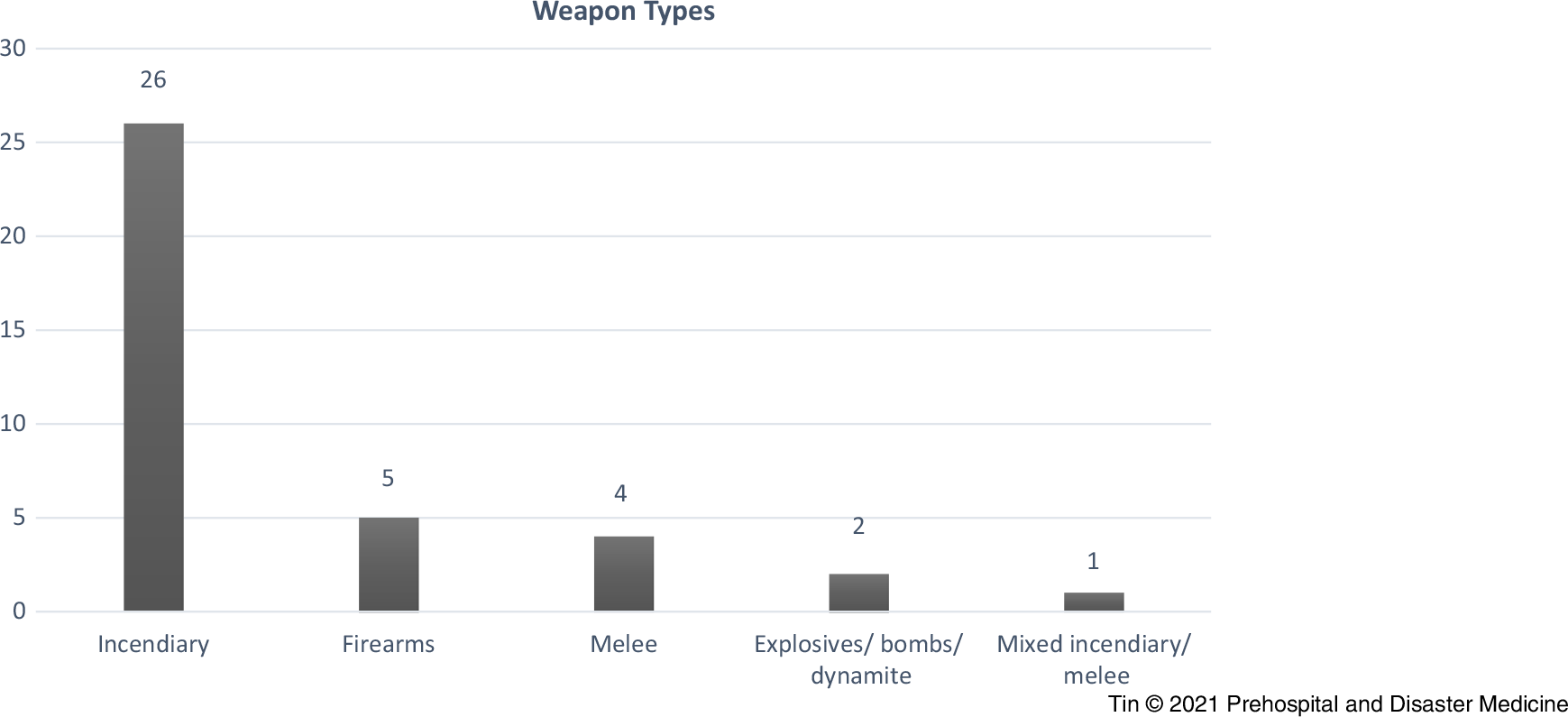
Thirty-seven terrorist events occurred in the study time period. Of the thirty-seven incidents, twenty-six (70.2%) used incendiary weapons, five (13.5%) used firearms, four (10.8%) were melee (bladed weapon/knife) attacks, two (5.4%) explosive/bombing/dynamite attacks, and one (2.7%) mixed attack using both incendiary and melee weapons (Figure 1).
Weapon Types Used in Terrorist Attacks.

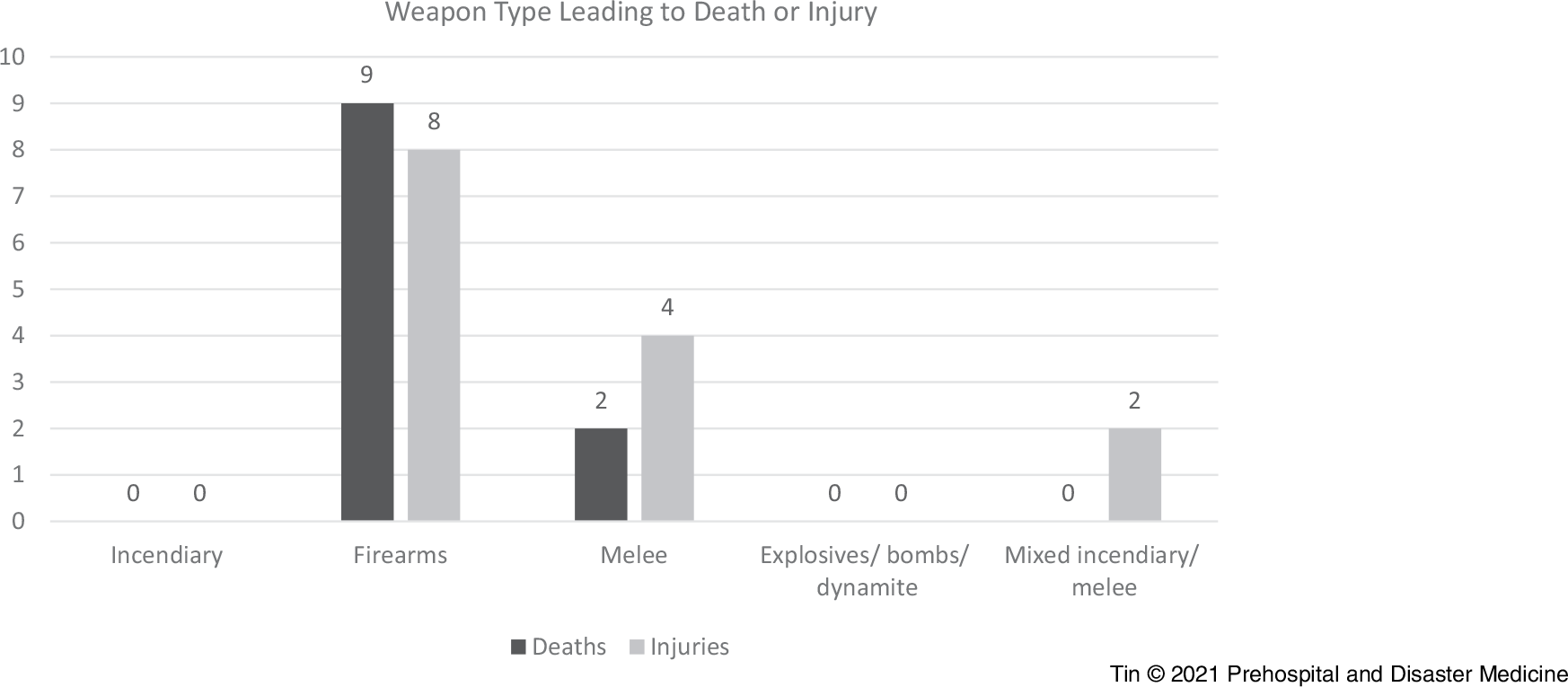
A total of nine out of thirty-seven incidents (24.3%) led to either one or more fatalities, injuries, or both. Out of the nine incidents, four were firearms related, four were melees, and one was a mixed melee/incendiary incident. All except one firearms-related incident (four out of five) resulted in either a fatality or injury or both. Every melee incident resulted in either a fatality or injury or both.
Of the nine incidents, eleven fatalities and fourteen injuries were recorded. None of the incendiary-only incidents caused any fatalities or injuries, and none of the explosives/bombs/dynamite incidents caused any fatalities or injuries (Figure 2).
Weapon Types Leading to Death or Injury.

Fatality Breakdown
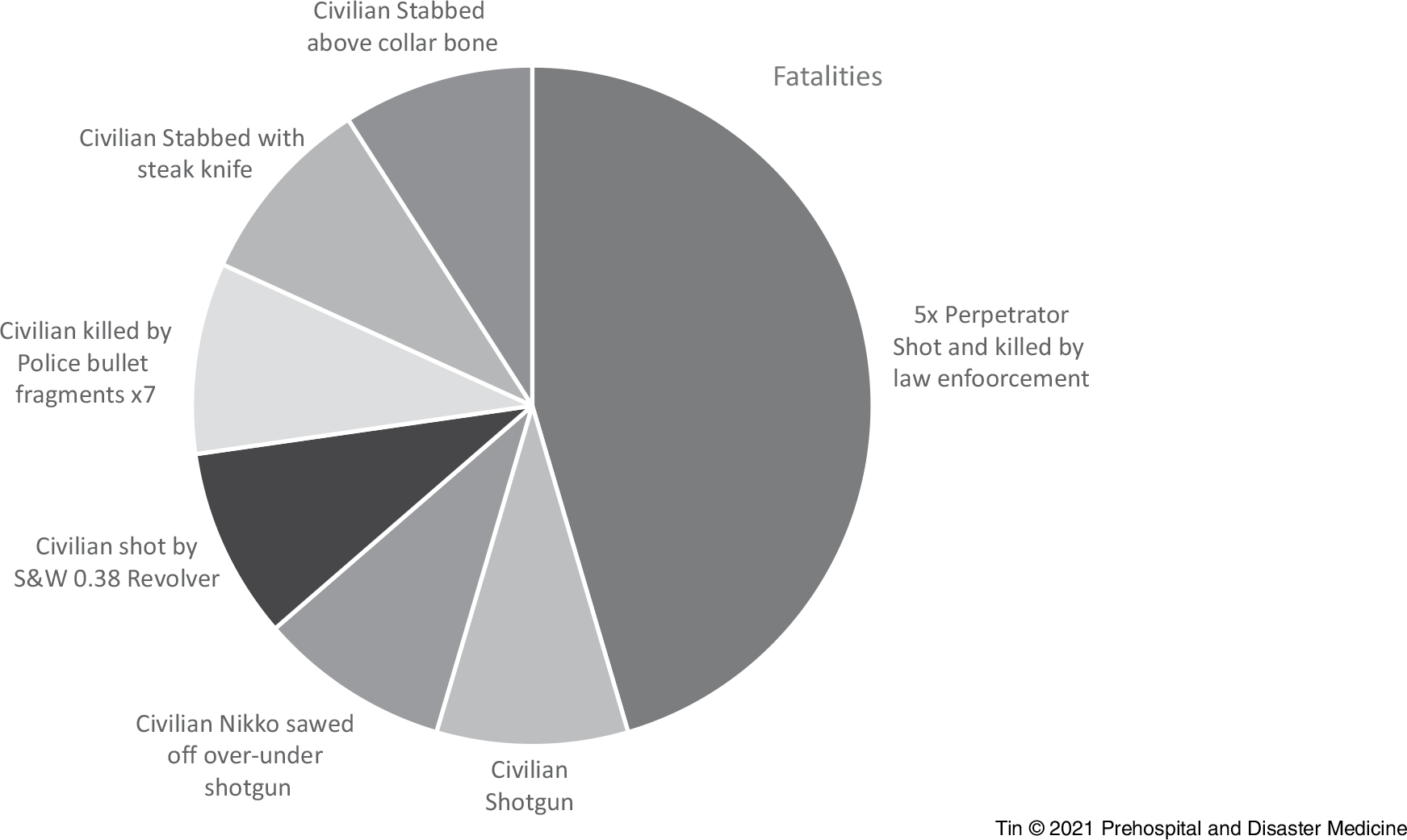
Five perpetrators were shot and killed by law enforcement. Two civilian hostages were killed, one shot by a perpetrator and one killed by police gunfire. One civilian police officer was shot by a handgun, one civilian was shot by a sawed-off shotgun, and two further civilians were fatally stabbed (Figure 3).
Fatalities from Terrorist Attacks Reported as the Person Killed and the Weapon Used.

Non-Fatal Injuries
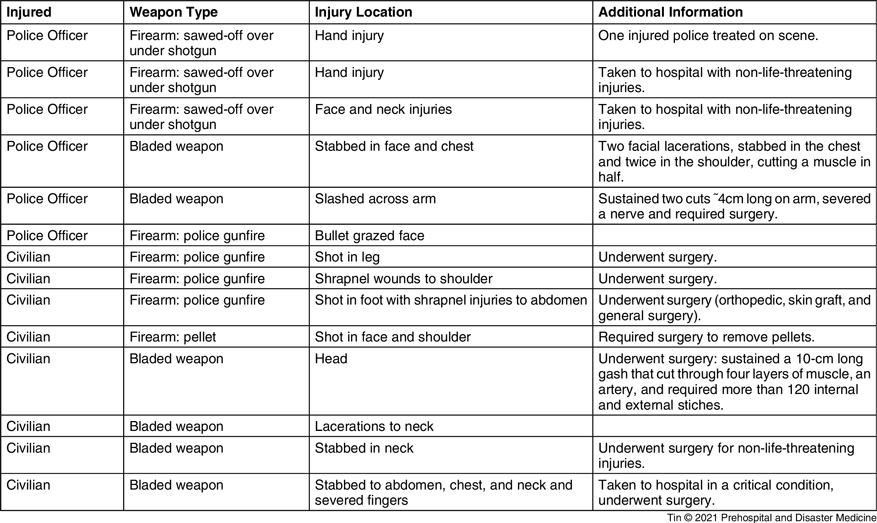
Fourteen non-fatal injuries were reported in seven incidents, including six police officers (Table 1).
Non-Fatal Injuries from Terrorist Attacks

Discussion
Australia has seen comparatively few terrorist incidents in the past decade, with minimal deaths and injuries sustained by the civilian population. A strong intelligence gathering capacity coupled with cohesive communities with diverse cultures and views are a good form of defense against violent extremist ideologies and threats of terrorism. Stringent weapon control also undoubtedly contributes to effective counter-terrorism measures in preventing incidents and injuries or deaths.
After the Bali bombing in 2002, which caused 88 Australian deaths, there was increased focus in Australia on hospital preparedness to deal with bomb-blast injuries. Reference Rosenfeld, Fitzgerald and Kossmann11 While there is no doubt it is important to be better prepared, in the past decade, only two bombings occurred with no injuries or deaths. In 2017, however, there was an attempt to explode a military-grade remote detonation bomb on an airliner departing from Sydney that failed after the terrorist, who had ties to ISIS, was unable to check the bag onto the plane. Reference Olding12 As a result, police have now been given more authority to enter and search premises, as well as seize and destroy explosive devices and substances, as part of a more bolstered counter-terrorism operation. 13
The majority of incendiary attacks targeted religious or police buildings, with seven targeting Mosques or Islamic Centers, eleven targeting churches, and four targeting police buildings or vehicles. Surprisingly, none of these caused injury or death, and it is hypothesized that with the global rise of attacks on similar venues, over time, they have developed a degree of hypervigilance and resilience. It is also worth noting that Al Qaeda has long openly condoned wildfire and arson as an efficient form of terrorism, and a recent Islamic State video urging recruits to light bushfires in Australia is a reminder that this is a very real risk. Reference Zimmerman14,Reference Loomes15
Australia has also seen relatively few firearms-related crimes or deaths in the past few decades, largely due to stringent gun law reforms; however, there are a high percentage of injuries and fatalities when firearms are involved. Reference Chapman, Alpers and Jones16,Reference Chapman, Stewart, Alpers and Jones17 This is consistent with previous research, which concluded in a multi-nation study that “even though firearms were used in less than 10% of incidents, they account for 55% of deaths.” Reference Tessler, Mooney and Witt18
Stabbing as a terrorist attack methodology is actively encouraged by terrorist organizations, as evidenced by articles in official Al Qaeda publications describing the methodology as an “easy option that does not require huge efforts or manpower, but the result is parallel to the big operations or even more.” 19 Furthermore, detailed guidance on blade selection and what organs to aim for are highlighted in terrorist publications, potentially increasing the lethality of this weapon choice. Reference Johnson20 Despite State and Federal laws in Australia regulating knives with high injury potential, this remains problematic as ordinary, legal knives can still be used efficiently as a weapon with fatal consequences.
Addressing preventable deaths at the point of injury remains a foundation of prehospital trauma medicine. While Tactical Emergency Medical Service units and Tactical Emergency Casualty Care courses address the training gaps in civilian first responders, who are often first on-scene in a potentially high-threat environment, there is a clear on-going need to promote and encourage these activities. The best health care systems in the world have difficulty responding to large-scale terrorist attacks, and Australia remains untested in such overwhelming events. Medical services and surge capabilities are often under constant strain, particularly in countries with seasonal disasters such as cyclones, floods, and bushfires. Reference Tin, Hertelendy and Ciottone21 As of this writing, the SARS-CoV-2 pandemic has significantly impacted medical capabilities globally, potentially exposing vulnerabilities that could be exploited, as well as possibly introducing complex terrorism opportunities in the future. Reference Ackerman and Peterson22
While there is a need to be forward thinking in anticipating new forms of terrorist attacks, responders should also not ignore the “tried and tested” methods of previous attacks. Firearm-related events remain a concern with a disproportionately high injury and fatality rate, but gunshot wound injuries are increasingly addressed by training courses such as Tactical Emergency Casualty Care within the Australian emergency first responder cohort. Reference Rosenfeld, Mitra and Smit23 Bladed weapon-related events remain problematic given the ease of purchase of legal knives, and further consideration should be given to training programs for responders which deal with penetrating trauma management. Reference Bartels24
Today, terrorist attacks in Australia remain low-frequency, high acuity-events to which Australians have vowed resiliency. As Australian Prime Minister Scott Morrison stated: “Australians will never be intimidated by these appalling attacks and we will continue to go about our lives and enjoy the freedoms that the terrorists detest.” Reference Morrisson25
Limitations
The GTD is a comprehensive record of global events. It is maintained by the National Consortium for START and is the basis for other terrorism-related measures, such as the GTI. 3 Reliance wholly on the GTD is partially mitigated by confirmation with other lay sources, and searches for other online searches, but if there are incidents not reported in the GTD, this could limit the veracity of the findings. Furthermore, injuries and fatalities were cross-matched with news records rather than formal hospital or coroner reports, so rely on the completeness and accuracy of these sources.
Conclusion
In the decade from 2009-2019, terrorist attacks on Australian soil have been manageable, small-scale incidents with well-understood modalities. Eleven fatalities and fourteen injuries were sustained as a result of terrorist events during that period. Incendiary weapons were the most commonly chosen methodology, followed by firearms, bladed weapons, and explosive/bombings/dynamite attacks. This analysis may support the need for CTM.
Conflicts of interest
The authors declare no conflict of interest.