The immense Casino Ballroom sits at one end of the city of Avalon, Catalina Island, about twenty miles from the metropolitan Los Angeles area. In the institutional memory of this small Southern California island community, the architecturally striking ballroom figures large in American cultural life during the Great Depression.Footnote 1 Yet in the majority of scholarly writing on big bands from this time period, the ballroom is scarcely mentioned at all.Footnote 2 What lies in the space between the local celebration and the scholarly accounts is an important and instructive story about overlooked aspects of mid-1930s American popular music. The Casino Ballroom was not the scene of ecstatic jitterbugs listening to the hot sounds of black and white bands led by musicians such as Duke Ellington or Harry James. Instead, the dance hall was designed as a thoroughly modern place for the presentation of exclusively white dance bands playing “sweet” jazz, a style that avoided the most obvious musical signifiers of its “hot,” raced sibling. For the owners of the Casino, jazz was to be the sound of modernity suffused with nostalgia for a threatened social order. Not only were no African American bands hired to play the ballroom—even black bands that played sweet—the managers listened carefully to the sounds of the white bands that were hired.
Since the actual sounds of the ballroom from its heyday have not survived on recordings, the best way to listen to the sweet sounds of the venue is to study commercial recordings of bands favored there.Footnote 3 I have chosen to examine several versions of a song special to Catalina, the tribute by Al Jolson, B. G. DeSylva, and Vincent Rose to the island city, “Avalon.” Although the song predates the construction of the ballroom, management appropriated it as an integral part of the island experience. Visitors would hear the song many times during their visit, as bands played it for incoming and outgoing ferries and to open their shows.Footnote 4 Through a comparison of three commercial recordings of “Avalon” that span the hot-to-sweet spectrum, I will show how the music of sweet jazz bands popular at the ballroom differed from the hotter styles of bands who never appeared there. Unlike the hotter sounds of the Jimmie Lunceford and the Casa Loma orchestras, the sweet “Avalon” of Jan Garber's band established musical relationships and values that were easily fused to the ideology of the island's promoters—the music created a sonic place that could be brought smoothly in line with the physical place. Not coincidentally, Garber was extremely popular at the Casino, returning summer after summer to large crowds.Footnote 5 As owners of the venue, the Wrigley family and its corporate voice, the Santa Catalina Island Company, sought very specific musical sounds of the dance band era for their grand ballroom as part of a larger project to create on Catalina Island what Michael Kammen calls “nostalgic modernism”—an American place that embraced the new while struggling to inject past traditions and social ideals into an unsettled contemporary life. In their embrace of this difficult position, the owners and managers of the island resort sought to resist the democratizing implications of rapid technological and social change.Footnote 6
In examining the history of the Casino Ballroom, we rediscover the lost sounds of these sweet bands, a massively popular segment of the American popular music landscape.Footnote 7 One goal of this essay is to provide an analysis of sweet jazz as a musical phenomenon with its own particular musical priorities different from, but intimately related to, hot jazz. Histories of the swing era have overwhelmingly focused on the hottest, most innovative bands—for example, groups led by Duke Ellington, Count Basie, Fletcher Henderson, Jimmie Lunceford, and Benny Goodman.Footnote 8 Gunther Schuller's landmark study The Swing Era, though especially broad in its coverage, is focused primarily on musicological analysis of major bands and soloists, most of them familiar names who played largely hot jazz. Other major studies by historians such as Lewis Erenberg, David Stowe, Kenneth Bindas, and Joel Dinerstein have sought to place swing in a wider cultural context, situating it as an expression of youth culture, New Deal ideology, American modernity, and machine-age life, respectively.Footnote 9 Yet like the monographs on particular musicians, these cultural historians also focus almost entirely on a narrow range of music, those from the most famous dance bands who played the hottest style of music. Studying the Casino Ballroom and the sweet bands that played there restores a significantly large part of the dance band story of the era.
Examining this particular dance hall, though, accomplishes much more. It illuminates a powerful contradictory impulse that ran through a large segment of American popular music of the 1920s, '30s, and early '40s: the entire ballroom experience, including sound, was designed as a technologically and culturally modern event, even though it was saturated by nostalgia and a rejection of social changes inherent to modernization. Big band music of the 1930s resonated with the strong belief held by many people in the rightness of the new, and a steady, though seriously challenged, faith in power of modern, reformed capitalism to lift society out of economic crisis and into a more egalitarian and prosperous future.Footnote 10 At the same time, large parts of the American populace were fearful of the social implications of such modernization. Writing of the 1920s, historian Lawrence Levine has aptly described this impulse as “the desire to have things both ways—to accept the fruits of progress without relinquishing the fundamentals of the old order.”Footnote 11 As the country was being tied more closely together through roads, mass culture, and New Deal federal government programs, Avalon was intensely segregated, set off from the rapidly intensifying urban nature of American life. Yet the island's growth as a tourist destination was predicated on 1930s technological and economic modernization.Footnote 12
The dance band music of the era—even in its sweet guise—was a thoroughly hybrid music, the product of a complex fusion of African American and European American musical practices. The attempt to absolutely match sound and place was impossible, and the music at the ballroom, with its audible crosscurrents of influences, testified to a multicultural reality. This truth heard in the music helps to explain, in part, why the Casino owners sought white sweet bands, when African American bands could easily have accommodated the preferred musical style. In their choices of bands, the administrators of the ballroom were not just hiring particular musicians but making an argument—a spatial-social argument—about the desirable relationship of music, social structure, and place. Black sweet bands would challenge the illusion of the particular social order being created and reveal the inherent contradictions behind the Catalina Island project—a white fantasy California where racial others were confined to servicing the basic infrastructure of the island. There were to be no black bodies onstage and a minimum of black sounds echoing in the venue.
The Avalon Experience
Although not nearly as popular as it was in the first half of the twentieth century, Avalon remains a tourist destination today, and on weekends day-trippers fill the streets of the small town. Island historians credit the birth of a tourist industry to George R. Shatto, who purchased Catalina in 1887 and, rather than mine the island for precious metals or natural resources, decided that the real gold was in tourism.Footnote 13 Allegedly at the suggestion of Shatto's wife, the new town was christened Avalon, after a passage from Tennyson's Idylls of the King.Footnote 14 Development accelerated when a local shipping tycoon, Captain William Banning, acquired the island in 1892.Footnote 15 Over the next twenty-seven years, however, the financial costs of maintaining and developing the resort proved too much and, in 1919, the Banning family sold Catalina to the chewing gum magnate William Wrigley Jr.Footnote 16 Wrigley sunk millions into improving the island's water supply, housing, and roads, and was committed to making Catalina an affordable getaway: “There is to be nothing of Coney Island flavor about Santa Catalina. It would be unthinkable to mar the beauty of such a spot with roller coasters and the like.” For Wrigley, “Catalina was developed to put within reach of the rank and file of the United States—the people to whom I owe my prosperity—a playground where they can enjoy themselves to the utmost, at such a reasonable figure of expense that all can participate.”Footnote 17
Wrigley's aversion to Coney Island and its roller coasters was not an anti-technological position but a social and aesthetic critique. Catalina was not going to be mobbed by massive working-class crowds enjoying cheap, lowbrow entertainment such as freak shows and thrill rides.Footnote 18 The island was to retain its natural beauty while not compromising any modern amenities. By the time of Wrigley's death in 1932, Catalina had been transformed into a popular middle-class vacation spot. The island had affluent visitors and upscale accommodations to cater to them, but Wrigley, through various promotional plans, was committed to middle-class affordability.Footnote 19 Besides fishing and water sports, he developed an array of attractions to take advantage of the island's natural resources: a bird park, a horse farm, and glass-bottom boat tours. Wrigley also made Catalina the spring training home for his Chicago Cubs. Under his guidance, the island became a tourist destination that provided modern comfort, entertainment, and natural experiences that showcased the island's beauty.Footnote 20
William Wrigley's son Philip inherited the island at the nadir of the Great Depression. Philip not only managed the island through the economic crisis but also expanded his father's vision, adding his own distinctive nostalgic impulse. Along with an array of cosmetic enhancements such as imported palm trees and sand to replace the island's natural pebble stone shore, he hired troupes of performers to dress as “early” Anglo and Spanish settlers and wander the downtown streets greeting and singing to visitors in a sanitized performance of California history.Footnote 21 For Philip K. Wrigley, “The historical background of Catalina Island, the last Spanish grant, its natural beauty and romance lend themselves admirably to the preservation of the atmosphere of old California. . . . Gradually we may be able to make all of Catalina Island a monument to the early beginnings of California.”Footnote 22
This nostalgic presentation of early California was in sharp contrast to its reputation for modern Hollywood glamour, the result of vacationing movie stars and frequent film productions in and around the island. Used as a military facility during World War II, Catalina Island reverted back to tourism after the wartime mobilization, though it never fully recovered its earlier glamour and popularity.Footnote 23 From the end of the war through the 1960s, the island lost many of its large hotels, including the grand Hotel St. Catherine. In 1975, Wrigley, through the Santa Catalina Island Company, deeded nearly 86 percent of the island to the recently created Santa Catalina Island Conservancy, effectively stopping most commercial development and ending the Wrigley family's great Catalina project.Footnote 24
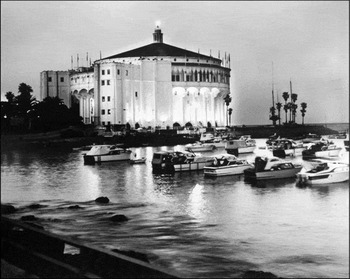
One of the centerpieces of that development program was, of course, the giant Casino Ballroom, pictured in Figure 1 (“casino” was used in an older sense describing any place of entertainment; there was never gambling). Built between 1928 and 1929, the massive theater and ballroom complex was constructed on the small Sugarloaf Point that straddles Avalon harbor and neighboring Descanso Bay. The circular edifice, with its orange-tiled roof and whitewashed walls, rises twelve stories and is nearly 180 feet in diameter—it was (and remains) one of the first sights of Avalon visible from the ferry.Footnote 25
The Casino Ballroom, Avalon, Catalina Island. Jeannine L. Pedersen, Catalina Island (Charleston, S.C.: Arcadia Publishing, Reference Pedersen2004), 86.

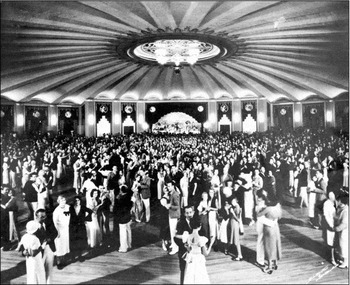
The grand theater occupies the first floor, and two sets of six ramps lead up to the second-floor ballroom, an enormous space that, at its 1929 opening, allegedly had 20,000 square feet of dancing space (with subsequent remodelings and modifications the dance area is now 10,000 feet).Footnote 26 The building's chief designers, architects Walter Webber and Sumner A. Spaulding, created a cantilevered structure capable of holding up both theater and ballroom ceilings with no supporting columns.Footnote 27 Figure 2 shows a large crowd of dancers filling the especially broad dance floor. Buttresses that reach out from midway up the building's outside walls support a balcony that circles the upstairs ballroom offering impressive views of land and ocean. The Casino was designed, in both form and function, as a scientific, state-of-the-art building. Wrigley built a radio broadcast room “equipped with all the latest sound devices” adjacent to the ballroom, allowing for transmission of its musical entertainment to listeners on the island (the ability to broadcast nationally would come several years later).Footnote 28 The first-floor movie theater was built in consultation with engineers specifically to handle the new “talkie” sound films.Footnote 29
Dancers on the floor of the Casino Ballroom, 1932. Jeannine L. Pedersen, Catalina Island (Charleston, S.C.: Arcadia Publishing, 2004), 85.

The modernistic art deco art—specifically the many murals that decorate the inside and outside of the building—wrap all this modern technology in a fantastical ambience that emphasizes what the island promoters called the “romance and adventure which is the essence of Catalina.”Footnote 30 The giant tile mural outside the main ticket booth features an underwater scene presided over by a lithe and naked mermaid. Inside, the movie theater walls depict highly stylized historical and mythological figures—hooded Spanish friars, Native Americans on horseback, and Venus and Neptune surrounded by abstract design patterns evocative of the sea.Footnote 31 Publicity material created by Wrigley's office for its opening in 1929 aptly captures this fantastical modernism: “Nothing has been omitted that ingenuity, imagination, experience, skill, with unlimited means, could devise to make the Casino one of the world's outstanding pleasure palaces. . . . [T]he Casino is alone worth a trip to the Magic Isle.”Footnote 32
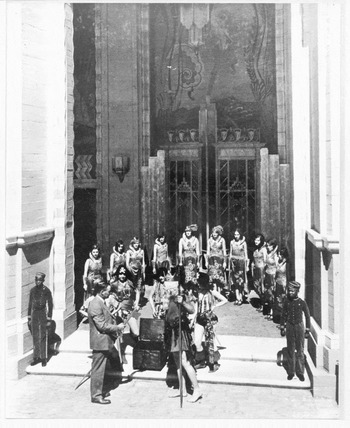
The grand opening of the building on 29 May 1929 featured a fashion revue, marching bands, dancing, and speeches. The proceedings were highlighted by the amphibious arrival of “King Neptune” and his six pirate “lassies,” who carried a “pleasure chest” containing the “golden key” that symbolically opened the building.Footnote 33 Figure 3 reproduces a photograph of the festivities. Staged just outside the building's grand entranceway with its sea-themed murals, we see Neptune, trident in hand, holding forth before the faux treasure chest, surrounded by women in elaborate costumes. David M. Renton, the general manager of the Santa Catalina Island Company, is holding the giant golden key with which he will officially open the new building, the island's real-life “pleasure chest.”
“Neptune” presenting the key to the island's new “Pleasure Chest,” the Casino Ballroom. Photograph courtesy of Catalina Island Museum Research Center, Avalon, Catalina Island.

A close look shows, flanking the main scene, two adolescent African Americans dressed in uniforms standing watch over the show.Footnote 34 The names of the black teens are unknown (along with many of the women), though Catalina historian Patricia Moore has identified several other figures in this scene (“Neptune,” David Renton, and “Miss Catalina”).Footnote 35 The young men are clearly subservient to the main action, decorative touches to this grandly theatrical opening. In their uniforms and peripheral position, they embody long-standing ideas about African Americans as the servants of white fantasy. They are also evidence that African Americans were involved in the island's functioning at various times, though in the role of laborers rather than vacationers. Published histories of the island do not discuss any permanent or part-time African American residents of Catalina or its main city.Footnote 36 A survey of The Catalina Islander, the island's only newspaper, from the mid 1930s through 1941, also reveals no presence of any African American community.Footnote 37 Photographs like the one reproduced in Figure 3 seem to be the only archival materials that document an African American presence on Catalina. On display at the Catalina Island Museum (located in the Casino Ballroom building), is another telling image, an undated photograph titled “Porters, Stevedores, and Concessionaires of the S. S. Catalina.” The photograph shows a large group of uniformed African Americans, twenty-four men and one woman, arrayed before the ship, and is another brief acknowledgment of the place of African Americans in the operation of the resort island. This island “pleasure chest” was for whites only.
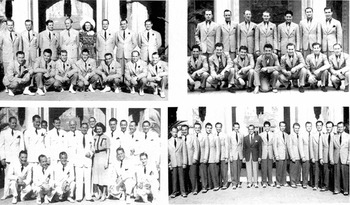
Whereas such segregation at this time was the norm in most places across the United States, the exclusionary racial policy of the owners of the island extended even to the entertainers that could play the ballroom—no African American bands played there during the 1930s and early '40s.Footnote 38 This is especially unusual, considering that even in the most racially segregated parts of the country black bands often played for all-white audiences.Footnote 39 Photographs of the bands who appeared at the ballroom, especially from the 1930s and '40s, are almost all the same: instrumentalists and singers are dressed in light, neatly tailored, and freshly pressed clothes (suits for men, dresses for women), and spread in a semicircle, often in front of the Casino.Footnote 40 Figure 4 shows four of these band portraits.Footnote 41 Striking in these photographs is not only the absence of any African American bands, but also of many of the most famous white bands of the era.
Formal photos of bands in front of the Casino Ballroom. Clockwise from top left, the bands led by Kay Kyser (1939), Dick Jurgens (1939), Freddy Martin (1939), and Jan Garber (1937). Patricia Ann Moore, The Casino: Catalina's “Two Million Dollar Palace of Pleasure,” 2nd rev. edn. (Avalon, Calif.: Catalina Island Museum Society, 2002), 88, 90, 91.

Indeed, a surprisingly large number of the most well-known bandleaders, both white and black, never played the Casino: Louis Armstrong, Charlie Barnet, Count Basie, Cab Calloway, Tommy Dorsey, Duke Ellington, Jimmie Lunceford, Glenn Miller, Harry James, and Artie Shaw. These bands, though primarily known as hot outfits, could have easily accommodated the sweet style favored at the venue. In addition, there is no evidence that Mexican or Chicano bands played the venue—a plausible circumstance given the island's small but long-standing Mexican American community. Other large ethnic groups in the Los Angeles area are also absent from the ballroom's musical stage.Footnote 42 Controlling the presence of these racial others went hand-in-hand with the development of the island into a particular kind of whites-only Southern Californian resort that combined modern amenities with the nostalgic ambience of “early” California.
The Casino Ballroom: White and Sweet
Starting with the very first band to play in the new building, Maurice Menge and his El Patio-Catalina Orchestra, the ballroom became a major venue for the increasingly popular jazz-inflected big band dance music. During the summer, bands would draw nearly 3,000 people during the week and over 5,000 people on the weekends.Footnote 43 From its first days, though, the venue featured only sweet bands that played in the mold of Paul Whiteman and Guy Lombardo. Hotter jazz, with its intimations of racial difference, was never too far away, bubbling beneath the sweet, placid surface. On the last night of their initial run, Menge's band let loose and abandoned “their season's restrained repertoire of waltzes and fox trots and jazzed it up” playing hot tunes such as “Twelfth Street Rag” to an appreciative crowd.Footnote 44 As the island developed under the Wrigleys' guidance, these outbursts of hotness became scarce as the dance hall was molded into a premiere venue for sweet dance band music.
The use of the terms “hot” and “sweet” to describe various manifestations of jazz dance band music is common in the literature and reportage from the 1920s through the 1940s. In a Down Beat article from 1936, Paul Eduard Miller offers some strongly worded help to listeners and critics seeking to separate out these different styles and their merits:
Sweet jazz is popular music in 4/4 tempo; it is music utterly lacking in musical intelligence and genuine emotion; it is crass music, manufactured on request by the songsmiths of Tin Pan Alley, one end of which is in New York and the other of which is in Hollywood. The popular song, comprising the huge bulk of what goes by the name of jazz is the choice of the musically untutored. It belongs part and parcel to the bands led by Guy Lombardo, Wayne King, Johnny Green, Eddie Duchin, and Fred Waring.
Hot jazz is also music in 4/4 tempo, but it is genuine music as well. That is to say, the point of which it differs from sweet jazz is not in its form but in its musical quality. . . . Compositions such as Variety Stomp, Alligator Crawl, Dallas Doings, Radio Rhythm, and Mad Moments are representative examples of the finest hot jazz. Even when badly executed, these works possess a remarkable and undeniable quality rich in Negro tradition and unique in background. Hot jazz thus differs from the other . . . in that it is a sincere expression of an emotional feeling and is founded on something more than mere sophistication.Footnote 45
I begin with Miller's distinction between hot and sweet because of the explicit way he mixes together musical characteristics and commerce with issues of race, specifically “Negro” and the unstated “Caucasian.”Footnote 46 And even though it was meant as a charged polemic against jazz fans and critics who lacked the proper aesthetic knowledge, Miller's definitions were (and, in many cases, remain) common expressions of the racial connotations of sweet and hot jazz during this period.Footnote 47
In much jazz criticism and historical writing, from the pioneering works in the 1930s up through today, the distinctions between hot and sweet have been about the relationship between certain key musical parameters—especially improvisation and rhythm—and African or African American culture.Footnote 48 For these writers, sweet jazz, also labeled “commercial” jazz, was a diluted version of the real thing. It was based on popular Tin Pan Alley tunes that were turned into stock arrangements by publishers. The music featured little or no improvisation and melody was predominant. Rhythms were staid and lacked the hard-driving forward push of hot swing grooves. Hot jazz, of course, was the opposite of this: full of rhythmic excitement, improvisation, and timbral distortions. These categories of hot and sweet are gross simplifications of a much more complex reality, however: very swinging rhythms could be applied to stock arrangements in performances that featured little improvisation. Conversely, original “jazz” compositions could likewise feature little improvisation and gentle rhythms. Unfortunately, much jazz historical writing and criticism has yet to fully address the past and present ambiguous usages of sweet and hot to describe the music of black and white bands of the 1920s through the '40s.Footnote 49 Although sweet and hot were—and remain—powerful discursive formulations that shaped musical understandings, these categories did not necessarily reflect the actual musical diversity of the era. The real truth of the situation lies in a careful discursive and musical analysis.
This pervasive discourse of race and musical style is key to understanding the predilection of the Casino Ballroom owners for particular bands. The owners could have easily hired black bands to play sweetly—many black bands were highly versatile and able to accommodate the needs of any audience. If patrons wanted waltzes or polkas, professional bands would provide them.Footnote 50 As Elijah Wald has recently noted, commercial pressures and rigid racial expectations often made it difficult for black musicians to record sweet arrangements of which they were proud.Footnote 51 Furthermore, there is evidence that many black listeners of the time very much enjoyed the sounds of bands such as Guy Lombardo and Paul Whiteman that played clear, familiar Tin Pan Alley melodies to sedate rhythms.Footnote 52
Still, despite the complex reality of black musicians and listeners, the discursive connections between race and hotness were strong because the roots of this formulation extended deep into US nineteenth- and twentieth-century history. In the final chapter of Lying Up a Nation, Ronald Radano traces the creation of the idea of hot black rhythm to nineteenth-century accounts of British travelers in Africa. Drawing on these accounts, Radano explains how US writers of the nineteenth and early twentieth century fixated on intense and dynamic rhythm as the central characteristic of black music in the United States. Hotness was rhythm and rhythm was blackness. This association would, in the interwar years, serve both the celebrants and critics of jazz dance band music.Footnote 53 Radano's discussion usefully suggests that even if no hot bands played at the Casino Ballroom (black or white), their music was still “present” as the necessary Other: “claims of black essence presume white ones too.” The discursive creation of black music was inextricably part of the “broader emergence of race in American public history and culture.”Footnote 54 Hiring appropriate music for the Casino Ballroom was part of an ongoing discursive process of separating out white musical sounds from black ones.Footnote 55
The Santa Catalina Island Company, as operators of the ballroom, were explicitly concerned with the type of sounds welcomed there. In a letter dated 5 July 1932, David M. Renton, William Wrigley's confidant and general manager of the SCIC, addressed J. C. Houck, father of bandleader Curt Houck, who had recently performed at the ballroom.Footnote 56 The elder Houck was a Los Angeles businessman and acquaintance of William Wrigley, and Renton's tone is casual. The letter details the great success of Curt's band—Renton claims that in the past two days 16,400 people danced to the band's music—and suggests that the ballroom engagement could lead to bigger things, a chance to “get his name before the public, as a real Catalina dance orchestra.”Footnote 57 Renton specifically mentions the band's sound: “The music is just what I have been trying to get for the past few years; it does not have the blare that a great many bands do, and goes well with the acoustics of the Casino.” Renton's use of the word “blare” strongly suggests that the Houck band played a more tempered dance music, toning down the raucous timbres of other, hotter bands. It was these hot timbres—the growling sounds of trumpets played with plunger mutes, the sharp, syncopated, staccato attack of ensemble horn passages—that intimately tied big band jazz to its roots in specific African American musical practices.Footnote 58 By 1932, jazz had indisputably entered American popular music, infusing its characteristics into other styles of popular music. But it was still an edgy music that had to be tamed before it achieved widespread acceptance into the white middle and upper classes.Footnote 59
Renton's comment that Houck's music “goes well with the acoustics” suggests further that for the management of the ballroom there was a particular kind of music that fit the building. Although bands of eleven to fifteen musicians could be very loud, in an era of cruder electrical amplification (the ballroom was initially built with microphones installed) it is hard to imagine that the ballroom would be unable acoustically to handle certain dance band music.Footnote 60 Acoustical appropriateness here seems to stand in for more general requirements regarding musical aesthetics, social propriety, and morality.
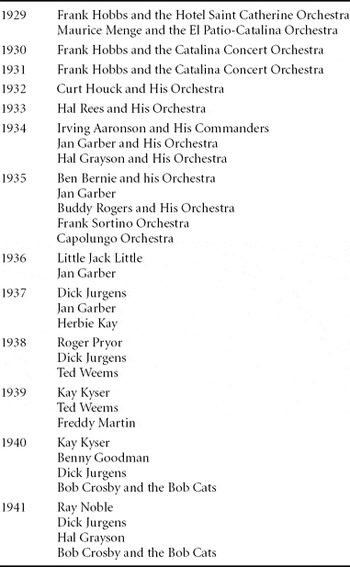
The suggestion of an appropriate music for the space was clearly put into practice during the 1930s. The groups hired all conformed to Renton's dislike of “blaring.” After 1934, when Philip Wrigley installed the remote transmission wire, the ballroom began booking national name bands rather than local musicians.Footnote 61 Philip K. Wrigley himself became friendly with the bandleaders who played the ballroom—another indication of the close ear the Catalina Island owners and management kept on the music of their cultural centerpiece.Footnote 62 With the exception of Benny Goodman in 1940 and Bob Crosby in both 1940 and 1941, all the bands that played the ballroom from 1934 until the Casino was closed during World War II were known primarily as sweet bands or resided well on the sweet end of the hot-to-sweet spectrum.Footnote 63 Table 1 lists the bands featured in the ballroom through World War II.Footnote 64
Bands at the Casino Ballroom, 1929–41. Information compiled from Patricia Ann Moore, The Casino: Catalina Island's “Two Million Dollar Palace of Pleasure,” 2nd rev. edn. (Catalina Island: Catalina Island Museum Society, Inc., 2002), 29–36, 85–114.

But the issue of appropriateness extended beyond just the sounds allowed into the room to the management of the people in the ballroom itself. Even after the repeal of Prohibition, the Casino did not offer alcoholic drinks until 1948. According to Patricia Moore, under William Sr. and his son, the Casino was operated with “utmost propriety”: a strict dress code prevailed, requiring jackets and ties for men and skirts and dresses for women. A special law enforcement officer was stationed at the Casino to deal with any drunken or rowdy behavior.
A floor manager also policed the ballroom area to make sure dancers kept “proper” distance from their partners. It was a practice that explicitly sought to contain any potential eruptions of public sexual behavior unleashed by the music.Footnote 65 Lew Oesterle was the official responsible for this through the mid to late 1930s. The Catalina Islander describes him as stern in enforcing “dance routine regulations” but generally liked for his geniality and “suave manner” in fulfilling his duties.Footnote 66 Oesterle himself describes the atmosphere of his dance floor:
When you dance at the Casino, you will be impressed by the atmosphere of refinement, for the good manners on the part of the dancers constitute part of the enjoyable time had by each guest. The policy of the Casino Management stresses courtesy for all and this is why visitors to Santa Catalina Island, both young and old alike, find at the Casino an atmosphere that insures the pleasantest of enjoyable evenings as well as Sunday afternoons from 2 until 4 o'clock.Footnote 67
Control over the ballroom experience—visual, sonic, and corporeal—was never total. As in the photo documenting the opening of the Casino Ballroom, racial others do appear, though at the very margins of the historical record.
A 1936 gossip column called “Doings at the Casino” contains a striking throwaway description of two “Harlem Boys” tucked between statements about then-engaged bandleader Jan Garber's fashion sense and descriptions of celebrity visitors:
[K]nown as “Dutch,” the Bachelor's Club's houseboy, and “Nathan,” Jan Garber's personal valet, [the two “Harlem Boys”] did their stuff last Saturday night with a “Trucking” contest held on the stage at the Ballroom. Jan says they both won.Footnote 68
Like the young African Americans photographed at the 1929 opening, this recounted episode is another reminder that blacks were present on the island, though contained and marginalized. Although black entertainers were not engaged at the ballroom, two young workers could briefly claim the spotlight. The tightly controlled experience—Oesterle's prudish remarks and strict rules, the anti-alcohol policy, the physical exclusion of racial others—has a parallel in the actual music played there. Which sounds were welcomed, and how did they differ from those that were not? What was it about the sounds and technical workings of certain white sweet bands that made them attractive to the owners and management of the ballroom? To answer these questions we must explore in some detail how sweet dance music worked in relation to the hotter sounds with which it was so often compared.
Avalon as Sound
Though the song “Avalon” (1920) preceded the Casino Ballroom's construction, the Santa Catalina Island Company adopted it as an unofficial theme for the island, one that permeated a visitor's trip and became an integral part of the island experience. Songwriter Vincent Rose composed the music for “Avalon” with B. G. DeSylva and singer Al Jolson collaborating on the lyrics. First introduced in Jolson's 1918 Broadway show “Sinbad,” a version was later recorded by the singer for Columbia Records in 1920.Footnote 69 There is little information on the circumstances surrounding the song's genesis and its relationship to the actual city of Avalon, though a brief 1936 article by Hollywood music writer Hal Holley suggests that Jolson bought the song for $5,000 after hearing Rose sing it while the two were playing golf at the Midwick Country Club.Footnote 70 Holley writes, “Jolson is said to have received $50,000 from the Wrigley interests alone for introducing that song.”Footnote 71
Jolson's first recording of the song sold very well and was among the popular songs of 1920; other singers and bands soon recorded their own versions, including a successful version by Paul Whiteman and His Orchestra.Footnote 72 The tune remained popular throughout the decade and into the big band era; recordings were made by Helen Morgan, Teddy Wilson, Django Reinhardt, Kenny Baker, Harry James, Harry Reser, the Cliquot Eskimos, Benny Goodman, Jimmie Lunceford, and the Casa Loma Orchestra. The song is still often performed and recorded, though it does have a very “old” sound, out of tune with the more sophisticated melodic and harmonic developments of both later Tin Pan Alley and modern (i.e., bebop and post-bop) jazz.Footnote 73 Like many early Tin Pan Alley songs, it has verses that frame a 32-bar AA1BC chorus, and recordings commonly dispensed entirely with the verses.
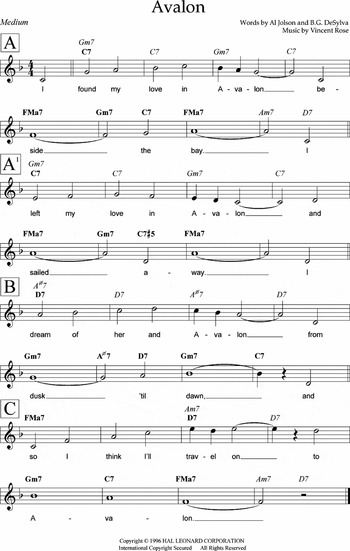
Example 1 is a typical lead sheet featuring just the chords and melody to the chorus. Consisting almost exclusively of half notes on the strong beats (1 and 3), the chorus melody is straightforward rhythmically and harmonically: it is strongly diatonic, and each eight-bar phrase of the AA1BC structure begins with an upbeat on beat three of the previous measure. With the exception of the bridge, the melody's initial leap is followed by a stepwise scale ascent in half notes for two measures and a brief descent by quarter notes in the third measure. Melodically, the bridge follows the same profile (leap and stepwise scale ascent and descent). And while the chorus bridge does provide a brief modulation to ii (Gm), it feels much more like a preparation for the dominant chord (C7) in m. 24 than a real presentation of contrasting musical materials. The last eight measures provide some variation, avoiding that melodic leap in favor of a step down and tonic arpeggio up, but the general melodic outline sounds very similar to what came before.
Lead sheet for “Avalon.” Words by AL JOLSON and B.G. DESYLVA Music by VINCENT ROSE © 1920 (Renewed) WARNER BROS. INC. All Rights Outside the U.S. Controlled by WB MUSIC CORP. and REDWOOD MUSIC LTD. All Rights Reserved. Used by Permission of ALFRED PUBLISHING CO., INC.

Thus, the sameness of the melody throughout the chorus combined with the static, largely diatonic harmonic progression imparts a strong sense of uniformity over the entire thirty-two bars. There are few troublesome spots for an improviser to negotiate—no significant key changes, complex rhythms, or dramatic melodic shifts. Perhaps because of this very effective simplicity, the song has led a long life both as a popular vehicle for swing-era big bands with their cutting-edge arrangements as well as New Orleans–style small jazz ensembles that favor simultaneous improvisation over a two-beat feel.Footnote 74 The malleability of “Avalon” lent itself to all sorts of reworkings by dance bands of the 1930s and '40s, and could easily be made sweet or hot.
Below I will survey three commercially recorded versions of “Avalon” by Jimmie Lunceford and His Orchestra, the Casa Loma Orchestra, and Jan Garber and His Orchestra. The songs document a move from hot to sweet in the language of the era. But close study reveals a more complex reality that the sweet and hot labels cannot completely encompass. Although all three bands spoke the distinctly modern language of big band dance music to a mass cultural audience through the newest technologies of radio and recording, they presented different musical places with their own set of social relationships. Each of these “Avalons” presented a particular “momentary acoustic community”—a set of musical practices that enacted certain social relationships and values.Footnote 75 These musical relationships and values then intersected with the larger cultural discourses on race and identity. In the case of Garber, his “Avalon” would prove an excellent match to the ideology of the real Avalon.
Jimmie Lunceford and Casa Loma's Hot Avalon
Many jazz historians and critics consider the Jimmie Lunceford band one of the most polished and hottest of all the African American bands of the era (George Simon called them “the most exciting big band of all time”).Footnote 76 A strong leader who had little tolerance for mistakes, Lunceford set a high standard for extremely tight, error-free performances.Footnote 77 This musical polish was combined with a keen sense of showmanship; the brass section pioneered the use of Derby hats as plunger substitutes, a stage technique that was quickly adopted by other bands such as Glenn Miller's Orchestra.Footnote 78 Though the group enjoyed its greatest success from about 1938 through 1941, the band continued playing, weathering many personnel changes, until Lunceford's premature death in 1947 from a heart attack.
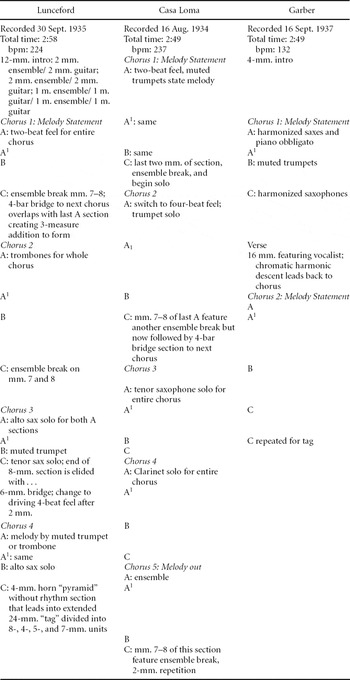
The Lunceford band's “Avalon” is a striking arrangement for its 1935 recording date, in part, because of its adventurous digressions from the conventional Tin Pan Alley form.Footnote 79 As was typical of the group, the performance emphasizes impressive ensemble work over individual solos. Column 1 of Table 2 summarizes the most important elements of the recording. Just a quick glance at the chart shows just how many interruptions arranger (and guitarist on the recording) Eddie Durham has inserted into the expected cycles of the AA1BC form. In the first chorus a four-measure connecting passage overlaps with preceding material creating an odd numbers of measures (see Chorus 1, C, Table 2). A little later Durham writes another four-bar intrusion that connects the third and fourth choruses while also changing the rhythmic feel. Perhaps most dizzying of all, the final chorus is abruptly short-circuited and transformed into an elaborate tag that brings the tune to a blazing conclusion. The track also features the band's trademark two strong beats to a measure groove: “the Lunceford two beat.”Footnote 80 As the tune develops, the two-feel gives way to a more driving and even four-beats-to-the-measure groove. The gradual replacement of the two-feel is part of the overall dramatic arch of the arrangement—as the ensemble passages become more virtuosic and the pace of the musical activity quickens, the shift to a driving 4/4 rhythm greatly enhances the drama.
Comparison of three recorded performances of “Avalon.” Jimmie Lunceford and His Orchestra, “Avalon,” The Original Decca Recordings, An Anthology of Big Band Swing, 1930–1955, Decca/GRP GRD-2–629 (2 CDs), 1993; Glen Gray and the Casa Loma Orchestra, “Avalon,” Best of the Brunswick Years, 1932–1934, Collectibles, Sony Music Entertainment COL-CD-7574, 2004; and Jan Garber and His Orchestra, “Avalon,” Jan Garber, “The Idol of the Air Lanes” and His Orchestra: A Melody From the Sky, Living Era CD AJA 5326, 2004.

The recording is a constant and dynamic interplay of part and whole, individual and collective, section and ensemble. The introduction sets up the aesthetic priorities: from the opening notes, the recording establishes a dramatic contrast of instrumental colors and players. The very first sound we hear is the high “ping” of the pianist striking F octaves (F5 and F6), followed almost immediately by horns and reeds entering with the rising, harmonized melody. Just as quickly, the horns drop out leaving an unusual solo spot for the electric guitar. Responding to the guitar's chordal solo the horns and reeds reenter with their melody, and Durham responds with another chordal statement. Over the next four measures the back and forth between guitar and horns moves faster—from two to one bar apiece—and the conversation spills over the bar lines.
It is a striking and dizzying opening with its barrage of shifting instrumental voices played with heavy syncopation against a strong underlying pulse. As an opening it synoptically introduces the Lunceford band's approach to the tune and their particular musical priorities: texture, rhythmic flexibility, call and response, and precision. Surprisingly, the melody of the tune is interpreted in a very straightforward way—the arrangement sticks close to the original sheet music's unsyncopated half notes (though they do rhythmically compress the written phrase endings). However, from the pickup to the bridge until the end of the chorus, Durham's arrangement departs more and more from the written music. The increasing use of syncopation is combined with shorter rhythmic values to create a small climax in the last A section. The remainder of the performance is an expansion of that first minute—a vigorous dialogue between section and soloist, rhythm instruments and melody instruments, two-feel and four-feel.
These predominating musical characteristics are practices strongly associated with African American cultural practices. Lunceford's “Avalon” employs many elements of Samuel Floyd's “master-trope of Call-Response,” a musical-rhetorical notion characterized by “calls, cries, whoops, and hollers; call-and-response, elision, pendular and blue thirds, musical expressions, vocal imitations by instruments, and parlando; multimeter, crossrhythms, and interlocking rhythms.”Footnote 81 In its clever manipulation of the familiar “Avalon” melody and form, invoking the original while also playfully deconstructing it, the Lunceford recording could also be construed as a paradigmatic example of African American musical “signifyin(g),” a vernacular cultural practice that works through “reference, gesture, and dialogue to suggest multiple meanings through association.”Footnote 82
Lunceford's music is profitably understood as an exemplary cultural product of a particular African American experience of twentieth-century American modernity. The massive demographic changes caused by the Great Migration radically urbanized black Americans, bringing large segments of the population into the factories of a rapidly expanding industrial economy. New urban economic and cultural opportunities along with black participation in World War I generated a mixture of hope for political progress and cynicism with the stubborn persistence of racism.Footnote 83 For Floyd, this was the context for an African American modernism, a cultural response built on the “psychological self-defense and self-empowering” strategy of signifyin(g)—“the tool of the human, urban trickster.”Footnote 84 The Lunceford band's “Avalon” is a clever, self-aware revision of the original Tin Pan Alley version, a repetition with difference that both marks out something new while placing itself within the old.
For their recording made a year earlier in 1934, Glen Gray and the Casa Loma Orchestra take a slightly different approach. While selectively holding on to certain key musical practices, the Casa Loma band aims for a milder version that tones down the musical breaks and interruptions and lightens the driving swing rhythm and attack. Like the Lunceford band, the Casa Loma Orchestra features prominently in most histories of jazz dance bands.Footnote 85 Their tune “Casa Loma Stomp,” recorded and released in 1930, is considered a major forerunner of swing—Gunther Schuller calls the song “the full-blown progenitor of hundreds of swing-style offspring.”Footnote 86 They were the first band of their kind to appear on a commercial radio series, The Camel Caravan, and their mix of hotter up-tempo numbers with languid ballads proved immensely popular to a diverse American audience.Footnote 87 Many members of the group owned a share of the band, an effort at collectivity that was unusual for the industry. Whereas all dance bands needed to be flexible in terms of musical style, the Casa Loma band truly straddled the sweet-hot divide, polling consistently in both categories in magazines such as Down Beat and Metronome.Footnote 88
From their first notes the Casa Loma band suggests different musical priorities. The arrangement (probably by the band's primary arranger Gene Gifford) dispenses with an introduction and begins with the “Avalon” melody. Featuring just muted horns and rhythm section, the opening is rather minimalist for a group of around twelve musicians. The rhythmic feel is very similar to the “Lunceford two-beat,” but much of the rest of performance is very different. First, the Casa Loma performance is less fragmented—the opening statement of the melody is played entirely by the horns with no commentary from the reeds. The sense of wholeness and ensemble unity is emphasized by the larger formal structure. With the exception of a few two-bar breaks at the end of choruses and a brief four-bar connecting passage between choruses two and three, the arrangement rarely digresses from the cyclical AA1BC structure of the song. Unlike the rapid back-and-forth of the Lunceford recording, the Casa Loma arrangement gives entire choruses to single, solo instrumental improvisations (trumpet in Chorus 2, tenor sax in Chorus 3, clarinet in Chorus 4 shown in Table 2).
Listening closely to the Casa Loma interpretation of Vincent Rose's melody alongside the Lunceford version reveals some subtle but essential differences. First, the Casa Loma reading, from the opening bar to the end of the first chorus, is uniformly syncopated with shorter rhythmic values—all the half notes of the sheet music have been compressed into quarter notes and eighth notes. Despite all this rhythmic activity their interpretation is just noticeably smoother—not legato, but the attacks are less front-heavy than those of the Lunceford band (the Casa Lomans do not lean so heavily on the beginning of their attack but spread the force through the whole note).
The Casa Lomans approach to the tune demonstrates how they toned down edgier musical techniques that were associated with the hottest bands. These musical techniques, though, were inextricably tied to a discourse of race. Hotter sounds, as Miller explained, brought you closer to authentic black music, and unpolished, straightforward emotional expression. As Renton might have put it, the Casa Lomans had less of the “blare” of hotter, blacker bands. They also play the song with far fewer disruptions and reconfigurations. The Casa Loma version represents a tentative reaching out and recognition of a complex culture deeply implicated in the African American experience. In their deliberate mixture of hot and sweet playing, they combined black-identified sounds and rhythms with the musical styles of the famous sweet white bands led by Paul Whiteman and Guy Lombardo. The Casa Loma band seems to recognize the difference between a Guy Lombardo and a Jimmie Lunceford band, but also the strong connections and cross-relationships. Song titles such as “White Jazz” and “Black Jazz,” meant as parodies, suggest the band's awareness of socially constructed racial differences.Footnote 89 Despite their comfort playing in different dance band styles, the Casa Loma band was too hot for the Casino Ballroom.
Jan Garber's Sweet Avalon
Despite their tremendous popularity and commercial success during the 1930s and '40s, Jan Garber and His Orchestra have mostly vanished from chronicles of American music and jazz. With just a few exceptions, the group's recordings are out of print, and you have to look very hard—in the case of Simon's The Big Bands, literally at the fine print—even to find the band named, let alone discussed in any detail. Most of Garber's output was of the sweet variety, and in the vast majority of the band's recordings there is just a hint of the rhythmic drive, exciting arranging, or improvisational skill that we now associate with the great dance bands.Footnote 90 Garber was a savvy bandleader with a good business sense, and his group prospered, selling records and tickets through the ups and downs of the 1920s, '30s, '40s and beyond.Footnote 91 He was a particular favorite at Catalina Island—the group played there every summer from 1934 to 1937—and his name became closely associated with the ballroom itself.Footnote 92
Garber and His Orchestra recorded their version of “Avalon” for Brunswick in Los Angeles on 16 September 1937. The recording features a fairly straightforward arrangement of the song with a vocal performance by Russ Brown (along with Lee Bennett, one of Garber's featured singers). A brief introduction—a descending figure by trumpets with reeds over a bass pedal on C (V in the recording's key of F)—leads quickly into the song proper, a full ensemble treatment of the AA1BC chorus. With gentle harmonizing reed support, saxophones play a vibrato-heavy version of the melody. Short bell-like piano fills of arpeggios and scalar fragments complement the mellow reeds. Along with saxophones and piano, an upright bass fills the rest of the musical space with half notes. The long breathy sax playing, the waves of unobtrusive tinkling piano fills, and the bowed bass combine to create a sense of sonic fullness—not crowded, but comfortably occupied. The mid-tempo performance (quarter note = 132 bpm) feels surprisingly slow despite all the musical activity. The full sound blankets any possible openings in the texture—there is little time to reflect on individual notes as the reeds' heavy vibrato fills the musical space.
In both the Lunceford and Casa Loma recordings, the rise and fall of the melody contrasts with the rhythm section's insistent and energetic two-feel, and a counterpoint is created between the steady pulse of the underlying rhythm and the ebb and flow of the melody as it is attacked in various ways by horns and reeds. With the Garber band, however, the rhythm section is far less prominent. The bass, as in the other recordings, plays in a two-feel, but the notes are much fuller. The drummer faintly thumps a steady four on the bass drum, providing just enough of a pulse to orient listeners and dancers amid the swirl of rising and falling reeds and horns.
After the statement of the melody, the Garber arrangement moves surprisingly to an instrumental version of the verse, unusual among the recordings in this discussion (and other versions from the era). The reintroduction of the verse is a deliberate gesture backwards in time and a rejection of the efficient, streamlined versions of Lunceford and Casa Loma—a distinctively nostalgic gesture. Rather than stripping away excess musical baggage to feature more soloists or more elaborate section work, Garber adds back elements, deliberately weighing down the song with the past. The inclusion of the verse is, in part, a direct link to the famous version by Jolson recorded in 1920. Furthermore, Russ Brown's singing contains just enough hints of Jolson's full, broad and nasally voice to suggest that famous recording without recreating it.
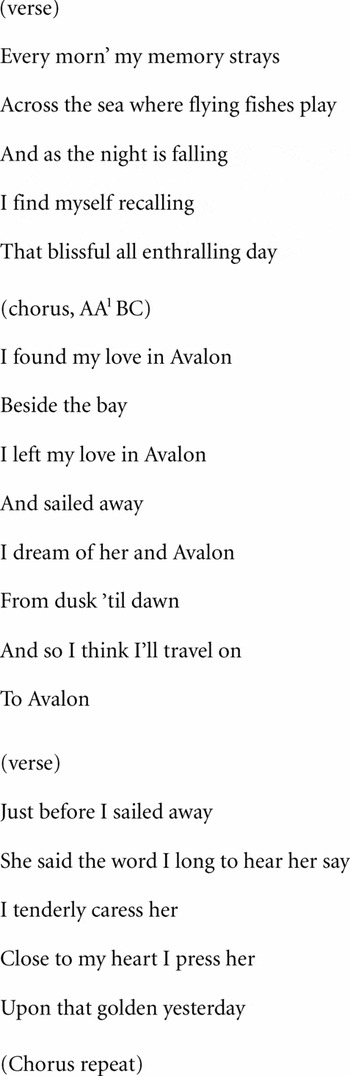
The presence of a singer obviously sets the Garber recording apart from both other examples, and it is the first performance that lets us hear some of the song's original words. Figure 5 contains the lyrics to “Avalon.” Unabashedly sentimental, the lyrics tell of the anonymous narrator's happy memories of time spent in the resort town. Whereas the verses directly suggest the actual town of Avalon (in the first verse there is a reference to “flying fish”—a real creature inhabiting the waters surrounding the island; the fish can glide substantial distances just above the water), the chorus tells us much of what we need to know. First, the song is a reminiscence of Avalon, in the past tense and explicitly looking backwards. Second, the lyrics fuse romantic love and place, explicitly connecting the two (“I dream of her and Avalon”). Finally, the song is framed by movement, first away from and then perhaps a return to the place of lost romance (“And so I think I'll travel on/To Avalon”). The song is a curious celebration of the city—rather than enumerating the island's modern offerings, the song's narrator reflects back on a previous time and a moment of lost perfection. Since “every morn'” the narrator's memory strays, the song suggests that some time has passed, though it could be weeks, months, or even years. The ambiguous time frame of the events recounted further strengthens the song's nostalgic ambience.
With Garber, most of the key musical markers of hotness have been greatly attenuated: the rhythm lacks the driving-forward motion of the other two performances, the Tin Pan Alley song structure is maintained and the melody is played clearly with virtually no melodic or rhythmic embellishments. For those contemporary listeners who were familiar with Garber's career, his band of the 1930s was a dramatic turn from his “jazz” groups of the 1920s—a switch from the hot sounds of New Orleans and Chicago to the sweet music of Guy Lombardo and His Royal Canadians. For those unaware of this trajectory, the music Garber made in the 1930s (until he went hot again in the early 1940s) was built on musical practices that were set up as deliberate contrasts to hot practices. Here the commonalities between dance bands play a central role: dressing a lot like Lunceford or Casa Loma, the Garber band spoke the modern musical language of the day with a decidedly different accent. The band only made sense in their relationship to other groups, and with race and musical practice so intimately intertwined, the group was deeply marked by their careful avoidance of racially freighted musical gestures.
Considered together, the Lunceford and Casa Loma bands create a musical “Avalon” that is far more open to other voices, far more willing to allow musical disruptions and digressions—to recognize in some way the complexities of US musical and racial identity. This is not to say that either band's music was a perfect sonic analogue to US democracy or racial equality. Both bands were, in their different ways, participating in a debate that at the least employed similar frameworks. Perhaps it is not surprising that neither group was welcomed at the Casino Ballroom. The music would have presented a challenge to the ideals of the venue and its developers. The music of Garber was a logical fit, a sonic corollary to the modern social vision of the island. Garber's “Avalon” is not escapist or a simple pandering to the demands of commerce, but a profound and uncomfortable disengagement with the fundamental hybridity of US culture.
Lyrics to “Avalon.” Words by AL JOLSON and B.G. DESYLVA Music by VINCENT ROSE © 1920 (Renewed) WARNER BROS. INC. All Rights Outside the U.S. Controlled by WB MUSIC CORP. and REDWOOD MUSIC LTD. All Rights Reserved. Used by Permission of ALFRED PUBLISHING CO., INC.

Nostalgia and Modernity
The word nostalgia, as Svetlana Boym points out, is formed from two Greek roots—nostos, meaning “return home,” and algia, meaning “longing”—a neologism coined in a Swiss medical doctor's dissertation in the seventeenth century. Johaness Hofer was searching for an appropriate name for a melancholic condition that afflicted certain geographically displaced peoples he had encountered. From this medical origin the term passed into popular usage but has accumulated meanings that exceed the narrow definition first proposed: from missing a particular place, the term became a more generalized word to describe a yearning for another time—an era at odds with the present.Footnote 93
Boym provides a helpful refinement of Kammen's “nostalgic modernism” and a more nuanced view of what the Catalina Island project was all about. According to Boym, “nostalgia is a rebellion against the modern idea of time,” and, by extension, the modern world that invented it.Footnote 94 In fact, the very concept of nostalgia is “coeval with modernity itself.” The two ideas “are like Jekyll and Hyde . . . alter egos.”Footnote 95 Despite economic turmoil and global world wars, Americans of the first half of the twentieth century were at the forefront of modernization, their social practices and state policies driven by an underlying belief in rational organization and progress and characterized by industrialization and technological development.Footnote 96 Many scholars have adopted the moniker of the “Machine Age” to describe the United States of these years.Footnote 97 The nation was engaged in a large-scale debate—manifested in a wide range of cultural forms—on the benefits and drawbacks of such rapid social and economic change. For Lawrence Levine, “[T]he central paradox of American history . . . has been a belief in progress coupled with a dread of change; an urge towards the inevitable future combined with a longing for the irretrievable past; a deeply ingrained belief in America's unfolding destiny and a haunting conviction that the nation was in a state of decline.”Footnote 98 This paradox was particularly strong in the decades between the world wars, a period characterized by a wholesale embrace of modern life as well as a vicious backlash in the form of anti-immigration laws, racially motivated violence, anti-Semitism, and exclusionary nativist sentiment. One pervasive solution to these contradictions was an embrace of nostalgia. Americans of these years found “it easier to come to terms with the new if it could be surrounded somehow by the aura of the old.”Footnote 99 The decade that produced the Empire State Building, streamlined trains, and the futuristic utopia of the 1939 World's Fair also brought to completion Colonial Williamsburg, an attempt to re-create a living colonial city.Footnote 100
Much of the literature on dance band jazz has not dealt with the nostalgia permeating this cultural form, choosing rather to emphasize its embodiment of fast, urban, machine-age culture.Footnote 101 But the conservative tendencies of the 1920s were not dropped wholesale in the face of the economic catastrophe of the Great Depression—there remained in many of the cultural productions of the time a profound ambivalence. Whereas swing would explode into public consciousness in the mid 1930s, dance band jazz already had a comfortable niche in American popular music. The largely youth-driven phenomenon of swing had its origins in the emergence and growing popularity of jazz and social dancing at the turn of the century. Thus, just focusing on youth culture, or on post-1935 dance band jazz, obscures the participation of vast numbers of other Americans—many of them white and part of a growing, urban middle-class. It was in their responses and the responses made by the culture industry to them that many of the era's most popular cultural forms took shape. Radio shows, the films of Frank Capra, the animation of Walt Disney, as well as sweet dance band jazz, all helped this segment of the United States make sense of a world in disorder.Footnote 102
The Garber recording of “Avalon” is best understood as a nostalgic gesture that provided a cultural working out of the contradictions of American modernization. Their music was the product of the same social forces that produced both Lunceford and the Casa Loma Orchestra. The Garber Band looked just like the hippest, sleekest swing band with their horn sections (no violins), snappy uniformed musicians, and precise, polished performances of popular tunes of the day. They made records, broadcast over the radio, and operated as an efficient and modern business. They were unequivocally a product of what Adorno and Horkheimer famously called “the culture industry.” Yet dressed in the clothing of 1930s modernity, the Garber band played a music that embodied a hesitant and ambivalent embrace of the era, particularly as one that was strongly implicated in engaging with African American life and culture.Footnote 103 Nostalgia, though, is also about attachment to place, and the song is firmly grounded in the real Avalon on Catalina Island. Garber's orchestra was one of the most popular bands to play Catalina Island—they were a fixture of the Casino Ballroom through the 1930s. Their music was a strong complement to the experience and ideology of the place, projecting an image of American modernity that was peaceful, secure, and grounded in a particular location.
In his autobiography Those Swinging Years, bandleader and saxophonist Charlie Barnet, an early devotee of hot jazz and a pioneer in interracial music making, recounts his time playing the ballroom in the 1950s. Over the years, encouraged by the Santa Catalina Island Company, a practice developed of playing “Avalon” for guests arriving and departing the island. According to Barnet, the band “had to play it on the street before the boat from the mainland arrived, as it docked, when it left,” as well as when they started and finished their ballroom show. “Like a prisoner crossing off the days he had to serve,” the band “had marked on the wall backstage” how many more times they had to play the song. The situation was so unbearable that Barnet claims he did everything “short of mayhem” to try to cancel the band's contract, even telling off city officials as “a bunch of old fuddy-duddies, thirty years behind the times.” Unfortunately for the band, the contract remained in place and they had to finish serving their time in “Alcatraz.”Footnote 104
Beneath the humor of Barnet's anecdote is a deeper lesson on the relationship between music and place. The establishment of a place—a delimited locale imbued with social meanings—takes a great deal of work, attentiveness, and, above all, reiteration—place-making is a constant and active process that is always threatened by contestation.Footnote 105 In the face of the Great Depression, the Wrigleys had to work with special diligence to transform and maintain Avalon and the ballroom as the kind of modern-nostalgic locale they so desired for economic reward and psychological comfort. The constant need to play “Avalon” in Avalon is another demonstration of the power of music to participate in the constitution of social and local experience. Although the Wrigleys literally built and rebuilt the island to approximate their vision of a tourist utopia, they were also acutely aware of the power of music to support or challenge their project. By regulating the sounds of the ballroom—the cultural centerpiece of the island experience—they could work to protect one especially potent avenue of cultural infiltration.
In the end, this effort was futile, because the very existence of the “white” sounds of sweet bands presupposed a “black” other. But the problem is deeper than this. As Radano reminds us, “[T]he musical concept [of black rhythm] was profoundly and intimately connected to the idea of modernism itself: black rhythm not only reflected society but infiltrated the very texture of American social existence, giving to the social a perceptible musicality expressing ‘racial’ (black) influence.”Footnote 106 The owners and managers of Catalina and the Casino Ballroom were attempting to create a complete and seamless resort experience, but in insisting so hard on their particular racialized view of the US, past and present, they failed to see the contradictions that underlay their project—to be modern in the US was to be both black and white. In their attempts to marry sweet jazz to a particular place, the owners and managers of Catalina Island sought to constitute, at least temporarily, a modern place that could hold on to an increasingly challenged white, middle-class social order.