INTRODUCTION
Global annual onion production is around 85 million tonnes per annum (FAO, 2012) which is marginally less than sugar cane, the major cereals and tuber crops, soybean, some tropical and temperate fruits (watermelon and bananas), oil palm fruit and tomato. It has a very important role in the human diet as well as having medicinal and functional properties (Rodríguez Galdón et al., Reference Rodríguez Galdón, Tascón Rodríguez, Rodríguez Rodríguez and Díaz Romero2008). A large number of pharmacological activities have been identified in onion. They are rich in substances derived from S-alk(en)yl cysteine sulfoxides ACSOs, which are responsible for its flavour and pungency. These substances confer antimycotic, antibacterial, hypoglycemic, hypocholesterolemic, antiatherosclerotic and antitrombotic properties to onion (Allium cepa) and garlic (Allium sativum) (Lanzotti, Reference Lanzotti2006).
In arid and semi-arid regions, onion production is entirely dependent on irrigation (Al-Jamal et al., Reference Al-Jamal, Ball and Sammis2001; Halvorson et al., Reference Halvorson2008; Mohammadi et al., Reference Mohammadi, Lamei, Khasmakhi-Sabet, Olfati and Peyvast2010). In contrast, in humid and temperate areas, such as the UK and Northern Europe, supplemental irrigation is used to buffer the impacts of infrequent and/or irregular precipitation during short-term droughts (Pejic et al., Reference Pejic, Gvozdanovi, Mili, Ignjatovi and Krsti2011). Here quality assurance is the major driver for irrigation to provide continuous supplies of premium produce demanded by the major retailers (Knox et al., Reference Knox, Rodriguez-Diaz, Weatherhead and Kay2010). Although research has been conducted on the water relations in onion (e.g. Martin de Santa Olalla et al., 2009; Peijic et al., 2011; Piccini et al., 2009) evidence to identify the most appropriate irrigation strategies under a range of agroclimatic and production conditions has not been synthesised in a way that could inform future industry and agronomic research needs. This paper aims to address that gap in knowledge by synthesising international scientific literature to understand the water relations and irrigation requirements of onions to guide future research and inform policies to promote best management practices, particularly as resource (soil, water, energy and labour) pressures increase. The paper structure is similar to that used by Carr and Knox (Reference Carr and Knox2011) but also draws on extensive industry evidence from interviews with key informants in UK onion production, including growers, agronomists and processors.
CENTRES OF PRODUCTION
The genus Allium (Alliaceae family) includes onions and shallots, as well as garlic and leek. Friesen et al. (Reference Friesen, Fritsch and Blattner2006) estimated there to be c. 780 species of Allium growing across the northern hemisphere from temperate areas to boreal zones. However, they are typically found in open, sunny, dry sites in fairly arid climates (Hanelt, Reference Hanelt, Brewster and Rabinowitch1990). Their annual growth (phenology) varies widely: species adapted to summer-dry regions show summer dormancy, whilst those adapted to cold regions are winter dormant (Brewster, Reference Brewster2008). Onions and shallots (Allium cepa L.) have been cultivated for approximately 4700 years. Its primary centre of domestication is considered to be in south-western Asia, although the Mediterranean has also been considered a secondary centre due to the high variability of cultivars grown in that area (Hanelt, Reference Hanelt, Brewster and Rabinowitch1990).
Allium cepa L. includes two horticultural groups, the Common Onion group and the Aggregatum group (Hanelt, Reference Hanelt, Brewster and Rabinowitch1990). The former embraces the majority of the economically important varieties. These are characterised by the formation of large, single bulbs and usually grown from seed. Onions grown for salads and as small bulbs for pickling also belong to this group (Brewster, Reference Brewster2008). In contrast, bulbs from the Aggregatum group are much smaller and include varieties that form clusters, such as shallots. Another classification adopted by Brewster (Reference Brewster2008) and the FAO (2012) distinguishes fresh onion shoots and onions for dry bulb production. The latter includes brown and red, cooked and uncooked for consumption, pickling, factory-made food, dehydration, seed production and sets (small bulbs used for planting). This review focuses dry bulb onions. Given its international importance, there are unsurprisingly many cultivars with each adapted to different local soil and agroclimatic conditions. An important aspect is the day-length bulbing requirement – this is the minimum photoperiod needed to stimulate bulb development which is directly linked to location.
In order to achieve a stable year-round supply, different husbandry techniques, planting dates and varieties are grown commercially. Onions can be grown as either a spring or over-winter crop from seed or sets. This helps to spread the period over which harvest occurs, thus extending the period over which retailers can be supplied. The planting date also influences final bulb size. For example, onions planted in autumn are typically harvested the following spring or early summer; those grown as spring-season onions are harvested in late summer. Using sets rather than seed permits earlier harvest. Globally, onions are an important crop with centres of production ranging from the warm tropics and temperate zones to high latitudes in the northern hemisphere (Brewster, Reference Brewster2008). The major producers include China, India and the USA, followed by Egypt and Tunisia. Total world production increased from around 30 to 35 million tonnes in the 1980s up to 90 million tonnes by 2011 (FAOSTAT, 2012). Onions are grown in a wide variety of soils, from sands to silts, on some clays and peat, but fertility is the key determinant. The most appropriate soil pH is 6–7, although this can be lower on organic soils. However, a fine de-stoned tilth is a prerequisite for commercial drilling. These preferred soil characteristics concur with the findings from a recent UK industry survey (Perez Ortola, Reference Perez Ortola2014). Onion is one of the most saline-sensitive crops with yields reported to decrease when ECe values rise above 1.2 mmhos cm−1 (Allen et al., Reference Allen, Pereira, Raes and Smith1998; Doorenbos and Kassam, Reference Doorenbos and Kassam1979).
CROP DEVELOPMENT
Onion is typically biennial; during the first year, seeds germinate and produce leaves and bulb in which nutrients then accumulate. In the second year, the plant flowers, pollinates and produces seed. Depending on the target market, growers typically cultivate onions either as an annual (for bulb production) or biennial (for seed production) crop. Brewster (Reference Brewster2008) identified the following phenological developmental stages for bulb production.
• ‘Loop’ stage: after germination underground, the cotyledon appears as a loop or hook above the surface;
• First leaf ‘crook’ or ‘whip’ stage: first true leaf appears, while the cotyledon is sharply bent forming a shepherd's crook or a whip;
• Cotyledon senescence: cotyledon desiccates after appearance of the second and third true leaves;
• Fourth leaf ‘leek’ stage: fourth leaf appears and the neck of the plant starts to thicken while first leaf withers;
• Fall of the first leaf: first leaf falls; second leaf detaches at the sheath and begins senescence from tip; leaves five, six and seven appear;
• Start of bulbing: the bulb begins to form; the second and third leaves desiccate; leaves 8–13 appear, and plant reaches its maximum height;
• Bulb swelling: bulb swells rapidly and leaves 4–6 desiccate; leaves may bend by their own weight, and 1 or 2 more may appear. A dry outer bulb skin begins to form;
• ‘Fall-down’ or ‘soft-neck’: the neck/pseudostem becomes hollow, loses turgidity and softens, leading to foliage collapse. Meanwhile, the bulb reaches its final size;
• Bulb ripening: the outer skin dries; the foliage senesces and then desiccates.
Allium cepa L. varieties are characterised by slow emergence and growth rates (Brewster, Reference Brewster1979) compared to other field vegetables such as lettuce or cabbage. Relative vegetative growth rates have been shown to be strongly correlated to temperature. Bulb initiation occurs when the plants no longer form green leaf blades but bladeless bulb scales. The most important factors affecting bulb initiation are day length, temperature and the ratio of red:far-red light (Lancaster et al., Reference Lancaster, Triggs, De Ruiter and Gandar1996; Lercari and Deitzer, Reference Lercari and Deitzer1987). Several non-destructive methods have been used to determine the initiation of bulb formation including the bulb to neck ratio (Lancaster et al., Reference Lancaster, Triggs, De Ruiter and Gandar1996), leaf ratio (leaf blade length to sheath length) and bulbing ratio (maximum bulb diameter to minimum sheath diameter) (Brewster, Reference Brewster2008). Dry matter partitioning varies through the different crop development stages. Prior to bulbing, most (three quarters) of the dry matter produced is partitioned to leaf blades with only around 6% to stem bases and leaf sheaths. Approximately 90 days after emergence, all dry matter is then partitioned into storage rather than leaves (de Visser, Reference De Visser1994; Tei et al., Reference Tei, Scaife and Aikman1996).
Bulb formation is a plant survival mechanism with factors such as weed competition and water stress triggering initiation (Brewster, Reference Brewster1990). Weed or neighbouring onion canopy cover absorbs light from a certain wavelength, affecting the ratio of red to far-red light; the lower this ratio, the faster the bulbing rate. This ratio decreases when light passes through the canopy, as leaves absorb the red wavelength more readily than the far-red spectrum. Thus a greater leaf area index (LAI) and competing weeds will accelerate bulbing (Mondal et al., Reference Mondal1986).
Several factors have been identified as determinants of yield (Brewster, Reference Brewster2008) including light interception. The quantity of light absorbed by the leaves and then converted into harvestable dry matter does usually not exceed 80% in onions (Mondal, Reference Mondal1985). The final stored dry matter depends on (i) the efficiency with which the absorbed light and CO2 are converted to sucrose by photosynthetic processes, and (ii) the proportion of photosyntethic sucrose that is transformed and stored as dry matter. Crop maturity is reached when the foliage falls over due to the weak necks. Several studies have also assessed the effects of harvest date and fall-over percentage on storability (Boyhan et al., Reference Boyhan, Purvis, Hurst, Torrance and Paulk2004; Suojala, Reference Suojala2001). However, this review focuses solely on the effects of water. An excess or shortage in water availability will have different consequences during each growth stage including transplant/emergence, canopy formation, bulb initiation, bulb formation, fall-over and ripening. The importance of water in each stage is briefly considered below.
Transplant/emergence
Both research and grower evidence confirms that a uniform emergence is critical in order to produce a uniform high-value crop. During this stage, some aspects are more sensitive to water availability, either excess and/or shortage. Emergence and transplanting are reported to be the most sensitive development stages to water shortage (Doorenbos and Kassam, Reference Doorenbos and Kassam1979). Crop water needs are thus small (with Kc factors of between 0.4 and 0.7) (Allen et al., Reference Allen, Pereira, Raes and Smith1998; Piccinni et al., Reference Piccinni, Ko, Marek and Leskovar2009) compared to other crop development stages. Seed water imbibition and radicle initiation, the initial stages of crop initiation, are more sensitive than radicle growth (Finch-Savage and Phelps, Reference Finch-Savage and Phelps1993).
Canopy formation/vegetative growth
After emergence through to bulb initiation, the leaves emerge and grow steadily to develop a canopy. Each leaf later corresponds to a bulb scale. This stage is known as vegetative development and considered to be the least sensitive to water shortage (Doorenbos and Kassam, Reference Doorenbos and Kassam1979; Kadayifci et al., Reference Kadayifci, Tuylu, Ucar and Cakmak2005). However, water stress from the four-leaf to six-leaf stages (Shock et al., Reference Shock, Feibert and Saunders2007), and during five-leaf, seven-leaf, and three-leaf and seven-leaf (double stress) stages (Pelter et al., Reference Pelter, Mittelstadt, Leib and Redulla2004) can reduce the percentage of single centred bulbs. Shock et al. (Reference Shock, Feibert and Saunders2000a) demonstrated that withholding irrigation during the vegetative development phase would not affect final production as much as during the last third of the growing season, when moisture stress reduces yield. However, although it is the least sensitive stage to water stress, UK growers reported it to be the most important. Adequate water status helps maximise canopy formation; the more leaves the plants produce at this stage, the more scales the bulb will develop later.
Bulb initiation
Base on UK grower interviews (Perez Ortola, Reference Perez Ortola2014) bulbing is induced by a certain level of water deficit, after the crop has accumulated sufficient light and heat. Growers therefore stop irrigating once the canopy has fully developed and the period for bulbing has commenced. However, no evidence was found in the scientific literature to substantiate this industry evidence.
Bulb/yield formation
The bulb formation period is also very sensitive to water deficit, especially during rapid bulb growth (Doorenbos and Kassam, Reference Doorenbos and Kassam1979). Shock et al. (Reference Shock, Feibert and Saunders2000a) showed that the crop was particularly sensitive to water deficit during the last third of the growing season, with deficit irrigation trials resulting in a yield reduction when moderate-to-high irrigation thresholds (soil water tensions of 30, 50 and 70 kPa) were applied during the last three weeks of the growing season. UK grower experience also suggests that a rapid maturation and very quick bulb growth can lead to reductions in post-harvest storability. In addition, large depths of water applied during very dry conditions can lead to cracking and skin breakage as the plant absorbs water too quickly.
Fall-over and bulb ripening
During the final crop development stage the crop dries and the outer skin layers lose moisture. Irrigation applied during this period can lead to regrowth and excess bulb moisture which then incurs extra drying costs for storage and can increase crop wastage. Thus, it is a common practice to stop irrigation two weeks prior to harvest to avoid rot and sprouting (Kumar et al., Reference Kumar, Imtiyaz, Kumar and Singh2007a).
Onion seed production
Onion plants grown for seed production are very sensitive to water stress during flowering (Doorenbos and Kassam, Reference Doorenbos and Kassam1979; El Balla et al. Reference El Balla, Hamid and Abdelmagee2013). El Balla et al. (Reference El Balla, Hamid and Abdelmagee2013) reported on the impacts of water stress leading to a reduction in seed yield and quality; and conversely, an increase in other yield and quality attributes from frequent irrigation during the reproductive stages.
Summary
• Transplant and emergence during seed water imbibition and radicle initiation, are reported to be the most sensitive growth stages to water shortage;
• Canopy formation is less water sensitive; however, if stressed during specific periods this can lead to multiple centred bulbs;
• It is reported that certain stress stimulates bulb initiation;
• During bulb formation the crop is very sensitive, especially during rapid growth, to both water stress (affecting yield) and water excess, which causes rapid bulb expansion;
• During fall-over and bulb ripening, the crop needs to dry. Water applications at this stage can negatively impact on crop quality.
ROOTS
In contrast to other field vegetable crops, scientific evidence relating to onion root development and response to water is very limited. Onion roots are widely used for structure, anatomy and physiology research purposes as they are easily taken from bulbs, being thick, straight and wide, unbranched and with no root hairs. Allium cepa L. develops root systems comprising of a few thick unbranched adventitious roots. These typically have a uniform width and emerge from the shoot's base (Bailey et al., Reference Bailey, Currey and Fitter2002). They only produce root hairs in moist air conditions and never in soil or solution culture (Brewster, Reference Brewster2008). Onions are characterised as having a shallow root system, with root penetration rarely exceeding 0.76 m (Drinkwater and Janes, Reference Drinkwater and Janes1955). However, the majority of roots are concentrated in the top 0.18 to 0.40 m (Drinkwater and Janes, Reference Drinkwater and Janes1955; Greenwood et al., Reference Greenwood, Gerwitz, Stone and Barnes1982).
PLANT WATER RELATIONS
The onion leaf epidermis is covered by a waxy layer or cuticle which contains sunken stomata (de Mason, Reference De Mason, Rabinowitch and Brewster1990). Its guard-cells are characterised by the lack of starch and chloroplasts (Heath, Reference Heath1951; Parkin, Reference Parkin1899). Whilst several environmental factors such as the concentration of atmospheric CO2 and light intensity directly influence onion stomatal aperture (Amodeo et al., Reference Amodeo, Talbott and Zeiger1996; Millar et al., Reference Millar, Gardner and Goltz1971), due to its leaf anatomy it is very difficult to use porometers or other stomatal conductance and water potential measuring devices. Limited evidence was found in the literature regarding stomatal response to water stress and correlation to onion growth. Millar et al. (Reference Millar, Gardner and Goltz1971) studied the stomatal response and conductivity in plants for onion seed production and recorded a near linear decrease in stomatal conductance with decreasing leaf water potential. The stomata closed when leaf water potential reached between −6.5 and −7 bar (−650 and −700 kPa). Under field conditions the lowest recorded soil water potential (SWP) of −20 kPa was insufficient to make the stomata close. In an attempt to relate measured water potential and plant development, several leaf water potentials above the stomatal closure threshold were tested and correlated to leaf growth rate. Leaf growth rate decreased when the water potential decreased (Millar et al., Reference Millar, Gardner and Goltz1971). Moreover, a direct correlation between turgor pressure and growth rate was also observed.
Summary
• There is limited evidence on stomatal conductance due to onion leaf morphology;
• Onion stomatal guard-cells lack starch and chloroplasts;
• Stomatal conductance was linearly correlated with leaf water potential;
• Water potential at field conditions was not enough to induce stomatal closure.
CROP WATER REQUIREMENTS
Kc estimation
Onions have adapted to grow in a wide range of soil and agroclimatic conditions. Much of the work to estimate crop coefficients (Kc) relates to arid environments, although there is a wide discrepancy between the suggested Kc and their timings for use in irrigation scheduling. To estimate crop water requirements, crop evapotranspiration (ETcrop or ETc) needs to be calculated. The rate of crop evapotranspiration depends on climatic and environmental conditions, as well as the development stage of the crop. ETc is assumed to represent crop evapotranspiration under standard conditions, defined as ‘a disease-free, well-fertilised crop, grown in a large field, under optimum soil water conditions and achieving full production under the given climatic conditions’ (Allen et al., Reference Allen, Pereira, Raes and Smith1998). ETc is estimated as the reference evapotranspiration (ETo) multiplied by a crop coefficient (Kc).
 \begin{equation*}
ETc = ETo \times K_c.
\end{equation*}
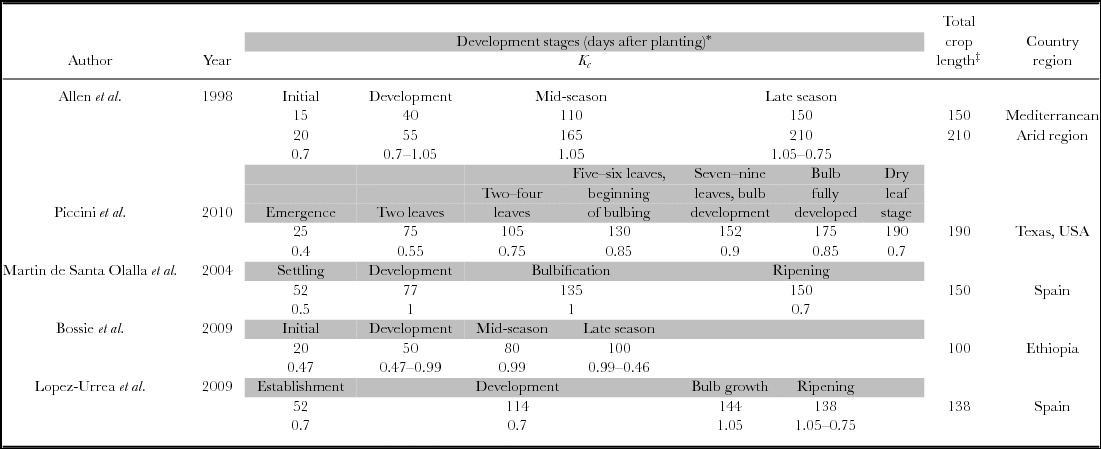
The Kc varies throughout the season and is linked to the crop development stage – usually termed initial, development, mid-season and late season. Time is usually measured in either days or growing degree days (GDD, a measurement of heat accumulation over a period of time given in °Cd). Kc can also be defined according to canopy cover. Several studies have estimated Kc values for onion but defined slightly different development stages for different regions. A summary of reported values is given in Table 1. Considering the large variability in Kc estimates based on location, Al-Jamal et al. (Reference Al-Jamal, Sammis, Bali and Smeal1999) correlated onion Kc values to their accumulated GDD and final yield. This means Kc values can be used independently of location and date. The derived Kc values were 0.43 for the initial stage (121 °Cd, using 4.44 °C as a base temperature), up to 1.09 for 1640 °Cd, then decreasing to 0.56. According to Al-Jamal et al. (Reference Al-Jamal, Sammis, Bali and Smeal1999) this approach allows growers to more readily estimate seasonal onion Kc values for scheduling irrigation.
Onion Kc values and crop development stages according to Allen et al., Reference Allen, Pereira, Raes and Smith1998, Bossie et al., Reference Bossie, Tilahum and Hordofa2009, Lopez-Urrea et al., Reference Lopez-Urrea, Olalla, Montoro and Lopez-Fuster2009, Martín de Santa Olalla et al., Reference Martín de Santa Olalla, Domínguez-Padilla and López2004 and Piccinni et al., Reference Piccinni, Ko, Marek and Leskovar2009.

*These refer to the individual stages identified by each author.
‡These refer to the total days between drilling and bulb maturity.
Seasonal water requirements
Onion seasonal water requirements depend on various factors including the variety cultivated, planting density, crop husbandry techniques, expected yield, local soil and agroclimatic conditions and method/s used for irrigation application and scheduling (Jiménez et al., Reference Jiménez, Juan, Tarjuelo and Ortega2010). The following studies highlight the impacts of such variability on crop water requirements. Seasonal onion ETc of 390 (Bossie et al., Reference Bossie, Tilahum and Hordofa2009) and 893 mm (Lopez-Urrea et al., Reference Lopez-Urrea, Olalla, Montoro and Lopez-Fuster2009) were estimated using lysimeters in the Central Rift Valley (Ethiopia) and at Albacete (Spain). The latter was greater than the theoretical estimated ETc using the FAO methodology. Bossie et al. (Reference Bossie, Tilahum and Hordofa2009) measured ETc rates of 51, 140, 145 and 54 mm during initial growth stage (20d), crop-development (30d), mid-season (30d) and late-season (20d) stages, respectively. Jiménez et al. (Reference Jiménez, Juan, Tarjuelo and Ortega2010) reviewed a number of studies on onion water requirements. For production between 35 and 45 t ha−1, between 350 and 550 mm were required (Doorenbos and Kassam, Reference Doorenbos and Kassam1979); 1040 mm was applied using furrow irrigation to achieve a mean yield of 59 t ha−1 (Ells et al., Reference Ells, McSay, Soltanpour, Schweissing, Bartolo and Kruse1993); 602 mm was applied through drip irrigation for a 75 t ha−1 crop in Spain (Martín de Santa Olalla et al., Reference Martín de Santa Olalla, Domínguez-Padilla and López2004) and 910 mm applied using overhead sprinklers to obtain 77 t ha−1 in Utah, USA (Drost et al., Reference Drost, Grossl and Koenig1997). Other studies estimated a seasonal ETc of 337 mm using micro-sprinkler irrigation in Bulgaria (Meranzova and Babrikov, Reference Meranzova and Babrikov2002); 597 mm for drip irrigation in Washington state (USA); 662 mm for drip-irrigated onions in Spain and 225–250 mm for yields of 10 t ha−1 in Eastern India (Bandyopadhyay et al., Reference Bandyopadhyay, Mallick and Rana2003). Seasonal ETc in Texas (USA) during two consecutive seasons was estimated to be between 362 and 438 mm (Piccini et al., Reference Piccinni, Ko, Marek and Leskovar2009). Based on these studies, the reported water requirements for onion thus range between 225 and 1040 mm to produce a mean yield of between 10 and 77 t ha−1 across a range of different locations, under varying soil and agroclimatic conditions and with irrigation systems of varying efficiency. The figures reported here represent ‘net’ irrigation needs – additional allowances need to be made to account for system efficiency depending on application method.
Any unintended water stress or soil water deficit can limit crop evapotranspiration (ETc) and hence impact on yield. The yield response under conditions of water deficit can be estimated using the yield response factor (ky). This relates the relative evapotranspiration deficit (1 – ETa/ETm) during the entire growing season or at a certain development stage to the relative decrease in yield (1 – Ya/Ym), where ETa represents actual evapotranspiration and ETm the maximum ET (defined as Kc × ET). Similarly, Ya is defined as the actual yield and Ym the maximum yield. These parameters were combined in the following equation defined by Doorenbos and Kassam (Reference Doorenbos and Kassam1979):
 \begin{equation*}
k_y \times 1 - \frac{{ETa}}{{ETm}} = 1 - \frac{{Ya}}{{Ym}}
\end{equation*}
If ky > 1, then the relative yield decrease is greater than the relative evapotranspiration deficit, and vice versa. ky values for onion have been estimated by Doorenbos and Kassam (Reference Doorenbos and Kassam1979) and Kadayifci et al. (Reference Kadayifci, Tuylu, Ucar and Cakmak2005). They reported values of 1.10 and 1.50 for the entire growing season, respectively. Values of 0.45 and 0.42 were estimated for the vegetative period, 0.80 and 1.02 for yield formation and 0.30 and 0.32 for the ripening stage. These show that the relative deficit in evapotranspiration during the stage of yield formation has a much greater effect on yield than the same level of relative deficit during ‘other’ crop development stages. As mentioned previously, seasonal values for ETc and Kc are thus dependent on the final yield. Al-Jamal et al. (Reference Al-Jamal, Sammis, Bali and Smeal1999) developed a practical method to determine Kc for an expected onion yield. Two water-use functions were defined. Crop yield and seasonal water applied were related through a water production function. The evapotranspiration production function represented the relationship between yield and seasonal evapotranspiration (Al-Jamal et al., Reference Al-Jamal, Sammis, Ball and Smeal2000). These studies confirmed that there is often a direct linear correlation between evapotranspiration and yield.
Summary
• Various authors have estimated Kc values for onion with the following values typically reported: 0.4–0.7 for the initial stage, 0.85–1.05 for middle development and 0.6–0.75 for the final stage;
• Kc values measured using lysimeters differed the most in the initial and final stages;
• Kc values were correlated to GDD to minimise the effects of location and climate on ETc calculations;
• Seasonal onion crop requirements estimated using lysimeters ranged between 390 and 893 mm, depending on location;
• Seasonal irrigation requirements ranged between 225 and 1040 mm in fields producing between 10 and 77 t ha−1. The total water depths applied depend on the location, climate, application system and yield requirements for the target market;
• Onion yield response factors were estimated to be 1.1–1.5 (whole season), 0.42–0.45 (vegetative period), 0.8–1.02 (yield formation) and 0.3–0.32 (ripening).
YIELD AND QUALITY RESPONSE TO WATER
Onion bulbs grown commercially need to meet stringent quality assurance criteria. They must be intact; sound without any signs of rotting or deterioration; clean; free from damage due to frost; sufficiently dry for the intended use; without hollow or tough stems; practically free from pest and damage caused by pests affecting the flesh; free of abnormal external moisture, foreign smell and/or taste; and the stem must be twisted or clean cut and not exceed 6 cm in length (except for stringed onions) (OECD, 2012).
These conditions are useful in defining the physical characteristics that impact on final yield, but UK growers and the onion industry are generally more concerned with post-harvest quality, including skin appearance, colour, protein and total soluble solids (TSS) concentration. Different quality standards have therefore been established depending on the target market. The effects of irrigation on these parameters have been widely studied to help define optimal irrigation management practices (Diaz-Perez et al., Reference Diaz-Perez, Gitaitis, Bertrand, Giddings, Randle, Harrison and Torrence2002; Enciso et al., Reference Enciso, Wiedenfeld, Jifon and Nelson2009; Kumar et al. 2007; Lacey and Ober, Reference Lacey and Ober2011; Martín de Santa Olalla et al., Reference Martín de Santa Olalla, Domínguez-Padilla and López2004; Mohammadi et al., Reference Mohammadi, Lamei, Khasmakhi-Sabet, Olfati and Peyvast2010; Shock et al., Reference Shock, Feibert and Saunders1998). In order to satisfy year-round consumer demand, the harvested crop needs to be stored under conditions that will minimise any deleterious effect on quality over time, as storage inevitably triggers biochemical change (Chope et al., Reference Chope, Terry and White2006). Indeed the main factors that trigger deterioration of stored onions relate to the pre- and post-harvest environmental conditions and associated biological processes (respiration, growth resumption and pathogen attacks) (Abrameto et al., Reference Abrameto, Pozzo Ardizzi, Gil and Molina2010).
Based on interviews with onion growers and key informants in the UK onion industry, parameters such as store temperature, relative humidity and air flow were all monitored closely during storage. The bulbs’ internal and external attributes are also periodically checked in commercial storehouses for evidence of rot, mould and regrowth. Sometimes, other quality indicators such as pyruvate (indicator of pungency of onion bulbs), TSS, firmness and weight decrease are also monitored (Chope et al., Reference Chope, Terry and White2007). For example, a recent storage monitoring study showed that both firmness and dry weight decreased during storage (Chope et al., Reference Chope, Terry and White2007). The environmental conditions, cultivar, use of growth regulators, fertiliser and irrigation regime and harvest date have also been studied and linked to post-harvest quality and storability (Boyhan et al., Reference Boyhan, Purvis, Hurst, Torrance and Paulk2004; Grzegorzewska, Reference Grzegorzewska1999; Ko et al., 2002). The most important limiting factors in onion storage are fungal related – black mould Aspergillus niger, fusarium basal rot Fusarium oxysporium (Ko et al., 2002) – bacterial diseases – bacterial soft rot Pseudomonas gladioli – and sprout growth. In addition, some anatomical and physiological bulb characteristics such as scale thickness, number of dry scales, pungency, dry matter content and TSS were also found to be closely correlated with storability (Ko and Chang, 2002; Yutaka and Makoto, Reference Yutaka and Makoto1997).
Several studies have also investigated the response of parameters known to impact on onion quality to different irrigation regimes. For example, TSS concentration was found to be positively correlated to bulb dry weight (Chope et al., Reference Chope, Terry and White2006), with levels increased when an increasing amount of water was applied in some experiments (Kahlon et al., Reference Kahlon, Singh and Sekhon2011) but not in others (Pejic et al., Reference Pejic, Gvozdanovi, Mili, Ignjatovi and Krsti2011). In addition, bulb protein content was found to be greatest when irrigation was 60% of cumulative pan evaporation (Ep) (compared to 80, 100 and 120%); however, this watering regime produced larger yield losses during post-harvest storage (Kumar et al., Reference Kumar, Imtiyaz and Kumar2007b). Other experiments showed that irrigation scheduling had no effect on bulb brix or on its pungency – a measurement of pyruvic acid content (Enciso et al., Reference Enciso, Wiedenfeld, Jifon and Nelson2009). According to Rattin et al. (Reference Rattin, Assuero, Sasso, Gastón and Tognetti2011), extended wet periods enhanced the occurrence of fungi-related disease. To counter this, Kumar et al. (Reference Kumar, Imtiyaz and Kumar2007b) suggested withholding irrigation at the end of the growing cycle. Thus it was demonstrated that moist conditions followed by two weeks of ‘drying off’ prior to harvest led to better quality (Martín de Santa Olalla et al., Reference Martín de Santa Olalla, Domínguez-Padilla and López2004; Shock et al., Reference Shock, Feibert and Saunders1998).
The effects of water restrictions during crop growth on post-harvest quality and storability have also been assessed. However, the results are not consistent. For example, Rattin et al. (Reference Rattin, Assuero, Sasso, Gastón and Tognetti2011) reported negative impacts on post-harvest quality, as well as bulb health, whilst other studies showed no negative effects on yield or quality (Enciso et al., Reference Enciso, Wiedenfeld, Jifon and Nelson2009; Martín de Santa Olalla et al., Reference Martín de Santa Olalla, Domínguez-Padilla and López2004). Plants where water was restricted during growth periods produced smaller sized bulbs with consequent losses in marketable quality, mainly due to sprouting or pre-sprouting softening (Rattin et al., Reference Rattin, Assuero, Sasso, Gastón and Tognetti2011). The percentage of single-centre onion bulbs, an important characteristic for the processing industry, produced under water-stressed conditions was lower when stress occurred earlier in the growing season. Compared to a control treatment, the percentage of single-centre bulbs was reduced by 40, 32 and 18% when soil-water stress was imposed at the three- and seven-, and five-leaf stages, respectively (Pelter et al., Reference Pelter, Mittelstadt, Leib and Redulla2004).
Shock et al. (Reference Shock, Feibert and Saunders2000b) studied the impacts of applying water via drip irrigation at different SWP. When the SWP was kept under −20 kPa, no reduction in storage decomposition was found. However, a negative impact on yield and its economic value was recorded. Kumar et al. (Reference Kumar, Imtiyaz and Kumar2007b) showed that a crop grown under water stress (0.6 Epan) was forced to early maturity, which resulted in the development of either immature or partially matured bulbs. These bulbs then started their rotting processes earlier. The highest yield was produced when the greatest amount of water was applied (100 and 120% of cumulative Epan) using micro-sprinkler irrigation (Kumar et al., Reference Kumar, Imtiyaz and Kumar2007b).
Finally, excessive or too frequent irrigation can lead to a reduction in storability. It has been shown that increasing irrigation frequency (intervals of 10 and 15 days compared to 20 and 30 days) using surface irrigation increases storage losses (Biswas et al., Reference Biswas, Khair, Sarker and Alom2010). By increasing the frequency, Biswas et al. (Reference Biswas, Khair, Sarker and Alom2010) found that the harvested dry matter would be reduced and storage losses increase due to rotting and sprouting. The weight loss would be greater in the most frequently irrigated plots due to higher initial moisture content. However, it was not only water that affects post-harvest quality. Other factors such as N fertilisation have also been shown to trigger rotting and sprouting during storage.
Summary
• Fungal and bacterial diseases and sprout growth constitute the most important limitations for onion storage;
• Total bulb soluble solid concentration increases with an increase in total applied water;
• The highest bulb protein concentration was found when 60% of cumulative Epan was applied. Those bulbs also experienced major loses in storage;
• Extended wet periods were linked to an increase in fungal disease;
• Generally it is recommended to withhold water applications (dry off) at least two weeks prior to harvest;
• Water restrictions during crop growth produce smaller bulbs and can lead to decay in storage;
• Onions grown under water stress were forced to mature early, which then produced immature or partially matured bulbs that started early rotting processes in storage.
IRRIGATION SYSTEMS
Onion is a shallow rooting crop typically grown on light soils with low available water holding capacity (AWC), requiring frequent and small water applications to avoid large soil water deficits accruing. An irrigation strategy with high frequency has been shown to increase fertiliser use efficiency, reduce leaching and improve yield by increasing bulb size (Renault and Wallender, Reference Renault and Wallender2000). In order to compare the performance and adequacy of different irrigation systems, performance coefficients such as irrigation efficiency (IE), irrigation water use efficiency (IWUE) and water use efficiency (WUE) are often used. IE is defined as the ratio of the volume of water that is taken up by the crop to the volume of irrigation applied (Kruse et al., Reference Kruse, Ells and McSay1987). IWUE (t ha−1 mm−1) is defined as the ratio of the crop yield (t ha−1) to seasonal irrigation water applied (mm) plus rainfall (Al-Jamal et al., Reference Al-Jamal, Sammis, Ball and Smeal2000). WUE is defined here as the ratio of dry matter produced per unit area (t ha−1) per unit of ET (mm) (Al-Jamal et al., Reference Al-Jamal, Ball and Sammis2001; Viets, Reference Viets, Pierce and Kirkham1965). WUE and IWUE values for onion have been estimated for different regions, under different agroclimate and irrigation conditions. The highest efficiencies resulted from those regimes in which irrigation requirements were not fully applied and seasonal rainfall was low. Under different irrigation treatments in greenhouse trials, the highest IWUE (56 kg ha−1 mm−1 for a yield of 27 t ha−1) corresponded to plots receiving 75% of the water applied compared to the fully irrigated treatment – where all the water lost was replaced. The rest of the treatments consisted of ‘no irrigation’ during specific development stages, or partial withdrawals (25, 50 or 75%) during the growing season (Kadayifci et al., Reference Kadayifci, Tuylu, Ucar and Cakmak2005). During a dry year in Serbia, onion IWUE was 281 kg ha−1 mm−1 compared to 46 kg ha−1 mm−1 calculated for a rainy season (Pejic et al., Reference Pejic, Gvozdanovi, Mili, Ignjatovi and Krsti2011). In the semi-arid Arkansas River Valley onion IWUE for furrow and drip systems were 53.4 and 121.6 kg ha−1 mm−1, respectively (Halvorson et al., Reference Halvorson2008). There is also a wide variation in reported WUE values for onion. For example, values of between 89 and 102 kg ha−1 mm−1 were estimated for onions grown in arid conditions in India using micro-sprinklers (Kumar et al., 2007); 34–91 kg ha−1 mm−1 were estimated in Serbia (producing 10–41 t ha–1) (Pejic et al., Reference Pejic, Gvozdanovi, Mili, Ignjatovi and Krsti2011) and up to 51 kg ha−1 mm−1 from a greenhouse trial in Turkey (Kadayifci et al., Reference Kadayifci, Tuylu, Ucar and Cakmak2005).
Furrow irrigation
In most of the main production areas in India, the USA and Spain onions have traditionally been furrow irrigated. However, surface irrigation is often criticised for its low efficiency (Al-Jamal et al., Reference Al-Jamal, Ball and Sammis2001, Halvorson et al., Reference Halvorson2008; Mohammadi et al., Reference Mohammadi, Lamei, Khasmakhi-Sabet, Olfati and Peyvast2010). Investment in micro (drip) and sprinkler irrigation is reported to offer major scope for water savings as well as increased yield and quality (size) (Halvorson et al., Reference Halvorson2008). Control of certain onion diseases is also considered more straightforward (Teviotdale et al., Reference Teviotdale, Davis, Guerard and Harper1990). However when furrow and sprinkler irrigation were compared in California's Central Valley, no significant differences were observed in either bulb fresh weight or TSS (Teviotdale et al., Reference Teviotdale, Davis, Guerard and Harper1990). Despite its continued use internationally on a large scale, there is a lack of recent evidence on the impacts of surface irrigation performance on onion productivity (yield and quality).
Overhead irrigation
Several studies have focussed on the adequacy of sprinkler irrigation, including the effects of distribution non-uniformity on onions. For example, experiments in New Mexico (Al-Jamal et al., Reference Al-Jamal, Ball and Sammis2001) compared sprinkler-, furrow- and subsurface-drip-irrigated onions. Sprinklers were found to be most efficient in terms of IE and IWUE as the amount of water applied closely matched ETcrop. Subsurface drip irrigation (SDI) uses permanent or temporarily buried dripper lines or drip tape located at or just below the roots. The IE for this system ranged from 45 to 77% due to an excessive volume of water being applied, a common problem on automated micro-irrigation systems. Furrow irrigation was found to be the least efficient, due to higher rates of evaporation and difficulties in achieving a uniform application along the furrow (Al-Jamal et al., Reference Al-Jamal, Ball and Sammis2001). Jiménez et al. (Reference Jiménez, Juan, Tarjuelo and Ortega2010) observed that a non-uniform application can lead to areas of under-irrigation in parts of a field. The consequences were lower ETa rates, lower yields and smaller mean bulb sizes for those plants that received insufficient water. Achieving a high level of application uniformity is therefore a pre-requisite for high-value onion production. In the UK, the most widely used system is the hose reel fitted with a raingun. Hose reels fitted with booms are also gaining popularity, particularly as energy costs rise. Only a very small proportion of onion growers currently use drip (trickle) irrigation due to the high capital (investment) costs and supplemental nature of irrigation in a humid environment, as well as the challenges of installing and retrieving the equipment at field-scale (Knox et al., Reference Knox, Rodriguez-Diaz, Weatherhead and Kay2010).
Drip irrigation
Drip irrigation has been shown to be advantageous for onion production in comparison to furrow since the uniformity of water distribution can be very high and runoff, deep percolation, bare soil evaporation and water interception from the canopy are all significantly reduced, with consequent reductions in disease risk. Halvorson et al. (Reference Halvorson2008) studied the effects of irrigation and N on furrow- and drip-irrigated onions in the semi-arid Arkansas Valley, Colorado. The SWP was maintained at −20 kPa. They found higher N use efficiency when the onions were drip irrigated. Yields were between 16 and 20% higher for all N treatments under drip, and the proportion of larger sized onions was also higher. Over two consecutive seasons, 72 and 57% less water was applied under the drip-irrigated experimental fields compared to the equivalent furrow-irrigated trials. Experiments suggest that onion yield under SDI is also higher than under conventional sprinkler irrigation. However, the amount of deep drainage was higher under drip. Consequently the highest IE was for sprinkler irrigation (Al-Jamal et al., Reference Al-Jamal, Ball and Sammis2001).
Summary
• A range of factors including location, soils and agoclimate, seasonal rainfall, field yield and application system influence onion WUE. Values were reported to vary between 34 and 102 kg ha−1 mm−1 and from 46 to 281 kg ha−1 mm−1 for IWUE;
• Small water deficits and dry seasons resulted in the highest IWUE and WUE. In greenhouse trials, the highest IWUE corresponded to a treatment in which 25% of the total replaced water (of a fully irrigated control) was applied;
• Traditionally most onion production have been dependent on surface (furrow) irrigation, but this method is considered less efficient than overhead (e.g. sprinklers) resulting in higher non-beneficial water losses, as well as increasing disease risks. The underlying trend suggests a switch from surface to advanced irrigation technologies including sprinklers and drip to reduce yield variability and increase crop quality;
• Sprinklers were reported to be the most efficient method for onion irrigation, but the method is susceptible to wind drift, non-uniformity and dry spots on exposed sites;
• Drip irrigation on onions is gaining popularity and has potential to increase water uniformity and nitrogen use efficiency, if managed carefully. However, high levels of management are needed to minimise over-irrigation and deep drainage losses.
IRRIGATION SCHEDULING
Irrigation scheduling involves deciding on the right time and the right amount of water a crop needs in order to maximise yield, quality and minimise water and nutrient leaching (Carr and Knox, Reference Carr and Knox2011; Hanson et al., Reference Hanson, Orloff and Peters2000; Sammis et al., Reference Sammis, Sharma, Shukla, Wang and Miller2012). There are various different approaches available including the use of water-balance models, in situ soil moisture monitoring, plant water potential monitoring (Sammis et al., Reference Sammis, Sharma, Shukla, Wang and Miller2012) or remote sensing (Usha and Singh, Reference Usha and Singh2013). The schedule can either be fixed, semi-fixed or flexible, depending on the irrigation interval and depths of water to be applied, and the application method used. Several methods are commonly used to estimate onion irrigation water needs. Seasonal crop water requirements will vary depending on the target market (which influences quality criteria) and local soils and agroclimate conditions. Several studies have tried to define the most suitable approach and evaluated the impacts of different approaches on yield and quality.
Due to the shallow root system and tendency to grow onions on lighter, less moisture retentive soils, the most common irrigation method used is overhead (sprinklers), followed by surface (furrow) and more recently micro (drip irrigation). Several authors have tried to identify an appropriate irrigation threshold based on SWP. Early trials suggested that −27 kPa was the optimal SWP for onions under furrow irrigation (Shock et al., Reference Shock, Feibert and Saunders1998). More recently, Shock et al. (Reference Shock, Feibert and Saunders2000b) determined the range of −10 to −17 kPa depending on the season as being optimum for drip-irrigated onions in Oregon, USA. In their experiments, they maintained the SWP at a constant value by applying small, frequent amounts at −10, −20, −30, −50 and −70 kPa. Enciso et al. (Reference Enciso, Wiedenfeld, Jifon and Nelson2009) compared irrigation scheduling strategies based on soil moisture and ET for a semi-arid location in Texas. Their experiments showed that under SDI the highest yields were achieved when the soil moisture was kept above −30 kPa, followed by −20 kPa and 100% ETc replacement. In India, the most effective scheduling for micro-sprinkler irrigation was shown to be 80% of the cumulative pan evaporation (Kumar et al., Reference Kumar, Imtiyaz and Kumar2007b). Protein content was shown to be negatively affected by increasing the applied water depth (from 60 to 120% Epan).
Water balance models are commonly used for irrigation scheduling. Córcoles et al. (Reference Córcoles, Ortega, Hernandez and Moreno2013) adopted the methodology of Pereira and Allen (Reference Pereira, Allen, van Lier, Pereira and Steiner1999) which consists of generating a soil water balance taking into account daily values of precipitation, runoff, net irrigation crop ET, deep percolation, and any contribution from the water table, considering the rooting depth on each day. This balance within the root zone allowed scheduling the irrigation of a centre-pivot-irrigated commercial onion field in Spain. This study tried to evaluate non-destructive methods to measure canopy cover in onions using aerial digital photography. The yield achieved was 75 t ha−1, with an average bulb size of 70–90 mm (Córcoles et al., Reference Córcoles, Ortega, Hernandez and Moreno2013).
In situ soil moisture measurement
In commercial onion production, irrigation is typically scheduled using a combination of in situ soil moisture measurement, water balance models and visual crop observation. Most UK growers still rely on visual observation and soil augering rather than objective scientific tools. Growers without access to automatic weather station data typically estimate irrigation need from soil moisture readings and use external irrigation management services or agronomy consultancies. The most frequently used devices to monitor in situ soil moisture content or SWP include capacitance probes, neutron probes or tensiometers. Consultancies are often used to install and manage the moisture probes on-farm fields with technical staff responsible for taking regular (weekly) readings and informing the farmer of the current and predicted change in moisture content. Due to their relatively high cost, growers often limit the number of monitoring probes to only a few fields and then extrapolate the relative trends in soil moisture to other fields adjusting for changes in soil texture across the farm.
Simulation models
In contrast to other crops, there has been limited development and validation of biophysical crop growth models for onion. Two models including ALCEPAS (De Visser, Reference De Visser1994) which simulates onion crop growth and yield under non-restrictive conditions or limiting water supply and MOPECO (Alvarez et al., Reference Alvarez, De Juan Valero, Tarjuelo Martín-Benito and López Mata2004) which combines crop water needs and yield with an economic assessment have been produced, but its application has been limited to Spain. More recently, Perez Ortola et al. (Reference Perez Ortola, Daccache, Hess and Knox2014) successfully calibrated and validated the Aquacrop model (Studeto et al., 2009) based on experimental field data for onions in the UK (Lacey and Ober, Reference Lacey and Ober2013) to assess the impacts of different soil and weather combinations and irrigation heterogeneity on onion crop development and yield.
Deficit irrigation
IE can be increased by under-irrigating crops in such a way that yield is not adversely affected. Deficit irrigation has the potential to reduce irrigation costs and increase both IE and IWUE (Al-Jamal et al., Reference Al-Jamal, Ball and Sammis2001; English, Reference English1990; English and Raja, Reference English and Raja1996). However, this requires identifying crop stages at which deficits could be applied without affecting yield or quality. Martín de Santa Olalla et al. (Reference Martín de Santa Olalla, Domínguez-Padilla and López2004) aimed to identify at which phenological stage controlled deficit irrigation or CDI could be applied. In their experiments significant effects were observed on yield when water deficits were applied during bulbification and ripening. Water restrictions at development and bulbification stages increased the weight percentage of small bulbs (<60 mm). In addition, the weight percentage of premium (75–90 mm)-sized bulbs increased with increasing water doses during growth and ripening (Martin de Santa Olalla et al., Reference Martín de Santa Olalla, Domínguez-Padilla and López2004). Other studies showed a yield reduction (−26%) after withholding irrigation at three- and seven-leaf stages (Pelter et al., Reference Pelter, Mittelstadt, Leib and Redulla2004). Withholding water during the growing cycle delayed bulbing initiation, reduced total dry weight, produced smaller bulbs and developed earlier sprouting in storage (Rattin et al., Reference Rattin, Assuero, Sasso, Gastón and Tognetti2011).
Irrigation scheduling constraints
Most studies in the literature relate to arid or semi-arid conditions where water scarcity is a growing issue. Onion response to deficit irrigation has been widely studied to assess when and how much the crop can tolerate water stress without reducing yield or quality. These techniques have been tested under experimental trials (e.g. Ayas and Demirtas, Reference Ayas and Demirtas2009; Martín de Santa Olalla et al., Reference Martín de Santa Olalla, Domínguez-Padilla and López2004; Rattin et al., Reference Rattin, Assuero, Sasso, Gastón and Tognetti2011), but no evidence on its commercial application is reported in the literature. In humid regions such as the UK, where rainfall is highly variable, one of the major concerns highlighted by growers is excess rainfall occurring late in the growing season. This creates major problems at harvest, reducing the value of production and raising post-harvest drying costs. Scheduling irrigation under supplemental conditions is therefore more difficult in terms of deciding on the timing, amount and frequency of irrigation so as to make most effective use of rainfall and limit the risks associated with nitrate leaching due to over-irrigation. Most UK onion growers and agronomists reported using capacitance probes or neutron probes for scheduling advice; aiming to apply between 15 and 20 mm at a 15–20 mm soil water deficit during canopy development and then apply 15–25 mm during bulb formation. However, these schedules are always checked against in-field visual observation of the crop status, and schedules then modified accordingly.
Summary
• −17 kPa was determined as the optimal drip irrigation threshold;
• For SDI onions, soil moisture content kept above −30 kPa gave the highest yields;
• −27 kPa was determined as the optimal furrow-irrigation threshold;
• The most appropriate schedule for micro-sprinkler systems was to apply 80% Epan;
• The most popular scheduling methods used are water balance methods and SWP and soil water content measurements, including capacitance probes, neutron probes and tensiometers;
• Growers always complement objective scheduling with visual crop observation;
• Deficit irrigation has been tested under experimental conditions, but no evidence found regarding commercial uptake;
• CDI during the bulbification and ripening periods significantly reduced onion yield and during development and bulbification produced smaller bulbs.
DRIVERS FOR CHANGE
Onions are grown in a wide variety of agroclimate conditions, with irrigation used to maximise yield in arid and semi-arid regions. In contrast, in humid or temperate regions, supplemental irrigation is important but principally for quality assurance, helping deliver high-quality continuous supplies of produce demanded by the major retailers and processors (Knox et al., Reference Knox, Rodriguez-Diaz, Weatherhead and Kay2010). But rising energy costs for irrigation coupled with increasing consumer demands for traceability and environmental sustainability are exerting pressures on current approaches to onion production. In arid regions such as Spain, Turkey and parts of the USA the focus is on water saving to reduce non-beneficial losses (Hess and Knox, Reference Hess and Knox2013) and improve WUE. Traditional gravity-fed furrow irrigation schemes are being replaced by overhead (centre pivot) and micro (drip) systems. However, in Spain an energy trade-off is underway between improving WUE and managing the costs associated with irrigation modernisation. Here the original conveyance (open channel) systems that supplied water under gravity have been replaced by pressurised (piped) systems. Whilst national water use has reduced on average by −21% between 1950 and 2007, average energy demand has increased by +657%. Thus, energy is becoming the major driver of change rather than water resource availability. Any improvements in water efficiency are therefore very closely linked to significant increases in energy with consequent impacts on emissions and the carbon footprint of the irrigated agriculture (Rodriguez-Diaz et al., Reference Rodríguez Díaz, Urrestarazu, Poyato and Montesinos2012). Climate change will exacerbate the situation; with increasing water scarcity and greater demands for environmental regulation; precision irrigation technologies (Monaghan et al., Reference Monaghan, Daccache, Vickers, Hess, Weatherhead, Grove and Knox2013) will inevitably play an increasing role in global irrigated onion production.
CONCLUSIONS
This review has highlighted a number of salient issues. Onion is particularly sensitive to water deficits during emergence and transplant, and to both deficit and water excess during the rapid bulb growth periods. Water restrictions during crop growth (total water withholding and CDI) resulted in lower yields and smaller bulbs. Early bulb maturity was identified as a result of growing the crop under water stress, causing secondary problems including early rotting in storage. Several studies have determined onion Kc values and reported on contrasting values (0.4–0.7/0.85–1.05/0.6–0.75) depending on climate and location. An attempt to minimise these differences was reported by correlating Kc to GDD. Total irrigation requirements are reported to range between 225 and 1040 mm with yield ranges of between 10 and 77 t ha−1, leading to WUE and IWUE of 34–102 and 46–281 kg ha−1 mm−1, respectively. Irrigation and water efficiency are thus highly influenced by agroclimate, the method of irrigation and final yield.
Crop quality is a key constituent of modern onion production. The most important limiting factors in storage are sprout growth and bacterial and fungal diseases, with the latter being strongly correlated to prolonged wet periods. Current trends show a move away from traditional surface (furrow) irrigation to more advanced micro (drip) and overhead (sprinkler) systems capable of applying water with greater precision and timing. Drip application is still a minor use, but research shows it can achieve the highest nitrogen efficiency use, reduce water losses and improve crop quality (by avoiding soil splash and high humidity conditions in the canopy). Finally, the drivers of change include the need for greater product traceability, quality assurance and managing the rising costs of energy. Future research should focus on these and encourage better integration of biophysical understanding of onion crop agronomy with new developments in soil and water management.