Introduction
Marine debris has become a significant issue for the world’s oceans (Coe and Rogers, Reference Coe and Rogers2012; Stafford and Jones, Reference Stafford and Jones2019). Floating objects are also known to facilitate the dispersal of sessile barnacles, including drifting plastics and large artificial structures in offshore waters (Barnes and Milner, Reference Barnes and Milner2005; Shuto and Hayashi, Reference Shuto and Hayashi2013).
Despite ongoing research, some barnacle species remain poorly documented. Two such taxa, Balanus pulchellus Ren, Reference Ren1989 (here reassigned to Amphibalanus) and Amphibalanus zhujiangensis (Ren, Reference Ren1989), originally described from the Zhujiang River Estuary in the South China Sea, have received little attention since their original descriptions (Figure 1a). Our recent examination of specimens attached to a buoy washed ashore in Okinawa, Japan, following a typhoon (Figure 1b), provides new distributional records for these overlooked species. Here, we present their morphological descriptions together with mitochondrial (COI) and nuclear (H3) sequence data, contributing to a better understanding of their identity, distribution, and possible dispersal via floating debris.
(a) Type locality (open circle), previously reported localities (open inverted triangles for Amphibalanus pulchellus; solid inverted triangles and dashed-line ellipse for A. zhujiangensis), and the present record (star) from Ginoza, located on the Pacific (eastern) coast of Okinawa Island, Japan, where both species were collected. (b) A stranded buoy after a typhoon. The buoy was encrusted with several acorn barnacle species, including Chthamalus sp., Megabalanus sp., Tetraclita sp., and Tesseropora alba.

Materials and methods
Field sampling
After a typhoon, a floating buoy encrusted by several barnacle species was found on the Kanna River estuary, Ginoza, Okinawa, Japan (26°28′25.0″ N, 127°57′16.0″ E) on 8 December 2006 (Figure 1). The samples were collected and preserved in 99% ethanol. The materials were deposited in the National Museum of Nature and Science, Tokyo (NMNS-Cr), and specimen information is summarized in Table 1. Because the specimens were collected in 2006 as part of a general survey of stranded marine debris, detailed records of the positions and abundance of individual barnacles on the buoy were not retained. The buoy lacked any legible markings or identification numbers that could be used to infer its origin or drifting history.
Materials examined and GenBank accession numbers

Table 1 Long description
Columns list Species, Museum No., COI, and H3. Amphibalanus pulchellus has museum number NMNS Cr 33305, COI accession LC919527, and H3 accession LC919529. A. zhujiangensis has museum number NMNS Cr 33306, COI accession LC919528, and H3 accession LC919530.
DNA extraction and sequencing
DNA was extracted from muscle tissue using the commercial Tissue Genomic DNA Extraction Micro Elute Kit (Favorgen). Partial sequences of mitochondrial and nuclear genes were amplified using the PCR primer set for the COI gene (LCO-1490/B2R-COI) and the Histone 3 gene (AF/AR) (Folmer et al., Reference Folmer, Black, Hoeh, Lutz and Vrijenhoek1994; Colgan et al., Reference Colgan, McLauchlan, Wilson, Livingston, Edgecombe, Macaranas, Cassis and Gray1998; Ayre et al., Reference Ayre, Minchinton and Perrin2009). PCR was performed using 10 μl of a solution containing 5.0 μl KOD One DNA Polymerase (Toyobo), 3.2 μl deuterium-depleted water, 0.5 μl of each primer (5 μM), and 1.0 μl of the DNA template.
The thermal regime entailed initialization using 35 cycles for 10 seconds for denaturation at 98°C, 5 seconds for annealing at 48°C for COI and 50°C for H3, 1 second for extension at 68 °C, and final extension at 15°C. The PCR products were observed on a 1.0% agarose gel and purified using the BigDye Xterminator kit (Thermofisher) and then sequenced using the ABI3130.
Phylogenetic analyses
All sequences were aligned in MEGA X (Kumar et al., Reference Kumar, Stecher, Li, Knyaz and Tamura2018) with MUSCLE (Edgar, Reference Edgar2004) and trimmed for final alignment. Analyses of the estimation of evolutionary divergence between 10 individuals of A. zhujiangensis were conducted using the Maximum Composite Likelihood model (Tamura et al., Reference Tamura, Nei and Kumar2004).
Soft-parts preparation and mounting
Soft parts were prepared following a modified clearing and staining procedure based on the method described by Tanaka (Reference Tanaka2014). Specimens were immersed in 10% potassium hydroxide solution and heated at 50°C for 30 min to dissolve soft tissues and facilitate dissection. The material was transferred to 70% acetic acid containing fuchsin and incubated overnight for neutralization, dehydration, and staining. Specimens were then dehydrated in 99% ethanol and cleared in xylene before being mounted in balsam on glass slides for morphological examination.
Results
The floating buoy is the same debris reported by Hayashi and Chan (Reference Hayashi and Chan2015) as a new record for the forgotten species, Tesseropora alba Ren and Liu 1979, previously. Morphological observations were conducted on ethanol-preserved specimens under a stereo microscope for species identification.
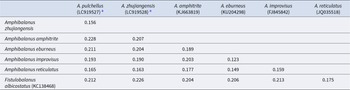
The floating buoy examined in this study, stranded after a typhoon and classified as marine debris, represents the first documented occurrence of A. pulchellus on stranded marine debris in Japanese waters. This study provides the first publicly accessible COI and H3 sequences for A. pulchellus, with pairwise COI sequence distances ranging from approximately 12.3 to 22.8% within the subfamily, providing the first comparative molecular framework for these poorly documented species (Table 2).
Pairwise genetic distances (p-distance) between seven species in the subfamily Amphibalaninae based on COI sequence variation (606 bp)

Table 2 Long description
Pairwise genetic distances are listed as p distance values for COI sequence variation across seven species, with values filled in the lower triangle. Row Amphibalanus zhujiangensis has 0.156 to A. pulchellus LC919527. Row Amphibalanus amphitrite has 0.228 to A. pulchellus LC919527 and 0.207 to A. zhujiangensis LC919528. Row Amphibalanus eburneus has 0.211 to A. pulchellus LC919527, 0.204 to A. zhujiangensis LC919528, and 0.189 to A. amphitrite KJ663819. Row Amphibalanus improvisus has 0.193 to A. pulchellus LC919527, 0.190 to A. zhujiangensis LC919528, 0.203 to A. amphitrite KJ663819, and 0.123 to A. eburneus KU204298. Row Amphibalanus reticulatus has 0.165 to A. pulchellus LC919527, 0.163 to A. zhujiangensis LC919528, 0.177 to A. amphitrite KJ663819, 0.149 to A. eburneus KU204298, and 0.159 to A. improvisus FJ845842. Row Fistulobalanus albicostatus KC138468 has 0.212 to A. pulchellus LC919527, 0.226 to A. zhujiangensis LC919528, 0.204 to A. amphitrite KJ663819, 0.206 to A. eburneus KU204298, 0.213 to A. improvisus FJ845842, and 0.175 to A. reticulatus JQ035518.
a Present study.
Taxonomic account
Amphibalanus pulchellus (Ren, Reference Ren1989)
New Japanese name: Wagasa-fujitsubo
(a, b) Amphibalanus pulchellus (NMNS-Cr-33305) and (c, d) A. zhujiangensis (NMNS-Cr-33306). (a, c) Shell wall of an individual from Kanna River Estuary, Ginoza, Okinawa, upper, basal, upper oblique, and lateral views; (b, d) details of opercular plates (outer and inner), surfaces of tergum (upper) and scutum (lower).

Amphibalanus pulchellus (NMNS-Cr-33305), mouthparts (a, labrum; b, mandible; c, maxilla I; d, maxilla II; and e, palp) and cirri (f, cirrus I; g, cirrus II; h, cirrus III; i, cirrus IV; j, cirrus V; and k, cirrus VI).

Balanus pulchellus Ren, Reference Ren1989: 468, Fig. 3; Pitombo, Reference Pitombo2004: 274; Yan et al., Reference Yan, Yan, Dong, Wang, Yan and Liang2009:1082.
Amphibalanus pulchellus Wells and Booth, 2012: 5.
Descriptions. Shell six-plated, outer surface scabrous, having longitudinal stripes; parietes slightly rough, parietal tubes lacking subsidiary tubes; radii wide; orifice rounded; tergum with carinal margin straight, spur furrow open and wide, basal margin straight on both side of spur; scutum trigonal, and exterior of scutum with growth ridges and longitudinal striations, occluding margin toothed, tergal margin slightly concave, inner surface smooth.
Labrum bilobed with a shallow notch, bearing three teeth on each lobe; palps oval, outer surface with an oblique row of long setae; mandibles with four teeth excluding inferior angle, fourth tooth bidentate, lower margin with a small tooth and pectinations; maxilla I notched, with two large setae above notch, and 15 setae below notch; maxilla II oval, with serrulate setae at the superior margin.
Distributions. South China Sea (Ren, Reference Ren1989; Yan et al., Reference Yan, Yan, Dong, Wang, Yan and Liang2009); North-Western Australia (Wells and Booth, Reference Wells and Booth2012); and the Pacific coast of Okinawa (present study).
Remarks. Ren (Reference Ren1989) originally described this species as Balanus pulchellus, and Pitombo (Reference Pitombo2004) subsequently categorized it within the genus Balanus, aligning it with the Balanus trigonus group. However, within the present species, the morphological characteristics, particularly those of the opercular plates (scutum and tergum), are consistent with the diagnostic features of the genus Amphibalanus defined by Pitombo (Reference Pitombo2004). Wells and Booth (Reference Wells and Booth2012) reported this species from North-Western Australia as Amphibalanus pulchellus; however, the taxonomic revision of this species was omitted. Here, we provide the morphological description of this species and hereby transfer this species from the genus Balanus to Amphibalanus on these features.
Amphibalanus zhujiangensis (Ren, Reference Ren1989)
Japanese name: Zujan-fujitsubo
Balanus zhujiangensis Ren, Reference Ren1989: 467, Figure 2; Puspasari et al. Reference Puspasari, Yamaguchi and Ross2002: 235, Figures 1, 2.
Amphibalanus zhujiangensis Pitombo, Reference Pitombo2004: 274; Liu and Ren, Reference Liu and Ren2007: 502, Fig. 227; Chan et al., Reference Chan, Prabowo and Lee2009: 238, Fig. 204; Pitriana et al., Reference Pitriana, Valente, Von Rintelen, Jones, Prabowo and Von Rintelen2020: 90, Fig. 24.
Descriptions. Shell six-plated, outer surface eroded, having longitudinal stripes; parietes slightly rough, parietal tubes lacking transverse septa and subsidiary tubes; radii wide; orifice rhomboidal; tergum with carinal margin convex, spur furrow open and wide, basal margin straight on both side of spur; scutum higher than wide and trigonal, exterior of scutum with single row of pits extending down the centre of valve, growth ridges well developed, lacking longitudinal striations, occluding margin toothed, tergal margin straight, inner surface smooth.
Descriptions for the soft parts of A. zhujiangensis have been given from Okinawa previously and omitted here (Puspasari et al., Reference Puspasari, Yamaguchi and Ross2002).
Distributions. South China Sea (Ren, Reference Ren1989; Yan et al., Reference Yan, Yan, Dong, Wang, Yan and Liang2009); Indonesia (Yamaguchi et al., Reference Yamaguchi, Hisatsune and Shuto2017; Pitriana et al., Reference Pitriana, Valente, Von Rintelen, Jones, Prabowo and Von Rintelen2020); Taiwan (Chen et al., Reference Chen, Hoeg and Chan2013); Japan (Okinawa: Puspasari et al., Reference Puspasari, Yamaguchi and Ross2002; present study; Osaka Bay: Otani et al., Reference Otani, Oumi, Uwai, Hanyuda, Prabowo, Yamaguchi and Kawai2007); Northern Australia (Yan et al., Reference Yan, Yan, Dong, Wang, Yan and Liang2009); New Zealand (Ahyong and Wilkens, Reference Ahyong and Wilkens2011).
Discussion
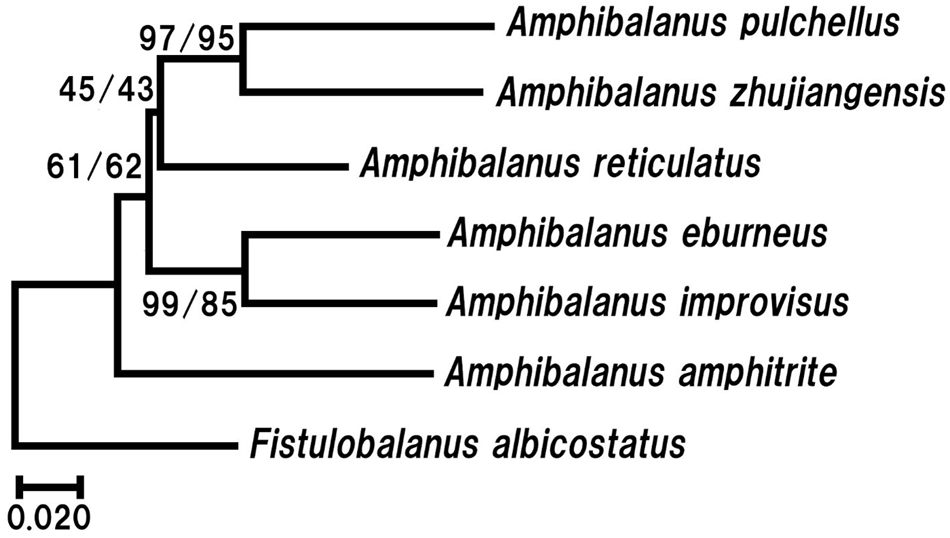
Amphibalanine barnacles typically inhabit the intertidal zone, yet Amphibalanus pulchellus and A. zhujiangensis were initially found on floating objects (Ren, Reference Ren1989), and subsequent records indicate their prevalence on marine debris, such as buoys or ship hulls (Otani et al., Reference Otani, Oumi, Uwai, Hanyuda, Prabowo, Yamaguchi and Kawai2007; Wells and Booth, Reference Wells and Booth2012; present study). Phylogenetic analysis suggests a close relationship among these species (Figure 4), highlighting their affinity for colonizing marine debris or floating objects. Despite continuous shoreline observations along the Japanese coast, no established intertidal populations of these poorly documented species were detected. Their apparent association with floating substrates suggests an opportunistic occurrence pattern, which may account for their limited historical records.
The phylogenetic trees in the neighbour-joining and maximum-parsimony analyses were inferred from 1000 bootstrap replicates, and both analyses were conducted using MEGA X (Kumar et al., Reference Kumar, Stecher, Li, Knyaz and Tamura2018). The sequences were aligned using MUSCLE, included in MEGA X. At each node, the numbers separated by a slash indicate the percentage NJ and MP bootstrap support, respectively (1000 replicates).

Although these rarely recorded species in the genus Amphibalanus have been sporadically reported from the Northwestern Pacific to Australian waters (Figure 1a), they have been discussed as potentially introduced or non-native taxa in Japanese and Australian waters (Puspasari et al., Reference Puspasari, Yamaguchi and Ross2002; Ahyong and Wilkins, Reference Ahyong and Wilkens2011; Wells and Booth, Reference Wells and Booth2012). However, determining whether such species are truly invasive or historically overlooked natives remains difficult, owing to the scarcity of reliable historical records. The closely related intertidal acorn barnacle Fistulobalanus albicostatus (Pilsbry, Reference Pilsbry1916), widely distributed in the western Pacific (from northern Japan to the South China Sea), comprises two major clades exhibiting a COI divergence ranging from 1.25% to 2.8% (Chang et al., Reference Chang, Chan, Hayashi, Shuto, Tsang, Chu and Chan2017). In contrast, despite the broad distribution of A. zhujiangensis in Indonesia, Japan, and Taiwan, the genetic distance within A. zhujiangensis populations is even lower (<0.01, Supplementary Table S1). This pattern is more consistent with recent dispersal or ongoing genetic connectivity than with long-term regional isolation. However, the native geographic origin of A. zhujiangensis remains uncertain because of the scarcity of historical records. Although A. zhujiangensis has been infrequently reported since its original description and could be considered a native species across subtropical regions including the East China Sea, this high genetic homogeneity suggests a different scenario. It indicates that the species’ distribution may have expanded rapidly in recent times, potentially associated with increasing availability of durable floating substrates in recent decades, although direct evidence for substrate specificity is lacking. In the Anthropocene, plastic debris has become an increasingly dominant component of marine surface waters, with long-term datasets documenting pronounced increases over the past decades (Ostle et al., Reference Ostle, Thompson, Broughton, Gregory, Wootton and Johns2019). Plastics in aquatic ecosystems serve as rich substrates for epiplastic organisms, forming what is referred to as the ‘plastisphere’ (Zettler et al., Reference Zettler, Mincer and Amaral-zettler2013). Okinawa Island, where the present study was conducted, has been reported to contain large amounts of marine debris (Ilechukwu et al., Reference Ilechukwu, Das, Jamodiong, Borghi, Manzano, Hakim and Reimer2024). Due to the limited records of plastisphere-associated fauna, the life history of these species remains largely unknown.
While our data suggest a recent expansion for A. zhujiangensis, the status of A. pulchellus remains even more obscure. Prior to this study, not a single genetic sequence had been publicly available for this species, rendering it one of the most poorly understood taxa within the genus. The lack of baseline data currently prevents assessment of its biogeographic status, whether A. pulchellus is a native species with a previously cryptogenic distribution in the subtropical Pacific or a newly introduced alien species. By providing the first publicly accessible COI and H3 sequences, this research establishes the necessary foundation for future comparative studies to clarify the origin or invasion history of these ‘forgotten’ species. Together with the recent discovery of Chelonibia testudinaria on plastic debris (Hayashi, Reference Hayashi2026), the present study suggests that anthropogenic floating objects may represent an overlooked source of distributional and ecological information for marine epibionts. Continued surveys of stranded marine debris may therefore reveal additional records of poorly known barnacle species and improve our understanding of their biogeography.
Supplementary material
The supplementary material for this article can be found at https://doi.org/10.1017/S0025315426101544.
Acknowledgements
We are much indebted to Prof. William A. Newman for providing his knowledge and references concerning barnacles, and R.H.’s friend, Tomoaki Nakamura (Okinawa Zoo and Museum), for finding the encrusted buoy while beachcombing. The authors used ChatGPT (OpenAI) and Gemini (Google LLC) to refine the English language and grammar of this manuscript.
Author contributions
R.H. conceived the study, conducted field investigations, performed formal analyses, prepared specimens and figures, and wrote the original draft of the manuscript. R.H. also contributed to reviewing and editing the manuscript. T.S. contributed to the methodology, species identification, and reviewing and editing of the manuscript.
Declaration of interest
The authors declare no conflicts of interest.
Data availability statement
Voucher specimens are deposited in the National Museum of Nature and Science, Tokyo (NMNS-Cr-33305-33306). The DNA sequences generated in this study are available in GenBank under accession numbers LC919527–LC919530.
Ethics and approach
Not applicable.
Funding statement
Not applicable.