Introduction
Depression is an important geriatric health condition, both as a disease entity and as a risk factor for health outcomes (Kawamura et al., Reference Kawamura, Shioiri, Takahashi, Ozdemir and Someya2007; Chachamovich et al., Reference Chachamovich, Fleck, Laidlaw and Power2008). However, if diagnosed, it is amenable to pharmacological and cognitive-behavioral interventions (Patel et al., Reference Patel2007). A first step in designing intervention programs is to assess the disease burden and identify groups at increased risk for the disease.
A recent review of studies of Caucasian elderly people concluded that the prevalence of major depression and clinically significant depressive symptoms among community-dwelling elderly ranges from 1.0% to 9.4%, and 7.2% to 49%, respectively (Djernes, Reference Djernes2006). Figures from Asian countries are similar (Hahn et al., Reference Hahn, Yang, Yang, Shih and Lo2004; Chiu et al., Reference Chiu, Chen, Huang and Mau2005; Chou et al., Reference Chou, Ho and Chi2006; Ishine et al., Reference Ishine2005; Reference Ishine2006; Lee and Shinkai, Reference Lee and Shinkai2005; Matsubayashi et al., Reference Matsubayashi2005; Okumiya et al., Reference Okumiya2005; Sakagami et al., Reference Sakagami2005; Tsai et al., Reference Tsai, Yeh and Tsai2005; Wada et al., Reference Wada2005a; Reference Wada2005b; Reference Wada2005c; Jain and Aras, Reference Jain and Aras2007; Jeon et al., Reference Jeon, Jang, Rhee, Kawachi and Cho2007; Kaneko et al., Reference Kaneko, Motohashi, Sasaki and Yamaji2007; Wong et al., Reference Wong, Mercer, Woo and Leung2008). Correlates of depression and depressive symptoms among the elderly include social, demographic and health characteristics (Hahn et al., Reference Hahn, Yang, Yang, Shih and Lo2004; Chiu et al., Reference Chiu, Chen, Huang and Mau2005; Lee and Shinkai, Reference Lee and Shinkai2005; Tsai et al., Reference Tsai, Yeh and Tsai2005; Wada et al., Reference Wada2005a; Chou et al., Reference Chou, Ho and Chi2006; Djernes, Reference Djernes2006; Jain and Aras, Reference Jain and Aras2007; Jeon et al., Reference Jeon, Jang, Rhee, Kawachi and Cho2007; Kaneko et al., Reference Kaneko, Motohashi, Sasaki and Yamaji2007; Wong et al., Reference Wong, Mercer, Woo and Leung2008). However, the strength of these associations varies by elder characteristics, such as gender, and also between countries. Further, most studies describing prevalence and correlates of depressive symptoms among the elderly pertain to developed economies (Hahn et al., Reference Hahn, Yang, Yang, Shih and Lo2004; Chiu et al., Reference Chiu, Chen, Huang and Mau2005; Lee and Shinkai, Reference Lee and Shinkai2005; Matsubayashi et al., Reference Matsubayashi2005; Sakagami et al., Reference Sakagami2005; Tsai et al., Reference Tsai, Yeh and Tsai2005; Wada et al., Reference Wada2005a; Chou et al., Reference Chou, Ho and Chi2006; Djernes, Reference Djernes2006; Jeon et al., Reference Jeon, Jang, Rhee, Kawachi and Cho2007; Kaneko et al., Reference Kaneko, Motohashi, Sasaki and Yamaji2007; Wong et al., Reference Wong, Mercer, Woo and Leung2008), while few pertain to developing economies (Ishine et al., Reference Ishine2005; Reference Ishine2006; Okumiya et al., Reference Okumiya2005; Wada et al., Reference Wada2005a; Reference Wada2005b; Reference Wada2005c; Jain and Aras, Reference Jain and Aras2007) and none to Sri Lanka, a developing South Asian country.
Elderly (≥60 years) Sri Lankans constitute 11.2% (in 2007) of the population (United Nations, 2007), a figure expected to reach 29% by 2050 (World Bank, 2008). These figures are among the highest in South Asia. Elderly Sri Lankans have witnessed rapid social and demographic changes, including declining fertility rates and increased out-migration of young adults, especially women (Gaminiratne, Reference Gaminiratne2004). They have also witnessed violent ethnic conflict, ongoing since 1983, and a tsunami in 2004, scenarios that have the potential to affect mental health adversely (Zoysa, Reference Zoysa2001; Ghodse and Galea, Reference Ghodse and Galea2006). The elderly, with lowered homeostatic reserve, are especially vulnerable to such adversities (Levkoff et al., Reference Levkoff, MacArthur and Bucknall1995). However, only limited research has been undertaken on the mental health of Sri Lankan elderly people; existing studies either target other groups (e.g. children, conflict/tsunami survivors) or are dated or not nationally representative (Gunaratnam et al., Reference Gunaratnam, Gunaratnam and Somasundaram2003; Perera et al., Reference Perera, Torabi, Jayawardana and Pallethanna2006; Catani et al., Reference Catani, Jacob, Schauer, Kohila and Neuner2008; Hollifield et al., Reference Hollifield, Hewage, Gunawardena, Kodituwakku, Bopagoda and Weerarathnege2008). Although the Sri Lankan National Survey on Elders 2003–4 (National Secretariat for Elders, 2004) assessed mental illness/disability, it did not capture depression/depressive symptoms separately. The National Mental Health Survey, carried out in 2007, excluded those aged over 65 years (Institute for Research and Development, 2008).
Older Sri Lankans are a particularly important resource in the family context as they contribute to household management and childcare (Siddhisena, Reference Siddhisena and Leeson2005; World Bank, 2008). This role is especially important given the migration of adult children, the majority of whom are women (Gaminiratne, Reference Gaminiratne2004). Good mental health of the elderly therefore contributes to well-being within the family and increases the earning capacities of the younger generation. The present study documents the prevalence and correlates of depressive symptoms among community-dwelling elderly Sri Lankans, and assesses whether the correlates vary by gender. In addition to contributing to the limited literature on depression in the elderly in developing economies in general, and Sri Lanka in particular, the results will highlight areas of concern and provide information to health providers, caregivers, and Sri Lankan policy-makers.
Methods
Sri Lanka Aging Survey (SLAS)
The sample and sampling procedure of the 2006 SLAS have been described elsewhere (World Bank, 2008; Østbye et al., Reference Østbye, Malhotra and Chan2009). Briefly, the survey comprised a representative sample of 2413 elderly from 2115 households in 13 of the 25 Sri Lankan districts (12 districts were excluded due to the prevailing ethnic strife). The interview covered a range of sociodemographic, financial and health-related factors, a proxy being used if the elderly person was unable to respond.
Outcome variable: clinically significant depressive symptoms
The presence of depressive symptoms was assessed for approximately half the sample (1181; 48.9%) using the 15-item Geriatric Depression Scale (GDS-15; Sheikh and Yesavage, Reference Sheikh, Yesavage and Brink1986) The other half of the sample was administered a modified version of the Mini-mental State Examination (MMSE) (for details, see Østbye et al., Reference Østbye, Malhotra and Chan2009) to assess cognitive status. Whether an elderly person was assessed for depressive or cognitive symptoms was based on alternate assignment at the level of the primary sampling unit (PSU). Administrative and time constraints precluded the administration of both scales to the entire sample.
The GDS-15, validated and administered in several countries, including those in Asia (Chiu et al., Reference Chiu, Chen, Huang and Mau2005; Ishine et al., Reference Ishine2005; Reference Ishine2006; Lee and Shinkai, Reference Lee and Shinkai2005; Matsubayashi et al., Reference Matsubayashi2005; Okumiya et al., Reference Okumiya2005; Sakagami et al., Reference Sakagami2005; Tsai et al., Reference Tsai, Yeh and Tsai2005; Wada et al., Reference Wada2005b; Reference Wada2005c; Chou et al., Reference Chou, Ho and Chi2006; Wancata et al., Reference Wancata, Alexandrowicz, Marquart, Weiss and Friedrich2006), provides an overall score (maximum = 15) based on the sum of individual item scores. A minimum score – ranging from 3 to 10 (Chiu et al., Reference Chiu, Chen, Huang and Mau2005; Ishine et al., Reference Ishine2005; Reference Ishine2006; Lee and Shinkai, Reference Lee and Shinkai2005; Matsubayashi et al., Reference Matsubayashi2005; Okumiya et al., Reference Okumiya2005; Sakagami et al., Reference Sakagami2005; Tsai et al., Reference Tsai, Yeh and Tsai2005; Wada et al., Reference Wada2005b; Reference Wada2005c; Chou et al., Reference Chou, Ho and Chi2006; Wancata et al., Reference Wancata, Alexandrowicz, Marquart, Weiss and Friedrich2006) – denotes the presence of depressive symptoms. We classified individuals with a score of ≥6 (cut off 5/6) as “having clinically significant depressive symptoms”. Where a proxy responded on behalf of the elderly person (n = 117) that person was excluded. Participants with ≥4 missing items (n = 65) were also excluded; for participants with one (n = 106), two (n = 51) or three (n = 21) missing items, the missing items were set to the average of those completed (Yesavage, Reference Yesavage2009). The final analysis sample therefore comprised 999 elderly participants.
Correlates: sociodemographic variables
Age (60 to 69, 70 to 79, ≥80 years), gender, ethnicity (Sinhala, Tamil/Moor/other), marital status (married, never married/widowed/divorced/separated), place of residence (urban, rural, estate), years of education (≤5, ≥6), and annual household income were considered.
Correlates: health variables
Variables from four “health dimensions” (physical, functional, financial and social) were considered. Physical health variables included physical disability (loss of or paralysis in any limb), chronic diseases (self-reported doctor diagnosed arthritis/rheumatism/diabetes/heart disease/hypertension/stroke/cancer/cataract/urinary incontinence), and hearing difficulty (unable to hear, or difficult to hear a person speaking at normal volume). Functional health variables included limitation in activities of daily living (ADL) (trouble with or unable to perform one or more of the following activities: eat, dress, go to the toilet, bathe), instrumental activities of daily living (IADL) (trouble with or unable to perform one or more of the following activities: take medication, sweep floor/yard, draw a pail of water from a well, prepare meals, shop for/obtain food, manage money/finances) and mobility (trouble with or unable to perform one or more of the following activities: stand up from sitting on a chair, stand up from sitting on the floor, bend/stoop/bow). Perceived adequacy of present income and allowances to cover monthly expenses constituted the financial health dimension, and living arrangement (living alone, living with spouse/child/others) constituted the social health dimension.
Statistical analysis
SAS for Windows, Version 9.1 was used for data management and analysis. The weighted prevalence of depressive symptoms was assessed using the survey sample weights. Considering the dichotomous nature of the outcome (presence or absence of clinically significant depressive symptoms), unadjusted and adjusted logistic regression models were used to identify its correlates. First-order interaction terms were introduced to assess the role of gender as an effect modifier of the other potential correlates; significant (p < 0.05) interaction terms were retained in the model. Only the gender/ethnic group interaction was significant. To account for this, a categorical variable with four gender/ethnic categories – Sinhalese male, minority (Tamil/Moor/other) ethnic group male, Sinhalese female, minority ethnic group female – was created. Two adjusted models, the first only with sociodemographics, and the second additionally having health variables were run subsequently. The SAS “proc surveylogistic” procedure, which accounts for sampling design and weights, was used for all models. Rao-Scott χ2 test was used to assess if the proportion reporting the presence of each individual symptom of GDS-15, among those who “had depressive symptoms”, was significantly different across age and gender categories. This test was also used to assess whether there were any significant differences in sociodemographic variables (except for annual household income where the t-test was applied) or health status variables between elderly participants who were and were not administered the GDS-15.
The SLAS involved the Sri Lankan Department of Census and Statistics, and consent was provided by the Sri Lankan Ministry of Social Services and Social Welfare. Exemption from full review for the analyses was given by the Institutional Review Boards of the National University of Singapore and Duke University Medical Center. All survey participants gave verbal consent.
Results
There were no significant differences between the elderly participants who were and were not assessed for depressive symptoms with regard to age, gender, ethnicity, marital status, place of residence, years of education, annual household income, physical disability, chronic diseases, hearing difficulty, ADL limitation, IADL limitation, mobility, perceived income adequacy and living arrangement (all p-values > 0.05).
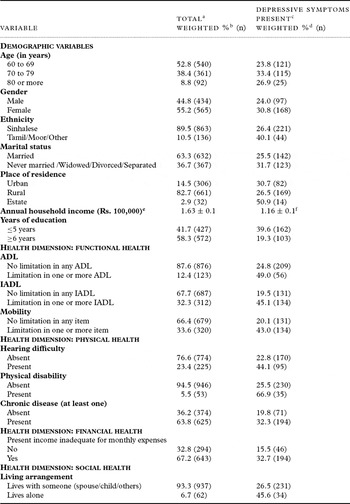
The weighted prevalence of depressive symptoms among community-dwelling elderly Sri Lankans was 27.8% overall: 24.0% among men, and 30.8% among women. It varied considerably with sociodemographic or health characteristics, ranging from 15.5% among those who perceived income adequacy to 66.9% among those with physical disability. (Table 1)
Weighted prevalence of potential sociodemographic and health correlates, and of depressive symptoms by correlates among Sri Lankan elderly

a N = 999, except for age (N = 993) and perceived income adequacy (N = 937).
b Column percentage, adjusted for survey design and non-participation.
c GDS-15 score ≥ 6 (N = 265; weighted % = 27.8).
d Row percentage, adjusted for survey design and non-participation.
e Expressed as mean ± S.E.
f Pertains to those with depressive symptoms.
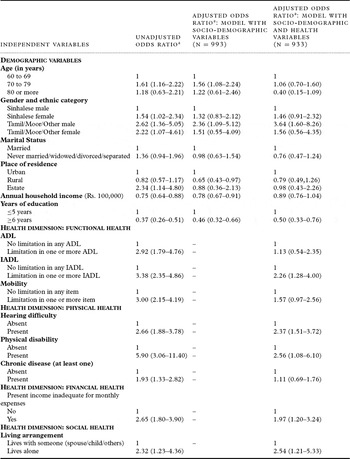
Table 2 presents the unadjusted and adjusted odds for depressive symptoms. While in the simpler model, age, place of residence, annual household income, gender/ethnic group and years of education were associated with depressive symptoms, on further adjustment for health characteristics, only the latter two remained associated. Additionally, in the final model, elderly with IADL limitation, hearing difficulty, physical disability, perceived income inadequacy or who lived alone were more likely to have depressive symptoms.
Sociodemographic and health correlates of depressive symptoms among Sri Lankan elderly: unadjusted and adjusted odds ratios

a Numbers in parenthesis indicate the 95% confidence interval for the odds ratio.
Among those with depressive symptoms, significant differences by gender with respect to individual symptoms of GDS-15 were observed only for three items: “do you often feel helpless”, “do you feel that your life is empty”, and “have you given up many of your activities or interests”. Women were more likely to give a response indicative of depression for the first two, and men for the last item. Assessing the same with respect to age category revealed a significant difference only for the item “do you feel full of energy”, observed to decrease with age.
Discussion
More than a quarter of community-dwelling elderly Sri Lankans had clinically significant depressive symptoms. The prevalence was much higher among estate dwellers (50.9%) and those with physical disability (66.9%). Educational status, gender/ethnic group, IADL limitation, hearing difficulty, physical disability, perceived income inadequacy and living arrangement were significant correlates of depressive symptoms.
The prevalence of depressive symptoms among older Sri Lankans (27.8%) is higher than that reported in most studies of community-dwelling Caucasian (Djernes, Reference Djernes2006) and Asian elderly (Hahn et al., Reference Hahn, Yang, Yang, Shih and Lo2004; Chiu et al., Reference Chiu, Chen, Huang and Mau2005; Ishine et al., Reference Ishine2005; Lee and Shinkai, Reference Lee and Shinkai2005; Matsubayashi et al., Reference Matsubayashi2005; Wada et al., Reference Wada2005a; Reference Wada2005b; Chou et al., Reference Chou, Ho and Chi2006; Jeon et al., Reference Jeon, Jang, Rhee, Kawachi and Cho2007; Kaneko et al., Reference Kaneko, Motohashi, Sasaki and Yamaji2007; Wong et al., Reference Wong, Mercer, Woo and Leung2008); some studies do report a similar prevalence (Tsai et al., Reference Tsai, Yeh and Tsai2005; Djernes, Reference Djernes2006; Ishine et al., Reference Ishine2006) or even higher (Okumiya et al., Reference Okumiya2005; Sakagami et al., Reference Sakagami2005; Wada et al., Reference Wada2005a; Reference Wada2005c; Djernes, Reference Djernes2006; Jain and Aras, Reference Jain and Aras2007) prevalence. Further, the prevalence we report is likely to be underestimated as we excluded elderly for whom a proxy was used (on inclusion of such elderly, the overall prevalence rose to 30% – analysis not shown).
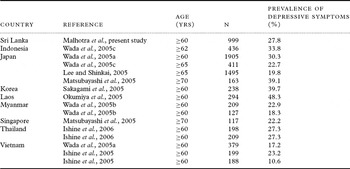
Though indicative, such cross-country comparisons should be interpreted with caution due to methodological differences, including variation in survey samples and the screening scale administered. Even studies using GDS-15 differ in the cut-off used to define presence of depressive symptoms (Chiu et al., Reference Chiu, Chen, Huang and Mau2005; Ishine et al., Reference Ishine2005; Reference Ishine2006; Lee and Shinkai, Reference Lee and Shinkai2005; Matsubayashi et al., Reference Matsubayashi2005; Okumiya et al., Reference Okumiya2005; Tsai et al., Reference Tsai, Yeh and Tsai2005; Wada et al., Reference Wada2005b; Reference Wada2005c; Chou et al., Reference Chou, Ho and Chi2006; Wancata et al., Reference Wancata, Alexandrowicz, Marquart, Weiss and Friedrich2006). By using different cut-offs, the estimated prevalence of depressive symptoms among Sri Lankan elderly overall ranged from 14.8% (cut-off: 7/8) to 68.8% (cut-off: 3/4), among males from 12.0% (cut-off: 7/8) to 65.5% (cut-off: 3/4) and among females from 16.7% (cut-off: 7/8) to 71.5% (cut-off: 3/4). Although, to our knowledge, the GDS-15 has not been validated for Sri Lankan elderly, validation studies from elsewhere report that our chosen 5/6 cut off has a sensitivity of 79–97% and specificity of 74–96% for determining late life depression (Herrmann et al., Reference Herrmann1996; Schreiner et al., Reference Schreiner, Hayakawa, Morimoto and Kakuma2003; Blank et al., Reference Blank, Gruman and Robison2004). Further, the cut off has been used in many studies, both in Asia (Table 3) (Ishine et al., Reference Ishine2006; Ishine et al., Reference Ishine2005; Lee and Shinkai, Reference Lee and Shinkai2005; Matsubayashi et al., Reference Matsubayashi2005; Okumiya et al., Reference Okumiya2005; Sakagami et al., Reference Sakagami2005; Wada et al., Reference Wada2005a; Reference Wada2005b; Reference Wada2005c) and elsewhere (Wancata et al., Reference Wancata, Alexandrowicz, Marquart, Weiss and Friedrich2006). Even on comparison with studies from other Asian countries using the same instrument and cut-off (Table 3), the overall prevalence of depressive symptoms we observe is high. It may reflect the negative psychological consequences of adversities such as ethnic conflict and natural disasters, and intergenerational pressures and expectations mentioned above.
Prevalence of depressive symptoms, assessed using GDS-15 with a cut-off of 5/6, among community-dwelling elderly residing in Asian countries

In the unadjusted analysis, and the model including only sociodemographics, those aged 70–79 years were more likely to have depressive symptoms, the odds being similar in the “young old” and “oldest old” groups. A possible explanation is the “healthy survivor effect”, i.e. the elderly surviving long enough to be “oldest old” are healthier than the septuagenarians. However, consistent with previous studies (Chiu et al., Reference Chiu, Chen, Huang and Mau2005; Lee and Shinkai, Reference Lee and Shinkai2005; Tsai et al., Reference Tsai, Yeh and Tsai2005; Wada et al., Reference Wada2005a; Chou et al., Reference Chou, Ho and Chi2006; Djernes, Reference Djernes2006; Jeon et al., Reference Jeon, Jang, Rhee, Kawachi and Cho2007; Wong et al., Reference Wong, Mercer, Woo and Leung2008), the association between age and depressive symptoms lost significance on adjustment for health status. This suggests that a difference in health status across age groups is responsible for any apparent correlation between age and depressive symptoms, (Djernes, Reference Djernes2006), thereby lending support to the “healthy survivor effect”.
The literature on the association between gender and depressive symptoms is inconsistent, with reports of no difference (Chiu et al., Reference Chiu, Chen, Huang and Mau2005; Lee and Shinkai, Reference Lee and Shinkai2005; Tsai et al., Reference Tsai, Yeh and Tsai2005; Djernes, Reference Djernes2006; Wong et al., Reference Wong, Mercer, Woo and Leung2008) as well as of females being at higher risk (Hahn et al., Reference Hahn, Yang, Yang, Shih and Lo2004; Djernes, Reference Djernes2006). Though we observed females to have a higher prevalence of depressive symptoms (30.8% vs. 24.0%), the difference was not statistically significant. The strong social and economic status of Sri Lankan women (Asian Development Bank, 1999) may explain this finding. It is notable that among the elderly with depressive symptoms, a gender difference was observed for some individual GDS-15 symptoms.
Studies also report a gender difference in correlates of depressive symptoms (Dean et al., Reference Dean, Kolody, Wood and Matt1992; Chou et al., Reference Chou, Ho and Chi2006; Jeon et al., Reference Jeon, Jang, Rhee, Kawachi and Cho2007). We observed the gender-ethnicity interaction to be significant; compared to Sinhalese males, males of minority ethnicity had higher, while Sinhala females and females of minority ethnicity had similar odds of depressive symptoms. Sri Lanka has witnessed a long drawn-out ethnic conflict between the Sinhalese (comprising 82.0% of the population overall, and in the majority in most of the Western and Southern districts) and Tamils (9.4% of the population overall, and in the majority in most of the Northern and Eastern districts) (Department of Census and Statistics Sri Lanka, 2007b). Since SLAS was primarily conducted in Sinhalese-dominated districts, it is possible that Tamils and other minorities perceive ethnic tension and discrimination (McConnell, Reference McConnell2008), leading to depressive symptoms. The higher odds only among males but not females of minority ethnicity could be the result of the strong social and economic status of women overall, or the selective persecution of ethnic minority males. These differences need to be investigated further.
Elderly people residing in estates had higher unadjusted odds of depressive symptoms, but not after controlling for other sociodemographics. This is not surprising since estate dwellers typically are Tamil, with lower income and educational status (Department of Census and Statistics Sri Lanka, 2001; 2007a; Gaminiratne, Reference Gaminiratne2004). Nevertheless, the high rates of depressive symptoms (50.9%) among elderly estate dwellers are alarming, and need to be addressed by health practitioners and mental health programs.
Socio-economic status (SES), including education and income/financial status, have been linked to depression and depressive symptoms; a higher risk is reported among those with lower income or education or SES, as well as among those who perceive income inadequacy (Hahn et al., Reference Hahn, Yang, Yang, Shih and Lo2004; Chou et al., Reference Chou, Ho and Chi2006; Djernes, Reference Djernes2006; Skapinakis et al., Reference Skapinakis, Weich, Lewis, Singleton and Araya2006; Wong et al., Reference Wong, Mercer, Woo and Leung2008). We observed the same pattern. Lower SES leads to chronic stress, inadequate perceived social support, and lack of control over one's environment (Skapinakis et al., Reference Skapinakis, Weich, Lewis, Singleton and Araya2006), and, in Sri Lanka in particular, financial insecurity may result from limited access by the elderly to social security schemes and government transfers (Gaminiratne, Reference Gaminiratne2004; Siddhisena, Reference Siddhisena and Leeson2005). As also reported previously, the perception of financial status has stronger and significant association with depressive symptoms compared to its objective measure (Skapinakis et al., Reference Skapinakis, Weich, Lewis, Singleton and Araya2006; Wong et al., Reference Wong, Mercer, Woo and Leung2008). However, given the cross-sectional nature of our analysis, the reverse association is also plausible: elderly people with depressive symptoms are more likely to perceive their income as inadequate.
Chronic diseases are among the strongest and most consistent correlates of depressive symptoms for the elderly (Hahn et al., Reference Hahn, Yang, Yang, Shih and Lo2004; Chiu et al., Reference Chiu, Chen, Huang and Mau2005; Djernes, Reference Djernes2006; Jeon et al., Reference Jeon, Jang, Rhee, Kawachi and Cho2007; Kaneko et al., Reference Kaneko, Motohashi, Sasaki and Yamaji2007; Wong et al., Reference Wong, Mercer, Woo and Leung2008). However, many studies reporting this association (Hahn et al., Reference Hahn, Yang, Yang, Shih and Lo2004; Jeon et al., Reference Jeon, Jang, Rhee, Kawachi and Cho2007; Wong et al., Reference Wong, Mercer, Woo and Leung2008) did not adjust for functional limitation/impairment, a prime mediator of the apparent association between chronic physical illness and depression (Williamson and Schulz, Reference Williamson and Schulz1992). In the present study, chronic diseases were associated with depressive symptoms in the unadjusted but not in the adjusted analysis, lending support to the role of functional limitations as a mediator. Functional impairment/limitations themselves have been reported to be correlates and predictors of depressive symptoms/depression among the elderly (Chiu et al., Reference Chiu, Chen, Huang and Mau2005; Lee and Shinkai, Reference Lee and Shinkai2005; Wada et al., Reference Wada2005a; Djernes, Reference Djernes2006). We also observed ADL, IADL and mobility limitations to be associated with depressive symptoms, though in the adjusted analysis only IADL limitation remained a significant correlate. Assistive devices and environmental modifications can prolong and improve independence in IADLs, and may decrease risk of depressive symptoms.
Elderly Sri Lankans living alone were more likely to have depressive symptoms. In our study, and in others observing the same association (Dean et al., Reference Dean, Kolody, Wood and Matt1992; Chou et al., Reference Chou, Ho and Chi2006; Jeon et al., Reference Jeon, Jang, Rhee, Kawachi and Cho2007), living arrangement is the most likely proxy for social isolation of the elderly and for intergenerational transfers; these factors, which we have not considered, are associated with living arrangements (Victor et al., Reference Victor, Scambler, Bond and Bowling2000) and depressive symptoms (Glass et al., Reference Glass, Leon, Bassuk and Berkman2006). The causal relationship between social support or isolation and living arrangements needs to be validated in longitudinal studies. The effect of living alone may be stronger in Sri Lanka since residing with immediate family is the traditionally accepted and commonest living arrangement for elderly people there (Siddhisena, Reference Siddhisena and Leeson2005). It is also possible that the presence of depressive symptoms might have resulted in undesirable behaviors, resulting in isolation from their immediate family.
Physical disability and hearing difficulty were associated with higher odds of depressive symptoms. A possible mechanism for this, which should be explored in longitudinal studies, could be the impaired social participation/greater social isolation as both movement and hearing play an important part in the ability to interact socially.
Since cognitive status was not assessed prior to GDS-15 administration, our sample might also have included some cognitively impaired individuals. However, GDS-15 can be used for individuals with mild to moderate cognitive impairment (CI), and exclusion of elderly with proxy respondents is likely to have excluded those with severe CI or dementia. While only half the sample was assessed for depressive symptoms, there was no significant difference in sociodemographics and health status between the two groups. Limitations of the study include the fact that information on the correlates considered was self-reported and not cross-verified. The survey sample was constrained by the ongoing ethnic conflict, with most of the Northern and Eastern districts excluded. Lastly, the SLAS did not assess for major depression, the prevalence of which is most likely to be lower than the figures we report for depressive symptoms.
Strengths of the study includes the fact that this is arguably the first survey reporting the prevalence and correlates of depressive symptoms among community-dwelling elderly Sri Lankans, based on a nationally representative sample (bearing in mind the constraints imposed by the ethnic conflict), using a validated instrument often used internationally. All elderly age groups from the young old to the oldest old, and both genders, are represented.
The recent National Mental Health Policy (NMHP), and plans for increased availability of mental health treatment at the primary health care level (Mental Health Directorate, 2005; WHO Country Office for Sri Lanka, 2008) indicate that the Sri Lankan government is concerned about the mental health care needs of its population. The findings of the present study call for a focus on geriatric mental health, especially depression, in such policies and programs since the current NMHP fails to mention geriatric mental health specifically. Because it has been shown, even in resource-poor settings, that depression can be effectively managed with pharmaceutical and psychological interventions (Patel et al., Reference Patel2007), it is important to provide such assistance. However, given Sri Lanka's limited resources, including trained manpower and infrastructure (WHO Country Office for Sri Lanka, 2008), universal availability and accessibility of depression diagnosis and treatment may not be possible. Systematic screening for depressive symptoms among all elderly is a contentious issue, especially if integrated systems for subsequent diagnosis, treatment and follow-up are not in place (MacMillan et al., Reference MacMillan2005). Such screening may be more appropriate in the high risk groups we have identified, along with development of diagnosis and treatment facilities. Even when less can be done, awareness of how common such problems are may make it easier, both for the elderly themselves, and their families, to live with depressive symptoms.
Conflict of interest
None.
Description of authors' roles
RM contributed in developing the overall concept, conduct of the data analyses, interpretation of the data and preparation of the manuscript. AC contributed in designing the data analysis, interpretation of the data and manuscript preparation. TØ developed the overall concept and the design of the analyses, prepared the manuscript and oversaw analysis and interpretation of the data.