INTRODUCTION
It has been nearly two decades since a carnivorous feeding habit was discovered to occur in a small cavernicolous sponge of the family Cladorhizidae (Asbestopluma hypogea Vacelet & Boury-Esnault, 1996) as an adaptation to a food-poor environment (Vacelet & Boury-Esnault, Reference Vacelet and Boury-Esnault1995). This trait, that to some extent challenges the definition of the phylum itself, is now considered general for all cladorhizid species, as well as for several members of related families such as Guitarridae (genus Euchelipluma) and Esperiopsidae (genus Esperiopsis) and suggests that carnivory appeared independently in several evolutionary lineages within the Poecilosclerida (Vacelet, Reference Vacelet, Custódio, Lôbo-Hajdu, Hajdu and Muricy2007). Since then, several genera have been erected (e.g. Vacelet, Reference Vacelet2008; Rios et al., Reference Rios, Kelly and Vacelet2011), and more than 40 new species have been described (e.g. Hestetun et al., Reference Hestetun, Fourt, Vacelet, Boury-Esnault and Rapp2013; Lopes & Hajdu, Reference Lopes and Hajdu2014).
At present, the family Cladorhizidae comprises seven genera and in excess of 130 species worldwide (Van Soest et al., Reference Van Soest, Boury-Esnault, Hooper, Rützler, de Voogd, Alvarez de Glasby, Hajdu, Pisera, Manconi, Schoenberg, Janussen, Tabachnick, Klautau, Picton, Kelly, Vacelet, Dohrmann, Cristina Díaz and Cárdenas2014). Within this family, the genus Chondrocladia presently includes 37 valid species (Van Soest et al., Reference Hajdu, Vacelet, Hooper and Soest2014) distributed over three subgenera: Subgenus Chondrocladia Thomson, Reference Thomson1873 (31 species), Subgenus Meliiderma Ridley & Dendy, 1886 (five species), and Subgenus Symmetrocladia Lee et al. Reference Lee, Reiswig, Austin and Lundsten2012 (one species). This genus is well characterized by a pedunculate body bearing diverse appendages, and the presence of anchorate unguiferous isochelae (Van Soest et al., Reference Hajdu, Vacelet, Hooper and Soest2014).
We describe a new species of Chondrocladia (Chondrocladia) collected from two different seamounts, the Gorringe and Galicia Banks. These are two of the largest seamounts of the north-east Atlantic Ocean, yet their presumably diverse fauna had been seldom studied until more recent explorations benefiting from private, governmental, non-governmental and international funding efforts. Some examples are: the campaigns made by OCEANA (Spain) and Universidade Lusófona (Portugal) to the Gorringe Bank that resulted in many new records for its two seamounts (OCEANA, 2005; Xavier & Van Soest, Reference Xavier and Van Soest2007; Abecasis et al., Reference Abecasis, Cardigos, Almada and Gonçalves2009); and the campaigns to the Galicia Bank made as part of the EU-funded INDEMARES project (Bañón et al., Reference Bañón, Arronte, Serrano and Sánchez2011; Altuna, Reference Altuna2012; Baba & Macpherson, Reference Baba and Macpherson2012; Cartes et al., Reference Cartes, Papiol, Frutos, Macpherson, González-Pola, Punzón, Valeiras and Serrano2014).
MATERIALS AND METHODS
Sponges were collected in the course of different scientific expeditions to the Gorringe and Galicia Banks (Figure 1), on board various research vessels and employing different sampling methods during August 2010, July and August 2011 and October 2011.
Map of NE Atlantic with collecting localities of Chondrocladia robertballardi sp. nov. (A) Gorringe Bank; arrow indicates the location of the holotype. (B) Galicia Bank; arrows indicate the location of the paratypes.

The Gorringe Bank is a large seamount – 200 km long and 60 km wide – located approximately 270 km off Cabo de São Vicente (south-west coast of Portugal) at the eastern tip of the Azores–Gibraltar plate boundary that separates Eurasia and Africa (Girardeau et al., Reference Girardeau, Cornen, Beslier, Le Gall, Monnier, Agrinier, Dubuisson, Pinheiro, Ribeiro and Whitechurch1998). It rises from nearly 5000 m depth up to 20–50 m depth (Gettysburg and Ormonde seamounts) and is enclosed to the north and south by the Tagus and Horseshoe Abyssal Plains, respectively. The ‘Nautilus’ NA017 expedition to this bank, made in October 2011 on board the EV ‘Nautilus’ of the Ocean Exploration Trust (see http://www.nautiluslive.org) was primarily designed for the study of active hydrothermal sites and volcanic activity in zones of ultra-fast spreading ridges. During this expedition, sponge samples were collected during four dives made between 132 and 2287 m employing the ROVs ‘Hercules’ and ‘Argus’.
The Galicia Bank is a structural high in the western Galicia continental margin (Atlantic NW Iberian), a region bounded to the north and to the west by the Biscay and Iberian abyssal plains, respectively. This bank is located about 120 km from the coast, and shows a trapezoidal geometry of 220 km wide in the E–W direction and 300 km length in the N–S direction. Data in the Galicia Bank were collected during two INDEMARES surveys carried out on board the RV ‘Thalassa’ (IFREMER-IEO) in July 2010 and the RV ‘Miguel Oliver’ (SGP) in July–August 2011.
For the holotype, the environmental conditions were observed on the videos and photographs taken during the dives. Underwater pictures were taken by the camera of the ROV ‘Hercules’. Paratypes 1 and 2 were collected with a rock dredge, whereas paratype 3 was collected with a bottom trawl.
Specimens were preserved in 70–80% ethanol upon collection, and prepared for histological examination. Spicules were prepared for both light and scanning electron microscopy (SEM) by boiling a small piece of sponge in nitric acid on a glass slide (Cristobo et al., Reference Cristobo, Urgorri, Solórzano, Ríos, Palacios, Martínez and Thomas1993). Skeletal arrangement and spicules of specimens were examined with a JEOL–6100 SEM at Oviedo University. The data for spicule sizes are based on a minimum of 25 measurements for each spicule category, comprising minimum, maximum and average lengths in micrometres (μm). The type material has been deposited in the Museum National d'Histoire Naturelle (MNHN Paris) and Museo Nacional de Ciencias Naturales (MNCN, Madrid).
SYSTEMATICS
Phylum PORIFERA Grant, 1836
Class DEMOSPONGIAE Sollas, 1885
Order POECILOSCLERIDA Topsent, 1928
Suborder MYCALINA Hajdu, Van Soest & Hooper, 1994
Family CLADORHIZIDAE Dendy, 1922
DIAGNOSIS
Sponges usually small, symmetrical, mostly in deep water, with diagonal, radiating supporting processes and basal root adaptations for living in soft sediments. Axial skeleton composed of monactinal or diactinal megascleres, from which radiating extra-axial tracts diverge to the ectosome. Microscleres include (an)isochelae, sigmas, forceps or micro(subtylo) styles (microspined, spear-shaped in a few cases). Considerable reduction to complete loss of the choanocyte layer is known for some species, being associated with an adaptation to carnivory, preying on relatively large food items (Hajdu & Vacelet, Reference Hajdu, Vacelet, Hooper and Soest2002).
Genus Chondrocladia Thomson, Reference Thomson1873
Chondrocladia Thomson, Reference Thomson1873, p. 188; Crinorhiza Schmidt, 1880, p. 83; Meliiderma, p. 102; not Neocladia Koltun, 1970, p. 193 (amended from Hajdu & Vacelet, Reference Hajdu, Vacelet, Hooper and Soest2002).
DIAGNOSIS
Cladorhizidae with a slender stalk and spherical body with filamentous processes that may be inflated and turgid in life. The base of attachment may be root-like or solid. Axial skeleton composed of monactinal megascleres (mycalostyles), from which radiating extra-axial tracts diverge to lateral processes. Microscleres include unguiferous anchorate isochelae (Vacelet et al., Reference Vacelet, Kelly and Schlacher-Hoenlinger2009).
Subgenus Chondrocladia Thomson, Reference Thomson1873
TYPE SPECIES
Chondrocladia virgata Thomson, Reference Thomson1873 (by monotypy).
Chondrocladia Thomson, Reference Thomson1873, p. 188. Crinorhiza Schmidt, 1880, p. 83. Type species: as above.
DIAGNOSIS
As above (Vacelet et al., Reference Vacelet, Kelly and Schlacher-Hoenlinger2009).
Chondrocladia (Chondrocladia) robertballardi sp. nov.
(Figures 2–5)
TYPE MATERIAL
Holotype: Museum National d'Histoire Naturelle, Paris. MNHN DCL4110. Field code NA017–060, Ormonde Seamount, Gorringe Bank, NE Atlantic Ocean (SW Portugal); 36°38.9713′N 011°03.2316′W, 1738 m, coll. J. Cristobo EV ‘Nautilus’, 17 November 2011.
Paratype 1: Museo Nacional de Ciencias Naturales, Madrid. MNCN 1.01/697. Field code 084DR02200711, Galicia Bank, NE Atlantic Ocean (NW Spain); 43°00.36′N 011°51.00′W, 1697 m, coll. P. Ríos & J. Cristobo RV ‘Miguel Oliver’, 20 July 2011.
Paratype 2: Author's collection. Field code 070DR15230810, Galicia Bank, NE Atlantic Ocean (NW Spain); 42°29.372′N 011°51.291′W, 1400 m, coll. P. Ríos & J. Cristobo RV ‘Thalassa’, 23 August 2010.
Paratype 3: Author's collection. Field code 004G07050811, Galicia Bank, NE Atlantic Ocean (NW Spain); 42°32.239′N 012°03.432′W, 1536 m, coll. P. Ríos, RV ‘Miguel Oliver’, 5 August 2011.
DISTRIBUTION
Atlantic Ocean to the west of the Iberian Peninsula, including Gorringe and Galicia Banks (1400–1738 m).
HABITAT
The holotype from Gorringe Bank was collected from sandy flat or low-slope bottoms where epifauna was uncommon; only big unicellular Foraminifera (Class Xenophyophora), free-living crinoids and bamboo coral (Family Isididae) were observed. Samples from the Galicia Bank were collected by trawl; as a result data on the type of sediment at these stations are not available. However, in general, on the bank summit, the flat part is covered by a thick layer of planktonic foraminifera ooze with a median grain size of ~190 µm and only 0.2% organic carbon; the surface of the sediment consists of numerous small current ripples and occasional mega ripples of ~50 cm height, indicating mobile sediment and high current velocities (Duineveld et al., Reference Duineveld, Lavaleye and Berghuis2004).
According to Druet et al. (Reference Druet, Acosta, Gomez-Ballesteros, Serrano, Sanchez, Flor, Gallastegui, Flor-Blanco and Martín Llaneza2009), there are three sedimentary units on the top of the Galicia Bank: (1) rock bottoms; (2) rock bottoms with sediment cover; and (3) rock bottoms with a thick sediment covering. The stations surveyed in the present study were in areas of the first two units. The sample in which paratype 1 was collected comprised a mixed sediment with rocks, pebbles, with abundant bamboo corals (Acanella), gorgonians (Shiftia, Chrysogorgia, Narella), stony corals (Enallopsammia, Desmophyllum, Caryophyllia) and black coral (Antipatharia); Asteroidea, such as Peltaster; Brachiopoda, cidaroid sea urchins and sponges (Pheronema carpenteri, Phakellia robusta, Asconema setubalense, Aphrocallistes beatrix and specimens of the genera Thenea and Geodia, among others). The sample of paratype 2 was also a composition of rocks, pebbles, dead stony corals, with typically rock-associated fauna, such as live Lophelia pertusa, Solenosmilia variabilis, other Anthozoa, such as bamboo corals (Family Isididae), representatives of the genera Desmophyllum, Swiftia, Acanthogorgia, Touarella; Asteroidea, such as Peltaster, and other Porifera, such as Asconema setubalense, Aphrocallistes beatrix, Asbestopluma sp. and many encrusting sponge species. Paratype 3 appeared along with other sponges, such as Asconema setubalense, Phakellia robusta, Hymedesmia spp.; Anthozoa of the genera Acanella, Narella and Chrysogorgia, and cidaroid sea urchins.
DESCRIPTION
The following habitat description is based on the holotype as this specimen was collected by ROV and is complete; all other paratypes were collected by trawl and are fragmented as a result. Paratypes are fragments of different sizes that nevertheless correspond with the holotype in morphology and skeleton. The holotype is a large stalked sponge (Figure 2), 40.4 cm high in life including the basal part composed of a rhizoid basal fixation system 9 cm long. The stalk is cylindrical (11 mm in diameter at the base and 2 mm at the apex) with two dichotomous branches. The larger branch is 12.4 cm and the smaller is 6.2 cm in length. The stalk is rigid, smooth, velvety to the touch and composed of longitudinally arranged fusiform styles. All parts of the stalk above the sediment have many secondary branches (3–10 on each cm of the stalk) which radiate in all directions perpendicular to the axis. In the preserved specimens, each of these secondary branches (0.3 to 3 cm in length with 2 mm diameter at the base and 0.7 mm at the end) has an irregular or ovoid swelling (3 mm in diameter). In the living animal, these swellings appear as translucent spheres of variable diameter, estimated at 10–12 mm diameter from the underwater pictures. In both cases the swellings/spheres occur at a distance of one-half to three-quarters the length of the branch. Apertures not visible. Consistency rigid but easily broken. Colour whitish to light brown in live specimens and light brown in alcohol. A polychaete worm (Family Polynoidae) was found in the middle of the stalk building a fine tube with sponge material. The specimen is in reproduction with several spherical embryos as inner balls (4 mm diameter) in the central part of the sponge.
Habitus of Chondrocladia (Chondrocladia) robertballardi sp. nov. (A and B) Collection of the holotype by the ROV ‘Hercules’ on board EV ‘Nautilus’ from Gorringe Seamount; (C and D) view of the holotype after collection; (E and F) view of paratype 1 from the Galicia Bank; (G) view of paratype 2 from the Galicia Bank; (H) view of paratype 3 from the Galicia Bank.
SKELETON
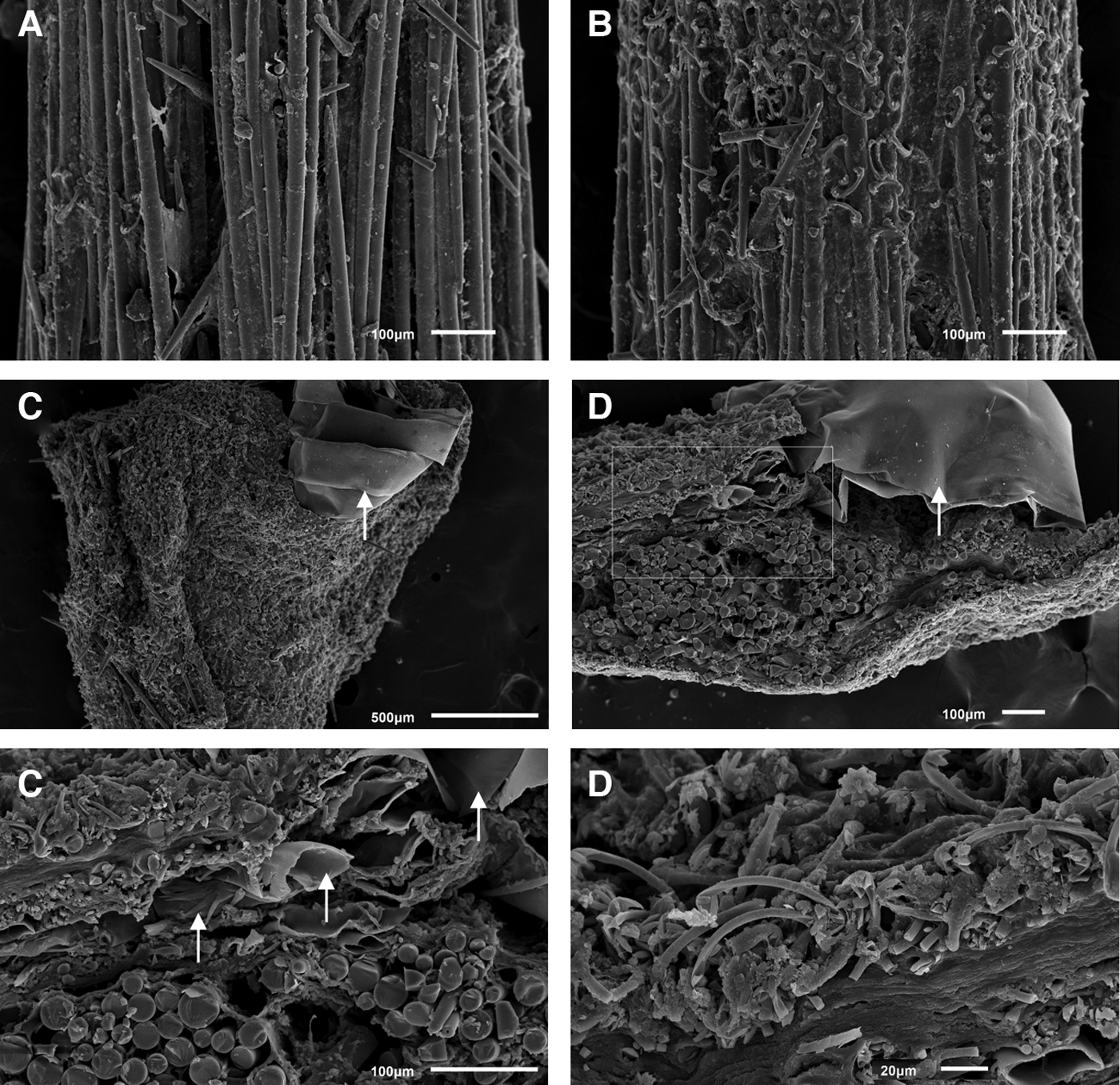
Stalk and secondary branches made of thick fibres of large fusiform styles without any twisting; rhizoids made of similar fibres of spicules linked by spongin. Covering of the stalk, devoid of microscleres in most parts, with a few isochelae near the spherical swellings. Swellings have a confused skeleton of fusiform styles internally, sometimes arranged in bundles, and an outer cover of extremely numerous anchorate isochelae. Remains of crustacean carapaces can be found on the surface of these spheres (Figure 3).
Skeleton of Chondrocladia (Chondrocladia) robertballardi sp. nov. (holotype) using SEM. (A) Surface of the stalk with large fusiform styles without any twisting or anchorate isochelae; (B) surface of the secondary branches in the vicinity of the spheres, with large fusiform styles and anchorate isochelae; (C) surface of a sphere with remains of crustacean skeletons; (D) cut perpendicular to the surface of one sphere with bundles of mycalostyles and a thick layer of anchorate isochelae; (E) detail of (D) with several crustacean appendages included (arrows); (F) section through the sphere surface, showing the anchorate isochelae layer on a base of spongin.
SPICULES
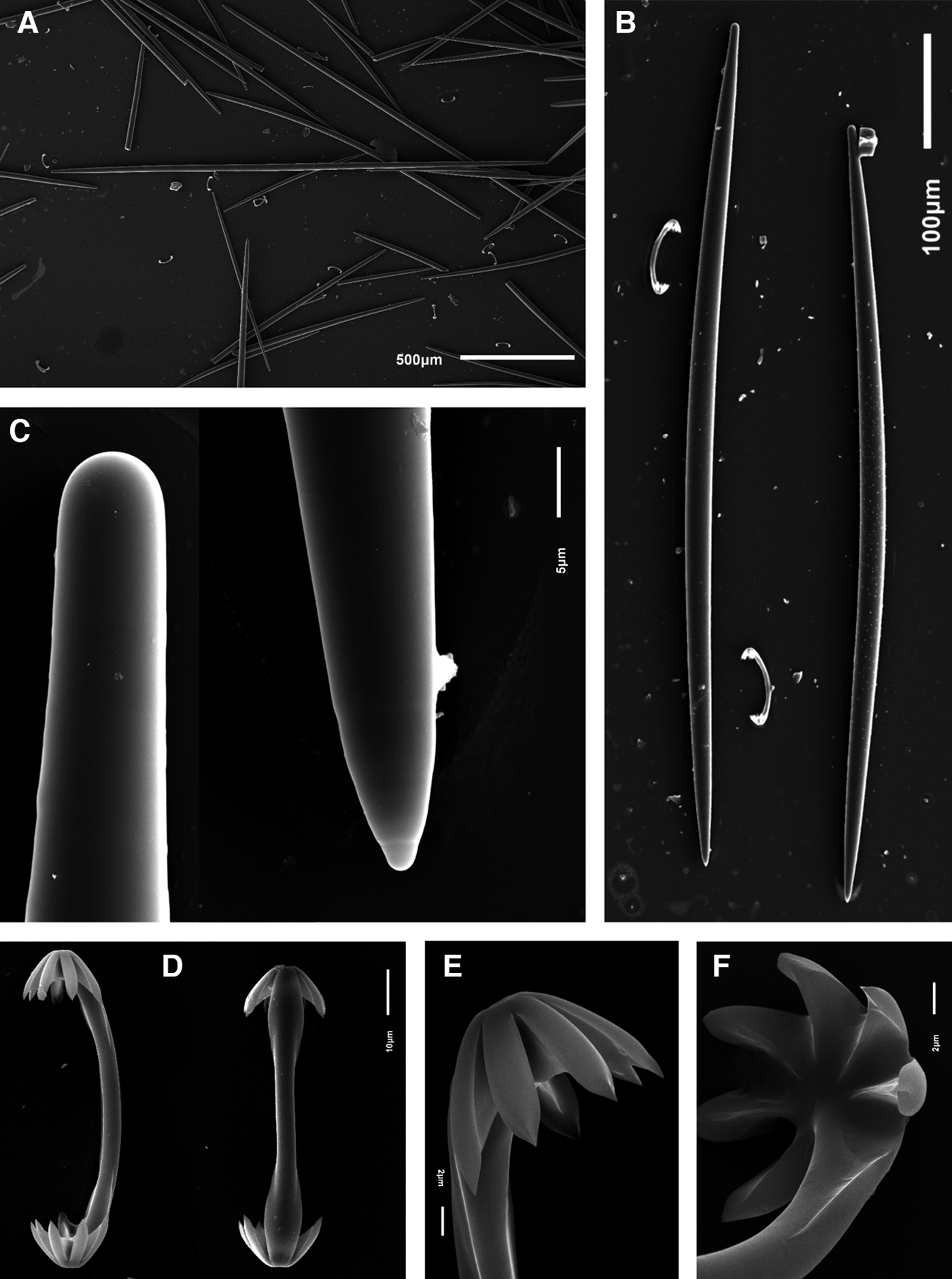
Spicules of Chondrocladia (Chondrocladia) robertballardi sp. nov. (holotype) using SEM. (A) Mycalostyles, general view of the spicules; (B) mycalostyles and anchorate isochelae; (C) head and tip of a mycalostyle; (D) anchorate isochelae, lateral and frontal view; (E) anchorate isochelae, lateral view; (F) anchorate isochelae, inner view.
Chondrocladia (Chondrocladia) robertballardi sp. nov. Comparison among specimens of three different areas. (A and B) Gorringe Bank, holotype; (C and D) Galicia Bank, paratype 1; (E and F) Galicia Bank, paratype 2.
Spicule dimensions of Chondrocladia (Chondrocladia) robertballardi sp. nov.
Megascleres. Mycalostyles with a variable length/thickness ratio; some short and thick (562 × 8.3 µm) and others long and slender (2181 × 36 µm).We cannot make a division in size classes because there are intermediate sizes. Larger mycalostyles are generally straight and feebly fusiform whereas the smaller mycalostyles are fusiform and slightly curved; both ending without an inflated head. Overall size: 528–2579 × 6.3–37 µm.
Microscleres. Anchorate isochelae rare or absent in the rhizoid, common in the stalk and very abundant in the inflatable bulges, with six short, lanceolate and sharply pointed teeth at each end; curved shaft with fimbriae and a marked flat end on the underside. Size: 52–70 × 3.4–20.3 µm.
DERIVATIO NOMINIS
Dedicated to Dr Robert Ballard, Oceanographer and Director of the Center for Ocean Exploration, University of Rhode Island, President of the Ocean Exploration Trust, of the Institute for Exploration, and the man who is internationally known for finding the wreck of the ‘Titanic’. This species is dedicated in honour of his contribution to the knowledge of the deep-sea, especially through the numerous campaigns made with the EV ‘Nautilus’ and ROVs ‘Hercules’ and ‘Argus’.
REMARKS
There are 37 known species of the genus Chondrocladia distributed in all oceans, between 200 and 8660 m depth. Three subgenera are recognized (Lee et al., Reference Lee, Reiswig, Austin and Lundsten2012): Subgenus Chondrocladia (31 species), Subgenus Meliiderma, 1886 (six species) and Subgenus Symmetrocladia Lee et al. Reference Lee, Reiswig, Austin and Lundsten2012 (two species).
Chondrocladia (Chondrocladia) robertballardi is present in deep waters off the Iberian Peninsula (1400–1738 m) and probably in the Cantabrian Sea (north of Spain) at similar depths. In another expedition of the Indemares Project, in the Aviles Canyon, we had filmed and photographed with ROV an identical specimen to the holotype of C. robertballardi. As we cannot study the skeleton, this material was not included in the present paper. These three areas (Gorringe, Galicia and Cantabrian Sea) are influenced by the Mediterranean water (MW). It is formed at the Gulf of Cadiz from the intense mixing of Atlantic central waters and the warm and salty overflow from the Mediterranean Sea through the Strait of Gibraltar. The MW spreads at 1000 m and flows northwards along the west Iberian margin, reaching the Cantabrian Sea and high latitudes such as the Porcupine Bank (Prieto et al., Reference Prieto, González-Pola, Lavín, Sánchez and Ruiz-Villarreal2013). Probably the dispersion of the species occurred from south to north.
The new species differs from other Chondrocladia in external morphology. The shape of C. robertballardi sp. nov. is a large stalked sponge with translucent spheres in the middle of secondary axes and a rhizoid fixation system. Some species of this genus have the lateral branches grouped at the top of the stalk or with a cylindrical stalk ending in an enlarged body from which secondary branches radiate in all directions, each ending in a translucent sphere (C. koltuni Vacelet, 2006, C. lampadiglubus Vacelet, 2006) but others, as the new species, have them distributed all along the stalk and have dichotomous ramifications. The location of the spheres in the middle of the lateral branches is an unusual character, which is also present in C. michaelsarsi (Arnesen, Reference Arnesen1920, p. 15) and C. virgata (Thomson, Reference Thomson1873, p. 187, figure 36). Chondrocladia robertballardi most closely resembles both, which were originally described from material collected in nearby areas. Chondrocladia michaelsarsi was collected in the Ibero-Moroccan Gulf and the Canary Islands between 1215–2603 m depth (Arnesen, Reference Arnesen1920). Chondrocladia virgata was collected just off the Strait of Gibraltar at a depth of 872 m.
Chondrocladia (C.) robertballardi. sp. nov. is different from other species of this genus with a secondary megasclere type such as C. schlatteri Lopes, Bravo & Hajdu, 2011, that possesses acantho (subtylo) styles. There is only a single type of megasclere, the mycalostyles, and only one size-class of anchorate isochelae.
This species differs from other species of Chondrocladia with two or more categories of anchorate isochelae: C. asigmata Lévi, 1964, C. koltuni Vacelet, 2006, C. levii Cristobo, Urgorri & Rios, 2005 and C. nani Boury-Esnault & van Beveren, 1982. C. scolionema Lévi, 1993 has a single category of anchorate isochelae, similar to C. robertballardi, but differs because it has only three teeth while the new species has six.
The lack of sigmancistras and sigmas in this species differentiate it clearly from other Chondrocladia such as C. albatrossi Tendal, 1973, C. amphactis (Schmidt, 1880), C. arctica (Hansen, 1885), C. arenifera Brøndsted, 1929, C. antarctica Hentschel, 1914, C. burtoni Tendal, 1973, C. clavata Ridley & Dendy, 1886, C. concrescens (Schmidt, 1880), C. crinita Ridley & Dendy, 1886, C. dichotoma Lévi, 1964, C. fatimae Boury-Esnault & van Beveren, 1982, C. gigantea (Hansen, 1885), C. gracilis Lévi, 1964, C. guiteli Topsent, 1904,C. lampadiglobus Vacelet, 2006, C. magna Tanita, 1965, C. michaelsarsi Arnesen, Reference Arnesen1920, C. multichela Lévi, 1964, C. nicolae Cristobo, Urgorri & Rios, 2005, C. nucleus (Hansen, 1885), C. pulvinata Lévi, 1993, C. vaceleti Cristobo, Urgorri & Rios, C. verticillata Topsent, 1920, C. virgata Thomson, Reference Thomson1873 and C. yatsui Topsent, 1930.
The new species here described raises to eight the number of Chondrocladia species in the north-east Atlantic (see an overview in Lopes & Hajdu, Reference Lopes and Hajdu2014, figure 13) and highlights that many new species are likely to be found in these special and yet under-explored habitats of the deep-sea.
ACKNOWLEDGEMENTS
This study was made possible thanks to the invaluable work of all the participants in the NA-017 EV ‘Nautilus’ expedition but the authors are especially grateful for the support of Katy Croft Bell, leader of the cruise, Alberto Serrano Indemares, leader of the Banco de Galicia Project and Eugenia Majón for her friendship, help and logistical support during the ‘Nautilus cruise’. We gratefully acknowledge Araceli Muñoz (SGM) for providing the map of collecting areas for the new species. We thank the crews of EV ‘Nautilus’, RV ‘Miguel Oliver’ and RV ‘Thalassa’ for their seamanship and support. This study was partially funded by the European Commission LIFE+ ‘Nature and Biodiversity’ call, and included in the INDEMARES Project (07/NAT/E/000732). The Biodiversity Foundation of the Ministry of the Environment was the institution responsible for coordinating this project in which various scientific institutions and NGOs were involved. We gratefully acknowledge Daniel Gonzalez of the Oceanographic Centre of Gijón (IEO) for his technical help. The authors also appreciate the helpful technical assistance of Alfredo Quintana from the Electron Microscopy Service of the University of Oviedo. We further warmly acknowledge Jon Hestetun (University of Bergen, Norway) for insightful discussions and for sharing slides of C. michaelsarsi and C. virgata type-material.