Introduction
Globally, people are living longer and there has been a growing interest in the quality of their lives, including their mental health and sense of wellbeing. In many cultures, ageist views of later life are characterised by loss of physical and mental functioning, poor mental health for older adults and perceptions that ageing is inherently depressing (Jain et al., Reference Jain, Kalesnikava, Ibrahim and Mezuk2021). Research has demonstrated that such negative attitudes are pervasive and that they are internalised by younger and middle-aged people well before they reach their later years (Kotter-Gruhn and Hess, Reference Kotter-Gruhn and Hess2012). Moreover, these ageist perceptions have implications for older adults and their sense of self, as well as their responses to mental health in later life.
In Canada, older men fall into one of the highest risk groups for contemplating suicide and those over the age of 85 (oldest old) have the highest rate of completion (Conwell, Reference Conwell2014; Statistics Canada, 2014). This fact has drawn attention to the gendered dimensions of mental health in later life, especially with increasing numbers of older individuals identifying as non-binary and transgender. Today's older men face a trilogy of stigmas in relation to ageing, mental health and gender. In general, men hold more stigmatising views about mental health (Oliffe et al., Reference Oliffe, Ogrodniczuk, Gordon, Creighton, Kelly, Black and Mackenzie2016); they often express their mental health differently than women (Gough, Reference Gough2016), and they are less likely to seek support than women (Spendelow, Reference Spendelow2015), whether it be informal support from family or community, or formal support through service providers. Attitudes towards help-seeking among men have been linked to understandings of masculinity, but these understandings of masculinity are not experienced or expressed uniformly by all men.
Masculinity intersects in particular ways with age. For example, because work is traditionally the domain from which men derive much of their sense of identity and self-worth, retirement can be particularly difficult for older men as they can no longer fulfil traditionally male identified breadwinner roles (Oliffe et al., Reference Oliffe, Ogrodniczuk, Bottorff, Johnson and Hoyak2012). In addition, older men can experience increasing isolation once they no longer have the workplace to develop bonds with others outside the home (Milligan et al., Reference Milligan, Neary, Payne, Hanratty, Irwin and Dowrick2016). Indeed, lost social bonds can accumulate in later life as bereavement and divorce are both more common with increasing age (Affleck et al., Reference Affleck, Carmichael and Whitley2018). Although some research suggests that masculinities are shifting and becoming more diverse (Bridges and Pascoe, Reference Bridges and Pascoe2014), most research that includes older men, particularly in rural places, indicates that their practices and values are more traditional (Garnham and Bryant, Reference Garnham and Bryant2014; Roy et al., Reference Roy, Tremblay, Robertson and Houle2017) and thus they may not seek support as needed. These values and practices surrounding masculinity may explain, in part, why depression among older men can often go undetected; in addition, emotional pain, sense of helplessness, shyness in coming forward with concerns and anger held over many years can also influence help-seeking (Conejero et al., Reference Conejero, Olie, Cortet and Calati2018).
Although we recognise the unique contexts surrounding older men's mental health, research on men's mental health continues to focus on young and middle-aged men. Research on older men's mental health is still relatively limited and deficit focused (Oliffe et al., Reference Oliffe, Ogrodniczuk, Bottorff, Johnson and Hoyak2012; O'Callaghan and Warburton, Reference O'Callaghan and Warburton2017). Very little attention has been given to how older men with mental health problems experience age and what it might mean to do so while living with mental health problems, particularly in rural places. In this article, we set out to study rural men's perceptions, experiences and expressions of mental health and wellness in relation to ageing. We draw on semi-structured qualitative interviews to explore experiences of growing older and how men, aged 50–79, reflect on their mental health and wellness over their lives. In doing so, we explore how age and time can become resources for some men by helping them to develop strategies, supports and a more positive sense of self – but for other men, ageing can simply be a process of survival.
Successful ageing and masculinity
Our study draws together concepts of successful ageing and masculinity. The often cited and contentious concept of successful ageing is most commonly associated with the work of Rowe and Kahn (Reference Rowe and Kahn1987, Reference Rowe and Kahn1998), who sought to challenge negative assumptions that ageing is inevitably a process of decline. Instead, successful ageing according to Rowe and Kahn emphasises independence, self-reliance and the ability to adjust as one ages. For Rowe and Kahn, this involved maintaining physical and cognitive functioning, warding off disease and disability, and maintaining meaningful social relations. In a similar vein, Baltes and Baltes (Reference Baltes and Baltes1990) described ageing successfully as the maximisation of gains and the minimisation of losses over a lifetime. In spite of the many valid criticisms of these dualistic definitions of successful ageing, what remains valuable about these early approaches is their emphasis on adaptation and positive aspects of ageing.
Critics of successful ageing have characterised the concept as an outcome and a kind of game which defines some older people as winners and others as losers, thus reinforcing individualism and ableism (Dillaway and Byrnes, Reference Dillaway and Byrnes2009). For decades, scholars have critiqued the idea of successful ageing as an objective end-point, recognising that older people are diverse, and thus experiences of success cannot all arrive at the same end-point (Scheidt et al., Reference Scheidt, Humphreys and Yorgason1999). More recently, Martinson and Berridge (Reference Martinson and Berridge2015) have called on social gerontologists to expand models of successful ageing by engaging with missing voices about their subjective experiences of successful ageing. Levitin (Reference Levitin2020) provides a modern and refreshingly new examination of the value of applying this frame of successful ageing, reminding us through his work that ‘successful ageing’ is still a very current construct and relevant idea.
Our research responds to Martison and Berridge's call with particular attention to the voices of rural men living with mental health problems. In addition, our research draws on the work of critical social gerontologists (Katz, Reference Katz2013; Katz and Calasanti, Reference Katz and Calasanti2015; Stowe and Cooney, Reference Stowe and Cooney2015) who argue that lifecourse perspectives are critical to understanding subjective experiences of ‘successful ageing’. Stowe and Cooney (Reference Stowe and Cooney2015) suggest that scholars must be attentive to the role of culture and place, time, structures and institutions, and social and relational resources in promoting successful ageing.
For men, in particular, a normative culture of masculinity can lead men to engage in behaviours that are not necessarily as conducive to health (Courtney, Reference Courtney2000), such as risk-taking, substance use and avoiding help-seeking. These are not just individual behaviours, they are shaped by social, cultural and economic contexts. On the other hand, some men may experience health advantages because of their access to certain resources (e.g. wealth, status and mobility). Underpinning increasingly critical views of successful ageing as a conceptual framework is an understanding that social inequalities shape experiences of successful ageing (Katz and Calasanti, Reference Katz and Calasanti2015). What then, does it mean for men living with mental health problems to experience successful ageing from their perspective? To answer this question, we turn to how adult ageing men themselves describe their own process of success as they age within the context of rural Manitoba, Canada.
Methods
This paper draws on a subset of data from a larger study focused on masculinity and rural men's mental health, which received ethics approval from the (Joint Ethics Review Committee) university research ethics committee. The larger study included 23 rural men, recruited through community events, press releases, and newspaper and radio advertisements. In this article, we focus on a sub-sample of ten participants between 50 and 79 years of age. The inclusion of young (middle-aged) men in our analysis is based on participants’ self-reflection; they identified as ageing men in their interviews and reflected on ageing and growing older (comparing themselves to their younger self) as part of their responses. We included the younger men because ageing emerged as a significant theme in their comments and specifically in relation to how they coped. In addition, one might argue that their experiences of mental health problems over the years have aged them, such that their chronological age is not reflective of their subjective ageing experiences. For example, like many older men, the younger men in the study were more reliant on services providing health and social care than would be typical of other men their age. The participants in the sub-sample sought professional support for mild to moderate mental health problems including self-reported and diagnosed symptoms of depression, anxiety, substance use, bipolar disorder, post-traumatic stress disorder and schizophrenia. The participants identified as heterosexual and one self-identified as Indigenous. More than half of the participants aged 50 and older were married (N = 6), three were divorced and one was widowed. None of the participants were currently farmers, although two had farmed in the past. Four men worked in professions related to health, social or government services. Additionally, two were unemployed, one was a mature student, two were retired and two identified themselves as veterans.
Each of the participants consented to participate in an individual interview that lasted approximately 90 minutes and followed a semi-structured guide. The guide was developed in partnership with a not-for-profit organisation providing remote (i.e. telephone or online) counselling to farmers, rural and northern Manitobans. The interview guide included a series of demographic questions, questions about social support (from whom and when) and questions about mental health experiences. Because discussing mental health is a sensitive subject, particularly in a rural context, men in the study were given the option of participating in an interview at home, the university or another community setting (e.g. café). The majority of interviews took place in the participant's home or at the university. This protocol helped to ensure that men felt comfortable during their interviews, contributing to the quality of data collected. Each of the interviews was digitally recorded and transcribed verbatim by a research assistant to enhance the confirmability of the data.
The interview transcripts were reviewed by three research team members to elicit broad themes using content analysis (Braun and Clarke, Reference Braun and Clarke2006). Content analysis requires that a reviewer retains theoretical and content knowledge of the literature in a designated area, in order to identify new and overlapping themes, as well as then moving beyond description and towards theorising the findings. In this case, literature on ageing men and mental health contributed to the analysis. In particular, the literature that was found contained few examples demonstrating the positive side to ageing men's mental health experiences – and yet the study participants expressed positive experiences and strategies particularly in relation to ageing. The participants’ positive reflections on ageing prompted us to use successful ageing as an analytical framework focusing on how men perceived successful ageing in the context of living with mental health problems.
The first two authors began a second stage of coding focused on the older participants, ageing and coping strategies over time. This involved reviewing the transcripts of older participants, coding for references to ageing, comparisons between the past and present, and men's descriptions of where and when they feel well and what constraints they face. Key overarching themes emerged in relation to time and sense of time, roles and relationships. The full research team discussed and confirmed final themes, after which the first author reviewed the ten transcripts again and conducted a final review of emerging themes. Our research team maintained quality in the process of data analysis through established guidelines for qualitative research (Braun and Clarke, Reference Braun and Clarke2006), e.g. we maintained an audit trail of our processes and we continually engaged in a review of emerging themes as a team through weekly team meetings. In the findings that follow, quotations are used to illustrate key themes and maintain the confirmability of the findings (see Table 1).
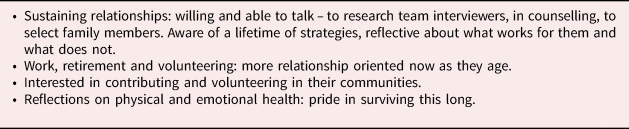
Key insights: men in our sample

Findings
The men in the study discussed their experiences of mental health and wellness over their lifetime. We found that the men spoke broadly about three key themes: sustaining relationships, work, retirement and volunteering; and reflections on physical and emotional health. In the first theme, the men reflected on the importance of long-term relationships to their wellbeing, and how they sustain and maintain these relationships. In the second theme, the men addressed the role that work, retirement and volunteering have on their sense of wellness. The final theme explores how the men reflected on physical and emotional health, including the intersections between the two.
Across each of these, the men identified specific resources and changing social positions that influenced their sense of ageing successfully, by their own definition. They also identified personal strategies they had used over the years for dealing with their own mental health problems on their own, and they talked about what worked for them now in contrast with other personal strategies that had not been successful in the past. Although not every participant was deeply self-reflective, young old and older men in the study generally considered which strategies worked and which ones were not as positive. The differences between men in the study and their sense of time and ageing as resources aligned with other resources such as education, income, and social and emotional support. We explore these relationships in more detail in the following sections.
Sustaining relationships
Family and relationships were an important source of social support for some men in our sample; however, not all men had sustained personal relationships, and some men sought out professional supports rather than familial and spousal supports. Several men reflected on the complex relationships that they had with various members of their family, which may have led to different help-seeking behaviours. Some men spoke about oppressive or abusive relationships within their families growing up and how that influenced their ability to sustain relationships over their lifetime. For example, Derrek (aged 53) said:
When I was younger, my father was, I wouldn't use the word so much now but the label abusive would fit, right? Physically, emotionally. Certainly, as I've grown older, understood that, had better perspective on that I think than when you are just an angry young man about it, right?
In reflecting on his relationships and the supportive people around him, he went on to add:
my first marriage failed ’cause it took me to my forties I'd say to figure out relationships and feelings. It was, I mean, and I don't know if we're totally figured out [second marriage] but, [I am] in a much better place with that than for a good chunk of my life really.
Consistent with research on masculinity and men, men in this sample described themselves as having a small number of close relationships. For example, when asked about social support, Adam, who is 60, responded, ‘there's a sprinkle of friends and family. I'm not near as much into family as my partner is’. Some men indicated that one of the strategies they had developed was being selective about those they let into their inner circle. Derrek (aged 53) said:
I've purposefully sort of distanced myself from more toxic, like negative people as I've gotten older. You know, other than people you have to work with that you can minimise your contact with, I really can't think of anyone in our circle that is really toxic or negative that way.
Although the men in the study perceived that they did not have many personally supportive relationships, some men indicated that they had developed stronger relationships as they aged. This is notable in regards to our overall view that as these men aged, they experienced some benefits to ageing. Nathan (aged 74) indicated, ‘Like I have certain friends that have been connected to with me for years and years and they're important too.’ He also emphasised the significant role that his partner played within his life, something we heard from several men who had sustained spousal relationships.
Men who had sustained relationships with an intimate partner over the years sometimes expressed guilt about what they had put their wives through and the work that their wives do for them. For example, Nathan (aged 74) said:
…sometimes you can kind of feel guilty about that from a personal point of view because you're not able to do what you used to do. But [partner's name] never makes me feel guilty. The guilt that I would feel would be my own guilt and I've pretty much forgiven that and allowed her to do way more work than she should.
Married men explained the integral role that their partners played in supporting their wellbeing. Other men like Owen (aged 67) reflected on how their past coping strategies such as drinking had hurt their partners. He said:
I know that my partner she does love me, and she stayed with me, but I've really, really hurt her. And so, we're still together and we really do hope and I really do hope that we will be forever.
Importantly, for both these older men, working with a social worker or therapist had helped them to negotiate sustainable relationships while managing mental health problems, revealing the importance of external support to individual perceptions of success as they aged. Another participant, Ryan (aged 67), explained that his partner had experienced depression, like him, and they supported one another. However, he noted that his partner had made an appointment for him to see a ‘shrink’ and that otherwise he would not have sought help. He added that through his relationship with his partner he learned ‘how to show anger, surprise, laughter, tears, and not be ashamed of it or embarrassed by it. So, it's [partner's name] that I've got to thank her for that’. Moreover, men indicated that they had learned and grew within their relationships and they expressed some pride in sustaining them. Family relationships played a protective role in the lives of men within the study by providing them with support. Importantly, the men felt empowered by their part in sustaining these relationships as they aged in spite of their mental health problems and the harmful events they went through together.
Some of the older men in the sample, however, were divorced and lived alone. Two of the divorced men discussed their fractured relationships with family members, in part resulting from their mental health problems as well as interactions with the criminal justice system. For example, Matthew, who is 54, said:
Yeah, I go to AA [Alcoholics Anonymous]. I am a part of AA (long pause) stuff like that. Go shopping. I live a pretty boring life. This is going to be a short interview (laughter) … I don't go anywhere; I don't do anything.
Matthew lived in an isolated area and he explained that most of the people he knew well no longer lived near him. He also indicated that he could not afford to drive often. Later in the interview, Matthew reflected on how his mental health problems and engagement with others had changed over his lifetime:
Well, my drinking stopped and then I just got a little bit older and I don't have a lot of issues anymore because I'm not really engaged in very much … I used to really have it hard. I [still] find it hard to motivate myself to do things for some reason being by myself all the time, I don't know. But other than that, my mental health like is okay. I talked to a few people and seems to be enough connection that I don't feel depressed but sometimes at night I'll feel depressed about being by myself and not being able to phone anybody ’cause I don't really know anybody.
Here, Matthew reflects on being isolated and feeling alone with no one else close by to talk with, especially in the evening. In spite of feeling lonely at times, Matthew identified some positive changes in relation to ageing. He associated his changing substance-use behaviour with ageing. In this way, ageing and shifting social attitudes towards drinking in the context of ageing may have had a positive influence on his coping strategies. While masculinity and youth intersected to reinforce drinking earlier in his life, this is no longer the case. In addition, the support he received from AA and his lack of engagement with peers with whom he used to drink also strongly influenced this change over his lifetime. Unfortunately, this combination of social and broader structural influences left him with few supportive relationships.
Work, retirement and volunteering
Work, retirement and volunteering emerged as relevant themes in relation to ageing and feeling healthy. For example, being retired caused some men to reflect on work in a new way. In explaining his hobbies and activities, Thomas (aged 60) said: ‘I found myself more busy now but the things I do, I wanna do and find them more satisfying because it's something I wanna do.’ At other points in the interview, he explained that there were fewer constraints on his mental health now in comparison to the past because of his retirement from a stressful work environment:
Actually, I think there is less [stress] now than there's ever been just because I am retired. Right. When I [was working] … there was restrictions on being healthy because of my job. Right. I'm supposed to be a boss. I'm supposed to have all the answers. Know what to do in every occasion. Often times, I didn't know what the hell I was doing.
Thomas felt a sense of relief having left a highly masculinised work environment for early retirement. Importantly, while research has often emphasised men's self-identification with work and challenges in retirement, not all men identify with, and find support within, the culture of their workplaces.
In contrast, Matthew (aged 54) struggled to find work in his more isolated rural community. He explained:
Like I'd probably be better off in the city for my condition but I can't really afford to live in [city name] on my income ’cause I don't get any money and I couldn't afford an apartment or anything. So, I'm kind of stuck out here and like rural mental health is pretty limited.
Matthew described a set of complex issues that led to his living rurally, but also contributed to his unemployment and lack of financial resources. He mentioned working two different jobs in larger cities when he was a younger man, but he was unable to hold down a stable job. He reasoned that he could not keep a job because ‘I was in and out of the hospital all the time ’cause I'm bipolar’. The absence of work reinforced his sense of isolation and stigma. He felt the surrounding community thought, ‘he's lazy, he's no good’.
Owen (also diagnosed with bipolar disorder) is retired at age 67 from a public-sector job and continued to find meaningful work as a volunteer in his community. He explained that he had managed to keep his job over the years in spite of great challenges with his mental health and medications, but he really found purpose when he started to advocate for mental health issues at work and now as a retired volunteer:
When I'm speaking in front of groups, when I'm facilitating, when I'm talking to people about mental health, and when I'm being an advocate, me being able to essentially come out and help in a way that I never ever in my life thought I would do, it's astonishingly wonderful that I'm alive. For quite a period of my life, that wasn't something I cared about at all. And then when I got better, it still was tricky and then there was a period of time in my life where I realised as I was driving my vehicle that I would never think about suicide again because I want to see life through no matter how hard it was going to be. And I knew it was going to be tricky for me but that was that.
For the older men in this study, men who have struggled with mental health problems for many years, being able to contribute to their communities had become a source of pride and wellbeing. Owen (aged 67) further commented that his voluntarism contributed to his sense of self-acceptance. He said:
Well, I have come to that point in my life where I believe I am a good person, I believe that the things that I do are more beneficial; I'm more help to the world than harm.
Moreover, each of the older men in the study spoke about the importance of being able to see themselves as contributors for their sense of wellbeing as they aged, and this was not necessarily tied to work.
Reflections on physical and emotional health
Men in the study reflected on their physical and emotional health with optimism and a sense of growth. Several men suggested that their emotional growth was bolstered by caring less about what other people think as they aged as well as their own growing self-acceptance, as noted above. For example, Ryan (aged 67) was very positive and reflective throughout his interview. He described what he had learned over his lifetime about being a man with emotions:
We're [men] not supposed to have any feelings. We're supposed to be able to cope with everything (pause) which is rubbish. And you don't talk to people. You don't get help. As I get older, I don't care so much about what other people think. It's always nice to be liked but if you don't like me, your loss sorry. I have no time for false people. Insincere. Don't suffer fools gladly, that's the way it is.
Ryan felt more comfortable rejecting dominant masculine norms around emotions as he aged. Regarding other dominant norms about physical strength and men's health, he added:
Ryan: Well, I'm fortunate I'm not dead. A lot of people my age are dying off or even before. As far as I know I've got no chronic illness. And I'm physically fit. I do a lot of walking and animal handling with [farm animals] and whatever. I mean firefighting; you gotta be fit as well.
Researcher: Okay. In general, would you say your mental health is excellent, very good, good, fair or poor?
Ryan: That's a tricky one because it's up and down. It depends on the day. It depends how I wake up. It depends how I feel. It's not excellent, it's not very good. It's good.
Interestingly, having lived much of his life with diagnosed depression, Ryan did not consider himself to be living with a chronic condition, or at least he did not have a chronic condition directly associated with ageing. Relative to his youth and to the other older men he associated with, he felt healthy because he was still alive and he continued to have the resources to adapt to daily changes, including changes in his mental and emotional wellbeing on a day-to-day basis.
Nathan (aged 74) reflected on his physical health in a similar manner, saying, ‘I'm not as good as I once was (laughter). I would say it's good for my age.’ However, he later explained that thinking about his physical health sometimes made him worried and that he had to be very mindful of this to manage his anxiety. He stated:
As I get older, I worry about my longevity and my health. And that causes me a bit of an issue ’cause I don't actually like going to see doctors and I don't like going to hospitals, and I don't like taking tests and stuff like that. But as you get older, it just becomes more prevalent that you have to go through this.
Although Nathan expressed discomfort seeking support over the course of his life, ageing helped to normalise support seeking. Similarly, Owen explained that it took him ‘decades’ to not only access support for his mental health problems but also get to the point where he ‘had all the pieces in place’.
Other participants, such as Sam (aged 78), suggested that ageing had prompted him to adopt new coping strategies, particularly engaging in different physical activities:
Well, my age because I'm fighting age. I'm fighting a potential Parkinson's. And I'm doing it well. I walk two hours a day at the Y [YWCA] every day. And I try to do it without exception. So, I work out hard. I've decided that this is where you know I have to do this for myself because I don't want to be weak.
In contrast to the other older men, Sam described himself as ‘fighting ageing’. By saying so, he demonstrates resistance to ageing ‘weakly’ in line with normative ideals of masculinity. It is interesting to note that Sam was also much less forthcoming and accepting of his mental health problems throughout his interview. He was divorced and lived alone, without strong social supports. His response to ageing, and physical and emotional health, highlights differences in responses to ageing among older men who are more socially isolated. The gym was very important to him. This is not to suggest that older men who live alone with mental health problems cannot age well, and develop better coping strategies; his example actually suggests that in some respects they can, but their strategies will most certainly look different.
In another example, Matthew (54), who is divorced, reflects on the value of developing a religious or faith-based practice as he grows older. He said, ‘I read a lot of Buddhism so I kind of make my choice from that.’ He also explained that he has a friend with whom he discusses Buddhism: ‘He's a Buddhist too. So, he's almost like a guru in a sense to me in Buddhism. He studies Buddhism so he gives me pointers on Buddhism.’ For him, Buddhism provided ‘pointers’ and social connection. Derrek (aged 53) also became more religious and described ‘spiritual connection’ and being with a faith community as an important resource for his emotional health and ageing well.
Discussion
In this article, we explored how rural men over the age of 50 living with mental health problems described their experiences of ageing. In doing so, we drew together literature on successful ageing, masculinity and rural mental health. Our findings demonstrate how the ten men in our study perceive ageing and time as resources for personal growth, particularly in relation to developing strategies to cope with sometimes longstanding mental health problems. Participants expressed gratitude, pride and self-acceptance in relation to ageing, which they did not associate with their earlier lives. In addition, participants highlighted the external resources that helped them to maintain relationships, to contribute to their communities through volunteerism in retirement, and to reflect with a degree of optimism in relation to their emotional and physical health. In doing so, the findings point to the usefulness of considering success from the perspective of missing voices (Martinson and Berridge, Reference Martinson and Berridge2015), such as men living with mental health problems (Stowe and Cooney, Reference Stowe and Cooney2015), and with consideration of the broader resources that support success.
Reflecting on their ageing experiences, men in the study identified a sense of pride in sustaining relationships, these might be fewer but more positive relationships, and a better understanding of their relationships over time. Some of the men in our study were able to sustain longstanding spousal/partner relationships (Owen) as well as connections with friends (Nathan), consistent with traditional definitions of successful ageing. However, some experienced relationship challenges related to histories of abuse (Derrek), as well as ‘drinking too much’ (Matthew). Notably, our findings suggest that participants’ ability to negotiate these challenges with a sense of success appeared to increase over the years, through their own learning but also with the support of others, such as mental health services (e.g. social worker, counsellor and psychologist). Some men had become more selective about their relationships as they aged to protect themselves (Derrek). Other men (such as Owen) reflected with some pride that they had sustained relationships with friends and community members over a long time and that this was important for sustaining good mental health while ageing with mental illness.
The married men acknowledged the critical support they received from their spouses and they revealed their pride in having maintained a marriage in spite of difficulties as they aged. In doing so, they showed their adherence to, and benefits accrued from, traditional gender roles and masculine identities (Connell, Reference Connell2002, Reference Connell2005; Connell and Messerschmidt, Reference Connell and Messerschmidt2005). Keeping a partner was a marker of normalcy and acceptance as a man, one they had achieved. Challenges here arose when older men felt they were too dependent on their wives, rather than conforming to traditional notions of being a provider. However, within their intimate relationships, some said they learned to express and accept their vulnerability in their spousal relationships as they aged (Ryan). This is consistent with other studies of masculinity and men's mental health, which indicate that men living with mental health problems may express their vulnerability in private settings with intimate partners but avoid expressing ‘weakness’ in public settings (Coen et al., Reference Coen, Oliffe, Johnson and Kelly2013). Other studies that focused on help-seeking behaviour among older men specifically, suggest that as men age, they may appreciate that they are not invincible and have a greater tendency to ask for help (Tannenbaum and Frank, Reference Tannenbaum and Frank2011). Study participants revealed important family and friend relationships that supported their ageing well with a mental health problem.
In contrast to other studies, many of the men in this study did not derive a strong sense of self-identity from their work (Affleck et al., Reference Affleck, Carmichael and Whitley2018). For some, they were unable to keep a job throughout much of their lives. Others did not struggle to retain their jobs; however, they struggled with the masculine cultures of their workplaces. For some men, retiring was liberating, since they were no longer constrained by this traditional work-based identification and culture as men, but they had some financial means to pursue things they enjoyed. Men in this study felt most successful in their work and retirement when they felt they were contributing in a meaningful way to their communities and people in their lives. As other studies have noted, this sense of connectedness and contribution is fundamental to men's mental health, particularly in preventing suicidality (Conwell, Reference Conwell2014).
When compared to their younger selves, men in this study reflected on and expressed a more positive view of themselves and their health as they aged. They expressed a range of different positive emotions including gratitude, self-acceptance, and a sense of humour about ‘not being dead yet’ and having survived despite mental health problems. In fact, some men were grateful that they found themselves in a time in their lives where they wanted to keep living, which had not always been their desire. Being able to articulate this positive sense of self is key to setting the stage for a more optimistic future. We argue that these findings demonstrate how this subset of participants are in the process of ageing successfully, by their own definition; they have developed strategies for dealing with their mental health problems as they aged. In this way, time has been a valuable and significant resource for these men.
We caution, however, against misinterpreting our findings as a suggestion that men simply grew out of their problems as they aged. This is certainly not our argument. We would also add that not all men had the resources to sustain relationships, keep contributing to communities they resided in and not all were able to reflect positively on their overall health. Consistent with other studies of rural men's mental health, some of the participants experienced greater isolation, barriers to employment, poverty and stigma because of the way independence is embedded in the culture and landscape of rural places (Roy et al., Reference Roy, Tremblay, Robertson and Houle2017). Still, they reflected positively on their ability to adapt to their own personal and sometimes extremely difficult circumstances, particularly as they aged. Their stories highlight the importance of perspectives on successful ageing, which emphasise the role of structures, relationships and events in individual ageing paths (Katz and Calasanti, Reference Katz and Calasanti2015). Successful ageing is not simply an individual experience or outcome; it can also be a process of adapting and accumulating resources over time. This underscores what the critiques of the Rowe and Kahn model of successful ageing have said as well, in that time and place, culture and society shape how individuals can age well (Stowe and Cooney, Reference Stowe and Cooney2015). This is not a lone pursuit; ageing successfully requires resources, community and family, and shifts in social norms about how ageing is perceived.
Our conclusions must be considered within a set of limitations, particularly in relation to our sample. First, our sample of participants is relatively small, and we have no participants characterised as the oldest old (85+). Importantly, our sample reflects a broader focus on rural men's mental health rather than an exclusive focus on ageing and mental health. The strength of our analysis is based on the prominence with which ageing and reflections on ageing as a resource emerged within the data. It is also possible that some of the optimism that men shared, particularly those recently retired, reflects a ‘honeymoon stage’ and that their experiences and perceptions will change again over their own lifetime. More research is needed to explore older men's experiences and perceptions of successful ageing as they age. It is also likely that men who were more isolated and had more negative experiences felt less comfortable coming forward to participate in this research. Our study cannot speak to the perceptions of those men who have been the most isolated and unwilling to talk about mental health in later life.
One thing is clear from this subset – these men were very eager to talk, they were fluent in their discussion about their own mental health and wellbeing, and the masculinised norm of ‘not talking’ was not as common a characteristic at this time in their lives (Herron et al., Reference Herron, Ahmadu, Allan, Waddell and Roger2020). These interviews highlight clearly that most of these men have accumulated strategies, they were more aware of which resources work for them personally and they articulated this awareness to others. They expressed successful ageing in relation to sustaining positive relationships over time, being able to retire and having opportunities to contribute to their communities, and accepting their physical and emotion health. In conclusion, we refer to King et al. (Reference King, Calasanti, Pietila and Ojalain press), who suggest that the study of masculinity has much to gain from a focus on the intersectionality of gender and age. By listening to the fears (and experiences) of those who are ageing, we advance the research on masculinity as well.
Financial support
This work was supported by the Social Sciences and Humanities Research Council of Canada (grant number 430-2018-00320).