Introduction
The brine shrimp Artemia Leach, 1819, a small crustacean belonging to the order Anostraca within the class Branchiopoda, is a characteristic inhabitant of hypersaline aquatic ecosystems such as coastal lagoons, inland salt lakes (chotts and sabkhas), and salterns worldwide, with the notable exception of Antarctica (Persoone and Sorgeloos, Reference Persoone, Sorgeloos, Persoone, Sorgeloos, Roels and Jaspers2000; Van Stappen, Reference Van Stappen, Abatzopoulos, Beardmore, Clegg and Sorgeloos2002; Samraoui et al., Reference Samraoui, Chakri and Samraoui2006; Ghomari et al., Reference Ghomari, Selselet-attou, Hontoria, Moncef and Amat2012; Amorouayeche et al., Reference Amorouayeche, Belksier and Amarkouayache2024). Its remarkable physiological adaptations, particularly a highly efficient osmoregulatory system, allow it to thrive in extreme salinity conditions where predators and competitors are scarce or absent (Gajardo et al., Reference Gajardo and Beardmore2012; Kara and Amarouayache, Reference Kara and Amarouayache2012; Lantushenko et al., Reference Lantushenko, Meger, Gadzhi, Anufriieva and Shadrin2022). Ecologically, Artemia often represents a significant component of the biomass in these extreme environments, serving as a crucial food source for specialist waterbirds, particularly flamingos and shorebirds (Samraoui et al., Reference Samraoui, Chakri and Samraoui2006; Amarouayache et al., Reference Amarouayache, Derbal and Kara2009a). Economically, Artemia is of immense importance to the global aquaculture industry. Its dormant cysts (embryos in diapause) can be stored for long periods and hatched on demand to produce live nauplii (larvae), which serve as an indispensable live feed for the larval stages of numerous commercially important fish and crustacean species (Madkour et al., Reference Madkour, Dawood and Sewilam2022). Approximately 85% of live prey used in marine finfish and shellfish hatcheries consists of Artemia nauplii (Dhont and Van Stappen, Reference Dhont, Van Stappen, Støttrup and McEnvoy2003; Amarouayache et al., Reference Amarouayache, Derbal and Kara2010). The global market for Artemia cysts exceeds 4,000 tonnes annually, underscoring their critical role in supporting the multi-billion-dollar aquaculture sector (Van Stappen et al., Reference Van Stappen, Abatzopoulos, Beardmore, Clegg and Sorgeloos2002; Amorouayeche et al., Reference Amorouayeche, Belksier and Amarkouayache2024).
North Africa, including Algeria, possesses a wealth of saline and hypersaline ecosystems, primarily chotts and sabkhas, distributed across coastal, high plateau (Hauts Plateaux), and Saharan regions (Gauthier, Reference Gauthier1928; Samraoui et al., Reference Samraoui, Chakri and Samraoui2006; Ghomari et al., Reference Ghomari, Selselet-attou, Hontoria, Moncef and Amat2012; Kara and Amarouayache, Reference Kara and Amarouayache2012; Amorouayeche et al., Reference Amorouayeche, Belksier and Amarkouayache2024). These habitats harbour diverse Artemia populations, whose presence was first documented by Blanchard and Richard (Reference Blanchard and Richard1890) and Gauthier (Reference Gauthier1928). Subsequent research efforts, particularly over the last few decades, have aimed to characterise these Algerian populations, assess their potential for aquaculture exploitation, and understand their ecological roles (Zemmouri, Reference Zemmouri1991; Gagneur and Kara, Reference Gagneur, Kara, Wetzel and Gopal2001; Kara et al., Reference Kara, Bengraine, Derbal, Chaoui and Amarouayache2004; Amarouayache et al., Reference Amarouayache, Derbal and Kara2009b). Despite numerous studies, a comprehensive synthesis of the taxonomy, genetic diversity, spatial distribution, reproductive biology, biochemical composition, exploitation potential, and aquaculture applications of Artemia in Algeria has been lacking. Many Algerian chotts and sabkhas remain challenging to access and study due to their ephemeral nature and remote locations, hindering consistent exploitation of wild resources (Gauthier, Reference Gauthier1928; Samraoui et al., Reference Samraoui, Chakri and Samraoui2006; Amorouayeche et al., Reference Amorouayeche, Belksier and Amarkouayache2024). Furthermore, the increasing global demand for Artemia cysts and the potential impacts of climate change on these sensitive wetland ecosystems underscore the need for a thorough understanding and sustainable management of Algerian Artemia resources (Salimi et al., Reference Salimi, Almuktar and Scholz2021; Chabet Dis et al., Reference Chabet Dis, Refes, Derbal, Aouiche, Mejdoub, Inoubli and Hmīed2024a).
This review aims to consolidate current knowledge of Artemia in Algeria by drawing on the available scientific literature, including journal articles, conference proceedings, and theses. It will cover the identification and distribution of different Artemia species and strains (bisexual and parthenogenetic), their reproductive strategies and life history traits, their biochemical profiles (particularly fatty acids), the potential for exploiting natural populations, their suitability for aquaculture, and the challenges and future perspectives for research and management. By synthesising this information, this review seeks to provide a valuable resource for researchers, aquaculturists, and environmental managers interested in Algerian Artemia.
Taxonomy and genetic diversity
Morphological focus
The taxonomy of Artemia in Algeria reflects the genus’s overall complexity, characterised by high morphological plasticity, diverse reproductive modes, and frequent polyploidy, which together complicate species delimitation (Sainz-Escudero et al., Reference Sainz-Escudero, López-estrada, Rodríguez-flores and García-parís2021). Populations across Algerian salt lakes exhibit both bisexual and parthenogenetic reproductive strategies, with varying ploidy levels documented across habitats (Ghomari et al., Reference Ghomari, Selselet, Hontoria and Amat2011; Kara and Amarouayache, Reference Kara and Amarouayache2012). While A. salina (Linnaeus, 1758) predominates in sites such as Bethioua Saltern, Chott Marouane, Garaet El Tarf, and Sabkha Ez-Zemoul, parthenogenetic populations are more common in Sabkha Sidi Bouziane, El-Bahira, Goléa Mnea, and Ouargla (see Table 1 and Figure 1 for the provinces and mapped geographical positions of the hypersaline aquatic ecosystems reviewed in this article) (Ghomari et al., Reference Ghomari, Selselet, Hontoria and Amat2011; Hidouci et al., Reference Hidouci, Ghomari, Maamri and Othmani2022).
Potential Artemia sites in Algeria (B: bisexual population; P: parthenogenetic population; 2n, 4n: indicates the ploidy level of a parthenogenetic population [2: diploid, 4: tetraploid]). Adapted from Kara and Amarouayache (Reference Kara and Amarouayache2012) and Missoum (Reference Missoum2022)

Table 1 Long description
Rows list 18 Algerian sites with columns for site name, geographical coordinates, area in hectares, depth in meters, mode of reproduction, species, and reference numbers. Areas range from less than 1 hectare at Gharabas Lake, Chott Touggourt, and Mellaha Guergour El Amri to 76800 hectares at Sabkha Timimoun, 48000 at Chott Melghir, 43000 at Sabkha Oran, and 36000 at Chott Marouane. Depth is often not given; reported depths include 40 maximum at Chott Marouane, 0.6 at Sabkha Ez Zemoul, 2 maximum at Golea Salt Lake, and a maximum depth value is listed for Garaet El Tarf without a number. Mode of reproduction is missing for several sites; where provided it includes bisexual only at Chott Marouane, Garaet El Tarf, Sabkha Timimoun, and Sabkha El Melah, and parthenogenetic diploid at Sabkha Oran and Chott Ouargla. Mixed modes appear at Sabkha Ez Zemoul with bisexual and parthenogenetic diploid, at Chott Melghir with bisexual and parthenogenetic diploid, and at Arzew Saltern and Sabkha Sidi Bouziane with bisexual plus parthenogenetic tetraploid and diploid. Species is blank for many rows; Artemia salina is listed at Chott Marouane, Sabkha Ez Zemoul, Arzew Saltern, Garaet El Tarf, Chott Melghir, Sabkha Sidi Bouziane, Sabkha Timimoun, and Sabkha El Melah. Coordinates span from about 35 degrees north in Oran, Setif, and Oum El Bouagui sites to about 29 degrees north in Adrar and Bechar sites, with longitudes shown both west and east.
(1) Sorgeloos et al. (Reference Sorgeloos, Lavens, Léger and Tackaert1986), (2) Zemmouri (Reference Zemmouri1991), (3) Haddag (Reference Haddag1991), (4) Beladjal et al. (Reference Beladjal, Mertens, Dumont, Belk, Dumont and Maier1995), (5) Kara (Reference Kara1998), (6) Gagneur and Kara (Reference Gagneur, Kara, Wetzel and Gopal2001), (7) Kara et al. (Reference Kara, Bengraine, Derbal, Chaoui and Amarouayache2004), (8) Samraoui et al. (Reference Samraoui, Chakri and Samraoui2006), (9) Amarouayache et al. (Reference Amarouayache, Derbal and Kara2009b), (10) Amarouayache and Kara (Reference Amarouayache and Kara2010), (11) Amarouayache et al. (Reference Amarouayache, Derbal and Kara2010), (12) Amarouayache et al. (Reference Amarouayache, Derbal and Kara2012), (13) Muñoz et al. (Reference Muñoz, Gómez, Green, Figuerola, Amat and Rico2008), (14) Ghomari et al. (Reference Ghomari, Selselet, Hontoria and Amat2011), (15) Derbal et al. (Reference Derbal, Amarouayache and Kara2010), (16) Hidouci et al. (Reference Hidouci, Ghomari, Maamri and Othmani2022), (17) Missoum (Reference Missoum2022),(18) Abdat and Krachaoui (Reference Abdat and Krachaoui2018), (19) Chabet Dis et al. (Reference Chabet Dis, Refes, Derbal, Aouiche, Mejdoub, Inoubli and Hmīed2024a).
Distribution of Artemia in Algerian wetlands. The numbers on the map detail the various wetlands across Algeria where Artemia, commonly known as brine shrimp, are found. 1. Sabkha Oran, 2. Dayet Morseli (Oran), 3. Gharabas Lake (Oran), 4. Arzew Saltern (Bethioua, Oran), 5. Sabkha Sidi Bouziane (Relizane), 6. Mellaha Guergour El-Amri (Sétif), 7. El-Bahira Lake (Sétif), 8. Sabkha N’zouri (Ez-Zemoul), 9. Sabkha Ez-Zemoul (Oum El Bouagui), 10. Garaet El-Tarf (Oum El Bouagui), 11. Chegga Oase (El Oued), 12. Chott Melghir (Biskra), 13. Chott Marouane (El Oued), 14. Chott Touggourt, 15. Chott Ouargla, 16. Goléa Salt Lake (Ghardaia).

Figure 1 Long description
Various wetlands in Algeria are marked by numbers. Key locations include Sabkha Oran, Dayet Morseli, Gharabas Lake, Arzew Saltern, Sabkha Sidi Bouziane, Mellaha Guergour El-Amri, El-Bahira Lake, Sabkha Nzouri, Sabkha Ez-Zemoul, Garaet El-Tarf, Chegga Oase, Chott Melghir, Chott Marouane, Chott Touggourt, Chott Ouargla and Golea Salt Lake. The map includes a scale bar indicating distances in kilometers and a small inset map showing Algeria′s position within Africa. The wetlands are distributed across northern and eastern Algeria, with clusters near Oran and Oum El Bouagui. The Mediterranean Sea is visible to the north and neighboring countries Morocco and Tunisia are labeled. The map provides a geographic overview of wetland locations within Algeria.
Morphometric analyses across these populations reveal consistent sexual dimorphism and significant correlations between biometric traits and body size. For example, A. salina from Chott Marouane exhibits males averaging about 6 mm and females ranging from 5.5 to 7.5 mm, with furca lacking basal constriction, subconical male antennal lobes, a spineless copulatory organ, and a rounded ovigerous sac (Amarouayache and Kara, Reference Amarouayache and Kara2010), all features typical with the Mediterranean–North African A. salina lineages and of isometric growth in females versus more allometric growth in males (Amat, Reference Amat, Persoone, Sorgeloos, Roels and Jaspers1980; Triantaphyllidis et al., Reference Triantaphyllidis, Abatzopoulos and Sorgeloos1998). Using a standard suite of morphometric characters (body and abdominal length, furca length and setation, head capsule, first antenna, and uterine shape), Ghomari et al. (Reference Ghomari, Selselet, Hontoria and Amat2011) discriminated 16 Algerian Artemia strains and showed that several salt lakes, including Sabkha Sidi Bouziane, harbour sympatric sexual and parthenogenetic lineages of different biogeographical origin, rather than products of local polyploidisation or reproductive mode shifts in reproductive mode. These results, reinforced by Missoum’s (Reference Missoum2022) eco-biological and morphometric work in Bethioua and Sabkha Sidi Bouziane and by Polymerase Chain Reaction (PCR)-based diagnostics, confirm the presence of A. salina in Bethioua and, for the first time in Algeria, document parthenogenetic Artemia in Sabkha Sidi Bouziane. Consistent with this framework, Chabet Dis et al. (Reference Chabet Dis, Refes, Derbal, Aouiche, Mejdoub, Inoubli and Hmīed2024a) showed that two western A. salina populations (Timimoun and El Melah) exhibit the expected pattern of larger females but males with longer furca and first antenna, whereas Bethioua parthenogenetic females are smaller in total and abdominal length but have relatively longer furca and first antenna, clustering with other parthenogenetic lineages in multivariate space. Together, these morphometric ‘keys’ and multivariate analyses considerably refine the current picture of Artemia diversity, sexual dimorphism, and biogeographical structure in Algeria.
Genetic and phylogenetic insights
Muñoz et al. (Reference Muñoz, Gómez, Green, Figuerola, Amat and Rico2008) and Muñoz and Pacios (Reference Muñoz and Pacios2010) used mitochondrial cytochrome c oxidase subunit I to demonstrate that Algerian populations include both bisexual A. salina and parthenogenetic lineages. Building on this, Sainz-Escudero et al. (Reference Sainz-Escudero, López-estrada, Rodríguez-flores and García-parís2021) confirmed that Algerian bisexual populations belong to the Mediterranean–South African A. salina lineage, and mitochondrial clock analyses indicated more recent divergence times than previously assumed. However, parthenogenetic Artemia did not form a single distinct clade in their phylogenies, but rather clustered within Asian bisexual taxa and were accordingly classified as A. urmiana Günther, 1899, and A. sinica Cai, 1989. Previous phylogenetic work based on nuclear and mitochondrial markers likewise showed that parthenogenetic lineages share close genetic affinities with Asian bisexual lineages, supporting a polyphyletic origin and multiple transitions from sexual to asexual reproduction within Artemia (e.g., involving A. urmiana, A. sinica, and Artemia sp. from Kazakhstan; Baxevanis et al., Reference Baxevanis, Kappas and Abatzopoulos2006; Maccari et al., Reference Maccari, Amat and Gómez2013). Asem et al. (Reference Asem, Eimanifar and Sun2016), who analysed all known ploidy levels of parthenogens, further demonstrated that these lineages are distributed across several Asian clades rather than forming a single monophyletic group, and that the most common parthenogenetic haplotypes are virtually identical to those of a sexual strain from Kazakhstan, consistent with an origin via historical hybridisation events.
Interestingly, Missoum (Reference Missoum2022) used PCR-based genetic analyses, including amplification of species-diagnostic loci and comparison with Artemia reference sequences, to distinguish between sexual and parthenogenetic lineages from western Algeria and to place them within the known diversity of the genus. Although based on a limited set of markers and two sites, the results show that the Algerian parthenogenetic lineage clusters near local A. salina in reference databases, consistent with the idea that some parthenogenetic Artemia may have originated from regional sexual ancestors. This pattern, which has not been documented for all parthenogenetic Artemia worldwide, fits broader hypotheses that the emergence of parthenogenesis in Artemia is complex and may involve multiple, geographically distinct sexual lineages. By comparing the obtained sequences with reference databases, the study confirmed the presence of A. salina in the Bethioua saltern and genetically validated the parthenogenetic Artemia previously reported from the Sabkha Sidi Bouziane. These molecular data complement morphological and ecological evidence, highlight the coexistence of sexual and parthenogenetic lineages in western Algeria, and illustrate the value of integrative genetic approaches for Artemia taxonomy in the region.
Spatial distribution of Artemia in Algeria
Overview of habitats and documented sites
Algeria possesses a diverse array of hypersaline environments suitable for Artemia, including coastal salterns, inland temporary or permanent salt lakes (chotts and sabkhas) located in the High Plateaus and the Sahara Desert (Gauthier, Reference Gauthier1928; Samraoui et al., Reference Samraoui, Chakri and Samraoui2006; Ghomari et al., Reference Ghomari, Selselet-attou, Hontoria, Moncef and Amat2012; Kara and Amarouayache, Reference Kara and Amarouayache2012) (see Figure 1). Early surveys by Gauthier (Reference Gauthier1928) and subsequent studies have documented the presence of Artemia across these regions. Kara and Amarouayache (Reference Kara and Amarouayache2012) provided a comprehensive review of Artemia biogeography in Algeria, listing 24 potential sites based on literature and field surveys. Morphometric characterisation was available for 14 of these sites at the time. Ghomari et al. (Reference Ghomari, Selselet, Hontoria and Amat2011, Reference Ghomari, Selselet-attou, Hontoria, Moncef and Amat2012) further expanded this knowledge, confirming the presence and identity of A. salina, diploid parthenogenetic Artemia, and tetraploid parthenogenetic Artemia in several major locations through morphometric and potentially other analyses (Table 1). Key regions and documented sites include:
Coastal region: Salterns near the coast, such as the salines of Arzew at Bethioua near Oran, and potentially coastal lagoons such as Laalalig near Annaba, host Artemia populations, often including A. salina and parthenogenetic forms (Haddag, Reference Haddag1991; Samraoui et al., Reference Samraoui, Chakri and Samraoui2006; Ghomari et al., Reference Ghomari, Selselet-attou, Hontoria, Moncef and Amat2012; Amorouayeche et al., Reference Amorouayeche, Belksier and Amarkouayache2024).
High Plateaus: This semi-arid region features numerous chotts and sabkhas. Sabkha Ez-Zemoul (Oum el Bouaghi) is a well-studied site that hosts A. salina and associated fauna (Amarouayache et al., Reference Amarouayache, Derbal and Kara2009a, Reference Amarouayache, Derbal and Kara2010, Reference Amarouayache, Derbal and Kara2012). El-Bahira Lake (Sétif), notable for its cold-season parthenogenetic population, is also located here (Derbal et al., Reference Derbal, Amarouayache and Kara2010; Amarouayache and Belakri, Reference Amarouayache and Belakri2015). Other sites in this region include Garaet El Tarf, Garaet Guellif, Garaet Ank El Djmel, Chott Tinsilt, and Mellaha Guergour El Amri (Sabkha Ain Arnat) (Zemmouri, Reference Zemmouri1991; Samraoui et al., Reference Samraoui, Chakri and Samraoui2006; Ghomari et al., Reference Ghomari, Selselet, Hontoria and Amat2011, Reference Ghomari, Selselet-attou, Hontoria, Moncef and Amat2012).
Saharan region: Despite the extreme arid conditions, several large chotts in the Sahara support Artemia populations. Chott Marouane (El Oued) is a major site known for its A. salina population, which has been studied for biomass and quality (Kara et al., Reference Kara, Bengraine, Derbal, Chaoui and Amarouayache2004; Amarouayache et al., Reference Amarouayache, Derbal and Kara2009b; Amarouayache and Kara, Reference Amarouayache and Kara2010; Ghomari et al., Reference Ghomari, Selselet-attou, Hontoria, Moncef and Amat2012; Benmehal et al., Reference Benmehal, Ghomari and Benabdelmoumene2022). Chott Melghir (Biskra) has also been confirmed to host Artemia (Samraoui et al., Reference Samraoui, Chakri and Samraoui2006). Other Saharan sites mentioned as supporting or potentially supporting Artemia include Touggourt, Temacine, Ouargla, and potentially Lac El Goléa (A. salina) and Sabkha of Timimoune (Adrar) (Gauthier, Reference Gauthier1928; Beladjal et al., Reference Beladjal, Mertens, Dumont, Belk, Dumont and Maier1995; Samraoui et al., Reference Samraoui, Chakri and Samraoui2006; Ghomari et al., Reference Ghomari, Selselet-attou, Hontoria, Moncef and Amat2012; Benmehal et al., Reference Benmehal, Ghomari and Benabdelmoumene2022).
Western Algeria: Sites like Mécheria and the Grande Sabkhain Oran have historical records, with the latter confirmed to host diploid parthenogenetic populations (Gauthier, Reference Gauthier1928; Ghomari et al., Reference Ghomari, Selselet-attou, Hontoria, Moncef and Amat2012). Sabkha Sidi Bouziane (Relizane) contains A. salina and both diploid and tetraploid parthenogenetic forms (Ghomari et al., Reference Ghomari, Selselet-attou, Hontoria, Moncef and Amat2012; Amorouayeche et al., Reference Amorouayeche, Belksier and Amarkouayache2024). More recently, Chabet Dis et al. (Reference Chabet Dis, Refes, Derbal, Aouiche, Mejdoub, Inoubli and Hmīed2024a) biocharacterised three Artemia populations from Timimoun, El Melah and Bethioua in western and northwestern Algeria, identifying Timimoun and El Melah as bisexual A. salina and Bethioua as parthenogenetic.
Habitat characteristics, environmental influences, and population dynamics
The distribution, abundance, and species composition of Artemia populations in Algeria are closely linked to the dynamic physicochemical characteristics of their habitats and the environmental pressures they impose.
Physicochemical habitat characteristics
Algerian Artemia habitats exhibit wide fluctuations in environmental conditions (Table 2). Salinity is the key environmental factor, acting as the primary filter, excluding most predators and competitors. It varies dramatically in space and time. For instance, Sabkha Ez-Zemoul, a temporary lake on the High Plateaus, experienced salinity ranging from 30 g/L shortly after filling to over 255 g/L as it dried (Amarouayache et al., Reference Amarouayache, Derbal and Kara2010, Reference Amarouayache, Derbal and Kara2012). In comparison, Chott Marouane in the Sahara is characterised by extreme hypersalinity, often exceeding 230 g/L and reportedly reaching 360 g/L, conditions tolerated mainly by A. salina (Amarouayache et al., Reference Amarouayache, Derbal and Kara2009b, Reference Amarouayache, Derbal and Kara2012; Amarouayache and Kara, Reference Amarouayache and Kara2010). Salterns like Bethioua operate across managed salinity gradients; under laboratory conditions, optimal survival for the local A. salina occurred between 75 and 100 g/L (Larti et al., Reference Larti, Agh and Alipour2012).
Physicochemical parameters of selected Artemia habitats in Algeria1

Table 2 Long description
Physicochemical parameters are listed for seven habitats: Chott Marouane, Sabkha Ez Zemoul, SabkhaArzew a, Bethioua Saltern, Sidi Bouziane Saltern, Ouargla Drain, and El Bahira Lake. Parameters include salinity in grams per liter, temperature in degrees Celsius, pH, and oxygen in milligrams per liter. Salinity is 230 to 360 at Chott Marouane, 30 to 250 at Sabkha Ez Zemoul, 250 at SabkhaArzew a, 150 to 250 at Bethioua Saltern, 120 to 200 at Sidi Bouziane Saltern, 65 to 71 at Ouargla Drain, and 46 to 127 at El Bahira Lake. Temperature is 12 to 40 at Chott Marouane, up to 30 at Sabkha Ez Zemoul, 10 to 32 at Bethioua Saltern, 8 to 30 at Sidi Bouziane Saltern, 15 to 25 at Ouargla Drain, and 4 to 29 at El Bahira Lake; temperature is not given for SabkhaArzew a. pH is 7.2 to 8.5 at Chott Marouane, 7.5 to 8.2 at Sabkha Ez Zemoul, 7.8 to 8.5 at Bethioua Saltern, 7.5 to 8.3 at Sidi Bouziane Saltern, and 3.78 to 8.43 at Ouargla Drain; pH is not given for SabkhaArzew a or El Bahira Lake. Oxygen is 2.5 to 6.8 at Chott Marouane, 3.2 to 7.5 at Sabkha Ez Zemoul, and 3.49 to 4.77 at Ouargla Drain; oxygen is not given for SabkhaArzew a, Bethioua Saltern, Sidi Bouziane Saltern, or El Bahira Lake.
1 Compiled from Amarouayache et al. (Reference Amarouayache, Derbal and Kara2009a), Amarouayache et al. (Reference Amarouayache, Derbal and Kara2010), Amarouayache et al. (Reference Amarouayache, Derbal and Kara2012), Amarouayache and Belakri (Reference Amarouayache and Belakri2015), Amarouayache and Kara (Reference Amarouayache and Kara2017) and Hidouci et al. (Reference Hidouci, Ghomari, Maamri and Othmani2022).
Temperature also varies widely. Water temperatures in Sabkha Ez-Zemoul fluctuated between 6°C in winter and 35°C in summer (Amarouayache et al., Reference Amarouayache, Derbal and Kara2010, Reference Amarouayache, Derbal and Kara2012), whereas Chott Marouane experiences high Saharan temperatures up to 50°C (Amarouayache et al., Reference Amarouayache, Derbal and Kara2009b). El-Bahira Lake is notable for supporting an active parthenogenetic population during colder months (Derbal et al., Reference Derbal, Amarouayache and Kara2010; Amarouayache et al., Reference Amarouayache and Belakri2015). Cysts remain viable under extreme conditions due to their cryptobiotic resistance, allowing them to survive extreme temperatures (Bennabi et al., Reference Bennabi, Meddah, Toumi, Hamel, Megharbi, Koudache and Ghomari2015). Water depth and permanence are critical because many Algerian sites are shallow (e.g., Sabkha Ez-Zemoul mean depth 0.6 m) and temporary, typically holding water from autumn/winter (October/November) to late spring/early summer (June/July) before drying completely (Samraoui et al., Reference Samraoui, Chakri and Samraoui2006; Amarouayache et al., Reference Amarouayache, Derbal and Kara2010, Reference Amarouayache, Derbal and Kara2012). This ephemeral nature enforces a strong reliance on cyst production. Although detailed data on ionic composition remain scarce, Algerian hypersaline sites are generally classified as thalassohaline, with a predominant Na-Cl ionic balance. However, local variations in salinity and ion concentrations likely influence Artemia distribution and adaptation (Ventosa and Arahal, Reference Ventosa and Arahal2009; Khallef et al., Reference Khallef, Lestini, Myllykallio and Houali2018; Khelfaoui et al., Reference Khelfaoui, Lenchi, Kebbouche-gana, Gana, Medhkour, Grine, Khemili-talbi and Akmoussi-toumi2022). The water is typically alkaline in pH.
Environmental controls on distribution and performance
Abiotic factors such as salinity and temperature are major drivers. High salinity restricts associated fauna. For example, the diverse crustacean community associated with Artemia in Sabkha Ez-Zemoul (including copepods such as Cletocamptus retrogressus Schmankevitsch, 1875, cladocerans such as Moina salina Daday, 1888, and other anostracans such as Phallocryptus spinosa [Milne-Edwards, 1840]) is largely absent from the more saline Chott Marouane (Amarouayache et al., Reference Amarouayache, Derbal and Kara2009b, Reference Amarouayache, Derbal and Kara2012). Temperature influences species dominance: A. salina favours cooler conditions, whereas parthenogenetic forms dominate in warmer periods, leading to seasonal alternation in sites where they co-occur (Amat, Reference Amat, Persoone, Sorgeloos, Roels and Jaspers1980; Ghomari et al., Reference Ghomari, Selselet-attou, Hontoria, Moncef and Amat2012). Water permanence dictates life-cycle strategies (Gajardo and Beardmore, Reference Gajardo and Beardmore2012). Biotic factors, such as competition among Artemia strains or with other crustaceans, and potential predation by specialist water birds, also shape distribution patterns (Amat et al., Reference Amat, Hontoria, Ruiz, Green, Sánchez, Figuerola and Hortas2005; Samraoui et al., Reference Samraoui, Chakri and Samraoui2006; Amarouayache et al., Reference Amarouayache, Derbal and Kara2012; Ghomari et al., Reference Ghomari, Selselet-attou, Hontoria, Moncef and Amat2012). High population density can reduce fertility, which may contribute to ecological regulation of population size. Early life stages are particularly vulnerable to food scarcity; metanauplii and juveniles have lower assimilation rates, and individuals between 2 and 7 mm are especially sensitive to food quality (Ghomari and Amat, Reference Ghomari and Amat-Domenech2014). Cyst dispersal, primarily by waterbirds, connects these otherwise isolated habitats and facilitates gene flow among populations (Green et al., Reference Green, Sánchez, Amat, Figuerola, Hontoria, Ruiz and Hortas2005).
Seasonal and interannual population dynamics
Artemia populations in these variable environments exhibit strong seasonal and interannual fluctuations. In temporary sites like Sabkha Ez-Zemoul, populations hatch from cysts after winter rains, reach peak densities in spring (e.g., April–May) when conditions are favourable, and disappear as the habitat dries in summer (Amarouayache et al., Reference Amarouayache, Derbal and Kara2010, Reference Amarouayache, Derbal and Kara2012). Sexual populations of A. salina thrive at low temperatures and dominate in winter and early spring, whereas parthenogenetic strains increase as temperatures rise, favouring warmer conditions. Tetraploid parthenogenetic populations develop only above 12°C, while diploid strains perform best above 20°C. This temperature shift eventually weakens the competitive ability of the tetraploid parthenogenetic strain under high-temperature conditions (Ghomari and Amat-Domenech, Reference Ghomari and Amat-Domenech2014). Population density can vary significantly with environmental conditions and seasons; Amarouayache et al. (Reference Amarouayache, Derbal and Kara2012) recorded much higher densities of A. salina (peak ∼15 ind/L) and associated fauna in Sabkha Ez-Zemoul during a wetter, lower-salinity year (2003, salinity 40–150 g/L) compared to a drier, higher-salinity year (2004, salinity 100–255+ g/L, peak A. salina density <5 ind/L). These contrasting years illustrate how increased rainfall, by lowering salinity, can markedly enhance A. salina density and the richness of associated crustacean assemblages. Amarouayeche and Belakri (Reference Amarouayache and Belakri2015) reported that maximum population density in El-Bahira Lake, which hosts only parthenogenetic forms (no males observed), reached 107.7 ind/L in April 2009 and 10.97 ind/L in May 2013. The highest adult density was 11.12 ind/L in April 2009 and 4.13 ind/L in April 2013. The A. salina population decreases sharply with rising temperatures in May, showing poor thermal tolerance and undergoing partial extinction. For this A. salina population, optimal reproductive salinity is about 75 g/L (Bennabi et al., Reference Bennabi, Meddah, Toumi, Hamel, Megharbi, Koudache and Ghomari2015).
Reproductive strategies shift seasonally: under combinations of relatively benign conditions (moderate salinity, suitable temperatures, sufficient food and oxygen), ovoviviparity (live nauplii) tends to predominate and supports rapid population increase, whereas increasing environmental stress (progressive salinity rise, basin drying, temperature extremes) generally favours a higher investment in resting cysts (oviparity), ensuring persistence through dormant stages (Barata et al., Reference Barata, Hontoria and Amat1995; Browne and Wanigasekera, Reference Browne and Wanigasekera2000; Amorouayeche et al., Reference Amorouayeche, Belksier and Amarkouayache2024). Superimposed on this seasonal pattern, interannual variability in rainfall strongly modulates hydroperiod and salinity, leading to marked year-to-year variation in the presence, abundance, and duration of Artemia populations in North African salt lakes and chotts (Samraoui et al., Reference Samraoui, Chakri and Samraoui2006; Amarouayache et al., Reference Amarouayache, Derbal and Kara2012).
Oviparity vs ovoviviparity depends on several interacting factors, and the pattern of response differs among species, strains, and sites rather than mapping neatly onto a single ‘favourable vs harsh’ axis. Thus, instead of ‘favourable = ovoviviparity, harsh = oviparity’, the literature shows many combinations; for example, under low temperature, short photoperiod and moderate high salinity, reproduction is mainly oviparous, whereas under high temperature, long photoperiod and low to moderate salinity, it is mainly ovoviviparous, and the positions of these thresholds differ among species and strains (e.g., Browne and Wanigasekera, Reference Browne and Wanigasekera2000; Yang and Sun, Reference Yang and Sun2023). Experimental work on A. sinica demonstrates that temperature, salinity, and photoperiod each significantly affect the proportion of broods produced as cysts versus nauplii and, crucially, that interactions among these factors are significant, so that the effect of a given salinity depends on the prevailing temperature and day length (Yang and Sun, Reference Yang and Sun2023). In some parthenogenetic populations, oviparity even rises with salinity up to an intermediate level and then declines again at the highest salinities, contradicting a simple linear ‘more stress leads to more cysts’ model (Sugumar, Reference Sugumar2010). Long-term field data from Sabkha El Adhib et (Tunisia) further indicate that fecundity and the encystment/ovoviviparity ratio in A. salina fluctuate markedly over seasons, with shifts in reproductive mode associated with concurrent changes in salinity, temperature, pH and dissolved oxygen, while population density and phytoplankton abundance show no straightforward relationship to these traits, underlining that different ecological drivers shape different components of the life history (Ben Naceur et al., Reference Ben Naceur, Ben Rejeb Jenhani and Romdhane2009). Adding another layer of complexity, Gajardo and Beardmore (Reference Gajardo and Beardmore1989) showed in A. franciscana from Great Salt Lake (GSL) that the proportion of offspring produced as cysts is tightly correlated with maternal multilocus heterozygosity and that more heterozygous females reproduce earlier, more often and with a higher share of cysts, leading them to conclude that the ability to switch reproductive mode has a strong genetic basis and may itself be locally adapted (e.g., GSL populations being genetically predisposed to high cyst production in a highly seasonal, freezing environment).
Reproductive biology
Artemia demonstrates notable reproductive plasticity, adopting both sexual and parthenogenetic strategies and alternating between cyst production and live nauplii release modes depending on species or strain and environmental conditions (Gajardo and Beardmore, Reference Gajardo and Beardmore2012; Amorouayeche et al., Reference Amorouayeche, Belksier and Amarkouayache2024).
Reproductive strategies and modes
Artemia populations in Algeria exhibit diverse reproductive strategies, with some reproducing sexually and others asexually through parthenogenesis. Bisexual reproduction involves mating between males and females, while parthenogenetic females reproduce asexually. Studies indicate that A. salina populations, such as those in Chott Marouane and Sabkha Ez-Zemoul, reproduce sexually (Amarouayache et al., Reference Amarouayache, Derbal and Kara2009b, Reference Amarouayache and Kara2010) and do not display facultative parthenogenesis observed in some other branchiopods. Conversely, populations in El-Bahira Lake and salterns such as Sidi Bouziane and Bethioua have been identified as parthenogenetic (Derbal et al., Reference Derbal, Amarouayache and Kara2010; Amarouayache and Belakri, Reference Amarouayache and Belakri2015; Amorouayeche et al., Reference Amorouayeche, Belksier and Amarkouayache2024). Despite differing patterns, bisexual and parthenogenetic populations occasionally coexist, as observed in Chott Marouane and Sabkha Ez-Zemoul, although competitive interactions may alter sex ratios (Kara and Amarouayache, Reference Kara and Amarouayache2012). These reproductive adaptations enable Artemia from Algerian salt lakes and salterns to exploit diverse hypersaline habitats, from ephemeral chotts to managed salterns.
Beyond reproductive strategies, Artemia from Algerian hypersaline systems also exhibit flexibility in reproductive modes. While oviparity is often associated with harsh or ephemeral conditions typical of many chotts and sabkhas (Barata et al., Reference Barata, Hontoria and Amat1995), studies on parthenogenetic populations from Sidi Bouziane and Bethioua salterns under laboratory conditions showed a predominance of ovoviviparity (>75% of individuals), even at high salinity (120 g/L) (Amorouayeche et al., Reference Amorouayeche, Belksier and Amarkouayache2024). This contrasts with the parthenogenetic population from El-Bahira Lake, which develops during the cold seasons and reproduces primarily by oviparity, producing relatively few cysts per brood (Derbal et al., Reference Derbal, Amarouayache and Kara2010; Amarouayache and Belakri, Reference Amarouayache and Belakri2015). The A. salina population from Chott Marouane similarly relies on oviparity to withstand extreme conditions (Amarouayache et al., Reference Amarouayache, Derbal and Kara2009a). The switch between oviparity and ovoviviparity is a key adaptation. Oviparity, the production of dormant cysts, allows populations to survive unfavourable conditions such as desiccation, extreme temperatures, or high salinity, thereby ensuring long-term persistence and dispersal (Gajardo and Beardmore, Reference Gajardo and Beardmore2012; Amorouayeche et al., Reference Amorouayeche, Belksier and Amarkouayache2024). By contrast, ovoviviparity supports rapid population growth under favourable environmental conditions (Barata et al., Reference Barata, Hontoria and Amat1995; Browne and Wanigasekera, Reference Browne and Wanigasekera2000).
Life history traits and fecundity
Life history traits of Artemia assemblages in Algerian inland saline waters, including maturation, growth rate, fecundity, and survival and mortality, vary significantly with environmental conditions, reproductive mode, and habitat. Factors such as salinity, diet, and other ecological variables play major roles in shaping these traits, which are critical for understanding Artemia ecology and optimising aquaculture practices. Artemia inhabit natural habitats with salinities ranging from 10 to 340 g/L, but are rarely found in waters with salinity below 45 g/L (Kara and Amarouayache, Reference Kara and Amarouayache2012). They exhibit several adaptations, including the ability to regulate internal salt concentration despite extreme external salinity, specialised osmoregulatory mechanisms, tolerance of low oxygen conditions in hypersaline waters, and temperature tolerance. The life cycle includes distinct stages from nauplii through multiple moults to adults, with development time varying according to environmental conditions.
Fecundity
Parthenogenetic Artemia populations from El-Bahira exhibited fecundity ranging from 5.69 ± 3.60 to 18.43 ± 9.67 offspring (cysts) per brood in 2009, increasing to 15.66 ± 21.61–98.00 ± 28.32 offspring per brood in 2013, with a maximum of 134 offspring recorded in a single brood (Amarouayache and Belakri, Reference Amarouayache and Belakri2015). Total cyst production in this population was estimated at 133.13 kg dry weight, corresponding to 13.31 kg/ha. Parthenogenetic females from Sidi Bouziane and Bethioua produced averages of 23.5 and 24.8 offspring per brood, respectively, with 66.7% of Bethioua and 70% of Sidi Bouziane females being productive (Amorouayeche et al., Reference Amorouayeche, Belksier and Amarkouayache2024). In A. salina from Chott Marouane, females produced between 4.9 and 17 cysts per brood depending on the sampling period, with an average of 17.1 ± 7.8 offspring at 40 g/L, 13.7 ± 7.4 at 100 g/L, and 12.1 ± 6.7 at 200 g/L (Amarouayache et al., Reference Amarouayache, Derbal and Kara2009a; Amarouayache and Kara, Reference Amarouayache and Kara2017). Infection by the cestode Flamingo lepisliguloides (Gervais, 1847) was found to reduce fecundity in Artemia females, with infected individuals producing fewer cysts per brood (24.83 vs. 43.70 in uninfected females) or becoming castrated (Amarouayache et al., Reference Amarouayache, Derbal and Kara2009a). In a more recent study, Chabet Dis et al. (Reference Chabet Dis, Refes, Derbal, Aouiche, Mejdoub, Inoubli and Hmīed2024a) biocharacterised the Timimoun, El Melah, and Bethioua populations under common laboratory conditions, revealing pronounced differences in survival, growth, and reproduction. Reproductive traits diverged, with Timimoun females maturing later (21.6 ± 1.2 days) but producing more total offspring per female (65.1 ± 58.9; 30.8 ± 16.7 offspring per brood), El Melah females showing intermediate fecundity values, and Bethioua females showing the highest offspring per day (18.0 ± 14.2) and the longest post-reproductive period (2.4 ± 1.9 days), indicating contrasting life-history strategies between bisexual and parthenogenetic strains in western Algeria. Bisexual vs parthenogenetic: the two bisexual strains differed significantly from the parthenogenetic Bethioua strain in 9 of 11 reproductive traits.
Time to maturity
Laboratory studies have shown that parthenogenetic females from Sidi Bouziane and Bethioua typically attain first sexual maturity at around 28–30 days when reared at 120 g/L salinity and 24°C (Amorouayeche et al., Reference Amorouayeche, Belksier and Amarkouayache2024). Whereas bisexual A. salina from Bethioua displays shorter maturation times, with individuals reaching maturity in approximately 15 days at 35 g/L salinity and extending to about 25 days at 150 g/L (Larti et al., Reference Larti, Agh and Alipour2012). Experimental work on A. salina from Chott Marouane further demonstrates the influence of salinity: at 40 g/L, 50% of females matured at 6.79 mm after 18 days; at 100 g/L, maturity was reached at 6.75 mm after 20 days. At 200 g/L, maturity occurred at a smaller size (5.25 mm) after 23 days (Amarouayache and Kara, Reference Amarouayache and Kara2017). Some reports suggest even faster development for certain A. salina populations, with sexual maturity reached as early as 10 days under optimal laboratory conditions (Bennabi et al., Reference Bennabi, Meddah, Toumi, Hamel, Megharbi, Koudache and Ghomari2015), though such rapid maturation is less commonly observed in natural or variable environments.
Growth rate
A. salina from Chott Marouane under controlled research conditions demonstrated growth rates of 0.33 ± 0.18 mm/day at 40 g/L, decreasing to 0.25 ± 0.22 mm/day at 100 g/L, and further to 0.19 ± 0.16 mm/day at 200 g/L when fed a diet consisting of baker’s yeast supplemented with a vitamin complex (Amarouayache and Kara, Reference Amarouayache and Kara2017). Parthenogenetic populations from Sidi Bouziane and Bethioua showed similar growth rates, averaging approximately 0.19 mm/day under comparable laboratory conditions (Amorouayeche et al., Reference Amorouayeche, Belksier and Amarkouayache2024). According to Chabet Dis et al. (Reference Chabet Dis, Refes, Derbal, Aouiche, Mejdoub, Inoubli and Hmīed2024a), under controlled culture conditions, the parthenogenetic Bethioua population displayed the highest absolute growth rate (0.39 mm/day), reaching 6.70 mm after 20 days, compared with 0.37 mm/day (6.50 mm) for Timimoun and 0.33 mm/day (6.60 mm) for El Melah. Feeding trials on parthenogenetic Artemia from El-Bahira revealed significant dietary effects on growth: yeast supported the fastest growth at 0.3 mm/day during the adult stage, followed closely by microalgae at 0.28 mm/day, while Ulva powder resulted in a markedly slower growth rate of 0.09 mm/day (Chabet Dis et al., Reference Chabet Dis, Khadra, Mustapha, Nabila, Ammar, Djamal Eddine, Rachida and Hemeir2024b). Additionally, these parthenogenetic strains from El-Bahira were observed to develop predominantly during the colder seasons (winter and spring), despite the lake remaining filled year-round (Amarouayache and Belakri, Reference Amarouayache and Belakri2015). These results highlight the critical roles of salinity and diet in shaping growth performance across different Artemia populations in Algeria.
Adult size
Parthenogenetic females from El-Bahira are relatively large, measuring between 9.04 and 12.15 mm (Derbal et al., Reference Derbal, Amarouayache and Kara2010), whereas parthenogenetic females from Sidi Bouziane and Bethioua are slightly smaller, averaging 8.28 and 8.71 mm, respectively, under laboratory conditions (Amorouayeche et al., Reference Amorouayeche, Belksier and Amarkouayache2024). Amarouayache and Belakri (Reference Amarouayache and Belakri2015) reported adults ranging from 8.00 ± 0.01 to 12.15 ± 1.13 mm, with the largest individual reaching 14.48 mm. On the other hand, bisexual A. salina males from Chott Marouane averaged 6 mm, while females ranged from 5.5 to 7.5 mm (Amarouayache and Kara, Reference Amarouayache and Kara2010). When reared under controlled salinity conditions, combined males and females from Chott Marouane measured 6.92 ± 0.50 mm at 40 g/L, 6.71 ± 0.48 mm at 100 g/L, and 5.77 ± 0.50 mm at 200 g/L (Amarouayache and Kara, Reference Amarouayache and Kara2017). In general, adult sizes of A. salina in Algeria typically range from 5.5 to 15 mm, depending on strain and environmental factors (Bennabi et al., Reference Bennabi, Meddah, Toumi, Hamel, Megharbi, Koudache and Ghomari2015).
Survival and mortality
Studies show that A. salina can tolerate salinity stress up to 200 g/L for only about 5 days, with mortality rates increasing sharply thereafter: 10% at 50 g/L, 20% at 75 g/L, 30% at 100 g/L, 50% at 150 g/L, and 90% at 200 g/L after short exposure periods (Bennbabi et al., Reference Bennabi, Meddah, Toumi, Hamel, Megharbi, Koudache and Ghomari2015). Mortality reaches 100% by day 6 at 200 g/L, 10 at 100 g/L, and 25 at 50 g/L. In natural environments, mortality typically does not exceed 30%. When A. salina individuals from Bethioua (223 g/L) were introduced into the higher-salinity saline water of Sabkha Sidi Bouziane, they experienced 100% mortality within 96 hours due to their inability to adapt (Bennabi et al., Reference Bennabi, Meddah, Toumi, Hamel, Megharbi, Koudache and Ghomari2015). Parthenogenetic populations from Sidi Bouziane and Bethioua reached 50% survival after 10 days at 120 g/L salinity (Amorouayeche et al., Reference Amorouayeche, Belksier and Amarkouayache2024). Optimal survival of A. salina from Bethioua was observed at salinities between 75 and 100 g/L (Larti et al., Reference Larti, Agh and Alipour2012). Bisexual populations generally show lower survival at high salinities than parthenogenetic strains, which tolerate salinities of 150–200 g/L better (Amarouayache and Kara, Reference Amarouayache and Kara2017; Larti et al., Reference Larti, Agh and Alipour2012). At 80 g/L, survival after 20 days was highest in El Melah (85.5%), intermediate in Timimoun (72.0%), and lowest in Bethioua (30.2%) (Chabet Dis et al., Reference Chabet Dis, Refes, Derbal, Aouiche, Mejdoub, Inoubli and Hmīed2024a). Feeding experiments demonstrated that diet impacts survival: parthenogenetic Artemia from El-Bahira fed microalgae had a survival rate of 75%, compared to 45% on yeast and 20% on Ulva powder (Chabet Dis et al., Reference Chabet Dis, Khadra, Mustapha, Nabila, Ammar, Djamal Eddine, Rachida and Hemeir2024b). Long-term survival decreases mainly due to food scarcity, with mortality rates reaching 70% after 25 days (Bennabi et al., Reference Bennabi, Meddah, Toumi, Hamel, Megharbi, Koudache and Ghomari2015).
Cyst and hatching characteristics
Cyst size
Hydrated cyst diameters differ among populations. Cysts from A. salina in Chott Marouane are among the smallest, averaging approximately 236 µm (Kara et al., Reference Kara, Bengraine, Derbal, Chaoui and Amarouayache2004; Amarouayache and Kara, Reference Amarouayache and Kara2010), while decapsulated cysts measured 209.4 ± 13.3 µm (Kara et al., Reference Kara, Bengraine, Derbal, Chaoui and Amarouayache2004). Conversely, parthenogenetic cysts from El-Bahira are larger, averaging around 277 µm (Derbal et al., Reference Derbal, Amarouayache and Kara2010).
Hatching quality
Hatching success and efficiency are key indicators of cyst quality in Algerian Artemia populations. Cysts from Chott Marouane have demonstrated hatching percentages of up to 69% and a hatching efficiency of approximately 179,680 nauplii per gram of cysts (Kara et al., Reference Kara, Bengraine, Derbal, Chaoui and Amarouayache2004; Amarouayache and Kara, Reference Amarouayache and Kara2010). Hatching synchronisation time (ts) was recorded at 12.5 hours for samples collected in 1994 and 2000, and 17 hours for 2001 samples treated with hydrogen peroxide. The highest efficiency (179,680 nauplii/g) was achieved with cysts harvested in 2000, corresponding to a yield of 0.44 g of nauplii; this means that 5.5 g of cysts produced 1 million nauplii, with the highest yields observed in May. Hydrogen peroxide treatment significantly increased hatching percentages for samples collected in May and March (Kara et al., Reference Kara, Bengraine, Derbal, Chaoui and Amarouayache2004; Amarouayache and Kara, Reference Amarouayache and Kara2010). Parthenogenetic cysts from El-Bahira exhibited slightly lower hatching rates, around 63% ± 21.18% (Derbal et al., Reference Derbal, Amarouayache and Kara2010). Kherraz-Chemlal et al. (Reference Kherraz-Chemlal, Boukhatem, Khelil, Sahnouni, Maatalah and Boutiba2017) reported a hatching percentage of 74.34% after 48 hours, a hatching efficiency of 93,120 nauplii per gram of cysts, and a hatching synchronisation time of 7 hours.
Naupliar size
Nauplii size shows considerable variation among Artemia populations in Algeria. Nauplii from Chott Marouane, for example, generally measure up to 428 µm (Kara et al., Reference Kara, Bengraine, Derbal, Chaoui and Amarouayache2004; Amarouayache and Kara, Reference Amarouayache and Kara2010). Parthenogenetic nauplii from El-Bahira have been reported to reach 549 µm (Derbal et al., Reference Derbal, Amarouayache and Kara2010), suggesting a greater potential size. In the western region of the country, studies by Bennabi et al. (Reference Bennabi, Meddah, Toumi, Hamel, Megharbi, Koudache and Ghomari2015) found that nauplii from Bethioua and Sabkha Sidi Bouziane are usually about 450 µm in length. Further research on Bethioua specifically noted nauplii reaching 562.24 ± 75.32 µm (Bezzi and Houhech, Reference Bezzi and Houhech2015). Under controlled laboratory conditions, nauplii sizes at hatching also varied with salinity: 450–670 µm at 40 g/L, 450–740 µm at 100 g/L, and 450–720 µm at 200 g/L (Amarouayache and Kara, Reference Amarouayache and Kara2017). An overall average length of freshly hatched nauplii across studies was reported as 522.36 ± 32.4 µm (Kherraz-Chemlal et al., Reference Kherraz-Chemlal, Boukhatem, Khelil, Sahnouni, Maatalah and Boutiba2017). However, nauplii from Ouargla are notably smaller, with an average size of 197.14 ± 23.22 μm (Hidouci et al., Reference Hidouci, Ghomari, Maamri and Othmani2022).
Biochemical composition
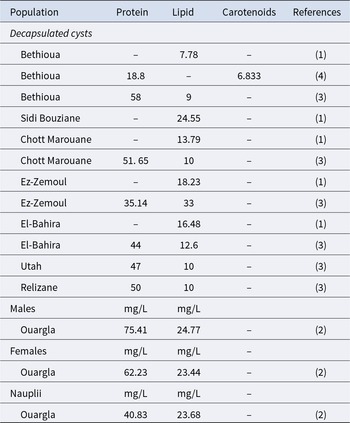
Unlike algae or rotifers, multiple life stages of Artemia, from decapsulated cysts (embryonic form) and non-feeding nauplii to enriched nauplii and adults, are used as larval food, each with distinct biochemical profiles. The composition of Artemia varies not only between species and strains but also between batches and seasonal harvests. The most pronounced biochemical differences appear in exogenous feeding stages (instar II and later), as instar I nauplii rely on yolk reserves. Because Artemia is a non-selective filter feeder with a high gut content-to-body volume ratio, its biochemical composition depends strongly on diet (Dhont and Van Stappen, Reference Dhont, Van Stappen, Støttrup and McEnvoy2003). Thus, distinctions between species, sources, and life stages are essential, given the range of Artemia applications in aquaculture. Few studies have examined the biochemical composition of Algerian Artemia, but available data indicate differences in total lipids, fatty acid profiles, and other nutritional components among populations and habitats (Kara et al., Reference Kara, Bengraine, Derbal, Chaoui and Amarouayache2004; Amorouayeche et al., Reference Amorouayeche, Belksier and Amarkouayache2024; Chabet Dis et al., Reference Chabet Dis, Khadra, Mustapha, Nabila, Ammar, Djamal Eddine, Rachida and Hemeir2024b). This section provides a comprehensive overview of the biochemical characteristics of various Artemia forms from Algeria (see Table 3), with brief comparisons to well-studied commercial strains.
Biochemical composition of different Algerian Artemia populations (% on a dry weight)

Table 3 Long description
Biochemical composition is listed for Artemia populations, with columns for Population, Protein, Lipid, carotenoids, and Reference. Under Decapsulated cysts, Bathioua appears three times: lipid 7.78 with protein missing, protein 18.8 with carotenoids 6.833 and lipid missing, and protein 58 with lipid 9 and carotenoids missing. Also under Decapsulated cysts, lipid only values are Sidi Bouziane 24.55, Chott Marouane 13.79, Ez Zemoul 18.23, and El Bahira 16.48, each with protein and carotenoids missing. Additional Decapsulated cysts rows report protein and lipid together: Chott Marouane protein 51.65 and lipid 10, Ez Zemoul protein 35.14 and lipid 33, El Bahira protein 44 and lipid 12.6, Utah protein 47 and lipid 10, and Relizane protein 50 and lipid 10, with carotenoids missing in these rows. Under Males with units shown as mg per liter for protein and lipid, Ouargla has protein 75.41 and lipid 24.77, with carotenoids missing. Under Females with mg per liter for protein and lipid and a dash shown under carotenoids, Ouargla has protein 62.23 and lipid 23.44. Under Nauplii with mg per liter for protein and lipid and a dash shown under carotenoids, Ouargla has protein 40.83 and lipid 23.68.
(1) Amarouayache et al. (Reference Amarouayache, Cakmak, Asan-ozusaglam and Amorouayeche2017), (2) Hidouci et al. (Reference Hidouci, Ghomari, Maamri and Othmani2022), (3) Amorouayeche et al. (Reference Amorouayeche, Amarouayache, Derbal and Kara2013), (4) Missoum (Reference Missoum2022).
Lipids
Total lipid content in Artemia cysts can vary between populations due to genetic factors, environmental conditions, and diet. Benmehal et al. (Reference Benmehal, Ghomari and Benabdelmoumene2022) analysed cysts from six Algerian sites and found total lipid percentages ranging from 11.02% to 30.25% of dry weight, with the Saharan strain from Timimoune showing the highest lipid values. Regarding decapsulated cysts, Amarouayache et al. (Reference Amarouayache, Cakmak, Asan-ozusaglam and Amorouayeche2017) reported lipid percentages in decapsulated cysts ranging between 7.78% (Bethioua parthenogenetic strain) and 24.55% (Sidi Bouziane parthenogenetic strain) (see Table 3). Collectively, the total lipid levels reported for decapsulated Algerian Artemia by Benmehal et al. (Reference Benmehal, Ghomari and Benabdelmoumene2022) (11.02%–30.25%), Amorouayeche et al. (Reference Amorouayeche, Amarouayache, Derbal and Kara2013) (9%–33%), and Amarouayache et al. (Reference Amarouayache, Cakmak, Asan-ozusaglam and Amorouayeche2017) indicate a broad range of 7.78%–33.00% for Algerian populations. These ranges overlap with those reported for major commercial strains such as GSL (14.7%) and San Francisco Bay (SFB) (15.7%) (Dendrinos and Thorpe, Reference Dendrinos and Thorpe1987; García-Ortega et al., Reference García-Ortega, Verreth, Coutteau, Segner, Huisman and Sorgeloos1998), suggesting that Algerian populations are broadly comparable in total lipid content.
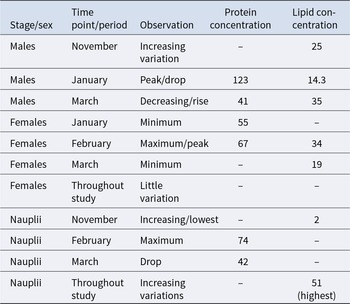
In terms of lipid variation across the sampling period during advanced stages, Hidouci et al. (Reference Hidouci, Ghomari, Maamri and Othmani2022) found that, in males, lipid concentrations showed an inverse relationship with protein levels. Lipid levels were 25 mg/L in November, decreased to 14.3 mg/L in January, and increased again to 35 mg/L in March. In females, lipid concentrations peaked at 34 mg/L in February 2017, while the minimum values (19 mg/L) occurred in November 2016 and March 2017. The average lipid concentration for females was 23.44 ± 5.56 mg/L. In nauplii, lipid levels fluctuated markedly throughout the study, from 2 mg/L in November to 51 mg/L, with an average of 23.68 ± 19.25 mg/L (see Table 4). Lipid values (mg/L) refer to concentrations measured in the extraction solution used in the original analyses, rather than the percentage of body dry weight.
Seasonal variation in protein and lipid concentrations (mg/L)1 of male, female, and naupliar Artemia in Ouargla

Table 4 Long description
Protein and lipid concentrations are reported in milligrams per liter for males, females, and nauplii at specific months and for a throughout study period, alongside an observation note. For males, November lists, Increasing variation with lipid 25 and no protein value; January lists, Peak slash Drop with protein 123 and lipid 14.3; March lists, Decreasing slash Rise with protein 41 and lipid 35. For females, January lists, Minimum with protein 55 and no lipid value; February lists, Maximum slash Peak with protein 67 and lipid 34; March lists, Minimum with lipid 19 and no protein value; Throughout study lists, Little variation with no protein or lipid values. For nauplii, November lists, Increasing slash Lowest with lipid 2 and no protein value; February lists, Maximum with protein 74 and no lipid value; March lists, Drop with protein 42 and no lipid value; Throughout study lists, Increasing variations with lipid 51 and no protein value, and the lipid entry is marked highest.
1 Values in mg/L indicate concentrations measured in the extraction/assay solution following Hidouci et al. (Reference Hidouci, Ghomari, Maamri and Othmani2022); conversion to dry-weight basis is not possible with the published data.
Fatty acids
The fatty acid profile (presence and concentration) is a critical determinant of Artemia’s nutritional value, quality, and market price (Léger et al., Reference Léger, Bengtson, Simpson and Sorgeloos1986; Sorgeloos et al., Reference Sorgeloos, Dhert and Candreva2001; Benmehal et al., Reference Benmehal, Ghomari and Benabdelmoumene2022). This lipid composition is vital for supporting growth, survival and functional development of fish and crustacean larvae, with key essential fatty acids including eicosapentaenoic acid (EPA, 20:5n-3), docosahexaenoic acid (DHA, 22:6n-3), arachidonic acid (ARA, 20:4n-6), α-linolenic acid (ALA, 18:3n-3), and linoleic acid (LA, 18:2n-6) (Benmehal et al., Reference Benmehal, Ghomari and Benabdelmoumene2022).
In Algerian Artemia cyst lipid fractions, individual fatty acids typically fall within the following ranges: palmitic acid (16:0) around 13%–20% of total fatty acids, oleic acid (18:1n-9) about 10%–25%, EPA approximately 2%–8% and DHA generally less than 1%–3%, values broadly representative of both sexually reproducing A. salina populations from Tell sabkhas and chotts (e.g., Relizane, Melghir, Ez-zemoule, Garaet El Taref) and parthenogenetic populations (diploid and tetraploid) from inland and Saharan systems such as Bethioua, El Goléa and Adrar, although exact proportions vary among sites and hydrological years (Ghomari, Reference Ghomari2013). Across strains, palmitic, stearic (18:0), palmitoleic (16:1n-7), cis-vaccenic (18:1n-7), oleic, LA, ALA, and EPA consistently dominate the profile, with the sum of saturated (ΣSFA), monounsaturated (ΣMUFA), and polyunsaturated (ΣPUFA) fatty acids comprising nearly all identified fatty acids. ΣPUFA is usually about 20%–40% of total fatty acids, and the sum of highly unsaturated fatty acids (ΣHUFA) is about 5%–15%, within which ARA, total n-3 HUFA (mainly EPA with low or trace DHA), and total n-6 HUFA are the main contributors. Summed fatty-acid classes show consistent geographic patterns, with ΣSFA, ΣMUFA, and ΣPUFA fatty acids together accounting for the bulk of total lipids; within the above ranges, coastal Tell sabkhas (Relizane, Bethioua in Oran) and high-plateau basins (Ez-zemoule, Garaet El Taref) tend to exhibit higher PUFA and HUFA proportions compared with the more arid Saharan sites (Melghir, El Goléa, Adrar) (Ghomari, Reference Ghomari2013).
Studies on Algerian Artemia strains consistently reveal particularly high levels of ALA in some populations. For example, the Chott Marouane strain was reported to have an ALA concentration of 55.04% ± 5.83% of the total fatty acids (Benmehal et al., Reference Benmehal, Ghomari and Benabdelmoumene2022). Early analyses from Kara et al. (Reference Kara, Bengraine, Derbal, Chaoui and Amarouayache2004) and Amarouayache and Kara (Reference Amarouayache and Kara2010) showed EPA at 1.25% and DHA absent in Chott Marouane, with the n-3 series strongly dominant (21.71%–25.21% of total fatty acids); ALA, oleic, palmitic, and palmitoleic acid were the predominant fatty acids, total unsaturated fatty acids (71.08%–71.32%) clearly exceeding saturated ones (24.55%–25.14%), and HUFAs also notable (21.71%–25.21%), with linolenic acid averaging 21.15% (Kara et al., Reference Kara, Bengraine, Derbal, Chaoui and Amarouayache2004). More recent work from western Tell sabkhas highlights strong inter-strain contrasts, with EPA reaching 16.25% (Amarouayache et al., Reference Amarouayache, Cakmak, Asan-ozusaglam and Amorouayeche2017) and DHA 5.64% (Benmehal et al., Reference Benmehal, Ghomari and Benabdelmoumene2022) in the Sidi Bouziane parthenogenetic strain, in contrast to the generally low or undetectable EPA and DHA in most other strains. Comparative analyses of five Algerian strains showed saturated fatty acids (SFAs) ranging from 26.55% to 30.36%, MUFAs from 37.56% to 52.03%, and PUFAs from 21.03% to 35.12%, with ALA and LA particularly abundant in the Chott Marouane strain (22.28% and 9.51%, respectively) (Amarouayache et al., Reference Amarouayache, Cakmak, Asan-ozusaglam and Amorouayeche2017). This spectrum of dominant fatty acids (palmitic, stearic, palmitoleic, cis-vaccenic, oleic, ALA, LA, and EPA) is similar to that described for decapsulated cysts of other Artemia populations worldwide (Dendrinos and Thorpe, Reference Dendrinos and Thorpe1987; Abatzopoulos et al., Reference Abatzopoulos, Agh, Van Stappen, Rouhani and Sorgeloos2006; Naceur et al., Reference Naceur, Jenhani and Romdhane2012), but Algerian strains are distinguished by their particularly high ALA and, in most localities, comparatively low EPA and DHA in most localities.
The n-3/n-6 fatty acid ratio varied from 1.33 in Bethioua to 7.01 in Sidi Bouziane, highlighting substantial variability among populations. Consistent with the classification by Watanabe et al. (Reference Watanabe, Kitajima and Fujita1983) and supported by Navarro et al. (Reference Navarro, Amat and Sargent1992) and Benmehal et al. (Reference Benmehal, Ghomari and Benabdelmoumene2022), Algerian Artemia populations are generally classified as freshwater-type because of their high ALA and low EPA levels, together with an elevated C16:0/C16:1 ratio (ranging approximately from 1.5 to 4.5 across Algerian sites; Ghomari, Reference Ghomari2013). Despite their high ALA content, the relative deficiency of EPA and DHA in most Algerian strains necessitates bioencapsulation or lipid enrichment strategies to improve their nutritional suitability for marine aquaculture hatcheries (Kara et al., Reference Kara, Bengraine, Derbal, Chaoui and Amarouayache2004; Amarouayache et al., Reference Amarouayache, Cakmak, Asan-ozusaglam and Amorouayeche2017; Benmehal et al., Reference Benmehal, Ghomari and Benabdelmoumene2022).
Protein
Protein content varies among Algerian Artemia populations and developmental stages (Table 3). Kherraz-Chemlal et al. (Reference Kherraz-Chemlal, Boukhatem, Khelil, Sahnouni, Maatalah and Boutiba2017) reported that decapsulated cysts from Bethioua contained 55.5% dry-weight protein, whereas adult Artemia contained 41.5%. In the Ouargla population, identified as diploid Artemia parthenogenetica, Hidouci et al. (Reference Hidouci, Ghomari, Maamri and Othmani2022) nevertheless observed both males and females, consistent with the occasional occurrence of rare, often sterile males in otherwise asexual lineages. Protein concentrations in Ouargla males varied considerably, peaking at 123 mg/L in January 2017 and decreasing to 41 mg/L in March, with an average of 75.4 ± 28.59 mg/L, while protein levels in females were more stable, ranging from 55 mg/L in January to 67 mg/L in February, with an average of 62.2 ± 4.66 mg/L. Protein concentrations in nauplii also fluctuated, reaching 74 mg/L in February and dropping to 42 mg/L in March, with an average of 40.8 ± 18.77 mg/L (Table 4). As for lipids, protein values expressed in mg/L correspond to concentrations measured in the assay solution rather than the percentage of body dry weight. Taken together, these values fall within the broad ranges of protein contents reported for nauplii and adults of other Artemia strains (approximately 39%–64%; Dhont and Van Stappen, Reference Dhont, Van Stappen, Støttrup and McEnvoy2003), indicating no major protein deficiency in Algerian populations. No data are currently available on the amino acid profile of Algerian Artemia strains; however, it is generally recognised that both nauplii and adults contain sufficient levels of the ten amino acids considered essential for fish larvae (Dhont and Van Stappen, Reference Dhont, Van Stappen, Støttrup and McEnvoy2003).
Carotenoids and vitamins
Limited data are available on the carotenoid and vitamin content of Algerian Artemia populations. Missoum (Reference Missoum2022) reported a high carotenoid content of 6.83% dry weight in A. salina from Bethioua, which exceeds that of Timimoune (1.916% dry weight) and Béchar (2.133% dry weight) by more than threefold, and one-fifth of that of the commercial strain, A. franciscana (Kellogg, 1906) (49.33 mg/g, equivalent to 4.93%) (Abdat and Krachaoui, Reference Abdat and Krachaoui2018). This relatively high carotenoid concentration enhances the nutritional value of Artemia as feed for aquaculture species, particularly for improving pigmentation in cultured fish and crustaceans. Specific vitamin profiles have been reported in available studies on Algerian Artemia. However, the nutritional role of vitamins in Artemia nutrition is recognised, with Amorouayeche et al. (Reference Amorouayeche, Belksier and Amarkouayache2024) reporting the use of vitamin complex supplements (15% of the diet) during laboratory rearing of Artemia from the Sidi Bouziane and Bethioua salterns.
In light of the data documented above, it is evident that the biochemical composition of Algerian Artemia, similar to that of other Artemia populations worldwide, varies considerably with species, habitat characteristics, sources, life stage, and seasonal factors. For instance, total lipid content ranges from 7.78 % in Bethioua to 33% in Ez-Zemoul, reflecting differences in environmental conditions and local food sources (Benmehal et al., Reference Benmehal, Ghomari and Benabdelmoumene2022) (see Tables 2 and 3). Seasonal fluctuations also influence protein levels, as observed in Ouargla populations, where protein peaks during cooler months, while lipid levels peak in spring months (Hidouci et al., Reference Hidouci, Ghomari, Maamri and Othmani2022). These biochemical variations are shaped by numerous environmental drivers, including salinity, temperature, food availability, and pollution, with dietary inputs from green algae (Chlorophyceae) contributing to high palmitic acid content across populations (Brett et al., Reference Brett, Müller-navarra, Ballantyne, Ravet and Goldman2006; Farhadian et al., Reference Farhadian, Kolivand, Mahmoudi Khoshdarehgy, Ebrahimi Dorch and MahboobiiSoofiani2013). Considering these findings, when compared with well-studied commercial Artemia such as GSL and SFB strains, Algerian populations show similar ranges of total lipid and protein content but a distinct fatty acid balance, with consistently higher ALA and generally lower EPA and DHA, highlighting their potential as nutritionally valuable yet heterogeneous resources that may benefit from targeted enrichment strategies in marine hatcheries.
Exploitation of natural Artemia resources
History and current state of exploitation in Algeria
The exploitation of wild Artemia resources in Algeria remains limited and largely unorganised compared with major producing countries. In Algeria, at least eight hypersaline ecosystems of high biological importance for Artemia have been documented, including Bethioua saltwork, Sabkha Ez-Zemoul, Sabkha Oran, Chott Marouane, Chott Melghir, Garaet El Tarf, the saline lake of El Goléa (Goléa Mnea), and El-Bahira Lake (Sétif) (Ghomari et al., Reference Ghomari, Selselet, Hontoria and Amat2011; Ghomari, Reference Ghomari2013; Amarouayache and Belakri, Reference Amarouayache and Belakri2015). While there is recognition of Artemia’s value, systematic commercial exploitation has not been fully developed. Several foundational studies on the ecology and biology of Artemia in Algeria focus on Chott Marouane and Sabkha Ez-Zemoul and examine biometrics and population dynamics (Kara and Amarouayache, Reference Kara and Amarouayache2012). These sites, along with others like Bethioua and Sidi Bouziane salterns, have the potential for sustainable harvesting if properly managed.
The total biomass of cysts produced in Chott Marouane (36,000 ha) is estimated at 7.6 t, corresponding to a yield of 0.21 kg/ha (Amarouayache and Kara, Reference Amarouayache and Kara2010), indicating significant potential for commercial exploitation. The parthenogenetic population in El-Bahira Lake (Sétif) also showed potential, with an estimated cyst reserve of 133.13 kg of dry weight (13.31 kg/ha) based on surveys in 2009 and 2013 (Amarouayache and Belakri, Reference Amarouayache and Belakri2015). While smaller in scale compared to Chott Marouane, it represents another potential source, particularly given its unique cold-adapted characteristics. However, the ephemeral nature of many Algerian salt lakes, whose water levels and salinity fluctuate significantly with rainfall and are often located in remote areas, especially in the Saharan and High Plateau regions, poses challenges for consistent harvesting operations (Kara and Amarouayache, Reference Kara and Amarouayache2012; Amorouayeche et al., Reference Amorouayeche, Belksier and Amarkouayache2024). Furthermore, harvesting practices need to avoid depleting natural populations and impacting the waterbirds that rely on Artemia (Samraoui et al., Reference Samraoui, Chakri and Samraoui2006).
Regulatory framework and sustainable management
There is no comprehensive regulatory framework specifically for Artemia exploitation in Algeria. Developing sustainable management practices would be essential to prevent overexploitation of natural populations, ensure consistent quality of harvested products, balance economic utilisation with conservation, and establish standards for commercial operations. The traditional human-operated saltpan management was compatible with maintaining population genetic diversity in A. salina. However, recent changes in saltpan use, such as aquaculture promoting the introduction of alien species, A. franciscana, and habitat loss, pose serious threats to the genetic diversity of A. salina populations in the Mediterranean area (Kara and Amarouayache, Reference Kara and Amarouayache2012). It is possible that viable cysts of A. franciscana could eventually reach Algerian Chotts and Sabkhas through human-mediated introduction or dispersion by shorebirds (Kara and Amarouayache, Reference Kara and Amarouayache2012). This potential introduction of non-native species highlights the need for regulatory frameworks and sustainable management practices to protect native Artemia biodiversity. The development of a regulatory framework for Artemia exploitation in Algeria would need to address several critical aspects: (1) harvesting quotas and seasons to avoid resource depletion, (2) quality standards for harvested cysts and biomass, (3) protection of native species against the introduction of non-native Artemia, (4) conservation of priority habitats, and (5) licensing and monitoring of commercial operations. Such a framework would help ensure the sustainable utilisation of Algeria’s Artemia resources while preserving their genetic diversity and ecological functions.
Applications in aquaculture
Importance of Artemia in Algerian Hatcheries
Artemia remains the most important and widely used food in fish and crustacean larviculture in Algeria, as it is globally. Vital advantages of Artemia in Algerian aquaculture include several practical and nutritional aspects. Artemia nauplii are considered an ideal live feed, easily stored and manipulated, hatching from cysts after about 24 hours of incubation (Lavens and Sorgeloos, Reference Lavens and Sorgeloos2000). These small instar I nauplii (400–500 µm long) are perfectly suitable for the mouth size of fragile larvae of a variety of marine and freshwater species (Lavens and Sorgeloos, Reference Lavens and Sorgeloos1996), and their nutritional composition meets many requirements of developing larvae. Currently, many Algerian operations depend on imported Artemia, primarily the American species A. franciscana from Utah, but no quantitative data are available on the volumes or precise origins of Artemia cysts imported by Algerian hatcheries. At the same time, Algerian Artemia populations are well documented and show good cyst and biomass quality for aquaculture use, although they are only locally or experimentally harvested and are not yet organised as a large, export-oriented commercial resource comparable to GSL or SFB. This dependence on imports highlights the potential economic benefits of developing local Artemia sources. The development of local Artemia production could significantly benefit the growing Algerian aquaculture sector by reducing dependency on imported Artemia, lowering production costs, ensuring a consistent supply, and potentially providing strains better adapted to local aquaculture species.
Controlled production and culture systems
Artemia can be cultivated under controlled conditions by manipulating reproduction through salinity control and adapting culture protocols to local conditions and available resources. For year-round production, it is necessary to implement extensive, semi-intensive, or intensive cultivation methods and develop appropriate culture systems (Dhont and Van Stappen, Reference Dhont, Van Stappen, Støttrup and McEnvoy2003). Recent laboratory studies by Amorouayeche et al. (Reference Amorouayeche, Belksier and Amarkouayache2024) on parthenogenetic populations from Sidi Bouziane and Bethioua salterns provide valuable insights for controlled production. Their methodology included: Rearing at a salinity of 120 g/L and a temperature of 24°C; feeding with baker’s yeast (85%) and a vitamin complex (15%); monitoring survival rate, growth, adult size, and reproduction traits. Their results showed: A survival rate of 50% was attained after 10 days; a growth rate of 0.19 mm/day for both populations; adult lengths of 8.28 ± 0.45 and 8.71 ± 0.55 mm for Sidi Bouziane and Bethioua, respectively; females attaining first sexual maturity at 28–30 days; ovoviviparity as the dominant reproduction mode (>75%) in both populations; mean fecundity values of 23.5 ± 14.9 and 24.82 ± 12.06 offspring per female. These outcomes demonstrate the feasibility of controlled production of Algerian Artemia strains and provide specific parameters for optimising culture conditions. Different cultivation approaches can be implemented, from extensive outdoor systems to more controlled indoor operations. The choice of system would depend on available resources and infrastructure, target production volume, intended use (cyst production vs. biomass production), and local environmental conditions.
Alternatives and complements to Artemia
Although copepods and cladocerans may provide superior fatty acid profiles or fill specific size niches, their routine use in Algerian hatcheries, like that of locally produced Artemia, has not yet been documented. To date, both Artemia and associated zooplankton from Algerian hypersaline systems remain essentially unexploited for aquaculture, and formulated microdiets are generally limited to partial replacement of imported Artemia and, where feasible, locally available copepods or cladocerans; therefore, it represents a future research avenue rather than an established practice in Algeria.
Challenges and perspectives
Impact of climate change on natural populations
Climate change is expected to alter temperature regimes, evaporation, and hydroperiods in Algerian hypersaline systems, with likely consequences for Artemia habitat availability and salinity profiles. However, no long-term datasets currently document climate-driven changes in Algerian Artemia populations, so these risks remain inferred from general climate projections and known physiological tolerances rather than demonstrated trends.
Economic potential and resource valorisation
Local Artemia production could significantly benefit the growing Algerian aquaculture sector by:
1. Reducing dependency on imported Artemia: Algeria currently depends largely on imported Artemia for its aquaculture operations. Local Artemia resources could reduce this dependency and associated costs.
2. Creating value-added products: Beyond basic cyst production, enrichment, and specialised processing of local Artemia into products such as enriched cysts, nauplii, or biomass tailored to hatchery requirements can provide value-added products suited for specific aquaculture applications.
3. Integration with salt production activities: Several Artemia habitats in Algeria (Ez-Zemoul, Djeloud, Guergour El-Amri, Marouane, Bethioua, Sidi Bouziane) are already used for salt production (Kara and Amarouayache, Reference Kara and Amarouayache2012). Combining Artemia harvesting with those operations could diversify income sources and strengthen local economies while optimising existing infrastructure.
4. Human consumption potential: Beyond aquaculture, the use of Artemia for human consumption has increased in some Asian countries (Van Stappen, Reference Van Stappen, Abatzopoulos, Beardmore, Clegg and Sorgeloos2002), offering an opportunity to utilise adult biomass alongside cysts in Artemia farming.
Conservation and sustainable management
Traditional saltpan management was once compatible with maintaining genetic diversity in A. salina populations. However, modern changes in saltpan use, including aquaculture activities and habitat loss, now threaten the genetic diversity of A. salina in the Mediterranean region (Kara and Amarouayache, Reference Kara and Amarouayache2012). The potential for viable cysts of non-native species to reach Algerian chotts and sabkhas through human introduction or bird-mediated dispersal underscores the need for robust conservation and sustainable management measures (Kara and Amarouayache, Reference Kara and Amarouayache2012). Addressing these challenges requires key considerations, including:
1. Biodiversity preservation: Artemia biodiversity in the Mediterranean Basin is likely unique compared to other parts of its natural range, and preserving this biodiversity, particularly the genetic diversity of native A. salina and parthenogenetic populations, should be a priority.
2. Habitat protection: Many Artemia habitats in Algeria are threatened by pollution, environmental modification, and climate change; protecting these sites is essential for sustaining Artemia populations.
3. Sustainable harvesting practices: Establishing protocols that maintain population viability while permitting economic utilisation is crucial for long-term sustainability.
4. Prevention of non-native species introduction: Implementing strict measures to prevent the introduction of non-native Artemia, particularly A. franciscana, is essential for maintaining native biodiversity.
5. Integrated management with other activities: Many Artemia habitats overlap with salt production and other uses, so integrated management approaches that balance these activities are required. A comprehensive management framework for Algerian Artemia resources would ensure their conservation while enabling sustainable economic use.
Directions for future research
Based on the reviewed literature, several key directions for future research on Algerian Artemia can be identified:
1. Comprehensive genetic characterisation: Further genetic studies are needed to characterise the unique genetic traits of Algerian Artemia strains using modern molecular methods to clarify their evolutionary relationships and adaptive genetic variations.
2. Expanded geographical coverage: While well-studied sites such as Chott Marouane, Sabkha Ez-Zemoul, Bethioua, and Sidi Bouziane have been studied, many potential Artemia habitats remain unexplored, particularly in the Saharan region.
3. Climate change impacts: Research on the effect of climate change on Artemia populations and their habitats in Algeria is needed to guide conservation and management strategies.
4. Optimised culture protocols: Refining site-specific and species-specific culture protocols for Algerian Artemia strains would facilitate their commercial production and utilisation.
5. Nutritional enhancement: Although Algerian Artemia strains generally possess good nutritional value, they contain low levels of HUFAs, particularly EPA and DHA, which are vital for the growth and survival of marine fish and crustacean larvae. EPA levels of 4%–5% in Artemia promote optimal larval performance, whereas concentrations in Algerian populations (e.g., Bethioua: 0.09%; Sidi Bouziane: 0.05%) fall below this threshold. Future research should focus on enrichment techniques to improve HUFA content, such as HUFA-rich supplements, commercial enrichment emulsions, microalgae-based enrichment, or custom formulations tailored to target aquaculture species.
6. Economic feasibility studies: Comprehensive assessments of the economic feasibility of commercial Artemia production in Algeria, including both wild harvesting and controlled culture, would guide investment and development planning.
7. Ecological interactions: Additional studies on the ecological role of Artemia in Algerian hypersaline ecosystems, including interactions with other organisms and contributions to ecosystem function, would enhance understanding of their ecological significance.
8. Sustainable management frameworks: Designing and testing sustainable management approaches for Algerian Artemia resources that balance conservation with economic utilisation.
These research priorities would enhance understanding of Algerian Artemia and support their sustainable use in aquaculture and related applications.
Conclusion
This comprehensive review has examined the taxonomy, genetic diversity, spatial distribution, reproduction, biochemical composition, and aquaculture utilisation of Artemia in Algeria. The synthesis of multiple studies reveals a rich diversity of Artemia populations across Algeria’s hypersaline environments, with significant potential for both scientific research and commercial applications. Algeria harbours both bisexual (A. salina) and parthenogenetic Artemia populations, distributed across at least 16 documented sites spanning from coastal areas to the Saharan region. These populations exhibit diverse characteristics in reproductive biology, biochemical composition, and environmental adaptations, reflecting their evolution across varied hypersaline habitats.
The biochemical analyses of Algerian Artemia strains reveal nutritional profiles generally suitable for aquaculture applications, particularly for freshwater species. While most Algerian strains are classified as ‘freshwater type’ with high Linoleic Acid (LOA) and relatively low EPA content, they still possess valuable nutritional characteristics. The protein content, carotenoid levels, and fatty acid profiles vary between species, sites, and developmental stages, offering diverse options for various aquaculture applications.
Despite the natural abundance and potential value of Artemia resources in Algeria, their exploitation remains limited and largely unorganised. The development of sustainable harvesting practices, controlled production systems, and appropriate regulatory frameworks could enable better utilisation of these resources, reduce dependency on imported Artemia for local aquaculture, and potentially create export opportunities. Several challenges face the conservation and utilisation of Algerian Artemia, including potential impacts of climate change, habitat degradation, and the risk of non-native species introduction. Addressing these challenges requires integrated approaches that balance conservation with sustainable exploitation.
Future research directions should focus on comprehensive genetic characterisation, optimised culture protocols, nutritional enhancement techniques, and sustainable management frameworks. Such research would contribute to both scientific understanding and practical applications of Algerian Artemia resources. In conclusion, Artemia in Algeria represents a valuable yet underutilised resource with significant potential to contribute to aquaculture development, scientific knowledge, and economic opportunities. Realising this potential requires coordinated efforts in research, conservation, and sustainable management.
Declaration of interest
The author declares no conflict of interests.
Data availability statement
No new data were generated or analysed in this review.
Ethics and approach
Not applicable. This review analysed previously published literature only.
Funding statement
This research received no specific grant from any funding agency, commercial or not-for- profit sectors.