Implications
Safety of transgenic ingredients on human and target animals has been the focus of attention. No negative effects of an insect-resistant corn or an herbicide-tolerant corn on the growth performance, egg quality and organ health were observed in laying hens for 12 weeks. The results of the present study indicate that two transgenic corn lines are well tolerated by laying hens for a 12-week study and provide safety assessment information on the two transgenic corn lines for consumers, producers and policy makers.
Introduction
The genetically modified (GM) corn is the second most important GM crop after soybean, and over 30% of the 184 million ha of globally grown corn in 2014 was cultivated by a GM variety (James, Reference James2014). The development of GM crops, such as insect-resistant or herbicide-tolerant corn, provides growers with such benefits as reduced input costs and better weed control (Gusta et al., Reference Gusta, Smyth, Belcher, Phillips and Castle2011). A GM corn line (BT-799) was produced by the insertion of the mCry1Ac gene derived from Bacillus thuringiensis strain. Transcription of the mCry1Ac gene confers resistance to insect damage. Another GM corn line (CC-2) was produced by the insertion of the maroACC gene derived from Agrobacterium tumefaciens strain. The maroACC gene was functionally improved by a gene shuffling process to optimize the kinetics of glyphosate acetyltransferase activity for acetylating the herbicide glyphosate.
Previous studies focus on performance and egg quality of laying hens to evaluate the nutritional equivalency of transgenic insect-resistant corn (Rasmussen et al., Reference Rasmussen, Cutler, Wilhems and Scanes2007; Jacobs et al., Reference Jacobs, Utterback, Parsons, Rice, Smith, Hinds, Liebergesell and Sauber2008; Scheideler et al., Reference Scheideler, Rice, Smith, Dana and Sauber2008) and transgenic herbicidal-tolerant corn (McNaughton et al., Reference McNaughton, Roberts, Rice, Smith, Hinds, Delaney, Iiams and Sauber2011) for a period of around 12 weeks; however, few studies have investigated the effect of transgenic corn on organ health and serum parameters of laying hens to evaluate the safety of transgenic corn. Some studies in other species found minor changes in organ weight and serum biochemical parameters for pigs (Buzoianu et al., Reference Buzoianu, Walsh, Rea, Cassidy, Ross, Gardiner and Lawlor2012; Walsh et al., Reference Walsh, Buzoianu, Gardiner, Rea, Ross, Cassidy and Lawlor2012) and rats (Kilic and Akay, Reference Kim and Ho2008) fed transgenic corn. In the present study, we determined the potential nutritional effects of feeding BT-799 corn and CC-2 corn compared with an isogenic corn to White Leghorn laying hens. Particular attention was afforded to changes in growth performance, egg production, egg quality, carcass yield, organ weight and clinical biochemical parameters.
Material and methods
Corn and diets
The control, BT-799 and CC-2 corn, with the exception of an additional commercially available non-transgenic corn source (reference, NONGDA 108), were grown simultaneously in the experimental field of China Agricultural University (Beijing, China). The genetic background of the control corn was similar to BT-799 and CC-2 corn. A non-transgenic soybean meal was purchased (Jiusan Oils & Grains Industries Group, Harbin, China). Corn- and soybean meal-based diets were formulated to meet nutrient requirements of commercial laying hens (National Research Council, 1994). Diets were prepared for each corn–soybean meal source mixed in the following order: reference diet, control diet, BT-799 diet and CC-2 diet to minimize the potential for cross-contamination of non-transgenic sources with transgenic sources. Samples of the isogenic, BT-799, CC-2 and reference corn grains and diet were evaluated for the existence of the mCry1Ac and maroACC genes with PCR and the mCry1Ac and maroACC protein with an antibody-specific ELISA.
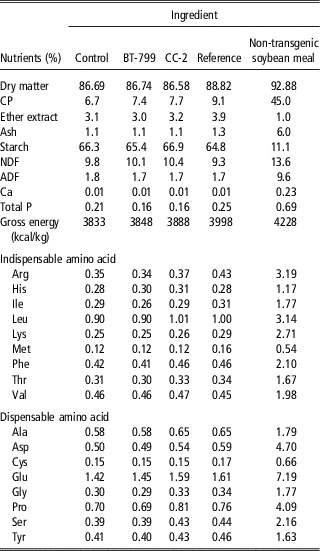
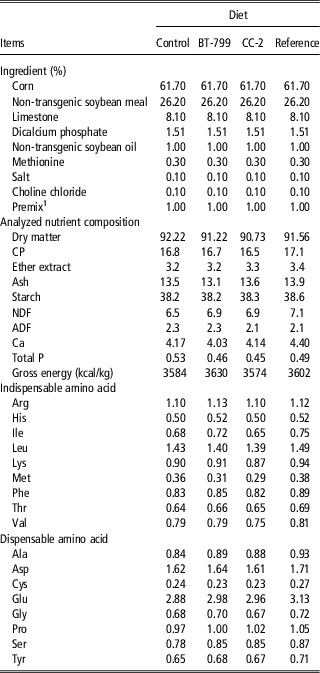
Samples from the corn ingredients (Table 1) and diets (Table 2) were analyzed for chemical and amino acid composition. Analytical determinations were conducted according to standard methods for dry matter (Method 930.15; Association of Official Analytical Chemists (AOAC), 2007), CP (Method 990.03; AOAC, 2007), ether extract (Method 996.01; AOAC, 2007), ash (Method 942.05; AOAC, 2007), Ca and P (Method 985.01; AOAC, 2000), ADF (Method 973.18; AOAC, 2007) and NDF by the method of Holst (Reference Holst1973). Starch was determined using the Megazyme Total Starch Assay Procedure (Megazyme International Ireland Ltd, Wicklow, Ireland) based on thermostable α-amylase and amyloglucosidase. Amino acid contents of the corn, soybean meal and diet were determined according to Method 982.30 in AOAC (2007). Gross energy was measured using an adiabatic bomb calorimeter (Model 6400; Parr Instrument, Moline, IL, USA).
Chemistry and amino acid analysis of corn and soybean meal (dry matter basis)

Control=non-transgenic near-isoline corn; BT-799=transgenic corn produced by the insertion of the mCry1Ac gene derived from Bacillus thuringiensis strain; CC-2=transgenic corn produced by the insertion of the maroACC gene derived from Agrobacterium tumefaciens strain; reference=corn from commercially available non-transgenic varieties.
Ingredient and analyzed nutrient composition (as-fed basis) of diets

Control=non-transgenic near-isoline corn; BT-799=transgenic corn produced by the insertion of the mCry1Ac gene derived from Bacillus thuringiensis strain; CC-2=transgenic corn produced by the insertion of the maroACC gene derived from Agrobacterium tumefaciens strain; reference=corn from commercially available non-transgenic varieties.
1 Provided per kg of diet: vitamin A, 12 500 IU; vitamin D3, 4125 IU; vitamin E, 15 IU; vitamin K, 2 mg; thiamine, 1 mg; riboflavin, 8.5 mg; calcium pantothenate, 50 mg; niacin, 32.5 mg; pyridoxine, 8 mg; biotin, 2 mg; folic acid, 5 mg; vitamin B12, 5 mg; Mn, 80 mg; I, 1 mg; Fe, 60 mg; Cu, 8 mg; Zn, 80 mg; Se, 0.3 mg.
Birds and housing
The experimental protocol was reviewed and approved by the Institutional Animal Care and Use Committee of the State Key Laboratory of Animal Nutrition (CAAS, Beijing, China). Healthy hens (White Leghorn) were raised to 55 weeks of age in cages of State Key Laboratory of Animal Nutrition (Beijing, China) under conditions common to commercial hen rearing. The experiment was divided into three 4-week phases (week 1 to 4, week 5 to 8 and week 9 to 12 of feeding phases). A randomized block design was used to assign cages to four dietary treatments: non-transgenic near-isoline corn diet (control), BT-799 corn diet (BT-799), CC-2 corn diet (CC-2) and reference corn diet (reference). The soybean meal was a non-transgenic variety. Each treatment was fed to eight cages of hens (replicates) for a total of 24 hens/treatment (96 total hens). Hens were housed in a room containing forced-air heaters with a cross-house ventilation system. Hens were housed (3 hens/cage) in free-standing single-tiered cages (40×38×38 cm; length×width×height) of available floor space per laying hen. Cages were separated by a wire partition to minimize the potential for cross-contamination. Birds were kept with ad libitum access to feed and water and the temperature was maintained at 22±3°C. The house for the hens was provided with programmed lighting with a maintained 16 h of light and 8 h of darkness. All the hens were kept healthy during the study period.
Performance and egg quality
BW were determined at the beginning and end of each phase, and feed consumption was also measured for each phase. Eggs were collected daily and egg production was determined weekly for each phase. Egg mass and feed efficiency measures were calculated from egg production, egg weights and feed intake. Four eggs per cage during the last week of each phase were selected to analyze egg quality. The length and breadth of the eggs was determined (FHK egg shape determinator; Fujihira Industry Co., Tokyo, Japan) and the egg shape index was calculated (breadth/length×100). Eggshell color was measured at the blunt, equatorial and sharp region (EQReflectometer; Fujihira Industry Co.). Eggshell strength were determined on the EggShell Force Gauge (Robotmation Co. Ltd, Tokyo, Japan) according to the method of Er et al. (Reference Er, Wang, Cao and Chen2007). Albumen height, Haugh unit and yolk color were analyzed (Asli et al., Reference Asli, Hosseini, Lotfollahian and Shariatmadari2007). Egg component weights (albumen, yolk and shell) were determined and eggshell thickness without inner and outer membranes was measured at the blunt, equatorial and sharp regions to get the average value (Van Den Brand et al., Reference Van Den Brand, Parmentier and Kemp2004).
Organ sampling, histological analysis and carcass yield
Blood samples were taken from the wing vein of 24 hens per diet treatment for serum collection. Serum samples were stored at −20°C for subsequent blood biochemical analysis. One hen per pen (8 hens/treatment) was humanely euthanized at the end of 12 weeks by cervical dislocation and a gross necropsy was performed. The heart, liver, spleen, lung and kidneys were removed first, trimmed of any superficial fat or blood clots, and weighed. The stomach (including glandular and muscular stomach) and small intestine were removed, emptied of contents, flushed with water, cleared of fat and connective tissue, blotted dry and weighed (Buzoianu et al., Reference Buzoianu, Walsh, Rea, Cassidy, Ross, Gardiner and Lawlor2012). Intestinal tissue sampling and determination of villus height, crypt depth, villus height/crypt depth ratio and number of goblet cells per villus and per millimeter villus in the duodenum, jejunum and ileum (n=8/treatment) were performed as described by Walsh et al. (2012). Ovary weights were determined as any reproductive overt abnormalities (Rasmussen et al., Reference Rasmussen, Cutler, Wilhems and Scanes2007). All hens were processed for assessment of carcass yield including dressing weight, eviscerated weight, abdominal fat (including fat around gizzard), breast meat, thigh meat, head and claws. Carcass yield and individual carcass parts yield were expressed as the percentage of whole live bird weight.
Blood biochemistry analysis
The following biochemical parameters in serum samples were taken at slaughter and measured with a TBA-40FR auto-analyzer (Toshiba Medical Systems, Tokyo, Japan), including glucose, total protein, total cholesterol, creatinine, urea, uric acid, Ca, phosphate, alanine aminotransferase, aspartate aminotransferase, γ-glutamyl transferase and alkaline phosphatase.
Statistical analysis
Data including performance and egg quality were summarized for each phase and for the entire experiment and analyzed using the MIXED procedure of SAS (SAS Institute Inc., Cary, NC, USA). The model included treatment, phase and the treatment×phase interaction as fixed effects; cage was designated as a random effect. The true comparison effect of interest in the present study was that of the BT-799 treatment v. the control treatment, and that of the CC-2 treatment v. the control treatment. Differences were considered significant if P<0.05; trends were reported for 0.05<P<0.10. Data generated from the reference corn varieties were used in estimations of experimental variability; least squares means were generated for the reference treatment, but statistical comparisons between reference and control treatment groups were not generated from estimate statements. Instead, these data for each measure were used to construct a 95% tolerance interval containing 99% of the observed trait values from hens fed the reference and control corn diets (Graybill, Reference Graybill1976). Data from the test (BT-799 or CC-2) groups were evaluated to determine if the observed values were contained within the confidence interval. If an observed value for a treatment was contained within the tolerance interval, the value was considered to be consistent with how hens would perform when fed diets containing a similar amount of commercial corn (Mejia et al., Reference Mejia, Jacobs, Utterback, Parsons, Rice, Sanders, Smith, Iiams and Sauber2010).
Results
Corn grain and diet compositions
Nutrient profiles were comparable within the corn and soybean meal ingredient (Table 1). Nutrient compositions of diets were also analyzed (Table 2). Concentrations of key individual nutrients (proximate, amino acids, Ca, P and gross energy) were similar between the diets produced with the corn grain and soybean meal sources. Samples of the BT-799, CC-2, control and reference corn ingredient and diet were evaluated for the existence of the mCry1Ac and maroACC with PCR and the mCry1Ac and maroACC protein with an antibody-specific ELISA. As indicated by the results of the evaluation, the mCry1Ac gene and mCry1Ac protein were present in the BT-799 corn ingredient and diet but not detected in the CC-2, control, or reference corn and diet; the maroACC gene and maroACC protein were present in the CC-2 corn ingredient and diet but not detected in other corn sources and diets.
Performance and egg quality
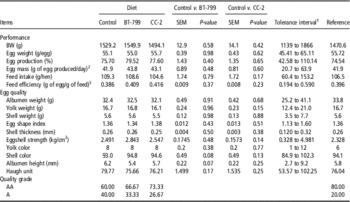
No treatment×phase interaction was observed for any performance or egg quality measure. Only the overall treatment data are presented in Table 3. Growth and egg performance measures of laying hens fed the control, BT-799, CC-2 and reference diets from week 0 to 12 of feeding phases are presented, along with measures calculated for the full 12-week feeding period. There was no effect of the diet treatment on BW during the present study. No statistically significant differences for egg weight, egg production, egg mass, feed intake and feed efficiency through the feeding period were observed among the diets. Egg component (albumen, yolk and shell) weights were similar among the diet treatment groups. No statistically significant differences in egg shape index, shell thickness, eggshell strength and yolk color were observed between hens consuming the control diet and hens consuming the BT-799 or CC-2 diet. There was a tendency (P=0.08) for shell color to be greater in the BT-799 diet than in the control diet. There was a tendency (P=0.07) for a lower albumen height for hens fed the BT-799 diet than for hens fed the control diet, but Haugh unit values did not differ (P>0.05) between the BT-799 and the control diet. Eggshell color, albumen height and Haugh unit values were similar between the CC-2 diet and the control diet. All observed values for hens fed the BT-799 and CC-2 diets fell within the calculated confidence interval. All eggs from the control and test groups in this study were graded as quality grade A.
Effect of feeding genetically modified corn to laying hens for 12 weeks on performance and egg quality

Control=non-transgenic near-isoline corn; BT-799=transgenic corn produced by the insertion of the mCry1Ac gene derived from Bacillus thuringiensis strain; CC-2=transgenic corn produced by the insertion of the maroACC gene derived from Agrobacterium tumefaciens strain; reference=corn from commercially available non-transgenic varieties.
1 Lower and upper limits of a 95% tolerance interval on 99% of the observed performance trait values from hens fed the control and reference diets.
2 Egg mass calculated as egg weight (g)×(egg production/100).
3 Feed efficiency calculated as (egg weight (g)×(egg production/100))/feed intake (g)/hen per day.
Intestinal histology
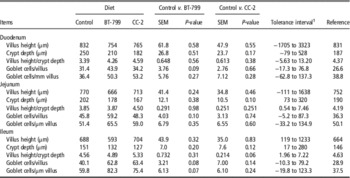
Histological examination of the kidney, spleen and liver did not indicate an effect of feeding the two transgenic corn lines (data not shown).Tissue hyperplasia and cell pigmentation were absent in any of the tissues examined. There were no signs of hemorrhage or alteration of blood vessel integrity, edema or fibrosis. No effect of feeding BT-799 corn to hens was observed for villus height, crypt depth and villus height/crypt depth in the duodenum, jejunum or ileum for 12 weeks (Table 4). There was a tendency for goblet cell number/villus in the duodenum (P=0.09) and ileum (P=0.08) to be greater in the BT-799 diet than in the control diet. Hens which consumed the BT-799 diet tended (P=0.08) to have a greater goblet cell number/micrometer villus compared with those consuming the control diet. No differences in villus height, crypt depth and goblet cell number between the CC-2 diet and the control diet were observed.
Effect of feeding transgenic corn to laying hens for 12 weeks on intestinal histolog

Control=non-transgenic near-isoline corn; BT-799=transgenic corn produced by the insertion of the mCry1Ac gene derived from Bacillus thuringiensis strain; CC-2=transgenic corn produced by the insertion of the maroACC gene derived from Agrobacterium tumefaciens strain; reference=corn from commercially available non-transgenic varieties.
1 Lower and upper limits of a 95% tolerance interval on 99% of the observed performance trait values from hens fed the control and reference diets.
Organosomatic indices and carcass yield
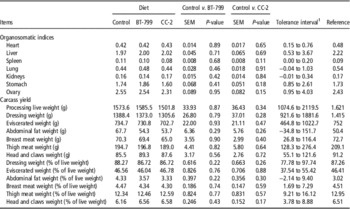
No statistically significant differences were observed for the ovary weight of hens fed the test and control diets (Table 5). The relative weights of the heart, liver, spleen, lung, kidneys and stomach were not affected by the diet treatment. No differences were observed for carcass yield or any individual parts yield between hens consuming the control diet and hens consuming the BT-799 or CC-2 diets. All observed values for hens fed the BT-799 and CC-2 diets fell within the calculated tolerance interval.
Effect of feeding genetically modified corn to laying hens for 12 weeks on organosomatic indices and carcass yield

Control=non-transgenic near-isoline corn; BT-799=transgenic corn produced by the insertion of the mCry1Ac gene derived from Bacillus thuringiensis strain; CC-2=transgenic corn produced by the insertion of the maroACC gene derived from Agrobacterium tumefaciens strain; reference=corn from commercially available non-transgenic varieties.
1 Lower and upper limits of a 95% tolerance interval on 99% of the observed performance trait values from hens fed the control and reference diets.
Serum biochemistry
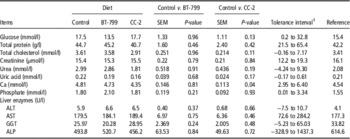
Serum liver enzymes (alanine transaminase, aspartate aminotransferase, γ-glutamyl transferase and alkaline phosphatase) were similar between the transgenic and control diets (Table 6). Serum creatinine, urea and uric acid were not affected by the diet treatment. There was no effect of the diet treatment on the concentrations of glucose, total protein, total cholesterol and phosphate. No statistically significant differences were observed for the Ca concentrations between hens consuming the control diet and hens consuming the BT-799 diet, whereas the Ca concentrations in the CC-2 diet were less (P=0.04) than in the control diet.
Effect of feeding genetically modified corn to laying hens for 12 weeks on serum concentrations of enzymes and other parameters to assess the liver and kidney function

Control=non-transgenic near-isoline corn; BT-799=transgenic corn produced by the insertion of the mCry1Ac gene derived from Bacillus thuringiensis strain; CC-2=transgenic corn produced by the insertion of the maroACC gene derived from Agrobacterium tumefaciens strain; reference=corn from commercially available non-transgenic varieties; ALT=alanine transaminase; AST=aspartate aminotransferase; GGT=γ-glutamyl transferase; ALP=alkaline phosphatase.
1 Lower and upper limits of a 95% tolerance interval on 99% of the observed performance trait values from hens fed the control and reference diets.
Discussion
Previous studies have investigated the effect of GM corn on performance and egg quality of laying hens (Rasmussen et al., Reference Rasmussen, Cutler, Wilhems and Scanes2007; Jacobs et al., Reference Jacobs, Utterback, Parsons, Rice, Smith, Hinds, Liebergesell and Sauber2008; Scheideler et al., Reference Scheideler, Rice, Smith, Dana and Sauber2008; McNaughton et al., Reference McNaughton, Roberts, Rice, Smith, Hinds, Delaney, Iiams and Sauber2011). To our knowledge, this is the first study in hens that evaluated the potential nutritional impact of BT-799 and CC-2 corn on intestinal histology, organ function and performance. These results demonstrated no differences in nutritional performance of laying hens fed the transgenic corn diets when compared with laying hens fed the non-transgenic control diets; statistical analysis of the data in this study resulted in rejection of all hypotheses of different performance and egg quality. In agreement with these findings, previous studies with laying hens have shown that laying hen performance and egg quality is not affected by corn conferring pesticide resistance (Jacobs et al., Reference Jacobs, Utterback, Parsons, Rice, Smith, Hinds, Liebergesell and Sauber2008; Halle and Flachowsky, Reference Halle and Flachowsky2014) or herbicide tolerance traits (McNaughton et al., Reference McNaughton, Roberts, Rice, Smith, Hinds, Delaney, Iiams and Sauber2011).
Transgenic feed have minimal effect on the small intestinal histology, which has been demonstrated in several studies. It has also been shown that villus height and crypt depth are not affected by feeding BT corn to GM pigs (Buzoianu et al., Reference Buzoianu, Walsh, Rea, Cassidy, Ross, Gardiner and Lawlor2012; Walsh et al., Reference Walsh, Buzoianu, Gardiner, Rea, Ross, Cassidy and Lawlor2012). Results of the present 12-week study showing that no effect of feeding the BT-799 diet to laying hens on villus height and crypt depth in the small intestinal were demonstrated, therefore, are in agreement with previous results. There was, however, a slight increase in the number of goblet cells per villus in the duodenum and ileum of the BT-799 group compared with the control group. Walsh et al. (Reference Walsh, Buzoianu, Gardiner, Rea, Ross, Cassidy and Lawlor2012) also observed a slight effect of BT corn on the number of goblet cells in the small intestine. A twofold increase in goblet cells numbers in the small intestine of pigs as a result of total parenteral nutrition was correlated with a change in gut microbiota, reduced integrity of the mucosal barrier and increased inflammation of piglets (Ganessunker et al., Reference Ganessunker, Gaskins, Zuckermann and Donovan1999; Mair et al., Reference Mair, Plitzner, Pfaffl, Schedle, Meyer and Windisch2010). Intestinal inflammation is accompanied by deepening of the intestinal crypts, shortening or even disappearance of the villi, malabsorption and diarrhea (Stevens et al., Reference Stevens, Lowe and Young2002). Small intestinal histology and the mucosal barrier integrity were not affected in the present study. Only slight change in goblet cell number observed in the small intestine may be attributed to the different gut microbial populations. Preliminary data from an observation of the gut microbiota of hens fed the GM corn diet would suggest differences in the relative abundance of certain intestinal microbial populations compared with the control diet (Zhong R, unpublished results). A slight increase of goblet cells may indicate increased secretion of mucins that protect against the invasion by pathogens (Kim and Ho, Reference Kaneko, Harvey and Bruss2010; Johansson and Hansson, Reference Johansson and Hansson2014).
Organ weight is a more specific health indicator of animals. Ovary weight of hens was not affected by the diet treatment. Rasmussen et al. (Reference Rasmussen, Cutler, Wilhems and Scanes2007) also reported that absolute ovary weight is similar in the control and BT corn diet. There were no differences for the relative weights of the heart, liver, spleen, lung, kidneys and stomach in hens fed the test and control diets. Carcass yield or any individual parts yield was similar between the transgenic and control diets in the present study. This result is consistent with the observation that carcass yield of broilers was not affected by the BT corn diet (Brake and Vlachos, Reference Brake and Vlachos1998; Aeschbacher et al., Reference Aeschbacher, Messikommer, Meile and Wenk2005) and by corn containing the glyphosate acetyltransferase gene (Taylor et al., Reference Taylor, Hartnell, Nemeth, Karunanandaa and George2005; McNaughton et al., Reference McNaughton, Roberts, Rice, Smith, Hinds, Delaney, Iiams and Sauber2011).
An increase in liver size and a concomitant increase in the liver enzymes concentration are the initial characteristics of liver dysfunction (Boone et al., Reference Boone, Meyer, Cusick, Ennulat, Bolliger, Everds, Meador, Elliott, Honor, Bounous and Jordan2005; Kaneko et al., Reference Kilic and Akay2008). In the present study, the liver weight and the serum liver enzymes (alanine transaminase, aspartate aminotransferase, γ-glutamyl transferase and alkaline phosphatase) were similar for the transgenic and control diets. Kidney dysfunction is characterized by changes in kidney weight and a concomitant increase in serum creatinine and urea (Kaneko et al., Reference Kilic and Akay2008). The kidney weight and the serum creatinine, urea and uric acid were not affected by the diet treatment in the present study. Hens fed the CC-2 diet had a lower Ca concentration compared with those fed the control diet and the differences were not considered to be CC-2 corn related. The observed difference in serum Ca was minor and was not correlated with the change in eggshell thickness or eggshell strength. All observed values for hens fed the CC-2 diets fell within the calculated confidence interval.
In conclusion, these results demonstrated no differences in nutritional performance of laying hens fed the transgenic corn diets when compared with laying hens fed the non-transgenic control diets; statistical analysis of the data in this study resulted in rejection of all hypotheses of expected differences of performance, egg quality, organ health and carcass yield. The incorporation of the mCry1Ac or maroACC gene into corn allows the grain grower more flexibility and simplicity for effective weed control, which in turn reduces application of pesticides and herbicide and improves environmental benefits.
Acknowledgments
The present study was jointly supported by the Genetically Modified Organisms Breeding Major Projects (2014ZX08011-005), Agricultural Science and Technology Innovation Program (ASTIP-IAS07) and Project of State Key Laboratory of Animal Nutrition (2004DA125184F1405).