1. Introduction – Indonesian morally based legislation and its challenges
At least 23% of the world's consumers consider themselves adherents of Islam (Pew Research Center, 2011). For a majority of these consumers, Halal is important as they strive to live their lives by this principle. Halal is an Arabic word meaning permissible or lawful. The term refers to any object or an action which is permissible to consume, use, or engage according to the Sharia Law (Adamec, Reference Adamec2009).
All food, in general, is considered Halal unless it is prohibited by the Qur'an (the holy book of Muslims) or the Hadith (the living practices of the Islamic Prophet, Muhammad). The Islamic dietary rules involve at least three aspects: (1) animals (for example, meat from pigs, swine, and dogs are prohibited); (2) Islamic methods of slaughter; and (3) impure substances (for example, alcoholic drinks and intoxicants and blood are prohibited).
The 2013 Global Islamic Finance Report identifies four phases of Halal evolution.Footnote 1 According to the Report, Halal assurance is based on trust in the first phase. For example, a Muslim trusts products bought from another Muslim. In the second phase, the assurance is based on Halal certification shown as a label on the product. In the third phase, the trust is gained by providing assurance that the entire supply chain (such as a Halal logistics/supply chain management system) is compliant with Sharia law which is audited and certified by an Islamic certification authority. The forth phase refers to the Halal value chain where Islamic food multinational companies can control the entire supply chains from ‘farm-to-fork’. According to the Report, most countries are in phase one or two; however, Brunei and Malaysia have entered phase three of the evolution.
Halal assurance undeniably plays a significant role in global trade. The global Halal market is worth about 2.3 trillion dollars (OIC, 2015) and reflects a huge demand for Halal products and the Halal industry globally. It appears that the Indonesian government is aiming to establish a robust phase two and to enter phase three of Halal assurance, as shown in several provisions of its 2014 Halal Product Assurance Act (Halal Act).
In September of 2014, the Indonesian House of Representatives passed a new law requiring mandatory Halal labelling and certification on a broad range of products, including ‘goods and/or services that are related to foods, beverages, as well as consumer goods that are worn, used or utilized by the public’.Footnote 2 The Halal Act is the first law in the Muslim majority nation requiring Halal labelling. Prior to this law, the Indonesian Council of Ulama (MUI) oversaw voluntary Halal labelling as primarily an assurance and marketing approach, rather than a legal approach, for Muslim consumers. The new law provides for a five-year grace period for application, meaning that traders have until 2019 before the mandatory Halal labelling takes full effect.
The Halal Act, while possessing important socio-cultural elements, may create problematic barriers for international trade. A note issued by the European Union's delegation to Indonesia, Brunei Darussalam and ASEAN expressed such concern. It stated that a number of provisions in the Halal Act (such as the mandatory nature of Halal labelling, the wide range of products covered, labels for Halal and haram products) demonstrate the far-reaching and draconian nature of the law and the potentially high burden it will create on business.Footnote 3 The note also pointed out that the potential complications, prolonged process, as well as the logistic requirements would all add substantially to the costs of producing and exporting products to Indonesia and imply unnecessary trade barriers with distortive effects on imports.
The aim of this paper is to evaluate the balance between, on the one hand, Indonesia's right to regulate with the aim of protecting certain religious belief practices, and, on the other hand, the potential of its morally motivated legislation to contravene its international trade obligations in the context of WTO law.
The organizational structure of this article is as follows. Section 2 looks at the elements and controversial provisions of the Indonesian Halal Act. The main analysis of this article is provided in Section 3. It evaluates the Halal Act in the context of the Technical Barriers to Trade (TBT) Agreement, including the public moral exception that Indonesia can employ to defend its Halal Act. ‘No less favourable’ and ‘not more trade-restrictive than necessary’ obligations under Articles 2.1, 2.2 as well as relevant ‘international standards’ under Article 2.4 of the TBT Agreement are also discussed in this part. Section 4 provides concluding remarks.
2. Indonesian Halal Act: context, elements, and controversy
Indonesia has one of the world's largest Muslim populations. Combined with one of the fastest growing middle class economies in the world, the increasing demand of the Indonesian population for Halal products cannot be overlooked. It is within this context that the Indonesian Halal Act has emerged, in an effort by the government to address the overlap of consumer preference driven by religiously motivated expectations and freedom.
The preamble to the Halal Act provides a number of factors taken into consideration at the outset and formulation of the Act. These include, first and foremost, that the Constitution of the Republic of Indonesia ensures the freedom of every citizen to practice his or her own religion.Footnote 4 Freedom of religion is an interesting concept to underpin the core of a law, enacted by a secular government, to apply to all trade in consumer products to, and within, the country.Footnote 5 The drafters of the law appear to connect the facilitation of Halal certification to the freedom of religious practice enshrined in the Constitution.
The second consideration of the Halal Act stipulates that it is the role of the state to facilitate the free practice of religion by providing protections and assurance of the Halalness of a given product.Footnote 6 The motivation of the law, then, could be described as not so much religious as it is legal; the state must protect the freedom of religion of its peoples (as per the Constitution) and thus enact a law to support the religious practice of Halal, through regulated certification and labelling. The question of whether such protection would also extend to certification requirements of religious minorities, say for instance the dietary requirements in Hinduism or Buddhism (religions that are also recognized in Indonesia), remains to be seen. Still, it is an important consideration that the drafters of the law seek to preserve religious freedom, rather than curb it.
Other considerations stipulated in the preamble of the Halal Act include recognition that the current products circulating within Indonesia are not always guaranteed Halal.Footnote 7 This is reinforced by Article 3 of the Halal Act, where the Halal Product Assurance authority is tasked with the objective of ‘providing convenience, security, safety, and certainty of the availability of Halal Products for the public in consuming and utilizing a Product’.Footnote 8 Currently, according to the Indonesian Ministry of Agriculture, Halal compliance and food safety have government oversight as part of one oversight program: the Safe, Healthy, Whole, and Halal (Aman, Sehat, Utuh dan Halal) program.Footnote 9 However, this program does not constitute a Halal certification authority.
Halal certification in Indonesia at present is, indeed, generally problematic and inconsistent for fresh foods, particularly in wet markets.Footnote 10 According to the Indonesian Council of Ulama (MUI) – the current supervising body for Halal certification – there are irregularities between Halal slaughterhouses, and there have been instances of random checks conducted in wet markets where Halal procedures were not being followed.Footnote 11 This is significant as, according to the USDA, 88% of all retail food sales in Indonesia occur in wet markets (Dyck et al., Reference Dyck, Woolverton and Rangkuti2012). The Indonesian Ministry of Health places this number at 60% of the overall population.Footnote 12
There is at present, however, no single central government legal administrative body for Halal certification. Instead, Halal certification in Indonesia is referred to as the processes, standards, and rules laid down by the MUI, a non-governmental body. Although the TBT Agreement primarily binds national governments, the Agreement also covers the activities of non-governmental bodies. A non-governmental body is defined very broadly in Annex 1.8 as a ‘body other than a central government body or a local government body, including a non-governmental body which has legal power to enforce a technical regulation’. As such, a WTO Member cannot escape from the purview of the TBT Agreement, even if the body is a national body within a Member State that applies a technical regulation and is incorporated as non-governmental body (Kudryavtsev, Reference Kudryavtsev, Epps and Trebilcock2013). The MUI in Indonesia fits comfortably within this category. The current role of the MUI as the sole Halal Authority in Indonesia draws its authority from two Ministerial Decrees issued in 2001.Footnote 13 Maintaining such a crucial part of Halal certification in Indonesia, the trade-related activities of the MUI fall within the ambit of the TBT Agreement. In practice, MUI performs its function without intervention from the government. Thus, the Indonesian government, as stated in ‘Consideration D’ of the Halal Act, sees a need to provide legal certainty on the Halalness of the products through legislation while simultaneously protecting religious freedom.
Considering such objectives, it is understandable that Indonesian policy makers felt the need to enact new Halal legislation. What is problematic, however, is the extent to which lawmakers decided to impose Halal certification and labelling requirements. A number of provisions in the Halal Act suggest onerous labelling requirements and certification processes that raise issues of consistency with the WTO Technical Barriers to Trade Agreement, as well as posing potential barriers for the broader business landscape in Indonesia. These issues will be considered below after a look at the Halal Act provisions.
2.1 Overview of poignant Halal Act provisions
The Halal Act includes a number of provisions that have the potential to disrupt international trade and create uncertainty for business. Some of the wording of these provisions is problematic in their current form as they are unclear as to the scope and reach of the Halal Act. Still, the implementing regulations are yet to be released and it may be that the dubious wording is clarified further. In any case, the potential scope of the law is enough to merit concern for trade liberalization.
A number of provisions of the law are highlighted below to provide context for the trade liberalization alarm bells that the Halal Act raises.
2.2 The nature of the Halal Act: a shift from voluntary to mandatory
Of particular unease stoked by the Halal Act is the mandatory nature of its provisions. Mandatory labelling requirements imposed on goods and services generally raise eyebrows; however, this law concerns a subject that has previously remained voluntary.
Article 4 of the Halal Act maintains that products that enter, circulate, and are traded in the territory of Indonesia must be certified Halal. Article 47(1) goes on to specify that Foreign Halal Products that are imported into Indonesia must comply with provisions as regulated in this law. In both instances, the word ‘must’ (and its Indonesian equivalent wajib) is used to denote the mandatory nature of the Halal Act. This assertion is in line with interpretation of the meaning of mandatory from WTO jurisprudence.
The term ‘mandatory’ was defined in EC–Trademark and Geographical Indications as ‘obligatory in consequence of a command; compulsory’.Footnote 14 The choice of the word ‘must’ in the Halal Act contextually denotes a compulsory action. The Panel in US–COOL Footnote 15 used two main indicators to determine that a measure could be considered mandatory. The first was considering the use of the word ‘shall’ and the second was the enforceability of the measure through specified sanctions. This same measurement could foreseeably, though not categorically, be used in relation to the Halal Act. Article 22 of the Halal Act provides administrative sanctions for businesses that do not separate the production facilities for Halal and non-Halal products. Furthermore, Article 56 imposes penalties, including monetary fines and criminal penalties of up to five years of imprisonment, to business operators that fail to maintain the ‘Halalness’ of their products after they have obtained the Halal certificates/labels.
Beyond this, mandatory labelling requirements generally present a minefield when it comes to navigating international trade. On the one hand, they arguably enable consumer choice; on the other hand, they potentially raise the price of goods and create non-tariff barriers to trade (Carter and Gruère, Reference Carter and Gruère2003). The local business community also seems unhappy with the mandatory nature introduced by the Halal Act. The American Chamber of Commerce in Indonesia, in their release on 18 December 2014 expressed that their main concern is that the law would create an unnecessary burden for small and medium sized enterprises. Businesses, particularly producers of consumer goods that do not traditionally require Halal labelling (i.e. non-food items), may find such requirements alarming and burdensome.
2.3 The wide scope of products encompassed
Article 4 plainly states that, ‘products that enter, circulate, and traded in the territory of Indonesia must be certified Halal [sic]’. The definition of a ‘product’ in the context of the Halal Act is defined in Provision Article 1(1) of the Act with very broad scope. The Article states that, ‘products are goods and/or services that are related to food, beverage, drug, cosmetic, chemical product, biological product, genetically engineered product, as well as consumer goods that are worn, used, or utilized by the public’.
Beyond the mandatory element, this Article poses a number of unprecedented difficulties to Halal certification. By including goods and services, drugs, cosmetics, genetically engineered products, and, particularly, consumer goods, the standard of Halal certification has increased to include almost all traded goods, not only food. In addition to this, the inclusion of services in the definition of a product raises questions as to how a service can be certified Halal. Importantly, for the purposes of this paper, the sheer number and scope of products that must be certified Halal potentially poses a technical barrier to trade. Products that have hitherto been superfluous to Halal certification must now undergo an (unspecified) additional step that adds costs and hassle to importers. An exploration of this in the context of TBT requirements is considered in Section 3 below.
2.4 Organizational oversight structure: a hybrid scheme to share the pie?
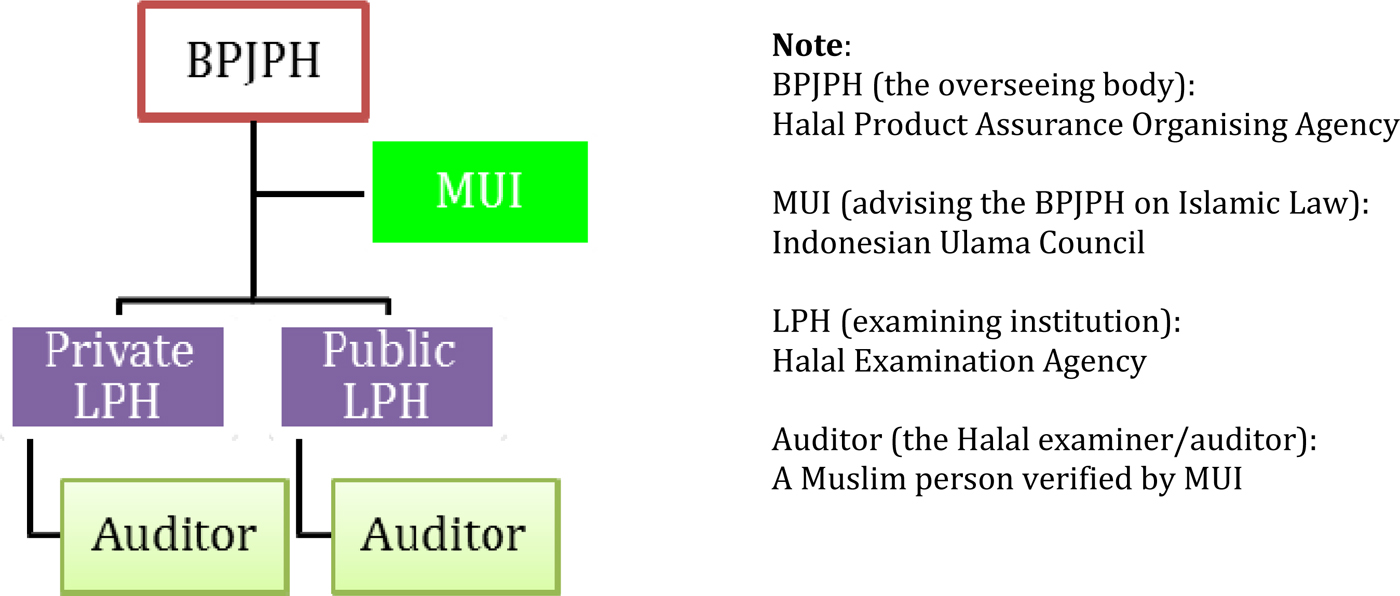
As stated previously, the Indonesian Council of Ulama (MUI) supervises and is responsible for the process and implementation of Halal certification in Indonesia at present. The Halal Act puts in place a government organization, the Halal Product Assurance Organizing Agency (BPJPH), to oversee the Halal certification process, as well as stipulate the functioning of that organization and the scheme of coordination for the process of Halal certification. The law empowers the BPJPH to oversee Halal product assurance, formulate policy, issue and revoke Halal certification, certify Halal auditors, and register Halal certification for foreign products, among other things.Footnote 16 However, the law also requires the BPJPH to collaborate with government ministries and the MUI. Included in the collaboration with the MUI is the certification of Halal auditors, the stipulation of the Halalness of a product and Halal Examination Agency (LPH) accreditation, as well as empowering the MUI to issue discretional Halal edicts in the form of ‘Decree of Halal Product Stipulation’.Footnote 17 Figure 1 below shows the organizational structure for Halal certification that the law creates.
Organizational structure for Halal certification in the Halal Act

Currently, businesses intending to have their products certified Halal essentially apply voluntarily through the MUI. The new law, when completely implemented, will require a far more onerous process for Indonesian Halal certification, which will be mandatory for almost all consumer products. This organizational structure requires the collaboration of at least four government and non-governmental agencies, not to mention the possibility of involvement of other ministries. Such a structure, at the outset of a new process for Halal certification, and more broadly when systematically implemented to ensure Halal compliance, could prove problematic. The bureaucracy involved in receiving certification through four or more agencies suggests more hurdles for importers, especially of consumer goods. Such processes open the door to rent-seeking practices and long delays in receiving certification, as evidenced in other Indonesian licensing practices.Footnote 18
2.5 Halal logistics and haram (non-Halal) labelling: a holistic approach?
Articles 24 and 25 of the Halal Act stipulate that ‘Business Operators [that submit the application and obtain a Halal Certificate] must … separate the location, place and equipment for processing, storing, packaging, distributing, selling, and presenting between Halal and non-Halal Product’ [sic]. These provisions suggest that logistics play an important role in ensuring the Halalness of a product. For example, it is conceivable under these provisions that manufacturers of consumer products, such as clothing, must establish separate utilities for the production, processing, and storing of goods if they also manufacture goods that could be considered haram, such as textiles where animal fibres that have not been certified as Halal are used in their production.
A Halal logistics system is aimed to ensure Halal integrity and to prevent direct contact with, or cross-contamination from, haram products. A major challenge for a Halal logistics system is its associated high and burdensome costs that will lead to the increased price of Halal products, particularly for traders from non-Muslim countries where the kind of infrastructure required may not be available.Footnote 19 The Indonesian government also faces a trickle-down risk, if it implements these provisions strictly. Halal food scarcity in the Muslim majority nation, due to little or no access to affordable Halal food/products, will threaten another of Indonesia's policy objectives – food security.
Article 26 is another relevant provision. It extends the labelling requirement to non-Halal products. This approach could be seen as a natural corollary to a law that requires mandatory Halal labelling, as non-Halal (or haram) products would require differentiation. Article 26 expounds:
(1) Business Operators that produce Product from Material that originate from haram Material as intended in Article 18 and Article 20 is excluded from submitting Halal Certificate application.
(2) Business Operators as intended in paragraph (1) must attached non-Halal information on the product.
There is no further clarification as to what the haram label would entail, or the process for businesses to define material as haram. It may simply be easier to identify ‘non-Halal’ substances in foodstuffs. However, the definition of ‘products’ provided in Article 1 of the Halal Act covers a wide range of products, including services and consumer goods where Halalness is not easy to identify. Thus, any implementing regulations clarifying this issue will be welcomed by the Indonesian business community.
2.6 Elongated procedures
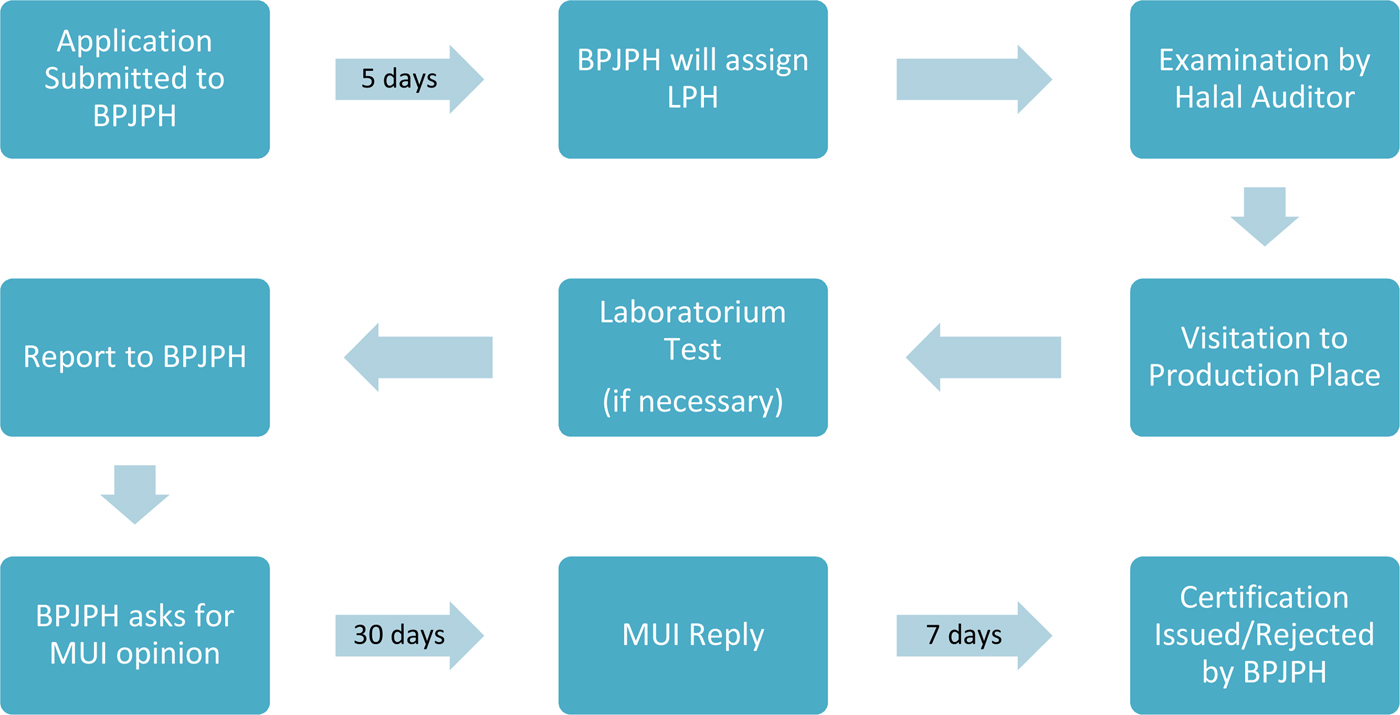
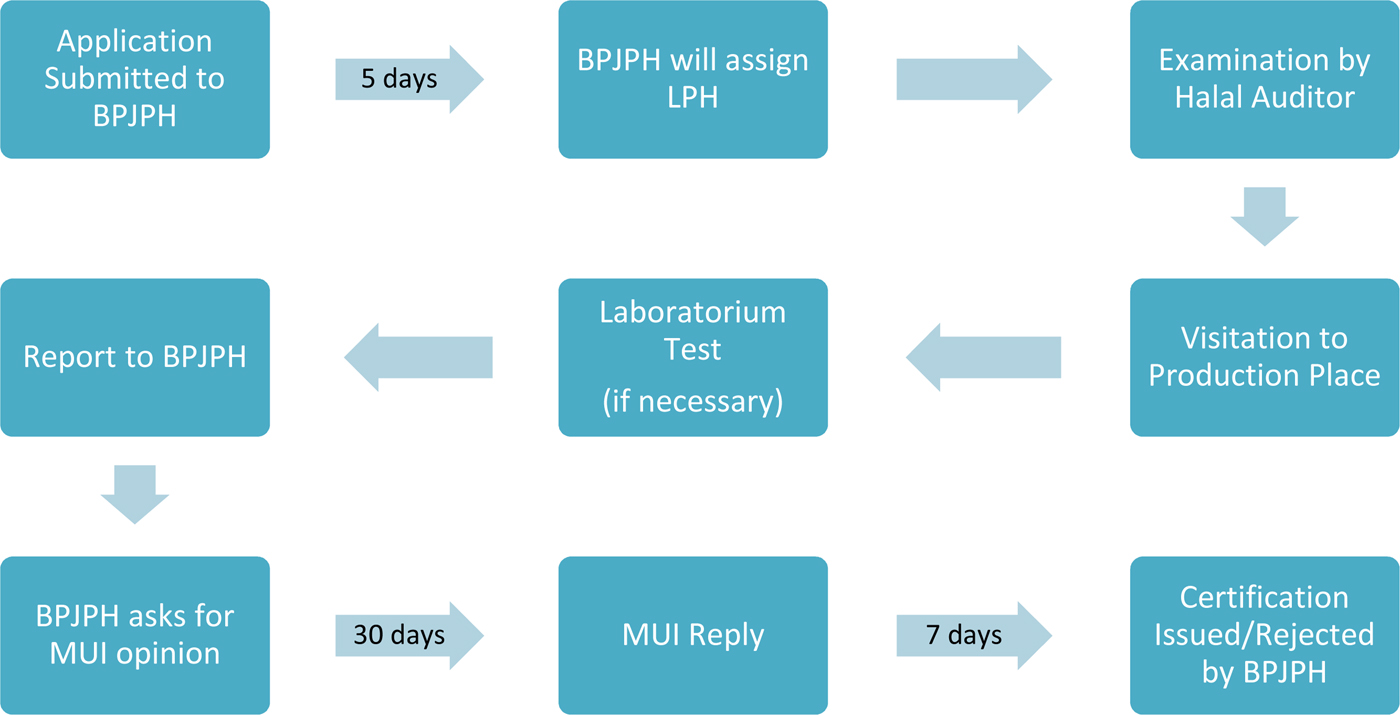
Articles 29–45 stipulate the formal procedure by which Halal certification will be sought upon implementation of the Halal Act. This is outlined in Figure 2 below.
Certification process under the new law
For business, a longer processing time may correlate with higher costs, particularly if goods must be periodically checked. Higher costs may also arise from place-of-production checks carried out by several oversight bodies. This was addressed in a Formal Meeting on certification practices at the WTO in 2013, which concluded with Member States agreeing that processes for certification must be streamlined in order to reduce costs and time to market. Higher costs mean more expensive final products passed on to consumers (Hammett and Smith, Reference Hammett and Smith2008). Hammet and Smith argue that in a world of increasing competition and standards, procedures need to be made as simple as possible so that they are affordable for small and large businesses alike. Ideally, these processes should occur before a product leaves the exporting country. Simplifying the certification process is important for the benefit of both producers and Indonesian consumers, and imperative to upholding Indonesia's obligations under WTO law.
2.7 Halal labels, not Halal stickers
Articles 38 and 39 of the Halal Act explain the technical requirements for Halal packaging and labelling. These articles require that, upon Halal certification, business operators must place the Halal label on the ‘product packaging, on a specific part of the product and/or on a specific place on the product.’ They also specify that the label ‘must be easy to see and read as well as not easily erase[able], detach[able], and damage[able]’. These requirements suggest a type of label that is printed directly on to a product's package, as a sticker could foreseeably detach or be removed. To require that all products have a Halal label printed directly on to the product package would suggest changes to the manufacturing process and would make it onerous for businesses intending to sell products in multiple markets to create Indonesian specific products.
The requirements discussed in Articles 38 and 39 of the Halal Act give rise to questions of the efficacy of the new system to domestic and foreign business communities and question compliance with WTO law. The remainder of this paper will consider this law in the context of relevant provisions of the TBT.
3. The application of WTO law
In determining the WTO consistency of the Halal Act, the central question is whether the Indonesian morally motivated measures are non-tariff barriers to trade. As corollaries, questions related to discrimination, the necessity of the measures, international standards, and whether the measures constitute an unnecessary barrier to trade are relevant.
The Sanitary and Phytosanitary Measures Agreement (SPS) and the Technical Barriers to Trade Agreement (TBT) are two WTO Agreements that set out basic rules with the aim of balancing the demand for domestic regulatory autonomy and the global harmonization of standards. The Agreements also attempt to prevent enforced measures becoming disguised protectionism.
One may refer to the application of the SPS Agreement to the Halal issues. This paper argues that the SPS Agreement does not apply to the Halal Act. As there is no clear scientific correlation between Halal products and the health and safety of consumers, the SPS is not centrally relevant. Instead, the provisions of the Halal Act present issues that fall under the ambit of the TBT Agreement, creating requirements that relate to technical regulations for Halal and non-Halal products.
3.1 Why the SPS does not apply
While both the SPS and TBT Agreements share similar objectives, they differ in scope at the level of application. The SPS Agreement covers measures with a purpose to protect, ‘(1) human or animal health from food-borne risks; (2) human health from animal- or plant-carried diseased; (3) animals and plants from pests or diseases; and (4) the territory of a country from other damage caused by the entry or spread of pests’.Footnote 20 The TBT Agreement, on the other hand covers technical regulations and voluntary standards and procedures, including labelling (Spreij, Reference Spreij2007). Packaging or labelling requirements that are directly related to food safety are covered by the SPS Agreement.Footnote 21 SPS measures on food labelling include a label that indicates or confirms a product as complying with certain provisions on microbiological criteria, pesticides residues, or food additives (Vidar, Reference Vidar and Albert2010). Expiry date and allergen information, such as gluten-free labels, are examples of SPS measures on food labelling. Lists of ingredients or nutrients are not considered an SPS measure, thus falling within the scope of the TBT Agreement (Vidar, Reference Vidar and Albert2010). In summary, the SPS Agreement is primarily concerned with food safety aspects. Meanwhile the objective of the TBT Agreement is to ensure that any product requirements, including labelling, do not create an unnecessary burden or ‘technical barrier’ to trade. Moreover, Article 1.5 of the TBT Agreement clearly specifies that provisions of the Agreement do not apply to sanitary and phytosanitary (SPS) measures.
Article 4.2 of the General Guidelines for Use of the Term Halal under the Codex Alimentarius (Food and Agricultural Organization, 1997) – a harmonized international food standard recognized by the WTO – states that claims on Halal should not be used in ways which could give rise to doubt about the safety of similar foods or claims that Halal foods are nutritionally superior to, or healthier than, non-Halal foods. Put differently, non-Halal food should not be claimed to cause problems to human health. Therefore, the measures affecting Halal certification or labelling can be argued as irrelevant to the SPS and are rather a straightforward application of the TBT.
Should the measures in the Halal Act ever be challenged, it would be difficult, if not impossible, to make a scientific correlation between the health of Indonesian citizens and the consumption of Halal products, beyond faith-based belief. If Halal labelling derives fundamentally from a belief, it cannot be measured by the standards of natural scientific inquiry. In this respect, the issues of sanitary and phytosanitary measures are not applicable to the Halal Act.
Though fundamentally different, the argument here echoes the ongoing debates around genetically modified foods (GMOs). In the EC–Biotech dispute, for instance, the United States argued there were no risk assessments supporting the respondent Member's anti-GMO measures.Footnote 22 The panel also appeared to avoid any statement that could indicate whether the GMO products were safe (Josling, Reference Josling2015). Regardless of the safety debates of GMO products, the WTO places the question of labelling (including the GMO labels) largely under the mandate of the TBT.
While the consistency of the Halal Act to WTO law can also be examined under the GATT 1994, the primary issue of concern in this paper is the problem of mandatory Halal certification and labelling. Accordingly, the next section focuses on assessing whether Indonesian Halal certification and labelling is consistent with the TBT Agreement.
3.2 An examination of the TBT consistency of the Halal Act
The TBT Agreement is designed to address three major technical barriers to trade, namely mandatory ‘technical regulations’, voluntary ‘standards’, and procedures followed to verify conformity with technical regulations and standards – ‘conformity assessment procedures’ (Kudryavtsev, Reference Kudryavtsev, Epps and Trebilcock2013). The TBT Agreement recognizes WTO Members’ right to implement measures to achieve their legitimate societal objectives. The sixth recital of the Preamble of the TBT Agreement clearly recognizes that ‘no country should be prevented from taking measures necessary to ensure the quality of its exports, or for the protection of human, animal or plant life or health, of the environment, or the prevention of deceptive practices, at the levels it considers appropriate’. While arguably important, such regulatory protection of legitimate objectives may create unnecessary barriers to trade or be used as disguised protectionism. An overarching aim of the Agreement, as provided in the fifth recital of the TBT Preamble, is to ensure that technical regulations and standards, including packaging, marking, and labelling requirements, and conformity assessment procedures adopted by Members do not create unnecessary obstacles to international trade.
The extent to which the TBT Agreement permits trade restrictiveness, expressing the religious beliefs of a society, is the main focus of this portion of the paper.
3.2.1 The Halal certification/labelling requirement constitutes a technical regulation
Prior to assessing Articles 2.1 and 2.2 of the TBT Agreement, the first point to consider is whether the Indonesian regulatory provisions of the Halal Act fall within the meaning of a technical regulation as defined in Annex 1.1 of the TBT. That definition specifies, ‘documents which lay down product characteristics or their related processes and production methods, including the applicable administrative provisions, with which compliance is mandatory. It may also include or deal exclusively with terminology, symbols, packaging, marking, or labelling requirements as they apply to a product, process or production method.’
The Appellate Body in EC–Asbestos introduced a three-tiered test to help determine a technical regulation. This included whether:Footnote 23
1. The measure applies to an identifiable product or group of products;
2. The measure lays down product characteristics; and
3. Compliance with the product characteristics laid down in the measure is mandatory.
The Panel and Appellate Body in subsequent cases recalled this test whenever they had to determine whether a measure constituted a technical regulation. The panel in US–Clove Cigarettes, for example, found that a piece of the United States’ legislation that placed a ban on flavoured cigarettes to be a technical regulation because (i) it explicitly identifies the products it covers: cigarettes and any of their component parts; (ii) it lays down product characteristics (in the negative form: ‘a cigarettes … shall not contain’); and (iii) it is mandatory (the word ‘shall not’ and the non-compliance provisions including criminal prosecution).Footnote 24 Similarly the panel in US–COOL held that the United States’ country of origin labelling measure is a technical regulation because the measure is mandatory (the word ‘shall’ and the enforcement mechanism including fines for each violation); it identifies product or a group of products, muscle cuts or in ground form beef or pork; and it lays down product characteristics by requiring a country of origin label to be placed on the identified products.Footnote 25
All three of these elements are met within the framework of the Halal Act. The Halal Act has wide-ranging scope that, in lieu of any implementing regulations, appears to cover all consumer products ranging from foodstuffs, pharmaceutical products, to personal care.Footnote 26 This could, arguably, make it difficult to establish an identifiable group of products. However, the distinction between ‘Halal’ and ‘non-Halal’ (haram) products throughout the Halal Act suggests that there are quantifiable products that are excluded from identification, thus creating an identifiable group of products being Halal products.Footnote 27
Beyond this, there are a number of provisions in the Halal act that prescribe product characteristics. Articles 37–41 specify the technical requirements of the Halal labelling, such as labels that cannot be removed and where the labels must be placed on a product. The definition of technical regulations in Annex 1.1 explicitly emphasizes ‘terminology, symbols, packaging, marking, or labelling requirements as they apply to a product’. As pointed out by (Voon et al., Reference Voon, Mitchell, Gascoigne, Epps and Trebilcock2013) a regulatory provision of a WTO member specifying mandatory labelling requirements for particular products would in principle satisfy such definition. Similarly, the Panel in US–COOL viewed that by imposing a country of origin labelling requirement, the measure fulfils the criterion of laying down product characteristics.Footnote 28
The technical regulations imposed by the Halal Act also echo the regulation deliberated in EC–Asbestos where the Appellate Body considered the phrase, ‘all products must not contain asbestos fibres’.Footnote 29 Article 4 of the Halal Act does not use the negative wording in EC–Asbestos, or the encompassing term ‘all’, but affirms that, ‘products that enter, circulate, and traded in the territory of Indonesia must be certified Halal’ [sic].
The mandatory nature of Halal certification/labelling, as outlined in the Halal Act, suggests a technical regulation is in place. The Panel in US–COOL considered the word ‘shall’ in the technical regulation, as well as the enforceability of the measure when evaluating the mandatory element of the measure.Footnote 30 The Halal Act, likewise, uses terminology such as ‘shall’ that reflects the mandatory nature of the measure. In a further demonstration of the impact of non-conformity with the provisions of the Act, administrative sanctions are imposed on businesses that breach the terms of the Halal Act;Footnote 31 the final section of the Explanatory Notes attached to the Halal Act even go so far as stating that, ‘administrative and criminal sanctions are enforced for violation of the law’.Footnote 32 The sanctions provided for non-compliance, coupled with the mandatory nature of the labelling requirements and the distinct characterization of the relevant products all point to the classification of the mandatory labelling provisions of the Halal Act as a technical regulation.
Being a technical regulation, the Halal Act distinctly falls under the ambit of the TBT. As such, there are several provisions of the TBT that the Halal Act potentially contradicts. These include discrimination and trade restrictiveness. Assessments for each of these are elaborated below.
3.2.2 ‘No less favourable’ treatment – TBT Article 2.1
Avoiding trade discrimination is a widely recognized goal of the WTO legal system (Cottier et al., Reference Cottier, Mavroidis and Blatter2000). Article 2.1 of the TBT stipulates that, in respect of technical regulations, imported like products ‘shall be accorded treatment no less favourable than that accorded to like products of national origin and to like products originating in any other country’.Footnote 33
Article 2.1 is similar to Article III:4 (national treatment) and Article I:1 (most-favoured-nation/MFN) of the GATT. The Appellate Body in US–Clove Cigarettes acknowledged that the very similar formulation of the provisions, and the overlap in their scope of application demonstrate that Article III:4 provides relevant context in interpreting Article 2.1.Footnote 34 But it is important to note that their scope, content, and obligations (TBT Article 2.1 and GATT Articles I:1 and III:4) are not the same or substantially the same, as found by the Appellate Body in US–Tuna II (Mexico).Footnote 35 There is also no general exceptions clause akin to Article XX of the GATT in the TBT Agreement.Footnote 36 But (Voon et al., Reference Voon, Mitchell, Gascoigne, Epps and Trebilcock2013) note that the Appellate Body uses some language of the GATT Article XX chapeau in applying TBT Article 2.1 and uses some of the techniques it utilizes in applying the word ‘necessity’ in GATT Article XX (a), (b) and (d) in applying TBT Article 2.2.Footnote 37
Determining whether imported and domestic products are like products is the first step to assessing the relevance of a measure under Article 2.1 of the TBT.Footnote 38 Considering the concept of ‘treatment no less favourable’ in GATT Article III:4 and TBT Article 2.1, the Appellate Body in US–Clove Cigarettes provided that likeness is to be determined based on the competitive relationship between and among products.Footnote 39 In other words, different treatment on imported and domestic products does not necessarily constitute discrimination.Footnote 40 A measure constitutes discrimination under Article 2.1 of the TBT whenever it modifies conditions of competition.Footnote 41 The Appellate Body also noted that Article 2.1 of the TBT prohibits both de facto and de jure discrimination.Footnote 42
Importantly, Article 2.1 does not prohibit detrimental impact (discrimination) that ‘stems exclusively from a legitimate regulatory distinction’.Footnote 43 Put differently, the measure is designed and applied in an even-handed manner – because, for example, it is designed and applied in a manner that does not constitute a means of arbitrary or unjustifiable discrimination – evidenced by assessing its design, architecture, revealing structure, operation, and application.Footnote 44
In US–COOL, the Appellate Body agreed with the panel's finding regarding the legitimacy of the objective pursued by the US country of origin labelling (COOL) measure, namely to provide consumers with information on the country in which the livestock, from which the meat they purchase is produced, is raised and slaughtered.Footnote 45 However, they also found that the COOL measure added costs and burdens in record keeping and verification in order to comply with the labelling requirements, and that such associated costs and labels do not convey meaningful information to consumers.Footnote 46 Thus, the Appellate Body concluded that the detrimental impact caused by the COOL measure cannot be, ‘explained by the need to provide origin information to consumers … the regulatory distinctions imposed by the COOL measure amount to arbitrary and unjustifiable discrimination against imported livestock … they cannot be said to be applied in an even-handed manner. Accordingly … the detrimental impact…does not stem exclusively from a legitimate regulatory distinction but, instead, reflects discrimination in violation of Article 2.1.’Footnote 47
The Halal Act draws distinction between Halal and non-Halal products. Such distinction is arguably justified under public moral exceptions as it is important to protect religious beliefs and practice. However, the Act appears to draw distinction between foreign and domestic certified Halal labels. Such distinction becomes problematic.
Imported products, having been certified Halal in their country of origin, are required to undergo the certification process in Indonesia. Certified Halal labels issued by overseas Halal certification bodies that do not have a collaboration of recognition with the Indonesian Halal authority are not recognized in Indonesia pursuant to Article 47.2 of the Halal Act. In other words, the required label itself is not one that generally distinguishes the product as Halal, but one that has been approved by the Indonesian Halal certification authorities.
An added burden is therefore placed on producers, importers, and distributors (and by extension consumers) that goes beyond any necessity to provide consumers with reassurance that a product is Halal. In short, such a distinction may have a negative impact on trade that reflects discrimination. It adds another level of onerousness to the mandatory Halal labelling in specifying a Halal label as distinct from other global Halal labels for the Indonesian market.
In the midst of this problem is the question of discrimination. In this respect, the extent to which favour is given to domestic Halal labelled products, versus internationally Halal labelled products, becomes a cause for concern. In practice, there are minor differences among Halal standards adopted by countries.Footnote 48 Halal standards are generally similar in essence as they are sourced from the Islamic Holy Scripture. These similarities have moved countries to negotiate for harmonization in Halal standards (OIC, 2015; American National Standards Institute, 2015). No doubt, there are differences in interpretation. Yet, even when taking into account any differences, the Indonesian approach to Halal standards is quite encompassing. For example, the current Indonesian Halal Authority through its decree issued in 1976 accepts the modern practice of stunning and mechanical slaughtering, while Brunei does not allow such practice (World Business and Investment Library, 2015).
What is important to consider, in any case, is whether Indonesia could justify the distinction it draws between imported and domestic Halal certified products because the distinction does not appear to stem from an Indonesian legitimate regulatory objective: to distinguish between Halal and haram products in order to protect public morals and religious beliefs. Should the Indonesian Halal Act be challenged, a complainant may argue that the moral/religious objective is not the true driving force behind the measure and, thus, such a distinction accords no less favourable treatment to like (Halal certified) imported products, amounting to arbitrary and unjustifiable discrimination. At the same time, Indonesia will encounter a huge challenge to explain that the distinction drawn by the Halal Act (by placing greater burdens on like foreign Halal products) has an impact on the objective of Halal assurance.
Accordingly, it can be concluded that Indonesia's Halal Act is likely to be found inconsistent with TBT Article 2.1. It has been recognized that Articles 2.1 and 2.2, although related, contain independent obligations. Finding a violation of Article 2.1 does not prejudge the outcome of the analysis of Article 2.2.Footnote 49 Below is a look at the consistency of the Halal Act with TBT Article 2.2.
3.2.3 ‘More trade restrictive than necessary’ – TBT Article 2.2
Beyond the challenge of discrimination, another concern of consistency with TBT provisions is apparent in Article 2.2. This Article establishes that, ‘technical regulations shall not be more trade-restrictive than necessary to fulfil a legitimate objective, taking account the risks non-fulfilment would create’. The Article goes on to suggest what constitutes a legitimate objective, ‘inter alia: national security requirements, the prevention of deceptive practices and the protection of human health or safety, animal or plant life or health, or the environment’. In the next section, it is explained that the phrase ‘inter alia’ means that the list of objectives provided in Article 2.2 is not an exhaustive list and that a legitimate objective can include protection of religious beliefs and public morals. TBT Article 2.2 also appears to follow the language contained in GATT Article XX(a), (b), and (d).
In conducting an analysis of Article 2.2, a panel should consider: ‘(i) the degree of contribution made by the measure to the legitimate objective at issue; (ii) the trade-restrictiveness of the measure; and (iii) the nature of the risks at issue and the gravity of consequences that would arise from non-fulfilment of the objective(s) pursued by the Member through the measure’. In most cases, the analysis will also include a comparison between the measure at issue and a possible alternative measure. The Appellate Body also suggested that ‘a comparison with reasonably available alternative measures is a conceptual tool for the purpose of ascertaining whether a challenged measure is more trade restrictive than necessary’. Such a comparison should be made in the light of the nature of the risks at issue and the gravity of consequences that would arise from non-fulfilment of the objective.Footnote 50
A restrictive aspect of the Halal Act provisions is the mandatory nature imposed upon businesses to register products as Halal. The broad scope of the measure appears to apply to almost any consumer product imaginable, thus creating a significant shake-up of current Indonesian trade procedures. Indeed, the mandatory element of the Halal Act could produce a barrier for importers, especially smaller operations (SMEs), who do not have the means by which to transform whole production and distribution chains to suit the labelling, production, storage, and transportation requirements that the Halal Act calls for.
The availability of less burdensome measures that serve a similar level of contribution to the intended objective would undermine any Indonesian defence of the necessity of its measure. A complainant to Indonesian Halal measures might propose a number of alternative reasonable measures to achieve the intended purpose. One potentially viable option is a voluntary system of Halal certification.
A complainant may reasonably argue that the costs of compulsory Halal certification and labelling (taking into account the application, logistics management, re-registration, and so forth) could be substantial particularly for SMEs. This mandatory scheme may keep, or force, those who cannot afford it out of the market. Under the voluntary certification scheme, producers and retailers could either opt for certification by the Halal authority (thereby using the official Halal label) or self-declaration (without a third party attestation) and market their products with a (non-official) ‘Halal’ or ‘Non-Halal’ label with monitoring by the government.
Such a voluntary scheme, arguably, does not fall into the scope of technical regulation under the TBT Agreement, as certification and official Halal labelling is not mandatory. However, one can still argue that the measure constitutes a ‘de facto’ mandatory labelling because the products have to be labelled (either official or non-official) in order to enter into the Indonesian market. Thus, the labels must comply with the provisions of the TBT Agreement that they have a legitimate objective and are not more trade restrictive than necessary to achieve such an objective.
Another possible less trade-restrictive alternative measure is the recognition of foreign Halal certification and labels issued by the accredited Islamic bodies that have been recognized in their country of origin. The current Halal Act does not recognize these overseas certified Halal labels issued by overseas Halal certification bodies that do not have a collaboration of recognition with the Indonesian Halal authority. In other words, even if a certified Halal product issued by a Halal certification body accredited and recognized in a Muslim country, say Pakistan or Saudi Arabia, but such a body does not have any collaboration with the Indonesian Halal body, the product cannot be assured as Halal.
Additionally, one of the most compelling arguments in favour of labelling is that it is a feasible means to achieve Indonesia's legitimate objective: that is, the protection of religious beliefs. A more extreme measure beyond labelling could be prohibition of non-Halal products, however this is manifestly more trade-restrictive compared to a labelling measure. Therefore, even if such above-mentioned proposed alternative schemes are technical regulations, they are seemingly less trade restrictive than Indonesia's mandatory Halal certification and labelling measures or an outright ban on non-Halal products.
The alternative, less trade-restrictive scheme described above, arguably, could provide both business operators and consumers with choices and assurance. They also still contribute towards Indonesia's intended legitimate objective. They provide more options for producers and at the same time still ensure consumers’ moral and religious interests are protected.
In contrast, Indonesia could argue that the proposed alternative measure (in this example, voluntary Halal certification) would not contribute to the achievement of the Indonesian Halal Act objective: providing greater Halal assurance to Muslim consumers, considering the greater risk of non-compliance, confusion of consumers, and potential irregularities inflicted by the alternative measure. In other words, the alternative measures would not achieve Indonesia's intended objective to the same extent as Indonesian mandatory Halal certification and labelling.
Indonesia may refer to the Appellate Body's finding in US–Tuna II (Mexico) as their legal basis. In this case, Mexico proposed the co-existence of the ‘dolphin safe’ label of the Agreement on the International Dolphin Conservation Program (AIDCP) and the US official dolphin safe label. Under the proposed alternative measure, the method of fishing tuna inside the Eastern Tropical Pacific (ETP) protects dolphins, enabling the use of the AIDCP dolphin-safe label (even though this method is not eligible for the US dolphin-safe label). The Appellate Body disagreed with the Panel's finding that the alternative measure would contribute to both the US’ intended objectives – consumer information and the dolphin protection – to a lesser degree of trade restrictiveness than the measure at issue. The Appellate Body viewed that the proposed measure ‘would allow more tuna harvested in conditions that adversely affect dolphins to be labelled “dolphin-safe”’. Thus, according to the Appellate Body, the proposed alternative measure would not contribute to the same extent to the attainment of the US’ objective as the existing US ‘dolphin-safe’ labelling provision.Footnote 51
Interestingly, in all WTO trilogy cases,Footnote 52 the Appellate Body found the measures inconsistent with Article 2.1, although none of them found a breaching of Article 2.2. Some observers suggest that the Appellate Body applies a more stringent approach under Article 2.1 and more leeway to the Member under Article 2.2 because, from the Appellate Body's stand point, it is more comfortable finding that a national regulatory measure is discriminatory rather than ‘unnecessary’ (Shaffer, Reference Shaffer2013).Footnote 53
3.2.4 The possibility of public morals exceptions to the Halal Act
It is not unusual for states to invoke religious beliefs or public morals as justifications to restrict imports. Israel prohibits the importation of non-kosher meat or meat products, a number of countries have placed a ban on importing pornographic materials, Taiwan imposes a ban on the sale of dog meat, and the European Union prohibits the importation of seal products.Footnote 54
With regard to the Halal Act, lawmakers may indeed be responding to a legitimate public concern. As such, it could be argued that Indonesia has the sovereign right to restrict trade for a legitimate policy objective. This poses an interesting legal and policy challenge. On the one hand, the WTO, appropriately, is not concerned with interfering in questions of religion and belief and recognizes the regulatory autonomy that Indonesia has as a Member. On the other hand, WTO Members have agreed not to enact technical measures that are an unnecessary barrier to trade. Indonesia may, thus, have grounds to mount an argument that exception should be granted to the Halal Act requirements on points of inconsistency with the TBT. Effectively, Indonesia could argue that a public moral justification exists.
3.2.5 The term ‘public morals’ defined in the multilateral trading system
Under the general exceptions stipulated in Article XX of the GATT 1994, subsection (a) allows for measures necessary for the protection of public morals. The concept of ‘public morals’ has been looked at in US–Gambling, China–Audiovisuals, EC–Seal Products, and Columbia–Textiles.Footnote 55 In the US–Gambling dispute (which concerned the similar concept of ‘public morals’ stipulated in Article XIV of GATS), the panel referred to the Shorter Oxford English Dictionary to determine the ordinary meaning of the term ‘public moral’. The term ‘public’ is defined therein as, ‘[o]f or pertaining to the people as a whole; belonging to, affecting, or concerning the community or nation.’Footnote 56 According to the panel, public morals exceptions must be aimed at protecting the interests of the people within a community or a nation as a whole. Subsequently, the word ‘moral’ is defined therein as ‘habits of life with regards to right and wrong conduct.’ Thus, the Panel considers the term ‘public morals’ as denoting ‘standards of right and wrong conduct maintained by or on behalf of a community or a nation’.
The panel in China–Audiovisuals reiterated the meaning of the term ‘public morals’ in US–Gambling and recognized that, ‘Article XX(a) uses the same concept as Article XIV(a), and see no reason to depart from the interpretation of “public morals” developed by the panel in US–Gambling.’Footnote 57 Likewise, in EC–Seal Products and Columbia–Textiles, the WTO panels again referred to the concept of public morals developed in US–Gambling.Footnote 58 The panel in US–Gambling further recognized that what constitutes ‘public morals’ are varied in time and space, depending on a range of factors, including prevailing social, cultural, ethical, and religious values that societies hold.Footnote 59
In sum, these four disputes have demonstrated a pattern whereby the WTO panels have declined to set up a global or WTO benchmark of what constitutes public morals and leave such discretion to each Member to define for itself.
3.2.6 The concept of ‘public morals’ under TBT Agreement
As pointed out by the Appellate Body in US–Clove Cigarettes, the TBT Agreement contains no general exceptions clause akin to Article XX of the GATT and no explicit reference to public morals.Footnote 60
However, the Preamble to the TBT Agreement has reflected the balance between trade-liberalization objectives and a member's right to regulate. As the Appellate Body in US–Clove Cigarettes put it, ‘[t]he sixth recital [of the Preamble to the TBT Agreement] “recognizes” Members’ right to regulate versus the “desire” to avoid creating unnecessary obstacles to international trade, expressed in the fifth recital.’Footnote 61
Objectives provided in the sixth recital are also recognized (or largely overlap) with the objectives listed in Article 2.2 of the TBT Agreement. When considering the term ‘legitimate objective’ in the context of Article 2.2, the Appellate Body in US–Tuna II (Mexico) noted that the use of the words ‘inter alia’ in Article 2 suggests that the provision includes an open-ended list of legitimate objectives.Footnote 62 The Appellate Body stated further that objectives recognized in other covered agreements may provide guidance for the analysis of what might be constituted as a legitimate objective under Article 2.2. Howse et al. (Reference Howse, Langille and Sykes2015) pointed out that the Appellate Body in the TBT trilogy of decisions in 2012 have interpreted the ‘legitimate objectives’ under Article 2.2 to include ‘public morals’ exceptions corresponding to Article XX(a). The panel in EC–Seal Products also recognized the public moral concern on seal welfare (the stated objective of the EU's measure) is legitimate under Article 2.2 of the TBT Agreement.Footnote 63
As argued by Howse et al. (Reference Howse, Langille and Sykes2015), the WTO should permit all types of moral and religious reasons for restricting trade, as it is not the WTO's role to take a stance in philosophical debates about the scope of morality. It is also not the WTO's concern if the moral/religious beliefs are shared by a majority or minority of society (in order to adequately be considered as a matter of public morals). It is the WTO's role to conduct a thorough analysis of any discriminatory aspects of the measure (whether the measure is protectionist), due process concerns and arbitrariness of the measure (Howse et al., Reference Howse, Langille and Sykes2015).
The Appellate Body in EC–Seal Products appeared to take a similar view by rejecting Canada's argument that the seal hunting is not worse than commercial deer hunting, which is still permitted and widespread in the EU. The Appellate Body provided that Members have the right to determine the level of protection they deem appropriate even when responding to similar interests of moral concern.Footnote 64
In this sense, the protection of religious beliefs could be a legitimate objective. Public morals here would reflect the intention of the drafters of the Halal Act in protecting religious freedom as enshrined in the Indonesian Constitution. Considering prevailing ethical and religious values, the Halal Act is a legitimate response to the Indonesian public's motivation.
As a nation where the majority of the people are concerned about the Halalness as a matter of religious practice and a standard of right or wrong, the public morals argument could be enlivened to exempt several provisions of the Indonesian Halal Act that may be inconsistent with WTO law.
3.2.7 International standards – TBT Article 2.4
Article 2.4 of the TBT Agreement requires that member states use international standards as a basis for their own technical regulations, where they exist. This is important because international standards prevent unnecessary barriers to trade to arise from differences in application of standards (Wijkstrom and McDaniels, Reference Wijkstrom and McDaniels2013). However, exception to the requirement to use international standards is noted in situations where the measures are ‘ineffective or inappropriate’ for the achievement of legitimate objectives.
The Codex Alimentarius (Codex) is a key internationally recognized standard in this regard. It contains the General Guidelines for Use of the Term ‘Halal’. Importantly, WTO law recognizes the Codex as an international standard. The SPS Agreement makes an explicit reference to the CodexFootnote 65 and WTO jurisprudence indicates that the Codex is also applied to the TBT.Footnote 66
In its statement to the TBT Working Committee in March 2016, Indonesia explicitly stated that the provisions of the Halal Act are formulated based on the Codex. Such reference and acknowledgement demonstrates that Indonesia recognizes the Codex as the relevant international standard for Halal. However, several provisions in the Halal Act are clearly not in line with the Codex. Article 21 of the Indonesian Halal Act prohibits Halal and non-Halal products to be processed in the same location, even when using separate facilities. In contrast, the Codex allows Halal food to be prepared, processed, or stored in different sections or lines, but within the same premises, as long as necessary measures are taken to prevent contact between Halal and non-Halal foods. The Codex also allows facilities that have been used for non-Halal foods to be used for Halal foods provided that proper cleaning, according to Islamic requirements, has been done.
Indonesia could argue that it does not contest the Codex as the relevant standard; however, as guidelines, Indonesia is entitled to regulate beyond the ‘minimum standard’ provided in the Codex. Article 2.4 permits WTO Members to deviate from an international standard when such standard is either ‘ineffective or inappropriate’ means for the fulfilment of the legitimate objective pursued. According to the Appellate Body, the terms ‘ineffective and inappropriate’, while closely related, are distinct. The term ‘ineffective’ refers to something that is not capable of accomplishing the stated objective or does not result in the stated objective, while the term ‘inappropriate’ refers to something which is not ‘specially suitable’, ‘proper’, or ‘fitting’ for the fulfilment of the stated objective.Footnote 67 The legitimate objective under Article 2.4 is interpreted by way of Article 2.2.
Therefore, Indonesia could argue that, taking into account the risk of contamination, it adopts a measure that goes beyond the minimum standard provided in the Codex to ensure greater achievement of the Indonesian Halal Act objective. The complainant could argue otherwise. The Codex standard clearly aims to prevent the risk of contamination. The standard it establishes contributes at the same level of effectiveness as the Indonesian measure, without adding unnecessary burden and costs. Thus, the Codex is an effective means for the fulfilment of the legitimate objectives pursued by Indonesia.
Beyond the Codex, several international bodies are struggling to unify the Halal standards between countries. The Organisation of Islamic Cooperation (OIC) began its effort to create Halal standards on food and cosmetics on 9 December 2015. Another international standard setting body striving for international Halal standards is the International Organization for Standardization (ISO). In October 2015, the United Emirates Arab (UEA) proposed to the ISO to establish a technical committee on Halal activity for goods and services (American National Standards Institute, 2015). If this proposal succeeds, the standards issued by the technical committee may be compelling for the WTO on Halal issues, as the TBT Agreement has directly cited the ISO in its Annex. Notwithstanding these attempts, genuinely effective efforts to unify Halal standards globally remain to be seen.
4. Conclusion
When it is fully implemented in 2019, the Halal Act will have wide-reaching implications on the trade and business environment in Indonesia. Already, the attention given to the law in reports by various chambers of commerce such as American Chamber of Commerce in Indonesia, as well as international law firms advising corporate clients, suggests concern across the board by international business. It is worrisome, too, for Indonesian businesses that will theoretically need to undergo the same level of burdensome scrutiny on all their consumer products. More than a simple endorsement process, the potential bureaucratic hurdles that the Halal Act creates, through numerous oversight bodies, may be troublesome for businesses to navigate. Beyond this, the requirements to label non-Halal products as haram, and the ambiguity around the scope of products affected by the act, create uncertainties that could put exports to Indonesia in limbo in 2019.
The analysis provided in this paper suggests that the Halal Act may be found inconsistent with Article 2.1 of the TBT Agreement. However, it is likely that Indonesia would be successful in a defence of its measures under Article 2.2.
Beyond WTO compliance, there are several important questions that the Indonesian government should ponder. Is the enforcement of the Halal Act feasible given the sheer number of products covered? Does the Act permit pluralism and support the freedom of religions, including the minority ones? Will the Act serve Indonesia's broader economic interest? Will the Act have ramifications for Indonesian food security? Will the procedures established in the Act open the door for rent-seeking behaviour?
In the case of Halal certification and labelling, alternatives are available. One of these alternatives may include, as a start, amending or clarifying the scope of Halal products provided in Article 4 of the Halal Act, which is too broad and equivocal. In lieu of this, a simple and effective system of Halal certification and labelling should be devised that is less trade restrictive and provides a ‘one-stop-shop’ type of certification procedure for importers. This could be achieved through government oversight that is transparent, straightforward, and simple. In doing this, the range of products to be labelled Halal should be more clearly defined, and an all-encompassing standard that takes into consideration global Halal standards should be developed so that consumers and businesses can more easily measure the Halalness of a given product. International institutions such as the ISO and OIC have taken the initiative to harmonize Halal standards across the globe. The application of ‘single window certification’ is worthy of consideration in this regard. The system will enable businesses to submit documents relating to Halal certification and labelling at a single location with a single entity/office and pay a single fee. This will increase efficiency and reduce trade costs. Above all, the place of the moral values of populations can be retained while simultaneously balancing the necessity of simplifying and improving trade-related activities.