


INTRODUCTION
Problems of social organization for collective action are the fundamental subject of study in political science (Ostrom Reference Ostrom1998), and perhaps nothing has captured the attention of scholars more than how individuals collectively organize to agree upon the rules by which society should be governed (Moore Reference Moore1966; North, Wallis, and Weingast Reference North, Wallis and Weingast2009). Of particular importance is the subnational provision of governance by intentional communities in developing states. A common assumption posits such governance inevitably fails (Fukuyama Reference Fukuyama2014), but a long line of research by economists, political scientists, and sociologists has demonstrated this is not always the case (Anderson and Hill Reference Anderson and Hill1983; Reference Anderson and Hill2004; Candela and Geloso Reference Candela and Geloso2018; Mukhopadhyay Reference Mukhopadhyay2014; Murtazashvili Reference Murtazashvili2016; Ostrom Reference Ostrom1990).
Here I join a robust literature that examines the effects of property rights on social order in developing states by examining the case study of the Jewish community of Palestine from 1920–1948. As the value of social order increases, individuals will collectively define their rights to it, developing social rules specifying the nature of governance (Barzel Reference Barzel1997; Candela Reference Candela2020). Any agreed upon organization of such individuals is an institution (North Reference North1990). The costs of enforcing different distributions of property rights within institutions—transaction costs (Coase Reference Coase1960)—determines institutional structure (Allen Reference Allen2011), and these transaction costs are an important determinant of social order in areas where state authority is still developing and individuals must create self-enforcing institutions of governance (Anderson and Hill Reference Anderson and Hill1983; Umbeck Reference Umbeck1981).
While this evolution of political order has received considerable attention, the case analyzed here shows an overlooked aspect of state building: the state may purposefully devolve the provision of important public goods to subnational actors when it is in the process of consolidating. The evolution of state consolidation demonstrates the production of public goods derives first from the provision of club goods (Buchanan Reference Buchanan1965) before becoming a prerogative of the state. Relevant examples include the creation and enforcement of commercial law through private merchant courts (Benson Reference Benson1989), private stock market regulation (Stringham Reference Stringham2015), and even military defense (Allen Reference Allen1998). Thus to understand state capacity to supply public goods, researchers must also understand this evolution of service provision from subnational private communities to states.
The Jewish community built over two hundred agricultural settlements across Palestine from 1920 to 1948: the kibbutz and the moshav. This analysis exploits natural variation in the settlement of the kibbutzim (plural of kibbutz) and moshavim (plural of moshav) before and after the year 1936. The subnational research design holds all other relevant factors constant (Snyder Reference Snyder2001), allowing for an examination of how changes in the Jewish community’s perceptions of security fundamentally altered the provision of public goods, along with its strategy of governance. Examining two institutions that were fundamentally similar except in one key aspect allows for the isolation of a single causal factor, the distribution of property rights, in order to examine its influence on the institutional supply of critical public goods necessary for effective governance (Przeworski and Teune Reference Przeworski and Teune1970).
Communal property necessitates an institutional structure that can meet the cost of metering and monitoring the production of a public good. The production of public goods, because they suffer from collective action problems, have higher transaction costs, defined here as the cost of metering, monitoring, and organizing the production of a good. For an institution to provide private goods, private property rights is an appropriate institutional arrangement. Given that individual contribution to a public good is comparatively difficult to measure, then the costs of monitoring individual performance is higher for a public good, which explains why the kibbutz emerges as the institutional mechanism to overcome such monitoring costs (Piano and Rouanet Reference Piano and Rouanet2020). Communal property rights are simply a function of internalizing the larger costs of providing public versus private goods (Candela, Jacobsen, and Reeves Reference Candela, Jacobsen and Reeves2020). A communal settlement like a kibbutz needs to closely monitor the behavior of its members to ensure no shirking takes place. These transaction costs are internalized by abolishing private property and making the community responsible for providing public goods. Private property, by contrast, shifts the responsibility in output directly to the individual who can best monitor her production and valuation of her output (Alchian and Demsetz Reference Alchian and Demsetz1972; Coase Reference Coase1937).
During relatively peaceful years from 1920 to 1935, the Jewish community built a mix of kibbutzim and moshavim, with a slight emphasis on the moshav over the kibbutz. In 1936, the Palestinian Arabs engaged in a sustained revolt for the next three years that claimed hundreds of Jewish lives and nearly brought both communities to the brink of open warfare. After 1936, the Jewish community shifted from a mix of both settlements to massively favoring the kibbutz over the moshav. This switch in settlement came about because the kibbutzim’s ban on private property made them superior providers of public goods, like military security, to the Jewish community, and thus more were constructed when greater national security was demanded. The moshavim, by contrast, because they allowed the ownership of private property and provided private goods, were more useful for growing the Jewish economy, so more were constructed during years of relative peace (Weintraub, Lissak, and Azmon Reference Weintraub, Lissak and Azmon1969).
An exogenous shock—the Arab Revolt—fundamentally changed the nature of Jewish governance by changing Jewish perceptions of national security. As security conditions deteriorated, the Jewish community shifted from using the settlement of moshavim to grow its economy to building more kibbutzim to provide security. This shift in settlement strategy reflected a change in governance by the Jewish community. The Jews traded butter for guns, plowshares for swords. But the Jewish community was not sovereign. Palestine was controlled by the British, and the question as to what kind of state would be established in Palestine—whether Jewish, Arab, or bi-national—was very far from settled (Bauer Reference Bauer1966; Near Reference Near1992a; Shapira Reference Shapira2012). Previous research (e.g., Barzel Reference Barzel1997; Hobbes Reference Hobbes2006) suggests that as demand for security rises, as it did post-1936 for the Jewish community, the state will corner the provision of security by establishing a monopoly over the use of force. This did not occur in Palestine until after Israel’s war of independence, when demand for security had already been met. Up to 1948 the provision of security stayed firmly in the public domain because its provision by the subnational kibbutzim remained efficient. This suggests that far from being a signal of state fragility, the devolution of security and police functions to substate agents may be an effective means for developing states to maintain control over their territory (Arjona Reference Arjona2016; Escalante Reference Escalante2020; Mampilly Reference Mampilly2012). This research demonstrates one way this devolution of security can be achieved efficiently.
THE DEVELOPMENT OF SOCIAL ORDER
In contrast to standard Hobbsian assumptions regarding the fragility of governance by nonstate actors (Fukuyama Reference Fukuyama2014), recent studies have done much to illuminate the successful ways in which intentional communities structure governance in areas of the world where states fail to live up to the assumptions of a fully sovereign and Weberian state. Rather than simply assuming such areas are zones of anarchy, these studies have illuminated the ways in which subnational communities structure political life where states are weak. Murtazashvili (Reference Murtazashvili2016) shows how local communities structure village life in Afghanistan and how informal norms, customs, and religion create a set of expectations that allow subnational communities to provide important public goods including political order and security. Mampilly (Reference Mampilly2012) documents the ability of violent insurgent organizations to provide governance, including the provision of public goods, to citizens under their control. Scott (Reference Scott2010) documents the efforts of many communities to remove themselves from state authority. Scott reminds scholars that the state is not always a benevolent provider of rights; it may also behave in a predatory manner towards certain communities, violating their rights to life, liberty, and property rather than guaranteeing them.
When interests of communities and the state diverge, the granting of rights over property by the state may actually negatively affect social well-being rather than preserve it (Leeson and Harris Reference Leeson and Harris2018). In areas of the world where states are weak, subnational communities are far more effective guarantors of property rights than states because they are perceived as more legitimate than the state and have better abilities to monitor community behavior and sanction violations of property rights (Murtazashvili Reference Murtazashvili2016). For these reasons, “anarchy” may be preferred to state-based rule given the inability of states to secure the basic livelihoods of these communities (Murtazashvili and Murtazashvili Reference Murtazashvili and Murtazashvili2015). Empirical evidence from even the most seemingly anarchic and violent places including refugee camps (Hajj Reference Hajj2016) and even prisons (Skarbek Reference Skarbek2014) shows the diversity of systems to establish property rights in the absence of state sovereignty. Put simply, political scientists are becoming aware that governance is not just the prerogative of the state but may be produced by a number of diverse entities across the world (Anderson and Hill Reference Anderson and Hill2004). This study takes these claims seriously by investigating the ability of the Jewish community of Palestine, another subnational community, to provide governance in the absence of an effective sovereign state.
This study following Olson (Reference Olson1993) defines governance minimally as guarantees of physical security and the satisfaction of material economic needs. Both are classic collective action problems. Physical security, including mobilization for military conflict, requires individuals to accept extremely high costs in exchange for securing their nation (Costa and Kahn Reference Costa and Kahn2010). No less important is collective behavior for sustaining economic markets. While standard economic theory suggests no coordination between agents need be necessary for efficient outcomes (Coase Reference Coase1960), such behavior still provides a public good in the sense that all benefit from a well-functioning economy, though one’s individual actions have little effect on the collective outcome. The mechanisms that produce each of these public goods countervail each other. Institutions that promote individualistic behavior to provide private goods necessary to develop economic markets disincentivize forms of social behavior that promote cooperation to provide security. Groups seeking to provide institutions of governance in developing states must find a balance between these two behaviors. Institutions must be designed to provide one type of public good while not quashing the other.
Understanding the provision of public goods in developing states thus provides a new means of observing the most important process of state formation, the period in between the embryonic development of social institutions and consolidation of state authority. Examining the historical development of kibbutzim and moshavim across Palestine from 1920 to 1948 provides a unique case study of precisely this consolidation, a window into the provision of critical public goods by substate entities, and an understanding of how property rights influence the institutional provision of the public goods necessary for governance.
PROPERTY RIGHTS, COLLECTIVE ACTION, AND GOVERNANCE
Palestine from 1920 to 1948 represents an important case to examine subnational provision of governance. Collective action problems are especially severe when groups must organize for mutual defense (Lichbach Reference Lichbach1998). Protection from conflict provides benefits to all group members, but such benefits cannot be individually consumed and therefore approach the definition of a pure public good (Smith and Bliege Bird Reference Smith and Bird2005). Yet the costs of this activity are quite high—including death—and so the benefits of free-riding should be considerable (Costa and Kahn Reference Costa and Kahn2010).
The distribution of property explains why the moshavim excelled in growing the Jewish economy and the kibbutzim provided military defense. Kibbutzim and moshavim were institutionally similar farms settled across Palestine by Jewish immigrants from Europe, but the kibbutzim abolished ownership of private property while the moshavim allowed individuals to own property. By distributing property rights in these ways, the kibbutzim and moshavim chose which type of good to produce (Piano and Rouanet Reference Piano and Rouanet2020), and the institutional distribution of property was selected to maximize institutional wealth net of the transaction costs of producing public or private goods (Allen Reference Allen2013). Israeli history is clear that immigrants who joined or settled kibbutzim were ideologically socialist-Zionist and wished to found a new society free from exploitation which they believed emanated from the institution of private property (Near Reference Near1992a; Shapira Reference Shapira2012). The settlers of the moshavim, by contrast, desired a more individualistic way of life. Indeed, many settlers of the first moshav, Nahalal, left the kibbutzim because they viewed is rules governing the communal distribution of property as being too strict (Near Reference Near1992a).
Settlement strategy was collaborative between the kibbutzim and moshavim and the embryonic Jewish executive institutions including the Jewish National Fund and Jewish Agency. These embryonic executive agencies did have some power, but were not officially recognized by the British Mandatory authorities with whom these agencies had a tumultuous relationship (Bauer Reference Bauer1966; Shapira Reference Shapira2012). The British had initially welcomed the establishment of a Jewish state in Palestine through the Balfour Declaration, but never assisted the Jewish community in building sovereign institutions. After the Arab Revolt, the British abandoned the goals of the Balfour Declaration by establishing strict limitations on Jewish immigration to Palestine at the height of World War II. And while the Jewish community joined the British war effort in North Africa, the British disbanded Jewish military units immediately after Rommel was defeated and instituted harsh penalties for Jews caught with illegal arms. The British even went as far as to raid several settlements searching for Jewish arms, arresting many settlers during Operation Agatha, or what the Jewish community referred to as the Black Sabbath (Near Reference Near1992b). The hostility of the British, beginning during the Arab Revolt, combined with the hostility of the Palestinian Arabs, convinced the Jewish community of the necessity of a comprehensive settlement plan that could ensure its security into the future (Near Reference Near1992a).
As settlement policy, the Jewish executive agencies decided whether economic development or security was needed and chose settlers to found moshavim or kibbutzim. Once settled, these settlements were autonomous in their everyday functioning and the executive agencies did not have any residual claimant status in order to direct individual behavior. The distribution of property within settlements was a decision made by settlers themselves. These decisions thus internalized transaction costs, creating two similar agricultural farms with two very different transaction cost regimes, and these transaction costs drove the production of public or private goods in the kibbutzim and moshavim (Anderson and Hill Reference Anderson and Hill1983). The moshavim and kibbutzim both faced collective action problems to provide collective or private goods, and internalized different institutional transaction costs to efficiently provide the public goods of security or economic development.
When greater national security was demanded, the Jewish Agency and Jewish National Fund chose to settle more kibbutzim. This increase in kibbutz settlement represents an attempt by the Jewish community to consolidate a monopoly over the use of force; however, the provision of security remained devolved to the kibbutzim. Every kibbutz member was automatically a member of the Jewish underground militia the Haganah, and the Palmach, the elite Jewish military commando force, split its time training among the kibbutzim and working their fields when off duty (Allon Reference Allon1970; Near Reference Near1992b). Each kibbutz, further, could act on its own to react to emerging security threats without explicit orders from the national military command (Central Zionist Archives S24/133 n.d.). The kibbutz acted as a counterweight to the British attempts to raise the transaction costs of providing defense. Given that the British raised the costs of Jewish defense by outlawing Jewish military organizations like the Haganah, the kibbutz was well suited to counteract these increases in costs of defense by bundling, and therefore absconding and obscuring, membership in the Haganah and Palmach with membership in a kibbutz. Any Jewish militia member could simply claim to be a member of a given kibbutz, while concealing their membership in illegal militia units. In other cases, the obfuscation was more blatant. The Ayalon Institute was a clandestine bullet manufacturing workshop hidden under a kibbutz that also had a laundry in which British officials used to get their uniforms washed. The bullet manufacturing was hidden under the laundry, and the Jews of the kibbutz devised a clever early warning system. When the British officers complained that the beer the kibbutz members served them was too warm, the Jews simply asked the British to call in advance of their arrival in the future, so the beer could be put on ice, and the manufacture of bullets briefly put on holdFootnote 1 .
Social order emerged as a function of the way the kibbutzim and moshavim distributed property rights. Private property rights are a means by which a group assigns responsibility to an individual for measuring and monitoring variations in the value of the institutional provision of a private good like agricultural output (Barzel Reference Barzel1997). Individual contributions to a public good like military security, however, are more difficult to measure (Hechter Reference Hechter1988). This means that the costs of ensuring kibbutz members engaged in behavior appropriate to supply such a public good are relatively higher, necessitating a mechanism by which individuals can internalize these higher transaction costs.
The communal kibbutz ensured compliance with costly group rules governing the provision of public goods. In the kibbutz all aspects of life were communal. Individuals ate together in a common dining hall, worked together in the orchards, and lived together in common dorm-like living quarters. The kibbutz monitored individual behavior at all times. When individuals behaved in ways inconsistent with institutional goals, they were socially ostracised. As one kibbutz member put it, “A person who does not pull his (sic) weight is usually looked down upon, even though people may not express it in so many words. He will not be given a position of responsibility. No one will listen to his opinions, and he will never become a real ‘insider’ on the kibbutz. We will be polite to him because he is a member of our community, but we will not be overtly friendly” (Criden, Criden, and Gelb Reference Criden, Criden and Gelb1974, 43). Thus different property rights regimes, though themselves a product of collective choice, also affected collective action by altering institutional transaction costs associated with monitoring the production of public or private goods.
Using primary and secondary sources, the following section shows the Jewish community understood the relative comparative institutional advantages (Hall and Soskice Reference Hall, Soskice, Hall and Soskice2001) of the kibbutzim and moshavim and that it constructed these institutions differently depending on whether the Jewish community’s national goal favored the growth of economic markets or the provision of military security. The kibbutzim and the moshavim answered the perennial guns and butter trade-off faced by all subnational actors seeking to provide effective governance as state power is consolidating. The Jewish community favored the moshavim pre-1936 when security conditions were comparatively favorable to a national goal of building the economy but massively favored the kibbutz as the preferred institution of agricultural settlement when military security was at a premium.
AGRICULTURAL SETTLEMENT AND THE ARAB REVOLT OF 1936
This section documents the strategic settlement planning by the Jewish community to use the kibbutzim and moshavim to provide military security and economic development, respectively, from 1920 to 1948. Figure 1 shows the historical settlement pattern of kibbutzim and moshavim from the year 1920 to 1948, the year of Israel’s war of independence. The year 1936 is marked by a vertical line. The Jewish community of Palestine preferred a mix of kibbutzim and moshavim, with slight preference given to the moshavim (Near Reference Near1992a; Weintraub, Lissak, and Azmon Reference Weintraub, Lissak and Azmon1969) from 1920 to 1935. The settlement pattern is radically different after 1936. From 1936 to 1948, the settlement of kibbutzim outpaced that of moshavim by a factor of more than two to one. Clearly 1936 was a year in which the previous pattern of settlement was shocked onto another path. Something happened to cause the Jewish community to change from favoring the moshavim over the kibbutzim to massively favoring the kibbutzim.
Historical Trends in Kibbutz and Moshav Settlement before and after the Arab Revolt of 1936

In 1936 simmering tensions between the Palestinian Arabs and the Jewish community exploded into communal warfare. The outbreak of the Arab Revolt, which lasted from 1936 to 1939, caught the Jewish community completely by surprise. While Arab opposition to British authority and Jewish settlement were not new, the organized and sustained nature of the Arab Revolt was unprecedented (Jacobson Reference Jacobson2007). Jewish population centers were repeatedly attacked, and more than ten thousand Jews were displaced (Near Reference Near1992a). In rural areas kibbutzim bore the brunt of attacks by Arabs (Jacobson Reference Jacobson2007; Katz Reference Katz1994). The Arab Revolt shattered Jewish preconceptions about life in Palestine. Notions of peaceful relations between Jews and Arabs were dashed as nationalist fervor gripped the Palestinian Arab community, leading to a protracted battle resulting in hundreds of Jewish deaths and thousands of Arab casualties, most of them caused by British military intervention (Hughes Reference Hughes2009).
This unexpected outburst of Arab violence caused the Jewish community to reevaluate its strategic motivations for settlement of the kibbutzim and moshavim. From 1920 to 1935, the Jewish community considered economic motivations to be the primary driver of settlement (Katz Reference Katz1994). The moshav was seen as more economically profitable (Near Reference Near1992a), and the national concern of the Jewish community during these years was the development of its economy (Metzer Reference Metzer1978). The relative peace allowed the Jewish community to build moshavim and focus on developing its economy (Weintraub, Lissak, and Azmon Reference Weintraub, Lissak and Azmon1969). While there were sporadic outbreaks of violence against Jewish settlements from 1920 to 1935, they were unorganized, spontaneous acts of rioting or vandalism that disappeared as quickly as they arrived (Chazan Reference Chazan2009).
This situation changed during the Arab Revolt. Because most violent episodes up to 1936 had been very short lived, the design and settlement of agricultural villages did not take Jewish communal self-defense into account (Central Zionist Archives S24/133 n.d.). The sustained attacks of the Arab Revolt necessitated a rethinking of Jewish security policy. Between April and October of 1936 alone, there were nearly two thousand attacks by Palestinian Arabs against Jewish settlements, property, and individuals (Chazan Reference Chazan2009). Though there were few casualties, this constant state of violence convinced the Jewish leadership that a state of war existed among the Palestinian Arabs and the Jewish community (Jacobson Reference Jacobson2007) and that any future settlement policy must be designed with this conflict in mind (Troen Reference Troen2008). Near (Reference Near1992a, 319) notes that the switch in settlement policy was a “radical departure” from what came before. Instead of a settlement’s economic profitability being the deciding factor of where to settle and what to build, from 1936 on, “such decisions would be taken in the framework of a generally agreed upon settlement strategy aimed at extending the boundaries of any possible Jewish state as much as possible and increasing the security of the existing population” (emphasis added).
The result of this new settlement strategy was a brand new form of settlement with the appearance and purpose of a military outpost. This settlement, shared among moshavim and kibbutzim, was called the Tower and Stockade (Troen Reference Troen2008). This Tower and Stockade showed an overwhelming preference for kibbutzim, with 75% of all Tower and Stockade settlements belonging to the kibbutzim (Bachi, Muhsam, and Sicron Reference Bachi, Gil, Muhsam and Sicron1955). This lopsided percentage was a direct result of national security policy made by the Jewish leadership. The Haganah, the Jewish military, understood the kibbutz’s communal nature best suited it to difficult collective action for military defense (Allon Reference Allon1970; Central Zionist Archives S/15/9786 n.d.). Near (Reference Near1992a, 315) calls the advent of the Tower and Stockade “the most important development in the field of Jewish self-defense, and the kibbutzim’s most striking innovation.” Settlement policy was subordinated to security considerations after 1936 (Troen Reference Troen2008). David Ben-Gurion made this clear saying,
For obvious economic reasons, the land redemption has been concentrated mostly in the valleys. Doubtless, this tendency will continue for a long time. However, there are special needs which compel us to abandon this path and make efforts to purchase land in the mountains… . We must conquer the mountains which can strategically determine the security situation in the country. During these last events we have witnessed the importance of the mountains to the armed gangs which the regular army finds hard to resist. It appears necessary to establish settlements on every mountaintop in Palestine with crucial strategic importance… . In my opinion we must plan to purchase those places…in order to fortify our strategic position during the forthcoming period.
(Central Zionist Archives S25/9839 n.d.)Here Ben-Gurion is advocating a reevaluation of settlement policy away from economic considerations and towards a security policy that not only necessitates building settlements in different areas—the mountains—but also, as Figure 1 shows, constructing more kibbutzim than moshavim, precisely for these security reasons. What made the kibbutzim more attractive as a military outpost compared to the moshavim? The next section demonstrates that the way in which these communities distributed property rights affected social behavior for different types of collective action. The individualistic structure of the moshav made that settlement uniquely suited to developing the Jewish economy, while the communal structure of the kibbutz facilitated collective action for the purposes of military defense.
STATISTICAL DATA ON INSTITUTIONAL STRUCTURE
This section analyzes an original datasetFootnote 2 compiled from archival documents gathered from the Central Zionist Archives in Jerusalem. The data measure the number of individuals employed in various economic branches of the kibbutzim and moshavim for the year 1948, the crucial year of Israel’s war of independence. The unit of analysis in the data is the individual kibbutz or moshav (N = 270: 99 moshavim, 171 kibbutzim). The data is taken from the Israeli Census of Towns, Villages, and Regions (Bachi, Muhsam, and Sicron Reference Bachi, Gil, Muhsam and Sicron1955)Footnote 3 .
The year 1948 is a critical year. Because Israel was engaged in a war, the abilities of the kibbutzim to provide security to the entire Jewish community were stretched to their limits (Morris Reference Morris2008; Near Reference Near1992b). If communal or individual property rights are correlated with greater or fewer costs for either economic development or security provision, we would expect to see these correlations at their most robust during 1948 when the Jewish community relied on these settlements to repel invading Arab armies. Of course, the data have some limitations. The data are only measured for one, albeit crucial, year, making generalizations across time impossible. While some statistical data may be culled from secondary historical sources, this is the only comprehensive dataset documenting the institutional structure of the kibbutzim and moshavim during this crucial year of 1948. Fortunately, the census provides an extremely useful source of data to test my hypotheses.
As stated previously, the communal or individualistic structure of the kibbutz or moshav facilitated the provision of public or private goods. The data measures the number of individuals within a kibbutz or moshav employed in various economic branches of the kibbutz or moshav, as well as demographic information. There are seven key variables measured by the census that indicate communal or individualistic behavior. Four of these measure communal economic behavior, while three measure individualistic behavior. Each is briefly explained.
The first variable is the percentage of settlers per capita Working in their own Settlement. Kibbutz members were expected to work inside their kibbutz (Abramitzky Reference Abramitzky2018). Thus members developed kibbutz-specific human capital. Members who lived in a kibbutz had little information on how to find a job outside of the kibbutz, and it would have been difficult for them to determine how useful their skills would be in the outside labor market. By committing to work for one’s own community, an individual’s dependence on the community for access to needed goods increases because one cannot obtain them elsewhere. Hechter (Reference Hechter1988) notes that as the economic dependence of any individual on a group increases, individuals are more likely to comply with costly rules governing labor because they require membership in the group for access to needed resources. Working inside the kibbutz thus represents a communal economic activity, especially since such behavior can be closely monitored.
The second variable is Outside Options and measures the literacy rate of a settlement. Illiterate individuals had limited employment options in the Jewish labor market and were thus more likely to be economically dependent on their respective settlement (Abramitzky Reference Abramitzky2018). Greater outside options imply greater individualism in that more literate individuals were more likely to be paid wages.
The third and fourth critical explanatory variables measure communal economic activity. The third variable is the size of the settlement’s Public Sector, while the fourth is the number of children per capita, a proxy for a settlement’s costs of Childcare. Over half of all settlers in kibbutzim and nearly half of all individuals in moshavim were engaged in providing public goods, including childcare or education, to other settlement members (Leon Reference Leon1969). The Public Sector variable is defined in the census data as the per capita number of individuals providing club goods including medicine, law, religion, police officers, and education for the settlement (Bachi, Muhsam, and Sicron Reference Bachi, Gil, Muhsam and Sicron1955). Kibbutzim “locked-in” cooperative behavior from members by providing local public goods which were accessible only to kibbutz settlers (Abramitzky Reference Abramitzky2018). These local public goods became unavailable to members who left a settlement, increasing exit costs. Thus larger public sectors represent greater time spent producing goods and services that could be used only by fellow settlement members but were otherwise economically useless in the broader Jewish economy. A larger Public Sector, all else equal, represents more commitment to communal economic activities.
The fourth variable, Childcare is measured by the number of children per capita within a kibbutz or moshav. Kibbutzim practiced communal child rearing (Near Reference Near1992a). Thus, the costs of raising children were borne by the whole settlement. Necessary services like day care, nursing, and medical care were shared equally among members who rotated in and out of their work shifts in the children’s house. This communal childcare created a free-rider problem. Caregivers could simply lavish their attention on their own children while neglecting to care for genetically unrelated children. Providing childcare thus represented a communal economic activity as all members desired a community of healthy, well-behaved children, but could pass their childcare duties off on other parents.
The fifth and sixth variables measure the distribution of private property. Proportion Hired measures the number of settlers per capita who were hired to engage in work in a settlement and were paid a monetary wage. These wage laborers were often outsiders to the moshavim who were hired seasonally to assist with harvests (Near Reference Near1992a). Wage labor implies private ownership of property (i.e., money), something that was strictly forbidden in the kibbutzim. Sixth, the census data record the number of individuals within a settlement who owned Private Property. By exploiting property for economic returns and investing those returns, private property rights fuel economic development (Ostrom Reference Ostrom2003). The ownership of private property, even small personal items, was forbidden in the kibbutzim.
Seventh is a measure of Intermarriage rates within a settlement. Marriage represents a shared avenue for obligation between members of any intentional community (Hechter Reference Hechter1978), and rates of intermarriage amongst that group measure the willingness of individuals within that community to take on costly obligations. Knowing that one would have to accept the communal distribution of property, for instance, when marrying in to a kibbutz displays one’s willingness to accept those additional transaction costs when living in that settlement. In this way, rates of intermarriage amongst settlers of a kibbutz or moshav represent a sense of shared solidarity, or obligation to bear additional transaction costs. Groups that espouse more solidarity are more likely to engage in collective action as social bonds among those groups are made stronger by intentionally creating these additional obligations for each married member of a settlement (Hechter Reference Hechter1978; Reference Hechter1988).
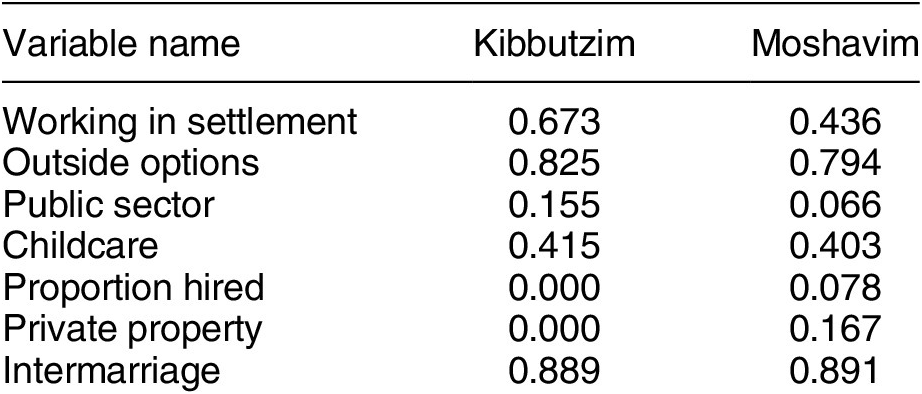
Table 1 shows the differences between communal and individualistic economic activity between the kibbutzim and moshavim in 1948. The kibbutzim show a greater communal economic activity through employment in their respective settlements, larger public sectors, and a complete abolition of private property and monetary wages. Communal economic activity should be positively correlated with the provision of security due to the communal nature of the kibbutzim being designed to facilitate the provision of such goods. Such activity should also be negatively correlated with the ability of a settlement to grow the Jewish economy, however, as individuals who can exploit private property for greater wealth will tend to shirk costly collective action. The following section will test this expectation on an original dataset. But first, the next subsection describes all control variables in each regression model.
Mean Proportion of Communal or Individualistic Institutional Structure: 1948

Alternative Explanations
There is a number of possible alternative explanations for the success of collective action in the kibbutzimFootnote 4 . These alternative explanations are controlled for in both regression models. This subsection describes the coding of the variables for these alternative explanations.
The provision of public goods is known to decrease in large groups (Olson Reference Olson1965). The census data records the total population of each settlement. Additionally, both settlement and settler age may explain how these settlements were able to provide security. A settlement that was well established may have been better able to repel enemy attacks than a newly founded settlement with few buildings. The census data record the founding year for each settlement. Subtracting that year from 1948 provides the age of the settlement. Additionally, a settlement comprised mostly of adults had comparatively more people to defend a settlement than a kibbutz or moshav with many children or elderly individuals who would have needed to be sheltered during the fighting. The census data record the age of settlers in five-year increments, and thus the mode settler age stands as a useful proxy for military-age individuals. Similarly, the number of males as a percentage of the total population may also proxy for military readiness, especially since the Haganah had a policy of evacuating women and children from settlements that were attacked (Morris Reference Morris2008).
The ability of a kibbutz to ensure compliance with rules prohibiting private ownership of property may also explain the success of these settlements in providing defense (Olson Reference Olson1965). An additional form of monitoring capacity separate from economic activity is measured by the proportion of settlers who could not speak Hebrew according to the census data. A larger proportion of individuals not speaking Hebrew reduced the ability of a settlement to convey messages, prevent the formation of potentially noncompliant cliques of non-Hebrew speakers, and ensure compliance with directions—especially in battle.
Collective action is impeded by ethnic diversity (Alesina et al. Reference Alesina, Devleeschauwer, Easterly, Kurlat and Wacziarg2003; Habyarimana et al. Reference Habyarimana, Humphreys, Posner and Weinstein2009). The census data record the world region of origin of each kibbutz or moshav member. Ethnic diversity is a bit of a misnomer considering all immigrants were Jews, but Jews from different regions of the world had different customs and spoke different languages upon arrival in Palestine, making at least linguistic diversity a possible impediment to collective action. Ethnic or linguistic diversity was measured using the standard Herfindahl index as proposed by Alesina et al. (Reference Alesina, Devleeschauwer, Easterly, Kurlat and Wacziarg2003).
Finally, the Israeli historical literature emphasizes the socialist-Zionist ideology of the kibbutzim as the primary causal mechanism explaining why the kibbutzim were so successful in providing defense for the Jewish community. The first kibbutzim were indeed founded by socialist Zionists who developed these settlements according to socialist ideology (Near Reference Near1992a). While ideology may have inspired the founding of the kibbutzim, given the transaction costs of monitoring shirking, the enforcement and sanctioning mechanisms of the kibbutz emerged as an institutional arrangement to facilitate collective action (Abramitzky Reference Abramitzky2018). Further, the theory presented here regarding property rights and collective action is meant to serve as a complement to, rather than a replacement of, ideological explanations. The ideology of a settlement is measured by the per capita number of settlers who immigrated from Eastern Europe, the geographic hotbed of Zionist-socialist ideology during this historical period (Near Reference Near1992a; Shapira Reference Shapira2012). The greater the proportion of settlers from Eastern Europe, the more imbued with Zionist-socialist ideology a settlement was.
PROPERTY RIGHTS, COMMUNAL INSTITUTIONS, AND COLLECTIVE OUTCOMES
According to the theory presented here, the institutional differences of the kibbutzim and moshavim that influenced transaction costs drove the provision of either economic development or military security. I first want to determine whether any institutional difference existed at all between the kibbutzim and moshavim. Theoretical and historical accounts suggest these differences existed, and the census data can empirically verify this. I used principal components analysis to examine which variables in the census data might load onto any latent factors and whether any of these latent variables measure differences in communal or individual economic activity amongst the kibbutzim and moshavim. Principal components analysis measures the existence of latent factors within the census data. The model computes correlations for each variable and measures the strength of these correlations to any latent factors that are linear combinations of two or more individual variables. The correlation each single variable has to the latent factor are called factor loadings and range from -1.0 to +1.0, representing the strength and direction of the variable’s correlation to a latent factor.
If the theory proposed earlier is valid, there should be a latent factor within the census data measuring whether a settlement was primarily economically orientated towards the production of private or public goods, and this latent dimension should be substantially different between the kibbutzim and moshavim. The results of the principal components analysis do reveal the existence of this latent factor. Four variables given in Table 1 load on to this latent factor, the first latent factor explaining the greatest variance (14%) in the data. The variables Private Property and Proportion Hired positively load onto the first factor (0.91 and 0.78 factor loadings, respectively), whereas the Public Sector and Working in Settlement variables load negatively onto the same factor (-0.56 and -0.30, respectively)Footnote 5 . The Public Sector and Working in Settlement variables both measure communal economic activities. The Private Property and Proportion Hired variables measure private rights to wages and property. This latent variable, which I call Individualism, is correlated positively with ownership of private property and negatively with communal economic activity.
A simple two-tailed t-test (t = 15.29, p < 0.0001) confirms that this latent factor is a critical institutional difference between the kibbutzim and moshavim. The mean level of individualism in the kibbutzim is −0.551, but the mean level of individualism in the moshavim in 0.952. The kibbutzim used communal property to reduce the transaction costs associated with metering and monitoring the production of public goods (including defense and security), whereas the moshavim used private property to reduce the transaction costs associated with metering and monitoring the production of private goods. The data supports the historical evidence that the kibbutzim and moshavim were different, and the reason for this difference was ownership of private property, which facilitated different transaction costs for the production of different goods.
Two regression models confirm that these different behaviors caused the moshavim and kibbutzim to provide different public goods. The first regression model is a logistic regression and measures a settlement’s propensity to provide Military Security. The dependent variable measuring security is a binary (0,1) variable where a coding of 1 indicates that a settlement was founded as a Tower and Stockade, and 0 otherwise. As previously mentioned, this Tower and Stockade type of settlement was built explicitly for military purposes and spanned both kibbutzim and moshavim. The variable thus exhibits variation across both settlement types, allowing for an examination of whether differences in property rights drove different outcomes with respect to security provision by each settlement type. The second regression model is a zero-inflated beta regression. The dependent variable for this model measures a settlement’s propensity to grow and develop the Jewish economy. The dependent variable in this model is the Private Property variable described previously. A normal beta regression measures the dependent variable on the interval (0,1), meaning all kibbutzim, with their complete prohibition on private property, would be undefined in the modelFootnote 6 . A zero-inflated beta regression measures the dependent variable on the [0,1) interval, ensuring all kibbutzim are included in the model.
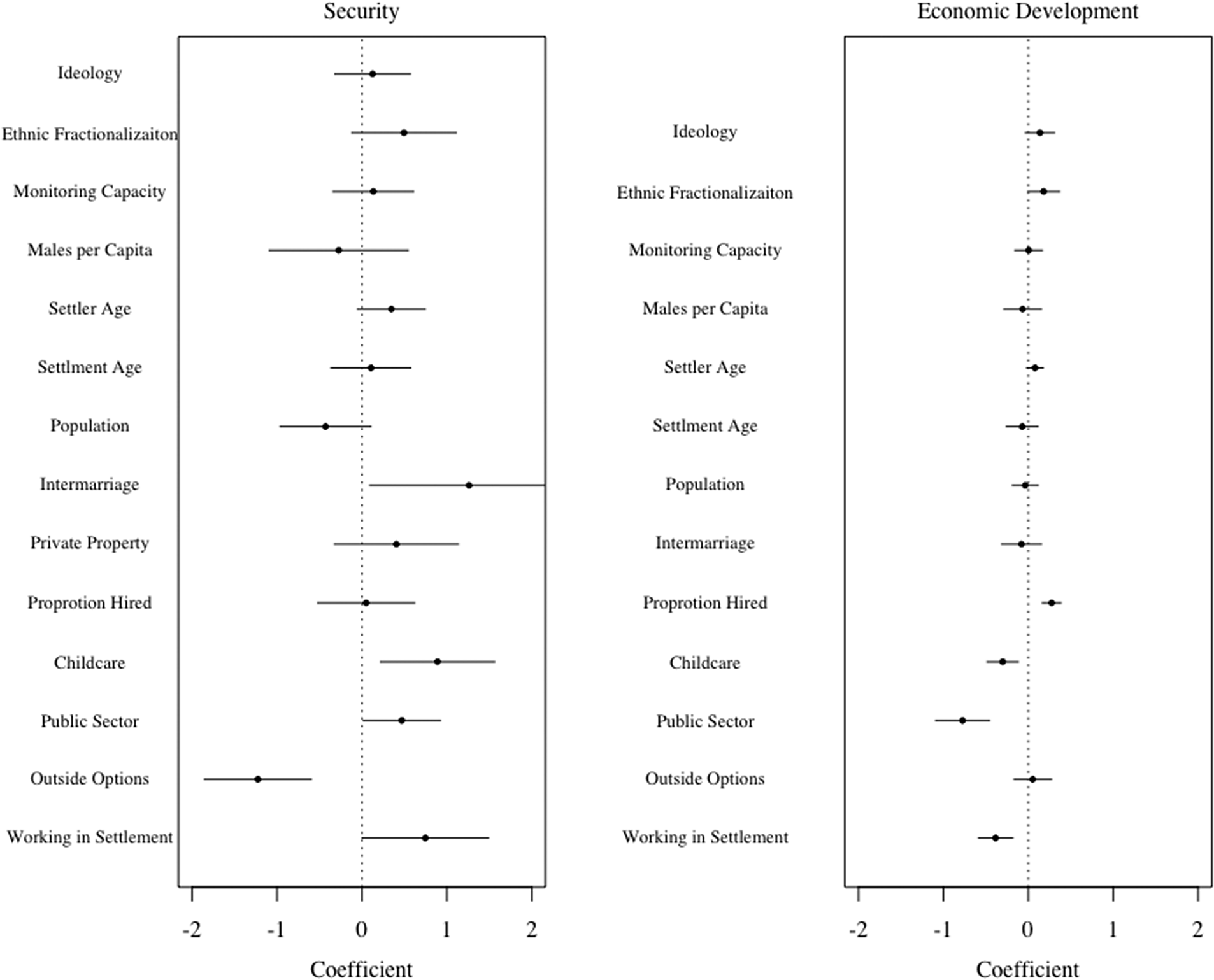
The evidence is exceptionally clearFootnote 7 . Variables measuring aspects of communal economic behavior are positively correlated with a settlement providing military security, whereas variables measuring individualistic economic behavior explain the development of the the Jewish economy. The institutional factors positively predicting the provision of military security predict a reduction of a settlement’s ability to provide economic development. The critical explanatory variables remain significant across both models, but switch signs, demonstrating that opposing institutional structures across the kibbutzim and moshavim explain the provision of different public goods. This is consistent with the theory of property rights influencing collective behavior described earlier. If the way property rights were distributed across these two institutions were chosen to maximize settlement returns net of transaction costs for the provision of different public goods, we should expect to clearly see such a difference reflected in the economic behavior of individuals within these settlements. That is exactly what is presented in Figure 2.
Coefficient Plot for Security and Economic Development Regression Models

The plot on the left side of Figure 2 is the logistic regression model with point estimates and 95% standard error bars explaining which variables are significantly correlated with the provision of military security. All variables measuring communal economic activity are positively and significantly correlated with security provision, whereas an individualistic variable, outside options, is negatively correlated with security provision. Working in the settlement (z = 1.967, p = 0.0492), the size of the public sector (z = 2.024, p = 0.0430), childcare (z = 2.598, p = 0.0094), and intermarriage (z = 2.061, p = 0.0393) all explain greater collective action to provide military security in a settlement. If a member had good outside options in the labor market, the model predicts less cooperative behavior for collective action (z = –3.805, p = 0.0001)
The plot on the right side of Figure 2 is the zero-inflated beta regression measuring the effect of settlement institutional structure on the exploitation of private property to facilitate economic growth. The situation is opposite from its counterpart on the left. When correlating institutional structure to economic development, all communal economic behaviors are now negatively correlated with economic growth, whereas individualistic variables like the proportion of individuals hired, are positively correlated with such growth. The size of the public sector (t = −4.795, p < 0.00001), the percentage of individuals working in their settlements (t = −3.721, p = 0.0002), and childcare (t = −3.219, p = 0.0014) all explained why a settlement provided more military security, but now explain why a settlement would provide less economic development. The payment of wages, and thus ownership of private property in the form of money, predicts a settlement’s propensity to develop the Jewish economy (z = 4.917, p < 0.00001) The relevant explanatory factors have switched signs, but they retain their statistical significance, indicating that private and communal property rights had opposite effects on institutional behavior.
What the regression models reveal is that two opposing institutional structures facilitated the provision of military security and economic development. If a settlement’s property rights were communal, that settlement facilitated the provision of military security. If a settlement distributed property rights individualistically, that settlement was more likely to contribute to the growth of the Jewish economy. The transaction costs that influenced economic behavior to provide public or private goods differed across the kibbutzim and moshavim, as shown the principal components analysis and the t-test. These two settlements were built for two separate purposes, and the shift from favoring the moshavim to the kibbutzim post-1936 suggests this change in strategy was a strategic state-building choice by the Jewish community. Because the critical difference between the kibbutzim and moshavim was the distribution of private property, the regression models provide powerful evidence demonstrating that this was the causal factor governing the provision of different public goods by the kibbutzim and moshavim.
TRANSACTION COSTS, MONITORING, AND COLLECTIVE ACTION
The regression models show that the institutional designs of the kibbutzim and the moshavim facilitated different social behaviors, and these behaviors resulted in the provision of distinct public goods necessary for governance. The results, though convincing, are not fully sufficient to establish causality. The correlations do not shed light on individual behavior. Examining primary and secondary historical sources, it is clear that the communal distribution of property caused the kibbutzim to develop a robust monitoring and sanctioning regime, which led those settlements to excel in matters of military defense, whereas the more individualistic distribution of property in the moshavim caused more individualistic economic activity, hampering security provision but improving the ability of the moshavim to grow the Jewish economy.
As previously stated, the different property rights regimes were endogenous to the kibbutzim and moshavim. The socialist-Zionist ideology of the kibbutz settlers explains why they wanted to abolish private property in their settlements, whereas the more individualistic preferences of the moshav members explains why they chose to keep private property rights. Yet endogeneity does not explain why the moshavim and kibbutzim provided different goods to the Jewish community; ideology was not significant in either regression model. Instead it is the different transaction costs between settlements that is the causal factor that explains the different types of economic behavior between the settlements and thus the provision of security or economic development.
Kibbutz members understood that the institution of the kibbutz itself produced collective action problems. “One problem of our work on the kibbutz is that no one sees direct results from (sic) his efforts, but only collective results. If I plow a stretch of land, it does not mean that the fruit will be all my doing, because the harvest will depend upon many other workers who will follow me. All I do is drive a tractor” (Criden, Criden, and Gelb Reference Criden, Criden and Gelb1974, 62). Due to the communal structure of the kibbutz, information rapidly spread about who was a “good” member. Though population growth steadily increased in the kibbutzim from 1920 to 1948, the kibbutz remained a small enough settlement, on average, to make shirking difficult (Leon Reference Leon1969). To take an example, in the kibbutz Degania, a member was asked to plow the largest field in order to prepare it for planting. At the end of each row he plowed, the member sat down and smoked a cigarette instead of moving on to plow the next row. After his work shift, “nobody said a word to him. But in the evening, in the dining hall, the atmosphere around him was such that the following morning he got up and left the kibbutz” (Near Reference Near1992a, 38). Since this member worked in full view of others, his loafing became common knowledge and he was socially ostracised until he left the kibbutz.
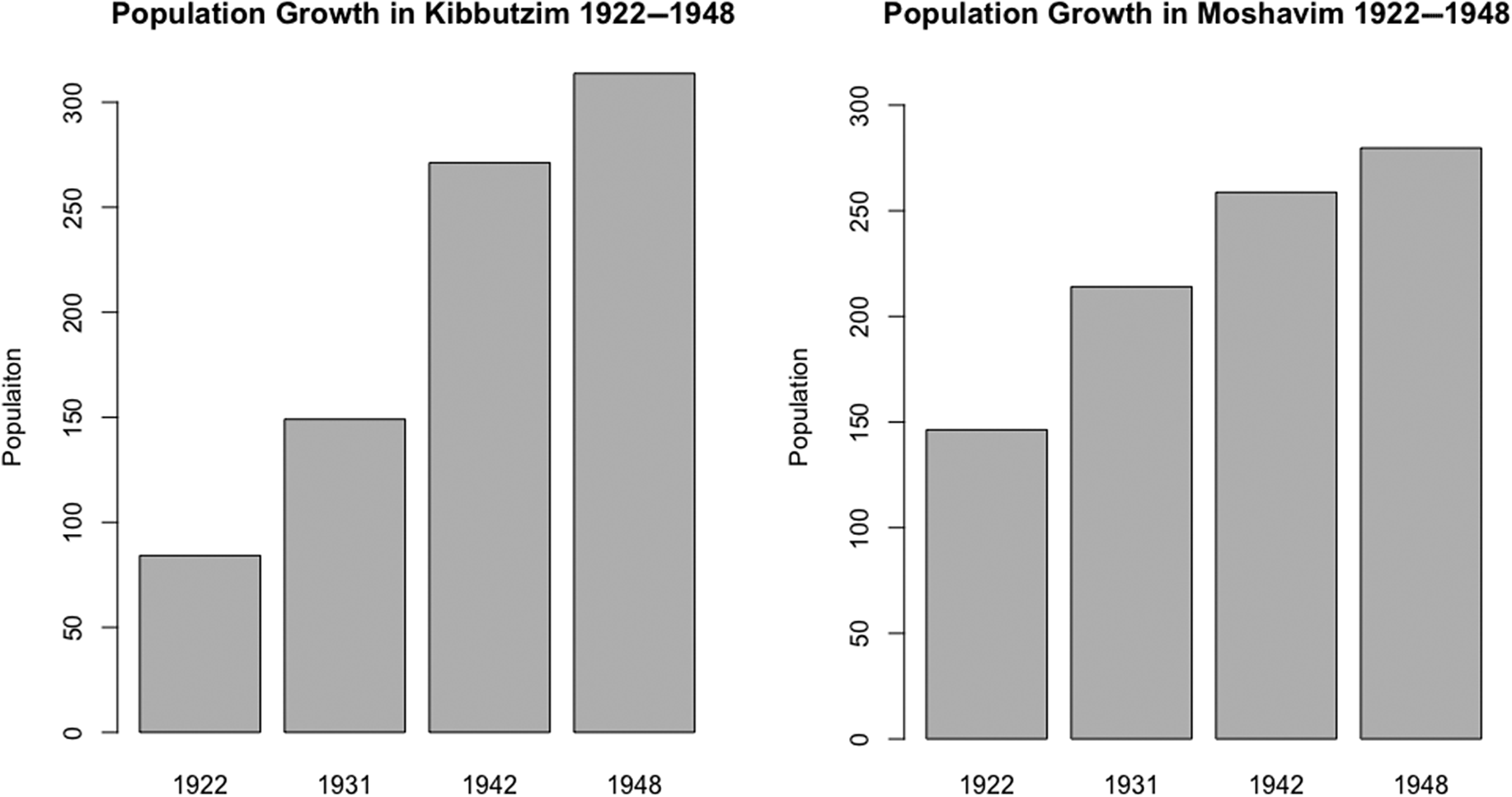
Figure 3 shows the average population of the kibbutzim and moshavim from the 1920s to 1948Footnote 8 . Consistent with a national strategy to grow the Jewish economy when Jewish-Arab relations were relatively calm, the moshavim had a larger population in 1922 and 1931, but this population growth slowed after 1936 and the kibbutzim show a larger population after 1942, when security was at a premium. Though this is consistent with a shift in settlement and population in those settlements to needed economic sectors—the provision of security—this increase in population was problematic for the kibbutzim. An increase in population size would increase the costs of monitoring settler behavior. Yet, as the next graph shows, larger populations of immigrants predict greater cooperation within a kibbutz.
Change in Population Growth for Kibbutzim and Moshavim: 1920–1948

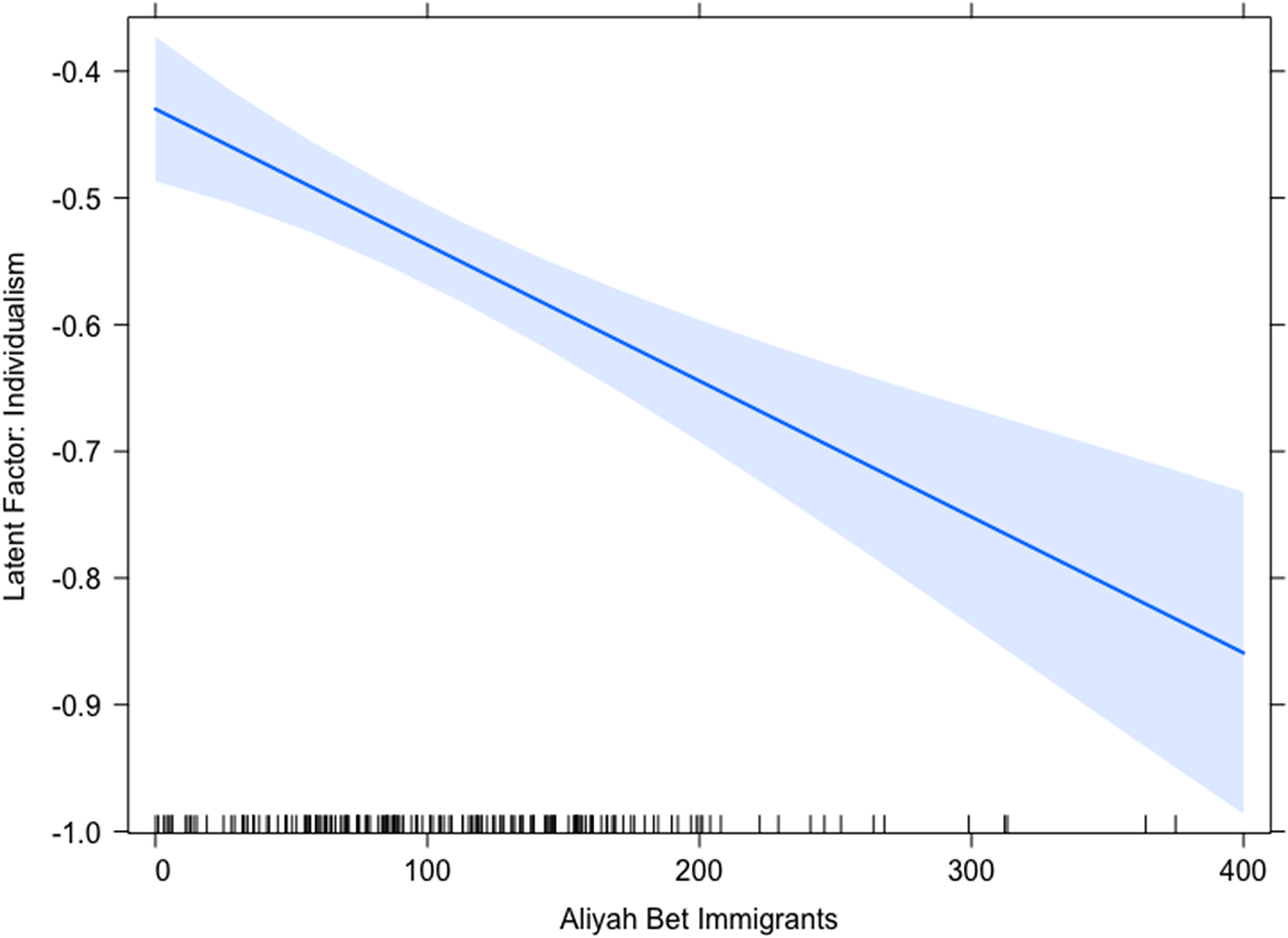
Figure 4 shows a decline in a kibbutz’s level of individualistic behavior for larger numbers of immigrants from the so-called Aliyah Bet, or illegal immigration period. The graph shows the predicted probability for a univariate OLS regression where the dependent variable is the latent Individualism factor extracted from the PCA model as described earlier. The only x-variable in the model is the number of immigrants who arrived to a kibbutz from 1940 to 1948 during this period of illegal immigrationFootnote 9 . The British instituted immigration quotas of no more than one thousand immigrants per month in the wake of the Arab Revolt. Such quotas were intolerable for the Jewish leadership during the Holocaust, and Ben-Gurion advocated for massive illegal immigration of Jews to Palestine beginning in 1939 in order to undermine British rule (Near Reference Near1992b). Kibbutzim had always been at the forefront of immigrant absorption in Palestine; this rate increased substantially during this period.
Predicted Individualism According to Aliyah Bet (Illegal) Immigrants to Kibbutzim

(Near Reference Near1992b) reports that nearly half of immigrants during this period were absorbed by the kibbutzim in some capacity. Such a large influx of members raised monitoring and other transaction costs that could threaten collective action. But, the immigrants quickly adapted their behavior. This is consistent with a robust monitoring regime that facilitated institutional learning. New members were immediately socialized into kibbutz society, and the communal nature of the kibbutz’s monitoring capacity, along with its social ostracism as a sanctioning mechanism, quickly brought the behavior of new members into line.
This institutional learning occurred due to two factors: monitoring of behavior and rewarding good behavior or sanctioning bad behavior. The kibbutz constantly required members to attend communal meetings and carry out their daily work while being watched by other members.
At midnight, when I was fast asleep, I was suddenly woken up by the loud peals of the bell. I was sure that a fire had broken out. I rushed outside, half naked, but everything was quiet… . asked what was going on. “Shh … don’t make a noise” they whispered. “The bell is calling us to a discussion.” I was amazed. A discussion at midnight? I went back to my tent and dressed. (Near Reference Near1992a, 246)
We established discipline according to “the call of the bell.” The members had to get up when it rang, and work a certain number of hours per day… . We had to establish’ the discipline of the bell’ in order to prevent chaos in the work schedule and to enable us to check the work… . But anyone who has a close acquaintance with these things knows that in order to organize work and prevent waste everyone must go out to work at the same time, and finish at about the same time. Permanence leads to punctuality. (Near Reference Near1992a, 247)
Meeting attendance was mandatory. Calling meetings at odd hours ensured that members could keep track of who came to the discussion and who stayed asleep. Instituting such discipline allowed the community to ensure everyone was pulling their weight by checking each others work. Using such monitoring capacity, the kibbutz was able enforce cooperation.
The kibbutz had no formal means by which it could sanction members for bad behavior. It rarely expelled even the most dedicated shirkers from the community (Criden, Criden, and Gelb Reference Criden, Criden and Gelb1974). Instead, the sanctioning power of the kibbutz targeted an individual’s social reputation (Leon Reference Leon1969). Shirkers were socially ostracized. The weight of public opinion served to enforce institutional rules (Criden, Criden, and Gelb Reference Criden, Criden and Gelb1974; Near Reference Near1992a). Given the choice between social isolation and compliance with kibbutz discipline, most individuals chose the latter since they relied on the kibbutz for their economic livelihoods and personal security in hostile areas of Palestine (Schwartz Reference Schwartz1953).
The power of public opinion had important ramifications for collective action. The social ostracism kibbutz members were subject to directly led to providing military security. Near (Reference Near1992b) contends that public pressure exerted on members by the kibbutz proved an effective means of recruitment to the Jewish military including the Haganah. The Jewish community lacked the ability to officially conscript soldiers. The British had outlawed Jewish military units after the war, conducted searches of settlements for arms, and arrested Jews caught with weapons. Since the Jewish community could not openly conscript, recruitment was encouraged through the use of persuasion, moral pressure, and propaganda. “Unlike the Yishuv in general, [the kibbutzim] had means of enforcing their recruitment policy. The Jewish Agency issued ‘mobilization orders,’ demanding the enrolment of certain age groups and categories of worker. But there was no effective way of enforcing these orders except through public opinion…. Kibbutz members, by contrast, were subject to the decisions of their communities, which translated the policies of the movements into concrete terms” (Near Reference Near1992b, 18–19). Near (Reference Near1992b, 21) reports 13% of all kibbutz members were mobilized during WWII, compared with just 5% of the entire population of the Jewish community.
The moshavim, by contrast, had comparatively less ability to monitor the behavior of its members because moshav life was more atomized. This unsurprisingly hampered the dissemination of information regarding the social behavior of members. Of course the moshav did not need to institute such a monitoring regime because settlers made institutional decisions regarding their exploitation of private property for economic development. Although the moshav lacked a robust monitoring regime comparable to that of the kibbutz, it did create a formal sanctioning regime for members who broke moshav rules (Schwartz Reference Schwartz1953). Sanctions in the moshavim took the form of fines. Limited evidence documents that individuals who could afford these fines simply paid them with little corresponding change in behavior (Abarbanel Reference Abarbanel1974; Baldwin Reference Baldwin1972). Because economic differentiation was possible in the moshavim, such sanctioning had relatively little effect on social behavior. Indeed, this led most moshav settlers to bemoan the lack of cooperation between members in that settlement.
Two quotes from moshav members make clear the institutional decay in cooperation across the moshavim due to the effects of private property. Baldwin (Reference Baldwin1972, 202) reports a common moshav joke bemoaning the selfish actions of many members: “A moshavnik came to the village and asked if there was mutual aid between members. The answer was: ‘Of course, two farmers will always combine to push down a third.’” Abramitzky (Reference Abramitzky2018, 84) also notes the frustration, and expectation, that the moshav was not well suited to provide mutual assistance between members. “I have no problem with mutual assistance, but it became immediately obvious that not all of us are set for that… . I understood I was signed up for mutual assistance in a moshav where members steal from their own pockets.” As the moshav was instituted to give economic returns directly to the individual, it is not surprising that decision making in that institution emphasized individual rather than cooperative behavior. The distribution of property in the moshavim made this kind of decision a dominant institutional strategy for producing private goods.
CONCLUSION
Problems of social organization for collective action are the fundamental subject of inquiry in political science. This research has demonstrated that property rights have an important effect on collective behavior. Communal distribution of property internalizes transaction costs of producing public goods, whereas private property internalizes transaction costs for producing private instead of public goods. In addition to being an outcome of collective decision making, property rights also affect collective action by influencing institutional transaction costs, altering the strategic behavior of individuals. As the Jewish community of Palestine demonstrates, property rights affect the provision of critical goods necessary for effective governance. And in contrast to previous theorizing, this case study demonstrates that the state may let property rights over critical goods remain public rather than privatizing the production of necessary public goods like security as long as the provision of these goods remains efficient. Thus, rather than being a sign of weakness, the devolution of security functions to substate actors may reveal an alternative strategy of governance where states are developing.
The Jewish community let the kibbutzim provide security for the nascent state of Israel because up to 1948 these settlements were the most effective providers of this critical public good. The cooperative behavior in the kibbutzim established over decades through monitoring and sanctioning of individualistic behavior created a well-trained soldier. Yet 1948 would be the end of the heroic period for the kibbutzim. The state of Israel, a sovereign battle-tested state, had emerged. Its army was now able to respond to foreign invasion, eliminating the need for security provision by disparate communal settlements. From 1948 to 1954, one hundred new kibbutzim were founded. But now, moshav settlement overtook the kibbutzim as two hundred and twenty-three moshavim were constructed during the same period (Near Reference Near1992b). The Israeli state was now consolidated, and only after this consolidation did it establish its monopoly over the use of force.
David Ben-Gurion, who in 1936 advocated settling kibbutzim to fortify the strategic military position of the Jewish community, now spoke out against these settlements (Near Reference Near1992b, 183–84):
I should like to speak not as prime minister, but as a pioneer… . The kibbutz movement which asserts the value of pioneering has never been as disappointing as it is in this respect. Where is the movement to meet the new immigrants, where is the pioneering element that will deal with immigration? Thousands of pioneers have done great deeds in their farms and their kibbutzim. What have they done for the immigrants? For the [improvement] of their homes, their farms, their kibbutzim—yes! But what have they done for the three hundred thousand Jews? During the past two years I have been humiliated and ashamed. I speak as one of the pioneers, and I ask: ‘What have they done?’… There has never been such a failure; I am humiliated and ashamed. True, they share their bed and their bread with those who join their kibbutzim. But what about those who don’t want to go to the kibbutzim, who want to be simple farm-workers—how are they being absorbed? What is their attitude towards them? The very values of pioneering are being called into question—and I know what pioneering used to be!
The Israeli state had repelled and expelled its foreign and domestic opponents. What was needed now was absorption of immigrants and the development of a robust economy that could feed, clothe, and absorb these new immigrants. Thus the settlement of more than twice as many moshavim over kibbutzim in the half decade since Israel’s war of independence. A kibbutz member puts the issue succinctly saying Ben-Gurion, “feared our strength, so he had to break us up. He didn’t want any strong autonomous organizations, because he considered them a threat to the new state” (Ingram and Simons Reference Ingram and Simons2000, 603). Now that the Israeli state had emerged victorious, it needed to establish and maintain its monopoly on the use of force. The kibbutzim were a direct threat to that. Thus the settlement of kibbutzim fell out of favor as a national goal, replaced by the moshavim, which constituted no direct threat to the state’s use of force as the distribution of private property was incompatible with collective action to provide local security.
The case of the kibbutzim and moshavim is a story about the consolidation of state authority. As states are consolidating their power, they may choose to devolve the production of certain goods to substate actors if such actors can efficiently produce these needed public goods. Yet when the state is sovereign it must thoroughly monopolize the use of force. This explains Ben-Gurion’s turn against the kibbutzim. While collective action may be sustained in institutions by the decentralized actions of private individuals and the distribution of property, this is ultimately but one strategy any state may employ at one phase of its development. Political scientists should not mistake strategy for weakness, but instead investigate this devolution of authority as a strategic choice made by a constrained sovereign until its power has been fully consolidated.
Supplementary Materials
To view supplementary material for this article, please visit http://dx.doi.org/10.1017/S0003055421000526.
DATA AVAILABILITY STATEMENT
Replication materials can be found at the American Political Science Review Dataverse: https://doi.org/10.7910/DVN/COFHJL.
ACKNOWLEDGMENTS
The author wishes to thank Carolyn Warner, David Siroky, and Michael Hecther for their invaluable comments and assistance with previous drafts of this research. I also want to thank the School of Politics and Global Studies at Arizona State University for funding that made the collection of archival data possible and the hospitality of the Central Zionist Archives and Yad Tabenkin Archives in Israel. A previous version of this research was presented at the American Political Science Association annual conference, San Francisco 2017.





Comments
No Comments have been published for this article.