INTRODUCTION
The white shark, Carcharodon carcharias (Linnaeus, 1758) is the largest, non-filter feeding shark species, and it commonly reaches a maximum total length (L T) of 5–6 m, although larger specimens are suggested (Compagno, Reference Compagno, Carpenter and Niem1998; Compagno et al., Reference Compagno, Dando and Fowler2005). This species is most commonly encountered in coastal and offshore waters of continental and insular shelves, including shallow bays, but also occurs in oceanic waters and on the continental slope (Compagno et al., Reference Compagno, Marks and Fergusson1997; Compagno, Reference Compagno2001; Last & Stevens, Reference Last and Stevens2009). It has a cosmopolitan distribution in all seas including cold boreal waters, temperate and subtropical regions, and has been occasionally recorded from several inshore tropical regions, such as in the central Pacific (Taylor, Reference Taylor1985; Compagno, Reference Compagno2001), the Coral Sea (Last & Stevens, Reference Last and Stevens1994, Reference Last and Stevens2009), Papua New Guinea (Burgess & Callahan, Reference Burgess, Callahan, Klimley and Ainley1996), northern Brazil (Gadig & Rosa, Reference Gadig, Rosa, Klimley and Ainley1996) and the tropical south-west Indian Ocean (Cliff et al., Reference Cliff, Compagno, Smale, van der Elst and Wintner2000). While widely distributed, the species is relatively uncommon in tropical waters compared to other large macropredatory sharks, and is more frequently seen and caught in inshore temperate waters (Compagno et al., Reference Compagno, Marks and Fergusson1997). It is far more abundant in cool to warm temperate waters rather than in the warm tropical waters (Compagno, Reference Compagno, Carpenter and Niem1998).
White sharks are occasionally recorded close to offshore islands both in the Pacific and the Atlantic and have been reported as by-catch in various offshore fisheries, such as tuna longline and squid fisheries (Burgess & Callahan, Reference Burgess, Callahan, Klimley and Ainley1996; Fergusson, Reference Fergusson, Klimley and Ainley1996; Compagno, Reference Compagno2001). Both tagging and genetic studies have shown that white sharks are highly migratory, and capable of making transoceanic movements, e.g. between South Africa and Australia (Pardini et al., Reference Pardini, Jones, Noble, Kreiser, Malcolm, Bruce, Stevens, Cliff, Scholl, Francis, Duffy and Martin2001; Bonfil et al., Reference Bonfil, Meyer, Scholl, Johnson, O'Brien, Oosthuzien, Swanson, Kotze and Paterson2005) and between Mexico and Hawaii (Compagno et al., Reference Compagno, Dando and Fowler2005).
Although the extrapolated distribution of white sharks includes Indonesia, there are no definitive records of this species from Indonesian waters. This paper presents the first record of C. carcharias from this country.
MATERIALS AND METHODS
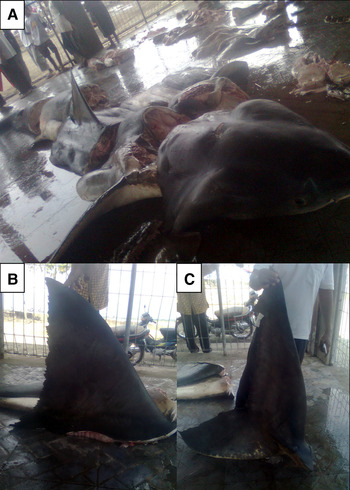
On 31 July 2013, a large white shark was caught by demersal longline fishers from Maringkik, West Nusa Tenggara operating about 11 km off Dompu, West Nusa Tenggara (08°51′S 118°18′E). The shark was harpooned as it followed hooked fish on the longlines during the retrieval operation at about 3 am. Due to its very large size, the body was cut into five pieces before being brought to the Tanjung Luar landing site in eastern Lombok (08°48.2′S 116°30′E) by three fishing boats.
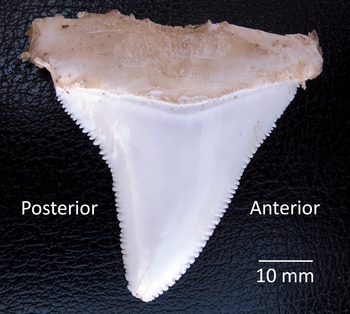
Information about this specimen was recorded by the authors during a market survey of Tanjung Luar, during which the local people showed photographic evidence and some retained teeth. Basic data such as length and sex were gathered from fisheries enumerators who regularly recorded shark landings at this site (for the total length) and from a shark-fin merchant (for fin measurements). The only body part of the specimen that could be recovered by the authors was an upper lateral tooth. This tooth is catalogued at the Research Centre for Oceanography's collection (NCIP 6548) in Jakarta (Figure 2).
RESULTS AND DISCUSSION
An adult male white shark was landed at Tanjung Luar market in five pieces. The specimen was approximately 6.6 m L T. The first dorsal fin measured 850 mm from base to apex, and pectoral fin length was 1150 mm (Figure 1). The shark was sold for 11 million rupiahs (equivalent to approximately US$ 970) and was processed on the same day. The only material retained was several teeth and one of them was collected and measured by the authors. The dimensions of the tooth are: perpendicular height (from tooth base to apex) 31.3 mm; anterior margin 49.9 mm; and posterior margin 39.6 mm. The tooth exhibits the strong serrations characteristic for this species. Upper anterolateral teeth of white sharks are upright and triangular with only the more posteriorly located upper teeth having slightly oblique cusps. Thus, this tooth is likely from the 8th–9th row from the symphysis based on its morphology.
Carcharodon carcharias, adult male, at Tanjung Luar landing site: (A) the body in five pieces; (B) dorsal fin; (C) caudal fin.

Upper lateral tooth of Carcharodon carcharias (NCIP 6548).

This record of C. carcharias from eastern Indonesian waters confirms the presence of this species in this region. The fishers mentioned that the shark was chasing fish that had been caught on demersal longlines as they were brought to the boat. Five boats were involved in the capture of the shark and it was cut into 5 pieces to fit in their boats. The demersal longline boats which operate out of Tanjung Luar are relatively small vessels with a 25 HP motor, and fish about 16 km from the coast in waters of 50–100 m depth. The target of this fishery is large demersal fish such as rays (including rhynchobatids, rhinobatids and dasyatids), sharks (including carcharhinids, sphyrnids, triakids and orectolobids) and also large demersal teleost fish. The occurrence of the white shark in southern Indonesia is likely to be a rare event. The shark fishers at Tanjung Luar have been fishing for sharks for many decades and this species has never been sighted before. The white shark is known to occur, although rarely, in tropical waters such as north-west Africa, east Africa (Kenya, Tanzania), the Seychelles, Mauritius, Madagascar, Sri Lanka, northern Australia, New Caledonia and the Philippines (Compagno et al., Reference Compagno, Marks and Fergusson1997; Fergusson et al., Reference Fergusson, Compagno and Marks2009) and now has been confirmed from Indonesia.
ACKNOWLEDGEMENTS
We are grateful to Mr Bram and fishers from Tanjung Luar who provided valuable information regarding the capture of the specimen and William White of CSIRO Australia for his review and suggestions on this manuscript. We also thank the Directorate of Regional and Species Conservation, The Ministry of Marine Affairs and Fisheries for financial support.