A leading research question facing institutional scholars in international relations (IR) asks how international institutions are able to influence the behavior of autonomous state actors.1
Martin and Simmons 1998.
Two different research communities are currently investigating this question. The rationalist community has focused its research program primarily on causal mechanisms such as information provision and reduced transaction costs.2
In order to test the effects of institutional information, for example, rationalist scholars often treat state interests as exogenously given. This is a modeling convenience, but it has the important effect of creating a “hard test” for rationalist institutional theories by holding interests constant.3As Wendt acknowledged on this point: “Neoliberals make things hard for themselves by accepting this constraint, and their efforts to explain cooperation under it are admirable”; see Wendt 1994, 384.
Conversely, the constructivist research community has at its foundation the argument that state interests are not exogenous. Unit-level interests change and evolve, and as with any other variable in international politics, they must be explained, or endogenized.4
Also central to constructivism is the argument that institutions shape member-state behavior through a macro-process often identified in the literature as international socialization: within the social context of IGOs, member-states interact on a regular and sustained basis, taking on new identities and interests.5Johnston 2001.
Despite the fact that causal mechanisms such as information provision and socialization are not directly competitive, or contradictory to each other, these two scholarly communities have not yet combined their efforts into a common research program on international institutions. Of course, this is not easy to do since these IR groups typically embrace different epistemological traditions. Yet more can be done to build bridges between these communities, especially where they are already united by a common research question.
In this article, we make an effort in this direction by testing the constructivist hypothesis about international socialization using a large-N quantitative methodology more common to the rationalist research tradition. We justify this as a valuable and important exercise because rationalist scholars have arguably ignored the constructivist socialization hypothesis due to doubts about its empirical validity. Indeed, this point has often been raised by rationalists and constructivists alike.6
See, for example, Goldstein and Keohane 1993, 6; Katzenstein, Keohane, and Krasner 1998, 677; Checkel 1998, 325; Johnston 2001, 511; and Zürn and Checkel 2005, 1047.
It would be wrong to say that there is no empirical evidence concerning international socialization, but much of the research has taken a small-N approach to the subject. Furthermore, the limited number of larger-N quantitative tests that exist have focused exclusively on European institutions, arguably an easy case for the socialization hypothesis.7
Finally, some of these quantitative tests reported only limited socialization effects even in Europe.8 Thus, while the underlying theory is certainly plausible, it remains uncertain whether it can stand up to more systematic empirical tests.Some scholars might respond that a systematic empirical test can never be constructed because state interests—a key dependent variable for the international socialization hypothesis—cannot be directly measured. On this point, we simply disagree. Recent data collection efforts have provided IR scholars with stronger and more comprehensive operational measures for state interest similarity. We admit that these data are not perfect, but few, if any, operational measures could meet such a standard. To paraphrase Voltaire: it is foolish to let the perfect stand in the way of the good.
With this understanding in mind, our article begins with a presentation of international socialization theory leading to a hypothesis about how IGOs promote interest convergence among member-states. We then demonstrate how this hypothesis can be tested systematically using relatively new data on dyadic interest similarity9
and joint structured IGO membership.10Boehmer, Gartzke, and Nordstrom 2004.
Our results show strong statistical support for the institutional socialization hypothesis, using both global and more restricted regional samples. Indeed, this structured IGO effect is as substantively strong, if not stronger, than any other factor in explaining dyadic interest convergence. We also demonstrate how our IGO result is consistent with a longer-term socialization process and cannot be explained by the short-term effect of institutional information. Next, we show some limits to the institutional socialization hypothesis. Unstructured IGOs reveal no effect in promoting member-state interest convergence. Following recent theory that argues that great powers in the international system often use IGOs for coercive means,11
Thompson 2006.
Finally, we conclude by discussing how these results can be read as generally supporting one of the main propositions advanced by international socialization theory. For constructivists, this should be very good news since the socialization hypothesis represents a critical part of their research program. Our results obviously cannot distinguish between different possible socialization micro-foundations, such as strategic calculation, role-playing, and/or normative suasion,12
Checkel 2005.
For rationalist scholars, our results can also be read as good news. Inasmuch as international institutions influence member-states' behavior by shaping their interests, rationalist scholars studying how institutions affect state behavior have yet another causal mechanism to add to their toolkit. This is valuable because many purely “rationalist” causal mechanisms, including information provision and institutional commitment, may sometimes work through changes in member-state interests. This understanding has implications for how rationalist scholars test their preferred institutional causal mechanisms, as we discuss in the final section of the article.
International Socialization Theory
We begin with a short presentation of international socialization theory drawn from the constructivist IR literature. This presentation is made with particular empirical goals in mind: establishing an appropriate unit of analysis, theoretically relevant dependent and independent variables, and a testable hypothesis relating these variables. We will also make a stronger case to demonstrate that this hypothesis has not yet been systematically tested in a broad international context.
The Socialization Process in International Relations
Definitions of “socialization” vary in the IR literature, but this term can reasonably be defined as the process by which actors acquire different identities, leading to new interests through regular and sustained interactions within broader social contexts and structures.13
Concerning socialization depth, constructivist scholars have carefully distinguished between Type I and Type II socialization.14Checkel 2005, 804.
The proposition of deep international socialization arguably represents a key component of constructivism as a structural theory of international relations, following Wendt's summary of constructivist “core claims: (1) states are the principal units of analysis for international political theory; (2) the key structures in the state system are intersubjective, rather than material; and (3) state identities and interests are in important part constructed by these social structures, rather than given exogenously to the system by human nature or domestic politics.”15
Wendt 1994, 385.
Toward a Testable Hypothesis
As Wendt's first point makes clear, international socialization should affect states, the primary actors in the international system. This is an important point because socialization theory originated in sociology and social psychology, where the relevant unit of analysis was individuals and not state actors. But as an approach to IR, constructivism necessarily focuses on the latter, although it certainly cannot ignore the former. As Beyers explained: “practices, norms, and preferences are not only internalized by individual actors, but, because they are shared by many, also characterize and shape the identity of larger social aggregates (that is, a bureaucratic agency, a political party, a country, and so on.).”16
Beyers 2005, 900.
With regards to deep socialization at the aggregate level, the most important dependent variable is state interests. Wendt's third claim quoted above makes this point clear, but many other constructivist scholars offer a similar argument.17
State identities are clearly another important variable in international socialization theory, but they are intervening with regard to state interests: institutions → identities → interests.18 With deep, or Type II, socialization, new social identities must come before any changes in state interests, and not vice-versa. If constructivist theory forced interests to drive identity change, then it would become hard to make any strong claims about Type II socialization. Indeed, if interests were doing the causal work on identities, then the process might become indistinguishable from “strategic calculation,” identified by Checkel as insufficient for deep “socialization and internationalization.”19Checkel 2005, 809.
The key independent variable for the deep international socialization process is institutions, especially IGOs since these are the primary “social structures” for states in the international system.20
Wendt 1994, 385. As discussed in Finnemore 1996, nongovernmental organizations (NGOs) may also play a role in international socialization. But since national governments are not NGO members, by definition, nongovernmental organizations do not typically serve as sites of socialization for state actors, although NGOs such as the International Committee of the Red Cross may act to promote international socialization.
Checkel 1999, 547.
Ibid.
Johnston 2001, 508–9.
Checkel 2005, 806–8.
We thus pose a causal hypothesis that can be tested systematically: IGOs make member-state interests more similar over time (that is, promote interest convergence). Presumably, these institutional effects should also be cumulative in character: states that are joint members of more IGOs should show greater interest convergence than states with less joint IGO membership. Indeed, if it is regular sustained contact/interactions within IGOs that socialize states in the international system, then more socialization opportunities should lead to even greater interest convergence.
The obvious null hypothesis is that IGOs have no independent causal effect on the interests of member-states. It is important to take the null hypothesis seriously because it effectively characterizes the view of many rationalist scholars. For example, analyzing the effects of IGOs on interstate military conflict (admittedly, a measure of state behavior and not directly a measure of state interests), Boehmer, Gartzke, and Nordstrom concluded that “IGOs are not broadly effective in the way they should be if international organizations alter preferences… .”25
Boehmer, Gartzke, and Nordstrom 2004, 2.
Breaking with the original neorealist position that international institutions are merely epiphenomenal,26
many realists currently acknowledge that international institutions are an important factor in world politics.27See, for example, Schweller and Priess 1997.
Thompson 2006, 1.
Gruber 2000, 8.
Existing Evidence on Institutional Socialization
As mentioned in the introduction, there is already some empirical evidence to support the institutional socialization hypothesis. But much more empirical work needs to be done. First, much of the early research deliberately took a small-N approach to demonstrate the empirical plausibility of this new theoretical approach to understanding institutional effects.30
See, for example, Finnemore 1996, 31.
Checkel 1998, 339.
Second, where there is larger-N quantitative support for the socialization hypothesis, it is not systematic in character, focusing almost exclusively on institutions and countries in Europe.32
For those searching for comprehensive empirical support, this regional evidence poses a potential inferential problem since Europe, especially Western Europe, may represent a “relatively easy case,”33Johnston 2005, 1036.
Checkel 1999, 554.
Third, much of the quantitative evidence from the European region is not, in fact, strongly supportive of international socialization. Studying the expressed preferences of European Commission officials, Hooghe found that while they are supportive of supranational norms, this support is better explained by national, not international, socialization.35
Hooghe 2005.
Kelley 2004, 453.
To conclude our presentation of the institutional socialization hypothesis, the argument is clearly an important one for IR theory; indeed, it forms part of what might be called the constructivist “hard core.”37
Lakatos 1970.
Testing the Institutional Socialization Hypothesis
We begin the empirical section by restating our cumulative institutional socialization hypothesis: states that are joint members of more IGOs should show greater interest convergence than states with less joint IGO membership. State actors are the theoretical unit of analysis and, thus, our statistical unit of analysis will be pairs of states (dyads) in a given year. Using this dyad-year unit of analysis, the institutional socialization hypothesis can be tested by taking advantage of recent data collection efforts coding both dyadic interest similarity in the post–World War II period and dyadic joint IGO membership over this same period of time.
Dependent Variable
Our dependent variable is dyadic interest similarity, with movement toward more similar interests over time defined as interest convergence. While it has long been an important concept in IR theory, interest similarity has proven difficult for scholars to operationalize directly. For many years, the preferred measure among quantitative IR scholars was one of common alliance partners, or alliance portfolio similarity.38
Altfeld and Bueno de Mesquita 1979.
Despite this limitation, we will use the alliance portfolio similarity measure as a robustness check on our preferred measure of interest similarity, affinity.
As an alternative, Gartzke offered a measure of dyadic interest similarity, labeled affinity, built from roll-call votes within the United Nations General Assembly (UNGA).40
Gartzke 1998.
Indeed, as Voeten wrote on this subject: “it is the only forum in which a large number of states meet and vote on a regular basis on issues concerning the international community”; see Voeten 2000, 185–86 (emphasis added).
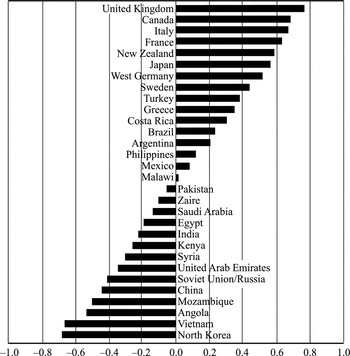
As a broad indicator of revealed state interests, affinity presents some obvious face validity. Using the updated data from Gartzke and Jo, this measure scores dyadic interest similarity along a −1 to 1 range with high values indicating greater similarity.42
Gartzke and Jo 2002.
We use the United States as the example based on the assumption that most readers will be familiar with the foreign policy interests of this international actor.
Since a figure containing the average affinity score for more than 100 United States dyads would be difficult to display, we instead selected 30 dyads that both covered the range of affinity values and contained states from all regions of the globe.

Average affinity for thirty U.S. dyads
Despite its face validity, we acknowledge that measuring state interests in terms of UNGA voting similarity has some potential problems. One concern is that the nonbinding character of UNGA resolutions leads states to engage in strategic and symbolic bloc voting. Such bloc voting is a problem inasmuch as it introduces bias into our measure of revealed state interests. This bias need not be a problem, however, if we can model it directly (and thus remove its effect from the coefficient on the primary independent variable described below). To the extent that certain country pairs are more/less subject to bloc voting, we can effectively control for much of this behavior through the use of dyadic fixed effects, which are included in our statistical model.45
To deal even further with the potential effect of bloc voting, we will also report our statistical results when constraining our sample to exclude dyad-year observations at the far ends of the affinity range (i.e. cases near 1 where the two states almost always voted together and cases near −1 where the two states almost never voted together).
Independent Variable
Our primary independent variable counts the number by year of potentially socializing IGOs in which the two states forming the dyad have joint membership. We use a count variable to capture the cumulative nature of the aforementioned institutional socialization hypothesis. Ideally, we would measure institutional socialization in terms of the total amount of “high density” institutional interactions per year within the dyad.46
Checkel 1999, 549.
In terms of bureaucratization, Boehmer, Gartzke, and Nordstrom recently classified IGOs into three increasing levels of institutionalization, or bureaucratization: minimal, structured, and interventionist.48
Boehmer, Gartzke, and Nordstrom 2004.
The term “interventionist” IGO is potentially misleading in that it does not identify IGOs with a mandate concerning military intervention. Using the definition provided above, the World Bank and the International Monetary Fund are identified as interventionist IGOs, but they obviously have no such security mandate.
Our primary independent variable, labeled joint structured igo membership thus counts the number of structured and interventionist IGOs in which the two states forming the dyad have joint membership. We follow this coding rule since both categories (structured and interventionist) include institutions with the bureaucracies necessary for a high density of member-state interactions. Minimal IGOs are excluded since they lack these necessary structures.50
When presenting our statistical analysis, we will present some results designed to demonstrate the validity of this coding decision.
We acknowledge this possibility but, fortunately, our large sample size reduces most of the problems associated with noisy data. Second, even if this were not the case, a high noise-to-signal ratio simply makes it harder (not easier) to find hypothesized relationships in the data. Thus, if we do indeed find the expected positive relationship between affinity and joint structured igo membership, then the institutional socialization hypothesis has arguably passed a very tough statistical test, allowing us to place even greater confidence in its empirical validity.
Control Variables
Our statistical model includes a number of control variables.51
Most of the control variables were obtained through EUGene (Bennett and Stam 2000).
These results are available upon request.
In trying to isolate the socialization effect of structured IGOs, it becomes important to control for the amount of interstate contact and interactions that takes place outside of IGOs. Since much of this day-to-day contact occurs through foreign ministry representatives stationed abroad, we include a variable labeled extra-igo contact, which identifies the lower number of diplomatic missions for the two states within the dyad-year.53
Boehmer, Gartzke, and Nordstrom 2004, 20.
Next we control for the difference in domestic political systems within the dyad. Our term domestic political difference is the absolute difference of the two overall Polity scores (Democracy–Autocracy) within the dyad-year.54
Jaggers and Gurr 1995.
See, for example, Oneal and Russett 1999.
See, for example, Hooghe 2005.
To control for economic contact and interactions, we include dyadic trade, which measures the lower of the two bilateral trade/gross domestic product (GDP) ratios in the dyad57
Oneal and Russett 2000.
We also experimented with other trade specifications, including the sum of state 1 and state 2's trade/GDP ratios. All of these specifications produced a similar statistical result.
See, for example, Kim and Russett 1996.
Gleditsch 2002.
To control for the important realist concept of relative state power, we use two different independent variables. First, we add the term relative economic size, which measures the log of the larger state's GDP relative to that of the smaller state in the dyad-year.61
Second, we control for relative military power by measuring the log of the stronger state's military capabilities relative to those of the weaker state in the dyad-year. These capabilities are captured using the Correlates of War index,62Singer, Bremer, and Stuckey 1972.
We also control for the fact that the two states in the dyad-year may be alliance partners. To this end, we add the dichotomous variable joint military alliance, which is coded as 1 if the states had a joint military alliance, broadly defined to include ententes, neutrality pacts, and defense pacts.63
Gibler and Sarkees 2004.
See, for example, Kim and Russett 1996.
To control for geopolitical factors that may affect state interests, we use the term geographic distance, measuring the distance in miles between the two national capitals in the dyad. To control for the fact that certain dyads experienced a prior colonial relationship, a historical fact that is likely to influence their interest similarity, we add the dichotomous variable colonial relationship, which is coded as 1 if this condition is met. Both of these control variables are completely time-invariant within a dyad. Thus, when we present our results including dyadic fixed effects, geographic distance and colonial relationship will drop from the model.
Model Specification
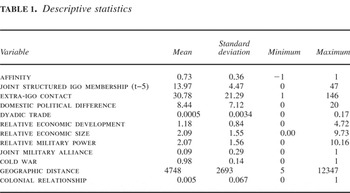
Our basic statistical model is laid out in equation (1) below, which is estimated using ordinary least squares (OLS) with robust standard errors clustered on the dyad. Table 1 presents the descriptive statistics for these variables.

Descriptive statistics

It is important to draw the reader's attention to one important detail concerning our model specification: the five-year time lag on joint structured igo membership. The five-year lag on our primary causal variable is driven by both methodological and theoretical considerations. With regard to the former, we are testing a causal hypothesis and without a lag, our results may be contaminated by reverse causality: states with more similar interests simply find it easier to join common international institutions. To deal with this potential endogeneity problem, quantitative modelers often employ a one-year lag. But such a short lag may be inadequate to this task, and so we use a longer five-year lag on our primary independent variable.
The five-year time lag on joint structured igo membership also comes from socialization theory, where scholars speak of “the socializing effect of repeated meetings over long periods.”65
Checkel 2005, 807.
Zürn and Checkel 2005, 1066.
Finally, using a time lag allows us to speak about state interest convergence, defined as the process by which two states acquire more similar interests over time. As stated earlier, the institutional socialization hypothesis predicts that states sharing more joint structured IGO memberships should have experienced greater interest convergence. To the extent that this is true, we should observe a statistically significant positive (+) coefficient for the lagged joint structured igo membership term. If these international institutions produced state interest divergence (that is, less similar interests over time), then we would observe a statistically significant negative (−) coefficient. Finally, a statistically insignificant coefficient, regardless of the sign, suggests that joint structured IGOs had no demonstrable effect on state interests (the null hypothesis).
Statistical Results
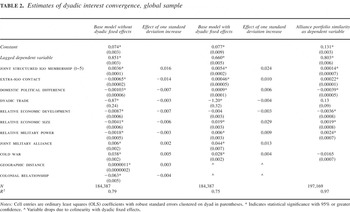
In Table 2, we present two sets of estimates for equation (1): the first set are those without dyadic fixed effects and the second set includes them. We offer both estimates because while dyadic fixed effects certainly reduce the potential for omitted variable bias, they are also problematic for the coefficients of relatively time-invariant control terms, including extra-igo contact, domestic political difference, relative economic size, and relative military power.67
Beck and Katz 2001 explained why the coefficients for these four control variables would change signs when dyadic fixed effects are added to the model. In effect, these relatively time-invariant regressors are highly colinear with dyadic fixed effects. Indeed, regressors that are completely time-invariant, such as geographic distance and colonial relationship, completely drop from the model with the addition of dyadic fixed effects due to perfect multicolinearity.
Estimates of dyadic interest convergence, global sample

Consistent with interest convergence, the coefficient for joint structured igo membership lagged five years is positively signed and statistically different from 0 with a high degree of confidence (p < .001) in both models. In Table 2, we also present the effect of a one standard deviation increase in each independent variable. This demonstration is analogous to presenting standardized coefficients since it evaluates the impact of each independent variable using a common metric. Without dyadic fixed effects, joint structured igo membership has the largest substantive effect of any independent variable in the model. When including dyadic fixed effects, the substantive effect of the IGO coefficient is surpassed by only that of relative economic size.68
In fact, we attach little substantive meaning to the large and positive relative economic size coefficient in the model with dyadic fixed effects. One would expect this independent variable to have a negative sign indicating that economic size differences are correlated with less similar interests. Indeed, this is the result obtained in the model without dyadic fixed effects. But adding these fixed effects to the model produces a sign flip on this independent variable, leading us to discount its substantive significance here.
To further assess the substantive significance of the joint structured igo membership coefficient, we refer the reader back to Figure 1, where we plotted the average affinity scores for a series of United States dyads. Using the model with dyadic fixed effects, a one standard deviation increase in the number of joint structured IGOs would make the United States–Japan dyad appear more like the United States–New Zealand dyad over a five-year period or the United-States–Argentina dyad appear more like the United-States–Brazil dyad over the same period. As these examples illustrate, our estimated IGO effect is not so large that institutional socialization can turn two long-time enemy states into close friends within just a few years, but socialization theory never predicted such a large and immediate effect. Furthermore, we have some reasons to believe that these estimated IGO effects may actually be understated.
First, we discussed earlier the phenomenon of bloc voting within the UNGA. We made an effort to control for bloc voting tendencies between country pairs through the use of dyadic fixed effects. But we could also exclude the observations where the dyad always voted together (affinity = 1) or never voted together (affinity = −1). When we estimated this constrained regression (N = 146,112), the joint structured igo membership coefficient increases by 42 percent, or from 0.0054 in the full sample to 0.0077 in this restricted sample. Indeed, as we further constrain our sample by cutting observations at the far ends of the affinity range, the IGO coefficient enlarges even further. For example, when we look at only the cases within the −0.6 to 0.6 affinity range (N = 44,034), the IGO coefficient effectively doubles, growing from 0.0054 in the full sample to 0.0097 in this very restricted sample.69
A full set of results is available from the authors upon request.
Second, the joint structured igo membership coefficient may also be understated by the lagged dependent variable, affinityt−1. The lagged dependent variable (LDV) is a necessary correction for serial autocorrelation in our pooled time-series data so we included it on methodological grounds. But this correction also produces attenuation bias in our ordinary least squares (OLS) estimates.70
In other words, including a lagged dependent variable tends to push the other coefficients in the model toward 0, making them appear substantively less significant. Keele and Kelly have shown that while LDV attenuation bias gets smaller with longer time-series, it still has large effects when using time-series that contain less than fifty observations.71Keele and Kelly 2006.
To assess the extent of LDV attenuation bias in our estimate of joint structured igo membership, we simply reestimated our fixed-effects model without the lagged dependent variable. In this model, the joint structured igo membership coefficient more than doubles, increasing from 0.0054 with the lagged dependent variable to 0.0128 without it.72
A full set of results is available from the authors upon request.
Our last statistical model presented in Table 2 offers a robustness check concerning our dependent variable. We argued earlier that affinity represents a better operational indicator of dyadic interest similarity, at least for our purposes, than the alliance portfolio measure that many rationalist scholars have used as a common interests control variable in models of interstate military conflict. In using it as a dependent variable, our concerns regarding the alliance portfolio similarity were twofold. First, the measure most directly captures state behavior, potentially weakening the interest signal in these data. Second, any interest signal in the alliance portfolio similarity measure is effectively limited to the issue area of security politics.
Despite these concerns, we should be able to find some evidence consistent with institutional socialization even when alliance portfolio similarity, measured using the S statistic,73
Signorino and Ritter 1999.
Institutional Socialization in Regional Samples
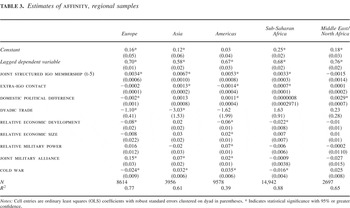
Having tested and found empirical support for the institutional socialization hypothesis using a large global sample, it is now useful to perform a similar exercise using smaller regional samples. First, finding statistical significance for the joint structured igo membership coefficient in more restricted regional groupings presents an even harder test for the institutional socialization hypothesis due to the much smaller sample size. Second, it is important to assess whether and to what extent institutional socialization can be demonstrated in regional contexts outside of Europe. To these ends, we reestimated equation (1) with dyadic fixed effects using five different restricted regional samples (that is, including only the dyads where both countries are within the region). These geographic regions are: Europe, Asia, the Americas, sub-Saharan Africa, and the Middle East/North Africa.
Our results, presented in Table 3, show statistically significant evidence of institutional socialization in all of the regional samples, except for the Middle East/North Africa. In fact, we found evidence consistent with institutional socialization even in this sample when the Israel dyads were dropped from the model. Without these observations, the joint structured igo membership coefficient in the Middle East/North Africa sample grows to 0.0043 with a robust standard error of 0.0008.74
A full set of results is available from the authors upon request.
See, for example, Barnett and Gause 1998.
Estimates of affinity, regional samples

Some readers may be surprised by the fact that the joint structured igo membership coefficient is substantively smaller in the European sample than in the Asia, Americas, and Africa samples. But this result is not inconsistent with empirical evidence that has already been reported in the socialization literature. As mentioned earlier, Hooghe found that Europeanization can be explained more by domestic political factors than by socialization through regional institutions.76
Hooghe 2005. Also consistent with Hooghe's evidence, we note the strong effect of domestic political difference in the Europe sample.
Note the statistically insignificant effect of domestic political difference, relative economic development, and relative economic size in the Asia sample.
Johnston 2005, 1037–39.
See, for example, Acharya 2001.
Socialization and/or Information?
Having presented results that are consistent with institutional socialization, we now consider the possibility that our results might also be explained by an institutional causal mechanism other than socialization. One possibility concerns institutional information, an important causal mechanism in many rationalist IR theories.
It is worth considering the possibility that IGOs do not actually socialize member-states; instead, they just provide greater information about the state of the world, including information about member-states' capabilities, intentions, and so on. With this new information, states simply find their institutional partners to be less threatening than before (that is, than in the world of less-complete information), thus leading to more similar interests. The socialization theory that we are trying to test here differs from this rationalist information account in that the latter does not imply a change in actor identities. With new information, institutional member-states simply learn more about the state of the world, retaining their old identities in the process. Socialization, as described in the previous section of the article, directly implies identity change: institutional interactions engender new social identities, eventually leading to member-state interest convergence.
If we knew a valid way to measure state identities over time, then we could simply test whether or not our IGO variable can also explain identity change. But lacking any valid operational measure for this important theoretical concept (that is, state identities), we need to look for another way to distinguish the causal effect of institutional socialization from that of institutional information. Fortunately, these two causal mechanisms may be distinguishable in terms of their impact over time, or by their lagged effects. As discussed earlier, constructivist IR theory posits that institutional socialization should take several years to mature; indeed, this was a primary reason that we lagged joint structured igo membership by five years.
Conversely, the effect of institutional information on state interests should emerge in a shorter time frame as it does not operate first through a change in state identities. Furthermore, information tends to disseminate rapidly, and its causal effect should appear relatively quickly if it does so at all. Indeed, the rapid dissemination of information is a key foundation underlying the rational expectations literature in economics,80
See, for example, Lucas 1972.
Fama 1991.
See, for example, Bearce, Flanagan, and Floros 2006.
Positing that institutional information has its strongest effect in the short term does not mean that institutions only provide new information when they are formed or when new states join them. But even when IGOs provide a regular stream of new information, the effect of any bit of information arriving at time t should be relatively immediate with its effect weakening over time, or as the time lag is increased. In this regard, it is important to remember that the IGO variable in our model specification—regardless of the time lag—captures only a one-period effect of structured IGOs on dyadic interest similarity. For example, a five-year time lag does not measure the cumulative effect of structured IGOs over five years; instead, it measures a one-period “effect” that occurs five years after the “cause.”
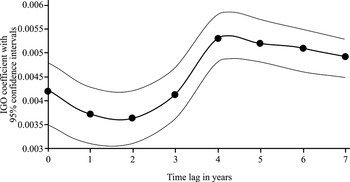
With this understanding in mind, we can simply vary the time lag on joint structured igo membership to see whether the associated coefficients conform more to the socialization explanation or to the information alternative. With institutional socialization, we should observe that the IGO coefficient generally strengthens as its time lag is increased, at least over a three- to seven-year time frame (five years plus or minus two to account for the uncertainty associated with how long it takes socialization effects to mature). With institutional information, we should observe the strongest IGO effect at time t−0 or t−1 with the coefficient weakening as its time lag is further increased.
Figure 2 plots the joint structured igo membership coefficient as its time lag is increased from zero to seven years.83
A full set of results for each regression is available from the authors upon request.
Each time the time lag is increased by one year, we would lose one observation from each dyadic time series. This explains why the joint structured igo membership coefficient with a five-year time lag reported in Figure 2 differs from the estimate reported earlier in Table 2. In Table 2, we used all available observations; in Figure 2, we used only those available for the model with a seven-year time lag, or the most constrained model.

The joint structured igo membership coefficient with a varied time lag
It is important to note, however, that these results are also not inconsistent with institutional information. Although substantively weaker, the IGO coefficient is statistically significant even with no time lag, a result that cannot be easily explained by the socialization causal mechanism in isolation. In this regard, it may be useful to consider information and socialization as institutional complements. Indeed, it is hard to imagine how institutional socialization could take place without the additional information about actor intentions and behavior provided by institutional structures. But the increasing lagged effects shown in Figure 2 certainly cannot be explained by information alone; they are consistent with a longer-term socialization process.
IGO Robustness Checks
Having established that our joint structured igo membership coefficient is indeed capturing a longer-term process consistent with socialization, it is now useful to revisit our decision to focus on the causal effect of “structured” IGOs. As discussed earlier, we made this decision based on the logic that these represent the broad category of international institutions most able to produce the high density of member-state interactions conceivably leading to their socialization. But we can now test the wisdom of this logic by exploring the additional causal effect of so-called “unstructured,” or minimal, IGOs (that is, those lacking formal bureaucratic, executive, and judicial organs).
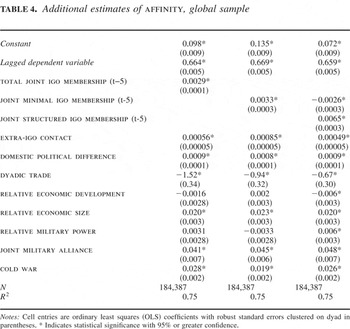
In Table 4, we present three new model specifications that include information on these unstructured/minimal IGOs. The first model simply adds the number of minimal IGOs to the number of structured ones to create a variable labeled total joint igo membership. If we were correct in our assumption that minimal IGOs lack the necessary organs, or structures, to promote member-state socialization, then adding these institutions to our IGO count will simply add noise to the socialization signal, thus weakening its substantive effect. We find that this is indeed the case as the total joint igo membership coefficient lagged five years is only about half the size of the joint structured igo membership coefficient with the same lag reported earlier in Table 2 (0.0029 versus 0.0054).
Additional estimates of affinity, global sample

In the second set of results presented in Table 4, we model the effect of minimal IGOs using a different independent variable labeled joint minimal igo membership, counting only the number of minimal IGO memberships shared by the two states in the dyad-year. Using this model specification, minimal IGOs appear to have a substantively modest socialization effect (0.0033), but this effect completely disappears once we properly control for the number of joint structured IGOs memberships that also appear within the dyad-year. Indeed, the statistically significant negative joint minimal igo membership coefficient lagged five years in this third model specification is consistent with dyadic interest divergence, not convergence.
In short, we have some empirical evidence that minimal IGOs lack the formal structures and organs necessary to promote member-state socialization. Thus, scholars wishing to proceed further in developing and testing socialization theory have some good reasons to focus their efforts on more structured international institutions and to identify the specific institutional features that facilitate the international socialization process. After presenting one final set of empirical results, we will return to this point in the last section of the article.
Realist Limits to Institutional Socialization
As discussed earlier in the article, new realist theory argues for limited institutional socialization, even within more structured IGOs, when more powerful states use these structures to coerce smaller states in the international system.85
See, for example, Gruber 2000.

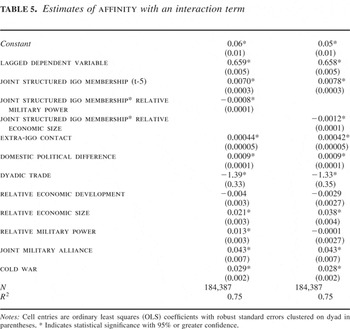
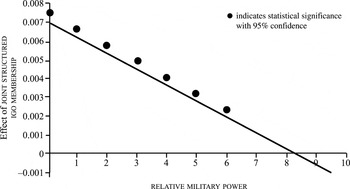
In equation (2), the extent of institutional socialization is given by two coefficients and the value of relative military power: β2 + β3 * relative military power. In a dyad marked by perfect power parity, relative military power is equal to 0; thus, institutional socialization for this pair of states comes only from β2, which we expect to show a strong positive coefficient given the limited coercion opportunities within such a power balanced dyad. However, as relative military power within the dyad gets larger, we expect the extent of institutional socialization to weaken. Thus β3, the coefficient on the interaction term, should have a statistically significant negative sign.
Our estimates presented in Table 5 offer results that are consistent with the realist caveat to the institutional socialization hypothesis. In Figure 3, we graph the marginal effect of joint structured igo membership conditioned on the value of relative military power. As the latter variable measures the log of the stronger state's military capabilities relative to those of the weaker state in the dyad-year, relative military power has values in our data set that range from 0 to 10 (see Table 1). Although its effect diminishes with greater dyadic power imbalances, one can still observe a statistically significant marginal effect for joint structured igo membership until relative military power ≥ 7. Indeed, less than 1 percent of the observations with our global sample have a value for relative military power that fits this condition. Hence, significant institutional socialization effects are present in the vast majority of post–World War II dyads.
Estimates of affinity with an interaction term


Marginal effect of joint structured igo membership conditioned on relative military power
Table 5 also presents a robustness check for the realist caveat to the institutional socialization hypothesis using a second indicator of relative state power: relative economic size. Adding a joint structured igo membership * relative economic size interaction term produces much the same result as discussed above. Institutional socialization has a strong effect on states with similar economic power; however, this effect diminishes with a greater dyadic imbalance in relative economic power.
Conclusions
As previewed in the introduction, we interpret these empirical results as strongly favorable to the institutional socialization proposition, which represents a core component of constructivism as an approach to understanding IR. Despite its importance within the constructivist research community, the possibility of institutional socialization has largely been ignored by rationalist scholars, who view the proposition either as systematically untestable or as empirically unsupported.
In this article, we have tried to show not only that the institutional socialization hypothesis can be systematically tested, but that it passes several important empirical tests, which should prove more convincing to scholars working in the rationalist community. Inasmuch as this exercise can help build a bridge between constructivist and rationalist approaches to studying international institutions, we conclude this article by speaking to both research communities.
Constructivist Socialization Theory
While supporting institutional socialization theory, our results are obviously not the last word concerning its empirical validity. In this regard, Gartzke, Nordstrom, Boehmer, and Hewitt, using an IGO-year unit of analysis, found that member-state preference heterogeneity does not decline over time, a result that could be interpreted as contrary to the expectations of institutional socialization.86
Gartzke et al. 2006. It is important to note, however, that this result is not necessarily at odds with the ones presented here. First, our results show the cumulative socialization effect of structured IGOs, which would not be picked up using the IGO-year unit of analysis. This unit of analysis instead captures the average effect of an individual IGO. Second, the statistical sample used by these authors included unstructured/minimal IGOs, which we also show to produce no socialization effect (see Table 4). Finally, the disadvantage in using the IGO-year unit of analysis is that it forces scholars to treat “time” as a causal variable. In constructivist theory, the causal variable is structured institutions, and not time. While it may require time for such institutions to produce any socialization effect, a time counter will be a poor proxy variable if the temporal socialization effect of structured IGOs is nonlinear (see Figure 2).
Our results also do not speak to the different micro-processes underlying institutional socialization. Scholars working on this subject have identified several possible socialization mechanisms, or micro-foundations, including persuasion (normative suasion), social influence, role-playing, and even strategic calculation.87
But even if our model does not distinguish between these socialization mechanisms (and, in our defense, it was not designed for this purpose), it does provide an avenue for moving in this direction.To the extent that scholars can identify particular institutional structures or attributes facilitating specific socialization mechanisms, then it should be possible to collect data on these features and then substitute more specific institutional variables into a dyad-year model of interest similarity to replace the more general IGO membership variable used here. This is surely a promising line of empirical research, but socialization theory needs to identify more clearly what particular institutional features facilitate a high density of interactions leading to member-state socialization. If theory does not move first in this regard, then data collection on specific institutional features will face an inevitable charge of “barefoot empiricism.”
Rationalist Institutional Causal Mechanisms
We also stated in the introduction that these results can be read as good news for rationalist scholars of international institutions. This conclusion follows for at least two reasons. First, the “truth” of institutional socialization as a causal mechanism—international institutions affect state behavior by shaping their interests—does not deny the empirical validity of any rationalist institutional causal mechanism, defined as those affecting state behavior even when interests are held constant. It just adds to the number of ways that institutions can affect state behavior.
Second, and perhaps more importantly, many “rationalist” explanations may operate more effectively when allowing state interests to vary. Consider information provision as an institutional causal mechanism. It is not just that institutions can transform incomplete information games into more complete information games where new strategic outcomes become possible. It is also the case that rationalist information theories sometimes work through preference change.88
With new information about the value of possible strategic outcomes, states may rank these outcomes differently. In game theory, this is simply another way of saying that state preferences over outcomes have changed; in effect, state interests are a moving part in certain rationalist information theories.Consider also certain rationalist theories about institutional commitment. States face a potential commitment problem in international bargaining whenever they believe that an agreement reached in the present could become unenforceable in the future.89
Fearon 1995.
See, for example, Bearce 2003.
This understanding has important implications for how rationalist scholars test their institutional theories. Rather than trying to hold interests constant with one or more control variables (such as affinity) next to their primary institutional causal variable, scholars may need to omit these controls to let state interests (as an intervening variable) vary appropriately when modeling certain forms of state behavior.91
If scholars do not omit such interest controls when testing an institutional theory that works through interest change, then they raise the risk of a Type II error, or a false negative. In effect, rationalist scholars may be creating too hard a test for some of their institutional theories.