Introduction and approach
The understanding of the condition and prevalence of poverty in twenty-first-century Poland is well developed. It is now possible to identify the groups at risk of poverty as well as the scope, growth rates and relevant measurement methods. Both abundant quantitative (expressing the level of poverty, for example, Czapiński and Panek, Reference Czapiński and Panek2015) and qualitative data (expressing the causes and conditions of poverty, for example, Karwacki, Reference Karwacki2006) is available for analysis. Further, there are numerous papers explaining the reasons for, mechanisms of, and the dynamics and current relative states of impoverishment in the population at large (Czapiński and Panek, Reference Czapiński and Panek2015; Galor, Goryńska-Bittner and Kalinowski, Reference Galor, Goryńska-Bittner and Kalinowski2014; Tarkowska, Reference Tarkowska2013; Panek, Reference Panek2011; Radziukiewicz, Reference Radziukiewicz2006; Karwacki, Reference Karwacki2006; Golinowska, Reference Golinowska2005; Palska, Reference Palska2002; Zienkowski, Reference Zienkowski1979). However, there remains a paucity of studies that offer a comprehensive explanation and description of rural poverty. Indeed, what few monographs that have tackled the wider issue offer only a limited survey and scope of rural problems (Kalinowski, Reference Kalinowski2015; Krzyszkowski et al., Reference Krzyszkowski, Marks, Lisek-Michalska and Przywojska2007; Chmielewska, Reference Chmielewska2004; Kwasek, Reference Kwasek2002), rather than a detailed analysis of the causes and dynamics of rural poverty, per se. This problem is exacerbated by the fact that there are no studies that address rural poverty in the critical context of interwar Poland, a period central to the establishment of many of the issues and patterns that pertain today. This study attempts to address this significant gap in our knowledge, identifying the patterns and particularities of rural poverty in Poland between the wars, and the multifaceted and diverse nature of Polish poverty in the initial years of national independence. The purpose of the article, therefore, is to indicate changes in the scope of Polish poverty, to analyse the adaptive mechanisms of rural populations, and to understand the privations that those living in poverty in rural interwar Poland endured.
Several issues must be addressed to examine and analyse the situation of peasants before the Second World War. On the one hand, the group surveyed is heterogeneous; on the other, there are no relevant studies providing an analysis of that group. This makes an in-depth investigation into rural poverty a difficult task. Also, there are no existing reliable analyses, the focus of researchers on what the situation should be rather than on what it actually was. As a consequence, caution needs to be exercised in the analytic work. Although a detailed review of literature and statistical data has been carried out for this study, it is still necessarily the case that the situation of different groups of the rural population cannot be represented with absolute certainty. It is even more challenging to generalise the findings into the entire population living in the territories considered.
Defining the rural population is not straightforward as this group includes both the peasants and the population of folwarks (large, serfdom-based farms and agricultural enterprises). Both of these groups are composed of landholders and landless people. In the peasant group, landowners held small or extremely small farms with up to twenty hectares of farmland. They employed labourers (landless people), and the extent of their farming activity was quite restricted. The second group consisted of wealthy landowners who employed landless people, including domestic servants, agricultural workers and craftsmen. The division was primarily based on land ownership and on farmland area. In this article, focus is mostly placed on the peasant population (that is, a social group of farm owners) and on farm-related employees. In 1921, peasants accounted for 68.9 per cent of the rural population and for 52.2 per cent of the Polish population.
Data sources include primary materials and publications, which include initial analyses. Much primary data was lost during the war, and therefore some of the information could only be retrieved from monographs that presented these materials. Monographs focusing on selected villages located in different Polish regions (Trzy Kurzyny, Broniszów, Jastrzębia or Rybna and Kaszów) – which today would be referred to as case studies – provided an important source of data. A significant data source, the Peasants’ Diaries published in 1935, was the outcome of a competition announced in 1933 by the Social Farming Institute. It was a record of the rural population’s situation. Rather than presenting the situation of all rural residents, the diaries focus on those who agreed to take part in the competition. Nevertheless, they are a valuable source of knowledge on peasants who lived at that time. Today, they are a monument of poverty faced in the two decades between the wars.
The informative power of sources included in it is invaluable, especially when it comes to those referring to the 1919–37 period (for example, Dziedzic, Reference Dziedzic1934; Fierich, Reference Fierich1933; Guścior, Reference Guścior1928; Inglot, Reference Inglot1927; Michałowski, Reference Michałowski1935; Mróz, Reference Mróz1935; Poniecki, Reference Poniecki1933; Sowiński, Reference Sowiński1928; Wize, Reference Wize1925; Zaklika, Reference Zaklika1933; Zakrzewski, Reference Zakrzewski1927). This is because they constitute a primary source of information; they are the consequence of direct observations of the population surveyed, including inventory records, consumption volumes or remuneration figures. Their value is mostly derived from them being authored by a participant and an observer. As eye witnesses of these events, people describing these historical realities allow the reader to dive inside the behaviours and situations of rural residents in the period between the wars and allow us a critical window on the experiential contexts of deprivation. Some further information from the period between the wars is evaluative in nature; the authors assess the facts they describe, and presenting their recommendations and conclusions (for example, Bolland and Schmidt, Reference Bolland and Schmidt1933; Curzytek, Reference Curzytek1928; Grabski, Reference Grabski1919; Poniatowski, Reference Poniatowski1936; Turowski, Reference Turowski1937, and press releases published in 1932 in the Wyzwolenie [Liberation] magazine). Note that the descriptions and evaluative opinions of two of them – Grabski and Poniatowski – are notably biased because they were authored by government officials. Grabski was a member of the national democracy movement, prime minister and minister of the treasury. Poniatowski was a people’s movement activist and minister of agriculture.
Postwar sources are secondary accounts and necessarily offer a distorted picture ex-post knowledge. It results from different experiences, from the processing of available information and from looking at it from a different angle (for example, Mieszczankowski, Reference Mieszczankowski1960; Żarnowski, Reference Żarnowski1973). Nevertheless, as they rely on source materials which today are no longer available, they enable an assessment of what the situation was at that time. It is important to note, however, that everything published in the Polish People’s Republic is biased by strong evaluative opinions resulting from the historical context, namely the need to comply with propaganda and censorship requirements. Overall, the diversity of sources enables a broad review of what the situation was in the period between the wars. The materials complement each other to enhance the knowledge of rural areas at that time.
The situation before independence
Poland disappeared from maps of the world for 123 years. In 1795, the third partition took place, with Russia, Prussia and Austria taking over 120,000 km2, 55,000 km2 and 47,000 km2 of the Polish territory, respectively. This meant Russia reigned over 462,000 km2 of the Polish territory and 5.5 million of the Polish population; the respective figures for Prussia and Austria were 141,000 km2 with 2.6 million people and 130,000 km2 with 4.2 million people. The partitioning authorities considered the Polish territories as remote regions which provided support for the developing cities in the central part of their countries. Galicia lagged not only behind Austria but also behind Czechia, Hungary and Slovakia. This was similar for Greater Poland, used as a supplier of agricultural produce for Prussia. Russia, too, considered these territories to be its border areas (see also Frenkel et al., 2019: 77). This resulted in slowing down the economic development of Poland. The partitioning authorities did not believe these territories should be developed. On the contrary, they considered them to be a granary for their countries and for their developing industry. The local population had a near-slave status and was viewed only as cheap labour.
For the Polish territories, being part of three partitioning states meant that the processes they experienced (including what is referred to as ‘depolonisation’) took place at different times and to different extents. One of the major processes affecting rural areas was the end of landlordism in the nineteenth century. During the era of landlordism, peasants were legally subjected to the nobles and landlords. This was manifested by serfdom and the feudal nature of the agricultural system. Every peasant and his family members were required to work for a specific number of days at their landlord’s land. At the same time, the peasant’s servitude was reflected by the fact that they were personally and judicially subjected to their landlord. As the national territory was incorporated into three partitioning states, these reforms were implemented as per different principles and in different years (Leszczyńska, 2019: 15). Prussia was the first to start (with the abolition of serfdom in 1807) but took the longest time to complete them (with the end of landlordism in 1858). Austria followed, and Russia was the last; these countries implemented both steps under a single act: respectively, in 1848 in Galicia; in 1861 in the Russian partition; and in 1864 in the part of the Russian partition referred to as the Kingdom of Poland. The end of landlordism affected the situation of the population to a different extent. It brought notable changes in the Prussian partition while having a perpetuating effect in other partitions. Prussia witnessed the development of an agrarian structure composed of economically strong folwarks and peasant farms but also of small holdings whose members were offered employment at the wealthy peasants’ folwarks. In turn, the Galician agriculture was characterised by overpopulation, extremely small farms and a generally low level of development, which was conducive to poverty. In the third (Russian) partition, farms were in an extremely poor condition due to strong repression that followed the two uprisings. The contributing factors included easement and enfranchisement of folwark servants. Also, that partition witnessed strong conflicts regarding land use.
Of the three Partitions, the relatively worst socioeconomic situation was experienced in Galicia where non-agricultural activity was virtually non-existent. Poverty was perpetuated by agricultural fragmentation and the inability to find employment in other sectors. The severe hardship was reflected in the term ‘Galician poverty’, which emphasised the extent of deprivation. At that time, in Prussian territories (primarily including Greater Poland), land ownership made it possible to exceed the production levels recorded in Western Europe. The population of Prussian rural areas found themselves in a more advantageous situation due to industrial development and the emergence of a new principle of working outside agriculture. With double sources of income, the financial situation in this part of Prussia was more favourable.
As a consequence of the absence of investments in the Austrian partition, no factories were built, agriculture was the sole occupation, and the population did not have any opportunities to improve their standards of living by engaging in additional employment. The disadvantageous situation in Galicia was exacerbated by high taxation levels imposed by Austrian authorities. As noted by Kalinka (Reference Kalinka2001), in 1840, over fifty million zlotys were paid to the Austrian treasury, and the amount of taxes went up after the abolishment of serfdom. To make things worse for the landowners, this meant they had to pay for hired labour. Hence, there were not enough funds to develop this territory, and the socio-economic situation of the local population kept declining. The peasants and landowners were pushed into a downward spiral of poverty: harder work and greater yields involved higher taxes while high interest rates were charged on loans. Excessive taxation levels perpetuated the underdevelopment of these territories and encouraged outmigration.
The rural population’s economic situation was determined by the nature of their employment, which resulted in various levels of earnings and, as a consequence, different extents of deprivation. Wize (Reference Wize1925: 17) identified four groups of farm workers: earners of allowance in kind (deputatnik), hired workforce (zaciążnik), homeworkers (chałupnik) and seasonal workers. Earners of allowance in kind were the largest group and resided at the employer’s premises. The group was heterogeneous, with the economic situation of different subgroups being dependent upon the outcomes of their work. The remuneration method (allowance in kind) had an impact on their difficult situation and the limited ability to address their needs. Note that the allowance could not be an effective remuneration for work; it was often conditioned by how skilled and quick the worker was. This was due to it being provided as an in-kind benefit, which often was not enough to address the minimum needs. At the same time, smallholders lacking managerial skills were unable to make efficient use of goods received from landlords (Wize, Reference Wize1925: 19–20). The difficult situation of allowance earners is reflected by the composition of the allowance which included cereals, peas, potatoes, fuel and 0.375 hectares of land under potatoes. Also, they were provided with a dwelling, a pigpen and maintenance for one cow. The annual remuneration in cash was 110 marks paid quarterly. When converted into cash, the allowance in kind represented five-sixths of the remuneration (Wize, Reference Wize1925: 25). Note, however, that the allowance earners had to use a part of their allowance to pay the hired workforce. Hired workers earned a smaller allowance in kind, composed of rye, potatoes and fuel plus c. 30 to 90 pfennigs in cash per day, depending on the category of labour (Poniecki, Reference Poniecki1933). The above was grossly inadequate for even the minimum needs.
The remuneration of homeworkers was paid in different forms, usually as land, cereals, pastureland for their cows, fuel, potatoes or a portion of meadow for mowing. However, in some rare cases, they were paid cash only. According to Wiza (Reference Wize1925: 26), the daily rate was 1.4 to 1.7 marks. The allowance in kind for seasonal workers was 3.22 marks per week, including 30 pounds of potatoes, 7 pounds of bread, 1 pound of barley groats, 2 pounds of coarse flour, ½ pound of salt, 2 pounds of peas and 3.5 liters of full-fat milk or 7 liters of skimmed milk. Sometimes, they also received meat and fat. In addition to the allowance in kind, they were provided with a place to live, fuel and appliances intended for everyday use (restricted in terms of quantity and quality).
The wives of allowance earners received the lowest remunerations of 0.25 to 0.3 marks per day. Their responsibilities included arranging the hay and participating in harvest works. However, they usually worked for no longer than half a day. At that time, the remuneration of peasants was 1.1 to 1.5 marks per day, whereas that of young people assisting in farm work varied in the range of 0.7 to 1.3 marks per day.
As shown by the calculations, in 1914, in the Poznań province (a region where the rural population enjoyed the relatively most advantageous conditions), manual workers earned an allowance in kind worth 459 marks, plus 110 marks in cash (per year); the allowance in kind of hired workforce, homeworkers and seasonal workers was worth 50, 480 and 3.22 marks per week, respectively, translating into an annual amount of 328.47 to 375,85 marks. The above reflects the farming population’s limited ability to meet their needs. Indeed, they were unable to address any other needs beyond survival. Even though there are no detailed analyses of consumption levels in rural areas covered by other Partitions, the situation can be reasonably expected to be much worse.
The difficulties faced by peasants in the era of Partitions were exacerbated by the First World War, which drained the rural areas of their resources and reserves (Borkowski, Reference Borkowski1981: 132). Ten per cent of total national assets were destroyed, primarily including buildings, animals, seed, machinery and fertilisers. War operations had a deteriorating effect on agricultural conditions. Farmers in the Prussian partition, who based their activity on a strong cooperation with urban contractors, sustained considerable losses. According to Borkowski (Reference Borkowski1981: 133), the decrease in productivity was 35 per cent for wheat, 60 per cent for rye, 40 per cent for barley, 33 per cent for oats and 18 per cent for potatoes; note that this was the staple diet for the rural population. Also, severe losses were experienced in the rearing of pigs (43 per cent), cattle (28 per cent), sheep (29 per cent) and horses (15 per cent). In the Galician Partition, the decline in productivity was 27 per cent, reaching up to 80 per cent for cereals and 30–70 per cent for livestock. In turn, losses in farming assets suffered in the Kingdom of Poland reached up to 45 per cent.
The Second Polish Republic
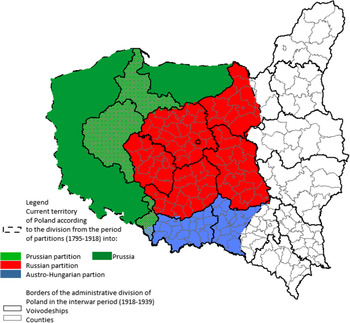
The symbolic beginning of Second Polish Republic was 11th November 1918 when Józef Piłsudski took over power from the Regency Council. The borders of Poland were traced as a result of the Treaty of Versailles, the Treaty of Saint-Germain-en-Laye, the Treaty of Riga, the Treaty of Trianon and the settlement made by the Conference of Ambassadors. Additionally, in 1921, as a consequence of the Treaty of Versailles, referendum outcomes and three Silesian Uprisings, the eastern part of Upper Silesia was also incorporated into Poland. Figure 1 shows the territory of the Second Polish Republic compared to today’s Poland.
An outline of borders compared to today’s Polish territory.
Source: I. Frenkel et al. (Reference Frenkel, Rosner and Stanny2018: 81).

Income and work
The Second Polish Republic witnessed a phenomenon referred to as agrarian overpopulation, resulting in a deterioration of the economic standing of rural residents (Mieszczankowski, Reference Mieszczankowski1960: 310; Mieszczankowski, Reference Mieszczankowski1983: 24; Turowski, Reference Turowski1937: 42). The size of the redundant population was estimated at nine million and 2.4 million by J. Poniatowski (Reference Poniatowski1936) and Z. Landau et al. (1939), respectively. According to postwar estimations by M. Stańczyk (Reference Stańczyk1955), it was four to five million people. Rural overpopulation made it problematic to address their needs. Holders of small and extremely small farms were particularly affected by these developments. With a small area and limited quantities of low-quality appliances, the production volumes were low, and there were too many people engaged in farming activities, making it impossible to attain minimum subsistence figures. The disadvantageous structure of farms drove a decline in the standards of living. Already in 1919, W. Grabski (Reference Grabski1919: 7–9) noted that overpopulation made it difficult to address the nutritional needs using the farms’ own production, and was a barrier to wealth-building (both for communities and individuals). He also found that the level of needs reported by the rural population was extremely low for a number of reasons, including lack of education and general backwardness. Grabski believed this situation could be improved with agricultural progress.
The disadvantageous agrarian situation made rural poverty even more severe. Nearly two-thirds of households had extremely small or small farms with an area of less than five hectares. With a limited production capacity, they faced the problem of surplus labour. As a consequence, most of them were unable to address their needs even to a minimum degree. Low standards of living and having one’s needs addressed to a poor extent were the reasons why the rural youth migrated to cities, driving a decrease in the standards of urban living. In a programme dedicated to the academic youth, A. Bolland and S. Schmidt (Reference Bolland and Schmidt1933) focused on the need to return to rural areas and on the advantages of rural work. Although they realised the hardships of farming, they shed a positive light on it, claiming that
rural areas are oversaturated with the landless and smallholders which, except for some very basic skills …, do not have adequate qualifications for any job. Meanwhile, a skilled craftsman is very rare in rural areas. There is enough room to provide him with a better living than what he experiences as an urban unemployed worker. (Ibid.: 12).
The objective of the relocation of the urban population, including educated youth, was to improve the situation in both rural and urban environments.
The basic reasons behind the deteriorating situation of rural residents were low prices of cereals and the absence of contractors willing to purchase their goods (Ciepielewski, Reference Ciepielewski1965: 28). As their standards of living were going down, the population tended to borrow money, which had a detrimental effect on agricultural development and made it more difficult to escape the spiral of poverty. In 1927, the debt rate was 159 zlotys per hectare, reaching 336 zlotys per hectare in 1931. By 1936, it went slightly down to reach 245 zlotys per hectare (after: Mieszczankowski, Reference Mieszczankowski1963: 141). The debt included bank loans taken to purchase land, funds borrowed from individuals and the outstanding amount of debt incurred in the era of partitions to be repaid to credit institutions based in the ex-partitioning powers (converted into Polish zlotys). Central and local-level taxes also represented a considerable burden. In 1928, the rural population was charged with seventy million zlotys of land taxes plus forty million zlotys more of local taxes.
T. Zakrzewski (Reference Zakrzewski1927: 12–16) noted that the reason for indebtedness was the prevalence of the hunger gap, forcing the population to borrow funds from wealthier peasants or ‘professional speculators’ in both money and food products. High interest rates charged on loans pushed the population into a downward spiral of debt. The peasants’ diaries describe the difficult situation facing rural areas: a peasant who borrowed 1 q of cereals was required to return 2 q, often with some additional benefits to the lender.
Sometimes, together with my wife, we try to understand what makes us unable to repay the debt even though we make our best efforts, we do not eat and sleep enough, we do not have enough clothes, we keep our land in good order, and have some good yields. Certainly, we face difficulties as we already have eight children; the four older go to … school, which is expensive; but in addition to our farm, we also have bees that are taken perfect care of and yield several dozen zlotys per year. Our conclusion is that the major problem for indebted farmers are the post-harvest prices of crops. Indeed, the wheelwright and the blacksmith want to be paid right after the harvest; the creditors come to collect the interest after the harvest, too. Then, we must sell goods in bulk. Sometimes, we do not have enough cereals before harvest and must either borrow it from a wealthier farmer or buy it. And as we cannot afford it, we must borrow money. On 10 June, I went to Mr K, a wealthy farmer, asking him to lend me one metre of rye. He willingly agreed and said: I do not lend rye, I only sell it. Today, the price is 25 zlotys per meter; I lend you one metre of rye; in return, you give me a bill of exchange for 25 zlotys. In two months, you will give me back a quantity of rye worth 25 zlotys plus half a zloty of interest. Two months later, the price of rye was 12.5 zlotys per meter, so I had to give him back two metres and pay fifty grosz in cash ….
Pamiętniki chłopów [Peasants’ Diaries], Diary 4, p. 45.
As the Peasants’ Diaries suggest, rural poverty was driven by fluctuations in wheat prices. In the fall, peasants sold cereals in bulk to satisfy their vital needs. However, during the hunger gap, the prices rose again, making it even more difficult for them to address their needs and forcing them to increase their debt levels. The taxes and debts were collected during periods of disadvantageous prices, thus driving further growth in supply of agricultural produce and further decline in prices. The crops were seized by bailiffs at a rate much below their prices (for example, 5 zlotys were paid for 100 kg of rye, while the production cost was c. 35 zlotys; 50 zlotys were paid for a cow or horse, which is less than the price of 1.5 q of rye) (Kalinowski, Reference Kalinowski2018: 173–80).
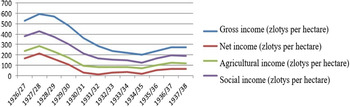
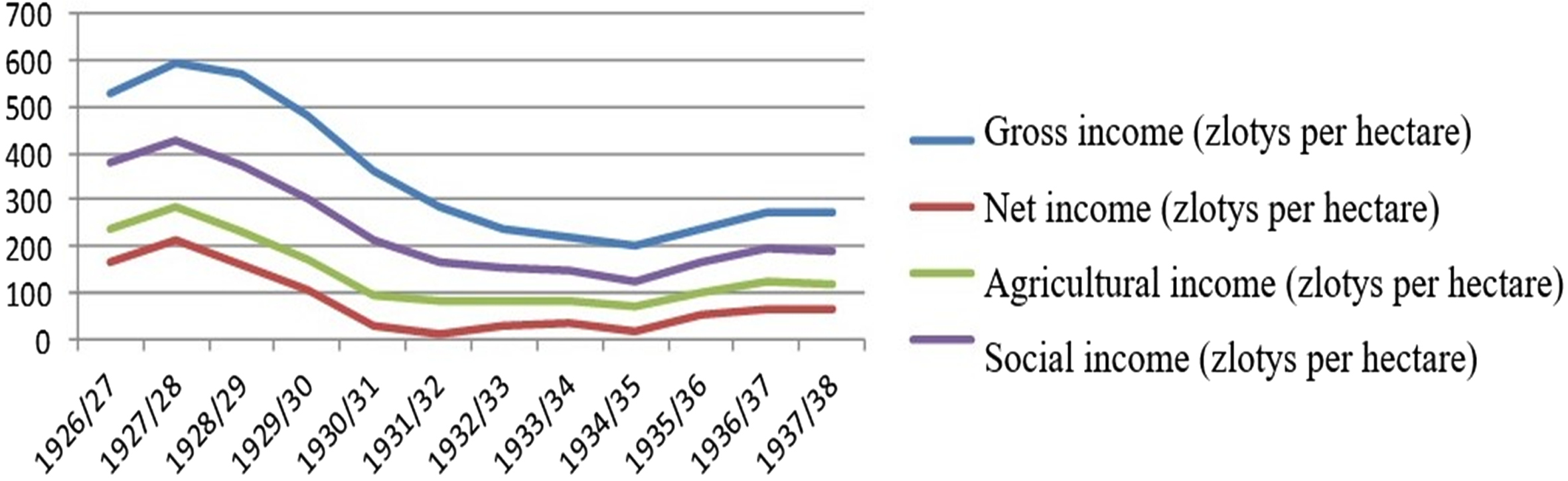
The gradual decline in the financial situation of the rural population is reflected in farm incomes. While in 1926/7, the gross farm income was 530 zlotys per hectare, it went down to 270 zlotys per hectare in the prewar years, and was as low as 202 zlotys per hectare when the crisis hit hardest in 1934/5. However, the significant difficulties in meeting individual needs were reflected in the levels of agricultural income, which decreased from 236 zlotys/ha to 68 zlotys/ha (1934/5) over the study period. In the next years, it followed a slight upward trend and reached 116 zlotys/ha before the Second World War. Considerable differences in income levels could be observed across the country. The worst situation was found in eastern and western voivodeships with an average amount of 84–99 zlotys/ha in 1933/4–1936/7, whereas the southern and central voivodeships recorded the highest levels of 142 zlotys/ha and 132 zlotys/ha, respectively (see Figure 2) (Central Statistical Office, 1939).
Farm incomes in 1926–38.
Note: Agricultural income is the total of incomes from capital and family labour; in turn, social income is the income from the farm held by the owner and third parties (in this case, the state, local government, employed labour force and creditors).
Source: Central Statistical Office (1939). 1939 Pocketbook, Warsaw, p. 74.
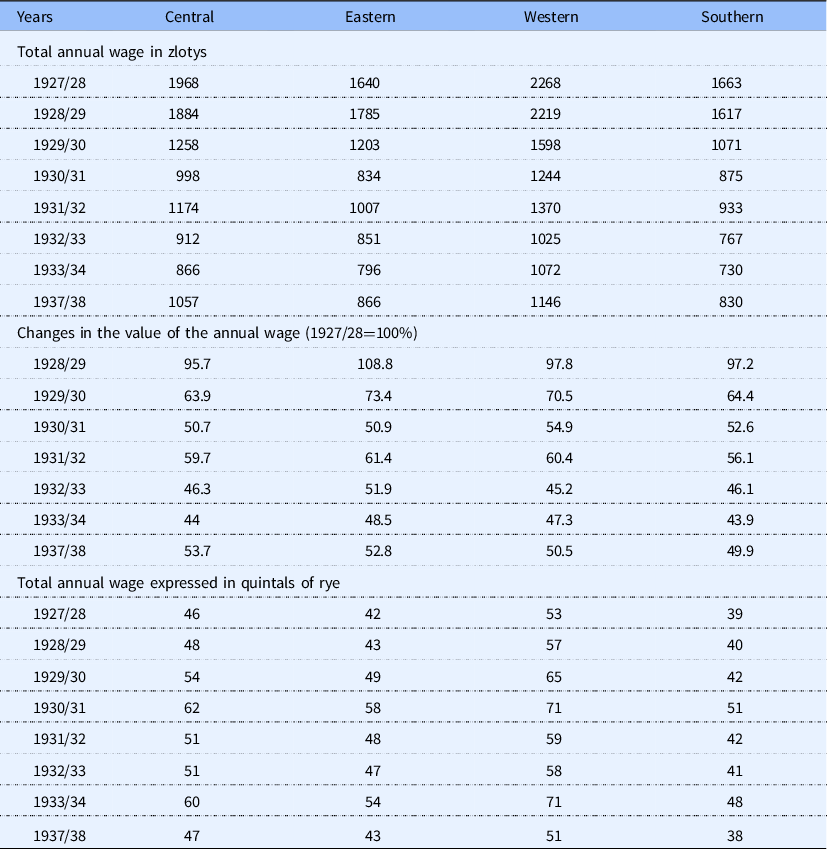
The economic situation of the rural population is also reflected by the wages of agricultural workers. According to Sz. Wenzieher (1933: 125–6), in 1929/30, their annual earnings stood at 1265.9 zlotys. Note, however, that the above amount included not only the wage alone (which was slightly over 10 per cent of total incomes) but also the allowance in kind (364.8 zlotys), accommodation (110.6 zlotys), fuel (167.6 zlotys), livestock farming costs (187.9 zlotys), land and potatoes (277.7 zlotys) and horse-drawn wagons (19.6 zlotys). The wage went down to 890.4 zlotys in three years. This was mostly impacted by the reduction in the allowance in kind (to 258.6 zlotys), land and potatoes delivered as an allowance (to 177.8 zlotys), value of the dwelling (to 62.2 zlotys), fuel allowance (to 126.9 zlotys), and subsidies towards livestock farming (to 117.3 zlotys) and horse-drawn wagons (to 14.8 zlotys). The wage itself was not subject to any major fluctuations (from 137.7 zlotys to 132.8 zlotys). The situation in Western voivodeships was relatively the best, whereas that in eastern and southern voivodeships was the worst (see Table 1). However, an analysis that takes only wages into account does not enable presenting the true changes in how the population’s needs were addressed. Despite a reduction in the total annual amount of wages, the wage expressed in quintals of rye remained at a similar level. However, it does not mean the rural population did not experience any changes in their situation. On the contrary, the decline in crop prices was the consequence of hardships affecting the rural residents. Forced to reduce their needs to a minimum, they sold cereals and other crops below the production costs, which had an effect on the reduction of market prices of crops. Note also that the situation of earners of allowances-in-kind cannot be generalised throughout all social groups living in rural areas. However, it does allow us to approximate the level of rural poverty experienced at that time.
Wages of regular agricultural workers (earners of allowance in kind) in 1927/8–1937/8

Source: Based on Central Statistical Office (1939). 1939 Pocketbook, Warsaw, p. 269.
Consumption, household equipment and debt
J. Michałowski (Reference Michałowski1935: 43–4) noted the limited levels of consumption among the rural population. In the periods of greatest prosperity, they had one hot meal per day (vegetable borscht with potatoes). Some farmers added skimmed milk to their borscht; the potatoes were served without fat, sometimes with buttermilk. Bread was consumed only in the autumn, and was rare between the New Year and the harvest time. Full-fat milk was consumed only on an exceptional basis; sugar was virtually non-existent; coffee was made of beet and chicory; and all eggs were intended for sale. The peasants ate very little meat, if anything at all. As reminded by the author, ‘if a peasant eats a hen, then either he is sick or the hen was sick’. According to research, one to two hens were consumed per year. According to Central Statistical Office data, annual meat consumption in Poland was 18.2 kg in 1929, 17.5 kg in 1930 and 19.9 kg in 1931; note, however, that the corresponding figures for the rural population were much lower or even halved (after Michałowski, 1919: 44).
The staple diet of the rural population included potatoes, skimmed milk from afternoon milking, and bread. Although quite voluminous (up to 350 kg of potatoes and up to 250 kg of cereals per year), it represented a low nutritional value because of insufficient quantities of proteins and fats. Note, however, that milk from afternoon milking was consumed only by farms who owned a large number of cows or in territories with a poorly developed network of dairies. Butter was rarely produced from milk, and therefore the level of butter consumption among the rural population was low (up to 2 kg per year). The prosperity of wealthier rural residents was reflected by two hot meals a day and a small quantity of fats (Michałowski, Reference Michałowski1935: 46). According to the author’s calculations, in the case of a farmer with two hectares of land under crops, in the most advantageous period (right after harvest in 1934), the daily food ration was worth 47 grosz and included 1.5 kg of potatoes, 1 kg of bread, ¼ litre of milk, cabbage, a little bit of salt and 50 g of fats. However, as can be easily calculated, in a family of four, this expenditure comes to a total of 686.2 zlotys, whereas two hectares of land under rye, wheat and potatoes could yield an amount of 249.10 zlotys. After adding the income from cow breeding, horticulture and eggs laid by 15 hens, the total was 494.10 zlotys. The above means that it was necessary to seek additional employment (for example, picking ground vegetation) to maintain these low standards of living. But anyway, 90 per cent of the rural population were undernourished, with a consumption level not above the subsistence minimum. Note that in 1928, that is, during the boom phase, the farm referred to above could produce an income of 1485 zlotys, with the expenditure being slightly higher (1.10 zlotys per capita). However, the resulting deficiency of 121 zlotys was related only to food expenditure (which should be increased with clothing costs, farming expenditure, taxes, interest charged on loans, etc.). The deficiency was covered with loans from migrants and with incomes from farm work and sales of porcine animals, goose down and poultry. Considering the proportion of farms smaller than five hectares, one can imagine how difficult was the situation in rural areas. These hardships are also reflected in the Peasants’ Diaries, with the words ‘misery’ and ‘poverty’ being used nearly 200 times and 360 times, respectively.
I noticed in several places around my village that children aged 2 to 4 are totally malnourished, and have bowed legs, stomachs bloated with potatoes etc. Some of them were walking barefoot all their lives. Can such children become healthy citizens? Especially with poverty growing every year?
Pamiętniki chłopów [Peasants’ Diaries], Diary 6, p. 60.
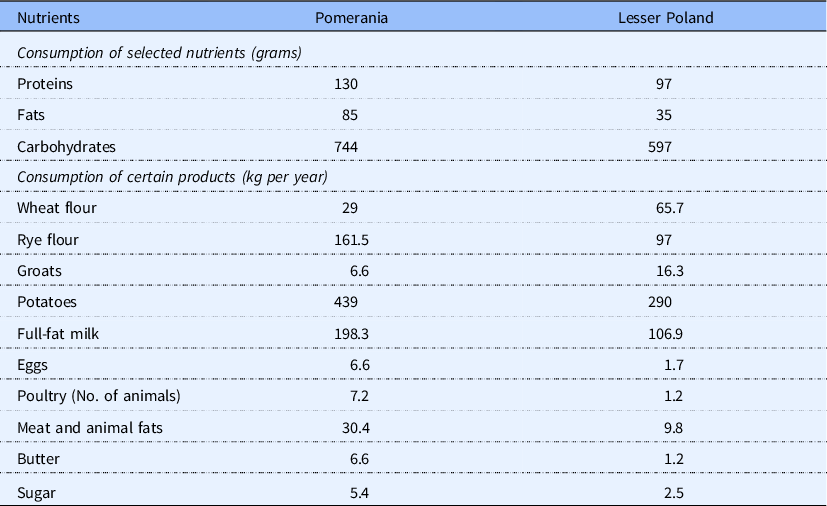
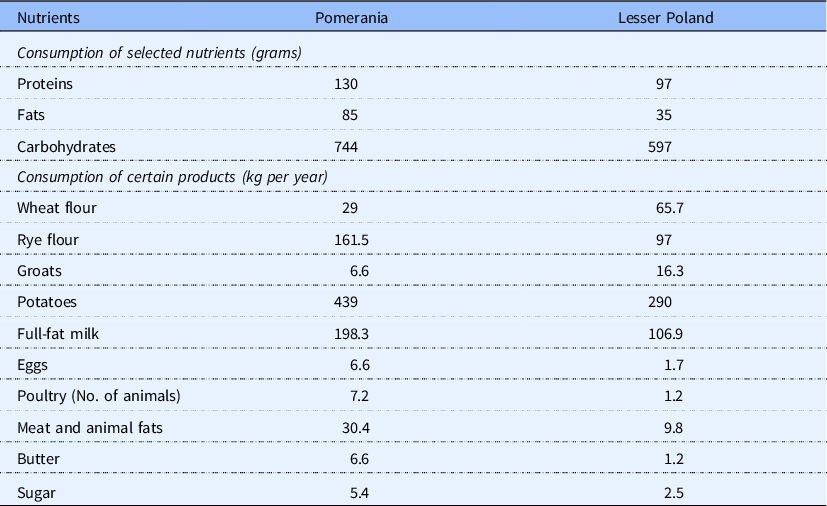
Consumption levels varied across regions. As indicated by F. Dziedzic (Reference Dziedzic1934: 79), in Pomerania, the consumption of proteins and carbohydrates was higher by nearly half than in Lesser Poland, with the consumption of fats being more than twice as high. Another conclusion from data analysis is that while Pomeranian residents consumed much more meat and poultry than those living in the poor region of Galicia, these consumption levels still cannot be considered sufficient. In one of his papers on the situation in Broniszewo, a Subcarpathian village, J. Fierich noted that
During summer, the population wakes up before sunrise. At 8 am, they have potatoes with sour milk and wheat noodles for breakfast; their lunch, served at noon, is composed of cabbage with potatoes or potatoes with milk; wealthier residents also eat dumplings with curd and hulled barley; between 4 and 5 pm, they eat bread with curd or butter and drink sour milk; between 8 and 9 pm, they have bread, a soup and hulled barley (or, eventually, what is left from lunch) for dinner. (Fierich, Reference Fierich1933: 213).
Fierich reasoned that during a crisis period, the consumption of meat and fats went close to zero, and that in the hunger gap, people had up to one meal per day. In another paper on a village located in the Sandomierz region, F. Guścior (Reference Guścior1928: 98) confirms that the staple diet included potatoes and cabbage: ‘In most Polish rural areas …, potatoes and cabbage are the sole food, and are sometimes consumed even three times a day… They eat it with bread…Meat is usually consumed twice a year (Guścior, Reference Guścior1928: 98). The comparison of findings by M. Sowiński (Reference Sowiński1928), F. Guścior (Reference Guścior1928), K. Mróz (Reference Mróz1935), B. Kłembukowski (1934) and A. Dzierżawski (1929) reveals the vital importance of potatoes (see Table 2), which behaved like inferior goods: an inverse proportion was observed between potato consumption and wealth. These authors indicated that similar diets and consumption levels were found across the population. However, M. Trawińska (1968: 192) claimed that the reason for the lack of dairy, meat or poultry was the consumption model rather than the unavailability of these foods. But based on materials such as the Peasants’ Diaries, it is difficult to agree with that opinion.
Consumption levels in the peasant population of Pomerania and Galicia in 1931–3 (per adult)
According to J. Michałowski (Reference Michałowski1935: 49–50), the purchase of an aluminum mug, scythe or nails was at the top of higher-order needs. He also noted the impoverishment of peasants:
Today, a middle-income farmer has ragged clothes and always wears the same pair of patched shoes and the same shirt, washed each evening. … Everyone has only one garment to wear, which is particularly tough to deal with for children. … during winter, in some households, children spend entire days tied up in sacks with chopped straw, all the way to the necks, because without clothes they would freeze in their cold, unheated rooms. And the rooms are heated less and less frequently. … The peasants use brushwood, wood and even peat as fuel; this strictly depends on the distance between their village and the forest (Ibid.: 49–50).
M. M. Mieszczankowski (Reference Mieszczankowski1983: 401) noted that
On average, one man had 1.5 garments; only one in two men had formal clothes. There was 3.2 pieces of underwear (shirts and underpants) per person, including 0.7 pieces worn on special occasions … 47% of families had warm coats or fur coats, 12% had fall coats, and 57% had jackets; on average, one piece per person. 60% of families had gaiters while 70% had calf boots. Other kinds of clothing, except for sweaters and headgear, were extremely rare.
As I said, farm income is not enough to easily cover day-to-day household expenses, not to mention loan installments and taxes. Also, there is interest to be paid. Today, no one charges high interest but even the small rates are challenging. Today, every farmer tries to learn everything, or actually his poverty teaches him everything; he already does everything by himself. He sometimes visits the blacksmith if he cannot handle something alone and cannot do without it. He repairs his old coats found somewhere around the house after several years because he does not have enough to afford a tailor. He does his best to sew and fix his shoes using nails because he can neither buy new ones nor let repair the old ones.
Pamiętniki chłopów [Peasants’ Diaries], Diary 1, p. 11.
The reduced profitability of farming activities, combined with high taxes, forced the peasants to restrict their needs as much as possible; they no longer purchased any industrial products and had to rely on natural farming methods. A strong reduction was observed in the volumes of coal, kitchen appliances, bakery, meat, fats, wheat and sugar purchased (up to 66.9 per cent in 1926–30). There was an even greater decline in the expenditure on travelling, education of children, furniture and appliances, newspapers, books, mail, footwear and clothing (by 84.8 per cent). W. Zaklika (Reference Zaklika1933: 48–49) stated:
The farming population spends 37 zlotys per capita per year on industrial products …. That amount must cover the purchase of salt, sugar, kerosene, clothing, footwear, schoolbooks and notebooks for children, medications in the case of illness, and generally the entire consumption of industrial products. … Those who believe these figures are not enough should visit rural areas and take a look inside peasant houses rather than investigating statistical data. They will see that children do not attend school in winter because they do not have footwear; that they spend the entire winter in an obscure, musty and humid room; that kerosene lamps are lit only in a few houses because farmers cannot afford kerosene; that the households can afford neither sugar nor salt; and that in woodless areas coal was replaced with peat as fuel. Peasant houses are literally hit by hunger because in the fall the peasants sell cereals to pay taxes and repay debts; potatoes are consumed all year round but they, too, sometimes become scarce during spring.
Rural poverty was exacerbated by the combination of unemployment and underdevelopment at national level. A picture of these hardships can be found in a press release published in the Wyzwolenie magazine (1932):
While poverty among urban unemployed is a widespread topic, no one volunteers to examine the terrific misery affecting the rural population. I saw terrible things when working as an interviewer! Here is a story of misery and despair: I enter a small mudhouse, which is about to collapse as it is severely leaning. Inside, there is a family of eleven, including nine children …. All of them barefoot and dressed in rags despite the cold inside the house. In pairs or in threes, they sit in corners covered by rags. Four of them do not even wear clothes; all they have are patched shirts. A true misery and despair!
Low standards of rural living were confirmed in research by S. Inglot (Reference Inglot1927), who indicated that rural residents had limited resources of durable consumer goods. E. Gorzelak (Reference Gorzelak2010: 123) also noted the small volume of industrial products purchased, whether intended for agricultural production or to address individual needs (including home equipment). Home furniture was reduced to a minimum; most peasants only had some essential household items (wooden spoons, mugs). In eastern and southern voivodeships, home equipment included a bunk which, together with a stove, was the place where the whole family slept; a table; a bench near the window; and a bowl shelf. In turn, the equipment of rural households located in western regions was more similar to that of lower middle-class houses in the east: chairs instead of stools, a wardrobe instead of boxes, and veneer furniture.
In the initial years after the First World War (until 1926), due to high prices of agricultural produce, the rural population found themselves in an advantageous situation which, however, declined strongly within a few years. Despite some fluctuations, the prices remained high for several years, making it possible for the farmers to invest and purchase land. Many peasants referred to this period as the golden era, as mentioned by some diarists. The crisis grew deeper only in 1928, as a consequence of prices and adverse effects of price scissors, bringing many households to the brink of ruin.
After August 15, we took a deep breath of relief. Now, we had to make our best farming efforts. As I had more free time to spend, I started to inspect the farm and quickly restored it to a fair condition. I could see that my neighbors and farmers in surrounding villages did so, too. It was a more peaceful time; as agricultural products were quite expensive and taxes were not so high, every farmer started to feel better. All of them started to rear animals which were extremely rare until 1920.
Pamiętniki chłopów [Peasants’ Diaries], Diary 17, p. 240.
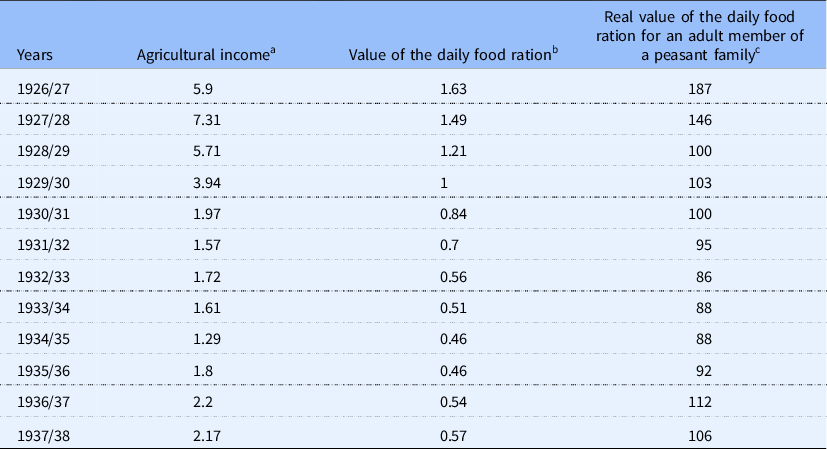
The deteriorating condition of the peasant population is confirmed by the decreasing real value of the daily diet of adult members of peasant families. In 1926/7–1937/8, it went down by more than eighty points, or even by a half during the strongest crisis (see Table 3). Note that farms formed a heterogeneous population. Therefore, while the income of the largest ones (thirty to fifty hectars) was 100 per cent, it was only half of it in smaller ones (five to ten hectares) and barely one-third in those with an area of two to three hectares (Curzytek, Reference Curzytek1928). As pointed out by J. Żarnowski (Reference Żarnowski1973: 138), the deteriorating situation of peasants is reflected by the ratio of daily food rations to daily agricultural income. Before the crisis, that ratio varied in the range of one-fifth to one-quarter; during the hardest crisis, it went up to one-third or one-half. The above confirms the principle of increasing food expenditure in the poorest households.
Daily agricultural income of a peasant family member vs value of the daily food ration for an adult in farms with an area of two to fifty hectares

Notes:
a Agricultural income includes the contribution in kind converted into money.
b The value of the daily food ration specified the value of food consumed.
c The food cost index for a working-class family living in Warsaw was used to calculate the real value of the daily food ration of an adult member of a peasant family.
Source: based on Żarnowski (Reference Żarnowski1973); Warsaw and Curzytek (Reference Curzytek1928).
Conclusions
In sum, it may be concluded that the progress witnessed in the Second Polish Republic did not translate into improvements in the situation of rural residents. Moreover, symptoms of deterioration could be observed in some regions (for example, in the former Prussian partition). The standards of living reached the borderline of extreme poverty. According to J. Żarnowski (Reference Żarnowski1973), while a small group of the rural population could certainly operate their farms freely and address their needs between the wars, the remaining part were limited to mere survival or casual incomes. In the last years before the Second World War (1937–8), the situation started to follow a slow though consistent upward trend; an equilibrium was attained between growth rates of agricultural and industrial products; improvements were observed in the labour market; the employment figures went back to the 1928 level; and the population enjoyed greater opportunities for seasonal migration. However, all of this was destroyed by war operations.
In the Second Polish Republic, rural areas had the following characteristics:
-
1. Moderate diversification of consumption structures irrespective of wealth levels;
-
2. Regional differences in consumption levels, resulting not only from the socio-economic situation of the regions but also from the degree of overpopulation and soil quality;
-
3. Gradual decline in the structure and quality of diets in the peasant population after 1929; and social impoverishment, including hunger suffered by small and extremely small farms;
-
4. Poor innovativeness level in the nutritional structure of goods purchased.
While poverty was mostly related to hunger and complete marginalisation, its consequences also include limited resources of durable consumer goods, poor accessibility of goods other than food, and low mobility. The rural poor were a heterogeneous group of people; the degree of poverty varied across employee groups. Furthermore, according to M. Halamska (Reference Halamska2007), rural poverty was also impacted by differences in culture, mindsets and customs, including poor knowledge resources, limited competences, distrust, passive attitudes and hostility towards elites.
This study is an important effort made to present the situation of peasants and rural dwellers between the wars. It shows the hardships faced by the rural population at the time of reconstructing the Polish state. Although highly important, rural dwellers were often considered as a whole; no differences were shown in how much they were at risk of deprivation. Indicating the heterogeneity across the groups allows to draw a broader picture of what the Polish rural areas were at that time. Also, the situation in particular partitions was often presented separately which made it more difficult to compare the standards of living between the different regions of the Second Polish Republic. The problems faced by rural areas between the wars show only a part of the society affected by poverty, and do not reveal how folwark owners dealt with their businesses. However, that group should be examined separately and therefore little account, if any, was taken of it in these considerations.
The considerations on poverty in Poland between the wars have a further aspect as they allow to reveal the challenges facing countries which, for many years, have been unable to be officially present on the international scene. They show the development issues affecting these countries, especially including their rural areas which, in many European countries, remain underdeveloped to this day. Obviously, the above is true not only for countries which no longer physically exist in the international setting but also for those who become increasingly recognised as owned by other states. At that level, these considerations could be helpful, for instance, to the former eastern bloc countries, which revive in the new realities.
In invariably idyllic representations of the interwar period, men are depicted wearing tailcoats and dancing the foxtrot with beautifully dressed women. However, it turns out that this period also had another aspect, namely the exclusion of entire groups of people. This means the rural population who were often unable to address their needs to a minimum extent. What remains ignored is the misfortune and exclusion of those born in a poor rural setting rather than in wealthy urban families, modern elites or folwarks. The situation of a considerable part of the population shows that excluding many people and depriving them of development opportunities, in combination with unsolvable issues of homelessness, lack of employment or crises (which resulted in massive pauperisation) can lead to a rise of anti-democratic populist forces. At that time, it resulted in the arrival in power of Hitler and Stalin and, as a consequence, in the breakout of the Second World War.
Learning from the past is vital for those who contribute to the development of modern states. A lack of knowledge, analphabetism (or smaller education opportunities), trust in authors of illusive concepts and exclusion of some groups from the distribution of resources and privileges is what promotes the creation of two fractions: those who succeeded and those who feel excluded and deprived. Unfulfilled promises, poverty and eroded foundations of democracy deteriorates the population’s morale and sense of belongingness. As a consequence, this could give rise to social unrest. In that sense, the knowledge of mechanisms existing at that time could be a lesson for today’s authorities on how to avoid what Europe faced when hit by economic crisis in the years right before the Second World War.