Introduction
Schizophrenia typically has an onset from late adolescence to the third decade. However, a small percentage of patients diagnosed with schizophrenia exhibit presenting symptoms in the sixth decade or later (Marneros et al., Reference Marneros, Deister, Rohde, Katona and Levy1992; Howard et al., Reference Howard, Rabins, Seeman and Jeste2000). Even classical studies like those conducted by Manfred Bleuler in the early 1940s reported that 4% of patients with schizophrenia had an onset of psychosis after the age of 60 (Howard et al., Reference Howard, Rabins, Seeman and Jeste2000). Over the next fifty to sixty years, nosologic characterization of such patients was controversial. Although some descriptions of late-onset patients characterized symptomatology as similar to early-onset schizophrenia, others – including pioneering British geriatric psychiatrist researchers and phenomenologists – identified alternative and distinct clinical features. These include female preponderance, higher incidence in immigrant populations, reduced family history of schizophrenia, more favorable prognosis, less affective flattening and blunting, less formal thought disorder, fewer negative symptoms, greater complaints of visual, tactile, and olfactory hallucinations, and of persecutory delusions, and presence of sensory deficits, especially deafness (Roth and Morrisey, Reference Roth and Morrisey1952; Kay and Roth, Reference Kay and Roth1961; Post, Reference Post1966; Pearlson et al., Reference Pearlson1989; Howard et al., Reference Howard, Almeida and Levy1994; Reference Howard1997; Reference Howard, Rabins, Seeman and Jeste2000; Almeida et al., Reference Almeida, Howard, Levy and David1995; Reeves et al., Reference Reeves, Sauer, Granger and Howard2001). Many of these authorities employed the diagnostic classification of “late paraphrenia” to describe such very late-onset patients, but this term was inconsistently adopted in formal nosological classificatory systems. In 2000, an international consensus statement published by the International Late-Onset Schizophrenia Group concluded that the diagnosis of very late onset schizophrenia (i.e. illness onset after age 60 years) had face validity, clinical utility, and research benefit, but that because of its nonconformity with classical early-onset symptoms should best be characterized as “very-late-onset schizophrenia-like psychosis” (Howard et al., Reference Howard, Rabins, Seeman and Jeste2000), although objections were still voiced about using the term “schizophrenia” at all if the clinical entity was so different (Taylor, Reference Taylor2001). Nevertheless, since then, the term “very-late-onset schizophrenia-like psychosis” (VLOSLP), however cumbersome, has gained traction in the literature, with new cognitive, neuroimaging, phenomenological, treatment-response, and longitudinal outcome reports (Barak et al., Reference Barak, Aizenberg, Mirecki, Mazeh and Achiron2002; Reeves et al., Reference Reeves, Stewart and Howard2002; Howard and Reeves, Reference Howard and Reeves2003; Jones et al., Reference Jones2005; Mazeh et al., Reference Mazeh, Zemishiani, Aizenberg and Barak2005; Moore et al., Reference Moore2006; Girard and Simard, Reference Girard and Simard2008), including those that support VLOSLP as a diagnostic entity (Barak et al., Reference Barak, Aizenberg, Mirecki, Mazeh and Achiron2002; Mazeh et al., Reference Mazeh, Zemishiani, Aizenberg and Barak2005; Girard and Simard, Reference Girard and Simard2008).
Drug treatment response in VLOSLP patients has been minimally studied, and has yielded variable findings. Open studies of typical antipsychotics have reported 50–60% remission rates, but these included patients with onset over the age of 40 years (Howard et al., Reference Howard, Rabins, Seeman and Jeste2000). Although reports exist on the use of atypical antipsychotics in VLOSLP patients (e.g. Barak et al., Reference Barak, Aizenberg, Mirecki, Mazeh and Achiron2002; Girard and Simard, Reference Girard and Simard2008), published information is limited. For example, one study utilized only risperidone (Barak et al., Reference Barak, Aizenberg, Mirecki, Mazeh and Achiron2002), whereas another noted general atypical antipsychotic use without further description of agent or dose (Girard and Simard, Reference Girard and Simard2008). Older studies on atypicals in elderly schizophrenic and psychotic patients (which may include VLOSLP patients) concluded that these newer agents are associated with fewer side effects, but incomplete remissions (Jeste et al., Reference Jeste, Rockwell, Harris, Lohr and Lacro1999a; Reference Jeste, Lacro, Bailey, Rockwell, Harris and Caligiuri1999b; Howard et al., Reference Howard, Rabins, Seeman and Jeste2000); although one Turkish case series reported that five of six VLOSLP patients achieved complete or nearly complete improvement at discharge, but types of antipsychotic agents (conventional or atypical) employed were not reported (Alici-Evcimen et al., Reference Alici-Evcimen, Ertan and Eker2003). One hopeful report supported that VLOSLP patients evidenced a better response to risperidone as compared to early-onset schizophrenic patients grown old (Barak et al., Reference Barak, Aizenberg, Mirecki, Mazeh and Achiron2002). However, a Cochrane database review to assess the effects of antipsychotic drugs for elderly people with late-onset schizophrenia (not explicitly VLOSLP, but including likely VLOSLP patients) found that not one of the 65 references selected for full-text examination met the methodological entry criteria for review, and therefore concluded that “there is no trial-based evidence upon which to base guidelines for the treatment of late-onset schizophrenia” (Arunpongpaisal et al., Reference Arunpongpaisal, Ahmed, Aqeel and Paholpak2003).
Given this uncertainty, the present report exploited the Zucker Hillside Hospital electronic medical record to review retrospectively the effect of atypical antipsychotic medication, including newer such agents for which published reports do not apparently exist on clinical symptom relief in patients with a probable VLOSLP diagnosis; and to extend information about naturalistic treatment response to discrete outpatient and inpatient populations.
Methods
A chart review study was conducted by accessing the electronic medical record database at Zucker Hillside Hospital of the North Shore-Long Island Jewish Health System in New York, after obtaining Institutional Review Board (IRB) approval. Zucker Hillside Hospital (ZHH) is the psychiatric division of Long Island Jewish Medical Center and operates approximately 210 inpatient beds of which 40 are associated with two discrete 20-bed geriatric psychiatry units dedicated to patients aged over 65 years. ZHH also operates a large ambulatory service, with approximately 1300 patients assigned to a geriatric psychiatry clinic track.
For this study, in order initially to be as inclusive of likely VLOSLP patients as possible, the medical record numbers were accessed for all patients aged 60 or older, who were active either on an outpatient or inpatient basis during the period from January 2006 to July 2008, and had a documented presumptive admission diagnosis of schizophrenia, schizoaffective disorder, bipolar disorder with psychotic features, delusional disorder, or psychosis NOS (not otherwise specified).
Patients prescribed atypical antipsychotic medication were included in the treatment outcome analysis if they met the following criteria for VLOSLP: presence of psychosis as defined by either delusions, hallucinations, formal thought disorder, or catatonic-like stupor; and onset of such symptoms at 60 years of age or more.
Potential subjects were excluded if they had either early-onset schizophrenia or schizoaffective disorder, any other form of psychosis with an onset prior to 60 years of age, any psychotic symptom secondary to a general medical condition, toxic ingestion, or delirium, and any diagnosis of cognitive disorder or dementia (even on a “rule-out” basis). Also, any patient who met entry screening criteria but was treated with typical antipsychotics or refused any psychotropic medication was also excluded.
Since some patients had multiple inpatient admissions, inpatient “episodes” rather than “patients” were considered in the initial sample identification. However, in order not to confound findings, only the first episode per patient was included.
The following data were abstracted from the e-record of each subject at the time of their admission/treatment initiation: current age, age at onset, and gender. For the outpatients, the patient's psychotic symptoms were classified by the treating clinician according to a mild, moderate, or severe checklist on admission. The end point selected for outpatient treatment outcome in the present study was symptom severity rating (inactive, mild, moderate, severe) following nine months on an atypical antipsychotic. For outpatients with an admission rating of moderate or severe, a positive treatment response was characterized as a severity rating of mild at the nine-month rating. For outpatients with an admission rating of mild, a positive treatment response was defined as now “inactive” symptoms.
For the inpatient sample on admission, the patient's psychotic symptoms were classified – similar to the outpatients – according to the same mild, moderate, or severe checklist. However, the end point for inpatient treatment outcome was discharge rating. For inpatients – unlike for outpatients – the e-record requires at discharge the completion of a 5-point Likert scale measuring degree of treatment response where “1” indicates “excellent response,” “2” indicates “good response,” “3” indicates “fair response,” “4” indicates “no change” and “5” indicates that symptoms are “worse.” A positive treatment response was characterized as an improvement score from 1 to 3 (excellent to fair) at discharge. Atypical antipsychotic medication name and dose were recorded at the nine-month endpoint for outpatients and at discharge for inpatients.
Results
A total of 137 outpatients and 362 inpatient episodes met initial inclusion “criteria.” Amongst the inpatient sample, 59 episodes were either repeat episodes of hospitalization or the patient had already been included in the outpatient sample. Of the potential outpatient and inpatient subjects, 118 and 273 respectively were excluded because they had either early-onset schizophrenia or schizoaffective disorder, any other form of psychosis with an onset prior to 60 years of age, any psychotic symptom secondary to a general medical condition, toxic ingestion, or delirium; six outpatients and ten inpatients were excluded because of a diagnosis of cognitive disorder or dementia (even on a “rule-out” basis); four outpatients and three inpatients were excluded because they were treated with typical antipsychotics; and one outpatient and four inpatients were excluded because of psychotropic medication refusal. Therefore, a total of eight outpatients (5%) and 13 inpatients (4%) treated with atypical antipsychotic medication met criteria for VLOSLP. All eight outpatients were treated in the clinic for at least nine months.
Patients were treated with either aripiprazole, olanzapine, quetiapine or risperidone (including one patient with risperidone long-acting injection) or a combination of aripiprazole plus quetiapine.
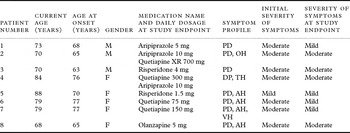
Table 1 shows the demographic and clinical characteristics of the outpatient sample. The average current age was 76.4 years (SD = 7.3) with a mean age of onset of psychotic symptoms of 70.1 years (SD = 5.8). Specific sign/symptom highlights per outpatient are as follows: Outpatient 1 expressed paranoid delusions about terrorists; Outpatient 2 persecutory delusions that planes were spying on him, that the police were tracking him, and that his apartment was poisoned with probable olfactory hallucinations re: poison smell; Outpatient 3 with referential suspected delusions; Outpatient 4 delusions of parasitosis with associated probable tactile hallucinations; Outpatient 5 paranoid delusions about the President of the U.S.A.; Outpatient 6 persecutory delusions about illegal entry into her apartment with auditory hallucinations; Outpatient 7 persecutory delusions of illegal entry into her apartment, photographs being taken of her, with both auditory and visual hallucinations; and Outpatient 8 with less elaborated persecutory delusions and auditory hallucinations. In summary, seven of the eight outpatients had paranoid/persecutory delusions; one had a delusion of parasitosis with associated likely tactile hallucinations; one had apparent olfactory hallucinations; one had suspected visual hallucinations; and four had auditory hallucinations. Seven of the eight outpatients' symptoms were rated as “moderate” and one was rated as “mild.” Overall 37.5% of patients (3/8) met criteria for a positive treatment response. Table 1 indicates that positive responses were seen in one outpatient treated with aripiprazole (5 mg), and two outpatients treated with quetiapine (at 75 mg and at 150 mg).
Demographic and clinical characteristics of VLOSLP outpatient sample (See Results section for symptom elaboration)

VLOSLP = very late-onset schizophrenia-like psychosis.
PD = persecutory/paranoid delusions; DP = delusions of parasitosis; AH = auditory hallucinations; OH = olfactory hallucinations; TH = tactile hallucinations; VH = visual hallucinations.
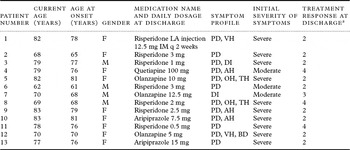
Table 2 displays the demographic and clinical characteristics of the 13 inpatients. The average current age of the patients who met the inclusion criteria was 75.5 years old (SD 6.9 years) with a mean age of onset of 73.5 years (SD 6.4). Specific sign/symptom highlights per inpatient were as follows: Inpatient 1 expressed persecutory delusions about neighbors following her, cameras installed in her ceiling, illegal entry into her home, and accusations that a family member was an imposter; Inpatient 2 persecutory delusions that phone lines were tapped, neighbors stealing from her, and the mafia pursuing her; Inpatient 3 delusions of spousal infidelity, persecutory delusions of illegal entry into his home, phones being tampered with, and cameras installed; Inpatient 4 persecutory delusions that her family was trying to kill her with threatening auditory hallucinations; Inpatient 5 persecutory delusions about radiation exposure, roommate spraying perfume chemicals and body lotions with likely olfactory and tactile hallucinations; Inpatient 6 paranoid delusions about an unelaborated conspiracy; Inpatient 7 delusions of spousal infidelity; Inpatient 8 persecutory delusions about roommate spraying chemicals on him while he was asleep and persisting chemicals on his shoes with associated probable olfactory and tactile hallucinations; Inpatient 9 persecutory delusions that the mafia were after her, auditory hallucinations of the voice of a friend she believed worked for the FBI; Inpatient 10 persecutory delusions about cameras in the house, spying neighbors with auditory hallucinations of neighbors' voices; Inpatient 11 persecutory delusions about neighbors and daughter trying to steal from her; Inpatient 12 persecutory delusions that husband was trying to kill her, bizarre delusions about her ability to communicate via cyberspace and telepathy and that she was a clone, questionable visual hallucinations; and Inpatient 13 persecutory delusions about rummaging in her mailbox, neighbors conspiring against her, and microphones in her house. In summary, 12 of the 13 inpatients had paranoid/persecutory delusions of diverse content; two inpatients had delusions of spousal infidelity; one inpatient had bizarre delusions; two inpatients had probable olfactory and tactile hallucinations; two had likely visual hallucinations; and three had auditory hallucinations. The symptoms of ten of the inpatients were rated as “severe” and three were rated as “moderate.” Overall 76.9% of inpatients (10/13) met criteria for a positive treatment response. Of the ten patients who responded, four responded to risperidone at doses ranging from 1 to 3 mg/day. One other responder was treated with a risperidone long-acting injection. Two responders were treated with aripiprazole (7.5 to 15 mg/day); and three responders were treated with olanzapine (5 to 12.5 mg/day). The only inpatient treated with quetiapine (100 mg) did not respond.
Demographic and clinical characteristics of VLOSLP inpatient sample (See Results section for symptom elaboration)

a1 excellent, 2 good, 3 fair, 4 no change, 5 worse.
VLOSLP = very late-onset schizophrenia-like psychosis; LA = long-acting.
PD = persecutory/paranoid delusions; DI = delusions of spousal infidelity; DP = delusions of parasitosis; AH = auditory hallucinations; OH = olfactory hallucinations; TH = tactile hallucinations; VH = visual hallucinations.
Discussion
The principal findings of this pilot case review of VLOSLP patients naturalistically treated with atypical antipsychotics are (1) that almost all of the currently available atypical antipsychotic agents prescribed (only ziprasidone and clozapine were not prescribed) can result in a positive treatment response; and (2) positive response can be achieved at low doses, supporting prior reports of response at lower doses in middle-age-onset schizophrenic patients as compared to early age onset counterparts (Palmer et al., Reference Palmer, McClure and Jeste2001). Taken together, this suggests that as the age-at-onset of schizophrenia-spectrum patients increases, so does pharmaco-sensitivity. Furthermore, the overall 62% response in this report (13/21 patients) lends support to another previous study suggesting greater treatment responsivity of VLOSLP patients as compared to early-onset schizophrenic patients now grown old (Barak et al., Reference Barak, Aizenberg, Mirecki, Mazeh and Achiron2002). Significant limitations of the present study include its retrospective design, small sample size, naturalistic treatment, and dependence on basic outcome ratings (e.g. mild, moderate, severe) unanchored by specific descriptors that might have enabled more accurate quantification of treatment response.
The primary phenomenological feature of the majority (90%) of patients meeting VLOSLP criteria in the present study were persecutory delusions, with and without hallucinations in multiple spheres. Of interest, 58% of patients with persecutory delusions expressed colorful beliefs about intrusion/invasion of their home and/or person that resonate with many of Kraepelin's descriptions of features of “paraphrenias” (Förstl et al., Reference Förstl, Howard, Almeida, Stadtmuller, Katona and Levy1992). However, no pattern of symptom response to atypical antipsychotics clearly emerged. Some patients with florid delusions and hallucinations responded to pharmacotherapy with particular agents, whereas others did not. Although the samples are tiny, inpatients had a dramatically higher response rate (76.9% vs. 37.5%) than outpatients. Since time from symptom onset to current age was considerably shorter in inpatients than outpatients, higher response rates in inpatients may reflect greater pharmaco-sensitivity in patients with less chronic symptomatology. Alternatively, since 77% of inpatients' symptoms were rated as “severe” as compared to none of the outpatients' symptoms (7 moderate, 1 mild), floridity may predict greater response.
The present findings of diverse treatment responses of VLOSLP patients to different doses of atypical antipsychotics contribute to the general impression in the literature that VLOSLP likely represents a heterogeneous disorder with some common phenotypes. For example, one recent study reported more pronounced cerebellar atrophy in VLOSLP patients compared to current age-matched elderly schizophrenics (Barak et al., Reference Barak, Aizenberg, Mirecki, Mazeh and Achiron2002); whereas a diffusion tensor magnetic resonance imaging study found no differences in fractional anisotropy, a measure of frontal white matter connectivity, in VLOSLP patients versus age-matched normal comparison subjects (Jones et al., Reference Jones2005). The former study concluded that VLOSLP likely involved a neurodegenerative process pathophysiologically, while the latter study argued against brain changes underlying onset of psychosis. Supporting this latter view was another recent study that followed up VLOSLP and older schizophrenic patients and reported that the majority of VLOSLP patients did not manifest cognitive and functional deterioration, but nearly half of the elderly schizophrenia group did (Mazeh et al., Reference Mazeh, Zemishiani, Aizenberg and Barak2005). Functional neuroimaging studies employing PET and SPECT also support heterogeneity of this patient population, reporting both an increase and no increase in dopamine receptor density in late-onset patients versus normal comparison subjects (Pearlson et al., Reference Pearlson1993; Howard et al., Reference Howard, Cluckie and Levy1993). Such findings may explain the inconsistent response profiles to dopamine-blocking antipsychotics seen in this and other studies.
In their consensus statement, the International Late-Onset Schizophrenia Group concluded that “antipsychotic drugs are a mainstay of therapy,” that “drug treatment should be started at very low doses,” and that “very late-onset patients may respond to dose amounts as low as one-tenth of those used in young adults” (Howard et al., Reference Howard, Rabins, Seeman and Jeste2000). The present retrospective findings support these conclusions.
It is interesting to note that of those patients in the present study who did respond positively to treatment, in almost all cases symptoms were ameliorated but not eradicated. This is consistent with some other reports of incomplete remission and further suggests that clinical features of VLOSLP likely represent both state and trait phenomena. Distinguishing these will depend on future prospective phenomenological, biological, acute treatment response, and longitudinal outcome studies of this unusual population, which would also help to clarify potential predictors of response. However, since only about 5% of older psychotic patients in our hospital-based sample (in a hospital with a large, geriatric psychiatry program) could be characterized as VLOSLP, aggregating a representative sample to further pursue such findings will likely be dependent upon multi-center studies, which have not yet been accomplished. Furthermore, future imaging studies may help to elucidate the neurochemical basis of antipsychotic response in this population, both in terms of symptom reduction and side-effect profile.
Conflict of interest
None.
Description of authors' roles
J. Scott formulated the research questions and designed the study, collected the data, and co-wrote the paper. B. Greenwald formulated the research questions and designed the study, co-wrote the paper and analyzed the data. E. Kramer analyzed the data, carried out the statistical analyses and co-wrote the paper. M. Shuwall organized the initial electronic medical record data abstraction and co-wrote the paper.