Introduction
This article explores how wide-ranging effects of exposure to psychological trauma in mentally ill individuals continue to be largely overlooked, contributing to poor outcomes and a flood of mentally ill individuals into the court system and correctional care. Even in state hospitals and community mental health settings, the consequences of trauma often go unrecognized and untreated in highly vulnerable individuals. The authors posit that a trauma-informed lens is needed to move “trauma-blind” systems forward to more enlightened, evidence-based care and treatment. The traditional criminalization hypothesis refers to the funneling of individuals with serious mental illness (SMI) into the criminal justice system as a result of deinstitutionalization and inadequate community mental health resources. This article explores how expanding notions about criminalization that identify factors beyond SMI still miss the mark by underestimating or omitting the role of trauma. Chronic under-recognition of trauma-related disorders contributes to misattributions about the cause and meaning of behaviors that pose common management problems in prisons, state hospitals, conditional release and community-based mental health programs, homeless shelters, and communities. A trauma-informed perspective offers insight for care providers (and individuals) seeking to understand acts of aggression, self-injury, high risk medical refusals, impulsivity, substance abuse, medication nonadherence, rule-breaking, and heightened reactivity to perceived disrespect, shaming, coercion, and power differentials. The authors encourage providers to take a new look at clients who demonstrate these behaviors with the view that for many individuals with SMI, these responses do not represent treatment resistance or reckless risk-taking, but rather, complex and adaptive behaviors that arise from traumatic life histories.
While trauma-informed care (TIC) is not the answer to all problems, it offers a more effective and compassionate approach to challenges facing individuals with SMI and the systems that treat them. TIC fosters awareness of the life-long effects of psychological trauma, shifting the clinical question from “What’s wrong with you?” to “What happened to you?” In trauma-informed systems, the impact of trauma is recognized at all levels and proactive policies and procedures are employed to mitigate harm and reduce re-traumatization. TIC is associated with improved mental health outcomes, patient satisfaction, and significant reductions in violence, sexually risky behavior, substance abuse, containment-related injuries, seclusion and restraint, and use of sedative hypnotics in acute inpatient settings. 1-3
TIC is a national standard promoted by public health agencies across the United States and beyond. Leaders in mental health care increasingly view trauma-informed perspectives as critical, and this paper serves as a call to action. TIC offers a roadmap for organizational change that supports safer environments for patients, inmates, and staff. A crucial first step is increasing awareness of trauma prevalence and impact among individuals with SMI.
Trauma Prevalence
Life histories replete with trauma are the norm for individuals involved with mental health services and the criminal justice system. Per the Substance Abuse and Mental Health Services Administration (SAMHSA), trauma is “an almost universal experience among people who use public mental health, substance abuse, and social services, as well as people who are justice-involved or homeless.” 4 Studies affirm that nearly all individuals treated in inpatient and forensic psychiatric settings are survivors of trauma, with reported lifetime prevalence rates of 98% in a mixed group of in/outpatients with SMI and 100% in male forensic inpatients—with 75% of the latter endorsing exposure in childhood.Reference Mueser, Goodman and Trumbetta 5 , Reference McKenna, Jackson and Browne 6 SMI mental health patients are also far more likely than the general population to be victims of trauma or violence in the previous year.Reference Khalifeh, Oram, Osborn, Howard and Johnson 7 High levels of trauma exposure and mental illness are found in correctional settings as well. Per the Treatment Advocacy Center, “Los Angeles County Jail, Chicago’s Cook County Jail, or New York’s Riker’s Island Jail each hold more mentally ill inmates than any remaining psychiatric hospital in the United States” and overall, more individuals with SMI reside in jails and prisons than in psychiatric facilities; the Center estimates that 15% of prisoners and 20% of inmates in jails are seriously mentally ill. 8 Other studies report higher rates of SMI in incarcerated persons; in Iowa, almost half (48%) of prisoners were diagnosed with a mental disorder and 29% were diagnosed with SMI.Reference Al-Rousan, Rubenstein, Sieleni, Deol and Wallace 9 Despite the almost universal presence of traumatic life histories in individuals with SMI, studies consistently demonstrate gross, systemic under-recognition of trauma-related disorders.
Trauma and Related Disorders Often Go Unrecognized
A significant number of individuals with SMI warrant a concurrent diagnosis of posttraumatic stress disorder (PTSD), but few individuals are diagnosed. In a multisite study, 43% of patients with SMI met criteria for PTSD upon evaluation, but only 2% were identified as such; a follow-up study found a 35% rate of PTSD in patients with SMI.Reference Mueser, Goodman and Trumbetta 5 , Reference Mueser, Salyers and Rosenberg 10 In a community mental health setting, 33% of patients with SMI met criteria for PTSD, but only 4% were identified.Reference Howgego, Owen, Meldrum, Dark and Parslow 11 A review conducted in a large forensic state hospital found that only 1.4% of patients were diagnosed with PTSD.Reference Alexander, Welsh and Glassmire 12 A systematic review of 34 articles determined that PTSD is a common comorbid condition with most studies reporting prevalence ranging from 20% to 30% with schizophrenia and higher comorbidity (40%) with concurrent substance abuse.Reference Seow, Ong and Mahesh 13 A comprehensive review covering 30 years of data and 33 studies concluded that the mean prevalence rate for PTSD in the context of SMI was 30%.Reference Mauritz, Goossens, Draijer and van Achterberg 14 Prevalence of “complex” PTSD (arising from prolonged, early, repeated traumatic experiences that are interpersonal in nature) was 31% in a sample of patients diagnosed with borderline personality disorder.Reference Ford and Fournier 15 Trauma exposure is also elevated in adults with intellectual disabilityReference Wigham and Emerson 16 and varies with socioeconomic status, poverty, gender, sexual orientation, and other demographic factors. 1
Accurate diagnosis of PTSD in the presence of SMI can be challenging. Severe trauma symptoms may be misinterpreted as evidence of personality or psychotic disorder, and dissociation can be difficult to differentiate from psychosis.Reference Lysaker and LaRocco 17 Flashbacks and hypervigilance may be interpreted as congruent with symptoms of paranoia or schizophrenia rather than concurrent PTSD.Reference Seow, Ong and Mahesh 13 , Reference Mauritz, Goossens, Draijer and van Achterberg 14 Other reasons for low diagnostic rates include a widespread belief that individuals with SMI are unreliable historians, despite studies demonstrating accurate self-report of traumatic events even in the presence of active psychiatric symptoms.Reference Grubaugh, Zinzow, Paul, Egede and Frueh 18 , Reference Fisher, Craig and Fearon 19 In cases where co-occurring PTSD is wholly unrecognized, effective clinical management and compassionate care prove challenging.
The Impact of Trauma
Childhood trauma is powerfully associated with serious issues that are routinely encountered in treating mentally ill patients and inmates, including leading causes of physical illness and mortality, psychiatric illness, substance abuse, and risk-taking behaviors in adulthood. The landmark Adverse Childhood Experiences (ACE) study (conducted by Kaiser Permanente in partnership with the Centers for Disease Control), queried 17 000 people and found that the number of traumatic events in a person’s early life is robustly correlated with subsequent heart, liver and lung disease, smoking, obesity, sexually transmitted diseases, substance use, depression, suicidal behavior, hallucinations, and other life problems.Reference Felitti, Anda, Lanius, Vermetten and Pain 20 The authors note that our earliest experiences are “not lost, but, like a child’s footprints in wet cement, are often life-long” and that unrecognized and un-treated trauma represent a costly public health problem. Other studies reveal that early exposure to trauma results in alterations in brain structure and function including, but not limited to, changes in the sensory system and hippocampus, increased activity in the amygdala, decreased activity in the prefrontal cortex, enlarged ventricles, decreased gray matter, and neurochemical changes such as increased dopamine and decreased serotonin.Reference Dannlowski, Struhrmann and Beutelmann 21 –Reference Read, Fosse, Moskowitz and Perry 23
While specific causal pathways are not yet fully understood, a growing body of research reveals a relationship between early trauma and later violence and criminality. A study associated with the ongoing ACE project found early childhood trauma was associated with aggression and adult criminality in male offenders.Reference Reavis, Looman, Franco and Rojas 24 The authors note that the powerful effects of trauma are too often ignored in treatments addressing criminality and that interventions do not attempt “to heal these neurobiological wounds are destined to fail.” In a study of nearly 4000 imprisoned males, those with histories of childhood physical or sexual abuse reported more substance abuse, symptoms of depression and anxiety, and interpersonal problems arising from difficulties with self-regulation and aggression.Reference Wolff and Shi 25 A recent meta-analysis indicated that individuals with psychosis and histories of maltreatment in childhood were twice as likely to be violent as patients with SMI lacking that history.Reference Green, Browne and Chou 26 Trauma also exacerbates expression of comorbid conditions: in patients with schizophrenia, PTSD is associated with increased suicidality, severity of positive symptoms, neurocognitive impairment, lower levels of functioning, and poor quality of life.Reference Seow, Ong and Mahesh 13 Exposure to early trauma has also been connected to repeated self-injurious behavior in adulthood,Reference Cleare, Wetherall and Clark 27 emotional dysregulation, and increased irritability.Reference Bielas, Barra and Skrivanek 28
Unrecognized Trauma Leads to Poor Outcomes
A pervasive lack of understanding about symptoms and adaptive behaviors common to SMI trauma survivors increases risk of poor outcomes, negative encounters with staff, and unwanted contact with the criminal justice system. A core tenet of TIC is that all behavior has purpose and meaning. An individual who erupts aggressively in the medication line upon being touched without warning may have an early life history that makes sense of a seemingly “unprovoked” outburst. Similarly, there may be a discoverable, reality-based rationale at work when an individual repeatedly refuses her gynecological appointments despite a history of cervical cancer. Authors of the landmark ACE study note that too frequently providers focus narrowly on the presenting problem “which is often only the marker for the real problem which lies buried in time, concealed by patient shame, secrecy, and sometimes amnesia—and frequent clinician discomfort.”Reference Felitti, Anda, Lanius, Vermetten and Pain 20 Without a trauma-informed lens and abiding curiosity, patients may well appear irrational, pathological, reckless, or resistant. TIC teaches us that patterns of behavior that appear unhealthy or destructive may represent the best available “solution” to an even worse problem facing that individual. Uninformed responses that disregard the challenges and needs of traumatized individuals may result in disengagement, inadequate treatment, or contribute to increased reactivity, aggression, and instability.Reference Pinals 29 All of this sets the stage for a revolving door between the streets, community, state hospital, and correctional settings.
The Criminalization Hypothesis and Trauma
The most common conceptualization of the criminalization hypothesis is that persons with SMI are disproportionately represented in the criminal justice system because untreated psychiatric symptoms bring them into contact with law enforcement, and that re-routing them to appropriate mental health treatment is the solution. To that end, concerted efforts have been made over the past 20 years to provide community-based alternatives such as jail diversion programs, problem-solving courts, specialized probation and parole caseloads, and forensic mental health services emphasizing psychiatric rehabilitation.Reference DeMatteo, LaDuke, Locklair and Heilbrun 30 , Reference Epperson, Wolff, Morgan, Fisher, Frueh and Huening 31 The sequential intercept model has served as a framework for identifying points of intervention that might “prevent individuals from entering or penetrating deeper into the criminal justice system.”Reference Munetz and Griffin 32 The primary goal of these “first generation” interventions was to ensure individuals with SMI were properly linked with needed mental health services, and often involved prebooking and postbooking diversion, forensic assertive community treatment, and forensic intensive case management.Reference Pinals 29 , Reference Epperson, Wolff, Morgan, Fisher, Frueh and Huening 31 , Reference Wolff, Frueh and Juening 33 However, a growing body of literature suggests the standard criminalization hypothesis does not wholly account for the large number of SMI in the criminal justice system, and that purely untreated mental illness only accounts for 5% to 10% of those individuals.Reference Skeem, Manchak and Peterson 34 –Reference Junginger, Claypoole, Laygo and Crisanti 36
One study of postbooking jail diversion found only 8% of crimes to be related to mental illness, while 26% were related to substance abuse; which led researchers to call for an expanded view of criminalization that includes other criminal risk factors inherent to the environments of individuals with SMI such as poverty, homelessness, employment instability, and substance abuse.Reference Junginger, Claypoole, Laygo and Crisanti 36 , Reference Draine, Salzer, Culhane and Hadley 37 A 2010 study of released prisoners revealed that 7% of crimes were linked to psychosis or survival behaviors resulting from socioeconomic disadvantage (respectively classified as “psychotic” and “disadvantaged”); however, the largest group (90% of mentally ill, 68% of nonmentally ill) were classified as “reactive” and found to have the highest likelihood of further criminal justice involvement. Group members were characterized by hostility, disinhibition, and “emotionally motivated responses to perceived provocation.” Among the mentally ill reactive group, substance abuse was determined to be a motivating factor in the majority of offenses. Based upon findings, the researchers called for additional attention to be paid to the same criminogenic risk factors shared by offenders without mental illness.Reference Peterson, Skeem, Hart, Vidal and Keith 35 In both studies, raters determined motivating behavior based on review of police reports and interviews with offenders; however, the methodologies used did not account for the fact that many traumatized individuals, particularly those who are untreated, lack sufficient insight to recognize or verbalize the full range of motivations/impulses behind their behavior. Furthermore, both studies failed to recognize the integral role trauma can play in substance abuse, hostility, disinhibition, and emotional reactivity.
Trauma: The Missing Piece
We suggest that criminalization occurs in an ongoing manner, not only at the time of first law enforcement contact, but well into the custodial and treatment phases. While SMI and/or other factors might lead individuals to be incarcerated or judicially committed to treatment, the story does not end there. Once in the criminal justice system, trauma-based behaviors are often misinterpreted and wrongly attributed to purely criminogenic factors, leading to improper or inadequate treatment interventions, power struggles with staff, and ultimately re-traumatization. In some cases, the stigma associated with certain types of criminal behavior, and those who commit it, may also play a role in staff insensitivity and inadequate attention to complex treatment needs.Reference Wiechelt and Shdaimah 38 While some acknowledge the role trauma can play in SMI entering the system,Reference Pinals and Felthous 39 we would argue that many seeking to expand the criminalization hypothesis still overlook the role trauma plays in continued criminalization of this population once incarcerated or remanded to care.
Additionally, trauma may underlie other risk factors contributing to criminalization. For example, both illicit drug use and homelessness are strongly connected to traumatic life histories. The ACE study strikingly revealed a powerful, dose-dependent relationship between early traumatic experiences and later intravenous drug use, noting a 4600% greater likelihood of heroin or methamphetamine use (via injection) in males with an ACE score of six versus males with scores of zero.Reference Felitti, Anda, Lanius, Vermetten and Pain 20 The SHIFT study found trauma to be one of two factors predicting long-term housing instability.Reference Hayes, Zonneville and Bassuk 40 Still, much of the research reconceptualizing criminalization appears to be siloed from concurrent literature on the impact of trauma. This disconnect continues to be a barrier to developing comprehensive, multi-faceted approaches that reduce SMI involvement in the criminal justice system.
Some researchers have begun to incorporate trauma into broader models, and we urge others to explore this topic more fully. One suggested second generation approach is the “person-place framework,” which calls for targeted interventions for mental illness, criminogenic risk, and other risk factors arising from social and environmental disadvantages commonly experienced by persons with SMI, such as addiction and trauma exposure.Reference Epperson, Wolff, Morgan, Fisher, Frueh and Huening 31 Others suggest the Risk-Need-Responsivity (RNR) modelReference Bonta and Andrews 41 should be updated to reflect current research indicating reactivity, impulsivity, and need for excitement can actually be trauma responses rather than indicators of antisocial personality.Reference Leitch 42 One researcher recommends treatment planning that addresses both criminogenic risk and responsivity factors—like trauma—“that can create barriers to positive outcomes.”Reference Pinals 29 The common theme in evolving research is that services aimed at mental illness alone may only be partially effectiveReference Pinals 29 , Reference Wolff, Frueh and Juening 33 , Reference Draine, Salzer, Culhane and Hadley 37 , Reference Fisher, Silver and Wolff 43; therefore, it is incumbent upon all of us in the mental health and criminal justice systems to regroup and evolve beyond the strategies employed over the last two decades.
We propose a comprehensive expanded view of the criminalization hypothesis that recognizes the interplay and overlap of all factors available in current research. Identified factors contributing to criminalization of SMI include: untreated mental illness, substance abuse, social and environmental factors, criminogenic risk, and unrecognized/untreated trauma (see Figure 1—original visual representation of an “expanded model of the criminalization hypothesis”).
Expanded model of the criminalization hypothesis.

How Trauma-Informed Principles Can Help
Trauma-informed systems offer the possibility of improved outcomes in multiple areas; however, trauma can only be healed within systems that are not re-traumatizing. Every member of an organization, from those who serve as first point of contact to executive leadership, must understand the impact trauma has on an individual’s development, and common behaviors traumatized individuals exhibit.Reference Elliott, Bjelajac, Fallot, Markoff and Reed 44 It is important for service providers to recognize that these behaviors are not always characterological, but may have developed over time as adaptive strategies for coping with the impact of trauma.Reference Stainbrook, Penney and Elwyn 45 This understanding can translate into more sensitive responses throughout the service delivery process. A hallmark of trauma-informed care is that each interaction is made with the intention of contributing to recovery and reducing the likelihood of re-traumatization.Reference Elliott, Bjelajac, Fallot, Markoff and Reed 44
It is also important to understand how one’s environment—within criminal justice or mental health settings—can be further traumatizing. Lack of control, hopelessness over circumstances, necessary security protocols, and exposure to institutional violence can trigger traumatized individuals who already experience significant anxiety, hypervigilance, and irritability.Reference Pinals 29 Even the traumatizing effect of a person’s own committing offense warrants further attention.Reference McKenna, Jackson and Browne 6 The vicarious trauma of staff can also lead to an unhealthy workforce, and institutional trauma that fosters reactivity and “management by crisis.”Reference Miller and Najavits 46 Transparency, flexibility, communication, and compassion at all levels can go a long way toward increasing physical and psychological safety for staff and those they serve.
Some mental health and correctional staff may perceive trauma-informed interventions as ineffective or even dangerous; however, quite to the contrary, they assist in the development of pro-social coping skills, safer and more peaceful milieus with fewer incidents, and improved staff morale.Reference Miller and Najavits 46 Staff across mental health and correctional settings should be trained to recognize signs and symptoms of trauma-reactivity, employ trauma-informed de-escalation techniques, create more trauma-informed physical environments whenever possible, and provide appropriate referral to trauma-specific treatments.
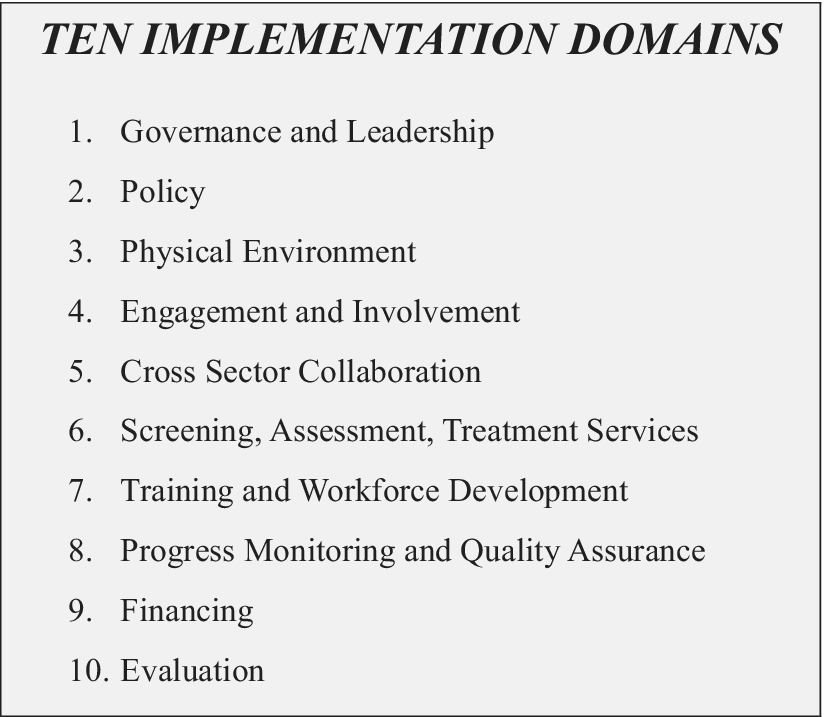
SAMHSA offers organizations a guide for implementing trauma-informed care across multiple domains, including not only workforce training and provision of trauma-specific services, but areas such as physical environment, leadership, and policy (see Figure 2—public domain image of SAMHSA’s “Ten Implementation Domains.” 47).
Ten implementation domains.

Clinical and Policy Implications
Given the high prevalence of trauma within the SMI population, universal trauma precautions should be employed in agencies that serve them.Reference McKenna, Jackson and Browne 6 , Reference Pinals 29 In other words, policies and procedures should reflect the assumption that every individual has a trauma history. Cross-sector training on trauma, its impact, and its behavioral expression can begin to change the hearts and minds of staff within mental health and criminal justice systems. A shift in system culture can then pave the way for changes that minimize environmental stressors, and encourage appropriate referral/linkage to evidence-based trauma-specific assessment and treatment. Trauma should be meaningfully integrated into risk management and viewed as a “universal component” of violence risk assessment.Reference Horowitz, Guyer and Sanders 48 Trauma-informed case formulations can guide treatment planning and trauma-focused interventions that have been identified as safe and effective in patients with SMI.Reference Swan, Keen, Reynolds and Onwumere 49 Exploring individuals’ support systems may offer valuable information that can assist with such formulations.Reference Pinals 29
With regard to program/research design and evaluation, consumers should be integrated whenever possible to ensure the wisdom of those with “lived experience” serves as a guide for change. Further, the principles of trauma-informed care must be operationalized in terms of specific activities and competencies that can be evaluated and replicated.Reference Leitch 42 A distinction should be made between mental health and public safety outcomes when selecting interventions. Program reviews over recent years show few instances where criminal justice and mental health outcomes were considered in tandemReference Epperson, Wolff, Morgan, Fisher, Frueh and Huening 31; however, this must change through appropriate cross-sector collaboration that also integrates community reentry, conditional release, and other community supervision entities. Some communities have found sequential intercept mapping workshops to be useful tools for collaboration between systems, education about available services and resources, and identification of service gaps.Reference Pinals 29
We urge systems to work together toward the following goals:
-
• Build cultures that embody TIC principles and practice relationship-based care and curiosity. Change culture first, and then implement trauma-specific services.
-
• Integrate trauma as a core component of violence risk assessment and incident/risk management (utilize trauma-informed case formulations).
-
• Implement sensitive trauma screening and assessment practices, and evidence-based treatments, including, but not limited to sensory modulation and somatosensory therapies, Cognitive Behavioral Therapy (CBT), and Eye Movement Desensitization and Reprocessing (EMDR).
-
• Address staff trauma to support healthier milieus and authentic, engaged, and relationship-based care with individuals with SMI.
-
• Engage in cross-sector training and collaboration, identify desired mental health and criminal justice outcomes, and develop an integrated plan for measurement and evaluation.
Conclusion
Over recent years, concerted efforts have been made by mental health and criminal justice systems to reduce criminalization of the mentally ill, yet large numbers of persons with SMI continue to fill jails, prisons, and state hospitals. Only with an expanded view of the multiple interconnected factors that contribute to criminalized SMI can systems begin to work together to address this complex social issue. To paraphrase Maya Angelou, now that we know better, we can do better. Acknowledging the powerful role of trauma is an important step toward healing, increased resilience, and mutual understanding. Building trauma-responsive organizations will enhance safety and bring renewed sense of purpose, meaning, and connection for individuals and the providers who serve them.
Disclosures
The authors have nothing to disclose.
Acknowledgments
The authors would like to thank the many dedicated trauma champions working to foster positive change, kindness, and clinical curiosity in the California Department of State Hospitals.