Surgical site infections (SSI)s are one of the key healthcare-associated infections (HAIs) tracked by the Centers for Disease Control and Prevention’s National Healthcare Safety Network (NHSN). The NHSN’s SSI surveillance definitions and metrics are used by hospitals and organizations to identify areas for improvement, to benchmark hospital and surgeon performance, and to track the progress of prevention efforts.
The current NHSN SSI rate calculation has some inherent flaws. The NHSN creates large categories for surgical procedures based on International Classification of Diseases, Tenth Revision (ICD-10) or current procedural terminology (CPT) procedure codes. When multiple surgical procedures are performed in the same operation, the NHSN definitions state that the operation is counted in each of the individual NHSN procedure categories; however, when an SSI is identified, it is only counted in 1 procedure category. When multiple procedures are performed through the same incision and the infection is not clearly associated with 1 surgical procedure, the infection is counted toward the “highest-ranking” procedure based on an NHSN-defined hierarchy.1 For example, an abdominal surgery that involved small bowel (SB), colon (COLO), and rectum (REC) would count in each of the SB, COLO, and REC procedure denominators, but an SSI associated with this operation would only count as a COLO SSI. This method of calculating SSI rates and SIRs is problematic because some procedures counted in an SSI rate denominator could, by definition, never have an associated infection.
To compound this problem, potential inconsistent application of surveillance definitions may skew hospital-to-hospital comparison of SSI rates and standardized infection ratio (SIR) calculations. Hospitals may count denominators differently due to the electronic medical record used and the level of IT support at the individual hospital. For example, many community hospitals only count the highest-ranking procedure in the denominator for SSI rate calculations, potentially inflating their reported SSI rates in comparison to hospitals strictly following NHSN guidelines. On the other hand, hospitals with more advanced information technology support have been able to assign NHSN procedure codes automatically based on ICD-10 procedure codes and follow NHSN rules for counting operations in multiple procedure denominators.
Methods
To explore the potential impact of inconsistent methods for calculating SSI denominators, we performed a retrospective analysis of SSI surveillance data from hospitals in DICON from January 1, 2015, to December 31, 2017. We only included hospitals where 200 or more primary spinal fusions and 200 or more primary colon surgeries were performed to ensure that SSI rates were not affected by low procedure volume. We examined SSI rates of laminectomies and rectal procedures using 2 different denominators: (1) current NHSN definition or (2) only when the rectal or laminectomy procedure was the primary procedure (ie, adjusted SSI rate). Because laminectomies are commonly performed with fusion procedures and rectal procedures are commonly performed with colon procedures, we hypothesized that the SSI rates would differ significantly when calculated using the 2 different denominators. Specifically, SSIs occurring after combined laminectomy and fusion procedures would be counted as spinal fusion SSIs (but not laminectomy SSIs) and SSIs occurring after combined colon and rectal procedures would be counted as colon surgery SSIs (but not rectal surgery SSIs). We then calculated the percentage change in SSI rate to compare the SSI rates using the adjusted denominators compared to the SSI rates using the current NHSN denominators.
Results
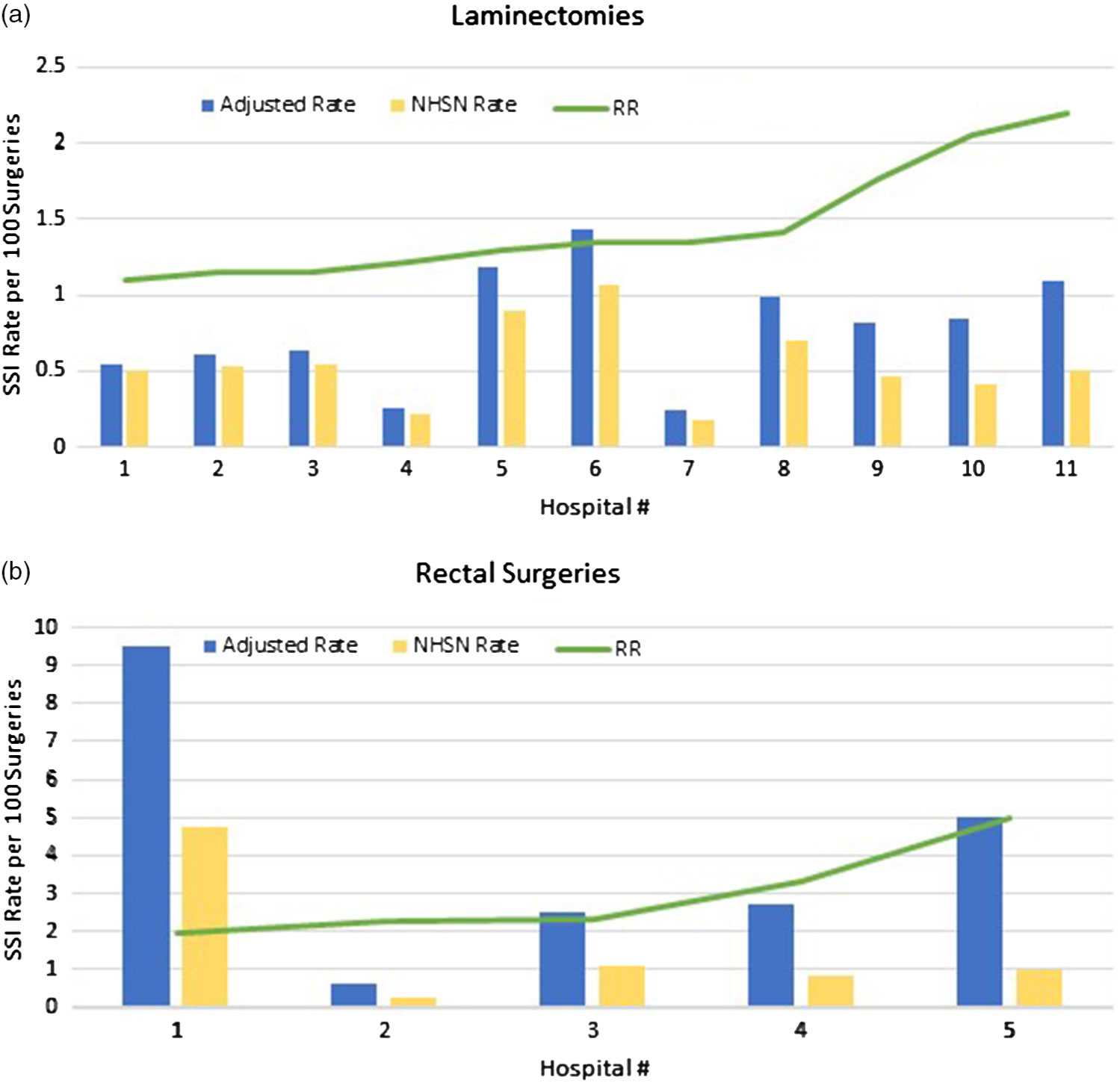
We reviewed surveillance data from 11 hospitals where 200 or more primary spinal fusions were performed and 5 hospitals where 200 or more primary colon surgeries were performed during the 3-year study period. Infection preventionists identified 87 SSIs associated with 17,247 (NHSN SSI rate: 0.50 infections per 100 procedures) laminectomies and 7 SSIs associated with 740 rectal procedures (NHSI SSI rate, 0.95 infections per 100 procedures). Laminectomy was the primary procedure in 12,015 cases (69.7%), whereas rectal surgery was the primary procedure performed in only 305 reported rectal procedures (41.2%). From these data, we calculated the change in SSI rates comparing the adjusted SSI rate to the NHSN SSI rate. The NHSN SSI rate and adjusted SSI rate for laminectomies were 0.50 and 0.72, respectively, which represents a 30.6% increase. The NHSN SSI rate and adjusted SSI rate for rectal surgeries was 0.95 and 2.30, which represents a 58.7% increase. The impact of the change in denominator on SSI rate varied by individual hospital (Fig. 1).
Hospital-specific surgical site infecton (SSI) rates comparing adjusted versus the National Health Safety Network (NHSN) denominators for (a) laminectomies and (b) rectal surgeries. Note. SSIs, surgical site infections; RR, rate ratio.

Discussion
This analysis confirms that the current NHSN method of calculating SSI rates underestimates the SSI rate of procedures, such as laminectomies and rectal surgeries, which are commonly performed alongside higher-ranking procedures. Surveillance for SSIs is an important function of infection prevention programs and routine feedback of comparative SSI rate data to surgeons reduces SSI.Reference Berrios-Torres, Umscheid and Bratzler2 – Reference Haley, Culver and White4 Comparative SSI rate data must be accurate and meaningful to surgeons. We believe that including only primary procedures in SSI denominators yields SSI rates that are more clinically valid than the current NHSN metrics.
In April 2019, the NHSN announced that it is considering a requirement for hospitals to report ICD-10 or CPT codes when reporting SSI denominators. Requiring ICD-10 or CPT codes when reporting SSI data may pave the way for NHSN to further risk-adjust SSI rates based on specific procedure(s) performed. We recommend that the NHSN consider revising their current method for counting SSI denominators by including only primary surgical procedures in denominators when calculating SSI rates and SIRs.
Acknowledgments
None.
Financial support
No financial support was provided relevant to this article.
Conflicts of interest
All authors report no conflicts of interest relevant to this article.