Introduction
Sapotaceae is a pantropical woody family of about 1250 species (Govaerts et al., Reference Govaerts, Frodin and Pennington2001). Typically, species of Sapotaceae are trees or shrubs, although one species, Donella welwitschii (Engl.) Pierre ex Engl., is a liana or a scandent shrub. The family was most recently monographed at generic level by Pennington (Reference Pennington1991). In 2005, Swenson and Anderberg proposed a three-subfamily infrastructure of Chrysophylloideae, Sapotoideae and Sarcospermatoideae, which has been widely accepted.
Subfamily Chrysophylloideae includes Chrysophyllum and Pouteria, which, as delimited by Pennington (Reference Pennington1991), are two of the largest genera in the Sapotaceae, containing c.80 and c.300 species, respectively (Govaerts et al., Reference Govaerts, Frodin and Pennington2001). Several studies have indicated, however, that in their current circumscription neither Chrysophyllum nor Pouteria is monophyletic (Bartish et al., Reference Bartish, Swenson, Munzinger and Anderberg2005; Swenson & Anderberg, Reference Swenson and Anderberg2005; Triono et al., Reference Triono, Brown, West and Crisp2007, Swenson et al., Reference Swenson, Richardson and Bartish2008; Bartish et al., Reference Bartish, Antonelli, Richardson and Swenson2011).
The key floral character on which Pennington (Reference Pennington1991) based his delimitation of Chrysophyllum was an absence of staminodes. In doing so, he created a broadly circumscribed genus combining species that had previously been recognised in several separate genera (Aubréville, Reference Aubréville1961; Baehni, Reference Baehni1965). Variation within Pennington's newly defined Chrysophyllum sensu lato was divided among six generic sections, of which four, sects Chrysophyllum, Prieurella, Ragala and Villocuspis, were composed exclusively of New World species. The Old World species were classified either in the amphi-Atlantic sect. Aneuchrysophyllum or the strictly palaeotropical sect. Donella. Molecular-based studies, however, support neither the monophyly of Chrysophyllum sensu lato nor the monophyly of sect. Aneuchrysophyllum or sect. Donella (Swenson et al., Reference Swenson, Richardson and Bartish2008; Bartish et al., Reference Bartish, Antonelli, Richardson and Swenson2011). The five (of 30) Old World species sampled from Chrysophyllum sensu lato were placed on one of two lineages, whereas species of sect. Chrysophyllum, including C. cainito L., the type of the genus, were placed on a third lineage (Swenson et al., Reference Swenson, Richardson and Bartish2008; Bartish et al., Reference Bartish, Antonelli, Richardson and Swenson2011). When sampling was increased to two-thirds of all known Afro-Malagasy species, two strongly supported Old World clades were again recovered (Mackinder et al., unpublished data). Only one Old World species, Chrysophyllum azaguieanum Miege from Upper Guinea, was not accommodated within the two Old World clades. Instead, it was placed on a separate lineage strongly supported as sister to the tropical African genus Delpydora. Chrysophyllum azaguieanum represents an undescribed genus (Mackinder et al., in preparation).
The two Old World lineages, as recovered in the phylogenetic analyses (Swenson et al., Reference Swenson, Richardson and Bartish2008; Bartish et al., Reference Bartish, Antonelli, Richardson and Swenson2011; Mackinder et al., unpublished data) broadly correspond to two genera, Gambeya Pierre and Donella Pierre ex Baill., recognised by Aubréville (Reference Aubréville1961, Reference Aubréville1964). The absence of staminodes in Chrysophylloideae is a plesiomorphic state that has been lost independently multiple times within the subfamily, so is not a character on which a monophyletic genus should be based (Swenson et al., Reference Swenson, Richardson and Bartish2008). Because we aim to delimit genera that as far as possible represent natural groups, we propose returning to an essentially Aubrévillean classification of the Old World species currently accommodated within the heterogeneous assemblage of Chrysophyllum sensu lato. Circumscription of Gambeya remains as described by Aubréville (Reference Aubréville1961). However, the molecular studies strongly support the inclusion of Austrogambeya Aubrév. & Pellegr., a southern African/Malagasy small genus of two species, in Donella (Swenson et al., Reference Swenson, Richardson and Bartish2008; Bartish et al., Reference Bartish, Antonelli, Richardson and Swenson2011; Mackinder et al., unpublished data). Hence, for the first time, we expand the circumscription of Donella to include Austrogambeya. Aubréville (Reference Aubréville1961) used leaf venation patterns to distinguish Gambeya from Donella, and our proposed amendment to his circumscription of Donella continues to allow the separation of Gambeya from Donella using venation pattern. Donella species have brochidodromous venation, often with numerous secondary veins, 1.5–3(5) mm apart, which usually run more or less straight across the leaf lamina, finally looping to join each other, often forming a submarginal vein. Between the secondary veins lie parallel intersecondary veins, which may be simple or compound. In some cases, for example, Donella analalavensis Aubrév., these intersecondary veins are closely packed and scarcely distinguishable from the secondary veins. In other cases, the secondary and intersecondary veins are not closely packed, and the intersecondary veins are more delicate and may be of similar length or much shorter than the secondary veins, for example in Donella ogoouensis (A.Chev.) Aubrév. & Pellegr. Tertiary venation, when present, is random reticulate. Gambeya species have eucamptodromous venation with prominent secondary veins below that are clearly spaced, c.1 cm apart. Intersecondary veins do not occur in Gambeya, and the tertiary venation, which is indistinct to the naked eye, is more or less percurrent, approximately at right angles to the secondary veins. Certain features of wood anatomy, such as the arrangement of pores and of the parenchyma, as well as the presence or absence of calcium oxalate crystals and silica particles, were noted by Aubréville (Reference Aubréville1961) as differences between Donella wood and Gambeya wood. In a family-wide study of African Sapotaceae species, Bokdam (Reference Bokdam1977) also demonstrated differences in seedling types between the two genera. In Donella, which he categorised as type A2 seedlings based on D. ogoouensis, D. pruniformis (Pierre ex Engl.) Aubrév. & Pellegr. D. ubanguiensis (De Wild.) Aubrév. and D. welwitschii (Engl.) Pierre ex Engl., cotyledons are enlarged, coriaceous and function as storage organs. Eophyll nervation includes a submarginal vein. In Gambeya, seedling type is apparently more heterogenous, falling into categories A1 and B2 (Bokdam, Reference Bokdam1977) but always differing from that of Donella. Species of seedling type A1, represented by Gambeya beguei (Aubrév. & Pellegr.) Aubrév. & Pellegr, G. boukokensis Aubrév. & Pellegr., G. lacourtiana (De Wild.) Aubrév. & Pellegr., G. perpulchra (Mildbr. ex Hutch. & Dalziel) Aubrév. & Pellegr. and G. subnuda Pierre, have enlarged, papery cotyledons, of which storage is not a primary function. Eophylls in these species lack a submarginal vein. Bokdam's seedling type B2, which includes Gambeya azaguieanum, G. gigantea (A.Chev.) Aubrev. & Pellegr. and G. murense (Engl.) Liben, has small, fleshy cotyledons that are enclosed within the testa (not free, as in types A1 and A2). Eophylls in these species also lack a submarginal vein. We know now that Gambeya azaguieanum is misplaced in Gambeya (Mackinder et al., unpublished data).
In this paper, we provide a synoptical revision of the 17 species that belong to Donella, 10 of which are endemic to Madagascar, six are endemic to tropical Africa and one, D. lanceolata, which occurs in eastern Madagascar, is also widespread through tropical and subtropical Asia, extending east to the Solomon Islands and south to Queensland. Here, for the first time, we describe two new species, Donella ranirisonii and D. humbertii, both from Madagascar. We consider Donella ranirisonii to resemble D. delphinensis Aubrev. most closely, in terms of both habit and general morphology, and D. humbertii to be closest in morphology to D. perrieri Lecomte. However, no molecular data are available yet for these proposed taxa.
Because infrageneric relationships in Donella are not well known, the species are grouped regionally (Madagascar, then tropical Africa) and then presented alphabetically within each region. Not treated here are 14 Old World species, 13 from tropical Africa and one from Madagascar, which were placed in the amphi-Atlantic assemblage of Chrysophyllum sect. Aneuchrysophyllum by Pennington (Reference Pennington1991). We propose that they once again be recognised in a reinstated Gambeya. The relevant African species are Gambeya africana Pierre (type of Gambeya), G. beguei, G. boukokoensis, G. gigantea, G. gorungosana (Engl.) Liben, G. korupensis Ewango & Kenfack, G. lacourtiana, G. lungi (De Wild.) Aubrév. & Pellegr., G. murense, G. perpulchra, G. prunifolia (Baker) Aubrév. & Pellegr., G. subnuda, G. taiensis (Aubrév. & Pellegr.) Aubrév. & Pellegr. The sole Malagasy species is Gambeya boiviniana Pierre.
Other species of Chrysophyllum sensu lato are sometimes found cultivated within the geographical range of the genus Donella. For example, Chrysophyllum cainito L. (type of the genus), native to the Neotropics (Peterson et al., Reference Peterson, Parker and Potter2012), is cultivated in many parts of the Old World within the natural range of Donella. Unlike Donella species, the lower surface of the leaves of Chrysophyllum cainito is covered by a layer of golden brown silky trichomes, and plants bear large red or purple fruits containing up to 10 seeds. Another New World species, Chrysophyllum oliviforme L., a close relative of C. cainito, is also cultivated in some parts of the natural range of Donella lanceolata (Blume) Aubrév. Chrysophyllum oliviforme can be recognised by its small (up to 2 cm in length) single-seeded ovoid fruits.
Materials and Methods
In preparation for this taxonomic treatment, herbarium visits were made to BR, K, TEF and WAG, where loans of critical material were selected. Loans were also obtained from G and MO, and high-resolution digital images of specimens were viewed on the JSTOR Global Plants database (no date), the Vascular Plants section of the database of the Muséum National d'Histoire Naturelle (no date), the database of the National Herbarium of the Netherlands (no date) and Australia's Virtual Herbarium (no date). The types of all names cited below have been seen, unless otherwise stated, and all published Donella binomials and trinomials are accounted for here. Collections seen that have a collector name but lack a collector number are not included in the exsiccatae. Collector name and number details are cited in the exsiccatae exactly as they appear on the herbarium labels, for example, gatherings made by Capuron may be listed under Capuron, R. SF (collector number) or Service Forestier, Capuron (collector number), according to their original format. Morphological terms follow Beentje (Reference Beentje2010), except for venation terms, which follow Hickey (Reference Hickey, Metcalf and Chalk1979) and the Leaf Architecture Working Group (1999). Measurements reported in descriptions were made on herbarium specimens, unless otherwise stated. Values reported for tree height ranges are rounded to the nearest 5 m and for diameter at breast height (dbh) are rounded to the nearest 5 cm. Values reported in elevation ranges have been rounded to the nearest 10 m. Preliminary conservation assessments follow the categories and criteria of the IUCN (2001). Estimates of the extent of occurrence (EOO) and area of occupancy (AOO) of each species were made with GeoCat (Bachman et al., Reference Bachman, Moat, Hill, de la Torre and Scott2011), using a 2 × 2 km grid. Distribution maps are based on occurrence data derived from herbarium specimen collection localities, and shading is used to represent elevation.
Systematic Treatment
Donella Pierre ex Baill., Hist. Pl. 11: 294 (1892). – Aubréville, Notul. Syst. (Paris) 16: 246 (1960). – Fl. Gabon 1:139–136 (1961). – Fl. Cameroun 2: 119–125 (1964). – Fl. Cambodge, Laos & Vietnam. 3: 64–67 (1968). – Fl. Madagasc. 164: 110–120 (1974). – Type: Donella lanceolata (Blume) Aubrév.
Chrysophyllum sect. Donella (Pierre ex Baill.) Engl., Monogr. Afrik. Pflanzen-Fam. 8: 41–42 (1904).
Austrogambeya Aubrév. & Pellegr., Adansonia, n.s. 1: 7 (1961).
Trees, occasionally shrubs, rarely a liana; white latex present. Stipules absent. Leaves more or less evenly spaced along the branch, ovate, elliptic; usually glabrous above, glabrous or hairy below; apex usually acuminate or acute, occasionally rounded, rarely truncate, base acute, cuneate or rounded, occasionally decurrent on the petiole. Venation brochidodromous, usually with a marginal vein. Secondary veins straight and parallel, intersecondary venation present, parallel to, and sometimes barely distinguishable from the secondary veins. Tertiary venation, if present, reticulate. Inflorescence a fascicle in the axil of current leaves or leaf scar. Flowers generally bisexual. Sepals 5, corolla small, gamopetalous, whitish, soon falling, lobes 5, ciliate, tube similar in length, slightly longer or slightly shorter than the lobes; stamens a single whorl of 10, inserted at or towards the base of the corolla tube and opposite the corolla lobes; filaments free, usually glabrous, rarely hairy; anthers often bearing an apical tuft of hairs; rudimentary staminodes occasionally present. Ovary subconical, surface glabrous but encircled in a ring of pilose hairs attached only at the base; style short, thick, glabrous. Functionally female flowers, those lacking stamens but containing a fully formed gynoecium, occasionally seen. Fruit (1–)3–5-seeded, subglobose to ellipsoid, glabrous, fleshy. Seed ellipsoid, strongly laterally compressed, with a hard, brown smooth testa; scar adaxial, rarely extending a little along the base (Donella bangweolensis (R.E.Fr.) Mackinder), usually linear.
Donella was first proposed by Pierre within a manuscript in which he presented several Sapotaceae genera as new to science. In 1891, his manuscript ‘Notes Botaniques: Sapotacées’ was published in part (pp. 1–68), but later pages exist only in proof stage, including page 73, where his description of Donella can be found.
We recognise 17 species in Donella. Eleven species occur in Madagascar, of which 10 are country endemics and one, Donella lanceolata (no. 8 in this treatment), is also widespread in tropical and subtropical Asia. Six further species are endemic to tropical Africa. We present two keys; Key I to the species of Madagascar and Key II to the species of tropical Africa. Donella perrieri and D. pruniformis are the most geographically widespread and morphologically variable species in Madagascar and tropical Africa, respectively. Consequently, they each appear twice in the relevant regional key to allow for their variation.
I. Key to the species of Donella in Madagascar, Asia, Australia, and the Indian and Pacific Ocean regions
-
1a. Petioles short, up to 7 mm 2
-
1b. Petioles longer, 9–20 mm 8
-
2a. Secondary and intersecondary veins so densely packed that reticulate tertiary venation is either completely absent or present only near the margins of the leaves, where the secondary veins are starting to diverge 3
-
2b. Secondary and intersecondary veins not so densely packed, reticulate tertiary venation visible between the secondary and intersecondary veins (use × 10 hand lens on lower surface) or (Donella ranirisonii) secondary and intersecondary veins barely distinguishable from each other occasionally bridged by tertiary venation 4
-
3a. Leaves ferruginous tomentose above and below when young, at maturity the indumentum persists along the midrib above and along the midrib and some or most of the lamina below, apex commonly truncate, occasionally retuse or emarginate 2. D. analalavensis
-
3b. Leaves glabrous above, completely glabrous below or puberulous on the midrib and margins, apex narrowing abruptly to a short acumen 4. D. delphinensis
-
4a. Leaves narrow, about 4–6 times longer than wide 10. D. ranirisonii
-
4b. Leaves broader, only 2–3 times longer than wide 5
-
5a. Some or most leaves > 6 cm long; known from Madagascar, tropical and subtropical Asia, Queensland and the Solomon Islands 7. D. lanceolata
-
5b. All or most leaves < 6 cm long; known only from Madagascar 6
-
6a. Leaves obovate or narrowly obovate, the widest point in the upper third of the lamina 5. D. fenerivensis
-
6b. Leaves ovate, narrowly ovate, elliptic or oblong-elliptic, the widest point around the midpoint or in the lower half of the lamina 7
-
7a. Petioles 2–4 mm long, glabrous; in evergreen montane forest at 800–1000 m elevation 1. D. ambrensis
-
7b. Petioles 5–7 mm long, sparsely to densely hairy; in lowland woodland around 100(–300) m 7. D. humbertii
-
8a. Lower leaf surface densely ferruginous when young, with 8–10 very distinct, prominent robust secondary nerves below, between which are conspicuous intersecondary nerves and an interconnecting visible reticulate network of tertiary nerves 9. D. masoalensis
-
8b. Lower surface glabrous or almost so, secondary and tertiary nerves not as above 9
-
9a. Secondary and intersecondary venation closely packed and slightly raised on both surfaces, tertiary venation barely visible 10. D. perrieri
-
9b. Secondary, intersecondary and tertiary venation clearly distinguishable each from the others 10
-
10a. Secondary veins usually joining just before the leaf edge to form a marginal vein, intersecondary veins strong; leaves drying brown 10. D. perrieri
-
10b. Secondary veins not joining just before the leaf edge to form a marginal vein, intersecondary veins weak; leaves drying green or brown 11
-
11a. Leaves drying brown, widest part in the middle or lower third of the lamina 3. D. capuronii
-
11b. Leaves drying green, widest part in the upper third of the lamina 6. D. guereliana
II. Key to the species of Donella in Africa
-
1a. Lower leaf surface hairy 2
-
1b. Lower leaf surface glabrous or hairs, if present, restricted to the midvein 3
-
2a. Shrub or small tree to 10 m; leaves narrowly elliptic, elliptic or obovate; seed scar adaxial but also extending a little along the base of the seed; known from Angola, Zambia, Democratic Republic of the Congo and Tanzania 12. D. bangweolensis
-
2b. Tree 25–35 m; leaves ovate, elliptic or oblong-elliptic; seed scar adaxial; a more widespread tropical African species but not recorded from Angola, Zambia or Tanzania 14. D. pruniformis
-
3a. Liana or scandent shrub; fruit narrowly ovoid to ellipsoid 17. D. welwitschii
-
3b. Tree; fruit globose, subglobose or ellipsoid 4
-
4a. Leaves 4–6.7 cm wide; mature fruit c.5–7 cm in diameter, seeds c.5 cm long 15. D. ubanguiensis
-
4b. Leaves 1.3–3.7 cm wide; mature fruit 2–2.5 cm in diameter, seeds < 3 cm long 5
-
5a. Leaf apex emarginate, rounded, rarely acute; fruit ellipsoid, 3.2–4.5 cm long; known only from Gabon 13. D. ogoouensis
-
5b. Leaf apex acuminate, acumen 4–15 mm long; fruit subglobose or ellipsoid; from tropical Africa 6
-
6a. Leaf midrib on upper surface flat or prominent; apex tapering to a narrow acumen (6–)10–15 mm long; fruit subglobose or ellipsoid, 2–5.6 cm long; known from Sierra Leone to Uganda 14. D. pruniformis
-
6b. Leaf midrib on upper surface sunken or channelled, apex narrowing abruptly to a short blunt acumen 4–8 mm long; fruit subglobose, c.2.5 cm long; known from Kenya, Mozambique, Zimbabwe, Swaziland and South Africa 16. D. viridifolia
1. Donella ambrensis Aubrév., Fl. Madagasc. 164: 118 (1974). Chrysophyllum ambrense (Aubrév.) G.E.Schatz & L.Gaut., Novon, 6(4): 426 (1996). – Type: Madagascar, Antsiranana Centre (Nord): Montagne d'Ambre, Service Forestier 11277 (holo P (P00109341); iso TEF (TEF000606)). Fig. 1.
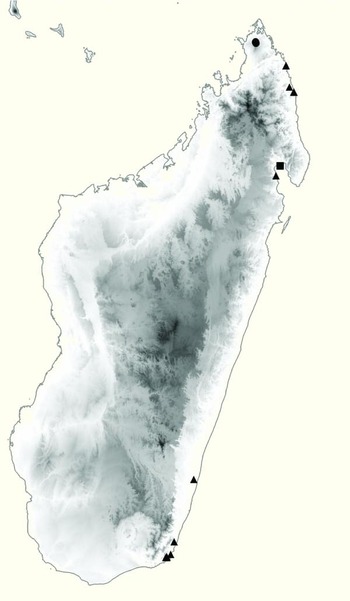
Distribution of Donella ambrensis Aubrév. (circle), D. capuronii (G.E.Schatz & L.Gaut.) L.Gaut. & Mackinder (square) and D. delphinensis Aubrév (triangles).

Tree to 25 m, dbh 35–60 cm. Petioles 2–4 mm long. Leaves ovate or elliptic, 2.2–4.9 × 1.3–2.5 cm, glabrous above and below; secondary and intersecondary veins visible, secondary veins joining just before the leaf edge to form a marginal vein, tertiary venation visible below (using × 10 hand lens); midrib on upper surface flat or prominent; apex acute or rounded but not acuminate, base acute. Flowers clustered in the axils of current leaves or at old nodes; pedicels slender, 3–4 mm long. Sepals imbricate, free, c.2 mm long, outside sparsely puberulous, margins ciliate towards the apex. Corolla white, c.1.25–1.5 mm long, lobes ciliate, similar in length to the tube, stamens inserted at the base of the tube, filaments glabrous, functionally female flowers also seen. Gynoecium c.1.5 mm long, ovary conical, surface glabrous, encircled by a sheath of dense pilose hairs attached at the base. Fruits subglobose, c.3 cm long, c.2.5 cm in diameter, slightly ribbed, glabrous, short-stalked, green at first, becoming yellow when ripe. Seeds not seen.
Habitat and ecology
Evergreen montane forest; 800–1000 m elevation.
Distribution
Endemic to Montagne d'Ambre, Madagascar.
Preliminary conservation assessment
Donella ambrensis is assessed here as Vulnerable (VU D2). The species does not qualify for a category of Threat under Criterion B, despite having an estimated EOO of only 0.980 km2, which falls within the limits for Critically Endangered (CR), and an estimated AOO of only 12 km2, which suggests an Endangered (EN) category might be appropriate. However, although the species is confined to Montagne d'Ambre, it occurs at high altitudes where there is little or no human activity, and no decline is expected, so we do not consider Criterion B to be applicable here. However, the lower altitudes area of Montagne d'Ambre National Park are not well protected, and given that the species has such a restricted AOO, future activity on the higher slopes could rapidly threaten the species.
Donella ambrensis was described by Aubréville (Reference Aubréville1974) from two fruiting collections at P only. A third gathering (Bernardi 12008), collected in 1967 and bearing flowers and fruits, was later located at G. Donella ambrensis has been collected only once more in 1994 (Leeuwenberg 14314). All four specimens were gathered at the type locality of Montagne d'Ambre, an isolated massif of evergreen montane forest within a seasonally dry environment.
2. Donella analalavensis Aubrév., Fl. Madagasc. 164: 117 (1974). Chrysophylum analalavense (Aubrév.) G.E.Schatz & L.Gaut., Novon, 6(4): 426 (1996). – Type: Madagascar, Mahajanga, environs d'Analalava, Perrier de la Bâthie 12309 (holo P (P00109345); iso P (P00109346)). Fig. 2.
Distribution of Donella analalavensis Aubrév.

Shrub or small tree 1–12 m tall, dbh 28–40 cm. Petioles 1–4 mm long. Leaves narrowly obovate, obovate or oblong-obovate, 2.8–6.3 × 1–3.1 cm, moderately ferruginous tomentose above when young, the tomentum persisting only along the midrib at maturity, ferruginous tomentose below, densely so when young, persisting along the midrib and some or most of the lamina below when mature; secondary and intersecondary veins fine, densely packed, secondary veins joining just before the leaf edge to form a marginal vein, tertiary venation more or less absent; midrib on upper surface flat or slightly channelled; apex commonly truncate, occasionally retuse or emarginate, base acute or cuneate. Flowers clustered in the axils of current leaves or at old nodes; pedicels slender 2–3 mm long. Sepals imbricate, free, 2–2.5 mm long, outside appressed golden pubescent, persisting in fruit. Corolla c.2 mm long, lobes ciliate, similar in length to the tube, stamens inserted at the base of the tube, filaments glabrous. Gynoecium c.2 mm long, ovary conical, surface glabrous, encircled by a sheath of dense pilose hairs attached at the base. Fruits ovoid, up to 1.8 cm long (immature), slightly ribbed, short-stalked, dense ferruginous tomentose mixed with a few longer golden hairs. Seeds 5.
Habitat and ecology
Inland seasonal forests; 50–610 m elevation.
Distribution
Endemic to the Western Domain of Madagascar (including its northern sector).
Preliminary conservation assessment
Donella analalavensis is assessed here as Near Threatened (NT) under the criteria of the IUCN (2001). The estimated EOO of 68,480 km2 falls within the Least Concern (LC) range, whereas the estimated AOO of 52 km2 is small enough to meet the requirements of Endangered (EN). However, we consider AOO likely to be underestimated, because there are several unexplored areas of suitable habitat within the EOO polygon. So at this point in time, we do not consider Donella analalavense to qualify for a category of threat under Criterion B. However, we expect, in the future, that uncontrolled forest fires and logging will lead to a decline in the extent and quality of habitat and a reduction in the number of mature individuals.
Species recognition
Donella analalavensis, similar in morphology to D. delphinensis, can be differentiated using leaf indumentum and apex shape characters (see key couplet 6). Service Forestier 24500 from Sahafary forest, north-east Madagascar, is placed here, although it is a somewhat atypical collection. The leaves, while bearing the ferruginous indumentum, are unusually narrow and spathulate in outline.
3. Donella capuronii (G.E.Schatz & L.Gaut.) Mackinder & L.Gaut. comb. nov. Chrysophyllum capuronii G.E.Schatz & L. Gaut. Novon, 6(4): 426, fig. 1 (1996). – Type: Madagascar, Toamasina, Nosy Mangabe Special Reserve, Bay of Antongil, 5 km S of Maroantsetra, Schatz & Miller 2555 (holo MO (MO277019); iso K, P (P00417607), PRE, TAN (TAN000696). Fig. 1.
Tree to 30 m, dbh not recorded. Petioles 9–16 mm long. Leaves narrowly elliptic to narrowly oblong, 7–14.5(–20.5) × 2.5–4.5(–6.5) cm, glabrous above and below; secondary veins looping before the margin but not joining just before the leaf edge to form a marginal vein, intersecondary veins visible, weak, tertiary venation visible, reticulate; midrib on upper surface flat or slightly sunken towards the petiole; apex acuminate, acumen blunt, up to 3 cm long, base acute or rounded. Flowers unknown. Fruits globose, 3.5–4.5 cm in diameter, short-stalked, glabrous, greenish yellow when ripe. Seeds c.2 cm long, c.1.4 cm wide, c.0.7 cm thick, light brown, shiny.
Habitat and ecology
Tree of evergreen forest on basalt; 30–310 m elevation.
Distribution
Narrow endemic of the Masoala region, on the island of Nosy Mangabe, Madagascar.
Preliminary conservation assessment
Donella capuronii is assessed here as Near Threatened (NT) under the criteria of the IUCN (2001). A sterile paratype of Donella capuronii, Service Forestier 27738bis from the mainland at Ambanitazana, has been excluded from the conservation analysis because of doubts over its identification. The species is therefore known from only three localities in three adjacent 4 km2 cells on the Island of Nosy Mangabe, giving an estimated EOO of only 0.641 km2, thus comfortably meeting the area requirements for Critically Endangered (CR). The estimated AOO, at 12 km2, meets the requirements for the category of Endangered (EN). However, the single population occurs within the Nosy Mangabe Special Reserve, a small island of c.5 km2 situated in the Antongil Bay, and an effective protected area. Although not currently threatened, any change to the protected status of this island could rapidly lead to the extinction of this narrow endemic species.
Species recognition
Donella capuronii differs from D. perrieri in having a very long (> 1 cm), narrow and blunt acumen, and also in the secondary veins, which are clearly distinct from tertiaries. Based on morphology, Donella capuronii is clearly related to D. perrieri but is too extreme to fall in its range of variation.
4. Donella delphinensis Aubrév., Fl. Madagasc. 164: 120 (1974). Chrysophyllum delphinense (Aubrév) G.E.Schatz & L.Gaut., Novon, 6(4): 428 (1996). – Type: Madagascar, Toliara, Service Forestier 7850 (holo P (P00109338); iso P (P00109339, P00109340)). Fig. 1.
Tree 8–22 m, dbh 20–30 cm. Petioles 3–5 mm long. Leaves obovate or narrowly obovate, 3.5–5.3 × 1.9–3.8 cm, glabrous above, completely glabrous below or puberulous on the midrib and on areas of the lamina adjacent to the midrib; secondary and intersecondary veins conspicuous, densely packed, secondary veins joining just before the leaf edge to form a marginal vein, tertiary venation more or less absent; midrib on upper surface flat or prominent; apex rounded or narrowing abruptly to short blunt acumen up to 5 mm long, base acute or cuneate. Flowers clustered in the axils of current leaves or at old nodes; pedicels slender 2–3 mm long. Sepals imbricate, free, c.2 mm long, outside appressed golden pubescent, margins ciliate near the apex. Corolla white or pale green, c.2 mm long, lobes ciliate, similar in length to the tube, stamens inserted at the base of the tube, filaments densely pilose. Gynoecium c.2 mm long, ovary conical, surface glabrous, encircled by a sheath of dense pilose hairs attached at the base. Fruits ovoid, 2.1–3.6 cm long, 1.1–2.5 cm in diameter, slightly to strongly ribbed, glabrous, green at first, becoming yellow when ripe, short-stalked, beak 5–10 mm long. Seeds c.2 cm long, c.1.2 cm wide, c.0.5 cm thick, medium brown, shiny; scar adaxial.
Habitat and ecology
Littoral forests; up to 240 m elevation.
Distribution
Endemic to the eastern coast of Madagascar.
Preliminary conservation assessment
Donella delphinensis is assessed here as Vulnerable, VU [B2ab(iii,v)] under the criteria of the IUCN (2001). The estimated EOO, at 37,048 km2, falls within the Near Threatened (NT) range, but the estimated AOO is only 44 km2, small enough to meet the requirements for a category of Endangered (EN). We propose a category of VU because this is a species of the heavily degraded and fragmented eastern littoral forests, where there is and continues to be a decline in the extent and quality of habitat and a reduction in the number of mature individuals.
Species recognition
Donella delphinensis is a small to medium-sized tree, morphologically similar to D. analalavensis, but can be differentiated using leaf indumentum and apex shape characters (see key couplet 6). The geographical ranges of the two species overlap in a small area in the north-east.
Donella delphinensis was first described by Aubréville (Reference Aubréville1974) from a single fruiting specimen, and flowers were not gathered until 2002 (several collectors). Fruits of D. delphinensis are typically ovoid, but one collection, Rabevohitra 4163 from Farafangana, has subglobose fruits. However, until more fruiting material is available and the range of variation in this character can be reassessed, and because the specimen is otherwise a good match for D. delphinensis, we have included it here for now.
5. Donella fenerivensis Aubrév., Fl. Madagasc. 164: 116 (1974). Chrysophyllum fenerivense (Aubrév) G.E.Schatz & L.Gaut., Novon, 6(4): 426 (1996). – Type: Madagascar, Toamasina, Tampolo, Service Forestier 13072 (holo P (P00109348); iso P (P00109349), TEF (TEF000610)). Fig. 3.
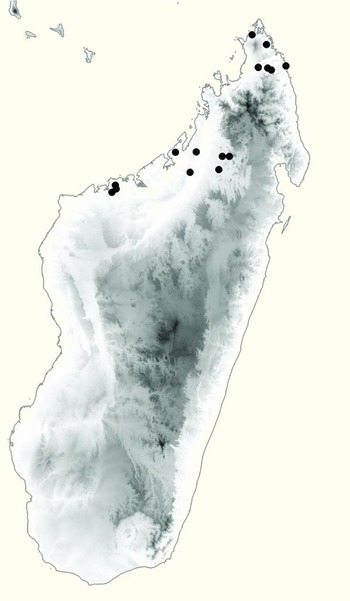
Distribution of Donella fenerivensis Aubrév. (circles), D. guereliana (Aubrév.) Mackinder (squares) and D. humbertii L. Gaut. & Mackinder (triangles).

Tree to 15 m, 15–20 cm dbh measured on a 10 m tree. Petioles 4–7 mm long. Leaves narrowly obovate to obovate, 2.8–6.7 × 1.3–2.9 cm, sparse scattered pubescent appressed puberulous along the midrib above, sparse to moderately appressed puberulous below; secondary and intersecondary veins conspicuous, not very densely packed, secondary veins joining just before the leaf edge to form a marginal vein, reticulate tertiary venation visible below (using a × 10 hand lens); midrib on upper surface flat, prominent or slightly channelled; apex truncate, obtuse or acute, occasionally narrowing abruptly to a short acumen or emarginate, base acute or cuneate, decurrent on the petiole. Flowers 1–3 in the axils of current leaves; pedicels slender 2–3 mm long. Sepals imbricate, free, c.2 mm long, outside appressed golden pubescent, margins ciliate near the apex. Corolla white or pale green, c.2 mm long, lobes ciliate, similar in length to the tube, stamens inserted at the base of the tube, filaments glabrous. Gynoecium c.2 mm long, ovary conical, surface glabrous, encircled by a sheath of dense pilose hairs attached at the base. Fruits subglobose, 2.6–3.5 cm long, 2.5–3 cm in diameter or ovoid, c.2.6 cm long (Capuron SF 28889), slightly ribbed, short-stalked, glabrous, green at first, becoming greenish yellow when ripe. Seeds 4 or 5.
Habitat and ecology
Littoral and sublittoral evergreen forests; up to 150 m elevation.
Distribution
Restricted range endemic, from Antongil and south to Ambila-Lemaitso, Madagascar.
Preliminary conservation assessment
Donella fenerivensis is assessed here as Endangered, EN [B2ab(iii,v)] under the criteria of the IUCN (2001). The estimated EOO of 18,135 km2 falls within the Vulnerable (VU) category, but the estimated AOO of only 36 km2 is small enough to meet the requirements for the category of Endangered (EN). Donella fenerivensis is a primary forest species now mainly found in heavily degraded and fragmented forest where there is continuing decline in the extent and quality of suitable habitat, number of locations and number of mature individuals.
Species recognition
Donella fenerivensis has sometimes been confused with D. analalavensis or D. delphinensis, but the secondary and intersecondary venation of D. fenerivensis is neither as crowded, prominent, nor as ascendant as in the other two species. Also, the fruits of D. fenerivensis are subglobose, not ovoid, as is typical in D. analalavensis and D. delphinensis.
6. Donella guereliana (Aubrév.) Mackinder comb. nov. Austrogambeya guereliana Aubrév., Fl. Madagasc. 164: 122 (1974). Chrysophyllum guerelianum (Aubrév.) G.E.Schatz & L.Gaut., Novon, 6(4): 428 (1996). – Type: Madagascar, Antsiranana, Ouest, Montagne des Français, Service Forestier 12794 (holo P (P00109335); iso P (P00109336, P00109337), TEF (TEF000609)). Fig. 3.
Shrub or tree to 20 m, dbh up to 45 cm. Petioles 9–12 mm long. Leaves oblanceolate, 4.8–9.8 × 1.7–3.4 cm, glabrous above and below; secondary and intersecondary veins fine, prominent, secondary veins not joining just before the leaf edge to form a marginal vein, tertiary venation reticulate, visible below; midrib on upper surface prominent; apex acute or short acuminate, acumen to 7 mm long, base cuneate, decurrent. Flowers borne singly or in clusters along the previous year's growth; pedicels slender, 3–5 mm long. Sepals imbricate, free, c.2 mm long, outside puberulous, margins ciliate towards the apex. Corolla white, 2–3 mm long, lobes ciliate, slightly shorter than the tube, stamens inserted at the base of the tube, filaments glabrous. Gynoecium c.2 mm long, ovary conical, surface glabrous, encircled by a sheath of dense pilose hairs attached at the base. Fruits subglobose, c.2 cm in diameter, slightly ribbed, glabrous, short-stalked, green.
Habitat and ecology
Lowland deciduous forest on limestone; 0–500 m elevation.
Distribution
Endemic to Madagascar, Western Domain, where it is mainly found in the northern sector, but also recorded from Bemaraha in the west.
Preliminary conservation assessment
Donella guereliana is assessed here as Endangered, EN [B2ab(iii,v)] under the criteria of the IUCN (2001). One collection, Service Forestier 24854bis, has been excluded from this conservation assessment because it was gathered at an imprecise locality. Although the estimated EOO, at 41,381 km2, falls within the Near Threatened (NT) category, the estimated AOO, at 28 km2, meet the requirements for a category of Endangered (EN). Donella guereliana is known from only four subpopulations, at two of which the extent and/or quality of habitat is in decline. Montagne des Français (the northernmost locality) is a protected area, but because of the vicinity of Antsiranana, logging and charcoal production are major risks. The north-easterly population at, and in the vicinity of, Lac Sahaka is now part of the Loky-Manambato protected area but is at risk from fire. However, decline is neither observed nor projected at Ankarana Tsingy, the third northerly subpopulation, or at the more distant south-western subpopulation of Tsingy du Bemaraha. Both those subpopulations occur in landscapes of limestone pinnacles that are unsuitable for agriculture and represent a natural barrier against fires. We consider the low value of AOO obtained from our data objectively to reflect the rarity of suitable environments and thus the rarity of the species.
7. Donella humbertii Capuron ex Mackinder & L.Gaut. sp. nov. resembles Donella perrieri Lecomte but differs in having slender and shorter petioles, 5–7 mm (not 10–20 mm) long and generally narrower leaves 1.6–2.8 cm (not 2.1–6.9 cm) wide, pedicels slender and shorter 2–3 mm (not 4–7 mm) long and seed scar elliptic or narrowly elliptic (not linear). – Type: Madagascar, Vallée du Menavava, fl. xii. 1905, Perrier de la Bâthie 8783 (holo P (P00752279); iso P (P00752278). Figs 3 , 4.
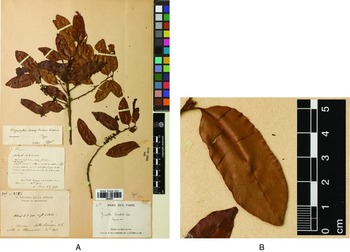
Donella humbertii L. Gaut. & Mackinder sp. nov. A, Holotype P00752279. B, Close-up of the leaves of isotype P00752278 to show venation above and below (Perrier de la Bâthie 8783).

Shrub or tree 2–13 m, dbh 25–30 cm measured on trees of 13 m and 10 m, respectively, bark rough. Petioles 5–7 mm long, ferruginous tomentose, later becoming glabrous or almost so. Leaves ovate, narrowly ovate or oblong-elliptic, 4.1–7.2 × 1.6–2.8 cm, glabrous above and glabrous to sparsely appressed or spreading puberulous below except for the ferruginous tomentose indumentum on the petiole (when flowering), becoming glabrous with age, ferruginous tomentose indumentum when present sometimes extends to the basal part of the midvein on both surfaces for up to 1.5 cm; secondary and intersecondary veins conspicuous and prominent above and below, not very densely packed, secondary veins 1.8–2.8 mm apart, measured midway along the midvein, joining just before the leaf edge to form a marginal vein, intersecondary veins 0.4–1.2 mm apart, tertiary venation reticulate, visible above and below (using a × 10 hand lens); midrib on upper surface flat or prominent; apex acute, sometimes with a blunt tip, base cuneate, asymmetrical, not decurrent on the petiole. Flowers 3–6 in the axils of current leaves; pedicels slender 2–3 mm long, appressed or spreading, sparsely to moderately ferruginous pubescent. Sepals imbricate, free, 2–2.5 mm long, the two exterior sepals only 2 mm long, slightly shorter than the others, outside appressed golden pubescent, inside glabrous, margins ciliate near the apex. Corolla c.3 mm long, lobes ciliate, c.1.25 mm long, shorter than the tube, stamens inserted towards the base of the tube, 2–4 staminodes present, either c.0.5 mm long, subulate or c.2 mm long, triangular, inserted between the corolla lobes, anthers extrorse, sagittate, filaments 1.25 mm long, glabrous or sparsely pilose, the connective not extended into a mucro. Gynoecium c.2 mm long, ovary conical, surface glabrous, encircled by a sheath of dense pilose hairs, c.1.25 mm long, attached at the base, ovary 5-celled, one ovule per cell. Fruiting pedicel 5–7 mm long, c.2.5 mm in diameter. Fruits ellipsoid or ovoid, 2.9–3.5 cm long, 2–2.8 cm in diameter, slightly-ribbed, glabrous, beak up to 3 mm long, pale brown when ripe. Seeds up to 5, laterally compressed, 21–24 × 12–15 mm, 8–10 mm thick, shining, light brown, wide, scar adaxial, elliptic to narrowly elliptic 17–19 × 5–8 mm. Fruit measurements taken from Service Forestier 12538 (P04596207, P04596208, P04596209).
Habitat and ecology
Woodland on sandy soil or clay; about 100–200 m elevation.
Distribution
Western Madagascar; Boeny and Melaky regions.
Local uses
The wood is used locally for crates (Service Forestier 12538).
Preliminary conservation assessment
Donella humbertii is assessed here as Data Deficient (DD) under the criteria of the IUCN (2001). This species is known from three collections, two of which, Perrier de la Bâthie 8783 and Service Forestier 12538, are from the Boeny region of Madagascar and were made about 110 and 60 years ago, respectively, neither with a precise locality. A third collection, Letsara et al. 892, was gathered in 2009 at Mahajanga in the Melaky region. The Boeny and Melaky regions fall in a part of Madagascar that is widely undercollected, where more botanical exploration is needed to understand the current distribution of this taxon before an informed assessment can be made.
Species recognition
Donella humbertii can be recognised by the combination of short slender petioles (5–7 mm long), densely ferruginous flowering pedicels, clearly visible tertiary venation and seeds with an elliptic to narrowly elliptic (not linear) scar. A pencilled note on the isotype (P00752278) reports the presence of five staminodes in the flowers or only two or three staminodes in some flowers. Having dissected several flowers (Perrier de la Bâthie 8783), we confirm the presence of two to four staminodes inserted singly in the sinuses of the corolla lobes or just below. Although we did not encounter a flower with five staminodes, two distinct staminode morphologies were seen. The description above was primarily prepared from Perrier de la Bâthie 8783 (P) and Service Forestier 12538 (P) on loan at E. The habit and habitat data from Letsara et al. 892 (P), examined as a digital image only, were incorporated in the description.
8. Donella lanceolata (Blume) Aubrév., Fl. Cambodge, Laos & Vietnam 3: 64 (1963). Nycterisition lanceolatum Blume, Bijdr. Fl. Ned. Ind. 676 (1826). Chrysophyllum lanceolatum (Blume) A.DC. Prodromus. [A. P. de Candolle] 8: 162 (1844). nom. illeg. – Type: Java, Blume 775 (Lecto L (L0006133), designated by Vink (Reference Vink1958); isolecto BRI (BRI-AQ0022555)). Fig. 5.
Distribution of Donella lanceolata (Blume) Aubrév.

Chrysophyllum roxburghii G.Don, Gen. Hist. 4: 33 (1838). Chrysophyllum acuminatum Roxb., Fl. Ind. 2: 345, t. 2041 (1824). nom. illeg. Donella roxburghii (G.Don) Pierre ex Lecomte var. tonkinensis Lecomte, Fl. Indo-Chine 3: 897 (1930). – Type: India, Roxburgh 2041 [icon], in Fl. Ind. (1824, emend 1832).
Chrysophyllum bancanum Miq., Fl. Ned. Ind., Eerste Bijv. 579 (1861). – Type: Indonesia, Sumatra, Bangka Belitung Is., Jeboes Banca, Teijsmann s.n. (lecto L (L0006130), designated here, isolecto P).
Chrysophyllum sumatranum Miq., Fl. Ned. Ind., Eerste Bijv.:579 (1861). – Type: Indonesia, Sumatra, Sumatera Utara, Battang Baroes, de Vriese & Teijsmann 973 (lecto L, designated here).
Chrysophyllum pentagonum Hance, J. Bot. 20: 78 (1882). – Type: China: Hong Kong, Ford s.n. (lecto K (K000792283), designated here).
Chrysophyllum dioicum Koord. & Valeton, Meded. Lands Plantentuin 11: 131 (1894). – Type: Indonesia, Java, Kooders 1734 (lecto L, designated here).
Donella roxburghii (G.Don) Pierre ex Lecomte var. tonkinensis Lecomte, Fl. Indo-Chine 3: 897 (1930). – Type: Vietnam, Tonkin: Forêts du Mont Bavi. Balansa 4339 (lecto P (P00649276) designated here; isolecto P (P00649275)).
Chrysophyllum roxburghii G.Don var. papuanum C.T.White, J. Arnold Arbor. 31: 105 (1950). – Type: New Guinea, Lae, Dadswell, Smith & White NGF1545 (lecto BRI, designated here).
Chrysophyllum lanceolatum A.DC. var. stellatocarpon P.Royen, Blumea 9: 32 (1958). – Type: Indonesia, Sumatra, Sumatera Selatan, Palembang, Banjoeasin and Koeboe-area near Bajoen, Thorenaar T744 (holo L).
Donella lanceolata (Blume) Aubrév. var. malagassica Aubrév. – Fl. Madagasc. 164: 117. (1974). – Type: Madagascar, Environs de la Baie d'Antongil, Bassin de la Fananehana, Service Forestier Capuron 8954 (holo P (P00109350); iso K(K000430609), MO (MO-2071243), P (P00109351 & P00109352), TEF (TEF000608)).
Tree, commonly medium to large (6–)15–40 m, dbh 20–80 cm. Petioles 4–7 mm long. Leaves narrowly ovate, narrowly elliptic, elliptic or oblong-elliptic, 3.2–14 × 1.2–4.8 cm, glabrous above, glabrous below except for a pale to ferruginous, commonly appressed tomentum along the midrib; secondary and intersecondary veins conspicuous but not densely packed, secondary veins joining just before the leaf edge to form a marginal vein, tertiary reticulate venation visible; midrib on upper surface flat or prominent; apex tapering gently or narrowing abruptly to an acumen 8–15 mm long, base cuneate or rounded, asymmetrical or not. Flowers clustered in the axils of current leaves or at old nodes; pedicels slender 3–5 mm long. Sepals imbricate, free, c.2 mm long, outside sparse appressed pubescent. Corolla white or pale green, c.2 mm long, lobes ciliate, similar in length to the tube, stamens inserted at the base of the tube, filaments glabrous. Gynoecium c.2 mm long, ovary conical, surface glabrous, encircled by a sheath of dense pilose hairs attached at the base. Fruits globose, 2.3–3.5 cm in diameter, or ellipsoid c.3 cm long, 2.2 cm diameter at widest part, slightly ribbed, glabrous, short-stalked, green at first, becoming yellow when ripe. Seeds 5, scar adaxial.
Habitat and ecology
In primary and secondary forest, often along river banks or streams and on slopes; in submontane forest (Madagascar); cloud forest (Vietnam) or mixed dipterocarp forest (Sarawak), 0–1600 m elevation. Reported as very common in the lowland forests of New Guinea (White, Reference White1950).
Distribution
Madagascar, widespread in tropical and subtropical Asia, extending south to Queensland and east to the Solomon Islands.
Preliminary conservation assessment
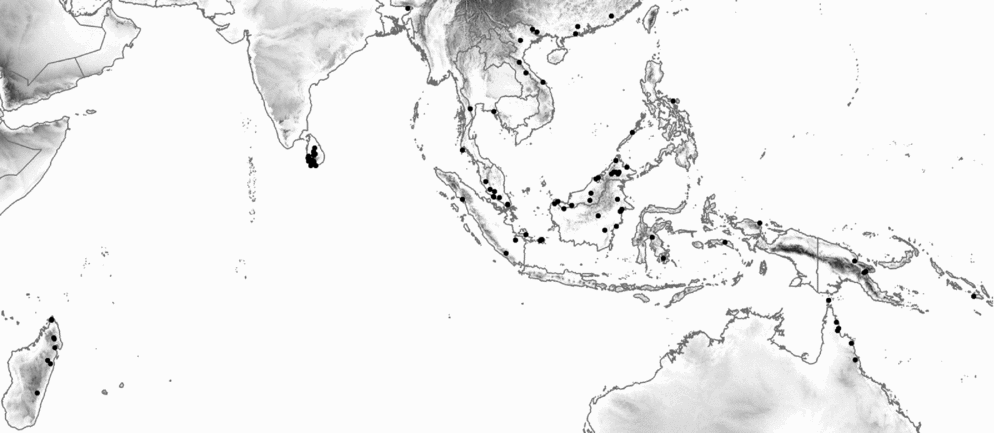
Donella lanceolata is assessed here as Least Concern (LC) under the criteria of the IUCN (2001). The estimated EOO of this species is very large, at > 4 million km2, although the estimated AOO is only 360 km2, which falls within the Endangered (EN) range. However, the estimated AOO is likely to be significantly underestimated, because many areas where we expect this species to occur are poorly collected, especially, Borneo, Sumatra, Sulawesi, the Philippines and Papua New Guinea.
Several regional taxonomic accounts of Sapotaceae have recognised local variation in this, the most geographically widespread species of Donella as a number of infraspecific taxa, but when gatherings from across the range are seen together, the variation appears continuous. A.P. de Candolle published the combination Chrysophyllum lanceolatum (Blume) A.DC. in 1844, which has commonly been used in the literature to refer to this species, but de Candolle's name was a later homonym of Chrysophyllum lanceolatum Casar., published in 1842, a name that refers to a species in Brazil. Two specimens from the eastern Usambara Mountains of Tanzania are thought unlikely to indicate that the species is native to Africa but more probably that it is an introduction made during German colonisation (Hemsley, Reference Hemsley, Milne-Redhead and Polhill1968). With respect to the occurrence of this taxon in Madagascar, the natural presence of a non-endemic tree species in an island where endemism of the shrubs and trees reaches 96% (Schatz, Reference Schatz2001), and where the two other non-endemic Sapotaceae are limited to Comoros or Mascarenes (Gautier, Reference Gautier, Goodman and Benstead2003), is to be considered with care. As a member of a genus with several edible fruits, we cannot exclude the possibility that this species arrived from Indonesia, with the first colonisers of the island. Alternatively, a peri-Indian Ocean distribution might indicate long-distance sea dispersal, although Donella lanceolata is apparently absent from most of the smaller islands. Population genetic studies of this species would be of great interest.
9. Donella masoalensis Aubrév., Fl. Madagasc. 164: 112. (1974). Chrysophyllum masoalense (Aubrév) G.E.Schatz & L.Gaut., Novon, 6(4): 428 (1996). – Type: Madagascar, Massif forestier du Beanjada, Nord de la presqu’île de Masoala, Service Forestier 8833 (holo P (P00109353); iso G (G00014786); K (K000430607), MO (MO-277020), P (P00109354, P00109355), TEF (TEF000607). Fig. 6.
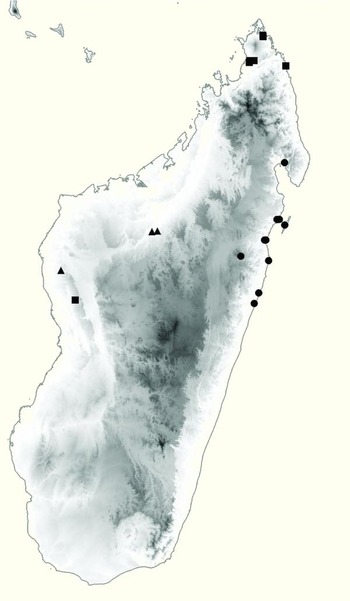
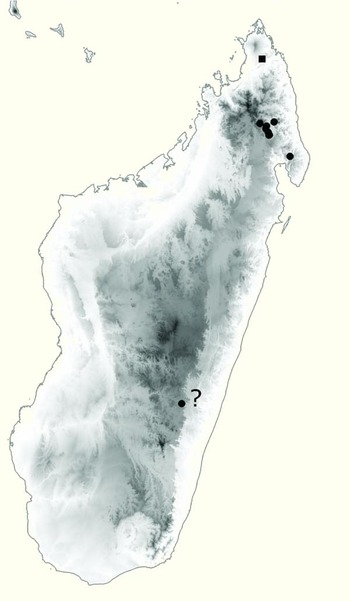
Distribution of Donella masoalensis Aubrév (circles) and Donella ranirisonii L. (square). The locality of a sterile collection (Service Forestier 23215), which differs slightly in venation from other collections of D. masoalensis, is marked with a ‘?’.

Tree 20–30 m, dbh 40–70 cm. Petioles 12–20 mm long. Leaves oblong-elliptic, 5.6–14.5 × 3.4–7.2 cm, glabrous above, densely ferruginous below when young becoming glabrous; secondary veins coarse, very prominent below, intersecondary veins fine but clearly visible, not densely packed, secondary veins looping and joining to form a marginal vein near to the leaf edge, tertiary venation conspicuous, reticulate, sometimes present beyond the marginal vein; midrib on upper surface channelled, flat or prominent; apex acute or short acuminate, acumen to 8 mm long, base cuneate or rounded. Flowers clustered in the axils of current leaves or at old nodes; pedicels 3–4 mm long. Sepals imbricate, free, 2–2.5 mm long, outside appressed ferruginous pubescent. Corolla colour not recorded, c.2 mm long, lobes ciliate, similar in length to the tube, stamens inserted at the base of the tube, filaments glabrous. Gynoecium c.2 mm long, ovary conical, surface glabrous, encircled by a sheath of dense pilose hairs attached at the base of the ovary. Fruits globose or subglobose 2.8–4 cm in diameter, slightly ribbed, short-stalked, greenish surface colour mostly covered by a ferruginous tomentum. Seeds 5, c.2 cm long, light brown, shiny; scar adaxial.
Habitat and ecology
Evergreen montane forest; 800–1800 m elevation.
Distribution
Endemic to Madagascar.
Preliminary conservation assessment
Donella masoalensis is assessed here as Near Threatened (NT) under the criteria of the IUCN (2001). Both the estimated EOO of 2025 km2 and the estimated AOO of 36 km2 meet the requirements for the category of Endangered (EN). However, Donella masoalensis occurs mainly in well-established protected areas in montane forest (Marojejy, Anjanaharibe-Sud, Masoala). Nevertheless, Service Forestier 23215 bis (marked with a ‘?’ on Fig. 6), a sterile collection differing slightly in venation, which was seen by Aubréville (Reference Aubréville1974) but cited under the wrong number (SF 8833) was collected at Ranomafana, much further south than any of the other gatherings, and if really conspecific, then the species may occur in intervening areas at medium elevation. Certainly, there is a threat of deforestation present at the most southerly locality, and loss of that subpopulation would lead to a large reduction in the known EOO.
Species recognition
Vegetatively, Donella masoalensis is a distinct species, characterised by coriaceous leaves that have prominent, coarse secondary veins and prominent but finer intersecondary veins clearly separated from each other and connected by a prominent reticulate tertiary venation.
10. Donella perrieri Lecomte, Bull. Mus. Natl. Hist. Nat. 34: 355. 1928. Chrysophyllum perrieri (Lecomte) G.E.Schatz & L.Gaut., Novon, 6(4): 428 (1996). – Type: Madagascar. Toamasina: Betampona près d'Ambodiriana, ouest de Tamatave, Perrier de la Bâthie 17413 (holo P (P00109356); iso P (P00109357, P00109358). Fig. 7.
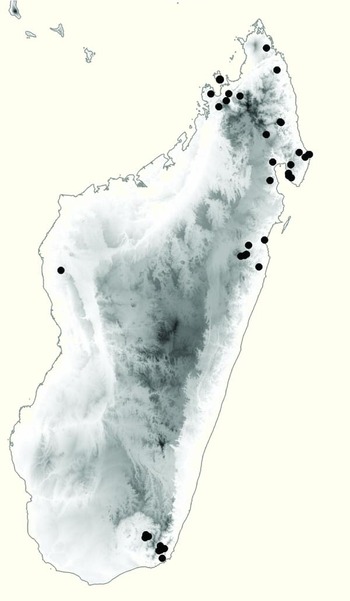
Distribution of Donella perrieri Lecomte.

Donella perrieri Lecomte var. pubescens Aubrév, Fl. Madagasc. 164: 116 (1974).). – Type: Madagascar, Tampolo, N. Fénérive, Service Forestier 8635 (holo P (P00109359); iso P (P00109360, P00109361)).
Donella perrieri Lecomte var. sambiranensis Lecomte, Bull. Mus. Natl. Hist. Nat. 34: 355. 1928. Donella sambiranensis (Lecomte) Aubrév, Fl. Madagasc. 164: 115 (1974).). – Type: Madagascar, Antsiranana, Bassin du Sambirano, Perrier de la Bâthie 15432 (holo P (P00109362); iso P (P00109363, P00109364)).
Tree 5–25 m, dbh 13–45 cm. Petioles 10–20 mm long. Leaves oblong-elliptic, oblong obovate or ovate, 3.5–15.2 × 2.1–6.9 cm, glabrous or sparse to moderately spreading pubescent above, glabrous, sparse to moderately appressed or spreading hairy below, indumentum (if present) most dense on or near the midvein; secondary veins prominent, usually joining just before the leaf edge to form a marginal vein, intersecondary veins conspicuous but not prominent, secondary and intersecondary veins densely or not densely packed, tertiary venation often visible; midrib on upper surface flat or prominent; apex variable, acute, rounded, truncate, occasionally narrowing abruptly to an acumen 7–12 mm long, base rounded or cuneate. Flowers clustered in the axils of current leaves or at old nodes; pedicels stout or slender (2–)4–7 mm long. Sepals imbricate, free, 2–3 mm long, outside sparse to moderately appressed pubescent. Corolla cream, yellowish or pale green, 1.5–3 mm long, lobes ciliate, longer, shorter or similar in length to the tube, stamens inserted at the base of the tube, filaments glabrous. Gynoecium 2–3 mm long, ovary conical, surface glabrous, encircled by a sheath of dense pilose hairs attached at the base. Fruits globose, subglobose or ellipsoid, 2.3–4 cm long, 1.6–4.5 cm in diameter, slightly ribbed, glabrous, stalk up to 1.2 cm long, greenish, yellow-green or brown when ripe, narrowed at apex or sometimes apiculate. Seeds 3–5, mid-brown, shiny; scar adaxial.
Habitat and ecology
Primary evergreen and transitional forests, often persisting in secondary forests; 0–1710 m elevation.
Distribution
Endemic to Madagascar; widespread throughout the Eastern and Sambirano Domains and also at lower altitudes in the Central Domain, rare in the Western Domain.
Preliminary conservation assessment
Donella perrieri is assessed here as Least Concern (LC) under the criteria of the IUCN (2001). The estimated EOO of this species is very large, at > 4 million km2, although the estimated AOO of 148 km2 falls within the Endangered (EN) range. However, the EOO is likely to be significantly underestimated, because this species is expected to occur in the central region of Madagascar, which is poorly collected compared with the coastal areas. Also, and somewhat unusually for the genus, this widespread and variable species is able to grow well in secondary forest.
Donella perrieri is by far the most common and variable species in the genus in Madagascar. We hypothesise that the wide distribution and high frequency of collection may be the result of high dispersal abilities and a broad ecological spectrum. Donella perrieri was recently discovered in the seasonal Western Domain (Beanka forest) in humid microhabitats associated with prolonged water availability because of a karstic environment, and might represent a relic of a quaternary wider extension of humid forest.
Two varieties have been described, neither of which have we maintained here. Aubréville (Reference Aubréville1974) proposed Donella perrieri var. pubescens as distinct from typical D. perrieri because of the presence of indumentum within the corolla (not glabrous), although, in this study, intermediates with a few hairs have been seen. Lecomte proposed Donella perrieri var. sambiranensis, later raised with hesitation by Aubréville (Reference Aubréville1974), to specific rank. This latter variety is known only from a single collection (Perrier de la Bâthie 15432). Some of the flowers conform to the very uniform floral morphology characteristic of the genus, whereas other flowers present unusual forms such as lacking stamens or having six petals, four wide and two much narrower instead of the typical five petals. The characters on which Lecomte (Reference Lecomte1928) relied to separate var. sambiranensis were the presence of large leaves with rounded bases. Within the context of the genus, Donella perrieri is very variable in leaf size and shape, including the leaf base. Also, many species display larger leaves on the fertile volcanic soils in the Sambirano Valley where the type was gathered (G. E. Schatz, pers. comm.).
11. Donella ranirisonii L.Gaut. & Mackinder sp. nov. Figs 6 , 8 , 9.
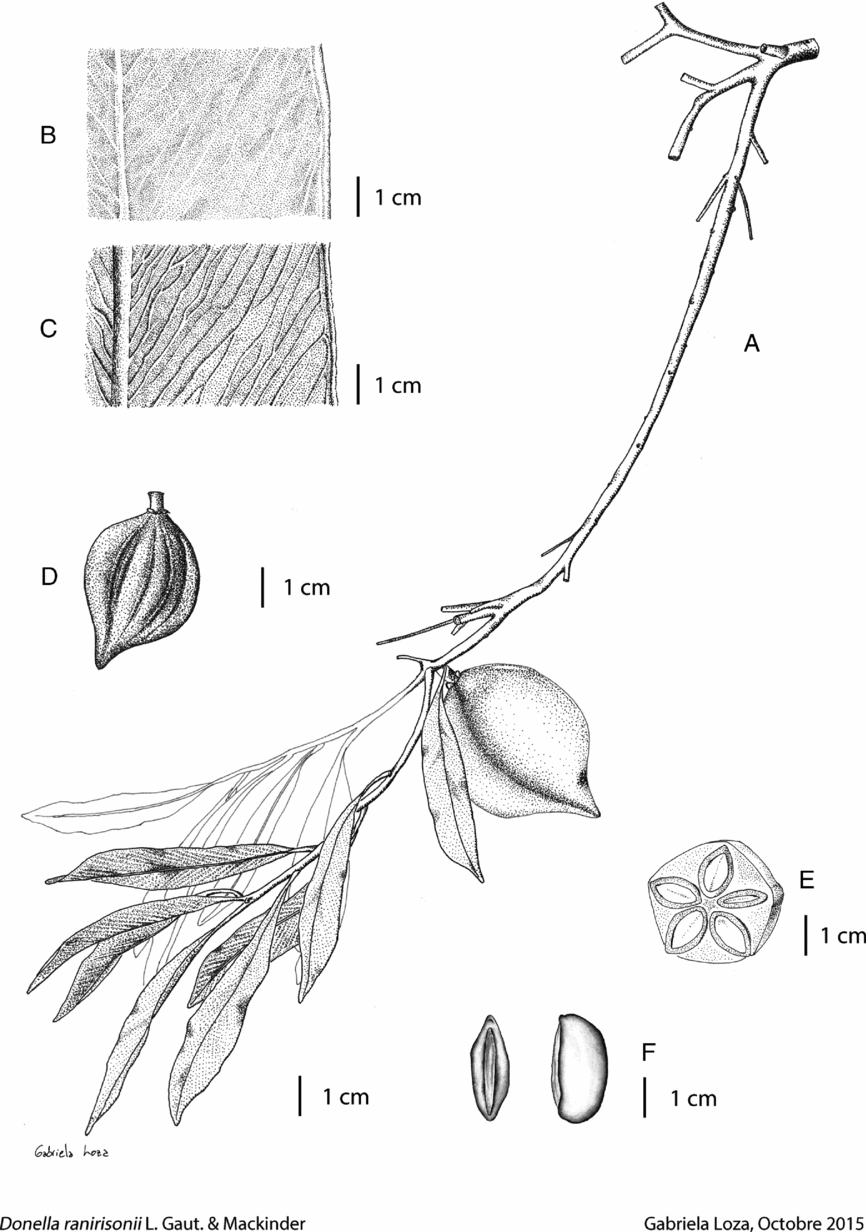
Donella ranirisonii L. Gaut. & Mackinder sp. nov. A, Twig with fruit in fresh condition. B, Detail of venation (adaxial side). C, Detail of venation (abaxial side). D, Dried fruit. E, Cross-section of fruit in fresh status. F, Seed from front and side view. Drawn from Gautier & Ranirison 5387 by Gabriela Loza.

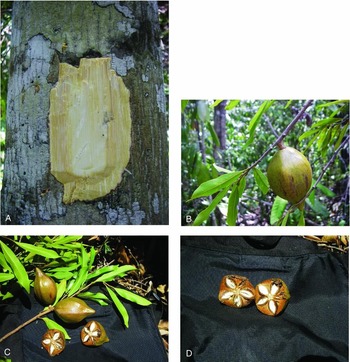
Donella ranirisonii L. Gaut. & Mackinder sp. nov. A, Slash. B, Fruit on tree. C, Fruiting branch. D, Close-up of fruit in cross-section. Photographed by L. Gautier.

Donella ranirisonii L. Gaut. & Mackinder resembles D. delphinensis Aubrév. but differs in having narrower oblanceolate leaves 4–6 times longer than wide (not up to 2 times longer than wide) and larger fruits of 3.8–4.8 cm long (not 2.1–3.6 cm long). – Type: Madagascar, Andrafiamena, forest around Anjahankely, 410 m, fr. 10 xi 2010, Gautier & Ranirison 5387 (holo G (G00304192); iso E, P, S, TEF)).
Chrysophyllum sp. 1 sensu Burivalova, Remote Sensing of Vegetation in Conservation: A Case Study from the Dry and Transitional Forests of Andrafiamena, Northern Madagascar. Unpublished Master's thesis, University of Geneva (2011).
Tree 10 m high, dbh 17 cm, little or no white latex in bark, twigs, and leaves. Trunk shallowly fissured, slash light yellow, inner wood cream, ultimate twigs with grey bark, 1–2 mm in diameter, apical buds dark brown and whitish pulverulent. Petioles 3–5 × 1 mm, thickened at base to 1.5 mm. Leaves alternate, entire, coriaceous, narrowly elliptic 5–7 × 0.8–1.6 cm (length:width ratio 3.8–6.3), broadest in the upper half at about two-thirds to three-quarters from the base, mostly glabrous, but with caducous golden pubescence consisting of 0.3 mm medifixed trichomes, sometimes persisting on the petiole and proximal part of midrib on the abaxial side, apex acute or acuminate, acumen to 1 cm long, base cuneate; midrib flat above in continuation of the upper side of the petiole, prominent below, secondary and intersecondary veins indistinct from each other, parallel and anastomosing, making an acute angle of c.30–40° with the primary nerve, visible above, conspicuous and slightly raised below, pale coloured on dry specimens, looping to form an intramarginal nerve c.0.5 mm from margin. Flowers unknown. Fruiting pedicel 4.5–8 mm long, 3 mm in diameter, with flaking beige surface. Fruiting calyx of five 1–1.5 mm long and broad, rounded sepals at base of fruit. Fruits ovoid and beaked, pentagonal in section, with copious sticky white latex, 3.4–5 cm long, 2.2–3 cm in diameter, glabrous, greenish brown, surface smooth and shining, with up to 5 seeds. Seeds up to 5, laterally compressed, c.27 mm long, c.13 mm broad, c.9 mm thick, shining, light brown, scar adaxial, linear, 22 × 3 mm.
Habitat and ecology
In semideciduous forest on sandstone at medium elevation; c.410 m.
Distribution
Known only from the type collection from Andrafiamena forest, north-eastern Madagascar.
Etymology
This species is dedicated to Patrick Ranirison, former Ph.D. student of Laurent Gautier, together with whom he collected the type specimen. Patrick Ranirison undertook his doctoral studies in the Loky-Manambato region of Madagascar, during which time he was also Head of the Conservation Programme in Andrafiamena, Head of Famelona Association and lecturer at the University of Antananarivo.
Preliminary conservation assessment
Donella ranirisonii is assessed here as Critically Endangered, CR [B2ab(iii,v)] under the criteria of the IUCN (2001). Known only from a single location, it is not possible to estimate an EOO, but the estimated AOO is, of course, very small (4 km2), which meets the requirements for a CR status. The site at which the single collection was gathered is outside the main forest block, not protected and threatened by uncontrolled fire, and we expect a decline in the extent and quality of suitable habitat. In addition, because Sapotaceae timber is highly sought after in Madagascar, we anticipate logging to be a further threat.
12. Donella bangweolensis (R.E.Fr.) Mackinder comb. nov. Austrogambeya bangweolensis (R.E.Fr.) Aubrév. & Pellegr., Adansonia 1: 7 (1961). Chysophyllum bangweolense R.E.Fr., Wiss. Ergebn. Schwed. Rhodesia-Kongo-Exped. 1911–1912, 1: 254, fig. 29 (1916). – Type: Zambia, Bangweolo, Kamindas, Fries 909 (lecto UPS (V-557099), designated here); Fries 909a (syn UPS (V-557102)). Fig. 10.
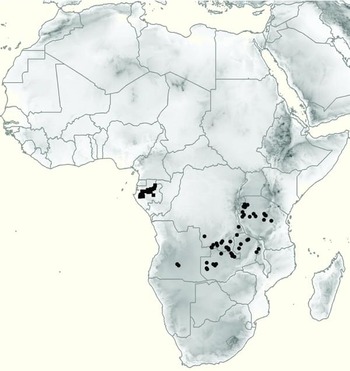
Distribution of Donella bangweolensis (R.E.Fries) Mackinder (circles) and D. ogoouensis (A.Chev.) Aubrév. & Pellegr. (squares).

Chrysophyllum cacondense Greves, J. Bot. 65, suppl. 2: 72 (1929). – Type: Angola, Bié, R. Luassenha, Gossweiler 2623 (lecto BM, designated here).
Shrub or small tree 1.5–10(–20) m, dbh 5–24 cm. Petioles 2–4 mm long. Leaves narrowly elliptic, elliptic or obovate, 3.6–18 × 1.5–4 cm, glabrous or puberulous above, moderately to densely ferruginous puberulous below; secondary and intersecondary veins visible but not densely packed, weakly brochidodromus, secondary veins not joining to form a marginal vein, tertiary reticulate venation visible; midrib, secondary and intersecondary veins on upper surface prominent, apex acute or very short acuminate, acumen up to 4 mm, base acute or rounded. Flowers clustered in the axils of current leaves or at old nodes; pedicels stout, up to 2 mm long. Sepals imbricate, free, c.2 mm long, outside sparsely to moderately ferruginous puberulous. Corolla white or pale green, c.2 mm long, lobes ciliate, similar in length to the tube, stamens inserted at the base of the tube, filaments glabrous, functionally female flowers seen. Gynoecium c.2 mm long, ovary conical, surface glabrous, encircled by a sheath of dense pilose hairs attached at the base of the ovary. Fruits subglobose, 2.4–4.5 cm in diameter, slightly ribbed, glabrous, short-stalked. Seeds 4–5, mid-brown, shiny; scar adaxial, extending a little along the base.
Habitat and ecology
Understorey tree of evergreen forest and thicket, also in Miombo woodland; 770–1750 m elevation.
Distribution
Angola, Democratic Republic of Congo, Zambia and Tanzania.
Preliminary conservation assessment
Donella bangweolensis is assessed here as Least Concern (LC) under the criteria of the IUCN (2001). Under Criterion B, at almost 1.5 million km2 the estimated EOO of this species is clearly in the LC range, but the estimated AOO, at 208 km2, meets the requirements for Endangered (EN). However, the AOO is likely to be severely underestimated; in particular Angola is very little explored botanically. Furthermore, the number of locations exceeds the upper limit of 10 needed to qualify for a category of Threat, nor is there any evidence of extreme fluctuations in EOO, AOO, number of locations or subpopulation or number of mature individuals.
13. Donella ogoouensis (A.Chev.) Aubrév. & Pellegr., Notul. Syst. (Paris) 16: 247 (1961). Chrysophyllum ogoouense A.Chev. in Bull. Soc. Bot. France 16: Mem. 8e: 266 (1917). – Chrysophyllum ogowense A.Chev., Vég. Utiles Afrique Trop. Franç. 9: 270 (1917) nom. superfl. – Type: Gabon, Environs de Lambaréné sur l'Ogooué, Fleury in herb. Chevalier 26365 (lecto P, designated here (P00417472)). Fig. 10 .
Donella griffoniana Pierre ex Pellegr., Mém. Soc. Linn. Normandie, n.s., 1(2): 15 (1928). Nomen nud.
Shrub or small, widely branched tree 2–10 m, dbh 15 cm measured on a tree c.5 m tall. Petioles 5–15 mm long. Leaves oblong-elliptic, elliptic or obovate, 3–10.5 × 1.4–3.5 cm, glabrous on both surfaces except for a few hairs on the midvein below; secondary and intersecondary veins fine but not densely packed, secondary veins looping to form a marginal vein, tertiary venation reticulate and visible without magnification; midrib sunken or channelled on upper surface; apex emarginate, rounded, rarely acute, base cuneate. Flowers clustered in the axils of current leaves or at old nodes; pedicels 2–3 mm long. Sepals imbricate, free, c.2 mm long, outside glabrous or a few scattered hairs present, margins ciliate particularly towards the apex. Corolla white, pale yellow, pale green or greenish yellow, c.2 mm long, lobes ciliate, more densely so than the sepals, similar in length to the tube, stamens inserted at the base of the tube, filaments glabrous. Gynoecium c.2 mm long, ovary conical, surface glabrous, encircled by a sheath of dense pilose hairs attached at the base. Fruits ellipsoid, (2.4–)3.2–4.5 cm long, (1.1–)1.6–2.1 cm diameter at widest part, slightly ribbed or smooth, glabrous short stalked, tapering to a point at the apex, yellow or orange when ripe. Seeds 5, 1.8–2.2 cm long, dark brown, shiny; scar adaxial.
Habitat and ecology
Seasonally inundated riverine forest and gallery forest; 40–500 m elevation. Noted as common locally in the Lopé reserve (L. White 702).
Distribution
Endemic to Gabon.
Preliminary conservation assessment
Donella ogoouensis is assessed here as least Concern (LC) under the criteria of the IUCN (2001). At > 46,000 km2, the estimated EOO of this species falls comfortably within the LC range for Criterion B, but an estimated AOO of only 124 km2 meets the requirements for the category of Endangered (EN). However, the distribution of D. ogoouensis is not severely fragmented, because suitable habitat is continuous across most of the EOO. Also, several of the subpopulations are located within protected areas. Furthermore, AOO is likely to be underestimated, because the southern part of Lopé National Park is undercollected compared with the northern part of the park.
Species recognition
A shrub or small tree found along watercourses, morphologically Donella ogoouensis is quite a homogenous species and readily identified by the rather rounded leaf tips, which are unusual in the genus, most species having more acute or acuminate leaf apices.
In January 1917, Chevalier published two binomials with similar epithets, Chrysophyllum ogoouense (Chevalier, Reference Chevalier1917a) and C. ogowense (Chevalier, Reference Chevalier1917b) in separate publications. In both cases, a single specimen, Fleury in Chevalier 26465, was cited. It can be viewed at the JSTOR Global Plants database. No information has been discovered to discern which day in January 1917 either name was published. Because it has not been possible to discover which was published first, they have equal priority. Consequently, Art. 11.5 (McNeill et al., Reference McNeill, Barrie, Buck, Demoulin, Greuter, Hawksworth, Herendeen, Knapp, Marhold, Prado, Prud'homme van Reine, Smith, Wiersema and Turland2012) applies, which states that the first effectively published choice made between the variants establishes the priority of the chosen name. Although Fleury in Chevalier 26465 bears the name Chrysophyllum (sect. Donella) ogowense A.Chev., the annotation is in a different handwriting to the rest of the label and may have been added later. When Aubréville & Pellegrin in Aubréville (Reference Aubréville1961) transferred this taxon to the newly reinstated genus Donella, they published a new combination in Donella using Chrysophyllum ogoouense as the basionym. In doing so, they neither referred to the publication of Chrysophyllum ogowense nor provided any discussion as to why they selected C. ogoouense over C. ogowense, so it not clear whether they were aware of the name C. ogowense A.Chev. As such, one could argue that they did not effect a ‘choice’ according to Art. 11.5. We choose Chrysophyllum ogoouense as the basionym for this taxon both in the interest of stability (the ‘ogoouense’ variant is in wide use) and in the interest of conservatism, because our choice eliminates the need to publish yet another name (new combination) for this taxon. Therefore we consider Chrysophyllum ogowense to be a homotypic synonym of C. ogoouense.
14. Donella pruniformis (Pierre ex Engl.) Aubrév. & Pellegr., Fl. Gabon 1: Sapotacées: 142 (1961). Chrysophyllum pruniforme Pierre ex Engl., Monogr. Afrik. Pflanzen. – Fam. 8: 42 (1904). – Type: Gabon, Libreville, Klaine 283 (lecto K (K000430540), designated here; isolecto E (E00290011)), see note below. Fig. 11.
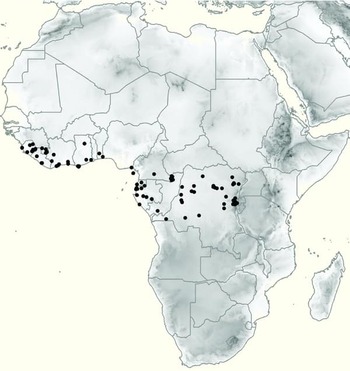
Distribution of Donella pruniformis (Pierre ex Engl.) Aubrév. & Pellegr.

Chrysophyllum buchholzii Engl., Monogr. Afrik. Pflanzen.-Fam. 8: 41 (1904). – Type: Cameroon, Limbareni, Buchholz 195 (B†).
Chrysophyllum gracile A.Chev., Bull. Soc. Bot. France 61 (Mém. 8e): 268 (1917). Type: Benin, Cercle·de de Porto-Novo, Reserves Forestières de Bokoutou, près Sakété, Chevalier 22888 (P. n.v.).
Donella parvifolia Lecomte, Bull. Mus. Natl. Hist. Nat. 26: 648 (1920). – Type: Gabon, Region de la Ngounié, Sindara, Le Testu 2299 (lecto P (P00512419), designated here; isolecto P (P00512420, P00512421), E (E00290013)).
Chrysophyllum mortehanii De Wild., Pl. Bequaert. 4: 137 (1926). – Type: Democratic Republic of Congo, Dundusana, Mortehan 657 (lecto BR (BR0000008962577), designated here).
Tree (8–)18–40 m, dbh 25–50 cm. Petioles 4–7 mm long. Leaves ovate, elliptic or oblong-elliptic, (2.8–)3.7–11 × (1–)1.6–3.2 cm, glabrous above, appressed ferruginous below when young, the indumentum persisting at maturity along the midrib and sometimes on the lower third of the lamina particularly adjacent to the midrib; secondary and intersecondary veins conspicuous, densely packed, secondary veins joining just before the leaf edge to form a marginal vein, tertiary venation more or less absent; midrib on upper surface flat or prominent; apex tapering to a narrow acumen (6–)10–15 mm long, base cuneate, sometimes asymmetrical. Flowers clustered in the axils of current leaves or at old nodes; pedicels slender 1–3 mm long. Sepals imbricate, free, 1.5–2 mm long, outside appressed ferruginous, densely so when young persisting in the lower half of the sepal at maturity. Corolla white, greenish or green, c.1.5 mm long, lobes ciliate, similar in length to the tube, stamens inserted at the base of the tube, filaments glabrous. Gynoecium c.1.5 mm long, ovary conical, surface glabrous, encircled by a sheath of dense pilose hairs attached at the base. Fruits subglobose or ellipsoid, 2–5.6 cm long, 2–2.5 cm in diameter, slightly ribbed, glabrous, short-stalked, mature fruits, pale to dark green, yellow-green, yellow or reddish brown when ripe. Seeds 1–5, 1.7–2.6 cm long, light to mid-brown, shiny; scar adaxial.
Habitat and ecology
Most commonly found in primary and secondary evergreen terre ferme forest, also found in montane forest and in evergreen to deciduous forest transitions zones at 0–1950 m elevation.
Distribution
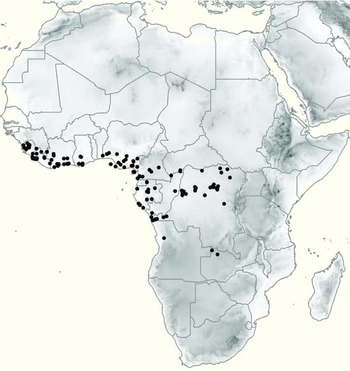
West and west-central tropical Africa, extending east into Uganda.
Preliminary conservation assessment
Donella pruniformis is assessed here as Least Concern (LC) under the criteria of the IUCN (2001). The estimated EOO is very large (> 4 million km2), although the estimated AOO of only 124 km2 meets the requirements for a status of Endangered (EN). However, the EOO is likely to be considerably underestimated, because large areas where we expect this species to occur are poorly collected, especially in north-eastern Gabon, Republic of Congo, south-eastern Cameroon and central Democratic Republic of the Congo. Donella pruniformis is by far the most common and variable species in the genus in Africa, although it is known to be rare in some well-surveyed sites (Harris, Reference Harris2002).
Closely related to Donella viridifolia (J.M.Wood & Franks) Aubrév. & Pellegr., which occurs in Kenya, Mozambique, Zimbabwe, Swaziland and South Africa (Kwazulu Natal), D. pruniformis mainly differs from D. viridifolia in the shape of its leaves, but fruit shape can sometimes be helpful in distinguishing these two morphologically similar species. The midrib of the leaf upper surface is prominent or flat but sunken and channelled in D. viridifolia. Also, in D. pruniformis leaf apices taper into a long narrow acumen, but in D. viridifolia the leaf apex narrows abruptly to a short blunt acumen. The fruits of D. pruniformis are variable in shape, either subglobose or ellipsoid, but only subglobose fruits are known in D. viridifolia. Klaine, T.J. reused collection numbers under 1000 at least twice, sometimes three times (Wieringa, pers. comm.). Klaine 283, cited in Engler's protologue of Chrysophyllum pruniforme and collected in Gabon on 11 vii 1896, is the type of Chrysophyllum pruniforme (see K000430540), but Klaine 283, collected in Gabon on 6 i 1898 (see P00138185), is the type of Klainedoxa cuprea Tiegh.
15. Donella ubangiensis (De Wild.) Aubrév., Adansonia, n.s., 3: 231 (1963). Mimusops ubanguiensis De Wild., Miss. Ém. Laurent 1: 434 (1907). Chrysophyllum ubangiense (De Wild.) Govaerts World Checkl. Seed Pl. 3(1): 15 (1999). Chrysophyllum ubangiense (De Wild.) D.J.Harris, Kew Bull. 55(1): 229 (2000). nom. illeg. – Type: Democratic Republic of Congo, Ubangi, E. & M. Laurent s.n. (lecto BR, designated here). Fig. 12.
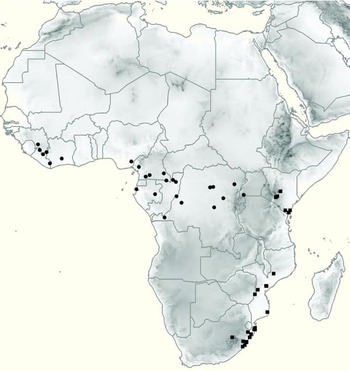
Distribution of Donella ubangiensis (De Wild.) Aubrév (circles) and D. viridifolia (J.M.Woods & Franks) Aubrév & Pellegr. (squares).

Chrysophyllum pentagonocarpum Engl. & K.Krause, Bot. Jahrb. Syst. 49: 387 (1913). Donella pentagonocarpa (Engl. & K.Krause) Aubrév. & Pellegr., Notul. Syst. (Paris) 16: 248 (1961). – Type: Cameroon, Moloundou area, confluence of Bok and Bemba Rs., Mildbraed 4240 (B†).
Chrysophyllum letestuanum A.Chev., Mém. Soc. Bot. France 8: 269 (1917). Donella le-testuana (A.Chev.) A.Chev. ex Pellegr., Mém. Soc. Linn. Normandie, n.s., 1(3): 15 (1928). – Type: Gabon, Tchibanga, Le Testu 1198 (lecto BM (BM000925371), designated here; isolecto BR (BR0000006277109), E (E00230038), WAG)).
Chrysophyllum belemba De Wild., Pl. Bequaert. 4: 122 (1926). – Type: Republic of Congo, Souanké, Baudon 3290 (lecto BR (BR0000008962515), designated here)).
Chrysophyllum claessensii De Wild., Pl. Bequaert. 4: 125 (1926). – Type: Democratic Republic of Congo, Belemba, route vers Avakubi, Claessens 383 (lecto BR (BR0000008962492), designated here; isolecto BR (BR0000008962522)).
Large tree 20–40 m, dbh 25–150 cm. Petioles 5–12 mm long. Leaves broadly elliptic or broadly oblong-elliptic, 9.2–18 × 4–6.7 cm, glabrous on both surfaces, secondary and intersecondary veins conspicuous, densely packed, secondary veins joining just before the leaf edge to form a marginal vein, tertiary reticulate venation of very limited extent; midrib on upper surface sunken or flat, apex narrowing abruptly to a short blunt acumen up to 10 mm long, base cuneate. Flowers clustered in the axils of current leaves; pedicels slender 3–4 mm long. Sepals imbricate, more or less free, c.2 mm long, outside appressed puberulous. Corolla white, 1.75–2 mm long, lobes ciliate, similar in length to, or slightly longer than the tube, stamens inserted at the base of the tube, filaments glabrous. Gynoecium 1.75–2 mm long, ovary conical, surface glabrous, encircled by a sheath of dense pilose hairs attached at the base. Fruits globose or subglobose, c.5–7 cm in diameter, slightly ribbed, glabrous, stalk c.1 cm long, stout, green at first, becoming yellow when ripe. Seeds 4.5–5.5 cm long, mid-brown, shiny; scar adaxial.
Habitat and ecology
Forest, evergreen or semideciduous, primary or secondary, always terre ferme; 15–1500 m elevation.
Distribution
West and west-central tropical Africa, extending east to the coast of Uganda.
Preliminary conservation assessment
Donella ubangiensis is assessed here as Least concern (LC) under the criteria of the IUCN (2001). The estimated EOO for this species is very large, at almost 3 million km2, although the estimated AOO of only 96 km2 falls within the Endangered (EN) range. However, the AOO is likely to be significantly underestimated, because large areas where we expect this species to occur are very undercollected, especially in Gabon, Republic of Congo, south-eastern Cameroon and central Democratic Republic of the Congo. Donella ubangiensis is known to be present but rare in several sites where in-depth surveys have been undertaken (Hawthorne, Reference Hawthorne1995; Harris, Reference Harris2002).
Donella ubangiensis is distinguished by having broad leaves and bearing the largest fruits and seeds of all known species of Donella. In the herbarium, fruits measure up to 7 cm in diameter, but in the field fruits measuring 9–14 cm diameter have been recorded (Letouzey 5211, Breteler 2696, Leeuwenberg 9681). Leaves from a sapling of eight and a half months old (Cremers 615) are oblanceolate (not broadly elliptic or broadly oblong-elliptic), have longer acumens up to 20 (not up to 10 mm) long and shorter petioles, 3–4 mm (not 5–12 mm) long as in mature leaves. Reports of Donella ubangiensis occurring in Ghana (Hemsley, Reference Hemsley, Milne-Redhead and Polhill1968; Govaerts et al., Reference Govaerts, Frodin and Pennington2001) were based on a misidentification of Vigne 1595, which is D. pruniformis.
16. Donella viridifolia (J.M.Wood & Franks) Aubrév. & Pellegr., Notul. Syst. (Paris) 16: 248 (1961). Chrysophyllum viridifolium, J.M.Wood & Franks in Wood, Natal Pl. 6: 569 (1911). – Type: South Africa, Natal, Berea near Durban, Wood 11636 (lecto NH (NH0012497-0), designated here; isolecto BOL (BOL137810), K (K000430603 & K000430604), PRE (PRE0632632-0 & PRE0632633-0)). Fig. 12.
Tree 3–30 m, dbh 25–90 cm. Petioles 5–9 mm long. Leaves oblong-elliptic, elliptic or lanceolate, 4–8.8 × 1.3–3.2 cm, glabrous on both surfaces except for a few hairs on the midvein below; secondary and intersecondary veins conspicuous, densely packed, secondary veins joining just before the leaf edge to form a marginal vein, tertiary reticulate venation of very limited extent; midrib sunken or channelled on upper surface; apex narrowing abruptly to a short blunt acumen 4–8 mm long, base cuneate. Flowers clustered in the axils of current leaves or at old nodes; pedicels slender 2–4 mm long. Sepals imbricate, free, c.2 mm long, outside appressed pubescent. Corolla white or pale green, c.2 mm long, lobes ciliate, similar in length to, or slightly longer than the tube, stamens inserted at the base of the tube, filaments densely pilose. Gynoecium c.2 mm long, ovary conical, surface glabrous, encircled by a sheath of dense pilose hairs attached at the base. Fruits subglobose, c.2.5 cm long, c.2 cm in diameter, slightly ribbed, glabrous, short-stalked, green at first, becoming yellow when ripe. Seeds 4–5, dark brown, shiny; scar adaxial.
Habitat and ecology
Evergreen lowland to submontane forest; 30–1660 m elevation.
Distribution
Kenya, Mozambique, Zimbabwe, Swaziland and South Africa (Kwazulu Natal).
Preliminary conservation assessment
Donella viridifolia is assessed here as Least Concern (LC) under the criteria of the IUCN (2001). The estimated EOO of this species is large, at > 1.4 million km2, comfortably qualifying for a category of LC, but the estimated AOO, at only 104 km2, meets the requirements for the category of Endangered (EN). However, the AOO is likely to be underestimated, because of undercollecting in areas of suitable habit in Mozambique.
The distribution of Donella viridifolia determines the southerly extent of the genus in tropical Africa and the species is apparently disjunct between Kenya and Mozambique. Characters that can assist in distinguishing Donella viridifolia from the morphologically close D. pruniformis are described under D. pruniformis. Leaves from a sapling (Faden 74/879A) are up to 11.5 × 4.7 cm, longer and wider than those of mature individuals.
17. Donella welwitschii (Engl.) Pierre ex Engl., Monogr. Afrik. Pflanzen-Fam. 8: 41 (1904). Chrysophyllum welwitschii Engl., Bot. Jahrb. Syst. 12: 521 (1890). Type: Angola, Welwitsch 4831 (lecto BM (BM000925379), designated here; isolecto K (K000430615); (BM000925379), G (G00014806), LISU (LISU219833, LISU219834)). Fig. 13.
Distribution of Donella welwitschii (Engl.) Pierre ex Engl.

Donella dubardii Pierre, Bull. Jard. Col. 5e année 28: 88 (1905). – Type: Côte d'Ivoire, près de Dabou, Jolly, s.n. (“Herbier du Jardin Colonial”) n.v.
Micropholis angolensis Pierre, Notes Bot. Sapot. (1891). Type: Angola, Golungo Alto, Welwitsch 4830 (holo P; iso K (K000430614), LISU (LISU219835)).
Chrysophyllum klainei Engl., Monogr. Afrik. Pflanzen.-Fam. 8: 42 (1904). – Type: Gabon, Libreville, Klaine 1577 (syn Herb. Pierre n.v.); Klaine 528 (syn E (E00230040), K (K000430620)).
Chrysophyllum ellipticum A.Chev., Explor. Bot. Afrique Occ. Franc. 1. 386 (1920), nom. nud.
Chrysophyllum ealaense De Wild., Pl. Bequaert. 4. 128 (1926). – Type: Democratic Republic of Congo, Eala, Vermoesen 2262 (lecto BR (BR0000008962584), designated here; isolecto BR (BR0000008962409, BR0000008962508, BR0000008962553, BR0000008962591, (BR0000008962607)).
Liana or scandent shrub to c.4 m. Petioles 2–5 mm long. Leaves oblong-elliptic, obovate-elliptic or obovate 3.5–16.5 × 1.6–5.1 cm, glabrous above, glabrous below except for a ferruginous appressed tomentum along the midrib; secondary and intersecondary veins conspicuous, densely packed, secondary veins joining just before the leaf edge to form a marginal vein, tertiary venation more or less absent; midrib on upper surface prominent; apex narrowing abruptly to a broad acumen 6–15 mm long, base acute or rounded. Flowers clustered in the axils of current leaves or at old nodes; pedicels slender 3–5 mm long. Sepals imbricate, free, 2 mm long, outside sparsely pubescent. Corolla white, creamy-white or greenish yellow, c.1–1.5 mm long, lobes ciliate, similar in length to, or slightly longer than the tube, stamens inserted at the base of the tube, filaments glabrous. Gynoecium c.1.5 mm long, ovary conical, surface glabrous, encircled by a sheath of dense pilose hairs attached at the base. Fruits narrowly ovoid to ellipsoid, 2.8–5.2 cm long, 1.1–3.2 cm in diameter at widest part, slightly to strongly ribbed, glabrous, short-stalked, apex acuminate, green at first, becoming yellow when ripe. Seeds 4–5, dark brown, shiny; scar adaxial.
Habitat and ecology
Primary and transitional to secondary evergreen forest, gallery and riverine forest, forest edges, also in thickets (Ghana); 0–670 m elevation.
Distribution
Sierra Leone to Democratic Republic of Congo, extending south to Angola and Zambia.
Preliminary conservation assessment
Donella welwitschii is assessed here as Least Concern (LC) under the criteria of the IUCN (2001). The estimated EOO is very large, almost 1.5 million km2, although the estimated AOO, at only 560 km2, meets the requirements for the category of Vulnerable (VU). However, the AOO is likely to be significantly underestimated, because large areas where this species is expected to occur are very undercollected, namely north central Democratic Republic of the Congo, south-eastern Cameroon, Republic of Congo and northern Angola.
Donella welwitschii is one of the very few lianas or scandent shrubs in the Sapotaceae. In the herbarium, it has sometimes been confused with D. pruniformis in the vegetative state. The lenticels of Donella welwitschii are small, more or less circular and slightly raised, not elongate and flat as in D. pruniformis (note on a species cover at K, probably by R.W.J.Keay).
Index to accepted names for use with exsiccatae
Species numbers as used in this account follow in parentheses.
Donella ambrensis Aubrév. (1)
Donella analalavensis Aubrév. (2)
Donella bangweolensis (R.E.Fries) Mackinder (12)
Donella capuronii (G.E.Schatz & L.Gaut.) L.Gaut. & Mackinder (3)
Donella delphinensis Aubrév. (4)
Donella fenerivensis Aubrév. (5)
Donella guereliana (Aubrév.) Mackinder (6)
Donella humbertii L.Gaut. & Mackinder (7)
Donella lanceolata (Blume) Aubrév. (8)
Donella masoalensis Aubrév. (9)
Donella ogoouensis (A.Chev.) Aubrév. & Pellegr. (13)
Donella perrieri Lecomte (10)
Donella pruniformis (Pierre ex Engl.) Aubrév. & Pellegr. (14)
Donella ranirisonii L.Gaut. & Mackinder (11)
Donella ubangiensis (De Wild.) Aubrév. (15)
Donella viridifolia (J.M.Wood & Franks) Aubrév. & Pellegr. (16)
Donella welwitschii (Engl.) Pierre ex Engl. (17)
Index of exsiccatae
Adam, J.G. 25 (14), 3839 (14), 3920 (14), 22630 (14), 22647 (14), 23193 (14); Adams, C.D. 4726 (17); Ake Assi, L. (17), (17); Akoègninou, A. 3297 (17); Ambriansyah & Arifin, Z. AA1051 (8); Amsini 100 (14); Andriamahay, M. & Rakotoarisoa, S.E. SNGF32306 (10); Andriamiarinoro, H. 274 (5); Antilahimena, P. 26 (10), 73 (10), 124 (10), 172 (10), 690 (10); Aridy, J. et al. 467 (10); Arifin, Z. & Arbainsyah AA1772 (8); Ariwaodo, J.O. 88 (17); Ashton, P.S. S22 (8); Astle, W.L. 590 (12), 713 (12); Aubréville, A. 94 (14), 131 (14), 4170 (15); Awa, D. & Illias, P. S45629 (8); Aylmer, G. 34 (14).
Bakayoko, A. 50 (17); Bakayoko, A. & Martin, P. 147 (17); Balakrishnan & Jayasuriya 880 (8); Balansa, B. 4339 (8); Baldwin, J.T. 6650 (14), 10812 (17); Bamps, P. 303 (14); Bayer, A.J.W. 1439 (16), 1445 (16); Bayer, A.W. 1445 (16); Bernardi, L. 12008 (1); Bernstein, J.H. JHB401 (8); Birkinshaw, C.R. 140 (10), 158 (10), 212 (10); Blume, C.L. 775 (8); Bokdam, J. 4326 (14), 4345 (14), 4566 (14), 4593 (14); Bolaa Bokamba, M. et al. 25 (14); Bolema, D. 57 (17), 366 (17), 648 (17), 658 (17), 1017 (17); Bos, J.J. 1860 (17), 1873 (17), 2102 (17), 5451 (17); Bos, J.J. & Breteler, F.J. 7228 (17); Boschbouwproefstation bb13324 (8), bb21333 (8), bb15885 (8), bb11979 (8); Boschproefstation bb12885 (8), bb12746 (8), T744 (8); Brand, D. SAN30879 (8); Brenan, J.P.M. 7965 (12), 7980 (12), 8082 (12), 8142 (12); Brenan, J.P.M. & Greenway, P.J. 7980 (12), 8082 (12); Breteler, F.J. 1234 (17), 1665 (17), 2222 (17), 2696 (15), 5442 (17), 6643 (13), 7011 (13), 8261 (17), 11399 (13), 15768 (17); Breteler, F.J. & Breteler-klein Breteler, B.J.M. 13144 (13); Breteler, F.J. et al. 5442 (17), 8261 (17), 8957 (13), 10624 (15), 14532 (14); Breyne, H. 3349 (17); Bullock, A.A. 19 (12); Burrows, J.E. 7713 (16), 10016 (16), 10140 (16); Burtt, B.L. 5263 (12); Buwalda, P. bb25840 (8).
Capuron, R. 28761SF (10), SF 9131 (10), 24500SF (2), SF24854b (6), 28889SF (5), 9232SF (10), SF24211 (2), 8833SF (9), SF22854 (10), 11482SF (10), SF8630 (5), SF24854 (6), 11277SF (1), SF8833 (9), SF8635 (10), SF24500 (2), 24211SF (2), 8591SF (10), 18935SF (2), 11345SF (8), 8732SF (10), 8308 (5), 8658 (5), 8805 (9), 8954 (8), 8974 (10), 11406 (10), 18935 (2), 24211 (2); Carlson, B. 197 (3); Carrier, C.L. KEP27340 (8); Cenabre, A.L. 29161 (8); Chatelain, C. et al. 368 (17); Chevalier, A. 22576 (17), 22863 (14), 22888 (14), 26252 (13); Chevalier, A. & Fleury, F. 26465 (13); Claessens, J. 383 (15); Coates-Palgrave, M. OM2668 (16); Compagnie Sucriere 201 (17); Compère, P. 1022 (17); Corbier-Baland, A. 1359 (17), 1453 (17), 1938 (17); Corner, E.J.H. S.F.31199 (8), SING31199 (BKF19991) (8); Couteaux, G. 387 (17); Coxe, I. 226 (12); Cremers, G.A. 615 (15), 851 (17).
Dadswell, H.E. et al. NGF1545 (8); Dalziel, J.M. 958 (14); Danser, B.H. 6441 (8); Daramola, B.O. 667 (17); Darbyshire, I. et al. 640 (17); Dauby, G. 293 (15); Dauby, G. et al. 860 (14); De Briey 215 (15); de Carvalho, M.F. 3406 (17); de Koning, J. 417 (17), 1494 (17), 5887 (14); de Vriese, W.H. 973 (8); de Vriese, W.H. & Teysmann, J.E. 973 (8); de Wilde, J.J.F.E. 750 (13), 8220 (15), 8229 (15), 8229A (15), 11968 (13); De Wilde, J.J.F.E. et al. 9225 (17); de Wilde, W.J.J.O. 873 (17); de Winter, B. & Vahrmeijer, J. 8528 (16); Dechamps, R. H13263 (17), 152 (14), 1339 (12); Dechamps, R. et al. 1337 (12); Deighton, F.C. 1598 (17), 1956 (17), 2388 (14), 2718 (14), 3102 (17), 3192 (17), 3919 (14), 5213 (14); Delvaux, J. 293 (12); Den Houten, M.H. & Van Bergen, M.A. 25 (17), 36 (17); Der Burg, W.J. 284 (14); Der Maesen, L.J.G. 5313 (13); Devred, R. 2598 (14), 3481 (12), 3518 (12), 4201 (14); Dewol, S. SAN83853 (8); Dewol, S. et al. SAN142286 (8); Dewulf, A. 386 (17); Dhetchuvi Matchu-Mandje, J-B. 1183 (17); Dibata, J.J. 1048 (14); Diwol, S. et al. SAN142286 (8); Djamsarie bb24757 (8); Dockrill, A.W. QRS22292 (8), 00956 (8); Donis, C. 314 (14), 3318 (14), 3773 (17); Drummond, R.B. 7233 (12); Dubois, J. 211 (14), 300 (14); Dubois, L. 84 (15), 738 (14).
Edwards, D. 3169 (16); Eggeling, W.J. 5448 (15); Eneme, F. & Lejoly, J. 5 (14); Enti, A.A. 1167 (17), 1804 (17); Evrard, C.M. 4188 (17), 4327 (17), 5108 (17); Ewango, C.E.N. 813 (15).
Faber-langendoen, D. 3225 (10); Faden, R.B. & Faden, A.J. 74897A (16), 74/897 (16); Faden, R.B. et al. 70981 (16); Fanshawe, D.B. F892 (12), F921 (12), F1303 (12); Fell, D.G. DGF9738 (8); Flamigni, A. 6109 (14); Fleury, l.F. 26252 (13); Florence, J. 1562 (13); Ford, G. 854 (12); Foreman, D; Farley, K; Noble, I NGF 45854 (8); Forster, P.I. PIF21309 (8); Fox 17 (14), 19 (14); Fox, J.E.D. 18 (14), 19 (14); Franks 12520 (16); Fu, D. 5024022 (8).
Gardner, H.M. 938 (16); Gautier, L. 3949 (9); Gautier, L. & Chatelain, C. 2396 (10); Gautier, L. & Ranirison, R. LG5387 (11); Gautier, L. & Ravelonarivo, D. LG4134 (10); Gautier, L. et al. 3255 (10), 4642 (2), 5549 (3); Gbile, Z.O. et al. FHI20586 (17); Geerling, C. 2284 (14); Geerling, C. & Bokdam, J. 2284 (14); Gerard, J.G. 3376 (17), 3837 (17), 5308 (17), 5423 (17), 5432 (17); Gereau, R.E. & Ndjango, J.-B. 7290 (14); Germain, R.G.A. 681 (17), 1860 (17), 4521 (15), 7652 (15), 8678 (17); Gerstner, J. 2546 (16); Gilbert, G. 316 (14), 495 (15), 1080 (14), 1189 (14), 1419 (14), 1897 (17), 4060 (14), 4593 (14), 5531 (14), 6093 (14), 6166 (14); Goldsmith, B. 30 (16), 31 (16), 962 (16); Gomes e Sousa, A.F. 1678 (17); Goodenough, J.S. 1739 (8); Goossens, V.G. 2358 (14); Gossweiler, M.J. 4852 (17), 8048 (17), 11702 (12); Govaerts, R. H30462 (12); Greenway, P.J. & Polhill, R.M. 11701 (12); Griffith, W. s.n. (8); Gutzwiller, R. 1444 (17), 1770 (14).
Haba, O-O. 9 (14); Hall, J.B. s.n. (17), 1340 (17), 42589 (17); Hallé, N. 192 (13), 1498 (13), 1898 (13), 2088 (13); Hallé, N. & Le Thomas, A. 192 (13); Hamid FMS5404 (8); Harder, D.K. 3544 (12), 3726 (12); Harder, D.K. et al. 81 (14); Harris, D.J. 1344 (14), 4108 (14), 4241 (14), 7727 (17); Harris, D.J. & Fay, J.M. 1822 (14); Hart, T.B. 291 (14), 292 (14), 293 (14), 314 (14), 341 (14), 868 (14); Havel, J.J. & Kairo, A. NGF15465 (8); Havel, J.J. & School NGF 17230 (8); Hawthorne, W.D. 263 (14); Henar, G.H. bb26241 (8); Hladik, A. 2305 (13), 2542 (13); Holmes 924 (12); Huang 5024013 (8), 5024016 (8); Hughes, J.F. 891 (17), 1957 (17), 2172 (17), 2382 (17); Hulstaert, R.P. 1182 (17), 1570 (17); Hyland, B. 6645 (8), 8452 (8).
Illias, P. S28792 (8); Irvine, F.R. 2152 (14).
Jackson, D. 3 (12); Jahj, Z. bb20765 (8); Jans, E. 905 (17); Jansen, J.W.A. 891 (17), 1936 (17), 1957 (17), 2172 (17), 2382 (17); Jarman, G.H. 222 (16); Jayasuriya, A.H.M. 1655 (8), 1726 (8), 1740 (8), 2188 (8), 2195 (8), 2199 (8), 2200 (8), 2201 (8); Jesperson 97 (17); Jessup, L.W. GJD3027 (8); Ji, L. 5024023 (8); John, D. 387 (17); Jones, A.P.D. FHI7434 (17); Jones, A.P.D. & Onochie, C.F. FHI18886 (15); Jongkind, C.C.H. 3762A (14), 1798 (14), 5645 (14), 6917 (15), 7205 (15); Jongkind, C.C.H. & Assi Yapo, J. 4927 (17); Jongkind, C.C.H. & Nimba Botanic Team 8144 (14), 8192 (14), 9944 (14); Jongkind, C.C.H. et al. 10196A (17), 1798 (14), 4699 (14), 7205 (17), 7483 (14); Jordan, H.D. 254 (17), 2121 (14); Junghuhn, F.W. s.n. (8).
Kalat, A. BRUN20885 (8); Kanywa 60 (12); Keay, R.W.J. FHI22465 (17); Kerr, A.F.G. 9864 (BKF14379) (8), 9864 (8), 18883 (8); Klaine, T.-J. 2348bis (17), 283 (14), 528 (17), 882 (17), 1557 (17), 2348 (17); Koorders, S.H. 1734 (8); Korthals, P.W. s.n. (8); Kostermans, A.J.G.H. bb34720 (8), 5537 (8), 6923 (8), 9886 (8), 10782 (8), 13523 (8), 23593 (8), 24018 (8), 26607 (8), 27548 (8); Kouamé, F.N. 1598 (14), 1613 (17); Kouamé, F.N. & Chatelain, C. 999 (17); Kuchar, P. 22267 (12), 24771 (12).
Lachenaud, O. 1631 (13); Lai, S.T. & Rantai, L. S69184 (8); Lascellas, A.R.W. (8); Latilo, M.G. FHI31839 (17); Le Testu, G.M.P.C. 1385 (17), 1476 (17), 2213 (13), 2299 (14), 3156 (17), 4494 (14); 7011 (13), 8395 (14); Le Thomas, A. 222 (10), 255 (10); Leal, M.E. et al. 1185 (13); Lebrun, J. 1385 (17), 1476 (17); Leeuwenberg, A.J.M. 1151 (13), 2252 (17), 2267 (17), 4554 (17), 7955 (17), 11305 (17), 11517 (13); Leeuwenberg, A.J.M. & Berg, C.C. 9681 (15); Leeuwenberg, A.J.M. et al. 14314 (1); Leighton, F.M. 1053 (8); Lejoly, J. 1486 (17), 2054 (17), 2886 (17), 4439 (17); Léonard, A. 88 (17), 875 (17), 3731 (14), 4722 (14), 6019 (17); Leonard, J. 714 (14); Letouzey, R. 3364 (15), 4276 (14), 5211 (15), 5300 (15), 14068 (17); Letsara, R. 892 (7); Liben, L. 3792 (12); Liegeois 42 (14); Lisowski, S. (12), B6962 (17), B7026 (17), 14 (12), 292 (12), 13017 (12), 16367 (14); Longgang Comprehensive Study team 11423 (8); Louis, J. 539 (15), 714 (14), 1034 (14), 1037 (14), 1515 (17), 2101 (17), 2537 (14), 2792 (14), 2808 (14), 3807 (14), 6148 (17), 7114 (14), 8772 (14), 11312 (17), 11954 (17), 12359 (17), 13182 (17), 13882 (14), 14325 (17), 15151 (17), 16636 (14); Luke & Robertson 2650 (16).
Madoux, E. (17), 202 (17), 422 (17); Malaisse, F. (12), 6987 (12), 8376 (12), 9600 (12); Mamit, J.D. & et. al. S34650 (8); Mangold, R.P. BW2215 (8); Mann, G. 2344 (14); Mbago, F.M. 1363 (12); MBG transect 462 (14), 1528 (14); McDonald, Karen 54 (13); McPherson, G.D. 14431 (10), 14623 (10), 15272 (13), 15836 (14), 16175 (17), 16792 (17), 17196 (9), 17902 (13), 17910 (13); Menavanza, F. 19 (17); Menzies, A. et al. 114 (14); Michelson, A. 38 (14), 102 (14), 359 (14), 510 (14), 785 (14); Middleton, David J. 1544 (8); Miège, J. s.n. (17); Mildbraed, J. 4240 (15); Miller, J.S. 3286 (10); Milne-Redhead, E. 974 (17); Minkébé Series & Wilks, C.M. W503 (13), 599W (13), W599 (13), 503 (13); Mohd. Oetoei bb23939 (8); Moll, E.J. 3227 (16), 3232 (16); Mortehan, M. 657 (14); Moukassa, G. 2301 (14); Moungazi, A. 1602 (13); Moutsambote, J.M. & Dowsett-Lemaire, F. 4516 (14); Msgbagbeola 209 (17); Müller, T. & Gordon, H.S. 1365 (16); Mutimushi, J.M. 3508 (12); Mwiga, G.T. 175 (12).
Ndolo Ebika, S.T. 89 (15), 343 (14); Nemba, J. & Thomas, D.W. 520 (17); Nicholson, D.J. 63 (16); Nimba Botanic Team NS489 (14), 90WE (17), 246WE (17); Nsimundele 988 (17); Nur, M. s.n. (8); Nusbaumer, L. 2834 (10).
Oetoei, M. bb23939 (8); Oldeman, R.A.A. 604a (17), 604 (17); Olorunfemi, J. FHI34183 (17); Onochie, C.F. 17355 (14).
Paie, I. S28792 (8); Parmentier, I. & Nguema Miyono, N.S. 731 (14); Pawek, J. 11981 (12); Perdue, R.E. & Kibuwa, S.P. 8092 (16); Perrier de la Bâthie, H. 1536 (10), 8783 (7), 12309 (2), 14834 (2), 15432 (10); 17413 (10); Pierlot, R. 811 (14), 1428 (14), 2395 (14); Pilz, G.E. 2102 (17); Pirozynski P548 (12), P599 (12); Pole-Evans I.B. 3049 (12); Poncy, O. 1530 (10); Pynaert, L. 988 (17).
Quiroz-Villarreal, D.K. et al. 1540 (13).
Rabe, J. 108 (10); Rabehevitra, D. & Razakamalala, R. 249 (6), 957 (4); Rabehevitra, D. et al. 960 (6); Rabenantoandro, J. 1340 (2); Rabenantoandro, J. et al. 918 (4), 1107 (4); Rabevohitra, R. et al. 4163 (4), 4223 (4); Rahajasoa, G. 299 (10), 346 (10), 1041 (10); Rahajasoa, G. et al. 1041 (10); Rakotomalaza, P.-J. & Ravelomanantsoa, D. 1990 (9); Rakotomalaza, P.J. et al 2075 (9); Rakotonandrasana, S. 484 (10); Rakotonandrasana, S. et al 575 (10); Rakotonirina, C.Z. 637 (10); Rakotozafy, B.F.L. 115 (10); Ramananjanahary, R.H. 110 (2); Ramison, R.G. & Armand, M. 314 (4); Ramison, R.G. & Ramisyl, E. 157 (4); Ramlanto & Fanani, Z. 673 (8); Ranaivojaona, R. 325 (2); Randriamampionona, B. 457 (10), 486 (10), 626 (10); Randrianaivo, R. 1877 (5); Randrianaivo, R. & Bernard, R. 128 (10); Randrianaivo, R. et al. 584 (4), 1988 (4); Randrianasolo, A. 73 (10); Randrianasolo, A. et al. 740 (5); Randrianjanaka, L.M. & Arnaud, B.M.J. 32 (8); Randrianjanaka, L.M. & Zafy, P. 184 (5); Ranirison, R. PR826 (2); Ranirison, R. & Nusbaumer, L. 842 (10), 849 (10); Rasoavimbahoaka, F. & Rastefanonirina, J.A. 275 (10); Ratovoson, F. 1300 (6); Ratovoson, F. et al 576 (10); Ratovoson, F. et al. 255 (10); Ravelonarivo, D. 301 (9); Ravelonarivo, D. & Rabesonina, R. 752 (9); Ravelonarivo, D. et al. 343 (9), 382 (8); Raynal, J. & Raynal, A. 10300bis (15); Razafimandimbison, S.G. & Ravelonarivo, D. 363 (9); Razafimandimbison, S.G. et al. 243 (9); Razakamalala, R. 5376 (10); Razakamalala, R. & Rabehevitra, D. 1329 (4); Razakamalala, R. et al. 508 (4); Razanatsima, A. 773 (10); Reed & Michel 1048 (12); Reekmans, M. 7332 (12), 7475 (12), 7595 (12), 7598 (12); Reitsma, J.M. 3658 (13); Reitsma, J.M. & Reitsma, B. 2398 (13); Reynoso, E.J. et al. PPI 14624 (8), PPI14624 (8); Richards, H.M. 19257 (12); Ridley, H.N. 2756 (8); Ridsdale, C.E. 496 (8); Robertson, S.A. & Luke 5208 (16); Runyinya, B. 999 (14).
Samai, S.K. 321 (14); Sapin, A. (17); Schaijes, M. 3717 (12); Schatz, G.E. & Miller, J.S. 2555 (3); Schmitz, A. 3000 (12), 3327 (12), 5021 (12), 5151 (12), 7253 (12); Schnell, R. 1051 (15), 2646 (15), 4623 (15); Schram, F.A.W. BW7838 (8); Scott Elliot, G.F. 5673 (17); Senterre, B. et al. 2922 (14); Service Forestier 64R87 (4), SF19440 (6), SF18959 (6), SF12794 (6), 28809bis (5), 213R16 (4), SF11222 (6), 3349 (2), 7358 (2), 7850 (2), 13072 (5), 13185 (4), 14183 (5), 14877 (1), 15923 (2), 16035 (5), 18337 (5), 19075 (2); Service Forestier de Madagascar 9-R-246 (10), 12538SF (7), 42-R-198 (10), 24854bis (6), 515-R-56 (8), 289-R-212 (10), 50-R-212 (8), 488-R-56 (8), 11-R-246 (8), 21-R-130 (2), 359-R-212 (8), 6814bis (6), 6760 (6), 7850 (4), 9990 (10), 11098 (10), 11222 (6), 12794 (6), 13072 (5), 14815 (10), 15180 (5), 18959 (6), 19440 (6), 19570 (2), 32035 (10), 32306 (10); Service Forestier, Capuron 23215bis (9), 946 (8), 8568 (5), 9002 (10), 11424 (10), 11433 (10), 18273 (10), 18905 (10), 27765 (10); Service, N.I.F. bb20765 (8), bb26241 (8), bb24757 (8); Shohor, M. 6614 (8); Sidiyasa, K.& Arifin, Z.; 2196 (8); SIMAB series 51127 (14); Sinclair, J. 7796 (40038) (8), S.F.40200 (8), SF40200 (8), 8390 (40594) (8), 7976 (8); Small, D. 654 (14), 734 (14); Smythe, C.W. 202 (17); Soejarto, D.D. 11154 (8), 13074 (8); Solo, J. & Randrianasolo, J. 33 (8); Sundaling, D. SAN83853 (8); Sundaling, D. et al. SAN71153 (8); Suzuki, E. K9989 (8); Suzuki, E. & Miyamoto K13207 (8), K13336 (8).
Tailifer, Y. 92 (14); Talifer, Y. 91 (14), 92 (14); Tang, E. & Sidek, K. 1564 (8); Tanner, R. 5701 (12); Téré, H.G. 2079 (14); Teysmann, J.E. s.n. (8); Thai 381 (BKF11946) (8); Thijssen, M.T. 365 (17); Thomas, D.W. 6214 (17); Thomas, D.W. & Wilks, C.M. 6579 (17), 6601 (13), 6602 (13), 6625 (13); Thomas, N.W. 726 (17), 836 (17), 1173 (17), 1596 (17), 6216 (17), 6503 (17); Thorenaar, A. T744 (8); Timberlake, J. 5395 (16); Tinley, K.L. 351 (16); Tirvengadum & Balasubramaniam 318 (8); Tisserant, C. 1329 (17), 1461 (17), 2049 (17); Toka, L. 244 (15); Torre, A.R. 4350 (16); Toussaint, L. 782 (17); Trapnell, C.G. 1293 (12); Troupin, G. 10725 (14), 16215 (14), 16242 (14); Tsiatrefy, G. M286 (4).
Unwin 30 (14).
Vahrmeijer, J. 1078 (16); Van Andel, T.R. & Evina, P. 3126 (17); van der Burgt, X.M. 1557 (14); van der Meiren, J.J. 81 (14); van der Zon, A.P.M. 109 (14); Van Doorn, J. & Van Doorn-hoekman, H. 374 (17); Van Meer, P.P.C. 1496 (17); Vasey, N. & Velo, N. 255 (10); Verdcourt, B. 3105A (16); Vermoesen, F.C.M. 2262 (17); Versteegh, C. BW4722 (8); Versteegh, C.P.C. & Den Outer, R.W. 95 (17); Vigne, C. 1595 (14); Voorhoeve, A.G. 70 (14).
Waas, S. 1453 (8), 2065 (8); Wagemans, J. 1568 (17); Walker, F.S. BSIP234 (8); Wallich, N. 4160 (8); Ward, C.J. 2675 (16); Waturandang, A.G. bb21333 (8); Wechuysen, R. 669 (12); Wells, M.J. 81 (16); Welwitsch 4823 (17), 4830 (17), 4831 (17), 4832 (17), 4833 (17); White, F. 3406 (17); White, L.J.T. 702 (13), 776 (13); Wigg FH2752 (12); Wilkie, P. & Imin, K. PW847 (8); Wilkie, P. et al. PW994 (8), PW538 (8), PW974 (8); Wilks, C.M. 3761 (15); Wolhauser, S. 60019 (10); Wongprasert, T. 149018/53-8 (8); Wood, J.M. 11636 (16); Worthington 554 (8), 1805 (8), 1982 (8), 2269 (8), 2378 (8), 2467 (8), 2638 (8), 5245 (8), 7116 (8); Würsten, B. E31213 (14), G1979 (14), M6295 (14), E1139 (14).
Xue, L. 5024012 (8).
Young, A.P. (8).
Zimba, N.B. 640 (12).
Acknowledgements
The authors would like to thank the staff of BR, E, G and MO for processing the loans of Donella specimens on which this revision is in part based. We would also like to thank Martin Pullan (RBGE) for creating the base maps of tropical Africa and Madagascar. Martin Callmander (G) kindly advised us on the conservation assessments of the Malagasy species. We are also indebted to Robert Mill (RBGE) and Henry Noltie (RBGE) for their assistance in nomenclatural matters. We also offer our thanks to two anonymous reviewers for their helpful comments. This work was supported by the Sibbald Trust. The second author received funding from SYNTHESYS to travel to BR to study Sapotaceae.