The late eleventh-century chronicler known as Anonymus Haserensis was a canon of the collegiate church of Herrieden that served Eichstätt Cathedral. His history of the bishops of Eichstätt through the reign of Gundecar II (d. 1075) reflects a cantor's knowledge of the cathedral's liturgy and serves the agenda of glorifying the city, the cathedral and its bishops.Footnote 1 Liturgical artists and their patrons feature prominently in the chronicle and their deeds contribute to the status of the institutions with which they were associated. In their stories, the liturgical arts are often intertwined not only with the institutional and the political, but also the personal. In the following passage, Anonymus Haserensis describes Reginold, bishop of Eichstätt from 966–91, as a learned scholar, a gifted musician and a composer of saints’ offices:
Reginold was of noble blood, but even nobler in learning – not alone in Latin and Greek literature, but even somewhat trained in Hebrew; and, what was unique and exceptional indeed, he was the finest musicus of his day. He first wrote a historia for St Nicholas, and for this he was promoted to the office of bishop. Once bishop, with profound study and ardent devotion he composed historica carmina for St Willibald, founder and patron of the see. He exerted all his powers of intellect to attain a remarkably varied ornamentation, for he adjoined notulas at the end of some of the longest responses, and under those phrases, he wrote short verses in the fashion of sequences … thereafter he made a most beautiful historia for St Wunebald, and lastly, one for St Blaise.Footnote 2
The four historiae Anonymus Haserensis attributes to Reginold met quite different fates. According to the chronicler, Reginold's Office for Saint Nicholas led to his appointment as bishop in 966, a political outcome of the composition of liturgical music. Based on the Latin vita by Paul the Deacon, the Office for Saint Nicholas quickly achieved tremendous popularity as witnessed by its widespread manuscript distribution across the Latin West.Footnote 3 The chronicler provides no further information regarding the institution or patron for which the Nicholas Office was written.
The two Offices for the Eichstätt patrons and Anglo-Saxon missionaries – the brothers Willibald, first bishop of Eichstätt, and Wunebald, first abbot of Heidenheim – were never widely distributed. The Office for Willibald was likely written for the saint's translation on 22 April 989, for which Reginold expanded the western end of the cathedral to accommodate a new chapel and tomb.Footnote 4 The Office for St Wunebald seems to have been written around the same time, as both offices are copied together in a single tenth-century libellus from the Eichstätt Cathedral, D-Trb Abt. 95, Nr. 5, along with Wolfhard of Herrieden's earlier Office for Walpurga, the sister of Willibald and Wunebald, and the first abbess of Heidenheim.Footnote 5 Texts from the three Offices are transmitted in Eichstätt manuscripts and printed breviaries through the late sixteenth century, though no sources in staff notation remain for the Willibald and Wunebald offices. The precision with which Anonymus Haserensis describes the trilingual prosula Terminus et idem interminus from the Willibald Office, which linguistically retraced his pilgrimage to Jerusalem through Latin, to Greek, to Hebrew and back again, adds weight to his attribution of the four offices to Reginold.Footnote 6
The Office for Byzantine bishop and martyr Saint Blaise is given as the last of Reginold's compositions, meaning that it was likely written within the last two years of his life: after the 989 translation and before his death in 991. Until now, the Office for Saint Blaise has been presumed lost,Footnote 7 but this article asks if a unique office transmitted in D-PREk Reihe V G1 (winter volume), a late fourteenth-century antiphoner from the Benedictine convent of Kloster Preetz, could be Reginold's lost Office for Saint Blaise.Footnote 8
Founded in Schleswig-Holstein in the thirteenth century, Kloster Preetz's mother house and origin of its founding congregation are unknown. All of its liturgical manuscripts have been lost, save the winter volume of the antiphoner, a late fourteenth-century gradual and the Initien Bok (the so-called Buch im Chor) of Prioress Anna von Buchwald, an idiosyncratic ordinal completed between the years of 1471 and 1487.Footnote 9 The Preetz source is admittedly late, and the office for Saint Blaise it transmits is fragmentary due to the removal of illuminated initials and even full quires from the antiphoner. This lack of documentary information forces us to consider different kinds of evidence to localise the Office's origin and date of composition, namely the form and style of the Office's text and music, and aspects of its content that point to an intended audience that was female.
As will be demonstrated, the Office's textual and musical style are consistent with that of the modally ordered Offices of the late tenth century. In particular, the Preetz Office for Saint Blaise shares a similar structure and musical forms with Reginold's Office for Saint Nicholas. Further evidence is found in the account of Anonymus Haserensis, who names the noble widow, artist and foundress Pia of Bergen, namely Biletrud, the former Duchess of Bavaria, as Reginold's patron. Biletrud's role as a patron of Reginold's rebuilt cathedral and her status as an aristocratic widow together supports the possibility that she was the intended audience for the Blaise Office and passio.Footnote 10 The passio offers a model of vidual piety, charity and patronage, and of spiritual friendship between widows and bishops.
In light of the intermingling of the liturgical, the political and the personal found in the account of Anonymus Haserensis, I propose that the Office was composed by Reginold for Biletrud within the context of a spiritual friendship and reciprocal artistic relationship. External evidence of devotion to Saint Blaise within the Ottonian royal family, to whom Biletrud was closely related, adds weight to this conclusion. The Blaise Office offers a case study in tenth-century compositional style, in the interdependency of personal relationships and the liturgical arts, and in women's roles as artists, patrons and transmitters of liturgical chant in Ottonian Germany.
Saint Blaise and his offices
According to legend, Saint Blaise was a fourth-century physician who was elected bishop of Sebastea and later retired to a hermit's cave to Mount Argus, where he became known for his miraculous healings of both humans and animals. He was martyred under Agricola, governor of Cappadocia, by being beaten, raked with carding combs and finally beheaded for his refusal to sacrifice to pagan gods. His life and miracles were retold in the Greek Acts of Saint Blaise, written some three centuries later.Footnote 11 Saint Blaise first appeared in the Roman calendar in the early seventh century.Footnote 12 The first traces of his cult in the German-speaking lands date to c.855, when the saint's relics were transferred from Rome to Rheinau, from whence the Abbey of St Blaise in the Black Forest was founded.Footnote 13 Saint Blaise was known in Eichstätt by the early tenth century, when Wolfhard of Herrieden included the saint in a liber passionalis prepared for Bishop Erkanbald (r. 884–916).Footnote 14
The cult of Saint Blaise flowered in the reigns of Emperor Otto II (955–983) and his son Otto III (980–1002), during a period of intensified Byzantine influence. Hermann Jakobs has linked the renewed interest in the cult of Saint Blaise to the general rise in popularity of Eastern saints associated with the circle of Theophanu, the young noble woman who was sent from Byzantium to marry Otto II in 972.Footnote 15 The spread of the cult in the last decade of the tenth century is evidenced by a Blasius reliquary recorded in Halberstadt in 992 and the translation of his relics to the cathedral of Toul in 994.Footnote 16 Later translations of relics followed to Paderborn (1014), Quedlinburg (1021), Braunschweig (1030) and Admont (1074), although the source of these translations is unknown.Footnote 17
The Preetz Office is one of three Offices for St Blaise known in the German-speaking region.Footnote 18 The best known of these is the Office Dum satellites, first documented in eleventh-century Rheinau and distributed widely throughout German and Austrian Benedictine sources, including those from the Saint Blaise Abbey in the Black Forest (hereafter identified as the Rheinau office.)Footnote 19 Dum satellites was also adopted in secular institutions as far north as Würzburg, Cologne, Trier and Braunschweig. The subsequent textual and musical comparison with the St Nicholas Office reveals that Dum satellites is unlikely to be the work of Reginold of Eichstätt.
Yet another Office for Saint Blaise is an unicum that Bruno Stäblein identified in D-LÜh 6, an antiphoner for Lübeck Cathedral written in 1397 (hereafter identified as the Lübeck office). This Office is most likely that instituted in 1284, when a certain Lucas donated thirty marks to the cathedral ‘so that the new historia for St Blaise might be sung’ at his altar.Footnote 20 Because the Lübeck Office was newly composed at the time of the donation, it could not have been Reginold's late tenth-century Office, a point confirmed through comparative stylistic analysis of text and music.Footnote 21
Analysis of the Preetz Office for Saint Blaise has shown that it aligns with what David Hiley has called the ‘non-Gregorian’ style of the tenth century. According to Hiley, this style differs from the traditional Gregorian style in its prose texts, its modal ordering, its expansion of range with emphasis on the fifth and octave, its sub-tonal (or Gallican) cadences and the attenuation of traditional responsory formulae and verse tones.Footnote 22 Jean-François Goudesenne attributes the codification of modal ordering to Hucbald of St Amand, and dates offices written in this style to approximately 900–1050.Footnote 23 He also points out that the narratives of these offices’ prose texts rely heavily on saints’ vitae. Both Hiley and Goudesenne distinguish modally ordered prose offices from a new style of office written in accentual rhymed poetry that appeared around the year 1000.Footnote 24
As shown in the following, the text and music of the Preetz Office manifest all these typical characteristics. Further non-Gregorian characteristics of the Preetz Office are its use of the double antiphon and the variation-form responsory. Lázló Dobszay and Janka Szendrei coined the term ‘double antiphon’ to refer to those antiphons that repeat a received antiphon melody twice or more in setting a single text, often with variation, embellishment or interpolations. The responsories of the Preetz Office for Saint Blaise are also non-formulaic, using instead variation-form melodies, a phenomenon documented by David Hiley and Madeleine Bernard in Offices of the tenth and eleventh centuries. In sum, elements of the Preetz Office consistent with the style of tenth-century non-Gregorian Offices include its prose texts closely modelled on the saint's passio, the modal ordering of its Matins antiphons, its distinctive approach to the adaptation of received melodies in the form of the double antiphon and the use of non-formulaic responsory melodies that use a variation form. Not only are these stylistic characteristics consistent with the compositional date of 989–91 derived from the account of Anonymus Haserensis, but they are also shared with Reginold's Office for Saint Nicholas.
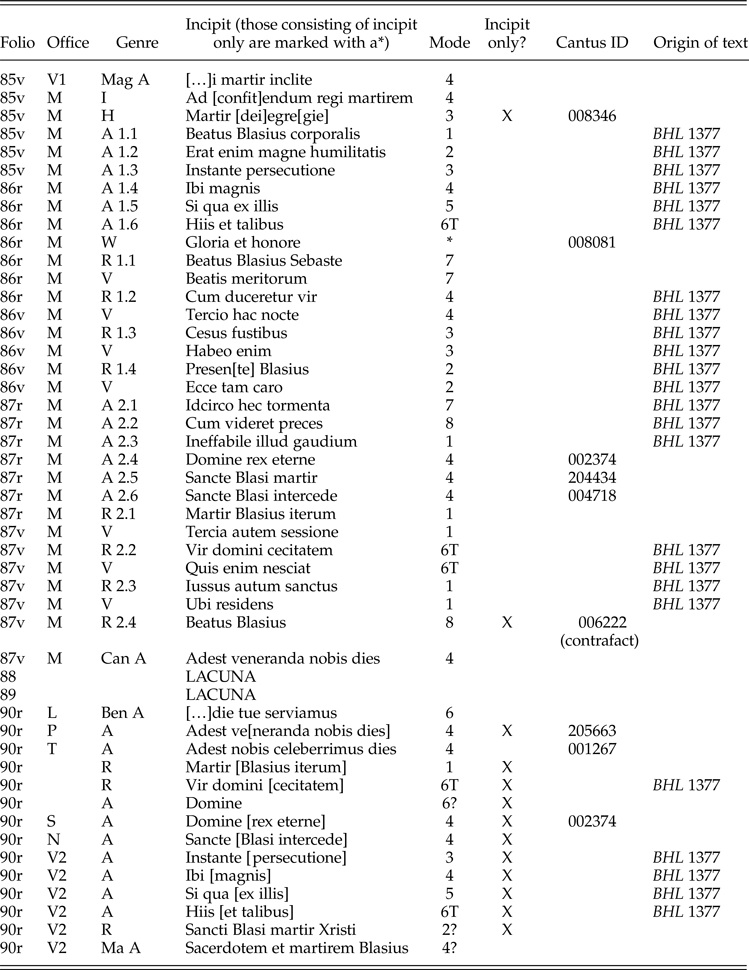
Table 1 gives the contents of the Office for Saint Blaise as transmitted in the fourteenth-century Preetz antiphoner, D-PREk Reihe V G1.
Contents of the Office for St Blaise, Preetz antiphoner, D-PREk Reihe V G1

The Preetz Office for Saint Blaise, incompletely transmitted due to lacunae in the manuscript, begins with the fragmentary Magnificat antiphon for first Vespers, […]i martyr inclite, and is then largely complete through the second nocturn of Matins. The narrative texts of the first nine antiphons and all but three of the Matins responsories were adapted from the passio identified as Bibliotheca Hagiographica Latina (henceforth BHL) 1377, discussed in the following.Footnote 25
Following the series of nine modally ordered Matins antiphons are three mode-four antiphons: Domine rex eterne, Sancte Blasi martir and Sancte Blasi intercede (see Table 1), all borrowed from other Offices to expand the original secular cursus of nine antiphons to the monastic cursus of twelve. The three added antiphons were carefully selected for their modal and textual similarity: all are in the fourth mode. Moreover, their texts are intercessory, in contrast to the narrative texts of the original nine.Footnote 26
Three canticle antiphons in the Preetz Office for St Blaise – the two Magnificat antiphons and one for the Benedictus – appear to be ornate double antiphons from the original layer of composition. Unfortunately, all are too fragmentary to analyse.Footnote 27 Two additional canticle antiphons from the Rheinau office Dum satellites and from the Office for Saint Martin were later added in order to complete the monastic cursus.Footnote 28 These additions are further indications that the Preetz Office was originally composed according to the secular cursus for a non-Benedictine community.
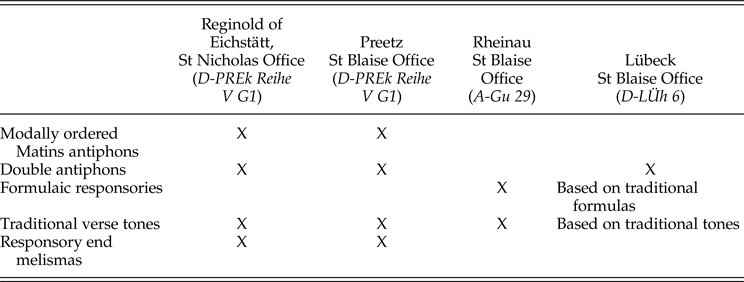
Table 2 compares structural and formal elements of Reginold's Office for St Nicholas with those of the three known German proper Offices for St Blaise: the Preetz Office, the Rheinau Office and the Lübeck Office. As Table 2 shows, the Preetz Office is the only one that, like the Nicholas Office, uses a modally ordered series of Matins antiphons, the double antiphon and non-formulaic responsory melodies.
Structural and formal elements in the Offices for St Nicholas and St Blaise

Double antiphons
According to Dobszay and Szendrei, in its simplest form, the ‘double antiphon’ repeats a given antiphon melody twice in the setting of a single text. Others may repeat only part of the melody or may join two different melodies in a single setting. Complex examples subtly rework received melodic elements through variation, embellishment or interpolation, sometimes transforming the function of phrases, or combining phrases from separate melodic types.Footnote 29 Double antiphons appear in the Trinity Office of Stephen of Liège and appear among the mode-one Matins antiphons from the repertoire of Saint Denis.Footnote 30 Importantly for this study, they are found in Reginold of Eichstätt's Office for Saint Nicholas.
Beatus Blasius, the first Matins antiphon from the Preetz Office, is an example of a double antiphon based on a simple received antiphon melody, such as that of Haec est virgo sapiens shown in Example 1.Footnote 31 This melody comprises an opening phrase (a) that rises to a, a second phrase (b) that descends from b to G, and a closing phrase (c) consisting of a formulaic cadence to the finalis D. This example is only one of the hundreds of antiphons that use variations of this simple received melody.
Ant. Haec est virgo sapiens.

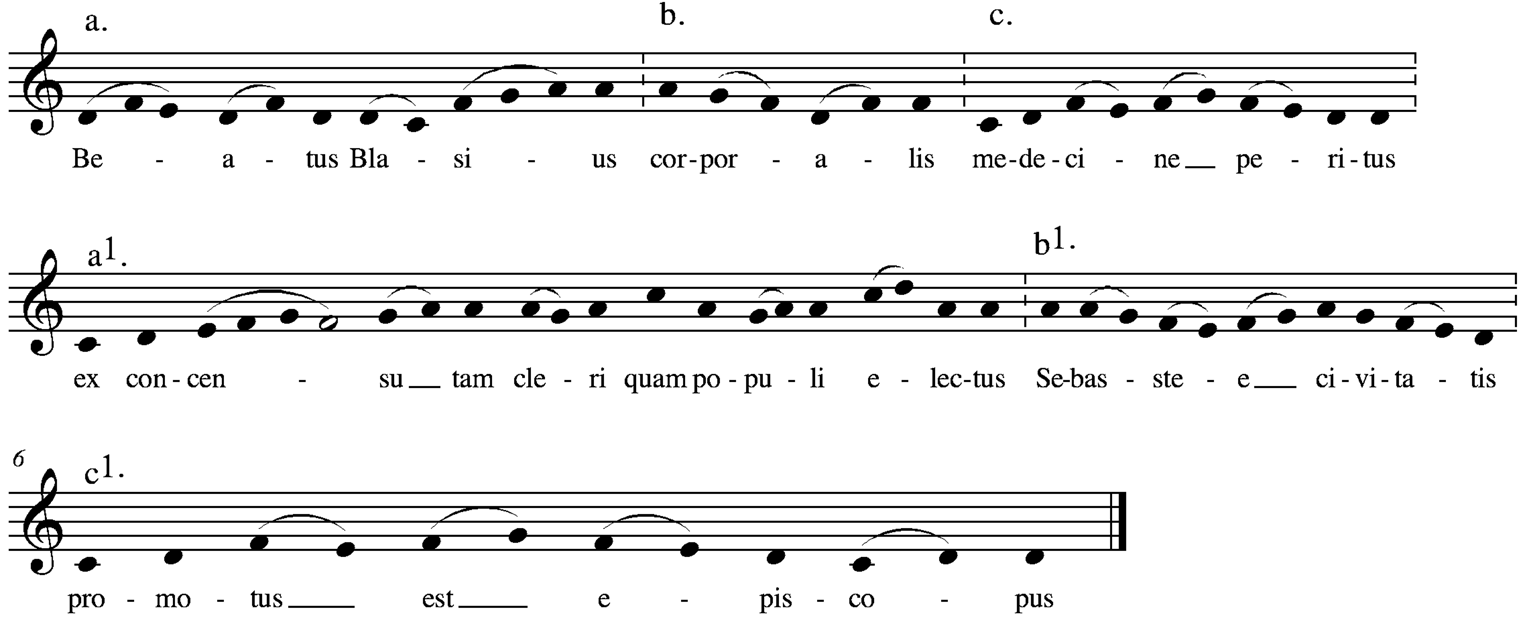
The antiphon Beatus Blasius from the Preetz Office transforms this received melody into a double antiphon consisting of two embellished repetitions, dividing the text into rhyming lines of unequal length:Footnote 32 ‘Beatus Blasius corporalis medecine peritus / Ex consensu tam cleri quam populi electus Sebastee civitatis promotus est episcopus.’
Example 2 lays the text and melody out in such a way as to emphasise the musical parallelism between the two iterations of the melody.
Ant. Beatus Blasius corporalis, Office for St Blaise, Preetz antiphoner, D-PREk Reihe V G1, fol. 85v.

As shown in Example 2, both iterations of the melody are built on the same three-phrase structure identified in Example 1: phrase (a) rises from the final of D to the reciting tone of a; phrase (b) descends from a through F to D, and phrase (c) consists of an elaborated undertone cadence to the finalis D. The second iteration of the melody expands in length to accommodate the longer text, and expanded upward in range to emphasise the unanimity of Blaise's election. Each of the other antiphons in the modally ordered Matins series is constructed with the same doubling technique, reinterpreting received antiphon melodies in similar ways. This is most apparent in the authentic mode antiphons, and less so in the plagal mode ones due to their limited ambitus and the circularity of their melodies.
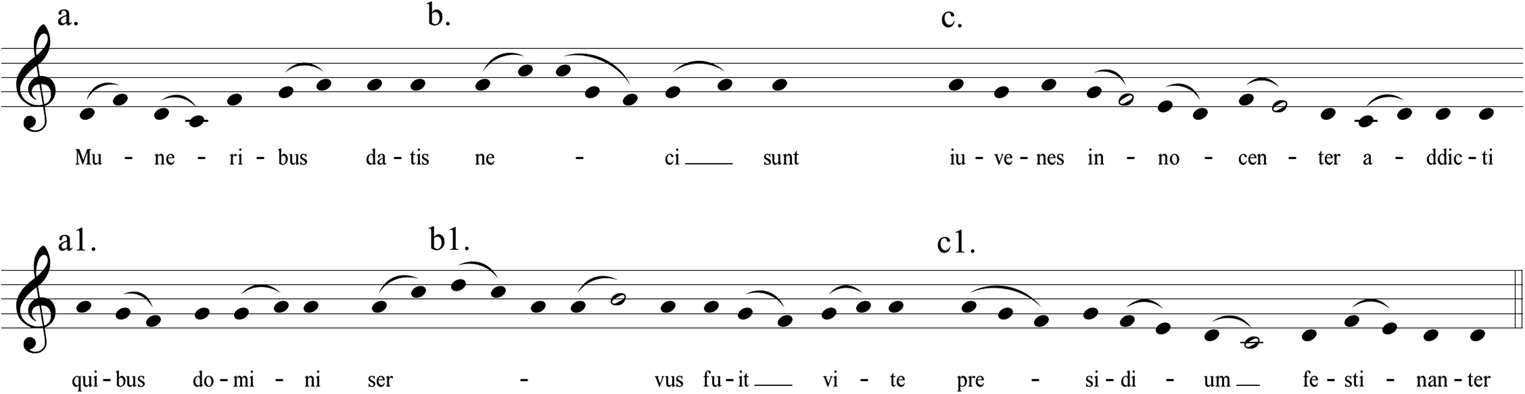
Reginold's Office for Saint Nicholas also uses double antiphons, though not exclusively. The first of its modally ordered Matins antiphons, for example, is a simple, albeit embellished, mode-one antiphon. However, the ninth antiphon, the Mode 1 Muneribus datis, is a double antiphon very similar in structure to Beatus Blasius described previously. Muneribus datis comprises two iterations of the mode-one melody. Unlike in the previous example, the two lines are equal in length, but do not rhyme: ‘Muneribus datis neci sunt iuvenes innocenter addicti / Quibus domini servus fuit vite presidium festinanter.’
As Example 3 shows, the first line begins with a typical mode-one opening phrase (a) that turns around the finalis of D before rising to the reciting tone of a. The second phrase (b) recites around the reciting tone of a, rising momentarily to c. The third phrase (c) descends stepwise into an undertone cadence to the finalis of D. The second melodic iteration eschews the opening gesture, beginning immediately with a recitation on a (a1). Beginning from this higher point, the phrase (b1), the melody expands upward in range by one step to reach the upper octave of d on the text ‘servus’, Nicholas's sanctity and humility, and his miraculous redemption of the innocent captives. The last phrase (c1) offers a variation on the stepwise descent and undertone cadence to D. As these examples demonstrate, both the Saint Nicholas and the Saint Blaise Offices creatively adapt received antiphon melodies into longer varied and embellished double antiphons in a similar manner.
Ant. Muneribus datis, Office for St Nicholas, Preetz antiphoner, D-PREk Reihe V G1, fol. 11v.

Matins responsories
Owing to a lacuna that begins in Responsory 2.4 and continues through the third nocturn (see Table 1), the exact manner in which the original secular series of responsories was expanded to the longer monastic cursus cannot be determined. Five of the responsory texts (nos. 1.2, 1.3, 1.4, 2.2 and 2.3) are derived directly from the passio (BHL 1377) and probably constitute part of the original office. The texts of responsories 1.1 and 2.1 are not adapted directly from the passio and may therefore represent later additions. Responsory 2.4 is a contrafact, and most likely a later addition as well.
As Table 2 shows, the Preetz Office is the sole Office for Saint Blaise that, like the Saint Nicholas Office, contains non-formulaic Matins responsories, traditional verse tones and lengthy end melismas. Selected responsories from the Preetz Office use a variation form and consist of melismatic, ornamented variations based on a simple melodic idea. David Hiley identified a similar form in the responsory Lugens pie defunctum for Saint Mary Magdalene, noting that this example is ordered not by traditional formulae, but rather by a ‘repetitive structure which gives the chant its own internal sense’.Footnote 33
Madeleine Bernard independently described responsories using variation form in the office compositions attributed to Bruno of Tours (1002–54) and other examples from the tenth to eleventh century. Bernard writes that in his responsories, Bruno
uses as material certain models which he presents two or three times, or sometimes more, in different aspects: it is the amalgam of these interpolated clauses that constitute the melody of the responsory. Naturally, all the variations have the same melodic scheme as the initial model, and therefore all have the same final – hence, the impression of stasis given by this melody that goes nowhere. The variations elongate the original model to differing degrees, while preserving its essential structure.Footnote 34
Importantly for this study, Bernard identifies the Office for Saint Nicholas as a precedent for the use of the variation-form responsory.Footnote 35
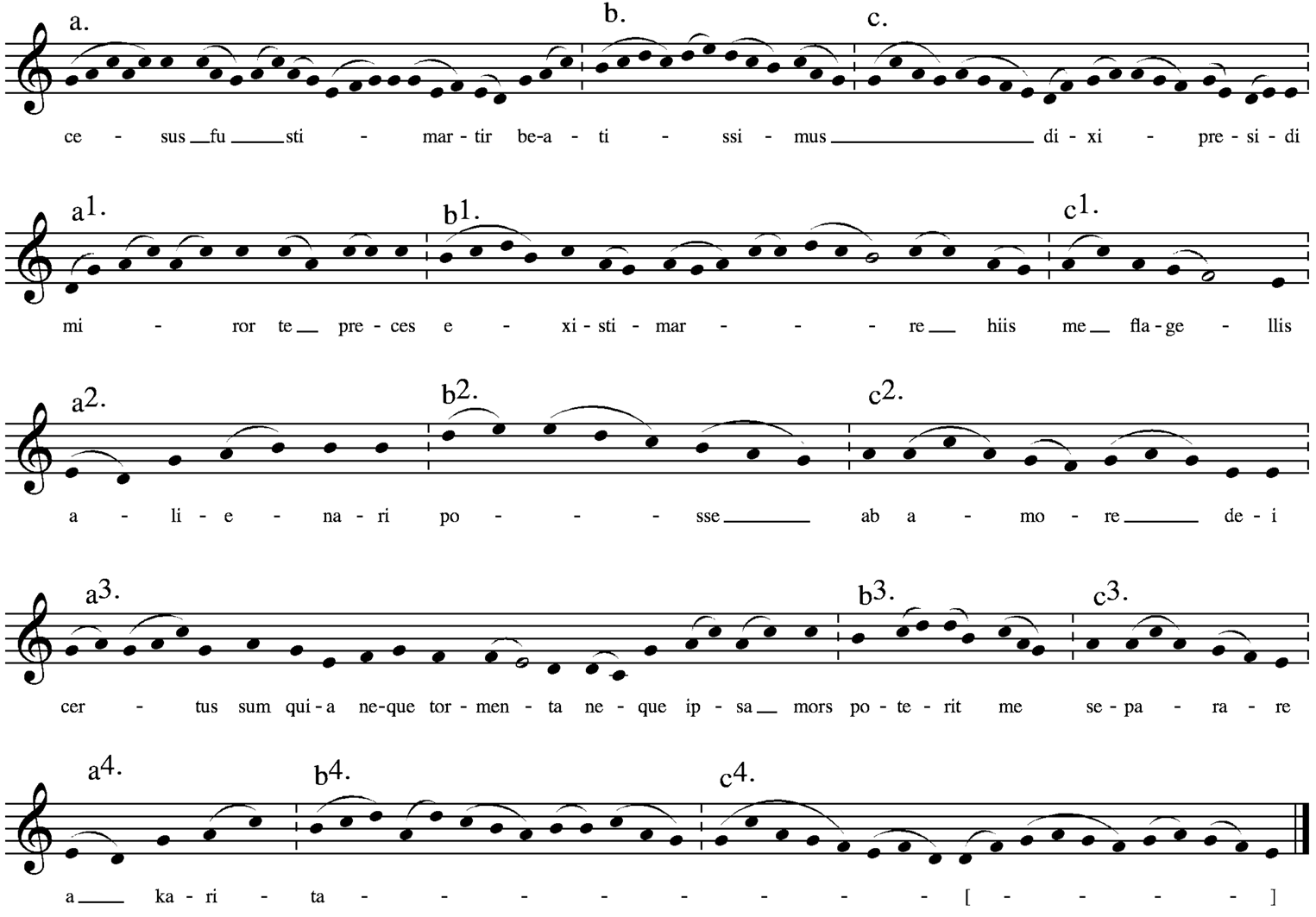
The comparison of examples of variation-form responsories from the Preetz Office for Saint Blaise and the Saint Nicholas Office demonstrate this similarity.Footnote 36 The mode-three responsory Cesus fustibus from the Preetz Office exemplifies the variation-form responsory: its structure consists of a series of melismatic variations of a simple model melody (what Bernard calls the ‘dessin primitif’), proposed in Example 4.
Model melody of Resp. Cesus fustibus.

Example 4 represents a theoretical melody underlying the variations in Cesus fustibus in its simplest conceivable form. Built around the central pitches of E, G, a and c, this melody can be conceived of as consisting of three phrases: phrase (a) descends from the finalis of E one step to D, before ascending through G and a to the theoretical tenor of c. Phrase (b) ascends and descends through the trichord of b-c-d, before resolving to G. Phrase (c) ascends momentarily from a to c and back, before descending via the trichord G-F-E to a final cadence on E.
The responsory Cesus fustibus consists of five varied statements of this melody. The variations of each phrase contrast in length and method of variation, as shown in Example 5.
Resp. Cesus fustibus, Office for St Blaise, Preetz antiphoner, D-PREk Reihe V G1, fol. 86v.

The five variations of this melody divide the text in which St Blaise defies his torturer into five lines of varying length:
As Example 5 shows, the variations of the opening phrase range from the simplest version in (a4), to the most elaborate in (a) and (a3). In these elaborated versions, the melody plays around the pitches G–a–c before descending to make the typical mode-three opening E–D–G–a–c at the very end of the phrase. The end melisma on the word karitate constitutes the bulk of the fifth statement of the melody.
The same compositional structure of varied repetition appears in the mode-five responsory Qui cum audissent from the Saint Nicholas Office. The model melody for this responsory is reconstructed in Example 6.
Model melody of Resp. Qui cum audissent.

The hypothetical model melody comprises three phrases: the first phrase (a) consists of a rising triad F-a-c, followed by a confirmation of the reciting tone, c-d-c. The second phrase is arch shaped, ascending from c to the octave f, and descending back to c. The third and final phrase consists of a decorated stepwise descent from the reciting tone c to the finalis F. The responsory Qui cum audissent consists of four iterations of this model melody, as transcribed in Example 7.
Resp. Qui cum audissent, Office for St Nicholas, Preetz antiphoner, D-PREk Reihe V G1, fol.12r.

The text of this example is broken into four lines: ‘Quicum audissent sancti Nicolai nomen / statim expandunt manus / utraque ad celum salvatoris laudantes / clementiam.’ As in the previous example, each of these lines is set with a varied and embellished statement of the melody. The last statement contains a reduplicative end melisma in xxy form on the word clementiam, which has attracted scholarly attention for its later use as a Benedicamus domino setting.Footnote 38 The melisma comprises the second and third phrases of the melodic statement. The statement begins with phrase (a3) an abbreviated version of the opening phrase F–F–c. The second phrase (b3) expands in range, extending upward to include the upper neighbour to the octave of the finalis g and the lower neighbour of the reciting tone, b-flat. This second phrase is then repeated, creating the xx part of the melisma's form. The final phrase, labelled y, is reinterpreted as a stepwise descent from c to F, followed by a coda that confirms the arrival on F. Thus, as in the previous example, the melisma comprises a structural part of the melody, without which its form would be incomplete.
In sum, the responsories of the Saint Nicholas and Preetz Offices for Saint Blaise are non-formulaic and take the form of variations – some on a single melodic model, as demonstrated by the preceding examples, and others taking more complex variation forms. As these examples show, the Preetz Office for Saint Blaise and the Saint Nicholas Office share similar structures, forms, and compositional strategies for the adaptation of received melodies.
One could explain the offices’ compositional similarities in other ways; for instance, the Preetz Office for Saint Blaise could have been written as late as the fourteenth century in an earlier style, in imitation of the Nicholas Office. However, it seems unlikely that a much later composition would match its model so closely in style across text, form and overall structure, yet without any obvious use of contrafact technique. For instance, the thirteenth-century Lübeck Office uses some double antiphons in the style of the Nicholas Office, but lacks its modal ordering and variation-form responsories. Perhaps most importantly, the prose texts of the Preetz Office point to an era of composition prior to the advent of Offices in accentual rhymed verse c.1000–50.Footnote 39 Finally, both Offices were originally composed according to the shorter secular cursus used in the liturgy of canons and canonesses, and only later expanded to the longer monastic cursus through the addition of antiphons and responsories.Footnote 40 If the Blaise Office was indeed written for a community of canonesses, it was mostly likely expanded to the monastic cursus during the twelfth century, when many German convents were reformed and brought under the Benedictine Rule.Footnote 41 It is also telling that a Benedictine reformer chose to preserve and expand the older Preetz Office for Saint Blaise with elements from the more popular Rheinau Office, instead of simply replacing it with the latter. The Preetz Office for St Blaise must have been important to the community in whose liturgy it was observed and considered worthy of preservation.
Further historical context
The historical context in which the Office was written and the contents of the passio offer important clues as to its intended audience. The prominence of women, and widows in particular, in Blaise's miracles and the posthumous foundation of his cult as narrated in the passio (BHL 1377), the life on which the Office was based, strongly suggest an intended audience that was female. Saint Blaise's miracles all involved assistance and healing to women and children. Widows attended to him during his imprisonment, buried him and established his posthumous cult. The saint would therefore have served as an ideal protector for a female patron, and particularly a widow.Footnote 42
If we accept the account of Anonymus Haserensis, then there is a good argument to be made that the Office was written for Reginold's friend and patron, Pia, the founder of Kloster Bergen bei Neuburg, located 18 kilometres southwest of Eichstätt. The chronicler extolled Pia as much for her artistic ability as for her largesse:
Moreover, that same bishop [Reginold] loved a certain very important lady called Pia who is reputed to have surpassed all other women of her day by the distinction of her handicraft. She adorned our church [Eichstätt Cathedral] with many a marvelous ornament, not only by working and setting a model herself, but also by teaching many other women many varieties of artistry. At last, giving herself over fully to the Lord, she built a nearby convent for holy women, Bergen, which she enriched with an endowment befitting royalty – for she was extremely rich – and adorned with every kind of art object before she turned it over to the special protection of the Church of Rome. John, the Apostolic Vicar [Pope John XV, r. 985–96], confirmed this deed with his privilege, which is in our possession today; and proclaimed a most terrible anathema against anyone doing any injustice to that convent.Footnote 43
According to the Bergen cloister chronicle of 1359, Pia of Bergen was Biletrud, first cousin of Otto II and the former Duchess of Bavaria.Footnote 44 It is critical to understand her status as a noble widow as it elucidates her relationship with the bishop, her artistic involvement in the rebuilding of Eichstätt Cathedral and her founding of Kloster Bergen. An appreciation for the roles of noble widows in Ottonian society as donors, monastic founders and liturgical artists helps to explain why Saint Blaise's was such a fitting patron for Biletrud and her community. Read against this background, the relationship between the elderly bishop Blaise and the widow who cared for him and established his posthumous cult offers a poignant model for the spiritual friendship and long relationship of protection, patronage and artistic exchange shared by Bishop Reginold and his patron, Biletrud.
Ottonian patronage of the cult of Saint Blaise
As the first cousin of Otto II, Biletrud was positioned close to the Ottonian court. Eichstätt historian Stefan Weinfurter has hypothesised that Reginold's Offices for Saint Nicholas and Saint Blaise, two of the most revered eastern saints, were written for the circle of Theophanu, the Byzantine wife of Emperor Otto II, and Biletrud's cousin by marriage.Footnote 45 If we accept Anonymus Haserensis's claim that Reginold wrote the Saint Nicholas Office before his 966 election, which preceded Theophanu's arrival in Saxony by at least six years, it seems that the Nicholas Office, at least, could not have been written for Theophanu herself. More fundamentally, Rosamund McKitterick has challenged Theophanu's centrality in the importation of Greek culture into the German-speaking lands, arguing for a more general and dispersed Ottonian interest in Byzantine culture during the later tenth century.Footnote 46
Yet it is evident that the cult of Saint Blaise did receive Imperial patronage during the reigns of Otto II and III. Traces of his cult appear in Otto II's gift in the year 974 to Theophanu of the civitas et curtis of Mühlhausen, where a church to St Blaise was documented from the year 1000.Footnote 47 A relic of Saint Blaise was mentioned in Halberstadt, the city built by Otto II, in 992.Footnote 48 A cloister in Wittekindsburg founded by Theophanu's son Otto III in 993, two years after her death, was dedicated to the Virgin and to Saint Blaise.Footnote 49 As Katrinette Bowarwé has shown, the Imperial foundation of Essen, ruled from 1039 to 1058 by Abbess Theophanu, granddaughter of Otto II and Theophanu, possessed relics of St Blaise by 1051.Footnote 50 Together, this evidence demonstrates that the Ottonian royal family supported a strong devotion to Saint Blaise. Thus, Weinfurter's claim that Reginold composed the Office of Saint Blaise for an Ottonian royal patron seems reasonable, though this patron was not necessarily Theophanu herself. Biletrud, her first cousin by marriage and Reginold's patron, seems an obvious candidate. Her connection with Theophanu provides a logical channel through which Biletrud could have learned of Saint Blaise, or even obtained a relic of the saint, prior to the founding of her community at Bergen. The possibility of Biletrud as the patron of the Saint Blaise Office becomes more compelling when we consider her position as a noble widow.
Ottonian widowhood
Widowhood left Ottonian aristocratic women in a vulnerable state – personally, financially and politically. Considered against the historical context of Ottonian widowhood, Anonymus Haserensis's remarks about Biletrud reveal not only her generosity and accomplishment as an artist and teacher, but also the specific strategies that she used to safeguard her financial assets, elevate her social status, and cultivate beneficial relationships. The daughter of Gerberga of Saxony and her first husband Giselbert, Duke of Lotharingia, Biletrud was married to Berthold, Duke of Bavaria, in 939 at the age of nine or ten.Footnote 51 She bore their only son, Henry the Younger, around 945 when she was fifteen or sixteen, and was widowed in 947 at the age of seventeen or eighteen.Footnote 52 She did not remarry, but instead, remained a widow for the rest of her life: a position which was both vulnerable and yet not without certain advantages.
Upon the death of her husband, a Ottonian widow who did not remarry might potentially gain control of her own wealth for the first time.Footnote 53 Yet she was also vulnerable to the accusations of moral impropriety that could serve as a pretext by her husband's kin to seize her inheritance, typically, dower lands given in marriage as a provision for widowhood.Footnote 54 Widows had to rely on relatives, noble allies and sympathetic churchmen to ensure that they would receive their inheritance, especially when far from their place of origin.Footnote 55 In Biletrud's case, the dower lands she inherited in 949 were seized by her husband's natal family and not returned to her until 976, twenty-seven years later, thanks to the intervention of the Empress Theophanu, her first cousin by marriage.Footnote 56
Remarriage also brought risks to the widow's financial independence and her children's prospects. While some churchmen considered remarriage to be inherently sinful, young widows were often pressured by their family of origin to remarry for financial reasons and to create political alliances.Footnote 57 Such was the case for Biletrud's mother, Gerberga, who was remarried to Louis IV (Lothar), of West Francia in 939, months after her first husband's death. Upon remarriage, widows lost control of not only their inheritance, but also the wardship of their children, giving political rivals a dual reason to marry the widowed mothers of underage heirs.Footnote 58
A woman could avoid both the vulnerability to scandal and the pressure to remarry by becoming a deo sacrata, or consecrated widow, which required taking a vow of chastity, but not of poverty or obedience.Footnote 59 In essence, consecration allowed the widow to continue to live in the world as an uncloistered female religious. Demographic shifts in the tenth and eleventh centuries resulted in many noble women outliving their husbands, creating a large population of wealthy aristocratic widows. These women were responsible for maintaining family piety and memory, including the memorial prayer, or the spiritual custodianship of deceased family members.Footnote 60 According to Katherine Clark Walter,
from the tenth through twelfth centuries, both monks and secular clerics reiterated the dangers a chaste matron faced if she lived outside of a structured community. However, canon law, narrative sources, and liturgies initiating the profession of widowhood suggested that a visible cadre of women engaged in just such a program of chaste widowhood in the world, a program characterised by prayer, distinctive clothing, prophetic utterings, and a particular intercession for the deceased spouse in Purgatory.Footnote 61
It is likely that Biletrud become a consecrated widow in order to remain in the world, retaining control of her finances as well as her son's education and political prospects.Footnote 62 Biletrud would have required permission for consecration as well as ongoing protection from her bishop, her immediate ecclesiastical superior, and her vow of chastity would have made it possible for the two to maintain a spiritual friendship. It helps to explain her involvement in liturgical art associated with the expansion of Eichstätt Cathedral, and gives context for the models of vidual piety in Reginold's passio for Saint Blaise (BHL 1377). Anonymus Haserensis's comment that Biletrud ‘in the end, completely turned to the Lord’ (‘ad ultimum perfecte conversa ad dominum’) is consistent with the historical reality of consecrated widowhood as a liminal status between secular life and an eventual retirement to the cloister.Footnote 63
Embroideries
While Anonymus Haserensis named Reginold the finest musicus of his day, he praised Biletrud as surpassing all of her contemporaries in the visual arts, conveying a sense of parallelism and parity between the two artists. He similarly praised variety and ornament as qualities in both of their work.Footnote 64 He described both leaders as taking on ambitious building projects: Reginold, the expansion of Eichstätt Cathedral, and Biletrud, the building of Kloster Bergen. He extolled Biletrud as a teacher, and while he did not explicitly mention Reginold's teaching, the transmission of his offices, in the absence of staff notation, would have required direct transmission.
Biletrud's adornment of Eichstätt Cathedral doubtless would have included embroidered liturgical textiles. In this, she would have imitated the example of Carolingian and Ottonian noble women in creating public artworks that conferred status and influence upon their makers. According to Jane Tibbetts Schulenburg, the art of embroidery provided a visible medium for female piety and sanctity for both the makers and the patrons of such works.Footnote 65 Women of all classes were praised for their skill and achievement in creating the costly embroidered vestments and ecclesiastical textiles that adorned church spaces and liturgies. Liturgical embroideries had both a practical and a symbolic value: the creation and donation of liturgical embroideries were acts of piety which, presented as special gifts to churchmen and religious institutions, became visible and durable parts of the liturgy.Footnote 66
As Simon MacLean has shown, the gendered art of embroidery also served as a means for powerful women to engage in political discourse.Footnote 67 One witness is the so-called ‘Kriegsfahne’ made by Biletrud's mother Gerberga, from 939 Queen of West Francia, to commemorate her role in the defeat of Count Reginar III of Hainaut.Footnote 68 In creating embroideries for Eichstätt Cathedral, Biletrud participated in an established practice of female patronage that strengthened her relationship with the bishop, and visibly established her community's status within the cathedral. Biletrud's adornment of Eichstätt Cathedral likely coincided with Reginold's expansion of the building, which culminated in the translation of Saint Willibald's relics to a new altar on 22 April 989.Footnote 69 It is possible that the so-called ‘Willibaldskasel’, an embroidered silk chasuble formerly displayed in the Saint Willibald chapel, may be the work of Biletrud and her students.Footnote 70
Schulenburg further notes that liturgical embroideries were exchanged within a gift economy that anticipated reciprocity in the form of counter-gifts and prayers for the salvation of the donor and her family.Footnote 71 This notion of reciprocal gift-giving within the bounds of a spiritual friendship is mirrored in the anonymous chronicler's ekphrastic descriptions of Reginold's and Biletrud's respective liturgical artworks. Named by Anonymus Haserensis as Reginold's sole patron and his artistic counterpart, Biletrud is the logical recipient of a historia that celebrates vidual piety, spiritual friendship between bishops and widows, and widows as donors and the keepers of saints’ cults. While it is possible that Biletrud commissioned the Blaise passio and office, it is also conceivable that Reginold composed these works for her as a reciprocal gift to reward her artistic patronage of Eichstätt Cathedral. One thing is certain: the gift of a historia would have also required time spent on direct and intensive oral teaching that relied on singing, listening, imitation and repetition: a process that fostered musical and textual community, while strengthening personal relationships.
Women's religious foundations
The founding of Kloster Bergen was the last of Biletrud's works recorded by Anonymus Haserensis. The foundation of a convent was a common strategy of Ottonian aristocratic women to protect their financial assets in anticipation of widowhood by rendering their dower the inalienable property of a religious community and providing them with a safe place of retirement.Footnote 72 The convent thus ensured aristocratic women against the fall in status and financial vulnerability associated with widowhood.Footnote 73 The widow, once consecrated, could remain independent, staying in the secular world as long as convenient to manage her affairs, and retiring to the safety of the convent when she wished.Footnote 74 This was particularly important for those widows whose children who had not yet come of age.Footnote 75 Widowed as a teenager and deprived of her dower, Biletrud was not able to found a convent until the return of her inheritance in 976, the same year her son, Henry the Younger, was named Duke of Carinthia. The intervening twenty-seven years must have been a precarious time for her, both personally and financially.
Biletrud's foundation at Bergen imitated models of female piety established by the Ottonian aristocratic women of her maternal family, described by Rosamund McKitterick as an ‘august circle of noble and royal benefactors of foundations for women which formed in association with the daughters and nieces of the Ottonian rulers at Quedlinburg, Gernrode, Essen and Gandersheim’.Footnote 76 Ottonian aristocratic women were prominent patrons of the imperial houses of canonesses where they were educated as girls, and which they protected as secular rulers, ruled as abbesses and retired to in widowhood.Footnote 77 In retiring to Kloster Bergen, Biletrud imitated the examples of her grandmother, Mathilda, foundress of Quedlinburg, and her mother, Gerberga, who retired as abbess of Notre-Dame in Soissons following her son's succession to the throne.Footnote 78 Biletrud's foundation of Kloster Bergen was both an act of piety that followed gendered practices of patronage and a practical measure that protected her inheritance and ensured her secure retirement.
Spiritual friendship and vidual piety in the passiones for Saint Blaise
It is difficult to imagine a patron saint more fitting for the widow Biletrud than the bishop and martyr Saint Blaise, whose followers were overwhelmingly women and children. The earliest known exemplar of the passio (BHL 1377), on which the Preetz Office is based, appears in the late eleventh-century passionale D-Mbs Clm 14031 from the abbey of St Emmeram.Footnote 79 Its distribution is limited to approximately a dozen sources, most from the German-speaking lands.Footnote 80 The narrative of BHL 1377 closely follows its model, the earlier and more widely distributed passio (BHL 1370) translated from a Greek original.Footnote 81 At least forty-five sources of this earlier recension remain in sources primarily from France and Italy. Both recensions offer exemplars of vidual piety and a model of spiritual friendship between bishops and their female followers. The redactor of the later recension BHL 1377 expands the narrative with lengthier and more elevated prose, but seldom departs from its content. Based on its multiple biblical allusions and Greek play on words, Albert Dufourcq described the redactor of the later recension BHL 1377 as a ‘scholar steeped in theology’.Footnote 82 Reginold certainly fit this description: his erudition, literary ability, musical gifts and knowledge of Greek all support the possibility that he penned the later passio as well as the office based thereon.
A close comparison of the two passiones, in particular, the three episodes that involve the character of a poor widow, offers insight into the intended audience for the later recension, BHL 1377. This later passio emphasises specifically Ottonian characteristics of vidual piety: the widow's responsibility for feeding the poor and her involvement in the propagation saint's cults. It refers directly to the biblical tale of the widow of Sareptha, which recalls the rite of the Consecration of Widows. These and other additions to the narrative offer further support to the hypothesis that Reginold composed the passio and Office for Biletrud, or Pia of Bergen.
The earlier passio BHL 1370 introduces St Blaise as the greatest among the martyrs of Cappadocia, marvelling that his followers included women as well as men. The narrative opens after the retired bishop's retreat to a hermitage on Mount Argus, where he attracts converts and renown through the miraculous healing of both humans and animals. The followers who are healed by Blaise and those who accompany him in martyrdom are exclusively women and children. The character of a poor widow, who appears in three separate episodes, is a constant presence throughout the story. In the first episode, Blaise miraculously recovers the poor widow's sole possession, a pig that had been stolen by a wolf. This episode demonstrates Blaise's compassion for the widow and establishes their spiritual friendship.
In the second episode, the widow, hearing of Blaise's torture and imprisonment, slaughters and cooks the same pig and serves it to him in jail in a candlelit feast. Blaise thanks and blesses her with an oblique comparison to the widow of Sareptha (1 Kings 17:6–17) who fed the prophet Elijah, even while her own family faced starvation. Echoing Jesus's words at the last supper, Blaise asks the widow to memorialise him by similarly burning candles and sharing food, promising material and spiritual rewards to her and anyone who follows her example: ‘Woman, do this in memory of me, and your house will not lack in the good things that are God's. And may whoever imitates you, and does this in memory of me, always receive from my God heavenly gifts and blessings all their days.’Footnote 83 Thus it was understood that the widow's gifts and memorial offerings, and those of anyone who offered similar memorials, would be rewarded, both materially in this life and spiritually in eternal life.
In the third and final episode, the poor widow fulfils Blaise's request for memorial prayer, fostering a flourishing posthumous cult at his grave:
that blessed old woman carried out his memorials according to the request that he made while in jail. And not only did that woman bring her surplus of the fruits of the earth as an offering, but also all of her friends, who, doing according to her tradition, were rewarded with the gift of blessings at that time – not only the faithful widow, but all of her friends. And this has been passed down to this day, to all of the faithful performing memorials to the most blessed and glorious martyr Blaise with candles and hymns and unceasing glory.Footnote 84
The poor widow of the passio is an exemplar of vidual piety: she maintains spiritual friendships with holy men, she offers hospitality in the form of food and comfort, she performs memorial prayers and she inspires others to do the same. Lastly, she nurtures a cult at tomb of Saint Blaise where she offers prayers in the form of sung hymns. The passio thus offers the reader material and spiritual rewards for continuing to honour Saint Blaise on his feast day and offers a devotional exemplar of singing in his memory.
The later recension of the passio (BHL 1377) on which the Preetz Office is based expands the three episodes involving the widow with certain key details. The author of BHL 1377 describes the purpose of the widow's visit to Blaise as to ‘obtain blessing’, emphasising the anticipation of reciprocity.Footnote 85 The author further relates that the elderly bishop rejoiced in the Lord, ‘having been delighted by her devotion and her pious (pia) good will’.Footnote 86 While by no means an unusual descriptor for a holy woman, the term pia, introduced in the later recension, may have acknowledged its intended audience, Biletrud, or Pia of Bergen.
Also new in the later recension is Blaise's statement recognising his aging and imminent death: ‘I know, woman, that my body has now begun to deteriorate and the sooner it finishes the good battle and its course is complete, having served me faithfully, the better. When I have passed to the Lord through martyrdom and my triumph over agony is finished, light candles in this manner in my memory.’Footnote 87 Reginold, too, would have been at the end of his life when he composed the historia for Saint Blaise. It is possible that he included Blaise's speech as a model to guide the widow Biletrud in offering memorial prayer following his own death. The request for memorial prayer articulated in BHL 1377 mirrors exactly the types of personal memorial prayer that was the responsibility of Ottonian consecrated widows, and the institutional memorial prayer that was the spiritual work of women's religious communities. These two forms of prayer were interconnected, as the widow's duty of memorial prayer could be satisfied through the prayers of the communities of religious women that she supported.Footnote 88 Memorial prayer was an important part of the spiritual economy of medieval women's foundations, and this doubtless held true for Kloster Bergen. Patrons – often nuns’ family members – donated money, land and goods in exchange for the nuns’ prayers for the repose of their souls, a reciprocal arrangement that cemented a continuous relationship between the community and the regional elite.Footnote 89
Also new in the later redaction is Blaise's explicit direction to the widow to feed the poor. He instructs her, saying
and if you have extra among your provisions, distribute it to the poor and destitute. And may my God, who said ‘what you do for the least of these, you do for me’; he, who at the prayers of his servant Elijah, made the flour in the widow's jar never decrease, nor the oil in her jar diminish, make your house likewise never want for necessity.Footnote 90
This passage combines two scriptural references: the first quotes Matthew 25:39, creating a Christological frame for the second, a reference to the story of Elijah and the widow of Sareptha. While the earlier recension of the passio refers to this episode only indirectly, the later recension quotes Elijah's promise that if the widow fed him, she would be blessed with plenty. The reference to Elijah and the widow of Sareptha would have also brought to mind the liturgical rite of the Consecration of Widows, in which the widow took a vow of celibacy and obedience to the bishop. Following the widow's veiling, the bishop prays:
Console, O Lord, this servant of yours, bound to the hardship of widowhood, as you deigned to console the widow of Sareptha through the prophet Elijah, and grant her the fruit of chastity that she might not recall her former pleasures and know by desire the enticement of sin, so that she might bow down to you alone, for which she may receive the reward of delightful sanctity to the six-fold degree.Footnote 91
The allusion to the widow of Sareptha would have reminded the reader of her own consecration, her submission to the authority of the bishop, her vow of chastity and the promise of material and spiritual rewards for her labours.
The combination of the two biblical references moreover brings the example of the widow of Sareptha into harmony with Christian parable, transmuting her charity to Elijah into charity for the poor. The widow's responsibility of the poor reflects a particularly Ottonian concern.Footnote 92 The ideal of the aristocratic widow as charitable patron was exemplified by Biletrud's own maternal grandmother Mathilda, widow of King Henry I, whose miracles focused on acts of poor relief.Footnote 93
The later recension also emphasises the poor widow's role in the development of the cult of Saint Blaise. It relates how she was joined in memorial prayer at his tomb by ‘many others from among her family, neighbours, and friends’Footnote 94 and that the faithful continued the annual observation where they ‘give alms, receive the poor, burn candles and lamps, and celebrate with hymns in his honour and to the glory of God’.Footnote 95 The later recension thus justifies widows’ involvement in saint's cults as shrine keepers, pilgrims, donors and singers. A similar ideal is visible in descriptions of devotion to martyrs and pilgrimages to saints’ tombs in the Epitaphia Adelheidis written for Empress Adelheid, Biletrud's aunt by marriage.Footnote 96 In short, the later recension offers of model of vidual piety in keeping with vitae celebrating the Ottonian female saints who were among Biletrud's immediate kinswomen.
Given the many parallels between the poor widow of the passio and Biletrud's own biography, it is difficult to imagine a more appropriate patron saint for the noble widow and monastic foundress. Both widows experienced privation and restoration of material possessions, and both donated to the church within the context of a spiritual friendship with a bishop. The passio BHL 1377 provided a model of female piety that paralleled Biletrud's own history and justified her friendship with the bishop, her donations of liturgical art, her foundation of a religious house, and her devotion to the cult of the Byzantine saint. As a gift to Biletrud and her community, Reginold's historia for Saint Blaise brings the hymns of the poor widow and her followers at the tomb of Saint Blaise into the hic et nunc of contemporary liturgical commemoration.
Is it anachronistic to suppose that the intended audience of an Ottonian-era historia could have been a noble widow? The evidence suggests otherwise. Madeline H. Caviness has documented numerous examples of wealthy and powerful women – abbesses, queens, widows and heiresses – as patrons of books and donors of liturgical goods in the eleventh and twelfth centuries.Footnote 97 Adam S. Cohen has observed that Ottonian abbesses, in particular, enjoyed a status on par with royalty and bishops in terms of their patronage of art, architecture, historical writing and luxury books. ‘Like their episcopal counterparts’, Cohen explains, ‘such abbesses as Hitda, Uta, Methilda, and Theophano commissioned luxury manuscripts, rebuilt their churches, and filled them with precious objects to express their religiosity and to establish the importance of their foundations within the social and ecclesiastical hierarchy of the realm.’Footnote 98 He notes that the churches and abbeys of Ottonian Germany benefitted from the patronage of secular women as well ‘whose familial connection created a permeable membrane between court and cloister’.Footnote 99
The evidence for individual women as patrons of vitae and liturgical music during the Ottonian period and high Middle Ages is scant but suggestive. As Simon MacLean has argued, the new life of St Clothildis written for Queen Gerberga, Biletrud's mother, simultaneously functioned as model and praise for its patron. Similarly, he proposes that the vita posterior of Saint Mathilda, the Ottonian queen and consecrated widow who was also Biletrud's grandmother, written c.1102 by a nun of Quedlinburg, was commissioned as a model for her descendants.Footnote 100 The vita posterior of Mathilda depicts the bereaved empress donning a widow's distinctive dress, and turning aside the secular entertainment for sacred song:
[S]he put all this aside and appeared clothed in mourning dress. Thereafter she wanted to hear no one singing secular songs, nor see a play performed, but indeed always heard selected holy songs, concerning the Gospels or other Scriptures, and also sedulously desired for herself that the lives and passions of the saints be sung.Footnote 101
The ideal of the widow as patron of vitae and devotee of religious lives and music was clearly strong among Biletrud's immediate family, though it is unclear if these works were used liturgically.
Evidence from eleventh-century England testifies to the female patronage of the kinds of text and music that constitute liturgical historia. Flemish poet and hagiographer Goscelin of Saint-Bertin composed vitae and possibly office music for the patron saints of the English women's communities of Wilton and Barking.Footnote 102 The cantor-historian William of Malmsbury describes Mathilda of Scotland (c.1080–118), educated at Wilton, as an enthusiastic and generous patron of new liturgical composition:
[Her] one love was of hearing divine service; and therefore she recklessly provided for sweet-singing clerks, speaking well of them all, making generous gifts, and promising more. Thence, as news of her liberality spread wide, clerks famed in song and poetry flocked thither; he who charmed the queen's ears with the novelty of song considered himself lucky.Footnote 103
While fame, honour and promise of material reward drew these poet-composers to their noble female patron, the cleric in the legend of the Widow of Bari was motivated by other interests. The legend, dated by Jones to 1087–150, concerns a widow ‘preeminently endowed in mind, though even richer in wealth and loveliness’. Devoted to Saint Nicholas, she held nightly vigils at his tomb in Bari. A young cleric ‘of noble birth and handsome features who breathed forth the sum of Helicon in both rhyme and meter’ fell in love with the widow. At a banquet she hosted annually on her patron's feast, the widow lamented that none had written ‘a single responsory or prose suitable for praise of that good friend of God, or even a canticle to honour his festive holy day’. Hearing this complaint secondhand, the enamoured cleric began to compose a historia for Nicholas and soon called on the widow, for whom he performed some of his new compositions. Delighted, she offered the cleric the reward of his choice; in response, he demanded her love. The distraught widow was only saved from fulfilling her promise by the intervention of Saint Nicholas, who taught the cleric the error of his ways.Footnote 104
Written some 150–200 years after the Office for Saint Nicholas was composed, the legend's placement of the office's composition after the saint's translation to Bari in 1087 is clearly anachronistic. Yet, Jones argued that the legend was, in fact, modelled on the historical figures of the bishop Reginold and his patron Pia.Footnote 105 While this cannot be proven, the legend is nevertheless remarkable for its portrayal of a wealthy and pious widow living in her own home as the patron and intended audience of a liturgical office. It moreover exemplifies the intertwined nature of personal relationships and liturgical composition seen in the Anonymus Haserensis's account of the bishops of Eichstätt. Together, these examples show that it was within the realm of imagination of tenth- to twelfth-century authors of history, hagiography and legend, for noble women – whether married, widowed or cloistered – to commission vitae and liturgical offices and to receive them as gifts.
The evidence I have presented for authorship and audience of the vita BHL 1377 and the Office for Saint Blaise is admittedly circumstantial. Yet, read together with Anonymus Haserensis's account, it supports the plausible scenario that Reginold wrote both the passio and Office for his patron Biletrud, either as a commission or as a reciprocal gift. Blaise's repeated desire to be memorialised after his death would have borne special significance the elderly Reginold, who evidently composed the office in the last two years of his life, and would have been in the position of seeking memorial prayer from Biletrud and her community. The choice of saints – both Greek bishops – for whom Reginold composed vitae and proper offices at the beginning and ending of his career respectively, is also significant. If Saint Nicholas, patron of youth and clerics, served as an appropriate model for a cleric in his ascendancy, the retired bishop Saint Blaise, the gentle healer and intercessor of widows, served as an equally appropriate model for a bishop nearing the end of his life.
Finally, if the Office for Saint Blaise was written for a founder of a community of canonesses and was transmitted exclusively through nuns’ repertoire, this would explain why it neither achieved the widespread distribution of the Office for Saint Nicholas, nor was preserved in the liturgical books of Eichstätt. Events in Bergen's subsequent history may shed some light on the office's possible transmission. As a house of canonesses, Bergen would have used a secular cursus for the office up until the time of its reform in 1159 by Abbess Regilind of the Benedictine Abbey of Admont. This reform explains the expansion of the office to the longer Benedictine cursus with material from the Rheinau Office Dum satellites, which by this time, was in Admont's repertoire.Footnote 106
The hypothesis that the Office for Saint Blaise found in the late fourteenth-century Preetz antiphoner may be the lost Office of Reginold of Eichstätt gives new insight into the Office compositions of Reginold of Eichstätt, the early veneration of Byzantine saints in the German-speaking lands, and the involvement of consecrated widows in the liturgical arts and propagation of saints’ cults in the Ottonian period and beyond. The figure of the consecrated widow, an avowed religious woman who lived independently in the world challenges the binary of medieval women as either secular and familial, or religious and cloistered. The consecrated widow lived in a liminal space between the world and the cloister, and moved easily between the contexts of family, cathedral and monastic community. She enjoyed relationships, visibility and influence that would have been impossible for either married or cloistered women. We should be aware of her role in the propagation of saints’ cults and her influence as donor and artist in the orbit of the cathedral as well as the monastery.