Be assured, my young friend, there is a great deal of ruin in a nation.
Adam Smith, letter of 1777Introduction
After the British surrender at Saratoga in October of 1777, a young correspondent wrote to Adam Smith of his fear that the British loss was a sign of national ruin. Many must have shared his distress. It would have been hard not to read the potential loss of a large and productive colony as anything other than a sign of decline, especially for those invested in mercantilist understandings of empire as the source of national wealth and prestige. Though certainly related to colonial events, such anxieties might also be understood as indicative of more widespread changes in the way those living in the later eighteenth century understood their relation to the past and, as a result, their expectations for the future. As Jürgen Habermas suggests, “the Zeitgeist, or spirit of the age, one of the new words that inspired Hegel, characterizes the present as a transition that is consumed in the consciousness of a speeding up and in the expectation of the differentness of the future.”Footnote 1
Habermas makes this point in connection with a reading of the German conceptual historian Reinhart Koselleck, who argues that eighteenth-century understandings of change as progress produce related changes in “time-sense” such that time appears to be speeding up and the future becomes less and less knowable. This sense of acceleration, in Koselleck's reading, makes it more difficult for those living in the eighteenth century to imagine the future because what he calls the “space of experience” (the past people use to relate to their present) no longer matches the “horizon of expectation” (their imagination of a potential future).Footnote 2 For Koselleck, in other words, with the Enlightenment understanding of progress comes the possibility that the future will be fundamentally different from the past because new ways of understanding the world create future possibilities that are conceived as new in a way that cannot be entirely derived from previous experience. Koselleck is not the only one to make this claim, and it correlates with, for example, J. G. A. Pocock's argument about the implications of public credit for the sense of the future in the British context. Pocock proposes that “the growth of public credit obliged capitalist society to develop as an ideology something society had never possessed before, the image of a secular and historical future,” which he further characterizes as “the spectacle of a society advancing at high speed into a world it can only imagine as existing in the forms which it may desire.”Footnote 3 Pocock thus describes a shift from a theological future to a market future in which markets and credit structures are contending with a religious notion of futurity as they seek to replace a religious teleology with a market teleology.
This shift in the ways in which those living in the eighteenth century imagined the future is not limited to economic concepts like debt and credit, but can be extended also to science and related developments in technology and industry, and to the implications of the use of reason and rationality more generally. This is a period in which society is increasingly self-conscious about the uncertainty of the future and, as the accounts of Habermas, Koselleck, and Pocock all suggest, increasingly aware of the speed at which the future seems to be arriving. My point, then, is that while late eighteenth-century anxieties about decline might be linked with particular events like the loss of colonies, as they clearly are for Smith's correspondent, such anxieties might also reflect broader changes in time-sense that make it more difficult to imagine the future at all. Fear of decline can be understood as a response to this problem: imagining immanent decline helps to contain an open future by making it knowable. The future will be a repetition of past decline.
But decline, in turn, is not the only way to imagine the future and Smith's (perhaps phlegmatic) composure in answering his correspondent is telling in this regard. “Be assured, my young friend,” he replied, “there is a great deal of ruin in a nation.”Footnote 4 Smith's response forms the basis of the present essay. In part, I want to use Smith's exchange with his young correspondent and its resonance in Smith's Wealth of Nations (1776) to suggest that we might think about the project of political economy as initiated by Smith as a discourse built around decline, seeking either to capitalize on decline or to make its reversal a central disciplinary tenet, in both cases partly through an insistence on quantifiable, measurable criteria by which the longer-term economic performance of a nation could be evaluated, but also by expanding the timescale through which those standards are understood. Similarly, in another work more obviously focused on decline, Gibbon rejects his contemporaries’ fears of Roman-style decline and produces an argument for European security in part through an expansion of the timescale applied to his understanding of decline. The fall of Rome may have been a setback for European manners, but a shift in perspective to the many millennia that surround Rome's rise and fall reveal, according to Gibbon, a broader pattern of progress.
Here, I want to ask how discourses of decline can help us to index changes in the scale on which time and historical distance are imagined and experienced in the later eighteenth century. In its focus on Smith's “great deal of ruin in a nation,” my essay's debt to Donald Winch, who uses this reply as the title of an essay on Smith and the problem of decline, will be obvious. Winch claims that for Smith “centuries were the relevant timescale for some of his observations” and he notes Smith's reluctance to predict “how long the long run would prove to be.”Footnote 5 This essay seeks to amplify Smith's understanding of decline in relation to the problem of historical distance through sustained close reading of a number of key moments in the Wealth of Nations; further, it aims to situate Smith's interest in timescale in the context of similar movements keyed to different timescales in other contemporary thinkers and as part of other contemporary discursive formations, including historiography, natural history, and statistical graphics.
One of my fundamental claims will be the obvious one that 1776 marks a key moment in the political and intellectual understanding of decline in the conjunction between Smith, Gibbon, and the American Revolution.Footnote 6 In addition to this obvious connection, I want to suggest further that the 1770s generally and the work of Smith and Gibbon in particular mark a moment in which understandings of temporal scale are reordered in a variety of discourses, including historiography, political economy, and natural history. While consistent with Michel Foucault's much repeated point about the temporalization of knowledge in the later eighteenth-century,Footnote 7 I will suggest that we can understand the implications of this reordering of temporal scale as a problem of distance that needs to be thought about along broader representational axes, both verbal and visual.Footnote 8 The essay has three parts: one on Gibbon, one on Smith, and a third on William Playfair, whose 1805 Inquiry into the Permanent Causes of the Decline and Fall of Powerful and Wealthy Nations combines Smith and Gibbon while delivering a series of strikingly innovative graphic visualizations of temporal scale.Footnote 9
Gibbon
The problem of decline is a problem of scale and measurement. An argument about decline requires a comparison between past and present that is then implicitly projected into the future. Such comparisons, in turn, imply issues of temporal scale and perspective. In the Decline and Fall, Gibbon's argument for European security depends upon substituting a broad temporal scale of millennia for the more narrow historical parallel between Rome and Europe.
Greece and Rome were particularly important in connection with eighteenth-century anxieties about decline because they presented a surviving record of societies that had gone through the cycle of rise, growth, decline, and fall. For those who believed in a cyclical model of history or in the relevance of historical parallels between temporally and geographically distinct events, then, the example of antiquity offered the challenge of finding a way to prevent the repetition of a cycle that brought the ancient world to an end. As Michael Sonensher suggests,
Chronologically the modern world was [the ancient world’s] heir. What came to matter in the eighteenth century was whether it might also have its fate . . . [whether] eighteenth-century Europe might have to face the prospect of a replay of the ancient cycle of decline and fall under modern conditions of war and debt. Here, the threat to established power and prosperity was not so much the inequality and luxury that, according to a long-standing tradition of political and historical analysis, had been responsible for earlier cycles of decline and fall, but the new financial instruments and fiscal resources that had accompanied the transformation of warfare during the seventeenth and eighteenth centuries.Footnote 10
For Sonensher, then, the problem of decline and fall becomes a problem of debt and credit. His comments offer a particularly useful way of thinking about Gibbon's monumental history as part of a protracted concern that eighteenth-century Europe would share the fate of late imperial Rome.
One curiosity of Gibbon's work, however, is that it begins with neither decline nor fall. Instead, we are offered an extended picture of Roman prosperity under the Antonines, which leads up to Gibbon's encomium (adapted from Robertson): “If a man were called to fix the period in the history of the world, during which the condition of the human race was most happy and prosperous, he would, without hesitation, name that which elapsed from the death of Domitian to the accession of Commodus.”Footnote 11 Such prosperity does not last, but Gibbon never offers a detailed parcelling out of cause, one that would explain the relative importance of internal and external factors in the eventual triumph of barbarism and religion.
Indeed, such a precise account of causality is not Gibbon's point, as Arnoldo Momigliano long ago pointed out.Footnote 12 Instead Gibbon is more concerned to draw distinctions between ancient Rome and modern Europe in consistent but brief insights that have bearing on his contemporary moment. In chapter 3, for example, we learn that “A martial nobility and stubborn commons, possessed of arms, tenacious of property, and collected into constitutional assemblies, form the only balance capable of preserving a free constitution against the enterprises of an aspiring prince” (DF, 1: 85). This reassuring explanation of the Glorious Revolution then expands to Europe later in the same chapter, when Gibbon notes in the final paragraph, “The division of Europe into a number of independent states, connected, however, with each other, by the general resemblance of religion, language, and manners, is productive of the most beneficial consequences to the liberty of mankind” (DF, 1: 106). Gibbon's emphasis on balance of power in a series of differently governed independent states then reaches its culmination in volume 3 of the Decline and Fall with the “General Observations on the Fall of the Roman Empire in the West” (1781).
As its omission from the chapter's title would suggest, cause is not central here. Gibbon indicates that “the decline of Rome was the natural and inevitable effect of immoderate greatness,” and adds, “The story of its ruin is simple and obvious; and instead of inquiring why the Roman empire was destroyed, we should rather be surprised that it had subsisted so long” (DF, 2: 509). His explanation of this “awful revolution” is now distinguished by a willingness to venture into sustained historical parallelism “for the instruction of the present age” (DF, 2: 511). For Gibbon, Rome's fall does not contain a moral lesson for Europe; instead, he suggests that the lack of an external threat, a system of balanced powers, and the development of arts and technologies like gunpowder distinguish Europe from Rome. Collectively this adds up to an optimistic claim for the durability and permanence of civilization on a grand scale of millennia:
the experience of four thousand years should enlarge our hopes, and diminish our apprehensions: we cannot determine what height the human species may aspire in their advances towards perfection; but it may safely be presumed, that no people, unless the face of nature is changed, will relapse into their original barbarism. (DF, 2: 515)
Such optimism is what J. G. A. Pocock calls “the enlightened narrative.” It suggests that the decline and fall of Rome can be seen at “a remove by an age which had solved their problems, yet found their values an effective criticism of the world which had replaced them.”Footnote 13 Manners and the balance of powers define the difference between European modernity and ancient virtue, while a belief in commerce and plurality serves as a critique of antiquity and its problem of imperium: the Romans sought to conquer others when they should have traded with them. In the face of anxieties about European decline, standing armies, and the loss of ancient virtue, Rome provides not a warning lesson for Europe, but rather a counterexample to Europe's more developed state of manners and commerce, even while the “analogy to Roman history could be effective in historical conditions recognized as different.”Footnote 14 In connection with Sonensher's point that eighteenth-century Europe was concerned that it “might have to face the prospect of a replay of the ancient cycle of decline and fall under modern conditions of war and debt,” Gibbon suggests that these very conditions create stability—debt can be associated with the new system of polite manners developed by commercial society, while the expensive technologies of warfare that debt supports protect Europe from barbarians (or civilize the very barbarians that learn to produce them).
In calling attention to this narrative, I want to underscore how it depends on a particular and particularly grand temporal scale. Gibbon looks back nearly two millennia to Rome and then, in eliciting a rationale for European security, he expands his scale another two millennia to what he terms “the experience of four thousand years” (DF, 2: 515). His “Observations” make clear Gibbon's willingness to think through historical parallels. But by adjusting his temporal scale away from a pointillistic comparison between imperial Rome and eighteenth-century Europe—between, in other words, two distinct temporal points in the typical manner of exemplary history or what Koselleck calls historia magistra vitae Footnote 15—and towards the scale of four thousand years of recorded history, Gibbon recalibrates his temporal scope. He explains Rome's decline and fall not as part of a cycle that all advanced civilizations are doomed to repeat, but rather as part of a longer narrative of the advance of civilization. This story is one that at moments down the scale, like the first half of the first millennium BCE, may appear to be a narrative of decline and fall, but that in its broader scale is ultimately one in which civilization makes a series of advances that prove more lasting and more permanent than momentary collapse. The key is an adjustment of perspective that moves from smaller (but still comparatively large) scales of time like centuries upwards to even larger units like millennia.
Smith
Where Gibbon ends his historical account of western Rome's decline, Smith begins his story of the progress of European society. With Gibbon's recalibration of temporal scale around millennia in mind I now want to expand the significance of this emphasis on scaling through a reading of particular episodes in Smith's Wealth of Nations. Book 3 of the Wealth of Nations—the short, historical book on landownership and land tenancy in Europe after the fall of Rome's western empire—is at once a story of progress and decline. Smith lays out his theory about the mutual interdependence of town and country and explains how, in theory at least, the progress of civilization should develop by directing capital first at agriculture, then at manufacture, and finally at foreign commerce. The irony, of course, is that in Europe, this supposedly “natural” order has been inverted. In an effort to explain this discrepancy, Smith offers an extremely compressed history of post-Roman Europe in which the thriftiness of the urban bourgeoisie, its persistent reinvestment of capital in manufacture and eventually land, produces European agricultural development.
Smith explains how, after the fall of Rome, land is claimed by a small group of powerful chiefs and leaders who place significant restrictions on their tenants. Eventually, however, an urban bourgeoisie emerges and establishes liberty and security in towns while those living in the country continue to be “exposed to every sort of violence.”Footnote 16 The rise of the towns, however, also benefits the countryside, and this is where Smith's story becomes most interesting. For Smith, the hierarchy and obligations of feudal law “strengthen the authority of the king and . . . weaken that of the great proprietors,” but not “sufficiently for establishing order and good government among the inhabitants of the country” (WN, 436–37). Such rural order is established, rather, by the arrival of luxury goods, something at last for large proprietors to purchase and have entirely for their own use. Desirous of ever more luxury, the landlord seeks to raise his rents, but can do so only by offering long leases. In this manner the independence of farmers is achieved; they have an incentive for improvement and, since the great proprietors now lack retainers, regular justice and order can be established. The progress of society in Europe and the conditions for improvement—what Smith calls “a revolution” (WN, 440)—is thus brought about without “the least intention to serve the public” (WN, 440) through the greed of large proprietors and the activities of merchants and artificers seeking to advance their own interest. The “folly” (WN, 440) of one class and the “industry” (WN, 440) of another brings about the order and stability of European commercial society through a chain of unintended consequences.
This is a narrative of progress and improvement. As such, it is not at all anomalous in a work whose first sentence has as its grammatical subject “improvement.”Footnote 17 As Duncan Forbes claims in his seminal essay on Smith, “The idea of the progress of society was the central theme and organizing principle of the social philosophy that he envisaged.”Footnote 18 Similarly, one of the main claims of Nicholas Phillipson's intellectual biography of Smith is that there is no Adam Smith problem: his work is completely of a piece and consistent with an attempt to develop a systematic science of man, one based on what Phillipson consistently refers to as a “theory of improvement.”Footnote 19
In contrast to Forbes, Phillipson and others, I want to emphasize the importance of decline in Smith's work. Take, for example, the case of the progress of civilization in Europe as recounted above. It is, as I have noted, a story of progress. But it is also, of course, a story of decline. To see it as either requires the cultivation of a temporally distanced perspective, one keyed chronologically not to years, or even decades, but to centuries. The great proprietors, however, regard the situation from a different scale. Tricked out and newly resplendent in a pair of diamond buckles or something else understood by Smith as equally frivolous or useless they may not realize that for this they have traded their power and authority. They do not know that they have sold their birthright, “for trinkets and baubles, fitter to be the playthings of children than the serious pursuits of men” (WN, 439) and have now become “as insignificant as any substantial burgher or tradesman in a city” (WN, 439). They know even less that their cupidity, or “vanity”, as Smith calls it, has been one engine of commercial society that established principles of justice and stability in town and country. What from Smith's long timescale is a process of decline may, for the wealthy, luxury-obsessed landowner, be a kind of progress: where he once had an army of retainers and wore rough clothes, now he has fine diamond buckles. Indeed, the great proprietors may never become aware of the magnitude of this exchange because it requires the distant, cultivated perspective of one observing the process from a later point in time. In this sense, Smith's compressed history illustrates the conventional assumption of historical distance: that increasing clarity comes with the passage of time; or, perhaps more accurately, with the detached observation made possible by the passage of time.
The distance required here, however, is not solely an issue of temporality, and we might productively think about it along the axes of representation, affect, ideology (implications for action), and cognition (fundamental assumptions about explanation and understanding)—the four distinguishable but overlapping distances that Mark Phillips locates as central to his recent rethinking of historical distance and that he calls form, affect, summoning, and understanding.Footnote 20 Broadening the category of historical distance can help us better understand the implications of Smith's history of European civilization, and how it might be understood to relate to his earlier work. In the Theory of Moral Sentiments (1759) Smith introduced the impartial spectator as a source of moral norms and social cohesion. This impartial spectator acts as a voice of conscience, but one that is socially constructed. As Smith writes in the first chapter of Part III, “We endeavour to examine our own conduct as we imagine any other fair and impartial spectator would examine it.”Footnote 21 But crucial to my argument is how the very quality of impartiality is here understood as a distancing effect: “We can never survey our own sentiments and motives, we can never form any judgment concerning them; unless we remove ourselves, as it were, from our own natural station, and endeavour to view them as at a certain distance from us.”Footnote 22 In Moral Sentiments, then, our sympathy with others and our judgment of ourselves are predicated on the particular calibration of distance and closeness. We sympathize with others by bringing ourselves closer to them and we judge ourselves by imagining an impartial spectator that enables a distance between our different selves, self as judge and self as actor.
Just as Smith in Moral Sentiments argued that our sympathies are conditioned by the proximities that objects and others have by virtue of being intimate to the self, we might understand the operations of his historical imagination in Book 3 of Wealth of Nations as a similar act of bringing the past closer to the self through an array of techniques for redistancing and rescaling. In emphasizing the importance of the impartial spectator as a link between Smith's earlier and later work, I follow John Dwyer, who argues that the “concept of the impartial spectator was a metaphor for moral judgment in Theory of Moral Sentiments and . . . entirely consistent with the combined economic and ethical role that Smith attributed to the gentry in Wealth of Nations.”Footnote 23 My analysis here places similar emphasis on spectatorship, but seeks to attend more closely to how Smith's understanding of impartial spectatorship uses techniques of distance and proximity to establish a point of view for the historical component of Wealth of Nations. Further, I want to underscore how we must also recognize the moral implications that Smith attaches to distanced impartiality. For Smith, the impartial spectator must be both empathetic and aware of empathy's limitations in the same manner that the historian must bring readers close to the events of history but must also avoid the sententiousness of the close view, a sententiousness that can hamper the proper understanding of historical process.Footnote 24
The narrative voice throughout Book 3 of Wealth of Nations is one of objective command, one that speaks in declarative absolutes like the opening sentence: “The great commerce of every civilized society, is that carried on between the inhabitants of the town and those of the country” (WN, 401). As he moves from the theoretical chapter on the natural progress of opulence (Book 3, chapter 1) to the historical narrative of European development (Book 3, chapters 2–4), Smith uses the advantage of temporal distance to cultivate detached observation that can offer greater clarity, but he also must bridge this temporal gap to make the events seem closer and more immediate to his reader. The technique that Smith adapts for this is one of compression. His account of thirteen centuries unfolds in a scant forty pages and contains relatively few references to particular dates and a similarly limited number of references to specific places. Particularities of time and space blur into a generalized story of European development as Smith performs a variant of conjectural history on European society itself. What Smith is doing here, in other words, is redistancing and rescaling social processes. He is making the long history of Europe after Rome short and compressed so that it can be appreciated as a kind of montage. Smith bridges temporal distance by choosing a mode of explanation that trades detail, nuance, and temporal precision for the enhanced understanding and cognition enabled by compression.
Once he has explained the means by which luxury produces the security of Europe, Smith then concludes:
A revolution of the greatest importance to the public happiness, was in this manner brought about by two different orders of people, who had not the least intention to serve the public. To gratify the most childish vanity was the sole motive of the great proprietors. The merchants and artificers, much less ridiculous, acted merely from a view to their own interest, and in pursuit of their own pedlar principle of turning a penny wherever a penny was to be got. Neither of them had either knowledge or foresight of that great revolution which the folly of the one, and the industry of the other, was gradually bringing about. (WN, 440, emphasis mine)
In this passage the focus on cognition and understanding mediates other aspects of distance and scale. Further, as the emphasis on perspective and point of view indicates, the formal and the affective aspects of distance are particularly close here. Both the merchants and the proprietors have a distinct point of view, “a view to their own interest.” Neither, however, can see or understand the other's point of view. We are reminded here of the impartial spectator not only because Smith's account faults both merchants and proprietors for their interestedness and lack of impartiality, but also because the passage turns on viewing and spectatorship. The meaning of the events described here might be understood as a conflict over focalization in which the privileged perspective is reserved for the narrator of the passage, whose greater temporal distance from events affords an opportunity to see what the participants cannot. It is the narrator of the passage who emerges by virtue of his distance from the events at hand as an impartial spectator, and this is why we experience Smith's history as a narrative of progress and not decline. Furthermore, although Smith presents himself as a distanced, objective observer of events, the affective dimensions of his account remind us of the moral qualities of distancing and make clear that he is not neutral. The great proprietors, who are characterized by “childish vanity” and “folly,” come off the worst here. The merchants are “much less ridiculous” but they operate in pursuit of what Smith rather dismissively calls a “pedlar principle.” Neither acts with any view to public service but “merely from a view to their own interests.” This might seem, then, like history without heroes, and Smith's de-privileging of agency makes the work's ideological dimension, its implications for action, difficult to read. The focus on techniques of distancing in the passage and the broader narrative, however, allows us to recognize that the hero of the story is the narrator himself, what Smith called in his earlier work the “impartial spectator.” We might thus describe the philosophical historian as an impartial spectator, one capable of recalibrating distance and scale to perceive significant patterns and to understand the outcome of unintended actions (what Smith here calls a “revolution”) and the lessons that this history carries for those seeking to measure and grow the wealth of nations.
My focus on the further dimensions of Smith's temporal rescaling, on the plastic and multivalent effects of historical distancing in Book 3 of Wealth of Nations, returns us to the claim I cited earlier about there being a “great deal of ruin in a nation” and to the larger problem of decline as characterized in Wealth of Nations. Just what does Smith mean when he makes this claim? In part, it links to Smith's anti-mercantilist argument in Wealth of Nations in which he questions whether there would be adverse effects from the loss of the colonies because, as currently administered, the colonies bring in less in tax revenue than they cost for war and protection. More abstractly, Smith is clearly suggesting that not every local setback can be played into a grand narrative like that of decline and fall. A single undesired outcome, or even a long series of them, does not necessarily indicate irreversible decline. It is again a question of distance and perspective, and one that relates to both time and space. Space because Smith's point is that local moments like Saratoga need to be understood as part of events happening elsewhere in the nation and the empire; and time because whether or not Saratoga marks a turning towards descent can only be known to one privy to a longer narrative and a distanced perspective.Footnote 25
Smith had taken up this very issue the year prior to Saratoga in the first edition of Wealth of Nations. Here, in a chapter in Book 2 on the accumulation of capital and productive and unproductive labor, Smith observes the regular appearance of jeremiads predicting Britain's immanent decline, jeremiads whose failed predictions do not prevent audiences from taking them seriously each time they appear. In rejecting these arguments, Smith rebuts the literature of jeremiad with a shift from a microeconomic and often local focus to macroeconomic indicators, and in so doing he also eliminates the moralizing tone of jeremiad. His response aims to identify quantifiable economic criteria through which decline might be measured, but it also emphasizes the need to calibrate one's temporal perspective for the longer term. Smith explains his point by looking at post-Restoration Britain, in what he calls the “happiest and most fortunate period of all” that has nonetheless included the “fire and plague of London, the two Dutch wars, the disorders of the revolution, the war in Ireland, the four expensive French wars of 1688, 1702, 1742, and 1756, together with the two rebellions of 1715 and 1745” (WN, 366). Taken singly or collectively, these events could be read as an indicator of decline, but a broader perspective reveals that despite government profligacy, private frugality and prudence have slowly counteracted these circumstances. Smith's understanding of how a collective series of disasters are part of a longer process of progress and improvement might be likened to debates in what we now call geology and earth sciences that explain catastrophic events as both destructive and productive and in which, in Mary Ashburn Miller's formulation, “Natural tropes provided a way of integrating apparent disorder into a narrative of eventual order.”Footnote 26
Like geological change, Smith describes a slow, almost invisible process that is contingent upon calibrating one's perspective for a particular distance. “To form a right judgment of it,” Smith notes,
we must compare the state of the country at periods somewhat distant from one another. The progress is frequently so gradual, that, at near periods, the improvement is not only not sensible, but from the declension either of certain branches of industry, or of certain districts of the country, things which sometimes happen though the country in general be in great prosperity, there frequently arises a suspicion, that the riches and industry of the whole are decaying. (WN, 365)
Smith's emphasis here on “periods somewhat distant from one another” reveals how problems of scale and the confusion of the short term for the long term can productively be understood as a problem of closeness and distance. Smith's insistence on the need for distance, in turn, gives him a powerful argument against what he perceives as the regular appearance of and credence given to jeremiads predicting national decline. These predictions, Smith argues, result from a confusion of scale and historical distance. They read the small-scale as the large-scale, the local (“certain districts”) as the national (“the country in general”), and the short-term as the long-term:
The annual produce of the land and labour of England, for example, is certainly much greater than it was, a little more than a century ago, at the restoration of Charles II. Though, at present, few people, I believe, doubt of this, yet during this period, five years have seldom passed away in which some book or pamphlet has not been published, written too with such abilities as to gain some authority with the public, and pretending to demonstrate that the wealth of the nation was fast declining, that the country was depopulated, agriculture neglected, manufactures decaying, and trade undone. (WN, 365)
What might appear to be a process of decline and fall, Smith suggests, could with the shift in perspective to a longer timescale be explained instead as the vicissitudes of a normal business cycle.
In thinking about decline, historical distance, and the problem of temporal scale, one of the ways to read the Wealth of Nations would be as an argument against jeremiads of decline because so often those who make these arguments focus on the local and short-term at the expense of longer-term patterns. They rely on a microeconomic focus when they should attend instead to macroeconomic indicators. One point of Wealth of Nations would then be to articulate the processes—like capital investment and the increasing productivity of labor—that lead to progress and counter arguments for decline. Such processes are objective and potentially quantifiable. The project of political economy as initiated by Smith thus promises to make questions of decline more objective—economic rather than moral—by offering the possibility of measurable categories through which anxieties about decline can be confirmed or refuted.
But Smith's political economy cannot be reduced to an exercise in quantification, and this is why my reading of Smith is less concerned with his account of labour, which has been the central concern for most of Smith's readers, and more with his historical perspective. This is why I chose to read Smith alongside Gibbon: both works offer a response to widespread perceptions of national and cultural decline, and in each case, the repudiation depends on a rejection of the moralizing that characterizes much of the literature of decline in favor of a focus on historical distance and a concentration on the effects of temporal rescaling and resizing.
Playfair
Considered thus, the changes in timescale that I have identified in Gibbon and Smith correlate also with developments in natural history. Buffon, for example, argued in Les époques de la nature (1778) that the earth could be 75,000 years old, and not the more biblically acceptable 5,000, while speculating privately that the figure might well be more like 3 million.Footnote 27 From Buffon forwards, debate over the age of the Earth and the efforts to reconstruct the process of geological development that produced present conditions intensified. My understanding of these developments relies on Martin Rudwick's Bursting the Limits of Time, which begins in 1787, shortly after the publication of the Wealth of Nations and the initial volumes of Decline and Fall, with what Rudwick calls a golden spike, a baseline from which to trace the emergence of a new geohistorical outlook. Rudwick is particularly clear about how the figures he calls savants develop a new conceptual space: “In contrast both to the short and finite timescale of traditional chronology and to the infinitely long perspective of traditional eternalism, they were beginning to open up the conceptual space for a third (and modern) option: that timescale might be unimaginably lengthy, yet not infinite.”Footnote 28 In linking the human time of Smith and Gibbon to the rescaling of time on an even longer natural and geological basis, I am not insisting on a model of direct influence, though Rudwick is keen to show how those working on the Earth's history borrowed metaphors and evidential techniques from biblical historians and antiquarians. Rather, I’m suggesting a correlation of new possibilities from 1770 onwards for thinking about time and scales of time across a range of emergent disciplines and modes of inquiry. As Maureen McLane and Laura Slatkin argue in connection with Homeric orality, “Intellectual history likes its currents to flow forward and downward. Yet there are thresholds of emergence that might still benefit from something along the lines of a Foucauldian archaeology of discourse rather than a sources-and-influence model.”Footnote 29 The recalibration of timescale is one. This rescaling of time was not limited to movements up the scale across larger swathes of time but also extended downward into smaller units. The last decades of the eighteenth century, after all, are where E. P. Thompson locates the increasing prominence and precision of timepieces as minutes and seconds begin to matter due to the increased synchronization of labour.Footnote 30
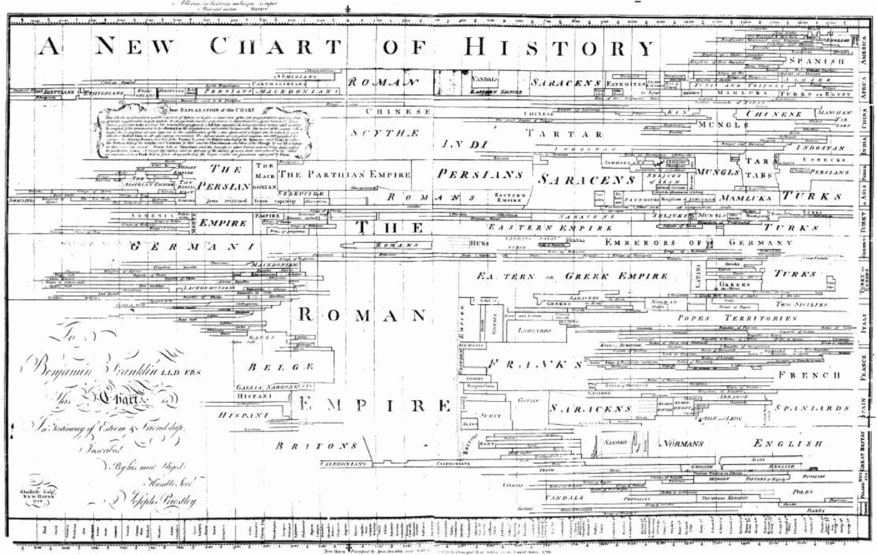
As thinkers in a variety of disciplines continued to recalibrate the relevant timescales to measure change and coordinate events, one prominent challenge was how best to represent such recalibrations. One emergent possibility was to use print media like copperplate engraving to transpose abstract time into visual space on a printed page. This too must be understood as a problem of distance in that such graphic representations sought to make a diverse array of events that spread across a broad swathe of time close and comparable by joining them in a single visual field. In 1769, for example, Joseph Priestley produced his New Chart of History (1769, 2nd edn 1770; Fig. 1). In his companion description of this chart Priestley argued that all time could be represented as a line. “Time here,” Priestley insists, “flows uniformly, from the beginning to the end of the tablet. It is also represented as flowing laterally, like a river . . .”.Footnote 31 With a horizontal axis of years and a vertical axis of territories, Priestly hoped to show both the temporal duration and the spatial expanse of empires in a glance, and hence to impress the imagination “indelibly” and efficiently with “a just image of the rise, progress, extent, duration and contemporary state of all the considerable empires that have ever existed in the world.”Footnote 32 Spatially and temporally distant events could be brought close through techniques of linear representation. Looking horizontally would show all the changes in government of a particular territory, while a vertical glance allowed for the comparison of various territories.
Joseph Priestley, A New Chart of History (London, 1769).

One drawback to this chart, Priestley explained, was that while it could show which empires occupied which territories, it had no way accurately to show the size of an empire's territory in comparative scale with other empires. To include large spaces like Tartary, Siberia, and America, places that he describes as “barren of events,” would make the chart “immoderately large.”Footnote 33 This is a problem that would subsequently be solved by William Playfair, who enhanced Priestley's historical chart and extended its linear and geometric principles to the financial measurement of relative prosperity and decline.
Playfair plays a central role in my argument about later eighteenth-century efforts to think about timescales and historical distance in relation to decline.Footnote 34 He is perhaps best known today for his contributions to statistical graphics: Playfair was the inventor of the time-series line graph, the bar chart, and the pie chart.Footnote 35 We can see the effect of these innovations when thinking about historical distance in relation to the problem of decline and the appropriate timescale in which to measure it if we look at Playfair's 1805 work An Inquiry into the Permanent Causes of the Decline and Fall of Powerful and Wealthy Nations. As its title indicates, the book combines aspects of Smith and Gibbon, and it does so in order to make an argument for how decline can be prevented and forestalled. Playfair's argument is basically that commerce, not conquest, sustains national power and that nations, particularly England, can maintain commercial prosperity if they direct their attention to preservation rather than extension. Particular attention must be paid to managing the national debt and maintaining a trade balance in favor of export.Footnote 36
The work is divided into three parts: Book 1 is a review of empires across history and provides data for historical causes of national decline; Book 2 considers the internal and external causes of decline; and, finally, Book 3 applies the first two books to England to argue that intelligently constructed government policy directed at manners, taxation, division of property, poverty, national debt, trade balance, and patterns of food consumption can postpone decline indefinitely. The Inquiry thus combines historical scope with measurable, quantifiable data in order to suggest that a proactive government-driven approach to the problem of decline can prolong national wealth and power.
With its focus on national debt and balance of trade, Playfair's economic understanding of decline might not be unique, but the work is, so far as I can tell, the first attempt at a general and comparative theory of the rise and fall of nations. What further distinguishes the Inquiry is the effort to represent this argument in a series of sophisticated charts. The first one (Fig. 2a), for example, attempts to represent historical events over three millennia. Time extends along its horizontal axis, with an even chronology punctuated by “Remarkable Events Relative to Commerce” (Fig 2b). The vertical axis shows ancient seats, European seats, and America, all distinguished by color. Combining the two allows Playfair to illustrate the arc of progress and decline and to offer a visual representation of the universal life cycle of commercial empires (though he markedly excludes the East). Like Priestley's New Chart, Playfair's illustrations turn abstract time into something that can be imagined and visualized concretely as a continuous linear progression. They attempt to bridge the distance between territories and events by uniting them in a single visual plane. As Playfair describes his charts, they “bring into one view the result of details that are dispersed over a very wide and intricate field of universal history.”Footnote 37 The key here is uniformity of scale, a development located in the mid-eighteenth century by Rosenberg and Grafton in their recent history of the timeline. “Once that uniformity had been achieved,” they note, “projecting other kinds of quantitative data into the chronographic space was not difficult.”Footnote 38
(a) William Playfair, Inquiry into the Permanent Causes of the Decline and Fall of Powerful and Wealthy Nations (London, 1805), Chart 1; (b) detail.
It may not have been difficult, but it certainly was not common. Playfair also adds an additional dimension to Priesley's linearity. Playfair's second chart, for example, translates irregularly shaped landmasses into uniformly scaled circles (or pies) (Fig. 3). Each of these circles has two tangent lines, a yellow one for population and a red one for revenue. At a glance, then, one trained to interpret this visual information can make a comparison of the relative present state of various empires. Additional charts present images of British imports and exports from 1700 to 1805 and the comparative increases in annual revenues between Britain and France from 1700 to the present. In each case, Playfair implies that decline is a relative category; that it can be quantified and measured; and, more, that it can be easily visualized through lines, shapes, and colors plotted to show comparative national prosperity and productivity, most commonly over an interval of a century, but also by examining the movement of empires over a two-thousand-year period. In other words, it is not only in his title that Playfair combines Gibbon and Smith; the visualizations of change over time that he offers utilize a combination of Gibbon's millennia (Chart 1) and Smith's century (Charts 3 and 4).
William Playfair, Inquiry into the Permanent Causes of the Decline and Fall of Powerful and Wealthy Nations (London, 1805), Chart 2.
Playfair's work develops Smith's insistence on the move from the smaller-scale to the larger-scale, from the annual to the centurial; not only do his charts enable their users to link the particular data of a year to a pattern spread across a century, but also they assume in their very form and scale that all annual data must be subsumed into the larger pattern of the century. If we think of the later eighteenth century as a moment of perceived acceleration, a perception fed by the proliferation of data to which Playfair explicitly responds, and a time during which historical actors experienced increasingly complicated relations to temporal processes, a recognition of what Reinhart Koselleck describes as “the peculiar form of acceleration which characterizes modernity,”Footnote 39 then one of the benefits of Playfair's graphs is their ability to stop time, or at the very least to make time yield to measured regularity. The charts show in a single image an abstract process as it is perceived to develop over a century, one that they then fix and make concrete. But in the way that such charts are scaled, they also participate in and advance the sense of acceleration because they enable viewers to see large swathes of time in a glance.
As Playfair notes in the “Advertisement” to Permanent Causes that introduces his graphics, “The reader will find, five minutes attention to the principle on which they are constructed, a saving of much labour and time.”Footnote 40 Here and elsewhere, Playfair insists on the psychological efficacy and consequent time-saving value of the graphic representation of quantitative information. To see numerical data as geometric shapes, he asserts, reveals its significance more quickly, makes it easier to remember, and saves time. As Playfair insists in the “Advertisement,” even the rough drafts of his charts gave him “a better comprehension . . . than all that I had learnt from occasional reading, for half of my lifetime.”Footnote 41 Time itself, then, takes less time to see. Playfair's charts can thus be understood as a direct response to the profusion of knowledge and information that we associate with the Enlightenment specifically and with the eighteenth century more generally. This seeming explosion of information—the sheer proliferation of raw data—is, of course, what enables Playfair's time-series graphs. But, for Playfair, the proliferation of information does more than provide raw data for visualization, it practically mandates such techniques as a time-saving device for those with increasing demands on their time. Indeed, Playfair promises that he can reduce days of work into the space of “five minutes.” This too, as should now be abundantly clear, is a distancing effect.
Collectively, then, my comparison of Gibbon, Smith, and Playfair suggests how an engagement with the problem of decline motivates a reordering of temporal scale. The abstract rescaling of Smith and Gibbon receives form and shape in Playfair's “linear arithmetic.” Prosperity and decline, Playfair suggests, can be mapped: “The amount of merchantile transactions in money, and of profit or loss are capable of being as easily represented in drawing as any part of space, or as the face of a country.”Footnote 42 Smith, Gibbon, and Playfair do not, of course, have the final word, and the anxieties of decline that their works address, whether linked to concrete events like the end of the first British Empire or the French Revolution or more abstract issues of time-sense and an unknown, open future, are further reshaped in the nineteenth century—and often in less optimistic fashion, as for example in Malthus's principle of population or Ricardo's law of declining returns.