Introduction
Suicide rates among Indigenous peoples around the world are appreciably greater compared with non-Indigenous populations, particularly in younger age groups.Reference Campbell, Balaratnasingam, McHugh, Janca and Chapman 1 – 4 Within First Nations communities in Canada, states of emergency as a result of very young children and youth dying by suicide are increasingly common.Reference Kirmayer 5 – Reference Mota, Elias and Tefft 7 Although numerous factors contribute to suicide, diminished mental health has been linked to the direct and intergenerational effects of historical and ongoing processes associated with colonization.Reference Bombay, Matheson and Anisman 8 – Reference Walls and Whitbeck 13
A particularly harmful policy in Canada was the forced removal of Indigenous children from their communities to be placed in Indian Residential Schools (IRSs) as part of the government’s strategy to abolish their cultural identities. 14 , 15 Generations of Indigenous children as young as age three were forcibly removed from their parents, and experienced years of chronic stress and trauma in the form of widespread abuse and neglect, eradication of connections to culture and familial bonds, and cultural shaming. 14 – Reference Sotero 16 The IRS system was officially acknowledged as an attempt at cultural genocide by the Truth and Reconciliation Commission of Canada in their final report released in 2015. Not unexpectedly, survivors of IRSs are at increased risk for various physical, mental and social health challenges including high rates of post-traumatic stress disorder, substance use disorders and major depression.Reference Elias, Mignone and Hall 11 , Reference Wilk, Maltby and Cooke 17 , Reference Corrado and Cohen 18
In addition to the effects on survivors themselves, the offspring of those who attended IRS demonstrated elevated risks for poorer self-reported health, chronic and infectious diseases psychological distress, as well as suicidal thoughts and attempts.Reference Bombay, Matheson and Anisman 8 , Reference Elias, Mignone and Hall 11 , Reference Hackett, Feeny and Tompa 12 , Reference Wilk, Maltby and Cooke 17 – Reference Menzies 21 Offspring of IRS survivors further reported elevated rates of childhood adversity and stressors throughout adulthood, including race and culture-related stressors such as discrimination experiences,Reference Elias, Mignone and Hall 11 , Reference Wilk, Maltby and Cooke 17 , Reference Bombay, Matheson and Anisman 19 , Reference Bombay, Matheson and Anisman 22 all of which contribute to poorer mental health outcomes.Reference Bombay, Matheson and Anisman 19 In particular, many of these factors linked to parental residential school attendance are predictors of higher rates of suicide and suicidal behaviors and psychological distress across cultures. 4
Parental childhood adversity has been linked with an earlier age of onset of psychological distress and suicidal behavior in non-Indigenous samples.Reference Docherty, Edwards and Yang 23 – Reference Wilson, Vaidyanathan, Miller, McGue and Iacono 25 If this is the case within Indigenous populations affected by IRSs, it would be expected that those with a parent who attended IRS would be at an elevated risk for suicidal thoughts or attempts earlier in life, which could be a contributor to the differential rates of suicide evident in younger v. older age cohorts. Much of the research exploring the intergenerational effects of IRSs has focused on assessing these relationships in adult samples,Reference Bombay, Matheson and Anisman 8 , Reference Wilk, Maltby and Cooke 17 and we are unaware of any research assessing how parental IRS attendance interacts with age to influence mental health outcomes during adolescence or childhood. Considering the large proportions of First Nations adults, youth and children who have been intergenerationally affected by IRS system, 26 understanding when the risks associated with parental IRS attendance manifests themselves across the lifespan is important to inform effective culturally based mental health and wellness programming and interventions.
Familial factors and early-life adversity in predicting mental health across development
The development of severe psychological distress, suicidal ideation and the progression from ideation to suicide attempts are distinct phenomena with unique predictors and outcomes that vary across development.Reference Klonksky, May and Saffer 27 For example, depression is associated with an increased risk for suicide attempts in non-Indigenous samples, but the strength of this association changes over the lifespan.Reference Goldston, Daniel and Erkanli 28 , Reference Rohde, Lewinsohn, Klein, Seeley and Gau 29 An international study across 21 countries revealed that childhood adversity (e.g., abuse, family violence, parental death or divorce) had the strongest associations with suicide attempts in childhood, and the strength of this relation decreased during adolescence, and declined still further in young adults, before a slight increase was apparent in older adulthood.Reference Bruffaerts, Demyttenaere and Borges 30 Similarly, studies conducted within the general population in the United States and Europe suggest that the influence of familial and early-life factors might be particularly strong predictors of mental health issues in earlier life.Reference Kendler, Gatz, Gardner and Pedersen 31 Likewise, adult offspring of parents with mood disorders and a history of suicidal behavior reported a lower mean age of onset of suicidal ideation if they experienced childhood adversity,Reference Melhem, Brent and Ziegler 24 and earlier age of onset for depressive symptoms as adults.Reference Docherty, Edwards and Yang 23 , Reference Wilson, Vaidyanathan, Miller, McGue and Iacono 25 , Reference Kendler, Gatz, Gardner and Pedersen 31 , Reference Neuman, Geller, Rice and Todd 32 Studies that distinguished between the onset of depressive symptoms in childhood (before 12) or early adolescence (12–14) v. later adolescence (15–18) have revealed that earlier onset is linked with a greater risk for chronic suicidal behaviors, mental health problems and substance use in adulthood.Reference Côté, Boivin and Liu 33 – Reference Bittner, Egger and Erkanli 37
Considering the chronic childhood adversity faced by many IRS survivors, and how this influenced the abilities of some to provide adequate environments for their children,Reference Bombay, Matheson and Anisman 8 , Reference Bombay, Matheson and Anisman 9 , Reference Bombay, Matheson and Anisman 19 it would be expected that adults with a parent who attended IRS would be at risk for higher levels of mental health issues, and would also be more likely to have these difficulties earlier in life. To explore this possibility in a national representative sample of First Nations adults living on-reserve, analyses of the youth and adult versions of the 2008–2010 First Nations Regional Health Survey (RHS) were carried out. In Study 1, analyses assessed whether or not parental IRS attendance was related to suicide ideation and attempts in childhood, adolescence and/or in adulthood, and whether these relations varied by sex. In Study 2, analyses of the youth version of the RHS explored the links between parental attendance at IRS with suicidal thoughts and/or attempts within the past year, and whether these relations varied with age and sex.
Methods
The data were collected from 250 First Nation communities across Canada between 2008 and 2010 [see First Nations Information Governance Centre (FNIGC), 26 for detailed methodology of RHS). To achieve statistically valid estimates for the population sample, analyses were performed using the complex samples module of the Statistical Package for the Social Sciences (v. 20; IBM Corporation) to take into account the two-stage stratified sampling design of the RHS. The adult and youth surveys included questions asking if they had ever thought about suicide and/or attempted suicide in their lifetime (yes or no), and if yes, whether this occurred in the past year, in childhood (before the age of 12), in adolescence (12–17) and/or in adulthood (18 or older; latter option only included for adults). 26 Both adults and youth were asked about their parents’ and/or grandparents’ attendance at IRS, and adults were asked if they personally attended IRS. The adult version of the RHS was administered to 11,043 randomly selected First Nations adults who were 18 years of age or older (mean=40.7 years; s.e.=0.18), with equal representation of males (50.7%) and females (49.3%). The RHS youth questionnaire was administered to 4837 randomly selected youth between the ages of 12 and 17 years. In the youth sample, there was a nearly equal representation of males (51.3%) and females (48.7%), and their mean age was 14.51 years (s.e.=0.04).
When the adult sample was categorized into mutually exclusive categories according to personal, parent and grandparent attendance at IRS, 26.0% reported that they did not personally attend IRS and that none of their parents or grandparents attended. Just under half (45.7%) reported that at least one of their parents attended, 9.8% had a grandparent (but no parent) who attended and 5.1% who attended IRS personally but did not have a parent who attended. An additional 13.4% who responded ‘don’t know’ or ‘refused’ an answer to at least one of the IRS questions were excluded from further analyses. To focus on comparisons of the intergenerational effects of having a parent who attended IRS, those who personally attended IRS or who had a grandparent but no parent who attended were also excluded from the analyses. Thus, the final sample in Study 1 comprised 7716 adults (weighted n=186,830).
In the youth sample in Study 2, 15.2% (n=692) said that they didn’t know or refused to answer questions about their parent/grandparent IRS attendance, and 28.9% (n=1262) had a grandparent but no parent who attended IRS. These respondents were removed from the analyses, which left 27.8% who did not have a parent or grandparent who attended (n=1541), and 28.1% who had at least one parent who attended (n=1342). The final unweighted sample in Study 2 comprised 2883 youth (weighted n=30,190).
Using the adult RHS in Study 1, binary logistic regression models assessed the main effects of parental IRS attendance (no=0 v. yes=1), sex (male=1 v. female=2), and the potential two-way interaction between parental IRS attendance and sex in predicting suicidal thoughts and attempts in childhood, adolescence and/or adulthood. Similarly, to assess the youth sample in Study 2, binary logistic regression models were used to test the main effects of parental IRS attendance, sex and age (continuous), and all two-way and three-way interactions in predicting past year suicide ideation and attempts. Cross-tabulations assessed interactions between parental IRS attendance, sex and age in Study 1 and 2, with non-overlapping 95% confidence intervals indicating statistical significance. In cases where there were fewer than five individuals per cell or the coefficient of variability was higher than 33.3%, data were suppressed and not released by FNIGC to protect anonymity (represented by ‘ds’).
Study 1: results in adult RHS sample
Of the adult sample analyzed, just over one-third (36.3%) reported that they did not have any parents who attended IRS, leaving just under two-thirds (63.7%) who had at least one parent who attended. Just under 1% (0.9%; 95% CI=0.7–1.2%) reported having thoughts about suicide in childhood, 10.7% (95% CI=9.8–11.7%) had such thoughts in adolescence and 10.0% (94% CI=9.2–11.0%) reported suicidal ideation in adulthood. In considering suicide attempts during different phases of the lifespan, 0.5% (95% CI=0.3–0.6%) reported that this occurred in childhood, 6.7% (95% CI=6.0–7.4%) said it happened in adolescence and 6.2% (95% CI=5.6–7.0%) said they had an attempt in adulthood.
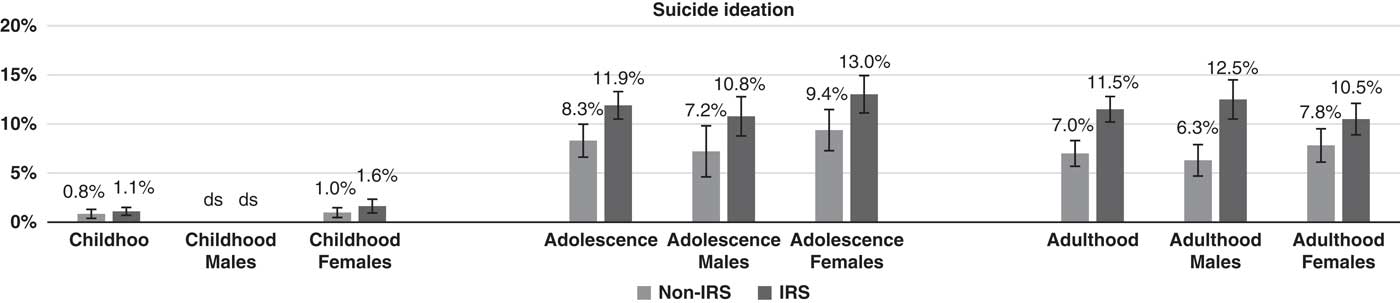
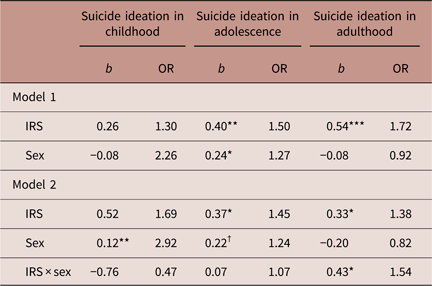
The regression analyses predicting reports of suicidal ideation in childhood did not reveal any significant predictors. However, parental IRS attendance and being female were associated with greater ideation in adolescence, with no significant two-way interaction (Table 1). In predicting ideation in adulthood, there was a significant two-way interaction (Table 1), with the cross-tabulation analyses showing that parental IRS attendance was only a significant predictor of a greater likelihood of reporting suicidal ideation among males (Fig. 1).
The proportion of adults who reported having suicidal thoughts in childhood, adolescence and/or in adulthood as a function of having a parent who attended Indian residential school (IRS) or who did not attend IRS. Error bars represent 95% confidence intervals. The proportions could not be reported for males in childhood because of data suppression (ds).

Binary logistic regressions predicting suicide ideation in childhood, adolescence and/or adulthood by parental Indian residential school (IRS) attendance and sex in the adult First Nations Regional Health Survey sample

†P<0.10, *P<0.05 **P<0.01, ***P<0.001.
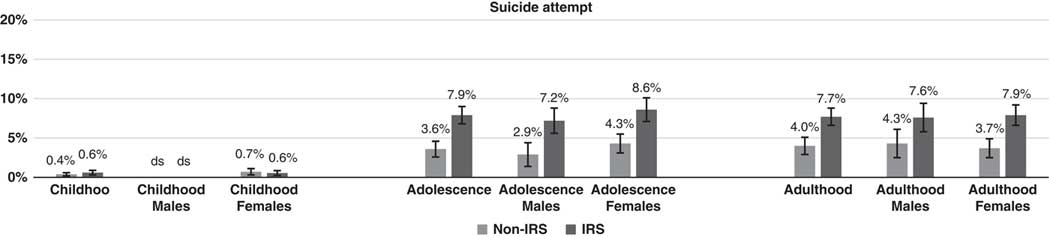
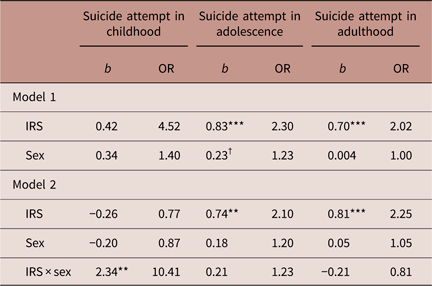
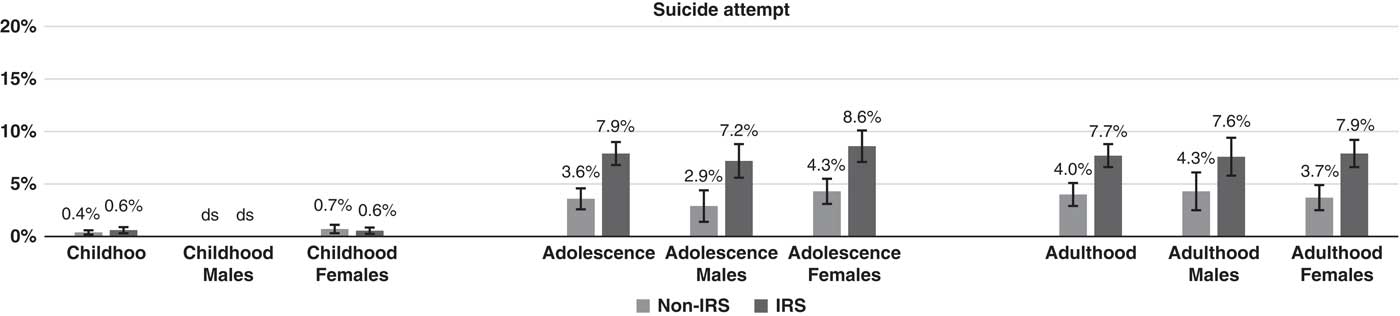
When considering suicide attempts, there was a significant interaction between parental IRS attendance and sex in predicting an attempt in childhood (Table 2). It appeared that males affected by parental IRS attendance were more likely to report an attempt in childhood, but this relation was not significant among females (Fig. 2). That said, because of the small unweighted number of adults in the sample who reported an attempt in childhood, this should be interpreted with caution. There were no significant two-way interactions predicting attempts in adolescence or adulthood, but parental IRS attendance was linked with greater risk at both age spans. Sex was marginally significant in predicting attempts in adolescence, with females being at greater risk (Fig. 2).
The proportion of adults who reported suicide attempts in childhood, adolescence and/or in adulthood as a function of having a parent who attended Indian residential school (IRS) or who did not attended IRS. Error bars represent 95% confidence intervals. The proportions could not be reported for males in childhood because of data suppression (ds).
Binary logistic regressions predicting suicide attempts in childhood, adolescence and/or adulthood by parental Indian residential school (IRS) attendance and sex in the adult First Nations Regional Health Survey sample

†P<0.10, *P<0.05 **P<0.01, ***P<0.001.
Study 2: results in youth RHS sample
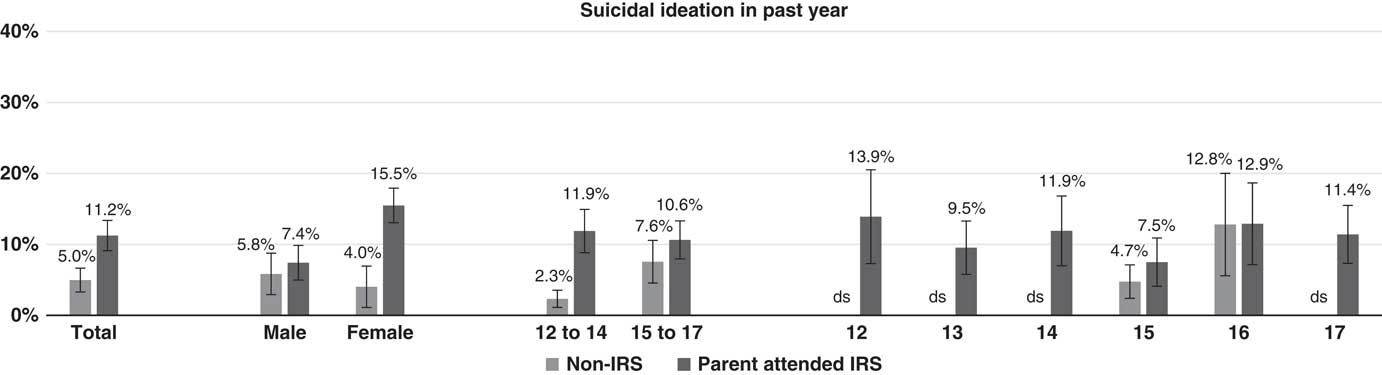
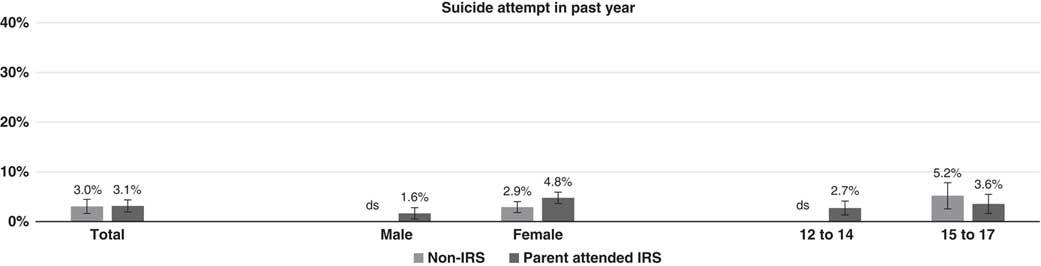
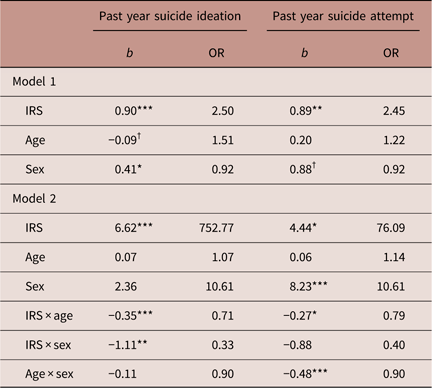
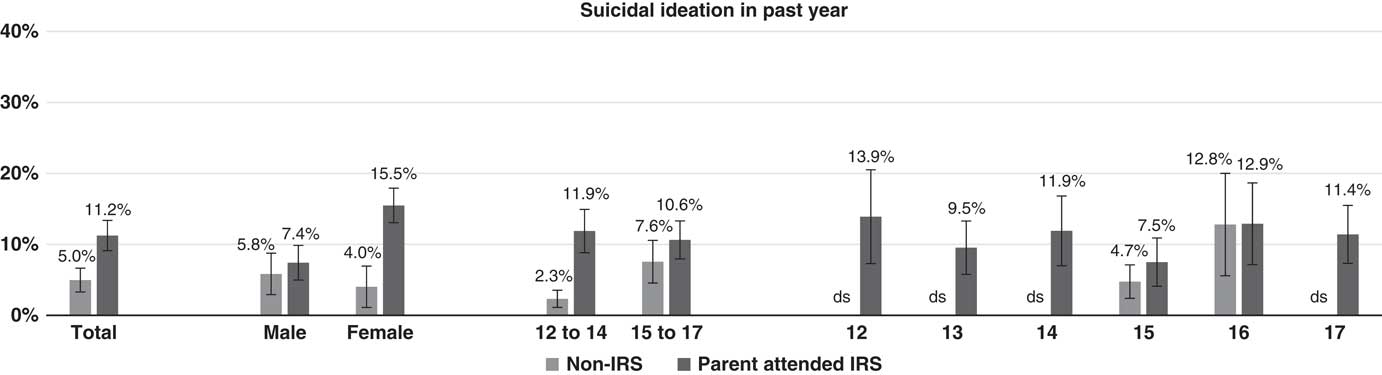
Of the total youth sample analyzed, 49.7% of youth reported that they did not have any parents who attended IRS, and 50.3% reported they had at least one parent who attended. In all, 7% (7.1%) said that they thought about suicide in the past year, and 3.0% reported an attempt in the past year. The regressions and cross-tabulations predicting suicidal ideation in the past year revealed significant two-way interactions between parental IRS attendance with age and with sex, such that effects of having a parent who attended IRS were greater in younger youth and among females (the three-way interaction was not significant) (Table 3; Fig. 3). Likewise, the regressions and cross-tabulations predicting suicide attempts in the past year revealed a two-way interaction between parental IRS attendance and age, with the relation between IRS attendance and attempts being greater in younger youth (Fig. 4). The two-way interaction between parental IRS attendance and sex in predicting attempts was not significant, and the three-way interaction was not significant (Table 3).
The proportion of youth who reported suicidal ideation in the past year as a function of age, sex, and whether or not they had a parent who attended Indian residential school (IRS). Error bars represent 95% confidence intervals. The proportions could not be reported for each age because of data suppression (ds).
The proportion of youth who reported suicidal attempts in the past year as a function of age, sex, and whether or not they had a parent who attended Indian residential school (IRS). Error bars represent 95% confidence intervals. The proportions could not be reported for males not affected by IRS or for each age because of data suppression (ds).

Results from logistic regressions predicting past year suicidal ideation and suicidal attempts in the youth First Nations Regional Health Survey sample

IRS, Indian residential school.
†P<0.10, *P<0.05, **P<0.01, ***P<0.001.
Discussion
The current study adds to the growing evidence demonstrating the long-term outcomes associated with the IRS system among Indigenous adults,Reference Bombay, Matheson and Anisman 8 , Reference Bombay, Matheson and Anisman 9 , Reference Elias, Mignone and Hall 11 , Reference Hackett, Feeny and Tompa 12 and further demonstrates that the increased risks for suicidal thoughts and attempts associated with parental IRS attendance start to manifest early in life before adulthood. In Study 1, analyses of the 2008/2010 adult RHS sample revealed that parental IRS attendance was associated with greater retrospective reports of suicidal thoughts and attempts that occurred during adolescence (between the age of 12 and 17 years), and that increased risk persisted into adulthood. These data are consistent with the findings among mainstream samples suggesting that parental factors and early-life adversity can influence mental health outcomes throughout the lifespan.Reference Cowan, Callaghan, Kan and Richardson 38 , Reference Benjet, Borges and Medina-Mora 39
Although some studies have shown that certain parental risk factors and childhood experiences are more influential in predicting mental health outcomes in childhood and adolescence v. in adulthood,Reference Bruwer, Govender and Bishop 40 , Reference Santana, Coelho and Borges 41 this does not seem to be the case in relation to parental IRS attendance among First Nations living on-reserve. In this regard, the proportions of adults in Study 1 who reported suicidal thoughts and/or attempts in adulthood were comparable with their estimates of these occurrences in adolescence. Although the rates of reporting were greater among those whose parents attended IRS, the stability of reports was evident in both the IRS-affected group and those not affected by IRSs. These findings emphasize the long-lasting effects of the IRS system on the children of those who attended, as well as the increased need for targeted mental health and wellness programming beginning early in life. The higher risk for suicide ideation and attempts could be related to parenting styles that evolved as a result of the childhood experiences of survivors at IRS, including patterns of communication associated with parents’ IRS trauma,Reference Santana, Coelho and Borges 41 as well as epigenetic changes related to gene expression of several neurobiological factors. Inasmuch as the offspring of IRS survivors have further endured substandard living conditions and pervasive interpersonal and systemic discrimination, these factors may have additively or synergistically undermined well-being, including elevated levels of psychological distress and suicidal thoughts and behaviors.Reference Bombay, Matheson and Anisman 19
In assessing potential sex differences in the adult RHS sample, the influence of parental IRS attendance appeared to be generally the same among men and women in predicting retrospective reports of suicidal thoughts in their childhood and adolescence. However, it appeared that in the adult sample IRS exposure was somewhat more aligned with suicide ideation among males, although the trend was in the same direction for females. In non-Indigenous samples, sex differences have been reported in relation to the links between various types of childhood adversity and mental health outcomes in adulthood.Reference Evans, Grella and Upchurch 43 , Reference Pirkola, Isometsä and Aro 44
However, in some studies suicidality was more likely to be associated with childhood environmental risk factors in females,Reference Angst, Hengartner and Rogers 45 whereas in other studies a greater association occurred in males.Reference Oquendo, Bongiovi-Garcia and Galfalvy 46 Cultural factors and the local context also moderate the influence of sex on various health and social outcomes,Reference Kirmayer 5 , Reference Kirmayer, Brass and Holton 6 and may explain some of these disparate results across populations. Within Indigenous contexts, it has been suggested that the high rates of suicide among males are linked to the significant social changes that have come with colonization, particularly in relation to the effects on traditional societal and family roles, responsibilities, identities, as well as patterns of interactions and social support networks.Reference Kirmayer, Brass and Holton 6 , Reference Kral 47 – Reference Leineweber, Bjerregaard, Baerveldt and Voestermans 49 Although there are many potential reasons for why males appeared to be more influenced than females by parents’ IRS attendance in adulthood, it might be that the traditional roles for men in some First Nations communities are more obsolete relative to females who have maintained their traditional roles in caregiving for their children. At the same time, it is noteworthy that females in the adult sample recalled greater suicidal ideation during adolescence. The source for the adolescent v. adult disparity is uncertain, especially given that retrospective reports might not be entirely accurate, particularly those made by adults in relation to their childhood and adolescence.
Although it was expected that parental IRS attendance would be associated with elevated suicidal thoughts and attempts in childhood, there were no significant differences as a function of parental IRS attendance in the adult sample. This said, the frequency of such recollections were very small, and the conclusions that can be made in relation to the childhood estimates are hampered by data suppression and low coefficients of variabilities. What can be concluded in this cohort of adults in Study 1 is that those with at least one parent who attended IRS were at greater risk for suicidal ideation and attempts in adolescence before the age of 18, and that this greater risk continued into adulthood.
As in the adult sample, analyses of the youth sample in Study 2 indicated elevated reports of suicidal ideation and suicide attempts in the past year among youth with a parent who had attended IRS. The elevated ideation was present even among respondents as young as 12 years of age, and was greater among females than in males. These differential effects of sex in relation to suicidal ideation in Study 1 and 2 may reflect developmental differences in how factors associated with sex influence suicidal thoughts in youth v. adulthood. Alternatively, this difference could reflect a cohort effect such that the increased influence of parental IRS attendance for females may be a newer phenomenon in younger generations. The possibility of such a cohort effect in relation to the greater risk for ideation among adolescent females is consistent with the increasing rates of completed suicides in young females being reported in some First Nations communities,Reference Eggertson 50 among Inuit in Nunavik,Reference Fraser, Geoffroy, Chachamovich and Kirmayer 51 as well as in non-Indigenous samples in CanadaReference Skinner and McFaull 52 and in other countries.Reference LaFromboise, Medoff, Lee and Harris 53 , Reference Lahti, Räsänen, Riala, Keränen and Hakko 54 One factor that may be particularly relevant for Indigenous populations, and other populations affected by collective trauma, is that many of the collective long-term outcomes include increased exposure to childhood adversity and violence,Reference Bombay, Matheson and Anisman 9 , Reference Somasundaram 55 , Reference Somasundaram 56 particularly among young women relative to men.Reference Elias, Mignone and Hall 11 , Reference Fraser, Geoffroy, Chachamovich and Kirmayer 51 Issues related to violence against women and childhood adversities may not have been present within Indigenous communities prior colonization, but may be associated with the pervasive intergenerational consequences of the residential school system that were associated with greater exposure to certain types of stressors and trauma that disproportionately affected females.Reference Bombay, Matheson and Anisman 8 , Reference Bombay, Matheson and Anisman 9
Another possible explanation for this potential cohort effect related to sex differences is that certain risk factors for stress-related issues appear to be specific to the transmission from mothers to daughter whereas male offspring are not affected in the same way. In this regard, animal studies have revealed transgenerational epigenetic changes, occurring mostly in male offspring, as a result of chronic, unpredictable parental separation.Reference Franklin, Russig and Weiss 57 Likewise, several sex-dependent transmission patterns were proposed that were mediated by parental factors, possibly stemming from epigenetic actions.Reference Ambeskovic, Roseboom and Metz 58 Such outcomes may come about owing to distress in pregnant females causing glucocorticoid changes that promote sex-dependent epigenetic actions.Reference Constantinof, Moisiadis and Matthews 59 Indeed, stressors experienced some time before pregnancy in rodents led to changes of dendritic length and spine density within brain regions associated with cognitive functioning and mood (i.e., anterior cingulate cortex and prelimbic/infralimbic cortex), primarily among male offspring.Reference Bock, Poeschel and Schindler 60 Understandably, less information concerning transgenerational effects of stressors is available in humans. Nevertheless, intergenerational changes associated with stressors have been reported.Reference Bowers and Yehuda 61 An epidemiological analysis in humans likewise indicated that childhood trauma, in this case stemming from parental death, had transgenerational effects that varied with the age of the trauma among males, whereas age was less important in producing adverse effects in females.Reference Vågerö and Rajaleid 62
We have previously speculated that epigenetic changes might contribute to the transgenerational effects of the trauma related to the IRS experience.Reference Bombay, Matheson and Anisman 8 , Reference McQuaid, Bombay and McInnis 20 Yet, as we indicated, the trauma experienced did not end with release from these schools, but continued when survivors returned to their communities.Reference Bombay, Matheson and Anisman 9 Thus, in considering the specific pathways leading to psychological distress in children and grandchildren, prenatal and postnatal environmental factors, and their interactions, may underlie intergenerational patterns in stress-related outcomes, brain morphometry, and gene expression patterns, and could possibly vary in a sexually dimorphic fashion.
While some physiological pathways of transmission of risk and resilience factors across generations are limited to females, there are other mechanisms that influence both sexes and/or males only. For example, early life experiences and relationships, especially those with parents, may contribute to the development of particular coping styles, which, may influence affective responses elicited by stressors encountered in adulthood. However, these outcomes may be sex-dependent and may vary yet again with the bonding patterns with the male or female parent.Reference Matheson, Kelly and Cole 63 Likewise, in a sample of adolescents and their parents in a mainstream population, maternal depressive symptoms predicted increased late adolescent depressive symptoms for girls but not males, whereas paternal depressive symptoms predicted increase depressive symptoms in all youth.Reference Mason, Chmelka, Trudeau and Spoth 64 There are certainly numerous interacting environmental and biological mechanisms that may be involved in the intergenerational transmission of risk that are involved in these effects, some of which influence males and females similarly and some that do not, and which might differ across the lifespan. The findings of the present investigation do not speak to the specific mechanisms involved, but they likely reflect the additive or interactive influence of multiple biopsychosocial and cultural factors that remains to be elucidated.
In considering the significant interaction between parental IRS attendance and age in predicting suicidal ideation and attempts in youth, cross-tabulations in Study 2 revealed that the proportions of those not affected by IRS reporting suicidal ideation and/or attempts was significantly lower among youth ages 12–14 years compared with those ages 15–17 years, which is consistent with the typical trajectory reported in mainstream samples. In contrast, there were no differences between those reporting suicidal ideation and/or attempts in the younger v. the older age cohort among those with a parent who attended IRS, suggesting these IRS-affected youth were at greater risk for an earlier onset of suicidal thoughts and behaviors. Knowing that exposure to childhood adversities is a key contemporary mediator of the intergenerational transmission of IRS trauma,Reference Bombay, Matheson and Anisman 8 , Reference Bombay, Matheson and Anisman 9 , Reference Bombay, Matheson and Anisman 19 the findings related to age in the youth sample are consistent with prospective studies that have reported links between various forms of child maltreatment and the earlier emergence of mental health disturbances relative to controls.Reference Andersen and Teicher 65 , Reference Widom, DuMont and Czaja 66 In essence, these findings are in line with the view that parental IRS attendance not only increases risk of developing serious psychological distress and suicidal behaviors, it can accelerate onset of these features. Similar intergenerational relationships have been observed between parental exposure to collective trauma in childhood and negative mental health outcomes in youth,Reference Cowan, Callaghan, Kan and Richardson 38 however, we are unaware of studies that reported links with the earlier onset of such symptoms.
The timing of onset of psychological systems has significant implications in terms of prevention and treatment, as it has been suggested that etiology of early- v. late-onset disorders may differ and could potentially represent unique subtypes of certain mentalReference Hammen, Hazel, Brennan and Najman 35 and physicalReference Singh, Ding and Zhang 67 conditions. This makes the developmental stage at which symptoms manifest an important starting point for examining possible causes, risk factors and protective factors in males and females. The importance of identifying the risk and protective factors involved in the transmission of IRS trauma is highlighted by the fact that earlier onset of psychological distress, depression, suicidal ideation and suicide attempts appear to follow a distinct trajectory of greater chronicity, severity of symptoms and more deleterious behavioral, social and health outcomes.Reference Melhem, Brent and Ziegler 24 , Reference Jaffee, Moffitt and Caspi 68 , Reference Zisook, Rush and Lesser 69
Considering the significant negative outcomes associated with early-onset mental health issues, and the large proportion of the on-reserve First Nations population affected by the IRS system, combined with the continued mental health inequities in Canada, further exploration is needed to build on findings of the present investigation. In this regard, however, the analyses were particularly limited in assessing how parental IRS was associated with suicidal thoughts in childhood due to the low unweighted sample sizes that lacked statistical power for these particularly variables. Another limitation, which may have particularly affected adults in Study 1, is that such retrospective reports tend to underestimate the incidence of mental health concerns as they are forgotten over time.Reference Moffitt, Caspi and Taylor 70 , Reference Simon and VonKorff 71 Generational differences may also have contributed to the underreporting of suicidality and differentially influenced the adult and youth cohorts assessed in Study 1 and Study 2. Yet another limitation is that we did not consider additional variables that might interact to predict suicidal thoughts, attempts and distress, such as substance use. For example, in a study of First Nations youth living on-reserve in the United States, earlier age of first substance use predicted developmental course and increased risk of later psychological outcomes.Reference Sittner 72 The potential synergistic or additive effects of having both parents who attended, and/or of having a grandparent who attended, were also not considered in the analyses.Reference Bombay, Matheson and Anisman 8 , Reference McQuaid, Bombay and McInnis 20 Finally, research in animal and human studies demonstrating the moderating influence of the parental sex in determining the transmission of risks and protective factors to their sons and/or daughters raises the potential importance of considering parental gender in future analyses.
Additional research should explore culture-related protective factors that can mitigate the transmission of risk factors across generations. For example, in mainstream samples, early-intervention cognitive-behavioral therapy (CBT) can be effective as either a prevention or intervention technique to reduce psychological risk in the offspring of individuals with a mental illness.Reference Reupert, Cuff and Drost 73 , Reference Siegenthaler, Munder and Egger 74 In this regard, CBT-based programs have been shown to reduce internalizing and externalizing symptomatology and rates of illness onset in the offspring of depressed parents.Reference Reupert, Cuff and Drost 73 Moreover, a family-based CBT program significantly reduced anxiety disorder onset in the 7–12-year-old offspring of anxious parents.Reference Ginsburg 75 Because of the unique nature of the culture-related trauma faced by generations of Indigenous children who were exposed to cultural shaming and separation from their traditional beliefs, languages and lifestyles, interventions that build on the strengths that are inherent in First Nations cultures and communities are especially needed. 76 , Reference Spear 77 It is important to note that there are significant variations across First Nations communities with respect to distress levels, suicidal behavior, and the personal and collective impacts of the IRS system, and therefore, regional and community-level variations should also be explored. As suggested by others,Reference Kirmayer 5 , Reference Fraser, Geoffroy, Chachamovich and Kirmayer 51 there is also a clear need for further research concerning how recent cultural changes in gender roles and expectations influence mental health and suicidal behaviors.
Notwithstanding the limitations, the current findings suggest that mental health and healing initiatives for Indigenous peoples should focus on improving the well-being of children and younger-aged youth and those showing signs of early-onset distress and mental health symptoms. Early identification of psychological distress is imperative due to potential sensitive periods of increased predisposition and greater potential for favorable outcomes from treatment.Reference Heim and Binder 78 Without intervening in the intergenerational cycles of distress and accompanying health and social problems in First Nations communities that have been catalyzed by the IRS system and other aspects of colonization, the significant mental health disparities might continue to persist.
Acknowledgments
We would like to acknowledge those who participated in the RHS, as well as the data collectors and those who worked to make the RHS possible. We would also like to acknowledge those who have been affected by the Indian Residential School system.
Financial Support
This work was supported by the Department of Psychiatry Research Fund at Dalhousie University.
Conflicts of Interest
None.
Ethical Standards
The secondary analyses of the Adult and Youth versions of the 2008/10 First Nations Regional Health Survey (RHS) presented in this paper were provided to the First Nations Information Governance Centre (FNIGC) for comment and review. That said, the analyses do not necessarily reflect the views of FNIGC. FNIGC requires that statistics reproduced from analyses of the RHS must be accompanied by a citation of the document, including a reference to the page on which the statistic in question appears. The subset of variables assessed in this paper were extracted from the RHS full data set on April 23, 2013 by FNIGC.