Since 2017, China has operated mass extra-judicial internment camps in the Xinjiang Uyghur Autonomous Region (XUAR), officially described as “education and transformation centres” (jiaoyu zhuanhua peixun zhongxin 教育转化培训中心). Scholarly estimates using official sources suggest that approximately a million people, or 10 per cent of the adult Uyghur population, have been interned.Footnote 1 Internment camps form part of regional party-chief Chen Quanguo's 陈全国 measures to tighten controls over the Uyghur population since 2015 under the rubric of “de-extremification” (qujiduanhua 去极端化).Footnote 2 These policies are logical conclusions of the ethnocentric insecurity cycles analysed in this article, where the state targets Uyghur identities as the causes of violence. While the 2008 Beijing Olympics’ slogan (“one world, one dream”) circulated across official media, riots and inter-ethnic violence exploded in Lhasa, Tibet. The 60th anniversary of the founding of the People's Republic of China (PRC) in 2009 was subsequently overshadowed by ethnically targeted violence between Turkic-speaking Muslim Uyghurs and the Han majority in Urumqi in Xinjiang. Since 2009, a shared national identity based on ethnic unity (minzu tuanjie 民族团结) has been officially described as a “zero-sum political struggle of life or death” and a prerequisite to China's rise.Footnote 3 In official policy thinking, nightmarish, mirror-images of the prosperity and power of the “great revival” (weida fuxing 伟大复兴) foretell China's collapse if minorities and Han fail to share this national identity. This paper asks how the deterioration of ethnic relations between Han and Uyghurs led to the eruption of mass violence among ordinary people. It analyses the interplay between official Chinese identity discourse and everyday micro-level security practices before, during and after the July 2009 violence.
The mutually reinforcing nature of China's goals of global power and securing the identity of its internal cultural frontiers is overlooked by Eurocentric international relations theory, which builds knowledge through domestic/international dichotomies.Footnote 4 However, China specialists have shown how domestic and international security are simultaneously framed through sharp distinctions between a domestic, civilized self and the international, barbaric other.Footnote 5 For example, China explains violence in Xinjiang as a “zero-sum political struggle of life or death” for a shared, civilized identity against the barbaric “inside/outside three evils” (jingneiwai sangushili 境内外三股势力) of “terrorism, separatism and extremism.”Footnote 6 The attributive phrase, “inside/outside,” positions Uyghurs inside China who identify as Turkic or Islamic as representing the culturally external threats of “Islamic terrorism” and Western human rights, which aim to “split and contain China's rise.”Footnote 7 Although Uyghurs generally identify with Turkic language and Islam,Footnote 8 official texts assert that it is only “the three evils” that claim Uyghurs to be “a Turkic minzu”Footnote 9 or “an Islamic minzu.”Footnote 10 Uyghurs are thus included as being Chinese but their identity is excluded as a source of insecurity and violence, and negatively attributed to a lack of Chinese national (Zhonghua minzu 中华民族) identity. China's “great revival” and domestic identity narratives of 56 unified minzu are mutually constitutive referents of security in which a rising, unified China must be secured against alternative, backward Uyghur identities. What Thomas Mullaney termed the odd calculus of “55 + 1” conflates Han and China by separating and prioritizing the Han over 55 minorities, enabling political control over minority identities.Footnote 11 However, the minzu concept also enables resistance from below through its double use as nation and ethnicity.Footnote 12
This paper examines relations between Chinese identity and insecurity in official explanations of violence in Xinjiang. How was violence by different ethnic groups narrated into a story of China's identity and insecurity? How did this narrative shape official and unofficial security practices and how did these generate insecurity for the state? These narratives will be shown to produce hierarchical ethnic relations and different insecurities for different ethnic groups. The constitution of danger is considered to be dependent on those to whom it is a threat and state security practices to be performative of identity boundaries.Footnote 13 “Security often produces insecurity,”Footnote 14 and securitized identity has different implications for differentially essentialized groups.Footnote 15 Understanding this security dynamic requires deeper consideration of popular “vernacular” insecurities.Footnote 16 In Xinjiang, vernacular resistance is officially conflated with armed organization. Elite and popular representational politics constitute the identity security contention itself.Footnote 17 Han and Uyghur responses to official security discourses, therefore, are central to understanding Chinese state security.
The paper links discourse analysis of official texts to ethnographic analysis of protests in Xinjiang to show how official performances of identity insecurities are re-interpreted by Han and Uyghurs to articulate alternative identity insecurities. The paper draws on ethnographic fieldwork in Urumqi conducted from 2009 to 2010, including participant observations of security practices and over 100 detailed, semi-structured interviews with Han and Uyghurs. It builds on the sparse available research on the July 2009 violence,Footnote 18 but is the first detailed study to use interviews and participant observations of Han perspectives in Urumqi, which were erroneously assumed to be indistinguishable from the party-state. Following the July 2009 violence, internet access and international communications were blocked for approximately ten months “to prevent unrest.”Footnote 19 To analyse the daily reproduction of identity and security discourses on the ground, therefore, the paper uses local newspapers and minzu tuanjie education texts, which were universalized following the violence.
The first section analyses official discourse on the events that sparked the violence in June 2009 at the Xuri Toy Factory in Guangdong, when Han co-workers killed two Uyghur labourers and injured hundreds.Footnote 20 This section will show how boundaries between Han as embodiments of China and Uyghurs as ethnic outsiders were securitized by downplaying organized Han violence against Uyghurs. The absence of any security response subsequently produced widespread Uyghur insecurity and sparked popular protests before the violence erupted in Urumqi in July. The second section explores how the July violence was conversely narrated as an existential identity–security threat both in the classroom and by ethnicized, street-level security practices. Uyghur violence against Han on 5 July was framed as existentially threatening, while violence against Uyghurs on 7 July was understood as a rational defence of personal and national security, constituting the hierarchical ethnic boundaries of the Zhonghua minzu. The final section analyses these security dynamics following a spate of syringe assaults in the aftermath that culminated in mass Han demonstrations calling for increased security and violence against Uyghurs. This section shows how Han and Uyghurs responded to official articulations of an insecure China under perpetual threat from Uyghur violence. Many Han felt their China was under threat while Uyghurs felt threatened by China.
This paper argues that the party-state's ethnocentric security narratives exacerbate ethnic tensions between Han and Uyghurs. This ethnocentrism is driven by insecurity about “barbarians” on China's imperial frontiers and their post-1949 transformation into ethnic minority subjects. These narratives frame China's identity as being under threat from Turkic enemies within, supported from outside by Islamic and Western enemies. Official security practices target Uyghur neighbourhoods and identity narratives as a source of this insecurity, activating pre-existing stereotypes of Uyghurs as external cultural threats. Official discourse frames violence as ordinary incidents or exceptional threats, depending upon the ethnicity of who is threatened. This bifurcated narration of violence positions majority–minority identities as oppositional, making both Uyghurs and Han feel under perpetual threat. Han and Uyghurs respond by articulating alternative ethno-national identity securitizations to counter official narratives of a multi-minzu China. China's leaders understand resolution of the insecurity produced through this dynamic in existential terms and the means to, and ends of, its global rise.
De-Securitizing Uyghurs: Majority Violence at Shaoguan, “6-26”
On 25 June 2009, Han workers entered their Uyghur co-workers’ dormitory at the Xuri Toy Factory in Shaoguan 韶关 in Guangdong province, attacking them with knives and metal pipes in large skirmishes which left two Uyghurs dead and hundreds injured.Footnote 21 The violence occurred after a local website posted that six Xinjiang boys had raped two innocent girls. The China Daily reported the incident as “triggered by a sex assault by a Uyghur worker toward a Han female worker.”Footnote 22 These allegations turned out to be fabrications by a disgruntled factory worker who failed to be re-employed after quitting his job.Footnote 23 A Han Chinese woman had accidentally entered the Uyghur men's dormitory and when the men shouted “boo,” her surprised scream activated ethnic stereotypes and led to official stories that she had been raped.Footnote 24 This section asks how the party-state conceptualized identity and security in explanations of violence by Han against Uyghurs. The violence by the Han parties was officially deemed not to be a security matter and Uyghurs who understood it as such were subsequently framed as the real threat to China.
Chinese internal orientalist discourse represents south-western ethnic minorities as agricultural, feminine and backward but also as integral components of China, relationally narrating majority Han identity as civilized, modern and superior.Footnote 25 However, internal orientalism in Xinjiang reproduces stereotypes that Uyghur cultural inferiority and backwardness are security threats. Sexualized ethnic stereotypes, emergent in explanations of the Shaoguan incident, are common as Han frequently represent Uyghur men as primal “sexual predators.”Footnote 26 These sexualized discourses have circulated in the post-2012 struggle against “Islamic terrorism.” Following unrest in Yecheng 叶城 in 2012, the-then Xinjiang Party chief, Zhang Chunxian 张春贤, stated, “Show no mercy to these terrorists … we shall not let them wave knives at our women, our children, and our innocent people.”Footnote 27 Official representations of primal Uyghur masculinity depicted threats to Chinese identity, and official discourse activated popular justifications of ethnic hatred following the Shaoguan incident. The Guardian interviewed 20 locals, including police, who immediately believed the allegations of sexualized violence by Uyghurs and claimed published casualty figures were kept artificially low. One young man was quoted as saying, “I just wanted to beat them. I hate Xinjiang people … we used iron bars to beat them to death.”Footnote 28 One local shop-owner told me, “Xinjiang people have a low level of civilization … they chase and harass girls all the time.”Footnote 29 The alleged rape was understood as an attack on China (“our women”) because its violence against a Han person refuted the passive and feminine social position of ethnic minorities.
The political-economic context behind Shaoguan further illustrates how Han are positioned as sources of identity security, while Uyghurs are expected to imitate their culture to reduce the security threat they represent. Reform-era policy in Xinjiang has engineered Han migration into minority areas through economic incentives, particularly labour opportunities in cotton and extractive industries.Footnote 30 Uyghurs, conversely, are sent to inner China to learn “modernization” and to transform “traditionally compact ethnic communities” and encourage “identification with the entire nation.”Footnote 31 “Ethnic dispersion” (minzu fensan 民族分散), measured by the number of minorities living in “scattered areas,” is officially described as “progress,” and “unity” is exemplified by Xinjiang's Han majority oil-producing cities, particularly Shihezi 石河子.Footnote 32 The Xuri Toy Factory was staffed through labour surplus export programmes implemented in Xinjiang: 96,000 workers were transferred from southern Xinjiang in the first half of 2009.Footnote 33 The regional government invested 300–400 million yuan in transferring labour from Xinjiang, the region with the third lowest population density in China and a net labour importer, to areas with the highest population density. The purpose of relocation was for Uyghurs to “become more open-minded” and “access modernization” through contact with majority Han.Footnote 34 “Modernization” is thus driven by the non-economic logic of identity security.
Unsurprisingly, ethnicized development strategies create considerable insecurity among Uyghurs, and labour transfers raised concerns of ethnically targeted “forcible relocation.”Footnote 35 On 7 July, China Labor Watch tacitly acknowledged forcible relocations, stating that “most workers go willingly,” and recommending that Uyghurs be allowed to “leave the factory at their discretion.”Footnote 36 Officials targeted vulnerable groups for relocation, specifically young women.Footnote 37 One elderly Uyghur confided that his daughter relocated following pressure from a Party cadre.Footnote 38 A young intellectual from the same village in southern Xinjiang expressed anger that many families had done the same.Footnote 39 While labour transfer policies aimed to transform Uyghur identity, their ethnocentrism unintentionally produced cycles of insecurity between Uyghurs and the state.
Official explanations of violence by Han against Uyghurs at Shaoguan reproduced hierarchical relations between ethnic groups; alternative Uyghur explanations were treated as security threats. Official minzu tuanjie textbooks and a Shaoguan government spokesman maintained that the factory killings were a “very ordinary public order incident” that was exaggerated to foment unrest.Footnote 40 By contrast, Uyghur rioters in Urumqi were labelled as the “scum of the nation” in the same texts.Footnote 41 Violence against Uyghurs was a non-existential criminal matter that was to be dealt with using standard legal procedures (“ordinary public order incident”). Xinjiang regional chairman, Nur Bekri 努尔白克力, and Party chief, Wang Lequan 王乐泉, used televised speeches on 6 and 7 July to condemn the “distortion of facts” by the “three evils.”Footnote 42Minzu tuanjie textbooks explained that the “three evils” have “distorted facts” and collaborated to “harm minzu tuanjie” and “split the nation” by representing the violence as a minzu problem.Footnote 43 The internal logic was that the Han participants were criminals who “cannot represent every member of their minzu” and, unlike Uyghur complaints, this did not cause “minzu hatred;” therefore, it was not a “minzu problem.”Footnote 44 This de-securitization invisibilized the Uyghur insecurity caused by ethnically targeted Han violence. Furthermore, it framed alternative representations of violence as existentially threatening to Chinese identity. Uyghur representations of the violence as a security threat were, therefore, acts of terrorism committed by the “three evils.” Official explanations securitized the party-state's narrative of Chinese identity as a fixed essence, which can only be represented by the state.
Downplaying Han violence and the lack of state response produced insecurity among Uyghurs. There was no news coverage until the incident was spread across the blogosphere and it was 10 October before two Han men were sentenced.Footnote 45 Guilty parties received no punishment at the time and the absence of action sparked protests. The public security bureau (PSB) sent SMS texts to every mobile phone in Xinjiang using the vocabulary of “public order,” rather than national security, and without specifying punishments. This was in sharp contrast to those addressing violence by Uyghurs. The absence of a state response to the Shaoguan violence contrasted with the rapid online activity of Uyghurs who posted videos of the incident on YouTube, Youku and Tudou, which went viral across Xinjiang.Footnote 46 A demonstration calling for action to be taken over the murders of the Uyghurs in Guangdong was subsequently organized online in the early days of July. It began with a march in the city centre of Urumqi at 5am on 5 July, from the South Gate (Nanmen 南门) to the People's Square (Renmin guangchang 人民广场). Almost a thousand Uyghurs protested and those heading the march waved large Chinese flags and chanted for “justice” and “equality.”Footnote 47 Like Judith Butler's celebration of the American national anthem sung in Spanish, these protests were “articulations of plurality” which ought to exist.Footnote 48 The peaceful protest performatively enacted aspirations of justice and equality for Uyghurs in a multi-minzu China where commentary on the organized murder of Uyghurs by Han is not a security matter.
Official Chinese accounts briefly mention the protest only in order to dismiss its representation of events as threatening “lies” from the “three evils” to stir up separatism.Footnote 49 Unlike other protests in China, it was elevated as an existential threat to China's identity, instead of labelled as illegal interference with public order. It challenged the party-state's narratives on Shaoguan and Zhonghua minzu where minorities are happy with their social position. The narrative of equality at the protest was framed as an external cultural threat, located in “Western discourses” of “democracy and human rights” to “split China.”Footnote 50 Even claiming that Uyghurs waved Chinese flags on 5 July was designated a terrorist act because it was perceived to be aligned with accusations of inequality from “Western enemies.” The protest for genuine equality made the state insecure because it challenged China's identity as unified, non-Western and built on boundaries between active Han and passive minorities.
Securitizing Han-centrism: “7-5” and “7-7”
This section examines how the identity-security narratives that framed the 5 July violence by Uyghurs as a threat to China but invisibilized the 7 July Han violence against minorities constitute and securitize the hierarchical boundaries of Zhonghua minzu. Xinjiang has witnessed recurrences of Uyghur resistance to the Chinese state since it was incorporated into the Qing empire in 1759 and named Xinjiang (“new frontier”) in 1884. Sean Roberts expressed surprise that tensions “had not boiled over into such violence until now,” particularly given the explosion of political violence in the 1990s.Footnote 51 Just days before the incident, Uyghur journalist, Heyrat Niyaz 海莱特尼亚孜, warned the regional government that monolingual education policies and labour transfers had angered nationalists and professionals whose jobs were under threat.Footnote 52 However, no violence in Xinjiang between 1997 and 2008 could be accurately attributed to terrorism, and the July 2009 riots represented a “departure from, not a culmination of, past patterns.”Footnote 53
Widespread violence was committed by ordinary people against other ordinary people on a scale unseen in contemporary China. This distinguished it from paradigmatic incidents in Baren 巴仁 and Ghulja 伊宁 in the 1990s, which had targeted police stations and official security institutions. According to official Chinese government figures, the violence resulted in 197 deaths, over 1,721 injuries, “looting and burning” of 131 shops, 633 “damaged houses” and 1,206 destroyed vehicles.Footnote 54 Many targets were symbols of luxury and ethnic inequality, including car dealerships, which tend to be owned by Han.Footnote 55 Official articulations of Han people as instruments of “modernization” and security positions them above Uyghurs in China's ethno-hierarchy. However, as symbols and minor beneficiaries of China's strategy in Xinjiang, ordinary Han became victims of violence, trapped between Uyghurs and the party-state. On 7 July, hundreds of Han residents responded by organizing into vigilante groups and targeting random Uyghurs. Uyghurs, Han and the security services were all perpetrators and victims.Footnote 56 The spiralling of events bore the hallmarks of Gardner Bovingdon's “snowballing,” where mass discontent during the 1990s led Uyghurs to protest once numbers grew and it became safer.Footnote 57 However, unlike the 1990s, this was violent, inter-ethnic snowballing.
Videos of men, women and children being killed on 5 and 7 July circulated on mobile phones across the city. Uyghur, Han, Hui and foreign eyewitnesses told stories of people being thrown to the ground and stamped to death by crowds.Footnote 58 Multiple Uyghur, Han, Mongolian, Kazakh, Hui and foreign eyewitnesses all explained how the violence was ethnically targeted and how they had to placate different rioting groups by declaring their ethnicity.Footnote 59 The mixed Uyghur–Han area of Zhongwan 中湾, south-east of Yan'an Street 延安路, saw Uyghur rioters torching Han shops and dragging people from cars and beating them.Footnote 60 Uyghur rioters built impromptu roadblocks across Saimachang 赛马场, the Xinjiang University area, parts of Yan'an Street, and the Uyghur district (Erdaoqiao/Döngköwrük 二道桥) shopping area. According to official reports, violence initially exploded at the People's Hospital on Victory Street (Shengli lu 胜利路) adjacent to Xinjiang University.Footnote 61 However, official narratives conflated protest and violence by asserting that the “incident” at the People's Square and violence at the University were enacted by the same “terrorists,” despite the two places being a 30-minute bus ride apart.
The Chinese state understood the July violence as a pivotal security matter superseding international commitments. President Hu Jintao 胡锦涛 cut short his attendance at G8 meetings and returned to Beijing.Footnote 62 By 9 July, Hu publicly declared that “7-5” was a “grave, violent incident with a deep political background” and a plot by “the inside/outside three evils” to “destroy minzu tuanjie, harm prosperity, and split the motherland.”Footnote 63 The “7-5” incident was unconvincingly described as an internationally funded, synchronized terrorist attack because the Uyghurs involved drove buses and trucks stacked with rocks.Footnote 64 The related violence against Uyghurs on 7 July was never explicitly acknowledged and no arrests were made. All July casualties were included under the “7-5 incident” as synonymous with the “struggle of life or death” between China and the “inside/outside three evils”.
The contrasting absence of media coverage or official reference to the violence of “7-7” normatively ordered meanings of materially similar acts of violence. City Party secretary, Li Zhi 栗智, met Han rioters on the streets of Urumqi on 7 July and chanted “down with terrorists.” He asked rioters to “unite and build a better Urumqi” but did not condemn their violence.Footnote 65 Regional Party chief Wang Lequan's televised speech on 7 July solely discussed the violence against Han, calling it a “strategy” of the “inside/outside three evils” to “destroy minzu tuanjie.”Footnote 66 Wang then addressed the Han rioters as “comrades,” explaining that Han “operations” were “not needed” because the security apparatus was now in control.Footnote 67 Official calls for “clear heads” represented an increasingly insecure state's attempt to calm the Han violence but failed to address Uyghur insecurity. Official descriptions of Han violence against Uyghurs as rational security “operations” by “comrades” ethnicized and normatively ordered ethnic identities. Uyghur violence was an irrational identity-security threat to China because it threatened the ethnic majority. Han violence was a non-security matter because the perpetrators were rational insider “comrades” struggling for China. The referent of Chinese security discourses in Xinjiang, therefore, is a Han-centric narrative of China under threat from “the three evils.”
The portrayal of “7-5” as a reified and singular event concealed the mass, decentred violence that engulfed Urumqi and enabled its representation as a life or death struggle between good (Chinese) and evil (Uyghurs). Official conflations of peaceful protest and mass violence generally deny that protest expresses popular sentiment that bears any relation to how ordinary Uyghurs (or Han) identify themselves.Footnote 68 The meaning of “7-5” was officially summarized through constant repetition of slogans declaring that it was “not a minzu problem, not a religious problem but a political problem of defending the unity of the nation and fundamental interests of the masses.”Footnote 69 Uyghur violence and discontent were framed together as evil threats from outside China while Han violence was invisibilized:
Why did the hatred of a minority of thugs cause so much damage to members of other minzu? … [T]hey are unable to correctly distinguish truth from lies or friend from enemy … so to overcome narrow-minded minzu feelings and consciousness, we must establish correct minzu feeling and consciousness … and never waver in intense struggle against the “three evils.”Footnote 70
Official education texts, as quoted above, made everyday thinking about identity a security issue by framing acceptance of official binarizing narratives as an existential matter for China's survival. These texts claim that “reactionary ideology has been instilled into the minds of youth” “as pretexts by anti-Chinese international forces” to “harm minzu relations” and “attack the Party and country.”Footnote 71 Terrorists’ attempts to use students to “distort Xinjiang history and interfere with minzu relations” were broadly defined, but included thinking that Uyghurs are a Turkic or Islamic minzu, “everyday discussions” of “minzu history and the contemporary minzu situation,” promoting ideas such as “justice” and “equality,” activities like “making friends, recognizing each other's hometowns, and student parties,” participation in protests and opposition to monolingual education policies.Footnote 72 Universities rounded up Uyghur students involved in the protest. They had to report to Party representatives before being confined and monitored in dormitories and sent to additional minzu tuanjie education classes.Footnote 73 The staff responsible for identifying students with “thinking problems” stated that they were guilty of becoming “too excited” and “shouting bad things” including “justice” and “equality.”Footnote 74 The identity and social activities of Uyghur students were judged and punished outside the legal system and no students were officially charged. Alternative thought that responded to ethnic targeting was framed as an ethnocentric security threat to China's identity. Security discourses gave Uyghurs an impossible identity binary: be good Chinese minzu and help China to rise, or be evil terrorists who collaborate with the West to split China.
The party-state's street-level security response reproduced these hierarchical ethnic boundaries through observably ethnicized practices. Ethnicized targeting by military and neighbourhood patrols reflected an acceleration of the pre-existing “heightened surveillance” of Uyghurs’ daily lives.Footnote 75 Martial law came into effect at 9pm on 7 July under the rubric of “traffic controls.”Footnote 76 Two days later, tens of thousands of troops arrived from regional headquarters in Lanzhou, Gansu. The People's Liberation Army (PLA) supplemented the police, People's Armed Police (PAP) and Special Police, who already patrolled the city, blocking all major traffic junctions. Security practices indicated that Uyghur neighbourhoods were a threat with heavily armed military patrols, neighbourhood patrols and newly installed CCTV. Areas where Uyghur violence had exploded, including Xinjiang University and Erdaoqiao/Döngköwrük, were heavily militarized for months with PLA patrols, armed PAP stations on most street corners, security gates, bag checks and the constant flashing of surveillance cameras. By contrast, Han-populated hotspots of the 7 July violence against Uyghurs such as Xinjiang Normal University and Qingnian lu 青年路, were only lightly patrolled by the PAP and left to neighbourhood watch patrols of Han volunteers approved by local work units (danwei 单位). Posters advertised for volunteers, who wore patrol armbands, but other Han residents were openly armed. By the end of September, I had observed dozens of neighbourhoods in the north where Han men, aged from 18 to their mid-60s, armed themselves with large clubs and paraded, without training, in the name of security. Videos online showed the PAP distributing large wooden clubs to random Han Chinese residents during the violence of July.Footnote 77 On Qingnian lu, potentially lethal extendable batons were being displayed for sale for 20 yuan in the windows of a discounted underwear shop. They sold out in a day. Ethnically targeted surveillance perpetuated the ethnicized and ever-present threat of violence, while Han children played on busy streets with their new deadly toys, attracting no attention.
Hu Jintao's speech on 7 July stated that “7-5 was over,”Footnote 78 but Han insecurity was evident through observation and conversations with local Han residents even during September.Footnote 79 Most Han interviewees warned me never to visit “dangerous,” “terrorist” Uyghur areas. Several told me that they had not even left their street since July. Within a single day of walking across the city, I observed six instances of Han Chinese parents physically dragging their children away from random Uyghurs. Most Han interviewees were eager to tell me the “truth about 7-5;” 12 interviewees expressed pride regarding the events of 7 July, declaring “we battered the Uyghurs!” or “we proved we too are a unified minzu.” Similar to the popular interpretations of the Shaoguan violence, official discourse activated rather than produced ethnic hatred, and people often framed their everyday insecurities using grand geopolitical discourse. Ordinary residents redeployed “three evils” discourse against Uyghurs and designated them as culturally external terrorist threats. I was informed by 17 local Han that ethnically targeted violence against Uyghurs was necessary because the government was “too slow” and “too soft” when dealing with “Uyghurs,” “terrorists” and the “three evils.” All of these terms were used interchangeably. Ethnocentric official discourse was deployed to articulate an alternative, chauvinist mono-ethnic identity security where all Uyghurs are culturally external Turkic threats to China.
The subsequent insecurity felt by Uyghurs in fear of state violence and Han vigilantes has remained relatively undiscussed in English and Mandarin sources. One young, politicized intellectual explained the July violence by saying, “If you have a boiling pot of water and keep the lid on too tight, it will eventually boil over.”Footnote 80 The World Uyghur Congress (WUC) spokesperson, Alim Seytoff, explained that tensions had been rising “because of the Chinese government's political propaganda, indoctrination of Chinese people … and portraying Uyghurs … as terrorists, separatists, and Islamic radicals.”Footnote 81 Uyghur campaign groups reconceptualized the inside/outside of identity security by viewing these events as an opportunity to invite the “outside” in and hear Uyghur insecurities. Most Uyghur interviewees and several eyewitnesses explained the outbreak of violence as a response to heavy handed policing at the peaceful protest.Footnote 82 Several claimed a policeman struck a female Uyghur at the square. Uyghur eyewitness interviews claimed the protestors only moved to Nanmen, where reports of violence eventually emerged, after the police moved into the square to detain people.Footnote 83 All non-Han interviewees expressed insecurity by explaining that they were too frightened to leave their homes for days because they could see Han mobs with weapons and hear near-constant screams. Multiple Uyghur interviewees described constant police gunshots in the city centre, Erdaoqiao/Döngköwrük and the university area on 5 July. They assumed the continuous gunfire of the security forces was aimed at Uyghurs. For many Uyghurs, state violence was understood in tandem with the violence of ordinary Han residents, and considered a threat.
Official explanations of the July 2009 violence securitized boundaries within Zhonghua minzu by narrating Uyghur violence as a threat to China's unified identity and by downplaying Han violence. The party-state framed alternative interpretations to its identity-security narrative as terrorism from outside China's cultural boundaries. The greatest threats to China were not invading states or armed separatist groups but alternative minority conceptualizations of identity and security that challenge notions that they are happy with their inferior social position in Zhonghua minzu. The referent of official identity security in Xinjiang, therefore, is not the living, breathing Han people themselves but an ethnicized identity-security narrative that constitutes hierarchical relations between majority and minorities.
After “7-5”: Insecuritization and the Ethnic Threat
The aftermath of the July violence saw a spate of small-scale assaults and robberies by Uyghurs using syringes against Han across Urumqi. These continued for several months and culminated in mass Han Chinese protests for increased security measures. This section uses participant observations to explore how security practices produce different insecurities for Han and Uyghurs because they essentialize these groups in different ways. On 5 September, Xinhua reported the syringes contained drugs, despite China's Academy of Military Medical Sciences’ announcement that six months of close observation was required to make this determination.Footnote 84 Xinjiang residents received SMS messages on 13 September from the PSB stating that the “syringe attacks are a continuation of 7-5” and committed by terrorists, and that all citizens have responsibilities to “resolutely struggle” for minzu tuanjie. The PSB explained that “no matter what tool is being used,” these attacks “create an atmosphere of terror and interfere with social order” and would be met with a prison sentence of between 5 and 15 years.Footnote 85 By 16 September, the PSB announced 75 arrests for related incidents. In contrast, a copycat spate of syringe stabbings, committed by Han perpetrators in Xi'an, was treated as an “ordinary criminal investigation.”Footnote 86 AIDS and drug use are frequently stereotyped as Uyghur problems across China and these stereotypes are activated in periodic regional health scares. For example, in late 2007, the Urumqi City Health Department sent public SMS messages stating that “Uyghurs” had strategically infected kebabs with HIV across the region. In November 2011, the Ministry of Public Security and Ministry of Health in Beijing had to publicly deny rumours that 20,000 HIV infected terrorists had again laced food with blood.Footnote 87 Syringe assaults in Xinjiang were narrated through these stereotypes into framings of violence by minorities, as biological threats to China's organic cultural integrity, what Sean Roberts terms the “biopolitics of exclusion.”Footnote 88 These narratives heightened different insecurities for Han and Uyghurs as the PSB and regional government publicized new regulations demanding residents – “the frontline” in fighting “terrorism” – remain “on guard” to report neighbours and family for everyday “abnormal behaviour.”Footnote 89
The party-state continued to securitize its Zhonghua minzu narrative by elevating what later transpired to be minor assaults to the level of national security threats, further exacerbating street-level insecurity. This insecurity was exemplified in the huge gaps between genuine attacks and erroneous claims. The regional government originally announced that between 20 August and 2 September, there were 476 incidents at hospitals in which 531 people were injured.Footnote 90 However, by 4 September, only 89 of the 476 officially reported incidents were confirmed as cases of syringe attacks.Footnote 91 On 3 September, a PSB SMS text told the city that only 15 people had been genuinely injured in syringe attacks. By mid-September 2009, Xinhua explained that bodily harm caused by syringe assaults was minimal and that no victims contracted any diseases.Footnote 92 Jackie Sheehan reported that many such incidents even turned out to be mosquito bites.Footnote 93 Many syringe incidents were openly explained as muggings but listed as terrorist incidents and added to the casualty figures of “7-5,” compounding perceived levels of security threat.Footnote 94 Local newspapers reported numerous cases where victims chased and apprehended alleged attackers, but public reports ignored the security threat this posed to Uyghurs. Several non-Uyghur eyewitnesses described one incident, on 3 September at Nanhu lu 南湖路, where three Uyghurs were dragged from a public bus and battered to death by Han residents. The victims were accused of perpetrating syringe attacks and the mob prevented the PLA and ambulances from entering the scene until they were dead. The state was unable to prevent Han Chinese from killing Uyghurs and unwilling to prosecute them for doing so. After all, it had heightened Han insecurities by positioning them as the “frontline” in fighting terrorism and framing majority violence as “operations” to secure China.
The heightened and ethnicized insecurity drawn from official narratives culminated in a mass rally on 3 September, which the party-state struggled to control. Tens of thousands of residents, almost entirely Han Chinese, assembled from across Urumqi at the North Gate (Beimen 北门), South gate and People's Square.Footnote 95 State media described the rally as “protests against syringe attacks” and “for security,” informing their audience that the protestors waved Chinese flags and shouted “severely punish the mob.”Footnote 96 However, the Chinese media overlooked the vast numbers involved and subsequent violence against Uyghurs in revenge for syringe attacks. Han protests were never linked to this associated violence, sharply contrasting with the official discourse that omitted to take note of the Uyghur protests and waving of Chinese flags. Protests by minorities were existentially threating to Chinese identity; Han protests were officially framed as for security and aligned with the party-state against the “inside/outside three evils.”
Analysis of the protests, however, reveals more complex identity-security politics than suggested by binary divisions between pro-CCP Han and separatist Uyghurs. The party-state struggled to contain the Han protest and so restored martial law as state insecurity grew. The Chinese media failed to mention the PAP's use of tear gas to disperse the Han crowd.Footnote 97 Nor was mention made of the thousands of PLA troops and PAP who were posted on all major thoroughfares running south towards Uyghur neighbourhoods on 3 September to block the passage of the mob. Groups of Han protestors attempted but failed to break past military cordons to reach the Uyghur district. Liberation Street (Jiefang lu 解放路), which runs from the symbolic centre of the city, Nanmen, all the way through the Uyghur district, was fenced off and guarded with tanks, armoured cars and approximately 1,000 troops armed with machine guns and riot shields, facing north to block potential Han Chinese rioters. Large-scale military roadblocks stayed in full force for weeks, controlling flows of people from Han-populated areas to Uyghur areas, and vice versa.
All Han protestors interviewed confirmed that their participation in the protests stemmed from feelings of insecurity after the syringe assaults, and most voiced their disappointment at the lack of executions of “Uyghurs” following 5 July.Footnote 98 Participants interviewed were all getihu 个体户 (small-scale private entrepreneurs) or working class. All framed the demonstrations as a Han protest, using vocabulary such as “we Han” and “our minzu” to describe participants. A small-business owner in her late 30s grinned and raised her fist as she told me there were “big protests” against Uyghurs and the government on 3 September.Footnote 99 The New York Times quoted a retired Han Chinese woman as saying “the government hasn't done anything … they haven't kept order. We're all so angry.”Footnote 100 When a male taxi driver in his mid-20s told me, “we fought back,” the “we” referred to Han Chinese who had attacked Uyghurs.Footnote 101 Violence perpetrated by Uyghurs was understood as threatening to Han cultural superiority, which the government failed to secure. At the street level, the ethnocentric grammar of official nationalism was ironically mobilized in Han Chinese resistance to the party-state's multi-minzu China, which articulated an alternative, ethno-nationalist identity insecurity. Following the large-scale security sweeps in Saimachang and Erdaoqiao/Döngköwrük on 6 July, Uyghur exile groups claimed that more than 10,000 Uyghurs had been reported missing.Footnote 102 Hundreds of disappearances and arbitrary detentions were insufficient to calm the Han protestors, who sought to restore Han superiority through violent ethnic revenge for “7-5.”
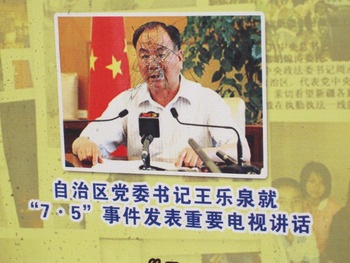
The Han protests were against Uyghurs but directed at the state. They called for the-then regional Party chief, Wang Lequan, to be sacked.Footnote 103 A PAP poster display of “7-5” identified Rebiya Kadeer, the Uyghur campaigner based in Washington, DC, as the “life or death enemy” alongside the Dalai Lama. However, there was more vandalism visible on an image of Wang Lequan, now seen as an ethnic traitor, as Han Chinese protestors scratched and drew over his face (see Figure 1). Demonstration chants of “kill the Uyghurs” were heard alongside chants of “kill Wang Lequan.”Footnote 104 Seven different participants raised their fist to me, shouting “kill Wang Lequan, kill the Uyghurs,” as if the two were synonymous, as they expressed anger at being prevented from reaching Döngköwrük/Erdaoqiao to “kill the Uyghurs.”Footnote 105 Although racist framings did predominate, they were not adopted by all participants. One male, self-employed, middle-aged Han Chinese resident explained that people had taken to the streets because “Han are angry,” not only about the “lack of security” and syringe attacks but also about “unemployment” and “inequality between Xinjiang and the rest of China.”Footnote 106 One getihu from Urumqi and in his late 40s explained:
It's a political problem. Nothing to do with ordinary people … Wang Lequan kill! Kill! Kill! [raises fist] There was no response. They did nothing. Wang Lequan is useless. He only looks out for himself, so Xinjiang is still poor compared to the rest of China. He does nothing … things are not finished.Footnote 107
“Regional Party Secretary Wang Lequan Gives Important Speech on the ‘7-5’ Incident.”

Like many working-class Han, he resisted the official narratives that he was the centre of China and instead felt politically marginalized. He understood his own identity insecurity through internal boundaries between state and society and between prospering inner China and underdeveloped Xinjiang. Like the Uyghur protests, the Han protests were about identity insecurity but snowballed owing to a broad range of insecurities, which were blamed on both the party-state and Uyghurs.
Official narratives attempted to co-opt the violence and complex identity insecurities that emerged in the conflict between Han residents and an insecure security apparatus. Late on 3 September, the city government and PSB pasted posters around Urumqi stating that the protests were “illegal” and participants should allow “unity to be maintained by Party and government.” On 5 September, Meng Jianzhu 孟建柱, the minister of public security, visited Urumqi and declared that the protest's goals to “severely punish criminals” had been met.Footnote 108 The state response represented insecure attempts to co-opt Han resistance to minzu tuanjie by claiming that political leaders had met their goals. However, this attempted co-option concealed violent Han chauvinism, which resisted the party-state's model of a multi-minzu China and created insecurity for Uyghurs.
Popular Han insecurity was exacerbated and translated into threats to identity by the party-state's identity securitizations and framing of syringe assaults as terrorist threats. Its ethnocentric grammar was mobilized as a resource of Han chauvinist resistance against the party-state's multi-minzu model of China. Security forces prevented Han nationalists from attacking the Uyghur “enemy,” thereby exacerbating Han protestors’ insecurity as they felt violence was required to secure China and maintain superiority over Uyghurs. Dynamics between the state and Han heightened state insecurity because loyalty from Han Chinese, the state's source of identity security in Xinjiang, was now under threat. The Han felt that their China was under threat while Uyghurs felt that they faced the threat of China. Han and Uyghurs redeployed official boundaries to articulate alternative ethno-national identities, making the state insecure because both ethnic majority and minorities challenged its multi-ethnic narrative of Zhonghua minzu.
Conclusions
The interplay between China's international security discourses and micro-level security practices in Xinjiang illustrates how China's “domestic” and “international” insecurities are mutually reinforcing. This paper explored how the party-state's framing of hierarchical ethnic boundaries was redeployed in everyday politics, following incidents of mass ethnicized violence in Xinjiang during 2009. The analysis shows how the “inside/outside three evils” discourse demarcated theoretically indivisible boundaries between China and the outside and between majority Han and minority Uyghurs. Discourses of danger superimposed external boundaries between China and international “enemies” on domestic cultural boundaries between Han and Uyghurs. Uyghur identity is being linked to “outside” dangers of Turkic culture, international terrorism and Western democracy, which are framed as threats to China's territorial and cultural boundaries. Violence by Uyghurs was portrayed as existentially threatening to China's rise and officially explained through an absence of Chinese identity. This configuration of identity and security shaped ethnically targeted security practices on the ground, producing insecurity between unequal ethnic groups and, subsequently, for the state. Official hierarchical identity-security narratives produced different insecurities among differentially essentialized groups, who both redeployed official securitizations through speech, protest and violence to articulate alternative identity insecurities.
The paper's first section showed how the Shaoguan violence against Uyghurs was officially designated as an “ordinary public order incident” and unrelated to identity security. However, the failure to punish the perpetrators produced Uyghur insecurity. Uyghurs demonstrated for action, mobilizing the Chinese national flag to perform their desired position of equality, but this was written out of the public record. The second section showed how subsequent violence by Uyghurs in July 2009 was framed as an existential identity-security threat to China. Violent “revenge” by Han Chinese was conversely framed as “operations” by “comrades” for national security. These complementary narratives produce a binarized identity security. Uyghur self-identification inside China, through language and religion, is allegedly supported by “Western enemies” seeking to prevent China's rise, and framed as a culturally external existential threat which causes violence and insecurity in Xinjiang. The binarized meaning attributed to violence by different groups ethnicizes daily security practices of surveillance and patrols that target Uyghurs and produce insecurity. The final section showed how syringe attacks in July's aftermath were officially represented as continuing threats to China's existence. This narrative heightened Han insecurity, sparking protests for increased security and inciting violence against Uyghurs. Slogans at the protest and interviews with participants showed how Han nationalists redeployed the official identity-security discourse to reject the party-state's model of a multi-minzu China and violently target Uyghurs as ever-present threats to their mono-minzu China. The party-state's attempts to secure China from the “inside/outside three evils” created insecurity for Uyghurs and, ironically, for itself. The securitization of Zhonghua minzu gave Han nationalists a discursive framework to articulate Uyghurs as a threat and demand violence as a response. The Chinese party-state, as arbiter between Han and Uyghurs, produces insecurity between the two groups by venerating and securitizing ethnocentric narratives of Han identity, while painting Uyghurs as threats to China's rise. Such discourses of danger exacerbate security problems in the region as Uyghurs resist the re-organization of their identities and frame China as the outside threat to their identity security.
On the first anniversary of “7-5,” insecurity remained across Urumqi. Public transport and streets were largely empty of residents. By 5 July 2012, the city was observably more bustling. However, ethnically targeted patterns of armed PAP patrols, bag checks, the constant flashing of surveillance cameras and temporary security gates had intensified in Uyghur areas. In 2005 alone, 18,000 arrests were made under suspicion of terrorism, and since 2009, a sharp rise in smaller violent incidents saw security services in Kashgar 喀什, Khotan 和田 and Yecheng targeted in a “self-fulfilling prophecy” of insecurity.Footnote 109 These spiralling cycles of insecurity show how identity categories continue to be violently contested from below. Since 2009, most outbreaks of violence, for example, in Bachu 巴楚, Shanshan 鄯善 and Pishan 皮山, have seen more focused clashes between Uyghurs and security services akin to the political violence of the 1990s. Many incidents have been sparked during cadre patrols of Uyghur neighbourhoods under the policy of “maintaining-stability work” (weiwen gongzuo 维稳工作) and President Xi Jinping's 习近平 strategy to build a “great wall of iron” to protect national unity.Footnote 110 Policies perpetuating this self-fulfilling prophecy have now culminated in internment camps that arbitrarily target individuals as extremists owing to their ethnicity. Uyghur identity is the background of potential instability that justifies this state of exception and its special policies.Footnote 111 In 2015, a male Han getihu in his 40s directed my attention to the buildings and military posts armed with machine guns across the Uyghur district, explaining, “it's so backward, like going back to the 19th century, but things are safe now.”Footnote 112 The securitization of Zhonghua minzu produces hierarchical ethnic relations that shape everyday Han and Uyghur insecurities, limiting the possibility of social trust and understanding of the other's identity.
Acknowledgement
The author offers his eternal gratitude to the many people of many ethnicities in Xinjiang whose stories and wisdom have made this work possible.
Biographical note
Dr David TOBIN is Hallsworth research fellow in the political economy of China at the University of Manchester. His forthcoming book, Securing China's Northwestern Frontier: Identity and Insecurity in Xinjiang (CUP), analyses the relationship between identity and security in Chinese policymaking, and ethnic relations between Han and Uyghurs in Xinjiang.