INTRODUCTION
On March 7, 2013 President Barack Obama invited leaders of the nation's largest religious denominations to the White House to discuss the administration's plans for comprehensive immigration reform. The list of attendees at the meeting included representatives from the: United Methodist Church, Southern Baptist Convention, National Association of Evangelicals, Church of Jesus Christ of Latter-Day Saints, and Catholic Church. Speaking with reporters after this meeting, the Archbishop of Los Angeles, Jose Gomez, said:
“Our collective faith groups are prepared to support just and humane reform of a broken immigration system. With the president's leadership and cooperation between both parties in Congress, we can achieve this goal within the year. We agree with the president and bipartisan Senate leaders who are stressing the importance of a path to citizenship for the undocumented. We should not sanction a permanent underclass in our society” (Gomez Reference Gomez2013).
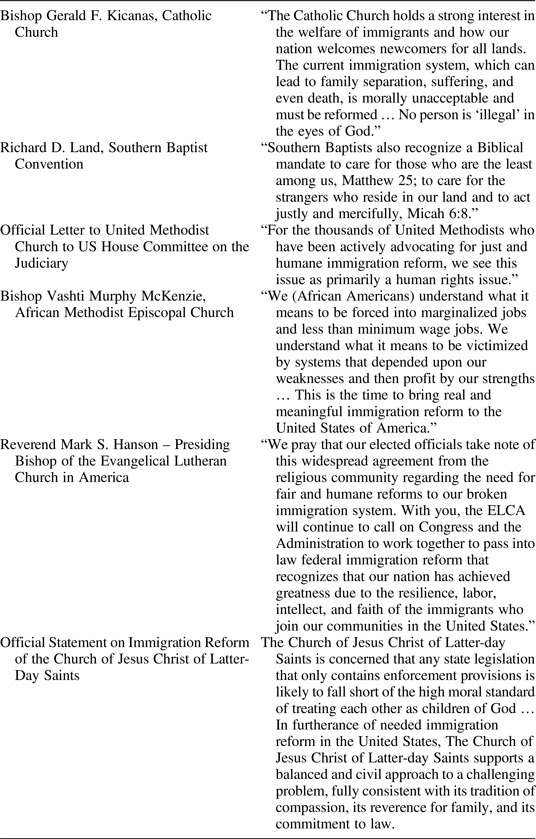
Gomez's statement, of course, is not the first time that a prominent religious leader has publicly spoken out in favor of liberal reforms to the American immigration system. As seen in Table 1, clergy from nearly every one of the nation's most populous denominations have come forward in the last decade to express their disapproval for policies that punish the estimated 11 million undocumented immigrants living in the United States (U.S.) (Nteta and Wallsten Reference Nteta and Wallsten2012; Knoll Reference Knoll2009).Footnote 1
Public statements of religious leader on immigration reform

It is important to point out, however, that these pronouncements are not the isolated musings of individual pastors seeking attention from mainstream media outlets. Indeed, each of the statements listed in Table 1 was made against the backdrop of an increasingly vigorous effort on the part of religious organizations to pursue liberal immigration reform through inter-denominational collective action. For example, the leaders of the nation's largest African-American churches formally joined with a number of Latino pastors in 2010 to pursue comprehensive immigration reform (2010 Letter from African-American and Hispanic Pastors in Support of Immigration Reform to the President and Members of Congress) and the leaders of the Episcopalian Church, the National Association of Evangelicals, the United Methodist Church, and the Evangelical Lutheran Church of America recently formed a number of umbrella organizations for the express purpose of lobbying members of Congress on immigration policy.
Unsurprisingly, survey evidence indicates that arguments about immigration policy are also finding their way into the sermons delivered in churches around the country. According to a 2010 report by the Pew Forum on Religion and Public Life, almost a quarter of respondents who attend church at least once or twice a month recall hearing a message on immigration in their place of worship (Pew Research Center's 2010 Religion & Public Life Survey). What's more, most of these messages express support for liberal reforms to the nation's current immigration laws. Among those in the Pew study who reported exposure to a message on immigration, 49% of respondents said that these messages argued in favor of liberal immigration reforms (as opposed to 23% of respondents who said that the messages they were exposed to argued against liberal immigration reforms). To put all of this differently, there appears to be a strong and growing consensus among church leaders that the clergy should take a proactive role in advocating for more liberal immigration laws.
In this article, we explore whether the clergy's persistently vocal advocacy for immigration reform in recent years is likely to change the public's perception of immigration policy and of undocumented immigrants. Specifically, we ask: does exposure to a message on immigration reform delivered by a religious leader that shares the respondent's faith lead people to express different views on immigration policy and undocumented immigrants as a group? We answer this question by examining unique data from a survey experiment embedded in a module of the 2012 Cooperative Congressional Election Study (CCES). Testing hypotheses derived from elite opinion theory, our results show that arguments from high profile religious leaders can compel some individuals to reconsider their views on some aspects of the immigration debate. To be more precise, we found that Methodists, Southern Baptists, and Evangelical Lutheran Church in America (ELCA) leaders successfully persuaded respondents who identify with these religious denominations to think differently about a path to citizenship and about the plight of undocumented immigrants. Interestingly, we also uncovered strong evidence that religiosity matters in different ways for how parishioners from different churches receive messages from their religious leaders. These findings force us to reconsider the impact that an increasingly strident clergy may be having on public opinion in general and on immigration issues in particular.
LITERATURE REVIEW
Public Opinion on Immigration
There has been no shortage of scholarly attempts to pinpoint the individual-level factors driving American attitudes on immigration policy in recent years. One set of scholars in this growing body of work argues that support for restrictive immigration policies often grows out of narrow concerns about one's own economic well-being (Malhotra, Margalit, and Mo Reference Malhotra, Margalit and Hyunjung Mo2013; Hainmueller and Hiscox Reference Hainmueller and Hiscox2010; Scheve and Slaughter Reference Scheve and Slaughter2001; Nteta Reference Nteta2013). Other scholars, however, argue that support for restrictive immigration policies most frequently stems from a broad set of concerns about the cultural threat that new immigrants may pose to contemporary notions of American national identity (Schildkraut Reference Schildkraut2011; Citrin and Wright Reference Citrin and Wright2009; Newman Reference Newman2013). Finally, some researchers argue that support for restrictive immigration policies is best explained by prejudicial attitudes toward Latinos or generalized ethno-centrism (Citrin et al. Reference Citrin, Green, Muste and Wong1997; Kinder and Kam Reference Kinder and Kam2010).
Although these studies provide a useful starting point for the kinds of questions we address in this article, they provide relatively little guidance for understanding the impact that exposure to proclamations from religious leaders may have on an individual's views about immigration. Indeed, much of the existing research completely ignores the role that contextual dynamics play in shaping Americans’ preferences concerning immigration reform (Hainmueller and Hopkins Reference Hainmueller and Hopkins2015). As a result, the existing literature on immigration attitudes provides few clues about how religious Americans respond to the rhetoric of religious leaders on immigration.
Clergy Influence
There is also a voluminous literature on the behavior of religious elites — ranging from studies of the level of political activity engaged in by congregational leaders (Djupe and Gilbert Reference Djupe and Gilbert2003) to examinations of the political content of clergy speech (Gilbert Reference Gilbert1993; Jelen Reference Jelen1993). More germane to our purposes here, however, is a large body of research attempting to assess the extent to which the religious context shapes the opinion of parishioners (Gilbert Reference Gilbert1993; Huckfeldt, Plutzer, and Sprague Reference Huckfeldt, Plutzer and Sprague1993; Huckfeldt and Sprague Reference Huckfeldt and Sprague1995; Wald, Owen, and Hill Reference Wald, Owen and Hill1988). Generally speaking, early scholarship on this topic found that the messages communicated in churches exercised an important influence over the political views and identities of congregation members (for a review see Djupe and Calfano Reference Djupe and Calfano2013). In a detailed study of Protestant parishioners, for example, Wald, Owen, and Hill (Reference Wald, Owen and Hill1988) found that an individual's level of political conservatism was partly determined by the theological conservatism of their congregation (also see Huckfeldt, Plutzer, and Sprague Reference Huckfeldt, Plutzer and Sprague1993). As Chris Gilbert (Reference Gilbert1993, 171) summarized in The Impact of Churches on Political Behavior, the early data “clearly support the hypothesis that churches are significant sources of political cues, and that churches do affect the political actions and beliefs of their members.”
More recent scholarship has reached contradictory conclusions about the influence of clergy speech on public opinion. On the one hand, some of this research has uncovered evidence for strong clergy effects (Bjarnason and Welch Reference Bjarnason and Welch2004; Djupe and Hunt Reference Djupe and Hunt2009). For instance, in his study of Anabaptist denominations, Fetzer (Reference Fetzer, Crawford and Olson2001) showed that pastors reinforced and converted their congregation's political views on issues of war and peace. Similarly, in their study of the Episcopal Church and the Evangelical Lutheran Church in America, Djupe and Hunt (Reference Djupe and Hunt2009) found that clergy messages on the environment played an important role in shaping the views of church members.
Other research, by contrast, has discovered that the influence of religious leaders is more limited and contingent upon characteristics of the message, the context of communication and the clergy member who is communicating (see Smith Reference Smith2008; Djupe and Gilbert Reference Djupe and Gilbert2009; Djupe and Calfano Reference Djupe and Calfano2009). In a specific test of Zaller's (Reference Zaller1992) model of elite influence, Campbell and Monson (Reference Campbell and Monson2003) found that Mormons are likely to “follow their leaders” only when there is endorsement by and agreement among Church of Jesus Christ of Latter-Day Saints Church leaders on political issues. In a study of attitudes on environmental protection, Djupe and Gwiasda (Reference Djupe and Gwiasda2010) employed a survey experiment to illustrate that religious leaders have their largest impact on members of their denominations when information regarding decision-making processes is communicated (Djupe and Calfano Reference Djupe and Calfano2009). The recent surge in scholarly attention on the impact of clergy pronouncements has not, in other words, produced a consistent set of findings regarding the scope and reach of the clergy's influence over their congregation's political attitudes.
Immigration, Religiosity, and Clergy Messages
To date, few scholars have even attempted to evaluate the extent to which religious leaders influence the preferences of their congregation on issues pertaining to immigration. Contrary to the relatively mixed findings discussed above, studies focusing solely on immigration have consistently demonstrated the important role that exposure to clergy messages plays in structuring parishioner's opinions on immigration policy. Using a 2006 Pew Center survey on immigration reform, for example, Knoll (Reference Knoll2009) showed that respondents who attend religious services more frequently are significantly more likely to oppose restrictive immigration policies. According to Knoll, this finding may mean that parishioners who regularly attend religious services are mimicking the publicly stated views of their religious leaders. Drawing on survey data from the 2004 National Politics Study (NPS), Brown (Reference Brown2010) found that economically vulnerable African-Americans who reported hearing political messages from their religious leaders were more likely to express opposition to immigration. Employing a different set of measures from the 2004 NPS, most notably an item that asked respondents whether they had heard a “sermon, lecture, or discussion” concerning immigration in their church, Nteta and Wallsten (Reference Nteta and Wallsten2012) found that exposure to clergy messages leads respondents to express stronger opposition to anti-immigration policies.
These studies should be lauded for drawing much needed attention to an often overlooked factor — messaging from religious elites — on an increasingly important political issue — immigration. With that said, however, the collection of studies discussed above employ research designs and analyze data sets that are poorly suited for identifying the influence of religious elites on their parishioners’ views of immigration. To be more precise, these recent articles can be used to reach only the most tentative of conclusions about the impact that clergy rhetoric has on immigration policy opinions because they each suffer from five major methodological weaknesses. We address each of these problems in turn.
The first methodological problem with the current body of work on elite leadership and immigration opinions is that all of the studies rely exclusively on self-report measures of exposure to messages from religious leaders. Knoll (Reference Knoll2009) bases his conclusions about clergy leadership on a simple question asking respondents how frequently they attend services at their place of worship. Brown's (Reference Brown2010) measure of exposure to elite messages on immigration is an index of two non-specific questions about political behaviors.Footnote 2 Nteta and Wallsten (Reference Nteta and Wallsten2012) use a question that asks respondents whether they “heard a sermon, lecture, or discussion at your place of worship that dealt with immigration or immigrants” during the last year.
The notorious validity problems of self-report measures are troubling for the conclusions drawn by this body of work. Numerous studies, for instance, have shown that Americans systematically over-report the frequency with which they attend church (Hadaway, Marler, and Chaves Reference Hadaway, Marler and Chaves1993; Reference Hadaway, Marler and Chaves1998; Presser and Stinson Reference Presser and Stinson1998). Additionally, self-reported measures of exposure to political messages communicated through media outlets are notoriously biased and unreliable (Prior Reference Prior2009). More importantly, Djupe and Gilbert (Reference Djupe and Gilbert2009) found that many congregation members misperceive the messages delivered by their church's leaders. If the measures used to assess clergy influence are not valid, leadership effects may arise not because of differences in exposure but because of differences in the accuracy of reporting exposure.
Second, the self-reported measures of exposure to clergy messages used in recent studies of immigration are exceedingly poor proxies for whether a respondent actually heard anything at all from their clergy about immigration.Footnote 3 Knoll's question about church attendance and Brown's index of contact with clergy members do not identify whether the respondent received any message from their clergy members whatsoever on immigration. The question used by Nteta and Wallsten explicitly asked respondents about hearing a “sermon, lecture or discussion” on immigration but it did not identify whether the clergy, fellow parishioners or some other actor was responsible for the immigration message being communicated. Unfortunately, therefore, these measures are an imperfect instrument for assessing the influence of clergy messages on the immigration attitudes of parishioners.
Third, the measures of exposure used in these studies do not reveal anything about the nature and content of the messages being communicated. Specifically, even if the measures discussed above serve as useful proxies for exposure to a clergy message on immigration, they cannot tell us whether respondents were exposed to pro or anti-immigration messages. For instance, Nteta and Wallsten's measure does not reveal anything about whether the “sermon, lecture or discussion” heard by the respondent focused on building or undermining support for liberal immigration reforms (or both). The inability to assess the direction of clergy messages is particularly problematic given that a number of studies have found that religious leaders frequently present both sides of an issue when discussing politics from their pulpits (Djupe and Neiheisel Reference Djupe and Neiheisel2008; Djupe and Olson Reference Djupe and Olson2010). The even-handed approach that church leaders take in their sermons on political issues may not only undermine the ability of parishioners to correctly recall the content of clergy messages but may also dampen the likelihood that immigration messages from religious elites will have any identifiable impact on policy attitudes (Djupe and Gilbert Reference Djupe and Gilbert2009). In short, without knowing the specific content of clergy message it is impossible to tell whether respondents are following the lead of their religious leaders.Footnote 4
Fourth, these studies rely on survey data from the very early part of the 21st century, thus failing to provide a more contemporary picture of the role of religious elites in framing public opinion on this issue. As noted by Bloemraad, Voss, and Lee (Reference Bloemraad, Voss and Lee2011) much of the public rancor over the issue of immigration reform began in 2006, ignited by the passage of immigration reform bills in the House (H.R. 4437) and the Senate (S2611) and pro-immigration protests held in major American cities. In fact, according to the Gallup's monthly survey of the nation's most important problem, a record 19% of Americans mentioned immigration as the nation's most pressing problem in April 2006 (Jones Reference Jones2006). Thus, the results provided by Knoll, Brown, and Nteta and Wallsten may represent a period in which clergy discussions regarding immigration were infrequent given the lower levels of saliency attached to the issue.
Finally, these studies use cross-sectional research designs that cannot rule out plausible rival hypotheses. The potential for reverse causation is particularly problematic for the internal validity of these studies. As a result of these methodological issues, these studies can provide only preliminary evidence that church leaders structure opinions on immigration issues (Djupe and Calfano Reference Djupe and Calfano2013).
THEORY
In examining the role of religious elites in influencing the opinion of their parishioners, our work relies heavily on scholarship associated with elite opinion theory (Carmines and Stimson Reference Carmines and Stimson1989; Zaller Reference Zaller1992; Lee Reference Lee2002). Elite opinion theory starts from the assumption that most people form their political opinions by relying on informational shortcuts instead of carefully researching the details of every policy issue. According to elite opinion theory, the actions and statements of political elites are the primary shortcut that people use in deciding where they stand on a given political issue. As a result, individual attitudes and aggregate public opinion responds in highly predictable ways to the ideas, information, and issue frames communicated by political elites through the mass media.
Although elite activity is assumed to be a central macro-level independent variable in explaining the dependent variable of mass public opinion, it is important to note that not all members of the public are equally influenced by elite messages. Zaller (Reference Zaller1992) outlined the differential impact of elite messages in his Receive-Accept-Sample (RAS) model of opinion formation. According to Zaller the RAS model of opinion formation has two basic steps: input (how information is received and processed) and output (survey responses or “opinion statements”). In Zaller's formulation, the input step depends on two separate events: receiving the message (influenced by an individual's level of political awareness) and accepting the message (influenced by an individual's predispositions). More specifically, Zaller argues that more politically aware people will be more likely to receive political communications than non-aware people and, for those that receive these communications, acceptance will increase when the message is consistent with the individual's predispositions — broadly defined as an individual's “interest, values and experiences” (Zaller Reference Zaller1992, 22).
In this article, we employ a variation of Zaller's RAS model of opinion formation. Much of the elite opinion theory scholarship examines the conditional impact of individual political predispositions, such as a respondent's partisan and ideological attachments, on the acceptance of elite cues. Here, we theorize that a distinct set of predispositions, namely a respondent's level of religiosity, will influence the likelihood that an individual accepts a message from a religious leader. Specifically, we hypothesize that highly religious individuals, like strong partisans, will be more susceptible to the influence of messages communicated by their church's religious leaders. If church leaders are making widely heard arguments in favor of reforming the nation's immigration laws and viewing undocumented immigrants sympathetically, for example, the most religious members of these religious denominations should express more support for reform and more sympathy for immigrants.
Our hypothesis that highly religious individuals will hold a distinct set of attitudes concerning immigration is by no means a novel argument (Green Reference Green2007; Layman Reference Layman1997; Welch and Leege Reference Welch and Leege1988; Knoll Reference Knoll2009; Nteta and Wallsten Reference Nteta and Wallsten2012). What is distinct about our approach here, as noted above, is the means by which we test this hypothesis. Rather than relying exclusively on cross-sectional data to examine religious elite influence, we employ a survey experimental research design that ensures exposure to pro-immigration clergy messages.
DATA
To test our hypothesis concerning the interplay of religious identity, religiosity, and opinion on immigration we make use of data from a survey experiment embedded in a module of the 2012 CCES. The 2012 CCES is an online survey of over 50,000 Americans conducted by YouGov on the behalf of over 40 colleges and universities. Recent work has found that the use of an opt-in internet panel produces estimates that are as accurate as national surveys that employ probability based telephone and mail surveys (Ansolabehere and Schaffner Reference Ansolabehere and Schaffner2014). Our survey module was administered to 1,000 respondents in the post-election phase of the survey.
DESCRIPTION OF EXPERIMENTAL DESIGN
Consistent with standard survey protocol, subjects were first asked to identify their religious affiliation in the Common Content portion of the Pre-Election 2012 CCES. In our analysis, we focus on respondents from six religious denominations: the United Methodist Church, the Southern Baptist Convention, the Evangelical Lutheran Church in America, the Church of Jesus Christ of Latter-Day Saints, the Catholic Church and a group of historically black churches.Footnote 5 We do so for two reasons. First, according to a 2010 Pew Center U.S. Religious Landscape survey, these six religious groups are among the most popular in the United States. Second, as noted in Table 1, leaders of each of these religious denominations have publicly expressed their support for liberal immigration reforms, thereby increasing the external validity of our fictional messages.
In total, there were 319 respondents who identified with one of the major religious denominations listed above. Of this group, 13.8% identified with the United Methodist Church, 13.5% with the Southern Baptist Convention, 12.9% with Evangelical Lutheran Church in America, 3.8% with the Church of Jesus Christ of Latter-Day Saints, 2.2% with the group of historically black churches, and 54.8% with the Catholic Church.
Half of the respondents who identified with one of the religious denominations listed above were assigned to one of the treatment groups.Footnote 6 Respondents in the treatment conditions were each shown a fictitious article from a popular American newspaper article that detailed the testimony of the leader of the respondent's specific religious denomination to the House Judiciary Subcommittee on Immigration Policy and Enforcement. In order to bolster the external validity of the article, we selected the ranking leader of each religious denomination under examination as the religious leader that offered testimony to the House subcommittee.Footnote 7
The text of each article begins by informing the reader that the religious leader in question spoke to the House Judiciary Subcommittee on Immigration Policy and Enforcement regarding the support offered by his religious organization for liberal immigration reforms. The article goes on to detail the stance of the religious leader in question, as he defends the position of his religious denomination on undocumented immigration by arguing that, “Immigration is ultimately a humanitarian issue since it impacts the basic rights and dignity of millions of persons and their families. Our immigration system fails to meet the moral test of protecting the basic rights and dignity of the human person.” The religious leader then attempts to undermine the belief that undocumented immigrants come to the U.S. for “nefarious” purposes arguing that most undocumented immigrants come to the U.S. to “reconnect with family members or find work.” The article then details the religious leader's specific policy proposals concerning comprehension immigration reform that include, “a six- to nine-month grace period for people who are here in an undocumented status to come forward, to register, to agree to pay fines and back taxes, to learn English, and (to) go to the back of the line so that they are not being rewarded.” The article ends with the religious leader imploring members of Congress to not forget the teachings of Leviticus 19:34 in crafting comprehensive immigration reform; an often quoted biblical passage which states “the alien who resides among you shall be to you as the citizen among you; you shall love the alien as yourself, for you were aliens in the land of Egypt.” The inclusion of this biblical passage was designed to not only mimic the public rhetoric of religious leaders on this topic but also to connect our study with recent work showing that clergy speech is more influential among church members when political statements are coupled with information on how the religious leader in question came to hold this position (Djupe and Gwiasda Reference Djupe and Gwiasda2010).
The text in each of the six articles is identical except for references to the religious denomination and religious leader in question in the article. We also altered the title of the article in each of the six experimental conditions. We titled the article, “(Insert Religious Denomination) Presses Congress for Compassionate Immigration Reform” in order to inform readers of the sympathetic position that the church has taken on the issue. In addition, each of the six articles were visually identical except for the inclusion of a picture of the religious leader in question which is located on the right side of the article copy between the first and second paragraphs. In order to maximize the external validity of our experiment, the text for all versions of the article was written to mimic in its tone, language, and visuals newspaper articles written about a 2010 meeting of the House Judiciary Subcommittee that featured many of the leaders of the religious denominations in our study (Goodstein Reference Goodstein2010).Footnote 8
A major concern with online survey experiments is that subjects will not pay enough attention to actually “receive” the treatment. In order to control for a lack of attentiveness among our subjects, we included an “attention check” question immediately following the article. This question asked respondents to identify “which of the following did the clergy NOT offer as a requirement for illegal immigrants to achieve legal status…pay a fine and back taxes, learn English, return to their home nation?”Footnote 9 Immediately following this factual question, respondents were asked two questions designed to tap into their underlying feelings about immigration policy and undocumented immigrants as a group. Specifically, the first question following the treatment asked respondents if they support, “Passing a bill to allow illegal immigrants to remain in the United States and become U.S. citizens, but only if they meet certain requirements over a period of time.” The second question asked respondents how sympathetic they “are toward illegal immigrants in the United States?” Respondents in the control condition were not shown an article and instead were directed to answer the questions listed above.Footnote 10
While we believe our survey experiment addresses a number of the theoretical and methodological shortcomings found in previous studies of clergy leadership, it is important to point out two limitations of the design we employ here. First, as a result of the fact that we attribute our treatment messages to the ranking national leader of each of the denominations listed above, we cannot make any claims about how local clergy members might shape immigration attitudes. Messages emanating from these more trusted, reputable and respected local leaders might have a much different effect on parishioner attitudes than the ones we estimate here.
Second, in order to maximize our study's external validity, we crafted our treatment messages to reflect the rhetorical frames actually used by religious leaders during past congressional committee testimonies (Goodstein Reference Goodstein2010). In these hearings, clergy have often justified their liberal positions on immigration reform by employing a sophisticated mix of identity cues, religious authority cues, biblical cues, policy arguments, and theological claims. By mimicking these “real world” clergy messages in our experimental treatments, we willingly sacrificed the ability to identify any specific rhetorical devices that drive clergy influence in favor of maximizing the generalizability of our findings. While we are ultimately interested in precisely identifying the core mechanisms at the heart of clergy influence, we view the analysis here as only a first step in the path to better understanding how religious leaders influence their parishioners.
RESULTS
Does exposure to a pro-immigration article that details the position of the respondent's religious leader cause individuals to express more opposition to restrictive immigration policies and more sympathy for undocumented immigrants? In order to assess the impact of the treatment on attitudes towards immigration reform and undocumented immigrants, we first compared the average responses of people who received a message from their religious denomination's leader to those who did not. In our analysis, each item was scaled 0 to 1 such that 1 represents support for a path to citizenship and a sympathetic view of undocumented immigrants. Figures 1 and 2 display the mean score for Catholics, Southern Baptists, ECLA, and Methodists in the control group and treatment groups.Footnote 11 As the data in Figure 1 shows, Catholics, Southern Baptists, and ELCA members were not persuaded by their respective clergy's calls to support more liberal immigration reform. Methodists, by contrast, were apparently convinced of the necessity to change the nation's approach to immigration by reading a message attributed to their church's leader — with respondents in our treatment group averaging 0.33 points more support for a path to citizenship than respondents in our control group.Footnote 12 As the data in Figure 2 also show, however, sympathy for immigrants was largely unmoved by clergy of any denomination. Specifically, there were no meaningful differences in the level of sympathy expressed by those who received a pro-immigration reform message from their church's leader and those who received no such message.
Mean differences between control group and treatment groups for citizenship with requirements.

Mean differences between control group and treatment groups for immigrant sympathy.

Unfortunately, we can only draw tentative conclusions from Figures 1 and 2 because they fail to take into account the conditioning influence that religiosity may have on message responsiveness. Our central hypothesis, derived from extant scholarship on religiosity, public opinion on immigration reform, and elite opinion theory, predicted that highly religious respondents exposed to a message on immigration from their religious leaders would be more likely to mimic the views of their religious leadership when compared to highly religious respondents in the control group. On the other hand, we also hypothesized that less religious respondents exposed to a pro-immigration message from their religious leader would exhibit no significant differences in their immigration views when compared to less religious respondents in the control condition. In defining a respondent's level of religiosity, we employed an index of three items from the 2012 CCES (Layman Reference Layman2001). The first asks respondents; “how important is religion in your life?” The second asks individuals, “Outside of religious services, how often do you pray?” The third asks, “Aside from weddings and funerals, how often do you attend religious services?”Footnote 13
The models presented in Appendix C show the results of ordinary least squares regression analyses that examine the interplay of a respondent's religiosity with their susceptibility to elite cues on immigration. Because the coefficients for the interaction terms shown in the models cannot be easily interpreted, we present these findings by calculating conditional marginal effects. According to Braumoeller (Reference Braumoeller2004), Brambor et al. (Reference Brambor, Roberts Clark and Golder2006) and Kam and Franzese (Reference Kam and Franzese2009), the significance of the marginal effects is far more important and revealing than the significance of the interaction terms presented in Appendix C. As Gidengil, Giles, and Thomas (Reference Gidengil, Giles and Thomas2008) write, “it is quite possible for the interaction term to be significant in the absence of a significant marginal effect and vice versa. Accordingly, a proper assessment requires that we calculate the marginal effects along with the corresponding standard errors.” Following this advice, we focus our attention in the discussion that follows on the substantively relevant marginal effects displayed in Figures 3, 4, and 5.Footnote 14 In order to better reflect the distribution of actual cases in the data, the graphs presented below limit the predicted values for each dependent variable to religiosity scores greater than 0.3.Footnote 15
Predicted immigration attitudes among all respondents

Predicted citizenship with requirements attitudes within religious groups.

Predicted immigrant sympathy within religious groups.

The predicted values presented below show that exposure to a message from one's religious leader exerts a very different impact on the immigration policy attitudes of religious and non-religious respondents. Among very religious respondents in the overall sample (i.e., religiosity scores greater than 0.75), exposure to a message from their clergy pertaining to the church's support for liberal immigration reform led to more supportive views of a policy providing a path to citizenship for illegal immigrants. Indeed, as Figure 3 shows, treatment group respondents who claimed that religion is more important in their lives, who reported praying more frequently and who attended church more often expressed far more positive feelings towards policies designed to protect the interests of undocumented immigrants when compared to similarly religious respondents in the control group. In short, consistent with our hypotheses, highly religious individuals appeared to follow the lead of religious elites on questions of immigration policy.
As Figure 3 also shows, however, exposure to messages from religious leaders appears to have had no impact on how much sympathy the religious or the non-religious respondents in our sample felt towards undocumented immigrants as a group. The predicted values in Figure 3 show that the treatment and control groups were essentially the same in their feelings towards undocumented immigrants, with religiosity increasing sympathy among both those who received a clergy message and those that did not. These findings suggest that religious leaders might be more effective at persuading their parishioners on the necessity of changing immigration policy than on enhancing their church members’ identification with the plight of undocumented immigrants.
While providing some preliminary insights into the nature of the clergy's influence on immigration issues, the pooled analyses presented above do not look for differences in leadership effects across religious denominations. There are good reasons, however, to believe that members of different denominations might respond differently to attempts from their clergy to persuade them on immigration issues. Indeed, as has been well documented, each religious denomination in our analysis has a distinct institutional hierarchy, a distinct tradition of political activity, and a distinct set of norms regarding deference to clergy members (Smith 2010; Smidt 2004). Additionally, church attendance, prayer frequency and subjective assessments of religion's importance in one's personal life are not evenly distributed across religious faiths (Leege Reference Leege1996; Cohen et al. Reference Cohen, Hall, Koenig and Meador2005; Mockabee, Monson, and Grant Reference Mockabee, Monson and Grant2001; Djupe and Gilbert Reference Djupe and Gilbert2009).Footnote 16
The size and scope of denominational differences raises the possibility that the findings presented in Figure 3 mask important differences in how Catholics, Methodists, Southern Baptists and ELCA members respond to their leaders. Given the relatively large number of Catholics in our sample, we were particularly concerned that the presence (or absence) of leadership effects among Catholics might lead us to draw inaccurate conclusions about how much clergy members representing other denominations matter in shaping their parishioner's views on immigration policy and undocumented immigrants. It could be the case, for example, that our findings about the importance of clergy messages on immigration policy were true among Catholics but not true among Methodists, Southern Baptists and members of the ELCA. Similarly, the absence of significant treatment effects in our overall analysis of sympathy towards immigrants could simply be the result of Catholics rejecting their clergy's message rather than evidence of across the board inefficacy on the part of all religious leaders.
In order to explore the possibility that members of some denominations were more responsive to clergy messages than members of other denominations, we ran versions of the models presented in Appendix C among our sample of Catholics, Methodists, Southern Baptists and ELCA members. The results of these within-denomination analyses are presented in Appendices D and E. Figures 4 and 5 display the within-group, predicted values for both of our dependent variables. Collectively, these analyses reveal that denominational differences matter a great deal in determining how parishioners respond to attempts at persuasion by their respective clergy members on immigration. In addition, these results show that, even within denominations, the conditioning influence of religiosity works in different ways for questions of immigration policy and questions of sympathy for the groups affected by those policies. In order to better illustrate these dynamics, we discuss the findings from each of our four within-denominational analyses in turn.
Contrary to the general expectations spelled out above, Catholics were not persuaded to increase their support for a path to citizenship or to express more sympathy for immigrants after reading statements from one of their church's highest ranking leaders, Archbishop Timothy Dolan. As Figures 4 and 5 clearly show, there were no significant differences between Catholics in the treatment and control groups on either of our dependent variables at any level of religiosity. Catholic attitudes on immigration, in other words, appear to be largely immune from the influence of their church's leadership.
The failure of Catholics to change their attitudes in response to a message from Archbishop Timothy Dolan may be the result of two different factors. On the one hand, the lack of leadership effects could stem from Dolan's or the Catholic leadership's unpopularity with the Catholic laity. As Brady and Sniderman (Reference Brady and Sniderman1985) argue in their study of the “likeability heuristic,” when an individual holds positive feelings towards a group, he or she is likely to adopt attitudes which are consistent with the group and the group's leadership. When an individual holds negative feelings towards a group, he or she becomes very unlikely to support the positions expressed by the group and their leadership.
Unfortunately, we do not have any good data about how Catholics felt towards their church's leadership during the period of our study. It is very possible, however, that the Church's leaders were unpopular with a non-trivial number of Catholics when our survey was administered. Indeed, in the months before the post-election CCES was fielded, Dolan and the Catholic Church were at the center of a major controversy on sexual abuse in the priesthood. Most notably, in May 2012, the New York Times reported that, under Dolan's leadership, a number of priests accused of sexual abuse were still receiving full salaries and had been paid substantial amounts of money to leave their positions (Goodstein Reference Goodstein2012). Although Dolan vehemently denied the report's accusations that he had given “payoffs” to protect accused priests, the issue was widely covered in the news media and attracted considerable attention among church observers.Footnote 17 This scandal, or the cumulative effect of similar events over the years preceding our study, may have increased negativity toward Dolan in particular or the leadership of the Catholic Church in general among American Catholics. These heightened feelings of negativity may have led Catholics in our sample to reject the persuasive messages about immigration contained in our treatment.
Alternatively, the lack of clergy influence among Catholics may be a result of the fact that the Catholic Church, more than any other religious denomination, has been at the forefront of supporting liberal changes to the immigration system (Knoll Reference Knoll2009). Unlike other churches, who are just beginning to mobilize around immigration issues, public declarations of support for liberal immigration reform by the U.S. Conference of Catholic Bishops date back at least to 2000 (Knoll Reference Knoll2009). Catholic leaders’ persistent and highly public support for liberal immigration reforms in the years preceding our study may have influenced the opinions of the most religious members of the Church well before the administration of our survey experiment. Put differently, our 2012 study may have come years too late to identify any meaningful clergy leadership effects among Catholics. While our research design cannot adjudicate between these two competing hypotheses regarding the lack of significant results among Catholics, our findings do suggest that future work gather enough data within denominations to explore how idiosyncratic factors unique to each church shape clergy influence on immigration.
Unlike Catholics, members of the ELCA showed clear signs of heeding their clergy's call on immigration. The response, however, was not always in line with the predictions of elite opinion theory. At low levels of religiosity (i.e., index scores less than 0.5), ELCA members explicitly rejected persuasive attempts by their church's leadership and showed clear evidence of a “backlash effect” on both immigrant reform and on sympathy towards immigrants — with those exposed to the hypothetical testimony displaying significantly lower levels of support for a path to citizenship and significantly less sympathy than those who were not. At very high levels of religiosity (i.e., index scores greater than 0.85), this pattern of responsiveness partially reversed itself — with those in the treatment group expressing significantly higher levels of support for a path to citizenship than those in the control group. Put differently, religiosity exerted a definitive and somewhat surprising influence on how ELCA members responded to their clergy's testimony about immigration reform.
As suggested above, we expected that highly religious individuals (regardless of their specific denominational affiliation) would be more likely to change their attitudes in response to pro-immigration reform messages than non-religious individuals. While there was some evidence to support this hypothesis for ELCA members, there was no evidence to support it among Methodists and Southern Baptists. Among Methodists, significant treatment effects on immigration policy attitudes were evident at nearly all levels of religiosity and evident on immigrant sympathy only at middling levels of religiosity (index scores between 0.4 and 0.6) — with those exposed to a religious leader's message showing more pro-immigration attitudes than those who were not. Among Southern Baptists, the treatment group was significantly more favorable towards a path to citizenship and significantly more sympathetic towards the undocumented than the control group at all but the highest levels of religiosity (i.e., religiosity scores less than 0.75). In short, elite opinion theory seems to provide a much better account of religiosity's conditioning influence on message acceptance among ELCA members than it does among Catholics, Methodists and Southern Baptists.
DISCUSSION
The findings presented here tell a complicated story about the impact that religious leaders have on the immigration attitudes of their parishioners. Undoubtedly, the main theme of this story is that no one theory can adequately account for how religiously affiliated individuals will respond to explicitly political communications from their respective church leaders. Indeed, contrary to the predictions of elite opinion theory, Catholics, Methodists, Southern Baptists, and ELCA members varied greatly in how they reacted to persuasive messages from their clergy and religiosity exerted a fundamentally different effect on responsiveness for parishioners of each of these denominations. In this respect, our results provide strong confirmation of the frequently heard argument that different models of public opinion are needed to account for the idiosyncrasies of America's diverse set of religious groups. More than anything else, our data show that attempts to apply a one-size-fits-all theoretical approach to understanding clergy rhetoric's impact on immigration attitudes will inevitably obscure more than they reveal.
In addition to pointing to the necessity of within-denominational analyses in the study of religion and politics, our analyses make three other contributions to the growing body of work on immigration and elite opinion theory. First, our study advances research into the determinants of public opinion on immigration by drawing attention to the role that religious elite messages play in structuring attitudes on proposals for policy reform. Unlike previous studies that narrowly focus on the individual-level determinants of immigration attitudes or employ questionable measures of exposure to religious elite rhetoric, we show that messages of support for liberal immigration reforms made by religious leaders are indeed mimicked by very religious parishioners in some religious denominations. We hope the relatively strong validity of the conclusions presented here help to move the literature further along in answering questions regarding the role of religiosity in conditioning opinion on immigration reform.
Second, the findings presented here suggest that clergy attempts to shape the immigration policy debate may do far more than simply persuade parishioners about the merits of legal reform. Specifically, arguments about the merits of a path to citizenship may “spill over” and shape perceptions of the undocumented as a group. As described above, the bulk of cues in our treatment referred to the church's support of liberal immigration reform rather than to the plight of undocumented immigrants. Additionally, the religious leaders in our treatments were speaking to the House of Representatives Judiciary subcommittee on the role of religion in the nation's debate over immigration reform rather than on the lived experiences of undocumented immigrants. Indeed, the title of the article (e.g., “The United Methodist Church Presses Congress for Compassionate Immigration Reform”) focused attention on the church's support for policy change and not on immigrants as a group. When the circumstances of undocumented immigrants are discussed, this information was primarily used to justify the church's liberal position on immigration reform.
We might have expected the policy-centric emphasis of our treatment to mitigate the impact of clergy messages on feelings of sympathy for the undocumented. We might have also expected limited leadership effects on the question of sympathy in light of an extensive body of research showing that elite rhetoric often fails to shape opinions about issues or groups that people have personal experience with (Zaller Reference Zaller1992; Karp Reference Karp1998; Paul and Brown Reference Paul and Brown2001; Wallsten and Nteta Reference Wallsten and Nteta2016). Indeed, given that a sizeable number of Americans report having direct contact with undocumented immigrants (Marrow Reference Marrow2011), the probability of finding significant differences between our treatment and control groups should have been very small. As our findings show, however, sympathetic views towards immigrants were significantly higher among less religious Methodists and Southern Baptists exposed to a clergy message and significantly lower among non-religious ECLA members exposed to a clergy message. Future work should build on these findings and consider the ways that feelings towards immigrants as a group might be changed when religious leaders seek to influence public policy.
Finally, contrary to our expectation that less religious individuals would be not be persuaded by their religious leaders, we found considerable evidence that less religious people did change their minds on immigration issues. Surprisingly, some of these individuals (namely, ELCA members) moved in exactly the opposite direction that their church's leader wanted them to move on immigration. The fact that religious ELCA members followed their leaders while non-religious ELCA members revolted against these same leaders reveals the existence of a previously unknown dynamic in how the public responds to clergy messages on immigration. Future work should explore whether this dynamic is unique to the ELCA, the issue of immigration and the particular political context during which our study was conducted.
CONCLUSION
Religious leaders are frequently speaking about immigration issues. When they speak, clergy are often expressing strong support for liberal reforms to the United States’ immigration system and are frequently pleading for Americans to take a sympathetic view of the nation's undocumented population. Yet the number of empirical studies examining the consequences of this speech is small and the existing studies are plagued by measurement and validity problems. In order to shed some much needed light on the impact of these statements, we conducted a novel survey experiment in which subjects were exposed to messages from their own church's leaders. The results presented here provide strong evidence that not all people respond to messages from their religious leaders in the same way. Indeed, the impact of persuasive communications from religious leaders is strongly conditioned by the issue in question and the denominational affiliation and religiosity of the individual receiving the message.
Although our results demonstrate that elite discourse has the power to influence public opinion on immigration issues, we believe that there is much more work to be done. First, future research should more systematically examine the content of elite messages (from both religious and political elites) regarding immigration reform in order to get a more complete picture of the nature of elite rhetoric on this issue (e.g., whether there is a polarized or unified elite communication environment, whether the nature of elite discourse differs by region, over time, or by religious denomination). Second, future studies may also contribute to the work we have done here by examining the potentially differential impact of elite messages based on characteristics of specific members of the clergy, such as clergy credibility, trustworthiness, or perceived efficacy, that may lead to a greater probability of acceptance of messages by parishioners (Djupe and Gilbert Reference Djupe and Gilbert2009). Third, research on how religious and non-religious people who hear messages from other (i.e., not their own) church's leaders is needed in order to assess whether people respond only to their own clergy on immigration. Finally, future work should examine whether the denominational differences in clergy influence shown here are unique to the issue of immigration or representative of a more general pattern.
APPENDIX A. FICTICIOUS ARTICLES ON IMMIGRATION REFORM


APPENDIX B. QUESTION WORDING
Education
What is the highest level of education you have completed?
Race
What racial or ethnic group best describes you?
Income
Thinking back over the last year, what was your family's annual income?
Religiosity Index
How important is religion in your life?
-
1) Very Important
-
2) Somewhat Important
-
3) Not Too Important
-
4) Not at all Important
Aside from weddings and funerals, how often do you attend religious services?
-
1) More than once a week
-
2) Once a week
-
3) Once or Twice a Month
-
4) A Few Times a Year
-
5) Seldom
-
6) Never
People practice their religion in different ways. Outside of attending religious services, how often do you pray?
-
1) Several Times a Day
-
2) Once a Day
-
3) A few times a week
-
4) Once a Week
-
5) A Few Times a Month
-
6) Seldom
-
7) Never
Sympathy for Undocumented Immigrants
How sympathetic would you say you are toward illegal immigrants in the United States?
-
1) Very Sympathetic
-
2) Somewhat Sympathetic
-
3) Somewhat Unsympathetic
-
4) Very Unsympathetic
Citizenship with Requirements
Please indicate whether you favor or oppose Congress doing each of the following this year. Passing a bill to allow illegal immigrants to remain in the United States and become U.S. citizens, but only if they meet certain requirements over a period of time?
-
1) Strongly Support
-
2) Somewhat Support
-
3) Neither Support or Oppose
-
4) Somewhat Oppose
-
5) Strongly Oppose
Attention Check
Which of the following conditions did the clergy NOT offer as a requirement for illegal immigrants to achieve legal status?
-
1) Pay Fine and Back Taxes
-
2) Learn English
-
3) Be Required to Return to Their Home Nation
-
4) Not Sure
APPENDIX C. REGRESSION RESULTS AMONG ALL RESPONDENTS

APPENDIX D. CITIZENSHIP WITH REQUIREMENTS WITHIN RELIGIOUS GROUPS

APPENDIX E. IMMIGRANT SYMPATHY WITHIN RELIGIOUS GROUPS