INTRODUCTION
Symptom Experience in Patients with Cancer
The symptom experience of cancer patients is multidimensional and Lobchuk (2003) describes it as a dynamic process that is a function of the patient's perception and response to symptom occurrence and symptom distress. Rhodes et al. (Reference Rhodes and Watson1987) in their seminal work argue that this experience is personal and subjective; therefore, it can be difficult for observers to interpret unless expressed by the patient. Symptom distress is considered to be independent of symptom occurrence, as the patient's perception of the disease affects the level of distress. Studies have shown that distressing symptoms do not necessarily have to be the most commonly occurring symptoms (Rhodes et al., Reference Rhodes and Watson1987), and that the dimensions of symptom frequency and severity do not equate to a measurement of distress (Broberger et al., Reference Broberger, Tishelman and Von Essen2005). It is recognized, however, as an accurate marker of quality of life (QOL) (Portenoy et al., Reference Portenoy, Thaler and Kornblith1994; Morasso et al., Reference Morasso, Capelli and Viterbori1999).
A number of symptom prevalence studies focus on lung cancer patients (Broberger et al., Reference Broberger, Tishelman and Von Essen2005; Tishelman et al., Reference Tishelman, Degner and Rudman2005; Cooley et al., Reference Cooley, Short and Moriarty2003). Difficulty breathing, pain, and fatigue are considered to be the most distressing symptoms in lung cancer patients (Tishelman et al., Reference Tishelman, Degner and Rudman2005). Cooley et al. (Reference Cooley, Short and Moriarty2003) found fatigue to be the most distressing symptom. Studies by Chang et al. (2000) and Ashbury et al. (Reference Ashbury, Findlay and Reynolds1998) assessed symptoms in heterogeneous groups of patients with cancer. Fatigue and anxiety were reported as the most frequent symptoms by Ashbury et al. (Reference Ashbury, Findlay and Reynolds1998) and the majority of patients rated fatigue as either moderate (50%) or severe (37%), although distress was not measured in the study. Psychological symptoms were also assessed and anxiety was found to be the second most frequently reported symptom; depression was apparent in over half of the 913 patients and 55% reported “problems sleeping” (Ashbury et al., Reference Ashbury, Findlay and Reynolds1998). Furthermore, fatigue, appearance, insomnia, and difficulty concentrating were the four most distressing symptoms reported in a group of breast cancer patients (Boehmke, Reference Boehmke2004). In a number of studies, those patients with more symptoms were found to have heightened psychological distress and poorer QOL (Portenoy et al., Reference Portenoy, Thaler and Kornblith1994; Morasso et al., Reference Morasso, Capelli and Viterbori1999), and also symptoms interfered with activities of daily living (Ashbury et al., Reference Ashbury, Findlay and Reynolds1998).
Socio-demographic characteristics may play a role in the symptom experience, although results are often contradictory from study to study. For example, in one study, the incidence of self-reported symptoms was ~5–25% higher in women than in men, those aged <65 reported 10–40% higher incidence of symptoms compared to older patients, and women rated fatigue as more severe than men and those <65 years rated it more severe than their older counterparts (Ashbury et al., Reference Ashbury, Findlay and Reynolds1998). These findings differ from Tishelman et al.'s (2005) study were patients ≥64 years of age ranked fatigue as more distressing than younger patients did. This, however, was only at one time period (3-month assessment). Authors concluded that there was no difference in symptom distress in relation to age, gender, and type of lung cancer among the top ranking symptoms. In a study by Manning-Walsh (Reference Manning-Walsh2004), the effect of religion on symptom distress was addressed, and it was found that religious support did not affect symptom distress and therefore also did not improve QOL.
Symptom Experience Reported by Informal Caregivers
In recent years, home care by family members has become increasingly common for patients with cancer. In addition, when patients are not able to communicate effectively, family members often take the role of decision-making and relay information about symptoms to clinicians on the patients' behalf (Lin, Reference Lin2001; Lobchuk, Reference Lobchuk2003; Broberger et al., Reference Broberger, Tishelman and Von Essen2005; Lobchuk et al., Reference Lobchuk, Kristjanson and Degner1997; Milne et al., Reference Milne, Mulder and Beelen2005; Lobchuk & Degner, Reference Lobchuk and Degner2002; McPherson et al., Reference McPherson, Wilson and Lobchuk2008). As a result of the increased responsibility of family caregivers, clinicians and researchers have become interested in assessing the accuracy of their reports about symptoms experienced by cancer patients.
A few studies have attempted to assess the accuracy of ratings between patients and their informal caregivers. Broberger et al. (Reference Broberger, Tishelman and Von Essen2005) conducted a longitudinal study looking at discrepancies and similarities between patients with lung cancer and their caregivers' assessment of symptom occurrence and distress. The study looked at 54 patient–family caregiver dyads. Data were collected at six different time periods: within 2 months of diagnosis and prior to treatment (T1), and at 2 weeks (T2), one month (T3), 3 months (T4), 6 months (T5), and one year (T6) after T1. Results suggested that family caregivers tended to report occurrence of symptoms more than the patients, and that the differences between patient and caregiver results were significant for all symptoms assessed except for appetite and mobility. In addition, ranking of symptoms according to distress also showed poor agreement between patients and their family caregivers. Both patients and caregivers, however, reported difficulty breathing, pain, and fatigue as the most distressing symptoms (Broberger et al., Reference Broberger, Tishelman and Von Essen2005). Although this study compared patient and caregiver responses to symptom occurrence and distress, different instruments were used to assess the two components of symptom experience and so results should be interpreted with caution.
In a similar study by Lobchuk et al. (Reference Lobchuk, Kristjanson and Degner1997), congruence between patients' and family caregivers' perceptions of symptom distress specifically in lung cancer patients was assessed with 37 patient–family caregiver dyads. The findings showed that the most distressing symptoms for patients included fatigue, cough, frequency of pain, breathing difficulties, and insomnia. These scores were consistent with the family caregivers' ranking of symptoms, however, caregivers tended to overestimate the degree of distress caused by those symptoms. In another study by Lobchuk (Reference Lobchuk2003), caregivers' perceptions of cancer patients' symptom experiences were assessed in a sample of 98 pairs of patients with advanced cancer and their family caregivers. The patients had a variety of cancers, mainly gastrointestinal, lung, gynaecological, and breast. Results showed that “lack of energy,” “worrying,” and “feeling sad” were the symptoms family caregivers reported as occurring most frequently, whereas “vomiting,” “mouth sores,” and “problems with urination” were least frequently reported. The results showed there was better agreement for the physical symptoms (κ = 0.20–0.70), than for the psychological symptoms (κ = 0.16–0.48). These results suggest family caregivers are better able to assess symptoms experienced by patients that are of a more physical nature and thus more observable. A more recent study by McPherson et al. (Reference McPherson, Wilson and Lobchuk2008), looking at the concordance between 66 patient and family caregiver assessments, found that the scores for symptom frequency and distress showed less agreement between patients and carers than those for symptom severity. Overall, the trend was for caregivers to overestimate scores.
Aim and Objectives
The aim of this study was to explore the symptom experience of patients with cancer over a 1-year period from both the patient and informal caregiver perspective. This is to provide symptom prevalence in cancer patients outside the North American context (which has produced the vast majority of similar studies to date), and focus on the changes over time, therefore adding to the limited longitudinal literature available. Objectives of this study were: to identify the symptom occurrence and associated distress in patients with cancer over time; to explore which symptoms are more distressing in a heterogeneous group of patients with cancer; to explore changes in symptoms over time; to assess the role of socio-demographic characteristics in the symptom experience of cancer patients; and to establish the degree of symptom agreement between patients and caregivers.
METHOD
Design
The study is prospective longitudinal in nature and was part of a larger study that used mixed methods involving triangulation of data from qualitative interviews, field notes, and validated scales, aiming to assess patient and caregiver experiences of symptoms over time. The current study focuses only on the quantitative data. Data were collected over a period of 2 years from October 2005 until September 2007. Ethical approval for the study was obtained from the local research ethics committee.
Sample
Patients were recruited from a large specialist oncology center in the United Kingdom, which receives referrals from around the country using convenience sampling. When patients agreed to participate in the study, they signed a consent form. A total of 100 patients were recruited shortly after diagnosis and were interviewed at home around the time of their first treatment session (T1). They were followed up for a period of 1 year at intervals of 3 (T2, treatment time), 6 (T3; post-treatment time) and 12 (T4; one-year landmark) months. The sample size was pragmatic, as the main focus of the larger study was qualitative in nature. At each time period patients were asked to complete the Memorial Symptom Assessment Scale (MSAS) (Portenoy et al., Reference Portenoy, Thaler and Kornblith1994). The patients participating in the study had a variety of cancers, mainly breast, lung, gynecological, gastrointestinal, and prostate cancers. This heterogeneous sample of patients allows for a wider view of symptom experience to be elicited as opposed to confining symptoms to a specific group of cancer patients. The sample included patients receiving either radiotherapy, chemotherapy, or both as part of their treatment. Those patients with cognitive impairment, metastasis with central nervous system involvement, life expectancy of <6 months at recruitment, or those unable to conduct an interview were excluded. Patients were provided with the MSAS and were asked to complete it by themselves. Demographic data such as age, marital status, race, occupation, level of education, and co-morbid conditions were also obtained from the patients. Clinical data were obtained from the patients' medical records. All data were collected in person by the study's research assistants, following each patient or caregiver interview (of the larger study).
To recruit informal caregivers, patients were asked to identify an individual primarily involved in their care at home. Caregiver written consent was obtained. Informal caregivers were then asked to complete an adapted version of the MSAS (Lobchuk, Reference Lobchuk2003) at each of the same four time points as the patients, but independent of the patients. In the adapted version, the questions were reworded to ask caregivers to answer the questions based on whether or not they thought the patient had experienced any of the mentioned symptoms in the last week.
MSAS
The MSAS was developed by Portenoy et al. (Reference Portenoy, Thaler and Kornblith1994) to assess the physical and psychological aspects of the patients' symptom experience by assessing frequency, duration, severity, and distress of 32 specific symptoms related to cancer. Each symptom is divided into the categories of “how often,” “how severe,” and “how much bother (distress)” it causes the patient. The patient reports whether the symptom is present in the past week and then each category is assessed using a Likert scale of 1–4 (0–4 for distress). The scale takes a multidimensional approach and has been described as providing an overall multifaceted measurement of symptom experience in a heterogeneous sample of cancer patients who are in various stages of cancer (Lobchuk, Reference Lobchuk2003). Four subscales are calculated based on the scoring system set out by Portenoy et al. (Reference Portenoy, Thaler and Kornblith1994), and include:
Psychological Symptom Subscale (PSYCH): the average of the symptom scores of “feeling sad, worrying, feeling irritable, feeling nervous, difficulty sleeping, and difficulty concentrating.”
Physical Symptom Subscale (PHYS): the average of the symptom scores of “lack of appetite, lack of energy, pain, feeling drowsy, constipation, dry mouth, nausea, vomiting, change in taste, weight loss, feeling bloated, and dizziness.”
Global Distress Index (GDI): the average of the frequency scores of “feeling sad, worrying, feeling irritable, and feeling nervous” and the average distress scores of “lack of appetite, lack of energy, pain, feeling drowsy, constipation, and dry mouth.”
Total MSAS score (GS): the average of the symptom scores for all 32 symptoms taking into account all four dimensions of frequency, duration, severity, and distress.
Data Analysis
Patient Data
Initial data analysis was descriptive in nature, summarizing the sample's characteristics and using average scores of the three dimensions of duration, severity, and distress calculated for each of the 32 symptoms and the total average score for each symptom. The distress items were recoded so that they fit with a 1–4 scale. For the calculation of the subscale scores, any single symptom score that was missing was replaced by the average score of that symptom. If >10% of the data were missing from each questionnaire, then that particular patient's response was excluded from the analysis, although this was minimal. Analysis of the total MSAS score over time was analyzed using Friedman's tests and Wilcoxon signed-rank tests. Comparison of the similarities between different patients was calculated using the unpaired T-test and Spearman rank correlation coefficients.
Caregiver Data
Descriptive statistics were used to summarize the caregiver characteristics in terms of socio-demographic variables. The mean scores for all three dimensions as well as prevalence of symptoms was calculated. Wilcoxon signed-rank tests were used to look at the differences in the median scores between each patient–caregiver dyad with respect to individual symptom scores, symptom dimensions, and subscale scores. When analyzing the results for average symptom scores and symptom dimensions with the Wilcoxon test, the Bonferroni correction was used to adjust for multiple comparisons (hence a significant p was that of p < 0.003). The κ statistic was also used to assess agreement between the individual scores of symptom dimensions for the 10 most common symptoms at T1–T4 between patients and their caregivers. Finally, Spearman's correlation coefficients were used to assess whether or not there was correlation between the patients' and family caregivers' average symptom scores.
RESULTS
Sample Characteristics
Patients
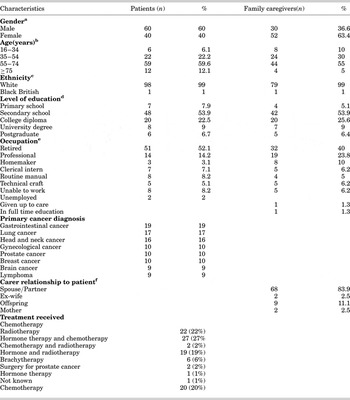
Of the 241 patients that were asked to participate in the study, 100 patients consented. Table 1 summarizes the data of the 100 patients recruited. Reasons for not consenting included: being too stressed around the time of diagnosis, the long-term commitment required to participate, time constraints, or not wanting to be involved with the additional qualitative interviews as part of the study. There was a borderline difference in age between participants and non-participants, with the latter group being slightly older than the participants (59.8 vs. 63.1, p = 0.06) but no other socio-demographic differences were observed. Of the 100 patients that participated in the study at T1, 84 patients participated at T2, 79 at T3, and 62 at T4, providing 325 assessments over 1 year. The decrease in participants is primarily due to patients' inability to complete the questionnaire fully due to ill health, patient death, patients having moved away or being lost to follow up, or not wishing to participate in the study any further. Seventy-two percent of patients were >55 years of age and there were slightly more male (60%) than female (40%) participants. A broad range of cancer patients were included and 41 (41%) had comorbid conditions.
Socio-demographic and clinical characteristics of the sample

aData missing for 2 caregivers.
bData missing for 1 patient; 4 caregivers.
cData missing for 1 patient; 4 caregivers.
dData missing for 11 patients, 6 caregivers.
eData missing for 2 patients; 4 caregivers.
fData missing for 3 caregivers.
Carers
Socio-demographic characteristics of the carers can also be seen in Table 1. Eighty-two caregivers participated in the study, 30 of which were male (36.6%) and 52 of which were female (63.4%). The majority of the caregivers were the patients' spouse/partner (83.9%) and also >55 years old (60%). Patients and caregivers who did not respond to the MSAS questionnaire at any time were excluded from the analysis. At T1 there were 74 patient–caregiver dyads, at T2 there were 61, at T3 there were 58 and at T4 there were 45 patient–caregiver dyads, resulting in a total of 238 dyadic assessments being performed.
Symptoms and Symptom Prevalence
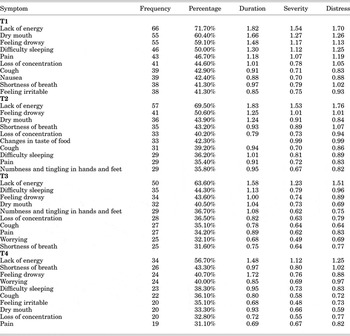
The majority of symptoms that were rated high for prevalence were also rated high for duration, severity, and distress. Lack of energy was consistently the most prevalent symptom at all the four time points affecting 57–72% of patients. Other common symptoms included feeling drowsy (41–59%), dry mouth (41–60%), shortness of breath (31–43%), difficulty sleeping (36.2–50%), loss of concentration (32.8–44.6%), cough (35.1–42.9%), and pain (31.1–46.7%), which were consistently present within the top 10 symptoms over time. Most symptoms showed some decrease in their prevalence over time.
The three separate dimensions of duration, severity, and distress of the top 10 symptoms appeared to follow the same pattern (Table 2). There was no distinct dimension that was scored higher than the others. However severity did tend to be scored slightly lower than the other two dimensions throughout the four time periods. The five least prevalent symptoms were swelling of arms and legs, dizziness, vomiting, and weight loss.
Frequencies and mean scores for the top 10 symptoms across time T1–T4 (raw scores)

Subscale Scores of MSAS
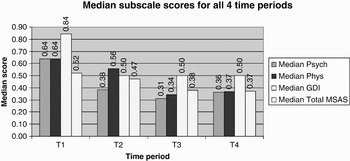
For a more in-depth understanding of the global symptom experience, the median subscale scores were calculated and are presented in Figure 1. Median values are used, as the data are non-parametric and skewed. There is a clear decrease in the level of symptom experience. There appears to be no difference between psychological symptoms and physical symptoms as they appear to be scored relatively similarly. Global distress was most severe at T1 with a median score of 0.84 but then it decreased to 0.50 at T2. Overall, the negative level of symptom experience is relatively low throughout, with the median scores never reaching over 1 out of the maximum of 4.
Median subscale scores for all four time periods.

As the GS takes into account all dimensions and symptoms, it would be an accurate measure of the general change of symptom experience over time. Analysis using the Friedman's test and Wilcoxon signed-rank test was performed to ascertain whether any change over time was significant or not. There was a significant decrease in symptom frequency over time (Friedman's test; p = 0.002), and this occurred between the periods of T2 to T3 (Wilcoxon signed-rank test; p < 0.05). The median number of symptoms was 9, 9, 6, and 7 at T1, T2, T3, and T4, respectively, whereas the mean number of symptoms was 10.1 (SD = 5), 9.1 (SD = 5.7), 7.6 (SD = 5.6), and 7.3 (SD = 5.6), respectively. The maximum number of concurrent symptoms that a patient recorded was 25.
Effects of Demographic Characteristics on Patient Symptom Experience
Comparison of the GS using the unpaired T-test between men and women showed no significant difference (p = 0.17) at T1. T2 and T3 did not yield any significant differences between men and women either (p = 0.12 and p = 0.63 respectively). At T4 there was a significant difference between males and females (p = 0.03), with females rating the GS greater than males.
Comparison of the GS between those <65 years old and those ≥65 years at T1 using the unpaired T-test showed a significant difference (p = 0.001), with patients <65 years scoring a more severe total MSAS score than patients ≥65 years. To assess this finding further, a correlation between the GS and patient age was calculated and was found to be rs= −0.34 (ρ 2 = 0.12, therefore explaining 12% of the variance). In conclusion, there was a relatively weak association between age and GS at T1. Similarly, at T2 there was a significant difference (p = 0.003) and the correlation coefficient was rs= −0.32. T3 and T4 yielded no significant differences in relation to age. Education, occupation, and religion were not associated with higher GS scores.
Comparison of Median Number of Symptoms for Each Cancer Group
The highest median number of symptoms occurred in the lung and breast cancer groups. Both groups recorded a median of 12 symptoms. Brain cancer patients also had a high median number of symptoms (=12) but this was at T3 only. Prostate and gynecological cancer patients tended to have a lower median number of symptoms (1–7 and 4–9, respectively) over the four time periods. Lymphoma patients had the greatest decrease in median symptoms from 11 at T1 to 2 at T4. Because of the small number of patients in the subgroups, only descriptive statistics have been used.
Comparisons of Symptom Frequency and Distress in Patients and Caregivers
When patients and caregivers were first interviewed at time T1, the top five symptoms that family caregivers reported as most frequently occurring in patients were: lack of energy (82.2%), feeling drowsy (61.6%), difficulty sleeping (60.8%), difficulty concentrating (57.7%), and worrying (56.5%). The patients, as can be seen in Table 2, reported the following five symptoms as most commonly occurring: lack of energy (71.7%), dry mouth (60.4%), feeling drowsy (59.1%), difficulty sleeping (50%), and pain (46.7%). In contrast, the top five most distressing symptoms for patients as perceived by family caregivers, in rank order of mean scores, from greatest to least, were: lack of energy (2.14), constipation (1.90), worrying (1.81), difficulty sleeping (1.72), and dizziness (1.49). On the other hand, the patients' ranking of the five most distressing symptoms were: lack of energy (1.70), dry mouth (1.26), difficulty sleeping (1.25), pain (1.19), and feeling drowsy (1.13). Similar results were found for all four time periods with slight differences occurring in the ranking of each symptom by patients and carers. Lack of energy was reported always as the most frequent and most distressing symptom by both patients and family caregivers at all time periods.
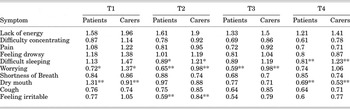
The least distressing symptoms reported by caregivers included swelling of arms and legs and problems with urination. Patients also reported these two symptoms among the least distressing but by T4, the mean symptom score for problems with urination had significantly increased in comparison to T1, though this was not reflected in the caregivers' results. The various reports by patients and caregivers of the different symptoms also showed that for some symptoms, although the prevalence was not reported high, when present, they caused a great deal of distress, e.g. constipation and feeling sad at T2. Table 3 represents a mean of the overall symptom scores for the top 10 common symptoms for all time points reported by patients and caregivers.
Mean of overall symptom scores T1–T4

Each overall score on this table is the mean of severity, duration, and distress for each symptom.
*Significant differences between results (p < 0.003).
**Borderline differences (p < 0.05) [after Bonferroni correction].
Congruence of Symptom Assessments in Patients and Caregivers
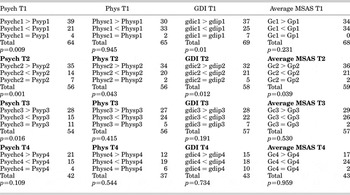
Wilcoxon signed-rank tests were performed for each patient–caregiver dyad. Subscale scores and results are shown in Table 4. Results showed significant differences (p < 0.05) for all subscales at T2 as well as for the psychological symptom subscales at T1 and T3 and the global distress index score at T1. It is evident that when there is a significant difference between patients' and caregivers' results, it is because of caregivers overestimating the overall score compared to patients. In addition, as time progresses, the differences between the patient–caregiver scores lessen. The κ statistic was also used to assess agreement. A κ value between 0.01 and 0.20 is considered to be slight agreement, 0.21 and 0.40 is fair agreement, whereas from 0.41 to 0.60 is moderate agreement. Kappa statistics further showed that the agreement between caregivers and patients was fair or moderate in most cases, with an increase in the score (suggesting better agreement) over time. Highest κ was at T3 and T4 for frequency of symptoms (= 0.42 and 0.45, respectively), whereas scores were generally somewhat lower for distress. The poorest agreement was seen for severity and distress of difficulty concentrating at T1. Moderate agreement between the scores was found for severity and frequency of cough at T1 and T3, respectively, and for frequency of lack of energy and severity of difficulty concentrating at T4. Lack of energy had the highest score for all symptom dimensions, from both the patients' and caregivers' perspective, although the caregivers gave a higher score in comparison. Similarly, when comparing mean scores for “distress” for all 32 symptoms, caregivers tended to overestimate the distress caused by each symptom. With regards to “worrying” at T1 and “difficulty sleeping” at T2, the majority of caregivers tended to consistently overestimate scores, whereas for “dry mouth” at T1 more caregivers underestimated the score. Spearman's tests were performed to assess the correlation of the overall symptom scores for the top 10 symptoms between patients and family caregivers. Results showed a positive correlation for the average scores of all symptoms from T1 to T4 except for the symptom “worrying” at T3 (p = 0.09). The strongest correlation was found for lack of energy at T4 (Rs = 0.71), whereas the weakest was for difficulty concentrating at T1 (Rs = 0.07).
Agreement between patient and caregiver assessments of symptoms over time

Psych: psychological symptom subscale; Phys: physical symptom subscale; gdi: global distress index; G: general score. ‘c’ following a subscale name indicates value for caregivers and ‘p’ indicates patient values. This table shows the cases of higher, lower, or equal agreement of caregivers with patients for each MSAS dimension over time.
DISCUSSION
To our knowledge, this is the first longitudinal symptom assessment study in cancer patients outside North America and Sweden. Key findings confirm past literature but also clearly showed the “chronicity” of some symptoms, the high prevalence of symptoms that are not currently well attended to in clinical practice, the moderate agreement between patient and caregiver symptom assessments, and that such agreement improves with time. Also it showed the small contribution of age and gender in symptom reporting, which changes at different times of the illness and treatment trajectory.
In this longitudinal study over 1 year from the start of cancer treatments, patients reported an average of 10.1 concurrent symptoms at T1, decreasing to 7.3 a year later. This is similar to the 9 symptoms reported in the study by Chang et al. (2000) and the 11.5 in an early study by Portenoy et al. (Reference Portenoy, Thaler and Kornblith1994). The decreasing nature of the symptoms observed in this study is also in agreement with other studies that have reported reductions in the severity of symptoms over time (Cooley et al., Reference Cooley, Short and Moriarty2003; Gift et al., Reference Gift, Stommel and Jablonski2003). The most frequently reported and by far the most distressing symptom across all assessment times was “lack of energy”. Whereas this symptom has been highlighted as such in the literature consistently over the past decade, little has been done to develop interventions to manage this complex and debilitating symptom. Encouraging evidence of effectiveness derives from studies using psychosocial interventions, cognitive–behavioral approaches, exercise, walking, and acupuncture (Goedendorp et al., Reference Goedendorp, Gielissen and Verhagen2009; Kangas et al., Reference Kangas, Bovbjerg and Montgomery2008; Molassiotis et al., Reference Molassiotis, Sylt and Diggins2007) and clinical management guidelines have also been developed (Atkinson et al., Reference Atkinson, Barsevick and Cella2000), although their uptake from practice is inadequate.
Dry mouth, feeling drowsy, difficulty sleeping, pain, and shortness of breath were also rated as highly distressing symptoms in agreement with past findings (Chang et al., Reference Chang, Hwang and Feuerman2000) although other studies tend to have differing results (with the exception of fatigue being consistently the most distressing) (Ashbury et al., Reference Ashbury, Findlay and Reynolds1998; Portenoy et al., Reference Portenoy, Thaler and Kornblith1994). Pain has also been reported as the second or third most distressing symptom by a number of studies (Portenoy et al., Reference Portenoy, Thaler and Kornblith1994; Lobchuk, Reference Lobchuk2003; Tishelman et al., Reference Tishelman, Degner and Rudman2005; Chang et al., 2000; Cooley et al., Reference Cooley, Short and Moriarty2003), whereas in this study it was somewhat lower (5th–10th most distressing symptom).
The results also showed that among the most commonly reported and most distressing symptoms are symptoms that are traditionally not well attended to in practice, such as loss of concentration, difficulty sleeping, or cough. The limited therapeutic options for some of these symptoms combined with possible underreporting by the patients aggravate these symptoms further. It is interesting to see that at T2 and T3 only (period of treatment and immediately after treatment in our sample) the symptom of “numbness and tingling of hands and feet” appeared in the top ten symptoms, possibly reflecting peripheral neuropathies commonly seen with many newer chemotherapy regimens; this symptom can be dose-limiting and have a great impact on daily activities. It is imperative that more attention be diverted to the assessment and management of such symptoms, as they may have a significant impact on QOL. The common and distressing symptoms reported by our sample provide a clear indication of the symptoms that necessitate more clinical and research input in the future.
At T4 (12-month assessment) the symptom burden reported was still considerable, with at least one-third to half of the sample reporting symptoms albeit of lower distress than that seen in earlier assessments. Whereas some of these symptoms are the result of disease progression, the chronic nature of several of these symptoms is important (i.e., lack of concentration or difficulty sleeping) as they could have a significant impact on the quality of the patients' survivorship. It is encouraging though that the distress reported by patients was generally below the “moderate” level. Furthermore, this study showed that commonly reported symptoms were also the most distressing symptoms (with only a few exceptions such as constipation and feeling sad that showed low frequency but high distress). This is in contrast with past literature where often it is suggested that the most frequent symptoms are not necessarily the most distressing ones (Rhodes & Watson, Reference Rhodes and Watson1987).
Female gender (at T4) and younger age (at T1 & T2) were the only socio-demographic variables that were linked with symptom experience. Whereas past research has shown a link between socio-demographic characteristics and symptom experience (Degner & Sloan, Reference Degner and Sloan1995; Given et al., Reference Given, Given and Stommel1994), others argue that there is no relationship (Oh, Reference Oh2004; Portenoy et al., Reference Portenoy, Thaler and Kornblith1994). The predictive power of these relationships was low in the current study, and whereas age and gender may play a role by mediating the symptom experience, the clinical manifestations of the disease and treatment side effects should be the key issues in this experience. Also, lung and breast cancer patients were found to have the greatest number of symptoms, agreeing with what has been reported in the literature previously (Cooley et al., Reference Cooley, Short and Moriarty2003; Degner & Sloan, Reference Degner and Sloan1995).
Agreement between patients' and caregivers' symptom reporting was better for symptoms that were more of a physical nature and easily observable, such as “cough” and “lack of energy,” in comparison to symptoms that were of a more psychological nature. This finding is in line with past studies (Sneeuw et al., Reference Sneeuw, Sprangers and Aaronson2002; Lobchuk & Degner, Reference Lobchuk and Degner2002). There was a slight tendency, though not statistically significant, for family caregivers to overestimate physical symptoms, too, and therefore have a higher score for the physical subscale as well as the global distress subscale score, but this was more pronounced and of statistical significance when comparing the psychological subscale. It has been suggested that lack of available cues, lack of knowledge to assess the various types of subjective symptom experiences, and ambiguity of the origins of particular signs could explain the greater discrepancy found when comparing psychological symptom experiences between caregiver and patient reports (McPherson et al., Reference McPherson, Wilson and Lobchuk2008). Furthermore, it is possible for caregivers to overestimate the patient's psychological symptoms because they may project their own feelings, and therefore it is recommended to take the caregivers' emotional state into account in future analyses (Higginson & Gao, Reference Higginson and Gao2008). Agreement between the scores seemed to improve with time, suggesting familiarization with symptoms and the distress they cause the patients, as time goes by.
When comparing patient and caregiver ranking (based on scale scores) of symptom distress with symptom occurrence for psychological symptoms, greater agreement was found for distress than for occurrence. The results also showed that caregivers tended to rate symptom occurrence as greater than patients did, which is in line with the findings from Broberger et al. (Reference Broberger, Tishelman and Von Essen2005). This may be the case because caregivers may view an ill person as less fortunate and expected to suffer, therefore creating an expectation that patients are worse than they really feel (Higginson & Gao, Reference Higginson and Gao2008). Other possible explanations may be cultural factors, effects of empathic capacity, and patients' underreporting of symptoms (Lobchuk et al., Reference Lobchuk, Kristjanson and Degner1997).
The results of the present study are in accordance with Milne et al. (Reference Milne, Mulder and Beelen2005) in that greater agreement was found for symptom dimensions between patients and caregivers as time went on. Sneeuw et al. (Reference Sneeuw, Sprangers and Aaronson2002) concluded that their results were dependent upon the patients' health, as there tended to be less discrepancy when the patient's health was either very good or very poor. Although the results of the present study contradict the findings by Sneeuw et al. (Reference Sneeuw, Sprangers and Aaronson2002), some caution is necessary as the current study assessed cancer patients whereas the previous study assessed patients with chronic diseases in general. There was less discrepancy between patients' and caregivers' scores for symptom severity at T1 and T3, which is in accordance with the study by McPherson et al. (Reference McPherson, Wilson and Lobchuk2008) that concluded agreement was better for symptom severity than for frequency and distress.
Limitations
The findings of this study need to be seen in light of its limitations. The sample decreased over time and by the 12th month (final assessment) the attrition was 38% in patients (39% in caregivers); this was mainly due to ill health or death as there was high retention of subjects if they were well throughout the study. The subsamples of the different cancer diagnostic groups also varied greatly and the small number of patients in each cancer group meant that comparisons of symptoms within different cancer groups could not be done. Additionally, the sample was biased toward stable family caregiver-patient relationships, as the majority of the caregivers were the patients' spouse or partner, making it difficult to apply the conclusions to caregivers of different age groups with a different relationship to the patient. In addition, it is unknown what perspective caregivers used when filling out the questionnaires, despite being instructed to report symptoms from the point of view of the patient. A further limitation is that the mental state of caregivers and patients was not assessed prior to their participation in the study, which could have affected the results. Finally, while the κ statistic showed that the agreement between caregiver and patient reports of symptoms was at best moderate, it is acknowledged that this statistical test is an overly conservative measure of agreement, and that true agreement could be somewhat higher.
Future research should look into identifying patients at risk for developing multiple symptoms, and determining whether there are subgroups of patients with particularly high symptom occurrence and distress. Research in symptom clusters is important for symptom management and needs further development. Also, the various factors that may affect or influence the accuracy of caregivers' recognition of patients' symptom experiences such as demographic, personality, and psychosocial characteristics of the caregiver, and how symptom reporting can be improved in caregivers, need further exploration. Future research should also identify the ways in which some symptoms may persist over time, and also assess the characteristics of caregivers (i.e., presence of depression, living arrangements, presence of comorbidities, support, etc.) that may lead to the variability in the patient and caregiver agreement with symptom assessments.
In conclusion, this first British study of cancer patient symptom experience has provided evidence of the array of symptoms experienced by cancer patients over the first year of their illness and treatment trajectory, and shown that the agreement between patient and caregiver ratings of symptoms was moderate, with psychological symptoms being an area of particularly low agreement. This research highlights the symptoms that are common among patients with cancer and the distress produced by them, providing indications of symptom foci in clinical practice and future research. Caregivers could communicate symptoms to clinicians fairly accurately, except when psychological symptoms are concerned. The assessment and management of the commonly reported symptoms should be a priority in clinical practice.
ACKNOWLEDGMENT
This study was funded by a grant from the Christie Hospital Charitable Trust.