Nomenclature
- b
-
cross-sectional width (mm)
- C
-
damping matrix
-
 ${D_{global}}$
-
global design space
-
${D_{local}}$
-
local trust-region design space
- E
-
Young’s modulus (GPa)
-
$f(t)$
-
external excitation vector
-
${f_1}$
-
mean relative error across all considered modes
-
${f_2}$
-
maximum single-mode relative error
- G
-
shear modulus (GPa)
- h
-
cross-sectional height (mm)
- K
-
structural stiffness matrix
- M
-
structural mass matrix
-
${M_{global}}$
-
global surrogate model
-
${M_{local}}$
-
local surrogate model
- n
-
number of modes considered in updating
- P1
-
first-stage Pareto non-dominated solution set
- P2
-
second-stage Pareto non-dominated solution set
-
$u(t)$
-
displacement response vector
- W
-
network weight matrices
- x
-
network bias vectors


Greek symbol
-
$\alpha $
,
$\beta $
-
Bayesian regularisation hyperparameters
-
$\delta $
-
trust-region contraction factor
-
${\phi _i}$
-
i-th mode shape vector
-
${\omega _i}$
-
i-th natural frequency (rad/s)
-
$\rho $
-
material density
-
${\rm{\Omega }}$
-
feasible design domain


1.0 Introduction
Throughout the full life-cycle development of modern aircraft, constructing a high-fidelity finite element model (FEM) constitutes the fundamental cornerstone for flutter boundary prediction, dynamic load assessment and aeroelastic control law design. Although computer-aided engineering (CAE) technology is extensively employed in the aviation industry, initial FEM frequently fail to accurately reproduce experimental test data from ground vibration tests (GVT) due to manufacturing tolerances, assembly nonlinearities, simplified boundary conditions and material property uncertainties [Reference Li1–Reference Şen3]. Direct aeroelastic analysis based on such deviated models progressively amplifies these errors throughout the fluid–structure interaction computational chain, severely compromising engineering decision reliability [Reference Di Leone, Lo Balbo and De Gaspari4]. Consequently, finite element model updating (FEMU) technology, which inversely calibrates physical parameters based on experimental modal data, has emerged as a critical bridge connecting virtual models with physical prototypes.
Existing model updating methods can be broadly classified into matrix-based and parameter-based approaches [Reference Wang, Zhao and Li5]. Although matrix-based methods provide superior computational efficiency, direct modification of mass or stiffness matrix elements inevitably destroys matrix sparsity and obscures physical interpretability, rendering updated models unsuitable for subsequent structural design iterations [Reference García Fernández, Fernández Fernandez and Brincker6–Reference Karaağaçlı, Yıldız and Özgüven8]. In contrast, parameter-based methods have gained widespread adoption in engineering practice by iteratively adjusting design variables with explicit physical significance (e.g. cross-sectional dimensions, material moduli) to minimise discrepancies between numerical predictions and experimental measurements [Reference Wang, Xiang and Wang9, Reference Zhu, Han and Liu10].
However, for complex flexible aircraft structures characterised by closely spaced modes and complex topologies, parameter-based updating constitutes an inherently nonlinear, non-convex, high-dimensional inverse problem [Reference Di Leone, Lo Balbo and De Gaspari4, Reference Arjas, Sillanpää and Hauptmann11]. Traditional gradient-based deterministic optimisation algorithms, despite their rapid convergence, exhibit high sensitivity to initial conditions and are susceptible to entrapment in local optima within multi-modal objective landscapes. To address this limitation, global heuristic algorithms such as genetic algorithms (GA) and particle swarm optimisation (PSO) have been introduced into the FEMU domain. Nevertheless, these algorithms encounter the well-documented exploration-exploitation dilemma: while excelling at global feasible-domain exploration, they frequently suffer from premature convergence during late-stage optimisation due to population diversity loss, hindering accurate local refinement [Reference Qin, Yuan and Gan12–Reference Teughels, De Roeck and Suykens15]. Moreover, for detailed aircraft models with many degrees of freedom, the computational burden imposed by thousands of iterative finite element analyses becomes prohibitive.
To reconcile the tension between computational efficiency and optimisation accuracy, surrogate model-based updating frameworks have emerged as a prominent research focus [Reference Li, Chen and Zhang16]. Although polynomial response surfaces and Kriging models demonstrate excellent performance for low-dimensional problems, they frequently encounter the ‘curse of dimensionality’ or overfitting risks when confronting high-dimensional nonlinear mappings. More critically, existing research predominantly focuses on single-algorithm improvements. For structures exhibiting complex dynamic characteristics, such as the GARTEUR benchmark, global algorithms alone cannot achieve accurate parameter updating, while local algorithms are vulnerable to multi-modal interference. Consequently, developing a hybrid updating strategy that simultaneously satisfies ‘computational efficiency’, ‘global search coverage’ and ‘local convergence precision’ remains a pressing challenge.
Addressing these challenges, this paper proposes an adaptive two-stage framework integrating trust-region resampling with deep neural-network surrogates. The framework incorporates two principal innovations. First, to overcome the computational bottleneck inherent in high-dimensional design spaces, a multi-layer perceptron (MLP) surrogate model trained via Bayesian regularisation is constructed. Compared with conventional response-surface-type approximations, this approach captures the nonlinear mapping between structural parameters and modal frequencies under limited sample conditions and improves generalisation capability. Second, a serial collaborative optimisation mechanism following a global exploration-local refinement paradigm is proposed. The first stage employs NSGA-II to identify a promising Pareto-front region; the second stage introduces trust-region resampling to construct a locally refined surrogate model through high-fidelity re-analysis in the neighbourhood of the knee-point solution. This mechanism reduces the epistemic uncertainty associated with a global surrogate under small local perturbations and improves the FE-verified modal-frequency agreement. The effectiveness of this integrated strategy for handling dense modal distributions and updating large-aspect-ratio flexible structures is validated using the GARTEUR SM-AG19 benchmark model published by the Group for Aeronautical Research and Technology in Europe.
2.0 Methodology
To improve both computational efficiency and local accuracy in global surrogate model-based updating of complex flexible aerospace structures, this section presents an adaptive two-stage framework employing trust-region resampling. As illustrated in Fig. 1, the framework implements a coarse-to-fine sequential optimisation strategy: stage 1 utilises a global surrogate model to rapidly contract the design space and identify the region of interest (ROI); stage 2 establishes a local trust region centred on the knee-point solution and constructs a refined local surrogate model through high-fidelity resampling, thereby reducing global-model prediction bias and improving parameter convergence.
Flowchart of the adaptive two-stage structural updating framework based on trust region resampling.

2.1 Modelling the inverse problem of structural dynamics
In the structural design and verification of modern aircraft, FEMs are extensively employed for structural dynamic analysis, modal characteristic prediction, flutter boundary assessment and aeroelastic optimisation [Reference Byun and Jun17–Reference Wright and Cooper19]. The structural dynamics problem is typically formulated as a second-order linear system [Reference Noh, Hwang and Valluzzi20]:
 \begin{align} M\ddot u(t) + C\dot u(t) + Ku(t) = f(t)\end{align}
where
 $M,C,K \in {R^{n \times n}}$
denote the system mass, damping and stiffness matrices, respectively, while
 $u(t)$
and
 $f(t)$
represent the displacement response and external excitation vectors. In modal analysis, neglecting damping and external forcing, the natural frequencies
 ${\omega _i}$
and mode shapes
 ${\varphi _i}$
are obtained by solving the generalised eigenvalue problem:
 \begin{align} \big(K - \omega _i^2M\big){\varphi _i} = 0\end{align}
Mathematically, model updating constitutes a measurement-based parameter identification inverse problem. To achieve a balanced update across all modes, the optimisation is formulated as a multi-objective problem rather than a single scalar minimisation. The non-dominated sorting genetic algorithm II (NSGA-II) is employed to simultaneously minimise two distinct objective functions: the mean relative error across all considered modes (
 ${f_1}$
) and the maximum single-mode relative error (
 ${f_2}$
).
 \begin{align} \left\{ \begin{array}{l}{f_1}(x) = \dfrac{1}{n}\sum\limits_{i = 1}^n {\left| {\dfrac{{\lambda _i^c(x) - \lambda _i^e}}{{\lambda _i^e}}} \right|} \\[10pt]{f_2}(x) = {\max _{i \in [1,n]}}\left| {\dfrac{{\lambda _i^c(x) - \lambda _i^e}}{{\lambda _i^e}}} \right|\end{array} \right.\end{align}
where
 $\Omega $
denotes the feasible design domain,
 $\omega _i^{FE}$
and
 $\omega _i^{Exp}$
represent the i-th computed and experimental modal frequencies, respectively, and
 ${w_i}$
is the weighting coefficient reflecting measurement confidence. Since K and M typically exhibit complex nonlinear dependencies on x, this optimisation problem is inherently non-convex and multi-modal, rendering direct solution methods susceptible to local optima entrapment. By decoupling these objectives, the algorithm prevents the ‘smoothing effect’ where significant local errors in individual modes are masked by a low overall average error.
In the context of multi-objective optimisation for model updating, the ‘Pareto front’ represents a set of optimal compromise solutions where no single objective (e.g. frequency error of a specific mode) can be improved without degrading another. Unlike traditional single-objective optimisation that seeks one global minimum, identifying the Pareto front allows engineers to balance the trade-offs between global mean error and local single-mode deviations, thereby providing a more robust physical insight into the structure’s behaviour.
2.2 Construction of Bayesian regularisation neural network surrogate model
Given the prohibitive computational cost of directly invoking the finite element solver during iterative optimisation, this study employs an MLP to construct a surrogate model approximating the nonlinear mapping from parameter space to response space:
 \begin{align} {\textbf{Y}} = {\mathcal{F}_{NN}}({\textbf{X}},{\textbf{W}},{\textbf{b}}NN)\end{align}
where
 ${\textbf{X}}$
denotes the input design variables,
 ${\textbf{Y}}$
represents the predicted modal frequency response and
 ${\textbf{W}}$
and
 ${\textbf{b}}NN$
are the network weight matrices and bias vectors, respectively. The MLP neural network architecture is shown in Fig. 2.
Schematic of MLP neural network architecture.

Although standard backpropagation algorithms perform effectively with abundant data, FEMU scenarios typically constrain training set size due to high sample acquisition costs. To mitigate overfitting under limited training data and enhance generalisation capability, the Bayesian regularisation (BR) algorithm is employed for network training.
Unlike conventional approaches that solely minimise mean square error
 ${E_D}$
, the BR algorithm incorporates a weight decay term
 ${E_W}$
, reformulating the objective function as:
 \begin{align} F({\textbf{W}}) = \beta {E_D} + \alpha {E_W} = \beta \sum\limits_{k = 1}^N {{{({y_k} - {t_k})}^2}} + \alpha \sum\limits_{j = 1}^M {w_j^2} \end{align}
where
 $\alpha $
and
 $\beta $
are hyperparameters governing the trade-off between prior probability and likelihood function. Within the Bayesian framework, network weights are treated as random variables following Gaussian distributions. Through posterior probability density maximisation, the algorithm adaptively updates
 $\alpha $
and
 $\beta $
during training, automatically penalising excessive weight magnitudes. This mechanism effectively reduces model complexity, enhancing robustness on unseen data and making it particularly suitable for high-dimensional nonlinear mapping challenges.
2.3 Two-stage collaborative optimisation strategy based on trust region resampling
Addressing the precision bottleneck frequently encountered by conventional single-stage global surrogate models during late-stage convergence, this paper designs a serial collaborative optimisation mechanism comprising global exploration and local refinement. The strategy constructs a locally refined response surface to approximate the FE-evaluated response in the neighbourhood of the candidate optimum, thereby reducing prediction errors arising from the smoothing effect of global models in small local regions.
During the initial updating stage, the design space is extensive and exhibits strong nonlinearity. The primary objective is to rapidly identify the Pareto front containing the global optimum rather than pinpointing a single extremum. Within the initial broad design space
 ${D_{global}} \in [{x_{lb}},{x_{ub}}]$
, Latin hypercube sampling (LHS) generates the initial sample set S1. Following finite element analysis (FEA) response evaluation, the global Bayesian neural network model
 ${M_{global}}$
is trained on S1. Subsequently, employing
 ${M_{global}}$
as the objective function evaluator, NSGA-II performs global search through non-dominated sorting and crowding distance mechanisms, yielding the first-stage Pareto non-dominated solution set P1. To balance full-spectrum modal trends with individual mode accuracy – a critical engineering requirement – a ‘knee point’ strategy selects a compromise solution
 $x_{opt}^{(1)}$
exhibiting balanced multi-objective performance from P1. This solution serves both as a candidate optimum and, more importantly, as the ‘anchor point’ guiding second-stage local search.
Although the first stage successfully identifies the approximate optimal solution location, training sample sparsity causes the global surrogate model
 ${M_{global}}$
to exhibit prediction errors near
 $x_{opt}^{(1)}$
that exceed the target modal-frequency agreement required for reliable updating. To address this limitation, a trust region resampling strategy is introduced: centred on the first-stage knee-point solution
 $x_{opt}^{(1)}$
, a contracted local hypercube defines the refined design space
 ${D_{local}}$
. This region’s boundaries are defined as:
 \begin{align} x_{lb}^{local} = x_{opt}^{(1)} \cdot (1 - \delta ),\quad x_{ub}^{local} = x_{opt}^{(1)} \cdot (1 + \delta )\end{align}
where
 $\delta $
denotes the contraction factor. In this study,
 $\delta = 0.20$
was selected after considering two competing requirements. The trust region must be sufficiently large to contain the true FE optimum if the first-stage knee point is affected by global-surrogate bias, but sufficiently small to increase the local sample density and reduce response nonlinearity. A ± 20% region was therefore used as a conservative local refinement range: it is half of the global geometric design range (±40%) and remains comparable to the allowable material-property range, while still providing adequate coverage for the second-stage FE re-evaluation.
Subsequently, small-scale LHS resampling is performed within the local trust region
 ${D_{local}}$
, with the FE solver invoked to compute FE-verified modal responses for these samples. A local neural-network surrogate model
 ${M_{local}}$
is then trained on this newly generated high-fidelity local dataset. Since the local response surface is smoother and the local sample density is substantially increased, the local model
 ${M_{local}}$
captures objective-function variations within the candidate optimum neighbourhood more accurately than the global surrogate. Employing the local model
 ${M_{local}}$
as the fitness evaluator, NSGA-II executes a second optimisation cycle. The resulting second-stage Pareto front P2 is then interpreted together with direct FE re-analysis to avoid confusing surrogate-predicted optima with FE-evaluated updating performance. The final solution extracted from this front constitutes the updated physical parameters.
3.0 Numerical implementation
To verify the effectiveness of the proposed combined updating strategy for complex aviation structural dynamics problems, this section selects the SM-AG19 aircraft model published by GARTEUR as the benchmark case. This model is widely used to evaluate aeroelastic analysis and model updating algorithms because of its large aspect ratio, high flexibility and dense low-frequency modal characteristics. This section details the FE modelling process, parameterisation scheme and surrogate model training and validation.
3.1 Description of the benchmark structure
The GARTEUR SM-AG19 physical model comprises primarily rectangular cross-section beams fabricated from aviation-grade aluminum alloy. Its geometric topology encompasses the fuselage, wings, vertical stabiliser, horizontal stabiliser and winglets. Figure 3(a) shows the overall structure of the aircraft, including the relative positions of its various components; Fig. 3(b) shows the specific dimensions of each component of the aircraft. According to the information in Fig. 3(b), the wingspan of the aircraft is 2,000 mm, the fuselage length is 1,500 mm and the tailplane span is 400 mm. The most notable dynamic characteristics of this structure include high flexibility due to the high aspect ratio configuration and significant sensitivity of the joint stiffness at multiple component connection points.
Geometric dimensions of the GARTEUR SM-AG19 aircraft: (a) diagram of the aircraft components; and (b) schematic diagram of aircraft component dimensions.

The aircraft finite element model (FEM) was developed using HyperMesh software. Given the structure’s slender beam characteristics, fuselage and wing primary structures were discretised using CBEAM beam elements. To accurately represent physical connection relationships between components (e.g. wing-fuselage and tail-fuselage junctions), RBE2 multi-point constraint rigid elements modeled joint coupling.
To improve the physical representation of structural joints, the RBE2 rigid elements at the wing-fuselage and tail-fuselage junctions were replaced by CBUSH spring elements. The translational degrees of freedom (K1–K3) and torsional degree of freedom (K4) were assigned large stiffness values to preserve kinematic constraints, while the rotational stiffness components (K5, K6) were varied parametrically from 104 to 1017 N·mm/rad. The test showed that modal frequencies converge when K5 and K6 exceed approximately 109 N·mm/rad, with further increases producing frequency variations of less than 0.1%. Accordingly, K5 and K6 were fixed at 1010 N·mm/rad in the final model. This result indicates that under the current structural configuration, connection rotational stiffness is not the dominant source of model discrepancy, and the primary updating targets remain the beam cross-sectional parameters and component-level material properties. The finite element mesh diagram of GARTEUR SM-AG19 is shown in Fig. 4. The final FEM consists of 312 elements. Specifically, the fuselage and lifting surfaces are discretised into 308 CBEAM elements, while the connections are modeled using 2 RBE2 rigid elements and 2 CBUSH elements.
Finite element mesh of the GARTEUR SM-AG19 aircraft.

The material properties assumed for the initial model are those of an isotropic aluminum alloy. Regarding the boundary conditions, the numerical modal analysis was performed under free-free conditions to match the setup of the GVT, ensuring that the rigid-body modes (first six modes) were separated from the elastic modes used in the updating process. Although the initial FEM was constructed from design drawings, inevitable discrepancies arise between eigenvalue analysis results and GVT data due to manufacturing tolerances, assembly clearances and beam element simplification errors, particularly within high-order and densely spaced modal frequency bands.
3.2 Parameter selection and network configuration
Based on structural mechanics principles and sensitivity analysis, variations in cross-sectional geometric parameters (width b and height h) directly alter the section moment of inertia and area, thereby modifying the structural stiffness matrix K and mass matrix M. Recognising that model errors primarily originate from machining tolerances, beam idealisation and equivalent stiffness deviations at connection interfaces, this study selected 16 design variables x for updating, encompassing rectangular cross-sectional dimensions of the fuselage, wings, winglets and tail, as well as material properties (Young’s modulus E and material density rho). The shear modulus G is no longer treated as an independent variable but is derived using a fixed Poisson’s ratio to maintain isotropic material consistency. To avoid repetitive listing, the variables are grouped by component in Table 1.
Definition of design variables for model updating

For the 16-dimensional input space and first 10 modal frequency outputs, the MLP neural network described in Section 2.2 was instantiated. Following hyperparameter optimisation, the final network topology was configured as follows: the input layer comprises 16 neurons corresponding to design variables X1–X16 in Table 1; the hidden layer adopts a two-layer architecture with 64 neurons per layer. The network weights W and biases b are initialised using the Xavier initialisation strategy to ensure variance consistency across layers and prevent gradient vanishing during early training epochs. The hidden layers employ the hyperbolic tangent (Tanh) activation function [Reference LeCun, Bottou, Orr, Müller, Montavon, Orr and Müller21] to capture strong nonlinear characteristics within the design space, while the output layer employs linear activation (Purelin) [Reference Goodfellow, Bengio and Courville22] to encompass the broad frequency response range.
3.3 Training and validation of two-stage surrogate models
To balance computational efficiency and local convergence accuracy, this study adopted a ‘Global Coarse Search – Local Refinement’ sequential modelling strategy. The specific sampling and training processes were executed in the following two stages.
3.3.1 Construction of global surrogate model
To capture the global mapping relationship between structural parameters and modal frequencies within the broad initial design space, a global surrogate model was first constructed. The variation range of each geometric design variable was set to ±40% of its initial nominal value, while the variation ranges of each elastic modulus and density were set to ±15%, defining the initial design space
 ${D_{global}}$
. LHS generated 1,500 spatially uniform input samples within this domain. The OptiStruct FE solver performed forward modal analysis on these 1,500 samples, extracting the first 10 natural frequencies as response labels. The dataset was randomly partitioned into training and test sets at an 85%:15% ratio. The global MLP model was trained using the Bayesian regularisation algorithm. Figure 5 presents regression analysis results for each modal frequency on the test set, and Fig. 6 presents the root mean square error (RMSE) of each vibration mode. The coefficient of determination (R2) exceeded 0.99 for all modes, confirming the global model’s adequacy for supporting NSGA-II preliminary Pareto-front identification and ROI localisation, but not for final FE-verified parameter selection.
Scatter plot comparing predicted values and true values of modal frequencies.

Global surrogate-model RMSE for each modal frequency.

To explicitly demonstrate the necessity of the second-stage local optimisation, Fig. 7 compares the surrogate-predicted Pareto solutions with their direct FE-evaluated responses. The blue points represent the optimal solutions predicted by the global MLP surrogate model. When these predicted optimal design variables are substituted back into the high-fidelity OptiStruct FE solver, the true structural responses (red points) exhibit a visible drift. Therefore, the first-stage Pareto front is used only to identify the ROI and define the trust-region centre, rather than being interpreted as the final FE-verified Pareto front.
Pareto front comparison.

This discrepancy illustrates the residual epistemic uncertainty of the global surrogate model. Because the global MLP is trained across a broad design space (±40%), it inherently suffers from a smoothing effect and lacks the resolution to capture small, highly nonlinear gradient variations in the immediate vicinity of the FE-evaluated optimum. Consequently, while the global surrogate successfully narrows down the ROI, relying on it alone yields FE-reanalysed responses that do not fully satisfy the desired modal-frequency agreement. This mismatch between surrogate-predicted optimality and FE-evaluated performance makes the second-stage trust-region resampling strictly necessary. By confining the design space to a ± 20% neighbourhood around the knee point and generating new high-fidelity samples directly from the FE solver, the local model substantially reduces this prediction bias.
3.3.2 Trust region resampling and local modelling
Despite the global model’s satisfactory test-set accuracy, its prediction residual within the small neighbourhood of the candidate optimum may still exceed the accuracy required for reliable modal-frequency updating. Therefore, local high-fidelity modelling was implemented based on the first-stage knee-point solution.
Scatter plot comparing predicted values and true values of modal frequencies.

Local surrogate-model RMSE for each modal frequency after trust-region resampling.

Centred on the first-stage knee-point solution
 $x_{opt}^{(1)}$
, a local trust region
 ${D_{local}}$
with ±20% variable variation was established. This region substantially contracts the design space and dramatically reduces response nonlinearity while retaining sufficient coverage around the candidate optimum. LHS resampling within the local region
 ${D_{local}}$
generated 200 new samples. Critically, this step bypassed global-surrogate interpolation and directly invoked the FE solver for FE-verified calculations. This high-fidelity re-evaluation strategy reduces epistemic uncertainty inherited from the first stage. A local MLP model was trained on these 200 high-fidelity local samples. As shown in Fig. 8, the predicted modal frequencies of the local surrogate model agree well with the corresponding FE-calculated values, indicating that the locally refined model captures the parameter-frequency relationship within the trust region with high accuracy. Owing to the smoother local response surface and substantially increased sample density, the local surrogate model’s RMSE on the validation set decreased by an order of magnitude relative to the global model, providing a more accurate local response approximation for second-stage refined optimisation. The specific RMSE for each vibration mode is shown in Fig. 9.
4.0 Results and discussion
This section evaluates the proposed two-stage updating strategy based on trust-region resampling. The analysis follows the sequence of optimisation process, physical meaning of updated parameters, structural-dynamics verification and comparison with related model-updating studies. First, the evolution of the two-stage Pareto front is examined to verify the effectiveness of local resampling in reducing surrogate-model prediction bias. Second, the rationality of the updated physical parameters and their implied sources of modelling error are discussed. Finally, the method is compared with representative FEMU studies to clarify its relative advantages and remaining limitations.
4.1 Optimisation process and Pareto front analysis
Based on the constructed two-level global and local surrogate models, the NSGA-II optimisation algorithm was executed sequentially. To visualise optimisation convergence behaviour, Fig. 10 presents the objective space distribution comparison of Pareto non-dominated solution sets obtained in the first and second stages.
Distribution of Pareto front solution sets.

As indicated by pink solid circles in Fig. 10, first-stage optimisation utilised the global surrogate model trained over the broad initial sample range. The resulting Pareto front exhibits clear convexity, revealing the trade-off between mean relative error across all modes (
 ${f_1}$
) and maximum single-mode error (
 ${f_2}$
). However, this front should be interpreted as a surrogate-predicted front for ROI localisation. Because the global surrogate is trained over a wide parameter domain, its local prediction accuracy near the optimum is insufficient for final model validation.
Employing the ‘knee point’ selection strategy, a compromise solution
 $x_{opt}^{(1)}$
balancing
 ${f_1}$
and
 ${f_2}$
was extracted from the first-stage front to serve as the trust region centre.
Centred on
 $x_{opt}^{(1)}$
, high-fidelity resampling and local surrogate model construction were performed within the ±20% trust region, followed by second-stage NSGA-II optimisation. As shown by red hollow circles in Fig. 10, the second-stage Pareto front exhibits a lower-left migration relative to the first-stage front. This improvement indicates that local FE re-analysis and resampling reduced the global model’s prediction bias and revealed a better FE-verified solution region. The more compact distribution of the second-stage front also indicates that, within the trust region, the parameter-response mapping is smoother and more suitable for local optimisation. Importantly, Stage 1 provides a surrogate-predicted search region, whereas Stage 2 provides the locally refined front used for FE-verified parameter selection.
From a computational-efficiency perspective, the proposed strategy required 1,700 high-fidelity FE evaluations in total, including 1,500 global LHS samples and 200 local trust-region samples. The subsequent NSGA-II searches were conducted on surrogate models rather than by repeatedly invoking the FE solver. Thus, the number of expensive FE calls is fixed by the sampling plan rather than by the population size and generation number of the optimiser. A direct FE-based NSGA-II implementation would require one FE analysis for every candidate solution evaluated during the evolutionary search and would therefore scale to several thousand FE calls under typical population-generation settings. The present evaluation-count comparison provides a hardware-independent summary of the computational saving.
4.2 Parameter updating results and physical consistency
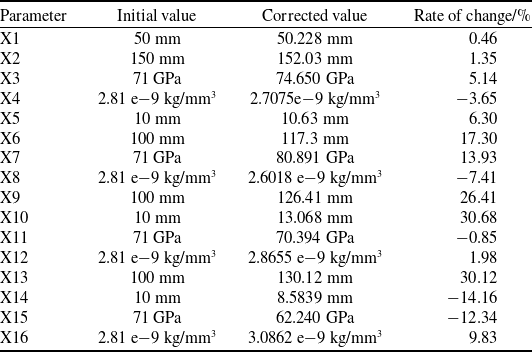
Following two-stage optimisation, the final updated values for the 16 design variables are presented in Table 2. Analysis of individual parameter variation rates reveals the physical origins of initial FEM errors.
Comparison of initial and updated parameters

The revised parameterisation scheme addresses several physical consistency issues. First, the substitution of idealised rigid elements with CBUSH spring elements at the wing-fuselage and tail-fuselage junctions isolates connection stiffness from material stiffness. Because the rotational stiffness bounds were parameterised and assessed during the initial setup, the final model avoids compensating joint flexibility solely through unrealistic material changes. Second, Young’s modulus and shear modulus are kept isotropically consistent through a fixed Poisson’s ratio, preventing physically inconsistent independent variation of E and G. Third, density is updated together with geometric parameters so that stiffness and inertia corrections are considered simultaneously rather than calibrating modal frequencies through stiffness alone. The density variations remain within −7.41% to +9.83%, which is compatible with an equivalent beam-model correction. When combined with the updated cross-sectional dimensions, the equivalent beam-line mass changes are approximately −1.90% for the fuselage, +15.45% for the wing, +68.46% for the winglet group and +22.67% for the tail group. These values indicate that the larger geometric changes should be interpreted as equivalent beam-model stiffness and inertia corrections, not literal manufacturing dimensional changes. The total mass of the FEM increased from 40.24 kg to 44.12 kg after updating, corresponding to a mass variation of +9.64%. Since only frequency data were available for the present benchmark comparison and no independent measured CG information was provided, CG was not used as an additional calibration target. Nevertheless, the limited total-mass variation indicates that the density and geometric updates remain within an acceptable equivalent beam-model correction range.
4.3 Structural dynamics verification
Optimal updated parameters from Table 2 were substituted into the original FEM for modal reanalysis. Frequency deviation comparisons before and after updating are detailed in Table 3.
Comparison of modal frequency errors before and after updating

Regarding frequency domain response consistency, this method achieved the following key advances:
-
(1) Balanced error convergence across the full frequency spectrum. The updated model not only reduced mean frequency error from 4.56% to 2.39% but, more critically, substantially reduced extreme deviations. As shown in Table 3, initial model prediction errors for critical 1st and 6th modes reached −12.54% and −12.75%, respectively, indicating systematic initial stiffness matrix deviations regarding global bending and local coupling modes. Following two-stage updating, errors for these critical modes were constrained to −6.38% and −0.28%, respectively, confirming the local trust region resampling strategy’s superiority in capturing nonlinear structural characteristics.
-
(2) Dense-mode frequency prediction. For the densely spaced modal cluster (3rd, 4th and 5th modes) within the 35–37 Hz frequency band, the updated model better matched the closely spaced frequency cluster within the 35–37 Hz band, with errors for these three modes maintained within 5%, demonstrating the local MLP surrogate model’s capability to improve the frequency prediction of tightly clustered modes. This demonstrates that the constructed local MLP surrogate model possesses sufficient resolution to penetrate global response surface smoothing effects and accurately characterise eigenvalue sensitivity topology under minute parameter space perturbations.
To further illustrate the effectiveness of the proposed two-stage method, the FE-reanalysed Stage 1 solution reduced the overall mean frequency error from 4.56% to 3.02%, as reported in Table 3. After trust-region resampling and local surrogate refinement, the Stage 2 solution further reduced the mean error to 2.39%. This comparison confirms that Stage 1 is useful for locating the promising design region, whereas Stage 2 provides the locally refined and FE-verified updating result. For complex flexible structures with dense modal characteristics, the coarse-to-fine strategy therefore improves local convergence without requiring direct FE evaluation at every NSGA-II candidate solution.
Qualitative comparison with representative FEM updating studies

4.4 Comparison with related model updating studies
To further clarify the novelty and relative performance of the proposed method, Table 4 compares representative model-updating studies. A strict one-to-one quantitative ranking is not possible because the studies use different structures, modal selections, updating variables, objective functions and validation data. Nevertheless, the comparison shows that the present method combines three features that are not usually considered together: a two-stage global-local surrogate strategy, explicit FE re-evaluation within a trust region and physically interpretable updating of both stiffness- and inertia-related beam parameters.
5.0 Conclusions
Addressing the demand for high-fidelity FEMs in aerospace structural digital-twin construction, this paper proposes an adaptive two-stage model updating method integrating Bayesian neural networks with trust-region resampling. The strategy was validated using the GARTEUR SM-AG19 benchmark model. The proposed framework first uses a global surrogate to locate a promising Pareto-front region and then applies trust-region resampling to construct a locally refined surrogate around the knee-point solution. This sequential strategy reduced the average modal-frequency error from 4.56% to 2.39% with 1,500 global FE samples and 200 additional local FE samples. By explicitly modelling joint connections with flexible elements and optimising component-specific densities and moduli under isotropic consistency, the method provides physically interpretable updating results while avoiding direct FE evaluation for every optimisation candidate.
While the current framework has proven effective for the present benchmark, several limitations remain. The updating process used frequency data only; complete mode-shape measurements were not available, and, therefore, MAC or Cross-MAC validation could not be performed. Frequency-only updating may admit non-unique parameter combinations, especially for dense modes or structures with coupled local and global deformation patterns. Future work should incorporate mode-shape correlation, frequency response functions (FRF)-based residuals, measured mass and constraint grammar (CG) constraints and uncertainty quantification to further improve identifiability. For structures where joint flexibility is the dominant source of discrepancy, incorporating parameterised CBEAM or joint elements as explicit connection models could offer finer control over joint stiffness updating. Extending this trust-region resampling strategy to nonlinear boundary conditions, such as penalty contact models with active/inactive transitions, and to pre-buckling and post-buckling regimes will further expand its utility in advanced aerospace structural analysis.
Data availability statement
Some or all data, models or code that support the findings of this study are available from the corresponding author upon reasonable request.
Financial support
This work was supported by the National Natural Science Foundation of China (grant number 12172141).
Competing interests
The authors declare none.