INTRODUCTION
Lake sediments are valuable archives of past environmental and climatic changes, and they offer a means of establishing an accurate chronological framework for sedimentation. Accelerator mass spectrometry (AMS) radiocarbon (14C) dating of organic material is currently the most widely used method of dating lake sediments (Björck and Wohlfarth Reference Björck, Wohlfarth, Last and Smol2001). A chronological framework for lake sediments can be constructed based on the 14C ages of terrestrial plant macrofossils (e.g., Andree et al. Reference Andree, Oeschger, Siegenthaler, Riesen, Moell, Ammann and Tobolski1986; Huang et al. Reference Huang, Peng, Rudaya, Grimm, Chen, Cao, Zhang, Pan, Liu, Chen and Chen2018), or on sedimentary total organic carbon (TOC) (e.g., Watanabe et al. Reference Watanabe, Matsunaka, Nakamura, Nishimura, Sakai, Lin, Horiuchi, Nara, Kakegawa and Zhu2010; Zhang et al. Reference Zhang, Liu and Li2021). The 14C activity of short-lived terrestrial plants is generally in equilibrium with the atmosphere, and the macrofossil ages can be used to provide accurate depositional ages for specific sedimentary strata, with the prerequisite that a negligible amount of time has passed between the growth of the plant material and its deposition within the lake. Although sedimentary TOC and aquatic plant remains can also be employed for this purpose, they are often affected by old carbon contamination and their 14C dates are typically older than their actual depositional age (e.g., Li et al. Reference Li, Qiang, Jin, Liu, Zhou and Zhang2018). The old carbon usually results from the following factors: disequilibrium in the 14C exchange between water and the atmosphere, which leads to lower 14C concentrations in the lake water (Druffel et al. Reference Druffel and Suess1983); the influx of groundwater or surface runoff from watersheds with a limestone substrate, which introduces pre-aged carbon (Olsson Reference Olsson2009); biological utilization of dissolved inorganic carbon (DIC) in the lake water (Kwiecien et al. Reference Kwiecien, Arz, Lamy, Wulf, Bahr, Röhl and Haug2008); an inherited reservoir effect from the introduction of sediments from the watershed (Frueh et al. Reference Frueh2012); and the variable contribution of old terrestrial organic material eroded from catchment soils (Blaauw et al. Reference Blaauw, van Geel, Kristen, Plessen, Lyaruu, Engstrom and van der Plicht2011). The lake 14C reservoir effect varies between different geographical units and over time (e.g., Hou et al. Reference Hou, D’Andrea and Liu2012; Mischke et al. Reference Mischke, Weynell, Zhang and Wiechert2013; Zhou et al. Reference Zhou, Cheng, Jull, Lu, An, Wang, Zhu and Wu2014, Reference Zhou, Chui, Yang, Cheng, Chen, Ming, Hu, Li and Lu2021; Zhou et al. Reference Zhou, He, Wu, Zhang, Zhang, Liu and Yu2015; Chen et al. Reference Chen, Zhu, Ju, Wang and Ma2019; Zhou et al. Reference Zhou, Xu, Lan, Yan, Sheng, Yu, Song, Zhang, Fu and Xu2020), and assessing the reservoir effect is a priority in the 14C dating of TOC and aquatic plant remains, to establish an accurate chronological framework for lake sediments.
Numerous methods have been applied to correct the lake reservoir effect. They include cross-dating approaches with 14C dating and other dating methods (e.g., 210Pb and 137Cs) to evaluate the lake reservoir effect (e.g., Lan et al. Reference Lan, Zhang and Yang2018; Xu et al. Reference Xu, Lu, Jin, Gu, Zuo, Dong, Wang, Wang, Li, Yu, Jin and Wu2021); optical luminescence dating (e.g. Wilkins et al. Reference Wilkins, De Deckker, Fifield, Gouramanis and Olley2012; An et al. Reference An, Lai, Liu, Wang, Chang, Lu and Yang2018); U-series dating (e.g., Hall et al. Reference Hall and Henderson2001; Fan et al. Reference Fan, Ma, Ma, Wei and Han2014); counting annual laminations (e.g., Tlan et al. Reference Tlan, Brown and Hul2005; Zhou et al. Reference Zhou, Chen, Wang, Yang, Qiang and Zhang2009; Bonk et al. Reference Bonk, Tylmann, Goslar, Wacnik and Grosjean2015; Zhang et al. Reference Zhang, Liu and Li2021); and comparative AMS 14C dating of different materials from the same sedimentary layer to assess the reservoir effect, such as fatty acids (Schroeter et al. Reference Schroeter, Mingram, Kalanke, Lauterbach, Tjallingii, Schwab and Gleixner2021), TOC, and terrestrial plant remains (e.g., Huang et al. Reference Huang, Xiang, Lei, Sun, Qiu, Storozum, Huang, Munkhbayar, Demberel, Zhang, Zhang, Chen, Chen and Chen2021a). Although AMS 14C dating of terrestrial plant material is a reliable means of quantifying lake sediment ages, terrestrial plant remains are usually scarce in lake sediments in arid central Asia and hence the method is rarely applied.
In the present study, we evaluated temporal changes in the radiocarbon reservoir effect at Lake Kanas by comparing the 14C ages of terrestrial plant remains and sedimentary TOC from the same stratigraphic levels, with the aim of quantifying the effect and determining the processes responsible.
STUDY AREA
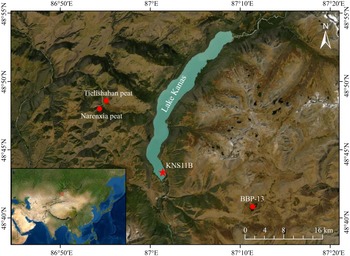
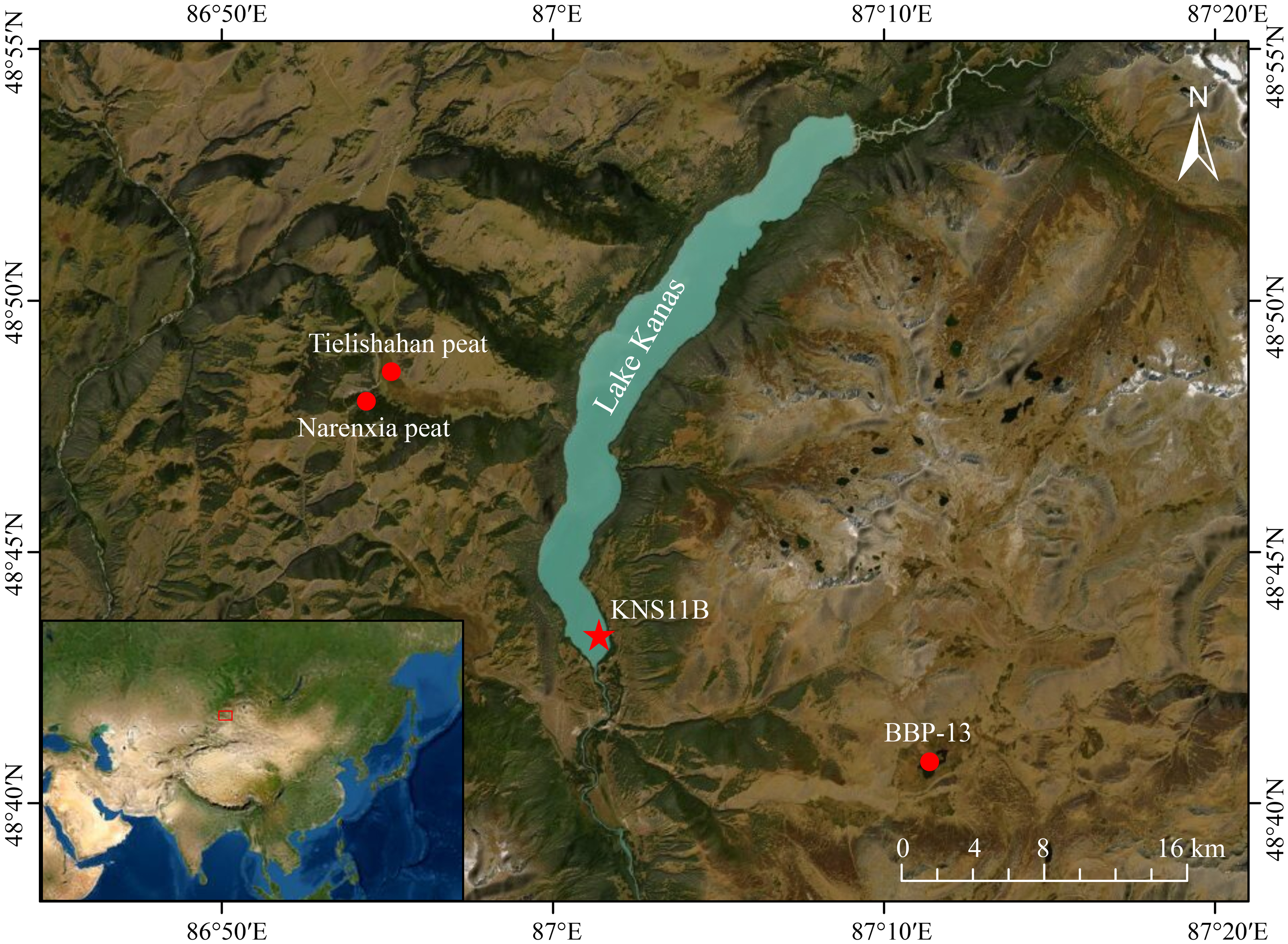
Lake Kanas (48.72°N–48.90°N, 87.00°E–87.16°E; altitude of the modern lake surface is 1365 m above sea level) is an open lake in the southern Altai Mountains (Figure 1), at the junction of westerly airflows and the Siberian high-pressure zone (Aizen et al. Reference Aizen, Aizen, Melack, Nakamura and Ohta2001). The length of the lake basin is 24 km, and the width is ∼2 km; the surface area is nearly 45 km2 and the average water depth is 120 m (Feng and Ren Reference Feng and Ren1990; Wu et al. Reference Wu, Liu, Zeng, Ma and Bai2014). The lake was formed by the damming of a valley by an end moraine that developed during the last glaciation (Xu et al. Reference Xu, Yang, Dong, Wang and Miller2009). Numerous glaciers developed in the northern upper part of the watershed of Lake Kanas during the last glacial period, above 3000 m in elevation, where they reached a total area of ∼210 km2 (Liu et al. Reference Liu, You and Pu1982). Snow or glacier meltwater and precipitation are the main water sources of Lake Kanas. The bathymetry of the lake basin is steeply sloping and there are no carbonate deposits in the watershed (Wu et al. Reference Wu, Liu, Zeng, Ma and Bai2014). The steep-sided lake basin, deep water, and low water temperature limit the growth of aquatic plants, which are nearly absent from the lake basin (Feng and Ren Reference Feng and Ren1990; Lin et al. Reference Lin, Rioual, Peng, Yang and Huang2018).
Location of Lake Kanas in Asia (inset) and the locations of the sampling site in Lake Kanas and other sites referenced in the text.
The climate of the region is influenced by the mid-latitude westerlies and polar airmasses, which supply water vapor by precipitation and snowfall in summer and winter. The average annual temperature is ∼5.5°C and the precipitation is ∼160 mm, based on records from Habahe meteorological station (AD 1958–2014), ∼96 km from Lake Kanas (Lin et al. Reference Lin, Rioual, Peng, Yang and Huang2018). Due to the topographic effect the precipitation in Lake Kanas is up to 400–700 mm, with a high proportion supplied as winter snowfall (Huang et al. Reference Huang, Peng, Rudaya, Grimm, Chen, Cao, Zhang, Pan, Liu, Chen and Chen2018). The snowfall and total precipitation in the high mountains are much higher, reaching ∼1000 mm (Feng and Ren Reference Feng and Ren1990; Zhang et al. Reference Zhang, Yang and Lan2018b).
The vegetation of the Kanas drainage exhibits a pronounced altitudinal zonation, with desert and desert steppe at low elevations (500–1300 m), forest vegetation at intermediate elevations (1300–2300 m), subalpine and alpine meadow at mid-to high elevations (2300–3000 m), and tundra vegetation at high elevations (3000–3500 m) (Xinjiang Comprehensive Survey Team, C. A. o. S., & Institute of Botany, C. A. o. S, 1978). Previous investigations show that widespread peat accumulation occurred in the southern Altai Mountains during 9600–9000 cal BP (Tang et al. Reference Tang2014; Feng et al. Reference Feng, Sun, Abdusalih, Ran, Kurban, Lan, Zhang and Yang2017; Zhang et al. Reference Zhang, Feng, Yang, Lan, Ran and Mu2018a; Wang and Zhang Reference Wang and Zhang2019; Xu et al. Reference Xu, Lan, Zhang and Zhou2019; Zhang and Elias Reference Zhang and Elias2019; Rao et al. Reference Rao, Shi, Li, Huang, Zhang, Yang, Liu, Zhang and Wu2020). Archaeological surveys show that the number of archaeological sites around Lake Kanas is very limited (Bureau of National Cultural Relics 2012; Huang et al. Reference Huang, Xiang, Lei, Sun, Qiu, Storozum, Huang, Munkhbayar, Demberel, Zhang, Zhang, Chen, Chen and Chen2021a), and the impact of human activities on the vegetation may have begun from ∼1500 cal BP onwards, based on pollen data (Huang et al. Reference Huang, Peng, Rudaya, Grimm, Chen, Cao, Zhang, Pan, Liu, Chen and Chen2018). Additionally, the streams on the hillslopes entering the lake typically have a slight peaty color, while the spring floods, caused by snow meltwater and heavy summer rainfall, may have contributed more old organic matter and humic acids, based on our field observations.
MATERIALS AND METHODS
Sediment core KNS11B (48°43′23″N, 87°01′22″E; length: 244 cm) was collected at a water depth of 19.85 m from the southern part of Kanas Lake using a piston corer (Figure 1). The core was frozen in the field, transported to the laboratory and then sliced into 1-cm intervals. The results of AMS 14C dating of terrestrial plant macrofossils from the core were reported previously (Huang et al. Reference Huang, Peng, Rudaya, Grimm, Chen, Cao, Zhang, Pan, Liu, Chen and Chen2018). Nine samples of bulk organic sediments were taken from different depths of the core to determine reservoir ages.
Seven TOC samples of the lake sediments were pretreated using an acid wash procedure. Briefly, 1–2 g samples were weighed and reacted with 0.5 mol/L HCl at 60°C; the acid was replaced daily until the solution became clear, and then washed to neutral and oven-dried at 60°C. The samples were graphitized using Auto Graphitization Equipment (AGE III) and measured using a compact AMS, Mini Carbon Dating System (MICADAS, IonPlus AG). All the experimental procedures were conducted in the Radiocarbon Laboratory of the MOE Key Laboratory of Western China’s Environmental System (Ministry of Education) of Lanzhou University. In addition, two TOC samples were prepared and dated by Beta Analytic (USA). The 14C dates were calibrated to calendar years using the online program OxCal4.4 (Bronk Ramsey Reference Ramsey2009) with the IntCal20 curve (Reimer et al. Reference Reimer, Austin, Bard, Bayliss, Blackwell, Ramsey, Butzin, Cheng, Edwards, Friedrich, Grootes, Guilderson, Hajdas, Heaton, Hogg, Hughen, Kromer, Manning, Muscheler, Palmer, Pearson, van der Plicht, Reimer, Richards, Scott, Southon, Turney, Wacker, Adolphi, Büntgen, Capano, Fahrni, Fogtmann-Schulz, Friedrich, Köhler, Kudsk, Miyake, Olsen, Frederick, Sakamoto, Sookdeo and Talamo2020). The results are reported as “cal BP”. The Bacon program (version 2.3.9.1) was used for age-depth reconstruction of lake sediments and peat sediments around the lake (Blaauw and Christen Reference Blaauw and Christen2011), the default settings are selected, with thick is 10, and acc. mean is 20. The IntCal20 database within the program R package was used for 14C date calibration (Reimer et al. Reference Reimer, Austin, Bard, Bayliss, Blackwell, Ramsey, Butzin, Cheng, Edwards, Friedrich, Grootes, Guilderson, Hajdas, Heaton, Hogg, Hughen, Kromer, Manning, Muscheler, Palmer, Pearson, van der Plicht, Reimer, Richards, Scott, Southon, Turney, Wacker, Adolphi, Büntgen, Capano, Fahrni, Fogtmann-Schulz, Friedrich, Köhler, Kudsk, Miyake, Olsen, Frederick, Sakamoto, Sookdeo and Talamo2020).
The acid-washed samples were also used for measurements of their carbon and nitrogen contents, using an Elementar Vario EL Cube at the State Key Laboratory of Applied Organic Chemistry of Lanzhou University. The limit of detection for carbon and nitrogen is 0.0004 mg and 0.0001 mg, respectively, and the analytical error of both elements’ contents is less than 0.1%. Additionally, isotopes of organic carbon and nitrogen were measured using an EA-MAT253 at the Third Institute of Oceanography, Ministry of Natural Resources, Xiamen, China. The isotopic values are shown in standard δ-notation in per mil (‰), with respect to Vienna Pee Dee Belemnite (VPDB) carbon and atmospheric nitrogen (N2). IAEA600 (consensus δ13C: –27.71‰, δ15N:1‰), Acetanilide#1 (consensus δ13C: –26.85‰, δ15N: –4.21‰), and USGS40 (consensus δ13C: –26.39‰, δ15N: –4.52‰) were used as working standards. The analytical error of δ13C and δ15N both not exceeding ±0.2‰.
RESULTS
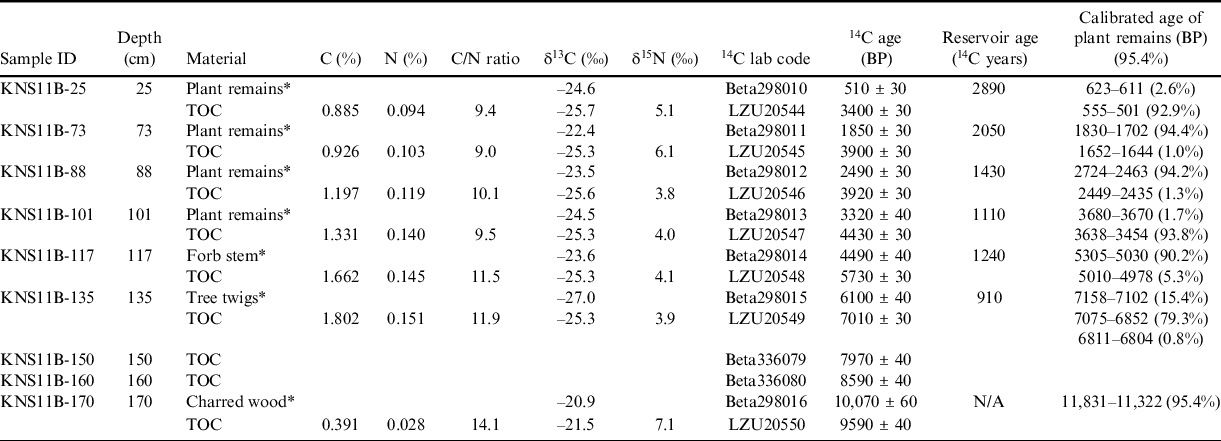
Details of the 14C dates of the 16 samples from core KNS11B are given in Table 1, including the types of dating material, C/N ratios, and isotopic compositions of the organic materials. The 14C ages of terrestrial plant macrofossils represent their depositional ages, as we assumed, and the ages decrease systematically along the core, from 11,831–11,322 cal BP at 170 cm depth, to 623–501 cal BP at 25 cm depth. The TOC 14C ages are systematically older than the parallel ages obtained by dating plant macrofossils, and the estimated reservoir effect increases along the sequence from the lower to the upper part of the core. The ages of the depths of 135 cm, 117 cm, 101 cm, 88 cm, 73 cm, and 25 cm are 910, 1240, 1110, 1430, 2050, and 2890 14C years, respectively. The 14C ages of the TOC and charred wood show a reversal at 170-cm depth, which indicates the absence of a radiocarbon reservoir effect and that the residence time of the terrestrial plant material before its incorporation in the sediments was relatively long. The C/N ratios of the sediment samples vary between 9.0 and 14.1, and the δ13C and δ15N values of the TOC vary between –25.7 and –21.5‰ and 3.8 and 7.1‰, respectively.
C/N ratios, isotopic compositions, and 14C ages of terrestrial plant macrofossils and TOC from core KNS11B from Lake Kanas (14C ages are calibrated with the IntCal20 curve; Reimer et al. Reference Reimer, Austin, Bard, Bayliss, Blackwell, Ramsey, Butzin, Cheng, Edwards, Friedrich, Grootes, Guilderson, Hajdas, Heaton, Hogg, Hughen, Kromer, Manning, Muscheler, Palmer, Pearson, van der Plicht, Reimer, Richards, Scott, Southon, Turney, Wacker, Adolphi, Büntgen, Capano, Fahrni, Fogtmann-Schulz, Friedrich, Köhler, Kudsk, Miyake, Olsen, Frederick, Sakamoto, Sookdeo and Talamo2020)
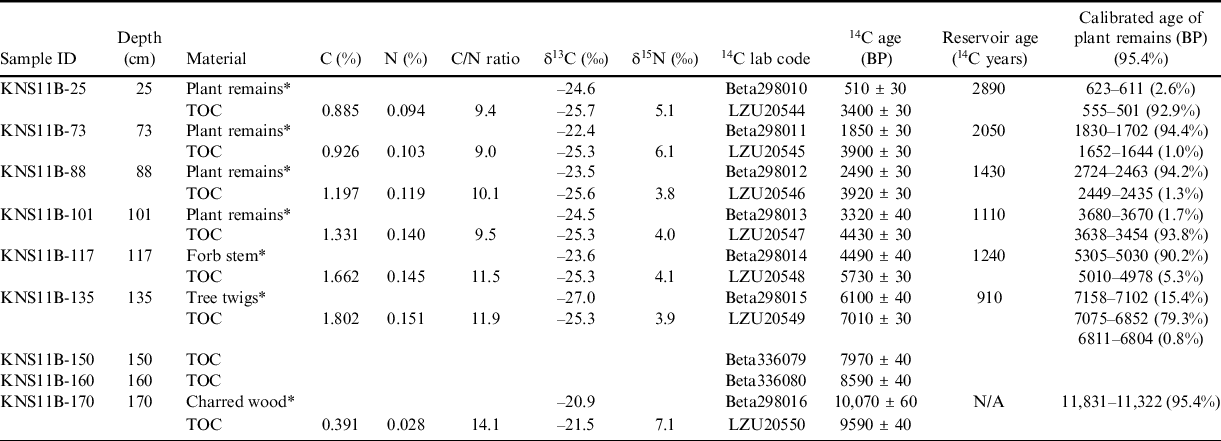
* 14C age and δ13C of plant remains are from Huang et al. (Reference Huang, Peng, Rudaya, Grimm, Chen, Cao, Zhang, Pan, Liu, Chen and Chen2018).
DISCUSSION
Temporal Variations of the Radiocarbon Reservoir Age in Lake Kanas
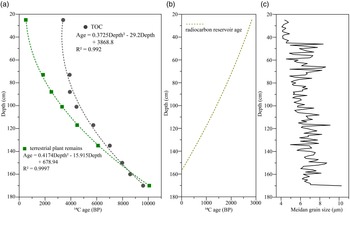
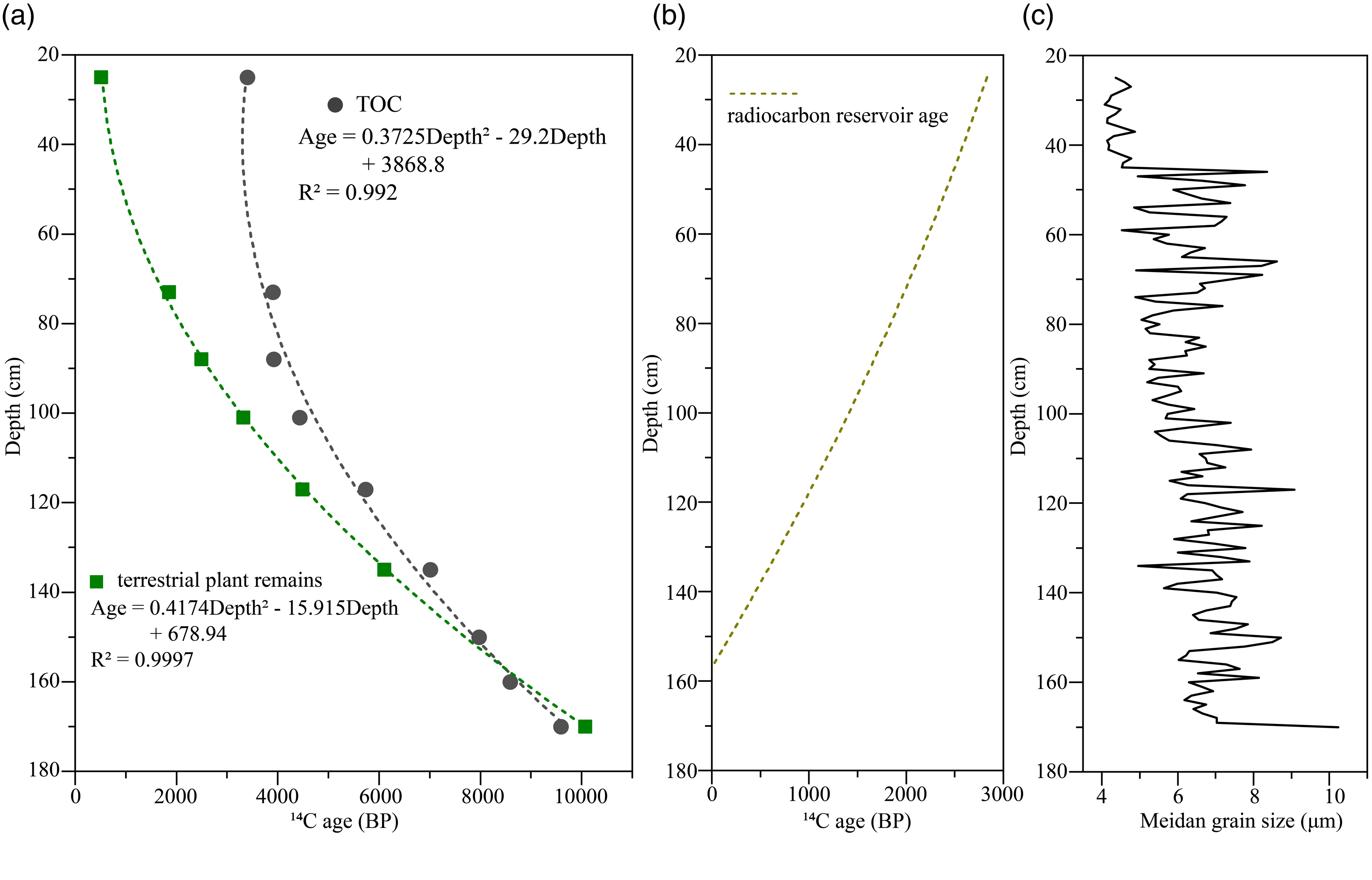
The 14C ages of the TOC are systematically older than those of the terrestrial plant remains, indicating an obvious reservoir effect of the TOC-based 14C dates. We simulated the 14C age-depth relationship of the plant residues and TOC to determine the diachronic variations of the radiocarbon reservoir age (Figure 2a). The results show that the reservoir age in Lake Kanas varies from ∼0 yr at 156 cm to ∼2830 yr at 25 cm below the sediment surface and that it generally increases upwards through the sedimentary sequence (Figure 2b).
(a) Age-depth relationship based on 14C dating of terrestrial plant remains and the TOC content of core KNS11B; (b) depth variation of the radiocarbon reservoir age and (c) median grain size of core KNS11B.
Before discussing the reservoir ages it is necessary to assess the reliability of the 14C ages of the seven samples of plant remains, which were published previously (Huang et al. Reference Huang, Peng, Rudaya, Grimm, Chen, Cao, Zhang, Pan, Liu, Chen and Chen2018). These plant remains include tree bark, twigs, forb stems, and charred wood, with sizes ranging from several millimeters to centimeters (see photos in the Supporting Information of Huang et al. Reference Huang, Peng, Rudaya, Grimm, Chen, Cao, Zhang, Pan, Liu, Chen and Chen2018). The plant remains were in a fresh condition with no evidence of aerobic humification or decay and they clearly demonstrate the characteristics of terrestrial-sourced materials. Lake Kanas is surrounded by numerous trees which shed abundant plant materials, which is confirmed by our investigation of a near-shore sediment core from Lake Kanas that contained terrestrial plant remains (Wang et al. Reference Wang, Huang, Peng, Zhou, Zhang and Du2017). Additionally, the calculated sedimentation rate (0.052 cm/yr) based on the 210Pb chronology of another sediment core from Lake Kanas (Feng and Ren Reference Feng and Ren1990) is very close to the sedimentation rate calculated from our 14C-based age model for the upper part of the core (0.05 cm/yr), which suggests that the residence time of terrestrial plants is relatively short and there is no obvious “old wood” effect (Huang et al. Reference Huang, Peng, Rudaya, Grimm, Chen, Cao, Zhang, Pan, Liu, Chen and Chen2018). Therefore, the chronological framework based on these plant remains can be regarded as reliable.
The climatic and hydrological conditions of lakes during the Holocene were often variable, which led to spatial and temporal variations in the 14C reservoir effect in different lakes. Although the combined application of 210Pb, 137Cs, and 14C dating of the same surface sediment layer can be used to determine the reservoir age, this approach cannot be used to estimate the reservoir age in the earlier stages. Linear regression is widely used to estimate the reservoir age (e.g., Fontes et al. Reference Fontes, Gasse and Gibert1996; Shen et al. Reference Shen, Liu, Wang and Matsumoto2005; Wu et al. Reference Wu, Li, Lücke, Wünnemann, Zhou, Reimer and Wang2010), and this method is applicable for stable environments and short-term depositional processes. In Lake Kanas, we simulated the age-depth model according to the 14C ages of plant remains and TOC, and the R2 values of the fitted curve are 0.9997 and 0.992, respectively (Figure 2a). The correlation between age and depth is significant. Accordingly, we calculated the radiocarbon reservoir age based on the simulated age model of plant remains and TOC, and we then simulated an idealized curve of the relationship of the radiocarbon reservoir age with depth (Figure 2b).
At the depths of 170 and 157 cm, the 14C ages of terrestrial plant remains are slightly older than those dated with TOC, which could be caused by an “old wood” effect as mentioned above (Figure 2a). The “old wood” effect of the charcoal or charred wood could be caused by the longer residence time between the death of the plant and the deposition of the sediments, which usually produces a relatively old age (Payette et al. Reference Payette, Delwaide, Schaffhauser and Magnan2012). As the sediments of Lake Kanas are relatively fine-grained, there is a very low possibility of the downward penetration of younger organic matter (Figure 2c), which means that the TOC-based 14C age could be reliable and that there was no radiocarbon reservoir effect. Deeper within the core the ages at the depths of 185–243 cm vary between 9500 and 10,060 14C BP, and several of the 14C ages are slightly reversed during the Younger Dryas and earlier. The similar 14C ages could be caused by a changing atmospheric 14C concentration (Muscheler et al. Reference Muscheler, Kromer, Björck, Svensson, Friedrich, Kaiser and Southon2008), a rapid sedimentation rate, and/or the downward penetration of younger organic material from the upper layer due to coarser sedimentary grain sizes as this time (see Huang et al. Reference Huang, Peng, Rudaya, Grimm, Chen, Cao, Zhang, Pan, Liu, Chen and Chen2018).
The 14C ages of the TOC gradually become older than those of the terrestrial plant remains and the reservoir age can be estimated for the upper ∼156-cm interval of the core (Figure 2b). At the depth interval of 156–25 cm, the simulated 14C ages of the terrestrial plant remains vary from ∼8350 to ∼540 BP, and the simulated 14C ages of the TOC are much older. The reservoir ages increase from the lower part to the upper part of the sedimentary sequence, from nearly 0 to ∼2800 yr. During the middle and late Holocene, the radiocarbon reservoir effect shows an increasing trend (Figure 2b).
Sources of TOC in the Sediments of Lake Kanas
Hydrological and climatic changes in northwest China could be the main factors responsible for the temporal changes in the 14C reservoir ages of the lake sediments (Zhou et al. Reference Zhou, Chen, Wang, Yang, Qiang and Zhang2009, Reference Zhou, Xu, Lan, Yan, Sheng, Yu, Song, Zhang, Fu and Xu2020). Studies of Lake Sugan and Lake Bosten showed that the reservoir effect was smaller during humid intervals, and significantly larger during dry intervals. Hypersaline lake water may undergo 14C exchange between the water and the atmosphere, leading to a smaller proportion of the 14C in the water than in air during the same interval, resulting in an increase in the radiocarbon reservoir effect (Zhou et al. Reference Zhou, Chen, Wang, Yang, Qiang and Zhang2009, Reference Zhou, Xu, Lan, Yan, Sheng, Yu, Song, Zhang, Fu and Xu2020).
Lake Kanas is a freshwater lake fed mainly by a river in the north and previous studies found that carbonate is absent from the sediments (Wu et al. Reference Wu, Liu, Zeng, Ma and Bai2014); therefore, the amount of “dead” inorganic carbon dissolved in the water should be very low and can be ignored. Additionally, Lake Kanas is relatively deep and the bathymetry is steeply sloping due to erosion by earlier glaciations, with very low biological productivity and almost no aquatic plants (Feng and Ren Reference Feng and Ren1990). Our field observations and investigations showed that meltwater during the spring and heavy rainfall in the summer often carry soil from the mountain slopes into the lake, and the floodwater has a dark peaty color. Therefore, the TOC in Lake Kanas is much more likely to originate within the watershed than be produced within the water column. Moreover, the δ13C of the 7 14C-dated sediment samples varied between –25.7‰ and –21.5‰, which is very close to the values of the plant remains (Table 1), in both cases indicating that the source of the organic material is terrestrial C3 trees and shrubs (δ13C: –31 to –23‰) (Meyers and Teranes Reference Meyers and Teranes2002). The δ15N values of the 7 sediment samples varied between 3.8‰ and 7.1‰, which is typical of terrestrial plants (δ15N: ∼4.5–10.3‰), rather than aquatic plants (δ15N: ∼12.8‰) (Talbot and Johannessen Reference Talbot and Johannessen1992). Hence, we infer that the TOC in the sediments of Lake Kanas is of allochthonous rather than autochthonous origin. Additionally, it is worth noting that the C/N ratios of the sediments varied between 9.0 and 14.1, which indicates a mixture of aquatic and terrestrial plant materials (Cook et al. Reference Cook, Leng, Jones, Langdon and Zhang2012). However, we suspect that the extremely low N content (∼0.1%) may lead to large uncertainties in the C/N ratios, which requires further study.
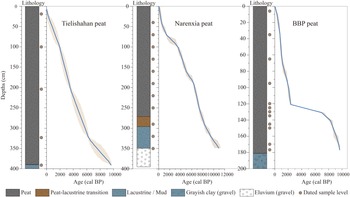
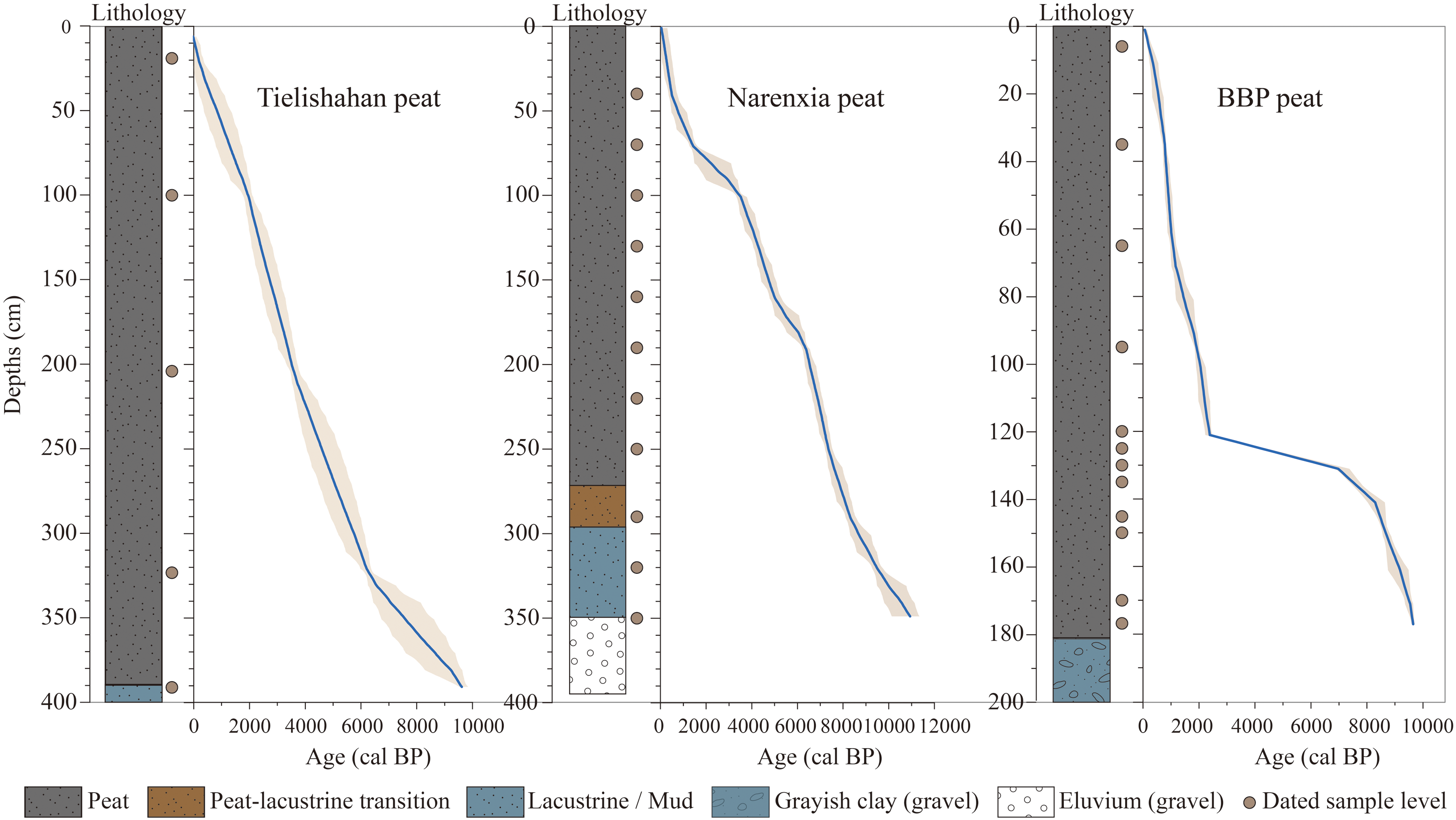
Peat accumulation was widespread in the study area during the Holocene. We reconstructed the relationship between the calendar age and depth in three previously reported peat cores (Zhang et al. Reference Zhang, Meyers, Liu, Wang, Ma, Li, Yuan and Wen2016; Feng et al. Reference Feng, Sun, Abdusalih, Ran, Kurban, Lan, Zhang and Yang2017; Xu et al. Reference Xu, Lan, Zhang and Zhou2019), using the Bacon program with all of the default settings (Figure 3). The Big Black peatland (BBP), ∼11 km to the east of Lake Kanas, begun to develop from ∼9500 cal BP (Figure 3, Xu et al. Reference Xu, Lan, Zhang and Zhou2019). Similarly, the ages of the Tielishahan and Narenxia peatlands, ∼8 km to the west of Lake Kanas, show that the peats began to accumulate from ∼9000 cal BP, and ∼9600 cal BP, respectively (Figure 3; Zhang et al. Reference Zhang, Meyers, Liu, Wang, Ma, Li, Yuan and Wen2016; Feng et al. Reference Feng, Sun, Abdusalih, Ran, Kurban, Lan, Zhang and Yang2017). Due to the effects of glaciation, there was minimal soil development in the region during the Last Glacial period, and soils developed mainly on the mountain slopes around Lake Kanas during ∼9600–9000 cal BP. Lake Kanas lies in a steep gorge and the soil on both sides of the mountain slopes is easily eroded by runoff. Therefore, we infer that organic material from watershed soils and peats is the dominant source of the organic material in the lake sediments.
Stratigraphy and Bacon age-depth models for peat deposits in the vicinity of Lake Kanas: Tielishahan peatland (Zhang et al. Reference Zhang, Meyers, Liu, Wang, Ma, Li, Yuan and Wen2016); Narenxia peatland (Feng et al. Reference Feng, Sun, Abdusalih, Ran, Kurban, Lan, Zhang and Yang2017); Big Black peatland (BBP) (Xu et al. Reference Xu, Lan, Zhang and Zhou2019).
Soil Erosion Caused by High Humidity/Precipitation Was Responsible for the Radiocarbon Reservoir Effect at Lake Kanas during the Mid-to-Late Holocene
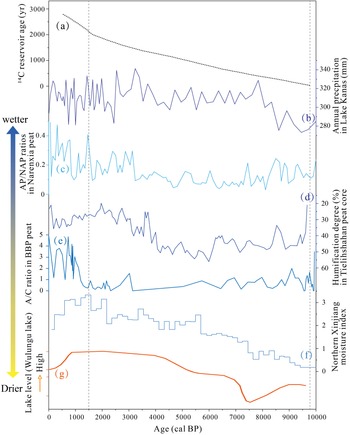
The chronological framework of lake sedimentation was reconstructed based on the 14C dates of plant remains, implemented with the Bacon program, using the Intcal20 calibration. A radiocarbon reservoir effect was evident and the reservoir age gradually increased after ∼9700 cal BP (Figure 4a). As discussed above, soils and peats on the mountain slopes were the major sources of organic material in the sediments of Lake Kanas during the Holocene, and this eroded organic material would have had varying ages. Thus, we suggest that the continuous supply of progressively older organic matter from eroding soils/peats from ∼9700 cal BP to the present-day was responsible for the increasing 14C reservoir age of the sedimentary TOC in Lake Kanas.
Temporal variation of the radiocarbon reservoir age at Lake Kanas compared with various regional paleoclimatic records. (a) Radiocarbon reservoir age at Lake Kanas; (b) quantitative annual precipitation reconstructed for Lake Kanas (Huang et al. Reference Huang, Peng, Rudaya, Grimm, Chen, Cao, Zhang, Pan, Liu, Chen and Chen2018); (c) arboreal pollen/non-arboreal pollen (AP/NAP) ratio from the Narenxia peatland (Feng et al. Reference Feng, Sun, Abdusalih, Ran, Kurban, Lan, Zhang and Yang2017); (d) humification record from the Tielishahan peatland (Zhang et al. Reference Zhang, Meyers, Liu, Wang, Ma, Li, Yuan and Wen2016); (e) Artemisia/Chenopodiaceae (A/C) pollen ratio from the Big Black peatland (BBP) (Xu et al. Reference Xu, Lan, Zhang and Zhou2019); (f) moisture evolution of the northern Xinjiang region (Wang and Feng Reference Wang and Feng2013); (g) lake level record of Lake Wulungu (Liu et al. Reference Liu, Herzschuh, Shen, Jiang and Xiao2008).
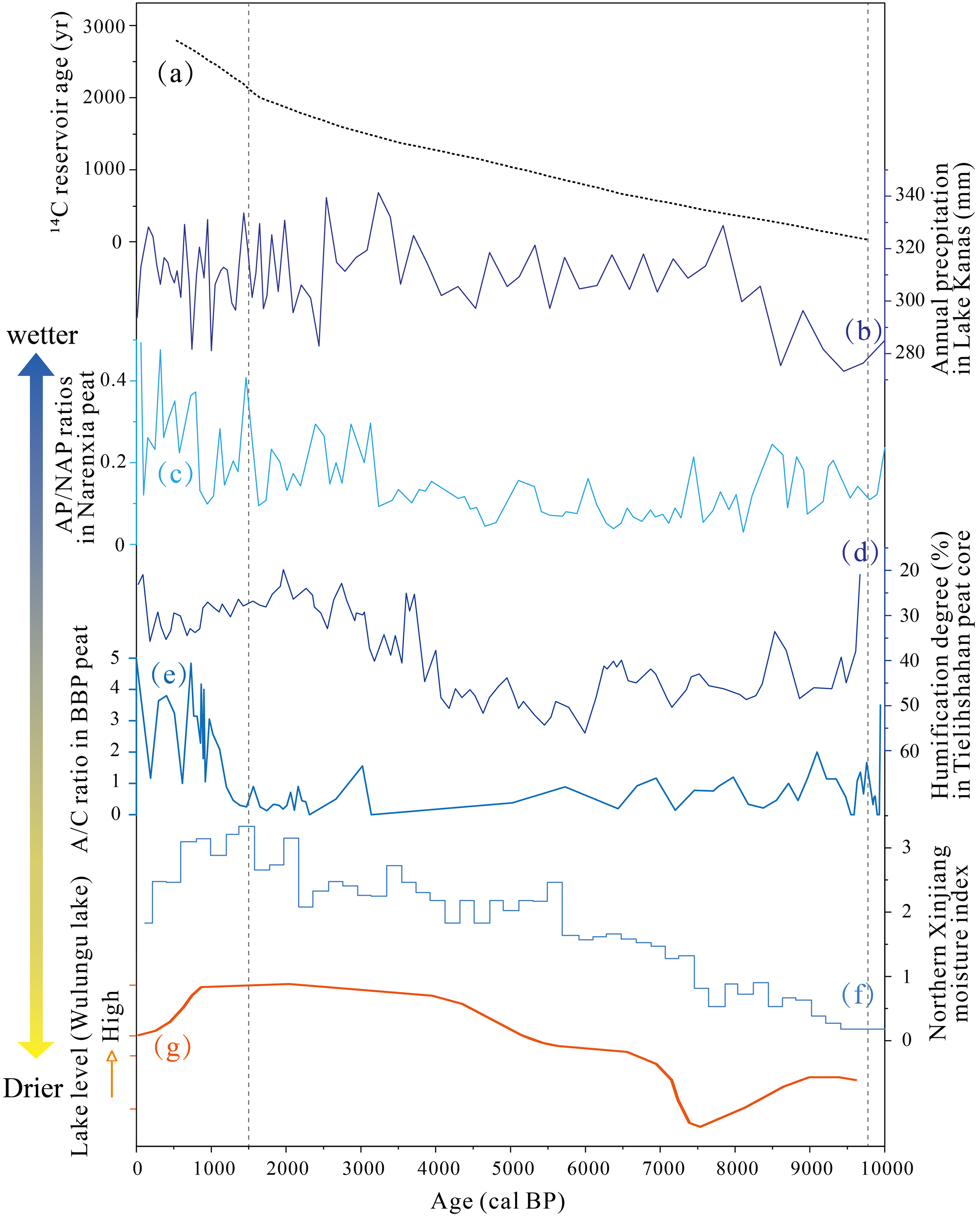
The intensity of soil erosion in watersheds is mainly controlled by flood frequency and intensity, soil availability, vegetation conditions, and human activities (He et al. Reference He, Zhou, Zhang and Tang2006; Zheng Reference Zheng2006; Huang et al. Reference Huang, Ren, Chen, Zhang, Zhang, Shen, Hu and Chen2021b; Chen et al. Reference Chen, Huang, Wu, Chen, Zhang, Zhou, Dodson, Zawadzki, Jacobsen, Yu, Wu and Chen2022). A pollen-based quantitative annual precipitation reconstruction from Lake Kanas indicated the occurrence of high humidity/precipitation during the mid-to late Holocene (Figure 4b; Huang et al. Reference Huang, Peng, Rudaya, Grimm, Chen, Cao, Zhang, Pan, Liu, Chen and Chen2018), which is supported by many other regional paleoclimatic records (Figure 4f, g; Liu et al. Reference Liu, Herzschuh, Shen, Jiang and Xiao2008; Sun et al. Reference Sun, Feng, Ran and Zhang2013; Chen F et al. Reference Chen, Jia, Chen, Li, Zhang, Xie, Xia, Huang and An2016; Chen H et al. Reference Chen, Chen, Huang, Chen, Huang, Jin, Jia, Zhang, An, Zhang, Zhao, Yu, Zhang, Liu, Zhou and Feng2019). The pollen-based precipitation reconstruction for Lake Kanas indicates slightly higher precipitation during the mid-Holocene compared to the late Holocene, which appears to be inconsistent with our inference of increasing soil/peat erosion during the late Holocene caused by higher precipitation. However, annual precipitation reconstructed by pollen data may be biased to precipitation falling during the vegetation growing and it may not reflect the contribution of winter snowfall. Winter snowfall contributes almost half of the annual precipitation in the study region, and while snow meltwater in spring has a limited influence on vegetation growth it has a large impact on soil erosion, as meltwater floods are frequent in the region. During the late Holocene, several glacier advances occurred in the Altai Mountains (Agatova et al. Reference Agatova, Nazarov, Nepop and Rodnight2012, Reference Agatova, Nepop, Nazarov, Ovchinnikov and Moska2021), which further demonstrates an increase in winter snowfall in the mountains around Lake Kanas. Various geochemical indexes from the Tielishahan, Narenxia, and Big Black peatlands, located around Lake Kanas (Figure 1), also indicate a wetting trend in the late Holocene (Figure 4c–e; Zhang et al. Reference Zhang, Meyers, Liu, Wang, Ma, Li, Yuan and Wen2016; Feng et al. Reference Feng, Sun, Abdusalih, Ran, Kurban, Lan, Zhang and Yang2017; Xu et al. Reference Xu, Lan, Zhang and Zhou2019).
Huang et al. (Reference Huang, Peng, Rudaya, Grimm, Chen, Cao, Zhang, Pan, Liu, Chen and Chen2018) have provided a detailed discussion of the regional vegetation dynamics during the Holocene. Three major stages in the vegetation evolution can be defined: the development of forest vegetation during the early Holocene; maximum forest coverage during the mid-Holocene; and the varying development of forest steppe during the late Holocene. However, climatically-controlled vegetation dynamics arguably were not the principal control on the intensity of soil erosion. Over the past ∼1500 years, human activity may have resulted in forest clearance and the reduction of the regional tree cover (Huang et al. Reference Huang, Peng, Rudaya, Grimm, Chen, Cao, Zhang, Pan, Liu, Chen and Chen2018). Forest clearance for pastoralism, especially, would have caused an increase in the rate of soil erosion.
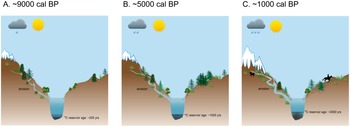
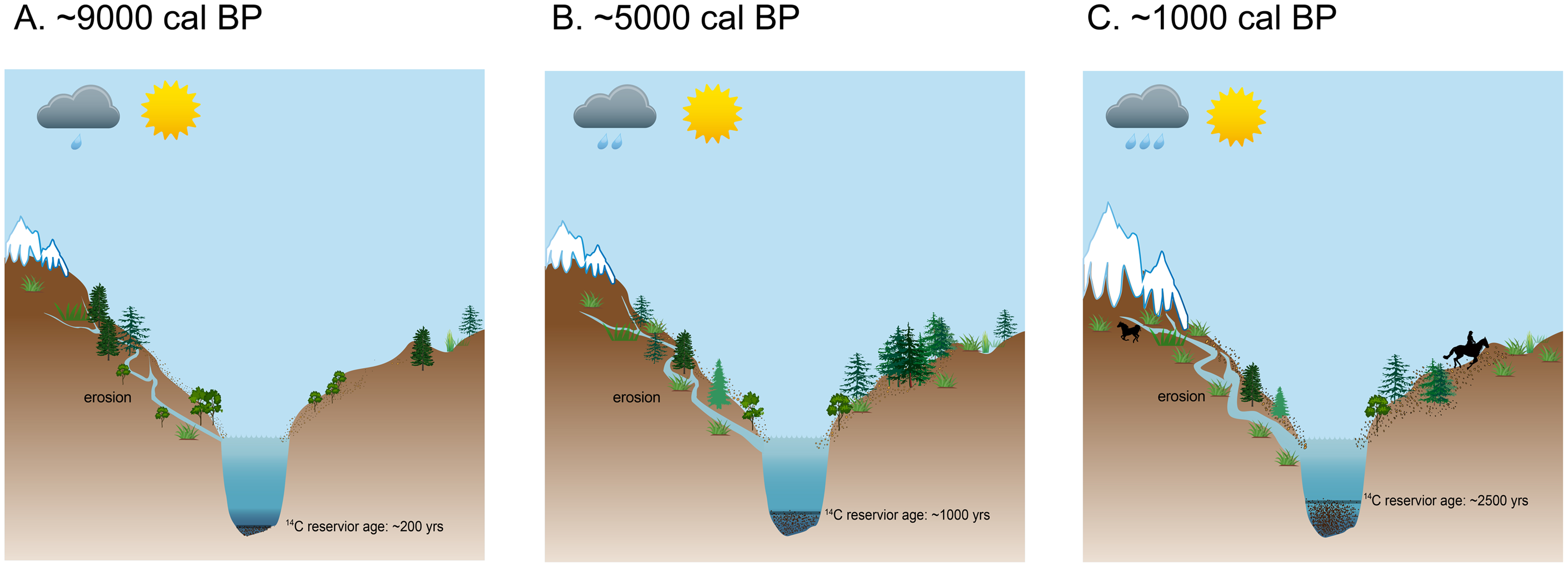
A schematic diagram illustrating the temporal pattern of soil erosion and its relationship with the old carbon effect is shown in Figure 5. During the early Holocene, the low tree coverage and limited accumulation of soil carbon resulted in the very limited supply of soil-derived old carbon to the lake sediments. However, the progressively wetting climate during the mid-to late Holocene promoted the increased accumulation of soil organic matter and peat, as well as causing an increase in soil erosion and thus the 14C reservoir age.
Schematic diagram illustrating the origin of the trend of increasing radiocarbon reservoir age at Lake Kanas.
CONCLUSION
Discrepancies between the 14C ages of the TOC and terrestrial plant remains in the Holocene sediments of Lake Kanas reveal temporal variations in the radiocarbon reservoir effect. The radiocarbon reservoir effect increased progressively from 0 yr at ∼9700 cal BP to ∼2800 14C yr at ∼530 cal BP. The erosion of soils and peat deposits in the mountains around Lake Kanas resulted in the supply of old organic carbon to the lake sediments. Additionally, we suggest that the supply of eroded organic material from different soil and peat depths resulted in the observed variations of the reservoir effect evident in the radiocarbon ages of the sedimentary TOC in Lake Kanas. Increased precipitation in the region during the mid-to late Holocene was responsible for soil organic matter and peat accumulation and their subsequent erosion, causing an increase in the age of the organic matter entering the lake, which in turn increased the radiocarbon reservoir effect. Therefore, climate change, especially the occurrence of snow meltwater–derived flooding, was the principal factor responsible for the observed change in the radiocarbon reservoir effect at Lake Kanas. During the past ∼1500 years, human activity may also have caused a further increase in soil erosion. Our results are of broad significance for the radiocarbon dating of the TOC of lake sediments which lack plant macrofossils, and they provide a foundation for past and future studies of lake sediment–based Holocene climate change in the region.
ACKNOWLEDGMENTS
The authors would like to thank two anonymous reviewers for their valuable suggestions. This work was jointly supported by the National Key Research and Development Program of China (2017YFA0603403), the National Natural Science Foundation of China (41571182).
DECLARATION OF COMPETING INTEREST
The authors declare that they have no conflict of interest.