INTRODUCTION
Death with or from dementia markedly increases with age (Brayne et al., Reference Brayne, Gao. and Dewey2006). Therefore, dying with dementia is increasingly common in our graying societies (Weuve et al., Reference Weuve, Hebert and Scherr2014). Palliative care becomes more appropriate with increasingly severe dementia (van der Steen et al., Reference van der Steen, Radbruch and Hertogh2014b ). However, in practice, many patients with dementia die uncomfortably, and sometimes with burdensome symptoms and treatments (Mitchell et al., Reference Mitchell, Teno and Kiely2009; van der Steen, 2010; Hendriks et al., Reference Hendriks, Smalbrugge and Galindo-Garre2015).
The way that people die lives on in the memories of their families, and witnessing suffering can cause anxiety and concerns about a family member's own death or the death of other loved ones, eventually triggering advance care planning discussions (Hirschman et al., Reference Hirschman, Kapo and Karlawish2008; Black et al., Reference Black, Fogarty and Phillips2009). Physicians' perspectives on dying patients' suffering—which might include psychological and/or spiritual suffering—are also relevant, because it is conceivable that their prior experiences will shape their judgment about treatment at the end of life, especially in terms of improving comfort, or in the case of unbearable suffering, which might involve palliative sedation or euthanasia. Physicians often feel that it is their duty to relieve suffering, and this can motivate the use of (terminal) palliative sedation (Rietjens et al., Reference Rietjens, Voorhees and van der Heide2014; Putman et al., Reference Putman, Yoon and Rasinski2013). Furthermore, patients with dementia may be incompetent with respect to decision making and often have difficulty communicating distress and its causes, particularly at the end of life. Clues how to relieve such distress may be provided by studying which factors are associated with suffering as perceived by the clinicians who are responsible for treatment.
However, we know very little about physicians' perspectives on discomfort and suffering at the end of life regarding with dementia. The perspectives of physicians who are specialists in caring for the frail older people, including at the end of life, are highly relevant in this regard. Physicians certified in elderly care medicine (Koopmans et al., Reference Koopmans, Lavrijsen and Hoek2010) are on staff in Dutch nursing homes. They usually know the patient and family well and have a strong and often decisive influence when it comes to decision making (Helton et al., Reference Helton, van der Steen and Daaleman2006; Reference Helton, Cohen and Zimmerman2011).
In the current study, we sought to address two main issues: (1) to gauge in how many patients Dutch elderly care physicians perceive suffering at the end of life; (2) to explore a variety of factors potentially related to perceived suffering (the characteristics of the physician and the patient, and the nature of the dying phase), to explore in whom and under what circumstances physicians perceive that dying with dementia involves suffering.
We selected factors potentially related to perceived suffering guided by key findings from previous work and theoretical frameworks, representing three perspectives:
-
1. Although sudden death may not involve much suffering, in nursing home populations the expectation of death may allow for preparation for the dying phase and for providing high-quality palliative and/or hospice care, as found in a study in U.S. long-term care facilities (Munn et al., Reference Munn, Hanson and Zimmerman2006).
-
2. In earlier analyses, the understanding of the progressive and terminal nature of the dementia was associated with the comfort of the patient when dying (End-of-Life in Dementia–Comfort Assessment in Dying [EOLD–CAD] scores; van der Steen et al., Reference van der Steen, Onwuteaka-Philipsen and Knol2013). We then conceptualized possible mediators that may be related to a lack of comfort at the end of life, based on a model constructed by Caron et al. (Reference Caron, Griffith and Arcand2005): (2a) family attitudes and patient–family relationships, (2b) family–physician (staff) interactions, and (2c) factors related to the care process. For example, unresolved disagreements about treatment during the final month of life is a candidate factor, as it might be related to unrelieved suffering. In addition to the perception that dementia is a disease from which one can die, we selected candidate factors from these three groups of mediators while selecting physicians' perspectives and assessments at the end of life.
-
3. Spiritual care is part and parcel of palliative care (World Health Organization, 2002). We found that residents were more often peaceful when residing in facilities with a religious affiliation (De Roo et al., Reference De Roo, van der Steen and Galindo Garre2014).
We answered the questions about suffering using data from the Dutch End of Life in Dementia (DEOLD) study, selecting variables compatible with the above perspectives in addition to the demographic data.
METHODS
The DEOLD Study
We analyzed data collected in the DEOLD study (2007–2010, with survival monitored through to the summer of 2011), in which 34 long-term care facilities participated, covered by 19 care organizations, each employing a team of physicians (described in van der Steen et al., Reference van der Steen, Ribbe and Deliens2014c ). The primary objectives were to describe quality of dying and end-of-life care, and to assess associated factors. The study protocol was approved by the Medical Ethics Review Committee of the VU University Medical Center in Amsterdam. Our observational cohort study employed both prospective (upon admission) and retrospective (only after death) recruitment of patients, and facilities adhered to one of these two designs (28 recruiting prospectively and 6 retrospectively). The differential recruitment strategies only affected the proportion of patients with advanced dementia and length of stay, which was shorter with prospective recruitment because not all patients were followed until death (van der Steen et al., Reference van der Steen, Ribbe and Deliens2014c ). The study was representative of the Netherlands in terms of geographic distribution of facilities and overall quality of care provided as evaluated by families (van der Steen et al., Reference van der Steen, Ribbe and Deliens2014c ).
Within two weeks after a patient's death, 103 physicians employed by the participating facilities completed questionnaires about 330 of 339 patients with dementia who died up until the summer of 2010. Of these, 213 cases were enrolled prospectively and 117 retrospectively (van der Steen et al., Reference van der Steen, Ribbe and Deliens2014c ).
An Outcome with a Valid Basis: Understanding Subjective Perceptions of Suffering Through Correlation with Objective Indicators
The study outcome was physicians' perceptions of suffering during the final six hours of life. Referring to this timeframe, within two weeks after the death, we asked physicians to describe the manner of dying, providing four response options that offered some description to guide the rating but left room for subjective interpretations: “passed away quietly / died in his/her sleep,” “was disturbed by / was aware of symptoms (e.g., breathlessness, pain, restlessness, fear, etc.),” “he/she suffered until the end / death was a struggle,” and “was found dead.”
The outcome of suffering had been proposed for a Dutch version of the Minimum Data Set–Resident Assessment Instrument (MDS–RAI) (D. Frijters, Ph.D., personal communication). However, it was not used as such, and therefore, before we assessed associations with the variables of interest, we did preparatory work in verifying whether physicians' perceptions of suffering correlated with more objective indicators of comfort/discomfort. For this, we explored whether it discriminated between higher and lower scores on valid indicators of (or lack of) comfort in dying. We employed a validated scale, the 14-item EOLD–CAD (Volicer et al., Reference Volicer, Hurley and Blasi2001), which has a range of scores from 14 to 42, with higher scores indicating higher levels of comfort. This scale includes items such as peace and presence or lack of symptoms (e.g., restlessness, anxiety, and choking). Comparative testing has shown that this is the best scale for measuring quality of dying in this population (van Soest-Poortvliet et al., Reference van Soest-Poortvliet, van der Steen and Zimmerman2013). In the DEOLD study, the EOLD–CAD referred to comfort “during the dying process,” as in the original development study (Volicer et al., Reference Volicer, Hurley and Blasi2001). It was completed after death by staff (physician or nurse, where the means did not differ; van der Steen et al., Reference van der Steen, Onwuteaka-Philipsen and Knol2013) and by families if the family was present when the patient died (van der Steen et al., Reference van der Steen, Onwuteaka-Philipsen and Knol2013; Reference van der Steen, Ribbe and Deliens2014c ). We defined a clinically important difference in EOLD–CAD total score between those perceived as suffering and those not suffering as ≥3 points (Boogaard et al., Reference Boogaard, van Soest-Poortvliet and Anema2013). We selected cases with a physician EOLD–CAD assessment (n = 165, with 21 missing) to examine if total and item scores differed.
The mean for patients perceived as suffering was only 28.0 (SD = 4.9), and it was 35.4 (SD = 4.1) for the other patients (t test, p < 0.001). All four subscales differed, as did 11 items, including those related to psychological well-being and spirituality (i.e., peace, serenity), with p values between 0.05 and 0.10 for the other three items (moaning, pain, difficulty swallowing; Mann–Whitney U test). Total scores (mean difference >3) for the nurse-completed EOLD–CAD (n = 144) and the family-completed EOLD–CAD (n = 87) as well as three of four subscale scores differed, as well as 7 (nurse) or 5 item (family) scores. In all, the results pointed to a consistent and substantial association of perceptions of suffering, with more objective indicators of suffering also when assessed by someone other than the physician.
Variables
We present candidate factors according to the three frameworks explained in the Introduction, and associations with perceived suffering are grouped by the degree to which they might be influenced by care. We therefore combined such physician and patient characteristics as demographics; the characteristics of the patient's death (e.g., cause); and aspects related to the decision-making process during the dying phase (care goals, decisions, decision making, communication, relationship, and perceived quality of care).
Advanced dementia was defined as a Cognitive Performance Scale score (Morris et al., Reference Morris, Fries and Mehr1994) of 5 or 6 and a Global Deterioration Scale (Reisberg et al., Reference Reisberg, Ferris and de Leon1982) score of 7, as used in U.S. research (see Mitchell et al., Reference Mitchell, Teno and Kiely2009). A five-point agreement scale was employed for physicians' beliefs that dementia is a disease that one can die from (van der Steen et al., Reference van der Steen, Onwuteaka-Philipsen and Knol2013). Physician characteristics were assessed at the midway point of the study.
Physicians' expectations about an “expected death” had the following response options: “expected,” “expected, yet sooner than anticipated,” “neither expected nor unexpected,” and “unexpected” (Dutch version of the MDS–RAI). Cause of death was reported using standard national recording practices. When a patient's death is designated as being due to “natural causes,” the death certificate distinguishes direct causes, those resulting in the direct causes including underlying causes, and contributing causes. We used cause of death reported anywhere on the death certificate (therefore, more causes per patient are possible).
Items related to the decision-making process were developed for the purpose of our study or were used from, or inspired by, other work. Descriptors of totals for some items have been published for selected samples, such as for those enrolled for the prospective data collection (van der Steen et al., Reference van der Steen, Onwuteaka-Philipsen and Knol2013; Reference van der Steen, Gijsberts and Hertogh2014a ; Hendriks et al., Reference Hendriks, Smalbrugge and Galindo-Garre2015), and are indicated in footnotes to the tables. We report on a goal of comfort care that combines palliative and symptomatic care, both aimed at enhancing a patient's well-being (van der Steen et al., Reference van der Steen, Onwuteaka-Philipsen and Knol2013). The most important “trigger” for providing comfort care was derived from a prestructured question with an open-ended “other” option. We recoded to distinguish two important physician strategies for advance care planning, relating to either condition or advance triggers, which emerged from qualitative work (van Soest-Poortvliet et al., Reference van Soest-Poortvliet, van der Steen and Gutschow2015). We employed an item about physicians’ intentions around end-of-life decisions as was done in previous studies (e.g., van der Heide et al., Reference van der Heide, Onwuteaka-Philipsen and Rurup2007). Palliative sedation is defined as keeping a patient in deep sedation or continuous sleep until death (Royal Dutch Medical Association, 2009). Any potentially burdensome intervention during the final week of life was defined as any hospitalization, emergency room visit, or new and/or ongoing parenteral therapy or tube feeding (Mitchell et al., Reference Mitchell, Teno and Kiely2009). Spiritual care was any type of spiritual care proved “shortly before death,” according to the physicians (van der Steen et al., Reference van der Steen, Gijsberts and Hertogh2014a ).
Statistical Analyses
We employed logistic generalized estimating equation (GEE) models to assess associations with patients' suffering adjusted for (hierarchical) clustering of patients with physicians and adjusted for design by adding a variable for prospective versus retrospective enrollment. We combined “was disturbed by / was aware of symptoms” and “he/she suffered till the end / death was a struggle (e.g., breathlessness, pain, restlessness, fear, etc.)” to indicate suffering. To reference no suffering, we combined “passed away quietly / died in his/her sleep” and “was found dead.” Of the 330 people in the sample (who died), we knew about suffering in 325. We did not know about the other 5 patients, as the physician did not complete this item. We report totals of the full sample of 330 patients for reason of representativeness.
We first examined all candidate variables one by one for an association with suffering, with adjustment for study design only (retrospective vs. prospective enrollment). Subsequently, variables significant at the 0.05 level were entered in stepwise backward regression until all variables were significant at the 0.05 level, so as to select the strongest independent variables associated with suffering (assessed using a Wald χ2 statistic), retaining the retrospective-versus-prospective assessment variable. We expected physician level to be most relevant, but we tested to see whether additional adjustment for clustering within care organizations (of physicians and patients) would result in a different model.
In multivariable analyses, we imputed missing values in continuous variables with means, and missing values in categorical variables with modes. Patient variables had less than 5% missing values. We had more missing values on physician variables because we lacked data from 12 of 103 physicians (e.g., due to their having changed jobs). Analyses were performed using IBM SPSS statistical software (v. 22.0.0).
We selected the patients who were perceived as having suffered the most (until the end or death was a struggle). We described these patients in terms of demographics, place of death, the independent predictors (with cause of death in full), and the objective indicators of lack of comfort.
RESULTS
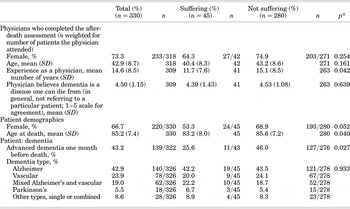
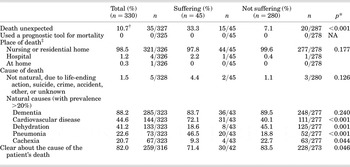
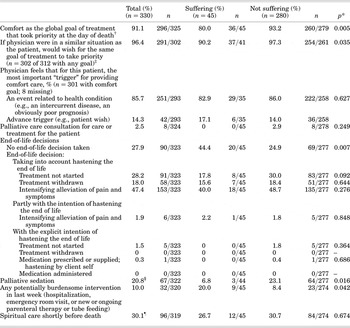
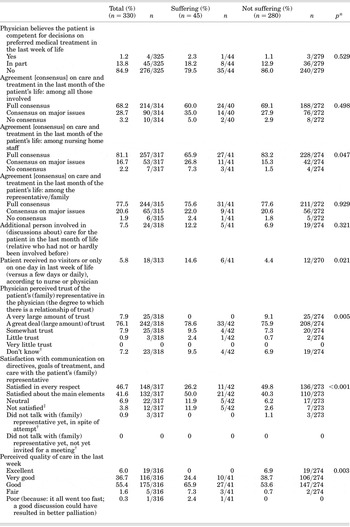
Of the physicians, 66% were female, and their mean age was 41.9 (SD = 9.1) years. On average, they had 13.5 (SD = 8.7) years experience, and mean agreement with the statement “dementia is a disease one can die from” was 4.65 (SD = 1.00) on the 1–5 scale. Table 1 presents slightly different figures for physician characteristics at the patient level (weighted for the number of patients included by physicians). Less than half (43.2%) of patients had advanced dementia upon death, a proportion that was somewhat higher in the retrospective design (52.7%) than prospectively, where not all were followed until death (38.1%, p = 0.012). Almost all patients (98.5%) died in a nursing home (Table 2). Also, almost all (98.5%) died a natural death. The top five natural causes of death were dementia, cardiovascular disease, dehydration, pneumonia, and cachexia. In most cases (Table 3), a comfort goal of care prevailed and some end-of-life decision was taken. The patient was rarely sufficiently competent with respect to decision making, but a lack of consensus on care and treatment was also rare (Table 4). The physicians usually rated the quality of care during the last week as good or very good (92.1%), and infrequently as excellent, fair, or poor.
Physician and patient† characteristics

* Values of p are adjusted for clustering at the level of the physician and for any differences between retrospective and prospective enrollment of patients. Of note, these p values were mostly similar to the p values with the χ2 or t tests.
† Descriptors of totals of patient items have also been reported by Hendriks et al. (Reference Hendriks, Smalbrugge and Hertogh2014).
Suffering and the patient's death

* Values of p are adjusted for clustering at the level of the physician and for any differences between retrospective and prospective enrollment of patients. Of note, these values of p values were mostly similar to the p values with χ2 or t tests.
† As also reported by Hendriks et al. (Reference Hendriks, Smalbrugge and Hertogh2014).
‡ The nursing or residential home refers to a psychogeriatric ward (almost all dementia, n = 320) or a special palliative care unit in the nursing home (n = 1). The hospital referred to an ICU in one case, an emergency department in one case, and two died on a regular ward.
Suffering and care goals, decisions, and interventions in the last phase

* Values of p are adjusted for clustering at the level of the physician and for any differences between retrospective and prospective enrollment of patients. Of note, these values of p were mostly similar to the p values with χ2 or t tests.
† Goals of care are usually negotiated during a process of advance care planning with family. A comfort goal of care refers to “a symptomatic policy” (56.3%; aimed at well-being and quality of life; additional prolonging of life undesirable), 34.8% “palliation” (aimed at well-being and quality of life; irrespective of shortening or prolonging of life); versus global goals of treatment had not been assessed (4.0%) maintaining or improving of functioning (3.1%), life prolongation (0.9%), other (0.9%; 1 physician-assisted suicide, and 2 combined palliation and symptomatic goals).
‡ In nine cases reasons were provided; in seven cases the physician would have preferred comfort care; in one case no hypodermoclysis anymore, and in one case treatment of depression.
§ As also reported by Hendriks et al. (Reference Hendriks, Smalbrugge and Hertogh2014), “Of all residents, 21% received palliative sedation: 17% of the prospectively and 28% of the retrospectively recruited sample (p = 0.015).”
¶ An article about spiritual care reported a lower percentage (20.8%) for the prospective design: “The percentage was higher (47%, and mostly (38%) rituals) in the two organizations that we excluded from the analyses because they collected the data only retrospectively. These were situated in regions with a dominant Roman Catholic tradition” (van der Steen et al., Reference van der Steen, Gijsberts and Hertogh2014a).
Suffering and decision making, communication, relationship and quality of care in the last phase

* Values of p are adjusted for clustering at the level of the physician and for any differences between retrospective and prospective enrollment of patients. Of note, these values of p were mostly similar to the p values with χ2 or t tests.
† Don't know or did not talk yet; was set to missing for regression analyses.
‡ Not satisfied: 12 reasons were provided, and these referred mostly to disagreements or more specifically to a feeling of inappropriate requests by the (family) representative, or not being present enough themselves or absence of the representative.
Physicians' Perceptions of Suffering
The physicians described the final six hours of 81.5% of cases (n = 265/325) as “passed away quietly / died in his/her sleep” (not in Table). A total of 15 patients (4.6%) were found dead. More than 1 in 7 (13.8%, 45/325) were perceived to have suffered during their final hours, 42 of whom were perceived as having been disturbed by or were aware of their symptoms, and 3 were described as having suffered until the end or that their death was a struggle. The proportions did not differ for prospective versus retrospective enrollment of patients (14.2 vs. 13.2% suffered; p = 0.792). Also, there was no change over time (no trend; correlation between suffering and time = –0.003, p = 0.95).
Dying and the Decision-Making Process: Factors Related to the Perception of Suffering
Many factors were associated with perceived suffering (see the right-hand columns in Tables 1–4): characteristics of the physician (less experience); patient (younger, no advanced dementia); the patient's death (unexpected, cardiovascular disease, pneumonia, no dehydration or cachexia as a cause, so less suffering with dehydration or cachexia); and a variety of aspects related to decision-making processes in the dying phase such as not having had a comfort care goal, an end-of-life decision, or palliative sedation, and a lack of consensus or trust.
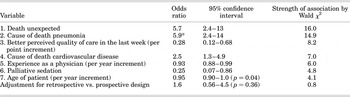
Physician-perceived suffering was independently and strongly associated with two factors related to cause of death: an unexpected death and pneumonia as a cause of death (odds ratios [OR] = 5.7 and 5.9, respectively; Wald χ2 ~ 15–16; Table 5). In addition, combined with other variables, during the stepwise regression procedure, these two were the variables that maintained by far the strongest independent association with suffering (by Wald χ2 statistic). Of the 35 patients who died unexpectedly, 15 suffered (42.9%) and 27.8% (20/72) of the patients who died from pneumonia suffered. The other factors independently but less strongly (Wald χ2 = 4–8) associated with physician's perceived suffering were diverse: worse perceived quality of care, death with cardiovascular disease, less experience as a physician, no palliative sedation, and younger patients. By contrast, the first item dropped in the stepwise procedure was “any potentially burdensome intervention in the final week of life” (p = 0.978).
Variables independently associated with suffering in stepwise backward logistic generalized estimating equation (GEE) regression adjusted for clustering at the level of the physician

* Despite a smaller odds ratio, the association with an unexpected death was slightly stronger than the association with pneumonia as a cause of death due to competing variables with almost similar strength of associations and a larger standard deviation of the regression coefficient for pneumonia as a cause of death.
Additional adjustment for clustering within care organizations did not change the model (a difference in Wald χ2 statistics of at most 0.1). Of note, when we entered all variables, the same variables were significantly associated with suffering, except for quality of care and patient age, which were marginally significant (p = 0.06) in the full model with all variables. Physicians' experience was strongly correlated with age (Pearson's r = 0.91, p < 0.001), but replacing experience by age rendered it nonsignificant (marginally; OR = 0.95, CI 95% = 0.91–1.0, p = 0.055).
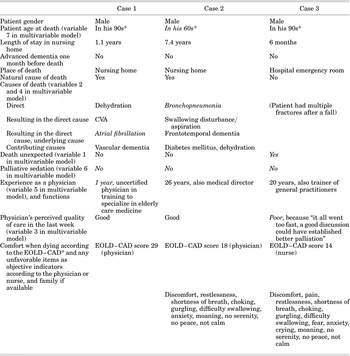
Table 6 describes the three cases in which the patient suffered the most, according to their physician. The first case refers to a patient who died with cardiovascular problems, but the very inexperienced physician did not report any objective indicators that clearly pointed to lack of comfort on the EOLD–CAD (rating most “somewhat”). The second case involved death from bronchopneumonia in a patient with young-onset dementia, and the physician reported 9 of 14 EOLD–CAD indicators as particularly unfavorable. The third case involved death after a fall and hospital transfer, and the nurse rated all 14 indicators as unfavorable while the physician reported to have provided poor care due to not having prepared for an emergency situation.
Description of the three (of 330) cases for whom their physician referred to the final 6 hours as “suffering till the end or death being a struggle”

EOLD–CAD = End-of-Life in Dementia–Comfort Assessment in Dying (range = 14–42, with higher scores representing better comfort). Reported items are the unfavorable items scored as “a lot” (3 points), and the favorable items scored “not at all” (1 point).
Items positively associated with perceived suffering in the multivariable model are in italics.
* For privacy reasons, we do not provide the exact age of persons we describe as individual cases.
DISCUSSION
In our nationally representative study, Dutch elderly care physicians found that 13.8% of patients with dementia suffered during the final six hours of life. Although the large majority (81.5%; and 4.6% who were found dead) “passed away quietly / died in his/her sleep,” a variety of factors related to suffering. Factors independently associated with suffering included circumstances of the dying phase (strongly associated, with odds ratios of almost 6: unexpected death and cause of death pneumonia; less strongly associated: cause of death cardiovascular disease). Further, these included factors related to quality of care (physician overall perspective), an intervention (palliative sedation), a characteristic of the physician him- or herself (less experience), and the patient (a younger patient).
Interpretation of Results in View of Other Studies
An unexpected death (but not “found dead”) may mean staff members were unprepared and that the dying phase was not recognized in a timely fashion so that comfort could have been provided, perhaps because medication or nonpharmacological measures were not provided in a timely manner or not yet effective. Our findings are consistent with those in U.S. long-term care, where residents whose death was expected were more likely to receive high-quality palliative or hospice care (Munn et al. Reference Munn, Hanson and Zimmerman2006). Independent of an unexpected death, death from cardiovascular disease involved suffering. In addition to symptoms that caused suffering, suffering might also relate to longstanding distress, as a meta-analysis of 10 prospective studies found that people in psychological distress are more likely to die from cardiovascular disease (Russ et al., Reference Russ, Stamatakis and Hamer2012). Chronic cardiovascular disease, such as heart failure, however, is increasingly being recognized as a disease that may benefit from palliative care (Siouta et al., Reference Siouta, van Beek and Preston2016). In previous studies, we found that death after pneumonia involved more suffering than death after food and fluid intake problems (van der Steen et al., Reference van der Steen, Pasman and Ribbe2009). Being short of breath might be perceived as particularly distressing. In the recent PneuMonitor study, discomfort with pneumonia decreased considerably between 2012 and 2015, but this might have been due to raised awareness among staff triggered by external observers visiting and observing the patient almost daily (van der Maaden et al., Reference van der Maaden, van der Steen and de Vet2016). Nevertheless, discomfort increased at the end of life. It is very possible that pneumonia is still not the “old man's best friend” in the meaning of being a comfortable way out, and it also occurs in less advanced dementia (Hendriks et al., Reference Hendriks, Smalbrugge and van Gageldonk-Lafeber2016).
Implications
Especially patients with pneumonia who are likely to die, or a fast, unexpected deterioration that might be fatal may benefit from frequent monitoring of comfort and aggressive application of comfort measures. Early identification of the dying phase and therefore having time to prepare and bring comfort, may be beneficial. Our results also suggest other factors: overall quality of care, treatment (palliative sedation), and physician's experience, although these factors do not translate directly into interventions. It is important to know whether unbearable suffering can be relieved. The association with perceived quality of care suggests that the physician felt there was room for improvement. Less experience may imply less experience in bringing comfort. Alternatively, exposure to suffering might lead to acceptance that death cannot be controlled fully and to raising of the bar for what is being perceived as suffering. However, perceived suffering did relate to objective indicators.
It is possible that a physician's training will affect her/his perspectives, or the importance they place on suffering. A study by Arnold et al. (Reference Arnold, Lloyd and von Gunten2016) suggested that the use of images and narratives in palliative care training can result in replacement of perceptions of suffering by more positive, hopeful perspectives on dying. In our study, only three patients were younger than 65. Younger patients might have more severe problems in some respects, such as being more aware of their disease, and their care might be different, and our findings, despite the limited variability in age in the DEOLD study, support the calls for research in younger people with dementia at the end of life (Koopmans et al., Reference Koopmans, van der Steen and Bakker2015).
Limitations and Strengths of the Study
Fewer patients who received palliative sedation suffered during the final six hours of life. Of course, these are physicians' perceptions, and they may have overestimated the effects of the sedation they had provided or underestimated the effects of potentially burdensome treatments. Previous work has shown that physicians' views on what constitutes a good death are more biomedically oriented than those from patients or families whose views include more psychosocial and spiritual issues (Steinhauser et al., Reference Steinhauser, Clipp and McNeilly2000). However, physicians may also believe that spiritual suffering increases such somatic symptoms as pain (Smyre et al., Reference Smyre, Yoon and Rasinski2015), although these works do not refer to dementia. The observational nature of our study does not allow for causal interpretation. Also, we questioned physicians after the death of a patient, and this may have introduced bias for variables such as the goal of care at the end of life. They may not have witnessed the final six hours, and their perception of suffering may have been a mixture of observations from nurses, family (e.g., through reflection on the last hours with the multidisciplinary team), and knowledge about the patient and his or her condition at the end of life. Some patients (4.6%) were found dead, so that nobody witnessed their final hours of life, and the percentage of people who suffered (13.8%) may therefore represent a modest underestimation. Suffering in our study referred only to the final hours of life. This suggests that the physicians believe that, more generally, few nursing home residents with dementia suffer. It is possible, however, that the frame of reference of what represents suffering is different during the dying phase compared to before, for example, if suffering is perceived as an inevitable part of the dying phase.
Future Research
Perceptions of suffering and changes earlier on in the course of the disease warrant longitudinal research and will remain issues in the debate over euthanasia in dementia (de Boer et al., Reference de Boer, Dröes and Jonker2011; Bolt et al., Reference Bolt, Snijdewind and Willems2015; Kouwenhoven et al., Reference Kouwenhoven, Raijmakers and van Delden2015; Tomlinson et al., Reference Tomlinson, Spector and Nurock2015). Qualitative research may examine perceptions of suffering in greater depth and also address existential issues related to perceptions on (unbearable) suffering. A comparison with family and patient perspectives is relevant in this respect, too, as patients in earlier stages or also later on may employ coping mechanisms that affect their perspectives on quality of life as well as suffering (de Boer et al., Reference de Boer, Hertogh and Dröes2007). Both family and staff perceptions are included in the only “suffering” measure for dementia, along with more objective indicators (Aminoff et al., Reference Aminoff, Purits and Noy2004). In parallel with prediction research in palliative care, in which subjective estimates of survival are often retained as an independent predictor in multivariable analyses (Glare & Sinclair, Reference Glare and Sinclair2008), probably because subjective judgment captures additional sensitive information, it is possible that the best estimate of suffering combines subjective estimates with objective indicators. This matter also warrants further study, and such work could also compare perceptions of suffering in people who die without dementia, in whom general practitioners perceive higher levels of and more varied forms of psychological distress (Meeussen et al., Reference Meeussen, Van den Block and Echteld2012).
CONCLUSIONS
Dutch elderly care physicians perceived suffering during the final hours of life in about one out of every seven patients, and those patients dying from pneumonia or dying unexpectedly were found to suffer more often. There may be room for improvement, especially through earlier identification of the onset of the dying phase, which would allow time for caregivers, and perhaps patients, to prepare, and could provide patients with improved levels of comfort.
FUNDING SOURCES
The Dutch End Of Life in Dementia (DEOLD) study was supported by a career award for JTvdS from the Netherlands Organisation for Scientific Research (NWO; the Innovational Research Incentives Scheme, Veni grant no. 91666073); by the Netherlands Organisation for Health Research and Development (grant no. 1151.0001); and by the VU University Medical Center, the EMGO Institute for Health and Care Research, the Department of General Practice & Elderly Care Medicine, and the Department of Public and Occupational Health, Amsterdam. Salary support for the analyses and writing of the manuscript was also provided by the NWO (Innovational Research Incentives Scheme, Vidi grant no. 91711339).
CONFLICTS OF INTEREST
The authors hereby state that they have no conflicts of interest to declare.