In the field of business history, the early twenty-first century has been a time for conceptual and methodological debates.Footnote 1 The discipline has also expanded to new geographies, as demonstrated in multiple literature surveys since 2000. Recent state-of-the-art studies examine business history activity in emerging markets.Footnote 2 The geographical expansion of business history to emerging markets has highlighted the need to understand how the institutional and social contexts in these countries have differed from those of the West. It has been suggested that the business responses of emerging markets should not be studied as anomalies or deviations; rather, they need to be incorporated on their own within the business history agenda. That is part of the rationale behind the alternative business history (ABH) hypothesis, which, in the words of Gareth Austin, Carlos Dávila, and Geoffrey Jones, “addresses themes that are largely different from those concerning developed markets; as such, it differs from what can be called mainstream business history.”Footnote 3 The fundamental tenets of ABH are spelled out in one of the four articles in Business History Review's Autumn 2017 special issue on methodologies.Footnote 4 ABH is informative, especially for business historians from emerging markets whose pathways for entry into the traditional discipline may at times run the implicit risk of falling into “traps.” Among those traps, one is ignoring, or underemphasizing, the role of the state as an actor in capitalist development.Footnote 5 Another is to assume a “teleological hierarchy” that implies that the experiences of the United States and Europe are “the one best way” or are “normal and normative.”Footnote 6 Within linear approaches to capitalist development, an emerging market's experiences that do not fit into some frameworks can easily be considered anomalous or exotic.Footnote 7
This article contributes to the history of emerging markets by bringing the ABH perspective to the study of entrepreneurship, looking at the specific case of women entrepreneurs in Colombia.Footnote 8 Women entrepreneurs have increasingly participated in, and influenced, some of Colombia's most innovative industries since 1990. They have tended to work in areas such as microfinance, health-food services, and green business, areas that grew disproportionately in recent decades. This article looks at the differences in entrepreneurship for women and for men in Colombia and also considers how the challenges for women entrepreneurs are, at times, distinct from those experienced in mature economies.Footnote 9
Finally, this article examines female entrepreneurship in Colombia during a time when landmark institutional changes and rapid social transformations were taking place in the country. As in other emerging markets, in Colombia during the years from 1990 to 2020, entrepreneurs, entrepreneurial families, business groups, and business interest groups were key actors. They were so, however, in a complex political context. On the one hand, the Andean country was one in which the liberal reforms came belatedly. On the other, by the early 1990s rural guerrilla warfare had entered its twenty-fifth year and was compounded by a flourishing illegal-drug-trafficking business.
In this article, we argue that since the end of the twentieth century Colombia experienced a series of multidimensional changes that drove diverse business responses, which, in turn, had a significant impact on the country's entrepreneurship. We identify an increasing heterogeneity in the composition of the group of entrepreneurs, marked by a greater diversity in social class and educational level, regional origin, professional trajectories, and political and ideological differences around Colombia's peace agreement signed in 2016.
Women played a significant role in bringing more diversity to entrepreneurship in Colombia. This proposition needs to be emphasized and studied since gender is a topic that does not get much attention in Latin American business history, which is still dominated by the histories of male entrepreneurs, entrepreneurial families, and business groups. As we will see, female entrepreneurship has been, until very recently, a hidden topic in Latin American business history.
The article is organized into four main sections. In the first section, we describe the significant institutional changes that started in the 1990s. In the second section, we analyze a number of Colombian female entrepreneurs’ testimonies following from current debates on female entrepreneurship. The third section completes the analysis of female entrepreneurship by looking at it as part of the growing heterogeneity of Colombian entrepreneurship overall. Finally, we conclude by reflecting on the broader trends, especially how women contributed to increasing diversity and diversification in Colombian entrepreneurship.
The article takes a novel perspective on women and business by looking at the trajectories and career dynamics of a selected group of women business leaders in Colombia. The goal is twofold: to identify internal and external factors that have encouraged or limited their careers, and to contextualize their experiences in a broader process of entrepreneurial changes and transformations. To do this, one of the sources is the Creating Emerging Markets (CEM) oral history database developed at Harvard Business School. The CEM project shows the potential for business history to use qualitative, ethnographic methodologies developed in other social-scientific disciplines, including sociology and anthropology.Footnote 10 The CEM oral history interviews were supplemented with selected primary and secondary sources.
Political and Economic Change in Colombia
For the last three decades, Colombia has gone through a series of significant economic, political, and social changes, which have driven varied business responses and resulted in changes to its entrepreneurship. One major transformation came with the liberal market reforms since the 1980s brought about by Latin America's integration into the world economy. Colombia was one of the last countries in the region where such policies came into effect, following structural adjustment programs recommended by international financial institutions, including the International Monetary Fund and the World Bank.Footnote 11 These policies epitomized the change from state protectionist economic development toward a market economy driven by global competition.
The César Gaviria administration enacted about a dozen liberalization reforms in 1991 and 1992.Footnote 12 These reforms covered international trade, banking, finance, foreign investment, deregulation in market entry, labor relations, and privatization of state-owned enterprises, among others.Footnote 13 Entrepreneurial actors (the private business sector) were to take center stage, as leading figures in furthering capitalist development.Footnote 14 By resorting to William Baumol's entrepreneurial theory, their “productive” functions should prevail over “unproductive” and “destructive” functions.Footnote 15
The constitutional reform of 1991, which replaced a constitutional charter that had lasted for 105 years, was another critical factor. Significantly, it included goals of participatory democracy and inclusiveness. The new charter emphasized human rights, multiethnicity, multiculturalism, civil-society participation, ecology, decentralization, and strengthening of the judiciary. The 1991 Constitution provided that women and men be treated equally before the law, that both receive the same protection and treatment from authorities, and that they enjoy the same rights, freedoms, and opportunities. It also added that “the authorities shall guarantee the adequate and effective participation of women in decision-making levels of the Public Administration.”Footnote 16
The Constitution embodied the contradictions of the emerging business environment. A demobilized guerrilla group (M19) was strongly represented; it became one of the three major forces in the constitutional assembly. The other two represented the Liberal Party and one faction of the Conservative Party. After three decades in operation, the Constitution has both enabled significant advances and demonstrated its own shortcomings.Footnote 17 Several attempts to introduce changes, stemming for the most part from rights groups, have taken place.Footnote 18 A longue durée perspective has usually been absent in the claims to propel them. In this as in the realm of the liberal reforms, Colombian society is hardly in the middle of a transition.Footnote 19 Nonetheless, as we will see, women entrepreneurs gained opportunities and protections under the new constitutional order, which explicitly recognized the need to demand gender equality from all political parties.
The constitutional process was an important beginning and offers valuable lessons about the relationships between the state, law, and gender-based political struggles. In the balance, reforms have had positive consequences for entrepreneurship. Overall, in Colombia's case, various socioeconomic, political, and ideological dimensions have increased the heterogeneity of the entrepreneurial class in the last decades. The next section, through testimonies from Colombia's top female entrepreneurs, discusses how they helped transform Colombia in terms of diversity in entrepreneurship—typically a masculine career path.Footnote 20
Female Entrepreneurs in Latin America
Recent years have seen considerable growth in the study of female entrepreneurship.Footnote 21 In particular, the literature has focused on understanding factors that can explain the difficulty women experience in undertaking an entrepreneurial career.Footnote 22 Even if there is no consensus, scholars have identified a long list of interrelated barriers: insufficient education or experience, stereotypes, lack of access to various material resources (especially capital), a paucity of mentors and role models, and competing demands on time, among other factors.Footnote 23 Other studies postulate that the form and structure of women's entrepreneurial pursuits are largely determined by both formal institutions (policies, laws, and regulations) and informal ones (societal values, culture, and family norms), as well as economic conditions and the prospects for social participation.Footnote 24
Candida Brush, a scholar of gender and entrepreneurship, stated in a pioneering study, “Women business owners are similar to males across some basic demographic factors, problems, and business characteristics, but they differ widely from male business owners across individual dimensions related to education, work experience, skills, approach to venture creation/acquisition, business goals, problems, and performance.”Footnote 25 In a similar vein, Lidia Heller, cofounder of RedWIM, a professional association of Latin American and Caribbean women in organizational management, stated that the main problems facing Latin American women entrepreneurs are the lack of adequate experience in business, trade, and education. They also confront barriers to accessing credit, financing, and trade networks.Footnote 26
From a historical perspective, women-led enterprises have always existed but have typically been ignored by business historians or considered according to criteria that accentuated their marginality.Footnote 27 Recent studies show that female entrepreneurs were almost entirely ignored in the academic literature until the twenty-first century. Likewise, the historiography of business history in Latin America hardly mentions women, and those accounts specifically dedicated to the subject are few and recent.Footnote 28 Historical studies of female leadership in larger companies are even scarcer.Footnote 29 Within this line, existing works have focused on case studies.Footnote 30 Others have considered women's representation on boards of directors.Footnote 31 Overall, the available research shows that women's access to positions of power and influence in the largest companies in Latin America remains a rare and late-breaking phenomenon and that many issues and discussions remain open. Nevertheless, it should be noted that women's business history is gaining more strength and will join a long tradition of studies on women's civil rights and corporate laws, the feminist movement, women's work, and access to education and political position—topics that have awakened early and numerous sensitivities in the Latin American historiographical field.Footnote 32 For Chilean business historian Bernardita Escobar, women's business history can be better understood if traditional paradigms that conceive of businesses only as vehicles for economic growth are set aside.Footnote 33
In Colombia, women's presence in the public sphere was part of a slow process of legal, economic, and cultural change, sometimes led by feminists and most times favorably influenced by external and internal circumstances.Footnote 34 For example, it was not until 1933 that women gained eligibility to receive a high school diploma, which made possible their entry into universities. Women were officially allowed in 1936 to occupy positions in public administration but were not actually granted this opportunity until 1954. That same year, Colombian women were granted the legal right to vote, and women voted for the first time in 1957. The struggle for equal political rights started in 1932; however, it was not until 1954 that feminist Esmeralda Arboleda, one of the first female lawyers and Minister of Communications, persuaded the Colombian Senate to pass a law granting civil rights to women. In 1957, Arboleda became Colombia's first woman senator, serving from 1958 to 1961.Footnote 35 Nonetheless, until the approval of the Quotas Act (2000), which required a minimum of 30 percent of women in government positions, female representation in such positions was an overwhelming minority.Footnote 36
Several statistics show the recent achievements of women in Colombia in such fields as education, labor market participation, and political and civil rights, even though there is a long way to go. As recently shown by a Banco de la República report, from 1985 there has been an increase in female enrollment in higher education, now exceeding that of men; women's labor participation also grew, though stagnating at the beginning of the twenty-first century.Footnote 37 The progress of women in formal political participation—both in voting and (to a lesser extent) as political leaders—has also been significant.Footnote 38
As the participation of women in political spheres has increased, so has the study of women in political and economic activities.Footnote 39 The first study of women in senior management of private enterprises in Latin America found that Colombia was, comparatively speaking, the country with the largest share of women at senior management levels in the private sector.Footnote 40 María Consuelo Cárdenas, a scholar of female executives, leaders, and gender issues in organizations, found that in Colombia women occupied 75 percent of regional or department management positions and 36 percent of president and vice president positions. And they exercised participative leadership.Footnote 41
But even though Colombia was recognized by the 2019 Mastercard Index of Women Entrepreneurs (MIWE) as one of the top markets where women had made significant strides, women still faced challenges when it came to entrepreneurship. According to the 2018 MIWE, women business owners in Colombia represented 25 percent of the total population of business owners.Footnote 42 This percentage reflects historical restrictions on women, and equal legal rights are still a critical barrier, even more acutely so in emerging markets.Footnote 43 The Global Gender Gap Index uses economic, educational, health, and political indicators to rank 153 economies on how well they are using their female talent pool. In the last few years, Colombia's position has improved, ranking twenty-second in 2020—but forty-third in economic participation and opportunity.Footnote 44 In the Global Entrepreneurship and Development Institute's 2015 Female Entrepreneurship Index, Colombia ranked twenty-ninth of seventy-seven countries in terms of conditions that foster high potential. Overall, these statistics show that gender disparities have been reduced in Colombia, but they persist.
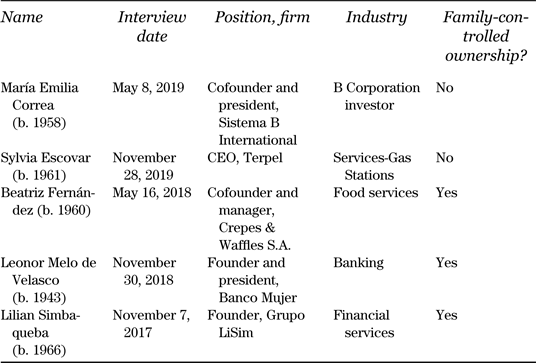
Considering that a gap remains in the business history literature, we analyze five top women entrepreneurs in Colombia through the lenses of key debates on female entrepreneurship (see Table 1). Each case presents a unique set of circumstances, accomplishments, and limitations. The intent is not to claim that these cases are representative of all female entrepreneurs’ experiences and career patterns. However, we can draw some broad generalizations, and these cases support our argument about the growing heterogeneity of Colombian entrepreneurship in the last decades.
Colombian Female Entrepreneurs from the Creating Emerging Markets Project at Harvard Business School

Source: Creating Emerging Markets Project, Baker Library Historical Collections, Harvard Business School, https://www.hbs.edu/creating-emerging-markets/Pages/default.aspx.
These five women represent a new generation of leadership that existed outside of the traditional portrait of family businesses in Latin America. In an economy where many large businesses are family owned, these women promoted a new way of doing business in Colombia. They were part of a new social sector (middle class, educated), confirming that entrepreneurship elites were no longer restricted to old, wealthy families or a privileged socioeconomic origin. Furthermore, each of these female entrepreneurs became a leader in her activity or sector. Together, they innovated in a variety of sectors, including traditionally male-dominated ones such as the oil-refining or banking industries, or have promoted the expansion of business in Colombia in new directions, including microcredit and green entrepreneurship. Their rise has come about in part through policy but has been staggered by persistent gender biases, which even some businesswomen supported.
A crucial debate in the literature has focused on how to promote female entrepreneurship, since starting a business is a challenging prospect and women confront additional barriers.Footnote 45 Women's decisions to start a business (or to work in the private sector) have been associated with their sociocultural background, especially their level of education or professional experience, as the cases of Lilian Simbaqueba, María Emilia Correa, and Sylvia Escovar exemplify.Footnote 46
Other cases highlight the significance of contextual challenges, which we found particularly relevant since, in Latin America, economic and political-institutional instability is a common factor of business life. Leonor Melo de Velasco, who founded the nonprofit Fundación Mundo Mujer (Women's World Foundation) in 1985, described how the devastating 1983 earthquake in Popayán moved her to venture into business. It was a time when “the city had to rebuild itself” and was in need of a socially responsible bank.Footnote 47 Eventually, Banco Mundo Mujer was authorized to operate as a bank by regulatory authorities. Contextual instability—with such factors as lack of access to credit amid a crisis and opportunity for entrepreneurs—represented a “push factor” that encouraged women to start businesses.Footnote 48
Access to finance is another topic of debate in the literature on women and business. Several studies claim that female entrepreneurs experience less support than men when they try to access business resources. For microventures and for small and medium-sized enterprises (SMEs) in particular, there is evidence of a persistent funding gap between male and female entrepreneurs.Footnote 49 Significantly, women business leaders have not only recognized this critical factor at the beginning of their careers but also have created ventures and pushed initiatives to reduce this gap. Lilian Simbaqueba recalled in her interview that she sought to improve chances for female entrepreneurs when she founded LiSim, one of Colombia's first microfinance companies, in 1996. The company's strategy was to expand the pool of loans to smaller businesses, including those run by women. “Now, we're working on making funding more easily available to SMEs, handling projects for Bancoldex and the Inter-American Development Bank (IADB) to encourage banks specially to grant loans to companies that are not so large and are starting off but have potential,” she noted.Footnote 50 In the decades since then, women have gained more access to credit with the growth of other like-minded initiatives, especially from the IADB.Footnote 51
Another debate in the field is related to the role of networks and relationships in either pushing or impeding the progress of women entrepreneurs.Footnote 52 Despite generally not coming from elite families, the five Colombian women entrepreneurs included in this study were able to expand their inner circles to build extensive networks and social relationships, to the point of becoming leaders and mentors of other women who were pursuing a business career. Simbaqueba openly talked about one of the most significant issues for promoting female entrepreneurship: the need for good mentoring, especially, as she put it, “same-gender mentoring.”Footnote 53
Interestingly, the literature has paid little attention to women's expectations about entrepreneurship and how an entrepreneurial career can offer a better “balance” between family and work.Footnote 54 The five women studied here openly recognized that they would face challenges, but at the same time, they also understood the critical importance of the support they received from their families. This observation complements previous studies about high-achieving women executives that considered domestic help and family support as vital to their success.Footnote 55 Interestingly, these expressions differ from those of men interviewed for the CEM project in Colombia, highlighting that these women are open to talking about their personal and emotional challenges and, even more, that doing so was not perceived as a weakness.
The women interviewed for the CEM project did not necessarily express open-mindedness on the topic of gender equality. On the contrary, some testimonies exhibited an unconscious gender bias, which Susan R. Madsen and Maureen Andrade define as “unintentional and automatic mental associations based on gender, stemming from traditions, norms, values, culture or experience.”Footnote 56 In fact, all said that they had not personally experienced discrimination based on gender.Footnote 57 At the same time, they recognized that women faced more challenges than men.Footnote 58 Indeed, as several studies have traced, the persistent gap between men and women in entrepreneurship can be attributed to the gender-based cultural and social stereotypes assigned to men and women.Footnote 59 In this regard, Sylvia Escovar highlighted the validity of this claim and of the ongoing self-perceptions that shape female entrepreneurship. She recalled that, remarkably, a woman had once said to her, “‘Well, yes, [I] got the highest score, but I think we should hire a man, because men make better plant workers.” Escovar commented, “This was no mean lady, and neither did she act out of hatred of women: it is just that gender bias is embedded in our mind, in our children, in our fellow workers, in language, and we must get rid of it if we want to create real change.”Footnote 60
Being exposed to gender biases (recognized or not) moved these women to embrace a complexity not faced by men, as Simbaqueba noted.Footnote 61 In fact, they incorporated such gender-based challenges into their leadership. As in previous studies on female executives, we found that the women interviewed for the CEM project could, at times, use gender stereotypes to their advantage in their way of exercising leadership. According to the literature, this type of leadership, which is more characteristic of women than men, has been recognized as more effective in multiple contexts.Footnote 62 For instance, these women talked openly about dealing with disruption and uncertainty.Footnote 63 This last issue has been raised worldwide recently in response to the role of women leaders during the COVID-19 pandemic. According to some analysis, during the pandemic, international women leaders managed to leverage women's role in the home to their advantage in the political sphere. An appreciation of traditionally feminine attributes in women political leaders has been displayed in much media coverage, providing more favorable treatment of female political leaders than previously.Footnote 64
Our analysis also identifies a more holistic view of entrepreneurial motivations and even shows how emotional commitment has been critical to the careers of the entrepreneurial women studied.Footnote 65 As suggested by ABH in emerging markets, businesspeople's commitment to their entrepreneurial activities tends to be more extensive in emerging economies than in developed countries, in the sense that inequality and the nature of the institutional voids may work to prompt some businesses—including these specific women—to acquire a broader view of their roles.
The next section considers the experiences of the group of leading female entrepreneurs interviewed for the CEM project with other cases and recent literature in the field. We focus on four categories that illustrate the changes toward more heterogeneous entrepreneurship in Colombia: social class and education; regional diversity; career paths and new green ventures; and political and ideological differences around Colombia's 2016 peace agreement. Intentionally, we seek to integrate our insights about female entrepreneurship into a general discussion to avoid the perpetuation of stereotypes about female entrepreneurship that persist in academia when women are presented just as a subtype or as secondary to men.Footnote 66
The Heterogeneity of Colombian Entrepreneurship
Even though the Colombian elite's entrepreneurial families and groups continue to hold economic, social, and political power at national, regional, and local levels, some of their counterparts belong to families that have experienced upward social mobility in recent years.Footnote 67 Money and social status do not necessarily come together any longer. Indeed, both the trajectories of the female entrepreneurs interviewed and secondary research illustrate this trend clearly.Footnote 68 None of these women were members of or linked to business elite families, indicating that social structure has experienced a relative increase in inclusiveness/openness. Instead, they created new ventures from scratch. Their careers illustrate the role of challenging contexts in identifying business opportunities and pursuing a career as an entrepreneur, as explained in the previous section.
Additionally, in the cases at hand, all of these women had a college degree (law, economics, dentistry) and enjoyed a higher educational level than their parents.Footnote 69 A similar portrait can be seen in a study from 2009 of ninety-eight female Colombian executives. In that study, the women had typically studied engineering, law, or administration, had master's degrees, were married, and had children.Footnote 70
Consequently, in Colombia, entrepreneurial elites are no longer restricted to old money and upper-class origins. The old, three-or-more-generation entrepreneurial families have come to coexist with relatively “new” money: newly rich families critically involved in leading their respective local settings, sectors, and business associations. Some examples include finance, commerce, agriculture, real estate and urban development, engineering and infrastructure, services, tourism, and some manufacturing sectors.Footnote 71 At this level, the businesswomen not only supported the diversity of industries but also explored opportunities in new business sectors after the 1990s—including microcredit financing, technological services, and the development of a new concept on a restaurant chain (high-quality and low-price meals)—that incorporated the concept of social responsibility.
Traditionally, Colombian entrepreneurship had a local and regional basis and identity. Colombia is a “country of regions” and has an extensive urban network that differs from the city model of most Latin American countries, which tend to be characterized by extreme centralization in their capital cities.Footnote 72 Since 1990, a strengthening of entrepreneurship with local and regional underpinning has been underway. New entrepreneurs were not necessarily born in the four largest cities (Bogotá, Medellín, Cali, and Barranquilla), as they once were, but enjoy visibility and legitimacy in the dozen or so medium-size urban centers. Interestingly, up to the late 1970s, some of the latter cities had their own distinctively rigid, noninclusive social structures and entrenched old elites (e.g., Cartagena, Manizales, and Popayán).Footnote 73 Leonor Melo de Velasco, who founded the Fundación Mundo Mujer, described her strong regional identity, commenting that after the earthquake that devastated Popayán, “people's homes and businesses were devastated. They needed financial aid to pay the additional expense to repair their houses, reorganize their businesses, and rebuild what they had lost.”Footnote 74 Nowadays, regional entrepreneurs are present in the massive ground inland passenger transportation sector (buses and taxis), and in commerce, especially in import and construction and infrastructure sectors. These new entrepreneurs have grown and expanded sizable capital accumulations in legal business (i.e., business not permeated by drug trafficking, contraband, or money laundering).Footnote 75 The subset of women business owners interviewed represents a clear example of this new trend. They were representative not of the traditionally (large) family business groups but of SMEs.
A subset of these new entrepreneurs comprised midcareer former executives of multinational enterprises (MNEs)—for example, in the oil and gas industry—who created new businesses in specialized market niches to provide outsourcing and other related services to their former employers. Or, as Simbaqueba recalled in her interview, “I had a chance to work for a multinational company that built risk forecast models for credit evaluation—particularly for credit cards. There [in Germany], banks and credit institutions rely on those evaluations.”Footnote 76 This unique skill set played to her advantage. Simbaqueba highlighted that she was one of the few people in the Colombian financial services industry familiar with a new practice called scoring. She leveraged this expertise to found her own business and quickly build a client base.
Another group of these new entrepreneurs had previous experience in the public sector but now work for large companies (business groups or MNEs) and achieved leadership in their respective industries (some even becoming critical figures in sectoral business associations). A clear example is Sylvia Escovar, former president of Terpel, Colombia's leading oil and gas distribution company, which currently operates in several countries across Latin America and is part of COPEC (Chilean controlled). After graduating with a master's degree from the Sorbonne in France, Escovar returned to Colombia and served in public-sector roles. In her testimony, Escovar credited her public-sector experience with teaching her about Colombia's different regions and cultures, its political economy, and the importance of public-private interactions. She was able to bring these lessons with her to the private sector, which helped her not only to become president of Terpel but also to be invited to sit on several corporate boards and be the only woman to be ranked on the Corporate Reputation Monitor's top ten list of Colombian leaders.Footnote 77
Others remained salaried managers who reached top executive positions in either top business groups or MNEs and achieved leadership in their respective sectors (e.g., becoming key figures in sectoral business associations). María Emilia Correa, a cofounder of Sistema B, a Latin American organization that promotes new economies and B Corporations, is a compelling case. After working within several civil-society organizations focused on helping businesses become more sustainable, Correa became in 1999 the first sustainability vice president at Grupo Nueva, a multinational investment holding company specializing in forestry and wood derivatives. This experience enabled her to acquire expertise in many essential business functions. Subsequently, she joined Natura Cosmetics in Brazil. After ten years in the corporate world, she chose to step away and become a purpose-driven entrepreneur, which she defined in her interview as “someone who runs into a problem and comes up with a business-based solution. It is using market tools to launch a value proposition, product, or service sold in the market to produce both a profit and, at the same time, a positive impact on society and nature.”Footnote 78 It is noteworthy that some businesses in emerging markets develop long-term concerns and strategies about business responsibility to society.Footnote 79
The process mentioned above is related to efforts by several entrepreneurs to take advantage of the country's biodiversity.Footnote 80 Colombia is considered one of the world's “megadiverse” countries, hosting close to 10 percent of the planet's biodiversity. Some large enterprises and SMEs are driven by female entrepreneurs who recognize, create, and seize opportunities to capitalize on Colombia's biodiversity, such as Beatriz Fernández, who pointed out this more recent trend. She noted that, in her food business, “We have focused on visiting several areas in the country because Colombia is a farming pantry … Look, this part of Crepes [her business] is absolutely divine: incorporating farmers, small farmers to our development, with the products they make in Cajamarca, like arracacha [Peruvian carrots], mandarin lime, red beans, to the products we have here. We have concentrated on researching and restoring forgotten crops, with land recovery, making the soil renewable.”Footnote 81 Together with environmental initiatives driven by green entrepreneurship, some large business groups deploy corporate policies of social responsibility and strategies regarding legal land ownership, acceptable ecological practices, and, more generally, “corporate citizenship” behavior. At the same time, some entrepreneurs have been active in projects to incorporate former warfare combatants into their businesses.Footnote 82
Nevertheless, these green or purpose-driven entrepreneurs coexist with illegal business activities that exemplify opposite conduct. Land invasions and robbery, illegal mining exploitations, coca cultivation, extensive cattle ranching, and rampant deforestation are the latter business actors’ “brands.” This phenomenon has not been an uncommon part of post–peace agreement processes in other parts of the world (e.g., in Northern Ireland, the Basque Country, and South Africa). In Colombia, new violent actors—criminal gangs, former paramilitaries, rebel groups, dissidents—go after territorial control that during fifty-two years of warfare was in the hands of armed, illegal actors.Footnote 83 Perhaps this is a paradox of war.Footnote 84 Undoubtedly, entrepreneurship plays and has played a direct role in it.
Finally, as part of the relationship between entrepreneurs and the state, the political context of the last three decades has forced entrepreneurs to make tough decisions as to their alignment or sympathies with certain social and political actors and attitude toward highly contentious issues.Footnote 85 The variety of actors directly involved in the prolonged violent conflict is also a relevant factor to consider; as mentioned, it includes drug-trafficking organizations, guerrilla fighters, the Colombian army, and private security forces.
Recent studies have explored the part played by women in preparing the ground for a political solution to Colombia's internal armed conflict. They have also demonstrated that women have played multiple, sometimes overlapping, roles related to war and peace in Colombia. Women have been peacemakers and peacebuilders, victims, care providers, combatants, and war supporters. The women interviewed for the CEM project highlighted their potential role as reformers. All of them showed an alignment with the peace process while emphasizing different approaches to the matter. Escovar, for example, represented a sector with high public commitment. She noted, “I have always believed that a great country like Colombia would arrive at a peace process that would help its people lose...fear, which would enable us, together with the government, to reach many previously unreachable places and feel, at the institutional and personal level, that the country belongs to its citizens and not to armed groups. I have believed in and contributed to this peace process, both personally and institutionally.”Footnote 86 In contrast, María Emilia Correa argued that “business leaders” could drive political solutions, commenting, “Frankly, I believe that peace in Colombia largely depends on our ability to build a rural environment where the young want to stay.”Footnote 87 In the case of Colombia, the “agrarian problem” has been exemplified by a lack of clarity on land ownership and property rights, nurturing profound contemporary violent social unrest. “Who owns the land?” was still an unresolved problem in the 2010s. In fact, integral agrarian reforms and land restitution were at the core of the 2016 peace agreement.Footnote 88
Besides voting in elections and providing financial support in electoral processes, entrepreneurial actors must become aligned with ideological positions regarding the mentioned range of issues. Thus, they have had to enlist in supporting (or not) government and private-sector policies, strategies, and actions on peace processes since 1990, including the U.S. government–backed Plan Colombia, the war against narco-trafficking, the extermination of illicit coca cultivation, and reconciliation programs. The testimonies of these five businesswomen highlight the process of Colombia's rural ethnic groups’ loss of communal lands.Footnote 89 As Simbaqueba synthetized when referring to her vision of the role of microcredit as a way to reduce poverty and vulnerability for these groups, “But the fact remains that there is a lot of poverty there; it's very poor, and the more we know, the more responsible we are: we need to think and find ways to help them out and provide solutions that support their growth there, their local well-being—in their towns, in their homelands.”Footnote 90
The last point to reiterate is that Colombian entrepreneurship also attests to a high level of heterogeneity in these ideological realms. Coexisting with these women business leaders’ testimonies and experiences were other voices and different positions: businesswomen who were enemies of peace, were ultra-right wing, and had family members close to paramilitarism. A group of business leaders directly involved in the government peace negotiations with the Revolutionary Armed Forces of Colombia (FARC) epitomized this ideological difference. At the same time, another influential entrepreneurship sector adamantly defied it and fueled the opposition to it.Footnote 91 Needless to say, whatever side was aligned with an entrepreneur's vision gained financial contributions.
Conclusion
Female entrepreneurship has been, until very recently, a hidden topic in Latin American business history, reflecting gender biases both in the business sector and in research on it. One key finding of this study was that women entrepreneurs’ experiences varied from case to case and across industries and regions. Women entrepreneurs have often faced similar types of discrimination, but we should not see them as a homogeneous group—a tendency that sometimes appears in the current literature about women's entrepreneurship.
As a second proposition, this article highlighted the fact that women's experiences are part of a broader and more recent transformation toward economic diversity in Colombia. The liberal reforms and the country's adoption of a new constitution that took place early in the 1990s epitomized the institutional change. During this period, the country had relatively sustained economic growth and stability in macroeconomic and economic policy, except for the severe financial crisis between 1998 and 2002. This was in line with “the absence of ‘growth miracles’ but also of major crises that is the curious secret of Colombia, which seems to have found the key to a way of achieving a moderate but steady development path.”Footnote 92 Together with the endurance of formal democracy, this makes a difference in the setting of other major Latin American countries. Nevertheless, the country also experimented with a half-century of social and political armed conflict that witnessed escalation of violence, multi-actor involvement in warfare, illegal-drug-trafficking businesses, paramilitary groups, and a peace agreement with those paramilitary groups in 2002. The peace agreement signed with the long-lasting guerrilla group FARC in 2016 opened a still-ongoing postconflict process. The interaction between the impact on business actors and their response to these contextual changes has led to significant transformations in the country's entrepreneurship. One of those transformations has taken place in entrepreneurship composition, the increasing heterogeneity and complexity of which has been highlighted.
A third proposition of this article concerns women's part in this process, which has covered economic and, more broadly, leadership roles related to peace, arms and disarmament, and citizenship building. Women have encompassed key entrepreneurial roles in an ample variety of survival, social, economic, and institutional endeavors. Interestingly, they have also been noticeable in recent rural and urban, civil society, and social protest mobilizations in several Latin American countries (e.g., Argentina, Brazil, Chile, and Peru).Footnote 93 Furthermore, the experiences of the five selected Colombian businesswomen show not only how the geographical expansion of business history to emerging markets stresses the need to understand how the institutional and social contexts in these countries have differed from those of the West, but also how relevant oral history can be for gaining a deeper understanding of complex (and often opaque) developments in women's entrepreneurship inside the Colombian business ecosystem.