The spread of gender quotas laws—legal measures aimed at increasing female representation in a single or lower house of the legislature—is often praised as a victory for women's political empowerment. While the African region now has countries with the most women represented in the legislature as a result of these laws, questions remain about the effects of these measures on women's influence within these institutions. I argue that we must scrutinize the political context of quota adoption to understand women's subsequent empowerment in the legislature. Once we distinguish the variation in political conditions, we start to see why political parties acquiesce to gender quotas and how they design the laws to either empower women within the legislature or reinforce party control. Parties influence three aspects of a gender quota design—the type of implementation, magnitude, and enforcement mechanisms—that have lasting effects on women legislators elected through these laws.
To study this, I propose a new index to shift our measurement of the impact of quotas from women as a critical mass to women as critical leaders within the legislature. Women's leadership equity will measure the extent to which women in the legislature have authority in political decision making through the leadership positions they attain (e.g., speaker, committee chair, party whip, etc.). I develop this index and use a qualitative comparative analysis methodology to analyze how political conditions at the moment of quota adoption shape whether women get promoted into leadership positions following the implementation of these laws. The results show that levels of women's mainstream political activity and political competition at adoption indicate why parties acquiesce to gender quotas and how they design the laws to either empower women within the legislature or reinforce party control.
Measures to increase the number of women in legislatures have become so prolific that an overarching term, gender quota, has emerged to encapsulate this phenomenon. This study focuses on gender quota laws adopted to increase the number of women in a legislature by instituting a requirement that women be represented at a specific threshold either as candidates (before an election) or as legislators (after an election).
For this study, I focus only on the politics driving gender quota laws because of the distinctive political incentives behind adopting and implementing these legal measures. While other authors may separate quotas by the actor implementing them (central reserved seats versus party candidate list quotas or voluntary measures), I argue that research must also investigate core interests behind creating a legal requirement for all parties versus allowing voluntary party measures. While voluntary party measures have been effective at increasing women's representation (e.g., in South Africa and Mozambique), parties have enormous incentives tied up in the adoption of legal requirements that influence the subsequent effects of these laws.
Reserved seats are codified in the law by creating a women-only electoral roll, designating seats for which only women can compete, or distributing additional seats to women based on each party's proportion of the vote. Reserved seats are always a guarantee of women's representation, but the design of such laws can be problematic when women are reliant solely on the support of the party, not the electorate (Burnet Reference Burnet2011, 310; Longman Reference Longman, Bauer and Britton2006; Meier Reference Meier2004). Women holding reserved seats typically do not hold a constituency and struggle with being perceived as less qualified for leadership positions because of their unequal footing with their elected counterparts.
Candidate quotas are also codified in the law but rely on political party compliance for implementation. Targeting the party selection process, these laws require that women make up a specified percentage of a party's electoral list, which can challenge the power balance (Bjarnegård and Zetterberg Reference Bjarnegård and Zetterberg2016, 395). Enforcement measures such as placement rules are needed because parties can circumvent the effects by relegating women to the bottom of the candidate lists or to unwinnable districts (Jones Reference Jones2009; Paxton and Hughes Reference Paxton and Hughes2015, 355).
Analyzing the African region, the specific type of quota adopted follows several trends. As Bauer (Reference Bauer2014) explains, there are differences in trends between the first wave of postconflict African countries adopting quotas (1990–2005) and the second wave (2005–2015) of countries adopting quotas to respond to increasing pressure for gender equality. The postconflict environment was met with first-past-the-post electoral systems that were less “woman friendly,” while the second wave had more proportional representation systems. Since we know that the “best-fit combination” for proportional representation systems is legislated candidate quotas and reserved seats for first-past-the-post systems, it is no surprise that there has been a shift from reserved seats in the first wave to candidate quotas more recently (Bauer Reference Bauer2014; Laserud and Taphorn Reference Laserud and Taphorn2007).
While the type of quota is clearly important, the specific design of the measure and how it is implemented and enforced also matter to parties and to the women elected. Learning and sharing of experiences across policy makers and activists has led to more effective measures around the world (Paxton and Hughes Reference Paxton and Hughes2015, 354). In the same way that proponents of women's empowerment understand how to make quotas effective, political parties know how to create loopholes or adopt specific measures that reinforce their power. The variation in laws across the region is indicative of the different incentives behind adopting these measures.
CRITICAL MASS AND CRITICAL LEADERS
Cross-national studies confirm the supposition that quota measures are effective at increasing the proportion of women in legislatures (Dahlerup and Freidenvall Reference Dahlerup and Freidenvall2005, 41; Paxton and Hughes Reference Paxton and Hughes2015; Schwindt-Bayer Reference Schwindt-Bayer2009). These laws can create a critical mass of women in the legislature, generating opportunities to form coalitions around common interests (Childs and Krook Reference Childs and Krook2008; Dahlerup Reference Dahlerup1988; Jaquette Reference Jaquette1997). What is more elusive for researchers is whether the quotas are effective at creating critical leaders—women as speakers, committee chairs, and party whips—who influence policy outcomes in the legislature.
While critical leaders might seem like a secondary effect of a quota, a growing number of researchers and policy advocates are seeking to understand whether the large numbers of women legislators influence policy outcomes—what Hannah Pitkin referred to as substantive representation (Pitkin Reference Pitkin1967, 63, 102; see also Franceschet and Piscopo Reference Franceschet, Piscopo, Franceschet, Krook and Piscopo2012). Developing an accurate measure for gauging women's influence in a legislature following the adoption of a gender quota law has challenges. Several case studies in Africa identify “women's interests” legislation such as improving maternity leave or combating domestic violence as an indication of influence (Bauer Reference Bauer2012; Meintjes Reference Meintjes, Goetz and Hassim2003). However, focusing on policies that promote “women's interests” may not produce an accurate comparative measure because public policy making is fraught with political agendas and influence structures. Any attempt to compare policy outcomes is quickly complicated by intervening political variables—executive support, political party agendas, and interest group pressures—not to mention variation in women's priorities in each country.
I propose a new approach to measuring women's influence in a legislature following quota adoption by looking at the equity of women legislators’ positions of authority within the institution rather than presuming what outcomes (e.g., maternal health legislation, gender-sensitive budgeting) would be the result of their influence. Therefore, an effective gender quota creates gender balance at all levels of the legislature, while an ineffective law either does not create gender equality across the members and/or fails to create equity at leadership levels. Seminal public policy literature defines the importance of leadership on agenda setting (Bachrach and Baratz Reference Bachrach and Baratz1962) and allocating scarce resources that are essential to representatives’ priorities and reelection bids (Fenno Reference Fenno1973). Committee leaders, for instance, serve as the gatekeepers for policy making since they have the power to “develop, modify, and kill legislation” (Heath, Schwindt-Bayer, and Taylor-Robinson Reference Heath, Schwindt-Bayer and Taylor-Robinson2005, 421).
Considering the U.S. Congress, the earliest theories on selecting legislative leadership focused primarily on the seniority of members (Fenno Reference Fenno1973; Weingast and Marshall Reference Weingast and Marshall1988) and policy knowledge or expertise (Gilligan and Krehbiel Reference Gilligan and Krehbiel1987). Looking at these theories, it is not surprising that women tend to be overrepresented in social committees and unrepresented in sector and business committees (Towns Reference Towns2003). Given the resources controlled by these committees, male-dominated leadership has an incentive to keep women off powerful committees.
Another set of theories focus on the interests of political parties when members who generate large campaign resources for the party or support other members are selected for leadership (Cann Reference Cann2008, 276; Deering and Wahlbeck Reference Deering and Wahlbeck2006). With governing successes core to reelection, parties do not disappear after the election but orchestrate agendas through members and leaders seated within the legislature (Cann Reference Cann2008; Jones Reference Jones, Morgenstern and Nacif2002; Cox Reference Cox1997, 170). Leaders are selected so that parties can employ tools to achieve success for their party, including controlling the agenda, disciplining members, and controlling resources (Hazan and Longley Reference Hazan and Longley2000, 6–9).
In the African context, the role of the legislature has evolved alongside the changing nature of the state. Salih (Reference Salih2005) emphasizes how the political environment and the institutional arrangements between the legislature and executive have constrained the ability of African legislatures to carry out some of their “generic” functions of generating independent legislation. However, that does not mean that these institutions have languished. Rather, legislative leaders approach their role as reactive rather than proactive, “increasingly invited to take a more profound role in anti-corruption campaigns, gender auditing, observance of social justice, and ethnic or violent conflict management” (Salih Reference Salih2005, 1). This is consistent with Joel Barkan's research, which argues that we should not overlook how these legislatures are building the critical capacity to “foster horizontal and vertical accountability” and expanding their authority through their oversight responsibilities (Barkan Reference Barkan and Barkan2009, 20). Contributing to these outcomes, the region has experienced a transformed role of the presiding officer, strengthening of the committee structure with staff and resources, and changes in procedures and electoral rules—all aimed at creating more autonomy in oversight and constituent services (Barkan Reference Barkan and Barkan2009, 20).
While the specific procedures for selecting legislative leadership vary across the African region, there is a common thread of party control across these relatively young legislatures, where powerful positions became the new patronage in the neopatrimonial era (Barkan Reference Barkan and Barkan2009, 14–15). Analysis of political parties in emerging democracies highlights both the breadth of dominant parties and their strategies of controlling access to resources for securing patronage and media messages to the electorate (Bogaards Reference Bogaards2004, 17; Van de Walle and Butler Reference Van de Walle and Butler1999, 19).
There are important gaps in this literature that would benefit from cross-national qualitative research in Africa. First, Africa has some of the highest percentages of women in the legislature as a result of gender quotas, yet there has been almost no comparative study of women as legislative leaders—presiding officers, committee chairs, and party leaders. Second, the field would benefit from the development of a richer measurement of women's empowerment in legislative leadership that would allow for cross-national comparison. While there are comparative data on legislative power, there is minimal research on the relative influence of parliamentary leaders across African democracies. This study is unable to differentiate influence between legislative leaders, so continued research is necessary on the correlation with institutionalized democracy and the potential implications for women's empowerment.
UNPACKING THE POLITICAL CONTEXT
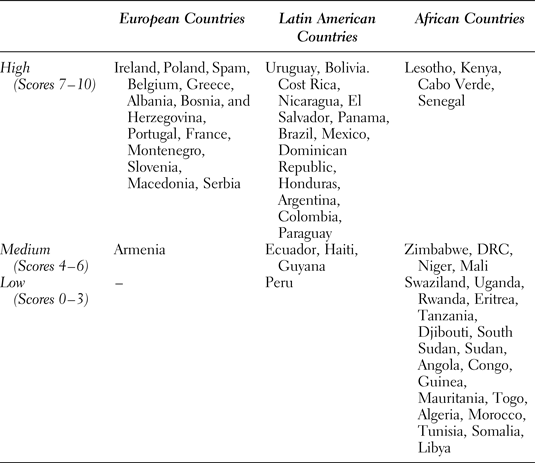
The lesser focus on comparing political context behind gender quota adoptions may be that most of the gender quota literature has focused on similar, more democratic contexts in European and Latin American countries. Table 1 illustrates the striking variation between the regions’ level of institutionalized democracy for the year the legislature adopted the gender quota in each country. In contrast to almost all the European and Latin American countries (84%), only a handful of the African countries (15%) were highly institutionalized democracies when they adopted quotas. The African region also has the greatest intraregional variation. While democracy level is only one aspect, this disparity demonstrates the need for a comparative study of African countries adopting gender quotas to understand how the contexts create different interests and incentives for these laws. The region presents an opportunity to investigate how variation in the political context might affect the impact of gender quotas.
Institutionalized democracy at gender quota adoption

Source: Author, drawing from Polity IV Project (2015)
Scholars generally accept that parties are the “gatekeepers” for the representation of women (Bjarnegård and Zetterberg Reference Bjarnegård and Zetterberg2016; Norris and Lovenduski Reference Norris and Lovenduski1995). Parties have enormous incentives and interests tied up in the adoption of gender quota laws since they maintain responsibility for selecting, financing, and supporting candidates for legislative seats regardless of whether the country has a first-past-the-post or proportional representation system. To understand the consequences of party incentives behind gender quota adoption, we need to trace the causal process through multiple steps, as shown in Figure 1. First, the country's political context shapes political party incentives and interests. Second, political party incentives influence the design of gender quota laws. How gender quotas are designed matters to parties and to the women elected, including the implementation type (reserved seats or candidate list quotas), magnitude (parity or percentage), and enforcement mechanism (alternation requirements, sanctions).
Theory of political interests driving gender quotas

I propose that we consider why the political context allowed for the adoption of the law to understand whether the measures have an effect on women's political empowerment. The politics behind the gender quota adoption have consequences for whether women can rise to leadership positions within the institution. Context shapes the interests of political parties, which acquiesce to gender quotas and design the laws to either empower women within the legislature or reinforce party control. Research on why countries adopt gender quotas can be divided into streams by the actors they emphasize (Krook Reference Krook2006, 307), yet each stream assumes that specific contextual features are present. I draw from this literature the most commonly referenced political conditions to test whether their manifestation during quota adoption matters for leadership equity.
H1:
A legacy of nongovernmental organizations (NGOs) focused on women's empowerment creates external pressure on parties to design and implement effective gender quotas.
The first group of studies suggests that mobilization of women's groups in society is necessary to apply pressure on male-dominated institutions to adopt quotas (Baldez Reference Baldez2006, 105; Bonder and Nari Reference Bonder, Nari and Brill1995, 188; Hughes, Krook, and Paxton Reference Hughes, Krook and Paxton2015; Krook Reference Krook2006; Tripp et al. Reference Tripp, Casimiro, Kwesiga and Mungwa2009). As a contextual feature, NGOs would provide external domestic pressures on political parties during the gender quota debate. Political parties are skilled at finding loopholes, but strong NGO involvement would raise awareness about problematic provisions with key stakeholders in the government. When measuring this condition, we do not want to confuse the proliferation of NGOs with their influence in political debate. Therefore, this condition will use a historic measure of the women's movement employed by Tripp and colleagues (2009) that also differentiates those NGOs engaging early in transnational learning through international forums.
H2:
Women's mainstream political activity creates internal pressure on parties to design and implement effective gender quotas.
Krook's (Reference Krook2009) work has been integral to understanding gender quotas because she identifies the coalitions between women's movement and elite that drive quota adoption. Literature on “state feminism” similarly argues that NGO advocacy is effective when it strategically collaborates with women inside the state (McBride and Mazur Reference McBride and Mazur2010; Stetson and Mazur Reference Stetson and Mazur1995; Threlfall Reference Threlfall, Krook and Childs2010). As a contextual feature of the development of gender quotas, women would have a “seat at the negotiating table”—directly involved in designing and debating the law—and be able to pressure parties to avoid problematic designs.
H3:
Political competition in the legislature influences party decision making on quota design.
Another set of studies highlight the political motivations of elite actors to adopt quotas “from above” in line with elite political goals, such as winning elections or reinforcing the legitimacy of the regime (Dahlerup and Freidenvall Reference Dahlerup and Freidenvall2005, 42; Driscoll and Krook Reference Driscoll and Krook2009, 242; Franceschet and Piscopo Reference Franceschet and Piscopo2008, 402; Fréchette, Maniquet, and Morelli Reference Fréchette, Maniquet and Morelli2008; Longman Reference Longman, Bauer and Britton2006, 140–41). Several prominent studies highlight party uncertainty that women are competitive candidates and how this effects party support for women candidates (Bashevkin Reference Bashevkin1993; Cheng and Tavits Reference Cheng and Tavits2011; Murray Reference Murray2004; Sanbonmatsu Reference Sanbonmatsu2006; Studlar and Matland Reference Studlar and Matland1996). Overall higher competition may create an incentive for parties to adopt quotas only if they can design laws that safeguard their control over legislators. On the other hand, lower levels of competition could incentivize quota measures as a means of preserving legitimacy in a low risk environment. To understand how laws might be shaped by political party motivations, we need to know how much competition exists within the legislature at gender quota adoption.
H4:
Without civic space to debate quota laws, parties will design problematic quota features that constrain leadership equity.
Much of the literature on gender quota assumes that there is a permissible environment in which to debate the development of the measures. A number of seminal studies on women's political participation in the African region have emphasized the effects of repressive and authoritarian regimes on the design and implementation of quotas (Josefsson Reference Josefsson2014; Longman Reference Longman, Bauer and Britton2006; Rosen Reference Rosen2013). There must be a political environment that allows internal and external pressures for change for there to be an influence of the other conditions. I expect the level of civic space to be a contributing condition allowing other aspects of the political context to have an effect. NGOs on the outside and women's mainstream political activity must be free to publicly debate the gender quota law for their influence to matter.
DATA, METHOD, AND MEASUREMENT
With more than half (28 of 54) of the countries adopting gender quota laws, the African region is uniquely placed for a cross-national study exploring the variation in leadership equity (Quota Project 2015). Given the continued diffusion of quotas across the continent, I define “gender quota countries” as those that implemented a law through an election prior to 2015, when I collected the legislative data for this study. Tunisia is the most recent gender quota considered, which implemented a quota in the 2014 parliamentary elections.
While I aim to retain a broad range of regime types, I must remove legislatures undergoing a level of political upheaval or conflict that has ceased their operations. I employ the Parliamentary Power Index to identify the countries lack any autonomy or capacity (Fish and Kroenig Reference Fish and Kroenig2009). Further, a few countries did not have a legislature (Burkina Faso, Central African Republic, and Burundi) when data were gathered in 2015. Finally, I am also compelled to exclude Zambia and Botswana as their legislative leaders chair all committees, precluding their comparison with the other cases. Despite substantial efforts, committee leadership could not be obtained for Lesotho. The remaining 34 countries—18 countries with gender quotas and 16 countries that have not adopted or implemented gender quotas—present a diverse and compelling set of countries for a cross-national African sample. An initial inclusion of nonquota countries (including those with voluntary measures) allows me to test whether laws are necessary for leadership equity—a question that must be addressed before I can investigate the political conditions at the time of gender quota adoption that lead to this outcome.
Dependent Variable
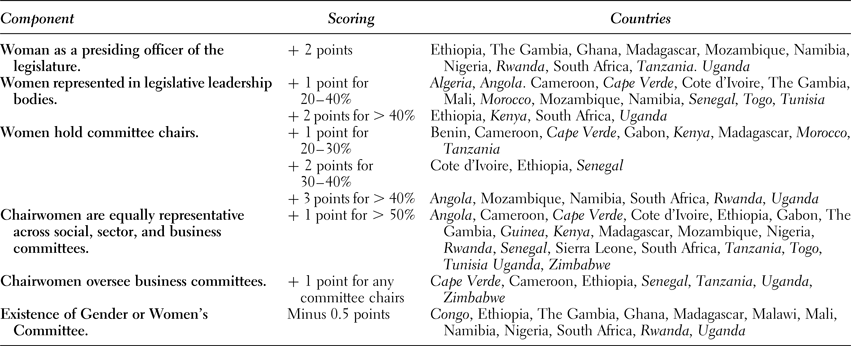
Leadership equity is the extent to which women in the legislature have equity in the political decision-making structure through the leadership positions they hold. High leadership equity would mean that leadership positions are equitably distributed between genders, allowing for equal input into legislative priorities and decisions. In a legislature with low leadership equity, leadership positions and control over the policy agenda are concentrated in one gender. I operationalize leadership equity using six components measured as a snapshot in 2015 for each country to allow for comparative analysis (see Table 2).
Measuring leadership equity

Gender Quota Countries are italicized.
Source: Author, drawing on information collected from legislative websites.
The first component looks at whether a woman has served as the presiding officer of the legislature. While this should not be the only measure of authority, the inherent powers of the presiding officer make this component important for evaluating leadership equity. To improve the precision of this component, I consider whether each legislature has had a woman presiding officer since 1994, when South Africa had the continent's first woman presiding officer. Beyond the presiding officer, the policy process requires a number of political positions with formal powers and responsibilities that represent parties at high levels and employ tools to achieve success for their party, including controlling the agenda, disciplining members, and controlling resources (Hazan and Longley Reference Hazan and Longley2000, 6–9). Therefore, the second component measures the extent to which women serve in the executive bureau as secretaries-general, parliamentary group leaders, majority leader, opposition leaders, deputy speakers, and parliamentary secretaries.
Committees play an important role in setting the agenda and guiding policy and resource priorities; therefore, the third component measures whether women have served as committee chairs. In the African context, committees tend to take a more reactive stance to policy making rather than a proactive one because the legislature has evolved alongside the changing nature of the state. Committees instead concentrate on oversight responsibilities, modifying executive bills, and raising awareness on issues to force the government to propose new laws (Salih Reference Salih2005, 14).
Two components of leadership equity measure whether the female committee chairs are equally represented among portfolios covering sector and business committees—and not concentrated in social committees. Research has found strong evidence that women tend to be isolated on women's issues and social issues committees (Heath, Schwindt-Bayer, and Taylor-Robinson Reference Heath, Schwindt-Bayer and Taylor-Robinson2005, 420). Consistent with the public policy literature, committees are categorized as social (culture, youth, tourism, health, and sports), sector (economic, defense, and foreign affairs), and business (budget, appointments, rules, and steering) committees (Barkan Reference Barkan and Barkan2009, 25, 27). Finally, for the last component, I consider whether the institutional features of the parliament marginalize women's policy preference by virtue of creating a committee designated for gender or women's issues. Studies show that “where a women/gender committee has been created, women are significantly less likely to serve on powerful committees” (Heath, Schwindt-Bayer, and Taylor-Robinson Reference Heath, Schwindt-Bayer and Taylor-Robinson2005, 430).
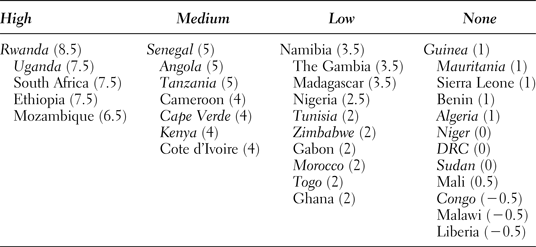
As presented in Table 3, the six components combine into an index of leadership equity across Africa that illustrates the variation across legislatures in promoting women as leaders. Not surprisingly, the distribution of leadership equity tilts toward the lower end of the spectrum, with no perfectly equitable countries. The index demonstrates that gender quota laws are neither necessary nor sufficient for leadership equity—an important finding given the expectation that gender quotas should promote women's political empowerment. In the highest leadership equity category, we have equal numbers of quota countries (Rwanda and Uganda) and those without laws (South Africa, Ethiopia, and Mozambique). Similarly, at the bottom of the spectrum, exactly half of the countries have gender quotas. The three nonquota countries in the high category also have voluntary party measures. This is no surprise as an effective party measures should be a clear indication of strong political will and pressure to genuinely empower women leaders at all levels. It is important to note that not all voluntary measures are effective. In fact, 13 of these countries have voluntary party measures, with some held by minority parties without electoral strength or others that choose to overrule their measure out of electoral necessity.
Legislative leadership equity across Africa

Component Scores are in Parentheses – Maximum Score is 9; Gender Quota Countries are italicized.
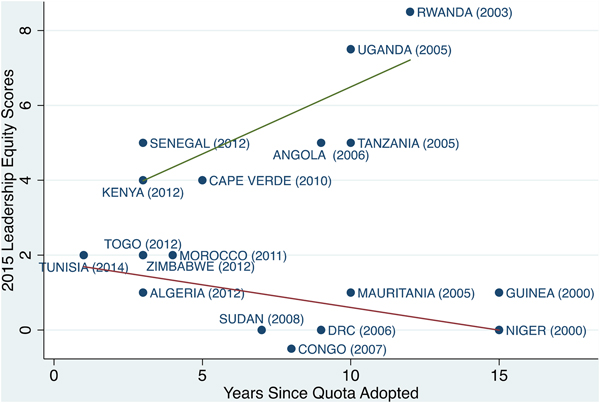
Referring back to theories of leadership selection, one explanation could be that gender quota laws for the 18 countries were implemented at different times over the last 15 years; therefore, the variation could be correlated with the institutionalization of these measures. Quotas that have been in place for a longer duration would have built seniority among the women in the legislature, allowing them to be promoted to leadership positions and thus achieving higher leadership equity scores. However, we see in Figure 2 two distinct and divergent trends: one in which the duration of the quota leads to more leadership equity and the another in which leadership equity appears to stagnate over the years. We can also see that there are clear trends emerging in even the most recent quotas (Senegal, Cape Verde, Algeria, Togo, and Tunisia). The snapshot of leadership equity allows us to visualize two conflicting trends in the gender quota data that suggest the need for deeper analysis of the context behind adoption and how it influences whether women are promoted to leadership.
Leadership equity & institutionalization of quotas

A few other explanations could be relevant for our high leadership equity cases, including the emergence from large-scale conflict (Hughes and Tripp Reference Hughes and Tripp2015; Tripp Reference Tripp2015) and influences of revolutionary or socialist legacy on women's rights (Htun and Weldon Reference Htun and Weldon2010). These factors certainly contribute to the domestic context; for instance, conflict and ideological legacies also influence a state's approach to civic space for debate and the value of political competition for a nation's prosperity. Given the variation across the cases, these factors do not explain the leadership equity index but offer context for which countries are receptive to quotas as affirmative measures.
Qualitative Comparative Analysis
To test the influence of domestic context on leadership equity, we need a midrange method that can both qualitatively identify how country-specific contexts might influence outcomes and comparatively analyze gender quota trends across these contexts. This study employs qualitative comparative analysis (QCA) tools to test whether domestic conditions influence subsequent leadership equity after the adoption of gender quotas in 18 African countries. QCA methods study a group of cases joined by a unique similarity, such as the adoption of gender quota laws. Quantitative approaches assume that causal variables have independent capacity to influence a dependent variable, while qualitative methods identify multiple variables that influence a particular outcome (Coppedge Reference Coppedge1999; Gerring Reference Gerring, Boix and Stokes2007, 103). QCA offers a middle ground by allowing for multiple paths to an outcome and clear trends across the cases that can be modeled to enhance our understanding of the relationship between the conditions (Ragin Reference Ragin2008a).
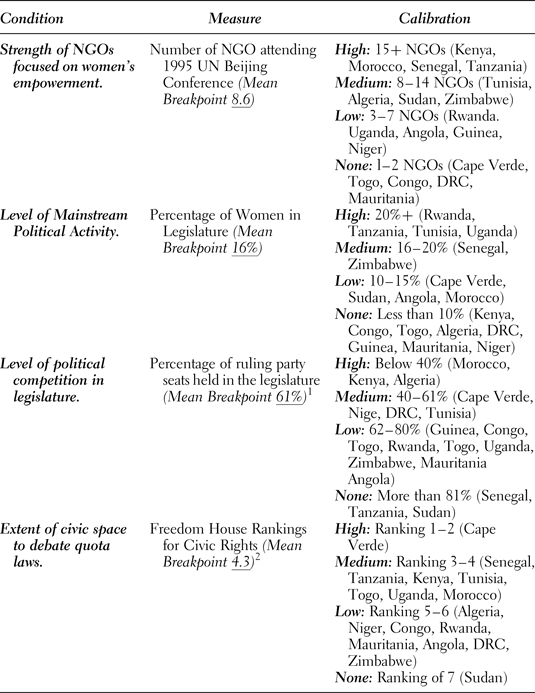
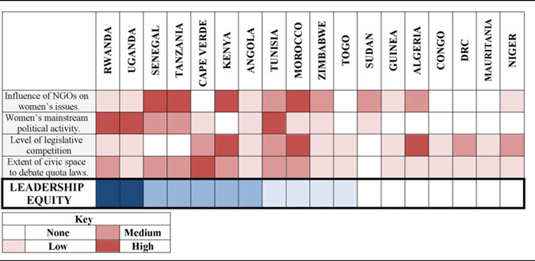
Experts on QCA design and development urge researchers to approach conditions by carefully developing theory and defining appropriate measures for each condition (Ragin Reference Ragin1994, Ragin Reference Ragin, Collier, Brady and Box-Steffensmeier2008b). I explore four theoretically derived conditions—NGO legacy, extent of women's mainstream political activity, level of political competition in the legislature, and degree of civic space—for their effects, both individually and as combinations, on leadership equity outcomes (see Table 4). When deciding how to calibrate the conditions, the QCA “crisp set” method forces the researcher to decide whether a case completely fits into a category (0 or 1). I employ the “fuzzy set” method, which offers more nuanced categories (0, 0.33, 0.66, 1) to increase confidence that the calibration for each condition represents variation across the cases (Ragin 2008). For example, when deciding categories of leadership equity, I can distinguish between Rwanda (1) and Tanzania (0.66) to give a more accurate reading of the conditions across the cases. I calibrate each condition in a way that emphasizes the relative scores with the mean representing the split between the high/medium and low/none categories. Table 5 illustrates the full coding by leadership equity.
QCA calibration of conditions

1Consistent with dominant party literature (Bogaards Reference Bogaards2004; Van de Walle and Butler Reference Van de Walle and Butler1999).
2Consistent with Freedom House Scale.
QCA conditions for African gender quota countries

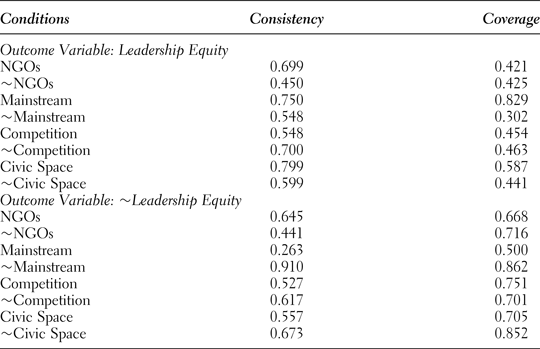
I employ fsQCA software to complete several tests on whether the presence or absence of the condition or combination of conditions influence either high or low leadership equity cases (Ragin, Drass, and Davey Reference Ragin, Drass and Davey2006). For each test, coverage scores indicate the percentage of cases that the condition was present when reaching the desired outcome. Consistency scores indicate the percentage of cases that fit the pattern across the entire set—not just the outcome being investigated.
First, a test of necessary conditions determines whether there are any “must have” conditions that consistently explain the outcome across all the cases. As demonstrated in Table 6, there are no conditions that explain high leadership equity with more than 90% consistency and coverage. However, an absence of women's mainstream political activity is very close to being a necessary condition for low leadership equity (0.91 consistency and 0.86 coverage). This suggests that women must not be represented in the legislature during quota adoption for the low leadership equity outcome to emerge. What is intriguing about the necessary condition finding is that women's absence from the table is more powerful than their presence.
Analysis of necessary conditions
(~Absence of condition/outcome)

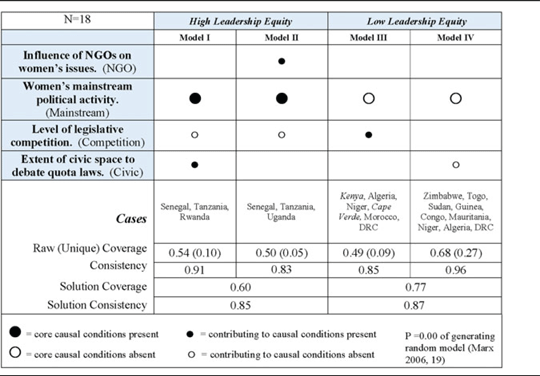
Second, a test of sufficient conditions allows us to say with relative confidence that certain aspects or configurations of the political context contribute to leadership equity outcomes. Conditions are included in fsQCA Truth Tables to look for “recipes” that are sufficient to get the outcomes (Legewie Reference Legewie2013). As shown in Table 7, core causal conditions (indicated by the larger circles) are most powerful for explanatory purposes, while other conditions contribute to the outcome (smaller circles). The truth table test indicates that both the presence and absence of women's mainstream political activity is most consistent and powerful condition across the cases. Model IV has the highest coverage, which means it explains the most cases; it also has the highest consistency, which means its conditions hold true across the cases.
Quota conditions for leadership equity in Africa

Four cases italicized in the table appear to emerge as counterfactuals—Tunisia, Angola, Kenya, and Cape Verde—because their contextual conditions do not align with their leadership
equity scores. Interestingly, these recent adopters fall on the borderline (between middle and low) of the spectrum, suggesting a middle recipe distinct to the second wave of quota countries (Bauer Reference Bauer2014) that might not fit into either high or low equity.
THE POLITICS BEHIND QUOTAS
In the previous section, I employed QCA methodology to compare four political conditions present or absent at gender quota adoption for their ability to explain the new leadership equity index. Analyzing the results, I find three recipes that pinpoint the different interests of political parties during quota adoption. I will review each recipe, incorporating qualitative information from the cases to explain how party interests influence quota design and its effects on the ability of women legislators to be empowered in the institution.
The first recipe that emerges from these results produces the highest leadership equity when a country adopts a quota under high women's mainstream political activity and low political competition. We also see a strong NGO legacy contributing to this outcome, which infers an interaction between women inside the legislature and external support networks. This recipe explains four cases—Tanzania, Uganda, Rwanda, and Senegal—with dominant or authoritarian party regimes. In this environment, electoral stakes are lower than the pressure to demonstrate a commitment to women's empowerment. This suggests that the party's primary motivation for the gender quota is to preserve its legitimacy. With high numbers of women at the negotiating table, we see some of the strongest quota laws, including full parity in Senegal and 30% guaranteed reserved seats in Tanzania, Uganda, and Rwanda (Quota Project 2015). However, parties still maintain control over the power structures by inserting design features that favor the ruling party. For example, in the first adoption of special seats in Tanzania, the dominant party was the primary proponent of party-nominated reserved seats because it boosted their numbers with legislators that were forced to support their agenda or risk losing their seat (Bjarnegård and Zetterberg Reference Bjarnegård and Zetterberg2016, 475).
The design of quotas in this environment creates a confluence of loyalist and mandate effects emanating from the gender quota designs. Loyalist effects emerge from designs that force women legislators to be overly reliant on the party (Goetz Reference Goetz, Marie Goetz and Hassim2003, 118; Matland Reference Matland and Dahlerup2006, 122). Loyalist effects have implications for whether legislators perceive women elected through these laws as able to credibly represent the legislature in leadership positions—and not merely party loyalists. For example, in Tanzania, the loyalist effect came from a quota provision that distributed the “special seats” by the number of party seats attained, endowing the dominant Chama Cha Mapinduzi party with a majority of special seats. This tainted women's subsequent selection as committee chairs, which were decided by vote of both ruling and opposition committee members (Yoon Reference Yoon2008).
In the highest leadership equity recipe, these effects are balanced by mandate effects, where partnerships across party lines and with NGOs empower women to vie for leadership positions (Kerevel and Atkeson Reference Kerevel and Atkeson2013, 98). In this instance, power dynamics are tilted toward the new, larger numbers of women, and leaders are encouraged to support increased leadership equity or potentially face backlash from the women's movement behind the quota adoption. In Uganda and Rwanda, large numbers of women at the negotiating table—high mainstream political activity—pushed for laws that allowed women to compete for the reserved seats, forcing the party to dedicate resources to their candidacies and providing them with campaign skills and legislative experience. In Uganda, the shift to directly elected seats also decreased the percentage of women expressing an interest in the “women's interests” agenda in the parliament (Josefsson Reference Josefsson2014, 101). The quota in this case not only significantly increased the network of women legislators but also gave the women a mandate to engage on broader parliamentary issues and contest leadership positions.
The second recipe evident from the analysis produces cases with middle leadership equity, explaining five cases—Cape Verde, Algeria, Morocco, Kenya, and Tunisia. The two defining features of this recipe are low levels of women's mainstream political activity and high political competition—contrasting with the previous recipe for high leadership equity. What most distinguishes these cases is that the gender quota was a feature of a competitive environment, which suggests party incentives for acquiescing to the gender quota to shore up support. With few women at the negotiating table during the development of the gender quota law, parties are able to direct measures that undercut the independence of women elected with clear consequences for their ability to be promoted to leadership positions. The majority of these cases are candidate quotas that put compliance in the hands of parties, but only two of the countries have enforcement measures to ensure the law is implemented. Tunisia and Cape Verde have “parity” quotas that call for equal representation, but these are not fully enforced in competitive environments in which parties can justify their partial application of the law before the electorate. In the case of Morocco, parties could not risk ceding political ground in the highly competitive environment despite mounting pressure from women interested in participating in politics (IFES 1993, 4). Parties banded together to create a quota that would give national list seats to women, effectively eliminating the need for parties to support women running for constituencies (Sater Reference Sater, Franceschet, Krook and Piscopo2012, 75).
In this political context, quotas are often designed to create strong label effects, whereby women elected are perceived by their colleagues as less capable of assuming leadership positions important for reelection chances in these competitive environments (Franceschet and Piscopo Reference Franceschet and Piscopo2008). Label effects are most pronounced when parties seek to limit the effect of the quota on the power structure by designing measures that marginalize women in the legislature. For example, in Morocco, the gender quota law undercuts the independence and influence of women by instituting a one-term limit for women on its national list (Darhour and Dahlerup Reference Darhour and Dahlerup2013), which effectively labels women legislators nominated for these seats as temporary members. Therefore, these labels influence whether the women are perceived as qualified for leadership positions that have a focus on larger national priorities and can lead to women being isolated to social committees that are viewed as more suitable for “women-only representatives.”
The final recipe produces cases with the lowest leadership equity when we find low levels of women's mainstream political activity and low civic space to debate the laws during adoption. This recipe explains the most cases—Niger, Zimbabwe, Togo, Sudan, Guinea, Congo, Mauritania, Angola, and the Democratic Republic of the Congo (DRC). Civic space curbs other aspects of the political context, including the influence of NGO sector. Without civic space to advance policy outcomes in the legislature, political parties have an incentive to adopt measures that consolidate their control without risks to changing the power structure. Since low civic space curtails accountability of these measures, there is every incentive for parties to create minimalist measures that the ruling party can apply to disqualify the opposition or ignore when the electoral race necessitates. Among these designs, we find the lowest thresholds—including 10% in Niger and 15% in Congo—that have little effect on the gender distribution of the legislature. Even with high thresholds for the quota, Mauritania, Guinea, and DRC lack enforcement measures. In Niger, we observe how the ruling party saw an opening to consolidate their control over the political process by creating a quota requirement that would put opposition parties at risk of forfeiting electoral gains. Opposition parties must reach the quota benchmark through constituency seats or risk the results being annulled for their party (Kang Reference Kang2013, 97).
When consolidating control, gender quotas are designed with features that create strong newness effects, as low compliance never allows the women to outgrow the expectation that they are not ready for leadership positions (Beckwith Reference Beckwith2007). Presumed newness is often at odds with the actual experience of women elected, but women retain a miniscule share of the legislative seats and male biased institutional norms remain dominant over these new members. For example, in Niger, a weak gender quota adopted in 2000 still has a strong newness effect whereby women legislators are persistently “deputies” to their male counterparts, even first-term male chairs in two committees. We also see indications of how the newness effect marginalizes women to stereotypical committees. For example, DRC has one of the parity gender quotas but the percentage of women has not even reached 10%, secluding the few women who are elected to chair the Committee on Social and Cultural Affairs.
CONCLUSION
For academics studying gender quotas, the rapid diffusion of these measures has been extraordinary. The gender quota movement represents one of the fastest-growing social and legal trends spreading to different regions of the world and different political contexts, including more countries in Asia and the Middle East such as Iraq (adopted in 2010), Georgia (2011), Mongolia (2011), Indonesia (2012), Jordan (2012), and Saudi Arabia (2011). The breadth of regimes, political space, and freedoms underscore a pivotal point related to this research: we cannot assume that gender quotas will result in a positive effect on women's empowerment. This study reinforced a growing awareness that gender quotas are not a one-size-fits-all fix for women's political empowerment. Different contexts are conducive to design different laws, which produce different effects on leadership equity.
First, political parties design gender quotas to reinforce their interests. The design of gender quotas matters, and parties have substantial influence over how these measures are crafted. This study reinforced literature arguing that the political goals of winning elections and maintaining power are key motivations for gender quota adoption (see Dahlerup and Freidenvall Reference Dahlerup and Freidenvall2005; Driscoll and Krook Reference Driscoll and Krook2009; Franceschet and Piscopo Reference Franceschet and Piscopo2008; Fréchette, Maniquet, and Morelli Reference Fréchette, Maniquet and Morelli2008; Longman Reference Longman, Bauer and Britton2006). I extended this theory by demonstrating that these political goals are also responsible for the specific design of the quota, which has consequential effects on women entering the legislature. Hence, the level of political competition within the legislature is vital to understanding the political interests behind gender quota adoption and leadership equity outcomes. This analysis suggests that increasing competition can be detrimental to women's leadership equity. In fact, dominant parties (as in Rwanda, Tanzania, Uganda, and Senegal) are more likely to increase the number of women when it is politically safe to do so and it serves to increase their legitimacy. If we consider the level of political competition in nonquota countries, we see that the seven countries with the highest levels of political competition also have the lowest levels of leadership equity (Benin, Ghana, Liberia, Malawi, Liberia, Mali, Sierra Leone, and Madagascar)—all Anglophone countries with plurality majority systems that do not favor women's representation (Bauer Reference Bauer2012, 1). Parties serve as more than just gatekeepers for candidacies, as they can stack the political deck for or against women's empowerment if their interests incentivize.
Second, parties require pressure to acquiesce to these measures, but there needs to be a concerted internal (women in mainstream politics) and external (NGOs) partnership to develop laws that empower the interests of the women elected through this mechanism. This study provides importance nuance to prominent literature on the role of NGO mobilization for quota adoption (see Baldez Reference Baldez2006; Bonder and Nari Reference Bonder, Nari and Brill1995; Hughes, Krook, and Paxton Reference Hughes, Krook and Paxton2015; Krook Reference Krook2006; Tripp et al. Reference Tripp, Casimiro, Kwesiga and Mungwa2009) by clarifying that NGO influence over the design of the quota relies on women already inside the legislature. When women's voices are part of internal negotiations over the quota, they can push for measures that disrupt the status quo power dynamics. Therefore, women's mainstream political activity during quota adoption is a key ingredient for future leadership equity. This finding is consistent with “state feminism” literature (see McBride and Mazur Reference McBride and Mazur2010; Stetson and Mazur Reference Stetson and Mazur1995; Threlfall Reference Threlfall, Krook and Childs2010) that NGO advocacy is effective when it strategically collaborates with women inside the state—or, in this case, inside the legislature.
Third, the new leadership equity index indicates that counting the number of women in the legislature is not sufficient to understand the extent to which they are empowered inside the institution. The percentage of women in the legislature is by far the most common cross-national measure of women's empowerment. The leadership equity index demonstrates the limits to only measuring women's share of the parliament, particularly in cases in which a gender quota mechanically boosted women's share of seats. The ease of comparing the percentages of women in legislature has perhaps diminished demand for more advanced measures of women's political empowerment and signaled to governments considering gender quotas that sheer numbers are the goal. This encourages “fast-track” fixes that can be justified as improving women's empowerment regardless of their long-term implications for influence and authority in these institutions.
Finally, a number of countries have demonstrated that gender quota laws are not necessary to improve women's participation in the political process. The women's movement sin South Africa, Namibia, Mozambique, and Cameroon pushed political parties to adopt voluntary measures to promote women's empowerment that negated the need to adopt legal measures. Creating a superficial fix can undercut the movement's demands for genuine empowerment of women in the political system. Policy makers and advocates alike should consider carefully the political context of a country, including the NGO legacy, civic space, political competition, and women's mainstream political activity, before determining the most effective means of advancing women's political empowerment. Each of these conditions suggests the ways in which party motivations can be aligned with the movement—with quotas or not.