





Impact statement
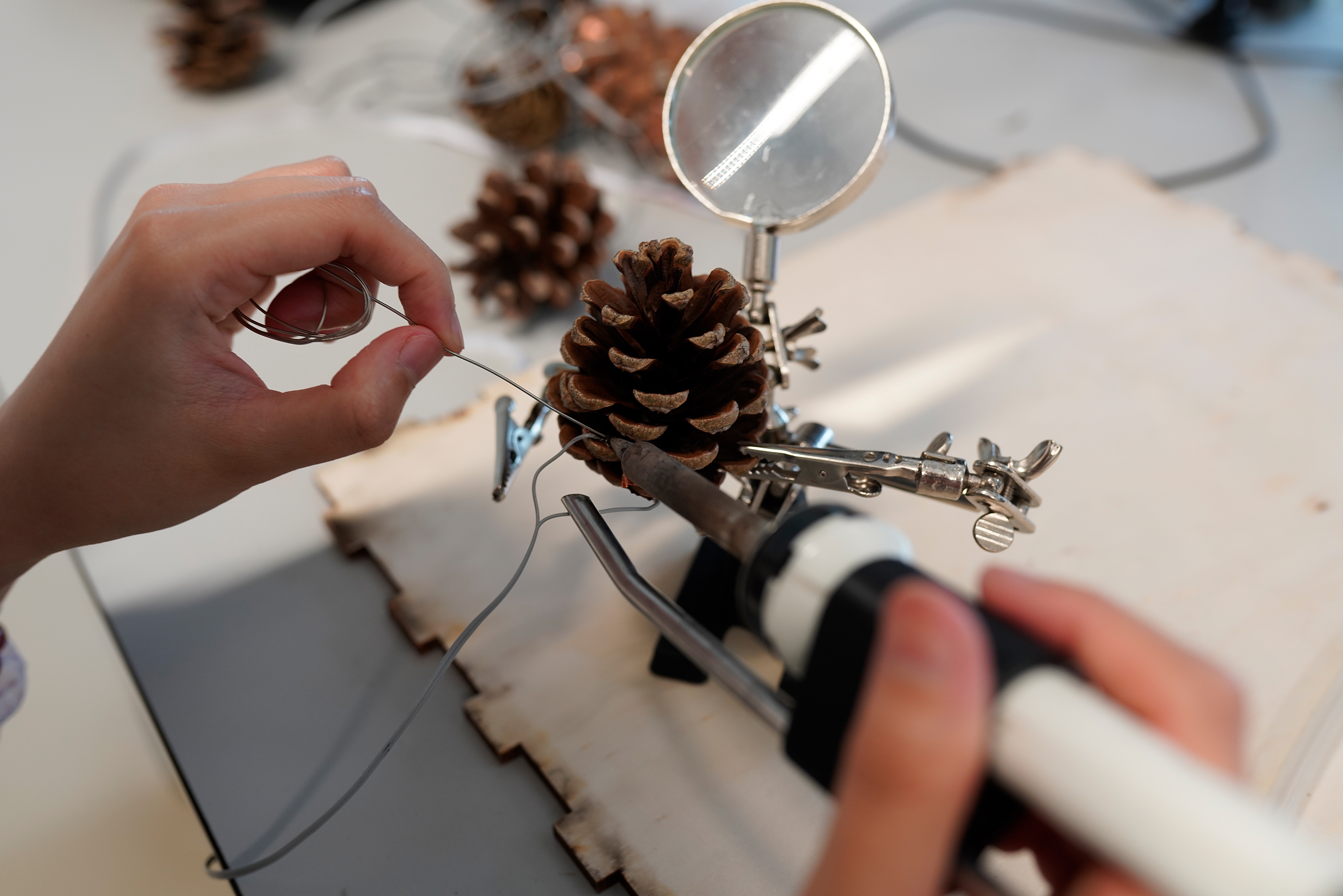
The main contribution of this paper is to evidence the actuation capabilities of pinecones in a biohybrid human–computer interaction (HCI) context. The paper introduces the concept of augmented hygromorphic natural sensors (AHNSs) as a time-based medium and aligns with research on slow interactions, sustainable electronics and low tech. The paper also introduces the Hygromorphically Driven Interaction Design Framework as a general framework for nature-based, as well as synthetic hygromorphic robotic structures. To support our research, we tested the use of pinecones as AHNS (Figure 1), and we developed a series of scenarios of use, enabling the understanding of pinecones’ actuation usability in out-of-the-lab conditions and with a minimal set-up. By doing so, we address both the HCI and the biohybrid systems research communities.
Soldering wires to copper tape attached to a Scots Pine pinecone scale. Photo credits: Matthew Lee-Smith.

Introduction
The growing recognition of the Anthropocene epoch (Crutzen Reference Crutzen2002; Latour Reference Latour1996; Parikka Reference Parikka2014) has created the premises for a deeper awareness of humanity’s impact on the Earth’s environment, as well as of the privileged place of humans in design activities. Ecological concerns (Tilder and Blostein Reference Tilder and Blostein2010) and more-than-human perspectives (Yoo et al. Reference Yoo, Bekker, Dalsgaard, Eriksson, Fougt, Frauenberger, Friedman, Giaccardi, Hansen, Light, Nilsson, Wakkary and Wiberg2023) have fuelled the research on alternative ways to conceptualise “participation” in the shaping of technologies and systems (Forlano Reference Forlano2016, Reference Forlano2017). In the field of HCI, these inquiries have translated into approaches that consider human – nonhuman interaction, such as human–plant (Chang et al. Reference Chang, Shen, Maheshwari, Danielescu and Yao2022; Fastnacht et al. Reference Fastnacht, Aispuro, Marschall, Fischer, Zierold and Hornecker2016; Kuribayashi et al. Reference Kuribayashi, Sakamoto and Tanaka2007; Wen and Wu Reference Wen and Wu2022) human–animal, and even nonhuman–computer interaction, such as animal–computer (Schmickl and Romano Reference Schmickl and Romano2024) and plant–computer (Aspling et al. Reference Aspling, Wang and Juhlin2016). Through post-humanist and post-anthropocentric frameworks, we are retrieving sustainability and decolonisation recites (Lowenhaupt-Tsing Reference Lowenhaupt-Tsing2021; Van Dooren et al. Reference Van Dooren, Kirksey and Münster2016), as well as attempts to develop tools that facilitate the understanding and the collaborations between different actors (Latour Reference Latour1996). The development of robotics in agriculture and environmental studies has created the premises for plant-inspired robots or biohybrid robots (Garmroudi et al. Reference Garmroudi, Tushar, Liu and Li2025).
The natural abilities of flora to sense and respond to changes in their environment have been recognised as an exciting opportunity for the development of new sensing systems, unlocking novel ways of interaction, supporting various applications such as improved agricultural techniques and nurturing healthier human–nature relationships (Seymour Reference Seymour2016), or as exploratory assemblages in art, design and architecture projects. Biomimetic, bioinspired and bio-triggered interactions are three of the main directions of research in connection to the natural structures and systems. The “Cyborg Botany” project from the MIT Media Lab (Sareen et al. Reference Sareen, Zheng and Maes2019) aimed to leverage the electrochemical signals and response mechanisms of plants for interactive functions and proposed a convergent view of interaction design that merges electronic functionalities with the biological functions of plants. Art projects such as “Akousmaflore” by Gregory Lasserre and Anais met den Ancxt (2007), “Eau-de-Jardin” by Christa Sommerer and Laurent Mignonneau (Reference Sommerer and Mignonneau2004) or “Auto Photosynthetic Plants” by Gilberto Esparza (Esparza Reference Esparza2013), have explored the technological mediated artistic expressions of plants (Loh et al. Reference Loh, Foth and Santo2024). There is also a growing enthusiasm for the use of natural materials in sensing applications in construction. Achim Menges and Steffen Reichert’s project “Hygroscope – Meteor sensitive Morphology” (Menges and Reichert Reference Menges and Reichert2012), for example, explores a novel mode of responsive architecture based on the combination of inherent behaviours of the wood material and computational morphogenesis. Also illustrative in this sense is Morphing Matter Lab’s research at the University of California which focuses on developing computational frameworks for active morphic materials/or shape-changing materials (Yao and Ishii Reference Yao and Ishii2019). These directions reflect the increasing interest in harnessing the sensing capabilities of plants and their derivative products for a wide range of applications and forms of expression.
In this paper, we present a series of experiments that aim to explore the potential of pinecones as “AHNS.” We also introduce the “hygromorphically driven interaction framework” to define a system that treats natural hygromorphic materials as co-performers of interaction (in this case, the pinecones’ actuation structures). The term designates complex, multiscale, direct and indirect relationships within an ecosystem driven by the natural rhythms of organic materials in connection to the humidity of their environment, rather than focusing on immediate human needs. The framework compels humans to adapt to the biological timescales advanced by the shape-changing states of the organic materials in connection to the humidity of the environment. Pinecones have become an increasingly popular subject of study in recent years, notably in attempts to decode their mechanisms of actuation (Eger et al. Reference Eger, Horstmann, Poppinga, Sachse, Thierer, Nestle, Bruchmann, Speck, Bischoff and Rühe2022; Horstmann et al. Reference Horstmann, Speck and Poppinga2024). From this point of view, they can even be considered “plant-grown robots” (Calvo Garzón and Keijzer, Reference Calvo Garzón and Keijzer2011). Often cited as examples of hydromorphic actuation (Reyssat and Mahadevan Reference Reyssat and Mahadevan2009) – a type of passive, materials-based actuation that allows changes in shapes in response to environmental humidity and temperature fluctuations (Yao et al. Reference Yao, Ou, Cheng, Steiner, Wang, Wang and Ishii2015); the pinecones exhibit perceptible, subtle changes when exposed to moisture. Our experiments aimed to investigate their hygromorphic capacities to prospect the development of inexpensive, easy-to-use AHNS.
This paper outlines the characteristics of pinecones and surveys the landscape of shape-changing organic materials as sensors, notably in the context of human–plant interaction. It then advances an experimental approach for a crafted biodigital, pinecone-controlled slow-interaction system designed to encourage reflective interaction (Hallnäs and Redström Reference Hallnäs and Redström2001). The paper also delineates prospects for their integration into HCI design, thus paving the way for emergent biodigital augmented sensor technologies with multifaceted practical implications. The questions the paper addresses are:
-
RQ1. Can a pinecone act as a hygromorphic natural sensor (HNS) in a digital context?
-
RQ2. Which uses can be assigned to a pinecone as an AHNS?
-
RQ3. What kind of interactive expressions can the use of an augmented pinecone take into an HCI context?
Definitions
Augmented hygromorphic natural sensor
In its natural state, the fallen pinecone operates as a passive HNS. Simply put, a hygromorph is a natural structure that changes shape in response to environmental moisture (Reyssat and Mahadevan Reference Reyssat and Mahadevan2009). An HNS operates through a physical mechanism (Burgert and Fratzl Reference Burgert and Fratzl2009). The pinecone inherently reacts to ambient humidity and outputs a mechanical movement, which is the natural opening and closing of its scales. However, in its raw form, this output remains entirely physical and disconnected from digital ecosystems.
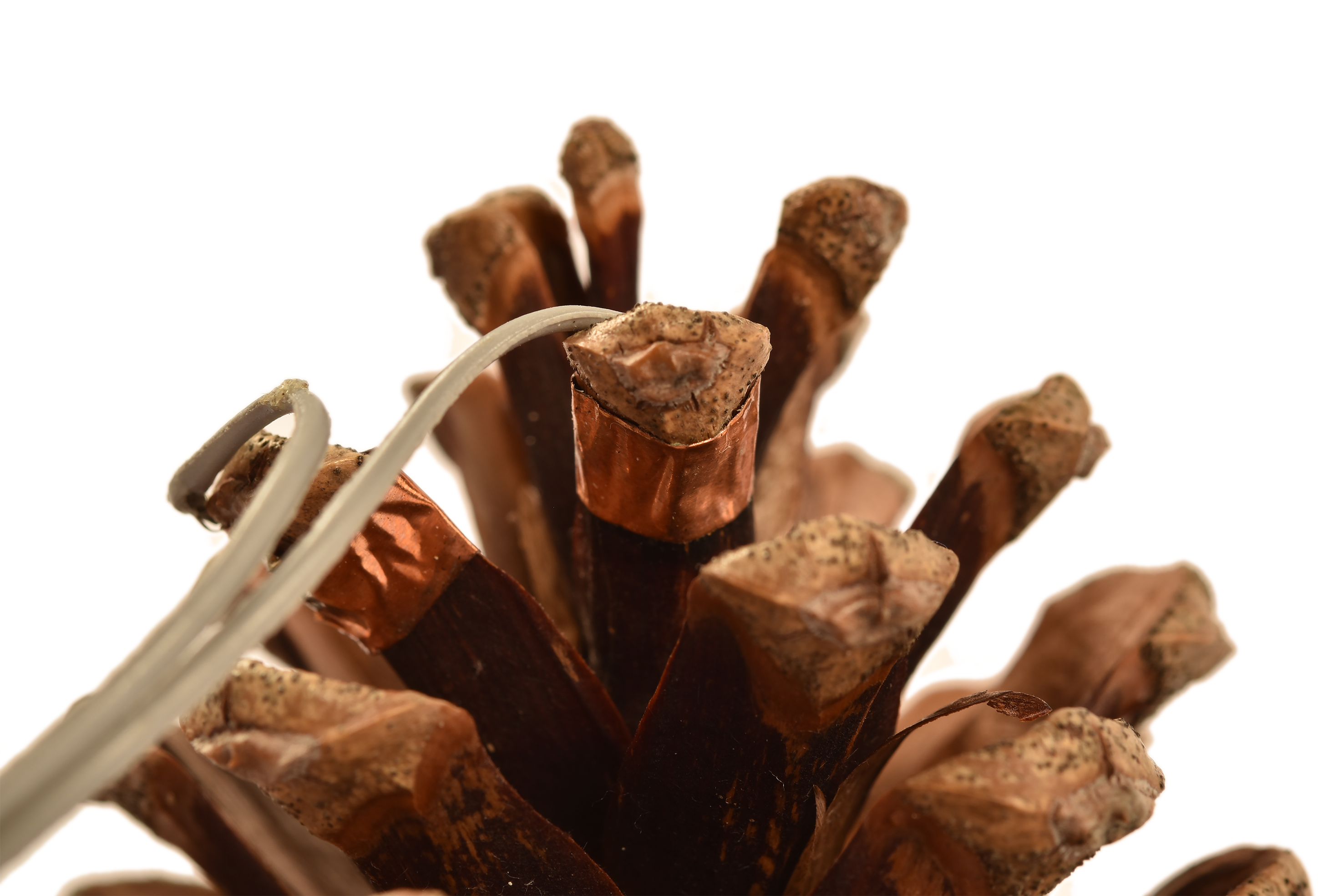
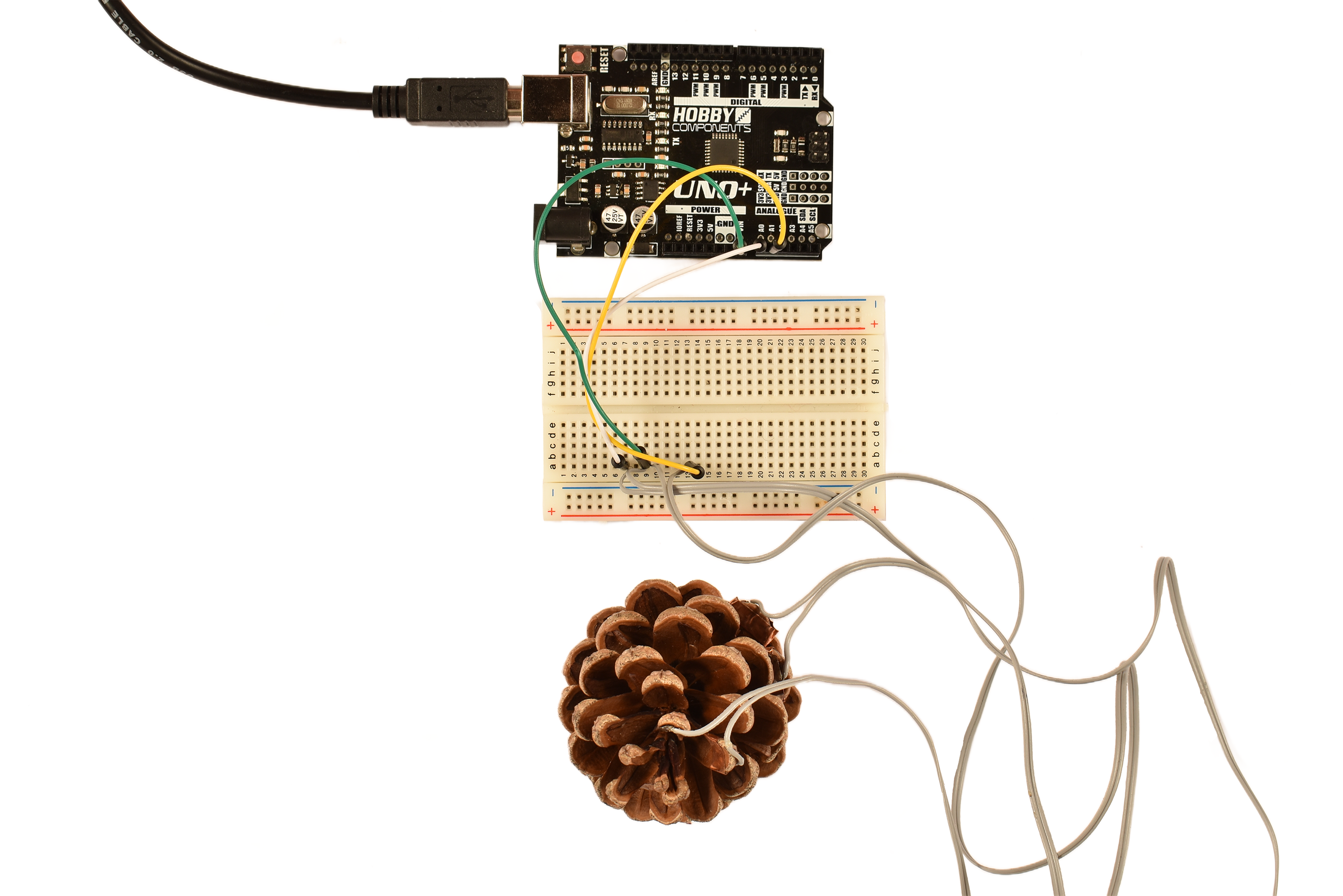
To bridge this gap, this paper introduces the design of an augmented HNS, or AHNS. We define an AHNS as a biohybrid interface (BHI) that uses minimal technological intervention to translate the pinecone’s natural shape-changing behaviour into a legible digital signal. As shown in Figure 2, we are affixing simple conductive copper pads and wiring to the inner surfaces of adjacent scales to augment the pinecone’s natural affordances (Yao et al. Reference Yao, Ou, Cheng, Steiner, Wang, Wang and Ishii2015). As the pinecone reacts to damp or wet conditions, its scales physically close; this natural movement forces the conductive elements into contact, effectively transforming the biological artefact into an environmentally driven electrical switch. The complete setup is shown in Figure 3.
A close-up of a scots pine pinecone with attached copper tape and wire, converting into a sensor. Photo credit: Matthew Lee-Smith.

Initial circuit setup to enable an Arduino to read the state of the pinecone sensor. Photo credits: Matthew Lee-Smith.

Hygromorphically driven interaction
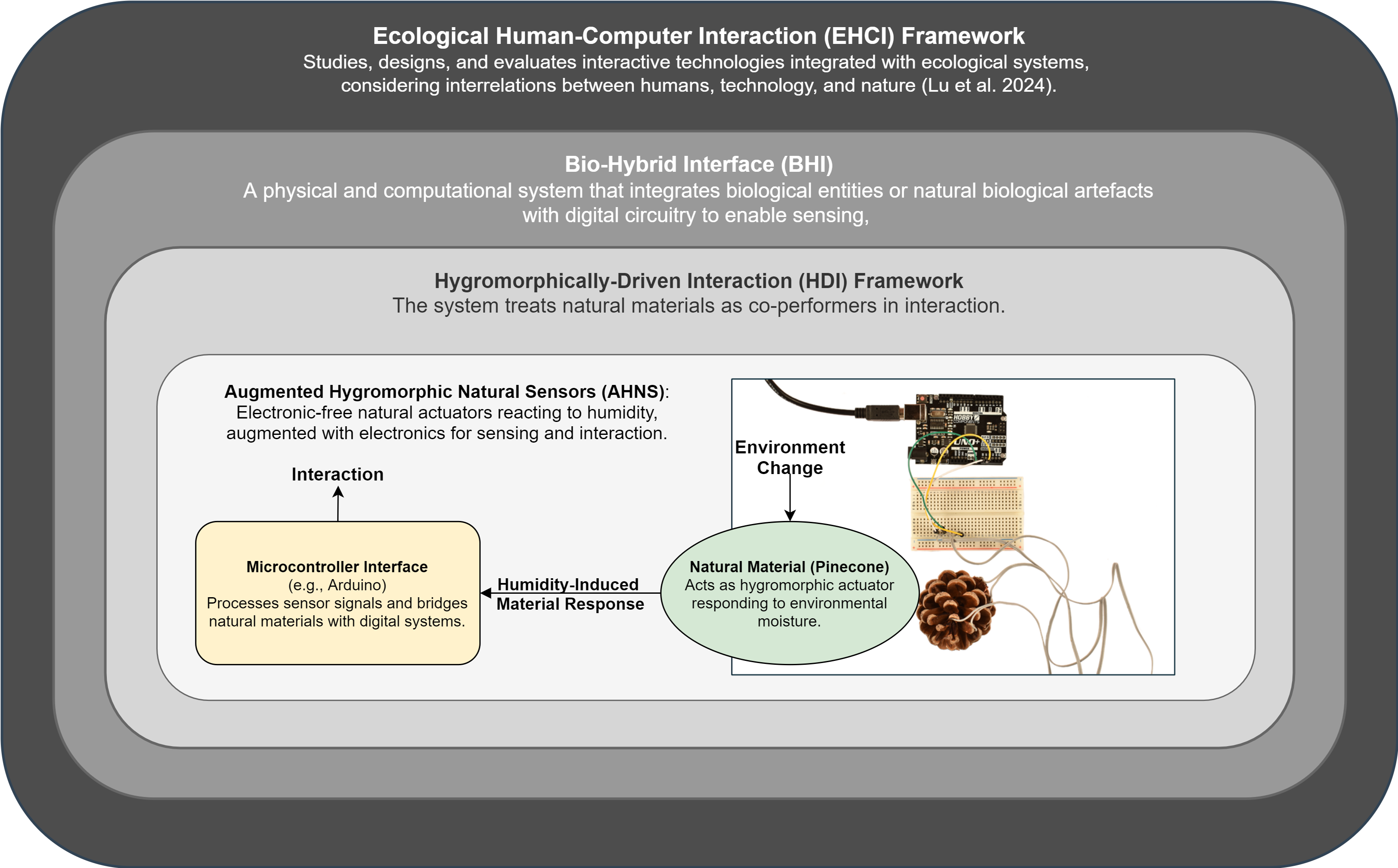
This paper explores a hygromorphically driven approach to biohybrid integration (Figure 4). Rather than prioritising an instantaneous digital switch, it foregrounds the process of actuation and highlights the inherent, slow temporal rhythms of the nature-based components required to trigger the signal.
A summary of the relationship between the definitions. Image credits: Tincuta Heinzel & Xiangyu Xiao.

Natural Sensors are inherently slow, hard to control and tailored to very specific stimuli and responses. As Yao (Reference Yao2017) showed, the hygromorphic materials activity ranges from hours (pinecones) and minutes (wheat awn and seeds pods) to seconds (natto cells) and can take the form of bended, culled, drilled (helix), expanded and folded structures. Depending on the targeted applications, actuation technology must be carefully chosen (Yao and Ishii Reference Yao and Ishii2019). Hygromorphically driven interaction (HDI) embraces the physical limitations of the pinecone. By integrating the digital system with the temporality of the hygromorphic material, the interaction becomes a slow, anticipatory process rather than an instantaneous response. Within this framework, the BHI ceases to be a passive transparent sensor; instead, it acts as an active mediator that compels human users to recalibrate their interactions to the slow, evolving rhythms of the natural world.
Biohybrid interface
Building upon the definition of the AHNS, we frame the overarching physical and computational system as a BHI. In the field of HCI, BHIs are generally understood as systems that intimately merge biological entities with digital circuitry to create novel shape-changing or sensing applications (Nicolae et al, Reference Nicolae, Roussel, Koelle, Huron, Steimle and Teyssier2023; Yao and Ishii Reference Yao and Ishii2019). While seminal works in biohybrid HCI often employ living microorganisms, such as Bacillus subtilis natto, as active actuators (Yao and Ishii Reference Yao and Ishii2019). Our research extends this paradigm to non-living natural artefacts. In this paper, we define the BHI as the synthesised architecture in which the pinecone serves as the physical actuator, and the copper contacts and microcontroller serve as the digital receptor.
Crucially, the design of this BHI is guided by the principle of minimal intervention. The electronic components are designed to conform to the natural geometry of the pinecone scales. By translating the natural, moisture-driven shape change into a binary electrical signal, our BHI acts as a physical-to-digital translator. It preserves the inherent material agency of the biological component while granting it a legible presence within a digital ecosystem.
Ecological HCI
We situate our research within the emerging paradigm of Ecological HCI (EHCI). Historically, sustainable HCI has been predominantly human-centred, focusing heavily on energy-efficient product design or utilising interfaces to prompt human behavioural change. EHCI, however, demands a broader ecological perspective that accounts for the “complex interrelations between human activities, technology, and the natural environment” (Hu et al. Reference Hu, Lu, Scinto-Madonich, Alfonso Pineros, Lopes and Hoffman2024). In this paper, EHCI provides the foundational ethos for our BHI. Our system physically integrates an ecological principle, the passive hygromorphic actuation of plant tissue, into the computational architecture.
Slow interaction
Traditional HCI paradigms prioritise computational efficiency and instantaneous feedback. In contrast, “slow technology” advocates for digital experiences that unfold over extended temporalities, deliberately creating space for human reflection, anticipation and ambient awareness (Odom et al. Reference Odom, Sellen, Banks, Kirk, Regan, Selby, Forlizzi and Zimmerman2014).
Our pinecone naturally embodies this principle through its inherent temporal rhythms. Because the baseline HNS requires a prolonged period to physically actuate in response to moisture gradients, the resulting interaction is intrinsically slow. This temporal gap is a defining feature of the HDI framework. Rather than masking this delay, our system forces the digital ecosystem to synchronise with the ecological temporality of the pinecone. The interaction ceases to be a momentary digital alert; instead, it becomes a prolonged, evolving process that aligns human perception with the slow, physical realities of natural materials (Clarke et al. Reference Clarke, Heitlinger, Light, Forlano, Foth and DiSalvo2019).
Background
From biotic sensing to biohybrid materiality
Throughout history, humans have observed and learned from Nature, recognising the intricate ways in which plants and animals interact with their environment. From the (incorrect) observation that moss grows on the north side of trees to the symbiotic relationship between humans and the honeyguide bird (Gruber Reference Gruber2018; Isack and Reyer Reference Isack and Reyer1989), our relationship with nature has often guided our understanding and actions. Biomimetism (Eadie and Ghosh Reference Eadie and Ghosh2011) and bio design (Grushkin et al. Reference Grushkin, Vijayakumar, Eastman and Antonelli2022) are two well-known approaches in the design field, one focusing on models, systems and elements from nature to solve human problems; the other incorporates biological growth to fabricate alternatives to oil-based materials. More recently, the development of bio-nanotechnologies has made it possible to design biosensors that monitor our bodies or environments by using enzymes and viruses as biological recognition elements (Fruk and Kerbs Reference Fruk and Kerbs2021).
Organisms function as sensors across diverse modalities. Examples include using unconventional detectors for environmental factors such as humidity, sunlight, pH levels, environmental pollution and even subtle environmental shifts, including human psycho-emotional influences. (Anaya-Covarrubias et al. Reference Anaya-Covarrubias, Larranaga, Almaráz-Abarca, Escoto-Delgadillo, Rodríguez-Macías and Torres-Morán2019; Baidoo-Williams et al. Reference Baidoo-Williams, Bril, Diken, Durst, McClurg, Dasgupta, Just, Kruger, Mudumbai and Newton2012; Gabrys Reference Gabrys2017; Head and Atchison Reference Head and Atchison2008). For example, the colour of hydrangeas can change according to variations in pH levels, thus being utilised to quantify acidity and alkalinity (Anaya-Covarrubias et al. Reference Anaya-Covarrubias, Larranaga, Almaráz-Abarca, Escoto-Delgadillo, Rodríguez-Macías and Torres-Morán2019). Besides plants, similar studies have also investigated biological responses in animals. For instance, research conducted by Baidoo-Williams et al. (Reference Baidoo-Williams, Bril, Diken, Durst, McClurg, Dasgupta, Just, Kruger, Mudumbai and Newton2012) used mussels and clams to detect water quality. Paired and networked sensors have been used for ecological and environmental monitoring, with significant effectiveness. The “Phytosensor” toolkit, for example, was developed by the Citizen Sense research group to address air pollution by allowing individuals to create air-quality gardens using plants as biosensors (Gabrys Reference Gabrys2017). These studies exemplify a design approach for biometric sensors, leveraging the biological characteristics of animals and plants, supplemented by artificial materials, to translate biological information into digital signals.
Hygromorphism as passive actuation and computation
Hygromorphs are natural or synthetic structures that undergo reversible shape transformations in response to changes in ambient relative humidity. As we defined, these structures represent highly efficient, passive actuators that translate environmental stimuli directly into mechanical work.
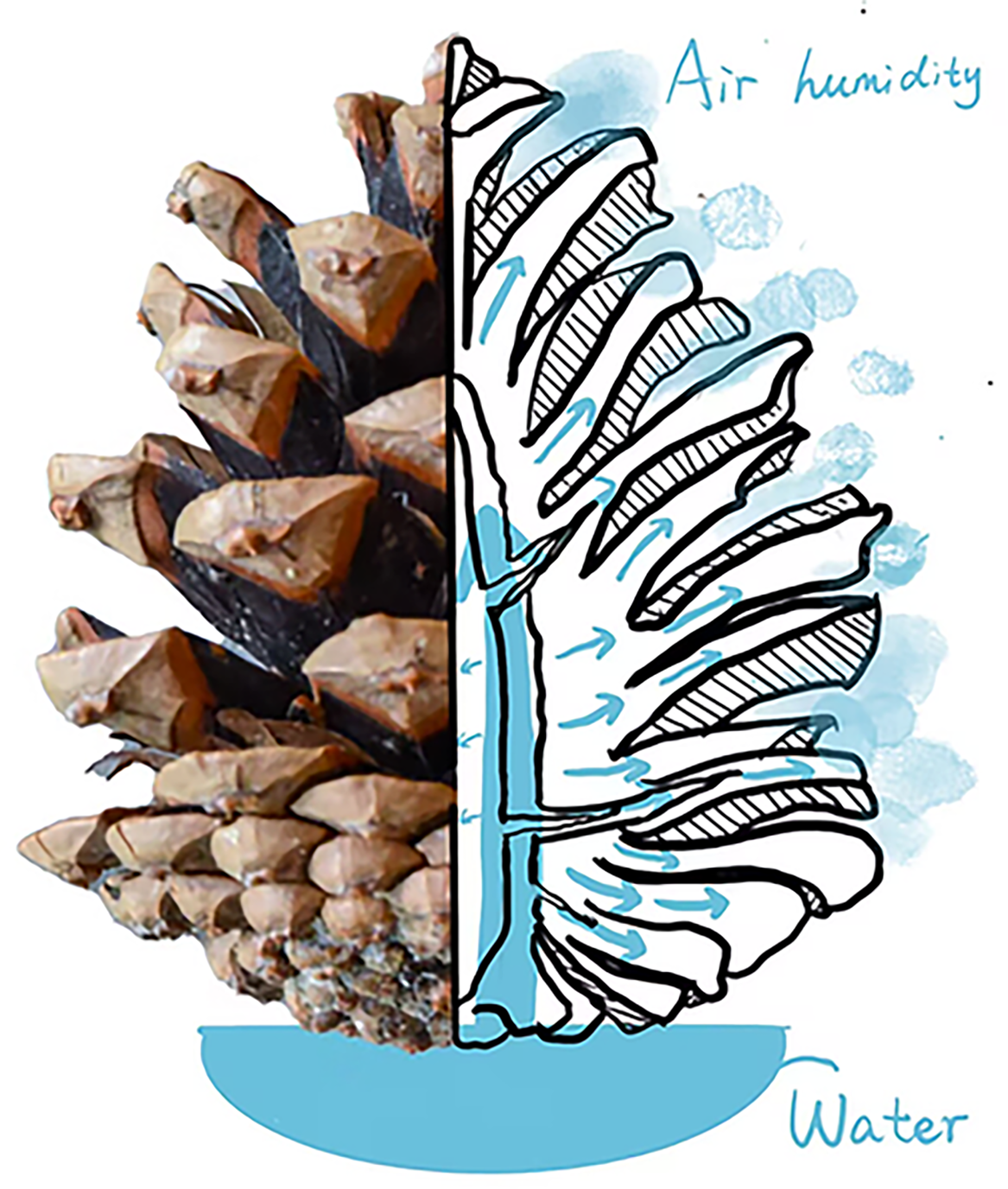
As reproduction organs of gymnosperm plants such as conifers (e.g., fir, spruce and pine trees) (Conway Reference Conway2013), pinecones possess the ability to detect and react to ambient humidity (Dawson et al. Reference Dawson, Vincent and Rocca1997). They are composed of structures that allow them to actuate based on environmental humidity (Eger et al. Reference Eger, Horstmann, Poppinga, Sachse, Thierer, Nestle, Bruchmann, Speck, Bischoff and Rühe2022; Fratzl and Barth Reference Fratzl and Barth2009). The outer layer contains lignin, which is rigid and hydrophobic, preventing it from absorbing water. In contrast, the inner layer is composed of hygroscopic cellulose fibres that can absorb moisture and swell (Figure 5). As ambient humidity increases, the cellulose microfibrils in the sclereid cells adsorb water molecules and expand volumetrically. Because the restrictive lignin layer resists this expansion, the differential swelling generates mechanical stress, forcing the entire scale to bend downwards. Conversely, in dry conditions, water desorption causes the sclereid cells to contract, forcing the scale to open. This predictable, mechanical deformation provides a reliable physical substrate for biodigital transduction (Kikvidze and Armas Reference Kikvidze, Armas and Pugnaire2010).
Cut-through sketch of water absorption in a pinecone. Image credits: Xiangyu Xiao.

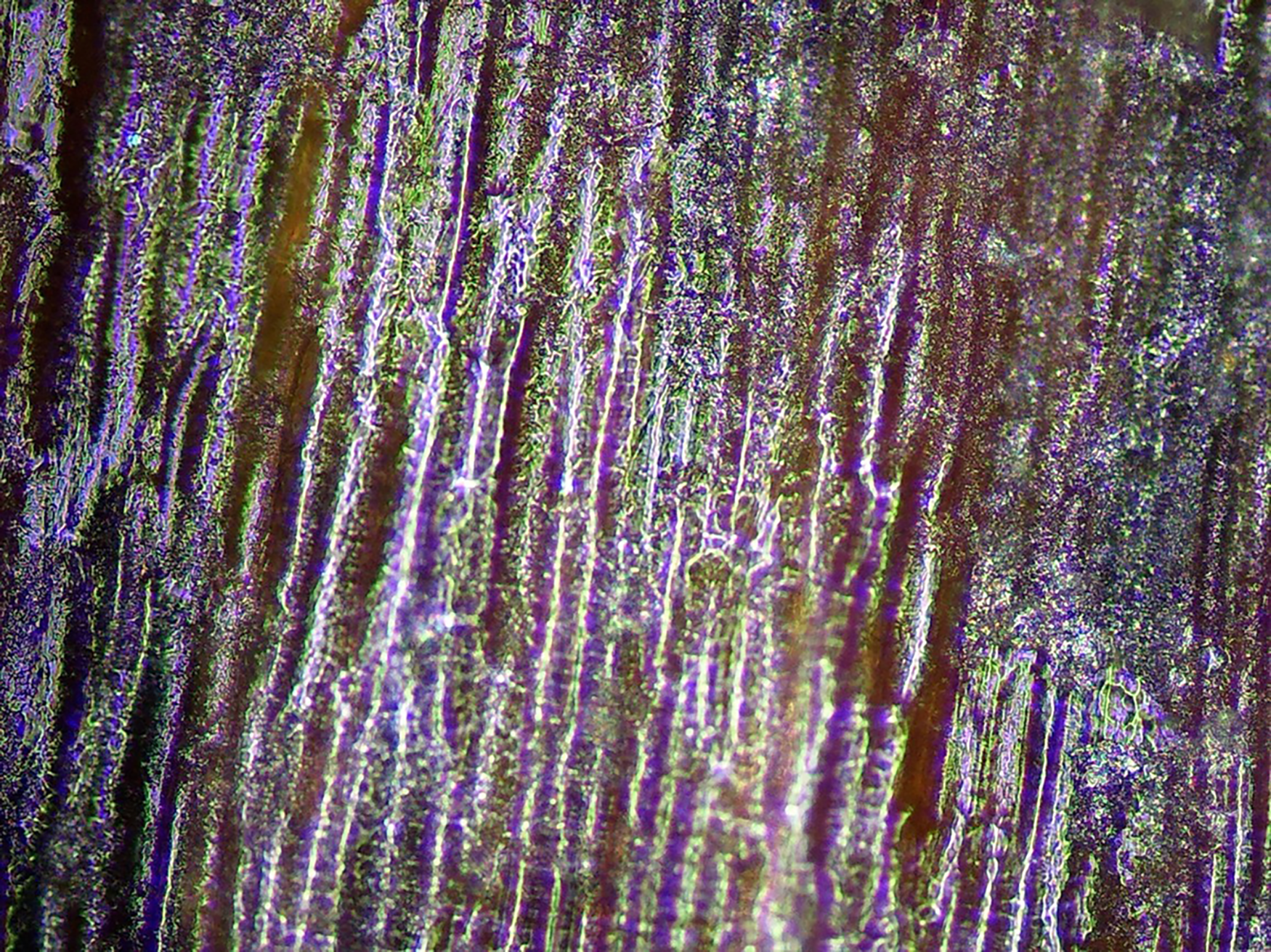
A noticeable visual process, the morphological changes are nevertheless quite complex; the pinecones react to the humidity by absorbing it via both the fibre and the scale. Song and colleagues (Song et al. Reference Song, Yeom, Seo, Kim, Kim, Lim and Lee2015) found that pinecones are very sensitive to moisture levels and visibly respond to small changes in humidity. Bae and Kim (Bae and Kim Reference Bae and Kim2020) found that the opening and closing angles of the pinecones do not depend on the pine species, but rather on the shapes of the pinecones. Horstmann and colleagues (Horstmann et al. Reference Horstmann, Speck and Poppinga2024) have pointed out that the arrangement of scales on the cone axis, the water displacement, the duration and movement sequences resulting from changes in environmental humidity, as well as the forces that they can produce, are interrelated. Yet, as Eger et al. (Reference Eger, Horstmann, Poppinga, Sachse, Thierer, Nestle, Bruchmann, Speck, Bischoff and Rühe2022) remark: “Although prior studies suggest a bilayer architecture consisting of lower actuating (swellable) sclereid and upper restrictive (non- or lesser swellable) sclerenchymatous fiber tissue layers to be the structural basis of this behaviour, the exact mechanism of how humidity changes are translated into global movement are still unclear.” (Figure 6).
Microscopic view of a Scots pinecone scale using an optical microscope Zeiss Primostart and augmented at 40% (2026). Photo credits: Elisa Mele.

EHCI and slow interaction
We situate our research within the emerging paradigm of EHCI. Historically, sustainable HCI has been predominantly human-centred, focusing heavily on energy-efficient product design or using interfaces to prompt human behavioural change through quantified data. EHCI, however, demands a broader ecological perspective that accounts for the “complex interrelations between human activities, technology, and the natural environment” (Hu et al. Reference Hu, Lu, Scinto-Madonich, Alfonso Pineros, Lopes and Hoffman2024). In this paper, EHCI provides the foundational ethos for our BHI.
A critical dimension of engaging deeply with ecological systems is recognising and respecting their inherent temporalities. Traditional HCI is driven by an expectation of technological immediacy, where inputs yield instantaneous digital feedback. However, integrating biological materials requires a shift away from human-centric speeds. We formalise this as a Hygromorphically Driven Interaction Framework – a design framework where the interaction loop is dictated by the natural rhythms and material agency of the biological component, rather than the immediate demands of the user. In our system, the hygroscopic response of the pinecone is not an instantaneous event, but a slow response to environmental moisture accumulated over several hours.
Within a traditional engineering paradigm, this temporal latency might be classified as low resolution or a systemic flaw. However, through the lens of Slow Interaction Design (Hallnäs and Redström Reference Hallnäs and Redström2001; Odom et al. Reference Odom, Sellen, Banks, Kirk, Regan, Selby, Forlizzi and Zimmerman2014), we frame this biological latency as a deliberate design affordance. By stretching the temporal gap between environmental shift and digital output, bio-triggered interaction resists the anxiety of constant connectivity. It forces users to decelerate, transforming the sensor from a simple alarm system into an artefact for anticipatory reflection and long-term environmental attunement.
Finally, a true EHCI approach must account for the lifecycle of the hybrid artefact. While the pinecone operates as a biodegradable actuator, integrating it with copper tracing and microcontrollers introduces conventional electronic waste streams. Aligning with recent calls for “unmaking” in biodesign (e.g., Gough et al. Reference Gough, Pschetz, Ahmadpour, Hepburn, Cooper, Ramirez-Figueroa and Catts2020), our fabrication process prioritises reversibility. The minimal technological intervention ensures that at the end of the artefact’s lifespan, the electronic components can be cleanly detached and reused or recycled, while the biological scaffold returns to the environment.
Pinecones have historically been used to predict dry and wet weather by being hung outside habitations to gauge the humidity of the air. Such examples testify to pinecones’ qualities as decorative elements and indigenous nature-based sensors for household handicrafts, where the pinecones’ aesthetic properties go hand in hand with their hydromorphic capacities. Our paper delves into the intriguing potential of employing pinecones as humidity sensors, leveraging their capacity to respond to variations in environmental moisture. Embracing an experimental approach, it investigates the capacity of pinecones to be used for the development of interactive devices, such as biodigital crafted artefacts aiming to support a better understanding of our environment through poetic means (Trogemann Reference Trogemann, Baecker, Paul and Sick2020).
Our approach is similar to the attempts to develop biodigital artefacts for multispecies understanding (Bell et al. Reference Bell, Coffie and Alistar2024), focusing on the process description and the reflection related to a carrying approach.
By attaching minimal technological interventions to the structural tissue of the pinecone scale, we tap into the plant’s innate hygromorphic capabilities to detect and digitise changes in humidity levels. Our experiments were driven by the desire to create minimal setups that provide reliable data related to the physical actuation of the scales, while simultaneously speculating on the broader use of pinecones as ready-made, environmentally responsive material interfaces.
Methodology
This section details the experimental methodology for conceptualising, fabricating and evaluating the pinecone as a functional, passive AHNS. While our approach draws inspiration from recent initiatives in developing biodigital artefacts for multispecies interaction (Bell et al. Reference Bell, Coffie and Alistar2024; Lu and Lopes Reference Lu and Lopes2022; Nicolae et al. Reference Nicolae, Roussel, Koelle, Huron, Steimle and Teyssier2023; Oktay et al. Reference Oktay, Ikeya, Lee, Barati, Lee, Chen, Pschetz and Ramirez-Figueroa2023; Pschetz et al. Reference Pschetz, Koppel and Bastian2024), this study fundamentally focuses on the electromechanical translation of innate biological kinematics into digitised signals. Our experiment was guided by three objectives: to test the pinecone’s capacity to act as AHNSs, to investigate the types of uses the pinecone AHNS can take and to explore the pinecone AHNSs’ interactive expressions within an HCI context. For this reason, our research was structured into two iterative phases: material exploration and sensor production, and practical and poetic case studies.
Phase 1: Material exploration and sensor production
The objective of this initial phase was to explore the material affordances of the pinecone and verify its viability as an HNS. We began by foraging for diverse types of pinecone species from various geographic regions across Europe, taking advantage of our local environment and pre-planned travel. We developed the following criteria to aid with the selection process:
-
• Actuation: The pinecone should demonstrate sufficient scale movement during humidity shifts and consistent contact between adjacent scales after actuation.
-
• Scale surface: The shape and surface of the pinecone scale should allow reliable adhesion of copper pads.
-
• Proximity: The pinecone should have sufficient natural resting distance between adjacent pinecone scales to ensure ease of attaching copper pads onto the scales.
Once a viable pinecone candidate had been selected, we adhered two pairs of copper tape and wires to adjacent scales at the top and bottom of the pinecone. This would effectively convert the selected pinecones into 2-bit AHNSs with four possible states. Finally, we conducted a set of experiments demonstrating the AHNS functionality and initial benchmarking against conventional approaches to monitoring soil moisture.
Phase 2: Practical and poetic case studies
Guided by the EHCI paradigm, we explored how these BHIs could be implemented across practical and poetic contexts. We sought design applications that fit the HDI framework. These speculative case studies encourage humans to interact with and reflect upon the slow, subtle ecological temporalities of the natural world, fostering a deeper appreciation for material agency and environmental rhythms. Because this exploration focused on subjective, experiential qualities of time and ambient feedback, we adopted an Experiential Prototyping methodology (Desjardins and Ball Reference Desjardins and Ball2018).
Results
Phase 1: Material exploration and morphological analysis
Phase 1 focused on collecting, evaluating, building and testing the AHNSs. Once a valid candidate was identified, we executed a benchmarking test to compare the pinecone’s morphological response to the soil and ambient moisture variability.
-
1: Considering the Pinecones
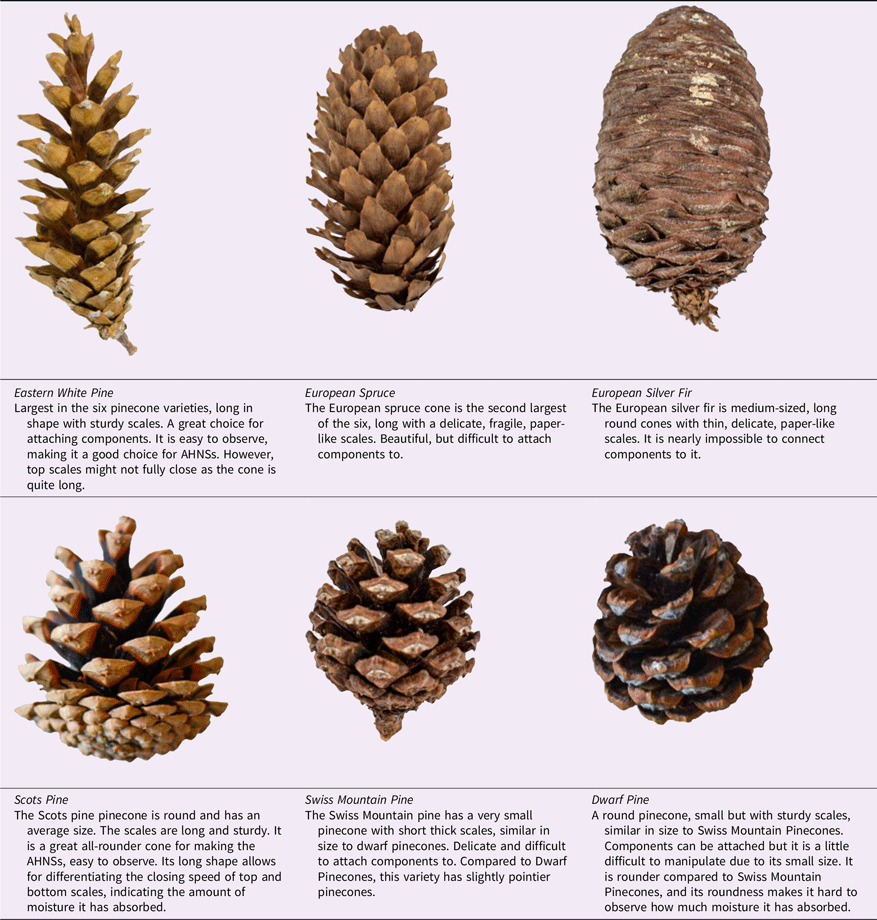
Our initial pinecone foraging from our local area and other European countries yielded six distinct candidates for consideration. In the following table (Table 1).
Comparison of pinecones. All photo credits: Matthew Lee-Smith & Xiangyu Xiao.

Table 1. Long description
1. Eastern White Pine A long, narrow Eastern White Pine cone with open, layered scales and a slightly curved conical shape, shown against a white background. 2. European Spruce A European Spruce cone with a tall, oval shape and many overlapping brown scales arranged densely from top to bottom. 3. European Silver Fir A compact European Silver Fir cone with a rounded cylindrical shape, tightly closed brown scales, and a small stem at the base. 4. Bottom-left pinecone A short, wide pinecone with thick, open brown scales arranged in a rounded form, showing a glossy surface texture. 5. Bottom-middle pinecone A small brown pinecone with open, irregularly layered scales and a compact rounded shape, shown against a white background. 6. Bottom-right pinecone A dark brown, rounded pinecone with thick overlapping scales and a dense, compact structure, photographed on a white background.
Based on the criteria and our material engagement, we identified the Scots Pine as a viable starting point. The Scots Pine demonstrated the highest potential as a practical, scalable biohybrid humidity sensor and was utilised for the physical prototyping and evaluation detailed in the subsequent sections.
-
2: Converting Pinecones into AHNS
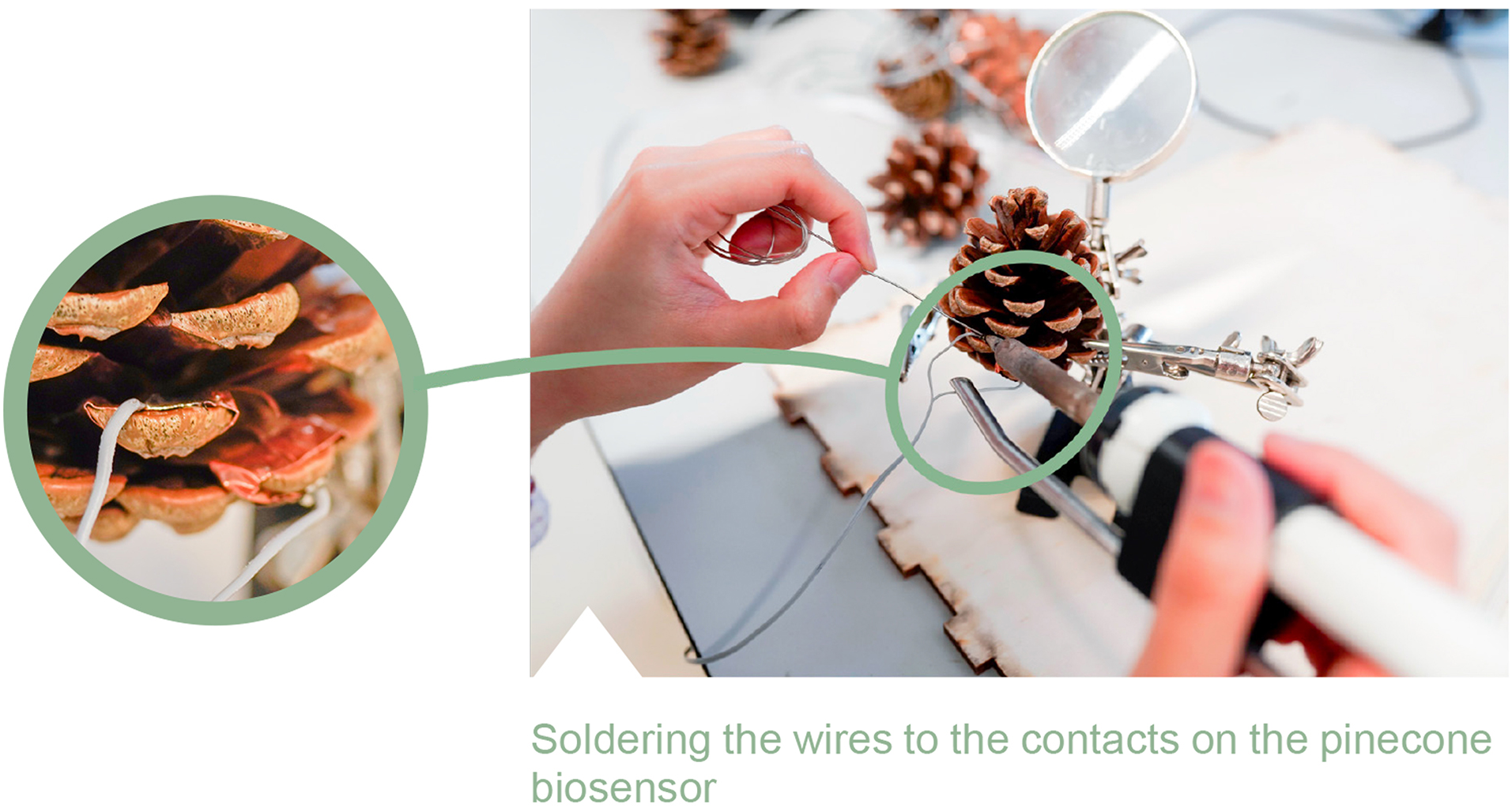
To detect whether a pinecone had closed, we implemented a simple and cost-effective method using conductive contacts placed where two scales touch. Copper tape was wrapped around adjacent scales so that, when the pinecone closed, the tapes made contact and completed a circuit. Tests showed that the tape adhered well even in moist conditions. As shown in Figure 7, wires were soldered directly to the copper tape to ensure a stable, long-lasting connection. Because thicker wires restricted scale movement, thin wires were used to avoid interfering with the pinecone’s natural motion.
-
3: Hydromorphic Activity Detection and Data Visualisation Using Pinecone AHNSs
Image of soldering the wires to the contacts on the pinecone AHNS. Image credits: Matthew Lee-Smith.

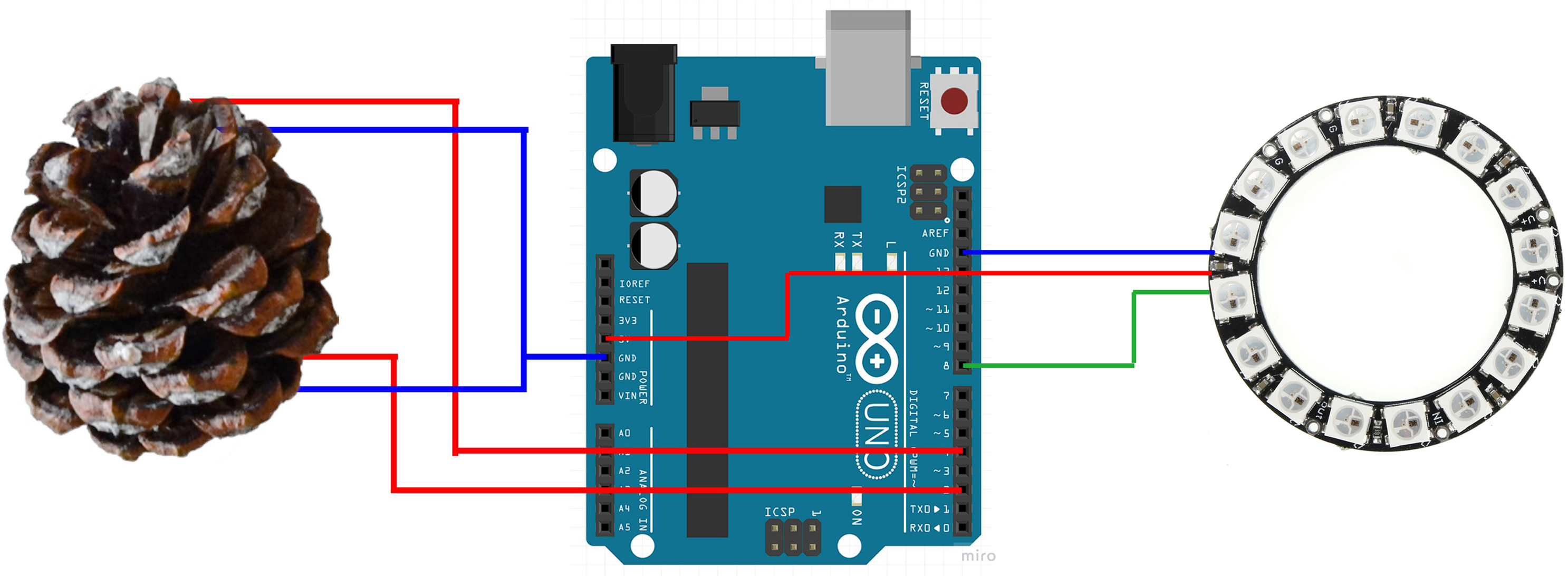
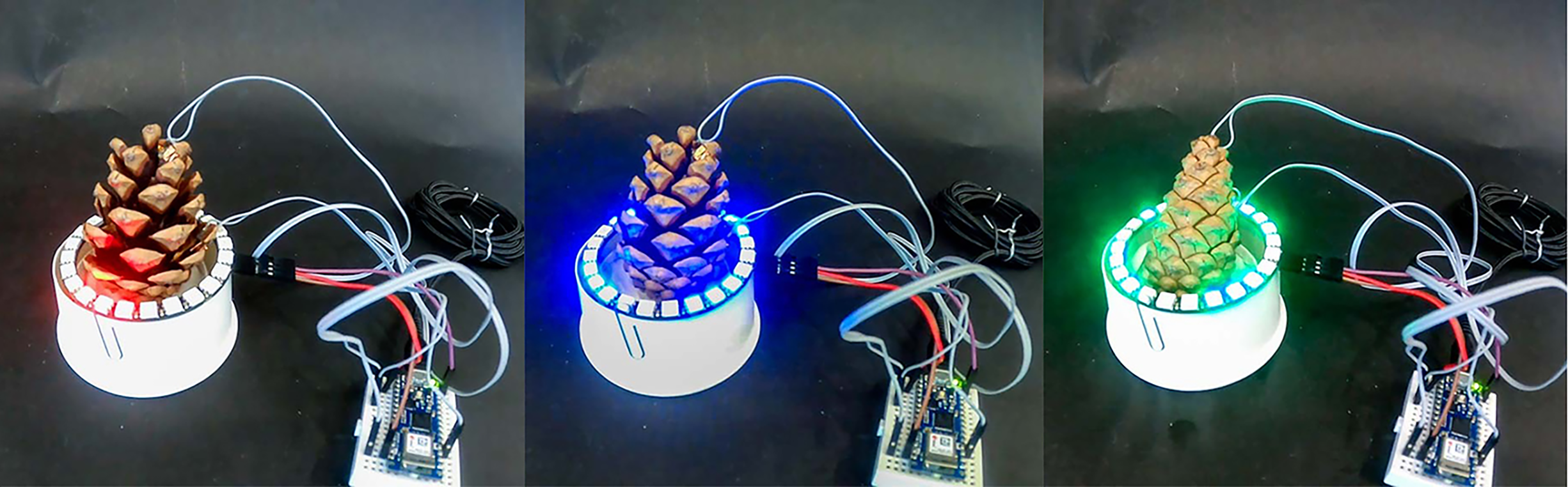
After verifying the feasibility of the copper tape contact method, we improved the setup’s ability to convey information by adding an LED ring and two sets of contacts (Figure 8). A pinecone was prepared with copper tape on the top and bottom scales, creating two contact pairs connected to an Arduino that controlled the LED ring (Figure 9). The LED colours indicated the pinecone’s moisture-driven states: red when both contacts were open, blue when only the lower contacts closed and green when both sets closed. The pinecone was placed in a shallow pool of water on a modified cup to initiate the hygromorphic process (Figure 9). The prototype demonstrated that pinecones could function as AHNSs reacting to moisture levels. It also demonstrated that pinecone scales close from bottom to top when the water source is placed below the pinecone, creating a noticeable time lag. Initially, the LED turned blue after about 40 minutes and shifted to green after roughly 150 minutes when the upper scales closed.
-
4: Benchmarking against digital sensors
Circuit diagram using LEDs and Pinecone AHNSs. Image credits: Xiangyu Xiao & Tincuta Heinzel.

Hydromorphic Activity Detection and Data Visualisation Using LEDs and Pinecone AHNSs (2024). Photos credits: Xiangyu Xiao.

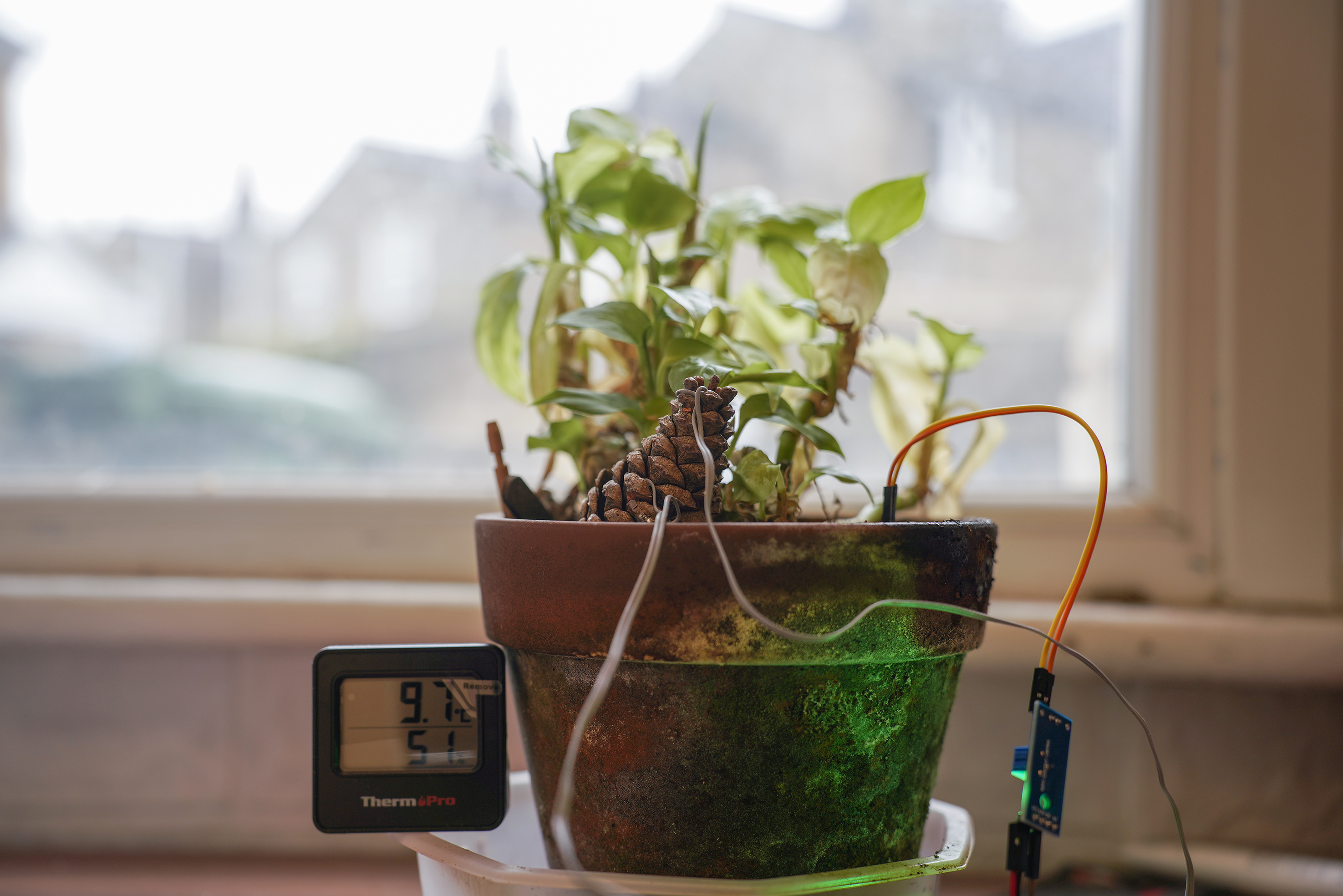
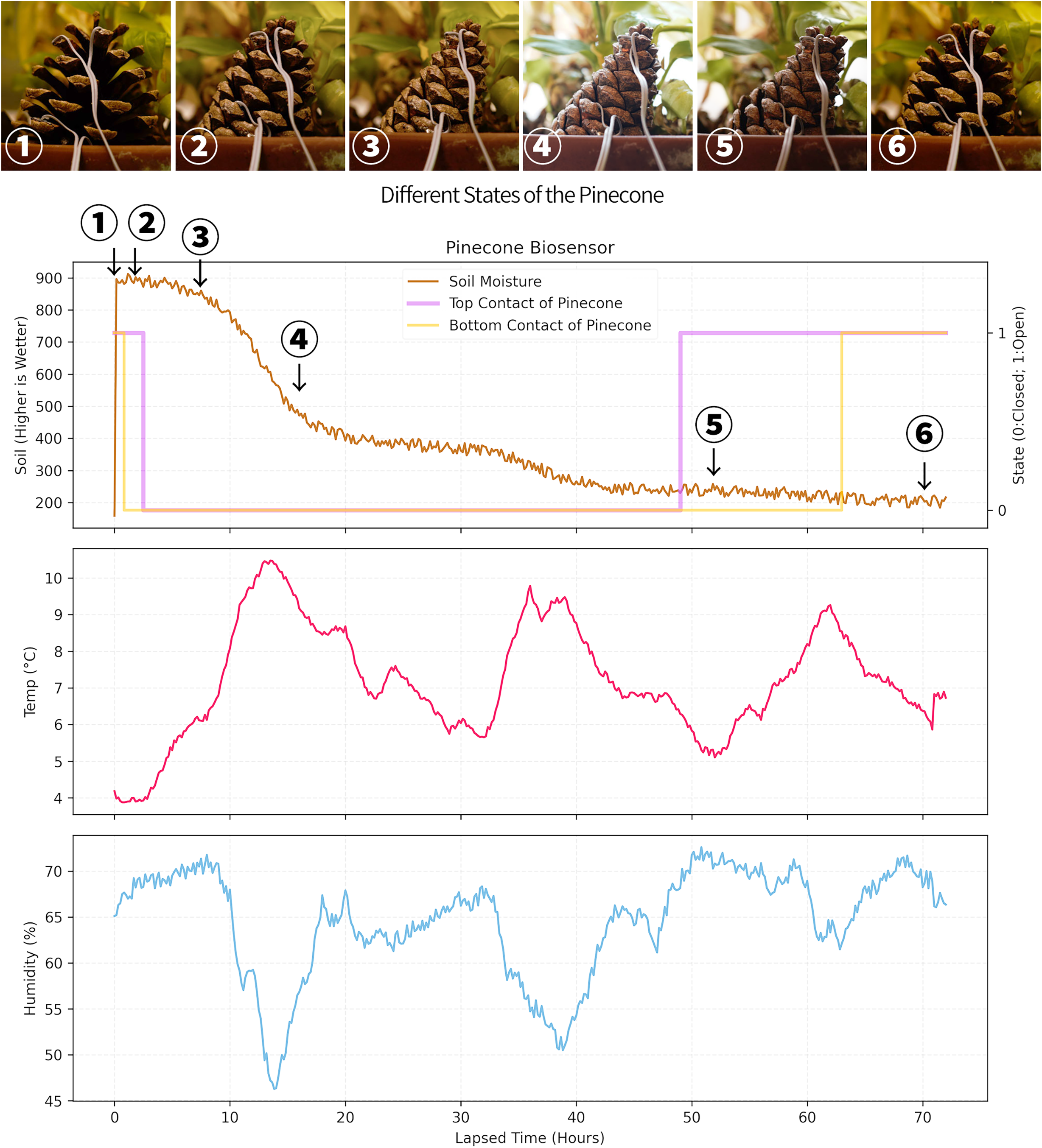
This subsection focused on the quantitative correlation and comparison between the pinecone’s physical state and the commercial ground-truth sensors. The experimental setup consisted of a potted plant with a pinecone AHNS and a conventional soil moisture sensor (Figure 10), an Arduino with a DHT22 humidity and temperature sensor for monitoring ambient values and an SD card for logging the data. Figure 11 displays the experimental data over approximately 72 hours. The viability and reliability of the pinecone actuation against continuous environmental data over 72 hours were analysed. The data reveal a strong, predictable correlation between the pinecone’s physical state and localised soil moisture depletion. Upon the initial hydration event (Hour 0), both the top and bottom scales of the pinecone rapidly transitioned from an open state (State 1) to a fully closed state (State 0) within the first three hours, as soil moisture peaked near an approximate saturation of 88% (based on a reading of 900 from the 10-bit analogue to digital pin on the Arduino with a range of 0 to 1023).
Experimental setup for performance benchmarking: A Scots Pine AHNS is deployed on the soil surface alongside a commercial capacitive soil moisture sensor and an ambient thermohydrometer. This configuration was used to record comparative data. Photo credits: Xiangyu Xiao.

Figure 10. Long description
A potted plant placed on a windowsill with a pinecone-based sensor installed on the soil surface. Wires connect the pinecone to electronic components and a small sensor module, while a digital thermometer is positioned beside the pot. A green light is visible on the side of the pot, indicating the experimental setup for monitoring soil moisture and environmental conditions. Figureure 10. Experimental setup for performance benchmarking: A Scots Pine AHNS is deployed on the soil surface alongside a commercial capacitive soil moisture sensor and an ambient thermohydrometer. This conFigureuration was used to record comparative data over 72 hours following a watering event, establishing a baseline for the pinecone’s hydromorphic actuation against standard electronic measurements. Photo credits: Xiangyu Xiao.
72-hour benchmarking results of the biohybrid pinecone sensor. The graphs illustrate the comparative data collected following a simulated watering event. The top subplot displays the capacitive soil moisture levels (brown line, left axis) mapped against the discrete actuation states (0: closed, 1: open) of the pinecone’s top (purple) and bottom (orange) scales. The middle and bottom subplots track ambient room temperature (°C) and relative humidity (%), respectively, contextualising the environmental conditions that influence the pinecone’s hydromorphic response as the soil dries out. Image credits: Xiangyu Xiao.

Figure 11. Long description
A 72-hour benchmarking Figureure for a bio-hybrid pinecone sensor. The top row shows six sequential photographs labelled 1–6, illustrating different physical states of the pinecone over time. Below, three line graphs compare the pinecone biosensor response with environmental measurements: the first graph shows soil moisture levels and the open/closed states of the pinecone’s top and bottom scales, while the second and third graphs show ambient temperature and relative humidity over the same 72-hour period. The Figureure demonstrates how the pinecone changes state as soil moisture decreases after a watering event.
Crucially, these initial observations suggest that the BHI possesses a degree of robustness against ambient environmental noise. While the middle and bottom subplots of Figure 11 illustrate daily fluctuations in the room’s ambient temperature (ranging from roughly 4°C to 10.5°C) and relative humidity (fluctuating between 45% and 72%), the pinecone did not exhibit any false triggers. Instead of reacting to these cyclical ambient shifts, the biological actuator remained reliably closed (State 0) until the soil moisture dropped significantly. This suggests that the pinecone AHNS could be a viable, localised sensor capable of tracking soil moisture. The benchmarking data highlights a critical spatial-temporal affordance of the material: sequential actuation. As the soil moisture steadily dropped below approximately 24% saturation (from a reading of 250), the pinecone did not open uniformly. The data shows that the top scale triggered (returning to State 1) at approximately Hour 54, whereas the bottom scale did not actuate until approximately Hour 64. This distinct ∼10-hour temporal gap between the actuation of different scales highlights the material’s potential to act as a progressive, multi-state sensor. This sequential behaviour perfectly positions the pinecone as a piece of time-based media. Rather than instantly alerting a user with a digital alarm, the AHNS functions as an ambient display that gradually unfolds to reveal information, such as a plant’s unseen biological rhythm and water consumption over several days.
Phase 2: Two case studies
Case 1 – Practical applications for the AHNS on different plantsetups
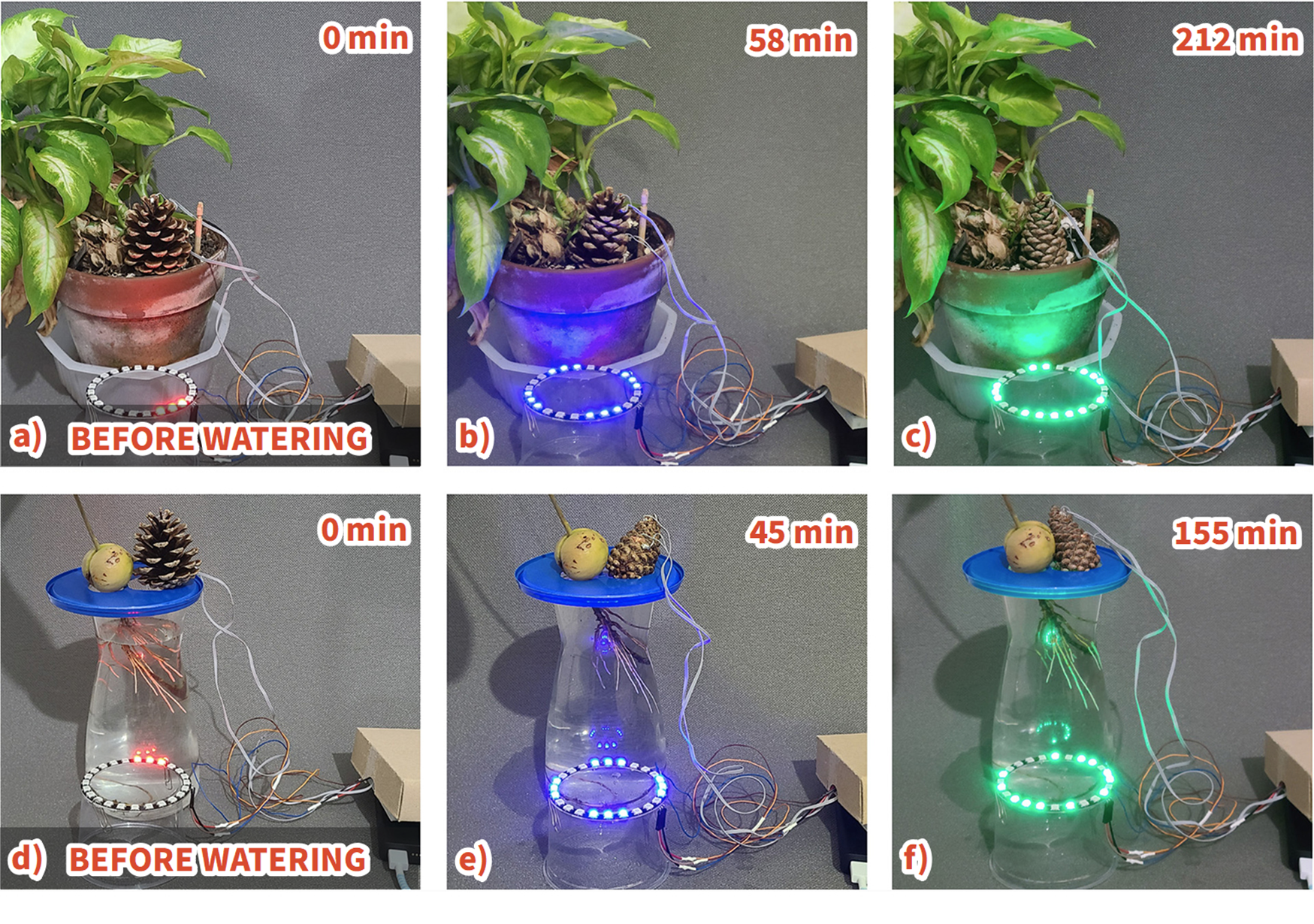
To address our second research question (RQ2) regarding the types of interactive expressions pinecone AHNSs can facilitate within an HCI context, we centred our exploration on the relationship between humans and plants. In this application, the pinecone serves as a biological sensing device that translates a plant’s watering needs. To compare these interactions across typical domestic environments, we tested the AHNS alongside both soil-based (potted ivy) and hydroponic (avocado) configurations. We utilised the same pinecone sensors for each experiment. The watering event was initiated when either the soil was completely dry or the water level had fallen sufficiently. We then captured the digital readings from the pinecone contacts using a serial plotter to generate graphs for comparative analysis. As in the first phase, copper tape contacts were placed at two points on the pinecone. Closure of the lower scales signalled that water had reached the lower parts of the pinecone. Closure of the upper scales indicated full moisture absorption throughout the pinecone, providing humans with a clear, gradual cue of the changing water status.
Configuration
Soil-based Plants. For soil-based plants, as illustrated at the top of Figure 12, a pinecone AHNS was placed directly onto the soil next to the plant. When the plant was watered, the pinecone touched the wet soil, triggering the closing of the pinecone scales.
Comparison of pinecone AHNS response to watering event on soil and hydroponic plants. Photo credits: Xiangyu Xiao.

Hydroponics. Hydroponic plants have long, well-developed roots that directly absorb water and nutrients from a hydroponic solution. As illustrated at the bottom of Figure 12, a pinecone AHNS was fixed at a certain height next to the roots. The hydroponic was watered until the solution touched the pinecone AHNS, causing it to close completely. In the hours following watering, the hydroponic solution evaporates, exposing the pinecone AHNS to the air. The pinecone dried out and opened, signalling the human to replenish water again. We found out that it takes two days for the pinecone AHNS to fully open after closing.
Findings
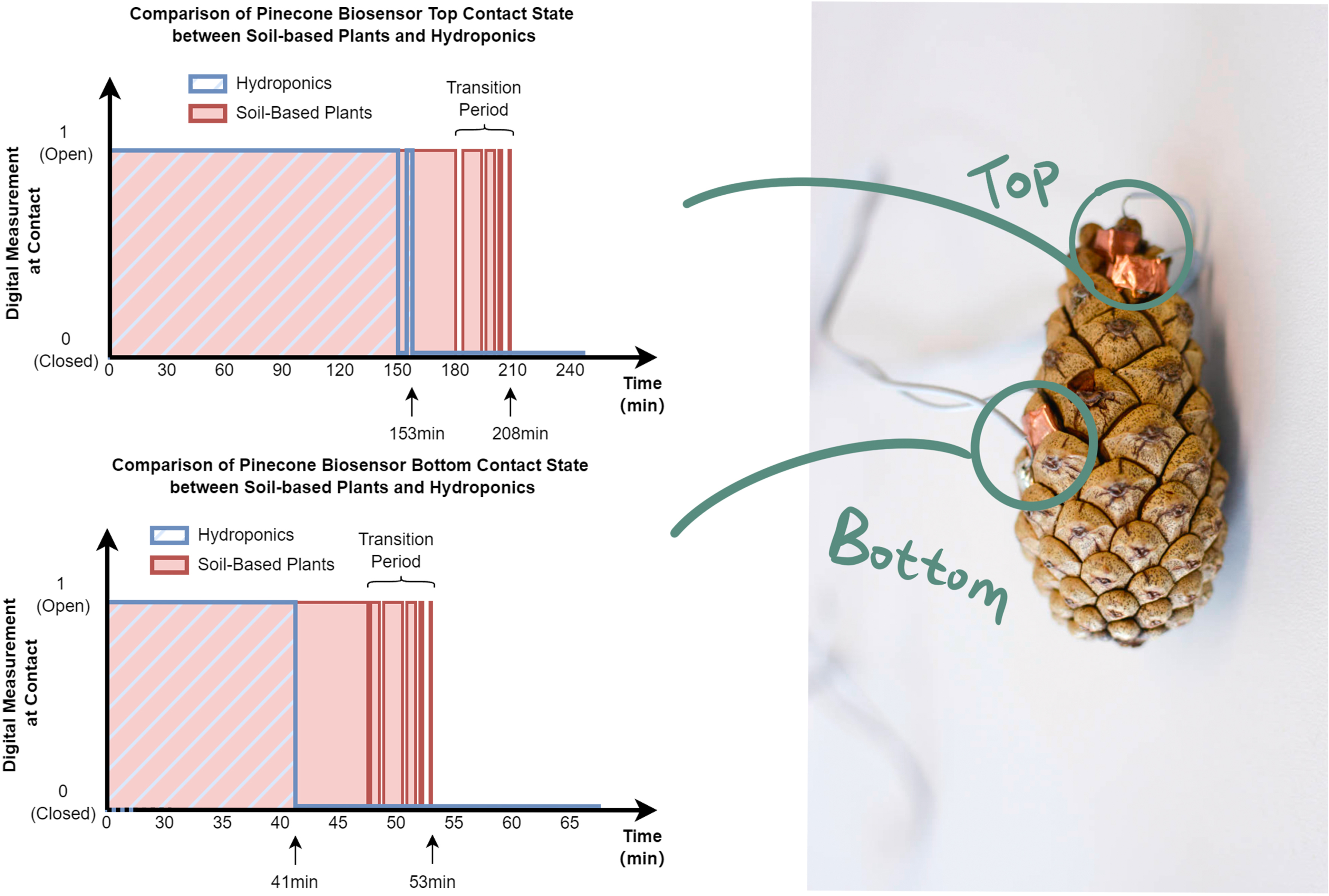
In terms of time to closure from the watering event, and starting with the bottom contacts, the hydroponic setup closed completely at 41 minutes (e), while the soil-based equivalent fully closed near the 53-minute mark (b). With the top contacts, there is a wider gap between the hydroponic and soil configurations, with them closing in approximately 153 minutes (2 hours and 33 minutes) (f) and 208 minutes (3 hours and 28 minutes) (c), respectively (Figures 12 and 13). Unlike in the first experiment, the transition from open to closed is not smooth. Instead, in both configurations, there are distinct “transition periods” in the sensor data, as illustrated in Figure 13. During this specific phase, the closing copper contacts do not immediately form a continuous electrical connection. Instead, the measured state of the pinecone fluctuates repeatedly between open and closed over many minutes until continuous contact is achieved. This phenomenon is most notable in the soil configuration but is present in both. This extended transition in soil versus hydroponics is most likely attributed to water entering the pinecone during the watering event and then evaporating, whilst also being impacted by the moisture in the soil. This could also explain why in image b of Figure 12 the middle of the pinecone is more closed than the top or bottom. We can also speculate that the transition period may be (1) due to the nature of evaporation in the two mediums, (2) that the pinecone in the hydroponics setup moved position more, (3) that the copper contacts were not as securely fastened as in phase 1 and/or (4) other environmental factors that we have not considered. Nonetheless, there is a notable difference in closure time between direct contact with moist soil and water.
Possible applications
Based on these differing actuation profiles, we can develop specific feedback applications tailored to each growing medium. For soil-grown plants, the AHNS can continuously monitor localised moisture levels and communicate the plant’s hydration status through mapped ambient light signals. In a practical scenario using potted ivy, a flashing red light serves as a preliminary alert for the user to initiate watering. As the lower scales close and trigger a blue light, the system indicates that the plant has reached its initial stage of root water absorption. Finally, a green light activated by the upper scales signifies comprehensive moisture saturation in the surrounding soil.
In hydroponic applications, the AHNS functions as a dynamic physical indicator of ambient water levels. Using a hydroponic avocado plant as a test case, if the water level drops below the optimal root zone, the pinecone gradually opens in response to the decreasing local humidity, prompting a red warning light. Once the user replenishes the water to adequately cover the roots and the AHNS’s lower threshold, the rapid closing actuation smoothly transitions the light from red to blue and eventually to green. This provides immediate, legible confirmation that the liquid level is sufficient and stable.
Case study 2: – Poetic human–plant interaction with slow interaction
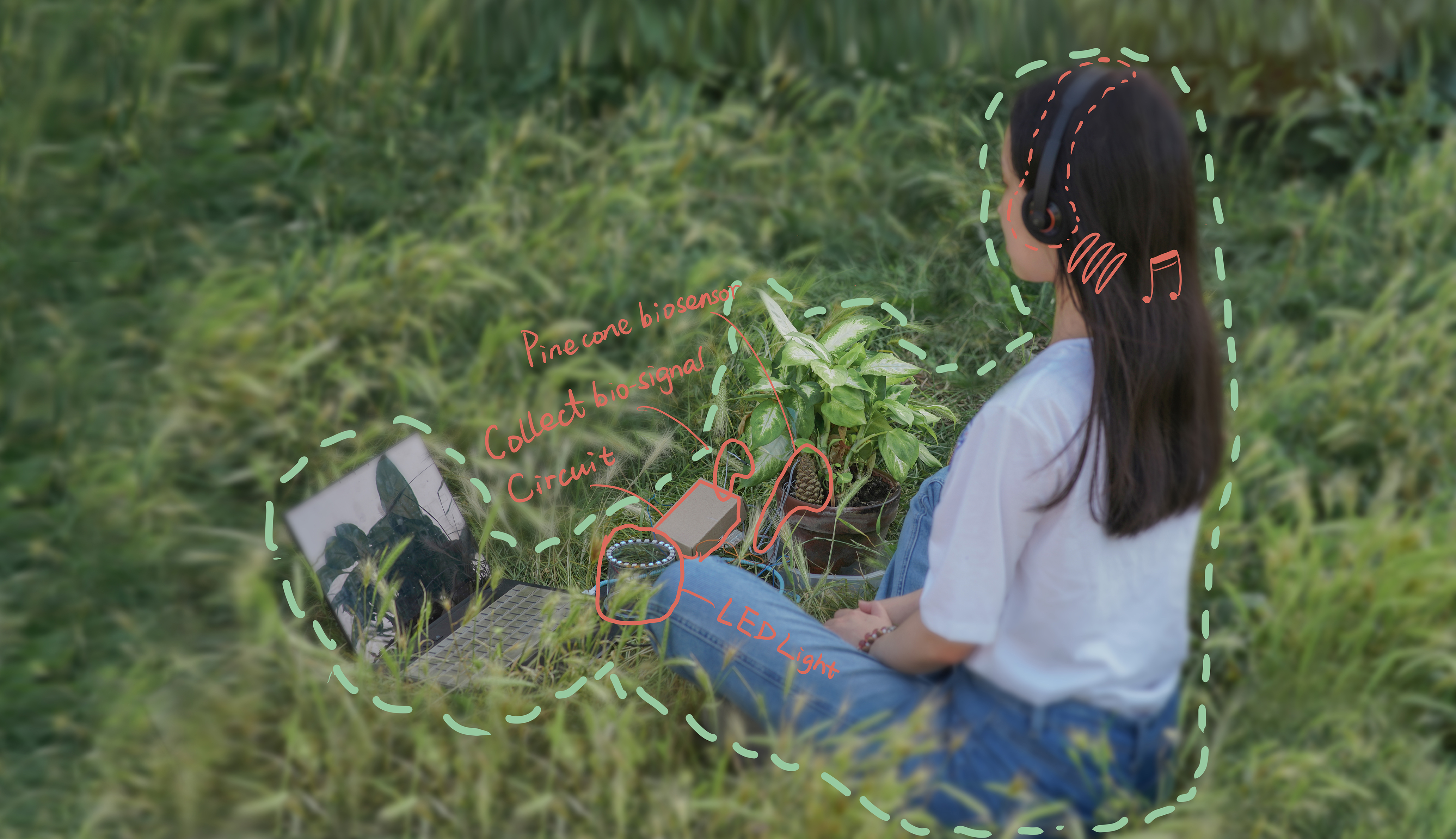
In terms of responding to RQ3, we transitioned from the technical validation of Case Study 1 to a Research through Design exploration. We designed a speculative ambient interface in Figure 14. This scenario uses the pinecone AHNS as a biohybrid mediator to reflect the slow environmental process of soil moisture evaporation. The first author deployed and lived alongside the system to directly experience how the material delay shapes human perception. Building upon the 10-hour actuation lag quantified in the previous phase, we used this inherent delay as the core design affordance for “slow interaction.” In this setup, as the soil is watered and ambient humidity rises, the pinecone scales slowly close; this physical actuation speed acts as the sole driver to trigger and modulate generative soundscapes and ambient light.
Comparison of pinecone AHNS top contact state between soil-based plants and hydroponics. Image credits: Xiangyu Xiao.

Figure 13. Long description
This Figureure clearly quantifies this phenomenon. The soil-based setup exhibited a prolonged and highly visible transition period. For instance, the top contact of the soil-based AHNS fluctuated significantly before establishing a solid connection at approximately 3 hours and 28 minutes. In stark contrast, the hydroponic setup demonstrated a much sharper and faster actuation, with only minimal fluctuations before fully closing at 2 hours and 33 minutes. A similar, though shorter, pattern was observed at the bottom contacts, where the hydroponic sensor closed completely at 41 minutes, while the soil-based sensor experienced a brief transition period before fully closing near the 47-minute mark.
Control of music using a pinecone AHNS. Image credits: Xiangyu Xiao.

Configuration
Through our deployment, we observed three distinct interactive expressions introduced by the AHNS into the environment:
-
• Temporal Expression: The AHNS functioned as an abstract, intuitive “timer.” The prolonged actuation period (up to 10 hours) acted as a physical abstraction of the time required for water to be absorbed and evaporated. This forced a shift in user expectation, moving away from the demand for immediate computational feedback towards a mindful, anticipatory synchronisation with natural hydration. The time is expressed through a visual representation of numbers.
-
• Sonic Expression: By mapping the sensor’s actuation stages to virtual instruments, the frequency and duration of the generated audio were strictly controlled by the mechanical state of the pinecone. The system produced an evolving soundscape, allowing the biological artefact to continuously “sing” its physical state and provide non-intrusive ambient awareness.
-
• Ambient Visual Expression: The sonic feedback was synchronised with gentle shifts in ambient lighting. Together, these expressions allowed the invisible, gradual shifts in environmental humidity to manifest as subtle, poetic alterations in the environment’s atmosphere.
Findings
By isolating the pinecone as the sole bio-trigger, this case study demonstrates that the AHNS excels as a mediator of slow interaction. The resulting design fosters a poetic, more-than-human interaction with ecological time. The immersive combination of generative music and light, paced entirely by the pinecone’s hygromorphic logic, cultivates a reflective environment that encourages users to observe and appreciate the subtle, slow-moving shifts of the natural world.
Discussion
Through a limited number of experiments, we demonstrated the possibility of using pinecones as augmented humidity sensors for art-inspired, poetic-oriented and experimental approaches. Not all pinecones were suitable for use as AHNSs. By comparing performance and ease of use, we found that the Scots Pine, with its thicker scales and compact size, is one of the more suitable options. Through attaching copper tape and wires, we converted the pinecones to a reversible AHNS. Then, we experimented with using pinecone AHNSs on plants grown in soil and hydroponic systems. Compared to other trigger-based plants, such as Venus Flytraps and Mimosa Pudica (Isai and Viller Reference Isai and Viller2010; Seow et al. Reference Seow, Honnet, Perrault and Ishii2022), pinecones have a slower response to external environmental signals. Although slow, the response of pinecones reflects the changes in soil and ambient humidity, and by measuring the number of closed scales, information about soil moisture can be potentially inferred. Furthermore, compared to robotic systems driven by living plant growth, which necessitate continuous hydroponic maintenance, light exposure and complex structural housing to sustain life (Hu et al. Reference Hu, Lu, Scinto-Madonich, Alfonso Pineros, Lopes and Hoffman2024), our system offers superior spatial and maintenance flexibility. Operating as a detached, moisture-responsive actuator, the pinecone requires zero biological upkeep and can be deployed in environments entirely unsuitable for living plants. Moreover, owing to their wide availability and the simplicity of the modification, pinecones are a viable material for hybrid, low-tech, augmented biodigital sensors.
Compared to fully electronic sensors, pinecone AHNSs might lack speed and accuracy, but within an HPI context, we believe that interaction is the most important part, which does not require speed and can tolerate inaccuracies. The water consumption needs of plants vary species to species; therefore, special attention should be given to their natural characteristics when designing for HPI with pinecone AHNSs. Nevertheless, pinecone AHNSs exhibit huge flexibility to be applied to different types of plants. There is, however, a question of how the observation of the pinecone behaviour influences the humans’ plant-care behaviour. This topic can be investigated in future research.
HDI framework
This paper introduces HDI as a novel design framework for biohybrid systems. Moving beyond treating environmental or biological artefacts as mere binary input signals, the HDI framework explicitly foregrounds the material agency and inherent temporal rhythms of nature-based sensors. As noted in prior HCI literature, biological actuators often possess inherent temporal latencies, challenge the standardisation processes and are tailored to highly specific environmental stimuli (Yao and Ishii Reference Yao and Ishii2019). Rather than viewing these traits as engineering flaws to be calibrated out, these latencies can be used for slow interactions. By subordinating the digital system’s clock to the ecological temporality of the pinecone, the interaction transforms into a slow, anticipatory process. Through this framework, the BHI ceases to be a passive, transparent sensor; instead, it acts as an active mediator that compels human users to recalibrate their interactions to the slow, evolving rhythms of the ecological world.
The value of the HDI framework becomes distinctly apparent when comparing our experimental findings with previous biohybrid actuation studies. For example, researchers utilised live Bacillus subtilis natto cells to create shape-changing fabrics (Yao et al. Reference Yao, Ou, Cheng, Steiner, Wang, Wang and Ishii2015; Yao and Ishii Reference Yao and Ishii2019). In such systems, the biological component is highly engineered to achieve rapid actuation (often reacting to sweat within seconds or minutes) to serve immediate human-centric needs, such as ventilation. In contrast, our 72-hour benchmarking revealed that the pinecone’s hygromorphic actuation operates on a vastly different timescale, exhibiting a functional latency of up to 10 hours between peak humidity exposure and maximum scale closure.
Under a traditional HCI paradigm, this 10-hour lag would render the pinecone unsuitable as an instantaneous interactive interface. However, viewed through the HDI framework, this extended latency is exactly what creates the space for slow interaction. Unlike highly engineered microbial sensors designed for immediate task resolution, the pinecone dictates a “more-than-human” temporality. The disparity between our findings and prior high-speed biodesign work demonstrates that HDI opens a different design space: one focused on long-term environmental attunement, anticipation and poetic reflection, rather than efficiency and control.
Embracing biological idiosyncrasy and the crafted aesthetic
A core tenet of traditional digital sensor design is the rigorous calibration of components to eliminate material variability. However, integrating ready-made biological actuators necessitates a departure from this paradigm. Throughout our experimental phases, we observed inherent morphological variations among the pinecone specimens, even within the same species. Individual pinecones naturally exhibited distinct scale stiffness/gaps and varying actuation in response to identical humidity levels. In standard engineering contexts, such variance would be classified as a systemic error requiring algorithmic suppression or mechanical calibration. However, attempting to artificially calibrate these pinecones to perform identically would not only require heavy, power-consuming technological interventions, but it would also strip the organic material of its fundamental nature.
Aligning with core biodesign principles, we argue that this variability is not a technical flaw, but rather a vital component of the system’s “crafted aesthetic.” Drawing on HCI discourses around imperfect materials and “wabi-sabi” (Tsaknaki and Fernaeus Reference Tsaknaki and Fernaeus2016), we argue that biological idiosyncrasy should be celebrated. Because no two pinecones possess the exact same internal structural geometries, each fabricated BHI behaves with a unique morphological signature. This non-standardisation fundamentally alters the human–artefact relationship; users cannot expect uniform, machine-like precision, but must instead accommodate the unique physical reality and subtle unpredictability of the specific artefact before them.
Future research directions
Future interactive materials based on pinecone properties
Apart from using pinecone AHNSs as environmental sensors, pinecones have many other potential applications as an interactive material. Architect Achim Menges created meteorology-sensitive architecture that responds to environmental humidity, morphing shape in response to different humidities (Menges and Reichert Reference Menges and Reichert2012). Taking inspiration from the two-layered structure of pinecone scales, future panels or roofs could adapt to environmental conditions, regulating light, ventilation and temperature inside buildings. Research also suggested that the resin produced by the pinecones can protect from bacteria and/or fungi, herbivores and potentially also from fires, as in serotinous species (Franceschi et al. Reference Franceschi, Krokene, Christiansen and Krekling2005; Hernández-Serrano et al. Reference Hernández-Serrano, Verdú, González-Martínez and Pausas2013).
Improving the pinecone AHNS’ resolution
In this paper, the pinecone is a two-bit HNS with two states for each pair of scales (open and closed), allowing it to function as a simple analogue moisture sensor. One could, of course, add more contacts at different levels, increasing the “resolution” of the sensor. However, there is also the space between the scales being fully opened and closed, which presents an opportunity for higher resolution. Several methods can be used to measure this, including flex sensors, strain gauges, capacitive sensing, ultrasound, infrared or time-of-flight (ToF) methods. These are commonly used methods to measure distance; however, the analysis of their feasibility is beyond the scope of this paper.
Human–plant slow interaction
Slow interaction involves a thoughtful, prolonged engagement characterised by a slow pace, allowing for deeper reflection and connection between participants (Hallnäs and Redström Reference Hallnäs and Redström2001). In this paper, we demonstrate that pinecones exhibit a slow-closing behaviour under wet conditions, making them effective AHNSs. These sensors bridge the communication gap between humans and plants through subtle feedback methods, including light and sound. As Odom et al. (Reference Odom, Sellen, Banks, Kirk, Regan, Selby, Forlizzi and Zimmerman2014) demonstrated through a technological design, slow interactions build anticipation and better support reflections, fostering deeper emotional connections and enhancing the user experience. Pinecone AHNSs take advantage of slow interactions to enhance and deepen the connection between humans and nature.
Conclusion
This paper brings biological knowledge into HCI by presenting an interaction model of HDI built around pinecone AHNSs. In our prototypes, the pinecones sense plant water absorption and relay this information to a control circuit that visualises and sonifies the hydration process, enabling users to experience moisture changes in an immersive, reflective way. The results show that pinecones are effective environmental humidity sensors and meaningful mediators between plants and humans. The study also clarifies the design rationale behind using AHNSs and contributes new insights to sustainable and slow interaction design.
The augmented sensors introduce a poetic use of natural, ready-made materials: a pinecone that would normally decompose gains a new “afterlife” as an AHNS that responds to the subtle “breathing” of soil and plants. Its shape changes power lighting and interaction, merging natural behaviour with digital expression and highlighting the close relationship between nature and technology.
Unlike traditional electronic sensors that require various industrial processes, resources and often toxic materials, pinecone AHNSs reduce environmental impact and electronic waste. Although they do not provide instantaneous feedback, they offer a sustainable alternative. Moreover, most electronic components used in our prototypes are reusable, making the system suitable for educational contexts as well. These AHNSs suggest a direction for environmentally aware design that maximises material characteristics, minimises waste and fosters a deeper connection between humans, plants and their environments. Unlike previous human–plant interaction research, this paper proposes a low-tech, biodigital hybrid approach that incorporates an existing natural material, a pinecone, into an augmented sensing system. This enables slow interactions, poetic experiences and new opportunities for teaching and designing with living and organic materials. Finally, the paper also brings into discussion the EHCI paradigm and makes the AHNSs paradigmatic for the described approach.
Data availability statement
The authors confirm that the data supporting the findings of this study are available within the article and that the supplementary materials have been uploaded to Loughborough University’s repository and can be accessed here: https://doi.org/10.17028/rd.lboro.32924786.
Acknowledgements
Various LLM’s/AI tools (e.g., Copilot AI and Grammarly) were used to check grammar and aid readability. Midjourney was used in the production of one image of a pinecone (Figure 3). Microsoft Word’s inbuilt alt-text generator (assumed Copilot) was used to generate the alt-text, which was then verified by the authors.
Author contributions
Xiangyu Xiao: Conceptualisation, Methodology, Data Curation, Software, Analysis and Writing – original draft, Tincuța Heinzel: Methodology, Data Curation, Analysis and Writing – original draft; Matthew Lee-Smith: Methodology, Data Curation, Software, Resources and Writing – Review and Editing; Elisa Mele: Software resources and visualisation, Writing – Review and Editing. All authors approved the final submitted draft.
Financial support
This research received no specific grant from any funding agency, commercial or not-for-profit sectors.
Competing interests
The authors confirm that there are no conflicts of interest.
Ethical standards
Ethical clearance was not required for this work as it was entirely conducted by and on the authors.
Appendix
Video demonstration of the prototype can be found here: https://youtu.be/HJAo0CuheFY.

 Open access

