Introduction
Impaired hearing and vision are the most common conditions affecting older adults (Gopinath et al. Reference Gopinath, Wang, Schneider, Burlutsky, Snowdon, McMahon, Leeder and Mitchell2009, Schneider et al. Reference Schneider, Gopinath, McMahon, Leeder, Mitchell and Wang2011; Rim et al. Reference Rim, Nam, Choi, Lee and Lee2014; Jun et al. Reference Jun, Hwang, Lee, Lee, Song and Chae2015). These sensory impairments have been found to be associated with physical function (Wallhagen et al. Reference Wallhagen, Strawbridge, Shema, Kurata and Kaplan2001; Crews & Campbell, Reference Crews and Campbell2004; Chia et al. Reference Chia, Mitchell, Rochtchina, Foran, Golding and Wang2006), daily living (Brennan et al. Reference Brennan, Horowitz and Su2005; Mikkola et al. Reference Mikkola, Polku, Portegijs, Rantakokko, Rantanen and Viljanen2015), mental health (Lin et al. Reference Lin, Gutierrez, Stone, Yaffe, Ensrud, Fink, Sarkisian, Coleman and Mangione2004; Chia et al. Reference Chia, Mitchell, Rochtchina, Foran, Golding and Wang2006; Lin et al. Reference Lin, Metter, O'Brien, Resnick, Zonderman and Ferrucci2011; Lin et al. Reference Lin, Yaffe, Xia, Xue, Harris, Purchase-Helzner, Satterfield, Ayonayon, Ferrucci, Simonsick and Health2013; Contrera et al. Reference Contrera, Betz, Deal, Choi, Ayonayon, Harris, Helzner, Martin, Mehta, Pratt, Rubin, Satterfield, Yaffe, Garcia, Simonsick, Lin and Health2016) and even mortality (Lee et al. Reference Lee, Gómez Marín, Lam, Zheng, Arheart, Christ and Caban2007). In addition, most studies that have investigated the effects of sensory impairment have reported an association between hearing impairment and depression (Abrams et al. Reference Abrams, Barnett, Hoth, Schultz and Kaboli2006; Hallam et al. Reference Hallam, Ashton, Sherbourne and Gailey2006; Evans et al. Reference Evans, Fletcher and Wormald2007; Ishine et al. Reference Ishine, Okumiya and Matsubayashi2007; Gopinath et al. Reference Gopinath, Wang, Schneider, Burlutsky, Snowdon, McMahon, Leeder and Mitchell2009; Lee et al. Reference Lee, Tong, Yuen, Tang and Vanhasselt2010; Carlsson et al. Reference Carlsson, Hjaldahl, Magnuson, Ternevall, Eden, Skagerstrand and Jonsson2015; Tseng et al. Reference Tseng, Hu, Liu, Yang, Shen and Tsai2016), as well as between vision impairment and depression (Rovner & Ganguli, Reference Rovner and Ganguli1998; Nyman et al. Reference Nyman, Gosney and Victor2010; Garin et al. Reference Garin, Olaya, Lara, Moneta, Miret, Ayuso-Mateos and Haro2014; Giloyan et al. Reference Giloyan, Harutyunyan and Petrosyan2015). However, other studies have yielded contrasting results (Pronk et al. Reference Pronk, Deeg, Smits, van Tilburg, Kuik, Festen and Kramer2011; Mener et al. Reference Mener, Betz, Genther, Chen and Lin2013; Loprinzi & Codey, Reference Loprinzi and Codey2014; Rim et al. Reference Rim, Nam, Choi, Lee and Lee2014). The burden of a single sensory impairment has not been well established even in studies reporting significant associations between dual sensory impairment and depression (Lupsakko et al. Reference Lupsakko, Mantyjarvi, Kautiainen and Sulkava2002; Crews & Campbell, Reference Crews and Campbell2004; Harada et al. Reference Harada, Nishiwaki, Michikawa, Kikuchi, Iwasawa, Nakano, Ishigami, Saito and Takebayashi2008; McDonnall, Reference McDonnall2009; Bernabei et al. Reference Bernabei, Morini, Moretti, Marchiori, Ferrari, Dalmonte, De Ronchi and Rita Atti2011; Kiely et al. Reference Kiely, Anstey and Luszcz2013; Yamada et al. Reference Yamada, Vlachova, Richter, Finne-Soveri, Gindin, van der Roest, Denkinger, Bernabei, Onder and Topinkova2014). Moreover, subgroup analyses of individuals vulnerable to sensory impairment have also yielded controversial results (Ives et al. Reference Ives, Bonino, Traven and Kuller1995; Tambs, Reference Tambs2004; Harada et al. Reference Harada, Nishiwaki, Michikawa, Kikuchi, Iwasawa, Nakano, Ishigami, Saito and Takebayashi2008; Gopinath et al. Reference Gopinath, Wang, Schneider, Burlutsky, Snowdon, McMahon, Leeder and Mitchell2009; Nachtegaal et al. Reference Nachtegaal, Smit, Smits, Bezemer, van Beek, Festen and Kramer2009; Li et al. Reference Li, Zhang, Hoffman, Cotch, Themann and Wilson2014). Therefore, we conducted this study to investigate the association between depressive symptoms and hearing or vision impairment in a population-based longitudinal setting. Subgroups were analysed to see whose depressive symptoms were significantly affected by sensory impairment. The effect of additional sensory impairment to pre-existing sensory impairment was also investigated.
Methods
Participants
The Korean Longitudinal Study of Aging (KLoSA) is a nationally representative longitudinal survey that was initiated in 2006 and has been conducted every other year since. Households are selected using a multistage stratified probability sampling method based on geographical areas. Respondents aged ⩾45 years were interviewed using computer-assisted personal interviewing methods. The questionnaires include items on demographics, family and social networks, physical and mental health, employment and retirement, income, and wealth. A total of 10 254 respondents were enrolled in 2006, and 8688, 7920, 7486 and 7029 participants were followed in the second to fifth waves of the KLoSA, respectively. We selected individuals with eligible data for hearing and vision who were not diagnosed with depression in 2006. Finally, 5832 individuals were included in this study.
Self-reported hearing and vision
Study participants were asked to report their perception of hearing and vision in all waves of the KLoSA. The level of self-reported hearing and vision were evaluated with a five-point scale (excellent, very good, good, fair or poor) and categorised as good (excellent, very good or good) or poor (fair or poor). This type of self-reported assessment and categorisation is also used in the analysis of English Longitudinal Study of Ageing (Chou, Reference Chou2008). Based on the assessments, either hearing or vision changes from that recorded in the previous survey were investigated to record the onset of sensory impairment. Changes from good to poor, which indicates new onset, were defined as hearing impairment or vision impairment. No change in poor sensory function was regarded as a pre-existing sensory impairment. When the hearing and vision impairment were found to develop at the same time, it was defined as dual sensory impairment. All the study participants were asked to report their use of hearing aid or spectacles.
Depressive symptoms
Depressive symptoms were assessed using the shortened Center for Epidemiologic Studies Depression (CES-D10) scale (Radloff, Reference Radloff1977). The shortened CES-D10 scale consists of ten items listed in the 20-item original version by establishing item-total correlations and eliminating redundant items (Andresen et al. Reference Andresen, Malmgren, Carter and Patrick1994). The CES-D10 scale has shown good predictive accuracy when compared with its full-length 20-item version. The time frame for assessing depressive symptoms was 7 days prior to the interview. Scores for depressive symptoms were treated as a continuous measure ranging from 0 to 10, while scores higher than three points indicated depressive disorder at baseline (Irwin et al. Reference Irwin, Artin and Oxman1999).
Other covariates
We included the following potential confounding factors in the analysis: sex, age (45–64, ⩾65 years), education (⩽6, 6–12, >12 years), marital status (married, divorced or bereaved, unmarried), economic activity (employed, unemployed), household income (in quartiles) and social isolation (not isolated, isolated). Participants who maintained contact with friends or family members less frequently than once a month were regarded as isolated (Steptoe et al. Reference Steptoe, Shankar, Demakakos and Wardle2013). Health-related factors such as regular exercise (0 times/week, 1–3 times/week, 4–7 times/week), body mass index (⩽18.5, 18.5–23, ⩾23 kg/m2), smoking status (never, former, current), alcohol consumption (never, former, current), hypertension, diabetes mellitus, cerebrovascular disease, cancer, chronic lung disease, arthritis and self-rated health (good, poor) were also included. Cognitive function was assessed with the Mini-Mental State Examination (MMSE). Based on the MMSE scores, study participants’ cognition statuses were categorised as normal (24–30 points), mild cognitive impairment (19–23 points) or moderate-to-severe cognitive impairment (⩽18 points).
Statistical analysis
A descriptive analysis of the study population was conducted at baseline. Participant characteristics according to change in hearing or vision were analysed with the χ 2 test and Fisher's exact test. To evaluate the association between hearing or vision change and CES-D10 scores, a generalised estimating equation (GEE) model was used. The GEE model can be used to analyse longitudinal correlated data, and accounts for time variations and correlations among repeated measurements in a longitudinal study design. Since dependent variable was normally distributed, identity link function was used in the GEE model. We adjusted for all covariates including demographic, socioeconomic and health-related factors when performing the analyses. The interactions of hearing or vision changes were also analysed after adjustment for potential confounders. Subgroup analysis was performed based on sex and age; the reference groups in all subgroup analyses were individuals who still had good hearing and vision. A p-value <0.05 was considered statistically significant. The SAS software 9.4 (SAS Institute, Cary, NC, USA) was used for the data analysis.
Results
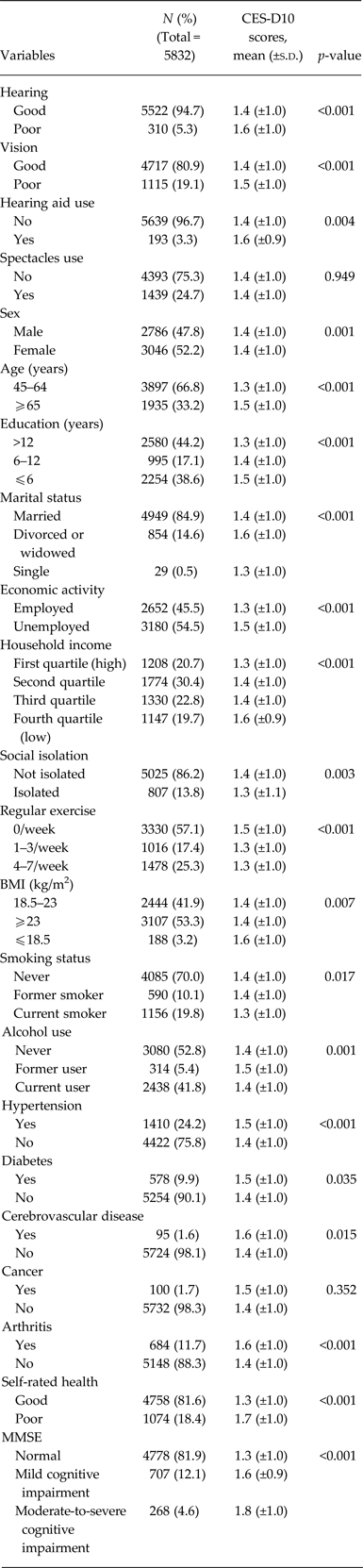
A total of 5832 individuals were included in this study and the data of the participants were analysed. The general characteristics of the study population at baseline are shown in Table 1. The mean ± standard deviation (s.d.) age of all participants was 59.9 ± 10.4 years, and there were 2786 male and 3046 female participants. The mean CES-D10 scores of all participants at baseline was 1.4 (±1.0).
General characteristics and CES-D10 scores of the study population at baseline (2006)

BMI, body mass index; MMSE, Mini-Mental State Examination; CES-D10, Center for Epidemiologic Studies Depression scale – ten items; s.d., standard deviation.
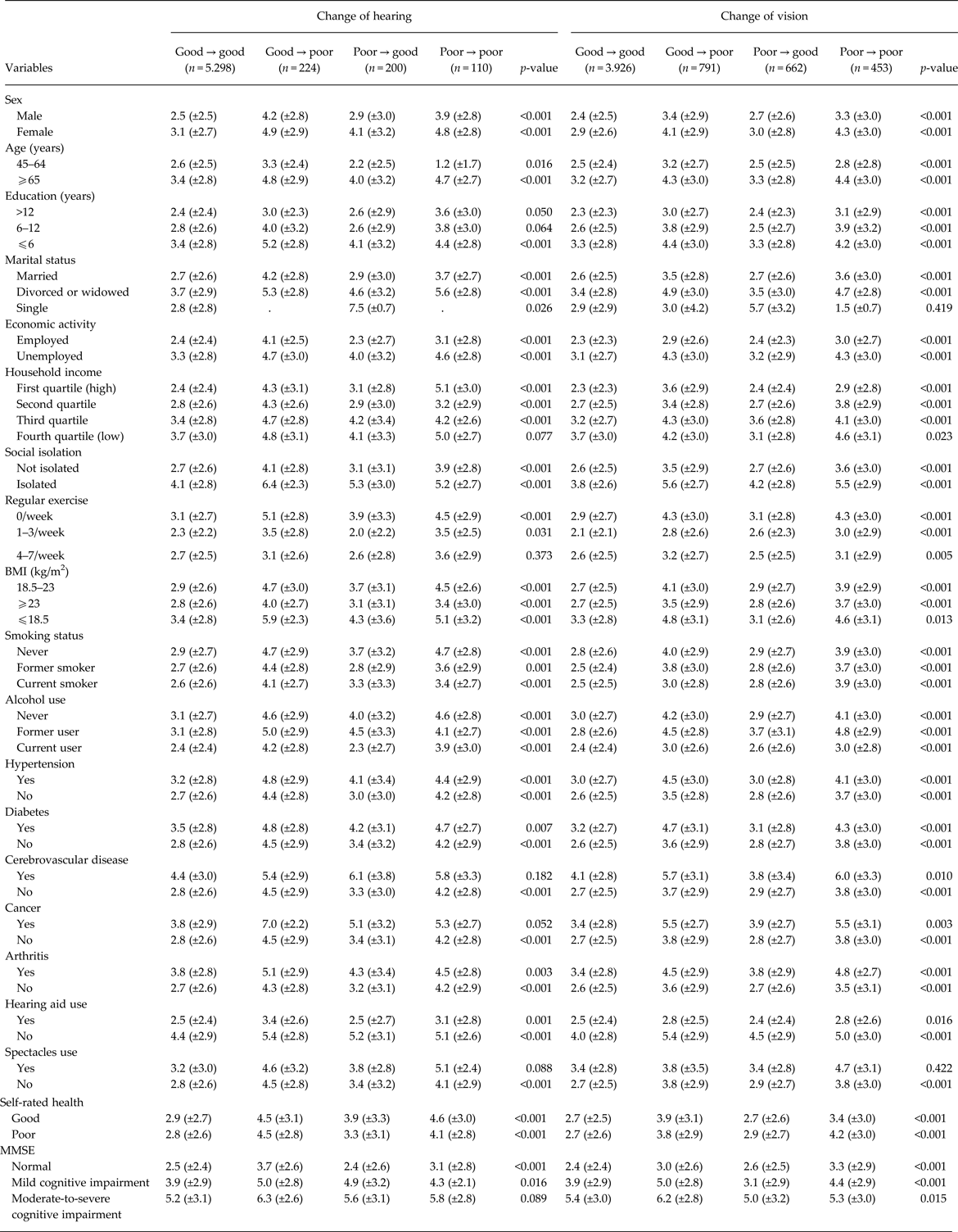
The participant characteristics were analysed according to changes in the self-reported hearing and vision from the previous survey (Table 2). There were 5298 participants who reported no change from good hearing, 224 reported a change from good to poor (hearing impairment), 200 reported a change from poor to good and 110 reported no change in poor hearing. In terms of self-reported vision, 3926 reported no change in good vision, 791 reported a change from good to poor (vision impairment), 662 reported a change from poor to good and 453 reported no change in poor vision.
CES-D10 scores of the study population according to self-reported hearing and vision changes (2006–2008)

BMI, body mass index; MMSE, Mini-Mental State Examination; s.d., standard deviation.
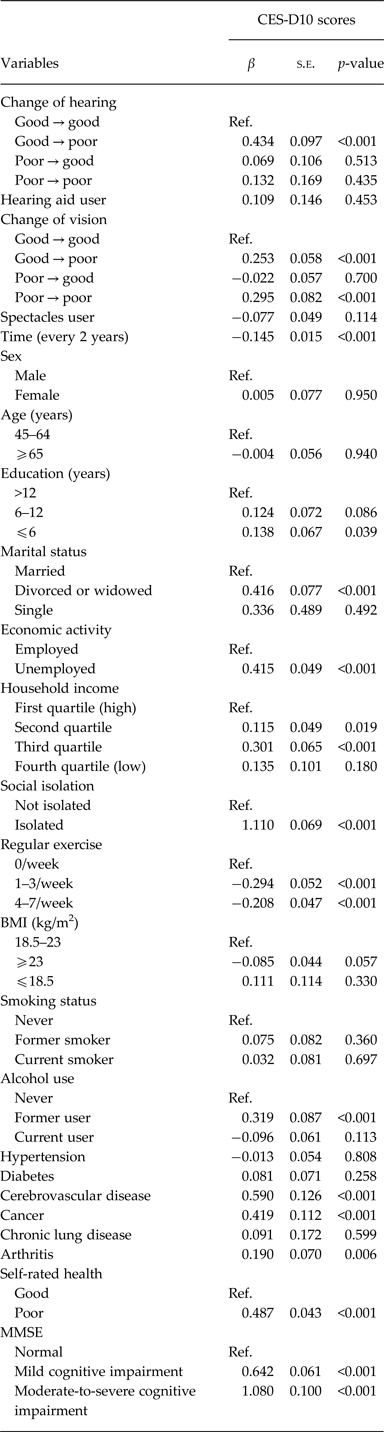
After adjustment for time and covariates in the GEE model, the CES-D10 scores of individuals with hearing impairment were significantly higher [β = 0.434, standard error (s.e.) = 0.097, p < 0.001] than those of individuals reporting no change in good hearing (Table 3). However, association between hearing aid use and CES-D10 scores was not significant (β = 0.109, s.e. = 0.146, p = 0.453). Vision impairment also resulted in significantly increased CES-D10 scores (β = 0.253, s.e. = 0.058, p < 0.001) when compared with no change in good vision. Although participants reporting no change in poor hearing did not show a significant increase in CES-D10 scores (β = 0.132, s.e. = 0.169, p = 0.435), those who reported no change in poor vision demonstrated significantly increased CES-D10 scores (β = 0.295, s.e. = 0.082, p < 0.001). Association between spectacles use and CES-D10 scores was not significant (β = −0.077, s.e. = 0.049, p = 0.114).
Results of generalised estimating equation for changes of hearing, vision and other covariates

BMI, body mass index; MMSE, Mini-Mental State Examination; CES-D10, Center for Epidemiologic Studies Depression scale – ten items; β, estimated coefficient; s.e., standard error; Ref., reference.
The effects of change in hearing or vision on depressive symptoms were analysed after adjustment for demographic, socioeconomic and health-related factors as potential confounders.
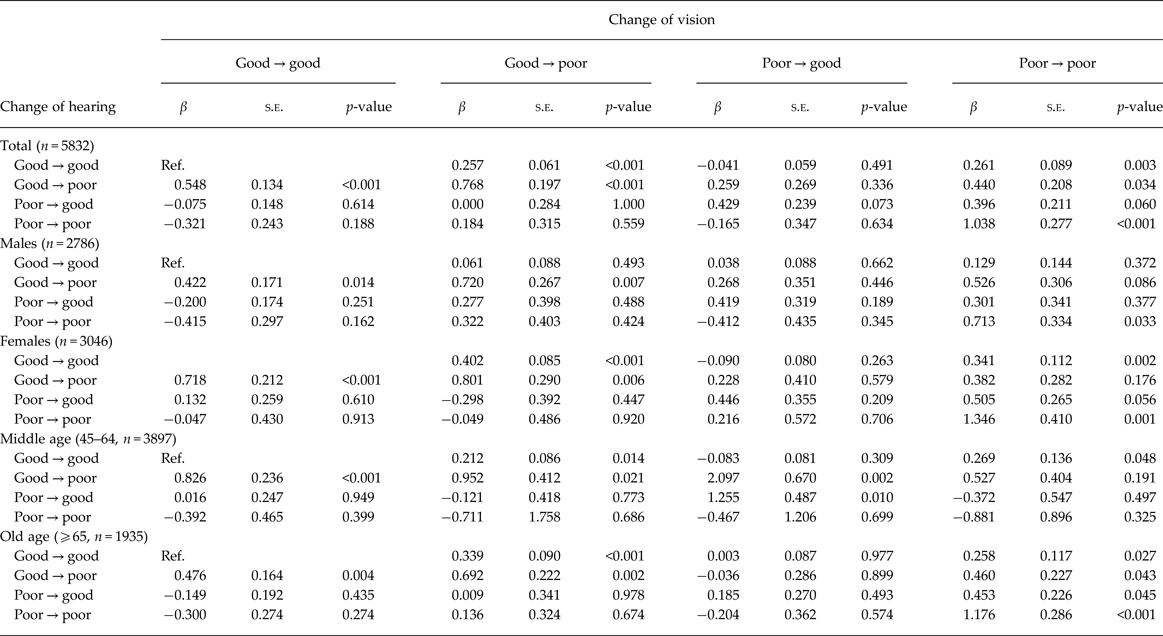
When compared with no change in good hearing and good vision, single impairment resulted in significantly increased CES-D10 scores (hearing impairment, β = 0.548, s.e. = 0.134, p < 0.001; vision impairment, β = 0.257, s.e. = 0.061, p < 0.001). The CES-D10 scores of participants with dual sensory impairment were also significantly increased (β = 0.768, s.e. = 0.197, p < 0.001), and the estimated coefficient was higher than those for single sensory impairments (Table 4).
Results of generalised estimating equation for interaction between hearing and vision change

β, estimated coefficient; s.e., standard error; Ref., reference.
The effects of interactions between change in hearing and vision on depressive symptoms were analysed after adjustment for demographic, socioeconomic and health-related factors as potential confounders.
The effects of hearing impairment on CES-D10 scores were significant in both male (β = 0.422, s.e. = 0.171, p = 0.014) and female participants (β = 0.718, s.e. = 0.212, p < 0.001). However, the effects of vision impairment were not significant in male participants (β = 0.061, s.e. = 0.088, p = 0.493) but were significant in female participants (β = 0.402, s.e. = 0.085, p < 0.001). The effects of dual sensory impairment were significant in both sexes (male participants, β = 0.720, s.e. = 0.267, p = 0.007; female participants, β = 0.801, s.e. = 0.290, p = 0.006). The effect of single sensory impairment on CES-D10 scores was significant in middle-aged adults (hearing impairment, β = 0.826, s.e. = 0.236, p < 0.001; vision impairment, β = 0.212, s.e. = 0.086, p = 0.014). In older adults, single sensory impairment was also significantly associated with CES-D10 scores (hearing impairment, β = 0.476, s.e. = 0.164, p = 0.004; vision impairment, β = 0.339, s.e. = 0.090, p < 0.001). The effects of dual sensory impairment were also significant in both age groups (middle age, β = 0.952, s.e. = 0.412, p = 0.021; old age, β = 0.692, s.e. = 0.222, p = 0.002).
Discussion
In a previous cohort study, a moderate or more severe degree of hearing impairment was associated with elevated odds ratios for depression; similar results were observed for vision impairment as well (Wallhagen et al. Reference Wallhagen, Strawbridge, Shema, Kurata and Kaplan2001). Another population-based study also demonstrated higher odds ratios for depression in participants with hearing loss, vision loss or both (Capella-McDonnall, Reference Capella-McDonnall2005). According to other studies, vision impairment is likely to have a more significant effect on depression than hearing impairment when the interactions are considered (Crews & Campbell, Reference Crews and Campbell2004; Chou, Reference Chou2008; Bernabei et al. Reference Bernabei, Morini, Moretti, Marchiori, Ferrari, Dalmonte, De Ronchi and Rita Atti2011). In contrast, in another longitudinal study, hearing loss was the main driver of the association between dual sensory impairment and increased depressive symptoms, whereas impaired visual function was not (Kiely et al. Reference Kiely, Anstey and Luszcz2013). In our study, the results are consistent with those from the study performed by Capella-McDonnall (Reference Capella-McDonnall2005), which also used self-reported assessment for sensory impairment. In her study, Capella-McDonnall reported that participants with dual sensory loss, vision loss only or hearing loss only had higher odds of depressive symptoms compared with those with no sensory loss. Moreover, she demonstrated that dual sensory loss had more significant effect on depressive symptoms than hearing loss only.
One reason for the varying results among previous studies might have been caused by the differing characteristics of study populations investigated. The studies that reported no evident effect of hearing impairment on depression included relatively older adults in the analysis (⩾61 years, Bernabei et al.; ⩾65 years, Chou; ⩾70 years, Crews et al.) when compared with other studies (⩾50 years, Wallhagen et al.; ⩾55 years, Capella-McDonnall) (Wallhagen et al. Reference Wallhagen, Strawbridge, Shema, Kurata and Kaplan2001; Crews & Campbell, Reference Crews and Campbell2004; Capella-McDonnall, Reference Capella-McDonnall2005; Chou, Reference Chou2008; Bernabei et al. Reference Bernabei, Morini, Moretti, Marchiori, Ferrari, Dalmonte, De Ronchi and Rita Atti2011). The effect of hearing impairment on depression was limited to middle-aged adults according to previous studies (Tambs, Reference Tambs2004; Nachtegaal et al. Reference Nachtegaal, Smit, Smits, Bezemer, van Beek, Festen and Kramer2009). Therefore, the effect might have been attenuated by the inclusion of an older population. Moreover, the effect of vision impairment has shown to differ according to age (Evans et al. Reference Evans, Fletcher and Wormald2007; Nyman et al. Reference Nyman, Gosney and Victor2010; Garin et al. Reference Garin, Olaya, Lara, Moneta, Miret, Ayuso-Mateos and Haro2014). Therefore, when analysing the effect of sensory impairment on depression, population's age and categorisation should be carefully considered.
The sex ratio of study participants included could be another reason for the results. Li et al. (Reference Li, Zhang, Hoffman, Cotch, Themann and Wilson2014) and Ives et al. (Reference Ives, Bonino, Traven and Kuller1995) reported a significant association between hearing impairment and depression in women (Ives et al. Reference Ives, Bonino, Traven and Kuller1995; Li et al. Reference Li, Zhang, Hoffman, Cotch, Themann and Wilson2014). Harada et al. (Reference Harada, Nishiwaki, Michikawa, Kikuchi, Iwasawa, Nakano, Ishigami, Saito and Takebayashi2008) found that hearing impairment was related to elevated odds of depression in men, but vision impairment was not (Harada et al. Reference Harada, Nishiwaki, Michikawa, Kikuchi, Iwasawa, Nakano, Ishigami, Saito and Takebayashi2008). In contrast, in their study, hearing impairment did not show increased odds for depression in women, but vision impairment did. The different effects of sensory impairment in each sex should be considered when establishing intervention strategies or planning further research.
Because we investigated the change in sensory impairment, the effect of newly developed single sensory impairment on depressive symptoms in participants who already had a sensory impairment could be investigated. To our knowledge, the effect of pre-existing sensory impairment prior to dual sensory impairment has thus far been investigated only by McDonnall in 2009 (McDonnall, Reference McDonnall2009). She showed that vision impairment prior to dual sensory impairment was associated with more severe depressive symptoms, whereas pre-existing hearing impairment was not, similar to that observed in our study (McDonnall, Reference McDonnall2009). Although the additional impacts of single sensory impairment remains inconclusive in the literature review (Schneider et al. Reference Schneider, Gopinath, McMahon, Leeder, Mitchell and Wang2011), the results indicate that the addition of a newly developed hearing impairment to a pre-existing vision impairment may have a greater impact on depression.
In clinical aspect, the differences shown in results might seem small. However, considering that CES-D10 scores of more than three points were treated as clinically significant depressive symptoms in the KLoSA survey, the differences do not represent a small change. Moreover, it needs to be considered that the change happened only in 2 years, which indicates that the differences only occurred in the previous survey. Being in a poor sensory impairment without intervention, especially in dual sensory impairment, would aggravate depressive symptoms over time and lead to the development of clinically significant depressive symptoms in several years.
The underlying mechanisms of the association between sensory impairment and depression are not well known. The most commonly adopted aetiologies of depression are loneliness and social isolation caused by sensory deprivation (Dalton et al. Reference Dalton, Cruickshanks, Klein, Klein, Wiley and Nondahl2003; Pronk et al. Reference Pronk, Deeg, Smits, van Tilburg, Kuik, Festen and Kramer2011; Chen et al. Reference Chen, Liang, Ou and Cai2013; Steptoe et al. Reference Steptoe, Shankar, Demakakos and Wardle2013). In support of the hypothesis, our results also showed that social isolation was a significant factor related to depression. The results emphasise the importance of social contact among people with impaired sensory functions.
The limitation of this study is the self-reported measurement of sensory impairment; nevertheless, we tried to use the same method as that in the English Longitudinal Study of Ageing (Chou, Reference Chou2008). Although self-reported assessments of hearing or vision have been widely used, controversies regarding the effect of sensory impairment on depression identified via assessment methods exist (Rovner & Ganguli, Reference Rovner and Ganguli1998; Wallhagen et al. Reference Wallhagen, Strawbridge, Shema, Kurata and Kaplan2001; Tambs, Reference Tambs2004; Capella-McDonnall, Reference Capella-McDonnall2005; Evans et al. Reference Evans, Fletcher and Wormald2007; Ishine et al. Reference Ishine, Okumiya and Matsubayashi2007; Chou, Reference Chou2008; Lee et al. Reference Lee, Tong, Yuen, Tang and Vanhasselt2010; Bernabei et al. Reference Bernabei, Morini, Moretti, Marchiori, Ferrari, Dalmonte, De Ronchi and Rita Atti2011; Pronk et al. Reference Pronk, Deeg, Smits, van Tilburg, Kuik, Festen and Kramer2011; Zhang et al. Reference Zhang, Bullard, Cotch, Wilson, Rovner, McGwin, Owsley, Barker, Crews and Saaddine2013; Garin et al. Reference Garin, Olaya, Lara, Moneta, Miret, Ayuso-Mateos and Haro2014; Li et al. Reference Li, Zhang, Hoffman, Cotch, Themann and Wilson2014; Yamada et al. Reference Yamada, Vlachova, Richter, Finne-Soveri, Gindin, van der Roest, Denkinger, Bernabei, Onder and Topinkova2014; Giloyan et al. Reference Giloyan, Harutyunyan and Petrosyan2015). The study performed by Kiely et al. (Reference Kiely, Anstey and Luszcz2013) is noteworthy in that they used an objective measurement of hearing and vision in a large population (Kiely et al. Reference Kiely, Anstey and Luszcz2013). According to their study, either hearing loss or dual sensory loss had significant effects on depressive symptoms, whereas vision loss did not. Interestingly, this result is contrary to previous studies that investigated the association between depression and hearing or vision impairments via self-reported measurements (Crews & Campbell, Reference Crews and Campbell2004; Chou, Reference Chou2008; Bernabei et al. Reference Bernabei, Morini, Moretti, Marchiori, Ferrari, Dalmonte, De Ronchi and Rita Atti2011). One study reported a significant effect of vision impairment or dual sensory impairment on depression, but not hearing impairment. These discrepancies could be attributable to the age effects of self-report measurement (Kiely et al. Reference Kiely, Gopinath, Mitchell, Browning and Anstey2012). Therefore, careful consideration is required when interpreting results based on self-reported measurements.
Another limitation is the lack of data, which need to be considered for sensory impairment and depression. Data on nutrition or diet quality, which are known to be associated with not only depression but also sensory impairment, were not eligible to be obtained from the KLoSA (Jacka et al. Reference Jacka, Pasco, Mykletun, Williams, Hodge, O'Reilly, Nicholson, Kotowicz and Berk2010; Lin et al. Reference Lin, Huang and Su2010; Gopinath et al. Reference Gopinath, Schneider, Flood, McMahon, Burlutsky, Leeder and Mitchell2014; Muurinen et al. Reference Muurinen, Soini, Suominen, Saarela, Savikko and Pitkälä2014). In addition, CES-D10 scores of participants who did not have any depressive symptoms due to taking antidepressants were also not available. Although there were 126 participants who took antidepressants from second to fifth surveys, they had to be excluded from the analysis due to their lack of CES-D10 scores.
The strength of our study is the numerous covariates included in the analysis that might be potential confounders. We considered demographic, socioeconomic and health-related factors in the analyses, according to prior studies (Chou, Reference Chou2008; Huang et al. Reference Huang, Dong, Lu, Yue and Liu2010; Kiely et al. Reference Kiely, Anstey and Luszcz2013). In terms of underlying medical condition, elevated depressive symptoms were associated with either arthritis, cerebrovascular disease or cancer, but not with hypertension or diabetes. Self-rated health was also significantly associated with depressive symptoms, as shown in the previous study (Ambresin et al. Reference Ambresin, Chondros, Dowrick, Herrman and Gunn2014). The associations, not only with medical conditions but also with education, marital status or cognitive impairment, were consistent with those reported by (Kiely et al. Reference Kiely, Anstey and Luszcz2013).
Regarding correction of sensory impairment, several studies report that hearing aids or cochlear implants have a protective effect on depression (Gopinath et al. Reference Gopinath, Wang, Schneider, Burlutsky, Snowdon, McMahon, Leeder and Mitchell2009; Boi et al. Reference Boi, Racca, Cavallero, Carpaneto, Racca, Dall'Acqua, Ricchetti, Santelli and Odetti2012; Mener et al. Reference Mener, Betz, Genther, Chen and Lin2013; Castiglione et al. Reference Castiglione, Benatti, Velardita, Favaro, Padoan, Severi, Pagliaro, Bovo, Vallesi, Gabelli and Martini2016; Choi et al. Reference Choi, Betz, Li, Blake, Sung, Contrera and Lin2016). Interventions such as spectacles and cataract surgery also resulted in decreased symptoms of depression (Owsley et al. Reference Owsley, McGwin, Scilley, Meek, Seker and Dyer2007; Meuleners et al. Reference Meuleners, Hendrie, Fraser, Ng and Morlet2013). Although either the use of hearing aid or spectacles were not associated with decreased depressive symptoms in our study, newly developed sensory impairment warrants attention and interventions to improve mental health.
Conclusion
We demonstrated that depressive symptoms are significantly increased in individuals with newly developed hearing or vision impairment aged ⩾45 years when potential confounders are adjusted for. Significant effects of dual sensory impairment on depressive symptoms were also found when the interactions of hearing and vision were taken into consideration. The dual sensory impairment resulted in increased depressive symptoms across sexes and age groups. Our results suggest that more attention should be paid to people with newly developed sensory impairment to improve mental health.
Financial Support
This research received no specific grant from any funding agency, commercial or not-for-profit sectors.
Conflicts of Interest
None.
Availability of Data and Materials
The raw data of Korean Longitudinal Study of Aging are available from the website of Korea Employment Information Service (http://survey.keis.or.kr/). Registration is required before to download the data.