Projectile point studies allow us to address adaptive strategies and historical trajectories of past human groups. Point morphologies track changes through time and space, allowing them to become temporal markers for studying cultural transformations and continuities. Recent decades have seen a more intensive study of projectile point contexts of use, weapon systems, and gender perspectives (Knecht Reference Knecht and Knecht1997; Martínez Reference Martínez2003; Nelson Reference Nelson and Knecht1997; Ratto Reference Ratto2003). Point design is contextual, transmits information, and can be used to show shared knowledge in a given space and time (Aschero and Martínez Reference Martínez2001; Wiessner Reference Wiessner1983).
Some authors have focused on the variability of points in a hunter’s quiver regarding the use of each type (Iversen Reference Iversen2016; Keeley Reference Keeley1996; Pétrequin and Pétrequin Reference Pétrequin and Pétrequin1990), including differences in the design between points used for interpersonal violence and those used for hunting (Berón Reference Berón, Mazz and Berón2012; Christenson Reference Christenson and Knecht1997; Loendorf et al. Reference Loendorf, Simon, Dybowski, Woodson, Plumlee, Tiedens and Withrow2015:942; Cotterell and Kamminga Reference Cotterell and Kamminga1992:181; Medina and Pastor Reference Medina and Pastor2021). Thus, war points were designed to maximize the likelihood of injuries regardless of how long it might take for the individual to die. In contrast, hunting projectiles were made to quickly kill the animals to avoid the possibility that they would not be recovered (Loendorf et al. Reference Loendorf, Simon, Dybowski, Woodson, Plumlee, Tiedens and Withrow2015). Based on these studies, as well as Rea (Reference Rea1998), we expect the projectile point recovery rate to be lower in situations of interpersonal violence. In contrast, the projectiles used for hunting will usually be recovered for reuse. We analyze projectile points from Arroyo Seco 2 (AS2) within this framework. AS2 is an open-air archaeological site, which presents exceptional characteristics to study hunter-gatherers of the Pampas region since the Late Pleistocene (Politis et al. Reference Politis, Barrientos, Scabuzzo, Politis, Gutiérrez and Scabuzzo2014).
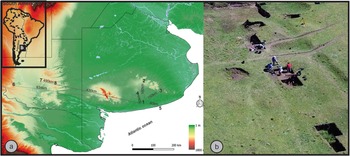
AS2, the earliest well-dated site in the Pampas, is a large, geologically stratified, multicomponent, Late Pleistocene to Late Holocene locality (Figure 1). Numerous occupation events representing field processing stations, residential camps, and burial practices have been uncovered, although identifying discrete occupation events has proven impossible (Politis et al. Reference Politis, Barrientos, Scabuzzo, Politis, Gutiérrez and Scabuzzo2014, Reference Politis, Gutiérrez, Rafuse and Blasi2016). However, a cluster of dates on extinct megamammal (Megatherium and Equus) bones, a few of which show human modification and are associated with unifacial artifacts made on orthoquartzite and phtanite, gave consistent ages between 14,000 and 13,000 cal years BP. The dates suggest at least two human occupation events, probably field processing camps (Politis et al. Reference Politis, Gutiérrez, Rafuse and Blasi2016). No projectile points were found in this Late Pleistocene component. Conversely, 32 projectile points have been recovered from the Holocene components, 13 of them in human skeletons. The association of projectile points and the skeletons enables us to confidently determine the ages of the points because these skeletons are well dated (Scabuzzo and Politis Reference Scabuzzo and Politis2024). The other 16 Holocene projectile points were recovered in stratigraphic units (hereafter SU) Y (Upper) and X, while three did not have a reliable provenience.
(a) Location of the site and sources of raw materials: (1)- Arroyo Seco 2; (2) Tandilia Range (fine-grained orthocuartzite from the Sierras Bayas Group, chert from the Cerro Largo Formation and silicified dolomite from the Villa Mónica Formation); (3) Tandilia Range (fine-grained orthocuartzite from the Sierras Bayas Group); (4) Interserrana plain (scantily exposed bedrocks of silicified siltstone from the Pillahuinco Group); (5) Atlantic coast (coastal pebbles of basalt, rhyolite, quartzite, dacite, chert, tuff, and others); (6) Meseta del Fresco (silicified limestone from the Meseta del Fresco Formation); and (7) Valle de Daza (silicified limestone); (8) El Carancho (silicified limestone). (b) Aerial view of the AS2 site. (Color online).

Figure 1 Long description
The image A shows a map of South America highlighting a specific region with varying elevation levels, indicated by color gradients. The map includes labels such as 'Atlantic Ocean' and 'Tandilia Range'. The image B shows an aerial view of a grassy field with several people gathered around a small excavation site. There are vehicles, including a red tractor and a white car, parked nearby. The area is surrounded by open grassland with a body of water visible in the background.
The primary objectives of our study are to identify the technological criteria in the production of AS2 projectile points and the associated weapon systems. Two goals of the latter are (1) to identify delivery systems used, whether they were suitable for mechanisms with a flight trajectory (e.g., throwing spears, points launched with dart throwers, or arrowheads using the bow; Hughes Reference Hughes1998; Martínez Reference Martínez2003; Ratto Reference Ratto2003) or without it such as hand weapons (e.g., short thrusting spears); and (2) to characterize the morphological designs of the points in each component. We also assess whether the projectiles performed different functions or were stylistic variants.
Additionally, the results obtained in this study are compared with the information from eastern Pampas sites with projectile points. Only points from stratigraphic contexts with absolute dates that have known weapon systems are considered (all dates are calibrated; Supplementary Material 1) for this comparison. This will enhance the development of a technological and chronological framework and fill in temporal gaps absent in the projectile point assemblage of AS2 (Late Pleistocene and most of the Early Holocene). In addition, the comparison will document changes and continuities in the projectile point designs throughout the historical trajectory in the eastern Pampas.
Arroyo Seco 2 Site
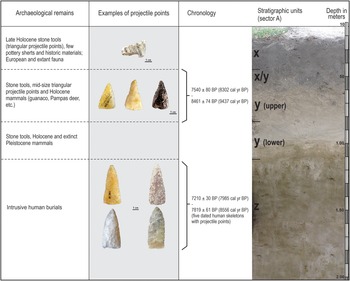
The AS2 site is located on a low ridge between the Arroyo Seco stream and a small shallow lake (Tres Arroyos, Buenos Aires Province; Politis et al. Reference Politis, Barrientos, Scabuzzo, Politis, Gutiérrez and Scabuzzo2014). A solid chronological and stratigraphic sequence that characterizes human occupations during the Late Pleistocene (between 14,000 and 13,000 cal years BP) and at different times of the Holocene has been established (Figure 2). The associated megafauna consists of extinct mammals, mainly Megatherium and Equus, and Pampas fauna such as guanaco, in the Late Pleistocene component, and guanaco and Pampas deer, among many others, in the Holocene levels. New sedimentological analyses by Adriana Blasi (Reference Blasi2025) at the AS2 identified four stratigraphic loess units (SU). The units are defined from the base to the top as Z, Y (Lower), Y (Upper), and X (Figure 2). There is also a transitional unit between X and Y, called X/Y—currently interpreted as the top section of Y (Upper) with organic material intrusions and a concentration of calcium carbonate at the base of Y (Lower), which was previously described as SU S (Fidalgo et al. Reference Fidalgo, Guzmán, Politis, Tonni, Salemme and Bryan1986; Politis et al. Reference Politis, Barrientos, Scabuzzo, Politis, Gutiérrez and Scabuzzo2014).
Schematic diagram of the stratigraphic profile of the AS2 site with the position of the projectile points. Note: The archaeological materials are not to scale. (Color online).

Figure 2 Long description
The diagram presents a comparison of archaeological remains, examples of projectile points, chronology and stratigraphic units with depth in meters. On the left, the archaeological remains are categorized into four sections: Late Holocene stone tools, stone tools with Holocene animals, stone tools with extinct Pleistocene mammals and intrusive human burials. Each category includes images of projectile points with scale bars indicating size. The chronology section provides dates in years BP (before present) for each category, ranging from 7,510 to 7,240 BP and 7,210 to 6,910 BP. The right side shows stratigraphic units labeled as x/y, y (upper), y (lower) and z, with corresponding depths in meters from 0 to 2.50. The stratigraphic units are visually represented with a photograph of sediment layers, indicating the depth and position of each unit.
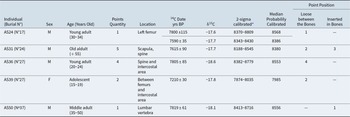
At least 50 individuals from 39 human internments were recovered in three sectors of the site (Politis et al. Reference Politis, Barrientos, Scabuzzo, Politis, Gutiérrez and Scabuzzo2014; Scabuzzo and Politis Reference Scabuzzo and Politis2019, Reference Scabuzzo and Politis2024). Four of the internments represent the oldest evidence of hunter-gatherer violence in Argentina (Table 1; Politis et al. Reference Politis, Barrientos, Scabuzzo, Politis, Gutiérrez and Scabuzzo2014; Scabuzzo and Politis Reference Scabuzzo and Politis2024).$
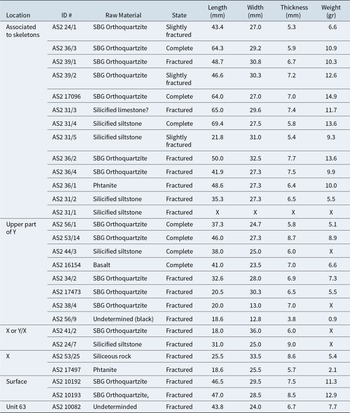
Projectile Points Sample Analyzed in This Article.

Table 1 Long description
The table provides measurements of projectile points, including length, width, thickness, and weight, along with their raw materials and condition. SBG Orthoquartzite is the predominant material, with lengths ranging from 18.0 mm to 69.4 mm. Many points are fractured, indicating potential use or environmental impact. Silicified siltstone and phtanite are also used, with silicified siltstone showing a wide range of thickness. Weight varies significantly, with some points missing weight data. The data suggests a diversity in material choice and condition, possibly reflecting different usage or preservation states.
Previous lithic studies at the site included morphological and technical use-wear analysis of the tools (Leipus Reference Leipus, Politis, Gutiérrez and Scabuzzo2014; Leipus and Landini Reference Landini, Politis, Gutiérrez and Scabuzzo2014), projectile points (Escola Reference Escola, Politis, Gutiérrez and Scabuzzo2014), and flakes and debris (Landini Reference Landini, Politis, Gutiérrez and Scabuzzo2014; Peretti and Escola Reference Escola, Politis, Gutiérrez and Scabuzzo2014). A preliminary microscopic use-wear analysis of the projectile points was inconclusive regarding specific use traces as the points did not develop clear use-wear traces (Marcela Leipus, personal communication 2025), which is common for this type of artifact (Laborda Martínez Reference Laborda and Amparo2016). The first morphological analysis of the projectile points made by Politis (Fidalgo et al. Reference Fidalgo, Guzmán, Politis, Tonni, Salemme and Bryan1986), describes eight points, none of which were found in burials. Later, Escola (Reference Escola, Politis, Gutiérrez and Scabuzzo2014) analyzed 12 pieces associated with human burials, five from SU Y (Upper) and one from SU X.
Materials and Methods
We first identified the lithic raw materials used to determine if their selection was related to the mechanical properties of the rocks (Ratto Reference Ratto2003). Second, we used a techno-typological approach analyzing variables such as the morphology of the projectile bases, blades, and tips; flaking patterns; and weight, length, width, and thickness, among others (Aschero Reference Aschero1975, Reference Aschero1983; Bleed Reference Bleed1986). For fragmentation, the distinction made by Escola (Reference Escola, Politis, Gutiérrez and Scabuzzo2014) was partially followed. She separated the assemblage into complete (including refitted points in full) and slightly fractured pieces versus fractured pieces (Escola Reference Escola, Politis, Gutiérrez and Scabuzzo2014). Size and width-thickness and length-width ratios were calculated through Aschero’s (Reference Aschero1975) graph based on Bagolini’s (Reference Bagolini1968; Supplementary Material 2). For these variables, only complete and slightly fractured pieces were considered. Additionally, we assessed the design of the points on different lithic raw materials, allowing us to study how the morphologies of the tools were transformed (Aschero Reference Aschero1988).
Our analysis of weapon systems is based on experimental, ethnographic, and historical information, yielding multiple models for functional assignment of projectile points (Fenenga Reference Fenenga1953; Hughes Reference Hughes1998; Ratto Reference Ratto2003; Shott Reference Shott1997; Thomas Reference Thomas1978). The models consider metric, morphological, and technical variables that differ between points of various propulsion systems. We seek to distinguish between darts, spears, and arrowheads systems based on variables proposed by Ratto (Reference Ratto2003): reinforcement surface, aerodynamics, hafting, penetration capacity, and expectations for the different capture systems. She separated the projectiles into hand points (thrust spears, or spears thrown by hand or with an atlatl) and projectile points (bow and arrow). For the functional assignment, we only considered complete and slightly fractured ones.
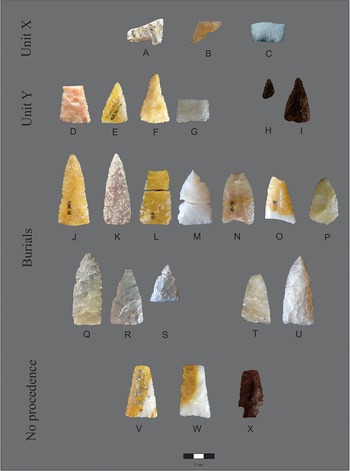
The sample analyzed comprises a total of 28 projectile points (Figure 3A–X; Table 1). Thirteen of the points were associated with five human skeletons interred in four burials. Five dates obtained directly from the bone collagen of the skeletons range between 8716 and 8413 cal years BP (Scabuzzo and Politis Reference Scabuzzo and Politis2024; Table 2). A sixth sample from skeleton AS24, yielded a date of 8000 cal years BP (Table 2), which is considered too young in comparison with the other dates (see discussion in Scabuzzo and Politis Reference Scabuzzo and Politis2024). Twelve points come from the SUs Y (Upper) and X assigned to the Early/Middle and Late Holocene, respectively (Politis et al. Reference Politis, Barrientos, Scabuzzo, Politis, Gutiérrez and Scabuzzo2014; Rafuse Reference Rafuse2017). Three points have an ambiguous stratigraphic provenance. In addition to these 28 points, two others have been found in X or X/Y (AS2 24/7 and AS2 41/2) and two in Y (Upper) (AS2 38/4 and AS2 44/3). They were not analyzed here, but photos and descriptions were made by Fidalgo and colleagues (Reference Fidalgo, Guzmán, Politis, Tonni, Salemme and Bryan1986) and will be considered in the discussion.
Projectile points from the Arroyo Seco 2 site: A: Siliceous; B and T: phtanite; C–G, J–P, V–W: orthoquartzite SBG; I: basalt; Q–S: silicified siltstone; U: possibly silicified limestone; H and X: undetermined rock. (Color online).

Figure 3 Long description
The image displays 28 projectile points arranged in rows and labeled from A to X. The points are categorized into different sections: Unit X, Unit Y, Burials and No Provenance. Each point varies in shape and material, with labels indicating their respective categories. The points are made from various materials such as siliceous, phtanite, orthoquartzite, basalt, silicified siltstone and possibly silicified limestone. The scale at the bottom indicates the size of the points.
Location of the Projectile Points in the Individuals.

Table 2 Long description
The table details the location and quantity of projectile points found in individuals of varying ages and sexes, along with radiocarbon dating and carbon isotope data. Young adults aged 20-34 had points primarily loose between bones, while older adults had points inserted in bones. The calibrated radiocarbon dates span from 7874 to 8809 years before present, with median probabilities indicating the most likely dates. The δ13C values range from -17.6 to -18.6, suggesting variations in diet or environmental conditions. The data highlights differences in burial practices and potential social or cultural factors influencing the placement of projectile points.
Sources: Politis et al. Reference Politis, Barrientos, Scabuzzo, Politis, Gutiérrez and Scabuzzo2014; Scabuzzo Reference Scabuzzo2010; Scabuzzo and Politis Reference Scabuzzo and Politis2019, Reference Scabuzzo and Politis2024
* The dates were calibrated with the CALIB 8.2 program (Stuiver et al. Reference Stuiver and Reimer1993; CALIB 8.2, http://calib.org), using the calibration curve SHCal20 Southern Hemisphere (Hogg et al. Reference Alan, Heaton, Hua, Palmer, Turney, Southon and Bayliss2020).
Results
Projectile Points Associated with Skeletons
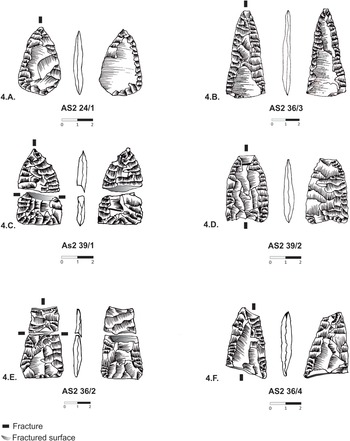
Two complete projectile points (AS2 36/3 and AS2 17096), three slightly fractured (AS2 24/1, AS2 39/1, and AS2 39/2), and two fractured ones (AS2 36/2 and AS2 36/4) were manufactured on SBG orthoquartzite of various colors including yellow, brown, and pink (Figures 3J–P and 4; Table 1; see Supplementary Material 3 for specimen location within the burials, state, and type of fractures). Only three points were manufactured on flake blanks (AS2 24/1, AS2 36/3, and AS2 17096). Three complete points are large and two are medium-large. The length-width ratio of three points is elongated medium, with two being normal laminar. All pieces are thick, except for point AS2 24/1 (Supplementary Material 4). Most cases exhibit marginal and partially invasive retouch, either unifacial or bifacial. Abrasion is present on the base of some specimens (AS2 36/2, AS2 36/3, and AS2 39/1), whereas on AS2 24/1, the abrasion extends almost to the distal portion (Escola Reference Escola, Politis, Gutiérrez and Scabuzzo2014). The extent of abrasion is interpreted as evidence of hafting technology (Figure 4D).
Projectile points found in human burials made in orthoquartzite SBG.

Figure 4 Long description
The image shows six illustrations of projectile points, each labeled with a specific identifier. The first illustration, labeled AS2 24/1, depicts a complete projectile point with detailed surface texture. The second illustration, labeled AS2 36/3, shows another complete point with similar surface detailing. The third illustration, labeled AS2 39/1, presents a slightly fractured point with visible fracture lines. The fourth illustration, labeled AS2 39/2, shows another slightly fractured point with detailed surface texture. The fifth illustration, labeled AS2 36/2, depicts a fractured point with clear fracture lines and surface details. The sixth illustration, labeled AS2 36/4, shows another fractured point with detailed surface texture. Each illustration includes a scale for reference and symbols indicating fracture and fractured surfaces are present.
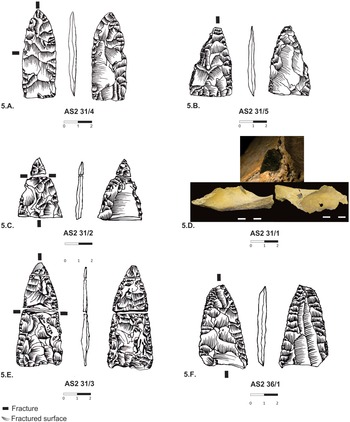
One complete (AS2 31/4), one slightly fractured (AS2 31/5), and two fractured projectile points (AS2 31/1 and AS2 31/2) were manufactured on silicified siltstone of different shades of green (Figure 5A–C). Three of the specimens were manufactured on flake blanks. In terms of the thickness, AS2 31/4 is thick, while AS2 31/5 is slightly thick (Supplementary Material 4). Invasive and partially invasive retouch, along with bifacial marginal retouching, suggests care in maintaining the longitudinal section and thinness. The AS2 31/1 specimen could not be analyzed because it is wedged in the right scapula of burial 24 (Figure 5D).
Projectile points found in human burials made on silicified siltstone (A–D), possibly siliceous limestone (E), and phtanite (F). (Color online).

Figure 5 Long description
The image shows six illustrations of projectile points labeled 5.A to 5.F. Each illustration includes a side and front view with measurements. 5.A (AS2 31/4) and 5.B (AS2 31/5) show detailed textures and fractures. 5.C (AS2 31/2) and 5.D (AS2 31/1) include a photograph of a fractured point. 5.E (AS2 31/3) and 5.F (AS2 36/1) display intricate patterns and fractures. Fracture and fractured surface are indicated with symbols.
A slightly fractured point (AS2 31/3) of white and gray silicified limestone, without an identifiable flake lank, was found fragmented into three segments. The specimen has marginal and partially invasive retouch, as well as marginal micro-retouch (Figure 5E). The point was stuck between the coccyx and the head of the femur, piercing the former bone. It appears to have been driven into the body with a spear when the individual was lying face down. The spear was used as leverage to favor penetration, which would have caused the point to break into three parts within the body.
The projectile point AS2 36/1 is the only piece made of a light gray phtanite. The specimen is a blade fragment with an unidentifiable blank. It has partially invasive and noninvasive marginal retouch (Figure 5F).
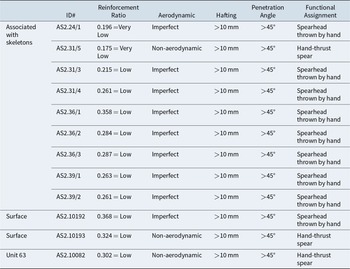
Function could be assigned to only nine of the 13 projectiles found in burial contexts. Based on their technological characteristics, eight were assigned to throwing spears and one (AS2 31/5) to a hand-thrust spear (Table 3).$
Functional Assignment of the Analyzed Lithic Points.

Table 3 Long description
The table analyzes lithic points based on reinforcement ratio, aerodynamic quality, hafting, penetration angle, and functional assignment. Most points have low reinforcement ratios and are classified as spearheads thrown by hand, with imperfect aerodynamics and penetration angles greater than 45 degrees. A few points, associated with very low reinforcement ratios and non-aerodynamic features, are identified as hand-thrust spears. All points have hafting greater than 10 millimeters. The data suggests a predominant use of hand-thrown spearheads, with a smaller subset used for thrusting, indicating varied functional assignments in the analyzed samples.
Projectile Points from SU Y (Upper)
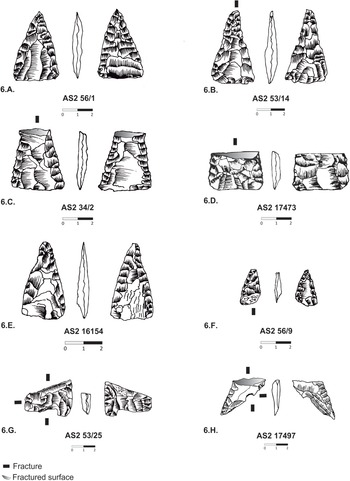
Two of the points manufactured on SBG orthoquartzite (shades of brown) are complete, while three are fractured. Use of a flake blank could only be demonstrated on one of the fractured points. The large and thick complete points (Supplementary Material 5) were marginally bifacially retouched (Figure 6A and B). The fractured points are pink, light gray, and white and present similar flaking characteristics as the complete pieces (Figures 6C and D).
Projectile points found in Y and Y–X (A–F) and X (G–H): A–D: orthoquartzite SBG; E: basalt; F: undetermined raw material; G: siliceous rock; H: phtanite.

Figure 6 Long description
The image shows eight illustrations of projectile points labeled 6.A to 6.H. Each illustration includes a scale bar and labels indicating fractures and fractured surfaces. 6.A (AS2 56/1) and 6.B (AS2 53/14) depict bifacially retouched points. 6.C (AS2 34/2) and 6.D (AS2 17473) show points with visible fractures. 6.E (AS2 16154) and 6.F (AS2 56/9) illustrate complete points with detailed flaking patterns. 6.G (AS2 53/25) and 6.H (AS2 17497) display fractured points with distinct surfaces. Each point is shown from multiple angles to highlight features.
Specimen AS2 44/3 was manufactured on silicified siltstone. According to Fidalgo and colleagues (Reference Fidalgo, Guzmán, Politis, Tonni, Salemme and Bryan1986), it is a bifacial point with an isosceles triangle shape, a slightly concave base, and lightly convex side edges. The base is thinned and has invasive bilateral retouch. The blank could not be identified. It also presents uniform bifacial marginal retouch.
Piece AS2 16154 was made of black basalt. Its blade has regular contours and a concave and convex portion on one edge, resulting from marginal retouching. The specimen shows resharpening and modification on the distal end of the blade, which may indicate a functional change. The base is convex (Figure 6E). Side A presents negative scars from irregular retouching, while side B shows evidence of a flake blank.
Finally, specimen AS2 56/9 is a tip fragment made of an undetermined dark gray raw material. It has regular micro-retouch on the left section and irregular laminar and wide retouch on the right edge (Figure 6F).
Projectile Points from SU X (Late Holocene)
Point AS2 41/2 is a proximal section of a bifacial point with a straight and thinned base and subparallel edges made on SBG orthquartzite. The silicified siltstone point AS2 24/7 is slightly fractured and was described as an isosceles triangle-shaped bifacial point with serrated edges and a slightly concave and thinned base. It also presents invasive bilateral retouch (Fidalgo et al. Reference Fidalgo, Guzmán, Politis, Tonni, Salemme and Bryan1986). The third point corresponds to a bifacial fragment on an undetermined white silica, with parallel sides and an irregular base (53/25). It has a discontinuous convex contour and was manufactured on a flake blank (Fidalgo et al. Reference Fidalgo, Guzmán, Politis, Tonni, Salemme and Bryan1986). The point was modified by a fracture and then repaired by pressure knapping (Figure 6G; Escola Reference Escola, Politis, Gutiérrez and Scabuzzo2014). The fourth point was made on phtanite and exhibits a transverse and an oblique fracture. Even though the blank was undetermined, there is evidence of parallel bilateral retouching (Figure 6H). We were unable to determine the weapon system for the projectiles found at SUs Y (Upper) and X, as most were fractured, and the remaining ones had been resharpened.$
Specimens with Ambiguous Stratigraphic Provenience
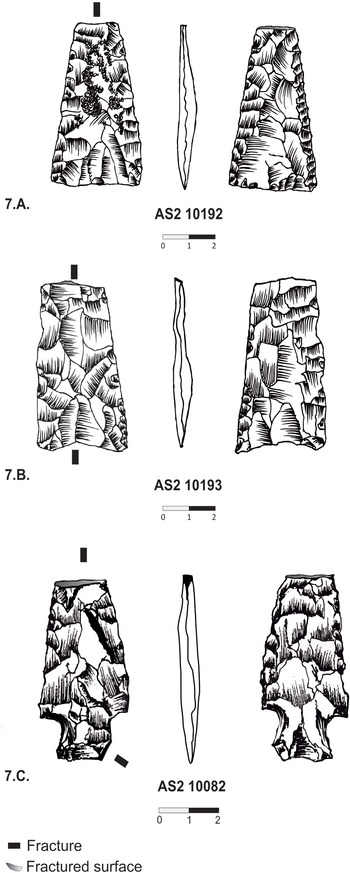
Two fractured projectile points were manufactured from brown and white SBG orthoquartzite (AS2 10192 and AS2 10193), and a third one (AS2 10082) was made from an undetermined dark brown rock. Both orthoquartzite points are large and thick, with length-width ratios of normal laminar and narrow laminar. They have marginal retouch on one side and partially invasively retouch on the other (Figure 7A and B). Specimen AS2 10082 is the only stemmed point in the assemblage (Figure 7C). It is also thick and normal laminar, but with a medium small ratio. The differential treatment on each side is similar to the other fractured points—partially invasive retouch and marginal retouch—but more irregular. The stem is short with concave sides and a slightly concave base. Two weapon systems are represented, piece AS2 10192 is part of a hand-thrown spear, while the remaining two are hand-thrust spears (Table 3).
Points with ambiguous stratigraphic provenance: A–B: orthoquartzite SBG; C: undetermined rock.

Figure 7 Long description
The image shows three illustrations of fractured projectile points labeled 7.A, 7.B and 7.C. Each illustration includes a front and side view. The first point, labeled 7.A, is identified as AS2 10192. The second point, labeled 7.B, is identified as AS2 10193. The third point, labeled 7.C, is identified as AS2 10082. Each point has markings indicating fractures and fractured surfaces. The scale below each illustration provides a reference for size.
Discussion
Trends in the Design of the Projectile Points from the AS2 Site
Projectile Points Associated with Skeletons
The most common raw material of projectile points associated with skeletons is SBG orthoquartzite (Table 1), which outcrops in the central part of the Tandilia Hills range at a minimum distance of approximately 150 km (Colombo Reference Colombo2011). Various colors of this rock were selected, as in many sites of the eastern Pampas (Colombo and Flegenheimer Reference Colombo and Flegenheimer2013). SBG is a hard, tenacious rock due to its silicified cement and well-sorted quartz grains (Weitzel and Colombo Reference Weitzel and Colombo2006; Weitzel et al. Reference Weitzel, Flegenheimer, Martínez and Colombo2014). These characteristics of SBG make it a good option for projectile point production and use among all the other Pampean rocks, as different petrologic and experimental studies have shown (Bayón et al. Reference Bayón, Flegenheimer, Valente and Pupio1999; Flegenheimer et al. Reference Flegenheimer, Martínez, Colombo, Berón, Luna and Bonomo2010; Nami Reference Nami1999). Additionally, SBG orthoquartzite is easily obtained from large outcrops in the Tandilia Hills Range. Also, many lithic studies have demonstrated orthoquartzites are suitable for various kinds of artifacts (e.g., Leipus and Landini Reference Landini, Politis, Gutiérrez and Scabuzzo2014; Nami Reference Nami1999).
The next most common material at AS2 is a silicified siltstone from the Ventania Hills range or from the nearby outcrop of Gonzales Chavez, located approximately 50 km from the site (Barros et al. Reference Barros, Blasi and Politis2022). Other raw materials were macroscopically identified as silicified limestone (AS2 31/3) and phtanite (AS2 36/1). The outcrops of silicified limestone occur in the western Pampas (Carrera Aizpitarte et al. Reference Aizpitarte, Manuel and Blasi2015), between 400 and 600 km from the site, while the closest sources of phtanite are in the northwestern sector of the Tandilia Hills range, about 160 km from AS2 (Barros and Messineo Reference Barros and Messineo2004).
The blanks for the production of orthoquartzite projectile points could have been obtained from prepared cores designed to produce predetermined flake shapes. They could also have been made from flakes obtained from nonprepared cores. Considering the production goals, morphological features such as length and thickness of some specimens suggest the use of prepared cores to acquire laminar and medium-elongated flakes. Two large pieces (AS2 36/2 and AS2 39/2) were produced and modified by bifacial thinning. During manufacturing, thinness and symmetry were sought in the longitudinal and cross sections. This same type of technique was identified in two of the projectile points without exact provenience (AS2 10192 and AS2 10193). Additionally, there are medium-sized blanks (AS2 39/1 and AS2 24/1), one with partial bifacial treatment (AS2 24/1).
The analysis of weapon systems based on projectile points indicates the use of hand-thrown spears, with only one case being a hand-thrust spear (Table 3). The remaining four points could not be attributed to any weapon system due to the degree of fracture. These results reinforce Scabuzzo’s (Reference Scabuzzo2010) conclusion, based on the osteological evidence from individuals with unilaterally worn elbow joints, that this was an indicator of the use of spears or atlatls.
Points from SUs Y (Upper), and X
In Y (Upper), the most represented raw material among the projectile points is the SBG orthoquartzite. The point bases are mostly convex, suggesting the same weapon system. Weapon systems could not be assessed for other AS2 specimens because of tool reworking and fractures. The specimen AS2 16154 (Figure 6E) shows a resharpening of the body, indicating a change in the instrument’s function, possibly to a drill, similar to AS2 53/14 (Figure 6B). The basalt used for AS2 16154 was probably obtained from the Atlantic coast (Leipus and Landini Reference Landini, Politis, Gutiérrez and Scabuzzo2014).
Points found in burials are mainly complete, large or medium-large, and have an elongated and laminar length-width ratio. Projectiles from Y (Upper) and X are smaller and fractured; some of them have been resharpened, while others have been reused without resharpening. Points from burials represent the last stage in the life history of these artifacts. Remaining within the human bodies could be responsible for their differential preservation (Loendorf et al. Reference Loendorf, Simon, Dybowski, Woodson, Plumlee, Tiedens and Withrow2015).
Projectile Points with Ambiguous Stratigraphic Provenance
One surface point is interpreted as the tip of a hand-thrown spear (AS2 10192), while the other (AS2 10193) is a hand-thrust spear. The raw material used is similar to the projectiles from the burials (Table 3). The pieces were not thinned to maintain regularity and lacked aerodynamic characteristics. Finally, the specimen AS2 10082 is the only stemmed point found at the site. It is morphologically similar to the Pay Paso type of Uruguay, which dates between 11,000 and 10,300 cal years BP (Rafael Suárez, personal communication 2019; Suárez Reference Suárez2011). The point is also similar to those from the Vejigas and Pilatos streams in Uruguay (Figure 7C; Meneghín and Sánchez Reference Meneghín and Sánchez2009:Plate VI) and to some of the points attributed to the Umbú phase in southern Brazil. However, there are also similarities to Late Holocene stemmed points from Northern Patagonia (Hugo Nami, personal communication 2024).
Although projectile points recovered from burials and those from the SUs Y (Upper) and X in AS2 differ in function, both are primarily triangular and mostly manufactured on SBG orthoquartzite, followed by the silicified siltstone and phtanite. However, silicified limestone is unique in that it is only associated with human skeletons. Similarly, the basalt and the two undetermined rocks only appear in Y (Upper) and X.
The projectiles associated with the skeletons are larger and have medium elongated or normal laminar length-width ratios, while others are large-medium in size and present a predominance of normal medium ratios. Another significant difference is the finishing of the pieces and the treatment of the bases. Escola (Reference Escola, Politis, Gutiérrez and Scabuzzo2014) proposed that points associated with the skeletons are pressure flaked, maintaining regularity and symmetry in the longitudinal and transverse sections. This is not the case of points from SUs Y (Upper) and X, where the use of pressure is scarce, and asymmetry predominates in the transverse and longitudinal sections. These variations are a function of technical characteristics necessary for hafting, as well as differences in the preparation and maintenance of functionally different projectile points, such as those for interpersonal violence versus animal hunting. In terms of weapon system, the points associated with human skeletons and those without stratigraphic context are tips of spears thrown by hand and, to a lesser extent, tips of hand-thrust spears.
The Projectile Points over Time in the Eastern Pampas
Late Pleistocene (14,000–11,700 cal years BP)
During the Late Pleistocene, the characteristic projectile point type is the Fishtail. Fishtails are found at many sites such as La Amalia, Los Pinos, Paso Otero 5, Cerro La China 1 and 2, and Cerro Sombrero Abrigo 1 (Bonnat et al. Reference Bonnat, Mazzanti and Martínez2015; Flegenheimer et al. Reference Flegenheimer, Mazzia and Weitzel2015; Martínez Reference Martínez2001; Mazzanti Reference Mazzanti1996–1998; Politis Reference Politis, Bonnichsen and Turnmire1991; Weitzel et al. Reference Weitzel, Mazzia and Flegenheimer2018; see Supplementary Material 6). They are mainly recorded in the Tandilia Hills range and, to a lesser extent, in the Interserrana area (the plains between the Tandilia and Ventania Hills ranges), although this may be sampling bias due to less archaeological research in the latter area. Fishtails, probably used as spear tips, were manufactured on SBG orthoquartzite, quartz, and phtanite. This type of projectile point is associated with Late Pleistocene occupations, between 12,800 and 12,000 cal years BP, throughout South America (Nami Reference Nami2010, Reference Nami2021; Prates et al. Reference Prates, Rivero and Iván Perez2022; Suárez Reference Suárez2006, Reference Suárez2015; Weitzel et al. Reference Weitzel, Mazzia and Flegenheimer2018). The site of AS2 was not occupied during this period. In fact, two occupation events have been detected, one at 14,000 cal years BP associated with the exploitation of Megatherium and Equus, and another at 13,000 cal years BP related to the exploitation of Equus and Hippidion, as well as Pampean fauna (Politis et al. Reference Politis, Gutiérrez, Rafuse and Blasi2016). Both of these events occurred before the expansion of Fishtail points to the Pampas and other regions of the Southern Cone (Suárez Reference Suárez, Suárez and Ardelean2019; Weitzel et al. Reference Weitzel, Mazzia and Flegenheimer2018).
For the period when Fishtail points occurred, two fragments of convex base points from Campo Laborde (Politis et al. Reference Politis, Messineo, Stafford and Lindsey2019) and Paso Otero 5 (Martínez Reference Martínez2001) have also been recovered, although no complete specimen of this type has yet been found. For Chichkoyan and Nami (Reference Chichkoyan and Nami2025), the base point of Campo Laborde could be the tip of a broken fishtail projectile point, a hypothesis that we do not favor. Nevertheless, more detailed and comparative studies are needed to reach a compelling conclusion.
Early Holocene (11,700–8200 cal years BP)
No projectile points in the Pampas region have been dated to this period, except for the ones presented in this article. The lack of dates on early Holocene projectile points is likely because of the scarcity of excavated sites for this period (Politis and Borrero Reference Gustavo and Borrero2024).
Middle Holocene (8200–4200 cal years BP)
In the Middle Holocene, projectile points were recovered at AS2, Paso Otero 4, Laguna de Los Pampas S2E, and Cerro La China 2 and 3. A basal fragment of a triangular projectile point made of SBG orthoquartzite was found in the upper level of the Paso Otero 4 site, dated at 8096 cal years BP (Barros et al. Reference Barros, Martínez and Gutiérrez2014). At the Laguna de Los Pampas S2E site, dated at 7818 cal years BP, the base of a medium triangular stemless projectile point made of SBG orthoquartzite was found (Messineo et al. Reference Messineo, González, Álvarez and Pal2018). At the Cerro La China 2 site, dated to 5099 cal years BP, and the Cerro La China 3 site, three medium triangular points made of SBG orthoquartzite were also recovered (Zárate and Flegenheimer Reference Zárate and Flegenheimer1991).
Late Holocene (4200–500 cal years BP)
During this period, numerous sites have been identified in the region, primarily situated on shallow lake edges, frequently reoccupied for extended durations. Nearly all sites exhibit stemless triangular points, such as Calera (3606 to 1616 cal years BP; Politis et al. Reference Politis, Messineo, Kaufmann, Barros, Álvarez, Di Prado and Scalise2005), Empalme Querandíes (3261 to 1965 cal years BP; Messineo et al. Reference Messineo, Álvarez, Dubois, Steffan and José Colantonio2013), Puente de Fierro (2572 to 1960 cal years BP; Vigna et al. Reference Vigna, Isabel González and Weitzel2014), Hangar (1095 to 609 cal years BP; Kaufmann et al. Reference Kaufmann, Álvarez, Messineo, Barros, Bonomo, Heider, Belardi, Bozzuto, Fernández, Moreno and Neme2021), La Guillerma (1062 cal years BP, González Reference González2005; Vigna et al. Reference Vigna, Isabel González and Weitzel2014), and Paso Vanoli (786 to 622 cal years BP; Vecchi et al. Reference Vecchi, Hernández and García2021), among others.
Finally, small to very small-triangular stemless projectile points were frequent during the Late Holocene, suggesting the spread of the bow and arrow after 3000 cal years BP. The spread of bow and arrow is based on a projectile point interpreted as an arrowhead at the Calera site (Kaufmann et al. Reference Kaufmann, Álvarez, Messineo, Barros, Bonomo, Heider, Belardi, Bozzuto, Fernández, Moreno and Neme2021). Although a close association exists between the arrow point and the dated sample, this age has to be taken with caution because it is an isolated occurrence and it is earlier than the dispersion of the bow and arrow in South America (see discussion in Marsh et al. Reference Marsh, Llano, Cortegoso, Castro and Yebra2023). The solid archaeological evidence of arrowhead appearance is based on a strong signal after 1200 cal years BP (Barros et al. Reference Barros, Heider, Álvarez, Kaufmann and Bellinzoni2018). Three rock shelters show high accumulations of arrow points at this time. In the Upper Component of the Cueva El Abra site (837 cal years BP; Mazzanti Reference Mazzanti2006) and in the Lobería 1 site (748 to 108 cal years BP; Mazzanti et al. Reference Mazzanti, Colobig, Zucol, Martínez, Porto López, Brea, Passeggi, Soria, Quintana, Puente, Berón, Luna and Bonomo2010) many complete and broken arrow points (approximately 300 in each cave) appear concentrated in restricted places (Diana Mazzanti, personal communication 2024). A similar assemblage, but with fewer points, was found in the site Alero Curicó (441 to 170 cal years BP; Pedrotta Reference Pedrotta2005).
At the Cueva El Abra site, Valverde and Martucci (Reference Valverde, Martucci, Martínez, Gutiérrez, Curtoni, Berón and Madrid2004) identified two groups of projectile points: small stemless triangular points and medium, lanceolate, and triangular points. They also recognized three types of aerodynamics: perfect, imperfect, and nonaerodynamic. Based on their analyses, the authors differentiated two weapon systems: a spear thrower or atlatl and bow and arrow (dart points and arrow points), which suggest different hunting strategies.
At Cerro Curicó, Pedrotta (Reference Pedrotta2005) described most projectile points as small, triangular, stemless, and bifacial. She proposed that 32 projectile points were within the range of arrowheads. At this site and in Cueva El Abra, the projectile points exhibit similar technological characteristics, which are common in projectile points associated with hunting during the final Late Holocene period. At this point, an apparent decrease in the consumption of artiodactyls and an increase in the exploitation of smaller species is detected (Valverde and Martucci Reference Valverde, Martucci, Martínez, Gutiérrez, Curtoni, Berón and Madrid2004). Incorporating the bow changed hunting strategies, allowing hunters to be further away from the prey to avoid detection and enabling greater precision in hitting the target.
Although the specific Late Holocene sample recovered in AS2 is limited, and this weapons system could not be established, technological differences are observed (e.g., relative dimensions, typology, standardization) compared to those found in other sites attributed to the Late Holocene, such as the El Abra Cave and Cerro Curicó sites. These differences could also be chronological, as it is unclear if those from AS2 are as late as the former.
Conclusions
The information summarized and discussed in the preceding text allows us to draw the following conclusions.
1. The earliest record of projectile points in the Pampas, the Fishtail type, dates to 12,800–12,200 cal years BP (Weitzel et al. Reference Weitzel, Mazzia and Flegenheimer2018), while the oldest well-dated triangular points in AS2 are placed at 8550 cal years BP; that is, a gap of 3650 years. The temporal discontinuity and significant differences in design and production suggest that the medium/large triangular points did not derive from the Fishtail projectile points, indicating they may have operated within a separate technological system and would not belong to the same tradition. Recent studies on ancient DNA (Posth et al. Reference Posth, Nakatsuka, Lazaridis, Skoglund, Mallick and Lamnidis2018) would support the development of new independent techno-morphological strategies. DNA studies propose an ancient genetic contribution to South America from the Anzik-1 skeleton of 12,800 cal years BP, followed by a partial population replacement at 9000 cal BP with a substantial continuity throughout the Holocene in various regions of South America, including the Pampas. Anzic is Clovis in age and technology, the same age as Fishtail points. While it remains challenging to directly correlate the techno-morphology of the points with population expansions (genetically defined), the shift in the genomic structure of the South American populations could partially explain the discontinuity between the two projectile point models.
Another explanation could be functional since as it has been pointed out (Schobinger Reference Schobinger1969) the end of the production and use of Fishtail projectile points roughly coincides with the extinction of the Pleistocene megafauna (Prates and Perez Reference Prates and Iván Perez2021; Prates et al. Reference Prates, Rivero and Iván Perez2022). Perhaps that design was functionally and stylistically associated with the hunting of Pleistocene fauna. Once the fauna became extinct, Fishtail points lost their primary function. In Uruguay, Fishtail projectile points were replaced by two types, Tigre and Pay Paso, dated to the Late Pleistocene and the Early Holocene (Suárez Reference Suárez2015, Reference Suárez, Suárez and Ardelean2019). However, in the Pampas, these types were absent except for the ambiguous example from AS2. The few sites assigned to this period suggest a low population density during the first millennia of the Early Holocene in the Pampas (see discussion in Politis and Borrero Reference Gustavo and Borrero2024).
2. The first examples of triangular projectile points (medium/large size) are mostly bifacial. They are associated with human burials at the Early to Middle Holocene boundary, between 8600 and 8000 cal years BP. The triangular projectile points were mainly used as spearheads to kill people. The social/symbolic dimensions of the points are unknown. However, it is clear that these points operated within a different social and symbolic context than those used for hunting. Whether the individuals with the embedded points were killed by their own band members as a result of intragroup conflicts, as part of ritual sacrifices, or if members of another band or ethnic group killed them is not known. The long-distance provenance of the raw material of the point AS2 31/3 supports the latter possibility.
3. Another set of medium-sized projectile points from SU Y (Upper) were dated between 9437 and 8302 cal years BP, or possibly up to 6556 cal years BP (Rafuse Reference Rafuse2017). However, the association between dates and the projectile points in stratigraphic contexts appears less robust than the association between projectile points and dates derived from burials. The points from the burials, those from the Y (Upper), and probably two of the points without stratigraphic references (AS2.10192 and AS2.10193) could be contemporary.
A high degree of standardization of large and medium triangular points exists in the other eastern Pampas sites at the end of the Early Holocene and during the Middle Holocene. This design is associated with the main use of spears thrown by hand and less with hand-thrust spears, which, in some cases, were maintained over time.
4. During the Late Holocene, few projectile points were recovered from SU X of AS2. No 14C dates are associated with these specimens, and due to the condition of the projectiles, we cannot identify the associated weapon system. However, some points date to the Final Late Holocene at Lobería 1, Cerro Curicó, and El Abra and show significant variability of medium and small stemless triangular points at this time. The associated weapon systems in the Final-Late Holocene include bows, darts, propellers (atlatls), spears thrown by hand, and hand-thrust spears. The use of the bow may date back as far as 3000 years cal BP, but convincing evidence suggests a date after 1200 cal years BP.
In summary, throughout the Holocene in the eastern Pampas, changes in design are primarily associated with varying social organization scenarios among hunter-gatherer groups, instances of violence within or between groups, and patterns of faunal exploitation. No projectile points have been recovered from the initial phase of settlement in the Pampas, represented in the two earliest occupation events of AS2 (14,000 and 13,000 cal years BP). However, in a second phase of population settlement (after 12,800 cal years BP), an extended and almost exclusive model emerged, the Fishtail point. At the end of the Early Holocene and throughout the Middle Holocene, a distinctive design was present: large and medium-sized, stemless, triangular projectile points. In contrast, the Late Holocene exhibits greater variability, characterized by the coexistence of medium and small stemless points, as well as the incorporation of bow-and-arrow technology, which is likely a result of shifting hunting strategies. Thus, technological continuity and a similar pattern (with variations in manufacturing techniques, sizes, and thicknesses) are observed in the design of triangular projectile points from the Middle Holocene until the time of the Spanish conquest. Finally, we note that the different models of projectile points coexist with another popular weapon: the bola stones. Bola stones were found in an AS2 burial dated to 5162 cal years BP (Scabuzzo and Politis Reference Scabuzzo and Politis2024). The coevolution of these two weapon systems, dating back to at least the Middle Holocene, remains a pending study in the archaeology of the South Cone of South America.
Acknowledgments
In memory of Patricia Escola, whose studies deepened our knowledge of the projectiles of the AS2 site and inspired the present article. We wish to thank Víctor Hugo González Catriel (who has recently passed away) and Claudio Martínez Curiqueo, leaders of the Mapuche-Tehuelche Community Peñi Mapu, for allowing the study of the Arroyo Seco 2 site and for their support in our research at the site. We also thank Pablo Messineo, Milagros Ríos Malan, and Manuel Carrera Aizpitarte for their helpful comments, and Alejandra Matarrese and Marcel Kornfeld for their assistance with translation and editing. We also thank Diego Rivero and Rafael Suárez for their help in identifying one of the pieces. Also, to Hugo Nami for his comments on the earlier version of the manuscript. Finally, to the three anonymous reviewers who helped to improve this manuscript.
Funding Statement
Funding for this project was provided by the Consejo Nacional de Investigaciones Científicas y Técnicas (CONICET) and the Agencia Nacional de Promoción Científica y Tecnológica (ANPCYT, PICT-2015-2777).
Data Availability Statement
The analyzed artifacts are available at the Instituto de Investigaciones Arqueológicas y Paleontológicas del Cuaternario Pampeano (INCUAPA), Consejo Nacional de Investigaciones Científicas y Técnicas (CONICET), and Facultad de Ciencias Sociales, Universidad Nacional del Centro de la Provincia de Buenos Aires. Some of them are also in exhibition at the Museo Municipal José A. Mulazzi of Tres Arroyos.
Competing Interests
The authors declare that there is no conflict of interest.
Supplementary Material
The supplementary material for this article can be found at https://doi.org/10.1017/laq.2025.10113.
Supplementary Material 1. Radiocarbon dates from sites mentioned in the text (table).
Supplementary Material 2. Size and length-width ratio (figure).
Supplementary Material 3. Fracture description of AS2 projectile point (table).
Supplementary Material 4. Relative dimensions in complete pieces associated with human burials (table).
Supplementary Material 5. Relative dimensions in complete pieces found in the stratigraphic unit Y (table).
Supplementary Material 6. Location of the sites mentioned in the text (figure).