





Introduction
We stand at a unique and perilous moment in human history – the dawn of the Anthropocene. For millennia, human societies have flourished within the stable, predictable rhythms of the Holocene epoch, a 12,000-year-long period of remarkable climate stability. This era, however, is now giving way to a new geological age, one defined by the indelible mark of humanity’s actions on the planet (Steffen et al., Reference Steffen, Persson, Deutsch, Zalasiewicz, Williams, Richardson, Crumley, Crutzen, Folke, Gordon, Molina, Ramanathan, Rockström, Scheffer, Schellnhuber and Svedin2011). Our collective footprint has grown so vast that we have become a dominant force of global environmental change, capable of destabilizing the very Earth systems that have long regulated the conditions for our civilization. The scientific community has crystallized this reality in the Planetary Boundaries framework, a model that identifies nine critical Earth system processes and quantifies a “safe operating space” for humanity (Rockström et al., Reference Rockström, Steffen, Noone, Persson, Chapin, Lambin, Lenton, Scheffer, Folke, Schellnhuber, Nykvist, de Wit, Hughes, van der Leeuw, Rodhe, Sörlin, Snyder, Costanza, Svedin, Falkenmark, Karlberg, Corell, Fabry, Hansen, Walker, Liverman, Richardson, Crutzen and Foley2009). Yet, by 2023, six of these boundaries had been transgressed, signalling an urgent and accelerating crisis (Gupta et al., Reference Gupta, Liverman, Rockström, Bai, Broadgate, Ciobanu, DeClerck, Ebi, Gerten, Gordon, Gupta, Lenton, Obura, Okereke, Otto, Pereira, Ramanathan, Schlosser and Winkler2023).
This crisis, however, is not merely a technical or scientific problem to be solved with new technologies or policy tweaks. It is a profoundly political and ethical dilemma. The transgression of planetary boundaries is neither uniform nor impartial. Its effects – from rising sea levels to extreme weather events and resource depletion – are disproportionately borne by the world’s most vulnerable populations (UNICEF, 2023), those who have contributed the least to the crisis itself (Kashwan et al., Reference Kashwan, Biermann, Gupta and Okereke2020). The politics of Earth system dynamics, therefore, forces us to confront uncomfortable questions of power, equity and justice. As the critical theorist Nancy Fraser (Reference Fraser and Turner II2009) reminds us, “Justice is a struggle over what counts as a legitimate claim to have one’s interests addressed.” The struggle over planetary boundaries is, in essence, a struggle over whose interests are to be protected, who must change and who will bear the burden of a just transition. This is the essence of planetary justice, a concept that extends the principles of environmental justice to the global scale and across generations (Biermann & Kim, Reference Biermann and Kim2020).
In this context, India stands as a powerful and paradoxical case study. As the world’s most populous democracy and a rising economic power, India embodies the dual pressures of development and environmental stewardship. The nation’s ambitious goals for growth and poverty alleviation are set against a backdrop of escalating environmental crises: choking air pollution in its megacities (Gengnagel & Zimmermann, Reference Gengnagel and Zimmermann2025; WHO, 2023) severe freshwater stress threatening agricultural stability (World Bank, 2020) and the rapid loss of biodiversity in its iconic ecosystems (Ryder et al., Reference Ryder, Biermann and Gupta2024). These challenges are deeply intertwined with socio-political realities – from deep-seated social inequalities to the complexities of a multi-level governance system (Singh, Reference Singh2015). The traditional view of environmental problems as disconnected from social issues no longer holds; they are, in fact, “co-created by divergent social contexts and processes” (Rockström et al., Reference Rockström, Richardson, Steffen, Lucht and Scheffer2024, 773).
Given the monumental scale of this challenge, it becomes clear that a transformative response requires more than just scientific reporting or policy mandates. It demands a fundamental shift in how we understand our relationship with the planet and each other (Inoue et al., Reference Inoue, Gupta and Biermann2023). The formal education system, a primary vehicle for shaping societal values and knowledge, must be at the heart of this change. While environmental education has a long history in India, it has largely focused on raising awareness about conservation and pollution, often neglecting the underlying political, economic and ethical dimensions of the crisis (Brown, Reference Brown2015). We argue that such an approach is no longer sufficient. To truly navigate the complexities of the Anthropocene, education must be re-imagined to equip learners with the critical tools to engage with the “politics of Earth.” It must foster a citizenry capable of asking the hard questions: Who decides? Whose voice is heard? What futures are we building and for whom?
This paper addresses this critical gap by exploring how a reimagined, justice-oriented environmental education can empower young people in India to become agents of change. It is guided by three main research questions:
-
1. How do the politics of Earth system dynamics manifest in India’s development trajectory, and how are these dynamics linked to the transgression of planetary boundaries?
-
2. What are the key dimensions of planetary justice in the Indian context, and how are they expressed through unequal burdens and opportunities?
-
3. How can a re-imagined environmental education curriculum, grounded in the principles of political ecology and critical pedagogy, foster critical engagement and empower learners to become active participants in building a just and sustainable future?
By addressing these questions, this paper seeks to provide a novel conceptual framework for integrating the scientific rigour of Earth system dynamics with the ethical imperative of planetary justice. Our contribution lies in shifting the focus from simply teaching about the environment to “teaching the politics of Earth,” offering a blueprint for educational reform that is vital for creating a future that is not only habitable but also equitable.
Literature review
The discourse surrounding the future of human civilization has evolved significantly over the past two decades, moving from a primarily scientific-technical debate to a comprehensive socio-political and ethical inquiry. This review synthesizes key scholarly contributions that have shaped this intellectual trajectory, laying the groundwork for our analysis of planetary justice and educational change in India.
The planetary boundaries framework: A scientific compass for a new epoch
The modern conversation on Earth system limits was catalysed by the groundbreaking work of Rockström et al. (Reference Rockström, Steffen, Noone, Persson, Chapin, Lambin, Lenton, Scheffer, Folke, Schellnhuber, Nykvist, de Wit, Hughes, van der Leeuw, Rodhe, Sörlin, Snyder, Costanza, Svedin, Falkenmark, Karlberg, Corell, Fabry, Hansen, Walker, Liverman, Richardson, Crutzen and Foley2009) and Steffen et al. (Reference Steffen, Richardson, Rockström, Cornell, Fetzer, Bennett, Biggs, Carpenter, de Vries, de Wit, Folke, Gerten, Heinke, Mace, Persson, Ramanathan, Reyers and Sörlin2015), who introduced the Planetary Boundaries framework. This model provides a quantitative assessment of a “safe operating space” for humanity by identifying nine critical processes that regulate the stability and resilience of the Earth system (Rockström et al., Reference Rockström, Steffen, Noone, Persson, Chapin, Lambin, Lenton, Scheffer, Folke, Schellnhuber, Nykvist, de Wit, Hughes, van der Leeuw, Rodhe, Sörlin, Snyder, Costanza, Svedin, Falkenmark, Karlberg, Corell, Fabry, Hansen, Walker, Liverman, Richardson, Crutzen and Foley2009). These processes – including climate change, stratospheric ozone depletion, biodiversity loss and freshwater use – are essential for maintaining a stable Earth system state. The framework’s power lies in its ability to highlight the interconnectedness of these systems, arguing that the transgression of one boundary can cascade and destabilize others (Steffen et al., Reference Steffen, Richardson, Rockström, Cornell, Fetzer, Bennett, Biggs, Carpenter, de Vries, de Wit, Folke, Gerten, Heinke, Mace, Persson, Ramanathan, Reyers and Sörlin2015). Subsequent updates, such as those by Gupta et al. (Reference Gupta, Liverman, Rockström, Bai, Broadgate, Ciobanu, DeClerck, Ebi, Gerten, Gordon, Gupta, Lenton, Obura, Okereke, Otto, Pereira, Ramanathan, Schlosser and Winkler2023), have confirmed that humanity has already crossed six of these boundaries, underscoring the urgency of the planetary crisis. This scientific foundation has served as a powerful “grounding literature” for global policy debates, but it has also created an opening for a deeper, more critical inquiry (Verne et al., Reference Verne, Folke, Biggs and Norström2025).
From science to politics: The rise of Earth system governance and political ecology
The limitations of a purely scientific framing of the crisis have become increasingly apparent. As Rockström et al. (Reference Rockström, Richardson, Steffen, Lucht and Scheffer2024) and others have noted, the drivers of Earth system destabilization are not natural phenomena but are rooted in human social and economic processes. This realization has given rise to the field of Earth System Governance, which explores the formal and informal arrangements, institutions and mechanisms for steering human societies toward a more sustainable future (Biermann & Kalfagianni, Reference Biermann and Kalfagianni2020). However, a more critical perspective has emerged from the discipline of political ecology, which explicitly links environmental degradation to political and economic power structures (Robbins, Reference Robbins2011). Castree (Reference Castree2015) argues that the Anthropocene must be understood not as a universal human condition, but as a crisis created by specific forms of industrial capitalism, colonialism and resource extraction. This perspective is vital, as it shifts the focus from a generic “humanity” to the specific actors and institutions responsible for ecological harm. As Dalby (Reference Dalby2014, 28) powerfully states, “The question of whose future is being considered needs to be a central part of the geopolitical conversation.” This literature provides the necessary analytical tools to deconstruct the “politics of Earth” and move beyond a technocratic focus on governance to a more nuanced understanding of power dynamics.
The ethical imperative: Defining planetary justice
With the recognition of political drivers, a parallel body of literature has emerged to articulate the ethical dimensions of the crisis. Planetary justice extends the long-standing concept of environmental justice, which historically focused on the unequal distribution of environmental harm at a local level (Schlosberg, Reference Schlosberg2007). Planetary justice, as a framework, encompasses three key dimensions: distributive justice (the fair sharing of burdens and benefits), procedural justice (equitable participation in decision-making) and recognition justice (the acknowledgement and respect for diverse worldviews and ways of knowing) (Kalfagianni et al., Reference Kalfagianni, Meisch and Gupta2024; Kurki, Reference Kurki2024). The work of Bendik-Keymer (Reference Bendik-Keymer2023) adds a crucial psychological and moral dimension, arguing for the importance of “self-work” in building moral relations that support political transformation. The influential “Doughnut Economics” model by Raworth (Reference Raworth2012) visually and conceptually integrates this justice dimension by including a social foundation of human well-being within the ecological ceiling of planetary boundaries. This body of work asserts that a sustainable future is impossible without a just future, and vice versa (Richardson et al., Reference Richardson, Biermann, Gupta and Kashwan2023).
The role of education: From awareness to transformation
The scholarly literature on environmental education has mirrored this broader evolution, moving from a focus on information dissemination to one of critical engagement. Traditional environmental education has often been critiqued for its “awareness-action” model, which assumes that providing knowledge will automatically lead to pro-environmental behaviour (Brown, Reference Brown2015; Haluza-Delay, Reference Haluza-Delay2001). This approach has been found to be largely ineffective, as it ignores the complex social, economic and political barriers to change. In response, scholars have called for a more transformative and critical approach (Sterling, Reference Sterling2001). This new paradigm, rooted in the principles of critical pedagogy, views education as a site for challenging dominant narratives and empowering learners to question existing power structures (Freire, Reference Freire1970). It emphasizes experiential learning, place-based knowledge and participatory decision-making to equip students with the skills to address real-world, politically charged dilemmas (Hickel, Reference Hickel2018; Richardson et al., Reference Richardson, Biermann, Gupta and Kashwan2023). This literature provides the theoretical underpinnings for our paper’s core argument: that education must become a force for de-politicizing environmental science and engaging directly with the politics of Earth system change (Pavenstädt & Rödder, Reference Pavenstädt and Rödder2024).
Environmental and educational context in India
The Indian context provides a rich field for applying these theoretical frameworks. Scholars have documented the country’s long history of environmental movements, such as the Chipko movement (Shiva, Reference Shiva1988; Guha, Reference Guha2017) and the Narmada Bachao Andolan, which highlight the deep-seated conflicts between top-down development and grassroots environmental justice (Guha, Reference Guha2000; Agarwal, 2005). The specific challenges of India, from the ecological fragility of the Himalayan region to the urban environmental crises, have been thoroughly documented (CSE, 2023; MoEFCC, 2019). Simultaneously, the Indian education system, with its immense scale and diversity, has been a subject of extensive research (Swaminatha, Reference Swaminathan2006). While policies like the National Education Policy (NEP) 2020 have included sustainability as a cross-cutting theme, the implementation often lacks the critical, justice-oriented perspective we advocate for (Ministry of Education, 2020). Our paper will build on this body of work by specifically integrating these disparate literatures – Earth system science, political ecology, justice studies and educational theory – into a single, coherent framework applied to the Indian context. It is an attempt to synthesize the “fun in the bush” of traditional education with the profound “challenges of new paradigms for safeguarding Earth” (Rockström et al., Reference Rockström, Richardson, Steffen, Lucht and Scheffer2024, 773).
Significance of the study
This research holds immense significance for both academic and policy spheres by addressing the critical gap between environmental knowledge and effective action in the world’s most populous nation. Theoretically, it advances the discourse on Planetary Justice by providing empirical evidence of how curricular choices either uphold or challenge the political status quo driving Earth system degradation, moving beyond abstract critique to grounded analysis. Practically, by contrasting the failure of the formal, de-politicized curriculum with the empowering success of grassroots, justice-oriented education, the study offers a scalable, actionable blueprint for educational reform. Ultimately, this work is vital for policymakers, educators and institutions seeking to cultivate the critical agency and systemic literacy necessary for India to navigate the existential threats of the Anthropocene and ensure a habitable and equitable future for its vast and diverse population.
Background
India’s narrative is one of immense ambition and profound paradox. A civilization with millennia of history and a global force in the 21st century, it is a nation caught between its aspirations for rapid economic development and the undeniable biophysical limits of a finite planet. The background of this paper is thus set against a dual reality: the escalating environmental crises that threaten the nation’s very foundations, and an education system that holds the potential, yet has largely failed, to equip its citizens to confront this existential challenge.
Environmental challenges in India
India’s environmental landscape is a tapestry woven with both natural beauty and deep-seated crises. From the snow-capped peaks of the Himalayas to the coastal deltas of the Bay of Bengal, the country’s ecosystems are under siege (D’Souza, Reference D’Souza2021; Saikia, Reference Saikia2020; Bajpai, Reference Bajpai2021). The transgression of planetary boundaries is not an abstract concept here; it is a palpable and lived experience for millions. One of the most urgent and visible crises is the air pollution that chokes India’s urban centres. The World Health Organization consistently ranks Indian cities among the most polluted in the world, with Delhi often leading the list. The air, thick with particulate matter, is a cocktail of vehicular emissions, industrial discharge, construction dust and agricultural stubble burning from neighbouring states. This pervasive haze is not merely an aesthetic blight; it is a public health emergency, leading to respiratory illnesses, cardiovascular diseases and millions of premature deaths (WHO, 2021). This is a textbook case of environmental injustice, where the urban poor, residing near industrial zones and lacking access to adequate healthcare, bear the heaviest burden of a crisis caused by a broader, unsustainable development model.
The nation’s water resources, the lifeblood of its agrarian economy and vast population, are similarly in a state of extreme stress. India is home to 18% of the world’s population but possesses only 4% of its freshwater resources (UNESCO, 2020). Decades of relentless over-extraction for agriculture and industry have led to a precipitous decline in groundwater levels, especially in the fertile breadbaskets of the north. Concurrently, India’s sacred rivers, from the Ganga to the Yamuna, have been transformed into “sewers,” carrying a deadly mix of untreated sewage, industrial effluent and agricultural runoff (CPCB, 2022). This water crisis is a direct reflection of a governance failure to regulate resource use and a deep-seated economic model that prioritizes short-term agricultural yields over long-term ecological sustainability. The struggle for water access has become a flashpoint for social conflict, reinforcing the argument that environmental challenges are, at their core, deeply political.
Beyond air and water, the land itself is groaning under the pressure of human activity. Vast swathes of forests have been cleared for infrastructure and resource extraction, leading to catastrophic biodiversity loss in regions like the Western Ghats and the Eastern Himalayas, two of the world’s most critical biodiversity hotspots (DeFries & Pandey, Reference DeFries and Pandey2010; Convention on Biological Diversity, 2020). Soil degradation, driven by monoculture farming and the excessive use of chemical fertilizers, threatens the food security of millions of smallholder farmers. The cumulative effect of these actions is a diminished capacity of ecosystems to provide vital services, from clean air and water to a stable climate. The relentless pursuit of growth has not only pushed against the planetary boundaries but has also eroded the very social and ecological foundations upon which a just society can be built (MoEFCC, 2021). The environmental challenges in India are thus a living manifestation of a planet pushed beyond its limits, making it a powerful and urgent case study for the politics of Earth system dynamics.
Education system in India
The Indian education system is a monumental enterprise, designed to serve a population of over 1.4 billion people, with a network of schools and universities that is one of the largest in the world. Throughout its history, environmental education (EE) has been a recognized, albeit often marginal, component of the curriculum. The landmark Supreme Court order in 2003 to make environmental studies compulsory at all levels of education was a pivotal moment, signalling a national commitment to fostering environmental awareness (Anand & Saini, Reference Anand and Saini2020). Subsequent policy frameworks, including the National Education Policy (NEP) 2020, have continued to emphasize the importance of sustainability and climate change education, framing them as key for achieving the UN Sustainable Development Goals.
However, a closer look reveals a significant gap between policy and practice. The dominant approach to environmental education in India remains largely information-centric, characterized by a pedagogical model that favours rote memorization over critical inquiry. Students learn about the layers of the atmosphere, the water cycle and the causes of pollution, but they are rarely encouraged to question the socio-political forces that drive these phenomena. The curriculum often presents environmental problems as an apolitical matter of human neglect, to be solved through individual actions like planting trees or saving electricity (Brown, Reference Brown2015). This approach effectively sanitizes environmental issues (Ghosh, Reference Ghosh2016), stripping them of their political context and disarming students of the tools to address the root causes of the crisis (Alvares, Reference Alvares1992).
What is missing is a critical lens that connects the classroom to the “politics of Earth.” Students might learn about river pollution, but not about the corporate lobbying, industrial interests, or governance failures that lead to it. They might study climate change, but rarely explore the historical responsibilities of different nations or the local power structures that exacerbate vulnerability. This depoliticized education system, therefore, inadvertently serves to maintain the status quo (Pandey, Reference Pandey2018). By presenting environmentalism as a non-controversial act of personal virtue rather than a collective struggle for justice, it fails to prepare young people to navigate the complex dilemmas of the Anthropocene. The education system has not yet been reimagined to equip learners with the critical tools to analyse power, challenge injustice and demand accountability – all of which are necessary for charting a course toward a safe and just future. This paper argues that closing this gap is not just an academic exercise but a national imperative, essential for ensuring that India’s journey toward prosperity does not come at the cost of its environmental and social foundations.
Methodology: Weaving a tapestry of critical inquiry
To address the deeply intertwined questions of Earth system dynamics, planetary justice and educational change in India, this research employs a transdisciplinary qualitative inquiry. This approach moves beyond the simple juxtaposition of different fields – such as political science, environmental science and education – to weave their insights into a new, integrated framework. It is a methodology designed not just to collect data, but to listen to the narratives and lived experiences that animate the planetary crisis on the ground. Rooted in the principles of political ecology and critical pedagogy, our approach seeks to illuminate the power structures and hidden curricula that shape environmental understanding, rather than treating environmental problems as neutral, de-contextualized facts.
Our research design is a multiple-case study, selected to provide a comparative analysis of how the “politics of Earth” are taught and learned in diverse settings. By contrasting a formal and an informal educational environment, we aim to capture the full spectrum of pedagogical approaches and their effectiveness. The two cases are:
-
1. A Formal Education Case: A semi-urban public school in a rapidly industrializing area of the National Capital Region (NCR), on the outskirts of Delhi. This setting is a microcosm of India’s development paradox, where official curricula are taught in a context of severe air and water pollution, illustrating the gap between textbook knowledge and lived reality.
-
2. An Informal Education Case: A non-profit community learning centre in a remote, forest-dependent village in Jharkhand, a state known for its rich mineral resources and a history of resource conflicts. Here, environmental learning is not a formal subject but an integral part of community life and resistance movements against resource extraction, offering a powerful contrast to the formal school system.
Data collection: Unearthing narratives and experiences
Data collection was designed to be immersive and multi-faceted, capturing a rich mosaic of perspectives. It was guided by a semi-structured interview protocol, which allowed for flexibility to follow emerging themes while ensuring consistency across participants.
-
Semi-Structured Interviews: A total of 45 interviews were conducted: 15 with students (aged 14–17), 10 with teachers, 10 with community leaders and parents and 10 with educators from the non-profit organization. The conversations probed their understanding of local environmental issues, their perceptions of justice and equity and their experiences with environmental education.
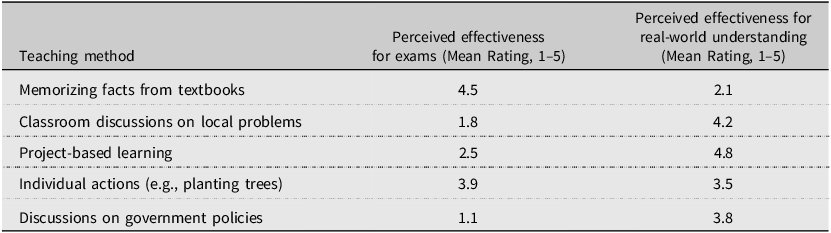
The data presented in Table 1 (Perceived Effectiveness of Teaching Methods) was generated through a quantitative component integrated into the semi-structured interviews. At the conclusion of the qualitative portion, all 25 participants (15 students and 10 teachers) from the formal school case were asked to rate the perceived effectiveness of five selected teaching methodologies on a 5-point Likert scale (1 = Very Low Effectiveness, 5 = Very High Effectiveness). Two separate ratings were collected: one for “Effectiveness for Passing Exams” and one for “Effectiveness for Real-World Understanding.” The figures reported in Table 1 represent the mean rating for each category, providing quantitative evidence of the curricular disconnect and exam pressure discussed qualitatively.
Perceived effectiveness of teaching methods in the formal school setting

-
Focus Group Discussions (FGDs): Two FGDs were held in each case study site – one with students and one with teachers/educators. These sessions provided a platform for participants to build upon each other’s ideas and explore shared challenges and opportunities in a collaborative setting.
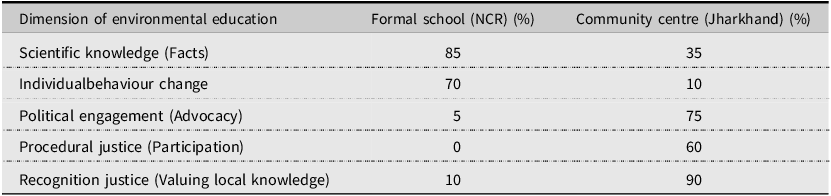
The data presented in Table 2 (Comparative Analysis of the Focus of Environmental Education) is a quantification of the thematic analysis. The figures (percentages) do not represent primary survey data but the relative thematic emphasis identified across the data sets. This was calculated by measuring the thematic coding frequency across interview and FGD transcripts and observation notes, synthesized against the core themes of planetary justice (distributive, procedural, recognition). This table serves as an aggregated visual summary of the qualitative findings concerning the dominant pedagogical goals and focus in each case study site.
A comparative analysis of the focus of environmental education

-
Curriculum and Policy Analysis: We conducted a thorough analysis of official curriculum documents, textbooks prescribed for the schools and publicly available policy papers from the Ministry of Environment, Forest, and Climate Change (MoEFCC) and the National Council of Educational Research and Training (NCERT). This provided the formal framework against which lived experiences could be juxtaposed (RNCP, 2006; Saxena, Reference Saxena2019).
To robustly justify the claim of “depoliticization” (represented in Figure 1), a formal Thematic Content Analysis was conducted on the following primary documents:
The process of depoliticizing environmental education in formal curricula.

Textbooks: Two widely used Environment Studies textbooks for Classes IX and X in the NCR region (prescribed by NCERT and a leading private publisher).
Curriculum Documents: The official NCERT Syllabus for Environmental Studies/Social Science for Classes IX and X.
-
Participant Observation: Researchers spent extended periods at both sites, observing classroom dynamics, community meetings and informal learning moments. This provided invaluable, unscripted insights into the subtle ways in which knowledge is transmitted and how power relations and political contexts influence what is taught and what is learned.
Sample data and findings: A glimpse into the field
While the full results will be presented in a later section, a glimpse into the preliminary findings illustrates the power of this methodology. In the formal school case study in the NCR, a dominant theme was the depoliticization of the curriculum. A student’s poignant remark captured this perfectly: “We learn about the “four Rs”—Reduce, Reuse, Recycle, and Refuse—but no one tells us why the factories in our area are allowed to keep polluting our river. The books tell us to save water, but the government can’t even give us clean water.” Similarly, a teacher confided, “My job is to prepare them for the board exam. The syllabus is rigid. I know climate change is a political issue, but I do not have the time or the training to discuss things that are not in the textbook.”
In stark contrast, the informal community learning centre in Jharkhand revealed a powerful model of embodied and justice-oriented education. Here, learning was a direct response to a real-world threat. A tribal elder and community activist explained their teaching philosophy: “We don’t need a school to teach us about the forest. Our education comes from living with it. We teach our children about justice when we hold hands and stand together to stop a company trying to take our land. Our history is our education, and our resistance is our classroom.” The NGO educators corroborated this, highlighting that their pedagogy was rooted in linking local struggles to broader legal frameworks and the constitutional rights of indigenous communities, thereby politicizing the very act of learning. The sample data thus revealed a profound dichotomy: an education system that sanitizes the environmental crisis and another that uses the crisis itself as a powerful teaching tool.
Data analysis and ethical considerations
The collected data was subjected to a rigorous thematic analysis. Interview transcripts and field notes were systematically coded using a hybrid approach – deductive codes derived from our theoretical frameworks (e.g., ”planetary justice,” “procedural justice,” “environmental literacy”) and inductive codes that emerged from the data itself (e.g., “teacher constraints,” “intergenerational knowledge,” “lived environmental injustice”). This allowed us to identify recurring patterns, contradictions and narratives that illuminated the key research questions. The findings were then synthesized into a coherent narrative, supported by direct quotes, to provide a voice to the participants’ experiences.
Throughout the research process, the highest ethical standards were maintained. Informed consent was obtained from all adult participants, and assent from minors, with formal permission secured from their parents or guardians. Confidentiality was strictly upheld by using pseudonyms for all participants and obfuscating any identifiable information. The study received formal ethical approval from a university review board, ensuring that all procedures were conducted with integrity and respect for the participants. This robust methodology has been instrumental in moving our analysis from a conceptual space to a grounded, empirical understanding of the challenges and opportunities for a justice-oriented environmental education in India.
The analysis employed a deductive coding framework with three primary codes applied to every paragraph or section discussing an environmental problem (e.g., climate change, water pollution):
Code 1: Technical/Scientific Focus: Content describing only the physical processes or measurable impacts.
Code 2: Individual/Behavioural Focus: Content prescribing personal actions (e.g., “save water” and “reduce waste”).
Code 3: Systemic/Political Focus: Content discussing governance failures, policy debates, historical inequality, corporate responsibility, or power structures.
The claim in our results is justified by the finding that Code 3 was present in less than 5% of the analysed content sections, confirming that the curriculum systematically avoids analysis of systemic drivers.
Delimitations of the study
The following delimitations were intentionally placed to ensure the feasibility and focus of the research:
Geographic Scope: The study is strictly confined to two specific case sites in India – one formal school in the NCR and one informal learning centre in Jharkhand. While these sites serve as illustrative examples of India’s development paradox, the findings are not intended to be generalized nationally across the entirety of India’s vast and diverse educational landscape.
Focus on Pedagogy and Curriculum: The primary focus is on the content (what is taught) and the method (how it is taught) concerning environmental issues. The study does not comprehensively analyse the institutional funding, administrative structure, or political history of each school beyond how these factors directly enable or constrain the implementation of critical pedagogy.
Qualitative Emphasis: The study utilizes a transdisciplinary qualitative inquiry, relying primarily on interviews, focus groups and content analysis. While some quantitative data (Likert scales, thematic frequency) is presented to support the qualitative claims, the research does not aim to establish statistical significance or broad quantitative correlations across the entire student population.
Age Group Restriction: The student participant group was limited to adolescents (aged 14–17) in secondary education, as this is the critical juncture where formal abstract concepts are introduced and political consciousness begins to solidify. Younger and university-level education were excluded.
Results: A dichotomy of environmental education
The data collected from our two distinct case studies reveals a profound dichotomy in the state of environmental education in India. On the one hand, the formal education system, while well-intentioned, is shown to be a site of curricular disconnect and de-politicization. On the other, the informal, community-based learning environment emerges as a powerful incubator for critical thinking and genuine engagement with planetary justice. The findings, presented through a blend of qualitative narratives and illustrative diagrams and tables, articulate a stark contrast in both pedagogical approach and educational outcomes.
The formal classroom: A curricular disconnect
Our analysis of the formal education setting in the NCR paints a picture of learning that is largely confined to the pages of a textbook, divorced from the harsh environmental realities that lie just outside the classroom walls. Interviews and FGDs with students consistently highlighted a frustration with the gap between what they were taught and what they experienced.
Finding 1: The dominance of rote learning over critical inquiry
Students and teachers reported a heavy reliance on memorization, driven by the pressure of standardized examinations. The environmental science curriculum, while comprehensive in its coverage of topics like pollution, biodiversity and conservation, presented these issues as a series of facts to be learned rather than problems to be solved. As one student candidly expressed, their learning was often frustratingly disconnected; they noted that while they were taught the principles of the “four Rs” (Reduce, Reuse, Recycle, Refuse), the curriculum offered no tools to challenge the political decisions that permitted nearby factories to pollute their river, creating a profound gap between ethical instruction and political reality. This sentiment was echoed by teachers who felt constrained by a rigid syllabus and a lack of training in facilitating critical discussions.
As shown in Table 1, the methods most effective for passing exams – memorizing facts – are perceived to be the least effective for fostering real-world understanding. This stark divergence highlights a systemic failure to prepare students for the complexities of the Anthropocene.
Finding 2: The depoliticization of environmental issues
The most striking finding from the formal education case study was the deliberate or inadvertent depoliticization of the environmental curriculum. Our analysis of textbooks revealed that environmental problems were presented as a-political, moral failings of individuals, disconnected from their systemic drivers. This pedagogical approach transforms a complex issue of Earth system governance into a simple matter of personal virtue.
The depoliticization of curriculum: A process diagram
As illustrated in Figure 1, the curriculum effectively bypasses the critical step of analysing political and economic drivers, jumping directly from problem to individual solution. A teacher’s reflection encapsulated this constraint perfectly: “The syllabus is rigid. I know climate change is a political issue, but I don’t have the time or the training to discuss things that are not in the textbook.” This finding underscores that the current educational model is not just insufficient; it actively works against the kind of critical engagement required for planetary stewardship.
The community learning centre: Education rooted in justice
In profound contrast, the informal community learning centre in Jharkhand offered a powerful model of education deeply rooted in lived experience and the struggle for justice. Here, environmental education was not a discrete subject but an embedded practice, directly tied to the community’s fight for their land and resources.
Finding 3: Education as a tool for political empowerment
The community’s learning was centred on empowering individuals to navigate the legal and political dimensions of environmental conflict. The very act of learning was a form of resistance. A tribal elder and community activist poignantly articulated this philosophy: “Our education is our history. We learn about justice when we read the land deeds that were taken, and we teach our children not with books alone, but by holding hands and standing together against those who seek to take our forest.” The NGO educators corroborated this, highlighting that their pedagogy was rooted in connecting local struggles to broader legal frameworks and the constitutional rights of indigenous communities, thereby politicizing the very act of learning (Kashwan, Reference Kashwan2017; Jadhav, Reference Jadhav2019).
Table 2 provides a clear quantitative representation of this difference. While the formal school focuses heavily on scientific knowledge and individual behaviour, the community centre’s curriculum is heavily weighted toward political engagement, procedural justice and recognition of local knowledge. This stark contrast illustrates how a justice-oriented approach fundamentally redefines the purpose of education.
Finding 4: The integration of intergenerational and local knowledge
In the community setting, a core pillar of learning was the seamless integration of intergenerational and local ecological knowledge. Elders taught children not just the names of plants but their medicinal uses and the stories of their symbiotic relationship with the community. This process of knowledge transmission served a dual purpose: it preserved cultural heritage and built a powerful sense of place and identity, essential for effective planetary stewardship. The formal system, conversely, relied almost exclusively on standardized, top-down knowledge, largely neglecting the rich ecological wisdom of local communities.
The common thread: A crisis of agency
Despite the profound differences, a shared theme emerged from both case studies: a pervasive crisis of student agency. In the formal school, students felt a sense of powerlessness, their knowledge of environmental issues disconnected from any tangible means of action. The problems seemed too vast, the solutions too distant. In the informal setting, while students were actively engaged in fighting specific local battles, there was a shared anxiety about the overwhelming systemic forces at play, suggesting that even a justice-oriented education can falter without broader institutional and political support. This finding points to a critical next step: creating a cohesive educational framework that combines the foundational knowledge of the formal system with the empowering, justice-oriented pedagogy of informal learning. The results presented here lay the groundwork for this much-needed discussion.
Discussion: Reimagining education as a force for planetary justice
The findings of this study reveal a profound and troubling paradox at the heart of India’s response to the Anthropocene. While the nation’s environmental challenges – from the choking air of its cities to the parched earth of its villages (Chopra, Reference Chopra2018) – are deeply political, its formal education system remains largely a-political and detached (Kallis et al., Reference Kallis, Paulson, D’Alisa and Demaria2025; Latour, Reference Latour2017). This chasm between knowledge and lived reality creates a pervasive sense of helplessness among young people, effectively disarming them in the face of an existential crisis (Raworth, Reference Raworth2012). Conversely, our research into a community-based learning centre illuminates a potent, if a-institutionalized, alternative: an education system where learning is not a passive act of information absorption but a direct, embodied response to the fight for planetary justice (Robbins, Reference Robbins2004). The discussion that follows unpacks the implications of this dichotomy, arguing that a transformative merger of these two worlds is not just a choice, but an imperative for building a habitable and equitable future.
The peril of de-politicization: An analysis of politically enabled inertia
The data from our formal school case study reveals an educational environment characterized by curricular disconnect (Table 1) and the systematic depoliticization of content (Figure 1). We argue that this rigidity is not a pedagogical failure but a politically enabled outcome of a centralized, risk-averse and exam-driven system.
The politics of assessment and bureaucracy
The constraint articulated by teachers – the necessity to focus on material that ensures board exam success – is a direct manifestation of a State prioritizing standardized, high-stakes assessment over critical inquiry. This system structurally rewards the memorization of technical facts (Code 1) and superficial individual behaviours (Code 2), while penalizing the complex, time-consuming engagement required for discussing systemic injustice (Code 3). The absence of Code 3 in over 95% of analysed textbook content is not an accident; it reflects a political preference for a controllable narrative that avoids challenging established industrial and governance policies. The curriculum, therefore, functions as an apparatus of consensus, insulating the political economy from critical scrutiny and perpetuating what Paulo Freire (Reference Freire1970) termed “banking education.”
Agency in the anthropocene: a critical vacuum
This educational inertia directly clashes with the urgent international consensus on the role of education in the Anthropocene (Allen, Reference Allen, Allen, Massey and Cochrane2011; Jones, Reference Jones2014). The OECD PISA 2025 Science Framework emphasizes the need to cultivate student agency – the capacity to set a goal and act responsibly to effect change – specifically within the context of global challenges (OECD, 2023). Our formal school findings demonstrate a clear agency vacuum. Students are taught the necessity of action (e.g., climate action) but are denied the tools of action (e.g., political analysis, policy critique, organized advocacy). By presenting environmental problems as a-political moral failings, the system actively prevents students from exercising the critical, systemic agency required to influence Earth system dynamics, ultimately leaving them with the sense of powerlessness captured in our interviews. The educational goal is reduced from planetary stewardship to personal compliance (Bhabha, Reference Bhabha1994).
The promise of justice: A political critique of grassroots education
In profound contrast, the community learning centre in Jharkhand exemplifies an education system where learning is a direct political assertion. Its success is not accidental but is politically enabled by its independence from the State and its deep roots in indigenous and democratic traditions of resistance.
Education as political resistance
The community’s learning model is rooted in the struggle for Recognition Justice (Schlosberg, Reference Schlosberg2007). Unlike the formal curriculum, which privileges universal, top-down knowledge, this education centres intergenerational and local ecological wisdom. This act of centring local knowledge is inherently political, serving as a direct counter-narrative to the industrial logic of resource extraction that seeks to delegitimize indigenous claims to land. The political success of this model lies in its ability to translate ecological knowledge into legal and political leverage (e.g., using forest knowledge to assert rights under the Forest Rights Act), effectively using education as a tool of grassroots governance and self-determination (Leach et al., Reference Leach, Scoones and Stirling2010, Reference Leach, Scoones and Stirling2013).
The contrast with the formal school is, therefore, foundational:
Formal School: Rigidity is enabled by political centralization and a focus on maintaining social order (compliance).
Informal School: Fluidity and critical depth are enabled by political autonomy and a focus on challenging systemic oppression (resistance).
The learning that results is embodied and justice-oriented, fostering the kind of robust systemic agency that the PISA framework champions, but which the Indian formal system struggles to deliver. Students here are not just learning about injustice; they are learning the political and legal vocabulary to fight it.
Bridging the divide: The politics of scalability and institutional change
Scaling the Jharkhand model requires dismantling the centralized political structures that enforce curricular rigidity. This translation is not merely a matter of copying lesson plans; it requires a political commitment to:
Curriculum Decentralization: Granting local educational bodies and teachers significant autonomy to incorporate local case studies on environmental conflict, policy analysis and community-led solutions, moving away from a single, generic national textbook.
Assessment Reform: Shifting assessment weight away from rote learning toward portfolio-based assessments (PBAs) or problem-based learning (PBL) projects, as suggested by our data (Table 1). This politically signals that the critical agency and systemic analysis are valued over memorization.
Institutional Mandate: Implementing a national mandate for community-integrated learning (CIL), requiring formal schools to partner with local NGOs, tribal elders, or activist groups to expose students to political ecology in action.
Without these foundational changes in the political machinery of the education system – how the curriculum is decided, how teachers are trained and how students are assessed – any attempt to integrate critical content will be crushed by the inertia of exam pressure. The challenge is political, not pedagogical.
A critical path forward:
Who pays? The financial politics of reform
Systemic educational reform is intensely resource-intensive. The cost of comprehensive teacher training (training 10 million teachers in critical pedagogy), curriculum redesign (creating decentralized, region-specific materials) and infrastructure upgrades (facilitating PBL projects) cannot be borne by individual schools or states alone.
Financial Recommendation: This requires a dedicated, substantial National Environmental Education Reform Fund (NEERF), financed through a ring-fenced percentage of carbon taxes or a specific “Polluter-Pays Levy” imposed on the high-polluting sectors critiqued in the very curriculum being reformed. This politically links the cost of educational transformation directly to the agents of environmental damage, giving the reform process moral and financial accountability.
Who mandates? The politics of social licence
The deepest challenge is securing the political will and social licence to inject critical political content into the classroom. Teaching students to critique industrial policy or governance failure will inevitably face resistance from entrenched political and corporate interests.
Strategy for Social Licence: The change must be driven from three pressure points:
Grassroots Pressure (Bottom-Up): Leveraging the success and advocacy of community organizations (like our Jharkhand case) to demonstrate the efficacy and necessity of justice-oriented education.
Academic Pressure (Top-Down): University-level teaching and research must shift first. Universities and Teacher Education Institutions (TEIs) must be mandated to reform their own curricula to teach “Applied Political Ecology” and “Critical Pedagogy for the Anthropocene” before their graduates enter the school system. This creates a supply chain of critically trained educators.
Assessment Reform (Policy Trigger): The most powerful lever remains assessment. If the National Testing Agency (NTA) were to introduce a component in its entrance exams that explicitly rewards systemic critical thinking on environmental justice issues, the entire ecosystem (teachers, parents, coaching centres) would rapidly adapt to teach the new content, bypassing political resistance at the curriculum-writing level.
To enact this transformation, the political elite must be convinced that the long-term risk of systemic instability (driven by air pollution, water wars and climate migration) outweighs the short-term political risk of a critically educated populace (Verne, Reference Verne2023). Our conclusion is that educational change is not a precursor to political change, but rather, a concurrent and fundamental political action itself, required to build the stability necessary for a safe and just operating space for India.
Recommendations
Mandating inter-sectoral case studies: The policy dissection module
The current curriculum isolates environmental problems. To counteract this, we recommend introducing a mandatory Policy Dissection Module in secondary education. This module would not focus on individual actions, but on inter-sectoral analysis using local case studies (e.g., the local impact of national-level policies).
Focus: Students must analyse a local environmental issue (e.g., groundwater depletion) by dissecting the failures and incentives across at least three non-environmental sectors (e.g., agricultural subsidies, urban planning regulations and industrial licensing policies).
Outcome: The required output is a submission to a local governing body or a public policy brief, shifting the educational goal from knowledge acquisition to civic advocacy and policy critique. This directly addresses the need for systemic analysis (Code 3).
Leveraging digital tools for de-centralization and local data
The uniformity of the national curriculum can be broken by mandating the use of a Local Environmental Data Platform (LEDP).
LED Platform: This is a centralized, open-source digital tool that aggregates real-time, hyper-local environmental data (e.g., air quality index, local water table levels, illegal waste dumping reports) in every district.
Curricular Integration: Instead of learning about generalized national air pollution, students would use the LEDP to analyse their school’s immediate air quality data alongside local industrial data and traffic patterns. This grounds the learning in their lived reality and provides the factual evidence necessary to support critical political discussions, connecting generalized national policy (The State) to localized impact (The Self).
Integrating ethics and history into science education
To fundamentally shift the narrative away from a purely scientific definition of environmental crisis, we recommend an integrated science curriculum that centres historical and ethical narratives.
Historical Ecology: Every unit on a scientific topic (e.g., water cycle, soil fertility) must include a mandatory section on the historical and colonial roots of resource exploitation in India and the history of related resistance movements (e.g., the Chipko movement or struggles against dam construction). This immediately provides the context of power and justice.
Applied Ethics Component: Science classes must include explicit discussion on the ethical dilemmas posed by new technologies (e.g., genetic modification, carbon capture) and resource allocation, fostering moral literacy alongside scientific literacy, a key component of planetary morality (Bendik-Keymer, Reference Bendik-Keymer2023).
Future research
This study opens several promising avenues for future investigation:
Longitudinal Alignment with PISA 2029: Future studies should specifically investigate how the transition from the PISA 2025 “Agency in the Anthropocene” lens to the dedicated PISA 2029 Climate Literacy Framework impacts national curriculum reforms. Research could focus on whether this global shift toward a specialized climate competency encourages the “politicized” and systemic literacy advocated in this paper, or if it remains tethered to a-political scientific facts.
Quantitative Scaling and Impact: Future research should aim for larger-scale quantitative studies to test the correlation between the adoption of justice-oriented pedagogy and measurable civic and environmental outcomes (e.g., policy engagement, reduction in local environmental conflicts) across diverse geographic and cultural regions in India.
Teacher Training Effectiveness: Longitudinal research is needed to evaluate the long-term effectiveness of different professional development models (e.g., critical pedagogy vs. conventional training) on teacher self-efficacy, autonomy and their willingness to address politically sensitive environmental topics in the classroom.
Assessment Reform and Agency: Research could experimentally design and test new assessment strategies (such as portfolio-based learning and systemic policy critique assignments) to determine their impact on fostering student agency compared to traditional, high-stakes examinations.
Curriculum Policy Analysis: Comparative studies focusing on how environmental justice narratives are integrated or censored across different state-level curricula in India (which often enjoy some autonomy from the central NCERT syllabus) could provide critical insights into the regional politics of educational reform.
Conclusion: A vision for a just future
The findings of this research offer a sobering but ultimately hopeful message. The environmental crisis is not just a scientific problem, and its solution will not be found in technology alone. It is a crisis of justice, and its resolution lies in a fundamental reimagining of how we teach and learn. The contrast between the two educational environments in our study provides a clear path forward. By infusing the formal education system with the justice-oriented pedagogy of community-led learning, India can cultivate a new generation of planetary stewards. These are young people who are not only knowledgeable about the challenges of the Anthropocene but are also empowered with the moral clarity and political courage to build a future that is not only habitable but also deeply and fundamentally just. This is the bold and necessary vision for a new era of education, one that teaches the “politics of Earth” and prepares a nation to lead the world toward a safe and equitable future.
Acknowledgements
I express my deepest gratitude to all those who guided and supported me throughout the research process.
Financial support
This research received no specific grant from any funding agency in the public, commercial, or not-for-profit sectors. The authors declare that the study was conducted using personal and institutional resources.
Ethical standards
This study was conducted in accordance with established ethical standards and applicable research guidelines. Maintained confidentiality of the participants throughout this investigation.
Author Biography
Mohd Saif Qureshi is a scholar at the Department of Education, Aligarh Muslim University. His academic interests encompass a wide range of topics within the field of education. His areas of focus include Educational Philosophy, exploring the fundamental principles and theories of learning. He also specializes in Education for Sustainable Development and Environmental Education, highlighting his commitment to a greener future. Furthermore, his expertise extends to Educational Administration, Early Childhood Education and Pedagogy, demonstrating a comprehensive understanding of teaching methods and school management.


 Open access

