On 6 February 1834, an old woman died on the Rue des Fontaines in Paris. Her full name was Marie-Marguerite-Charlotte Robespierre. Charlotte (1760–1834) was the younger sister of Maximilien and Augustin Robespierre. Some forty years earlier, on 28 July 1794, following the coup d'état of the previous day, 27 July 1794 (9 Thermidor Year II in the Revolutionary Calendar), Charlotte's two brothers, Maximilien and Augustin, had perished together on the guillotine. The coup d'état of 9 Thermidor led to the overthrow of the Committee of Public Safety on which Maximilien had been a leading light, and which had directed the Terror. Celebrations would be instantaneous, launching a tidal wave of attacks in print. Le triomphe des Parisiens and the Portraits exécrables du traitre Robespierre et ses complices, complete with images of the severed heads of Maximilien and his brother and their alleged accomplices from the Committee of Public Safety, Saint-Just and Couthon, are characteristic examples (Figures 1 and 2).Footnote 1 Much blame would focus – and has continued to focus in history-writing down to the present day – on Maximilien's role within the Committee of Public Safety, which had implemented violently repressive policies as a way of winning the war within France and without, and of instituting, so it was held, a ‘republic of virtue’.Footnote 2
Le triomphe des Parisiens (Paris, 1794). © British Library Board: FR 598.

Portraits exécrables du traitre Robespierre et ses complices. © British Library Board: F856.

In memoirs published posthumously in 1835, Charlotte Robespierre sought to rehabilitate her brothers from the calumnies which had buzzed like flies about their heads, ever since those heads had fallen into the guillotine basket over forty years earlier. She had taken to the grave a profound irritation in particular at the ways that Maximilien's physical appearance was generally described.
Brother Augustin [she stated] was big, well made and had a face full of nobility and beauty. Maximilien did not share these features to the same extent. He was of average height and of delicate complexion. His face exuded sweetness and goodness, but was not as regular nor as fine as his brother's. He was nearly always smiling.Footnote 3
Warming to her theme of a sweet, good, ‘nearly always smiling’ Maximilien Robespierre, she went on to excoriate the way that her brother had been portrayed since his death. One particular portrait, that had accompanied apocryphal memoirs published in 1830, drew her particular scorn. It was, she stated, ‘an ignoble caricature’ (Figure 3). ‘His physiognomy is there disfigured, just as as his cowardly enemies have disfigured his character.’ In fact, ‘[Maximilien's] physiognomy exuded sweetness and he had an expression of goodness which struck everyone who saw him.’Footnote 4 We can just about glimpse the faintest of smiles playing lightly around the lips of a number of the portraits of the future arch-terrorist, such as Adelaide Labille-Guiard's famous 1791 painting of him in his costume as deputy in the National Assembly.Footnote 5 Yet, loyal Charlotte's sisterly memory has cut little historiographical ice, and historians ever since have scoffed at the thought of sweet, smiley Robespierre.
Portrait of Robespierre, from Mémoires authentiques de Maximilien Robespierre, ornés de son portrait tiré de ses mémoires (Paris, 1830). © British Library Board: 010661.c.28.

Charlotte was attacking the attempt to read the alleged wickedness of Robespierre in his face. Physiognomical portraiture – the detection of character through bodily, and especially through facial, depiction – could be done in words as well as by pencil or paintbrush. An early, influential textual example of the genre, written just weeks after Robespierre's death, was the ‘Portrait of Robespierre’ by Antoine Merlin de Thionville, a deputy who had sat alongside him in the National Convention:
People who like to find relationships between faces and moral qualities, between human faces and those of animals, have noted that just as Danton had the head of a mastiff, Marat that of an eagle, Mirabeau that of a lion, Robespierre had the face of a cat. But the face altered its physiognomy; at first it was the anxious but fairly soft look of a domestic cat; then the wild look of a feral cat; and then the ferocious look of a tiger.Footnote 6
We may be surprised to think of a Robespierre who smiled. And by drawing on the conventions of physiognomy in this Revolutionary bestiary so as to make a tiger of him, Merlin de Thionville was of course adding to our doubts. For tigers do many things; smiling is not conventionally held to be among them. The smile of a tiger is a simple impossibility.
In my Presidential Addresses, under the general heading of ‘French Crossings’, I have taken the idea of crossing very broadly, ranging from the crossing of territorial boundaries, to the crossing of disciplinary frontiers, through to the meaning of crossing in the lives of my subjects. In 2009, I used the differential, Anglo-French reception of Charles Dickens's A Tale of Two Cities, and his own personal Channel-hoppings, to explore issues of personal and national identity under a transnational prism.Footnote 7 Last year, the book of comic drawings of the obscure French court embroiderer, Charles-Germain de Saint-Aubin, allowed me to examine the crossing of social boundaries and the role of laughter in sometimes transcending, sometimes reinforcing, class frontiers.Footnote 8 In the present paper, while incidentally passing back and forth over the disciplinary boundaries separating visual from textual studies, and the history of art and the history of science, I will be examining the crossing of another type of boundary, namely, the frontier between humans and animals.
Yet, is the term ‘frontier’ justified in regard to human–animal relations? In recent years, a number of continental philosophers – Giorgio Agamben, Emmanuel Levinas, Gilles Deleuze, Jacques Derrida and others – have explored the human–animal relationship in an avowedly ‘post-humanist’ spirit that posits as its foundation porosity rather than rupture.Footnote 9 Oddly, early modern French society in some ways prefigured this. While people certainly viewed with horror monstrous beings that incorporated within their bodies human and animal components, suggesting a sense of incommensurability, yet at a more everyday level they were also well habituated to less extreme and prejudicial ideas involving the crossing of the human–animal frontier.Footnote 10 One of these was physiognomy, a discipline which historians have too often lost from view, and on which Merlin was drawing in composing his Revolutionary bestiary. Flourishing particularly between c. 1500 and c. 1850, physiognomical writing and analysis provided a space in which individuals could explore what united humans and animals and what differentiated them. It thus offers an appropriate lens through which to explore changing views of the human–animal relationship. Significantly, moreover, although we may (foolishly) imagine that smiling lies beyond historical analysisFootnote 11 and (misguidedly?) surmise that it is quintessentially human (and therefore presumably non-animal), the smile was a source of much physiognomical reflection. The putative smile on the face of an alleged tiger will thus allow us to reflect on the human–animal relationship while also considering the pressing political, ideological and historiographical issues in play concerning the French Revolutionary Terror in which physiognomy came to be caught up.
Considering how widespread and influential physiognomy has been as a form of knowledge which had currency for an exceptionally long period across an impressively wide range of cultures, it remains surprisingly under-studied.Footnote 12 The discipline has a venerable pedigree in western and Arabic cultures, as well as long-established traditions in India, China, Japan and elsewhere. The earliest existing physiognomic dicta are to be found on Mesopotamian clay tablets carved over 3,000 years ago. They propound things such as: ‘If a man has curly hair on his shoulders, women will fall in love with him’, or ‘If a man with a contorted face has a prominent right eye, far from home dogs will eat him.’Footnote 13 Physiognomy always had an air of pseudo-empirical non-falsifiability, that is evident in the shards of the discipline which remain in our own culture (such as the idea of individuals with red hair having fiery tempers). The basic notion behind physiognomy is that one can grasp an individual's character, identity and even destiny by close informed scrutiny of their outward physical appearance, especially their face. Developed in Antiquity, physiognomy was taught in medieval universities; it gained in intellectual cogency during the Renaissance; it was found in manuscript and printed sources in just about every European language in the early modern period from Icelandic to Welsh; and it was published in every imaginable print format from learned in-folios through to cheap almanachs and broadsheets.
One reason for physiognomy's astonishing longevity and cultural reach has been its capacity for adapting its precepts to harmonise with current ways of understanding the world. Like Galenic medical theory which for much of the early modern period still provided the standard way of thinking, about states of bodily health, for example, physiognomy was grounded in a cosmology expressing itself in correspondences between substances and qualities both within and between the supra- and sub-lunar worlds. This encompassed correspondence between humans and animals. A hoary physiognomic truism had it that one of the ways that character could be read was through detecting human resemblances with animals. A key physiognomic syllogism went along the lines: a man looks like a lion; a lion is brave and masterful; the leonine man must therefore partake of the same qualities and be brave and masterful. Based on prestigious texts ranging from Antiquity through to the Renaissance and beyond, this strain of physiognomic analysis was given systematic visual illustration in Giambattista Della Porta's De humana physiognomonia (1586), a work highly influential among artists as well as physiognomistsFootnote 14 (Figure 4).
Giambattista Della Porta, ‘Lion Man’, from idem, De humana physiognomonia (Turin, 1586). © Wellcome Library, London.

Physiognomy caters to an essential, everyday social concern: namely, what sort of person stands in front of me? The discipline purports to offer help in answering this question. Its practitioners realised that it requires a degree of subtlety and sophistication, not least because some individuals do not want their characters to be read. If one of physiognomy's stock aphorisms was ‘in facie legitur homo’ (‘the character of man is in his face’), another was ‘fronti nulla fides’ (‘there's no trusting faces’). The apparent contradiction highlighted the point that it needed a trained physiognomic eye to see through pretences about their true nature with which individuals often obscured the underlying features of their face. Contradicting Shakespeare's Lady Macbeth, physiognomy was precisely that art which promised ‘to find the mind's construction in the face’.Footnote 15
During the eighteenth century, popular almanachs still blithely circulated physiognomic notions such as that a man born in November will have ‘a white face with red spots, a big head, hard bones, and will be quite fleshy and big, with a cold complexion, plus . . . fine delicate teeth’ (and so on).Footnote 16 But by then, such views were no longer viewed as having scientific validity within elite circles, due to the decline of the Renaissance cosmology of correspondences in the Scientific Revolution and the Enlightenment that also, incidentally, undermined Galenic medical thought.Footnote 17
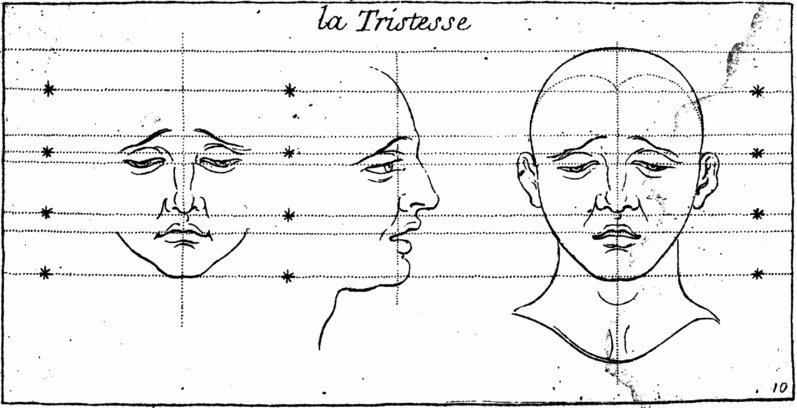
Yet, physiognomy's end was far from nigh. Two major transformations ensured its passage as a powerful cultural force well into the nineteenth century. First, there was a fundamental reformulation of the analysis of facial expression. In the late seventeenth century, Louis XIV's premier painter, Charles Le Brun, attacked the theory of resemblances and cosmological analogies on which Della Porta's work had been based, and shifted physiognomic analysis towards the study of facial expression.Footnote 18 Indeed, his followers often claimed he had renounced physiognomy for what became known as pathognomy, the study of the facial expression of feelings.Footnote 19 Le Brun grounded his studies in contemporary science in fact, notably the physiology of René Descartes, who held that the human soul resided in the pineal gland located in the brain behind the bridge of the nose.Footnote 20 Le Brun developed a whole theory around the assumption that disturbance of the passions of the soul catalysed movement on the face from this originary spot, so that disturbances rippled from the eyebrows outwards (Figure 5). Mild passion might cause a slight disturbance in this area; extreme passion caused major distortions across the face. Le Brun's theological and physiological surmising became increasingly dépassé in the eighteenth century. But his book of drawings – with their almost geometrical facial calibrations of feeling – continued to be influential, going through numerous reeditions. Indeed, it became the way that people in the Enlightenment learned to draw: William Hogarth noted around mid-century, ‘It is the common drawing book . . . for the use of learners.’Footnote 21 If one wants a single example of the continuing strength of Le Brun's influence, one has only to compare his representation of despair (Figure 6) with the facial contortion (a century later) shown on the guillotined head of Saint-Just (‘S.J.’), Robespierre's fellow Terrorist, in the Thermidorian pamphlet cited earlier.Footnote 22
Charles le Brun, ‘Tristesse’, after idem, Le Brun, Conférence sur l'expression générale et particulière (Paris, 1668) (1720). © Wellcome Library, London.

‘Désespoir’, after Charles Le Brun, Conférence sur l'expression génerale et particulière (Paris, 1668) (1770). © Wellcome Library, London.

Descartes was held to have made an intervention in a very long-running polemic, by essentially cutting humanity off from the animal world. The human cogito emphatically and indeed definitionally did not extend into the animal realm. The Cartesian contention that the human soul was located in the pineal gland was based on the, in fact anatomically ungrounded, finding that only humans possess such a gland.Footnote 23 For his part, however, Charles Le Brun continued to be fascinated by analogies between animals and humans – as is attested by a collection of his drawings on the subject that reprised and updated Della Porta. Significantly, however, these were only publicly known in France from 1797, just after Robespierre's fall.Footnote 24
The second incursion and force for renewal within the world of physiognomy also overtly downplayed overlaps between the human and the animal and assumed a radical, Cartesian incommensurability between the two. This was the oeuvre of the German pastor-physiognomist, Johann-Caspar Lavater.Footnote 25 From the 1770s down to his death in 1801, Lavater sought to re-cast Renaissance physiognomy from top to bottom. He claimed to throw out all earlier physiognomical writings except Aristotle and to start from scratch through close observation of his fellow-men. His Essays on Physiognomy – a European best-seller published in numerous editions, translations and vulgarisations, that established him as one of the celebrities of his age – put humans at the centre of the physiognomic vision.Footnote 26 Only humans had a face and that face was a version (albeit a degenerate version) of the face of God, who had made man in His own image.Footnote 27 Whereas Le Brun had increasingly shifted attention to facial mobility, Lavater placed more emphasis on the solid and unchanging parts of the human head as a guide to character. Despite its strongly religious inspiration, Lavaterian physiognomy also aspired to scientific status, specifically rejecting the traditional physiognomic lore about ‘leonine’ character, for example, in favour of mathematical and geometrical approaches. Lavater worked hard to develop ways of measuring and quantifying human heads, deploying, for example, the silhouette, craniometry and consideration of the so-called facial angle.Footnote 28 Just as Renaissance physiognomy had benefited from contemporary sciences, which underpinned their practices (Galenic physic and Aristotelian cosmology in particular), so Lavater hitched physiognomy's wagon to the rise of quantitative and comparative methodologies in the social and medical sciences.Footnote 29
Following on from the break-up of the medieval and Renaissance cosmology in which physiognomy had been formerly grounded, the effect of Le Brun and Lavater was to keep it in play as an intellectual discipline – and indeed to give it a strong impulsion. Moreover, even though both men stressed radical discontinuity and incommensurability between humans and animals, in fact both also showed themselves very open to the traditional physiognomical interest in human–animal resemblance. Lavaterian physiognomy was a very broad church that tended to have something for (and from) everyone. Lavater's disciples, for example, were soon blithely intermixing their master's work with that of Della Porta and Le Brun and with emergent disciplines such as phrenology.Footnote 30 There was thus nothing surprising or out of line with Merlin de Thionville in 1794 invoking physiognomy in making his Robespierre/tiger comparison. Notwithstanding Le Brun and Lavater, some men at least could still be beasts. Indeed, the Terror had revealed the bestial in humankind, just as it had revealed, as we shall see, the tiger in Robespierre.
What was it about tigers that made it possible for these poor creatures to be assimilated to Robespierre? Tigers were not well known in medieval Europe, and they made few appearances in medieval bestiaries or heraldic sources.Footnote 31 Neither did Renaissance physiognomical writings find a place for them – although both Della Porta and Le Brun made comparisons with the cat.Footnote 32 When the tiger did hove into view, its outstanding characteristic and its biggest liability was its stripeyness. Striped pelts, cloth and decor were generally viewed as denoting ignominy and treachery in the Middle Ages and Renaissance.Footnote 33 This perspective may have influenced the great Enlightenment naturalist, Buffon. In his multi-volumed and hugely influential Histoire naturelle (1749–67), Buffon ranked the tiger, among carnivores, as a poor second to the lion, with which its character formed a stark contrast. ‘To pride, bravery and strength, the lion conjoins nobility, clemency and magnanimity; while the tiger is low and ferocious, and cruel without justice, that is to say, without need.’Footnote 34 He went on, using language which as we shall see echoes rather accurately polemical writings against Robespierre, to note how the tiger – almost like a ‘bad lion’ – ‘though satisfied with flesh, seems always thirsty for blood’. Viciously cruel, seemingly for the sake of it, ‘he desolates the country he inhabits, . . . he kills and devastates herds of domestic animals and he slaughters all wild beasts [he encounters]’.Footnote 35
Buffon was not out of line with his contemporaries. The tiger's penchant for wilfully cruel destructiveness had been highlighted by Voltaire – who had made tigrishness a national characteristic. His French compatriots were, he complained, ‘a nation divided into two species, one of idle monkeys who mock at everything, and one of tigers who tear’.Footnote 36 Over the course of the eighteenth century, the adjectives that qualified the tiger most frequently in French literary works were words like ‘bloodied’, ‘inhuman’, ‘fierce’, ‘pitiless’, ‘wild’, ‘wicked’ and ‘treacherous’.Footnote 37 Symptomatically, one of eighteenth-century literature's greatest villains – Lovelace in Richardson's Clarissa, which was almost as much of a best-seller in France as in England – had a heart ‘as hard as a tiger’ and was ‘cruel as a tiger’.Footnote 38
It is also worth mentioning in passing that Buffon and his contemporaries were hardly more warm-hearted towards the cat. The sweet, loveable domestic pussy-cat would be a bourgeois creation of the fin de siècle around the late nineteenth century.Footnote 39 For Buffon, cats were characterised by ‘innate malice, natural perverseness and a taste for evil’; ‘they only appear to be affectionate’.Footnote 40 The great naturalist still saw cats in terms that made their massacre comprehensible and possibly even desirable.Footnote 41 His views were shared by Lavater. The sight of a tiger at its prey recalled ‘Satan triumphing at the fall of a saint’, and cats were, Lavater went on, ‘tigers in miniature’. Even crueller with birds and mice than tigers with lambs, cats took pleasure in the sufferings of their victims.Footnote 42 Calling Robespierre a cat was clearly just as bad as calling him a tiger.
The zoomorphic was probably the most widely used of four registers in which Thermidorian polemicists attacked Robespierre. First, in terms of the historical record, he was ‘a modern Cataline’ (evoking the conspirator against the Roman res publica), ‘Nero’ and on occasion even ‘Cromwell’.Footnote 43 Secondly, in terms of political ideas and institutions, Robespierre was a tyrant and a dictator – and even a would-be king.Footnote 44 Thirdly, he was a monstrous being: a vampire, a ‘political chameleon’, a sphinx and so on.Footnote 45 Monstrosity was a staple theme in French Revolutionary print culture – as Louis XVI and Marie-Antoinette already knew, to their cost; monster Robespierre was thus only the latest in an evolving series.Footnote 46 Fourthly, there was the zoomorphic depiction of Robespierre as a wild animal – sometimes a wolf, sometimes a reptile, but most frequently, most powerfully and most influentially, a tiger. A German print of 1794 or 1795, ‘Greuelscenen der Jacobiner’, portrayed Robespierre alongside prowling tigers. ‘The tiger Robespierre’ (a frequent formulation) had presided over a political system that was in essence, as another pictural attack put it, a ‘cadavero-faminocratic government’ and a ‘tigrocracy’.Footnote 47
Two tigrish characteristics were particularly helpful to the perpetuation of Robespierre's zoomorphic identity. First, the tiger's immoderate taste for blood-curdling killing had evidently made Robespierre an excellent target for the comparison at a time where the fantasies ran that in directing the Terror he aimed to depopulate France through hecatombs of guillotinings.Footnote 48 All ‘Robespierrists’ (the word was a Thermidorian neologism) were so many ‘blood-drinkers’ (‘buveurs de sang’), and their chief had a quasi-vampiric, bulimic appetite for the liquid.Footnote 49 Second, was the fact that this tiger had a tail. ‘You can cut off my head, but I am leaving you my tail’, Robespierre had apocryphally said as he mounted the scaffold (though as we shall see he was in no fit state to utter any last words).Footnote 50 La queue de Robespierre – ‘Robespierre's tail’ – was the term given to his supporters, men who either had been his willing collaborators before Thermidor or who were still seeking to implement his policies. For the pamphleteers, such men were tigers ‘avid for carnage’, tigers ‘who seek to bring down the human species’.Footnote 51 In the event, the tiger's tail would soon be crushed, but not before the pamphlets had consolidated Robespierre's reputation as a voracious tiger, and established an enduring ‘black legend’ of his ‘tigocracy’.Footnote 52
Robespierre was thus in good (or rather, bad) tiger-cattish company – and has remained there for the duration. The power of the metaphor was supported by the physiognomic tradition which, as we have suggested, continued to endorse the human–animal connection. The English author John Adolphus, writing in 1799, noted how the ferocity of Robespierre's gaze led ‘an accurate observer to compare his general aspect to that of the cat-tyger’.Footnote 53 Two decades later, in 1821, the marquis de Ferrières echoed Merlin de Thionville when he wrote that Robespierre's ‘face had something of the cat and the tiger in it’.Footnote 54 Physiognomic handbooks confirmed the association. Isidore Bourdon's 1842 text on physiognomy and phrenology, for example, noted how ‘the physiognomy of Robespierre resembled that of a tiger’, as was evidenced by his ‘sanguinary instinct’.Footnote 55 The tiger analogy was soon enshrined within French Revolutionary historiography. Michelet, for example, recalled a conversation with Merlin de Thionville, in which Merlin had exclaimed ‘Ah! If only you had seen his green eyes, you would have condemned him as I did.’ Green eyes, the eyes of a cat. The eyes of a cat that would become, as Merlin had stated categorically, a tiger. On another occasion, Michelet evoked Robespierre on the festival of the Supreme Being, the ill-starred revolutionary cult which he had created, as ‘radiant’, but with a ‘disturbing’ smile: ‘Passion visibly has imbibed his blood and dried his bones, leaving only nervous life, like a drowned cat brought back to life by Galvanism’ (i.e. by electric shock). Robespierre became, moreover, Michelet held, more and more cat-like as time went on.Footnote 56
The tiger–cat comparison was deployed by historians across the political divide. For the liberal politician and historian Alphonse de Lamartine, ‘the bony outline of [Robespierre's] face involuntarily made one think of a beardless tiger’.Footnote 57 Later in the century, the rabid reactionary, Hippolyte Taine, paraphrased Merlin de Thionville: Robespierre had ‘a cat's physiognomy, which was at first that of a worried but fairly gentle house-cat [but] became the ferocious expression of a tiger-cat’.Footnote 58 At the other end of the political spectrum, his near-contemporary, the great socialist politician and historian, Jean Jaurès, noted the ‘feline’ character of a statesman ‘who walked at the margins of his responsibilities like a cat on a roof's edge’.Footnote 59
This sequence of quotations certainly does not exhaust the presence in French Revolutionary historiography of Robespierre the cat–tiger. It became a familiar trope, as it remains. In her compelling recent biography, Fatal Purity, for example, Ruth Scurr quotes Merlin de Thionville before noting Robespierre's ‘feline’ character that she claims, moreover, to be able to detect in his portrait.Footnote 60 Merely considering such a view is a latter-day homage, I believe, to the success of the Thermidorian campaign of vilification. For I have simply been unable locate any individual who made even the slightest reference to Robespierre in terms of cats or tigers before his death. People may have remembered or imagined Robespierre as a tiger–cat after his death; there is no contemporaneous evidence I have found that anyone experienced him directly as such during his lifetime.Footnote 61 John Carr, an English visitor to Paris in 1802, was perceptive enough to spot what was going on. Coming across a ‘handsome’ bust of Robespierre made before his death, Carr noted: ‘History, enraged at the review of the insatiable crimes of Robespierre, has already bestowed upon him a fanciful physiognomy, which she has compounded of features which correspond with the ferocity of his soul, rather than with his real countenance.’Footnote 62 The feline–tigrish spectre that has haunted even the most respectable of historical scholarship ever since is an ex post facto creation. Robespierre the ferocious cat–tiger owes everything, in sum, to the force of Thermidorian ideology and the ambient ethos of physiognomical theory.
In his lifetime, in fact, what physical description of Robespierre there was downplayed the physiognomic idiom. Far from standing out as physically wild, fierce or farouche, Robespierre passed in the crowd. ‘His somewhat sulky physiognomy had nothing exceptional about it’, even one Thermidorian polemicist recorded. ‘His physiognomy and his gaze were expressionless’, admitted another.Footnote 63 Robespierre was normally represented, moreover, as punctiliously correct in his dress and demeanour. He studiously eschewed the baggy plebeian trousers of the sans-culottes for a primped, polite and puffed-up appearance. He also tended towards an earnest, po-faced seriousness that won him the sobriquet ‘the Incorruptible’. But this also led to him being viewed at times as yawn-inducing, even laughable.Footnote 64 The ‘delicate complexion’ that sister Charlotte evoked matched the pallor that was probably the most frequently remarked on aspect of his facial appearance among contemporaries prior to his death in 1794. Ground in the Thermidorian mill, this pallor would be viewed as a symptom of Robespierre's bulimic, vampiric appetite for blood.Footnote 65
Thermidorian propagandists occasionally acknowledged Robespierre's suaveness of appearance. But they merely held that it was a deliberate smokescreen that he had thrown up to hide his true, ferociously mendacious character. Fronti nulla fides, after all. The claims of physiognomy were, moreover, neatly congruent with the concern for transparency that was a fundamental feature of Revolutionary political culture. Robespierre and his followers were obsessed, for example, by ‘red caps worn by intriguers’, and with plots against the Republic, grounded in a similar concern with the apparent ubiquity of dissimulation.Footnote 66 This could bring Robespierre himself close to a highly physiognomic stance: he attacked the ultra-Revolutionary Joseph Fouché, for example, saying that ‘his face was the expression of crime’.Footnote 67 It required a connoisseurial eye to penetrate physiognomic dissembling and to see through the political pretences of an opponent of the Revolutionary cause.
Following Robespierre's fall, there were some who held that the physiognomic gaze had come into its own even more, and was serving the cause of democratic accountability. Writing in the weeks after 9 Thermidor, the journalist Jean-Joseph Dussault opined that the art of physiognomy had in fact progressed since 1789. ‘Tricked by so many traitors, the people has felt the need to look outside of speeches and even of actions in order to locate the true thinking of their representatives.’ He continued, in a way that showed that Thermidorian propaganda was doing its job:
History's paint-brush offers not a single case, from Cataline through to Robespierre, of a single great conspirator who has concocted the loss of liberty within a republic, and who has a flowery countenance or an agreeable look . . . [Physiognomy] . . ., this dialect of nature that is so difficult to translate, is becoming a common and familiar language for a free people, prone to being betrayed.Footnote 68
If physiognomy had hitherto failed to perform its democratic task in the case of Robespierre – for it had missed the tiger lurking underneath, in pussy-cat clothing – this was partly due to his dastardly dissimulation and partly to a rather personal characteristic that was increasingly evoked. Robespierre, it was noted, ‘often clenched his fists, as in a nervous contraction, and the same movement was evident in his shoulders and his neck, that he agitated convulsively to left and right . . . [to which could be added] a frequent blinking [of the eyes] that seemed linked to the aforementioned convulsive agitation’.Footnote 69 Fréron, one of the architects of Robespierre's downfall on 9 Thermidor, had known him when they were both schoolboys at the Collège Louis-le-Grand. ‘His mobile face’, Fréron recalled, ‘had [already] contracted those convulsive grimaces for which he was known.’Footnote 70 One contemporary later stated that it was ‘a continual and embarrassing blinking of the eyes’ that marked Robespierre out, while another noted ‘a contraction in the mouth’.Footnote 71 Charles Nodier in the Restoration amplified this even more luridly, evoking ‘the nervous trembling that shook his palpitating limbs, through to the habitual tic that tormented the muscles of his face which spontaneously gave them the expression of laughter or of pain, through to the twitching of his fingers on the speaker's lectern, as if he were playing the spinet’.Footnote 72 This quotation recalls Michelet's likening of his smile to the galvanic twitch of a vivisected cat, evoked earlier.Footnote 73
In our own day, medical researchers tend to see facial tics either as expressions of Tourette's syndrome or else as the symptoms of an underlying neurological disorder. Indeed, the facial tic is a godsend to modern authors wishing to attempt a psychoanalytical sketch of Robespierre. Over the eighteenth century, however, the term ‘tic’ had come to denote any invariably ridiculous little habit that individuals adopted involuntarily – tugging at a wig, stroking one's nose, scratching one's arse (the latter example is from Diderot).Footnote 74 Yet, interestingly, and revealingly in this study of animal–human crossings, the first and continuing usage of the term relates to veterinary medicine. A tic had originated as ‘a kind of illness that horses get which makes them from time to time have a kind of convulsive movement of the head, and they take hold of their manger with their teeth and gnaw it’.Footnote 75 To his contemporaries at least, Robespierre the tiger evidently had an equine air. Strangely, this emerged in the final stages of his life, as he was being transported to the Committee of Public Safety during the night of 9–10 Thermidor. Silenced by his pistol shot to his jaw and in great physical distress, ‘he sought repeatedly to bite those carrying his stretcher on several occasions’ – much like a tiger in his cage or a horse convulsively biting his manger.Footnote 76
At the turn of the century, medical researchers were in fact becoming increasingly interested in the tic. There was a debate over whether the involuntary tic could be differentiated from horse sickness on one hand and on the other from facial neuralgia presenting symptoms of facial contraction. The issue was discussed in a number of medical works, notably Guillaume-Antoine Soulagne's thesis, Essai sur le tic in 1804, which described the kind of facial distortions involved.Footnote 77 While eyebrows furrow and eyelids draw close, the corner of the mouth is drawn back towards the ear, with the jaw remaining immobile producing the appearances of sardonic laughter. Writing several years later, another medical researcher, Jean-Auguste Hérail, compared the tic to the involuntary laughter, often described since Antiquity as canine or sardonic laughter, whose characteristic was the raising of the upper lip to reveal the dog teeth.Footnote 78 The Robespierre legend was thus formed at a time when medical men were writing of the facial tic as something that looked like involuntary, sardonic laughter.Footnote 79
If Robespierre seemed unable to manage the sunny, smiling beam of humanity later to be praised by his sister as his everyday expression, it was because his facial tic was allegedly so extreme that it made his face difficult for even a trained physiognomic gaze to read and comprehend. His attempt at a smile was a kind of bestial and cunning jamming device that prevented the physiognomic gaze from performing its work of detection: ‘The smile of confidence never rested on his lips’, noted the English critic John Adophus, ‘but they were nearly always contracted by the sour grin of envy aiming to appear disdain.’Footnote 80 It was also, as we have suggested, a further crossing, simultaneously equine and canine, into the world of animality in which Robespierre's reputation wallowed, post-Thermidor.
In his novel Quatre-vingt treize, published in 1874, Victor Hugo imagined a tavern scene in which Robespierre discussed the destiny of the Revolution with Marat and Danton. The exquisitely well-dressed Robespierre presents a picture of characterless dedication to work – he has a pile of papers before him. Marat has a cup of coffee on the go and Danton is drinking from a bottle of wine. Robespierre is also distinguished by having ‘a nervous tic on his cheek which’, Hugo noted, ‘prevented him from smiling’.Footnote 81 The tic topos, that earlier critics had utilised to indicate the involuntary unnaturalness and artificiality of Robespierre's attempts at a smile, is here expanded so as to encompass a physiological incapacity to smile. We may place this plot device in the context of the incredulity of Victor Hugo's contemporaries (and subsequent historians) when confonted with the Robespierre's sister's claim that her brother had had a sweet and smiley disposition. It is also helpful to set it in the physiognomic tradition I have been discussing.
Master-physiognomist Johann-Caspar Lavater waxed famously lyrical about the human smile and laughter. Laughter is, he maintained, ‘the touchstone of good judgement, of qualities of the heart and of the energy of the Creator . . . With an agreeable laugh one can never be wicked.’Footnote 82 We note in passing that the smile and laugh – that Lavater often conflates – are historically and etymologically interrelated, the smile seeming to emerge as a kind of sub-laugh (the literal translation of the French verb noun and verb, sourire (‘smile’, ‘to smile’) or sous-rire). Although Lavater noted there was much theological debate over the question of whether Jesus had ever laughed, he thought it unimaginable that he had never smiled: ‘for if Christ had never smiled, he would not have been a man’.Footnote 83 This neat formulation nodded towards Lavater's overriding notion of the human face created in God's image, but also evoked the long-established physiognomical precept that benign laughter was what set humankind apart from beasts. Aristotle was alleged to have claimed that the faculty of laughter was quintessentially and exclusively human, a notion that Rabelais had updated as ‘laughter is of man alone’. Robespierre's inability to smile properly – partly due to his tigrish physiognomical disposition, partly because of his animal-like facial tic – was thus a symptom of his base inhumanity.Footnote 84 If man was an animal risibile – a creature capable of laughter – Robespierre certainly was not. ‘No-one’, recalled his school-friend Fréron, ‘remembers having seen him laugh even once.’Footnote 85
The publication in 1872 of Charles Darwin's study, The Expression of the Emotions in Man and Animals is often viewed as the moment when physiognomy's long-maintained scientific pretensions finally hit the buffers. Darwin had nearly fallen foul of popular physiognomical analysis personally – the captain of the Beagle almost refused to allow him on board in 1831 because the shape of his nose revealed a lack of energy and resolution according to Lavaterian textbooks. Darwin's subsequent study of physiognomical writings led him towards formal disdain for them, and he dismissed them out of hand as ‘surprising nonsense’ at the very outset of his Expression of the Emotions. Footnote 86
Paradoxically, however, Darwin's account of facial expression in fact allowed a greater longevity and indeed a form of scientific legitimation for one of the key notions behind millennia of physiognomic lore, namely that there was a meaningful relationship between human and animal facial conformation and gestures. (Yet, the word physiognomy was studiously eschewed, and the practice henceforth most likely to be evoked by cartoonists and caricaturists.) Darwin's evolutionary account of the main ways in which the emotions were expressed blew away any putative division between humans and animals on the basis of expressive behaviour. Darwin was attracted by the notion that his pet dog was wont to grin at him – a sentiment many anthropomorphically minded pet-owners must have shared.Footnote 87 But he also highlighted a fuller overlap in the expression of the emotions among animals closest to humans in the evolutionary chain. Thus orangutans could chuckle and grin. Chimpanzees could laugh. The Cynopithecus niger might even flash a smile – as Darwin endeavoured to demonstrate with one of the most devastatingly unconvincing images ever to appear in a canonical scientific text (Figure 7).Footnote 88
Cynopithecus niger, from Charles Darwin, The Expression of the Emotions in Man and Animals (1872). © Wellcome Library, London.

Despite such comic top-notes, Darwin's denial of a rupture between humans and animals in the expression of emotions such as smiling and laughing continues to be scientifically pertinent to our own day.Footnote 89 The term physiognomy might have fallen into terminal discredit but the intellectual concerns it expressed remain embedded in the Darwinian science that still offers the framework in which evolutionary biologists and psychologists work. These view laughing and smiling as innate and universal attributes, noting, for example, that human babies can be found producing something approximating to a smile when they are less than three hours out of the womb.Footnote 90 Smiling is observed after three to four weeks, and laughter follows shortly afterwards. By three to four months, laughter is more developed, and ‘social smiles’ are evident as are the reservation of smiles for carers.Footnote 91 Evolutionary biologists also note that laughter and smiling are morphologically identical – that the basic facial changes associated with each gesture are essentially interchangeable.Footnote 92 Furthermore, they stretch this human universalism into the world of the great apes. But they divide over whether the human smile links to the benign play face of these mammals – as Darwin surmised – or else to gestures which communicate threat and aggression.
The smile (as we have seen with laughter)Footnote 93 thus comes fraught with complex meanings that allows it to cross boundaries – emotional boundaries – between love and hate, attraction and repulsion. It is a point of which Lavater was more than aware: he commented on the variability of the smile, contrasting ‘the sweet smile’ that ‘adds to the eyes and mouth a grace and wit that an observer easily remarks’ with, at the far extreme, the unpleasant ‘sardonic laughter which degenerates into facial contortions’.Footnote 94 Beyond this broad generalisation, the universalist idiom of evolutionary psychology's take on the laugh and the smile might seem to proof it against merely historical analysis. Evolutionary time is so drawn out – the smile, it is seriously suggested, goes back ten million years – that it makes even the Braudelian framework of the longue durée seem the merest nano-second. Yet, the apparently timeless universalism of the evolutionary scientists still leaves some room for historians working with historical time-frames and deploying the methods of social and cultural construction. The scientist Paul Ekman has accumulated, for example, a list of some 180 different types of smile – which suggests that the gesture covers a particularly wide range of social situations and contexts, and that the smile's morphology and semantics of the smile are more various than the Darwinian approach appears at first blush to allow.Footnote 95
That smiles are socially and culturally constructed within definable historical periods is evident when we consider their historical development over the course of the eighteenth century. For something akin to a ‘French Smile Revolution’ was under way, even within the lifetime of Maximilien Robespierre.Footnote 96 This emerges clearly, for example, in works of literature. It is striking to note the relative infrequency of the term sourire in late seventeenth- and early eighteenth-century texts. Any smiles around are invariably ‘forced, ‘arrogant’, ‘disdainful’ and ‘ironic’ and notably, in light of the neurological discussion about Robespierre's convulsive grin, ‘sardonic’.Footnote 97 They denote a gesture seemingly preferred by aristocrats and others in the social elite for condescending towards or being contemptuous of their social inferiors, or else they are a rictus aimed at hiding true feelings. This usage linked to the court culture that the absolute kings of France had established, wherein facial impassivity was the template for kings and courtiers alike.Footnote 98 According to La Bruyère, ‘A man who knows the court is master of his gestures, his eyes and his face; . . . he smiles to his enemies, controls his temper, disguises his passions, belies his heart, speaks and acts against his real feelings.’Footnote 99 Any smiling or laughing in this context could only be top-down – de haut en bas – unspontaneous, disdainful, ironic, removed from authentic feelings and very much that sardonic smile ‘degenerating into facial contortions’ discussed by Lavater.Footnote 100
The 1740s and 1750s, however, witnessed a dramatic step change in regard to usage of the term, sourire. First, there was a doubling, then a tripling in the frequency with which the word was used in works of literature.Footnote 101 Second, there was a detectable shift in the way in which the meaning of the smile was understood. What seems to have kick-started literary sensitivity to a new kind of smile was the translation into French at mid-century of Samuel Richardson's Pamela and Clarissa, foundational works of English sensibility.Footnote 102 This trend was subsequently taken forward and popularised by the influential novels of Jean-Jacques Rousseau notably Julie, ou la Nouvelle Héloise (1761) and Émile (1762) and the numerous literary works influenced by them. In this new literature of sensibility, smiles were ‘enchanting’, ‘sweet’, ‘agreeable’, ‘friendly’ and ‘virtuous’. These smiles of sensibility were very much Lavater's ‘sweet smiles’. They also notably transgressed codes of contrained good manners codified since the Renaissance by permitting the opening of lips to reveal white teeth – a gesture (to which I will return) that was now adjudged more sociable, more natural and in a way more moral.Footnote 103 The smile was not – as in the crushingly monotonous court culture still being performed out at Versailles – an insincere, artificial and tight-lipped grimace aimed at hiding true feelings or acting out repressed aggression. Rather, it offered a transparent pathway into the soul, a gesture that was shared on terms of equality, not hierarchy, between two evenly matched individuals. The ironical and sardonic superior smile did not of course disappear from the novel. Every plot had its villain, after all, every Clarissa its tiger-like Lovelace to encounter. Yet, it now seemed that the smile could be read for character, and that one could know what a person was like by their smile.
One might be tempted to dismiss all this as merely something that took place only in fiction – were it not the case that the literature of sensibility had an enormous impact on social attitudes and behaviour. A broad swathe of the upper reaches of society in both England and France sought not merely to read about Clarissa and Julie and their ilk – but to be like them.Footnote 104 The emulative behaviour certainly extended, incidentally, to smiling so as to reveal clean white teeth. A mouth-opening gesture in the past that had been hugely criticised in conduct books as plebeian, crude and impolite was now legitimated as emblematic of a new humane politeness and moral transparency. A new facial regime, a new regime of faciality, and what we can recognise as the new, modern smile was in gestation.Footnote 105
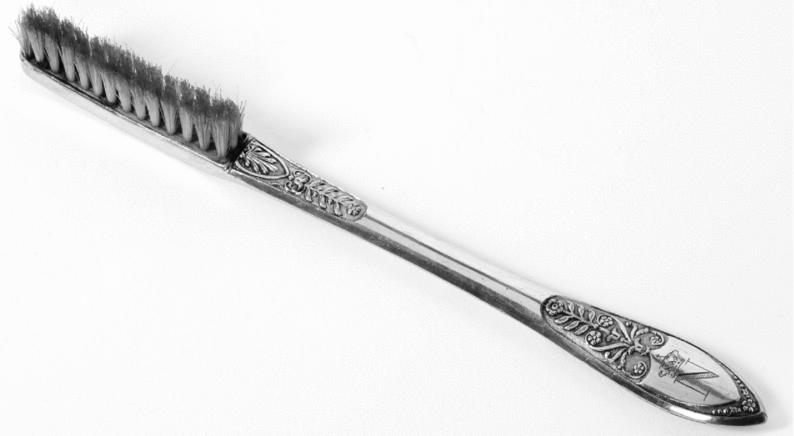
Proof that the smile of sensibility was not just confined within the literary domain, but was strongly influencing behaviour in the public sphere is the fact that new technologies of mouth care were emergent precisely in this period, with Paris in the vanguard.Footnote 106 The tooth-puller of old now had a rival to contend with: the dentist. It is not an accident that the word dentist (‘dentiste’) dates from this period, for a vocational sub-grouping of practitioners emerged, using surgical know-how to create preventive dentistry. The public toothpuller had been something of a one-trick pony. The new dentist achieved new standards of care, developing an armamentarium of operative tools, passing far beyond mere tooth-extraction – the very last thing a good dentist should be doing – to tooth-filling, cleaning, whitening, straightening, transplanting and replacing. On the eve of the Revolution, the Parisian surgeon Nicolas Dubois de Chémant announced his invention of porcelain false teeth, thus allowing the white-toothed smile to become available even to the terminally toothless.Footnote 107 The regular cleaning of teeth had long been advocated. But now for the first time in human history, this was to be done not simply with a cloth and a toothpick, but with dental powder or paste and with a toothbrush, a shamefully unheralded innovation of this very period. (Napoleon's personal toothbrush may be viewed in the Wellcome Collection, London) (Figure 8).Footnote 108 Lavater characteristically set the seal of approval on the white-toothed smile: ‘clean, white and well-arranged teeth [he held] . . . [show] a sweet and polished mind and a good and honest heart’. It was not the case, he maintained, that people with bad teeth could not in some cases be estimable in their way. But, generally speaking, bad teeth revealed ‘either sickness or else some melange of moral imperfection’.Footnote 109
Toothbrush of Napoleon Bonaparte. © Wellcome Library, London.

Where, then, in the ‘French Smile Revolution’ can we place the political revolutionary, Maximilien Robespierre? In the first part of this paper, I suggested that the tiger–cat reputation that Robespierre acquired on his death is more useful for comprehending an aspect of the nineteenth century's political imaginary, and the subterranean role that physiognomic portraiture has played in shaping subsequent historiography, than in allowing us to understand what Robespierre was really like or really all about. Robespierre inhabited the world of sensibility that was creating the French Smile Revolution. Had he died in 1789, moreover, recollections of him would not, we can wager, be dwelling on his tigrish disposition, but on his exemplary sensibility. The small-time country-town lawyer from provincial Arras had worked hard, built up his practice, specialised in pro bono litigation for the disadvantaged, liked country walks and picnics, dabbled in science, penned soppy verses (for example, an ode on the arts of nose-blowing and uses of the handkerchief) and written sentimental love-letters in the style of Jean-Jacques Rousseau. Put like this, he sounds the sort of character who, as his sister Charlotte would aver, would indeed be ‘nearly always smiling’.Footnote 110
Did he have white teeth, however? The evidence is that at least he tried to. In his memoirs, his fellow-deputy Barras recounted how he and fellow-deputy Fréron had visited Robespierre at his lodgings shortly before 9 Thermidor in an attempt to get him to reach a political compromise. They found him how? Cleaning his teeth (a point unnoticed by historians hitherto).Footnote 111 Barras noted that as Robespierre cleaned his teeth, he insouciantly spat out mouth-rinsing water at the feet of his fellow-deputies. The gesture conveyed, in Barras's account, a lack of civility on Robespierre's part and an overload of contempt for individuals he regarded as his inferiors rather than his fraternal equals. (Clearly, the man had never read his Norbert Elias.) But there is also a hint of the public display of private functions that had characterised the Bourbon court: Robespierre was thus displaying manners that were both reprehensibly Bourbon and irredeemably bestial. Even while noting Barras's spin on the incident, the anecdote reveals that Robespierre did, until the end of his days, maintain the new forms of dental hygiene. He was dentally equipped as a regular man of feeling. (And indeed, flippantly, one might think: ‘the Incorruptible’ – what a wonderful brand-name for a tooth-paste.Footnote 112 )
I began this paper with Charlotte Robespierre's memory of her brother's smiling physiognomy, and have gone on to set this personal recollection contrastively against not only the ‘black legend’ which sprang up as soon as Robespierre was executed but also the historiographical polemics that have circled around this contentious figure ever since. What has been striking is the extent to which debates among historians and biographers have been influenced (even to the present day) by the strongly physiognomical hatchet-job performed on his character after his death, notably the ex post facto invention of his tigrish proclivities. This may partly be explained by physiognomy's perennial wish to penetrate beneath facial and bodily appearance to the ‘reality’ of sub-jacent character, which evidently strikes a chord in our own era of emergent facial recognition technologies.Footnote 113 But the insistence on Robespierre's tiger-like characteristics seems to owe less to physiognomy's claims to explain than to its power to depreciate and diminish. By pushing Robespierre across the human–animal frontier, by making a tiger of him, in other words, we make it impossible to take his humanity seriously – let alone the possibility that he might, as his sister claimed, have managed a smile (at a time moreover when that gesture was being viewed as the key indicator to character). It is all too easy, I would contend, to ‘understand’ the Terror if we consider that its artisans were so many beasts and monsters. What is much more of a challenge is to understand how the Terror could have been created by men of feeling and good will. Robespierre was – of course – no angel. But we can only hope to manage some sort of dispassionate historical judgement on such a complex figure if we deal firmly with the physiognomic language which has accompanied his reputation. If we do not, we risk being only the ventriloquist dummies of Thermidorian propagandists.
Readers may have felt that in the course of my argument, the smile of Robespierre has been waxing and waning before their eyes rather like the grin of a Cheshire cat. I would like to end with one final image of Robespierre's face and capacity to smile that was to prove extremely influential over the next century. It set the seal on his alleged bestiality, and did so in style and in a way that has proved difficult to efface from the memory. That image derives from his execution.
Arrested in the National Convention on 9 Thermidor, Robespierre escaped custody and sought to lead a counter-coup against the assembly. Later that night, faced with its failure, he sought to blow his brains out with a pistol.Footnote 114 He missed. Or at least he missed his brains. He blew a huge hole in his lower jaw, part detaching it from his face. His captors that night bandaged up his face, subjecting him to taunting to which he was powerless to reply. Rushed through the Revolutionary Tribunal next morning, he was conveyed in a tumbril through the streets of Paris. The socialist historian Jean Jaurès recorded that women were dancing wildly in celebration outside his lodgings on the Rue Saint-Honoré as the tumbril passed. Robespierre smiled sadly at the sight, Jaurès tells us (though on what evidence it is not clear, and quite what this smile might have actually have looked like we can only shudder to think).Footnote 115
What happened when the tumbril reached the guillotine is better attested. I will follow Michelet's account. As Robespierre climbed the steps of the scaffold:
One of the guillotine crew brutally snatched away the bandage that held his poor broken jaw together. He let out a howl . . . He could for an instant be seen pale, hideous, his mouth wide open and his teeth falling to the ground . . . there was a heavy thud.Footnote 116
End of story. Or maybe – maybe equally correctly – the start of one. For this macabre episode would be much recounted and gleefully elaborated upon in histories of the Revolution throughout the nineteenth century (twentieth-century historians tend to be more circumspect with the detail, or more squeamish). The animal shriek had irrevocably wiped the smile off Robespierre's face, and established his subhuman bestiality at a stroke. The tiger had lost its white and well-kept teeth even before its head had hit the bottom of the basket. For many of those throughout the nineteenth century who contemplated the French Revolution, this was a fitting end for a tyrannical and bestial monster, pointing a moral, adorning a tale and exemplifying a physiognominal precept. The thought of Robespierre's ‘nearly always smiling’ face would now seem a chimerical fantasy that it would prove impossible, save for sister Charlotte and her ilk, even to imagine. What lingered in the mind was not the well-groomed smile of sensibility, but rather the gaping, gothic black hole where once a smile had been. By reducing Robespierre to a kind of degree zero of humanity, suffused by a sheer animality that was proclaimed by that final, bestial howl, the nineteenth century would live with a monstrous, ideologically hyper-charged and nightmare vision of what revolutions were all about. The bestialisation of Robespierre was equated with the bestiality of all revolutions and all revolutionaries.