Introduction
For most people, spousal loss is an unusually stressful life event. But it is also the case that individual reactions to bereavement are dependent on a wide range of more or less unique circumstances (Stroebe, Stroebe and Schut Reference Stroebe, Stroebe and Schut2001; van der Houwen et al. Reference van der Houwen, Stroebe, Schut, Stioebe and van den Bout2010). In the present paper, the association between pre-loss earning differences between spouses and post-loss wellbeing is analysed. Hence, the focus is on the relationship between structural gender differences and individual wellbeing. The idea is that an unequal intra-household distribution of incomes reflects a traditional gendered division of work, responsibilities, and control within the household (e.g. Stocks, Díaz Martinez and Halleröd Reference Stocks, Díaz Martinez and Halleröd2007; Vogler Reference Vogler2005). It is therefore assumed that large pre-loss income differences between spouses make both men and women less prepared to cope with spousal loss: widows are affected because they need to cope with traditional male tasks (Bennett et al. Reference Bennett, Stenhoff, Pattinson and Woods2010) and widowers because they have to deal with typical female household chores (Bennett Reference Bennett2010). Thus, it is hypothesised that large pre-loss intra-household earning differences have a negative effect on wellbeing among both widows and widower. The paper brings together two strands of research and contributes to the literature on bereavement by linking a structural condition, i.e. the gendered income structure, to individual wellbeing among people who have experienced spousal loss. It contributes to the discussion on intra-household distribution of resources by looking at how individuals are affected by the intra-household income distribution after the relationship itself has ended.
The analysis is based on prospective longitudinal data covering 1,503 individuals who were all married in the mid-1990s (t 0), when they were between 58 and 84 years of age. In the early 2000s, when the follow-up was conducted (t 1), 241 of the previously married individuals had experienced spousal loss. The basic idea is to analyse whether, and to what degree, bereavement is associated with long-term deterioration of wellbeing in general and, in that case, whether this development is particularly accentuated among widows and widowers who have experienced a high degree of intra-household income inequality. Four dimensions of wellbeing will be analysed: global wellbeing as well as specific experience of psycho-social, physical and financial wellbeing.
Bereavement and wellbeing
Spousal bereavement is a life event usually associated with adverse effects on overall quality of life as well as with increased mortality risk (Boyle, Feng and Raab Reference Boyle, Feng and Raab2011; Martikainen and Valkonen Reference Martikainen and Valkonen1996; Stroebe, Stroebe and Schut Reference van der Houwen, Stroebe, Schut, Stioebe and van den Bout2010). Nevertheless, the way people react to spousal loss does vary, and different patterns of grief – for example common, resilient and chronic grief – can be distinguished (Bonanno, Wortman and Nesse Reference Bonanno, Wortman and Nesse2004; Ong, Fuller-Rowell and Bonanno Reference Ong, Fuller-Rowell and Bonanno2010; Ott et al. Reference Ott, Lueger, Kelber and Prigerson2007; Tweed and Tweed Reference Tweed and Tweed2011). Bereaved spouses who are exposed to common grief typically experience a recovery period after the first period of deep grief and depression (Carr Reference Carr2004; Onrust et al. Reference Onrust, Cuijpers, Smit and Bohlmeijer2007; Ott et al. Reference Ott, Lueger, Kelber and Prigerson2007). The resilient group never really fall into a period of deep grief, while the chronic group are not only unable to avoid deep grief and depressive symptoms, they also have greater difficulties coming out of this state. Important explanations for why bereaved people react differently are the degree of pre-loss marital dependency and marital closeness (Abakoumkin, Stroebe and Stroebe Reference Abakoumkin, Stroebe and Stroebe2010; Carr Reference Carr2004; Carr et al. Reference Carr, House, Kessler, Nesse, Sonnega and Wortman2000; Ong, Fuller-Rowell and Bonanno Reference Ong, Fuller-Rowell and Bonanno2010; Ott et al. Reference Ott, Lueger, Kelber and Prigerson2007; Pruchno, Cartwright and Wilson-Genderson Reference Pruchno, Cartwright and Wilson-Genderson2009) and access to social support after spousal loss (Ha Reference Ha2008; Bennett Reference Bennett2010). Care-giving prior to spousal loss impacts on the bereavement process, and relief from a chronically stressful care obligation has been shown to ease the negative emotional effects of spousal loss (Keene and Prokos Reference Keene and Prokos2008). Personal characteristics such as positive emotions and trait resilience have also been shown to ease the coping process after conjugal loss (Ong, Fuller-Rowell and Bonanno Reference Ong, Fuller-Rowell and Bonanno2010).
Although the bulk of the research on the consequences of bereavement focuses on pre-loss emotional relations between spouses and post-loss ability to find support among other family members and close friends, there are studies that focus on more structural factors as well. The idea that women's involvement in the paid labour force provides economic, social and psychological resources that increase their ability to cope with stressful events such as spousal death was tested by Pai and Barrett (Reference Pai and Barrett2007). They concluded that widows who have been involved in full-time work are less affected by psychological distress than are widows who worked part time or not at all. The explanation suggested by Pai and Barrett is that women who worked full time had more control over their life (mastery) and higher self-esteem. The notion that work-life history is of importance to coping with spousal loss is interesting, and the present study takes this question a bit further by looking at not only the possible impact of labour market participation as such, but more specifically at whether and how intra-household earning relations play a part in explaining the relation between losing a spouse and wellbeing.
Intra-household distribution of incomes
Research on intra-household distribution of resources has shed light on the processes through which economic resources are redistributed among household members. The research has first and foremost focused on sharing between spouses and the often intricate and complex ways in which household economies are organised (Nyman Reference Nyman2002; Stocks, Díaz Martinez and Halleröd Reference Stocks, Díaz Martinez and Halleröd2007). Despite complexity and variation, there is a more or less general pattern showing that the spouse who earns less, most commonly the wife, has the least favourable situation, and that an unequal income distribution between spouses is related to dependency, lack of control, and differences in personal spending (e.g. Blood and Wolfe Reference Blood and Wolfe1960; Brines Reference Brines1994; Pahl Reference Pahl1989; Sørensen and McLanahan Reference Sørensen and McLanahan1987; Vogler Reference Vogler1998, 2005). Income differences between spouses are intrinsically linked to the traditional division of work between spouses, and women's responsibility for home and children has been suggested to explain why income differences between men and women are reproduced and, at the same time, why wives more often than husbands experience financial difficulties and worries (Halleröd Reference Halleröd2005).
Research on income difference between spouses has rarely concentrated explicitly on older people. However, there are reasons to believe that income sharing is of specific importance to older people. First, there is a cohort effect. Older people have lived the greater part of their lives in a comparatively more gendered society with lower female labour market participation and taken-for-granted female responsibility for children and housework. But there are also reasons to believe that there is an age effect. Becker (Reference Becker1981) perceives negotiations between spouses as a series of events that generate more and more specialised intra-household division of work over time, which, even though the theory itself is gender neutral, in most cases means that the wife does the main part of the housework while the husband concentrates on market work. Hence, we can assume that the intra-household distribution of both initial earnings and housework becomes increasingly uneven over time. Other theories, such as the resource bargaining theory (Blood and Wolfe Reference Blood and Wolfe1960) and the resource dependency theory (Sørensen and McLanahan Reference Sørensen and McLanahan1987), are less inclined to accept Becker's view of family members as altruistic, but do nevertheless assume that a series of events over time will lead to a sharper division of work within the household and deepened gender inequality when it comes to both earnings and sharing of housework (Halleröd Reference Halleröd2005; Rothstein Reference Rothstein2010). The idea of on-going specialisation is also supported by qualitative studies (Evertsson and Nyman Reference Evertsson, Nyman, Grönlund and Halleröd2008; Nyman Reference Nyman2002; Stocks, Díaz Martinez and Halleröd Reference Stocks, Díaz Martinez and Halleröd2007). Thus, it is not only that older people established their families at a time when traditional gender patterns played an even more important role than they do today, it is also the case that within-household dynamics among older couples reflect the accumulated effect of a long-term process.
Depending on the construction of the pension system, the pre-loss intra-household distribution of incomes has varying degrees of impact on the economic situation after spousal loss. Of interest here is the Swedish pension system, which is highly individualised and where there is a direct link between the individual's labour market participation and his/her pension. It is also the case that pension rights are not generally transferable between spouses, and thus in cases of spousal loss there is usually a substantial loss of household income. Hence, the intra-household distribution of labour market incomes is more or less maintained also after retirement. Given the gendered labour market, the economic consequences of losing a spouse are therefore often more serious for women than for men. This is clearly seen when we look at the data used in the present paper (see below). In 2002–03, the median annual disposable income was around 128,000 Swedish Crowns (SEK) for widowers, but only 105,000 SEK for widows. Thus, in addition to the emotional and social consequences, spousal loss also has negative economic effects that are related to the pre-loss intra-household distribution of incomes.
Although it has been shown that resources are often unevenly shared within households, it is also clear that, in most households, some kind of sharing does occur (cf. Stocks, Díaz Martinez and Halleröd Reference Stocks, Díaz Martinez and Halleröd2007) and that income differences between spouses are more or less neutralised as long as both spouses are alive. However, the fact that most spouses have a mechanism for redistribution does not mean that the adverse effects of earning differences are eliminated. Lack of control and dependency are other aspects that do not vanish just because spouses share economic resources. It is in fact often the other way around, i.e. sharing resources may create control and dependency within the household (Halleröd and Nyman Reference Halleröd, Nyman, Grönlund and Halleröd2008; Nyman Reference Nyman2002; Roman and Vogler Reference Roman and Vogler1999; Sørensen and McLanahan Reference Sørensen and McLanahan1987; Stocks, Díaz Martinez and Halleröd Reference Stocks, Díaz Martinez and Halleröd2007; Vogler and Pahl Reference Vogler and Pahl1994).
Why should earning differences between spouses matter?
Because of the strong link between income differences between spouses and the organisation of work and responsibilities within the household – the more equal the income distribution, the more equal the sharing of tasks, control and responsibilities – the intra-household distribution of incomes can been linked to role expansion theories (Brook, Garcia and Fleming Reference Brook, Garcia and Fleming2008; Nordenmark Reference Nordenmark2004). Small intra-household income differences can be seen as an indicator of role expansion and multiple social roles, which generate greater experience of handling different social roles, provide a wider social network, as well as increase experience of dealing with different practical situations. These are typical features that have been shown to be important in the coping process after spousal loss (Bennett Reference Bennett2010; Bennett et al. Reference Bennett, Stenhoff, Pattinson and Woods2010; Carr Reference Carr2004; Carr et al. Reference Carr, House, Kessler, Nesse, Sonnega and Wortman2000; Stroebe, Stroebe and Schut Reference Stroebe, Stroebe and Schut2001), making it plausible to claim that spousal loss has a less adverse effect if the pre-loss intra-household distribution of incomes has been relatively equal, and vice versa.
Because women generally have lower incomes than men, our intuition may tell us that widows will be most negatively affected by an unequal intra-household distribution of incomes, while for widowers this will be less of a problem. Now, if this were true and if the intra-household distribution of incomes really were important, we would also be able to observe that the negative impact of spousal loss is less serious for men. But this does not seem to be the case, and it is frequently reported that losing a spouse causes more or at least not less distress among men than among women (Carr Reference Carr2004; Lee and DeMaris Reference Lee and DeMaris2007; Stroebe, Stroebe and Schut Reference Stroebe, Stroebe and Schut2001). However, the argument put forward here is not that an unequal intra-household distribution of income is harmful only to the spouse with the lowest income, but that it is assumed to be harmful to both partners. A sharp pre-loss division of work within the household means that the surviving partner has to take on tasks and responsibilities that previously have been dealt with by their spouse. Again building on results from research on intra-household distribution of resources, we know that specific tasks and responsibilities differ systematically between men and women. The general picture for widows is that they have to shoulder responsibilities for economic control, larger economic decisions and maintenance of properties, i.e. tasks generally dealt with by husbands – particularly if the husband's earnings were considerably higher than the wife's (Nyman Reference Nyman2002; Pahl Reference Pahl1989; Stocks, Díaz Martinez and Halleröd Reference Stocks, Díaz Martinez and Halleröd2007; Vogler Reference Vogler2005). For widowers, the effect occurs because they have to shoulder the full responsibility for housework, shopping, cooking and other daily chores. Again previous research tells us that this is particularly true in households where the husband earns considerably more than the wife. Hence, the assumption is that an unequal intra-household distribution of resources has negative effects on the wellbeing of both widows and widowers.
However, it is likely that we will find gender differences when it comes to financial worries and difficulties. Because this situation (see above) is much more common for women, it is expected that economic difficulties will be more common among widows than among widowers.
Based on the above line of reasoning, the following tentative hypotheses can be deduced:
• Hypothesis 1: An unequal pre-loss intra-household distribution of incomes makes it harder for both men and women to cope with spousal loss. It is therefore anticipated that a more uneven pre-loss intra-household distribution of incomes will be related to a higher degree of wellbeing problems for both widows and widowers.
• Hypothesis 2: The negative income effect of spousal loss is more common and generally larger among women than among men. It is therefore anticipated that an unequal pre-loss intra-household distribution of incomes will be more strongly related to a high degree of economic stress and economic difficulties among widows and than among widowers.
The discussion above is based on a traditional situation where the husband has the highest income. Logically, we would expect the situation to be reversed in a non-traditional household where the wife has the highest income. However, research indicates that this is not necessarily the case. Husbands who earn less than their wives do not seem to take greater responsibility for different kinds of household chores (Brines Reference Brines1993, Reference Brines1994; Halleröd Reference Halleröd2005; Nordenmark Reference Nordenmark1999; Stocks, Díaz Martinez and Halleröd Reference Stocks, Díaz Martinez and Halleröd2007). Nor do men who are economically dependent on their partner seem to worry about lack of control and independence (Stocks, Díaz Martinez and Halleröd Reference Stocks, Díaz Martinez and Halleröd2007). These findings make it especially interesting to study widowers who earned less than their wives did. However, in addition to the fact that this issue is beyond the scope of the present paper, it is also the case that such an analysis requires a much larger sample.
Data and operationalisation
The analyses are based on data from the Panel Survey of Ageing and the Elderly (PSAE). PSAE was fielded in 2002 and 2003 as an integrated part of the Swedish Survey of Living Conditions (ULF) (Vogel and Häll Reference Vogel and Häll2006), which has been conducted annually since 1975. What makes the PSAE unique is the inclusion of a broad range of questions relevant to old age and an over-sampling of people in the age category 65+. The main part of the PSAE sample is made up of a panel that had previously been included in the ULF survey programme. The working sample used here consists of panel data from two points in time; data related to t 0 were collected in 1993, 1994, 1995 or 1996 (the bulk of respondents were interviewed in 1994 and 1995) and data related to t 1 were collected in 2002 and 2003. The working sample is made up of 1,503 individuals (790 men and 713 women) who at t 0 were married and in the age range 58–84, and who at t 1 were either still married or widows/widowers living in single-adult households. No distinction is made between couples who were formally married (N=1,399) and unmarried cohabiting couples (N=104). Respondents who at t 0 were living in single-adult households or who divorced between t 0 and t 1 are not included in the working sample. At both points in time, data were mainly collected via face-to-face interviews. A smaller fraction of respondents have been interviewed via telephone. The PSAE and ULF also use indirect interviews in case the respondent is incapable of participating in the interview owing to physical or cognitive impairment. Several of the indicators central to the present study were not included in indirect interviews, and all indirect interviews have therefore been excluded from the working sample.
Independent variables
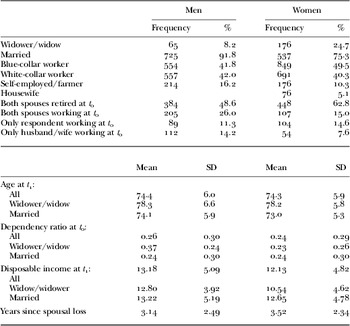
The main independent variable is change in marital status, i.e. spousal loss between t 0 and t 1. Table 1 shows that about a quarter of the women had become widows at t 1, while only 8 per cent of the men had become widowers at t 1. The independent variable that is supposed to explain a significant part of the variation in wellbeing among widows and widowers is the pre-loss intra-household distribution of incomes, which is measured by the so-called dependency ratio at t 0. Following Sørensen and McLanahan (Reference Sørensen and McLanahan1987), the dependency ratio is calculated according to the formula: (z i − x i)/(z i + x i), where z i is the husband's after-tax income and x i is the wife's after-tax income. The ratio can vary from −1 to 1. A ratio value of 1 means that the husband is the household's only income earner and that he has to transfer half of his income to his wife to achieve equality. A ratio of −1 obviously means the opposite, i.e. that the husband has no income at all and has to receive half of his wife's income to achieve equality. Table 1 shows that the mean dependency ratio for men is 0.25 and for women 0.24, which means that, as expected, most husbands need to transfer resources to the wife in order to achieve equality. In only 17 per cent of cases is the dependency ratio negative, i.e. the wife's income is larger than the husband's.
Descriptive statistics: independent variables

Note: SD: standard deviation.
Widows and widowers who are identified in the sample have all experienced spousal loss sometime between t 0 and t 1. Hence, time since spousal loss varies considerably within the sample. The PSAE includes information allowing us to calculate number of years since loss. For both widowers and widows, the mean time since spousal loss was somewhat above three years, but the deviations from the means were considerable. Because the negative impact on wellbeing is most prevalent immediately after the loss, the logarithm of time since loss is used in the analysis. It should be noted that this measure is not ideal, as the impact of spousal loss often changes significantly during the first year (Bonanno, Wortman and Nesse Reference Bonanno, Wortman and Nesse2004; Ong, Fuller-Rowell and Bonanno Reference Ong, Fuller-Rowell and Bonanno2010; Ott et al. Reference Ott, Lueger, Kelber and Prigerson2007), which is something we unfortunately miss given that the available data only contain information on number of years.
Both the dependency ratio and sharing of housework are most extreme in households where the wife has spent most of her married life as a housewife; in such cases, we may expect housewives who become widows to find the coping process especially hard. Therefore, an additional dummy variable is included that discriminates those women who at t 0 report that they primarily have been housewives. As can be seen, this is a relatively small share of all women, only around 5 per cent, which reflects the fact that Swedish housewives have long been an endangered species.
Earlier research has shown that the intra-household distribution of resources is typically related to socio-economic status (SES) (Halleröd Reference Halleröd2005; Roman and Vogler Reference Roman and Vogler1999). Because the same applies to wellbeing, it is necessary to include controls for SES. Two variables are used. The first one, labour market position, is based on Statistics Sweden's socio-economic code (SEI) and discriminates between blue-collar workers, white-collar workers and the self-employed (including farmers). The classification is based on retrospective information on the respondent's main occupation during his or her working career. Respondents without any occupational history, for example housewives, are given the same SES as their spouse. Second, the households' equivalent disposable income at t 1 is included as a control variable in order to eliminate the risk that our results on wellbeing will be related to income differences between households, not differences within households. Educational attainment (primary, secondary and tertiary schooling) has also been tested, but when added to the analysis alongside SES and income, education does not add any additional information and the results are not shown here.
A subjective health measure is used as a control for poor pre-loss health. Respondents who reported poor or very poor health were classified as being in poor health. PSAE does not include any information on the respondent's spouse's health, which is unfortunate considering that the spouse's health condition before death is important to the coping process (Keene and Prokos Reference Keene and Prokos2008).
As mentioned above, for both men and women, there is a fairly strict relation between pre-retirement income and pension income, which means that the dependency ratio gives a good indication of the long-term relation between the relative sizes of each spouse's contribution to the total household income. However, at t 0 there are households in which one of the spouses is retired while the other is still working, which will have an impact on the dependency ratio (in the typical case the dependency ratio will be overestimated if only the husband is working and underestimated if the only the wife is working). It is also possible that engagement in paid work shortly before spousal loss directly impacts on the coping process (Pai and Barrett Reference Pai and Barrett2007). Dummy variables are therefore constructed to capture whether the respondent, his/her spouse, or both were working at t 0.
The dependent variables – dimensions of wellbeing
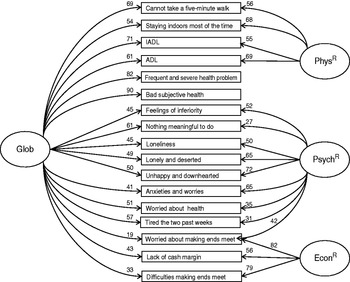
In a recent study, Halleröd (2009) used PSAE data to analyse associations between a range of different welfare problems among older people (66+); the current sample is a sub-sample of that sample. The indicators, listed in Figure 1, covered physical functionality and health, a set of psycho-social indicators measuring worries, anxieties and social integration and, finally, a number of indicators dealing with economic conditions. Thus, the data cover three areas – physical, psycho-social and financial wellbeing – on which bereavement has a substantial impact (e.g. Stroebe, Stroebe and Schut Reference Stroebe, Stroebe and Schut2001). In order to sort out the relationship between the indicators, a series of confirmative factor analyses (CFA) were fitted to the data, and two group models were estimated to reveal differences between men and women and the ‘young-old’ and the ‘oldest-old’. These analyses showed that even though the prevalence of wellbeing problems is generally higher among women and the oldest-old, the patterns of associations did not differ between men and women or between different age groups (see also Saarni et al. Reference Saarni, Suvisaari, Sintonen, Koskinen, Harkanen and Lönnqvist2007). Finally, a four-factor nested single group model (shown in Figure 1) was chosen as the preferred model. The four latent variables derived from this model, i.e. the estimated individual factor scores, are used as dependent variables in the present study as well.
Nested confirmative factor model. Standardised weighted least squares with robust standard errors and mean- and variance-adjusted chi-square (WLSMV) regression coefficients (coefficient×100). Notes: ADL: activities of daily living. IADL: instrumental activities of daily living. Glob: global factor. PsychR: residual psycho-social factor. PhysR: residual physical factor. EcoR: residual economic factor. N=3,053; Goodness of fit: RMSEA=0.035; CFI=0.97; TLI=0.98. Source: Halleröd (2009).

The model estimates one latent global factor (Glob) that is related to all 17 input variables, such that a high score on this factor indicates an accumulation of psycho-social, physical, economic and somatic health problems. As can be seen in Figure 1, the global factor is strongly related to health. Although it is common for older people to accumulate different types of problems and although there is often a strong link between physical and psycho-social problems, this is not always the case, which is shown by the three latent residual factors measuring psycho-social (PsychR), physical (PhysR) and economic (EcoR) problems. It is important to interpret the latent residual factors correctly. Scoring high on PsychR indicates that an individual suffers from psycho-social problems without at the same time having physical or economic problems. If they also have these other problems, they score high on Glob, not PsychR. Worth noticing is that PsychR is unrelated to the subjective health measure and to ‘frequent and severe health problems’, which means that PsychR is in essence a measure of psycho-social wellbeing that is unrelated to the general health situation. Thus, the use of residual factors helps us separate psycho-social problems that are related to poor health from psycho-social problems that are not related to health problems.
In the same way as PsychR captures those who are only suffering from psycho-social problems, PhysR only captures older people who experience substantial limitations in their physical mobility, but who nevertheless report feeling more or less fine, i.e. they do not feel their health is poor, they do not feel lonely or downhearted, they do not experience financial problems, but they do have considerable problems moving around and keeping up with daily activities. EcoR consequently measures economic problems among people who are otherwise healthy, unworried and feel they are socially integrated. Naturally, there are many older people who experience financial difficulties who also suffer from poor health and psycho-social difficulties, but they score high on the global factor Glob. By relating the impact of spousal loss and the dependency ratio to each of the four factors, additional knowledge will be gained about how bereavement affects different aspects of older people's wellbeing and about the degree to which these differences can be linked to the pre-loss intra-household distribution of incomes. For more in-depth information about the model, see Halleröd (2009).
Because we know that somatic and psycho-social symptoms often coincide, it is expected that spousal loss will affect the global factor Glob, i.e. that bereavement will trigger a combination of somatic, psycho-social and economic problems, leading to a high score on Glob. The link between the psycho-social factor PsychR and bereavement is even more straightforward, as this latent variable is made up of indicators related to factors typically associated with bereavement, such as anxiety, loneliness, lack of meaning, unhappiness and worries. It is harder to see why bereavement should have any impact on the residual factor PhysR, i.e. why spousal loss should lead to somatic health problems not related to psycho-social aspects. One possible link, however, is that older people do not experience their physical problems as particularly troublesome as long as they are supported by a partner. But once the partner is gone, physical limitations may become more apparent. The empirical test will reveal whether such an assumption has any validity. The residual economic factor, EcoR, is related to Hypothesis 2, which means that we primarily expect widows with high scores on the dependency ratio to score high on this factor.
Method
The four latent factors are not normally distributed, and for all four factors there is an identifiable left-hand-side truncation value representing individuals who do not score on any of the manifest variables listed in Figure 1. In order to deal with this problem, Tobit models have been estimated. The Tobit model assumes a relationship between the latent (unobserved) normally distributed variable y* and the actually observed outcome measure y. The latent dimension y* is equal to the observed dependent variable y if y exceeds the cut-off point for censoring. If y* is below the cut-off point, y is equal to the cut-off value. The model assumes a linear relationship between the independent variables and the latent dimension y* based on a likelihood function that estimates a linear model for the metric data and a probability model for the censored data. The estimated Tobit regression coefficients are linear and additive in relation to the latent response continuum, not in relation to the observed measures (Sullivan, McGloin and Piquero Reference Sullivan, McGloin and Piquero2008). All four dependent latent factors have been recalculated into z-scores, which means that the parameter estimates are to be understood in terms of standard deviations. Finally, to clarify and avoid misunderstandings: the four outcome variables are measuring wellbeing problems. Hence, a higher score means less wellbeing.
Results
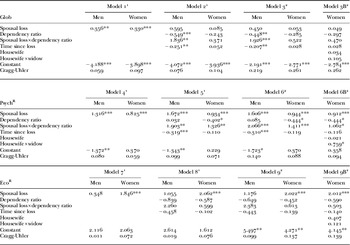
The results from the regression models are shown in Table 2. Separate models are estimated for men and women. The first models have Glob as the dependent variable and show the impact of spousal loss itself. Because we know that both widows and widowers are older compared to those who are still married and because we also know that age affects the outcome variables (Halleröd 2009), age is included as a control variable in this as well as in all other models. As can be seen, spousal loss for both men and women is associated with a high Glob score, i.e. spousal loss is associated with accumulation of a wide range of wellbeing problems strongly correlated with health. In Model 2, the dependency ratio and, most crucially, the interaction effect of spousal loss and dependency ratio are included in the model. Added is also time since spousal loss. Looking at men, we can see a negative effect of the dependency ratio at t 0 on Glob at t 1. Hence, married men are generally better off if they are the household's main income earner. But this is not true for widowers. Spousal loss in combination with a high dependency ratio increases men's Glob score, indicating an overall lower wellbeing. We can also see that, as expected, the estimate for time since loss is negative, which means that the negative effect of bereavement fades over time. With the exception of time since loss, the estimates for women go in the same direction as for men, but the effects are weaker and not significant. Thus, contrary to the hypothesis, there is no connection between pre-loss intra-household distribution of incomes and global wellbeing among widows, such an effect is only found among widowers.
Tobit regression estimates on global factor (Glob), residual psycho-social factor (PsychR) and residual economic factor (EcoR)

Notes:
1. Control for: age.
2. Control for: age, poor health at t 0, socio-economic status (disposable income at t 1 and occupational class), both spouses working at t 0, respondent working at t 0, and husband/wife working at t 0.
Significance levels:
* p < 0.1,
** p < 0.05,
*** p < 0.01.
In the third model, all the additional control variables are included. The inclusion of these variables, estimates not shown, does not change the main results from Model 2. Finally, Model 3B, which includes the dummy for housewives and an interaction between widowhood and housewife, is estimated for women. Neither the main variables nor the interaction variable had any significant effect.
In the next phase, the PsychR score is estimated. Looking at Model 4, both widowers and widows score higher on PsychR compared to those who live in intact marriages, which clearly shows the adverse effect of spousal loss on psycho-social wellbeing. The effect of losing a spouse remains in Model 5. By itself, the dependency ratio has no significant effect for men, while there is a negative effect for women, indicating that women are better off in intact households where there are large income differences. The combination of a dependency ratio and spousal loss clearly increases the PsychR score for both men and women. Thus, an uneven intra-household distribution of resources deepens the negative effect of spousal loss on psycho-social wellbeing for both sexes. Again we find a negative impact of time for widowers, but not for widows. Inclusion of the control variables poor subjective health, working status, income and class in Model 6 does not change the picture, and as shown earlier, the PsychR measure is basically unrelated to both age and socio-economic conditions (Halleröd 2009). Model 6B shows that the housewife–widow interaction significantly affects PsychR, increasing psycho-social problems.
The same models as described above have also been estimated for PhysR, but this factor was totally unrelated to spousal loss and the dependency ratio, and the results from these models are not presented here. The analysis related to EcoR reveals that widows experience economic difficulties to a higher extent than those who have not experienced spousal loss as well as in comparisons with widowers. Widows' experience of economic problems is, contrary to the hypothesis, not related to the pre-loss dependency ratio. The effect of spousal loss among women also remains more or less unaffected in Model 9, when class and disposable income at t 1 are also included in the model, as well as in Model 9B, when the housewife measure is added. Hence, widows, but not widowers, are, regardless of their previous dependency ratio and current income, generally more troubled than others when it comes to financial matters.
Conclusions
In line with earlier results (cf. Carr Reference Carr2004; Carr et al. Reference Carr, House, Kessler, Nesse, Sonnega and Wortman2000; Ha Reference Ha2008; Ong, Fuller-Rowell and Bonanno Reference Ong, Fuller-Rowell and Bonanno2010; Ott et al. Reference Ott, Lueger, Kelber and Prigerson2007; Pruchno, Cartwright and Wilson-Genderson Reference Pruchno, Cartwright and Wilson-Genderson2009), the present empirical analysis showed that spousal loss had adverse effects on wellbeing for both men and women. Both widows and widowers scored higher on the global measure of overall wellbeing problems, which was made up of a combination of health, psycho-social and economic problems. Bereaved men and women also scored higher on the residual psycho-social factor, i.e. even though they were physically healthy they suffered from specific psycho-social problems such as worries, anxiety and sleeping problems. Widows but not widowers also reported a higher degree of economic problems, again measured as a residual factor, which means that these problems occurred independently of somatic health problems and psycho-social problems. Owing to the individualised construction of the Swedish pension system, we expected that widows would be more affected by economic problems.
The central assumption that the pre-loss intra-household distribution of incomes affects post-loss wellbeing was generally supported by the data, even though the results were somewhat mixed. Let us look first at the global measure of wellbeing, that is, the degree to which individuals are suffering from a combination of somatic health, psycho-social and economic problems. Among men who did not experience spousal loss, being the household's main income earner at time t 0 was related to absence of global wellbeing problems at time t 1. Thus, husbands generally fared well if they earned more than their wives. But in cases of spousal loss, the picture looked different, and widowers who earned the bulk of the household's income scored higher on the global measure. Hence, the typical male breadwinner was exposed to a range of strongly health-related wellbeing problems – physical, psycho-social and economic – in cases of bereavement. For widows the picture looked different, and there was no relationship between the intra-household distribution of incomes and global wellbeing problems. Earlier results indicate that widowers more than widows suffer from physical problems (cf. Stroebe, Stroebe and Schut Reference Stroebe, Stroebe and Schut2001). The present analysis does not find a general difference between widows and widowers. They both score approximately the same on the health-related global wellbeing measure, but only for widowers was the score on the global measure related to pre-loss intra-household distribution of incomes. This finding not only emphasises the need to continue to examine differences in coping capacity and coping behaviour between widows and widowers, it also reveals the importance of more specifically analysing the link between physical health problems and the readiness among widowers to take on typical female household chores.
These initial findings do not mean that intra-household income distribution is unimportant to the wellbeing of widows. When looking at the residual factor measuring psycho-social wellbeing problems, i.e. psycho-social problems not related to somatic health or financial problems, we did find an impact of intra-household distribution of incomes for both widows and widowers. For both groups, large pre-loss income differences were associated with a high degree of psycho-social wellbeing problems. For widows it was also shown that spousal loss had an especially negative impact on the small minority of housewives, a finding that further underlines the importance of pre-loss organisation of the household economy and household work.
It was also clear that widows, but not widowers, suffered from financial worries to a higher degree than other women did. Contrary to expectations, this effect was unrelated to the pre-loss dependency ratio. It was also unaffected by post-loss income. Thus, money worries among widows seem to be a general pattern, unrelated to the factors analysed here. However, this result is in line with earlier studies showing that financial strain is more common among widows (cf. Bennett et al. Reference Bennett, Stenhoff, Pattinson and Woods2010; Carr Reference Carr2004; Stroebe, Stroebe and Schut Reference Stroebe, Stroebe and Schut2001).
On the whole, the results support the hypothesis that when spousal loss occurs, both women and men will be negatively affected by an uneven intra-household distribution of incomes. The results are also in line with studies of spousal bereavement focusing on the coping difficulties faced by widows (Bennett et al. Reference Bennett, Stenhoff, Pattinson and Woods2010) and widowers (Bennett Reference Bennett2010). For men, this holds true for both the global factor and the residual psycho-social factor. For women, only the latter was affected. The results also indicate that, to the degree that there is a gender difference, it is widowers who are most negatively affected by the traditional uneven intra-household distribution of incomes.
The results add potentially important knowledge to our understanding of bereavement. Earlier research has pinpointed several more or less individual features affecting coping abilities, for example marital closeness (Abakoumkin, Stroebe and Stroebe Reference Abakoumkin, Stroebe and Stroebe2010; Carr Reference Carr2004; Carr et al. Reference Carr, House, Kessler, Nesse, Sonnega and Wortman2000; Ott et al. Reference Ott, Lueger, Kelber and Prigerson2007; Pruchno, Cartwright and Wilson-Genderson Reference Pruchno, Cartwright and Wilson-Genderson2009), access to social support (Ha Reference Ha2008), care obligations (Keene and Prokos Reference Keene and Prokos2008) and positive emotions (Ong, Fuller-Rowell and Bonanno Reference Ong, Fuller-Rowell and Bonanno2010). Although important, these features are relatively difficult to deal with from a political perspective. What the present paper adds is an understanding that structural gender inequality, generated by the interplay between the gendered organisation of household work and gendered labour markets, can have adverse effects for both widows and widowers. The results are in line with earlier findings on the relationship between labour market participation and bereavement (Pai and Barrett Reference Pai and Barrett2007). They also set the spotlight on structural gender inequality, which is something that can be influenced by policies promoting gender equality. The present article is based on data from Sweden, a country often pinpointed as a forerunner when it comes to gender equality and female labour market participation. Sweden also has comparatively small intra-household income differences and a less sharp division of work between men and women (e.g. Ray, Gornick and Schmitt Reference Ray, Gornick and Schmitt2010). Hence, by using Swedish data to test whether pre-loss intra-household distribution of incomes would affect post-loss wellbeing, we clearly chose a hard case. If we find such a relationship in Sweden, we will probably also find it in other countries with less gender equality. The good news is that the present findings indicate that increasing gender equality will lead to a win–win situation that makes it easier for both men and women to cope with spousal loss, and this is probably not only true for Sweden, but for most other countries as well.
Acknowledgements
I wish to thank my colleagues at both the University of Gothenburg and Umeå University for their valuable comments. I am also grateful for helpful comments from reviewers. The Swedish Council for Working Life and Social Research has financially supported this research.