Osteoporosis has become an increasingly recognized health concern by the medical community and the public. The hallmark of this skeletal disorder is diminished bone strength predisposing to a higher risk of fracture (1). Two types of osteoporosis are distinguished: (i) primary osteoporosis, attributable to aging, menopause, and lifestyle-related factors, such as smoking, alcohol, diet and physical inactivity; (ii) secondary osteoporosis, caused by diseases and/or the use of drugs.
Primary osteoporosis affects millions of postmenopausal women and a growing number of men. Because of induced hormonal changes, it is more common among women after menopause. As such, it is perhaps the widest ranging social, physical, and economic impact of estrogen deficiency (Reference Gambacciani, De Aloysio and Elia2–Reference Nelson, Helfand and Woolf4) and a leading risk factor for bone fractures in menopausal women (Reference Cooper, Campion and Melton5). The incidence of osteoporotic fractures in Western countries is rising as the life expectancy lengthens. There is a clear relationship between bone mineral density (BMD) and fracture risk that facilitates the use of BMD as a predictive factor for the development of osteoporotic fractures. This approach, however, has two drawbacks: its predictive value is rather low in general (Reference Marshall, Johnell and Wedel6), and its sensitivity further decreases with patients’ increasing risk and age.
To achieve a higher sensitivity that is not affected by age, additional clinical risk factors independent of BMD, for example, prevalent rheumatoid arthritis, smoking or excessive alcohol consumption, have been added to the evaluation.
Through this evaluation, an algorithm was developed that predicts the absolute 10-year fracture risk with a much higher predictive value than that from the evaluation of BMD or clinical risk factors alone (Reference McCloskey, Johansson and Oden7;Reference Kanis, McCloskey and Johansson8).
The algorithm is known as FRAX® and is available free of charge at www.shef.ac.uk/FRAX ®/. After the FRAX® algorithm is calibrated to local hip fracture and death rates, it is applicable to any geographic region (Reference Lakatos, Balogh and Czerwinski9).
According to a World Health Organization (WHO) study group (10), the gold standard test for osteoporosis screening is the measurement of bone mineral density (BMD) by dual-energy X-ray absorptiometry (DXA or DEXA). Developed roughly 20 years ago (Reference Genant, Faulkner and Gluer11), DXA is the method of choice for diagnosing osteoporosis and, consequently, fracture risk estimation.
Recently, there has been increased interest in the use of quantitative ultrasound sonography (QUS) (Reference Lewiecki, Richmond and Miller12;Reference Nayak, Olkin and Liu13). However, using QUS to diagnose osteoporosis is somewhat problematic. The reason for this is that the WHO diagnostic classification applied to DXA t-scores cannot be used for QUS because QUS t-scores are not equivalent to t-scores derived by DXA (Reference Faulkner, von Stetten and Miller14); the explanation for this finding is that the two techniques measure distinct bone properties. Approaches to overcoming this dilemma require appropriate conversion equations and predefined, device-specific diagnostic thresholds; these, however, are still in development. Although osteoporosis screening by QUS is not recommended as a substitute for DXA, it may offer some potential advantages as a pretest: QUS is easy to use, radiation free, and requires no special facilities for operation. For these reasons, QUS has been proposed as a prescreening tool, with DXA offered only to those women identified by QUS as being at high risk for having osteoporosis (Reference Lewiecki, Richmond and Miller12;Reference MacLaughlin, MacLaughlin and Snella15;Reference Marín, González-Macías and Díez-Pérez16). Consistent with the review of Schousboe and Gourlay (Reference Schousboe and Gourlay17) and the study by Nayak et al. (Reference Nayak, Roberts and Greenspan18), consensus is lacking about the DXA test or the sequence QUS+DXA, the threshold for selecting individuals for treatment and the optimal age at which to initiate screening (Reference Schousboe and Gourlay17;Reference Nayak, Roberts and Greenspan18).
The policy question we posed for this study was whether DXA alone was more cost-effective for identifying postmenopausal women with osteoporosis than was a two-step procedure combining QUS with DXA. To answer this question, we performed a systematic review of the literature and evaluated the currently available evidence according to the PRISMA criteria (Reference Moher, Liberati and Tetzlaff19).
This study is part of a research series in health technology assessment developed by the Department of Public Health and San Giovanni Battista University Hospital (Turin Italy). The research series focused on the performance and economic evaluations of different techniques (Reference Gianino, Galzerano and Tizzani20;Reference Gianino, Galzerano and Minniti21).
MATERIALS AND METHODS
Methods
Search Strategy
In 2012, two researchers independently performed systematic searches of international databases to identify publications from PubMed, the International Network of Agencies for Health Technology Assessment (INAHTA), the Health Evidence Network (HEN), the National Institute for Health Research (NIHR) Health Technology Assessment program, the National Health Service (NHS) Economic Evaluation Database, Research Papers in Economics (RePEc), the Web of Science, Scopus, and EconLit using MESH terms, text words, and acronyms in multiple combinations.
All papers written in English, French, and Italian, regardless of their dates of publication, were considered for our purposes. Details of the search procedure are available in Supplementary Table 1, which can be viewed online at http://dx.doi.org/10.1017/S0266462314000257.
Selection strategy and criteria
In the first stage, the researchers analyzed the search results individually to find potentially eligible publications. The publications were sorted by title and abstracts; all irrelevant studies (lack of pertinence, identical publications found on more than one database) and reviews were excluded.
In the second phase, only the studies that met the following inclusion criteria were selected: (i) the patients had to be postmenopausal women; (ii) the study had to compare QUS plus DXA with DXA alone. No exclusion criterion was applied to the publication types; (iii) the measurement of effectiveness had to be reported as the number of osteoporotic subjects accurately diagnosed, that is, the number of true positive cases; (iv) the publications had to contain sensitivity and specificity or allow for their calculation; (v) the technique used had to be DXA at the femoral neck or lumbar spine or total hip (Reference Leib, Lewiecki and Binkley22) and calcaneal QUS; (vi) the economic evaluation of resources required to provide the alternative techniques (DXA and QUS test costs) had to be included.
The exclusion process was performed by two independent reviewers. Discrepancies were resolved through the intervention of another reviewer.
Quality Assessment
The 10-item Drummond checklist was used to assess the methodological quality of the included studies (Reference Drummond23). Details of the quality assessment are available in Supplementary Table 2, which can be viewed online at http://dx.doi.org/10.1017/S0266462314000257. The Drummond checklist provides a global assessment of the quality of evidence, but it did not form the basis for accepting or rejecting articles.
Data Extraction
The researchers reviewed the selected full texts for eligibility and extracted the required data. For each publication, the following information was retrieved: (i) Study characteristics: Publication year, Country and setting, Sample size, Prevalence of osteoporosis, Recruitment design, Prospective economic evaluation; (ii) Technique characteristics: Types of devices; Sites of application; (iii) Screening strategies with DXA and QUS, specifying QUS parameters and thresholds for women who required a DXA measurement for accurate diagnosis; (iv) Economic evaluation characteristics: Types of costs, Currencies and financial years; Cost breakdowns (i.e., the systematic process of identifying the individual elements that composed the unit costs of the QUS and DXA tests); (v) DXA and QUS test results: Number of osteoporotic subjects accurately diagnosed (true positives); QUS sensitivity and specificity when available.
Economic Analysis
Our review was conducted to analyze the cost per true positive case of two different strategies for osteoporosis screening and their incremental cost-effectiveness.
Cost per true positive case was calculated as total cost divided by number of true positive cases detected with the two different approaches: (i) the total cost per osteoporotic subject based on DXA measurement alone, that is, without a QUS screen and (ii) the total cost per osteoporotic subject identified by QUS+DXA, that is, using QUS as a screen. This cost was the sum of the total cost of performing the QUS test in all subjects and the cost of performing additional DXA testing in those women who were positively detected with QUS.
For DXA, osteoporosis is defined by the WHO as a BMD that is 2.5 standard deviations or more below the mean peak bone mass in healthy young adults (a t-score ≤ -2,5) (24).
Incremental cost-effectiveness was calculated as the extra cost needed to generate each additional true positive result.
To compare the costs per true positive case, the current costs of the DXA and QUS tests were adjusted to Euro currency and inflation (base year 2006, i.e., the last year in the published studies used to estimate the test costs) (25;26) and exchange rates (27).
Cutoff values were calculated that indicated the level below which, based on the ratio unit cost of the QUS test and the unit cost of the DXA test, a true positive case diagnosed by the QUS+DXA technique was more cost-effective than was a true positive case detected by DXA alone.
RESULTS
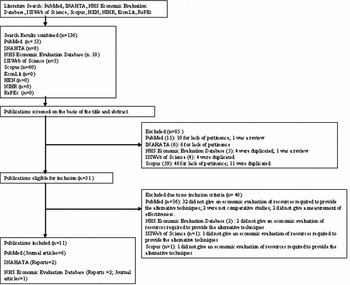
Overall, 136 publications were found. After the titles and abstracts were read, eighty-five publications were excluded as irrelevant (lack of pertinence or duplicates) or as reviews. Of the remaining fifty-one publications, forty were excluded because they did not meet the inclusion criteria. Finally, a total of eleven publications, seven journal articles, and four reports were included in our review (Figure 1). The four reports provided the basis for the discussion.
Study flow diagram. Steps for selecting the studies for inclusion in this review.

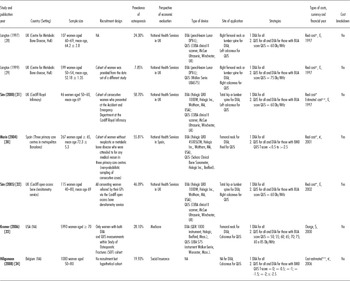
The quality of the journal articles was good. Each article fulfilled six to ten items on the Drummond checklist (Supplementary Table 2). The characteristics of the studies are illustrated in Table 1.
Characteristics of the Studies

*Cost estimated = when resources that required alternative methods (QUS and DXA) were proposed by institutions or the literature.
**Real cost = when actual resources that required alternative methods (QUS and DXA) were identified, enumerated and valued.
All journal articles were cohort studies, and their analyses were performed from the perspective of the third-party payer. The women's ages ranged from 40 to 70. The prevalence of osteoporosis ranged between 7.85 percent and 57.70 percent.
Three studies used mcCue CUBA Clinical (Mc Cue Plc, Winchester, UK), two used Wolkers Sonix UBA575 (Walker Sonics Inc. Worcester, MA) and one used the Sahara Clinical Bone Sonometer (Hologic Inc., Bedford, MA) for QUS test (Table 1). Three studies measured the broadband ultrasound attenuation (BUA) of the right calcaneus, two of the left calcaneus and two of both calcanea.
In terms of strategy, five studies adopted one QUS threshold value, and two studies used different QUS threshold values to identify women who needed a DXA measurement for an accurate diagnosis.
Five studies used BUA measurements as the QUS parameter and two used t-scores (Table 1).
Five studies reported the real cost of the DXA and QUS tests; two studies reported the charges or estimated costs (Table 1). Two of the 7 studies gave a breakdown of different cost items (Table 1).
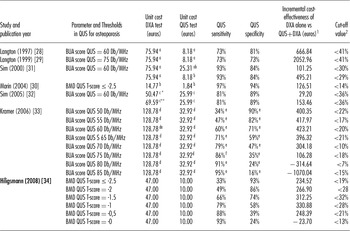
All studies reported that the DXA test was costlier than the QUS test, with some stating that the cost of the DXA test was ninefold or eightfold higher (Reference Langton, Ballard and Langton28–Reference Sim, Stone and Johansen31) and others reporting that it was twofold (Reference Sim, Stone and Phillips32), threefold (Reference Sim, Stone and Johansen31;Reference Sim, Stone and Phillips32), fourfold (Reference Kraemer, Nelson and Bauer33), or fivefold higher (Reference Hiligsmann, Ethgen and Bruyere34) (Table 2).
Sensitivity, Specificity, Unit Cost of the QUS Test and DXA Test, Incremental Cost and Cutoff Value (2006 Euros)
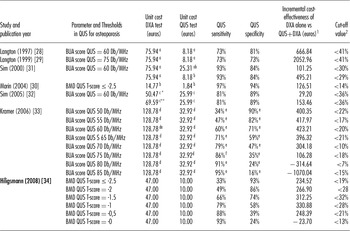
1 Incremental cost –effectiveness is calculated as the extra cost needed to generated each additional true positive result
2 A cut-off value was calculated and indicated under what ratio unit cost for the QUS and DXA tests a case diagnosed by combining QUS+DXA was more cost-effective than was a case diagnosed by DXA alone
a The values in € 2006 are obtained adjusting for an inflation rate of 1.1332 and for an exchange rate £/€ of 1.,4892
b The values in € 2006 are obtained adjusting for an inflation rate of 1.1095
c The values in € 2006 are obtained adjusting for an inflation rate of 1.1035 and for an exchange rate £/€ of 1.4892
d The values in € 2006 are obtained adjusting for an inflation rate of 1.1710 and for an exchange rate $/€ of 0.,8268
e Our own calculations
* DXA fan beam
** DXA pencil beam
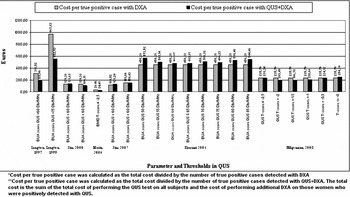
According to Langton et al. (Reference Langton, Ballard and Langton28;Reference Langton, Langton and Beardsworth29) and Marín et al. (Reference Marín, López-Bastida and Díez-Pérez30), the cost per true positive case diagnosed by DXA was higher than that for diagnosis by QUS+DXA. Kraemer et al. (Reference Kraemer, Nelson and Bauer33), however, estimated that the cost per osteoporotic subject identified by DXA alone was less than the cost per osteoporotic subject identified by QUS+DXA. In contrast, three studies (Reference Sim, Stone and Johansen31;Reference Sim, Stone and Phillips32;Reference Hiligsmann, Ethgen and Bruyere34) reported that the cost per osteoporotic subject identified by DXA alone was higher or lower than that of QUS+DXA (Figure 2).
Cost per true positive case with DXA* and QUS+DXA** in 2006 Euros.

For all of the studies, a cutoff value was calculated that indicated under what ratio unit cost for the QUS and DXA tests a case diagnosed by combining QUS+DXA was more cost-effective than was a case diagnosed by DXA alone. Depending on the study, cases diagnosed by QUS+DXA were cost-effective as long as the cost of the QUS test was between 7 percent and 41 percent of the cost of the DXA test (for each study, the cutoff values were as follows: 41 percent in the studies by Langton et al., 30 percent in Sim et al. 2000, and 36 percent in Sim et al. 2005, 14 percent in Marín et al., 7–22 percent in Kraemer et al., and 13–32 percent in Hiligsmann et al.) (Table 2).
The incremental cost to diagnose one more case ranged approximately between 30 and 2,000 Euros (Table 2).
In three cases, there were incremental savings associated with diagnosing each additional case: QUS 80 Db/MHz and QUS 85 Db/MHz, in Kraemer et al. (Reference Kraemer, Nelson and Bauer33) with a QUS t-score = 0 in Hiligsmann et al. (Reference Hiligsmann, Ethgen and Bruyere34) (Table 2).
DISCUSSION
The policy question we posed for this study was whether DXA alone was more cost-effective for identifying postmenopausal women with osteoporosis than was a two-step procedure using QUS plus DXA. In a previous review in 2008, Schousboe (Reference Schousboe35) concluded that on balance, the cost-effectiveness studies of heel ultrasounds did not make a convincing case that heel ultrasounds should be used in places where central DXA was available. In his review, Schousboe did not compare cost per true positive case detected by DXA alone with cost for QUS+DXA; he did not analyze variables such as, for example, sensitivity and specificity or type of costs. In contrast, in our review, we made a comparison and took into account several variables.
In any event, the results of our review did not allow for definitive conclusions about the better technique for diagnosing osteoporosis, most likely because of the lack of homogeneity among the studies. One of the difficulties we encountered in comparing the studies was the different QUS devices used. They differ substantially with respect to the algorithms they used, the parameters they measured, and the strength of the empirical evidence supporting their use, among other aspects (Reference Langton and Njeh36;Reference Njeh, Hans and Fuerst37). Another difficulty we encountered in comparing the studies was the different ways the QUS parameter was measured: BUA with different Db/MHz values or a QUS t-score (0.0, −.05, −1.0, −1.5, −2.0, −2.5). According to the INAHTA report (Reference Alton38), these parameter measurements are not directly comparable.
In addition, there are different sites for the device applications. Only Sim (Reference Sim, Stone and Johansen31;Reference Sim, Stone and Phillips32) measured the BUA of the right and left calcanea and showed that QUS sensitivity increased with the use of the left calcaneus in comparison with that of the right calcaneus. Furthermore, there were differences concerning the costs for true positive cases.
Our review shows the inhomogeneous results likely caused by (i) the types of costs used to determine the values of the QUS and DXA tests, (ii) the items included in the evaluations of the DXA and QUS test costs, (iii) the different sensitivities and specificities of the QUS tests and (iv) the ages of the screened populations and their prevalence of osteoporosis.
Indeed and about point: (i) Kraemer et al. (Reference Kraemer, Nelson and Bauer33) found the cost per QUS test and DXA test to be higher than did any other study, perhaps because he used Medicare reimbursement rates rather than real costs; (ii) the costs of the DXA test in Sim et al. 2005 (Reference Sim, Stone and Phillips32) consisted of staff salaries (technologist, doctors, nurse, clerk, training and development), equipment (depreciation over 7 years, maintenance, consumables interest) and assumed overhead of 20 percent or more. In Marín et al. (Reference Marín, López-Bastida and Díez-Pérez30), costs consisted of salaries for the technician and the doctors, equipment and maintenance and assumed overhead of 10 percent. The different resources identified, enumerated and valued determined that the DXA test in Sim et al. 2005 (Reference Sim, Stone and Phillips32) was more expensive than that used in Marín et al. (Reference Marín, López-Bastida and Díez-Pérez30); (iii) in Hiligsmann et al. (Reference Hiligsmann, Ethgen and Bruyere34), the cost per true positive case detected by QUS+DXA was higher than the cost for diagnosis by DXA alone when the QUS t-score = −2.5 or = 0.0. In the other situations, true positive cases diagnosed by QUS+DXA were less expensive than were those identified by DXA alone. This could be explained by the range in the QUS sensitivity and specificity, between 33 percent and 93 percent and between 24 percent and 93 percent, respectively, so that the cost per true positive case diagnosed by QUS+DXA was higher when there were many false positives or there was low QUS sensitivity; (iv) a significant factor in the cost per true positive case is the prevalence of osteoporosis at the different ages. Langton et al. 1999 (Reference Langton, Langton and Beardsworth29) showed that for women aged 50–55, the prevalence of osteoporosis was only 7.85 percent, whereas Langton et al. 1997 (Reference Langton, Ballard and Langton28) found that the prevalence for women aged 60–69 was 24.3 percent. As the prevalence of osteoporosis within a population increases, the total screening cost is divided over a large number of osteoporotic subjects and the cost per subject identified decreases. Hence, the cost per true positive case diagnosed by DXA in Langton et al. 1999 (Reference Langton, Langton and Beardsworth29) was 967.83 Euros for the 50–54 year cohort, falling to 312.52 Euros for the 60–69 year cohort in Langton et al. 1997 (Reference Langton, Ballard and Langton28).
Most of the authors suggested an extra cost needed to generate each additional true positive result using DXA compared with QUS+DXA because of the higher DXA test unit cost and the low QUS sensitivity. These results confirmed the conclusions of Nayak et al. (Reference Nayak, Roberts and Greenspan18). Nayak demonstrated that different osteoporosis screening methods were effective and that there were incremental costs for DXA screening per additional identified case. In contrast, Kraemer et al. (Reference Kraemer, Nelson and Bauer33) suggested cost savings per additional true case of osteoporosis diagnosed by DXA when the QUS parameter was 80 and 85 Db/MHz and the sensitivity was 91 percent and 95 percent for QUS, respectively, similar to Hiligsmann et al. (Reference Hiligsmann, Ethgen and Bruyere34), with a QUS t-score = 0 and a sensitivity of 93 percent.
In conclusion, our review aimed to assess the available evidence on the costeffectiveness of different techniques for diagnosing osteoporosis in postmenopausal women.
Although there is some evidence that screening is effective in identifying postmenopausal women with osteoporosis, our results suggest that the role of QUS in the diagnosis of osteoporosis remains unclear (Reference Homik and Hailey39;40) and show that from the perspective of the third-party payer, QUS may be useful as a prescreening tool for osteoporosis if the cost ratio between QUS test and DXA test unit costs is below a specified cutoff value (expressed in percent) and if the QUS sensitivity and specificity are high.
To arrive at a definitive conclusion of whether DXA alone is more cost-effective for identifying postmenopausal women with osteoporosis than is a two-step procedure with QUS plus DXA and is in line with the INAHTA report (Reference Dunfield, Mierzwinski-Urban and Hodgson41), our results underscored that homogenous cost-effectiveness studies are needed to elucidate the question as to which technique is less costly and more effective in the identification of patients with osteoporosis. In this way, some of the studies’ biases could be overtaken, for example, conclusions cannot be extended to women younger or older than the target group being examined; costs and resource use that were not adequately reported. The problem is relevant because the experts agreed that in the future, fracture prediction will change with the use of the more complex FRAX® system, which integrates both DXA and QUS+DXA data.
In addition, the problem is significant because the evidence for which is the most cost-effective—DXA only or QUS + DXA—is important for policy makers, who have then to combine these results with other information about possible interventions for treating osteoporosis and actual health outcomes, such as osteoporosis-related fracture reduction.
In fact, because there is evidence that fractures and their complications are the relevant clinical sequelae of osteoporosis; that osteoporosis-related fractures create a heavy economic burden; and that patients with osteoporosis reduced their fracture risk with pharmacotherapy, a comprehensive approach to diagnosing and managing osteoporosis is recommended to decision makers. This approach should take into account the cost of the screening program but also the cost of the resources necessary to treat true positive cases and the benefits of these resources to health outcomes.
In addition to being homogeneous, studies on cost-effectiveness must be conducted with greater methodological rigor because healthcare decision makers need to be sure that the evidence on efficiency is reliable and can be applied to their own situations.
In this review, the process of critically appraising health economic evaluation studies assisted by Drummond checklists showed that the quality of published health economic evaluations varies. Some studies did not provide sufficient evidence for decision makers in the countries in which they were conducted: for example, Langton et al. (Reference Langton, Ballard and Langton28;Reference Langton, Langton and Beardsworth29) in the United Kingdom and Kramer et al. (Reference Kraemer, Nelson and Bauer33) in the United States did not provide details of the costs of the two tests and did not justify the types of costs used, and Hiligsmann et al. (Reference Hiligsmann, Ethgen and Bruyere34) in Belgium did not use a sensitivity analysis. Thus, decision makers cannot judge if the findings are applicable to their health service or social insurance.
SUPPLEMENTARY MATERIAL
Supplementary Table 1: http://dx.doi.org/10.1017/S0266462314000257
Supplementary Table 2: http://dx.doi.org/10.1017/S0266462314000257
CONTACT INFORMATION
Davide Minniti, Health Service Organization To3, via Rivalta 29, 10098 Rivoli (Turin), Italy
Ottavio Davini, Emergency Radiology Division, San Giovanni Battista University Hospital, Corso Bramante, 88/90, 10126 Turin, Italy
Maria Rosaria Gualano, MD, (mariarosaria.gualano@unito.it)
Maria Michela Gianino, PhD, Department of Public Health, University of Turin, Italy, via Santena 5 bis, 10126 Turin, Italy
CONFLICT OF INTEREST
The authors have nothing to disclose.