


Introduction
The current economic climate emphasizing efficient provision of healthcare requires that inpatient units maximize the potential of the inpatient setting, providing empirically validated treatment in an accessible, appealing, yet cost-effective manner. An ongoing struggle for the inpatient unit remains how to provide efficient and effective treatment services for a heterogeneous inpatient population with the resources available. Briefer admissions, combined with fiscal limitations and fewer available staff, have led to a significant decrease in the range of services provided during inpatient hospitalization. Too often, the consequences of these changes have been units that focus primarily on pharmacotherapies and neglect opportunities to provide other services. However, for many patients, inpatient hospitalization can be a time and place for focused, intensive psychotherapeutic treatment, allowing individuals to learn more about how to help themselves and how best to promote their own wellbeing.
Cognitive behaviour therapy (CBT) on the inpatient unit
Wright (Reference Wright and Salkovskis1996) identified several features of CBT that make it a good fit for inpatient treatment. He argued that CBT, as a problem-oriented, short-term treatment can provide an organizing structure for the unit. CBT's emphasis on collaboration between provider and patient empowers patients to take an active role in their treatment and facilitates the development of strong therapeutic alliances between patients and staff. Providing patients with psychoeducation about the effectiveness of CBT can also increase their positive expectations for their inpatient stay, thereby possibly improving outcomes.
More importantly, the cognitive model provides patients with a solid framework for understanding their difficulties. CBT's emphasis on the development of new skills, including behavioural activation and cognitive restructuring, allows patients to learn to better manage negative-thinking patterns that fuel intense negative emotions and maladaptive behaviours. Effective programming can teach patients how to incorporate these new skills into their lives, providing them with adaptive coping strategies for use both in the hospital and when they return to the challenges and difficulties of daily life outside the hospital.
While there is some question regarding the ability of CBT to work with certain patients struggling with more severe psychopathology, there is evidence that CBT can help address the needs of many patients. Research has suggested that CBT can be a component of effective inpatient treatment of severe symptomatology (Bowers, Reference Bowers1990; Davis & Casey, Reference Davis and Casey1990; Thase et al. Reference Thase, Bowler and Harden1991; Whisman et al. Reference Whisman, Miller, Norman and Keitner1991; Stuart & Bowers, Reference Stuart and Bowers1995). Bowers (Reference Bowers1990) conducted a controlled trial with a small sample of depressed inpatients (with an average hospitalization of about 30 days), comparing medication alone, relaxation therapy plus medication, and cognitive therapy plus medication. Results indicated that the combination of individual cognitive therapy and medication was superior to medication alone. Thase et al. (Reference Thase, Bowler and Harden1991) examined outcomes among 16 unmedicated inpatients struggling with significant depression after receiving intensive individual therapy (five sessions per week over a maximum of 4 weeks). Their results provided preliminary support for the use of intensive CBT on the inpatient unit. Numerous other studies have examined the impact of the combination of inpatient and follow-up outpatient cognitive therapy for the treatment of depression (Miller et al. Reference Miller, Bishop, Norman and Keitner1985; Reference Miller, Norman and Keitner1989; Whisman et al. Reference Whisman, Miller, Norman and Keitner1991; Scott, Reference Scott1992) highlighting patients’ positive response and improvement in symptomatology, as well as maintenance of gains at follow-up (Miller et al. Reference Miller, Norman and Keitner1989; Shaw, Reference Shaw1980; Whisman et al. Reference Whisman, Miller, Norman and Keitner1991). Friedberg et al. (Reference Friedberg, Viglione, Fidaleo, Celeste, Lovette, Street, Yerka, Bieraugel, Dumas and Beal1998) found that a combination of individual CBT sessions, group psychotherapy, and supplemental psychoeducation and skills training groups on the inpatient unit provided over 12 weeks led to increased knowledge of CBT principles and lower levels of depression among a sample of depressed inpatients.
There is much additional research highlighting the utility of CBT on the inpatient unit; however, the majority of these studies have focused on diagnostically homogeneous populations such as patients struggling with eating disorders (Wiseman et al. Reference Wiseman, Sunday, Klapper, Klein and Halmi2002; Bowers & Ansher, Reference Bowers and Ansher2008), alcohol dependence (Ness et al. Reference Ness, Tian and Oei2005), schizophrenia and psychotic disorders (Drury et al. Reference Drury, Birchwood, Cochrane and Macmillan1996; Haddock et al. Reference Haddock, Tarrier, Morrison, Hopkins, Drake and Lewis1999; Valmaggia et al. Reference Valmaggia, Van Der Gaag, Tarrier, Pijnenborg and Sloof2005), and depression or anxiety (Bowers, Reference Bowers1990; Page & Hooke, Reference Page and Hooke2003). A review of the literature by Stuart & Thase (Reference Stuart and Thase1994) noted that on the inpatient unit, CBT was being delivered primarily through individual psychotherapy. These authors encouraged future clinicians and researchers to develop group psychotherapy protocols that may be more cost-effective and easier to implement on the inpatient unit.
Two more recent studies examined the effectiveness of cognitive behavioural group therapy on the inpatient unit. Veltro et al. (Reference Veltro, Vendittelli, Oricchio, Addona, Avino and Figliolia2008) found that mean length of stay steadily declined and patient satisfaction scores significantly improved following the introduction of group CBT programming on a mixed-diagnosis adult unit. On a structured inpatient unit incorporating a standard 10-day group CBT programme, researchers found improvements in self-esteem, locus of control, anxiety, depression, and stress, with gains maintained at 3 months follow-up (Page & Hooke, Reference Page and Hooke2003).
Maximizing the inpatient experience
To date, research has focused mainly on the impact of individual CBT sessions as an adjunct to standard inpatient care. However, given the limited resources available to inpatient units today, a group-oriented CBT programme might prove to be a more realistic, cost-conscious method of delivering empirically validated care in an efficient manner. With the work of Page & Hooke (Reference Page and Hooke2003) and Veltro et al. (Reference Veltro, Vendittelli, Oricchio, Addona, Avino and Figliolia2008) as a background, this paper first describes the group-oriented CBT programme developed for our unit. We then provide a preliminary report of patients’ treatment experiences in this group-oriented CBT inpatient treatment programme.
Treatment programme
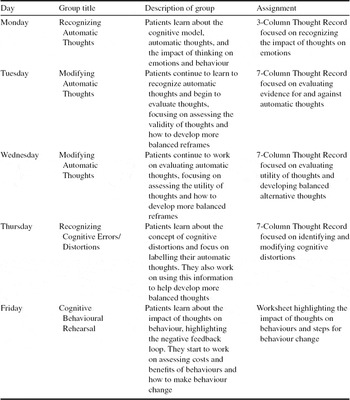
Treatment took place on the Women's Unit, an acute inpatient unit serving women aged 18–65 years presenting with a wide variety of psychiatric conditions. The average length of stay on the Women's Unit is typically <2 weeks. The Women's Unit is a comprehensive CBT unit, which, as described by Wright et al. (Reference Wright, Thase, Beck and Ludgate1993) is a unit where all staff are trained in CBT and there is a solid commitment to a cognitive approach to treatment. Programming is designed to weave elements of CBT throughout the patient's day, helping her to implement and benefit from adaptive use of new cognitive skills gained on the unit. There are several key elements of our CBT programming including a morning Goals group, Skills and activity groups, daily CBT groups, Self-help time, and an evening Wrap-up group. The core CBT experiences, adapted from the work of Freeman et al. (Reference Freeman, Schrodt, Gilson, Ludgate, Wright, Thase, Beck and Ludgate1993), are comprised of daily CBT groups and Self-help time (see Table 1). Staff who participated in the running of these groups included nurses, social workers, the unit activity therapist, psychologist, psychology externs (doctoral students in clinical psychology completing training on the unit), and mental health (milieu) counsellors. The unit psychologist, who completed formal training in CBT at The Beck Institute, provided all staff with extensive training in CBT and with their assigned group modules (prior to the initiation of their respective groups). While three staff members (one nurse and two social workers) also completed formal CBT training at The Beck Institute, most staff had no training in CBT prior to the start of programme development. Given the significant variability in staff background and experience, training was individualized to each staff member and typically involved a combination of didactics, role play, co-facilitation and in-vivo supervision of groups, and ongoing supervision and consultation as needed. Psychology externs received a minimum of 2 hours supervision per week. There was an ongoing weekly open CBT supervision and training session available for all staff.
Women's Unit Core Group CBT programming (adapted from Freeman et al. Reference Freeman, Schrodt, Gilson, Ludgate, Wright, Thase, Beck and Ludgate1993)

Daily CBT groups
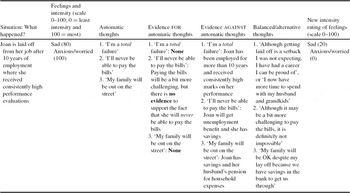
The centrepiece of the CBT programming on the Women's Unit is the daily CBT group (Freeman et al. Reference Freeman, Schrodt, Gilson, Ludgate, Wright, Thase, Beck and Ludgate1993). These groups take place each weekday afternoon and are co-facilitated by a permanent staff member (social worker, nurse, or activity therapist) and one to two psychology externs. The manualized treatment emphasizes classic Beckian concepts including behavioural activation, identification of irrational and maladaptive automatic thoughts and their influence on emotional and behavioural functioning, and evaluation and cognitive restructuring of automatic thoughts (Beck et al. Reference Beck, Rush, Shaw and Emery1979; Beck, Reference Beck1995; Greenberger & Padesky, Reference Greenberger and Padesky1995; Leahy, Reference Leahy2003). The first half of each group includes a didactic presentation of the daily topic (recognizing automatic thoughts, evaluating automatic thoughts, etc.). The second part of group typically includes group discussion of patient examples, highlighting use of the new concepts. Group facilitators guide patients through the steps of recognizing automatic thoughts, helping them to evaluate their thinking in different situations and to develop more balanced responses. Patients are encouraged to participate actively in the group exercise, helping one another to identify and modify automatic thoughts. There is also time for discussion of patient questions and feedback. Each patient receives a workbook that covers topics presented in the CBT group that she is able to use both in the group and on her own time (see Table 2 for an example of a daily thought record from a patient's workbook).
Example of a completed Thought Record from a patient's workbook (adapted from Greenberger & Padesky, Reference Greenberger and Padesky1995)
Evaluating and changing your automatic thoughts – use the evidence

Self-help time
This semi-structured hour in the late afternoon is a follow-up to the earlier CBT group. It is a time for patients to work on the ‘assignment’ from the CBT group. Two to three psychology externs and mental health counsellors are available to work individually with patients on applying CBT skills to their own lives and situations. While there is a specific daily worksheet, patients are encouraged to select an activity that is most appropriate for their daily treatment goal(s). In addition to daily thought records, during Self-help time patients have the opportunity to work on a variety of different options including creating activity schedules, practising use of relaxation skills, problem-solving exercises, cost-benefit analyses, and role plays of new skills with staff.
In addition to these groups, patients are encouraged to identify and develop specific daily goals consistent with their overall treatment goals. During the morning Goals group, patients are able to work with nursing and psychology staff to define specific goals, to identify ways to achieve the stated goals, and to evaluate and modify maladaptive thoughts that might interfere with goal achievement. In the evening, the Wrap-up group is led by nursing staff and provides an opportunity for patients to reflect on their work towards their goal each day, discussing adaptive coping strategies, as well as challenges that may have interfered throughout the course of the day. Additionally, patients are offered various skills and activity groups coordinated by the unit activity therapist. Skills groups, including relaxation techniques and stress management, build-in aspects of CBT, teaching patients to identify how negative thinking interferes in various areas of their lives and helping them to apply new cognitive and behavioural skills as needed. Activity groups, including poetry and exercise focus on helping patients learn more about how to incorporate rewarding activities into their daily lives, monitoring the impact of these activities on mood and overall satisfaction level.
Methods
Participants
The preliminary results presented summarize the experience of 78 women who were admitted to the Women's Unit, a 25-bed inpatient psychiatric unit at a large, metropolitan public hospital during 2007–2009. This acute stabilization unit treats adult women presenting with a range of psychiatric diagnoses using a combination of medication management and the comprehensive CBT group psychotherapy programme described. Participation in the research study was voluntary and written informed consent was obtained. The study was approved by the hospital's Institutional Review Board.
The participants ranged in age from 18 to 62 years, with a mean age of 35.8 years (s.d. = 11.5). Fifty percent of the sample identified themselves as Caucasian, 26% as Hispanic, 10% as African American, 3% as Asian, and 11% as mixed ethnicity or ‘other’. Regarding education level, 12% reported a ‘less than high school education’, 16% had completed high school or achieved high school equivalence, 30% reported ‘some college’ experience, and 42% were college graduates. Length of hospitalization ranged from 3 to 58 days, with a mean stay of 12.3 days (s.d. = 10.2). The majority of the sample (82%) stayed for ≤2 weeks. Primary diagnosis at discharge as provided by the attending psychiatrist, included: major depression (51%, n = 40), bipolar disorder (18%, n = 14), a psychotic or schizophrenic disorder (14%, n = 11), eating disorder (5%, n = 4), and ‘other’ (e.g. anxiety, other mood, etc.) (12%, n = 9).
Exclusion criteria included an inability to speak and read English, moderate to severe mental retardation, or significant thought disorder/disorganization that would limit the participant's ability to reliably complete self-report measures. The data reported here are those of women who were hospitalized on the unit for a minimum of at least three CBT group sessions (offered only on weekdays), in order to assess for impact of unit programming. One participant was omitted from analyses because discharge complications (housing issue), rather than clinical necessity, resulted in an extreme length of stay (79 days).
Instruments
Demographic/follow-up questionnaire
At admission, all participants completed a basic demographic questionnaire including information regarding age, race, education level, and other variables. Additionally, when participants were contacted by phone about 1 month after discharge, they were asked a brief set of follow-up questions designed for this study. These included: ‘What services are you currently receiving?’, ‘Have you consistently been taking your medications as prescribed?’, and ‘Have the CBT skills that you learned been helpful?’
Outcome Questionnaire-45 (OQ-45)
The primary outcome measure was the Outcome Questionnaire-45 (Lambert et al. Reference Lambert, Burlingame, Umphress, Hansen, Vermeersch and Clouse1996). The OQ-45 is a 45-item measure of weekly psychosocial functioning assessing behaviours, mood states, and interpersonal skills, designed to assess change occurring during the process of psychotherapy. Total scores range from 0 to 180, with higher scores reflecting more impaired psychosocial functioning. Items include, ‘I have difficulty concentrating’, ‘I have trouble falling asleep or staying asleep’, ‘I feel loved and wanted’, and ‘I have thoughts of ending my life’. In addition to the total score, this measure also yields three subscales: the Symptomatic Distress scale, Interpersonal Relations scale, and Social Role scale. The OQ-45 is internally consistent, with coefficient alphas ranging from 0.93 for the total score and 0.71–0.91 for the three subscales, and stable over time, with test–retest reliability coefficients ranging from 0.78 to 0.84 (Lambert et al. Reference Lambert, Burlingame, Umphress, Hansen, Vermeersch and Clouse1996). Previous research has shown that the proposed cut-off score of 63, above which indicates a ‘clinical’ level of psychosocial impairment, can reliably discriminate patient from non-patient samples (Lambert et al. Reference Lambert, Gregersen, Burlingame and Mariush2004).
Procedure
Potential research participants were recruited through a flyer posted on the unit and mention of the research during a brief treatment orientation for all new patients. If a patient expressed interest in participating within the first 72 hours of admission, she was provided with general information about the study and informed consent was completed. Participants completed the OQ-45 at three time-points: within 72 hours of admission, within the 24 hours prior to their discharge from the unit, and about 1 month post-discharge (via telephone). They also completed the demographic questionnaire at admission and the follow-up questionnaire during the post-discharge telephone call. While hospitalized, research assistants recorded the total number of groups offered to and attended by each participant on a daily basis. Diagnosis was provided by each patient's attending psychiatrist and obtained from the final discharge report by a trained research assistant blind to the participant's scores on any self-report measures.
Results
Participation in group psychotherapy
This sample of patients attended an average of 71.5% of all groups offered during their inpatient stay, and 79.3% of all daily CBT groups. Self-help groups had a 51.3% average attendance rate. In terms of actual number of groups attended, 87% of the sample attended at least three daily CBT groups and 74% attended at least three Self-help groups.
Few differences emerged in group participation between patients with different primary diagnoses. A one-way analysis of variance (ANOVA) examining mean rate of group participation between participants with a primary diagnosis of depression (n = 40), bipolar disorder (n = 14), or a psychotic disorder (n = 11), the three most prevalent diagnostic categories for patients in this study, indicated no statistically significant differences in percentage of total groups attended [F(2, 62) = 0.98, p = n.s.], percentage of Self-help groups attended [F(2, 62) = 0.56, p = n.s.], and number of total groups attended [F(2, 62) = 0.58, p = n.s.], and number of Self-help groups attended [F(2, 62) = 0.15, p = n.s.]. However, there was a significant difference in the percentage of daily CBT groups attended [F(2, 62) = 5.68, p= 0.01]. Tukey's post-hoc analyses indicate that patients with a primary diagnosis of depression attended a greater percentage of groups than did patients with a primary diagnosis of schizophrenia or other psychotic disorder (82.5% compared to 59.5%; p= 0.01). Notably, there were no significant differences in the number of actual daily CBT groups attended while hospitalized (participants in each diagnostic group attended an average of 5–6 groups). Participants with a primary diagnosis of a psychotic disorder were hospitalized an average of 4 days longer than those patients diagnosed with major depression. Thus, participants with different diagnoses received approximately the same amount of treatment (groups), but appeared to engage at different rates.
Additionally, preliminary analyses suggest that participation in group is modestly related to patient outcome at discharge (see Table 3). When controlling for a participant's score at admission on the OQ-45, her score at discharge showed statistically significant partial correlation with the percentage of total groups (r= -0.30, p < 0.01), and percentage of CBT-specific groups attended (r= -0.28, p < 0.02). The direction of these correlations suggests that there may be a relationship between increased attendance of groups and improved psychosocial functioning (lower scores on the OQ-45); however, these are preliminary results based on pilot data. Of note, correlational analyses indicated that length of stay was not significantly correlated with the percentage of total of CBT-specific groups attended or with OQ-45 total score at admission, discharge, or 1 month post-discharge and therefore was not included as a covariate in any analyses.
Partial correlations of group attendance with discharge OQ-45 subscales

*p < 0.01, **p < 0.001.
Patient response to hospitalization
At 1 month post-discharge, 92% of the sample reported that the CBT skills learned while hospitalized were helpful and 91% reported that they were making use of the CBT skills learned on the unit. Ninety-five percent of patients were engaged in aftercare treatment. Only one participant reported not taking medication as prescribed, while 74 (95%) reported consistently taking their medication. Additionally, only 7.7% of the sample had been re-hospitalized (n = 6) at 1 month; two participants were not asked this question. Independent-sample t tests revealed no significant differences in percentage of total groups or CBT-specific groups attended, length of stay, or OQ-45 scores at admission and discharge between participants successfully contacted at 1 month post-discharge (n = 78) and those who were not (n = 59).
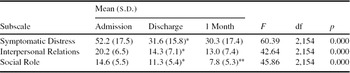
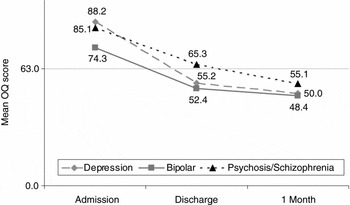
A one-way within-subjects ANOVA with Bonferroni correction for multiple comparisons indicated that patients’ psychosocial functioning improved significantly over time [F(2, 154) = 66.35, p < 0.001], with significant improvement from admission to discharge. The sample's mean OQ-45 score decreased from 87.0 (s.d. = 25.0) to 57.1 (s.d. = 26.1), a change from a clinical level to a non-clinical level of psychosocial impairment. The three OQ-45 subscales also significantly decreased from admission to discharge (see Table 4). Scores on the Social Role scale continued to significantly improve after discharge (p < 0.001; see Table 4). Furthermore, a two-way, mixed ANOVA examining mean OQ-45 score within and between participants with a primary diagnosis of depression (n = 40), bipolar disorder, (n = 14), or a psychotic disorder (n = 11), demonstrated that participants in all three groups evidenced significant change over time [F(2, 124) = 31.600, p < 0.001]. There were no significant differences between diagnostic groups in the level of improvement experienced (see Fig. 1).
One-way within-subjects ANOVA of OQ-45 subscales

*Significant change from admission, p < 0.001.
**Significant change from discharge, p < 0.001.
Changes in mean OQ-45 total score from admission to follow-up for three diagnostic groups. A score of ≥63 on the OQ-45 indicates clinically impaired functioning (Lambert et al. Reference Lambert, Gregersen, Burlingame and Mariush2004).

Discussion
Despite continuing pressure to provide optimum services in the face of growing fiscal constraints on inpatient care, there is relatively little research attention devoted to the topic. Here we report on the experience of a group of women who participated in a group-oriented CBT programme on an inpatient unit. It appeared that patients on this single-sex unit were open to engaging in CBT programming, evidencing high attendance rates at groups, even though attendance was not mandatory. Furthermore, most of these patients reported at follow-up that they found the CBT skills learned on the unit to be very helpful and most reported making use of their skills 1 month post-discharge. Preliminary data collected in this uncontrolled pilot study indicate that patients experienced a significant improvement in overall psychosocial functioning during the hospitalization and that their degree of participation in group psychotherapy was directly related to their degree of improvement in functioning at the time of discharge. These improvements were maintained 1 month post-discharge. Only a small percentage of participants had been re-hospitalized and an overwhelming percentage were engaged in psychiatric/psychological treatment and reported consistently taking their medications. Importantly, patients diagnosed with a range of psychological disorders, specifically major depression, bipolar disorder, and psychotic disorders, all achieved significant improvement from admission to discharge, with maintenance of gains 1 month post-discharge.
Although the lack of a control group makes these results difficult to interpret, our results are consistent with the positive findings of Veltro et al. (Reference Veltro, Vendittelli, Oricchio, Addona, Avino and Figliolia2008) and Page & Hooke (Reference Page and Hooke2003), exploring the impact of a group-oriented inpatient CBT programme with a heterogeneous population of patients presenting with a wide variety of disorders. These preliminary data might be taken to suggest some promise for a structured, protocol-based, group-oriented inpatient CBT programme with a mixed population of patients in the inpatient setting. Certainly there is no ideal inpatient programme that would fit all settings and populations, but a group-oriented CBT inpatient programme may prove to be an attractive alternative, providing a level of patient empowerment, psychoeducation, and cognitive and behavioural strategies that allow patients to respond to interventions and benefit in a meaningful way.
We note several limitations to the interpretation of these data and their generalizability. First, this is an observational study of the experiences of inpatients on the Women's Unit. It is not a controlled study. As such, any changes which occurred during hospitalization or following discharge may be the direct result of the programme described or may be attributable to other factors not examined in this preliminary report. Our report of a significant relationship between degree of participation in the programming and improved outcomes offers encouragement for the further development of this programme or others like it but its specific contributions to treatment outcomes across different settings, populations, or resource opportunities warrants much additional study. In this spirit, we note that the majority of the participants in this study were taking psychotropic medications which were often adjusted in both dosage and type during their hospitalization. We chose not to control for any possible confounding effects of medication use and our results must be interpreted with this in mind. Moreover, patients were allowed to elect to participate in the study or not and in this and several other ways, the subjects were not randomized to either the type or quantity of treatment received. Finally, the exclusion criteria used in this study precluded the ability to make any observations on what will be in some settings, a great majority of the available treatment population.
Nonetheless, we believe that the value of research conducted in naturalistic clinical settings can provide useful guidance in bridging the often wide gap between research and actual clinical practice within the very real and very practical limitations that exist in the inpatient setting. Controlled studies more closely examining the effectiveness of group-oriented, inpatient CBT programmes are warranted and will be a logical next step in efforts to continue to improve treatment options available to patients requiring an inpatient level of care. Certainly, CBT may not be the most appropriate treatment option for all inpatients, and future research is also warranted to address the question of fit and how best to meet patients’ needs.
Conclusions
In sum, this paper reports data gathered from participants in a group-oriented, inpatient CBT programme for women. These women reported significant improvements from admission to discharge and the relationship between the degree of participation in CBT group psychotherapy and these improvements were positively related. Furthermore, these gains were maintained at 1 month post-discharge. Patients presenting with major depressive disorder, bipolar disorder, or a psychotic disorder all evidenced similar positive treatment trajectories, indicating that a structured group-oriented inpatient CBT programme may hold promise as a solid intervention for the mixed population of patients typically found on inpatient units.
Acknowledgements
We thank the administration of the Department of Psychiatry of New York Presbyterian Hospital and the staff of The Women's Unit for their support of this project.
Declaration of Interest
None.
Learning objectives
Upon reading this paper, the reader will be able to:
• Recognize the challenges facing inpatient units and consider the development of a comprehensive, group-oriented inpatient CBT programme as a way to enhance services.
• Discuss the outcomes gained by patients participating in an inpatient group-oriented CBT programme.
• Appreciate how use of structured CBT programming can foster patient participation in treatment, encouraging their active role and contributing to improved outcomes.




Comments
No Comments have been published for this article.