Introduction
Kerala is in the south western part of the Indian Peninsula, bordered by the Western Ghats in the east and by the Arabian Sea in the west, located between 76°23′ and 77°23′E longitudes and 9°44′ to 10°18′N latitudes on the northern hemisphere. The area has a size of only 38 863 km2, is from 11 to 121 km wide and has a coastal length of 590 km. The state has abundant rainfall through south-western (June to August, with an average rainfall of 2 250–2 500 mm) and north-eastern (September to November, rainfall of 450–500 mm) monsoon. The climate is hot and quite humid because of the proximity of the backwaters, which are a network of waterways, inlets, estuaries, brackish lagoons, lakes and canals lying almost parallel to the Arabian Sea coast. The network includes five large lakes including large ones like Vembabad and Ashtamudi and linked by canals and fed by 38 rivers. At the backwaters freshwater from the rivers and the brackish water from the Arabian Sea get mixed and have a unique ecosystem. The biodiversity of this coastal area is also unique as in the Western Ghats.
There is one long spell of dry weather between the two monsoons from November to June. There are 44 rivers originating from the Western Ghats with 41 flowing west and draining out to the backwaters in the coastal area or directly into the Arabian Sea. As the Western Ghats are less than 120 km from the sea, all these rivers are relatively short. Principal crops are rice, coconut, tea, coffee and spices. Before the recognition of Vechur breed by the Government of India by 2001 Kerala did not have a cattle breed of its own. The local cattle were referred to as nondescript (ND) (Velu Pillai, Reference Velu Pillai1940) as they were not scientifically described. Among them had been a variety known as Vechur. The adaptability to hot humid environments and low feed requirements are just some of the valued attributes of the cows; however, the farmer's preference for the cow had mostly been due to their relatively higher milk yield (KAU, 1999).
The small Vechur cows were the pride of Kerala. This status was lost subsequently with their near 100 percent replacement with cross-bred cows. But with the revival of the breed they have a more elevated status now. The Vechur cows have relatively high milk production compared with those of the other native varieties of Kerala (Velu Pillai, Reference Velu Pillai1940).
The name Vechur is believed to have originated from the place of origin – Vechur. This place is situated in a unique low-lying agricultural tract called Kuttanad, where farming is done below the sea level on a sizeable portion. Vechur cattle were an integrated part of the traditional agriculture, especially paddy cultivation in this lowland. The author used to observe, in her childhood in the 1950s, the bulls being used for ploughing in the marshy paddy fields and were excellent for this use because of their light weight.
Vechur cattle near extinction
In the 1960s, the Kerala Government launched a series of massive cross-breeding programmes with exotic bulls such as Brown Swiss, Jersey and Holstein Friesian in order to increase milk production. The implementation of the aggressive cross-breeding throughout the state with exotic bulls transformed the local animals. Local bulls were not permitted to be retained as per Kerala Livestock Improvement Act (1961) (Government of Kerala, 1961); however, temple bulls were exempted. The allure of the cross-bred cows was their higher (double the amount) yield of milk production in the first generation compared with that of the local animals. The Government wanted a complete transformation of the local cattle in favour of the exotic cross-breeds. This government policy, coupled with a cultivated preference on the part of the farmers for cross-bred cows, led to the near extinction of Vechur cows. It was actually believed that the Vechur had become extinct.
Conservation efforts
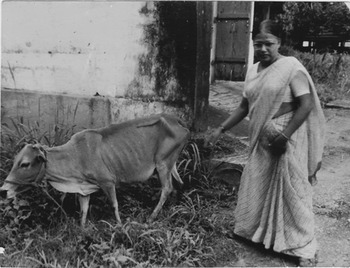
It was in 1988 that the author, a professor at the Kerala Agricultural University, started a serious conservation effort for Vechur cattle. This was not in accordance with the Government policy of that time. A student team led by Anil Zachariah volunteered to make a search for Vechur cattle and join the conservation attempt. After searching for many months, eight cattle were located. The spotting of a Vechur cow along with Manoharan, a toddy tapper of Ullala (formerly a part of Vechur village), was the first exciting step in the conservation effort in Kerala (Figure 1).
First spotted Vechur cow with the author (1989).

The students (most of them in their teens) literally jumped and danced in their excitement. A few other animals were also spotted in other places. This was reported by Iype (Reference Iype1996). This paper reports on the progress of this conservation project.
Materials and methods
In addition to reviewing available documented information about Vechur cattle in Kerala, this report used data generated by the Vechur cattle conservation project in Kerala Agriculture University and the cows with the farmers. The challenges faced in this project are also reported here as observations of the author. The size of the population was eight when it started and then two dozens of animals were purchased and added to this population. This basic stock and progenies in the conservation unit and those with farmers numbered totalled to about 2000.
Results and discussions
Starting of the nucleus herd
The owners of the cattle were convinced to sell these animals that were spotted by the team. With a stock of just eight animals, the project to conserve the germplasm of Vechur cattle was commenced on the 26 July 1989 at the Kerala Agricultural University. The searching for animals was continued by the team, and in 1 year 24 more animals were added to the initial lot of eight (Iype, Reference Iype1996).
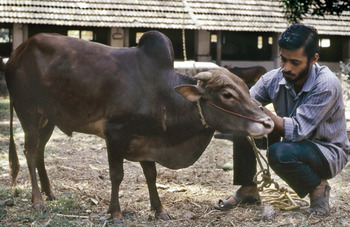
The first step in the conservation effort was selecting bulls and multiplication of the animals to the maximum possible, as the numbers were very low. Good bulls were selected. Next-generation bull is seen in Figure 2. Distributing a few animals to committed farmers was the next priority. By 1999, the first set of animals could be given back to farmers. This allowed them to be in different places.
Vechur bull with Anil Zacharia (1992).

Difficulties encountered
In the 1980s, it was difficult to convince people that conservation of native cattle is necessary. The team was mocked even by many scientists. But they tried hard to educate others. In the first leaflet for “Save Vechur” the author highlighted four points: (1) to conserve domestic animal biodiversity; (2) to retain the heat and disease-tolerant cow as an insurance in case of crisis; (3) to cater for farmers' needs who cannot give sophisticated management to the cow, but need milk just for domestic consumption; and (4) to save them as a raw material for scientific studies in future and unravel their potential for improvement. Since 1999, next-generation cows were being given to the farmers. But pure breeding of Vechur remained a problem as the bull semen was not available near the farmers.
A very disturbing experience was the death of a few animals in the conservation unit in the Kerala Agricultural University. Autopsy and forensic examination revealed that poisoning was the cause. This was an extremely difficult and confusing time. No one, even the author herself, knew on any given day what was in store for the animals. Next was the allegation that some western countries were trying to steal some of the germplasm for the patenting of genes. Vandana Siva came out with the allegation that the Roslin Institute in Scotland had patented the alpha lactalbumin gene of the cow. Siva cited a particular patent number EP 765390 (Jayaraman, Reference Jayaraman1998). Nobody could find such patent details. The Indian Council of Agricultural Research, Swaminathan Foundation, India, Rafi Canada and others after making searches intimated the Kerala Agricultural University that there is no such patent/application related to Vechur. Kumar interviewed Vandana Siva, Harry Griffin of the Roslin Institute, the author and the Kerala Agricultural University authorities (Kumar, Reference Kumar1999). It was reported that the EP number 765390 quoted by Siva was not submitted by the Roslin Institute, but by PPL Therapeutics and it was about a human gene and Holstein cow. It was not at all connected to the Vechur or the genes of any Indian cattle and the story by Siva was entirely groundless. The Vice Chancellor, Dr Syama Sundaran Nair, published a white paper on the whole issue to clarify the real situation. All the allegations and the poisoning of animals resulted in the loss of some of the valuable germplasm as well as all of the time and energy.
In spite of these disturbing circumstances, the conservationists were determined to push ahead with the effort. P. K. Uthaman and many environmentalists came forward in support of the conservation (Uthaman, Reference Uthaman2000). Thirupathy Venketachalapathy, K. C. Jayan Joseph and his mother Rosakutty, N. Jayadevan, Joby George, K. C. Raghavan, the members of the student team, people of Vechur were all out to battle the war. Slowly things took a more positive turn, as more people became convinced that conservation was a necessity. All these made the conservationists feel that a nongovernmental agency with farmers and conservationists had to be formed for the continuation of conservation.
The Vechur Conservation Trust
The informal association since 1988 to conserve the Vechur cow was registered as The Vechur Conservation Trust with the objective of saving other native domestic animals and birds in 1998. It was felt necessary that a nongovernmental organization with conservationists, farmers and breeders was initiated in the interest of sustainable conservation.
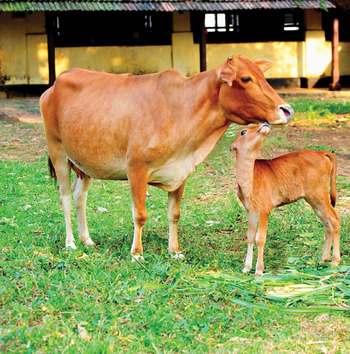
The Trust established a germplasm centre in the native tract of Vechur cattle in order to assure purity in the breeding of the Vechur; otherwise, the cows distributed to farmers would get crossbred due to lack of availability of Vechur bull semen. The bulls in the unit are with known pedigree for 4–5 generations. The cow in Figure 3 is of the seventh generation and the calf eighth generation from the foundation stock. The Trust has undertaken research and development work in spite of major financial constraints. Animal identification of native animals has been started with farmers but this effort has a long way to go. This being the first step towards the breed improvement and for the first time introduced for native cattle is a great achievement of the Vechur Conservation Trust. This identification is imperative to avoid fraud in the purchase and sale of animals.
Cow and calf (generations 7 and 8).

Continued conservation and research work
The Council of Agricultural Research sponsored the conservation work in the Kerala Agricultural University from the next year of its start and made it possible to begin the research necessary to characterize the Vechur breed and undertake other works like embryo transfer. As a result, this small cow today has a place in the breed map of cattle published by the National Bureau of Animal Genetic Resources, ICAR, India (NBAGR, 2001). The FAO has also officially listed the Vechur cattle among the Indian breeds in their Domestic Animal Diversity Information System in the critical category and description given in the breed data sheet (DAD-IS, 2012). One cow made entry into The Guinness book, as the smallest cow of the world (Guinness, 2011). The Vechur Conservation Trust is active with its work with farmers. The Trust is also supported by the Government in a small way.
Features of Vechur cattle
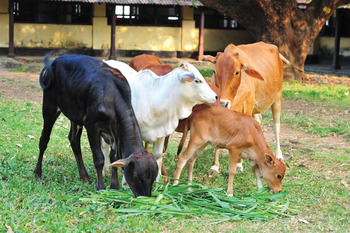
These cattle are small sized with an average weight of about 133.6 ± 3.7 and 173.5 ± 6.8 kg and a height of 89.0 ± 0.7 and 99.8 ± 1.4 cm for cows and bulls, respectively (Iype and Venketachalapathy, Reference Iype and Venkatachalapathy2001). The animals have a solid colour. Red, black, white and their shades are commonly seen (Figure 4). Chocolate and grey colours are also seen; red, black or fawn and white colours. Hump is prominent for bulls.
Different colours of Vechur.

Milk production and quality
The average daily yield is 2.5 kg per day (Iype, Reference Iype2009). The lactation length was reported to be 242 days (Iype and Thirupathy, 2001). The milk of Vechur cows was considered to have high medicinal value and was extensively used in the Ayurvedic system of medicine (Vijayan Vaidyan Thennattu, personal communication). The traditional belief was that Vechur milk is good for infants and convalescing people, as it is more easily digested. The low-fat globule size (3.21 µm) found in the studies (Venkatachalapathy and Iype, Reference Venkatachalapathy and Iype1996) gives an indication that this could be true.
Studies have shown that Vechur cattle are free from Bovine leukocyte adhesion deficiency (Aravindakshan and James, Reference Aravindakshan and James2006). Growth studies showed that the rate of growth for Vechur is good under Kerala conditions. By 6 months the bull calves weigh 44 kg and by 9 months 64 kg and 173 for bulls over 2 years. It is around 4 times and 6 and 16 times of the birth weight of 11 kg for males (Iype and Venkatachalapathy, Reference Iype and Venkatachalapathy2001).
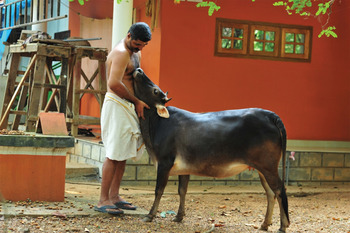
This and the recent research finding on the β-casein A2 allele in the Vechur cow (Muhamed and Mathew, Reference Muhamed and Mathew2010), the finding that arginine content in Vechur cow milk is more than that in the milk of other cows (Anisha Bhasker and Mohankumar, Reference Anisha, Bhasker and Mohankumar2011) and the experiences of people are increasing the popularity of the cow. Added to this is the use of dung and urine for natural farming, organic and zero budget farming systems. Compared with bigger cows Vechur cow is a pet and companion to farmers if reared affectionately (Figure 5).
The companion of the farmer (2001).

Experience of farmers and economic feasibility
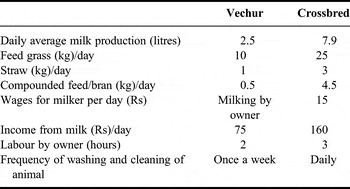
A survey undertaken with the farmers showed the below results (Iype, Reference Iype2009). This was a part of a project undertaken by the Vechur Conservation Trust. The milk yield of Vechur cattle was recorded by asking the farmers. Same was the procedure with cross-bred cows. The cows were in one of the first three lactations. The average was 2.3 for crossbreds and 1.6 for Vechur. The Vechur cows were newer to the area and with advancing time the average parity number would increase. The observations were of 1 year (Table 1).
A comparison of Vechur and cross-bred cows of the farmers (Iype, Reference Iype2009).

Source: Unpublished progress report 2007 Vechur Conservation Trust (Iype, Reference Iype2009).
Because the cost for feed, labour, fodder cultivation and grazing is increasing, cattle raising has become not viable for many. Farmers are also dejected with disease problems of the crossbreds as well as their heat intolerance. The management-intensive, exotic/cross-bred cows become a liability to many farmers forcing them out of the dairy business. Many farmers do not want to take the trouble of going out to sell the milk in the collection centres. In this context, a breed of cow that needs no sophisticated management is an answer for a good percentage of people.
The ideal cow is the one sustainable to the farmer and need not be a high producing one. Vechur cow rearing is a low-input, “eco-friendly” system, as the grass in the compound and by-products of agriculture are used as feed. The use of the urine and cow manure rather than chemical fertilizers is beneficial economically as well as environmentally. Now there is a big boost to native cow keeping as many farmers switch to organic farming or “zero budget natural farming”.
The farmers having Vechur cows are of different economic status. Wealthy people who want really good milk and are concerned about food security is one group. Resorts are especially interested in maintaining Vechur cows as it is an attraction to the guests. They are used as lawn mowers in some eco-friendly resorts. Apart from energy saving for lawn the smallest cows in action in the lawn moving is a real attraction. Also the feeding becomes inexpensive.
Middle-class people use them for food security and as an income through the sale of milk or ghee.
Organic/Natural/zero budget farmers are much interested in Vechur. The demand for Vechur cows is great. The problem is those who can afford buy the cows at a fancy price. So the poor are tempted to sell away the cows though the cow is sustainable.
Now the Kerala Government has started realizing the importance of this conservation. After 23 years of dedication and persistence, it is a great accomplishment to the pioneers that this effort is now recognized and acknowledged by the Kerala Government and also the people. But more has to be done for the farmers.
Further developmental work
A change in the government policy promoting indigenous breeds is absolutely essential. People are at the centre of any conservation effort. Only the livestock keepers can effectively do something to ensure survival of the native animals. But they need support. The experience of the past is that unilateral governmental policies have been detrimental to breeds and breeding. What is required now is the strengthening and supporting of livestock keepers. Native breed associations should be encouraged to be formed and they should fulfil their responsibilities and governments should recognize the farmers' rights. A change is required to the effect that the policies are with the concurrence of the farmers. Governments need to give only general guidelines. With global warming looming no one can afford to lose heat-tolerant animals like Vechur. Crossbreds have been a failure in India. Large-scale/factory farming is getting promoted in India and in other developing nations. The small farmers in Kerala are leaving cattle rearing, which is resulting in a drastic reduction in livestock. Kerala Livestock Census figures reveal a cattle population drop of 49 percent between 1996 and 2007 (Kerala Government, 2012). Now there is a great realization that the Vechur cow is invaluable to farmers; especially those with small land holdings. The Vechur cows are highly sought after by many farmers. They find it very economical to maintain this cow. It provides sufficient milk for home consumption and one cow can provide enough milk for two households. For those who wish to own a cost-effective cow for home use that frees one from having to consume processed milk, a Vechur is the perfect cow especially in hot and humid tropical climates! The Vechur cow is contributing to future food security. Considering the unique qualities of the Vechur, value addition programmes should be taken up. At least in the initial stage funding from national and international agencies would help and this cow would be used globally in future.
The Vechur Conservation Trust is making available the germplasm to more farmers near and far since 8 years. The demand is high. If supported, the work can be done more extensively.
Conclusion
Vechur cattle have been saved from extinction owing to a collective effort, despite many ordeals and obstacles. Instead of just being yet another variety listed among the thousands that have been going into oblivion, the Vechur is now a living reality, providing farmers with a viable, economical and sustainable resource. More financial support is needed to ensure that the number of these animals can be increased effectively, making them available for those who want.