INTRODUCTION
There is renewed interest in forage legumes because they can contribute to more sustainable feeding systems, are able to fix atmospheric nitrogen (N) and have a high feed value for ruminants (Waghorn Reference Waghorn2008). However, proteins in forage legumes are often poorly utilized as they are rapidly degraded in the rumen and this leads to large urinary N losses (Min et al. Reference Min, Barry, Attwood and Mcnabb2003). The use of tanniniferous legumes could improve protein utilization by ruminants. Condensed tannins (CT) are plant secondary compounds that are able to bind proteins and inhibit their ruminal degradation (Waghorn Reference Waghorn2008; Theodoridou et al. Reference Theodoridou, Aufrère, Andueza, Pourrat, Le Morvan, Stringano, Mueller- Harvey and Baumont2010). A reduction in protein degradation in the rumen can lead to a subsequent increase in amino acid flow to the small intestine (Frutos et al. Reference Frutos, Hervas, Giraldez and Mantecon2004), although according to Waghorn (Reference Waghorn2008) the microbial growth and the fractional absorption of amino acids from the intestine can be affected.
The variability of CT composition among tanniniferous forages gives rise to different nutritive values (Waghorn Reference Waghorn2008). The effects of CT in the rumen and the intestine differ according to their content and structure as well as the nature of the proteins (Min et al. Reference Min, Barry, Attwood and Mcnabb2003; Mueller-Harvey Reference Mueller-Harvey2006). The nutritive quality and availability of plant proteins depend not only on amino acid content and composition but are also affected by the intrinsic molecular structure of proteins (Yu et al. Reference Yu, Niu and Damiran2010) as demonstrated for in situ degradability of proteins in different barley varieties (Yu Reference Yu2007). However, very few studies have been conducted on forages.
The current study investigated differences among three sainfoin varieties, which were cultivated at the same site and harvested at different dates, in terms of ruminal protein degradability. Lucerne was used as a non-CT containing legume and was cultivated at the same site and compared with the sainfoin varieties. The objective was to compare the ruminal degradability of three sainfoin varieties and lucerne and explore the relationship with CT content and structure and with protein secondary structure.
MATERIALS AND METHODS
Experimental forages
Three varieties of sainfoin (Onobrychis viciifolia) (Esparcette from Ukraine, Ambra from France and Villahoz from Spain) were studied in comparison with lucerne (var. Aubigny). They were sown in August 2008 and cultivated on the INRA Clermont-Ferrand-Theix site (France (45°43′N, 03°01′E; 870 m asl) on a granitic brown soil in a full factorial design with three replicate blocks. Samples of the three replicates were harvested at two different dates in 2009 during the first growth cycle and at one date during the second growth cycle. No mineral fertilizer was applied (Theodoridou et al. Reference Theodoridou, Aufrère, Andueza, Le Morvan, Picard, Stringano, Pourrat, Mueller-Harvey and Baumont2011). The harvest dates and estimated phenological stage according to Theodoridou et al. (Reference Theodoridou, Aufrère, Andueza, Le Morvan, Picard, Stringano, Pourrat, Mueller-Harvey and Baumont2011) for the first growth cycle, P1, were on 5 May (mid-vegetative stage for Ambra (1·99) and the early vegetative stage for Villahoz (1·29), Esparcette (1·29) and lucerne (1·00)) 2 June (early bud stage for Ambra and Villahoz and late vegetative stage for Esparcette and lucerne) for P2 and on 2 June (early bud stage for Ambra and Villahoz, mid-vegetative stage for Esparcette and early vegetative stage for lucerne) for P3 for the second growth cycle (4 weeks after cutting on 5 May). For each harvest date the morphological composition (leaf-to-whole-plant ratio) was also evaluated for all sainfoin and lucerne varieties (Theodoridou et al. Reference Theodoridou, Aufrère, Andueza, Le Morvan, Picard, Stringano, Pourrat, Mueller-Harvey and Baumont2011).
In situ disappearance in the rumen
The study was conducted indoors at the 1354 UE RT experimental farm in France (45°42′N, 03°30′E). The cows were handled by specialist personnel trained in animal care and welfare according to the European Union Directive N° 609/1986 under agreement N° A63 565.
One sample per treatment was used to measure in situ disappearance in the rumen. Ruminal degradation of dry matter (DM) and N was measured using a nylon bag procedure. Dacron bags (pore size 53±15 μm, Ankom Co., Macedon, NY, USA) had an internal surface area of 5×11 cm and were closed by heat sealing. The bags accommodated c. 3 g of air-dry sainfoin samples (1 mm mesh) harvested at each phenological stage. They were incubated in the rumen of three cows fed at maintenance level with a diet containing 0·70 hay and 0·30 concentrate on a DM basis. In situ degradation was measured in the rumen with incubation times of 2, 4, 8, 16, 24 and 48 h. Each cow first received two bags for the incubation times of 2, 4 and 8 h, and then three bags for the incubation times of 16, 24 and 48 h. The degradation kinetic of each sample was performed in each cow at two different periods. Samples of a common dehydrated lucerne used as a ‘standard’ were incubated for 8 h in duplicate in the rumen of each cow to detect any changes in the level of rumen degradation activity during the experiment. After removal from the rumen, bags were washed and stored at −20 °C until analysis. Before analysis, the bags were thawed and washed in a washing machine (3×10 min) with cold water until the rinse water was clear. The bags were then dried at 60 °C for 72 h.
Fourier transform/infrared-attenuated total reflectance data and collection analysis
Molecular spectroscopic measurements were performed on three replicates per sample. Fourier-transform/infrared-attenuated total reflectance (FT/IR-ATR) spectroscopy was performed using a JASCO FT/IR-4200 with a ceramic IR light source and a deuterated L-alanine doped triglycine sulfate detector (JASCO Corporation, Tokyo, Japan) equipped with a MIRacleTM ATR accessory module and fitted with a ZnSe crystal and pressure clamp (PIKE Technologies, Madison, WI, USA). Molecular spectral data were collected from the sainfoin and lucerne samples. Each sample was analysed five times. Thirty-two scans per sample were collected in the mid-infrared range from 4000 to 700 cm−1 in transmission mode at a spectral resolution of 4 cm−1. The collected spectra were corrected against air as background.
Spectral analysis of protein molecular structure profiles
The functional spectral bands associated with protein molecular structures were identified with OMNIC 7.2 software (Spectra-Tech Inc., Madison, WI, USA) and assigned according to published studies (Kemp Reference Kemp1991; Himmelsbach et al. Reference Himmelsbach, Khalili and Akin1998; Wetzel et al. Reference Wetzel, Eilert, Pietrzak, Miller and Sweat1998, Reference Wetzel, Srivarin and Finney2003; Budevska Reference Budevska, Chalmers and Griffiths2002; Miller & Dumas Reference Miller and Dumas2010). Unique primary protein features found in peptide bonds (carbon–oxygen (C–O), C–N and nitrogen–hydrogen (N–H)) include amide I band (c. 0·80 C–O and c. 0·20 C–N stretching vibration; centred at a wavelength of c. 1655 cm−1) and amide II band (c. 0·60 N–H bending vibration, c. 0·40 C–N stretching vibration; centred at c. 1550 cm−1), which are detectable as two absorption peaks within the wavelength region from c. 1720 to 1485 cm−1 and were measured as peak areas (Jackson & Mantsch Reference Jackson, Mantsch and Meyers2000; Wetzel et al. Reference Wetzel, Srivarin and Finney2003; Barth Reference Barth2007). Absorption peak heights for variables of secondary protein structure, i.e. α-helices (c. 1660 cm−1) and β-sheets (c. 1630 cm−1), are detectable in the amide I area using the second derivative function of OMNIC 7.2 (Spectra Tech, Madison, WI). The regions of specific interest in the current study included the protein amide I and II bands, and the protein α-helix and β-sheet between 1715 and 1480 cm−1. The ratios of amide I : II bands and α-helix : β-sheet spectral intensities were calculated. In order to investigate the changes or the differences in feed protein structure, the bands mentioned before would be expected to serve as an appropriate probe indicating changes to molecular structure. Therefore, a change in those ratios is indicative of some difference in protein structure. It is possible that protein structure plays a role in protein quality and degradability, so those ratios may permit the evaluation of protein structure in a manner which could be linked to protein nutrient availability, digestibility or digestive behaviour. For example, a high proportion of β-sheet structure could be partly responsible for low access to gastrointestinal digestive enzymes, which may result in a low protein value and low protein availability (Yu Reference Yu2006, Reference Yu2010).
Laboratory analysis
One half of all samples was dried at 60 °C for 72h in a forced-air oven, the other half was freeze-dried and all samples were ground to pass a 1-mm sieve. Total N content in forages and residues from in situ incubation was determined by the Kjeldahl method. Neutral detergent fibre (NDF), acid detergent fibre (ADF) and acid detergent lignin (ADL) were determined using the ANKOM filter bag method (ANKOM Technology, Macedon, New York, USA) according to Van Soest & Wine (Reference Van Soest and Wine1967) and as modified by Pagan et al. (Reference Pagan, Wolfe, Terrill and Muir2009). Pepsin–cellulase digestibility was determined according to Aufrère & Michalet-Doreau (Reference Aufrère, Michalet-Doreau, Boucqué, Fiems and Cottyn1985).
Condensed tannins were analysed by direct thiolysis of freeze-dried samples with benzyl mercaptan at 40 °C for 1 h to obtain information on tannin content and composition (Gea et al. Reference Gea, Stringano, Brown and Mueller-Harvey2011). Tannin content included extractable plus unextractable CT. Data on CT composition consisted of mean degree of polymerization (i.e. molecular size), prodelphinidin : procyanidin (i.e. proportion of prodelphinidin in CT) and cis : trans ratios (i.e. proportion of cis in CT) (Mueller-Harvey Reference Mueller-Harvey2006). Condensed tannin content was also determined by the hydrochloric (HCl)–butanol assay (Reed Reference Reed1986). These CT parameters were also determined by near infrared spectroscopy (NIRS) as described in Theodoridou et al. (Reference Theodoridou, Aufrère, Andueza, Le Morvan, Picard, Stringano, Pourrat, Mueller-Harvey and Baumont2011). Since lucerne is CT-free, zero values for mean degree of polymerization, prodelphinidin : procyanidin, cis : trans were inserted in these tables.
Calculations
In situ DM and N rumen disappearance curves of samples were fitted to the model of Ørskov & McDonald (Reference Ørskov and McDonald1979) using a non-linear regression procedure (SAS 2000):
 $$P = a + b({\rm 1} - {\rm e}^{ - ct} )$$
where P is potential disappearance, a is the rapidly disappearing fraction, b is the slowly disappearing fraction, e is the base of the natural logarithm, c is the disappearance rate of the slowly disappearing fraction and t is the incubation time; (100 − a – b) was considered to be the residual fraction. The effective disappearance of N (NDeg) was calculated as:
 $${\rm NDeg} = a + bc/(c + k_{\rm p} )$$
assuming a passage rate (k p) of 0·06/h. The same model was used to calculate the effective disappearance of DM (DMDeg).
Statistical analysis
For chemical composition (N, NDF, ADF, ADL), leaf-to-whole-plant ratio, pepsin–cellulase digestibility and protein structure (areas of amide I and II bands, ratio of amide I : amide II, α-helix height, β-sheet height and ratio of α-helix : β-sheet) data were analysed using the Mixed Procedure of the SAS (2000) software package and were submitted to ANOVA testing of species, growth cycle, variety and sampling date as fixed effects. Sampling date was considered as a repeated variable. For CT content, mean degree of polymerization, proportion of prodelphinidin and proportion of cis values, data were analysed according to a model that tested variety, growth cycle and sampling date as fixed effects. Sampling date was also considered as a repeated variable. For DMDeg and NDeg variables, the ANOVA model considered the effects of species, cycle, variety and sampling date as fixed effects. Animal was considered as a random effect and sampling date as a repeated variable. The relationship between chemical composition variables, pepsin–cellulase digestibility, content and structure of CT and protein molecular structure was evaluated by Pearson correlation coefficients.
RESULTS
Chemical composition
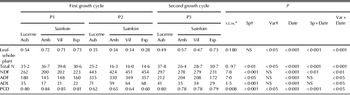
For both sainfoin and lucerne, leaf-to-whole-plant ratio, N content and pepsin–cellulase digestibility decreased during the first growth cycle (Table 1). In the second growth cycle (P3), the same parameters had intermediate values. Lucerne and sainfoin showed similar trends of NDF and ADF during both growth cycles; however, pepsin–cellulase digestibility values were unchanged at each harvest date.
Leaf-to-whole-plant ratio (g/g), nitrogen concentration (total N; g/kg DM), neutral detergent fibre (NDF; g/kg DM), acid detergent fibre (ADF; g/kg DM), acid detergent lignin (ADL; g/kg DM) and pepsin–cellulase digestibility (PCD g/g DM) of three sainfoin varieties (Ambra (Amb), Villahoz (Vil) and Esparcette (Esp)) and a Lucerne (Aubigny (Aub)) at two different dates during the first growth cycle (5 May : mid-vegetative stage for Amb and early vegetative stage for Vil, Esp and lucerne (P1)), 2 June: early bud stage for Amb and Vil and late vegetative stage for Esp and lucerne) (P2)) and at one date during the second growth cycle : 2 June (early bud stage for Amb and Vil, mid-vegetative stage for Esp and early vegetative stage for lucerne) (P3) (4 weeks after cutting on 5 May)

* s.e.m., standard error of mean.
† Sp, species.
‡ Var, variety.
NS, not significant.
Protein molecular structure
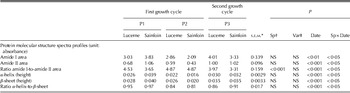
The characteristics of protein secondary structure of sainfoin and lucerne are presented in Table 2. A significant effect of date (P<0·001) was observed on all parameters of protein structure (amide I, amide II, ratio of amide I : amide II, α-helix, β-sheet and ratio of α-helix : β-sheet). Changes in the amide I and II areas due to harvest date were species-dependent. Amide II was higher for sainfoin than for lucerne at P1 and lower at P2, whereas the amide I : amide II ratio was lower for sainfoin at P1 and P3 and similar to lucerne at P2. The α-helix, β-sheet and their ratio followed the same pattern. Consequently, the interaction of species×date was significant (P<0·05) for all parameters (Table 2). No significant differences were found between varieties within the same species.
Features of protein molecular structure of lucerne and three sainfoin varieties (mean values) at two dates during the first growth cycle (5 May: mid-vegetative stage for Ambra and early vegetative stage for Villahoz Esparcette and lucerne (P1)), 2 June: early bud stage for Ambra and Villahoz and late vegetative stage for Esparcette and lucerne) (P2)) and at one date during the second growth cycle (2 June: early bud stage for Ambra and Villahoz, mid-vegetative stage for Esparcette and early vegetative stage for lucerne (P3)) (4 weeks after cutting on 5 May).

* s.e.m., standard error of mean.
† Sp, species.
‡ Var, variety.
Interaction, Var×Date: NS: P>0·05.
NS, not significant.
Characteristics of condensed tannins
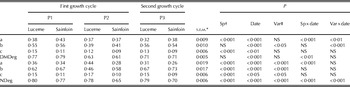
The content of CT, whether measured by HCl–butanol or thiolysis assay, was higher at the more advanced maturity (P2 and P3 in relation to P1). This contrasts with all other chemical composition parameters, which were intermediate during the second growth cycle compared with the two harvest dates of the first growth cycle. Esparcette had consistently higher CT contents (P<0·001) than Ambra or Villahoz (Table 3).
Condensed tannin (CT) concentration (thiolysis method) (g/kg DM), mean degree of polymerization (mDP), prodelphinidins (PD; proportion in CT), cis : trans flavanol (proportion of cis in CT), CT concentration (HCl–butanol method) (g/kg DM) of three sainfoin varieties at 2 different dates during the first growth cycle (5 May : mid-vegetative stage for Ambra and early vegetative stage for Villahoz, Esparcette (P1), 2 June: early bud stage for Ambra and Villahoz and late vegetative stage for Esparcette (P2)) and at one date during the second growth cycle : 2 June (early bud stage for Ambra and Villahoz, mid-vegetative stage for Esparcette (4 weeks after cutting on 5 May)

* s.e.m., standard error of mean.
† Var, variety.
NS, not significant.
The mean degree of polymerization increased from the first (P1) to the second date (P2) during the first growth cycle and was intermediate at the second growth cycle (P3) between the first growth cycle dates (P<0·001). Differences were observed among the three varieties (P<0·05) and according to the date (var×date, P<0·01).
Prodelphinidin : procyanidin ratios increased from the first to the second growth cycle (P<0·001) and varied among varieties with date (var×date, P<0·05). During the first growth cycle the proportion of cis-flavanols also increased. Proportions were intermediate at the second cycle compared with the first growth cycle dates and varied among the three varieties (P<0·001) (Table 3).
In situ dry matter and nitrogen disappearance in the rumen
The DMDeg was higher for the less mature forage (P1), decreased with plant maturity (P2) and the regrowth (P3) was intermediate between P1 and P2. No effects between species (lucerne and sainfoin) and among the three sainfoin varieties were observed for the DMDeg, but significant differences were found between lucerne and sainfoin according to the harvest date (P<0·001) (Table 4). The pattern of a fraction changes differed between both species (P<0·001) and harvest dates (sp×date, P<0·001) and also between varieties and harvest dates (P<0·01).
In situ ruminal degradability of dry matter (DMDeg) and nitrogen (NDeg) of three sainfoin varieties and one lucerne at two different dates during the first growth cycle (5 May : mid-vegetative stage for Ambra and early vegetative stage for Villahoz, Esparcette and lucerne (P1)), 2 June: early bud stage for Ambra and Villahoz and late vegetative stage for Esparcette and lucerne) (P2)) and at one date during the second growth cycle : 2 June (early bud stage for Ambra and Villahoz, mid-vegetative stage for Esparcette and early vegetative stage for lucerne) (P3) (4 weeks after cutting on 5 May).

* s.e.m., standard error of mean.
† Sp, species.
‡ Var, variety.
NS, not significant.
a, rapidly degradable fraction; b, slowly degradable fraction; c, degradation rate of b fraction; DMDeg or NDeg, in situ ruminal degradability of DM or N calculated with a passage rate of 0·06/h.
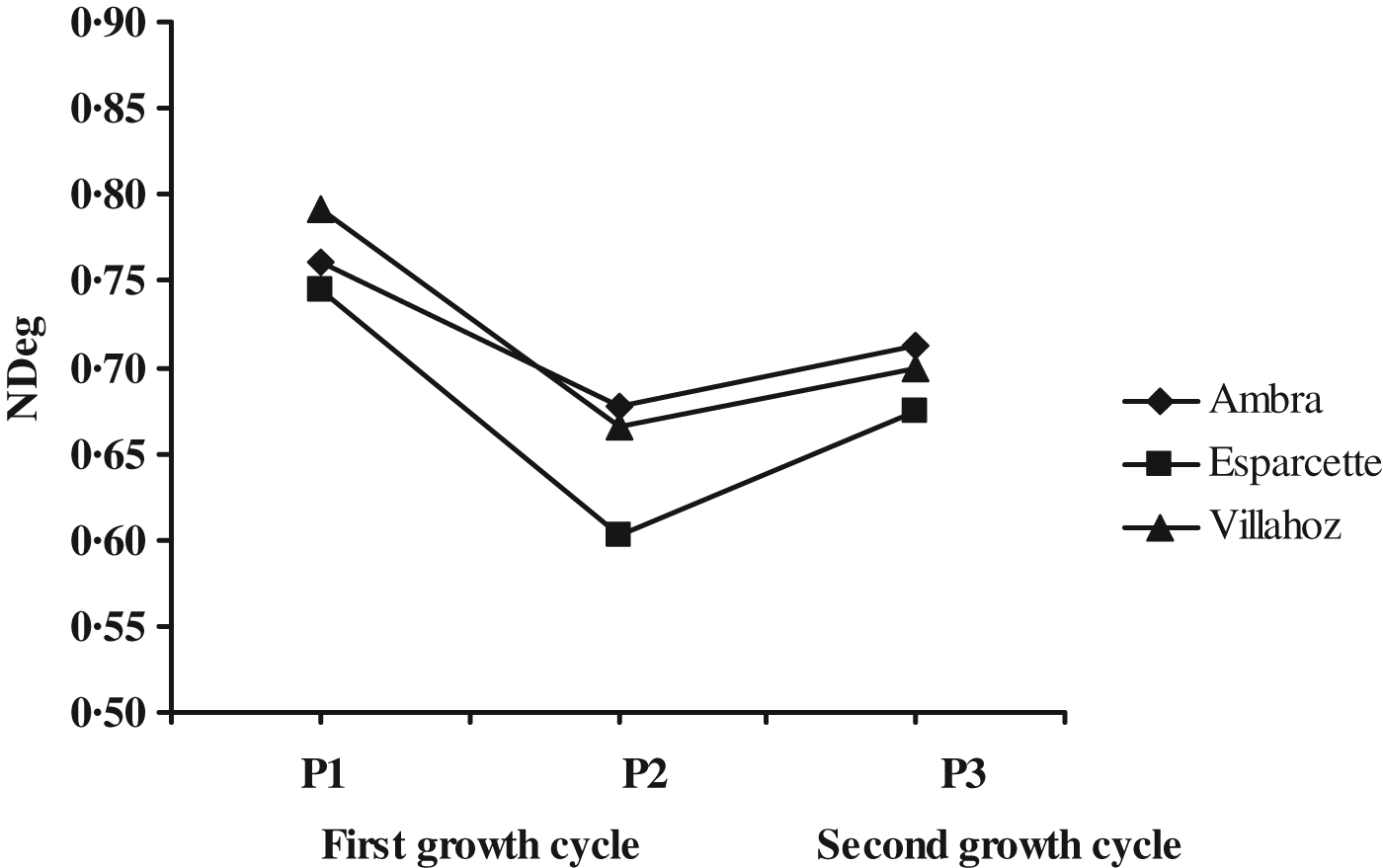
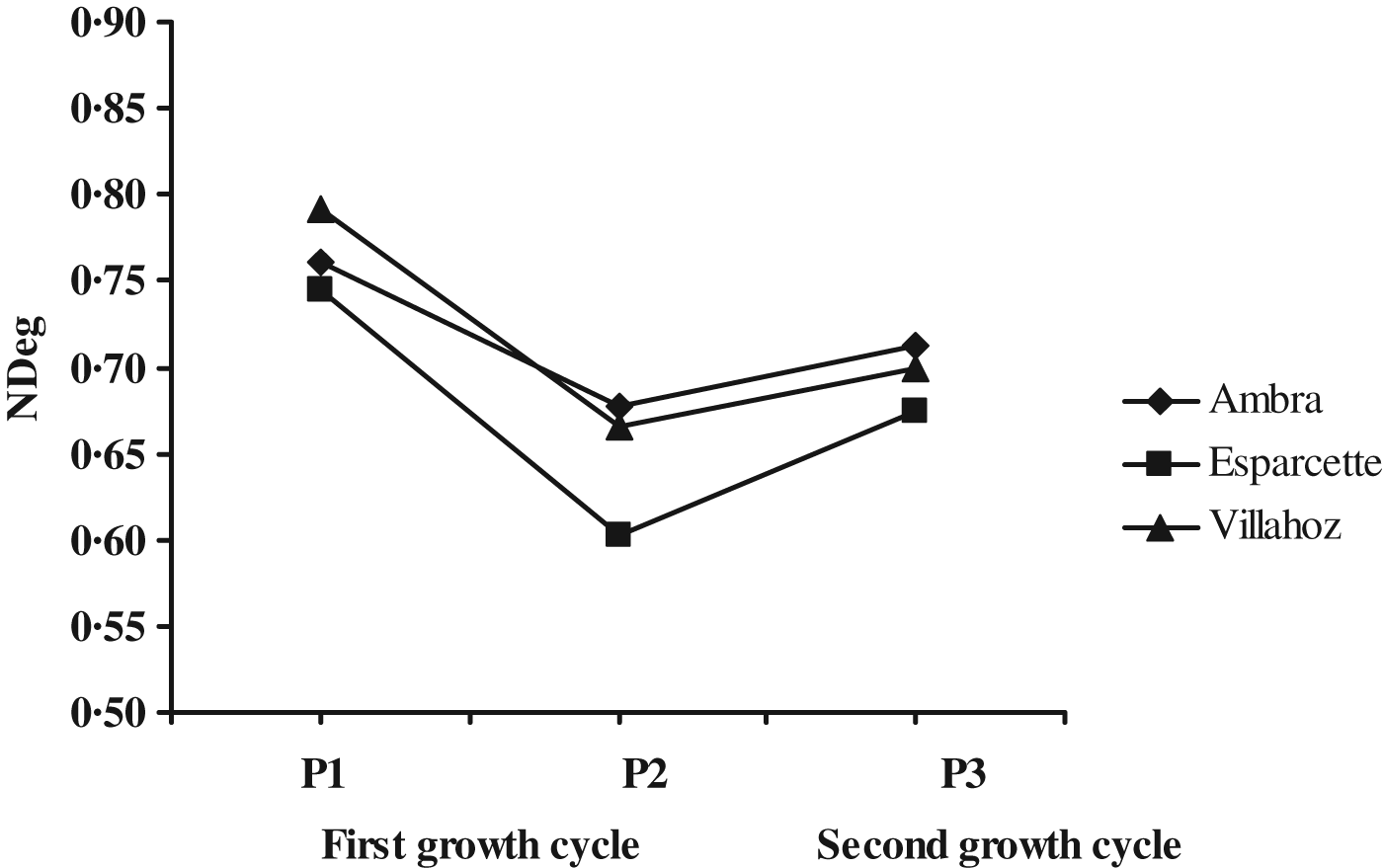
In contrast to the DMDeg results, there were differences between species for NDeg (P<0·001, Table 4) and differences among sainfoin varieties (Fig. 1). Lucerne NDeg did not vary greatly, whereas sainfoin NDeg decreased drastically between the P2 and P3 dates. Consequently, the interaction between species and date had a significant effect on the a fraction and NDeg (P<0·001). Moreover, the decrease in NDeg of Esparcette with forage maturity was significantly stronger than for the other two sainfoin varieties (var×date, P<0·001).
In situ nitrogen degradability (NDeg) of the three sainfoin varieties at two different dates during the first growth cycle (5 May: mid-vegetative stage for Ambra and early vegetative stage for Villahoz, Esparcette and lucerne (P1)), 2 June: early bud stage for Ambra and Villahoz and late vegetative stage for Esparcette and lucerne) (P2)) and at one date during the second growth cycle: 2 June (early bud stage for Ambra and Villahoz, mid-vegetative stage for Esparcette and early vegetative stage for lucerne) (P3) (4 weeks after cutting on 5 May).
Relationships between chemical composition, in situ degradability, protein secondary structure and tannin characteristics
The degradation of N in the rumen was positively correlated with N content (r=0·81, P<0·001) and the amide I band (r=0·70, P<0·01) and negatively correlated with CT content (r=−0·81, P<0·001) and all CT structural parameters. Also, the a fraction of N degradability and the degradation rate c were negatively correlated with CT content, with r=−0·73, P<0·01 and r=−0·92, P<0·001), respectively. The a fraction was also negatively correlated with all three CT structural variables. The b fraction was positively correlated with the amide II band but negatively correlated with the amide I : amide II ratio (r=−0·83, P<0·001) (Table 5). Finally, the DMDeg was positively correlated with protein structure in terms of α-helix, β-sheet, ratio of α-helix : β-sheet, amide I and II bands (r=0·90, 0·84, 0·95, 0·80, 0·80, respectively) and negatively correlated with NDF (r=−0·96, P<0·001).
Correlations between DMDeg or NDeg and some parameters of chemical composition, CT content (HCl–butanol or thiolysis) and their structure and protein structural characteristics of three sainfoin varieties and Lucerne.
Nt, nitrogen concentration; NDF, neutral detergent fibre, CT, condensed tannin measured by HCl–butanol or thiolyse method (CT HCl–butanol or CT thiolyse); mDP, mean degree of polymerization PD : PC, prodelphinidins: procyanidins (proportion of PD in CT); cis : trans (proportion of cis in CT), molecular protein structure (α-helix height, β-sheet height, α-helix : β-sheet, amide I area, amide II area, amide I : amide II); aN, rapidly degradable fraction; bN, slowly degradable fraction; cN, degradation rate of b fraction for NDeg (in situ ruminal degradability of N calculated with a passage rate of 0·06/h; DMDeg, in situ degradability of DM).
*P<0·001; **P<0·01; *** P<0·05.
For samples of lucerne, we considered that CT, mDP, PD: PC, cis : trans values in these tables are set at 0.
DISCUSSION
Relationship between nitrogen degradability and tannin content and structure
The decrease of NDeg between P1 and P2 (−0·13) for the three sainfoin varieties was due to the plant ageing process and the presence of CT, which increased from P1 to P2, and was related to the phenological stage and a significantly lower N content (Theodoridou et al. Reference Theodoridou, Aufrère, Andueza, Le Morvan, Picard, Stringano, Pourrat, Mueller-Harvey and Baumont2011). However, the decrease of NDeg for alfalfa was very small (−0·02), as observed previously by Aufrère et al. (Reference Aufrère, Dudilieu and Poncet2008) (−0·028) and Aufrère et al. (Reference Aufrère, Dudilieu, Andueza, Poncet and Baumont2013) (−0·038). Condensed tannin content was highest in the sainfoin regrowth (P3), but NDeg value was intermediate between the P1 and P2 dates. This reflects the partial relationship between NDeg and CT content (Azuhnwi et al. Reference Azuhnwi, Thomann, Arrigo, Boller, Hess, Kreuzer and Dohme-Meier2012).
The NDeg of Ambra and Villahoz varieties was consistently higher than for Esparcette, in line with the latter's higher CT content in both growth cycles. However, structural differences in CT may also explain the NDeg results (Mueller-Harvey Reference Mueller-Harvey2006; Theodoridou et al. Reference Theodoridou, Aufrère, Andueza, Pourrat, Le Morvan, Stringano, Mueller- Harvey and Baumont2010). These CT are polymers of four flavanol units, which differ in the number of OH groups giving rise either to prodelphinidins (consisting of gallocatechin or epigallocatechin units) or procyanidins (consisting of catechin or epicatechin units) (Waghorn Reference Waghorn2008). The CT polymers also contain a variable number of monomeric units and this determines their mean degree of polymerization or average polymer chain length (Stringano et al. Reference Stringano, Hayot Carbonero, Smith, Brown and Mueller-Harvey2012). The current study revealed that NDeg was significantly related to CT structure (proportion of prodelphinidin, r=−0·66, P<0·05; mean degree of polymerization, r=−0·75, P<0·01; proportion of cis, r=−0·70, P<0·05). A parallel increase was noted in mean degree of polymerization, proportion of prodelphinidin and CT concentration with phenological stage during the first growth cycle, in agreement with the results of Koupai-Abyazani et al. (Reference Koupai-Abyazani, Mccallum, Muir, Bohm, Towers and Gruber1993).
It would appear that the mean degree of polymerization value of sainfoin (mean value: 25) during the first growth cycle influenced CT activity. This might explain the relatively weak effects of CT on NDeg of sainfoin compared with lucerne at the first harvest date (P1), 0·77 v. 0·80, respectively. The differences between lucerne and sainfoin NDeg were greater at P2 (0·65 v. 0·78) and P3 (0·70 v. 0·79) and may be linked to the higher mean degree of polymerization values (mean value: 36·4 at P2 and 37·4 at P3). These results also agree with previous findings where CT content and mean degree of polymerization were higher for leaves than stems and were linked to lower NDeg for leaves than stems (Theodoridou et al. Reference Theodoridou, Aufrère, Andueza, Pourrat, Le Morvan, Stringano, Mueller- Harvey and Baumont2010).
The rapidly disappearing a fraction was lower for sainfoin than lucerne at P2 and P3 and reflects higher CT contents at these dates. The presence of these CT resulted also in a depressed c value (the b fraction degradation rate). Frutos et al. (Reference Frutos, Hervas, Giraldez and Mantecon2004) reported similar CT effects. As a consequence of these changes, sainfoin NDeg was lower and closely related to the a fraction (r=0·76, P<0·01). However, there is a discrepancy between the current results and those of Guimaraes-Beelen et al. (Reference Guimaraes-Beelen, Berchielli, Beelen and Medeiros2006) for different mimosa varieties, who reported that tannins reduced all three variables: the soluble fraction, the potentially degradable fraction and the degradation rate. Although no information is available on these mimosa tannins, it is noted that some mimosa tannins are profisetinidins (i.e. 5-deoxy proanthocyanidins), which have fewer OH groups and tend to have lower mean degree of polymerization values than sainfoin CT (Mueller-Harvey Reference Mueller-Harvey2006). Therefore, it remains to be established whether the contradictory effects on the potentially degradable fraction are due to the different tannin types in sainfoin and mimosa. This observation could also be linked to the fact that several studies have found no nutritional benefits of profisetinidins on N-retention (Mueller-Harvey Reference Mueller-Harvey2006).
Relation between in situ degradability and protein molecular structure
The digestion of forage protein in the rumen can be attributed to the combined processes of solubilization and degradation (Min et al. Reference Min, Mcnabb, Barry and Peters2000). Proteins are released from plant cells and solubilized into the rumen environment during chewing and this is an important prerequisite for degradation. This is followed by microbial proteolysis and results in the formation of peptides, amino acids and ammonia. This process is affected by the molecular structure of proteins.
Yu (Reference Yu2005) reported that information gleaned from secondary protein structure can help to understand the digestive fate and nutritive value in animals. Amide I and II bands are linked to different functional groups in proteins, which can be measured quantitatively in terms of peak area or height. The ratio of amide I : amide II describes differences in the overall molecular structures of proteins and varies between biological tissues (Yu et al. Reference Yu, Niu and Damiran2010). The main features of secondary protein structures are α-helices and β-sheets. Their relative proportions influence protein nutritive value, quality and digestive fate: a high proportion of β-sheet structures appears to reduce access by gastrointestinal digestive enzymes and results in lower protein degradability in the rumen (Yu Reference Yu2005).
During the first growth cycle, the α-helix : β-sheet ratio decreased in line with NDeg for sainfoin but was not affected by species (sainfoin or lucerne). As forages become more mature, N compounds change and these can be seen as characteristic changes of protein molecular structure with the harvest date. Ribulose 1–5 diphosphate carboxylase (Rubisco) represents 0·80 of stroma protein and is the most important protein in forage. Mangan (Reference Mangan, Thomson, Beever and Gunn1982) separated foliar proteins into fractions I and II by ultracentrifugation. Fraction I consists mainly of Rubisco and degrades rapidly in the rumen (Nugent & Mangan Reference Nugent and Mangan1981). The less-studied fraction II consists of cytoplasmic proteins, a large number of chloroplast enzymes and thylakoid protein, and this fraction is degraded slowly in the rumen. The N linked to cell walls represents a small part of the total N (about 0·10 according to Aufrère et al. Reference Aufrère, Boulberhane, Graviou and Demarquilly1994) and was only slightly and slowly degraded in the rumen. Nitrogen in the NDF residue was partly degradable in the rumen (i.e. fraction II), whereas ADF residue largely contains N that is linked to lignin, plus N in extensin, a glycoprotein and in proteins, which have been denatured by heat. This N was not, or only partly, degradable in the rumen (Van Soest Reference Van Soest and Van Soest1994; Sanderson & Wedin Reference Sanderson and Wedin1989). These N-forms may partially explain their close relationship with the b fraction and could be related to the changes in protein structure as found in the current study. A correlation between characteristics of the protein molecular structure and the slowly degraded fraction was also mentioned by Doiron et al. (Reference Doiron, Yu, Mckinnon and Christensen2009) in flaxseed and by Samadi et al. (Reference Samadi and Yu2013) in canola: they found that the α-helix : β-sheet ratio was positively correlated with the slowly degraded protein fraction as determined by the Cornell Net Carbohydrate Protein System.
Relation between dry matter degradability and protein molecular structure
With both species, the DMDeg was closely correlated with NDF but also with protein structure (α-helix, β-sheet, ratio of α-helix : β-sheet, amide I and amide II). The decrease in protein content was a result of the lower leaf-to-stem ratio and may explain the negative but close correlation between protein structure and NDF content.
Condensed tannin–protein interactions
Studies have shown that CT bind very efficiently to the large subunits and less to the small subunits of Rubisco (Min et al. Reference Min, Mcnabb, Barry and Peters2000). This suggests that the rate of protein degradation by rumen micro-organisms is influenced not only by the solubilization of these proteins but also by their protein structure (level of cross-linking, disulphide linkages) and their interaction with CT.
Condensed tannins form H bonds between their phenolic groups and the amide groups of proteins. In addition, they interact with proteins via hydrophobic stacking of aromatic rings (Mueller-Harvey Reference Mueller-Harvey2006; Dobreva et al. Reference Dobreva, Frazier, Mueller-Harvey, Clifton, Gea and Green2011). The stable and often insoluble CT–protein complexes in the rumen dissociate at pH<3 and release the protein. The formation of CT–protein complexes depends not only on the content, but also on the structure of CT and proteins (Frazier et al. Reference Frazier, Papadopoulou, Mueller-Harvey, Kissoon and Green2003; McAllister et al. Reference McAllister, Martinez, Bae, Muir, Yanke and Jones2005). Proteins with low affinity for tannins are generally small, compact and cross-linked with disulfide bonds. Conversely, tannins have particularly high affinities for proline-rich proteins (Mehansho et al. Reference Mehansho, Butler and Carlson1987). Proline plays an important role in tannin–protein interactions because of its inability to fit into the α-helix and this leads to loose, open structures that are readily accessible for H or hydrophobic bonding by tannins (Mehansho et al. Reference Mehansho, Butler and Carlson1987). The present study found no significant difference between a non-CT-containing legume (lucerne) and a CT-containing legume (sainfoin) in terms of functional groups and structural features except for the amide I-to-amide II ratio. This ratio demonstrates differences in protein molecular structure makeup (Yu et al. Reference Yu, Niu and Damiran2010), Also lucerne and sainfoin differed in their CT contents but no significant correlation was found between CT content and structure and the amide I-to-amide II ratio.
Most of the Rubisco was degraded rapidly in the rumen. However, the presence of CT caused complexation especially with this soluble protein of the a fraction and this explains the high negative correlation coefficient between CT and the a fraction (r=−0·73). Moreover, the NDeg decreased from the P1 to P2 date for all three sainfoin varieties and mirrored the α-helix and β-sheet decreases.
CONCLUSION
Nitrogen degradability was related to the a fraction, the rate of degradation c of the b fraction, the CT content and to CT structural features. However, the relationship between NDeg and the b fraction was weak. Protein structural features (amide I, amide II, α-helix, β-sheet) were correlated with the slowly degradable b fraction.
The current research demonstrated the importance not only of the quantitative and qualitative characteristics of CT, but also of the need to take into account molecular features of proteins for interpreting the nutritional effects of tannin-containing animal feeds. A better understanding of these tannin–protein interactions and their biological effects will improve our appreciation of their contribution to the nutritive value of forages.
The current work was supported by the EU's Marie Curie Research Training Network ‘Healthyhay’ (MRTN-CT-2006-035805). The authors thank Bernard Debotte and his staff for growing the forages, Jean-Marie Ballet, André Guittard, Pierre Capitan, Marie-Claude Pizaine and Juliane Pourrat for their assistance, the staff at ‘the Cèdres’ for the in situ measurement on cows.