Introduction
Having attempted to kill oneself is strongly associated with subsequent suicide (Zahl & Hawton, Reference Zahl and Hawton2004; Cooper et al. Reference Cooper, Kapur, Webb, Lawlor, Guthrie, Mackway-Jones and Appleby2005; Gibb et al. Reference Gibb, Beautrais and Fergusson2005; Tidemalm et al. Reference Tidemalm, Langstrom, Lichtenstein and Runeson2008). Attempters have 66 times the risk, as compared with the general population, for killing themselves during the year following their index attempt (Hawton et al. Reference Hawton, Zahl and Weatherall2003). Having a history of a prior attempt has greater relative risk for a future fatal attempt than having mental disorders (Harris & Barraclough, Reference Harris and Barraclough1997; Ostamo & Lonnqvist, Reference Ostamo and Lonnqvist2001; Cooper et al. Reference Cooper, Kapur, Webb, Lawlor, Guthrie, Mackway-Jones and Appleby2005; Liao et al. Reference Liao, Lee and Chiang2008; Chan et al. Reference Chan, Chiu, Chen, Chan, Wong, Chan, Law and Yip2009).
Few studies have provided compelling evidence to suggest that such burden of suicide can be reduced through interventions. One, the World Health Organization-sponsored Multi-site Intervention Study on Suicidal Behaviours (SUPRE-MISS) study (Fleischmann et al. Reference Fleischmann, Bertolote, Wasserman, De Leo, Bolhari, Botega, De Silva, Phillips, Vijayakumar, Varnik, Schlebusch and Thanh2008), involved a hospital-based randomized controlled trial of emergency room contacts of 1867 suicide attempters, and reported significantly fewer deaths from suicide for those who received brief intervention and contact. However, the recording of subsequent suicides depended on a variety of official and non-official data sources, increasing the potential for reporting errors. Other trials with attempters have included both brief and more extended psychotherapies (Hawton et al. Reference Hawton, Townsend, Arensman, Gunnell, Hazell, House and van Heeringen1999), and efforts to enhance engagement/adherence (Fleischmann et al. Reference Fleischmann, Bertolote, Wasserman, De Leo, Bolhari, Botega, De Silva, Phillips, Vijayakumar, Varnik, Schlebusch and Thanh2008). Overall, published findings regarding the effectiveness of intervention programs have been mixed (Crawford & Kumar, Reference Crawford and Kumar2007). With the exception of SUPRE-MISS, no studies have included a sufficiently large sample to examine future deaths rather than attempts.
The National Suicide Surveillance System (NSSS), launched in Taiwan in 2006, is the first effort to universally register suicide attempts on a national level and to link individuals to a structured intervention program that includes brief counseling, psychoeducation, and follow-up contacts (Chiang et al. Reference Chiang, Chen, Tai and Lee2006, Reference Chiang, Liao and Lee2008; Liao et al. Reference Liao, Lee and Chiang2008). While the NSSS was not designed as a randomized controlled trial, its ‘real-world’ data can offer the prospect of adding to the understanding of the impact derived from a practical, ongoing initiative to reduce suicide mortality.
Using data accumulated from January 2006 to December 2008, we aimed in this paper to assess the effectiveness of the NSSS aftercare for reducing suicides. We also examined its effect on the timing of suicides, identified risk factors for eventual suicide and risk factors that influence the time elapsed between the index and fatal attempts, and determined the highest risk period for fatal attempts following the index registration.
Method
Subjects and NSSS procedures
The study cohort included all attempting individuals in Taiwan who were registered in the NSSS, aged ⩾15 years, and survived their index attempts from 1 January 2006 to 31 December 2008. The NSSS protocol, approved by the ethics committee of the National Taiwan University Hospital (NTUH-REC no. 200711030R), comprised an initial assessment shortly after an attempt, followed by sessions of brief counseling either in person or through telephone contacts during the ensuing 3–6 months. According to the NSSS protocol, each individual was first contacted within 3 days of the index registration and a minimum of two contacts per month for at least 3 months were required. Frequency of contacts changed over time, which was determined by risk detected at the latest contact based on the Brief Symptom Rating Scale and other rating scales including the Pierce Suicide Intent Rating Scale and SAD PERSONS scale. The decision regarding the risk and frequency of contacts was made by staff members making the contacts who were supervised by psychiatrists or senior psychologists. An individual with high risk would be referred to intensive psychiatric treatment. When the risk was moderate, the frequency of contacts would be once or twice per week; psychotherapy or counseling to the individual or family would be offered if needed. When the risk was low, the frequency of contacts would be two contacts per month and if the individual presented low risk for two consecutive evaluations, termination of services would be discussed in the supervision meeting held every 2–4 weeks. Immediate referrals to mental health and social welfare services were provided at the discretion of local staff members or the request of registrants or families.
In addition to traditional healthcare providers and agencies, the case-reporting portal of the NSSS incorporates non-governmental organizations and governmental departments – including police and other law-enforcement agencies, fire administration, social welfare, and education – to implement the program with as broad a reach as possible. When an individual attempting suicide is identified by a healthcare institution, he/she would be registered through the NSSS on-line reporting system within 24 h. If an individual is identified by any of the other agencies, he/she would be reported to the Department of Health by fax and the on-line registration process would be completed by staff of the Department of Health within 24 h.
Data regarding demographic characteristics, reasons for suicide, mental disorders and choices of lethal methods were collected using an on-line structured report form. Although willingness to receive aftercare was sought uniformly at the time of index contact that involved a detailed description of aftercare services, staff members of local mental health centers – alerted through the NSSS – made further efforts to engage new registrants in care irrespective of their initial willingness for aftercare (Chiang et al. Reference Chiang, Chen, Tai and Lee2006, Reference Chiang, Liao and Lee2008; Liao et al. Reference Liao, Lee and Chiang2008).
A suicide following the index attempt was identified through the linkage of NSSS data and the national mortality database held by Taiwan's Department of Health. Those individuals who died within 7 days of their index attempt without any record of a repeated suicidal act were classified as delayed deaths arising from the initial events and they were excluded from the current analyses. For instance, persons attempting suicide by charcoal burning may suffer from carbon monoxide poisoning. Depends on the individual's health condition and exposure level, death can occur within days or even weeks of the attempt.
Statistical analyses
We first examined descriptive data, including demographic information, choice of lethal methods, presence of mental disorders, initial willingness for aftercare, aftercare received and subsequent suicides. We employed the Kaplan–Meier method to depict survival curves over time, comparing those who received aftercare versus those who did not with the log-rank test to examine statistical significance. The effectiveness of aftercare was contrasted among groups defined by the choice of lethal methods at the index attempt. For this initial study, the maximum follow-up interval was 24 months. To further specify the highest risk period after an index attempt, we calculated in days the time intervals to reach 25%, 50% and 75% of subsequent suicides.
The fact that most people who attempt suicide once never attempt again poses a special analytic challenge: following their index attempt, they survive throughout the follow-up period and become ‘non-susceptible’ to suicide during their lifetime. Thus the survival curve does not descend to zero but to the probability of non-susceptibility. Conventional survival analysis methods that do not consider such non-susceptibility may bias findings regarding the time elapsed until the outcome of interest.
Therefore, we took into account the fraction of ‘non-susceptible subjects’ and applied the logistic/proportional odds mixture model (Kuk & Chen, Reference Kuk and Chen1992; Lu & Ying, Reference Lu and Ying2004), in which a logistic model formulates the probability of event susceptibility and a proportional odds model that specifies the time to event occurrence of the susceptible subjects (see Appendix for a more detailed explanation). This approach allowed us to assess the impacts of aftercare on the odds of eventual suicide and on the timing from the index attempt to death for susceptible subjects, while taking into consideration other potential risk factors. All the analyses were based on a statistical computing program written in R software (version 2.7.2; The R Foundation for Statistical Computing; http://www.r-project.org/index.html). The significance level was set at 0.05.
Results
During 2006–2008, the NSSS recorded 50805 surviving index suicide attempts involving persons aged 15 years and older (excluding 771 individuals who died within 7 days of the index attempt). Among them, 44364 (87.3%) ultimately received aftercare and 854 (1.68%) subsequently killed themselves during the period of follow-up (mean = 465.7 days; median = 516 days; 1st quartile = 230 days; 3rd quartile = 731 days). Errors in phone numbers or addresses were the recorded main reasons that led to not receiving follow-up contacts. There were 33787 females (66.5%) in the total cohort, and 26659 (52.47%) of the registrants were aged 25–44 years at the time of their index attempt. Within the cohort, 13007 (25.6%) reported a history of mental disorders.
Predictors for eventual suicide
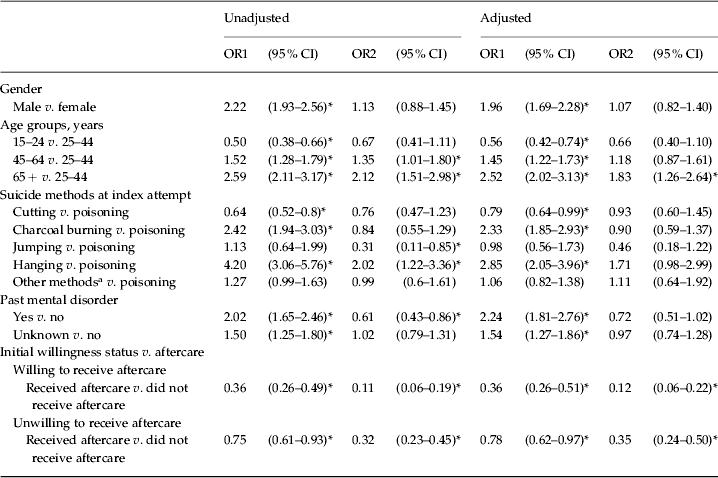
After taking into account the fraction of non-susceptibility, the risk factors for eventual suicide included: older age, male gender, having a history of mental disorders, and using hanging or charcoal burning for the index attempt (Table 1). Being aged 65 years or older was the only factor associated with both higher odds for eventual suicide and a shorter duration to death [odds ratio of probability of eventual suicide (OR1) 2.52, 95% confidence interval (CI) 2.02–3.13; odds ratio of event probability of time to suicide of susceptible subjects (OR2) 1.83, 95% CI 1.26–2.64].
Mixture model analysis for subsequent suicide among persons attempting suicide

OR1, Odds ratio of probability of eventual suicide; CI, confidence interval; OR2, odds ratio of event probability of time to suicide of susceptible subjects.
a Other methods: drowning, domestic gas poisoning, firearms, and others.
* p < 0.05.
Choice of method at index attempt
Among the methods chosen for the index attempts, solid/liquid poisoning was used for most attempts (60.01%), followed by cutting (22.99%) and charcoal burning (5.96%). Jumping from heights (1.83%) and hanging (1.43%) were less frequent. The choice of method for the index attempt was associated with age, gender and history of mental disorders: people who attempted suicide by cutting [age: median = 29, interquartile range (IQR) 23–38 years] or jumping from heights (age: median = 32, IQR 24–43 years) were younger than those who used charcoal burning (age: median = 36, IQR 29–45 years), solid/liquid poisoning (age: median = 38, IQR 28–49 years) or hanging (age: median = 47, IQR 35–60 years).
Among those persons who used hanging for their index attempt (n = 724), 48 (6.63%) later killed themselves; of these, 33 (68.75%) used hanging as the means of death. Among the 3028 index attempters who used charcoal burning, 109 (3.60%) subsequently died intentionally; of these, 66 (60.55%) used charcoal burning as the fatal method. Of the 30487 index cases using solid/liquid poisoning, 486 (1.59%) later died and most of them shifted to more lethal methods for their suicide – charcoal burning (n = 110; 22.63%), hanging (n = 104; 21.40%) and jumping from heights (n = 57; 11.7%). Overall, charcoal burning accounted for the largest number of subsequent suicides during the study period (n = 228 of the total 854 suicides; 26.7%), followed by hanging (n = 215; 25.18%), solid/liquid poisoning (n = 215; 25.18%) and jumping from heights (n = 104; 12.18%).
Effectiveness of aftercare
Regardless of initial willingness for aftercare, and taking into account demographic factors and mental disorders, the NSSS aftercare seemed to decrease subsequent suicides for attempters (with initial willingness for aftercare: OR1 0.36, 95% CI 0.26–0.51; without initial willingness for aftercare: OR1 0.78, 95% CI 0.62–0.97). In addition, aftercare was shown to prolong duration to eventual death (Table 1). The presented effectiveness of aftercare differed by groups based on initial willingness for aftercare: receipt of aftercare was associated with a decreased risk in subsequent suicides by 22.5% among those who were initially unwilling to receive aftercare, and by 63.5% for those who expressed their willingness for such services initially (calculated from Table 1).
Time to eventual suicide
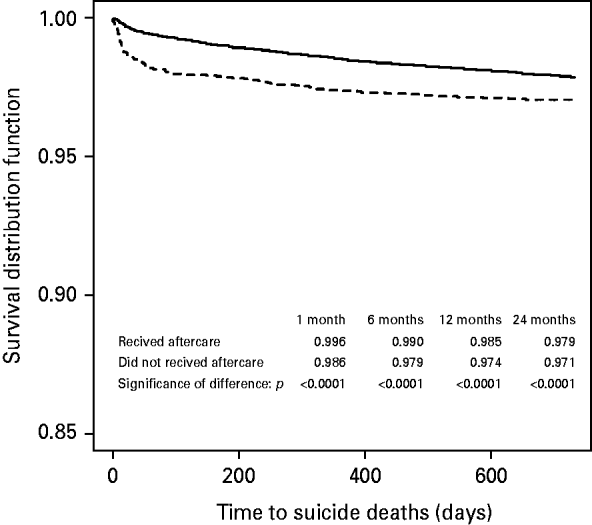
Overall, half (427 of the total 854 suicides) of the suicides occurred within 101.5 days of index attempts (25%: 24 days; 50%: 101.5 days; 75%: 281 days). For those persons receiving aftercare who later killed themselves, the time to half of the observed deaths was 127.5 days (25%: 32 days; 50%: 127.5 days; 75%: 304.2 days); for those who did not, it was 32.5 days (25%: 11 days; 50%: 32.5 days; 75%: 182.2 days).
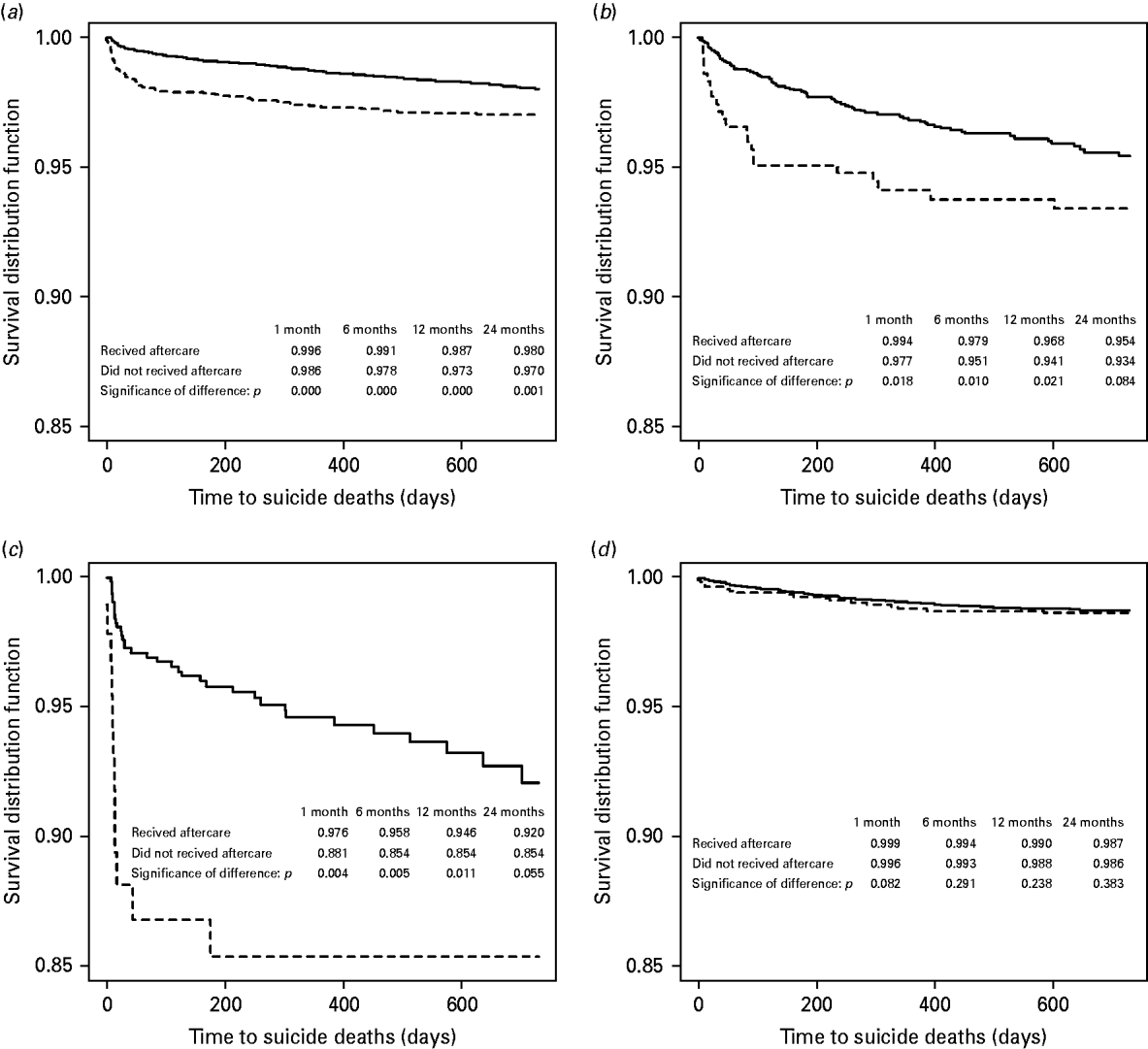
Despite the NSSS aftercare lasting for only 3 to 6 months following the index attempt, the survival probability for those receiving aftercare remained higher than those not receiving aftercare over the entire follow-up period of 24 months (1 month: Z test, p < 0.0001; 6 months: Z test, p < 0.0001; 12 month: Z test, p < 0.0001; 24 months: Z test, p < 0.0001) (Fig. 1). Receiving aftercare significantly changed the risk for subsequent suicide for those using hanging (log-rank test: p = 0.005), charcoal burning (log-rank test: p = 0.042) and solid/liquid poisoning (log-rank test: p < 0.0001) at their index attempts, but not for those who cut themselves (log-rank test: p = 0.675) (Fig. 2).
Kaplan–Meier survival curves representing time to subsequent suicides for attempters receiving aftercare and those not receiving aftercare (p < 0.0001; log-rank test). (–––), Survival curve for suicide attempters receiving aftercare; (- - -), survival curve for those not receiving aftercare.
Kaplan–Meier survival curves representing time to subsequent suicides by aftercare received among attempters using different lethal methods at their index suicide attempts. (a) Solid/liquid poisoning (p < 0.0001; log-rank test); (b) charcoal burning (p = 0.042; log-rank test); (c) hanging (p = 0.005; log-rank test); (d) cutting (p = 0.675; log-rank test). (–––), Survival curve for suicide attempters receiving aftercare; (- - -), survival curve for those not receiving aftercare.
Discussion
Despite limitations that we will consider, the NSSS interventions were robustly associated with two outcomes that were consistent with an ‘effect’: a decreased risk in subsequent suicides by at least 22.5%; and a prolonged duration from the index attempt to death. Risk factors for subsequent suicide in this prospectively followed cohort included older age, male gender, having been diagnosed with a mental disorder, and having chosen hanging or charcoal burning at index attempts. Elderly attempters were particularly prone to nearer-term fatal repetition. Charcoal burning and hanging – methods with high case fatality percentages – accounted for nearly 52% of eventual suicides; among later suicides that had initially used charcoal burning or hanging, most used the same methods again. Suicide often occurred within a few months of a prior attempt; half of the observed suicides occurred within 101.5 days of their index attempts.
The size of this cohort is such that it provides greater confidence of the impact of these findings despite the ‘real-world’ nature of this study and the absence of a randomized control group. The unique data linkage available for this study, with its broadly based sources of information, allows for a prospective modeling of risk factors among prior attempters rather than a cross-sectional comparison of subjects and controls (Kraemer, Reference Kraemer2003). According to a mental health survey on a probability sample in Taiwan, the 12-month prevalence of suicide attempt in Taiwan was estimated to be 0.29% (Liao et al. Reference Liao, Lee, Chen, Yang, Lu and Chen2006, Reference Liao, Chen, Lee, Yang, Lai, Liu, Lung, Lin and Chen2012), which was equivalent to the national population projection of nearly 47000 adults with suicide attempts in 1 year (Liao et al. Reference Liao, Lee, Chen, Yang, Lu and Chen2006). Based on this estimation, the current sample involving subjects who survived their suicide attempts may cover more than one-third of total suicide attempters in Taiwan and is remarkably representative.
To our knowledge, this was the first study involving such a large population and demonstrating the potential effectiveness of a structured intervention program in reducing deaths from suicide among identified attempters. Among the three broadly conceived suicide prevention strategies, i.e. universal, selective and indicated (Mrazek & Haggerty, Reference Mrazek and Haggerty1994; Bertolote, Reference Bertolote2004), universal prevention strategies are designed to reach the entire population while selective strategies target subgroups of the general population that are determined to be at risk; unlike universal and selective strategies, indicated prevention programs identify individuals who are experiencing signs of suicidal behaviors or other related problems associated with suicidality. Accordingly, indicated interventions are targeted toward individuals, such as those registered in the NSSS, who are deemed to be ‘at very high risk’. As past studies have been limited in their ability to draw conclusions in terms of saving lives, the size and diversity of our cohort, with measured effects on both subsequent suicide and elapsed time to suicide, give greater confidence in the applicability of the finding that the relatively modest – but widely applied – NSSS aftercare can save lives. While the intervention program generally lasted for 3–6 months following the index attempt, its effects appeared to be sustained for up to 24 months (Fig. 1). These findings were evident across groups as defined by methods chosen for the index attempts – with the exception of cutting, a method of low lethality and most susceptible to admixture including both those attempting to kill themselves and those having self-directed injury but not lethal intent. Aftercare was associated with a decrease in risk of suicide ranging from 22.5% (for those without initial willingness for aftercare) to 63.5% (for those with initial willingness for aftercare). It seemed probable that the individuals who initially did not want the intervention did worse and that may be because they were more determined to die by suicide or they were more pessimistic about the potential benefits of the intervention.
Two risk factors stood out: elderly persons had 2.5 times greater odds for eventual suicide and for a foreshortened time until death, calling for prevention efforts during the months immediately following initial identification. Persons using more lethal methods at index attempts, i.e. hanging and charcoal burning, had greater long-term risk. These results underscore again that ‘means matter’ (Elnour & Harrison, Reference Elnour and Harrison2008), and that risk assessment must include ‘implementation’, i.e. method, as a central element informing aftercare (Weisman & Worden, Reference Weisman and Worden1972). Moreover, people who used a method with high lethality on their first attempt tended to use it on their fatal attempt. This confirms a prior report about charcoal burning as a fatal method in Taiwan (Kuo et al. Reference Kuo, Conwell, Yu, Chiu, Chen, Tsai and Chen2008), and reinforces the challenge of finding ways to limit unfettered access to charcoal (Chang et al. Reference Chang, Gunnell, Wheeler, Yip and Sterne2010; Yip et al. Reference Yip, Law, Fu, Law, Wong and Xu2010).
The relatively short elapsed time to 50% of the total deaths – 101.5 days – underscores the urgency to intervene quickly. Of special importance: among those persons not receiving aftercare who later killed themselves (n = 170), 42 suicides (25%) occurred within 11 days of the index attempt and 85 (50%) within 33 days, emphasizing yet again the critical period of vulnerability during the early days following an initial event. Consistent with other studies (Isometsa & Lonnqvist, Reference Isometsa and Lonnqvist1998; Ostamo & Lonnqvist, Reference Ostamo and Lonnqvist2001; Hawton et al. Reference Hawton, Zahl and Weatherall2003; Gibb et al. Reference Gibb, Beautrais and Fergusson2005; Tidemalm et al. Reference Tidemalm, Langstrom, Lichtenstein and Runeson2008), 83% of fatal repetitions occurred during the first year in our study, although the limited extent of our follow-up period inevitably narrowed our view. While our results indicated that aftercare prolonged time until death, this was not a target outcome – or one that is a ‘success’ in itself. Nonetheless, it may offer another window of opportunity for further interventions.
Limitations and conclusions
We must be very cautious in concluding that the application of services ‘caused’ a reduction of suicide. As a naturalistic cohort study that precluded the possibility of randomization, we are aware that attempters who did not receive aftercare may have differed in important characteristics beyond easily measured demographic factors or indices captured by the NSSS. This remains a concern despite the fact that there were no differences in distributions of age and gender by groups based on aftercare received (results not shown). However, aftercare had significant effects among suicide attempters irrespective of their initial willingness for aftercare (Table 1). Further subgroup analyses also revealed significant effects of aftercare not only for both genders, but also for those with or without mental disorders (results not shown). After controlling for demographic characteristics and the presence of mental disorders, the effects of aftercare remained robust in multivariate analyses especially that in our statistical model, the effects were measured while taking into consideration subjects' susceptibility to suicide. It seemed not likely that the effects of aftercare were fully attributed to certain differences between groups based on whether they received aftercare or not.
Despite common approaches to training the cadre of NSSS-related health workers and personnel in local mental health facilities, there must have been substantial day-to-day variations in the quantity and the quality of their interactions with NSSS registrants. It is in this context that one might argue that effects were apparent despite the lack of assured standardization of the intervention, another feature of the real world. Also, with the average period of follow-up of 1.28 years, interpretations of the current results should be restricted to short- to medium-term outcomes.
A comprehensive effort to register all persons attempting suicide, for purposes of epidemiological surveillance and for stimulating direct intervention, can not be undertaken in many countries. Whether the apparent personal intrusion so evident with such registration is acceptable will be a subject for each to debate. This study also will be difficult for others to reproduce, given the unique data sources and linkage, and the deep commitment of Taiwan's society to implement the program with as broad a reach as possible.
Finally, the NSSS-sponsored intervention does not replace other public health approaches. Deaths from suicide can occur on the first attempt (Isometsa & Lonnqvist, Reference Isometsa and Lonnqvist1998), and among people not in contact with mental health providers (Luoma et al. Reference Luoma, Martin and Pearson2002). However, the results from the NSSS highlight that it is possible to make a difference in the lives of individuals most at risk, that is, those who have already attempted to kill themselves.
Appendix. Description of analytic method: logistic/proportional odds mixture model
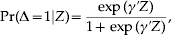
Let Δ denote the indicator of suicide that follows the index attempt (Δ = 1 or 0 for yes or no), and Z and Z* denote the vectors of explanatory variables such as gender or age, for modeling the susceptibility and incidence, respectively. The logistic/proportional odds mixture model is composed of both a logistic model:
 $${\rm Pr} \lpar \rmDelta \equals 1\vert Z\rpar \equals {{\exp \lpar \gamma {\prime}Z\rpar } \over {1 \plus \exp \lpar \gamma {\prime}Z\rpar }}\comma $$
and a proportional odds model:
 $$S_{\setnum{1}} \lpar t\vert Z^{\ast } \rpar \equals {\rm Pr} \lpar T \gt t\vert \rmDelta \equals 1\comma Z^{\ast } \rpar \equals {1 \over {1 \plus \exp \lpar H\lpar t\rpar \plus \beta {\prime}Z^{\ast } \rpar }}\comma $$
wherein γ and β represent the regression parameters, and H an unknown but estimable monotone transformation function. For each one-unit increase in the explanatory factor Z or Z*, exp(γ) is the odds ratio (denoted by OR1 hereafter) with respect to the probability of eventual suicide versus exp(β), the odds ratio (denoted by OR2) with respect to the event probability of the time to suicide of the susceptible subjects. Hence, we can interpret that an attempter with a significant OR1 >1 (<1) tends to have a higher (lower) probability to be susceptible to suicide and he/she with a significant OR2 >1 (<1) tends to have a shorter (longer) duration from the index attempt to eventual suicide.
Acknowledgements
The authors thank all the staff at the Taiwan Suicide Prevention Center and the colleagues participating in the follow-up care of the attempters to make the program successful. This research was funded by a grant from the Department of Health (DOH 94-3084) of the Executive Yuan of Taiwan.
Declaration of Interest
None.