

I. INTRODUCTION
English demographic history has been constructed on the bedrock of parish registers. The registration of baptisms, marriages and burials by Anglican parishes from 1538 onwards provides the most detailed, comprehensive information about the English population found in any source, in a format that ostensibly offers widespread coverage. The manner in which the registers were kept, and their chances of survival, have been influenced by human error, slap-dash recording, accidental damage, purposeful vandalism and a variety of other hazards that restrict the effectual coverage of the existing record. Even so the registers of vital events incontestably provide the best historical source for the study of population and demographic change prior to the registration of births, marriages and deaths from 1837.
Registers have been used chiefly by the Cambridge Group for the History of Population and Social Structure to accomplish two different types of study. First, simple tabulations of monthly totals of baptisms, marriages and burials drawn from 404 parishes have produced a national illustration of demographic trends. This work has included discussion of the shortcomings of baptism and burial registration as a guide to the occurrence of vital events, but has also involved assessments of national nuptiality, fertility and mortality, along with pre-census estimations of total population.Footnote 1 Second, an elaborate, structured technique of parish reconstitution has permitted a closer study of 26 parishes where the registers are both continuous and detailed. This research can be used to test the findings of the work based on tabulations, but it is also used to address finer questions about the range of marital practices and mortality experiences.Footnote 2
It is impossible that any source will usurp the primacy of parish registers in demographic study; it is imperative, though, that other sources be deployed to challenge, augment or confirm the conclusions drawn from registers alone, because questions have been raised about the incidence and impact of register inaccuracies. It is not necessary to agree that vital registration ‘virtually collapsed between the 1790s and the 1820s’ in order to perceive the necessity to test register data.Footnote 3 Most additional sources will seem crude instruments by comparison, if only by dint of their patchy coverage. In some cases taxation listings, or occasional pre-1801 censuses, use registers for confirmation rather than supplying confirmatory evidence themselves. At least one genre of demographic information, however, is only now emerging as a suitable source for the pursuit of English demography, namely the delivery registers of midwives.Footnote 4 Admittedly, examples of this form of evidence are not numerous, and in their survival they might perhaps be likened to an occasional or partial census; they shed light on a very specific segment of a community, usually for tens of years at a time rather than hundreds. What is more, there is a problem regarding comparability with existing work that takes the parish as the unit of study. Casebooks are not confined to one parish (since practitioners typically spanned registration boundaries), nor do they necessarily cover all the reproductive experiences of discrete families for a study of fertility (such as might be revealed by reconstitution). Therefore the birth data relate simply to the group presenting for delivery, and can only generate a relatively simple cohort study.Footnote 5 Conversely, midwifery casebooks do contain unique features, not to be found elsewhere in the English record; for instance, they supply the only reliable account of stillbirth and miscarriage before 1700, and virtually the only account of any kind after 1700 and before 1927.
Midwifery records facilitate the investigation of two demographic puzzles. First, they can be used to test the validity and coverage of local parish and chapel registers, particularly in relation to baptisms and infant burials. Nominal linkages between births and baptisms, births and burials or – in relation to a very few birth events – successive birth, baptism, burial and maternal burial, can suggest some important adjustments to be made to demographic calculations based solely on parish-register data. Midwifery information can be used to comment on birth/baptism intervals, birth/burial intervals, the proportion of stillbirths in the whole cohort and the absence of any definite public recognition of a birth. To date, demographic work that is securely founded on births rather than baptisms is scarce, because parish registers alone rarely feature birth dates or precise ages at baptism. Berry and Schofield's article of 1971 remains a standard work by virtue of its drawing on the subset of baptism registers where ages can best be gleaned.Footnote 6 The use of midwifery records approaches the problem from the other end, as it were. Having a categorical record of a live birth invites a search in all surviving relevant registers for ceremonial acknowledgement of that birth. This search can legitimately encompass Protestant non-conformist and Catholic baptismal registers, as well as multiple Anglican baptism records. Whereas parish reconstitution inserts a ‘dummy’ birth to account for the burial of unbaptised infants, the midwifery study can take as its starting point the known birth.
Second, these documents extend the possibility of an alternative approach to work on infant and maternal mortality. Linkage of births with burials, as opposed to baptisms with burials, provides the scope to add detail to the broader demographic picture. The relationship between stillbirths and maternal mortality, for instance, is exceptionally difficult to access at close quarters (preliminarily overcome by the use of Swedish data, as Schofield has done, or by inferring stillbirths from the rate of early neonatal deaths, in the case of WoodsFootnote 7), while research on infant mortality – in particular prior to 1813 – has been largely neglected and is inevitably based on parish-register data surviving in a variety of different formats. Therefore this article will tackle the demographic opportunities thrown up by midwifery records in the pre-registration era, specifically by comparing records of births with concomitant records of infant baptisms, and with burials of both children and mothers.
Thus the impact of this research is two-fold. First, it suggests a set of rules for the use of midwifery casebooks as a demographic source, and brings to the fore the aspects of midwives' evidence that cannot be matched in parish registers. Second, it tests assumptions that are currently based on parish registers alone, by testing the register entries against an independent (although itself demonstrably imperfect) record of births.
There will naturally be a dramatic difference in scale between the research of the Cambridge Group and this examination of demography and the midwives, which has a bearing on the issue of statistical significance: ‘Obtaining good estimates usually depends on analysing a substantial and representative body of material because local practice varied widely.’Footnote 8 The sort of exercise carried out here is, of necessity, bound up with the detail of such local practice, and cannot hope to be statistically significant.Footnote 9 In terms of, for example, maternal mortality, the number of mothers dying in north Shropshire over the whole period 1781–1803 was small. Furthermore, the deliveries cannot be treated as a random sample of all obstetric deliveries during the period. The sample yielded by any midwifery casebook is skewed by the ability of parents to pay the fees of the different practitioners. Nonetheless, there are precedents for annexing unusual, if delimited, bodies of material for demographic purposes. Riley based his case-study on a cohort of mothers that is similarly distanced from traditional demographic techniques, inasmuch as he did not focus on women in discrete parishes. Instead he investigated mothers whose residences were dispersed but who were members of friendly societies. The women under his scrutiny spanned the period 1778–1929 and resided in Dorset, Derbyshire and Wales. His findings too were based on small absolute numbers of, for example, women dying in the year after delivery, in the interests of revealing the health experiences of a particular group, namely women who could afford membership subscriptions to a society.Footnote 10 The midwifery evidence used here also has some of the same problems of representativeness as the reconstituted parishes used in demographic studies so far. It does not contain any large urban settlements, for example. Even so, the result is a novel, empirical approach to demographic questions that extends the reach of the English evidence.
In this article, I will give a brief account of the midwifery practices that are featured here, and longer consideration to the methodological issues that arise when using midwifery casebooks in this way. The remainder of the article will be concerned with registration practices and mortality rates, with a view to testing the accuracy of the Shropshire parish registers.
II. THE MIDWIVES
Thomas Higgins was a surgeon-apothecary and man-midwife working in the market town of Wem, in north Shropshire. Higgins left an extraordinary family and professional archive that yields extensive insights into the working life and social milieu of a late-eighteenth-century medical practitioner (which I discuss elsewhere).Footnote 11 Among his other papers he kept two small, paperbound booklets to hold details of all the deliveries he attended during his career, and these infants will form the chief focus of this study.Footnote 12 He undertook his first delivery in 1781, and worked continuously until 1803 when he died.
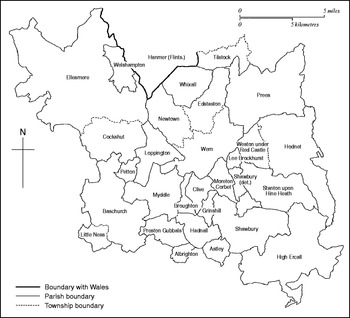
Higgins's notebooks contain details of 1,140 live births, 47 stillbirths and 9 miscarriages, comprising 1,196 infants delivered in all. His obstetric work took him away from home, in that he attended mothers up to ten miles away from Wem (see Figure 1). Therefore vital events associated with his deliveries have been sought across 29 parishes or other registering authorities for this article.Footnote 13 Even so the final number of vital events (1,044) is small compared to the numbers incorporated into other demographic studies, so the timeframe has not otherwise been broken down for this study (whereas it is usual to examine discrete decades).Footnote 14
Parishes in north Shropshire where Thomas Higgins practised midwifery from 1781 to 1803 (Wem in the centre).

Higgins made a note of the date and time of each delivery, the sex of the child and whether it was born alive or dead.Footnote 15 He made no mention of the infants' presentation (whether natural, breech, or otherwise), nor did he cite the occasions when he engaged in manipulation or used obstetric instruments.Footnote 16 Therefore we have no idea whether he was familiar or adept with ‘podalic version’, in which turning an infant in utero so that it could be delivered feet-first was thought to constitute the safest and most effective way to tackle an unnatural presentation.Footnote 17 Against one delivery he scrawled the single word ‘forceps’, suggesting that he owned a set and could use them, but otherwise his thoughts and preferences on the protocols of labour are unknown.Footnote 18 The main function of the notebooks was seemingly financial, because they include fairly meticulous entries relating to the charges levied and the dates when payment was made. While this suggests that Higgins put mercenary concerns above those of medical record-keeping, it does mean that his notebooks are unlikely to have been selective in the cases they recorded in order to show his practice in an unduly good light (and so the surviving record does not misrepresent the full profile of his practice).Footnote 19
As with most demographic studies, this is a comparative project, involving sample nominal-linkage exercises for two additional midwifery casebooks from south Staffordshire and Whitby in Yorkshire at the same period. John Greene and his son were delivering babies in south Staffordshire between 1765 and 1824. Their single surviving casebook spans the whole period and records 1,741 deliveries.Footnote 20 John Greene senior delivered all of the infants up to November 1797, when his son and namesake started to take over some of the caseload. By the start of 1803, the majority of the cases were attended by John Greene junior. John senior began work in and around populous Walsall, but by 1783 he had removed to Brewood and, by the end of the eighteenth century, the partnership was practicing exclusively in this very rural location, north of the industrial centre of Wolverhampton.Footnote 21 Brewood parish was akin to Wem, in that it had a marketing function, but it was much less populous; however, unlike Higgins, the Greenes did not venture far outside their parochial stamping ground, as the majority of their patients resided inside Brewood or just beyond its boundaries. The information the Greenes recorded tells of similar but not identical preoccupations to Higgins's. The casebook contains the parents' surnames and addresses, the date of birth, the amount charged for attendance and the sex of the child. The vital status of the children has to be inferred from the shorthand ‘DD’, used to indicate stillbirth. But there were important differences. First, the Greenes did not use this list to track payments, since it is not clear when or whether the anticipated income was received. Second, they included brief details about the experience of the labour. The majority of such entries were simply to record that the delivery was ‘natural’ but a significant minority included annotations on non-standard presentation, complications suffered by mothers and the use of instruments. Finally, they did not trouble to remind themselves of either parental first names or the child's legitimacy. All of these differences add up to a document that is much more concerned with a medical event than with a social contact.
The second comparator in this study involves a female practitioner. Frances Johnson's career was chronologically contiguous with Higgins's, although it was of longer duration, as she delivered her first child in March 1783 and her last in May 1816. Like many female midwives, she began her work after the completion of her own family (when her two surviving daughters were aged 13 and 15 respectively).Footnote 22 Unlike Higgins, she enjoyed a year of retirement before her death in 1817. Johnson lived and worked in the centre of Whitby, where she delivered 1,798 infants. Her four original casebooks do not survive, but they were transcribed by G. Waddington in November 1887.Footnote 23 The information is different again to what we have from both Higgins and the Greenes. Johnson typically recorded the child's first name (or, failing that, its sex), and parental names, including all of the mothers' first names. Fathers' occupations and addresses were given, however, as was additional information about the birth that was unrelated to the presentation, such as stillbirth, illegitimacy, twins or triplets. Notably, she did not use the books to keep an account of monies charged to or owing by parents.Footnote 24 Her casebook was perhaps more akin to a personal record of achievement.
In order to embed the evidence from Higgins's casebooks in a rigorous demographic study, it was necessary to consider it alongside evidence from comparator practitioners, and the casebooks of Greene and Johnson have the advantage of chronological coincidence with his. It was not possible, though, to attempt to link all of their deliveries with the relevant parish registers. Therefore samples were taken. For the Greenes, 113 deliveries – comprising their entire workload for the years 1798 to 1802 – were extracted for linkage, whereas for Johnson 122 deliveries – representing her midwifery work in 1800 and 1801 – were employed. In this way the Greene and Johnson samples each represent approximately 10 per cent of the Higgins material. The samples are admittedly small, and cannot be used to comment on rates of maternal mortality at all, but they give some point of reference for most of the other calculations made from the Higgins data. Also, both of the comparator casebooks were scrutinized for all non-standard entries throughout their careers. In this way, they can be used more robustly for comments about rates of stillbirth, for example.
III. METHODOLOGY
All of the Higgins cases, and the sample material from the Greenes and Johnson, were entered into three separate Microsoft Access database tables for this study. The different construction of each casebook was reflected in the design of the tables. Each midwifery table was linked to a companion table holding the vital events found to be associated with each delivery. Every delivery might have generated up to three recorded vital events, namely a baptism, an infant burial and a maternal burial. In practice, only one (Whitby) family recorded all three in relation to one delivery. The majority of the deliveries can be connected with only one link.
The imperfect nature of the data required that two types of link had to be established. The first was a definite connection, where all the details between the delivery notebooks and the parish registers matched. The only leeway here was in the spellings of surnames, which I generally elided in an uncontroversial way (for example, Groom and Groome were regarded as interchangeable). The second type of link was provisional, indicated in the database by two question marks (one preceding the type of vital event, the other preceding the information that did not agree with the midwifery casebook, or that did not conform to the search rules outlined below). The links were all established manually, and did not engage in any form of weighted match-scoring (whereby, for example, age data would be given priority over occupational labels in confirming or ruling out links). Similarly, given the vagaries of the Shropshire evidence, it was not imperative even for all the first and surname labels to match to establish a provisional link (unlike the procedure in parish reconstitution); this leeway was perhaps all the more permissible given that one of the sources was not a register but a midwifery casebook, inherently a less formal document than a parish register.Footnote 25
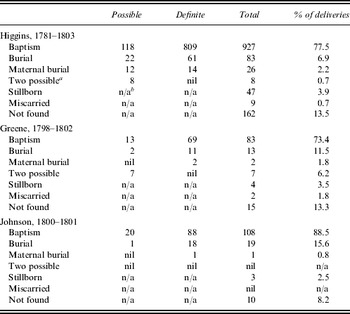
The endeavour to forge links between deliveries, baptisms and burials met with varying success among the three casebooks (see Table 1).
Nominal linkages between deliveries and vital events in the casebooks of Thomas Higgins, John Greene senior and Frances Johnson and parish registers

a Means that there are two possible entries in the baptism or burial register for one delivery/infant/mother, so both are discounted for the purposes of record linkage.
b Indicates ‘not applicable’.
Sources: For Higgins and Shropshire parish registers: Shropshire Archives, Shrewsbury, 1848/44 (casebooks of Thomas Higgins), and Shropshire Parish Register Society, Shropshire parish registers, diocese of Lichfield (London, 1901–1942), volumes I, II, V, VII, IX, X, XI, XIX, XX, XXI. For Greene and Staffordshire parish registers: Wellcome Trust Archive, London, MS 8965 (casebook of two John Greenes, father and son), and Staffordshire Record Office, Stafford, D4014/1/5. Breward register of baptisms and burials, 1785–1812. For Johnson and Whitby parish registers, Whitby Museum Archive, 942.747 (1887 transcription of casebooks of Frances Johnson), and Yorkshire Parish Register Society, Whitby parish registers CD, series 11 (2005), which contains all baptisms, marriages and burials in the Anglican church from 1600 to 1837.
Parish registers were systematically checked for all relevant events. First, where a delivery was recorded at a definite address, the baptism and burial registers that should have related to that address were searched. The majority of the events in all three casebooks were found in this way, although with markedly less success for the baptisms of the Greenes' infants. Where no baptism or burial could be linked, the deliveries entered the next round of searches among the registers of adjacent parishes. Where no address was given in the Higgins casebook, it was assumed that the delivery took place in Wem, and the town registers were searched accordingly. Finally, all entries that remained unlinked entered a final round of searches in all plausible registers (meaning that evidence for some deliveries was sought in all of the 29 Shropshire parishes, townships and chapels retaining a baptism or burial register that fell within the purview of this study, as lying within Higgins's professional reach).
Burial registers were searched for all the infants and, where preceded by a baptism these could be linked securely via first names (in that the first name given at baptism was the same as the first name of the child buried). Maternal burials were sought more selectively, and in a more complex way. This was necessary because Higgins typically recorded fathers' names but not mothers', and Greene merely noted surnames. Where a linked baptism gave parental names, named mothers could be sought, but only after their final delivery. I took it as axiomatic that as, for example, Higgins delivered Abigail the wife of John Harris eight times (the most fecund couple in the study), it would be pointless to search for Abigail's burial after each of her first seven deliveries. Conversely, where a baptism was not found, the burial registers were searched for mothers by surname only. Connections established in this way were always treated as provisional, unless other evidence could be used to confirm the security of the link.
The search rules for this study arose from the reasonable assumption of chronological constraints on child-bearing. The nine months after a delivery were regarded as the optimum time for locating a link with parish registers. After nine months had elapsed, it was possible that the same couple might have had another baby and that any infant baptism or burial recorded more than nine months after a delivery might therefore relate to a later child. The longest interval for nine calendar months would amount to 276 days, but I allowed all links up to 280 days as definite.Footnote 26
Even so, in the interests of thorough searching, the registers were scrutinized for at least one year after each delivery. If a baptism or infant burial was found beyond the nine-month point, it was included cautiously, as a provisional link, up to an interval of 400 days. If a baptism was found fortuitously (not as the result of a structured search) more than 400 days after delivery, it was excluded unless one of two criteria were met: either the baptism had to be a confirmed link, made secure by the inclusion of extra data in the register (usually by giving a date of birth), or the family had to have a track-record of baptising their children after pronounced or even drastically extended intervals. For example, in Shropshire Joseph and Elizabeth Hilditch, the proprietors of the Bull's Head inn at Wem, demonstrably chose to wait a year or two before baptising their children, while the Bassford family preferred to baptise in batches, registering five children at once in May 1796.
This technique incorporates a minimalist view of the possible intervals between births. Birth intervals were very unlikely to be as short as nine months, even where the possibility of repeated conception was hastened by absence of breast-feeding or where intervals were shortened by infant pre-maturity. Intervals were typically of between fifteen and thirty months, or longer in the case of final pregnancies, and these can readily be attributed in general terms to biological causes such as the lack of ovulation/menstruation after a birth, or to contextual causes such as sexual behaviour.Footnote 27 A rapid experience of birth and re-conception was characteristic only of elite families, where there was a drive to maximize the numbers of surviving legitimate heirs.Footnote 28 Even so there seemed no justification for transposing likely generalized trends onto the experiences of individual non-elite families wherever a baptism or burial within nine months could not be found. It would not be valid to infer an interval of at least 15 months, for example, since individuals cannot be confidently assumed to have exhibited average behaviour.
This study does not examine child mortality beyond the age of one year. Since it was not certain that any one child would die, searching for the burials of all children who were alive (or assumed to be alive) at the age of one would have been highly labour-intensive (and the further away from the child's delivery, the more likely the exercise would be to yield diminishing returns, as a result of population mobility). This means that it is not possible to see the impact on infant mortality of, for example, weaning after the age of one.Footnote 29
The registers retained by north Shropshire parishes vary widely in their relevance and content. Higgins lived and carried out a good deal of his work in the small market town of Wem, so the Wem registers are central. No parish reconstitution has been done for Wem, but the quality of its parish-register data has been endorsed by its inclusion as one of Wrigley and Schofield's original 404 parishes, by its use for Laslett and Oosterveen's research on bastardy and by its inclusion in Jones's work on infant mortality.Footnote 30 Elsewhere the registers for the parish of Prees are particularly full, including mothers' maiden names in the baptism register until the middle of 1793, and recording assumed causes of death up to 1797. In contrast, its chapelry of Whixall kept a sparse list of dates, first names and surnames; some recorded baptisms did not even feature any parents' names. The inclusion or omission of extra details variously facilitated or hindered my search for definite or provisional links. In many cases, though, the discrepancy that determines the ‘provisional’ nature of a link is very minor; in these instances I am confident that the vital event is correctly associated with the delivery, but the disjunction between the two pieces of evidence still needed to be acknowledged. The disjunctions between deliveries and baptisms for Whitby are almost negligible, by virtue of the register's recording of dates of birth. In all three locations, if there were two or more discrepancies or occasions of doubt the link was discarded. For example, if both the father's name and the infant's sex were mismatched, the information about the vital event was rejected.
In the case of eight of Higgins's deliveries and seven of Greene's, two or more plausible events were found that were equally likely. In these instances, all the possibilities are indicated in the database. As most of the possible events relate to two baptisms, most are treated as provisional baptisms for the purposes of the calculations below. In a few rare cases the same vital event could have related to two or more deliveries. In these cases all the information was omitted.
On one point all the registers are equally and predictably silent. None include a record of the burial of stillborn infants after 1700.Footnote 31 The recording of stillbirths at the point of delivery is particularly significant for precisely this reason. The occurrence of stillbirths in a family has otherwise to be inferred from gaps between baptisms or from early neonatal mortality. Stillbirths also present a problem for forging definite links. Since there was inherently no likelihood of an infant burial that would record the parents' names, there is no way to be sure that the burial of a woman with the right surname within the days and weeks after a birth was the burial of a mother following the complications of a traumatic childbirth event. Therefore mothers' burials identified after stillbirths are regarded as provisional here, unless the husband's name was recorded in the register and matched with the father's name (where given by Higgins).
Some of the links that are retained are anomalous because there is a mismatch between the details of the delivery and the associated baptism or burial. Midwives probably completed their delivery notebooks retrospectively, because some of their details are patently wrong. There can be no other explanation where, for example, Higgins attributed the birth of twin boys to the Chamber family in July 1789 while the parents buried twin infant girls. Wherever the date of baptism is given as earlier than the date of birth (or where the exact date of either birth or baptism is uncertain) the interval between the two is given here as ‘anomalous’. There is a particularly high rate of anomalous dates for the Whitby evidence.
Lack of absolute congruence between the midwives' details and the parish registers leaves a core of deliveries that cannot be tied securely to any one specific baptism or burial (despite a number of possible events), particularly where the parents had a frequently found surname such as Davies. Nonetheless, these blanks are far outnumbered by the deliveries for which no plausible baptism or burial can be found. In total, 162 deliveries are denoted ‘not found’ in the vital-events database for Shropshire, representing 13 per cent of Higgins's workload. These apparently unregistered babies will have met a variety of fates. A few will have been baptised outside of the geographical area deemed plausible. This was the case where a pregnant woman returned to her parental home to lie in, for example, as did Mr Bickley's daughter Mrs Phillips (who was twice delivered by Higgins but neither of whose children was registered in the area). Some were baptised after the first year of life, while a number of infants doubtless survived unbaptised. Others died in early infancy without either their baptism or their burial being registered. Some ministers did register the deaths of the very young. The vicar of Shawbury buried a child who was said to have lived just a few hours (thereby drawing a clear distinction between the child who had survived for a short time and the stillborn child, who had never done so). Even so it is a certainty that some children would have died shortly after Higgins delivered them alive and were not entered in any burial register. The ‘not founds’ are problematic for any attempt to analyse links statistically; however, a provisional solution is outlined below in relation to infant mortality.
IV. BIRTH/BAPTISM INTERVALS
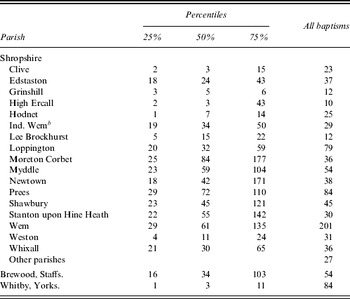
The time that elapsed between delivery and baptism is customarily viewed by demographers at the level of the parish (see Table 2). None of the Shropshire parishes featured here could have been used for reconstitution purposes, so the Higgins evidence provides the only possible access to this information. The birth/baptism intervals in the parishes where Higgins practised display none of the homogeneity that might have been apparent if there had been any regional influence affecting all the parishes. Rather, contiguous townships and parishes display drastic variations in their baptising behaviour. Whixall township, for example, baptised considerably earlier than Prees parish (of which it was technically a detached portion). Collectively, the north Shropshire evidence tends to confirm Berry and Schofield's in two respects. First, ‘variations in the length of the birth/baptism interval could … occur within a very small locality’.Footnote 32 Second, it patently connects with (although it cannot independently confirm) the evidence for lengthening intervals that becomes marked towards the end of the eighteenth century.Footnote 33
Intervals (in days) between birth and baptism in percentiles of baptisms in selected parishes in Shropshire, Staffordshire and YorkshireFootnote a

a Calculations were made only for parishes with ten or more definite baptisms, and exclude those links with anomalous intervals. This table's format derives from B. M. Berry and R. S. Schofield, ‘Age at baptism in pre-industrial England’, Population Studies 25:3 (1997), 453–63. Berry and Schofield established a methodology whereby at least 80 consecutive baptisms quoting ages were used. Given the dispersed nature of Higgins's practice, this would have excluded virtually all his parishes from enquiry. Therefore this table is notionally comparable to Berry and Schofield's data, but with the caveat that the information has different claims to being robust.
b The Independent non-conformist chapel in Wem.
Sources: As in Table 1.
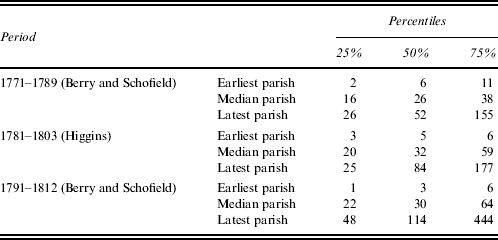
The picture of baptism practice in Brewood suggests that parents customarily tolerated a substantial delay between the event of a birth and its associated ceremony, as was the case in Wem and many other Shropshire parishes. Whitby parents, in contrast, collectively baptised in line with the earliest of the Shropshire parishes. Clearly a quite different culture of registration pertained in Whitby than in most of north Shropshire or in south Staffordshire (see Table 3). A comparison of Higgins's parishes with Berry and Schofield's latest period shows that 75 per cent of children in the median parish for both this study and theirs were baptised within two months of their birth. Intervals for infants in later-baptising parishes could be protracted, although it is worth observing that waits of over a year were very rare. The figure of 444 days for the latest parish in 1791–1812 is clearly anomalous; the next-latest parish given by Berry and Schofield displayed a delay of 266 days.
Birth/baptism intervals, by percentile, across the Shropshire parishes where Thomas Higgins conducted deliveries, as compared with those identified by Berry and SchofieldFootnote a

a See B. M. Berry and R. S. Schofield, ‘Age at baptism in pre-industrial England’, Population Studies 25:3 (1997), 453–63.
Sources: Shropshire Archives, Shrewsbury, 1848/44 (casebooks of Thomas Higgins), and Shropshire parish registers (as in Table 1), and Berry and Schofield, ‘Age at baptism’.
Shropshire residents did not postpone baptism for any reasons associated with the church calendar. Intervals in Bedfordshire parishes allegedly (according to Krauss) related to a desire to have children baptised on the parish saint's day, but as this sort of allegiance did not apparently intensify over the eighteenth century it cannot account for the lengthening intervals.Footnote 34 In Higgins's evidence from Shropshire the only date that attracted more than a dozen baptisms was the first of January: 22 infants were baptised on that date, registered across seven different parishes. The parents' favouring of a new-year ceremony contributed to a culture of long birth/baptism intervals, since they were prepared to wait an average of 103 days for their date of choice, but the geographical distribution means that they had little collective impact on parochial intervals.
V. UNDER-REGISTRATION OF BAPTISMS
Under-registration of baptisms is a known problem with Anglican parish registers, particularly for the late eighteenth and early nineteenth centuries. It has been ascribed to two principal causes, namely the rise in registration of non-conformist baptisms and the likelihood – not constant over time but increasing as the birth/baptism interval lengthened – that children would die before being baptised and so would never feature in a baptism register.Footnote 35 One of the ways that under-registration of baptisms has been addressed in the existing literature has been via scrutiny of these infants who were buried without prior baptism. Among Higgins's deliveries, 49 children possess a burial record only, rather than successive baptism and burial records. This can be expressed as 43 per 1,000 live births, or 53 per 1,000 live and baptised births. This falls some way behind the rate of 74 per 1,000 estimated by Wrigley for the 1780s,Footnote 36 but such a shortfall is what might perhaps be expected from a set of parish registers that were chosen for their geographical coverage (that is, north Shropshire) rather than for their quality. Access to the midwifery evidence, however, permits a calculation of the proportion of infants delivered alive but neither baptised nor buried. The deliveries not linked to any parish-register entry represent the shortfall of baptisms over and above that revealed by the burial of unbaptised infants.
In north Shropshire the rate of non-registration (that is to say, of neither a baptism nor a burial) among the children delivered by Higgins stood at 142.1 for every 1,000 of his live births, or 174.7 missing children per 1,000 live and baptised births. These figures must be added to the proportion of children identified here by reference to their burial to give the total proportion of children born alive but never apparently baptised. This calculation yields estimates of 185.1 per 1000 live births, or 227.6 per 1,000 live and baptised births. These are both far in excess of Wrigley's estimate of 74 per 1,000, suggesting that around 20 per cent of all live births were not recognized by a baptism. Perhaps the north Shropshire evidence can be taken as one preliminary qualification of Wrigley's low estimate, and also of Razzell's (clearly rather drastic) assumption of one-third of births going unregistered by baptism.Footnote 37
VI. INFANT MORTALITY
Parish registers pose a number of problems for studies of infant mortality. Prior to 1813 it was not necessary to record an individual's age at death, so identification of people under one year old demands a comparison of baptism with burial records. Under-registration can complicate the detection of both baptisms and burials, while lengthening intervals between birth and baptism can frustrate or jeopardize calculations of infant age. Midwifery records obviate these problems and provide a good test for the coverage of infant-burial registration. The Shropshire evidence provides grounds for an upward revision of both infant mortality rates and the shortfall in infant-burial registration towards the end of the eighteenth century.
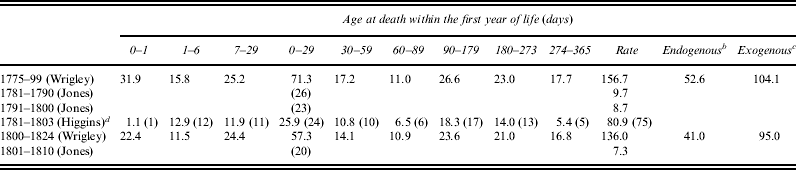
The demonstrable (that is, registered) infant mortality rate among Higgins's deliveries stands far below the rate predicted in parish reconstitutions (see Table 4). The numbers of infants whose burials could be found for this study suggest a rate of 81 per 1,000 across the period 1781–1803, whereas the national rate for England based on parish reconstitutions (but adjusted to accommodate illegitimate children) for 1775–1799 stands at 166.Footnote 38 There are no adequate reasons that can be offered to argue that the Shropshire data is both divergent and accurate. Higgins was working in a largely rural setting, and this may have reduced the local infant mortality rate below the norm, but even so the discernible rate is exceedingly low. So too is the infant mortality rate for illegitimate children. In attempts to estimate this in the past the assumption has been that the mortality among illegitimate children was double the rate for legitimate children.Footnote 39 Yet for Shropshire the revealed rate is just 42.6 per 1,000 (where the indication of illegitimacy is confirmed by Higgins, rather than by the burial registers). This figure is depressed by the relatively high proportion of illegitimate children for whom no record of a vital event can be found. The death rate for Higgins's twins (21 sets) was much higher than for his singletons, at 261.9 per 1,000, but this too is lower than the national figure, which was frequently 300 per 1,000 or higher.Footnote 40 Twin births were more likely than singletons to be premature and therefore less capable of sustaining independent life.
Mortality rates among infants delivered by Thomas Higgins, 1781–1803 (numbers of burials shown in parentheses) compared with the rates per 1,000 live births extracted by Wrigley et al. and JonesFootnote a

a See E. A. Wrigley, R. S. Davies, J. E. Oeppen and R. S. Schofield, English population history from family reconstitution 1580–1837 (Cambridge, 1997), 226, and R. E. Jones, ‘Infant mortality in rural north Shropshire, 1561–1810’, Population Studies 30:2 (1976), 307. The figures from Jones (in parentheses) refer to numbers of burials, as for Higgins. Both Wrigley et al. and Jones were of course calculating on the basis of burials in days after baptism not after birth. Therefore calculations in this table of the death rate per 1,000 live births in north Shropshire are based on Higgins's 927 live and baptised births, in order to make the figures more nearly comparable with the earlier research of Wrigley et al. and Jones. The 75 burials found for Higgins's infants within their first year of life exclude 8 burials in the database either where the interval between birth and burial is anomalous or there were two possible burials, or where burial took place more than 365 days after birth. Finally, Wrigley's figure for the total rate has been adjusted to overcome problems associated with the reconstitution parishes.
b Mortality within the first month of life, typically associated with poor maternal nutrition or the consequences of birth, i.e. not attributable to the external environment.
c Mortality typically associated with challenges presented by life after birth, including material deprivation.
d The figures given to one point after the decimal place indicate mortality rates among babies delivered by Higgins whose burials appear in the registers; numbers in parentheses below relate to the actual number of burials involved in the generation of the rate.
Sources: Wrigley et al., English population history; Jones, ‘Infant mortality’; casebooks of Thomas Higgins (as in Table 1).
In order to accord with the data retrieved from parish reconstitution, there would have to have been a large number of infant burials carried out within the first year of life but outside of the parish of birth/baptism that I have not found. Yet the meticulous search methods employed here have tended to reveal a small number of such infant burials outside the parish of birth. For example, the children of John and Martha Minton were baptised in Clive (their place of birth), but whenever an infant of theirs died it was buried in the adjacent parish of Grinshill.
Collectively this suggests that the north Shropshire parish-register figures are seriously depressed by under-registration of early infant burials. Ministers in Shropshire had not entirely ceased to record the burials of unbaptised children; in 13 of the 29 parishes in north Shropshire examined here they can be shown to have buried infants who had not been formally baptised (so there was nothing amounting to a blanket ban on the practice in the locality) but even so 57.3 per cent of the definite burials of Higgins's infants were done without benefit of prior baptism. This can be expressed as 37.7 per 1,000 children born alive yet buried before baptism. This is considerably lower than Razzell's estimate for 1839–1844 of 54.5 per 1,000,Footnote 41 but then this definite evidence from Shropshire comprises a minimum figure, given the large number of ‘not founds’.
This raises the questions of how many unregistered, ‘not found’ infants survived their first year of life (and potentially much longer, into adulthood and reproductive activity) and of how many such infants died within a year of birth. One aspect of the midwifery data suggests a strategy for guesstimating the number of births that yielded surviving infants versus the number that were succeeded by an infant death. Midwives enjoyed repeat custom where a combination of habit, loyalty or confidence in their medical accomplishments among their patients resulted in a series of bookings for deliveries. This means that it is possible to draw inferences about family behaviour and preferences when patterns of birth and baptism become discernible. Where Higgins delivered two or more children for parents who sought baptism at least once, and where those same families appear to feature one or more infants who were ‘not found’, it is reasonable to suppose that those infants might have been buried without record. Conversely, where there are family groups in his records whose children were never baptised, it is more probable that some or all of their children survived without being brought to church or chapel. Where Higgins made only one delivery for a family, of course, no inference may be drawn. This is clearly a very approximate method, since families who did not baptise might also have suffered the misfortune of an infant death, and families who did baptise locally might have stopped doing so for some reason other than an early infant death. Even so, this technique gives a rough-and-ready basis for apportioning the ‘not found's. In all, 25 ‘not found’ deliveries were made to families who apparently never baptized their children, while 80 were to families who did baptize them. The final 57 ‘not founds’ were made to families for whom Higgins only delivered once. If these 57 are apportioned in a ratio of 1:3 never-baptising to baptising families (to accord approximately with the 25:80 split exhibited where Higgins delivered more than once), this would give 39 deliveries to families whose children may well have survived without baptism, and 123 deliveries to families whose infant children died and both their baptism and burial happened to go unregistered. This would mean that the rate of unregistered infant deaths stood at 107.9 per 1,000 of all infants born alive, or 132.7 per 1,000 baptised infants.
Jones estimated that infant mortality stood at around 130 per 1,000 in north Shropshire in 1800, and attributed wide variations between individual parishes to the registration practices of different incumbents rather than to real variations in mortality rates leaving almost 50 per cent of all infant burials unregistered.Footnote 42 Yet the behaviour of Higgins's patients implies that infant mortality in the same region ran to 213 per 1,000, and that nearer 62 per cent of all infant burials were unregistered.
This would suggest that, in some ways, the under-registration of infant burials has a more drastic impact on the use of parish registers for demographic purposes than the under-registration of baptisms. If the assumptions made here about the ‘not founds’ are fair, then the proportion of children who were not visibly baptised and who then survived was relatively small compared with the proportion of children who were neither baptised nor buried and did not survive. Individuals who died as very young infants were of course excluded from reproducing, and so their impact on population size or positive growth was negligible or nil. Yet if many infant-mortality events remained concealed from parish registers, this would have implications for calculations of fecundity made in reconstitution studies, and so for estimations of the threat to infant life posed by different life-stages and environments.
Given only the bare rates, and the potential for movement in the figures (dependent on the distribution of the ‘not found's), it would be just possible that babies in north Shropshire may simply have enjoyed unusually good life chances. A simplified form of nominal-record linkage done by Wrigley for Wem in the 1780s found an infant mortality rate of 92 per 1,000 (a rate slightly lower than average in an exercise involving 16 parishes nationally).Footnote 43 But when Higgins's overall rate is broken down to illustrate infants’ life chances at different points during their first year of life, then the deficiencies of both the simplified nominal-linkage technique and the north Shropshire parish registers in general become clear. The rate of mortality for infants in their first days of life is drastically skewed by the under-registration of neonatal burials among Higgins's deliveries and Jones's cohort when compared with Wrigley's findings from ‘good’ parish registers. Consequently it is not appropriate to estimate endogenous and exogenous infant mortality using the Bourgeois-Pichat technique from the Higgins data, because that relies on the distribution of all deaths within the first year of life being known.Footnote 44 While it might be possible to guess at the shortfall of burials within the first month of life, the results are too sketchy to use in a further (still speculative) calculation. Similarly, given the apparently high rate of under-registration of early infant burials, little can be made of any seasonal distribution among the infants who were buried.
The Higgins data can be used, though, to shed light on the issue of early baptism for weakly babies.Footnote 45 If this was practised in north Shropshire parishes, it would be likely to yield a number of deliveries that were followed by both baptism and burial during the first month of life. Yet the reverse is found: of the 15 infants definitely buried in the first month of life, only 2 had previously been baptised. Additionally, the parish of Myddle made an occasional note of private baptisms that preceded baptism in church. In only one case did a private baptism take place before a burial (rather than before a public baptism), and in that instance 134 days elapsed between birth and burial. Therefore it seems more appropriate to conclude (provisionally) that a different set of priorities operated in north Shropshire. Rather than baptising a child early in order to ensure its baptism before death, parents were waiting to gauge how robust or fragile their babies would prove to be. In other words, their intention was to carry out a baptism or a burial, not both. In turn this would suggest that for secular reasons parents preferred to observe the ritual most appropriate to the child (the baptism of a demonstrably robust child or the burial of a weakly one), and that this preference was more important than any supposed benefit for the child's soul of baptism before death. This conclusion goes further than that of Jones, who assumed that there was ‘no relation between probability of dying and probability of baptism’,Footnote 46 since it is supposed here that the probability of dying categorically militated against baptism.
The situation was totally different in Whitby, however. There baptisms typically took place rapidly after birth and, of the 18 infants buried within the first year of life, all but one had been previously baptised. Most telling of all, every infant burial that can be identified took place eight days or more after the birth. Given that infant lives were most precarious during the first week, and given that only 10 of the children in the Whitby data cannot be found being either baptised or buried, there are good grounds to suppose that all of the ‘not founds’ in Whitby comprised unregistered infant deaths/burials that took place prior to baptism.
VII. STILLBIRTH
The group of infants that were delivered dead is of particular interest to demographers. One of the most serious omissions from English parish registers is the failure of most to record stillbirths.Footnote 47 This has implications for understanding issues of fertility and family-spacing but also for foetal mortality and maternal mortality (discussed below). Higgins's notebooks contain 47 stillbirths, constituting a mortality rate of 41.2 per 1,000 live births, or 50.7 per 1,000 live and baptised births. This rate is broadly repeated in the Yorkshire cases. Frances Johnson delivered 73 stillborn infants against 1,725 live births, giving a rate of 42.3 per 1,000 live births (with the rate per 1,000 live and baptised births not calculable). The experience was apparently rather different in Staffordshire, where the Greenes reported a rate of 30.2 stillborn infants per 1,000 live births.Footnote 48 The Shropshire and Yorkshire rates are high in relation to the Swedish experience at the same date, where stillbirths comprised just 2.8 per cent of all birth events (although rising to 4.4 per cent in one urban setting).Footnote 49 They are consonant, however, with Finlay's reading of the Hawkshead parish registers and with the stillbirth rates reported at the British Lying-in Hospital in London, at the Dublin Lying-in Hospital and at the Westminster General Dispensary during the last half of the eighteenth century.Footnote 50 Furthermore, the midwives' figures for stillbirth here provide clarification for Wrigley's assumption that the stillbirth rate reduced to 40–50 per 1,000 live births between the 1680s and the 1830s. The reduction had apparently occurred in the locations studied here at least by the late eighteenth century if not earlier.Footnote 51
The vast majority of Higgins's stillbirths were one-off events for the family, at least in terms of midwifery attendance. Just one family suffered two stillbirths. Johnson's patients in Whitby suffered a slightly greater concentration of stillbirths in some families, but 74 per cent were one-off occurrences. As the Greenes gave no parental first names their patients are harder to analyse, but even so the variety of surnames shows that at least 86 per cent of the stillbirths they attended up to 1804 were one-offs. This revealed incidence suggests a very different experience for most mothers than was the case for Lewis's aristocratic mothers at the same period. Elite women could conceive rapidly (arising from their avoidance of breast-feeding and a familial desire to produce surviving male heirs). A group of 11 women of the 48 Lewis identified suffered almost half of all discovered miscarriages and all the stillbirths for her group.Footnote 52 Reproductive wastage was not so concentrated in non-elite families.
Higgins was tracking all the patients who owed him money for obstetric attention. Therefore he was inclined to record not only stillbirths among full-term infants but also miscarriages that resulted in a medically supervised delivery. In nine cases of attendance where he did not record the sex of the child, he labelled them ‘foetu’ or ‘foetus’. On three occasions he estimated that these were of just four or more months' gestation. Of the nine, five were delivered dead and one (of six months' gestation) apparently alive, and the status of three was not noted. The live birth resulted in a burial three days later, while the infants of no status never entered vital registration. Miscarriages were clearly not reported by Higgins in proportion to their likely occurrence but beyond four months' gestation it was probably increasingly appropriate to call for obstetric assistance, if only because estimates of pregnancy duration were often inherently inaccurate.Footnote 53 Miscarriages must be accounted for in midwifery registers though, to ensure that the stillbirth total is not artificially increased.Footnote 54
VIII. MATERNAL MORTALITY
Prior to the middle third of the twentieth century, there were three main causes of maternal deaths. Sepsis (or puerperal fever) was a bacterial infection that mothers suffered in the aftermath of a delivery and it accounted for 33–50 per cent of deaths. Toxaemia (or pre-eclampsia) is a condition involving dangerously high blood pressure during late pregnancy, and around 20 per cent of maternal deaths were ascribed to this cause. Perinatal haemorrhage killed a further 15–20 per cent of the mothers who died. These causes ‘tended to recur in the same proportion to each other even when the total maternal mortality rates were widely different’.Footnote 55 Pre-eclamptic deaths had little connection with the circumstances of labour, but haemorrhage and fever often arose from either the biological progress of labour or the effects of medical intervention.
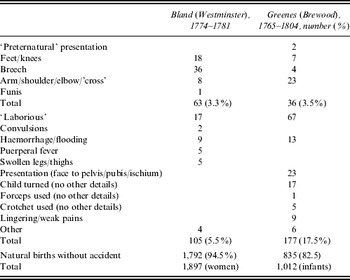
Higgins provides no details whatsoever about presentation, labour or subsequent maternal health. The Greene casebook, however, is informative (especially under the hand of Greene senior). If all of the births not denoted as merely ‘natural’ are extracted for 1765–1804, the rate of unnatural presentations and ‘laborious’ births can be compared with contemporary figures for the London poor, as reported by Robert Bland and based on the experiences of the Westminster General Dispensary for 1774–1781 (see Table 5).Footnote 56 This is particularly instructive in assessing the threats to maternal lives from midwives' practices. It is immediately apparent that either John Greene senior saw a much more problematic group of patients than were treated in Westminster or (more likely) he was an interventionist practitioner. His casebook reports more than three times as many ‘accidents’ as were found in London (where an ‘accident’ appears to have meant any problematic labour, involving a non-standard foetal presentation, the need for instrumental intervention or other difficulty during birth). This is most evident in the willingness of the Greenes to intervene. They went so far as to turn 17 infants in order for them to present by the head, in addition to all those who were referred to as awkward presentations, and of the latter they even turned 2 where the feet were presenting. In other words, far from practising the (potentially effective) intervention of podalic version described above, in their cases successful delivery was probably hindered by a determination to deliver by the head.
Perinatal complications reported by Bland for Westminster and by the Greenes for BrewoodFootnote a

a See R. Bland, ‘Some calculations of the number of accidents or deaths which happen in consequence of parturition’, Philosophical Transactions of the Royal Society of London 71 (1781), and the surviving casebook of the two John Greenes, Wellcome Trust Archive, London, MS 8965. Note that Bland's figures refer to female patients while the Greenes' have been based on infants delivered.
Sources: Bland, ‘Some calculations’; Greene casebooks.
Similarly Greene's definition of a ‘laborious’ delivery draws in a much larger percentage of women than Bland's notation. What is more, Bland's ‘accidents’ include infants whose faces were not turned correctly to the spine, whereas Greene lists those cases separately from ‘laborious’. In all Bland noted the use of one blade of the forceps just four times and ‘lessening the head’ (probably involving the use of a crotchet) eight times, all included among the ‘laborious’ cases, comprising just 0.6 per cent of the total. Greene cited forceps 60 times and the crotchet a further 15, performing 7.4 per cent of deliveries by instruments. This use of the crotchet in particular is excessive in comparison to nineteenth-century practitioners.Footnote 57 The Staffordshire men were in danger of fulfilling the earlier-eighteenth-century stereotype of the male practitioner who was ever eager to justify his presence by use of implements.Footnote 58
There is also a suspicion that the Greenes could be dangerously hasty in their management of labour. Deaths from haemorrhage were avoidable if birth-attendants were particularly careful in the third stage of labour (delivery of the placenta). Good advice was available in print from at least 1786, and the majority of women who experienced such bleeding survived in the mid-nineteenth century.Footnote 59 But of the ten women that the Greenes lost in the immediate aftermath of delivery up to 1804, seven deaths can be attributed to ‘flooding’, or 6.9 per 1,000. The inference can be drawn that they were over-eager to deliver the placenta, which tends to be confirmed when compared with the record of other midwives. Catharina Schrader's practice was characterized by infrequent and dexterous intervention, and she lost just five women to haemorrhage out of 3,014 cases, or 1.6 per 1,000.Footnote 60 In sum, the Staffordshire casebook initially points to rather poor obstetric practice.
And yet the Greene material contrasts so sharply with the Bland estimates for London that it does invite further questions. It should certainly be seen as a testament to provincial male officiousness, but it could also point to a problem with using Bland's evidence as representative. Bland used his letter to the Royal Society in part to advance his own theories. He was suspicious of heat and enclosed rooms (which were, incidentally, marks of female-managed childbirth), which he saw as active promoters of puerperal fever.Footnote 61 He also thought that the poor were less prone to fever by the inadvertent virtues of poorly insulated housing and inadequate heating (virtues which in justice he realized had an unfortunate effect on infant health). Therefore his denoting around 95 per cent of all deliveries as natural and unproblematic (and his low reported maternal mortality rate of 3.7 per 1,000 live births) underpinned his assumption that ‘the lower sort of people recover more certainly after parturition than persons in higher stations in life’, a commonly held view and a point that he made to promote the success of his own private practice. Yet the advantage of the poor was over-estimated, and the supposed vulnerability of the rich has been questioned.Footnote 62 Additionally, by focusing on women's recovery rather than on infant well-being, Bland was potentially exempted from revealing the full extent to which, for example, perinatal problems might be indicated by the use of instruments or the occurrence of stillbirth. Were the forceps used very conservatively at Westminster, as Loudon suggests was often the case in 1770–1860? They were used in 5–15 per cent of cases in the late twentieth century, a rate which at the lower end was akin to that of the Greenes.Footnote 63 Were the 84 children ‘dead-born’ in Westminster (those who had been perceived to move in the womb but were dead on delivery) all accounted for within the 105 births subject to ‘accident’?Footnote 64 On balance, the Greenes' evidence suggests that Bland's 2.2 per cent of births constituting a risk for maternal health is probably an underestimate.
Where information about the cause of death is absent, maternal mortality is typically identified by death within 42 days of delivery.Footnote 65 The results of some studies are also calculated on the basis of deaths within one year of delivery (in order to accommodate all possible deaths prompted by the same obstetric event) but deaths after six weeks, yet still arising from childbirth, were numerically likely to be relatively few.Footnote 66 These judgements cannot, of course, account for mothers' deaths prior to delivery. The numbers of Higgins's mothers who can be proved to have died is small. It is worth stressing, though, the methodological difference between estimates of maternal mortality based on days after prior deliveries and the standard practice of parish reconstitution that can only consider burials 42 days after baptisms.
Register links confirm just 10 maternal burials within 42 days of delivery (arising from 8 live births and 2 stillbirths), or 8.7 per 1,000 live births (10.8 per 1,000 live and baptised births) in the north Shropshire data.Footnote 67 This finding is in line both with calculations for Sweden of 8–9 per 1,000 between about 1760 and 1815 and with the interpretations of English reconstitution evidence that put the figure at just under 8 per 1,000 in the later eighteenth century (albeit that the volume of data used here is small in comparison with the Swedish aggregations and the 13 parish reconstitutions).Footnote 68 This is particularly intriguing, given the starting point of deliveries rather than baptisms. The rate of maternal mortality arising from stillbirths in the evidence from Shropshire is much higher at 42.5 per 1,000 stillbirths, albeit that the figures involved here are tiny (that is, 2 maternal burials against 47 stillbirths), but it is low in relation to the rates Eccles anticipated for England of 57 to 137 per 1,000.Footnote 69 Nonetheless, the Shropshire evidence here is again close to the Swedish experience, where 38.2 mothers died per 1,000 stillbirths.Footnote 70 The maternal mortality rate associated with twin births in Higgins's casebooks was nil.Footnote 71
The Higgins data is unlikely to under-estimate maternal death as a result of under-registration. Burials of adult women were much less likely to have been under-recorded in parish registers than were those of unbaptised, neonatal infants. Among the women Higgins attended, it is likely that the vast majority of subsequent maternal burials have been found in my researches. Therefore this information for England confirms the assumptions made from the Swedish data. Notably, the likelihood of a woman dying after a stillbirth was four or five times higher than after a live birth.
Despite the congruence of these figures – of 8–10 maternal deaths per 1,000 deliveries – the Higgins evidence still confirms the potential role of stillbirths and unregistered infants in destabilizing calculations about maternal mortality made from parish registers alone, especially where the registers are not necessarily of ‘reconstitution’ quality, because reconstitution rules require the burial of a woman to post-date the baptism or burial of a child for it to be seen as a maternal death. Just two of the ten north Shropshire mothers who died within 42 days of a birth can be linked with an earlier recorded infant baptism or burial. Of the remaining 8, 2 had stillborn (unregistered) children, 2 had children who were unregistered without acknowledgement of stillbirth and 4 were buried before their children were either baptised or buried. Calculations of the time elapsed between infant baptism and maternal burial would miss these four latter deaths, so Dobbie's calculations, for example, might be skewed by these omissions.Footnote 72 The baptisms and infant burials that post-date maternal burials also present problems for reconstitution algorithms, and effectively challenge the inferences that can be drawn from parish reconstitution alone. In each case the baptism would be linked to the earlier recorded marriage more securely than would the maternal burial by means of the reconstitution rule requiring a baptism to precede a mother's burial (possibly resulting in a missed maternal death). Furthermore, the baptism or burial of a child might record the names of both parents even where the mother had clearly died, whereas reconstitution rules would deem that her survival can be deduced from her name being cited in her child's baptism and burial records.Footnote 73 These findings do, however, substantiate the idea that maternal mortality observable from live-birth events constituted 60 per cent of total maternal mortality. Six of Higgins's ten mothers who died had children who were registered.
It is not clear how Higgins might have annotated his attendance on women who died undelivered. This is important because in the Swedish context discussed by Schofield around a quarter of all maternal deaths occurred in this way.Footnote 74 In every case in Higgins's midwifery notebooks where the mother died within 42 days he gives the sex of the child, indicating that the body of the infant was always removed (potentially even from a woman who might already be dead). In his drugs notebook (a separate document to the midwifery registers) he records obstetric visits for purposes other than delivery (chiefly after a birth, or to deliver the placenta only) but apparently he made none to women who died undelivered.Footnote 75 Given that both types of notebook seem to have been kept partly to track debts owed by parents, it seems unlikely that Higgins would not have levied a charge simply because mother and baby both died. Therefore it seems unlikely that maternal burials would have been missed from all of his notebooks as a result of women dying undelivered. Women who will have been missed from these sorts of midwifery sources (just as they are missed from parish-register analyses) would have died before a midwife could be called, for example women who suffered pre-eclamptic toxaemia before the onset of labour, or in cases where medical intervention was concealed (specifically in cases of procured abortion, a practice intimately associated with maternal mortality).Footnote 76
The Higgins evidence from north Shropshire acts in confirmation of Schofield's conclusions, and suggests that estimates of maternal mortality from parish registers have not been ‘much too low’, as Dobbie alleged.Footnote 77 It also supplies additional evidence for a declining rate of maternal mortality in the late eighteenth and early nineteenth centuries, which has been attributed to improvements in obstetrical practice. A number of historical studies have made it plain that the actions of birth attendants could have had a profound impact on the outcome of each delivery, for both infant and mother. On the whole, research to date has favoured as an explanation that the employment of female midwives lacking formal training was safer than using the services of medical men, particularly in the early twentieth century.Footnote 78 More generally, improvements in survival rates for either mothers or children are attributed to fluctuations in three relevant trends: improved standards of living, higher-quality obstetric care at the time of birth or more conscientious uptake of obstetric services by mothers.Footnote 79 Higgins was evidently a participant in the general improvement in mothers' life chances, not an inhibitor of it. His patients do not seem to have experienced an epidemic of puerpural fever since his maternal deaths were never clustered. Moreover, Loudon has estimated that practitioners with a mortality rate of 10 or fewer per 1,000 were ‘probably providing worthwhile obstetric care’.Footnote 80
IX. CONCLUSION
The data presented here are not voluminous, and the parishes of north Shropshire cannot be taken as representative of England. Therefore this article does not set out to overturn the demographic calculations of other research. Instead it showcases a new technique in the study of register deficiency, infant mortality and maternal mortality.
The north Shropshire parish registers are clearly flawed as a record of infants born, since they fail to provide evidence of around 20 per cent of all the live births recorded by Higgins.Footnote 81 The data for birth/baptism intervals confirm the findings of Berry and Schofield about parental behaviour, particularly the propensity to baptise within a year, but when they are taken with birth/burial intervals they also suggest a rationale for community priorities for weakly babies. The Whitby residents recorded by Frances Johnson were assiduous in baptising their children before a possible early death, and seem not to have registered the deaths of unbaptised infants. This implies a community appreciation there of the spiritual significance of baptism for an infant's soul and the status of registerable deaths within the congregation. In north Shropshire and Staffordshire, people seem to have been more concerned to enact the single more appropriate ceremony for each infant – baptism or burial – which implies both that a likelihood of an early infant death militated against baptism and that the spiritual significance of baptism was not an important parental motivator.
Where midwives delivered more than one child for each family, the delivery records can be used to infer the fate of unregistered infants (whether of survival without baptism or death without recognized burial). This calculation anticipates that 60 per cent or more of all young infant burials went unregistered. This drastic under-representation of neonatal burials has the potential to destabilize calculations about endogenous mortality rates (those taking place within one month of birth, attributable to poor maternal nutrition or birth trauma rather than contextual or environmental causes). Furthermore the infant burials that are found in the records tend to problematize some of the conventions of reconstitution technique. Inferences about the survival of both parents (where both are named in the case of a baptised child) would not be justified in Shropshire.
Midwifery notebooks constitute a unique source for an examination of stillbirth, and recognized (medically attended) miscarriage, so providing a test for the Swedish data used in earlier studies and for the assumptions made about and from early neonatal infant mortality. The evidence here from Shropshire, Staffordshire and Yorkshire all points to a higher rate of stillbirth in England than that exhibited in Sweden in 1751–1850. All four midwives here recorded deliveries of dead infants in the range of 30 to 42 per 1,000 live births.
Maternal mortality is more difficult to observe. The Westminster data generated by Bland and used by Schofield to estimate the risks to mothers at the time of birth are somewhat undermined by the Staffordshire evidence here and by a closer scrutiny of Bland's own priorities. The results of other studies in terms of calculable maternal mortality are essentially confirmed,Footnote 82 since in Shropshire around 10 mothers died per 1,000 live births, but the rules governing reconstitution (and therefore the maternal mortality events that can be recovered by this technique) are called into question.
The notebooks kept by midwives listing the deliveries they managed can be used for more than a case-study of obstetric technique or medical status. They provide access to some awkward or little-considered aspects of demographic history, albeit necessitating labour-intensive record linkage, and can contribute to our limited array of resources for testing the capabilities of parish registers to record accurately the births and deaths of English people in the past.
ACKNOWLEDGEMENTS
This research was undertaken with the assistance of a Wellcome Trust Research Expenses Award, a sabbatical granted by the Keele Humanities Research Institute and a research leave award from the Arts and Humanities Research Council. I am very grateful for all three.