“So long as bank charters are dependent upon legislative favor, so long they will be an everlasting bone of contention, and the fruitful source of the bitterest party hostilities.”
—Richard Hildreth (1840)Footnote 11. INTRODUCTION
Under the direction of Martin Van Buren, a group of young New York Democratic politicians and newspaper editors built the first American political machine, which dominated New York politics for two decades after 1820. Second-generation Van Buren Democrats, moreover, remained a potent political force up to the Civil War despite short-lived but effective challenges from Antimasons and Whigs. Like most nineteenth-century political machines, Van Buren's partisan coalition, labeled the Bucktails by supporters and the Albany Regency by detractors, was initially built on the strategic and unapologetic distribution of patronage.Footnote 2 Under New York's Revolutionary-era constitution, the governing coalition controlled the appointment of thousands of government officials and bureaucrats from local justices of the peace to the state comptroller and treasurer.Footnote 3 Newly elected governors were inundated with petitions for appointments from supplicants. The most effective executives were those who distributed the appointment spoils to men who had not only provided previous assistance to the coalition but would also advance the executive's agenda going forward. In this, Van Buren followed his predecessors, notably De Witt Clinton, who, if he did not pioneer, perfected the systematic use of the spoils.Footnote 4
Under pressure from a rising early nineteenth-century democratic impulse that brought about an expanded franchise and greater local self-determination, New York's politicians revised the state constitution in 1821. One fundamental constitutional change was the elimination of the ruling coalition's appointment power. Most municipal, county, and state officials were elected rather than appointed. The change, unsuccessfully opposed by Van Buren and his allies, took away the spoils glue that held the Bucktails’ coalition together. The Bucktails needed an alternative source of spoils. They turned to and then systematized the preferential distribution of economic privilege.
Throughout the nineteenth century, a state government's most important role was “that of promoting development by distributing resources and privileges to individuals and groups.”Footnote 5 The Anglo tradition of distributing economic privileges, which dated to the Tudor and Stuart eras in return for promoting the state's interests, moved across the Atlantic and became one of the identifying characteristics of American governments.Footnote 6 Distributive policies were central to nineteenth-century American politics because government could, through its eminent domain powers, bestow rights as varied as millpond dams and rights of way for canals, turnpikes, and (later) railroads; through its franchise privilege, government could bestow corporate and (sometimes) monopoly privileges on financial, manufacturing, and transportation enterprises. It should come as no surprise that the preferential distribution of corporate privileges emerged as one of the most common and yet contentious of governmental actions.
Douglass North, John Wallis, and Barry Weingast label as natural states those governments that maintain ruling coalitions through the preferential distribution of economic privileges. A natural state creates “individual privileges and [economic] rents through social organizations, and uses those organizations to bind powerful individuals together into a sustainable coalition.”Footnote 7 The apparatus of government, then, is built around personal relationships and patronage.Footnote 8 One of the most powerful mechanisms for building and sustaining coalitions in early nineteenth-century New York was the distribution of legal privileges associated with incorporation. Corporations were organizations that generated rents, aligned interests, and hence bound people together in common purpose. The corporate charter, therefore, proved to be a useful device through which men in power granted franchises to favored individuals or groups.Footnote 9 Few charters were more valuable than those for banks and other financial firms.
This article investigates the nineteenth-century American natural state in action with a focus on the distribution of charters of financial enterprises, namely banks and insurance companies. After a brief survey of the politics of early New York's corporate chartering practices, it shows that the direct connection between politics and economics was already on the decline by the time New York made its first moves toward less partisan corporate chartering, a post-natural state political order that North, Wallis, and Weingast label open access. This finding is consistent with Lu and Wallis, who present evidence that corporate chartering in Massachusetts grew less partisan in the first half of the nineteenth century, particularly after 1811.Footnote 10 They argue that the state's political leaders, facing a partisan-driven collapse of the state's financial system, arrived at an understanding that depoliticized the chartering process for the remainder of the pre–Civil War era.
While the evidence is consistent with their interpretation, Lu and Wallis provide no compelling narrative of how this Federalist-Republican détente was negotiated or later enforced. There is an inherent time-consistency problem in that there was no mechanism by which the cohort of politicians who negotiated the détente could tie the hands of future cohorts. Future cohorts of politicians were free to revert to partisan rent seeking by way of corporate chartering. That Massachusetts did not revert to an earlier incarnation of the natural state is interesting, but it is not clear how it was achieved or even whether its experience is generalizable. It appears not. When, in the 1830s, Pennsylvania's politicians faced an opportunity to reform banking and cross the threshold into open access, they chose not to. A new cohort of political leaders exploited to their own advantage an existing governmental structure built around rent seeking; the old system was not dismantled.Footnote 11 It was not even modified for another quarter century.
This exploration of New York shows that the long-run trend toward the depoliticization of American corporate chartering could be reversed. When Martin Van Buren's Bucktail Democrats took the reins of the state's government, they altered chartering rules and the financial system itself in way that allowed them to reverse the downward trend in partisan incorporation. During the Van Buren machine's heyday, political allies were increasingly likely to receive bank and insurance company charters, they were more likely to be allocated shares in initial share offerings, and they were increasingly likely to be appointed to these companies’ boards of directors. The lifeblood of the Van Buren coalition was its ability to dispense patronage through political appointments, and when this was taken from them, they developed a mechanism through which economic rents could be distributed to party operatives at all levels that avoided overt corruption. It was an ingenious system that maintained the coalition's natural-state dominance until the coincidence of financial panic and a newly viable political opposition swept the Van Buren coalition from power just long enough for the opposition to rewrite the rules in a way that dismantled the Democrats’ rent-dispensation system.Footnote 12
When crisis offered an opportunity for change, New York's Whig solution was neither the Massachusetts Federalist-Republican détente nor the Pennsylvania Antimasonic-Democratic status quo; New York's Whigs dismantled the old system and established a new chartering regime in its place, one that solved the political time-consistency problem. When New York's Democratic appellate courts upheld the Whigs’ constitutionally problematic free banking law, the courts’ decisions signaled that a reversion to the status quo ante was, while not inconceivable, improbable.Footnote 13 Preferential partisan bank chartering created organizations “regarded with skepticism, suspicion, and outright fear by the public” and opposition politicians alike.Footnote 14 The New York Whigs’ fundamental alteration of chartering procedures proved surprisingly durable. It persisted into the next century. Its durability was due in part to its building a wall between political power and economic opportunity. And this was an approach to economic regulation with such broad appeal as to make it hard for subsequent politicians to dismantle.
Not only does this study put some flesh on the bones of transitions from natural states to the open-access orders described by North, Wallis, and Weingast, it offers a fresh perspective on the nature of chartering corruption and its ultimate purposes. Richard Hildreth, in 1840, depicted the system in a way that would feel familiar to any public-choice economist who views most government interventions as exercises in rent seeking. “Special legislative favor,” he wrote, is won by “speculative politicians, who have first availed themselves of their political influence to get a charter, and then … make the most they could out of it.”Footnote 15 That is, chartering was a public grant of private monopoly; it was rent seeking in its clearest form. In Van Buren's natural state, it was transformed into something more. Private seeking of private monopoly for private gain was made to serve the party. The party benefited not by capturing some of the rents it distributed, but by dispensing rents to those who would advance the party's and the administration's agenda. In doing so, it created the first viable political machine in the United States.
There is no consensus among historians about either the sources or consequences of New York's antebellum constitutional-political changes and the rise of Van Buren's machine. The changes were once attributed to manifestations of Jacksonian democracy, but that interpretation does not stand up to critical scrutiny.Footnote 16 The changes occurred before Jacksonianism took hold, were vigorously opposed by those who would later lead and benefit from Jacksonianism, and they ran counter to the economic egalitarianism of mainstream Jacksonianism. The Jacksonian program progressed in New York more in spite of Jackson's men rather than because of them.Footnote 17 The North, Wallis, and Weingast natural-state approach offers an interpretation consistent with the gradual though uneven movement toward broader access to economic opportunity that unfolded in nineteenth-century New York.
2. POLITICIANS, PARTIES, AND PATRONAGE IN EARLY NEW YORK
Based on the resident of the governor's mansion, New York's post-Revolutionary and early nineteenth-century politics can be divided (usefully, if not strictly) into four periods: an early Federalist Era to 1800; the Jeffersonian Era defined by Republican governors Lewis and Tompkins to 1820; the Bucktail Democratic period to 1838, the early years of which witnessed Martin Van Buren and De Witt Clinton competing for control; and the era of competitive politics between the Democrats and, in order, Antimasons, Whigs, and Republicans up to the Civil War.
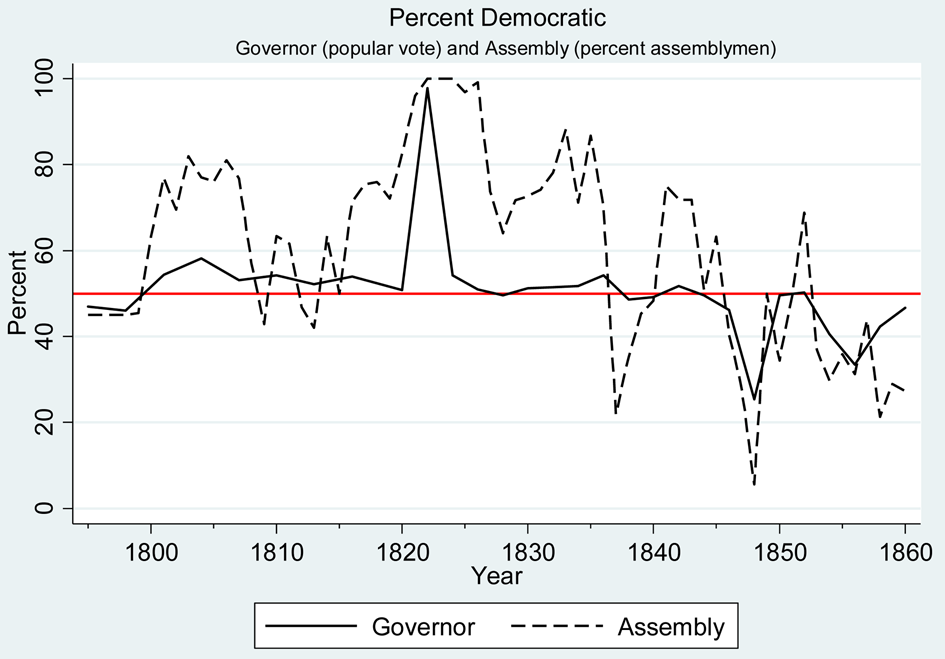
Figure 1 shows that Democratic control of the governorship, with the exception of the 1822 election, was based on modest majorities.Footnote 18 On the other hand, Democratic-Republicans held commanding majorities in the state Assembly between 1800 and 1809 and between the end of the War of 1812 and the Panic of 1837, which are the years on which this study focuses. It was an era of party flux, constitutional change, and rapid economic development. One constant amid these changes was the controlling groups’ continued reliance on patronage in their efforts to build and maintain ruling majorities. The changes wrought by the decline of Federalism and the rise of the Antimasonic and Whig parties have been studied elsewhere, so this study documents the operation of the natural state in the two decades during which De Witt Clinton's and Martin Van Buren's visions of the appropriate developmental role of the state vied for electoral support.Footnote 19 Before turning to the mechanics of the natural state in action in subsequent sections, this section provides a sketch of the political events of the era relevant to the discussion in subsequent sections of this study.
Percent of the Popular Vote for Democratic Gubernatorial Candidates and Percent of New York State Assemblymen Identified as Democrat. Source: Michael Dubin, Party Affiliations in the State Legislatures: A Year-By-Year Summary, 1796–2006 (Jefferson, NC: McFarland, 2007).

Any discussion of the political affiliations or persuasions of the era's politicians must nod toward the reality that political parties, in the modern sense of the term, did not exist before Van Buren's Bucktail Democrats started to build one in the mid-1820s. Politicians formed coalitions and established alliances with other like-minded men, but they did not establish competing organizations with stable leadership and committed members that advanced candidates for office, advocated for particular governmental policies, and aligned the interests of elected officials toward a common agenda, including the long-term electoral viability of the organization.Footnote 20 Early nineteenth-century political alliances coalesced around charismatic personalities, such as Alexander Hamilton or De Witt Clinton, and were more constituent-driven or project-focused than policy-oriented.Footnote 21 Because they formed only loosely around broad ideologies, allegiances tended to be fluid.
The absence of political parties built around common conceptions of governmental action and the commonweal was partly a consequence of the actions expected of contemporary state governments. Up to the 1830s and beyond, as much as one-third of a typical legislative session dealt with local matters such as authorizing municipalities or counties to build a jail or a poor house; another one-third of legislative time was devoted to incorporating towns, villages, and benevolent and eleemosynary institutions. Private relief laws—divorces, settlements of debts owed to or by the state treasury, and so on—accounted for another 20 percent. Matters of statewide interest accounted for 20 percent or less of legislative time. If the number of pages committed to session laws is indicative of legislative outputs, state legislatures were not pursuing policies or activities informed by abstract philosophies of good government. Rather, legislatures passed laws that allocated resources and extended privileges to individuals, municipalities, or other interests.Footnote 22
When organized political parties first emerged, they took advantage of the system by directing valuable local privileges to favored groups. As the volume of certain types of legislation, such as petitions to incorporate churches or academies, threatened to overwhelm legislative sessions, legislatures adopted general laws that authorized incorporation by way of official registration.Footnote 23 Legislatures, however, tended to retain the chartering prerogative for valuable or controversial organizations; banks were, at times, both valuable and controversial.
The identity of favored individuals and interests changed with changes in the majority coalition. In the years of Federalist dominance, Federalists were appointed to key political positions and were granted charters for the Bank of New York (1791), for which Alexander Hamilton is believed to have drawn up the original articles of association, and the Bank of Albany (1792), the original directors of which included Stephen Van Rensselaer III, Abraham Ten Broeck, and other wealthy landowners, merchants, and attorneys with Federalist leanings.Footnote 24 Collectively, the directors of the Bank of Albany held a number of elective offices ranging from the mayor of Albany to U.S. congressmen, and the bank's directors were, as DeAlva Alexander details, unapologetically Federalist.Footnote 25
In markets with several competing banks and relatively abundant capital, the political affiliation of a bank's directors and shareholders would be of little relevance. But in capital-scarce environments served by monopoly banks, the banks could serve party interests. Almost from the opening of the banks at New York and Albany, Republican merchants complained that they were shut out of bank credit because Federalist bankers made a point of lending to Federalist borrowers. Legislative grants of local monopolies combined with excess demand for loans provided banks with the economic latitude to discriminate and remain profitable, which made political favoritism possible.Footnote 26 Favoritism in lending, moreover, served the party in that it was used to reward loyalty and punish defection.
New York, like the nation, went Republican around 1800. Despite a brief resurgence of Federalism fueled by dissatisfaction with Republican prosecution of the War of 1812, New York Federalism was done by 1801. In that year, Republican majorities were elected to both houses of the state legislature, and George Clinton, a Republican, was elected governor.Footnote 27 By 1806 there were no Federalists in the state Senate; just nineteen of 112 state assemblymen were Federalists, as well as only two of seventeen congressmen. New York Federalists did not even field a gubernatorial candidate in 1804.
Once they had defeated the Federalists in 1800, the Republicans split into three factions: one headed by George Clinton and his nephew De Witt Clinton, one by the Robert R. Livingston and his brother-in-law Morgan Lewis, and a third by Aaron Burr. Despite their differences, New York's Republicans took their lead on patronage from Thomas Jefferson. Jefferson's removal of incumbent Federalist officials to be replaced by Republicans “for purely political reasons constituted the backbone of his efforts to break the Federalists’ power.”Footnote 28
New York Republicans followed a parallel course. Despite his general antipathy toward commerce and finance, Jefferson appreciated the value of harnessing the political power of banks. In a letter to his secretary of the Treasury, Albert Gallatin, Jefferson wrote, “I am decidedly in favor of making all the banks republican by sharing [government] deposits amongst them in proportion to the dispositions they show.”Footnote 29 In New York, the Hamilton-Burr rivalry spilled over into economic policy and bank chartering. In 1799 Burr obtained a legislative charter for the Manhattan Company. Ostensibly a water company, it was granted broad corporate powers by the legislative charter, and it embarked on banking operations nearly as soon as it opened. At its inception, the Manhattan Company was decidedly Republican, and when the Clintonians ousted the Burrites from the company's board of directors, merchants who were politically aligned with Burr found they had less access to credit. Thus, patronage and favoritism in the natural state occur at the intraparty, as well as the interparty, level. As interests realign within an organization, its resources and capacities can be deployed to the advantage of the current locus of power, so long as the organization operates by the rules imposed and enforced by the state.Footnote 30
3. BANK CHARTERING IN THE NATURAL STATE
During the years of Republican majorities between 1800 and 1820, bank chartering was characterized by two features: partisan chartering and rent seeking that often devolved into bribery. In 1803, for example, a group of Federalist investors joined in a partnership to establish the Merchants Bank of New York City. Not only was their 1804 charter petition rejected, a Republican-dominated legislature passed a restraining act that prohibited unincorporated (or private) banking. The Merchants Bank's owners were given until May 1805 to wind up the now-illegal partnership's affairs. In early 1805 the bank's partners petitioned a second time for a charter, which was again rejected in committee, according to Jabez Hammond, “on party grounds, not because chartering the bank would be prejudicial to the public interest.”Footnote 31 When a bill based on the petition was not reported out of committee, the petitioners secured the assistance of Ebenezer Purdy, a second-term, politically connected, Republican state senator who represented the Southern District of New York. Once Purdy became involved, the committee reported a bill that was later passed by both houses and signed by Governor Morgan Lewis. A subsequent legislative investigation revealed that at least six legislators had been bribed in return for votes in favor of the charter.Footnote 32 Others who opposed the charter were paid to absent themselves from the statehouse on the day of the third reading and final vote. Facing expulsion, Purdy resigned in March 1806.
Although a group of Federalist bank promoters received a charter from a Republican-majority legislature, they did so only at substantial cost. While some legislators received cash bribes, most of those implicated in the investigation were promised shares in the bank. Some legislators held their shares, but most sold them shortly after the bank opened at a premium over their initial offering price. The practice of a promise for shares in return for votes accomplished several things. First, it provided legislators with some grounds for self-defense if charged with bribery. They had not accepted cash for a vote, but rather a risky asset of uncertain value. Moreover, it was more difficult to prove that the shares had not been paid for. Second, it allowed the majority party to charter a bank requested by minority-party investors and still retain representation as shareholders, if not as directors. Third, even absent outright corruption, the practice of shares-for-votes afforded members of the majority party a mechanism by which they could extract at least some of the anticipated monopoly profits. It is a classic example of rent seeking in a natural state.Footnote 33 Furthermore, the fact that a group of Federalists could obtain a charter from a Republican legislature reveals the weakness of early political coalitions. Defections were common when defecting advanced a legislator's private interests.
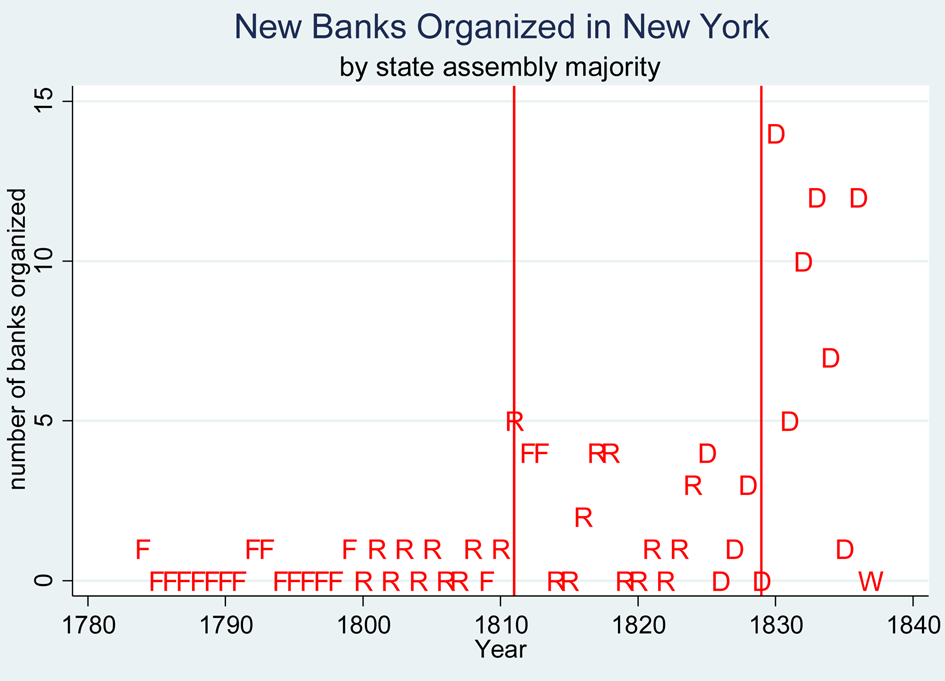
As Figure 2, which plots the number of new banks organized by the party with the majority in the state Assembly, makes clear, there were few opportunities to corrupt legislators or for parties to engage in systematic rent seeking prior to 1811.Footnote 34 In no year did more than one new bank open; in most years no banks were chartered. A regime shift in state bank chartering occurred in 1811 when Congress failed to recharter the Bank of the United States (BUS). With the BUS's closing, prospective bankers in the country's commercial centers, including New York City, petitioned for charters to replace the credit facilities previously offered by the BUS and capture the profits available in commercial lending.
Banks Chartered by Year and Majority Party. Sources: Warren E. Weber, “Early State Banks in the United States: How Many Were There and When Did They Exist?” Journal of Economic History 66, no. 6 (June 2006): 433–55, https://doi.org/10.1017/S0022050706000180; Michael Dubin, Party Affiliations in the State Legislatures: A Year-By-Year Summary, 1796–2006 (Jefferson, NC: McFarland, 2007).

One group of New Yorkers petitioned for an institution to be called the Bank of America with a capital of $6 million, which was three times the size of the city's then-largest bank.Footnote 35 The mostly Federalist petitioners hired two prominent Republicans, David Thomas and Solomon Southwick, and others to lobby on their behalf. Thomas was a long-time friend of De Witt Clinton, whom contemporary observer Jabez Hammond described as a politically experienced and savvy “silent, cautious man, artful, sagacious, and possessed of a deep knowledge of men.”Footnote 36 Southwick, editor of the Albany Register, then the most influential Republican newspaper, was handsome, likable, persuasive, and equally well connected, and expected to attain high public office.Footnote 37 Each man used his political connections, promises of shares in the bank, and cash to convince legislators to vote in support of the charter. Men representing existing banks lobbied against the Bank of America petition. When Governor Daniel D. Tomkins, a Jeffersonian Republican ideologically opposed to bank chartering, got wind of widespread bribery, he invoked his constitutional prerogative to temporarily dismiss the legislature for six weeks.Footnote 38 When the legislature reconvened the act establishing the Bank of America passed. Subsequent investigations led to several indictments and trials. Lobbyist John Martin served time in the penitentiary for his attempts to bribe legislators. Although Thomas and Southwick were acquitted of bribery in separate trials, the episode derailed their political careers.
Widespread rent seeking and the fragility of the era's political alliances points to politics without defining issues or principles. The prize that accrued to the winners of political contests was not an electoral mandate to pursue some well-articulated economic, social, or political agenda; rather, the prizes were personal prestige and patronage, which, absent defining issues, became the driving forces underlying political competition. Factions were more rival teams of free agents than parties, and politics was a struggle between those teams currently in office and those that were not for the power to distribute patronage, either directly or indirectly.
One feature of New York's governmental structure that made obtaining office valuable and alliances changeable was that an electoral majority gave the winners control of the Council of Appointment. New York's 1777 constitution established the Council of Appointment, which consisted of the governor and four state senators, one from each of the state's four senate districts. By the 1810s five men controlled the appointment of nearly 15,000 state, county, and municipal officials, from the secretary of state, attorney general, comptroller, and surveyor general to sheriffs and justices of the peace to mayors of incorporated cities, including the mayor of New York City, as well as militia officers, court clerks, county coroners, and so on.Footnote 39 The council originated in conservative concerns over ceding control of such appointments to either the legislature or to popular election, but it evolved into the principal mechanism by which patronage was dispensed.
Control of patronage was one of the attractions of office holding, but newly elected governors were overwhelmed by requests for positions from supporters and hangers-on. At the state level, the number of subordinate offices was limited. Each cabinet-level office typically employed a chief and deputy administrator and a few clerks. The state comptroller, for example, was allowed a deputy, an accountant, and a dozen clerks; the state treasurer was allowed a deputy, a bookkeeper, and a clerk.Footnote 40 There was one sheriff per county and one mayor per city. By 1820 there were, however, more than 2,500 justices of the peace in office at any time. Each city, town, and township had one or more justices, all of whom earned fees for hearing cases. No legal expertise was required or expected. Governors rewarded lower-level political allies with appointments as justices of the peace.
By the 1810s no one, except those currently in office, defended the Council of Appointment, which centralized the distribution of patronage into a few hands. The role and structure of the council virtually guaranteed that it would become politicized, and it developed a reputation for nepotism and corruption. During the 1810s there were repeated calls to rewrite the state's constitution. Although myriad reasons were advanced in favor of constitutional change, there were three principal issues at stake. First, limits on suffrage denied most urban workers and tenant farmers the vote. Second, the four original senate districts no longer represented demographic, economic, or political reality. Third, a nearly exclusive reliance on taxes on real property rather than realty and personalty advantaged merchants and corporations at the expense of farmers. These and other lesser issues drove the push for a constitutional convention.
Clinton and Van Buren resisted the calls for constitutional change, but on different grounds. Clinton clung to the eighteenth-century founders’ view of government by a meritorious, virtuous elite who would pursue “a single and common good that might be thwarted by advocates of a particular interest.”Footnote 41 Clinton distrusted popular democracy because it opened the door for something other than meritocratic, virtuous leadership. Van Buren's opposition arose from his more pragmatic concern that constitutional change would undermine his ability to create a powerful partisan organization. Historian Donald Cole argues that the constitution that emerged from the 1821 convention was neither a first step toward radical Jacksonian democracy, as some have viewed it, nor a rear-guard conservativism that merely tweaked the status quo, as others have.Footnote 42 The constitution included some significant and long-overdue changes, including a tripling of the electoral franchise, a doubling of the number of senate districts that increased representation for the western and southern regions of the state, the abolishment of the Council of Appointment, and the requirement that any new or renewed bank charter be passed by a two-thirds majority of both legislative houses. Cole concludes that the “political implications of the [1821] constitution outweighed the constitutional.”Footnote 43
Van Buren's early opposition to constitutional reform gave way once he appreciated the groundswell of popular support for it. Once it was clear that change was coming, Van Buren and his allies tried to limit its political ramifications through their attempts to retain something akin to the Council of Appointment. After they lost that battle, they tried to keep as many appointments as possible under the control of the governor. They were mostly unsuccessful in this, as well. Under the 1821 constitution the governor, lieutenant governor, assemblymen, senators, sheriffs, county clerks, coroners, boards of supervisors, and common councils were elected by popular ballot. Mayors were appointed by councils. Justices of the peace were appointed by judges and councils or supervisors; the governor got involved only if judges and councils could not reach agreement on the appointments. Militia officers were elected by company members. Higher-ranking officers were elected by lower-ranking officers. The secretary of state, comptroller, treasurer, attorney general, surveyor general, and commissary-general were appointed by joint ballot of the state Assembly and Senate. As commander-in-chief of the state, the governor alone appointed the adjutant-general of the militia. All other gubernatorial appointments—county court judges, masters in chancery, and high-ranking militia officers—were subject to senate consent. Governors were not stripped of their appointive powers, but such powers were sufficiently diminished that governors lost much of the power of patronage. Legislative majorities gained some limited patronage powers. Most of the power had been eliminated by changing appointive offices to elective. Ruling coalitions had fewer rewards to distribute in their efforts to align the interests of rank-and-file members with the coalition's leadership.
The changes wrought by the 1821 constitution went into effect in 1822. In the meantime, Van Buren's Bucktails won a majority in the state senate, replaced Clinton's men on the Council of Appointment, and quickly replaced Clinton's political appointments, from department heads to justices of the peace, with their own. The Bucktails who took these positions were young men who formed the nucleus of the Bucktail wing of the New York's Democratic Party through the 1830s and into the early 1840s: Azariah Flagg (30 years), William L. Marcy (34 years), Silas Wright (35 years), Enos Throop (36 years), and others. After 1821, the Bucktails maintained control over the now-limited patronage privileges through their legislative majorities, though their use of the power was not always politically astute. In 1824 the Bucktails unceremoniously replaced De Witt Clinton on the state canal commission. Clinton's popularity derived in large part from his early and unwavering advocacy of the Erie Canal, and his ejection from the committee created a backlash that culminated in his 1824 election as governor over the Bucktail candidate, Samuel Young.
With their power to dispense patronage through political appointments curtailed, Van Buren's Bucktails needed an alternative mechanism through which they could reward partisan loyalty. One such mechanism was the legislative authority to grant economic privileges, such as canal construction and maintenance contracts, and corporate charters. Banks and insurance companies were among the most lucrative corporations, but it was difficult to secure enough charters to reward middling political operatives. Moreover, the two-thirds majority vote mandated by the 1821 constitutions made bank chartering even more difficult. Up to 1820 New York had chartered only thirty-three banks, which was fewer than both Massachusetts and Pennsylvania despite New York being more populous and more commercially developed than either. Partisanship and corruption tainted most pre-1820 bank charters. With charters needing a super-majority for approval, it was likely that the partisanship and corruption would only increase, which would, in turn, make bank chartering an even more politically fraught endeavor.
The system arrived at a crisis moment with the 1823 charter of the New York Chemical Manufacturing Company. The company sought corporate privileges to manufacture nitric acid, muriatic acid, paints, and dyes. Its original charter forbade it from engaging in any banking activities. The following year the company's directors petitioned to modify its charter so that it could also operate as a bank. William Caldwell, of New York City, was hired by John C. Morrison, one of the company's directors, to secure it banking privileges. According to the resulting legislative investigation, Morrison agreed to pay Caldwell $2,000 if he succeeded. It was alleged that Caldwell, in turn, bribed Madison County Assemblyman Thomas Spencer, and that at least six state senators—Thomas Greenly (Hamilton), Perley Keyes (Watertown), Melancton Wheeler (Whitehall), Alvin Bronson (Oswego), John Cramer (Waterford), and Erastus Root (Delhi)—had personally benefited from the charter.Footnote 44 Relatives of two other senators had been hired as clerks by the bank after its charter was amended, but the investigating committee found no evidence of a quid pro quo.Footnote 45
Historians Alvin Kass and Nathaniel Benton believe that the Chemical Bank scandal marked the effective end of corrupt, but not partisan, bank chartering. Kass argues that the 1821 constitution's expansion of the franchise changed the electorate, which changed the median voter's tolerance for vote selling, patronage, and the openly partisan granting of economic privilege.Footnote 46 Antiestablishment, anticorruption politicians emerged to represent this part of the electorate, including the Antimasonic movement that emerged after 1826. In addition, by 1825 Van Buren had established the primacy of the Bucktail Democrats in state politics and, by Benton's account, 1825 marked the “last attempt to procure bank charters by bribery.”Footnote 47 Van Buren and his lieutenants channeled the rent-seeking nature of bank chartering to the direct benefit of the party. Individuals continued to reap the rewards from chartering, but once the Bucktails took control of chartering, banking rents were no longer allocated through bribery.
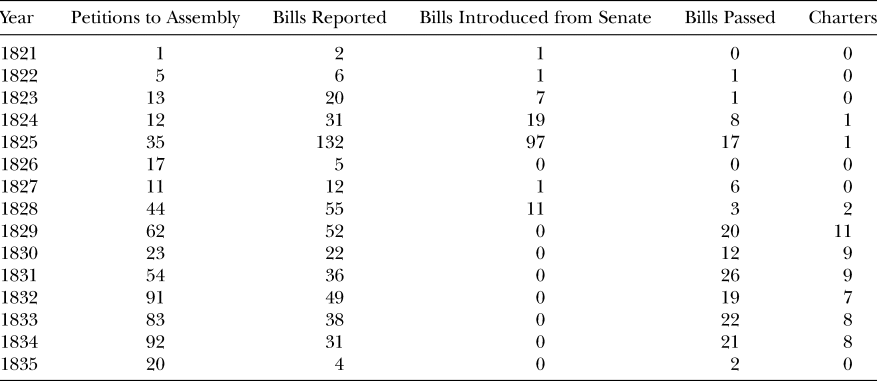
Table 1, which reports statistics on the state Assembly's actions on banks, reveals one of the issues facing Van Buren and the Bucktails. Between 1821 and 1828, petitioners requested more than 100 bank charters from both the Assembly and the senate. The Assembly committee on banks reported out 263 chartering bills, only thirty-six of which were subsequently passed. Of these, the state senate concurred in only four instances. The constitutional requirement that bank charters receive the assent of two-thirds of both houses made it difficult to charter banks, even though commercial interests wanted greater access to credit. Bucktail legislators could not meet their constituents’ demands. A more distressing prospect for the Bucktails, perhaps, was that the charters of thirty-one of the state's forty existing banks were set to expire in the next three years.Footnote 48 Absent a solution to the chartering gridlock, the Bucktails faced the prospect of presiding over a near collapse of the state's financial sector.
Petitions, Bills Reported and Passed, and Charters in the New York Assembly, 1821–1835

Sources: New York State Assembly (1821–1835); Albany Evening Journal (1830–1835).
The second issue facing Van Buren's Bucktails was their inability to overcome the two-thirds hurdle challenged their ability to distribute one of the most lucrative sources of government-granted patronage, privilege, and rent.Footnote 49 Legislators were reluctant to charter banks when a favorable vote very nearly implicated a legislator as corrupt and exposed his constituents to a risk of loss in the event a bank failed. Joshua Forman, a retired New York City merchant, offered a solution. He proposed a banking system wherein each bank contributed toward a common fund, to be maintained by the state, that would be used to reimburse bank creditors in the event that any one of them failed. Moreover, the banks would be subject to regular inspection by one or more bank commissioners. Once Forman convinced Thomas Olcott, an Albany bank president and long-time Van Buren ally, that the plan would provide internal and external oversight and monitoring, safeguard creditors and the public against bank failures, mitigate corruption, and break the logjam involved in passing bank charters, Olcott convinced Van Buren.Footnote 50 Van Buren then presented the broad outlines of the plan in his annual message to the legislature, which did not include any change to the standard chartering procedure.Footnote 51
Van Buren sold the Safety Fund to critics of its continued reliance on the standard rent-seeking chartering model by downplaying the economic consequences of politically motivated chartering. In his 1829 annual message to the legislature, which was widely reprinted in Democratic-leaning newspapers, Van Buren contended that the “particular recipients” of any charter were of “minor importance.”Footnote 52 Because the number of bank stockholders was small relative to the size of the electorate and because shares changed hands so often, “the equity of its original distribution becomes a comparatively unimportant matter.”Footnote 53 Van Buren was disingenuous at best. Having lost the Council of Appointment as a mechanism for distributing patronage, the Bucktails needed a new way to reward party operatives and political allies. If the Safety Fund assuaged fears of bank failures, its passage might liberalize chartering and offer a mechanism by which party operatives could be rewarded with a few shares in a bank, a reward that Van Buren maintained was of minor importance. How the Bucktails accomplished this is discussed later.
Table 1 and Figure 2 make clear that passage of the Safety Fund liberalized chartering. Beginning in 1829, the average number of petitions to the Assembly requesting a charter increased from 17.3 per year between 1821 and 1828 to 60.7 per year between 1829 and 1835. The number of bills reported out of the Assembly's committee on banking and insurance also increased, as did the number of bills passed in the Assembly. Chartering acts increased from an annual average of 0.5 between 1821 and 1828 to nearly 7.5 between 1829 and 1835. Several charter renewals also allowed existing banks to increase their capitals through new share sales. As will be discussed later, the Bucktails ensured that shares in new and existing banks found their way into the hands of Bucktail supporters in numbers proportionate to the investors’ importance to the party.
Denied patronage appointments and with a limited capacity to distribute bank shares to supporters and allies, the Bucktails realized they needed another source of valuable patronage. They settled on insurance companies. Although insurance companies were not chartered with the same fanfare as banks, investors sought charters for insurance companies because they could legally engage in many of the same financial functions as banks, except note issuance. But more than one legislative investigation uncovered instances of insurance companies issuing small-denomination bonds that circulated as currency.Footnote 54 Like banks, insurance companies bought government bonds and made loans, mostly against mortgage security, but they also engaged in some short-term lending. Directorships and shares in insurance companies may not have been as lucrative or as sought after as bank directorships or shares, but they were distributed to political allies in the same way. Petitioners asked for a charter. Petitions were referred to Assembly and Senate committees on banks and insurance. Lobbying proceeded. Bills were reported out and voted on. Chartering acts were signed by the governor. The fact that the number of insurance company charters approved by the state legislature increased from just twenty-seven between 1801 and 1819 to 132 between 1820 and 1837, has gone largely unremarked on by political and economic historians.Footnote 55 Insurance charters granted by the Bucktails provide 132 examples of the accuracy of Benson's observation: “Whatever else may be said of the Regency under Van Buren's aegis, it always remained true to its first principle—to reward men for faithful service to the cause.”Footnote 56
4. THE LONG-RUN DECLINE (AND SHORT-TERM REVERSAL) OF THE POLITICIAN-DIRECTOR
This section and the next explore the mechanics by which New York's early nineteenth-century politicians corrupted the chartering system in order to capture rents, favor allies, and dispense patronage. This section reveals that the long-run decline in the politician-banker found by Lu and Wallis was not unique to Massachusetts.Footnote 57 The proportion of bank directors that held elective office in New York between 1785 and 1860 declined from more than one-third to about one-eighth, which, though less pronounced, is of about the same order of magnitude as that observed in Massachusetts. The New York experience adds nuance to our understanding of the era in that it is consistent the notion that the transition from natural state to open access was neither a linear nor an uninterrupted process.Footnote 58
North, Wallis, and Weingast argue that incipient movements of natural orders toward open access can be derailed. During their heyday, New York's Bucktails diverted, but did not derail, the process—if a declining trend in the proportion of politically connected men (politician-bankers) who held shares in and served as directors of the state's banks and insurance companies is evidence of such a transition. In retrospect, it is. But the transition was not destined. Had an odd and serendipitous chain of events that galvanized the electorate and laid the foundation for the Antimasonic–Whig coalition that rewrote the rules concerning the creation of corporations not occurred, the transition itself may not have happened or happened only later.Footnote 59
The principal evidence used to understand the connection between financial firms and politics uses lists of the initial directors of newly chartered banks and insurance companies. The chartering act authorizing the pro-Federalist Bank of New York, the original articles of association, which were written by Alexander Hamilton, was typical in that Section 5 of the act listed the men who would serve as the directors until the first shareholder meeting and election.Footnote 60 The bank's charter named thirteen men as its initial directors, among them Isaac Roosevelt, who served thirteen years in the state Senate and three terms on the state's Council of Appointment; Gulian Verplanck, who served nine years in the state Assembly and four terms in the U.S. House of Representatives; Comfort Sands, four-term assemblyman and one-term state comptroller; John Murray, judge; and William Maxwell, who served for seven years as the state district attorney.Footnote 61 The men named as directors to the board of the Federalist-leaning Bank of Albany in 1792 included, besides Jeremiah and Stephen Van Rensselaer, men who had or would later serve as state senators, assemblymen, congressmen, and state attorneys.Footnote 62 Republican-chartered banks followed the same practice. The Manhattan Company's initial directors included judges, state senators, assemblymen, as well as a state attorney general, a future congressman, and Aaron Burr, a future vice president of the United States. Thus, the men allowed to establish and manage the state's earliest banks were drawn disproportionately from the political-economic elite. Because bank directors were well positioned to benefit from the rents distributed by the organization to its managers and owners, ruling groups used bank directorships as reward for past loyalty to, as well as inducements for continued effort on behalf of, the then-ruling coalition.
The first step of data collection involved gathering nearly every New York bank charter granted between 1791 and 1836, the last year in which the legislature provided special acts of incorporation for banks.Footnote 63 Charters for 181 of the 221 insurance companies chartered between 1798 and 1858 were also collected. In addition to original directors, charters sometimes provided names of the principal petitioners for the charters and the commissioners appointed to solicit subscriptions, allocate shares among subscribers, and collect the initial payments for shares. The bank sample of 2,333 person-bank observations includes 1,789 original directors, 593 commissioners, and 125 petitioners. Some men served in more than one role. The insurance sample of 4,166 person-company observations includes 2,395 directors, 268 commissioners, and 1,503 petitioners. Here, too, some men served in more than one capacity.
In the 1830s bank chartering acts increasingly included the names of the subscription commissioners without enumerating the directors. The reason for this change is not clear. It may have been that the legislature believed it was appropriate to delegate the election of the initial directors to the shareholders, or the legislature may have omitted this information in an effort to make partisan appointments less obvious. After 1837 the legislature no longer issued special charters for banks, so the names of the initial directors of free banks in the sample are reconstructed from city and county histories, which often contain lists of original directors.Footnote 64 In other cases, initial director lists are taken from published bank histories. An online data appendix provides the details of the sample sources.Footnote 65
One test of the depoliticization of banking hypothesis is to observe a declining share of politician-directors over time.Footnote 66 The second step of data collection, therefore, involved matching the samples of bank and insurance petitioners, commissioners, and directors to lists of men who ever served New York State in the state legislature or U.S. Congress. The New York Civil List of 1870 provides the names of every individual who served in any state or federal office.Footnote 67 A preliminary investigation revealed small numbers who served as sheriffs, judges, heads of state administrative bureaus, and other appointive offices. Because there were so few directors who occupied these administrative offices, that information was not coded.Footnote 68 The focus here is the connection between corporate insiders and elected representatives. Petitioners, commissioners, and directors are considered among the political elite if they ever served in the state Assembly or Senate, or the U.S. House or Senate, regardless of whether their term as directors occurred before, during, or after their elective service. Some served for a single term in just one body; others served multiple terms and in multiple bodies.
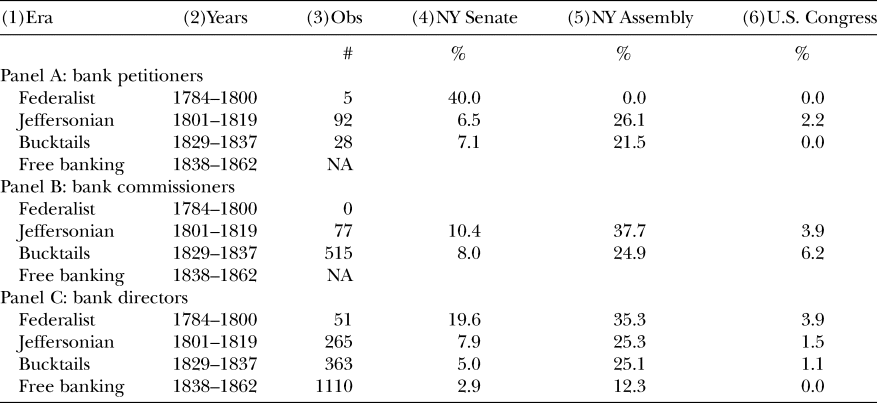
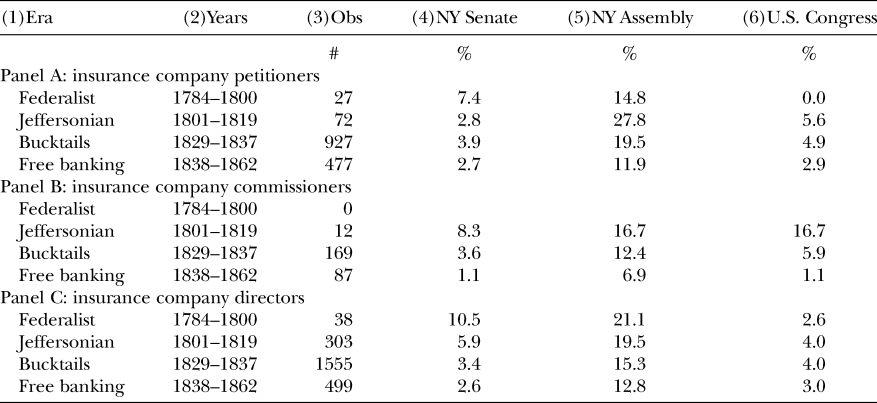
Tables 2 and 3 report summary information on bank and insurance company petitioners, share distribution commissioners, and directors. The data are divided into four eras that correspond to the political philosophies of each era's majority coalition: Federalist, Jeffersonian Republicans, Bucktail Democrats, and a politically competitive Democratic-Whig era labeled as the Free Banking Era.
Bank Petitioners, Commissioners, and Initial Directors Who Ever Served as Elected Representatives

Notes: Columns 4 through 6 report the percentage of times an individual appears in the public record as petitioner, commissioner, or director and elected representative. Men may appear more than once and in more than one role. Petitioners are individuals who requested a charter and are names as such in the chartering act. Commissioners were appointed by the legislature to supervise public subscriptions to corporate shares and distribute them if there were more shares subscribed than authorized. NY senators, assemblymen, and congressmen are those who ever served in the named body. Thus, 6.5 percent of the ninety-two men whose name appeared in a chartering act as a petitioner was ever elected to the New York State senate.
Sources: See text and data appendix.
Insurance Company Petitioners, Commissioners, and Initial Directors Who Ever Served as Elected Representative

Notes: Columns 4 through 6 report the percentage of times an individual appears in the public record as petitioner, commissioner, or director and elected representative. Men may appear more than once and in more than one role. Petitioners are individuals who requested a charter and are names as such in the chartering act. Commissioners were appointed by the legislature to supervise public subscriptions to corporate shares and distribute them if there were more shares subscribed than authorized. NY senators, assemblymen, and congressmen are those who ever served in the named body. Thus, 6.5 percent of the ninety-two men whose name appeared in a chartering act as a petitioner was ever elected to the New York State senate.
Sources: see text and data appendix.
Because there were relatively few bank petitioners or commissioners listed in the charters, and because there were no commissioners or petitioners during the Free Banking Era, my discussion of banks focuses on directors. Panel C of Table 2 shows that the percentage of initial bank directors that ever served in the New York State Senate declined from 19.6 percent in the Federalist Era to just 2.9 percent in the Free Banking Era. The share of initial directors who served in the state Assembly declined from 35.3 percent to 12.3 percent; and the share who ever served in Congress declined from 3.9 percent to zero. For all three elective offices, there is a sharp decline between the Federalist and Republican eras, Republican professions of partisan chartering notwithstanding. The proportion of New York State senators and U.S. congressmen who were appointed to initial bank board declined by more than one-half and that of state assemblymen appointed to a directorship declined by one-third. The decline between the Republican and Democratic eras was, on its face, modest by comparison. The transition to free banking further cut the proportion of director-assemblymen in half and the proportion of state senator-directors by two-fifths.
Table 3 reports the same statistics for insurance companies. Panel A suggests that petitioning and the assignment of share subscription commissions became somewhat less partisan over time. There are too few observations during the Federalist Era to draw conclusions, but the fraction of assemblyman-petitioners and congressmen-petitioners declined from the Jeffersonian to the Bucktail and again to the Free Banking Era. Statistics in Panels B and C point to similar conclusions: The appointment of politically connected men to be share subscription commissions declined between the Republican and Free Banking Eras, as did the share of men named to the original boards of directors of these companies. More than one-fifth of Federalist Era bank directors ever served in the state Assembly; by the Free Banking Era, one-eighth ever served. Declining fractions of state senators and congressmen ever served as original insurance company directors.
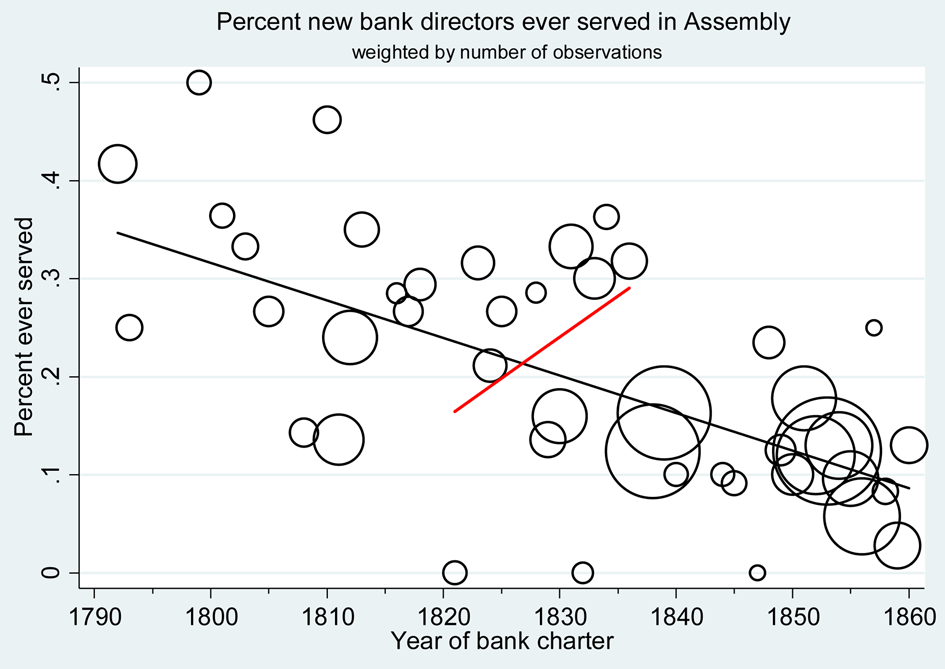
Figure 3 reveals why a simple comparison of the mean number of assemblymen-directors in the Jeffersonian and Bucktail era can be misleading. Each circle in the diagram reports the fraction of assemblymen-directors for all banks chartered in each year. The size of the circle is proportional to the number of observations in that year—the larger the circle, the more directors listed in chartering act or other historical records at risk of being matched to the Civil List. First, it should be noted that more banks opened later in the period, which meant more directors even though bank board sizes declined over time.Footnote 69 Second, there was substantial variation in the fraction of assemblymen-directors even within eras. Third, the long-run trend of declining fractions of politician-directors observed and discussed by Lu and Wallis is evident in the New York data. The estimated trend line suggests a long-run decline from an average of about one-third of directors ever served in the New York State Assembly among banks chartered in the Federalist Era to less than one-tenth by the end of the Free Banking Era. The fourth feature, and that most relevant for the current discussion, is the reversal of the long-run decline during the Bucktail era. The near equality of the ratios in the Jeffersonian and Bucktails Eras masks the increase in the proportion of assemblymen-directors between 1820, when the Bucktails establish their political dominance, and the adoption of free banking in 1838.
Percent of New Bank Directors Who Ever Served in New York State Assembly, 1784–1860.

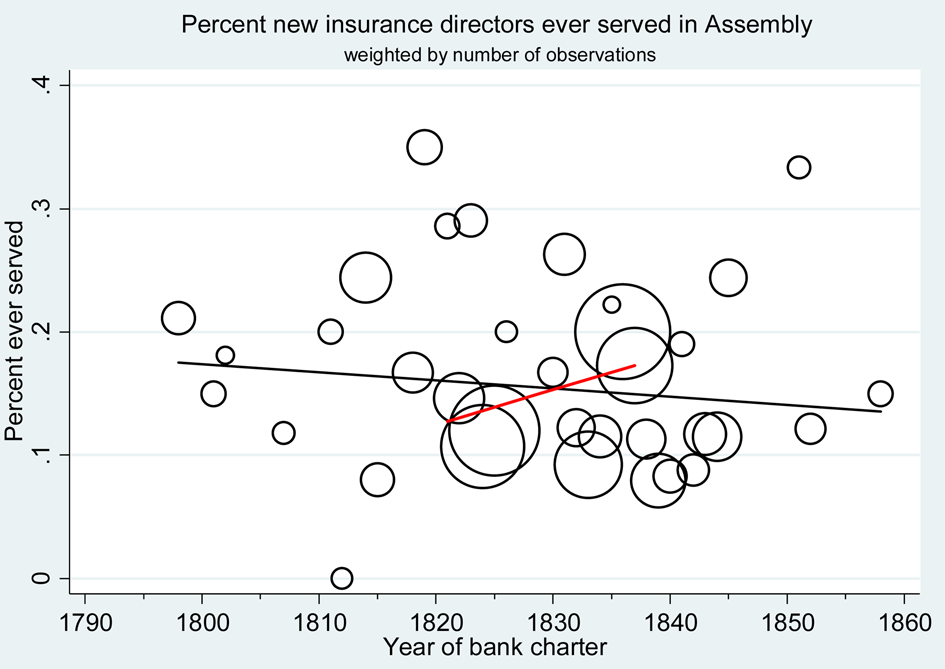
Figure 4 presents the same information for insurance companies. The long-run decline in politician-directors is evident, although less pronounced than with bankers. The trend is also interrupted during the Bucktail Era, though again the reversal is not as pronounced for insurance companies as for banks.
Percent of New Insurance Directors Who Ever Served in the New York State Assembly, 1790–1860.

Period averages and trend graphs are suggestive of substantial changes in behaviors, but it is not clear that the eras differ in a statistically significant way. In addition to the visual evidence, I estimate four logistic regressions to test whether the Bucktail Era represented a genuine reversal of the long-run trend toward less partisan incorporation. The regressions use the basic data underlying Tables 2 and 3 and Figures 3 and 4. Regressions take on the following general form:

Where the regression is implemented such that the dependent variable is dichotomous variable that equals 1 if the individual in question is a director named in the charter that ever served in the state senate or Assembly, and 0 otherwise (regressions are not fitted for congressmen because of the small number of nonzero realizations). The γ's are three era fixed effects; the excluded category is the Jeffersonian Era. These should capture the effect of any notable shift in the appointment of politicians to directorships across regimes. The trend coefficient will capture the long-term trend in partisan appointments. The coefficient of principal interest in the current context is the value of β2, which is designed to capture the reversal of trend during the Bucktail Era observed in Figures 3 and 4. If the reversal is meaningful, the coefficient will be large and statistically significant.
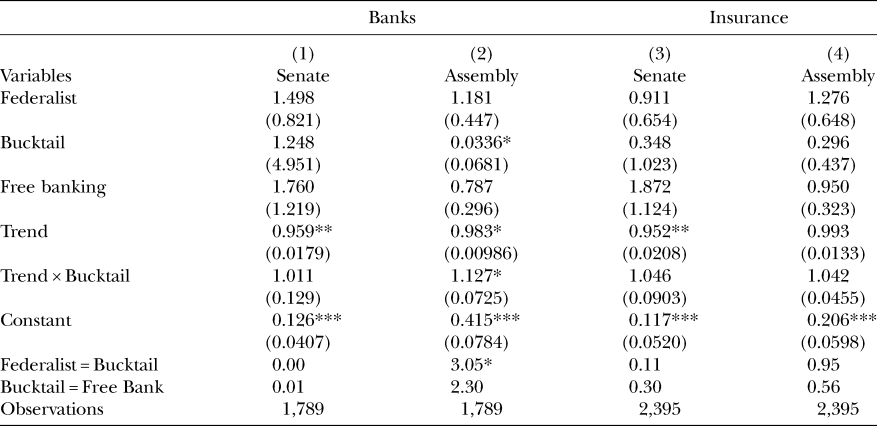
Table 4 reports the results of four regressions; two that consider senators and assemblymen appointed to bank boards, and two that consider those appointed to insurance company boards. Instead of the regression coefficients, which can be difficult to interpret, the table reports the exponentiated coefficients or odds ratios. The regressions generate plausible estimates. First, the constant, which equals p/(1 − p) for the excluded category (the Jeffersonian Era) can be used to estimate the probability, after controlling for other factors, that a politician was appointed to an original corporate board. Equation 1 predicts the probability to be 11.2 percent, which is higher than, but not out of line with, the raw average of 5.9 percent reported in Table 3. Equation 2 predicts the odds of observing an ever-served assemblyman appointed to a bank directorship in the Federalist Era to be 29.3 percent, after controlling for the trend in political appointments. The estimates on the trend variable imply that, for each additional year, the odds of observing a politician-director declined by between 1 and 4 percent. Over a decade, the probability declines by an average of about 2 percentage points.
Estimated Odds Ratios for Politician-Directors by Era

Notes: Standard errors are in parentheses. The Federalist = Bucktail and Bucktail = Free Bank rows report chi-square statistics for equality of odds ratios across periods.
*** p < 0.01; ** p < 0.05; * p < 0.10.
Sources: Author's calculations from data discussed in text and reported in appendix.
The estimates of principal interest, however, are those on the interaction term (trend × Bucktail). These coefficients will reveal if the reversal observed in Figures 3 and 4 can be observed statistically. In each case, the odds ratio is positive, which points toward the Bucktails having temporarily reversed the long-run declining trend in the prevalence of the politician-director. The only significant coefficient, however, is that appearing in the regression for assemblymen-bankers, and the odds ratio in this regression is consistent with an increase in the probability that an assemblyman was appointed to a bank board increased by about 1.7 percent per year between 1820 and 1837. The coefficient in Assembly-insurance regression (#4) is consistent with an annual increase of assemblyman-director of about 0.5 percent per year. The insurance company odds are not large effects, but they are consistent with efforts by the Bucktails to bend the long-run trend away from the politician-director back toward their favor.
The long-run decline is consistent with the gradual transition from the natural state to open access discussed by North, Wallis, and Weingast. It is also consistent with an increase in the value of specialization and the division of labor. Early American politicians, especially those who served in state legislatures, approached politics as much as a civic obligation as a second career. Most operated farms or small businesses or pursued a profession, such as law or medicine. Legislative service was costly because it interfered with the legislator's principal occupation. Thus, the average early nineteenth-century New York assemblyman served a single one-year term, though the number who served multiple terms increased over time.Footnote 70 As politics became more agenda driven, complex, and party-oriented, the rise of the professional politician is consistent with Adam Smith's specialization and the division of labor. Specialization is not inconsistent with the transition to open access, but it suggests a change in the incentives motivating natural state and open-access politicians. The former will be more motivated by the ability to capture or distribute rents; the latter will be motivated more by agendas and rising up party ranks. The contradiction of Van Buren's Bucktails is that they were both; party leaders had to accommodate the rent seekers and aspiring careerists. How they accomplished this is discussed in the next section.
5. THE BUCKTAILS OPERATION OF A MATURE NATURAL STATE, 1825–1837
Given the newly expanded electorate's lesser tolerance for the corruption, privileges, and favoritism involved in corporate chartering, the challenge facing Van Buren's lieutenants was how to funnel privileges to party men without having the system devolve into the corruption of the earlier generation. To better understand how Van Buren's Bucktails transformed corporate chartering from one that satisfied the rank-and-file's rent seeking with an electorate less tolerant of over bribery, it is instructive to consider Kass's three types of party members: voters, backers, and zealots.Footnote 71 Voters were those who could be counted on to vote for the party's candidates, did so publicly, and readily acknowledged doing so. Backers were those who contributed time and money to the party on behalf of candidates. Zealots were the local or state party leaders; they populated the middle and upper levels of the party hierarchy, designed its proposals, and participated in party caucuses and conventions.
The issue facing the Bucktails was how to make banks Democratic, to borrow Jefferson's phrase, and make the chartering process serve them through the creation and distribution of rents while avoiding its devolution into bribery that had brought the process into disrepute. How were the Bucktails to get banking to serve it patronage objectives? Van Buren and his lieutenants found their answer in the selective appointment of bank subscription commissioners. Commissions were created by the legislature, and commissioners were responsible for opening subscription books and, if the shares were oversubscribed, which was common, to distribute shares among the subscribers, and to collect share down payments. Distributions were left to the judgment of the commissioners because part of their charge was to ensure that banks were owned by men of wealth, character, reputation, and standing within the local community and statewide party. In the end, reputation and standing mattered most.
One aspect of the Bucktails’ party-building genius was that they found a mechanism to distribute shares in proportion to a subscriber's value to the party. Share distributions were used to reward voters, backers, and zealots in a way that replicated the patronage distributed by the old Council of Appointment. Thus, a long-time voter who might have eventually received an appointment as a justice of the peace under the old council system was granted the right to subscribe to a few bank or insurance company shares under the new system. A zealot who, before 1820, might have been appointed to a mayoralty or a deputy canal commission was granted the right to subscribe to a dozen or a score of bank shares. The share distribution system would be an effective reward system only if it provided rents in proportion to importance to the party. Shares could not be ceded gratis without raising accusations of corruption. How did the Bucktails allow partisans to rent seek without widespread corruption?
In response to charges that the distribution of shares of three banks in northern New York State had been inequitable, a legislative committee provided detailed reports that document partisan share distributions. Augustine Dauby, a subscription commissioner for the Oneida Bank (1836), testified that he was convinced that the shares would be oversubscribed and expressed a concern that the Whigs, then in control of the Bank of Utica, would attempt to “wrest the power of the bank from the hands of its more immediate friends,” meaning, of course, Bucktail Democrats.Footnote 72 Dauby and his fellow commissioners instructed local party operatives to solicit subscriptions from as many Bucktail men as possible. If the subscribers had neither the wherewithal to pay for the shares nor the inclination to hold the shares, the commissioners directed the subscribers to sign preprinted powers of attorney in which the subscriber directed the party holding the power of attorney to dispose of their shares after distribution. Subscribers who assigned their shares also signed a note (IOU) for the initial 10 percent down payment, which was supplied by the person holding the power of attorney. Within days of the distribution, the assigned shares were sold at 2 to 10 percent over the issue price, the note was paid, and the subscriber received the premium as a reward for lending his name to the commissioners. Though this process, the commissioners followed the letter of the law in that no individual was allowed to subscribe for or receive more than twenty-five shares, and no commissioner directly profited from the sale of the shares after distribution. The commissioners, as a group, countenanced the practice to “secure to themselves and their friends the control of the said [Oneida] bank, and at the same time to distribute as widely as possible the benefits to arise from the premium on the sale of stock.”Footnote 73
The senate committee investigating the Oneida Bank also took testimony from complainants and local notables concerning the share distribution. Their testimony reveals how the party rewarded loyal members. Mulford Bond, a Utica grocer, testified that he sold his five shares after distribution and told the commissioner he intended to do so when we subscribed. Why was he awarded shares despite his intent to sell them on delivery? Bond was favored because he had lived in Utica for fifteen years; served as tax collector and leather inspector, both previously patronage appointments; and “had taken an active part in the political affairs, or as much as any of the working class of people.”Footnote 74 The reports document dozens of similar stories.
The 1836 Oneida Bank investigation, which reports complete shareholders lists for August 1836 (the initial distribution), November 1836, and February 1837, provides a glimpse into the Bucktails’ patronage-based bank chartering in operation. The three shareholder lists were matched to biographies of the area's notable men that appear in histories of Utica City and Oneida County, many of whom were successful, politically connected businessmen.Footnote 75 It might be reasonable to believe that the Oneida Bank experience is generalizable to other banks chartered in the 1830s, at the height of the Bucktails’ power.Footnote 76 It is not necessarily generalizable to other times or places.
In August 1836, the Oneida Bank's 4,000 shares were divided between 632 shareholders. Three women were each awarded a single share; four men received just two shares. The modal allocation was five shares; the mean was 6.41. Four state assemblymen and two state senators who resided in and represented Oneida County each received ten shares. All had voted in favor of the chartering act.Footnote 77 Twelve men, including the eleven share distribution commissioners, were awarded the legal maximum of twenty-five shares. The only noncommissioner to receive twenty-five shares was Samuel Beardsley, who was at various times a state senator, a four-term congressman, state circuit court judge, the U.S. district attorney for the Northern District of New York, state attorney general, and chief justice of the state supreme court.Footnote 78 Under Kane's taxonomy, Beardsley was zealot par excellence, and he was rewarded as such. But like many less prominent political operatives who were awarded shares in the Oneida Bank, Beardsley sold his shares shortly after the distribution and pocketed about $200. Having bought shares sold by backers and zealots granted shares under the subscription-and-payment-by-note system, Commissioner Dauby later owned 204 shares and was on the board of directors.
If the men whose biographies appear in a history of Utica City or Oneida County are a sample of likely zealots, then the matched shareholder-biography lists can be used to dig a little deeper into the initial allocation and post-allocation redistribution of shares. One effect was that the subscription-payment-by-note approach, which led to quick post-distribution sales, concentrated ownership. In November 1836, the bank's 4,000 shares were owned by 226 shareholders, or just more than one-third the number of individuals who were initially allocated shares. Among the eighty-six notable men whose biographies appear in local histories, average shareholding at distribution in August 1836 was 7.7 shares. In November 1836 average shareholdings among this group was 13.9 shares; it increased to 15.0 shares in February 1837. Average shareholdings among men not mentioned in local biographies decline from 5.6 shares in August 1836 to 4.5 in February 1837. Thus, notable men were initially awarded more shares and purchased shares after the distribution. Nonnotables were more likely to be sellers.
Legislative investigations in 1838 into share distributions for the Commercial Bank of Oswego and the Jefferson County Bank of Watertown revealed that the practices employed by the Oneida Bank's commissioners were employed by these banks’ commissioners, as well. Subscriptions were solicited from pro-Bucktail voters, backers, and zealots, many of whom assigned their distributions through powers of attorney to others, who were more likely than others to receive shares. Voters were accommodated. Orville Hungerford, president of the Jefferson County Bank, testified, not without an unmistakable tone of informed but critical dubiety, that shares were distributed to and paid for by “notoriously poor” subscribers.Footnote 79 Despite his obvious dissatisfaction with the system, Hungerford offered only a veiled criticism, being unwilling to antagonize the state's political leaders to whom he owed, in part, his position. Backers and zealots, such as a canal toll collector (25 shares), a county court clerk (25 shares), a canal weighmaster (10 shares), and an attorney (10 shares), among other political appointees, received shares in the Commercial Bank of Oswego in proportion to their standing in the party.Footnote 80 Banks were made Democratic to serve the political and economic aims of the Bucktail leadership.
These investigations laid bare the Bucktails’ patronage-based bank chartering. The Bucktail-dominated legislature approved charter petitions for politically favored elites and then manipulated share allocations to distribute rents to party operatives and supporters beyond the small group that would ultimately take control of the banks. The Bucktail leaders Martin Van Buren, Silas Wright, and William L. Marcy, even the Antimason Thurlow Weed, embraced early nineteenth-century patronage politics and were comfortable with lobbyists influencing political outcomes. They did not tolerate overt bribery and vote selling among party members.Footnote 81 Thus, Benton could conclude, perhaps accurately, that the “last attempt to procure bank charters by bribery was made in 1825.”Footnote 82 The Bucktails’ share distributions distributed rents and yet restored some measure of political legitimacy to corporate chartering.Footnote 83
6. CONCLUDING COMMENTS
Free banking's adoption, which marked the end of the Bucktails’ dominance of New York politics, marked the beginning, not the end of the transition, toward the open access order of free incorporation and organizational competition described by North, Wallis, and Weingast. Lee Benson reports that to attract and keep Irish and other Catholic immigrants loyal to the party, New York City's Tammany Democrats favored Irish Catholics with market licenses for food stalls and petty municipal offices through the 1840s.Footnote 84 In response, some native-born Protestants, who resented the Democrats’ use of partisan patronage, formed the American Republican Party, a nativist, anti-Catholic party that realized some successes in New York City's elections. Similarly, Thurlow Weed, a prominent Antimason who was instrumental in the adoption of free banking, was not averse to the use of distributional politics when it served his purposes. In the 1850s, as his political career wound down, Weed lobbied legislators on behalf of streetcar company charters and is alleged to have bribed legislators to accomplish his purposes. He denied the bribery allegations, but he saw no contradiction in advocating free banking at one time and bribing legislators at another. In each case, his action was what the politics and economics of the moment called for, and Weed was nothing if not pragmatic.Footnote 85
William L. Marcy, the Bucktail governor, and Thurlow Weed (National Democrat, Antimason, and Whig, by turns) were fierce political opponents. Marcy, the conservative, was one of the Bucktails’ most powerful men. During a speech in the U.S. Senate, he said, “to the victor belong the spoils of the enemy.” Weed, the reformer, edited the principal anti-Bucktail newspaper and advocated for universal, free, state-supported education, free libraries, the elimination of imprisonment for debt, stricter enforcement of usury laws, temperance (but not prohibition), and better treatment of Indians and immigrants, and he spoke out against the spread of slavery (but not abolitionism). Moreover, Weed rarely let pass an opportunity to portray the Bucktails as a cabal that ran a corrupt political machine constructed on the dispensation of favors and patronage. Considered at face value, the two men could not be more different.
Yet Marcy and Weed shared much, including their belief that political goals were achieved through spoils. Van Buren's and Weed's inner circles were each made up of intelligent, loyal, hard-working, politically astute men.Footnote 86 Although Marcy coined the phrase “to the victor go the spoils,” Weed understood the power of spoils as much as any. Building an effective party apparatus required effort and loyalty from its supports and operatives, and one of the best ways to encourage both was to reward them. In nineteenth-century New York, the price of loyalty was, most often, a subordinate, appointive office. Packing these offices with loyal subordinates meant that the party could carry out policy. Weed learned the value of patronage through observation—Van Buren's success in the unapologetic use of it and John Quincy Adams's signal failure in his refusal to do so. Weed used it at every subsequent opportunity.Footnote 87
Throughout his long career, Thurlow Weed remained an advocate of the spoils system. He did not hesitate to buy votes. He confessed to the practice. Weed was not reticent in discussing his lobbying on behalf of “highly questionable” bills. Among his few personally imposed restraints, however, was his refusal to seek favors for family. Even the suggestion that he himself had accepted a bribe sent him into a “berserk rage.” Van Deusen failed to uncover any evidence that Weed ever sold his vote on any canal, insurance, or bank bill during his brief stint as an Antimasonic assemblyman, even though selling one's vote, whether directly to a lobbyist of indirectly through a party's patronage system could be lucrative.Footnote 88 Van Buren's approach was the same. Some lines were not to be crossed.
Moreover, Weed and Marcy were troubled by the advent of Jacksonian democracy. In their opposition to the distribution of exclusive privileges, the enforcement of government-granted monopolies, and appointive rather than elective offices, the Loco-Focos and the Working Man's Party which considered these features of government oppressive and unjust, and these parties threatened the very operation of New York as a natural state. New York stood at the doorstep of open access in the mid-1830s: Conditions were right for the transition to commence, and passage of the state's free banking law in 1838 pushed the door ajar. But free banking was just the first step of a transition that unfolded over the remainder the century. The transition to open access was not, however, inevitable, which the Bucktails’ political successes in the two decades preceding free banking make clear.