Introduction
Improving well-being in carers of people with dementia is an important public health and policy issue (Karlawish, Reference Kazarian and McCabe2011). Over the last few years there has been an increasing emphasis on the concepts of positive mental health and well-being (Doherty and Kartalova-O’Doherty, Reference Doherty and Kartalova-O’Doherty2010). Evidence of the importance of assessing well-being in dementia caregiving is highlighted by evidence indicating that caring for a relative with dementia is associated with a higher risk of developing depression (Joling et al., Reference Joseph, Linley, Harwood, Lewis and McCollam2010). Dementia caregivers are in fact more prone towards experiencing high levels of caregiver burden in comparison to the general population or carers of relatives affected by other chronic illnesses (Draper et al., 1992).
Approximately a quarter of family carers of people with dementia meet diagnostic criteria for clinically significant anxiety (Parks and Pilisuk, Reference Pinquart and Sorensen1991; Russo et al., Reference Schultz and Wiliamson1995; Mahoney et al., Reference Morris, Morris and Britton2005), and depression (Schultz and Wiliamson, Reference Tennant1991; Gallant and Connell, Reference Greene, Smith, Gardiner and Timbury1997; Song et al., Reference Zimet, Dahlem, Zimet and Farley1997), posing carers at greater risk of experiencing both clinical and sub-clinical symptoms of psychological distress (Proctor et al., Reference Ryff and Keyes2002; Papastavrou et al., Reference Pearlin, Mullan, Semple and Skaff2007). High levels of caregiver burden decrease well-being for family carers (Pinquart and Sorensen, Reference Russo, Vitaliano, Brewer, Katon and Becker2007), can impair social relationships, and increase financial costs (Butcher, Reference Cale2001). As a result, the prevention of psychological distress and the promotion of emotional and social well-being for dementia caregivers are now a national priority in the United Kingdom and worldwide.
There is increasing international interest in the concept of positive mental health and its contribution to health outcomes. Mental well-being, currently conceptualized as more than the absence of mental illness, appears protective for a range of outcomes such as self-rated physical health, stress, and immunity responses (Davidson, Reference Diener, Emmons, Larsen and Griffin2004). The association of positive mental health to both health and social outcomes (Huppert and Wittington, Reference Joling, van Hout, Schellevis, Knol and van Marwijk2004; Linley and Joseph, Reference Mahoney, Regan, Katona and Livingston2004) has given rise to interventions that focus on facilitating positive mental health and promoting mental well-being at a community level (Fava et al., Reference Gallant and Connell1998).
The construct of well-being is thought of as encompassing separable cognitive and affective components, which are part of a higher order global construct (McNeil et al., Reference Mykletun, Stordal and Dahl1986). Current instruments available utilize different conceptualizations of well-being. For example, scales such as the Positive and Negative Affect Schedule (PANAS; Watson et al., Reference Watson, Clark and Tellegen1988) focus on both affective and emotional aspects of emotional well-being as two distinct and independent dimensions: positive and negative affect. Other approaches in the literature include evaluating well-being along a continuum of happiness and depressive affect (i.e. Short Depression–Happiness Scale (SDHS), Joseph et al., Reference Karlawish2004), or by incorporating both physical and mental aspects (i.e. WHO Well-Being Index (WHO-5); Bech, Reference Bech2004). Several measures aim to capture either cognitive–evaluative aspects of well-being (i.e. Satisfaction With Life Scale (SWLS); Diener et al., Reference Diener and Suh1985), or primarily eudaimonic or general psychological function (i.e. Scale of Psychological Well-Being (SPWB); Ryff and Keyes, Reference Singleton, Bumpstead, O’Brien, Lee and Meltzer1995). A common feature among these scales is that they measure aspects of both mental health as well as mental illness.
The Warwick–Edinburgh Mental Well-Being Scale (WEMWBS) has been developed recently to provide a measure of mental well-being suitable for use in the UK adult population (Tennant et al., Reference Tennant2007). The WEMWBS was developed by capturing a wide conception of well-being, including affective–emotional aspects, cognitive–evaluative dimensions, and psychological functioning (Tennant et al., Reference Tennant2007). Developed originally for use in the general population, the WEMWBS has been shown to be responsive to change in a wide variety of interventions and populations enabling identification of protective and promoting factors related to positive mental health (Maheswaran et al., Reference McNeil, Stones and Kozma2012).
Given the increasing focus on mental well-being in carers of people with dementia, there is currently a need for understanding how positive aspects of caring can relate to negative consequences, such as caregiver burden. For example, evidence indicates that positive mental health attributes can explain differences in psychological distress in carers even after controlling for stressors of caring such as extent and frequency of care (Noonan and Tennstedt, Reference Papastavrou, Kalokerinou, Papacostas, Tsangari and Sourtzi1997).
In comparison with existing instruments in the field (i.e. Mental Health Inventory (MHI, Berwick et al., Reference Berwick, Murphy, Goldman, Ware, Barsky and Weinstein1991; WHO-5; SPWB), the WEMWBS is one of the few solely positive single scales for measuring mental well-being, whereas its short form makes it suitable for population-level surveys. Testing the suitability of the WEMWBS as an indicator of population mental health and well-being in dementia carers is likely therefore to be useful for monitoring mental well-being and identifying protective factors related to positive mental health for dementia caregivers (Proctor et al., Reference Ryff and Keyes2002; World Health Organization, 2002; Mahoney et al., Reference Morris, Morris and Britton2005; Joling et al., Reference Joseph, Linley, Harwood, Lewis and McCollam2010).
The main aim of the present study was to identify predictors of mental well-being in carers of people with dementia guided by stress and coping models in the literature (Pearlin et al., Reference Pinquart and Sorensen1990), placing emphasis on evaluating both primary stressors (i.e. caregiver burden) and potential mediators of outcomes for carers (i.e. coping resources, social support). On the basis of previous research suggesting that the WEMWBS is a psychometrically robust scale, offering promise as a tool for monitoring mental well-being (Tennant et al., Reference Tennant2007), our secondary objective was to gather preliminary data on the psychometric properties of the scale. Associations with other standardized measures assessing different dimensions of mental health were also examined. We hypothesized that mental well-being would show high correlations with scales measuring anxiety and depressive symptoms (Hospital and Anxiety Depression Scale (HADS)), and moderate correlations with scales measuring physical health status (EQ-5D-VAS). A secondary hypothesis was that coping resources (coping strategies, social support) would predict higher levels of positive well-being for carers. Given recent UK psychiatric morbidity studies (Singleton et al., Reference Zigmond and Snaith2001; Singleton, 2003) reporting significant gender differences, we hypothesized that males would report higher scores on the WEMWBS compared to females.
Method
Participants
Participants were contacted through voluntary sector organizations offering support services to carers of people with dementia in the United Kingdom. Inclusion criteria for carers included providing approximately four hours of care to a relative with dementia, being directly involved in patient's care, and sufficient understanding of the English language. All potential participants signed an informed consent form and completed the questionnaires. A total of 230 carers were invited to participate, of whom 198 agreed to participate. Six participants were excluded as they no longer provided care to their relative. Caregivers who had more than three items missing on each questionnaire were excluded from the analyses (n = 22). There were no differences between those who were excluded (due to missing data) versus those that were included in terms of demographic characteristics, or burden reported. Proportion of missing data for the WEMWBS was low (3.2%), and there were no items more likely to be left incomplete. One hundred and seventy family caregivers of people with dementia took part in the present study ranging in age from 24 to 88 years (138 females and 32 males). The present data were collected as part of a large-scale project investigating emotional well-being in family carers of people with dementia.
Materials
The WEMWBS (Tennant et al., Reference Tennant2007) was used to measure positive aspects of well-being, evaluating both hedonic and eudaimonic aspects of mental health, including positive affect, positive functioning, and satisfying interpersonal relationships. Participants are required to choose the statement that best describes their experience over the past two weeks using a 5-point Likert-type scale. All items are scored positively, from 1 (none of the time) to 5 (all of the time) and a total scale score is calculated by summing the 14 individual item scores (14–70). Examples of items used in the WEMWBS include the following: “I’ve been dealing with problems well” and “I’ve been feeling close to other people.” Higher WEMWBS scores indicate a higher level of mental well-being. In the present sample, the measure demonstrated a Cronbach's α of 0.83. Consistent with Tennant et al. (Reference Tennant2007), data were included in the analysis only when the WEMWBS was fully completed.
Anxiety and depressive symptoms were measured with the HADS (Zigmond and Snaith, Reference Zigmond and Snaith1983). The HADS is a 14-item self-report questionnaire designed to assess anxiety (e.g. “I get a sort of frightened feeling as if something awful is about to happen”) and depression (e.g. “I look forward with enjoyment to things”) as two distinct dimensions in non-psychiatric populations. Recent studies have shown that scoring the HADS as two separate subscales of anxiety and depression is appropriate in non-clinical populations of older men and women (Cale et al., Reference Carver2010), validated throughout the age range to identify clinically significant anxiety and depression (Mykletun et al., Reference Pallant2001). The HADS assesses how the person has been feeling within the past week, and consists of two seven-item subscales, each being scored on a 0–3 scale, which generates scores for generalized anxiety and depression (0–21). In the present sample, a Cronbach's α of 0.81 was observed for HADS-Anxiety and of 0.86 was observed for HADS-Depression.
The Relative's Stress Scale (RSS; Greene et al., Reference Greene, Smith, Gardiner and Timbury1982) measures stress specific to caregiving by asking the caregiver to complete 15 5-point Likert items (not at all/never, a little/rarely, moderately/sometimes, quite a lot/frequently, considerably/always). Items are scored 0–4 and summed to give a total scale score ranging from 0–60. Factor analytic studies show that the RSS comprises the following three factors: personal distress experienced by the relative in relation to the patient; life upset related to caring; and negative feelings toward the person with dementia (PwD). A Cronbach's α of 0.89 was observed for the scale, similar to previous studies.
Physical health status was measured by the Visual Analogue Scale (EQ-VAS) of the EQ-5D, commonly used to measure self-reported health status (EuroQoL, Reference Fava, Rafanelli, Conti and Grandi1990). The EQ-VAS records the respondent's self-rated health on a vertical VAS, providing a quantitative measure of health outcome as judged by the individual respondents. The VAS has been successfully used by previous research in estimating physical health in older adults (Hulme et al., Reference Huppert, Wittington, Huppert and Baylis2004).
The brief version of the Coping Orientations to Problems Experienced Scale (COPE; Carver, Reference Carver and Scheier1997) is a 28-item questionnaire measuring coping styles (Carver et al., Reference Cooper, Katona, Orrell and Livingston1989). In the present study the dysfunctional coping scales of the Brief COPE were used: self-distraction, denial, substance use, behavioral disengagement, venting, and self-blame. Participants rate their use of each strategy on a 4-point Likert-type scale ranging from 1 (not at all) to 4 (a lot). Consistent with past research (Carver et al., Reference Cooper, Katona, Orrell and Livingston1989; Carver and Scheier, Reference Carver, Scheier and Weintraub1994; Carver, Reference Carver and Scheier1997), Cronbach's α level in the present study for the scale was 0.79.
Perceived social support was assessed with the Multidimensional Scale of Perceived Social Support (MSPSS; Zimet et al., Reference Zimet, Dahlem, Zimet and Farley1988). The MSPSS is a 12-item scale measuring three sources of support: support from family, friends, and significant others. Previous studies show that the MSPSS demonstrates excellent psychometric properties (Kazarian and McCabe, Reference Kiecolt-Glaser, Dura, Speicher, Trask and Glaser1991). In the present sample, the measure demonstrated a Cronbach's α of 0.82.
Procedure
All participants completed the questionnaires at home, and were asked to return the forms at their earliest convenience. The WEMWBS was embedded in a 20-item questionnaire, which was mailed directly to family carers of people with dementia who expressed interest in participating. We collected information on age, gender, level of education, relationship to the patient, marital status, and total time caring for PwD.
Statistical analysis
All statistical analyses were carried out using SPSS (version 17.0). Descriptive statistics (mean and standard deviation) were calculated for all variables, including demographic and clinical characteristics of both patient and caregiver. Distribution checks for continuous variables were performed using the Kolmogorov–Smirnov test. The relationship between caregiver and patient characteristics and the caregiver WEMWBS scores was investigated via ANOVA or two-tailed Student's t-tests. For correlations of continuous variables, Pearson's r was used whereas for discontinuous variables Spearman's ρ was used instead. To determine the unique contribution of each of the independent variables in predicting positive well-being (dependent variable), multivariate regression analysis was performed (stepwise multivariate regression). A logistic model predicting carer mental well-being was used and adjusted for age and gender, physical health, stress related to caregiving, anxiety, depression, use of dysfunctional coping strategies, and social support available to carers. The level of statistical significance was set at p = 0.05.
Results
Factor structure
Given that this study was the first to use the WEMWBS in a sample of carers of people with dementia, the data were analyzed using exploratory factor analysis (principal components analysis (PCA)). To check the suitability of the data for factor analysis, the Kaiser–Meyer–Oklin (KMO) measure of sampling adequacy and the Bartlett's test of sphericity (Bartlett, Reference Bartlett1954) were carried out. The KMO value was 0.90, which exceeds the value of 0.6 suggested by Pallant (Reference Parks and Pilisuk2005). The Bartlett's test of sphericity was statistically significant (p < 0.001), supporting the factorability of the correlation matrix. Eigenvalues > 1 were used to select factors. The results of the PCA indicated that in line with Tennant et al. (Reference Tennant2007), scores derived from this sample show a single underlying factor which explained 57% of the variance.
Demographics and the WEMWBS
A total of 81.2% of the sample of caregivers were females, 52.6% were spouses of the PwD, 29.3% were sons/daughters, whereas the remaining caregivers (18.1%) were another relative/friend or partner. A total of 49.2% left school at 18 years of age, 48.4% at 14 years, with the remaining of the sample (2.4%) leaving school before the age of 14 years. A total of 22.6% of the sample of caregivers were caring for 2–4 years, 23.3% for 4–6 years, 15.8% were providing care to their relative for 1–2 years, with the remaining carers (38.3%) providing care for 6 years or above. Of the 170 carers, 76.3% were married, 12.2% were single, and the remaining (11.5%) were widowed or divorced. The majority of the carers were White/European (92.5%). Of the 170 PwD, 62.3% were females, 61.4% were married, and 36.3% were widowed/separated, or never married (2.3%). More than half of the sample (62.2%) left school at the age of 14 years, 32.9% left school at the age of 18 years, with a total of 4.9% leaving school before the age of 14 years. A total of 91.7% of the sample were White/European.
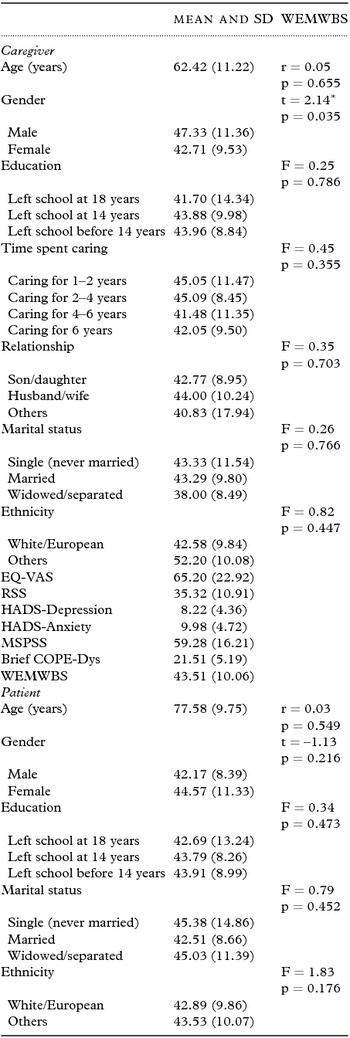
Descriptive statistics (mean and standard deviation) calculated for all variables for both patients and caregivers are presented in Table 1. Among the demographic variables, gender of family carer was associated with self-reported levels of mental well-being, where male caregivers reported higher scores on the WEMWBS compared to females. Separate ANOVAs investigated the relationship between caregiver and patient characteristics and caregiver WEMWBS scores. These analyses showed that WEMWBS scores did not differ by education, ethnicity, and marital status characteristics of carers and people with dementia. Time spent caring and type of caregiving relationship were not associated with self-reported positive well-being in carers (see Table 1).
WEMWBS scores and demographic characteristics

Notes. EQ-VAS: EQ-Visual Analogue Scale (EuroQoL, Reference Fava, Rafanelli, Conti and Grandi1990); RSS: The Relative's Stress Scale (Greene et al., Reference Hooker, Monahan, Shifren and Hutchinson1982); HADS: The Hospital Anxiety and Depression Scale (Zigmond and Snaith, Reference Zigmond and Snaith1983); MSPSS: Multidimensional Scale of Perceived Social Support (Zimet et al., Reference Zimet, Dahlem, Zimet and Farley1988); Brief COPE-Dys, Coping Orientations to Problems Experienced Scale (Carver, Reference Carver and Scheier1997); WEMWBS, The Warwick–Edinburgh Mental Well-Being Scale (Tennant et al., Reference Tennant2007).
*p < 0.05.
Correlations between WEMWBS and predictor variables
Well-being was negatively associated with stress specific to caregiving (r = 0.63, p < 0.001), anxiety (r = 0.53, p < 0.001), depression (r = 0.50, p < 0.001), and use of dysfunctional coping strategies (r = 0.51, p < 0.001). Higher scores on the WEMWBS were associated with higher levels of self-reported physical health (r = 0.63, p < 0.001), and social support in carers (r = 0.39, p < 0.01).
Regression analyses
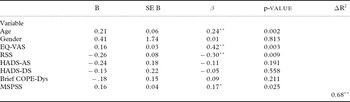
All independent variables were simultaneously entered in the regression model. Scores on the WEMWBS were entered as the dependent variable, but age, gender, physical health (EQ-VAS), stress specific to caregiving (RSS), anxiety (HADS-AS), depression (HADS-DS), dysfunctional coping (Brief COPE-Dys), and social support (MSPSS) were entered as independent variables. This analysis showed that almost 70% of the variance in caregiver well-being was accounted for by the variables entered, F(8,163) = 19.89, p < 0.001. Age of carer, physical health, stress specific to caregiving, and levels of social support made an independent contribution in predicting WEMWBS scores. These results can be seen in Table 2.
Age, gender, dysfunctional coping, physical health, anxiety, depression, social support, and carer stress predicting carer mental well-being

Note. WEMWBS: The Warwick–Edinburgh Mental Well-Being Scale (Tennant et al., Reference Tennant2007); EQ-VAS: EQ-Visual Analogue Scale (EuroQoL, Reference Fava, Rafanelli, Conti and Grandi1990); RSS: The Relative's Stress Scale (Greene et al., Reference Hooker, Monahan, Shifren and Hutchinson1982); HADS: The Hospital Anxiety and Depression Scale (Zigmond and Snaith, Reference Zigmond and Snaith1983); Brief COPE-Dys: Coping Orientations to Problems Experienced Scale (Carver, Reference Carver and Scheier1997); MSPSS: Multidimensional Scale of Perceived Social Support (Zimet et al., Reference Zimet, Dahlem, Zimet and Farley1988).
*p < 0.05; **p < 0.01.
Discussion
Past studies have suggested that caregivers commonly face chronic, profound, and complicated stress associated with caregiving, which affects their mental and physical health both directly and indirectly (Kiecolt-Glaser et al., Reference Maheswaran, Weich, Powell and Stewart-Brown1991; Hooker et al., Reference Hulme, Long, Kneafsey and Reid1992). The present study is the first to use the WEMWBS in measuring well-being in family carers of people with dementia. Results showed that the scale is useful in predicting psychosocial outcomes in carers of people with dementia. Moreover, our results indicate that mental well-being as measured by the WEMWBS is associated with demographic characteristics of carers such as gender. In line with our hypotheses we found that mental well-being was higher in male caregivers in comparison to females. As in previous studies reporting gender differences in mental well-being, in the present study males reported higher scores on the WEMWBS compared to women, consistent with the original study evaluating the WEMWBS (Tennant et al., Reference Tennant2007) and the general literature reporting gender differences in subjective well-being (Pinquart and Sorensen, Reference Proctor, Martin and Hewison2001; Cummins et al., Reference Davidson2003).
Current findings add to previous research by demonstrating that carers who report high levels of mental well-being are less likely to experience high levels of anxiety and depressive symptoms, are less likely to use dysfunctional coping strategies, and experience high levels of caregiver burden (Cooper et al., Reference Cummins, Eckersley, Pallant, van Vugt and Misajon2008). The results of the present study showed that age, physical health, stress specific to caregiving, and levels of social support available to carers, explained incremental variance in carers’ well-being after controlling for caregiver's age, depression, anxiety, and use of dysfunctional coping. An important finding of the present study is that social support is an important coping resource for carers that can act as a protective factor from experiencing decreased well-being, in line with theoretical models positing that social support is a mediator of stress in carers (Pearlin et al., Reference Pinquart and Sorensen1990). Current findings indicate that the WEMWBS is a useful measure for quantifying positive mental health in caregiving research, covering the majority of the range of concepts associated with positive mental health, including both hedonic and eudemonic aspects, positive affect, satisfying interpersonal relationships, and positive functioning.
Many studies have described which individual patient and caregiver characteristics may predispose caregivers to high levels of stress. The present study shows that anxiety and depressive symptoms are strongly related to mental well-being; however physical health and social support available to family carers may be powerful determinants of caregiver well-being. The present results showed that social support plays an important role in promoting carers’ well-being. So although they experience caregiving as a strenuous event, social support may allow them to positively cope with stressful situations associated with caregiving, and therefore do not experience decreases in their mental health. A significant implication of current findings is that carers reporting lower scores in the WEMWBS and decreased well-being are also less likely to experience good physical health, and have access to limited support systems.
The present study provides preliminary evidence that the WEMWBS could be a suitable population measure for dementia carers, allowing researchers to adopt a multi-dimensional approach of subjective well-being (Ryff and Keyes, Reference Singleton, Bumpstead, O’Brien, Lee and Meltzer1995; Diener and Suh, Reference Doherty and Kartalova-O’Doherty1998). Unlike other commonly used measures of mental health, the WEMWBS did not show a ceiling effect in the present study, indicating that the measure may have potential for documenting overall improvements in population mental well-being. Confirmatory factor analysis supported the hypothesized one-factor solution, suggesting that WEMWBS measures a single underlying concept.
The promotion of emotional, social, and mental well-being in dementia caregivers is becoming a national priority in a number of countries. WEMWBS is one of the few solely positive single scales for measuring mental well-being and seems appropriate to use with this population. In addition to offering rigor for research and evaluation in public mental health, WEMWBS’ positive focus offers a developmental perspective, enabling identification of protective and promoting factors of caregivers’ well-being.
Limitations
It is significant to acknowledge the limitations of the present study. The high percentage of female participants is a limitation of external validity of our study. Validation studies with a general population sample and a greater sample size should be conducted. Although the present study offers preliminary data on the psychometric properties of the scale, we were not able to provide data on convergent validity. Larger studies should explore the suitability of WEMWBS, and its association with other positive measures of well-being in the literature. Due to the small and non-representative sample of family carers our results cannot be generalized to all populations of dementia caregivers, and we were unable to provide norms or data that could be helpful for screening purposes. Most carers and people with dementia were well educated, and measures of socioeconomic status were not included in the assessment. Social desirability was an issue not directly addressed in this research project; however previous studies show that the WEMWBS is less influenced by social desirability in comparison to other measures used in the literature (Tennant et al., Reference Tennant2007). Future studies could investigate whether WEMWBS scores at baseline can protect caregivers from depression, anxiety, and decreases in quality of life and to evaluate the sensitivity of the scale to change.
Conclusions
The challenges of caring for a family member with dementia can result in high levels of stress and psychological morbidity (Morris et al., Reference Noonan and Tennstedt1988). Developing a thorough understanding of the factors that determine positive mental health in dementia carers is an important priority for current research. Demand for instruments to monitor mental well-being in dementia caregivers and evaluate mental health promotion initiatives is growing. The present study has provided preliminary findings that the WEMWBS may be useful for identifying determinants of positive mental health in dementia caregivers. The associations of the WEMWBS scores with other standardized measures in the current study supports the usefulness of the scale as an overall indicator of well-being for carers of people with dementia. The present results although limited are complementary to previous tests of the validity of WEMWBS in general population samples. It will be important for future studies to test the instrument in larger and more diverse populations of family carers of people with dementia, including clinical settings where carers at risk of experiencing psychological distress could be identified.
Conflict of interest
None.
Description of authors’ roles
Vasiliki Orgeta and Martin Orrell designed the study and wrote the research proposal. Vasiliki Orgeta performed the literature searches and undertook the statistical analysis, and Elena Lo Sterzo contributed to data collection and writing parts of the manuscript. All authors contributed to and have approved the final manuscript.
Acknowledgments
Vasiliki Orgeta, Elena Lo Sterzo, and Martin Orrell would like to thank those who kindly volunteered to participate in the study.