I. Introduction
How do statute and common law interrelate? This fundamental question received scant attention in the field of employment law until the House of Lords' decision in Johnson Footnote 1 in 2001. Lord Hoffmann (joined by three others) established the “Johnson exclusion zone” where common law claims based on a breach of the implied term of mutual trust and confidence were pre-empted by the statutory claim for unfair dismissal. This controversial decision has attracted serious criticism and precipitated two further House of Lords' decisions in Dunnachie Footnote 2 and Eastwood and McCabe,Footnote 3 The issue was considered again in Edwards v Chesterfield Royal Hospital N.H.S. Foundation Trust,Footnote 4 by a seven-justice Supreme Court. In Edwards the majority extended the Johnson exclusion zone to express contractual disciplinary procedures. Further, they endorsed Lord Hoffmann's obiter remarks that one express term (the notice clause) should be prioritised over another (the contractual disciplinary procedure). Edwards is therefore the latest decision in this line of case law to raise issues of both fundamental constitutional and contractual importance.
The aim of this article is to use Edwards as a prism through which to examine these two issues. We shall argue that the idea of statutory “trumping” of the common law, while at first sight appealing from the perspective of democratic legitimacy, in fact misunderstands the complex evolution of the common law in this field and its interplay with statute (section II). We shall also argue that the traditional pre-eminence given by the common law to the notice clause over all other express terms in the contract needs to be reconsidered in the light of the statutory developments, particularly in the field of unfair dismissal (section III). Section IV concludes.
II. The Relationship Between Statute and Common Law
A. Different Approaches to the Relationship between Statute and Common Law
While statute and case law are distinct sources of English law “they interact in significant ways”.Footnote 5 The literature identifies a spectrum. At one end of the spectrum lie situations where the two work together in what Atiyah describes as a “legislative-judicial partnership”.Footnote 6 He refers to statutes which have deliberately adopted open-textured language and “thereby delegated to the courts the responsibility for creative development of case law”. He gives the example of the old Workman's Compensation Acts and their formula about accidents arising “out of and in the course of employment”. The content of this formula is left to be worked out by the judges. In employment law more generally there is often such a symbiotic relationship between statute and common law. Take, for example, dismissal law. As we shall see below, the statutory protection against unfair dismissal is conditional on an individual being an employee. Section 203 ERA 1996 defines “employee” as a person with a “contract of employment”, a notion which is elaborated by the common law. In this situation both statute and common law have a role to play; neither one nor the other takes precedence.Footnote 7
At the other end of the spectrum lies the situation where statute has expressly intervened to alter the common law position. In this case – what we shall term “full pre-emption” – it is wholly justifiable that statute should prevail and pre-empt the common law. This approach can be justified on the grounds of protecting the supremacy of the democratically elected Parliament over the unelected judiciary. Indeed, sometimes a statute expressly states that its rules take precedence over the common law.Footnote 8
However, most cases inevitably lie somewhere between these two extremes and the question of whether it can be implied that the common law is replaced, or further development of the common law prevented, because of statutory intervention, is much more difficult. The starting point is often said to be the “intention of Parliament”. Many have pointed out the problems inherent in this notion,Footnote 9 and it clearly cannot mean the subjective intentions of the members of Parliament at the relevant time. However, if what is meant is that the court must start by considering the proper construction of the statute, we agree. In construing a contract, while in broad terms the court is seeking to implement the intention of the parties, it is clear that it is objective, not subjective, intention which is crucial and that the court must construe the words used in the context of the broader factual matrix.Footnote 10 Similarly, construing the relevant statutory provision will require the court to take into account a number of factors including the common law context, developments in the common law and statute and, increasingly, the presumed intention behind the legislation, as derived from the legislative history.Footnote 11
In Johnson, Lord Nicholls said that the crucial consideration was whether the alleged common law right could “satisfactorily co-exist” with the statutory regime”.Footnote 12 That would not be the case if the alleged common law right undermined or contradicted the statutory regime or if the two could not in practice co-exist in the same sphere.Footnote 13 Cross gives the example of areas such as planning and childcare where statute law has been treated as a comprehensive “code” replacing the common law, thereby preventing the intervention of common law principles unless expressly authorised by Parliament.Footnote 14 Similarly, the courts have rejected any attempt to superimpose equitable principles (either through specific performance or equitable assignment) to avoid the rules regulating the passing of property laid down in the Sale of Goods Act 1893. The Sale of Goods Act was passed at a time when the principles of equity and equitable remedies were recognised and given effect to in all courts, and the total sum of legal relations arising out of the contract for the sale of goods may well be regarded as defined by the code.Footnote 15 However, in the context of employment law, we do not believe that it can be argued that statute has intended to provide a comprehensive code to deal with all aspects arising from the employment relationship;Footnote 16 on the contrary – many writers continue to see the contract as the cornerstone of the employment relationship.Footnote 17
More difficult are cases where the courts have reasoned that allowing a common law right to be relied on is inconsistent with Parliament's intention in enacting a statute in a certain way.Footnote 18 An example can be drawn from the relationship between statutory and common law nuisance. At common law, any person who by any act endangers the public commits a common law offence known as public nuisance.Footnote 19 However, there are now statutory provisions which impose criminal penalties in many areas affecting public health and comfort. Indeed, the most typical and obvious causes of public nuisance, including, nuisance caused by smoke, animals, noise, pollution of water, obstruction of the highway, harassment, raves, bomb hoaxes and sending noxious substances in the post, are now the subject of express statutory provisions. Those statutory offences are subject to specific time limits and maximum penalties.
In R v Rimmington Footnote 20 one of the appellants had sent a large number of packages containing racist material to members of the public, and the other had posted an envelope containing salt to a friend as a practical joke which backfired when some escaped in a post sorting office causing an anthrax scare. The evidence was that some of the conduct complained of would have fallen within the scope of various statutory provisions, but that the Crown had chosen to charge each of the defendants with the common law offence because it was out of time to prosecute under the statute and it was felt that the conduct involved warranted a greater penalty than available under statute. Although when Parliament enacted the statutory offences it did not expressly abolish the corresponding aspect of the common law offence, Lord Bingham held that “where Parliament has defined the ingredients of an offence, perhaps stipulating what shall and shall not be a defence, and has prescribed a mode of trial and maximum penalty, it must ordinarily be proper that conduct falling within that definition should be prosecuted for the statutory offence and not for a common law offence which may or may not provide the same defences and for which the penalty is unlimited”.Footnote 21 He continued “good practice and respect for the primacy of statute do in my judgment require that conduct falling within the terms of a specific statutory provision should be prosecuted under that provision unless there is good reason for doing otherwise”.Footnote 22
Thus, it is not proper to rely on the common law to avoid time limits or a maximum penalty imposed in relation to a statutory offence. In D.P.P. v Fearon Footnote 23 it was suggested by the Divisional Court that the principle in R v Rimmington applied more widely. In that case, the Crown had tried to rely on the common law offence in the case of a defendant who attempted a single act of solicitation (in an area well known for prostitution). Certain acts of solicitation were rendered unlawful by statute, including kerb crawling and persistent solicitation. But the conduct did not fall within any of those offences. It was held that there was insufficient public conduct to amount to the common law offence, but Elias L.J. added obiter:
… in my judgment, the appeal arguably fails for another reason also … . As Lord Bingham held in Rimmington it will rarely be appropriate to prosecute for this common law offence where it falls within the terms of a specific statutory provision. … s.2 of the Sexual Offences Act 1985 provides the conduct of this nature is only unlawful where it is persistent. It would certainly circumvent that limitation if the argument were correct, albeit that it would only do so in a vice area, however that is defined. One would then also be left with the curious situation that the conduct of persistent solicitation would attract a limited penalty whereas the single act of solicitation, being a crime under the common law offence of public nuisance, would attract if tried on indictment a sentence at the discretion of the court.Footnote 24
We see from these examples that development of the common law will be curtailed where, given the intention to legislate in a certain way in a particular area, the common law is being used to circumvent Parliament's intention. This may be the case if an attempt is being made to avoid a time limit or maximum penalty or to apply different rules or principles to an area meant to be completely codified. However, common law development is only precluded where such a conflict exists. Thus, there is nothing in the reasoning in either Rimmington or Fearon to suggest that the fact that Parliament had chosen to create statutory offences in certain areas, eg nuisance caused by animals or smoke, prevented common law nuisance applying in an area with no statutory intervention at all (although it was clear that the judges found it hard to think of any examples which were not covered). We shall call this situation “partial pre-emption” (although we are aware that this terminology risks creating confusion rather than clarity since, even in the case of full pre-emption, in areas outside the occupied field the common law will apply).
British Railways Board v Herrington Footnote 25 provides a good example of partial pre-emption. The Occupiers' Liability Act 1957 imposed duties on occupiers of premises to lawful visitors. At common law it had previously been held that no duty was owed to trespassers. It was argued that if Parliament had wanted to reverse the common law position in relation to trespassers it would have done so in the Act. Thus, the essence of the argument was that the Act fully occupied the field and common law could not continue to develop. The House of Lords rejected this and imposed a common law duty. Lord Wilberforce expressly dealt with, and rejected, the arguments based on full pre-emption:
“[I] can see no sense in supposing that when Parliament left the law alone as regards trespassers the intention was to freeze the law as, or as it was taken to be, in 1929. As this Act itself shows, what Parliament left alone in the case of trespassers, while displacing them in the cases of invitees or licensees, were the rules of common law. But the common law is a developing entity as the judges develop it, and so long as we follow the well tried method of moving forward in accordance with principle as fresh facts emerge and changes in society occur, we are surely doing what Parliament intends we should do”.Footnote 26
In other words, statute only partially occupied the field.
Similarly, in Thai Trading Co v Taylor Footnote 27 the question was raised whether an agreement between solicitor and client, that he would only charge if the claim succeeded, was contrary to public policy. The Court held not. The policy was formed in an age when litigation was regarded as an evil to be discouraged. Current attitudes were explained by Courts and Legal Services Act 1990 which validated certain forms of conditional fee agreements. Beatson refers to the fact that
It might be thought that the carefully crafted legislative scheme of the 1990 Act and Regulations made under it show and define the extent to which Parliament has decided to make such agreements enforceable, so that this example of judicial guidance from statute is illegitimate. But it is arguable that the progressive narrowing by the courts of this head of public policy during the last half century meant that if Parliament wished to freeze further common law development it had to do so more directly.Footnote 28
Likewise, in the field of employment law, common law, and in particular the implied term of mutual trust and confidence, has filled gaps in the now detailed web of statutory employment protection. So in Mahmud Footnote 29 the House of Lords ruled that “stigma” damages could be awarded to an individual who found it difficult to find a new job as a result of his prior employment with an employer, BCCI, which had run a “dishonest and corrupt” business in breach of the implied term of mutual trust and confidence. Once again the common law protection is playing a separate role to the statute; neither one nor the other prevails. At no stage has it been argued that since statute has not regulated this area of stigma damages then common law should not trespass on this domain. This is an example of partial pre-emption: the common law is able to continue developing so long as it does not contradict or undermine the statutory regime.
By contrast, the effect of the argument relied on by the majority in Johnson was that the common law could not develop to extend an analogous right to protection against unfair dismissal to workers when the statutory regime deliberately gave rights to employees only, since such a development would contradict the statute which deliberately places limits on a range of issues including who can claim (employees), the period of service required before a claim can be brought (usually two years), the forum for that claim (the Employment Tribunal) and the amount of compensation that can be paid (a basic and a compensatory award subject to strict statutory limits).Footnote 30 Further, if the common law were to adopt an analogous right for workers to claim unfair dismissal they would not be subject to the statutory cap. Using Elias L.J.'s language in Fearon, this would create a “curious situation”.
It can therefore be argued that the establishment of the Johnson exclusion zone is compatible with the principles on the interface between the statute and common law developed in Rimmington and Fearon (even though these cases were not cited). We now turn to examine Johnson in more detail.
B. The Establishment of the Johnson Exclusion Area
Mr Johnson was summarily dismissed following allegations of misconduct. An industrial tribunal upheld his complaint of unfair dismissal and awarded him compensation of £11,691.88 based on the statutory maximum in place for such claims.Footnote 31 However, Johnson argued that he had suffered a psychiatric illness as a result of his dismissal and that the damages awarded did not reflect the true measure of his loss of earnings which he calculated to be more than £400,000. He therefore instituted proceedings in the County Court for breach of an implied term in his contract that his employers would not without reasonable and proper cause conduct themselves in such a way as to damage the relationship of trust and confidence between the parties.
The majority of the House of Lords (Lords Bingham, Nicholls, Hoffmann and Millett) rejected his argument because of the existence of the right to claim for unfair dismissal in the Employment Rights Act 1996 which, they argued, effectively pre-empted his right to claim at common law.Footnote 32 Lord Steyn dismissed the claim on the narrower ground of remoteness.
The basis for the majority's decision was that to imply the term argued for would circumvent or be inconsistent with legislative intent. In summary: “a common law right embracing the manner in which an employee is dismissed cannot satisfactorily coexist with the statutory right not to be unfairly dismissed”.Footnote 33 The principle was formulated in various ways but, in essence, the argument ran as follows. At common law there was no right not to be unfairly dismissed; an employer was free to dismiss without cause and without following any particular procedure. As views about the nature of the employment relationship developed, this position was felt to be unsatisfactory.Footnote 34 Parliament intervened in the Industrial Relations Act 1971 (now Part X of the ERA 1996Footnote 35) by creating the right not to be unfairly dismissed.Footnote 36 The Act's concept of unfairness extends to both the substantive reason for dismissal and the procedure adopted. Parliament was silent as to whether the statute was intended to replace the common law (pre-emption) or supplement it (co-existence). This parliamentary silence enabled the judges to choose which way to read Part X ERA 1996. They opted for pre-emption.
Given the existence of the statutory regime, the majority in Johnson took the view that “a newly developed common law right …., covering the same ground as the statutory right, would fly in the face of the limits which Parliament has already prescribed on matters such as the classes of employees who have the benefit of the statutory right, the amount of compensation payable and the short time limits for making claims.”Footnote 37 To put it another way, the creation of the statutory right to claim for unfair dismissal made any development of the common law implied term of mutual trust and confidenceFootnote 38 in the context of dismissal unnecessary and undesirable since it would give the claimant a second bite of the cherry.Footnote 39 In most cases (as on the facts in Johnson) such a common law claim would replicate a statutory right and it would therefore be unnecessary to imply a term. In other cases, for example, where the claim was made by an employee in an excluded category or without the minimum required service, it would be inconsistent with the declared policy of Parliament.Footnote 40
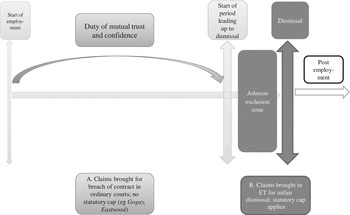
In Eastwood v Magnox (joined with the appeal in McCabe v Cornwall County Council)Footnote 41 the House of Lords implicitly recognised that Parliament had intervened only in a limited field. Lord Nicholls, giving the leading speech, explained that the statutory code provides remedies for infringement of the statutory right not to be dismissed unfairly. This, he said, included, in the ordinary course, an employer's failure to act fairly in the steps leading up to dismissal since the unfairness in the pre-dismissal behaviour does not, of itself, cause the employee financial loss; the loss arises when the employee is dismissed. In these circumstances the resultant claim for loss falls squarely within the Johnson exclusion zone and the remedy is confined to the statutory claim. By contrast, he said, a common law action lies if, before his dismissal, whether actual or constructive, an employee has acquired a cause of action at law, for breach of contract or otherwise.Footnote 42 This was the situation in Mahmud where, as described, the House of Lords allowed a claim for stigma damages by former employees of BCCI. However, Lord Nicholls continued that exceptionally, financial loss might also flow from an employer's failure to act fairly in the steps which may lead to dismissal. Financial loss, albeit for psychiatric harm, flowing from suspension is one instance (Gogay Footnote 43); financial loss from psychiatric or other illness caused by pre-dismissal unfair treatment is another (as on the facts in Eastwood and McCabe). He said that a cause of action which precedes, and is independent of, the subsequent dismissal, remains unimpaired by the employee's subsequent unfair dismissal and the statutory rights that flow therefrom. In this case there will be a common law action in respect of the earlier breach before the ordinary courts (see A on Fig 1). In respect of the subsequent dismissal, the employee may also present a claim to an employment tribunal (see B on Fig. 1). However, if he brings proceedings in both a court and a tribunal he cannot recover any overlapping heads of loss twice over.
The effect of the decisions in Johnson and Eastwood

As Lord Nicholls himself recognised, the ruling in Eastwood creates a number of anomalies and difficulties in demarcation. The first and most obvious drawback is that in such cases the division of remedial jurisdiction between the court and an employment tribunal will lead to a duplication of proceedings, with an attendant waste of resources and costs. Secondly, he said, the existence of this boundary line means that in “some cases a continuing course of conduct, typically a disciplinary process followed by dismissal, may have to be chopped artificially into separate pieces” (with the incentive on the employee to shoehorn the facts into period A on Fig 1), with the loss flowing from the impugned conduct taking place before actual or constructive dismissal lying outside the Johnson exclusion area, and the loss flowing from the dismissal itself within that area. Thirdly, he said, the existence of this boundary line produces other strange results. An employer may be better off dismissing an employee than suspending him. A statutory claim for unfair dismissal would be subject to the statutory cap, a common law claim for unfair suspension would not.
These anomalies are not the only source of criticism. To many labour lawyers the result in Johnson sticks in the craw. It has the effect of limiting the protection for employees; Footnote 44 it “greatly” diminishes the law on the implied term of mutual trust and confidence; Footnote 45 it turns the statutory protection against unfair dismissal into a ceiling not a floor, and it assumes that the statute fully pre-empted the common law when the legislative history is at best moot on this point.Footnote 46 Nevertheless, we do broadly accept the basic premise that since Parliament has spoken in the area of unfair dismissal, common law implied terms should not be used to circumvent those limits. If the limits cause injustice then it is for Parliament to increase those limits.Footnote 47
It has been argued that there is no reason why the statutory regime of unfair dismissal should preclude common law development in respect of wrongful dismissal given the different meaning of those concepts.Footnote 48 As explained in section C below, we think this is a powerful argument in the case of express contractual terms. However, we accept that the position may be different in relation to the implied duty of trust and confidence. This is a term implied in law into every employment contract, not a term implied in fact on the basis of the intention of the particular parties. Terms implied in fact are terms which are “not expressly set out in the contract, but which it is found that the parties must have intended to include”.Footnote 49 The effect of adding such terms is simply to formally express what was already the agreed intention of the parties. However, terms implied by law, including the implied term of trust and confidence, are different. “[T]here is a presumption that they are included in all contracts of service, as “necessary incident[s] of a definable category of contractual relationships.”Footnote 50 Terms implied by law do not depend on the inference that the parties intended to incorporate such a term into their agreement, rather “the courts are guided by general policy considerations affecting the type of contract in question” and will take into account considerations of reasonableness, fairness and justice.Footnote 51 In deciding whether to imply in law a term of trust and confidence, it is right that the courts should strive not to come to a different answer on those policy considerations than that already reached by Parliament if legislation exists in the same area.Footnote 52
In other words, the issue of whether to imply a term of trust and confidence does overlap in a significant way with the considerations relevant to the remedies for unfair dismissal which Parliament has legislated are necessary incidents of certain employment contracts. Allowing a common law claim in circumstances precisely covered by the legislation solely to avoid the statutory cap might well undermine the statutory regime. The situation is broadly analogous to that in Rimmington in relation to common law nuisance. Had the House of Lords ruled otherwise, there is a good chance that Parliament would have intervened anyway to stop the evolution and perhaps do more profound damage to the law of unfair dismissal at the same time.
Thus, while we broadly accept the policy arguments underpinning Johnson concerning the use of implied terms to circumvent statutory limits, the issue in Edwards and Botham was whether the principle of parliamentary supremacy and pre-emption extended beyond the facts of Johnson to cover breach of express contractual terms. The majority in the Supreme Court in Edwards and Botham thought it did. We disagree.
C. Edwards and Botham: The Applicability of the Johnson Exclusion Zone to Express Contractual Terms
Mr Edwards was a consultant surgeon whose contract of employment contained terms setting out procedures to be followed in the case of disciplinary proceedings. A complaint was made against Edwards and, following a disciplinary hearing, he was summarily dismissed. He issued proceedings in the High Court for damages for breach of his employment contract and its wrongful termination. He alleged, inter alia, that the disciplinary panel had not been properly constituted and that he had been denied a fair hearing which led to them reaching erroneous conclusions. The Court of Appeal allowed his claim for damages for loss of reputation arising from the decision of the panel.
Mr Botham was a youth worker whose contract also contained contractual requirements concerning any disciplinary proceedings. An allegation was made against Botham of inappropriate conduct against two teenage girls and following a disciplinary hearing he was summarily dismissed and placed on a list of persons deemed unsuitable to work with children. He succeeded in a claim for unfair dismissal and subsequently issued proceedings in the High Court for damages for breach of express terms of his employment contract including a claim for loss of future earnings which was allowed by the Court of Appeal. Appeals against the decisions in Edwards and Botham were heard together by the Supreme Court.
The majority of the Supreme Court allowed the appeals and rejected the claims. Lord Dyson (with whom Lords Walker and Mance agreed) argued that, given the link made by Parliament between failure to comply with disciplinary or dismissal procedures with the outcome of unfair dismissal proceedings, where “provisions about disciplinary procedure are incorporated as express terms into an employment contract, they are not ordinary contractual terms agreed by parties to a contract in the usual way”.Footnote 53 In reaching this conclusion he expressly endorsed the most controversial aspect of Lord Hoffmann's speech in Johnson where Lord Hoffmann said at paragraph 66 that disciplinary procedures cannot have been intended “to qualify the employer's common law power to dismiss without cause on giving such notice, or to create contractual duties which are independently actionable”. However, as Moore-Bick L.J. said in Edwards in the Court of Appeal, no express terms had been relied on in Johnson and Lord Hoffmann's remarks “although entitled to respect, are clearly obiter and not binding on us”.Footnote 54 Nevertheless, Lord Dyson in the Supreme Court concluded that Parliament has specified the consequences of a failure to comply with disciplinary procedures in unfair dismissal proceedings. He continued that
It is necessarily to be inferred from this statutory background that, unless they expressly agree, the parties to an employment contract do not intend that a failure to comply with contractually binding disciplinary procedures will give rise to a common law claim for damages.Footnote 55
Referring to Parliamentary intention, he said that Parliament did not intend that an employee could choose to pursue his complaint of unfair dismissal in the ordinary courts, free from the limitations carefully crafted by Parliament for the exercise of this statutory jurisdiction”Footnote 56 and so “the reasoning in Johnson is a bar to a claim for damages for breach of an express term of an employment contract as to the manner of dismissal”.Footnote 57
Lord Phillips found Lord Hoffmann's, and now Lord Dyson's, approach based on the intention of parliament “somewhat artificial”. He took a different line based on remoteness of damage which we consider below. Lord Mance added that if the wrongful or unfair dismissal is to be attributed causatively to the prior failure to take proper disciplinary steps, “I find it difficult to see why or how the damages recoverable for the prior failure should or could exceed the compensation recoverable for the later dismissal”.Footnote 58 He thought that the disciplinary proceedings and the dismissal were all part of “single process” and that the remedy for any unjustified stigma lies “in the restoration of reputation which may in the ordinary course be expected to result from a successful claim for wrongful or unfair dismissal”.Footnote 59
We disagree with the Supreme Court's reading of Johnson. The crucial difference between the claimants in Edwards and Mr Johnson was that the Edwards claimants had the benefit of, and were relying on, breaches of express terms of their contracts of employment, a point forcefully noted by Moore-Bick L.J. in Edwards in the Court of Appeal.Footnote 60 In contract law generally the distinction between express and implied contractual terms is not crucial in the sense that once a term has been implied it will have the same effect as any other express contractual provision. However, in the context of the legislative constraint argument, the distinction is crucial because the analysis begins at the earlier stage of whether such a term should be implied at all. Furthermore, there is also a difference in this respect between terms implied in law and terms implied in fact. As explained above, terms implied by law do not depend on the inference that the parties intended to incorporate such a term into their agreement; rather they apply as a necessary incident of all employment contracts which means that the issue of whether to imply a term of trust and confidence does overlap in a significant way with the considerations relevant to the remedies for unfair dismissal. However, we agree with the Court of Appeal that the legislative constraint argument relied on in Johnson should not apply in the case of express contractual terms. As outlined above, the starting point for the reasoning in Johnson was that Parliament had intervened and altered the common law position by giving limited statutory protection against unfair dismissal to certain employees. A common law claim based on a term implied in law could not be allowed to undermine that statutory regime.
However, an employee with the benefit of an express contractual term does not need to rely on the statutory regime. There is therefore no inconsistency or circumvention of statutory intent if such an employee is not covered by the limits on the statutory right to claim for unfair dismissal because he or she is relying on a right of a completely different nature.Footnote 61 In other words, statute has pre-empted the common law in respect of the narrow field in which it operates (partial pre-emption); it does not oust the common law in all matters somehow connected to dismissal (full pre-emption). This is one way of construing Lord Nicholls' approach in Eastwood and it is certainly the view of Lady Hale (in the minority) in Edwards:
There is no reason at all to suppose that, in enacting the Industrial Relations Act 1971, Parliament intended to cut down upon or reduce the remedies available to employees whose employers acted in breach of their contracts of employment. Quite the reverse. Parliament intended to create a new statutory remedy for unfair dismissal which would supplement whatever rights the employee already had under his contract of employment.Footnote 62
In other words she, and Lord Kerr,Footnote 63 suggested that the 1971 Act was intended to supplement the rights of individuals and not supplant them (reflecting the traditional view that statute is a floor of rights not a ceiling). She continued that:
We have seen how the “Johnson exclusion area” has been productive of anomalies and difficulties. For this reason alone, it should not be extended further than the ratio of the case. The Court of Appeal recognised this in Edwards: the Johnson exclusion zone should be limited to the consequences of dismissal in breach of the implied term of trust and confidence. The House of Lords was persuaded that the common law implied term, developed for a different purpose, should not be extended to cover the territory which Parliament had occupied….. There was and is nothing to suggest that Parliament intended to limit the entitlement of those few employees who did and do have a contractual right to the job, the right not to be dismissed without cause. It is for that reason that I am afraid that I cannot agree that the key distinction is between the consequences of dismissal and the consequences of other breaches. The key distinction must be between cases which must rely on the implied term to complain about the dismissal and cases which can rely on an express term.Footnote 64
We would agree with Lady Hale that the Johnson exclusion zone is not about damages for dismissal generally: rather it concerns the specific question of whether an implied term of trust and confidence can be imposed,Footnote 65 that is, the demarcation between Mahmud which confirms such terms generally and Johnson where such a term was not implied. If the claimant can rely on an express contractual term this demarcation is irrelevant. And this would certainly be the view on the Continent where mandatory statutory standards prevail over contractual ones but only in an upwards direction.Footnote 66 In other words, protective labour regulation could never pre-empt more protective express contractual provisions.
For these reasons we think the majority's approach in its application of Johnson is incorrect. Further, we would argue, the implications of the majority's approach are serious. We wish to highlight two particular problems. First, taken to its logical conclusion, it would effectively mean that as soon as Parliament legislated in any employment area, common law would be ousted. So, for example, the existence of the Health and Safety at Work Act 1974 or the Protection against Harassment Act 1997 would pre-empt any development of the common law in these areas. Co-existence would cease. So far this has not been, and in our view, should not be the case.Footnote 67 Further, if the individual, blocked from bringing a claim to enforce his or her rights under the contract, tries to bring alternative claims (e.g. for defamationFootnote 68), leaving aside the problems associated with a proliferation of litigation, the logical corollary of the majority's argument is that these claims should also be barred.
Second, the majority's approach would create (further) anomalies. Consider the situation of an individual who does not qualify for unfair dismissal protection under the ERA 1996, either because he or she is not a relevant type of employee (eg a worker or an office holder such as a master of an Oxbridge college) or he or she has not worked for the statutory minimum period. If his or her employment contract is expressly said not to be terminable without cause (as is the case with many university teachers), the majority's approach in Edwards would say that this clause is pre-empted by the ERA 1996 and so cannot be enforced by the individual, even though the effect of the ERA 1996 is to exclude the individual from bringing a claim, the very situation which the contractual term is intended to address.
In conclusion, while we recognise the attempt in Johnson to reconcile the competing interests of the individual litigant on the one hand and society as a whole, as expressed by the will of Parliament, we think that for the reasons outlined above Johnson should have been confined to the situation of implied terms and not extended to cover express terms as well. That said, we do recognise that terms relating to disciplinary procedures may raise difficult considerations, not because of the Johnson exclusion area, but rather because of other contractual principles or limitations. This, and the relationship between an express disciplinary procedure and an express notice clause, will be considered in the next section.
III. The Measure of Damages for Claims for Wrongful Dismissal
A. The General Rules on Damages for Wrongful Dismissal and the Notice Period
Assuming that the minority in Edwards was right (as we would argue), what measure of damages could Mr Edwards have expected: an amount covering pay and other benefits until retirement (which in Mr Edwards' case would have amounted to about £3 million pounds) or simply his pay for the notice period plus a so-called Gunton extension (the pay for the period it would have taken to carry out the disciplinary procedure), as Nicol J. had awarded in the High Court?
Traditionally, notice provisions have trumped all other contractual terms in assessing damages for wrongful dismissal, as Nicol J. assumed in Edwards. It is possible to explain this in a number of ways. If an employee has no contractual job security beyond the notice period, he or she can have no right to claim for loss of earnings in excess of that period. Alternatively, in terms of the assessment damages, damages are calculated on the basis that the contract breaker performs in the least onerous way to himself.Footnote 69 According to this principle, where the defendant has the option of performing the contract in various ways, damages must be assessed on the assumption that he will perform it in the way least burdensome to himself.Footnote 70 Applying this to claims for wrongful dismissal, if an employee can be dismissed with notice without giving or establishing any reason for the dismissal, damages for wrongful dismissal are limited to the earnings during that notice period because it is assumed that the employer would exercise his unfettered right to terminate by giving notice.
However, although precedence is generally given to notice provisions in the assessment of damages, there will be cases when damages for loss of future earnings will prima facie be available in a claim for wrongful dismissal, damages for termination of a fixed term contract being a good example. In Manchester City Football Club plc v Joe Royal Footnote 71 a football manager was employed for a fixed period of four years. The contract made provision for termination on certain grounds, none of which applied. It also provided (clause 14.3) that in the event of termination prior to expiry of the fixed term, the manager should be paid a sum equal to 12 months of his basic salary if the team was in the Premier League and a sum of 6 months basic salary if in the First Division. Describing the purpose of this clause, Smith L.J. held:
In my view, it is unfortunate that, at the hearing in the Court below, neither party invited the Judge to consider the purpose of Clause 14.3 and the parallels which can be drawn between the structure of the compensation provisions in the contract and the way in which damages for breach of an employment contract are assessed at common law. At common law, the important criteria for assessment are the earnings that the employee would have earned but for the breach and the difficulty that he or she will have in replacing those lost earnings by other employment. It seems clear to us that clause 14.3 was intended to provide a proxy for a common law assessment. If the manager were in charge of a Club in the Premier League, he would lose higher earnings and would find it more difficult to replace his earnings than if he were the manager of a First Division Club. We think that this is what the parties had in mind when agreeing Clause 14.3.Footnote 72
On that basis, because the team had been relegated for the following season (even though the formalities had not yet been completed) and thus the manager's salary would have been lower, compensation was payable at the lower rate to reflect the loss of earnings for the remainder of the four year period.Footnote 73
There also seems to be no reason why damages should not be available for future loss of earnings in relation to contracts which contain an express term giving job security, such as those providing that an employee cannot be dismissed without good cause, and are thus not subject to notice provisions.Footnote 74 There are even examples of the court implying such job security without an express term.Footnote 75
However, one of the most difficult issues is when the existence of express terms guaranteeing disciplinary procedures will be construed as modifying or limiting the right of the employer to terminate on notice, and thus give an entitlement to damages for loss of earnings in excess of the notice period. In other words, how should courts construe a contract with agreed disciplinary procedures, but also a notice period. This is considered in Section B below, where we argue that the notice clause should not trump express contractual disciplinary procedures. However, if we are right on this point, this raises a further question as to how damages should be assessed for breach of such a contract. This raises issues of remoteness and causation, issues we consider in Section C below. Further, if, despite these problems, damages are available, how does this fit with the least onerous principle, considered in Section D?Footnote 76
B. The Construction of Express Terms Relating to Disciplinary Proceedings
The problem of reconciling contracts which couple a right to terminate on notice with a provision that if the employer wants to terminate on disciplinary grounds he must follow a prescribed procedure was recognised by Lady Hale in Edwards who argued the terms could be analysed in several ways.Footnote 77 The contract could mean that:
(1) the employee can be dismissed on notice for non-disciplinary grounds, but if the alleged grounds are disciplinary then the employer must follow the required procedures.
(2) if the employer wants to dismiss on disciplinary grounds it can do so only after following the prescribed procedure; but having done so it can then dismiss on notice regardless of the result of those proceedings.
(3) the employer can always dismiss on notice whether or not the procedure is followed.Footnote 78
Ultimately it will be a question of construction of the particular employment contract, although it is surprising that on a question of such practical importance there is no clear judicial guidance. The analysis in (3) seems to be the default position of common law – and Lord Hoffmann in Johnson in particular.Footnote 79 Yet, that construction deprives the clause laying down disciplinary procedures of all practical effect.
The analysis in (2) seems to be consistent with the decision of the Court of Appeal in Gunton. Footnote 80Gunton is seen as authority for the proposition that if an employee is dismissed without the employer going through the contractual disciplinary procedure the employee can recover damages for loss of earnings during the period required to carry out the disciplinary procedure (the so-called “Gunton extension”).Footnote 81 According to Moore-Bick L.J. in the Court of Appeal of Edwards, this “decision supports the conclusion that a term of that kind [relating to disciplinary procedure] has legal effect and is capable of sounding in damages.”Footnote 82 Lord Dyson disagreed. Gunton, he said, was “a claim for wrongful dismissal for purporting to terminate the contract on the basis of an invalid notice [ie that the employer could not dismiss on notice without first undertaking the disciplinary process properly].”Footnote 83 But how different is this from the facts in Edwards? Lord Mance is more upfront: “The extension [in Gunton] may be difficult to reconcile with Lord Hoffmann's view in Johnson, para 66 …”.Footnote 84 The majority in Edwards therefore also appear to favour option (3).
The result of following this third construction is that where it has been contractually agreed that the individual cannot be dismissed without the employer complying with the disciplinary procedure, the employer could merely snap its fingers at the substantive and procedural terms of the contract. Yes, the employer would be exposed to a wrongful dismissal claim for the notice period (the “Addis measure of damages”Footnote 85) and, perhaps, a Gunton extension, together with an unfair dismissal claim but, as has been seen, the damages for unfair dismissal are capped (and the average awards are far less: for 2010/11 it was £8924, with the median award being £4591).Footnote 86 In the case of highly paid employees or in the case of some academics where the just cause process is lengthy, dismissing on notice might be considerably cheaper for the employer. The majority of the Supreme Court in Edwards would retort that an injunction would be available in these circumstances (whose existence is not caught by the Johnson exclusion zone because it does not “cut across the statutory scheme for compensation and unfair dismissal”Footnote 87) and is likely to be granted since damages would not be an adequate remedy. Yet, this disregards the point of principle that Lady Hale and Lord Kerr make: how can an employee with a contractual right to a particular disciplinary process enforce that right in advance by injunction but not claim damages for its breach after the event.Footnote 88 Even if Lady Hale and Lord Kerr are wrong, there is a further issue, the case law on injunctions in the employment field traditionally requires that mutual trust and confidence be on-going.Footnote 89 Employers may well argue that there is in fact a breakdown in confidence which is why the contract has been terminated in the first place. Therefore no injunction would be granted.
It is for these reasons that we prefer option (1) of Lady Hale's three possibilities. Where a disciplinary matter is at stake (a matter to be determined in good faithFootnote 90), the employer must go through the express disciplinary procedure and cannot circumvent it simply by giving notice. In other words, the clause on disciplinary procedures does place substantive limits on the notice clause. This seems to be the view taken by Keene L.J. in Kaur v M.G. Rover Group:Footnote 91
In the present case it seems to me that, if paragraph 2.1 of The Way Ahead [which expressly provided that there would be no compulsory redundancies] is incorporated into the individual contract, it and the notice provision in condition 13 could be read together in a compatible way. There is no reason why the contract could not be read as providing the right for the appellant to terminate on the specified notice, except in a redundancy situation where the employee was unwilling to leave. It could be a somewhat strange end result, since in all other situations the appellant could terminate on notice without having any good reason and without the dismissal being wrongful as a breach of contract. … Therefore I do not accept that the notice provisions would prevail in the present case, if paragraph 2.1 of The Way Ahead is a term of the contract through incorporation.
There is no good reason why the notice clause should always prevail, apart from the common law legacy that employers can fire at will and capriciously if they so choose. The IRA 1971 was introduced to put an end to this. Moreover, the recent statutory reforms to the ERA 1996 would point towards prioritising the disciplinary clause over the notice clause. For example, the ill-fated Employment Act 2002 had as its express purpose the reduction in litigation through the use of disciplinary and grievance procedures (which were intended ultimately to have legal effectFootnote 92). If employers have disciplinary procedures and employees wish to rely on them, surely employers should not be able to circumvent them simply by giving notice. This is the flipside of Lord Hoffmann's arguments in paragraph 66 of Johnson and Lord Dyson's observations in Edwards. If this analysis is correct, then the logical corollary is that if a contractual disciplinary procedure must be respected then surely employees should be entitled to bring a claim in damages if employers have not followed their own disciplinary procedures correctly.
However, we accept that such claims raise a further set of issues about the measure of damages, remoteness and causation. In particular, although an employer cannot terminate for disciplinary reasons without going through the contractually agreed procedures this does not turn the contract into a contract for life.
C. Remoteness of Damage and Causation
The problems of remoteness and causation were flagged up by Lord Steyn in Johnson. Unlike the majority, he would have allowed the claimant a cause of action based on breach of the obligation of trust and confidence. However, he too dismissed the appeal due to what he described as “formidable evidential difficulties”. He first considered causation, noting:
It was suggested at the hearing that the claim would inevitably fail on causation. The difficulty is real: how would the employee prove that his psychiatric condition was caused by the manner of his dismissal rather than the fact of his dismissal?Footnote 93
However, he was not inclined to strike out the claim on that basis. But remoteness, he said, presented an even more formidable difficulty. He considered the allegations of knowledge set out in the pleadings and concluded:
Taking into account what the employers are alleged to have known, as well as the lapse of time, I would not dissent from the view of Lord Woolf [in the Court of Appeal]Footnote 94 that there is no realistic prospect that the employee will be able to overcome this obstacle.Footnote 95
Lord Hoffmann also referred to similar evidential problems. He noted that a claim for psychiatric damage “notoriously gives rise at the best of times to extremely difficult questions of causation. But the difficulties are made greater when the expert witnesses are required to perform the task of distinguishing between the psychiatric consequences of the fact of dismissal (for which no damages are recoverable) and the unfair circumstances in which the dismissal took place, which constituted a breach of the implied term.”Footnote 96 In relation to remoteness, he went on to comment that another difficulty was the potentially open-ended nature of liability. Mr Johnson's case was that Unisys had knowledge of his psychological fragility by reason of facts lodged in the corporate memory in 1985–1987 and therefore should have foreseen when he was engaged that a failure to comply with proper disciplinary procedures on dismissal might result in injury which deprived him of the ability ever to work again. Lord Hoffmann noted that:
On general common law principles it seems to me that if the necessary term is implied and these facts are made out, the claim should succeed. It may be that such liability would be grossly disproportionate to the employer's degree of fault. It may be likely to inhibit the future engagement of psychologically fragile personnel. But the common law decides cases according to principle and cannot impose arbitrary limitations on liability because of the circumstances of the particular case. Only statute can lay down limiting rules based on policy rather than principle.Footnote 97
These comments seem to be an early foreshadowing of more general criticisms of the principle of remoteness in contract, in particular by Lord Hoffmann, and culminating in the recent case of Transfield Shipping v Mercator Shipping (The Achilleas). Footnote 98 In summary, the criticism is that using forseeability as a touchstone for remoteness,Footnote 99 while appropriate in tort, may not be appropriate in contract where even if a loss is foreseeable (as was arguably the case in Johnson) it may be that the parties would not have agreed that that type of loss should fall on the contract breaker. Or, to put it another way, even foreseeable losses should not be recoverable unless they fall within the scope of the contractual duty (borrowing the concept of scope of duty introduced in tort in South Australia Asset Management Corp v York Mantague Ltd. (SAAMCO) Footnote 100). Thus, on the facts of The Achilleas, even though it was arguable that the loss of a particularly profitable charter was a foreseeable result of the breach, the loss was nonetheless too remote to be recoverable. As Lord Hope put it, the question was not simply whether a loss was foreseeable, but “whether the loss was a type of loss for which the party can reasonably be assumed to have assumed responsibility”.Footnote 101 Clearly this is a debate which will continue.Footnote 102 Whether developments in the law of remoteness generally can provide an answer to Lord Hoffmann's concerns about the open-ended nature of the liability in Johnson is unclear, but in any event, problems of remoteness and causation are certainly no justification for a rule preventing all claims for damages for breach of express disciplinary terms. However, there is a final potential problem to address, that is, how the “least onerous” principle might limit any claim for damages which would otherwise be available.
D. The “Least Onerous” Principle
For the reasons outlined above, our preferred construction of contracts containing disciplinary procedures and a notice provision is that those procedures have substantive effect and that an employee can only be dismissed on disciplinary grounds if those procedures are complied with. However, we accept that that is not the same as turning the contract into a contract which cannot be terminated without cause: the employer could still terminate on other grounds including by giving notice. This means that because damages are assessed on the basis that the contract breaker performs in the least onerous way to himself, a claimant's damages are limited to the contractual notice period unless he can show loss which would be incurred even if the employer had exercised his right to terminate on notice for a reason other than a disciplinary one. This can be a very difficult line to draw as the court is essentially required to decide to what extent the failure to follow correct procedures is subsumed or overtaken by the subsequent dismissal. The obvious way in which such a loss could arise is if the findings made in the disciplinary proceedings affect the reputation of the employee such as to amount to a handicap on the job market and cause a future loss of earnings due to the inability to find a new job. Indeed this is exactly the kind of loss which both of the applicants in Edwards alleged they had suffered.
In our view there is no reason why in principle such a claim should not be allowed. Drawing an analogy with the decision of the House of Lords in Mahmud, the starting point should be that if the employee can prove breach of a contractual term (in Mahmud the implied term of trust and confidence, in Edwards the agreed disciplinary procedures) and that breach has caused loss, i.e. that it is more difficult to find a future job, then damages should be recoverable. However, this raises the question of how this is compatible with the 1909 decision in Addis v Gramophone Co. Ltd. Footnote 103 There the House of Lords ruled that where a servant is wrongfully dismissed, damages for the common law action of wrongful dismissal were confined to the pay during the notice period. Damages could not include compensation for (1) the manner in which the dismissal took place, (2) injured feelings of the servantFootnote 104 or (3) any loss he might sustain from the fact that his dismissal makes it more difficult to find employment.Footnote 105 In other words, does the third limb of Addis rule out claims for stigma damages?Footnote 106
In Mahmud both Lord Nicholls and Lord Steyn (with whom the other members of the House of Lords agreed) rejected any suggestion that Addis says that an employee cannot recover financial loss for damages to his employment prospects caused by breach. It was simply that loss of reputation in that case could not be recovered because it was not caused by breach of contract.Footnote 107 In Edwards there was clearly a cause of action: breach of express contractual terms as to disciplinary procedures. There is nothing in Addis as interpreted in Mahmud to prevent damages for future loss of earnings because of handicap in the job market caused by that breach.
This approach did not command support from the majority in the Supreme Court in Edwards. For example, Lord Mance noted that awarding damages could only be on the basis of a hypothesis of adverse findings issued independently of any dismissal which would involve an inquiry which was both speculative and unreal. In his view, the position of Mr Botham was even more problematic: if the wrongful or unfair dismissal was to be attributed causatively to the prior failure to take proper disciplinary steps, he found it difficult to see why or how the damage recoverable for the prior failure should or could exceed the compensation recoverable for the later dismissal. We disagree. The conducting of the disciplinary proceedings without following the agreed procedures constituted a breach of contract. Damages should be recoverable for that breach if it caused loss over and above the dismissal itself, for example, because the findings made in those proceedings caused an ongoing handicap in the job market. Nor would it be odd if those damages exceeded the compensation recoverable for unfair dismissal as the parties had bargained for greater protection for the employee in Edwards than the statutory minimum guaranteed by the statute. Such stigma damages may well have been exactly what the parties had in mind when agreeing to follow certain procedures before making potentially damaging disciplinary findings.
As to how the quantum of such damages would be calculated, the House of Lords in Mahmud made it clear that the basis was financial loss (not injured feelings or anxiety) resulting from the prejudicial effect caused to the employee's employment prospects. Proving such a handicap on the labour market might not be easy:Footnote 108 the court would presumably have to consider the extent to which the findings made it impossible to get a job in the same or any related field (as was likely to be the case for Mr Edwards and Mr Botham) rather than simply more difficult, and what alternative employment might be available given the duty to mitigate loss. In some cases a substantial loss of future earnings might be recoverable.
IV. Conclusions
To labour lawyers Johnson has long been a difficult decision. While we recognise the problems for employees generated by Johnson, we have argued that the House of Lords' reasoning is consistent with approaches to statutory interpretation in other areas of law. However, in Edwards the majority in the Supreme Court seems to have been swept away by the winds of Lord Hoffmann's rhetoric in Johnson and so did not appreciate the major factual differences between the two cases (Johnson concerning an implied term of mutual trust and confidence, Edwards concerning an express term). While we have argued that the two cases need to be distinguished and that damages should be available for breach of an express term concerning a disciplinary procedure, we recognise that this creates further problems in respect of how such a clause fits with other terms in the contract, particularly the notice clause. We have argued that, contrary to the traditional view that a notice clause trumps any other term in the contract, we think there are good policy reasons for this understanding to change.
Yet this still leaves the problem of whether claimants like Mr Edwards can claim £3 million in damages (i.e. damages until the end of his career). We accept that this would be unpalatable for the courts for legal reasons (remoteness and causation) and practical/policy reasons (the economic crisis means that most employers are struggling; and when that employer is the health service a £3.8 million pound award would equate with over 600 lost hip replacement operationsFootnote 109). In practice such large claims will be rare and the legal burdens to satisfy considerable. However, if, in breach of agreed disciplinary procedures, a finding is made which genuinely makes it impossible for an employee to find another job we see no reason why substantial stigma damages should not be awarded.